Exposure to childhood trauma is associated with a host of negative outcomes, including, but not limited to, post-traumatic stress disorder (PTSD). As demonstrated in investigations such as the Adverse Childhood Experiences (ACE) study (Felitti et al. Reference Felitti, Anda, Nordenberg, Williamson, Spitz, Edwards, Koss and Marks1998; Anda et al. Reference Anda, Felitti, Bremner, Walker, Whitfield, Perry, Dube and Giles2006; Dube et al. Reference Dube, Fairweather, Pearson, Felitti, Anda and Croft2009), childhood adversity has been associated with adult outcomes, such as suicide, depression, alcohol use, drug use, and physical consequences, such as autoimmune disorders. The term ‘toxic stress’ has been used to describe multiple chronic stressors in childhood, including abuse, neglect, parental substance use, or parental depression, which may lead to changes in learning, behavior, and physiology that have an impact throughout adulthood (Garner & Shonkoff, Reference Garner and Shonkoff2012; Shonkoff & Garner, Reference Shonkoff and Garner2012). Childhood maltreatment has been suggested as a neurobiologically distinct subtype or ‘ecophenotype,’ due to the earlier onset of symptoms, symptom severity, co-morbidity, and poor treatment response associated with it (Teicher & Samson, Reference Teicher and Samson2013). Changes in reactivity in the hypothalamic–pituitary–adrenal (HPA) axis, reduced hippocampal volume and amygdala reactivity as well as epigenetic changes, such as DNA methylation, have been suggested as possible mechanisms for this relationship (Szyf, Reference Szyf2011; Teicher & Samson, Reference Teicher and Samson2013; Anacker et al. Reference Anacker, O'Donnell and Meaney2014). From a developmental perspective, diagnoses such as depression, PTSD and substance use disorder often have an onset in adolescence to early adulthood (Kessler et al. Reference Kessler, Berglund, Demler, Jin, Merikangas and Walters2005). Childhood traumatic experiences may lead to changes in brain development, as well as gene expression, which influence the early development of behavior problems and onset of psychiatric symptoms. Thus, many mental and physical health diagnoses may have their roots in childhood experiences.
Due to the wealth of data on the negative impact of childhood traumatic experiences and the potential impact of stress on the developing brain, research in this area may benefit from isolating childhood trauma from trauma that occurs in adolescence or adulthood. It has been suggested that traumatic experiences in childhood lead to a more diverse array of PTSD symptoms than traumatic experiences that occur in adulthood (Cloitre et al. Reference Cloitre, Stolbach, Herman, van der Kolk, Pynoos, Wang and Petkova2009). Epigenetic changes, such as DNA methylation, may depend on when in life the adverse experience occurs, as PTSD from a childhood trauma has a different epigenetic profile than PTSD from a trauma during adulthood (Mehta et al. Reference Mehta, Klengel, Conneely, Smith, Altmann, Pace, Rex-Haffner, Loeschner, Gonik, Mercer, Bradley, Muller-Myhsok, Ressler and Binder2013). Last, there is some evidence that childhood traumatic experiences early in life may increase the risk of trauma exposure later in adulthood (Acierno et al. Reference Acierno, Resnick, Kilpatrick, Saunders and Best1999), the cumulative effect of which may have an impact on later outcomes in adulthood. Consequently, limiting the focus of analysis to the critical window of pre-adolescent experiences may help to tease apart potential influences on later development.
As defined by the DSM-5 diagnostic criteria of PTSD, trauma encompasses a range of experiences, from being directly assaulted to witnessing a traumatic event to hearing about a traumatic event experienced by a friend or family member (APA, 2013). Types of trauma exposures may have an impact on the development of negative outcomes, with experiences such as assaultive trauma conferring higher risk for PTSD and other psychiatric outcomes than other trauma types (Breslau et al. Reference Breslau, Kessler, Chilcoat, Schultz, Davis and Andreski1998a ; Chung & Breslau, Reference Chung and Breslau2008; Wilcox et al. Reference Wilcox, Storr and Breslau2009). At the same time, the accumulation of multiple smaller traumatic and adverse experiences may also impact mental and physical health (Odgers & Jaffee, Reference Odgers and Jaffee2013). Exposure to one traumatic event in childhood may increase the likelihood of exposure to other childhood traumatic experiences, suggesting that childhood traumatic events are often interrelated (Dong et al. Reference Dong, Anda, Felitti, Dube, Williamson, Thompson, Loo and Giles2004). In addition, family history of psychopathology or substance use could create a familial environment in which multiple types of trauma are more likely to occur (Walsh et al. Reference Walsh, MacMillan and Jamieson2002, Reference Walsh, MacMillan and Jamieson2003). As a result, traumatic experiences may not occur in isolation and a pattern of multiple traumatic experiences across the same time period may be involved.
The current project aimed to study the effect of childhood trauma exposures before the age of 13 years on psychiatric (e.g. suicidal behavior, substance abuse), criminal, and physical health outcomes by young adulthood. A latent class analysis (LCA) approach permitted the examination of how different types of traumatic exposures typically cluster across childhood, in order to identify specific demographic and clinical profiles of childhood traumatic experiences. These classes can identify those individuals with childhood trauma who go onto develop negative outcomes in young adulthood, which will have implications for screening, intervention and prevention efforts. A wide breadth of negative outcomes in adolescence and young adulthood was investigated for a transdiagnostic perspective on the relationship of childhood trauma and psychiatric outcomes, as well as the potential impact of trauma on medical or behavioral outcomes. We used data from a community-based sample of children from an urban environment followed from childhood into young adulthood. Traumatic experiences were limited to those reported to occur before the age of 13 years in order to obtain a depiction of childhood adversity. Development of these latent classes can inform future genetic, epigenetic, and neurobiological studies of how specific types of childhood traumatic experiences lead to distinct negative outcomes in young adulthood.
Method
Participants and procedures
The sample consisted of 2311 participants initially recruited in first grade as part of an epidemiologically based, randomized field trial of two school-based preventive interventions, whose immediate targets were reading achievement and aggressive, disruptive behaviors (Kellam et al. Reference Kellam, Werthamer-Larsson, Dolan, Brown, Mayer, Rebok, Anthony, Laudolff and Edelsohn1991; Kellam et al. Reference Kellam, Brown, Poduska, Ialongo, Wang, Toyinbo, Petras, Ford, Windham and Wilcox2008). Nineteen elementary schools within five urban areas were randomly assigned within each urban area to a control condition or one of two intervention conditions provided only during first and second grade. The intervention conditions were the Good Behavior Game, which uses behavior management strategies to reduce impulsive, disruptive classroom behavior in a peer group context (Barrish et al. Reference Barrish, Saunders and Wolf1969) and Mastery Learning, a more precise, enhanced reading curriculum (Block & Burns, Reference Block, Burns and Shulman1976). The 1815 participants that comprised the analytic sample completed at least one of four young adult assessments at approximately 19, 21, 22, and 29 years of age, and must have completed the list of childhood traumatic events used in the 1996 Detroit Area Survey (Breslau et al. Reference Breslau, Kessler, Chilcoat, Schultz, Davis and Andreski1998a ), either at the 21- or 29-year assessment. Over half of the sample was female (n = 957; 52.7%), whereas 72% had a minority ethnicity (70.8% African American, 1.2% non-African American minority) and 55.2% received free or reduced meals in first grade. Participants included in the analytic sample did not differ from those not included in the initial sample by intervention status or age at entry into the study in first grade. However, the analytic sample was significantly more likely to receive subsidized lunch in first grade, to be African American and female (Storr et al. Reference Storr, Or, Eaton and Ialongo2014).
This study was reviewed and approved by the Johns Hopkins School of Public Health Institutional Review Board. Written consent was obtained from parents for childhood participation for assessments beyond standard school assessments. Consent was obtained from each young adult at the time of each young adult interview. Participants completed surveys through interviews with research staff who were blind to previous assessments and received rigorous training prior to field work. Additional study details can be found in previous papers (see Storr et al. Reference Storr, Reboussin and Anthony2004; Wilcox & Anthony, Reference Wilcox and Anthony2004; Kellam et al. Reference Kellam, Brown, Poduska, Ialongo, Wang, Toyinbo, Petras, Ford, Windham and Wilcox2008; Wilcox et al. Reference Wilcox, Kellam, Brown, Poduska, Ialongo, Wang and Anthony2008).
Measures
Child and young adult trauma exposure
Participants completed the 1996 Detroit Area Survey on traumatic events to assess trauma exposure in childhood and young adulthood (Breslau et al. Reference Breslau, Kessler and Peterson1998b ). Participants were asked if they had ever experienced any of 18 different traumatic events based on criteria A of the DSM-IV (APA, 2000). Items in this analysis are included in the Supplementary material.
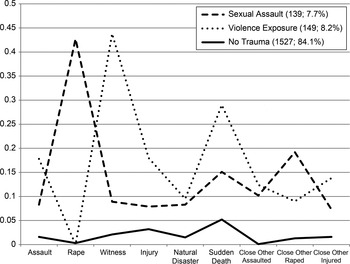
Upon endorsing a traumatic event, participants responded to follow-up questions regarding their age at each event, which time was the worst experience, and age of worst experience. We defined any traumatic events occurring prior to age 13 as childhood traumas, whereas traumas occurring after age 18 represented young adult traumas, regardless of whether they were considered to be the ‘worst experience’. Trauma exposure between ages 13 and 17 were not included in these analyses. Affirmative responses on these items in childhood and young adulthood during any assessment were combined to form the childhood and young adulthood trauma variables. Items with low base rates and similar content were combined to reduce model complexity (see caption of Fig. 1) into nine possible trauma exposure categories.
Item response probabilities for latent classes of trauma before the age of 13 years. Indicators for the classes were comprised of bundles of items given low response rates on multiple single items. Indicators included the following items: Assault – includes being captured/kidnapped, shot, stabbed, mugged or beaten up; Rape – includes rape or sexual assault; Witness – includes witnessing a death or discovering a dead body; Injury/Illness – includes motor vehicle accident, life-threatening illness, or other injury to self; Natural Disaster – includes experiencing a natural disaster; Sudden Death – includes experiencing the sudden death of a friend or family member; Close Other Assaulted – includes the physical attack of a family member or friend; Close Other Raped – includes rape or sexual assault of a family member or friend; Close Other Injured – includes motor vehicle accident, life-threatening illness or injury of a friend or family member.

Parent psychopathology and substance use
During the young adult assessments, participants were asked to recall characteristics of their primary caregivers during their childhood, including parental substance use and psychiatric disorders. These items were modeled after similar items to assess family history in the National Epidemiologic Survey on Alcohol and Related Conditions (NESARC; Grant et al. Reference Grant, Dawson, Stinson, Chou, Kay and Pickering2003). A ‘yes’ on any of four questions relating to parents (mother or father) having difficulties with drugs or alcohol was combined to form a dichotomous measure of parent substance use problems during childhood. Responses to three ‘yes/no’ questions about parents (mother or father) experiencing depression, mania, delusions or hallucinations, were combined to represent the presence of parental psychopathology during a participant's childhood.
Psychiatric and substance use disorder outcomes
Participants were assessed for PTSD, major depressive disorder (MDD), antisocial personality disorder (ASPD), and alcohol and drug use disorders according to diagnostic criteria stipulated in the DSM-IV, text revision (APA, 2000). All waves used a Composite International Diagnostic Interview (CIDI)-based instrument which was fully structured to allow administration by lay interviewers and scoring of diagnoses by computer. The CIDI-UM (Kessler et al. Reference Kessler, McGonagle, Zhao, Nelson, Hughes, Eshleman, Wittchen and Kendler1994) was used in the age 19 assessment and subsequent waves used the World Mental Health Composite International Diagnostic Interview, Version 2.1 (WHO WMH-CIDI) (Kessler et al. Reference Kessler, McGonagle, Zhao, Nelson, Hughes, Eshleman, Wittchen and Kendler1994; WHO, 1997), following procedures from the National Comorbidity Survey (Anthony, Reference Anthony1994). The CIDI has demonstrated acceptable validity when compared to independent clinical interview (Wittchen, Reference Wittchen1994; Andrews & Peters, Reference Andrews and Peters1998), as well as the PTSD module (Breslau et al. Reference Breslau, Kessler and Peterson1998b ). Only those who met criteria for the diagnosis with onset at age ⩾13 years during any of these assessments were indicated as having these diagnoses. Those who reported meeting criteria for the psychiatric diagnoses before the age 13 years were coded as missing data for these variables and were thus not included in evaluation of the outcomes. This procedure was used to maintain evaluation of the time ordered relationship between trauma exposure and psychopathology.
Suicide ideation and attempt
Questions regarding suicide attempt or ideation were asked as part of the MDD module in all of the assessment waves (additional detail in Supplementary material). In order to constrain temporality, only those who endorsed attempt or ideation at age ⩾13 years were coded as having had suicidal behavior. To account for suicidal behavior being a diagnostic criteria for MDD, a diagnosis of MDD at age ⩾13 years was operationalized without including the criteria regarding suicidal behavior.
Criminal convictions
Adult criminal records for participants were procured in 2004 from the adult prison database of Maryland Department of Corrections, when participants were 24–25 years old. Thus, these data reflect criminal convictions that occurred between the ages of 18–25 years for participants (additional detail in the Supplementary material). These data were stratified to represent violent, non-violent, and substance-related criminal convictions.
Health outcomes
The National Health and Nutrition Examination Survey III: Data Collection Forms (NHANES; National Center for Health Statistics, 1994) interviews have been developed for use in the ongoing National Center for Health Statistics studies. At the 29-year assessment, participants responded to items derived from the NHANES interview, which included ‘yes’/‘no’ screening items related to sexually transmitted infections (STIs), diabetes, stomach ache, headache, and hypertension. During this assessment, height and weight were measured by trained staff with a scale and tape measure, from which body mass index (BMI) was estimated (i.e. weight (lb)/[(height (in)2) × 703]). BMI was categorized above and below 30, the cut point for obesity (WHO, 1995).
Analysis
A LCA was conducted using Mplus version 7.11 (Muthén & Muthén, Reference Muthén and Muthén2013) to model childhood trauma experiences prior to age 13. An LCA is a person-oriented approach to identify distinct subgroups of individuals across a series of indicator variables. Analyses assumed that distinct groups exist based on the patterns of trauma exposures. Model fit and class viability were identified using comparison of goodness-of-fit indices and the distinctiveness of classes. Goodness-of-fit indices included the Bayesian Information Criterion (BIC), Vuong–Lo-Mendell–Rubin likelihood ratio test (VLMR-LRT; Lo et al. Reference Lo, Mendell and Rubin2001) and bootstrap likelihood ratio test (BLRT; McLachlan & Peel, Reference McLachlan and Peel2000). The auxiliary facility in Mplus was used to evaluate class differences according to overall and pairwise differences in the outcome across classes with posterior probabilities from multiple imputations (Muthén & Muthén, Reference Muthén and Muthén2013). The young adult outcomes included suicidal behavior, psychiatric diagnoses, and health outcomes occurring at age ⩾13 years, as well as criminal convictions and traumatic events during young adulthood. Due to the relationship between trauma and PTSD, PTSD symptom clusters were also included as potential outcomes. For more information on LCA, please refer to Collins & Lanza (Reference Collins and Lanza2009).
Covariates
Variables serving as covariates related to contextual, environmental characteristics and demographics and were included in the LCA models to identify the influence of concurrent childhood adversity experiences on trauma exposure. Contextual characteristics included intervention status (0 = control condition, 1 = Good Behavior Game or Mastery Learning), parental psychopathology, and parental substance use. Demographic controls included gender (0 = male, 1 = female), race/ethnicity (0 = European-American, 1 = African-American), and subsidized lunch status (0 = no, 1 = yes). Free and reduced meals status served as a proxy variable for low income.
Treatment of missing data
Missing data was managed with full information maximum likelihood (FIML) estimation. FIML produces parameter estimates that are less biased than other missing data strategies even when the data are not missing at random (Graham, Reference Graham2009).
Results
Class enumeration
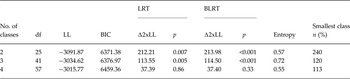
An LCA was estimated to identify typical patterns of trauma exposure during childhood in order to create latent classes. Results from comparing models indicated that three classes provided the best fit for the data (see Table 1). Although the BIC increased as additional classes were extracted, other fit indices supported the three class model. Three classes were the highest number of classes for which the LRT and BLRT remained significant. Moreover, the entropy was highest for the three class model. The posterior probabilities of class membership demonstrated adequate class separation (range 0.029–0.180) and homogeneity of class (range 0.770–0.994).
Class enumeration for latent class analyses

BIC, Bayesian Information Criterion; BLRT, bootstrapped likelihood-ratio test; df, degrees of freedom; LL, log likelihood; LRT, Lo-Mendell–Rubin likelihood ratio test.
The three classes corresponded to distinct and interpretable classes of trauma exposure before the age of 13 (see Fig. 1). The first class, the Low Childhood Trauma class (n = 1549, 85.2%), had low probabilities of trauma exposure. The second, Violence Exposure class (n = 149, 8.2%), displayed high rates of experiencing physical assault and physical injury, or witnessing physical assault, physical injury or death. The third, Sexual Assault class (n = 120, 6.6%), demonstrated the highest rates of rape and sexual assault, as well as having close friends or family also experiencing sexual assault.
Effect of control variables
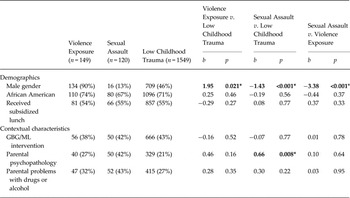
A strong gender effect emerged, where men were significantly more likely to belong to the Violence Exposure class, and women were more likely to be members of the Sexual Assault class (see Table 2). Only young adults belonging to the Sexual Assault classes were significantly more likely to have had a caregiver with psychopathology during childhood (p < 0.01) than the Low Childhood Trauma class. No other control variables were significantly different among classes.
Covariates of latent class membership

GBG/ML, Good Behavior Game/Mastery Learning intervention; statistically significant parameter estimates are given in bold.
* p < 0.05; statistically significant parameter estimates are notated in bold text.
Effect of trauma class membership on young adult outcomes
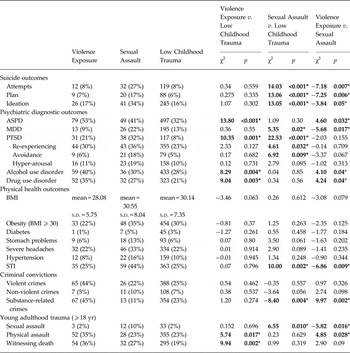
The childhood trauma classes displayed many differences across young adult outcomes (see Table 3). The Sexual Assault class, but not the Violence Exposure class, had significantly higher rates of both suicide attempt, having an attempt plan, and ideation than the Low Childhood Trauma class. Those in both the Violence Exposure and Sexual Assault classes were significantly more likely to have a PTSD diagnosis than the Low Childhood Trauma class. By diagnostic symptom clusters of PTSD, only the Sexual Assault class demonstrated significantly higher likelihood of re-experiencing and avoidance symptoms than the Low Childhood Trauma class. The Sexual Assault class also had higher rates of MDD than the other two classes, whereas the Violence Exposure class had higher rates of ASPD as well as alcohol and drug use disorders than the other two classes. The Violence Exposure class was significantly more likely than the other two classes to have convictions for violent, non-violent and substance-related crimes. The Sexual Assault class was significantly less likely to experience substance-related crimes compared to both classes.
Outcomes of latent class membership of child trauma experiences

ASPD, Antisocial personality disorder; MDD, major depressive disorder; PTSD, post-traumatic stress disorder; BMI, body mass index; STI, sexually transmitted infection.
Suicidal behavior and psychiatric diagnoses reflect onset from the age of ⩾13 years; criminal convictions and young adult trauma reflect experiences from the age of ⩾18 years.
* p < 0.05; statistically significant parameter estimates are given in bold.
Childhood trauma classes were strong predictors of young adult trauma experiences. The Sexual Assault class had significantly higher odds of experiencing sexual assault during young adulthood than the other classes. Similarly, the Violence Exposure class had significantly higher odds of being physically assaulted during young adulthood than the other two classes. The Violence Exposure class also had a higher likelihood of witnessing death than the Low Childhood Trauma class. Finally, only one of the physical health outcomes was significantly different among the classes. The Sexual Assault class was significantly more likely to disclose having had a STI than the other two classes.
Gender effect of outcomes
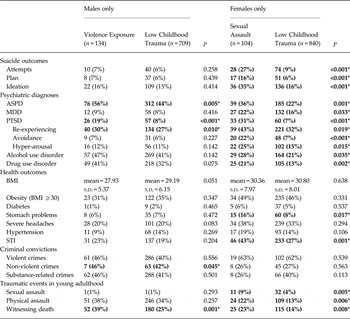
Given the strong effect of gender on child trauma class membership, we conducted follow-up analyses on gender differences in young adult outcomes. We conducted gender-specific χ2 tests comparing the Violence Exposure class to the Low Childhood Trauma class among men and among women compared the Sexual Assault class to the Low Childhood Trauma class. We found marked differences in outcomes (see Table 4). The women in the sexual trauma class were significantly more likely to have experienced suicide attempt and ideation, all psychiatric diagnoses, stomach problems, and to have had a STI than women in the Low Childhood Trauma class. Men in the Violence Exposure class were more likely to experience ASPD and PTSD and to have had a non-violent criminal conviction, but did not show significant differences in other psychiatric outcomes including suicidal behavior, health outcomes, or other criminal convictions from men in the Low Childhood Trauma class. Men in the Violence Exposure class were more likely than men in the Low Childhood Trauma class to have witnessed another person's death and women in the Sexual Assault class were more likely than women in the Low Childhood Trauma class to experience all young adult traumatic events.
Gender effects of outcomes of latent classes of child trauma experiences
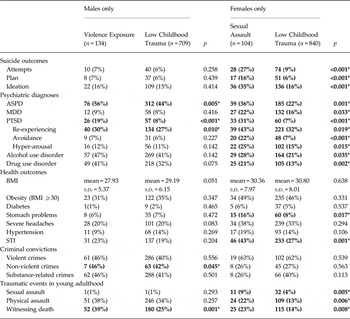
ASPD, Antisocial personality disorder; MDD, major depressive disorder; PTSD, post-traumatic stress disorder; BMI, body mass index; STI, sexually transmitted infection.
Suicidal behavior and psychiatric diagnoses reflect onset from the age of ⩾13 years; criminal convictions and young adult trauma reflect experiences from the age of ⩾18 years.
* p < 0.05; statistically significant parameter estimates are given in bold.
There were too few women in the Violence Exposure class and men in the Sexual Assault class to report any additional analyses beyond descriptive results (Additional detail in the Supplementary material).
Discussion
Three latent classes of childhood traumatic experiences before the age of 13 years emerged from an analysis of a community-based sample from an urban environment. The first group, which accounted for the majority (84%) of the sample reported low levels of all traumatic experiences. The second class comprised 8% of the sample, was predominately male, reported the highest levels of witnessing violence, physical assault, physical injury and the sudden death of a close friend or family member. The third group comprised 8% of the sample, which was predominately female, reported the highest levels of sexual assault for themselves and knowing someone who had been sexually assaulted. The second and third classes had different profiles of psychiatric diagnoses occurring at age ⩾13 years as well as the same types of trauma exposures in young adulthood. Distinct patterns of outcomes emerged when analyses were stratified by gender; women in the Sexual Assault group reported a wide range of negative psychiatric outcomes, while men in the violence exposure class reported a pattern of outcomes limited to post-traumatic stress and antisocial personality.
The creation of these latent classes suggests clustering of types of traumatic experiences (physical v. sexual assault) by gender. Differences in exposure to traumatic experiences by gender has been reflected in the Youth Risk Behavior Survey (YRBS), in which 10% of female and 4% of male high-school students report that they have been forced to have sexual intercourse (CDC, 2015), as well as the ACE study in which 25% of the women and 16% of the men reported sexual abuse in childhood (CDC, 2014). Similarly, an analysis of the Detroit Area Survey of Trauma found that lifetime exposure to assaultive trauma and witnessing a death were more likely in men than women (43% v. 32% for assaultive violence; 40% v. 19% for witnessing death or violence) (Breslau et al. Reference Breslau, Kessler, Chilcoat, Schultz, Davis and Andreski1998a ). This analysis further extends this literature to suggest that these gender differences in trauma exposure begin before the age of 13 years and reinforces the importance of gender as a critical construct in trauma research.
The relationship of parental psychopathology to the Sexual Assault class highlights the significance of familial environment and possible genetic effects on the association between childhood trauma and psychiatric diagnosis. On one hand, there is a robust literature linking parental psychopathology with abuse exposure in offspring (Chaffin et al. Reference Chaffin, Kelleher and Hollenberg1996; Walsh et al. Reference Walsh, MacMillan and Jamieson2002) with some analyses proposing that childhood abuse may, in part, mediate the intergenerational transmission between parent and child diagnoses (Verona & Sachs-Ericsson, Reference Verona and Sachs-Ericsson2005). On the other hand, recent evaluations have found interactions between genetic polymorphisms and trauma exposure to predict the development of PTSD (Liberzon et al. Reference Liberzon, King, Ressler, Almli, Zhang, Ma, Cohen, Tamburrino, Calabrese and Galea2014), which may similarly underlie the relationship between family psychopathology, trauma and offspring diagnoses. Analyses of adoptees have suggested a combination of both biological parental history with adoptive parental experiences lead to increased risk of outcomes such as offspring hospitalization due to suicide attempt (Wilcox et al. Reference Wilcox, Kuramoto, Brent and Runeson2012), highlighting the importance of potential interactions between genetics and familial environment. Further analyses can investigate potential genetic effects, whether through single polymorphisms or more general polygenetic risk scores, to evaluate the relationship between childhood traumatic experiences and later psychiatric diagnoses. Similarly, important familial factors which may have an impact on exposure to traumatic experience and may be related to parental psychopathology, such as parental physical or psychiatric impairment, stress, neglect or decreased monitoring of child behavior, can also be investigated using these latent classes.
Psychiatric outcomes associated with class membership underscore that specific early traumatic experiences are associated with distinct consequences, including, but not limited to PTSD. The women in the Sexual Assault class were more likely to experience global impairment in terms of increased suicidal thoughts and behaviors as well as increased incidence of almost all of the examined psychiatric diagnoses, when compared to the women in the low trauma class. Men in the Violence Exposure class had more circumscribed effects, with increased rates of ASPD and PTSD compared to men in the low trauma class. Results suggest that patterns of childhood traumatic experiences may be associated with specific transdiagnostic vulnerabilities (Teicher & Samson, Reference Teicher and Samson2013), which may be related to potential epigenetic changes as well as neurobiological pathways such as reduced hippocampal volume or amygdala reactivity. Further investigation of potential epigenetic or neurobiological differences between the three classes may highlight distinct neurodevelopmental pathways to psychiatric outcomes.
Out of the other negative outcomes included in this model, only STIs and traumatic events in young adulthood were consistently associated with class membership. STIs were closely associated with the Sexual Assault class; it is not known whether these infections were transmitted as a result of the assaults in childhood or in young adulthood or related to other sexual behavior. With the exception of stomach problems, which have been associated with stress and anxiety (Means-Christensen et al. Reference Means-Christensen, Roy-Byrne, Sherbourne, Craske and Stein2008), none of the other lifetime health outcomes were associated with class membership. Only non-violent criminal convictions were associated with Violence Exposure class when analyses were stratified by gender, suggesting that the association between childhood trauma and outcomes such as alcohol and drug use disorders or ASPD did not extend to legal repercussions. Class membership was associated with traumatic experiences in young adulthood, particularly for the Sexual Assault class, in which young adult women were more likely to experience sexual assault, physical assault and witness death. These results replicate previous work in this area (Acierno et al. Reference Acierno, Resnick, Kilpatrick, Saunders and Best1999) and highlight the importance of early intervention for survivors of child trauma. As data collection ended at age 29 years, it is not known how these traumatic experiences in young adulthood then impacted further experiences in middle adulthood and beyond.
Several characteristics of the study limit the findings. First, traumatic experiences reported in young adulthood may have been subject to reporting biases, particularly by gender. Although we may not have captured all possible trauma events given this methodological approach, research suggests that the false positive disclosures of trauma are unlikely (Hardt & Rutter, Reference Hardt and Rutter2004). Additionally, the perpetrator of the trauma was not recorded; therefore, it is not known whether the traumatic exposure was instigated by someone in the family or in the larger community. Second, the order of onset among multiple psychiatric outcomes was not evaluated. For example, it is possible that individuals developed PTSD, which put them at risk for other psychiatric outcomes, such as suicide attempts (Wilcox et al. Reference Wilcox, Storr and Breslau2009). Third, physical health outcomes and parental psychopathology and substance abuse were not confirmed by clinician or medical record diagnosis. Reported family history of psychiatric diagnoses is limited, but may be more reliable for diagnoses such as depression, schizophrenia or substance abuse (Hardt & Franke, Reference Hardt and Franke2007). Fourth, the sample size did not permit further regression models of the impact on gender on psychopathology; there were too few women in the Violence Exposure class and too few men in the Sexual Assault class to investigate possible interactions. Further investigations of the role of gender on both reporting trauma as well as the development of negative psychiatric outcomes after traumatic experiences, is indicated. Fifth, endorsement of many traumatic experiences was quite low, which may have taxed the computation involved in estimating the LCA. Finally, it is possible that the combination of trauma exposure in childhood and young adulthood may have led to adverse psychiatric outcomes by age 30. It is also possible that a traumatic experience occurring after childhood could have been considered a ‘worse’ experience and more directly led to the psychiatric outcomes. Further analysis using these classes of childhood trauma exposure with the addition of adolescent and young adult trauma exposure is indicated to determine the effect of cumulative trauma.
Conclusions
Latent classes of childhood traumatic experiences before the age of 13 years were computed and studied using an urban community sample followed from childhood to age 29 years. Assaultive traumatic experiences in childhood, both sexual and non-sexual, were found to predict negative psychiatric outcomes by young adulthood, including re- traumatization. Childhood sexual abuse in our sample predicted more global impairment in women, whereas violence exposure in men predicted more limited outcomes. In our sample, we identified unique developmental pathways by type of childhood trauma exposure to young adult negative psychiatric and behavioral outcomes.
Supplementary material
For supplementary material accompanying this paper visit http://dx.doi.org/10.1017/S0033291715001300.
Acknowledgements
This work was supported by several National Institute of Health grants over the span of the prospective study: National Institute of Mental Health (MH090480, MH71395, MH 71395, MH 48802) and National Institute on Drug Abuse (DA09897, DA04392, and DA019805).
Declaration of Interest
None.