


Statement of Research Significance
Research Question(s) or Topic(s): This study examines whether the temporal predictability of sensory input can improve inhibitory control in adults with attention deficit hyperactivity disorder. Specifically, we evaluate whether knowing exactly when an event will occur helps individuals with attention deficit hyperactivity disorder make fewer impulsive errors, in favor of correct responses. Main Findings: We found that while the temporal predictability of an event initially increased the urge to respond quickly in all participants, it actually helped adults with attention deficit hyperactivity disorder to better suppress their impulsive errors over time. This effect was strongest in individuals who struggled the most with maintaining their focus of attention, but was less effective for those who were highly impulsive. Study Contributions: This research shows that the temporal predictability of sensory input enhances inhibitory control in adults with attention deficit hyperactivity disorder. Incorporating clear temporal cues into clinical settings and daily routines may help improve behavioral regulation in these individuals.
Introduction
Impulsivity is widely recognized as a core feature of attention-deficit/hyperactivity disorder (ADHD) (American Psychiatric Association, 2022; Barkley, Reference Barkley1997) and often persists into adulthood (Song et al., Reference Song, Zha, Yang, Zhang, Li and Rudan2021). Adults with ADHD frequently report difficulties waiting their turn in conversation, interrupting others before they have finished speaking, or responding prematurely before fully evaluating consequences. Such behaviors not only suggest impairments with inhibitory control, but also instability in the temporal regulation of action.
Indeed, timing difficulties are considered a central component of ADHD (Noreika et al., Reference Noreika, Falter and Rubia2013), with most research documenting deficits in explicit timing (e.g., estimation, discrimination, or reproduction of temporal intervals; Mette, Reference Mette2023; Zheng et al., Reference Zheng, Wang, Chiu and Shum2022). By contrast, far less attention has been paid to implicit timing, such as temporal prediction, which relies on sensorimotor information to anticipate event timing (Nobre & van Ede, Reference Nobre and van Ede2018). Unlike explicit timing – which involves deliberately evaluating a discrete interval against an internal standard – temporal prediction operates without overt duration judgments, and instead supports proactive preparation for action. Anticipating event timing improves attentional resource allocation, leading to faster responses (Correa et al., Reference Correa, Lupiáñez and Tudela2006; Coull & Nobre, Reference Coull and Nobre1998) and higher accuracy (Correa et al., Reference Correa, Lupiáñez and Tudela2005; Davranche et al., Reference Davranche, Nazarian, Vidal and Coull2011; Visser, Reference Visser2014). However, evidence from clinical populations remains inconsistent. Specifically, some studies suggest ADHD-related difficulties in using temporal predictability to optimize behavior, indicating altered timing mechanisms and less efficient use of temporal information (Dankner et al., Reference Dankner, Shalev, Carrasco and Yuval-Greenberg2017; Durston et al., Reference Durston, Davidson, Mulder, Spicer, Galvan, Tottenham, Scheres, Xavier Castellanos, Van Engeland and Casey2007; van Hulst et al., Reference van Hulst, de Zeeuw, Rijks, Neggers and Durston2017), while others suggest that temporal prediction may be at least partly preserved. For example, using a variable foreperiod (FP) paradigm, Vallesi et al. (Reference Vallesi, D’Agati, Grelloni, Pasini, Mazzotta and Curatolo2016) showed that children with ADHD, like controls, benefited from longer temporal intervals, reflecting intact updating of temporal expectations over time.
Predicting when an event will occur can facilitate sensorimotor processing, but may also impair performance in response conflict tasks by increasing impulsive errors, a pattern observed in healthy adults (Correa et al., Reference Correa, Cappucci, Nobre and Lupiáñez2010; Korolczuk et al., Reference Korolczuk, Burle and Coull2018), typically developing children (Korolczuk et al., Reference Korolczuk, Burle, Senderecka and Coull2025b), and in children with ADHD (Korolczuk et al., Reference Korolczuk, Burle, Casini, Gerc, Lustyk, Senderecka and Coull2025a). However, the effects of temporal structure on action control in ADHD may be more nuanced. When provided with longer preparatory intervals, children with ADHD actually showed improved inhibitory control (Korolczuk et al., Reference Korolczuk, Burle, Casini, Gerc, Lustyk, Senderecka and Coull2025a). Similarly, Thibeault et al. (Reference Thibeault, Lemay, Chouinard, Lespérance, Rouleau and Richer2016) reported that children with comorbid ADHD and Tourette’s syndrome used temporal predictability to speed responses, while successfully keeping their impulses in check. Thus, temporal information may, under certain conditions, compensate for regulatory difficulties in ADHD rather than exacerbate them.
Despite these promising findings regarding the role of temporal predictability in modulating response inhibition, the current evidence remains limited and primarily from studies in children (Korolczuk et al., Reference Korolczuk, Burle, Casini, Gerc, Lustyk, Senderecka and Coull2025a; Thibeault et al., Reference Thibeault, Lemay, Chouinard, Lespérance, Rouleau and Richer2016). It therefore remains unclear whether adults with ADHD can use temporal information to regulate impulsive behavior. The present study examines how temporal predictability affects impulse control in ADHD using a modified Simon task (Simon, Reference Simon1969). In this task, participants respond to non-spatial target features requiring left-or right-hand responses, while target location is either spatially compatible or incompatible with the required response hand. When stimulus location corresponds to the instructed response hand (compatible trials), performance typically benefits from automatic response activation; when it does not (incompatible trials), this automatic tendency must be overridden. The Simon compatibility effect reflects the mean performance difference between incompatible and compatible trials, with slower and less accurate responses in incompatible trials.
However, focusing on mean performance measures provides only limited insight into the mechanisms underlying the compatibility effect as they unfold over time. To capture the dynamics of impulse control, RT distributional analyses can be employed, an approach widely used in adults (Ridderinkhof et al., Reference Ridderinkhof, Forstmann, Wylie, Burle and van den Wildenberg2011), children (Ambrosi et al., Reference Ambrosi, Servant, Blaye and Burle2019, Reference Ambrosi, Śmigasiewicz, Burle and Blaye2020), and clinical populations (Fluchère et al., Reference Fluchère, Burle, Vidal, van den Wildenberg, Witjas, Eusebio, Azulay and Hasbroucq2018; Grandjean et al., Reference Grandjean, Suarez, Diaz, Spieser, Burle, Blaye and Casini2021; Suarez et al., Reference Suarez, Burle, Tobon, Pineda, Lopera, Hasbroucq and Casini2015). This approach dissociates two functionally distinct components of impulse control: early automatic activation of impulsive response tendencies and the later engagement of inhibitory control. The initial component reflects a rapid tendency to respond to salient but distracting stimulus features, such as target location. In our task, this manifests as automatic activation of the response hand corresponding to stimulus side, even when the instructed response requires the opposite hand. Conditional Accuracy Functions (CAF) capture this process by plotting accuracy as a function of response time (RT), thereby quantifying fast errors arising from premature response activation. In the Simon task, CAFs typically show reduced accuracy for the fastest responses in incompatible trials, indicating that early, stimulus-driven activation increases the likelihood of impulsive errors (Ridderinkhof et al., Reference Ridderinkhof, Forstmann, Wylie, Burle and van den Wildenberg2011). In contrast, inhibitory control develops more gradually and is most apparent in slower responses. With longer RTs, participants have greater opportunity to suppress the impulse and implement the instructed response. Delta plots capture how selective inhibition evolves over time by showing how the Simon effect magnitude changes across the RT distribution. A stronger reduction of interference at longer latencies (more negative slope) indicates more efficient inhibition of initially activated impulses (Ridderinkhof, Reference Ridderinkhof, Prinz and Hommel2002). Here, we combined these complementary analyses to separate effects of temporal predictability on early response activation and subsequent inhibitory control.
Based on prior evidence (e.g., Menceloglu et al., Reference Menceloglu, Suzuki and Song2021), we hypothesized that temporal predictability would increase prepotent response activation in both the healthy and ADHD groups. This would be reflected in shorter RTs to compatible targets, alongside increased fast impulsive errors to incompatible targets following temporal cueing, as revealed by CAF analyses. Given elevated impulsivity in ADHD, we expected temporal cueing to exacerbate fast, impulsive errors more in this group than in controls. For selective inhibition, however, we formulated a different prediction. Consistent with recent findings in children with ADHD (Korolczuk et al., Reference Korolczuk, Burle, Casini, Gerc, Lustyk, Senderecka and Coull2025a), we hypothesized that temporal predictability might enhance later inhibitory processing in adults with ADHD. If temporal structure is compensatory in ADHD, it should produce a steeper reduction of the compatibility effect in cued versus neutral trials across the RT distribution (more negative delta plots), indicating more efficient suppression of impulsively activated responses.
Method
Participants
This study was conducted in accordance with the Helsinki Declaration. Ethics approval was obtained from the Komisja Bioetyczna przy Uniwersytecie Medycznym w Lublinie (Approval No: KB-0024/60/04/2025). Forty-one participants provided informed consent (ADHD: n = 19, mean age = 22.6, SD = 2.32, 10 males; controls: n = 22, mean age = 22.2, SD = 2.07, 4 males). Sample size was based on prior ADHD studies of temporal predictability and inhibitory control, including work using distributional analyses in conflict tasks (Dankner et al., Reference Dankner, Shalev, Carrasco and Yuval-Greenberg2017; Grandjean et al., Reference Grandjean, Suarez, Diaz, Spieser, Burle, Blaye and Casini2021; Korolczuk et al., Reference Korolczuk, Burle, Casini, Gerc, Lustyk, Senderecka and Coull2025a; Ridderinkhof et al., Reference Ridderinkhof, Scheres, Oosterlaan and Sergeant2005; Suarez et al., Reference Suarez, Burle, Tobon, Pineda, Lopera, Hasbroucq and Casini2015; Thibeault et al., Reference Thibeault, Lemay, Chouinard, Lespérance, Rouleau and Richer2016; Vallesi et al., Reference Vallesi, D’Agati, Grelloni, Pasini, Mazzotta and Curatolo2016). A sensitivity analysis conducted in G*Power 3.1 (Faul et al., Reference Faul, Erdfelder, Lang and Buchner2007) was used to estimate the minimum detectable effect size for the main interactions in the mixed analysis of variance (ANOVA). The analysis used the F-test family, repeated-measures ANOVA, within–between interaction option, with two groups, four repeated measurements corresponding to the Cue × Compatibility conditions, α = .05, power = .80, an assumed correlation among repeated measures of.50, and nonsphericity correction ϵ = 1. This indicated that the sample (N = 41) was sufficient to detect medium-to-large interaction effects (f ≈ 0.25, α = .05).
Participants in the ADHD group had a prior diagnosis according to the Diagnostic and Statistical Manual of Mental Disorders, Fifth Edition (DSM-5), confirmed by a licensed psychologist and psychiatrist and reported no other neurological disorders. Controls reported no history of ADHD or other neurological/psychiatric disorders. All participants had normal or corrected-to-normal vision. Of the ADHD group, nine were unmedicated, and ten were taking methylphenidate. To explore potential effects of medication, additional exploratory analyses were conducted within the ADHD group, comparing participants taking methylphenidate with those who were unmedicated. Given the limited sample size, these analyses were preliminary.
Experimental task
Participants performed a temporally cued Simon task (Korolczuk et al., Reference Korolczuk, Burle and Coull2018) programmed in PsychoPy (Peirce, Reference Peirce2007; Peirce et al., Reference Peirce, Gray, Simpson, MacAskill, Höchenberger, Sogo, Kastman and Lindeløv2019; Figure 1). Stimuli were presented on a white background with a central cue consisting of two concentric circles (∼1° visual angle). Targets (“+” or “×”; ∼1°) appeared to the left or right of the cue (∼3.6°).
Trial timeline of the temporally cued Simon task. Each trial began with the presentation of a cue (500 ms) indicating either a short (600 ms) or long (1400 ms) foreperiod (FP) in the temporal cue condition, or providing no temporal information in the neutral cue condition. Following the FP, a target stimulus (“+” or “×”) appeared for 200 ms, either to the left or right of fixation. Participants responded according to the shape of the target while ignoring its spatial location, resulting in compatible trials (target location matching the response hand) and incompatible trials (target location opposite to the response hand). The background display was visible during the response window, followed by a variable inter-trial interval (1900–2400 ms).

Two conditions were presented in separate blocks: temporal and neutral cueing. In the temporal condition, the cue indicated target timing, with inner-circle brightening signaling a short FP (600 ms) and outer-circle brightening a long one (1400 ms); all cues were valid. In the neutral condition, both circles brightened simultaneously, providing no temporal information.
Participants responded as quickly and accurately as possible based on target shape. Target location was irrelevant but either matched the response hand (compatible) or was opposite (incompatible). Response mappings were counterbalanced: for half, “+” required a left-index response (“lctrl”) and “×” a right-index response (“>”), with the mapping reversed for the remainder.
Each trial began with a 500 ms cue (temporal or neutral), followed by a 600 or 1400 ms FP with the background display on screen. The target then appeared for 200 ms, followed by the background until a response was made. The inter-trial interval varied randomly between 1900 and 2400 ms (100 ms steps).
The experiment comprised two blocks (temporal, neutral) of 120 trials each (240 total). Trials were evenly distributed across FP (600, 1400 ms) and compatibility (compatible, incompatible), yielding 30 trials per condition in random order. Short breaks were provided every 30 trials.
Before the experiment, participants completed 72 familiarization trials. Initial training included short blocks of temporal (short, long, mixed) and neutral trials with auditory feedback (high/low tones for correct/incorrect). Feedback was then removed, and participants completed additional mixed temporal and neutral trials.
Data analysis
RTs were analyzed without trimming or excluding extreme values to preserve intra-individual variability, a hallmark of ADHD (Castellanos et al., Reference Castellanos, Sonuga-Barke, Scheres, Di Martino, Hyde and Walters2005; Kofler et al., Reference Kofler, Rapport, Sarver, Raiker, Orban, Friedman and Kolomeyer2013). This is also essential for CAF and delta plot analyses, which rely on the full RT distribution.
To examine temporal predictability effects on response speed, correct-trial RTs were analyzed using a mixed-design ANOVA with group (ADHD, control) as a between-subject factor and cue (temporal, neutral), FP (short, long), and compatibility (compatible, incompatible) as within-subject factors. Error rates were analyzed using the same design after arcsine square-root transformation.
To characterize impulsive responding dynamics, Conditional Accuracy Functions (CAF) were computed by plotting accuracy across RT quintiles using vincentization (De Jong et al., Reference De Jong, Liang and Lauber1994; Ratcliff, Reference Ratcliff1979; Vincent, Reference Vincent1912). For each participant and condition, correct and incorrect RTs were ranked from fastest to slowest and divided into five equal-sized bins (quintiles). Accuracy was then computed for each quintile and used as the dependent variable. These values were analyzed using a mixed ANOVA with group (ADHD, control) as a between-subject factor and cue, FP, compatibility, and quintile (1–5) as within-subject factors.
To assess the effects of temporal predictability on the dynamics of inhibitory control, delta plots were computed, showing the compatibility effect (incompatible – compatible RT) across RT quintiles (incompatible – compatible RT) across RT distribution segments (Ridderinkhof, Reference Ridderinkhof, Prinz and Hommel2002). Using vincentised correct-trial RTs, compatibility effects were computed for each quintile, participant, and temporal condition (Cue × Foreperiod). These values were analyzed using the same mixed ANOVA as for the CAF.
In addition to omnibus ANOVAs, planned comparisons tested a priori temporal cueing effects within each compatibility condition. This approach was applied across RT, CAF, and delta plot analyses, based on previous findings (Korolczuk et al., Reference Korolczuk, Burle and Coull2018, Reference Korolczuk, Burle, Coull and Smigasiewicz2020; Korolczuk et al., Reference Korolczuk, Burle, Senderecka and Coull2025b).
Questionnaire
ADHD symptoms were assessed using the Polish version of the Adult ADHD Self-Report Scale (Buźniak et al., Reference Buźniak, Woropay-Hordziejewicz, Bereznowska and Atroszko2022; Kessler et al., Reference Kessler, Adler, Ames, Demler, Faraone, Hiripi, Howes, Jin, Secnik, Spencer, Ustun and Walters2005), an 18-item questionnaire, based on DSM criteria rated on a 5-point scale (1 = “not at all“; 5 = “to a large extent”). The ADHD group reported significantly more symptoms (M = 50.2, SD = 9.2) than the control group (M = 30.1, SD = 10.3), t(39) = 6.56, p <.001, d = 2.05.
Independent assessment of sustained attention and impulsivity (CPT-3)
Although continuous performance tests (e.g., Conners CPT 3) are widely used in ADHD assessment, mean performance has limited discriminative value in adults (Arrondo et al., Reference Arrondo, Mulraney, Iturmendi-Sabater, Musullulu, Gambra, Niculcea, Banaschewski, Simonoff, Döpfner, Hinshaw, Coghill and Cortese2024). However, CPT indices remain useful as dimensional markers: RT variability reflects attentional instability (Castellanos et al., Reference Castellanos, Sonuga-Barke, Scheres, Di Martino, Hyde and Walters2005; Kofler et al., Reference Kofler, Rapport, Sarver, Raiker, Orban, Friedman and Kolomeyer2013), and commission errors index inhibitory control failures (Barkley, Reference Barkley1997; Lipszyc & Schachar, Reference Lipszyc and Schachar2010). Accordingly, CPT measures were used here as individual-difference variables to examine how they modulate temporal predictability effects on impulse control.
Participants completed the Conners Continuous Performance Test 3 (CPT 3), a ∼15-min Go/No-go task (360 trials; 20% non-targets) requiring responses to all letters except “X.” To characterize individual differences, we extracted indices of attentional stability and action control: RT variability (Hit RT SD), commission errors, anticipations (<100 ms), omissions, and detectability (d′).
To test whether attentional differences modulated temporal predictability effects, CPT indices were included as continuous predictors in linear mixed-effects RT models with cue, FP, compatibility, and group as fixed effects (and their interactions with CPT indices), and random intercepts for participants. Follow-up analyses used simple effects based on estimated marginal means.
Results
Response times
A significant compatibility main effect on RT was observed, F(1, 39) = 17.58, p <.001, ηp 2 = .31, indicating slower responses to incompatible than compatible targets in both groups. A cue main effect (F(1, 39) = 4.36, p =.043, ηp 2 =.10) reflected faster responses following temporal versus neutral cues. Crucially, a significant Group × Cue × Compatibility interaction qualified these effects, F(1, 39) = 4.51, p =.040, ηp 2 =.10, 95% CI [.00,.30]. Planned comparisons analyses revealed distinct patterns across groups (Figure 2). Replicating previous findings in adults (Korolczuk et al., Reference Korolczuk, Burle and Coull2018), control participants showed a temporal cueing benefit for compatible targets (p =.018) but not for incompatible targets (p = .933). Conversely, in the ADHD group, temporal cueing tended to speed responses to incompatible targets (p =.089), but not for compatible targets (p =.276). No group main effect was found, F(1, 39) = 0.13, p =.724, and the Group × Compatibility interaction was not significant, F(1, 39) = 0.01, p =.928.
Temporal cueing speeded response times to compatible, but not incompatible, targets in the control group. In contrast, in the attention-deficit/hyperactivity disorder (ADHD) group, temporal cues showed a tendency to speed responses to incompatible rather than compatible targets. Error bars reflect standard errors.

Error rates
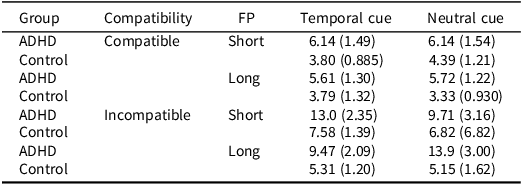
Table 1 shows mean accuracy. Error rates revealed a main effect of compatibility, F(1, 39) = 20.63, p <.001, ηp 2 =.34, with more errors to incompatible than compatible targets, and a main effect of group, (F)(1, 39) = 4.12, p =.049, ηp 2 =.10, with higher error rates in ADHD. No other effects were significant.
Mean error rates (%) with standard errors

Table 1. Long description
The table presents mean error rates with standard errors for different groups and conditions. It has four rows and three columns. The columns are labeled Compatibility, FP, Temporal cue, and Neutral cue. The rows are labeled ADHD and Control, with sub-rows for Compatible and Incompatible conditions, and further sub-rows for Short and Long FP. Row 1: ADHD, Compatible, Short, 6.14 (1.49), 6.14 (1.54). Row 2: Control, Compatible, Short, 3.80 (0.885), 4.39 (1.21). Row 3: ADHD, Compatible, Long, 5.61 (1.30), 5.72 (1.22). Row 4: Control, Compatible, Long, 3.79 (1.32), 3.33 (0.930). Row 5: ADHD, Incompatible, Short, 13.0 (2.35), 9.71 (3.16). Row 6: Control, Incompatible, Short, 7.58 (1.39), 6.82 (6.82). Row 7: ADHD, Incompatible, Long, 9.47 (2.09), 13.9 (3.00). Row 8: Control, Incompatible, Long, 5.31 (1.20), 5.15 (1.62).
Note: ADHD = attention-deficit/hyperactivity disorder; FP = foreperiod.
Early activation of impulsive responses (CAF)
To examine how temporal predictability affected the activation of fast impulsive errors, CAFs were computed, plotting accuracy as a function of RT (Figure 3). The analysis revealed significant main effects of compatibility, F(1, 39) = 18.63, p <.001, ηp 2 =.32, and quintile, F(4, 156) = 44.74, p <.001, ηp 2 =.53. Overall, responses were less accurate to incompatible targets than to compatible ones, and accuracy varied across the RT distribution. As expected, a significant Compatibility × Quintile interaction qualified these effects, F(4, 156) = 39.90, p <.001, ηp 2 =.51. Specifically, accuracy for incompatible targets was markedly reduced in the first RT quintile and increased progressively for slower responses, reflecting the transient expression of fast impulsive errors under situations of response conflict (Ridderinkhof, Reference Ridderinkhof, Prinz and Hommel2002). A group main effect (F(1, 39) = 4.12, p =.049) showed overall lower accuracy in ADHD versus controls. However, neither the Group × Quintile interaction, F(4, 156) = 1.75, p =.143, nor the Group × Compatibility × Quintile interaction, F(4, 156) = 1.02, p =.397, reached significance, suggesting similar temporal profiles of impulsive errors across groups.
Conditional Accuracy Functions (CAF) depicting accuracy as a function of response time. Adults with attention-deficit/hyperactivity disorder (ADHD) showed overall lower accuracy than controls. Temporal cueing increased error rates for the fastest responses, indicating stronger early activation of incorrect responses, similarly in both groups.

Importantly, temporal cues modulated the expression of impulsive errors across the RT distribution (Cue × Compatibility × Quintile interaction, F(4, 156) = 2.84, p =.026, ηp 2 =.07, 95% CI [.00,.14]). Planned comparisons showed that temporal cueing increased fast errors to incompatible targets only in the earliest RT quintile (p =.038), demonstrating again stronger early activation of prepotent responses triggered by temporal predictability. However, the Group × Cue × Compatibility × Quintile interaction was not significant, F(4, 156) = 0.88, p =.478, indicating similar effects of temporal cueing on fast impulsive errors across groups.
Finally, a significant Cue × FP × Compatibility interaction was found, F(1, 39) = 7.71, p =.008, ηp 2 =.17, 95% CI [.01,.37]. Planned comparisons indicated that the increase in errors for incompatible targets in temporally cued trials was particularly pronounced at the short FP (p =.006), replicating previous finding that the effects of temporal cues tend to be strongest at shorter preparatory intervals (Coull et al., Reference Coull, Frith, Büchel and Nobre2000). No other effect was significant.
Selective inhibition of impulsive responses (delta plots)
To examine temporal cueing effects on compatibility dynamics, we used delta plots indexing the compatibility effect (incompatible – compatible RT) across RT segments (Figure 4). In the Simon task, this effect typically decreases with increasing RT, reflected in negative-going slopes that index efficient inhibitory control.
Delta plots illustrating the compatibility effect (incompatible − compatible) across the response time (RT) distribution, providing an index of the dynamics of selective response inhibition. Changes in the slope of the function at longer RTs are typically interpreted as reflecting the efficiency of late inhibitory processes, with decreasing or negative slopes indicating more effective suppression of prepotent responses as a function of time. Left panel (matched controls): In the neutral cue condition, the compatibility effect decreased at longer RTs, consistent with efficient engagement of inhibitory control mechanisms. However, when temporal cues were present, this reduction was less pronounced, and the compatibility effect remained relatively elevated during the slowest responses, suggesting that temporal predictability disrupted the late-stage implementation of inhibition in this group. Right panel (ADHD): A different pattern was observed in the attention-deficit/hyperactivity disorder (ADHD) group. In the neutral condition, the compatibility effect increased at the slow end of the RT distribution, indicating inefficient inhibitory control. In contrast, under temporal cueing, the compatibility effect decreased for slower responses, reflecting a relative improvement in inhibitory processing when temporal information was available.

Analysis revealed a Group × Cue interaction, F(1, 39) = 4.51, p =.040, ηp 2 =.10, qualified by a Group × Cue × Quintile interaction, F(4, 156) = 3.08, p =.018, ηp 2 =.07, 95% CI [.00,.15]. Planned comparisons showed that in controls the typical negative slope was present under neutral cues but absent with temporal cues (p =.012; Figure 4A), suggesting that temporal predictability reduced the efficiency of inhibitory control in healthy adults. In ADHD, instead, neutral cues produced an atypical positive slope, indicating weaker response impulse suppression. In temporally cued trials, however, this pattern was no longer present: the delta function no longer showed an increase across the RT distribution and instead resembled the more typical flat or slightly negative-going pattern (p =.009).
Together, these results indicate that temporal predictability had opposite functional consequences in the two groups. In healthy adults, temporal cues appeared to impair the suppression of impulsive responses. By contrast, adults with ADHD showed reduced inhibitory efficiency following neutral cues but improved suppression of impulsive responses when temporal cues were available.
Exploratory analyses: ADHD medication status
To explore potential effects of medication, we conducted additional exploratory analyses within the ADHD group comparing participants taking methylphenidate (n = 10) with those who were unmedicated (n = 9). Despite the small, unmatched subgroups, some qualitative performance differences emerged. Unmedicated participants showed a greater temporal cueing benefit for incompatible trials and a clearer improvement in the late portion of delta plots with temporal cues compared to neutral ones. By contrast, medicated participants exhibited lower overall error rates and a less differentiated delta plot profile. However, due to the limited sample size and between-subject comparison, these observations should be interpreted cautiously.
Individual differences in sustained attention and impulsivity: Effects on RT using linear mixed-effects models (LMMs)
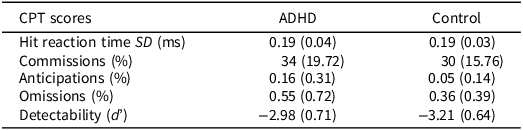
To examine whether individual differences in attentional stability and impulsivity modulated response speed in the Simon task, RT was analyzed using linear mixed-effects models including cue, FP, compatibility, and group as fixed effects, and their interactions with CPT indices (Hit RT SD, commission errors, anticipations <100 ms, omissions, and d′; see Table 2).
Mean raw CPT 3 scores and SD in ADHD and controls. For detectability, higher scores indicate poorer ability to discriminate targets from non-targets

Table 2. Long description
The table presents CPT scores for ADHD and control groups across five metrics: Hit reaction time SD, Commissions, Anticipations, Omissions, and Detectability. The table has five rows and three columns. The columns are labeled CPT scores, ADHD, and Control. The rows are labeled with the metrics and their respective values. Row 1: Hit reaction time SD (ms), ADHD 0.19 (0.04), Control 0.19 (0.03). Row 2: Commissions (percent), ADHD 34 (19.72), Control 30 (15.76). Row 3: Anticipations (percent), ADHD 0.16 (0.31), Control 0.05 (0.14). Row 4: Omissions (percent), ADHD 0.55 (0.72), Control 0.36 (0.39). Row 5: Detectability (d’), ADHD -2.98 (0.71), Control -3.21 (0.64).
Note: ADHD = attention-deficit/hyperactivity disorder; CPT = Continuous Performance Test; SD = standard deviation.
RT variability
The analysis revealed main effects of cue, F(1, 9067.4) = 11.89, p <.001, and compatibility, F(1, 9066.6) = 29.48, p <.001, consistent with the ANOVA results. RT variability in the CPT predicted response speed in the Simon task, F(1, 37.2) = 25.87, p <.001, with higher variability associated with slower RTs.
RT variability interacted with cue, F(1, 9068.8) = 7.79, p =.005, compatibility, F(1, 9067.3) = 5.55, p =.019, and group, F(1, 37.2) = 4.32, p =.045, qualified by a Group × Cue × Compatibility × RT variability interaction, F(1, 9065.7) = 4.69, p =.030. Follow-up analyses showed this effect emerged only at high RT variability (+1 SD), F(1, 9082) = 7.96, p =.005. In this condition, controls showed a temporal cueing benefit for compatible trials, F(1, 9065) = 6.18, p =.013, but not for incompatible trials, F(1, 9066) = 0.00, p =.987. In contrast, the ADHD group showed a pronounced temporal cueing benefit for incompatible trials, F(1, 9070) = 23.92, p <.001, but no significant effect for compatible trials, F(1, 9070) = 2.64, p =.104. Group differences in cueing were observed only for incompatible trials, F(1, 9068) = 10.62, p =.001.
A Group × FP × RT variability interaction was also observed, F(1, 9065.3) = 15.08, p <.001. At high RT variability, ADHD participants showed a robust FP effect, F(1, 9065) = 17.30, p <.001, with faster responses following longer FPs, while controls showed no such effect (p =.113). No significant FP effects were found at lower levels of RT variability in either group.
Commission errors
A significant Group × Cue × Commissions interaction was observed, F(1, 9065.2) = 6.36, p =.012. Follow-up analyses showed that, in the control group, temporal cues facilitated responses on average, F(1, 9065) = 5.34, p =.021, and high commission error levels, F(1, 9065) = 6.64, p =.010, but not at low levels, F(1, 9065) = 0.13, p =.722. In contrast, in the ADHD group, temporal cues facilitated responses at low, F(1, 9066) = 11.87, p <.001, and average commission error levels, F(1, 9067) = 9.71, p =.002, but not at high levels, F(1, 9067) = 1.14, p =.286. This pattern shows that temporal cues sped responses with lower impulsive responding in the ADHD group, but at higher levels in controls. Commission error levels were similar across groups, t(39) = 0.86, p =.198, and showed substantial overlap in their distributions (ADHD: M = 34.36, SD = 19.72; controls: M = 29.61, SD = 15.76). The ranges were similar across groups (ADHD: 4.17–68.1; controls: 5.56–73.6), indicating the interaction was not driven by distribution differences.
In addition, a significant Group × Cue × FP × Commissions interaction, F(1, 9065.0) = 6.14, p =.013, indicated that these effects were further modulated by the FP length. To examine the source of this interaction, we analyzed the simple effects of cue across group, FP, and commission error levels. In controls, temporal cueing effects emerged only at the short FP, on average, F(1, 9065) = 6.14, p =.013, and high levels of commission errors, F(1, 9065) = 11.66, p <.001, but not at low levels, F(1, 9065) = 0.13, p =.717. No significant effects were observed at the long FP, either at low, F(1, 9065) = 0.76, p =.385, average, F(1, 9065) = 0.61, p =.434, or high levels of commission errors, F(1, 9065) = 0.05, p =.830. A similar pattern was observed in the ADHD group, where temporal cues facilitated responses only at the short FP, at low, F(1, 9066) = 12.79, p <.001, and average commission error levels, F(1, 9066) = 9.02, p =.003, but not at high levels, F(1, 9066) = 0.55, p =.460. No significant effects were observed at the long FP, at low, F(1, 9066) = 1.69, p =.194, average, F(1, 9066) = 1.98, p =.160, or high commission error levels, F(1, 9066) = 0.59, p =.441. This pattern further shows that temporal cueing facilitates responses at short FPs in both groups, but only if impulsive responding is low. Importantly, commission error levels showed comparable ranges across groups, indicating that these effects cannot be attributed to differences in the distribution of this moderator.
Anticipations
A significant Group × FP × Anticipations interaction, F(1, 9065.1) = 8.13, p =.004, was further qualified by a Group × Cue × Foreperiod × Anticipations 4-way interaction, F(1, 9065.1) = 6.36, p =.012. Follow-up analyses showed that temporal cueing facilitated responses primarily at short FPs, replicating the pattern observed for commission errors. In controls, facilitation at the short FP was present on average, F(1, 9065) = 8.00, p =.005, and high anticipation levels, F(1, 9065) = 9.07, p =.003, but not at low levels, F(1, 9065) = 0.36, p =.546. In ADHD, temporal cueing effects at the short FP were observed across all levels of anticipatory responding, including low, F(1, 9066) = 5.87, p =.015, average, F(1, 9066) = 7.92, p =.005, and high levels, F(1, 9067) = 4.21, p =.040. Crucially, anticipatory responses tended to be higher in the ADHD group, t(39) = 1.50, p =.071, but the distribution overlapped substantially with that of controls (ADHD: M = 0.16, SD = 0.31; controls: M = 0.05, SD = 0.14). The range of anticipatory response rates was also comparable across groups (ADHD: 0.00–1.11; controls: 0.00–0.556). While the upper range was wider in ADHD, the levels used for interpretation (mean ±1 SD) remained within the observed range of values of the control group, indicating that the interaction was unlikely to be driven by non-overlapping ranges of this moderator variable.
No significant interactions between temporal cueing and either omission errors or detectability were observed (all ps >.05), indicating that these measures did not modulate the effects of temporal predictability on response speed.
Discussion
This study examined how temporal predictability shapes action control in adults with ADHD, focusing on response activation and inhibition. Building on evidence that temporal information can facilitate or impair performance depending on task demands (Correa et al., Reference Correa, Cappucci, Nobre and Lupiáñez2010; Menceloglu et al., Reference Menceloglu, Suzuki and Song2021), we tested whether adults with ADHD use temporal cues to regulate impulsive responding and whether this depends on attentional stability and impulsivity. Replicating previous findings (Korolczuk et al., Reference Korolczuk, Burle and Coull2018; Korolczuk et al., Reference Korolczuk, Burle, Senderecka and Coull2025b), controls showed a temporal cueing benefit for compatible but not incompatible targets. Conversely, adults with ADHD showed the opposite pattern, with faster responses to temporally cued incompatible targets, suggesting that whenever inhibitory control was required (a function typically compromised in ADHD), temporal cues facilitated performance.
Chronometric analyses further clarified these effects. Whereas the cost of incompatible targets typically decreases at longer RT (negative delta plots; Ridderinkhof et al., Reference Ridderinkhof, Forstmann, Wylie, Burle and van den Wildenberg2011), adults with ADHD showed the opposite pattern, indicating inefficient suppression of impulsive responses. Similar patterns have been reported in children with ADHD (Grandjean et al., Reference Grandjean, Suarez, Diaz, Spieser, Burle, Blaye and Casini2021; Korolczuk et al., Reference Korolczuk, Burle, Casini, Gerc, Lustyk, Senderecka and Coull2025a), supporting its role in difficulties with flexible behavioral control in ADHD (Faraone et al., Reference Faraone, Bellgrove, Brikell, Cortese, Hartman, Hollis, Newcorn, Philipsen, Polanczyk, Rubia, Sibley and Buitelaar2024). Critically, temporal cues reversed this pattern: suppression improved at longer RTs, indicating more efficient inhibitory control. This suggests that external temporal cues may compensate for ADHD by reducing temporal uncertainty and supporting preparatory control. Converging developmental evidence shows that children also use temporal cues to inhibit prepotent responses, with effects diminishing as endogenous control matures (Korolczuk et al., Reference Korolczuk, Burle, Senderecka and Coull2025b). A similar pattern is observed in children with ADHD, who show improved suppression of impulsive responses with longer preparatory intervals (Korolczuk et al., Reference Korolczuk, Burle, Casini, Gerc, Lustyk, Senderecka and Coull2025a). Together, these findings suggest that the ability to leverage temporally predictable information to regulate action control is present early in development and may be selectively recruited in individuals with less efficient control mechanisms.
Critically, temporal predictability improved inhibitory control in ADHD but impaired it in control participants. In the control group, temporal cues disrupted the typical reduction in the compatibility effect at longer RTs, indicating less efficient inhibition and replicating previous findings (Korolczuk et al., Reference Korolczuk, Burle, Coull and Śmigasiewicz2022). Thus, in controls, temporally predictable targets induced behavior similar to that seen in ADHD for non-temporally predictable targets. This dissociation suggests that effects of temporal predictability might depend on endogenous attentional capacity. Given ADHD’s heterogeneity (Faraone et al., Reference Faraone, Bellgrove, Brikell, Cortese, Hartman, Hollis, Newcorn, Philipsen, Polanczyk, Rubia, Sibley and Buitelaar2024), the utility of temporal cues may vary with individual cognitive profiles. Exploratory analyses indicated that unmedicated participants showed stronger cueing benefits and greater improvement in late-stage inhibition, whereas those taking methylphenidate showed lower error rates and reduced reliance on temporal cues. These findings should be interpreted cautiously given the small sample and between-subject design.
Related to this, we examined whether the effects of temporal predictability were moderated by individual differences in attentional function, as measured by the CPT-RT variability, a behavioral index of attentional fluctuation (Castellanos et al., Reference Castellanos, Sonuga-Barke, Scheres, Di Martino, Hyde and Walters2005; Kofler et al., Reference Kofler, Rapport, Sarver, Raiker, Orban, Friedman and Kolomeyer2013). In the ADHD group, temporal cueing benefited incompatible trials, but only in individuals with high CPT-RT variability; this effect was absent in controls and in ADHD individuals with lower variability. Thus, individuals with ADHD with greater moment-to-moment variability relied more on external temporal cues to stabilize performance and support inhibitory control, although this correlational finding should be interpreted with caution. In controls, cueing benefits were limited to compatible trials, and the absence of a conflict-specific effect of CPT-RT variability suggests that the underlying mechanism may be at least partially specific to ADHD, rather than a general attentional trait shared by both groups. A similar pattern emerged for CPT-commission errors: in controls, cueing benefits increased with higher error rates, whereas in ADHD they decreased. This suggests that the effects of temporal predictability depend on baseline activation state, facilitating performance at moderate activation levels in controls but becoming less effective or counterproductive in highly impulsive individuals with ADHD.
Interestingly, this dissociation aligns with models proposing an inverted U-shaped relationship between neuromodulatory tone and attention, with optimal performance at intermediate activation levels (Arnsten, Reference Arnsten2011; Aston-Jones & Cohen, Reference Aston-Jones and Cohen2005; Cools & D’Esposito, Reference Cools and D’Esposito2011). In ADHD, altered dopaminergic and noradrenergic function may shift this balance (Tripp & Wickens, Reference Tripp and Wickens2009). Individual differences in response variability – often interpreted as reflecting attentional lapses – may index a suboptimal, low-arousal state. In such cases, temporal cues could enhance performance by increasing activation, shifting toward a more optimal level. In contrast, higher commission errors, typically associated with impulsive or over-engaged responding, may reflect a state near the upper end of this function. In this case, increased temporal predictability could amplify impulsivity, pushing performance away from the optimal range and leading to poorer outcomes. These interpretations should, however, be treated with caution, as neuromodulatory state was not directly measured in the present study. Further support for the inverted U-shaped model comes from studies manipulating cortical excitability. For example, transcranial random noise stimulation over the prefrontal cortex improves time perception in ADHD but impairs it in controls (Asad et al., Reference Asad, Gladhill, Peterson and Wiener2025). Such bidirectional effects align with our findings, suggesting different baseline states of temporal and control systems in ADHD.
Importantly, temporal cueing effects in ADHD were independent of CPT-anticipation rate. This is notable given that temporal cues increased fast impulsive errors in the Simon task in both groups (Korolczuk et al., Reference Korolczuk, Burle and Coull2018, Reference Korolczuk, Burle, Coull and Smigasiewicz2020), indicating higher early response activation. Despite this, individuals with ADHD still benefited from temporal cues at longer RT latencies, suggesting that early impulse activation does not necessarily impair later inhibitory control.
The present findings should be interpreted in the context of the high clinical heterogeneity of adult ADHD, as we cannot determine the extent to which individual differences in clinical features contributed to the observed effects. Given the modest sample size in the present study, the more complex interaction effects should also be interpreted with caution and replicated in larger, more clinically characterized samples. Future studies with larger ADHD cohorts and more comprehensive clinical phenotyping will be important to determine how symptom profiles, comorbidities, emotional and executive functioning, medication status, and other clinical characteristics influence cognitive processes related to temporal predictability and inhibitory control. Nevertheless, the consistency of the key findings with previous work on temporal predictability and inhibitory control supports their robustness.
In conclusion, this study shows that temporal predictability can enhance impulse control in adults with ADHD, especially those with low attentional stability. External temporal cues may help compensate for intrinsic attentional fluctuations and enhance behavioral regulation in ADHD.
Acknowledgments
We thank Katarzyna Panecka for her help with data collection.
Funding statement
This work was supported by the National Science Centre, Poland (I.K., grant number 2024/52/C/HS6/00009). The funding source had no impact on any part of the present study.
Competing interests
The authors declare none.
Ethical standards
A CC-BY public copyright license has been applied by the authors to the present document and will be applied to all subsequent versions up to the Author Accepted Manuscript arising from this submission, in accordance with the grant’s open access conditions.





 Open access

