





Opening
Honouring the ways of old,
to lift the new and restored – to grow, to share.
The names of Noongar Boodja Footnote 1 —
Maatagarup, Goordandalup, Goolililup
woven with warlang moorditj, health,
memory, song, story – the fire of kaarlak koorl koorliny
always returning or coming home;
kura, yeye, boordawan
past, present and to come.
Ancient knowledge systems have stood the test of regenerative cultural vitality over millennia. Co-author Len Collard is a Whadjuk Ballardong Noongar Traditional Owner of the Perth Metropolitan area and surrounding lands, rivers, swamps, ocean and culture. Len and Oral are cultural mentors for first author Sandra Wooltorton who has lived in Noongar boodja and been learning Noongar knowledge, language and ways for most of her life. Sandra is a multigenerational Australian. Co-author Oral McGuire is a Mangarda Whadjuk Balladong Noongar. He is Len’s uncle and is a local, national and internationally recognised fire expert. Together we bring a rich Noongar positionality, woven together by the three authors in conversation.
The contribution of this paper is to enhance the integration of Indigenous fire knowledge within environmental education, with the aim of bringing practical Indigenous wisdom into everyday Australian life. Indigenous knowledge is necessary for Australia at this planetary time (Poelina et al., Reference Poelina, Wooltorton, Blaise, Aniere, Horwitz, White and Muecke2022; Steffensen & O’Malley, Reference Steffensen and O’Malley2022; Yunkaporta, Reference Yunkaporta2019). Our writing responds to the 2025 Planetary Health Check which reported that seven out of nine Planetary Boundaries have been breached (Planetary Boundaries Science, 2025). This means that humanity has collectively pushed the planet well beyond safe limits and the risk of crossing thresholds to ecological collapse is perilously high. We say, it doesn’t need to be this way.
In 2022, the UN declared that since there has been inadequate progress addressing climate change through national pledges, transforming societies may remain the only option (UNEP, 2022). This paper is a Noongar response to the need for societal change, using the lens of fire as metaphor – gentle healer (right fire: teacher) or raging enemy (wrong fire: climate change). The question this paper addresses, is: how can the Indigenous environmental humanities help educators bring about regenerative social change in adult groups that seem resistant?
Walking together: both ways
We want to make the old way become the new by handing this knowledge down to our younger generation. And when I say hand it down, I’m talking about non-Aboriginal people as well as Noongars. That’s a way of walking forward together. (Eugene Eades, in Caddy & Eades, Reference Caddy and Eades2026)
Walking together is a goal of this paper too, as it is one way to right-size the planet. As authors we write this paper for all of ourselves – including you, the reader – as people with normative suburban aspirations. We do not mean us/them in any way. It is “we” – us mob altogether, people who aspire towards a liveable future. As well as teaching, we are all environmental educators by the lifeways we live. That is, we educate by the practices we model and our ethos as ecological citizens. Respecting the Aboriginal custodianship protocol about speaking for one’s Country and respecting others’ right to self-determination, we frame this paper using Noongar knowledge. That said, as a body of Aboriginal knowledge, the embedded principles are transferable; and in the same way we refer to the work of other Indigenous researchers.
Picture dreaming tracks, trails of creator beings and songlines criss-crossing Australia. The place is exuberant with life. Scattered across the landscape are cool burns taking place, storytelling and learning in progress, dance and celebration happening, food gathering and preparation in one’s kaarlup (home place), with ceremony and law being planned around the Elder’s kaarl (campfire). In her (Reference Bird Rose2011) book Wild Dog Dreaming: Love and Extinction, Deborah Bird Rose’s teachers tell their stories with great generosity, even though they have faced extinction by massacre, many different types of cruelty and conditions like slavery.
One of Bird Rose’s teachers, Daly Pulkara, said: “We have listened to your stories. You, you Whitefella, you can listen to stories too” (p. 13). (By which Daly means, so please listen to us now – our stories are for you.) Another of Bird Rose’s (Reference Bird Rose2011) teachers, Old Tim Yilngayarri, tells her about rolling stories together in neighbourly ways. Bird Rose explains each group of people are responsible for keeping and caring for their Country’sFootnote 2 knowledge. Stories and songs of each of the Countries meet at “handover“ places, where the song is passed on to the next group. Imagine ways to keep the storied wisdom rolling on and on, allowing it to freshen up, accumulate and strengthen. Storytellers do not offer final meanings (Bird Rose, Reference Bird Rose2011, p. 24). Here, we include howls, barks, bird song and whistles too – and fire – as stories come in many voices and forms.
As authors, we keep Noongar stories rolling, and here we pass them to you to roll them on and on, to spread them through your storying and teaching. Stories live in places and have their own lives too. Be ready as you walk in Noongar Boodja; a story might come to you in one way or the other, as you pass it by.
A central metaphor in Noongar culture is kaarl (campfire, home place), a gathering place for Noongar story sharing. Visualise fire making with Pop Bennell (Reference Bennell and Collard1993, p. 8):
Making a fireFootnote 3
h’And then you karl karlangany see
Karl kurl baranginy
Wood
Karl the same thing
You make a fire with karl see h’an then you get the wood
You get ‘em merran stick blackboy stick merran
bring ‘em ‘ere see get ‘em
take to the ol’ Nyungar
h’an’ they get ‘em h’an give h’it to ‘em
put one down underneath
h’an’get the one in their ‘and h’an make a ‘ole to start
h’an’ they rub h’it like that (hand movements)
rub-h’it rub-h’it rub-h’it rub-h’it
yayi yayi
nidja nyininy
nidja yayi yayi
karl kurliiny see
h’it’s startin’ to burn
h’an then the smoke
h’an they just blow h’it
thas then ‘ow they got their fire goin’ see.
Below, we link Pop Bennell’s fire story with Bird Rose’s firestick wisdom.
Firestick wisdom: weaving narratives
Imagine a campfire where the flames are not too high, the coals are glowing brightly, and people are chatting and telling stories, letting the flow of ideas take them into new places… (Bird Rose, Reference Bird Rose2011, p. 25).
Bird Rose weaves diverse stories, ideas and philosophical concepts to generate conversation with all beings, perhaps to stretch stories, challenge the storytellers and see what sparks might be produced. She calls this method “firestick wisdom” (Reference Bird Rose2011, p. 25), to create friction and learning around the campfire.
Using a relational methodology in this paper, we weave, loop and narrate literatures. Thinking with Bird Rose, we begin with Noongar firestick wisdom then introduce pyro-pedagogies (Reid, Reference Reid2019), followed by Ingold’s (Reference Ingold2006, Reference Ingold2022) and Shrei’s (Reference Shrei2024) animist epistemologies to weave an ageless worldview into modernity. Next, we describe problems regarding planetary boundaries, to show how modernity’s story has led to trouble like climate change; multiple violences; and species extinctions. The environmental humanities demonstrate ways beyond the current societal impasse. Alongside Noongar insight, Donna Haraway’s thinking on staying with the trouble and making kin outlines pathways toward a new story. On this conceptual ground we thread Stephen Muecke’s (Reference Muecke2023, Reference Muecke, Behr and Rösch2025) description of cosmography as method for writing worlds, before illustrating Noongar stories for modernity. We weave two methods: learning together (firestick wisdom around the campfire) and writing the world (cosmography).
To support a return to right-relations within planetary boundaries, this experimental paper entangles Noongar sensibilities with the environmental humanities in a spirit of firestick wisdom. Noongar knowledge holders – with Boodja – are powerful teachers who actively teach and pass on knowledge about fire using intergenerational Noongar ways. Elsewhere, programmes that teach with and about fire are becoming known as pyro-pedagogies (Gough et al., Reference Gough, Towers, Verlie, Tolbert, Higgins, Bazzul and Wallace2021; Reffhaug & Lysgaard, Reference Reffhaug and Lysgaard2024; Reid, 2019). For instance, Gough et al. (Reference Gough, Towers, Verlie, Tolbert, Higgins, Bazzul and Wallace2021) argue that fire should be regarded as unruly kin because of the ambiguous human relationship with fire that is increasingly impacting upon contemporary life in Australia due to climate change. The authors propose a pedagogy that recognises fire as an active force shaping human lives, identities and futures. They highlight Indigenous fire stewardship as a model for living sustainably with fire and emphasise the need for place-based, child-centred bushfire education. Steffensen (Reference Steffensen2020) shows how teaching about fire involves working together with local knowledge holders, local language and cultural learning, continually. He explains the necessity of truth telling at all levels and in all places, since Country’s story interweaves with stories of the Elders and ancestors. Fire education is a way of life for Australia now – a “must do”.
How should we live? In a way that enhances life where you live, such that Country engages responsive relationship with you and kin inhabitants, says Mathews (Reference Mathews2023). We expand on this below, with firestick narratives.
Kaarlaboorn Kaartdijin (Firestick wisdom – narratives)
Let’s begin with the actual firestick. Several different types of wood make a good kaarlaboorn (firestick) in Noongar boodja, like merran (balga, or blackboy flower stem as Pop Bennell referred to in the story above). Using Pop Bennell’s advice, we encourage you to make one with your family or students. See Figure 1 for a pictorial description of how to make a fire with a firestick.
Making a Fire (from Collard & Bennell, Reference Bennell and Collard1993, p. 9).

As kaarlaboorn kaartdijin (firestick wisdom), the kaarl (campfire) means sharing, understanding and knowing-with Boodja. Think of a circle of people around the fire as a space where trust flows like kep (water) along a bilya (river), guided and protected by the communities along the riverbanks who care for river-Country. Around the campfire people might use drama to laugh about the events of the day and sometimes use the arts to show and discuss. Here in the circle everyone’s needs are equally important; and moort (family relations) make sure no one considers themselves better than others. In this kaarl (campfire) metaphor, everyone knows the cultural rules for reciprocity, because Noongar extended families are large and close-knit. Noongar stories maintain balance with the trio of Boodja (Country), moort (relationships, kin) and kaartdijin (knowledge, wisdom). In this way, the kaarl is about listening and speaking, community-building and decision-making. It is also a foundation for governance that incorporates cultural complexities such as Elder Councils and Boodja (Country) firstFootnote 4 (Bennell & Thomas, Reference Bennell and Thomas1981). We advocate the use of the circle gathering as it can be transformative of practice.
On the other hand, kaart in Noongar language translates to head and thinking and “up high” like a mountain top. Kaart (head or top or mountain), kaartdijin (knowing, knowledge) and kaartitj all relate to kaart. Too much kaart (head) – without connection to Boodja and moort – is kaart warra (crazy). In Noongar language, kaartwarra means bad head, and kaartitjboort means can’t think. If an individual disregards moort (family/kinship) and boodja they are said to be kaartitjboort (empty headed or unknowing/knowledge-less) which can lead to karnya (shame). The way to remedy this is more kaartdijin – learning. Thinking about balance, there can also be too much kaarl – fire – like wildfire, fossil fuel technologies, heat and fiery or hot-headed personalities. We will return to this idea in the Worldview section and in the section called Boodja First. We advocate the use of the campfire circle gathering as it can be transformative of practice.
Perhaps in common with aspiring to stand up too tall like a mountain top, suburban modernity seems linear and vertical: mortgages, career ladders, growth curves, rising property values. Decision-making for home, community and/or locale is outsourced elsewhere – to markets, experts, regulators – rather than held in dialogical proximity to place. In contrast, the kaarl offers another political imaginary. What would it mean for neighbours to sit, metaphorically and literally, around their local campfires? To read their landscapes, to notice species presence, to deliberate within ecological limits rather than above them? We see that resistance to change softens when we experience ourselves not as isolated homeowners defending assets, but as participants in a shared circle of all our relations.
A worldview for reorientation towards life
Here we situate animism in worldview, as fire, and within Noongar Boodja.
Right fire is a sacred spark – warming, illuminating and fiercely transformative. This notion is also used in On Fire, Shrei’s (Reference Shrei2024) podcast that is informed by multi-cultural mythos, story and academic insight. Here, we take key points from his episode to bring some animist thought to the vitality and power of fire in our world today. In a nutshell, according to Shrei (Reference Shrei2024), fire teaches through contrast: hearth and wildfire, devotion and destruction. We carry fire within us as passion, anger, hunger and creative drive. Untended, these flames burn relationships and landscapes alike; but tended with patience and rhythm, they gather community and kindle renewal. Creative and political fires need containers – circles, rituals, shared purpose – where energy becomes action without turning to harm. Across our planet, mismanaged fire fuels conflict and climate crisis. Yet when in balance, fire is healing, guiding collective courage, sustaining activism (beginning at home) and renewing the ground of common life.
In his (Reference Shrei2023) podcast entitled: Animism is normative consciousness, Shrei explains animism as felt, lived experience of a living, vital world of forces. He asserts that an animist, experiential-embodied way of seeing the world – and our place in it – is normative. We – Western rationalists – are the exception. An animist worldview, says Tim Ingold (Reference Ingold2006), is one that is seamlessly interconnected in the sense of knowing and being, ontology and epistemology, life and thought. In 2006 he proposed the re-animation of western rationalistic thought; so that scientists would see themselves in and part of, rather than outside of the world they observe. He explains animism as a condition of being alive to the world, responsive to entanglement within a field of relations – a field of vital forces. This means the living world is co-creative, unfolding, sentient and vibrating with energies and intent. Life itself generates form, and “vital force is free flowing like the wind” (Ingold, Reference Ingold2022, p. 138). The living world depends, he says, on this uninterrupted movement.
Boodja: nurturing terrain
Boodja is often translated to the English word: country, however unless CountryFootnote 5 is specified, this is a weak interpretation as it misses the vitality and kincentricFootnote 6 embeddedness of Noongar socio-cultural and emotional/spiritual relationship. People may have an intimate relationship linked with those of the same kinship relation. As well, in Noongar Boodja, ‘borungur means a totemic ancestor or “in relation to”, or second brother (Wooltorton et al., Reference Wooltorton, Collard and Horwitz2019, p. 11). This means a totem is treated in the same way as the duty of care towards one another in a familiar way, like a brother. Relating this to literature, a totemic relationship – a particular kin relationship, is one where beings of different appearance or species have the same life force (Muecke, Reference Muecke, Van Dooren, Eds. and ini2022).
Here, we cite the work of Oral McGuire, to describe the depth of interrelation with boodja. Referring to the sacredness of Boodja, he says:
Boodja is one of those concept words, which is very much a female - has a female connotation… When women are pregnant, they are boodjari - being pregnant, carrying child and that whole process of mothering and being the nurturer is an important context for connection to Country because Boodja is - you know, we in our language, we say ngulluk ngarngk nidja boodja. This land is our mother. Ngarngk is another concept word that is tied very much to women. It’s our kinship term for mother, but it’s also the sun … So the connection … life- and life-giving forces and obviously the female spirit is really critical. Along with Bilya the word for river. But more importantly, it’s actually the word for the umbilical cord in the mother. So bilya and bilyada are natural ecological systems … of life and sustenance. (McGuire in James et al., Reference James, Mullins, McGuire and Head2022)
A Noongar worldview integrates practical, experiential knowing from skilled sensory, embodied interactions with Boodja and her vitality. Stories and song from the Elders Council (a circle) link the Nyitting (creation times) with the present through a nonlinear sense of time, a long now of kura, yeye, boordawan – past, present and to come. A nonlinear expansive sense of time is cyclical, like day and night and the seasons. There are keys within this animist worldview – like its priority on storytelling and embodied practice. Next, we visit the problem of crossing planetary boundaries – the result of the foolishness we collectively practice.
Crossing planetary boundaries as Earth on fire – foolishness
As long predicted, unrelenting industrial-technological expansions have driven our home beyond planetary boundaries and the limits to growth (Meadows et al., Reference Meadows, Meadows, Randers and Behrens1972; Planetary Boundaries Science, 2025). Many planetary beings now experience recurring heatwaves, massive fatal floodings and connected landslides, pandemics, escalating violence, wars, gigafires and the list continues. Gough et al. (Reference Gough, Towers, Verlie, Tolbert, Higgins, Bazzul and Wallace2021) point out that one gigafire alone – in Australia, 2019 – scorched tens of millions of acres, killed more than a billion animals, destroyed thousands of buildings and took the lives of at least 34 people. Metacrisis prevails (Irwin & Wooltorton, Reference Irwin and Wooltorton2026).
The breached boundaries are climate change (greenhouse gases have reached dangerous levels); change in biospheric integrity (extinctions and loss of natural productivity are at unsafe levels); land system change (earth’s forests are shrinking); freshwater change (irrigation and agriculture, industrial water use have exceeded capacity), biogeochemical flows (fertiliser overuse cause pollution and dead zones), ocean acidification (now threatening marine life) and introduction of novel entities (like plastics that are increasing without control). These boundaries are trending towards increasing pressure – suggesting further deterioration and destabilisation of planetary health in the near term.Footnote 7 Metaphorically, earth – our home – is on fire.
Nearly 50 years ago in Georgia, UNESCO (1977) announced a framework – the Tbilisi Declaration – for lifelong interdisciplinary, holistic, ethical, aesthetic, multi-perspectival and active environmental education to foster awareness, skills and positive behavioural change. Ten years later, the release of Our Common Future: Report of the World Commission on Development (Brundtland, Reference Brundtland1987) heralded an era of global action to monitor and steer sustainable development. Decades later, we recognise the same political powers that knowingly transgress planetary boundaries actively resist environmental education and action. These include combinations of corporate interests like fossil fuel lobbyists who have funded climate change scepticism and promoted free school curriculum materials that emphasise fossil fuel benefits (Furuta & Bromley, Reference Furuta and Bromley2025; Wills & Baxter, Reference Wills and Baxter2026); neoliberal think tanks who assert that political regulations are detrimental to economic growth and who oppose climate education as “ideological indoctrination”; lobbyists who resist education by promoting ‘culture war’ narratives and who advocate for delaying tactics such as more research rather than action (Culhane et al., Reference Culhane, Hall and Roberts2021; Diesendorf, Reference Diesendorf2025); as well as well-funded populist and far right movements (Krange et al., Reference Krange, Kaltenborn and Hultman2021).
This is the confusing context for suburbanites struggling with ownership-related debts, aspirations of upward social mobility, showy notions of comfort and commitment to economic growth. We gain hope by applying the work of Ehrrnström-Fuentes and Hokkanen (Reference Ehrnström-Fuentes and Hokkanen2025) who show that regenerative worldviews follow resistance to these types of extractivist ideals. They explain how the resurgence of more-than-human relations activates reciprocities that can be deeply transformative, as farmers become more deeply embedded within the life-giving features of their farms.
In environmental education, a participative, relational, vitality-oriented worldview has long been advocated since this has underpinned regenerative human societies for millennia (Bawaka Country et al., Reference Burarrwanga, Ganambarr, Ganambarr-Stubbs, Ganambarr, Maymuru, Lloyd, Daley, Suchet-Pearson and Wright2023; Rousell, Reference Rousell2023). International research shows evidence in support of this through changed farmer practice (Ehrrnström-Fuentes & Hokkanen (Reference Ehrnström-Fuentes and Hokkanen2025). Next, we turn to the work of Oral McGuire to hear more about regenerative Noongar knowledge and the continuing colonial ignoring of Noongar wisdom – even when clearly necessary.
Oral McGuireFootnote 8
We still hold our concepts and our codes for the deep meaning and the connection of place, and spirit, and belonging. And obviously, that whole concept of caring.
[Referring to the horrors of colonisation], so even though we’d been … excluded from the colony, we actually had the rest of [Noongar] country if you like that we were existing on so our culture [could be continued] in the first 50 or 60 years. But certainly, you know, the devastation of colonisation has been a loss of connection to Country. And so you start to overlay some of these big structures and systems that have taken control. And we end up with, you know, the story of [wild]fire, if you like, and how Noongar people and Aboriginal people, First Nations peoples, not only in this Country, but globally have been removed from the practice of fire. [And wildfires are one direct result.] …
So, this existence of first knowledge, sacred knowledge is a human, a wonderful human reality. And the treatment of that, that wonderful resource, if you like, of Aboriginal people, Indigenous peoples globally, not only around fire, but the whole, the whole earth is in serious trouble because of this lack of respect and acknowledgement. So, my hope gets very diminished by the simple fact that no one listens to us. No one listens to me, I speak and some of you may have heard me speak or have been listening to me speak and some of you might think I talk crap, but the reality is, no one is changing things.
But I’m a realist, as well. And I think the reality around fire, the reality around the existence of untruths … in this world is a serious problem for us and our human existence. The AnthropoceneFootnote 9 era, you know, for people still to be denying that climate change is human induced or human initiated, is just so foolish that it’s ridiculous. (McGuire in James et al., Reference James, Mullins, McGuire and Head2022)
Alienation from Country and its embedded vitalities like fire seems to be the core of the problem. We look to the environmental humanities for ways to conceptualise this predicament, and then we listen the teachings of fire.
Relational methodology
Weaving, braiding, entwining and entangling is part of the relational methodology that grounds this paper. In Indigenous research, relational methodologies often disclose living, breathing, participatory worlds. They tend to reveal co-becoming with more-than-human worlds, multi-dimensional reciprocity and de-centred human authority. For example:
The gurtha, the fire, is burning. … Country is homeland and place, Country is spirit and song, Country is human and plant and wind and current, Country is knowledge. Country is everything and the relationships that bring everything to life. The gurtha, the fire, burns, keeping Country alive. The fire is our knowledge and the knowledge of Country, as well as the relational materiality of burning flames. (Country et al., Reference Burarrwanga, Ganambarr, Ganambarr-Stubbs, Ganambarr, Maymuru, Lloyd, Daley, Suchet-Pearson and Wright2023, pp. 279–280)
In a relational way, below we enfold Noongar knowledge through the environmental humanities and “rub together” the various perspectives in application of Bird Rose’s firestick wisdom – like a good campfire conversation. To narrate a right story – a right fire – for the West towards regeneration and healing, we use a Noongar voice on kinship, before outlining two further environmental humanities positions. We visit the work of Donna Haraway (Reference Haraway2016) whose work has produced pathways towards a worldview of practical interconnectedness with the more-than-human. Finally in this section, we spend time with the cosmography of Stephen Muecke (Reference Muecke2023, Reference Muecke, Behr and Rösch2025) to cooperatively bring forward the voice of the world.
Kinship in Noongar Boodja
Many dwellers in Boodja (Country) celebrate kinship connections which tie people to place through familiarities of reciprocity, care and obligation. People may have a strong bond of meaningful connection with those people and species of the same kinship relation. Next, insights from Donna Haraway help us explain ways to implement a Noongar life-oriented worldview – part of which is kinship – into the modern every day.
Donna Haraway: chthulucene, always co-becoming
Living-with was [is] the only possible way to live-well (Haraway, Reference Haraway2016, p. 162).
Haraway’s work applies similar notions to certain Noongar concepts. We weave her work into Noongar culture and language to explain ways of remaking Country into modernity’s main concern. Haraway’s (Reference Haraway2016) work shows that knowing the world requires disrupting rigid distinctions between science, story, nature and culture, with naturecultures describing the inseparable entanglements of life. Here, our intention is to show that the account we, as humans, give of reality is always a storied account. In this subsection, we highlight two Noongar concepts: kaarla koorl and Boodja.
Haraway proposes the term: Chthulucene, which joins two Greek words (khthôn – of the earth and kainos – now, or a new freshness/vitality) to refer to “a kind of timeplace for learning to stay with the trouble of living and dying in response-ability on a damaged earth” (Haraway, Reference Haraway2016, p. 1). We understand Chthulucene as an active, ongoing way of thinking, for an era she describes as ongoing multispecies “composting” and interconnections that require both scientific attention and ethical responsibility. In this way of thinking, living and dying well as mortal beings is to collectively reconstitute refuges (ecological safe havens), making possible vigorous biological-political-cultural-technological recomposition and recuperation (like composting), while making time to mourn irretrievable losses. This feels like kaarla koorl, coming home; to the Noongar concept of Boodja (Country) and Noongar ways of knowing, being and doing.
For us, Noongar Boodja holds broad, deep meanings in spiritually meaningful ways. Boodja is kincentric – a deeply relational place-embedded enmeshment of plants, humans and local species that ties obligations to care through kinship systems and ancestral connections. In this way, obligations to care are joyful responsibilities, not coercions. Haraway recommends the idea of kinship as making kin not babies (Reference Haraway2016). Here, making kin is more than genealogy or ancestry. On p. 1, Haraway writes, the “task is to make kin in lines of inventive connection as a practice of learning to live and die well with each other in a thick present”. She says it is not like putting on a “magic cape” – it is one of the hardest tasks to undertake and most urgent (Reference Haraway2016, p. 89). We will return to “making kin” in the discussion on firestick wisdom.
Staying with the trouble, Haraway (Reference Haraway2016) writes, and yearning for resurgence, requires becoming heir to difficult histories – like the notion of karni waangkiny – truth telling in Australia. Surveying Haraway’s impact, we find compelling evidence of changed environmental education practice resulting from application of her work alongside other authors within the environmental humanities (eg. Cutter-Mackenzie-Knowles et al. Reference Cutter-Mackenzie-Knowles, Lasczik, Wilks, Logan, Turner and Boyd2020; Merewether et al., Reference Merewether, Blaise and Giamminuti2025; Rousell, Reference Rousell2023).
Next, we consider the newer works of Stephen Muecke, co-writer for many years with his teacher Paddy Roe, Nyikina man of the Goolarabooloo – “saltwater Country” in the West Kimberley region of Western Australia (Roe & Muecke, Reference Roe and Muecke1983). The intention in using Muecke’s recent works (Reference Muecke2023, Reference Muecke, Behr and Rösch2025), is to consider ontological and epistemological pluralism as background for belonging to territory from Paddy Roe’s point of view. This is now Muecke’s standpoint too, as we shall see.
Stephen Muecke: cosmography as method, onto-epistemological pluralism
A cosmography, in simple words, is a written description of a cosmos or world in all its dimensions. For Muecke, it moves beyond the “ethnos” human-centred focus of traditional ethnography, to embrace a grander narrative of all modes of being with their different agencies, sensitivities and intelligences that are ultimately interconnected to forge the coherence of a specified cosmos.Footnote 10 This is like a particular way of describing a worldview.
Muecke (Reference Muecke, Behr and Rösch2025) explains his interpretation of cosmography as multispecies ethnography, using multiple modes of belonging to solve a problem. In this frame, more-than-humans have a voice in society. For Muecke (Reference Muecke2023, Reference Muecke, Behr and Rösch2025), this cosmography refutes a singular level of reality, particularly the reductive idea that there is only one reality (in which fiction would be mere fancy, spirituality would be delusion). In other words, this cosmography recognises and values diverse, multi-level ways of knowing and being. Everything is understood through one or more beings or entities, via a multiplicity of associations in a common ecological gathering that makes up a cosmos, a world.
Muecke (Reference Muecke, Behr and Rösch2025, p. 26) writes:
One protocol I learned from [Paddy Roe] is that “things must go both ways”, that knowledge has to be traded, as values are translated from one “cosmos” to another, his and mine, and that the medium for this is a storytelling that starts by situating the narrator. Immersed in the space of the story, the narrator draws the listener in and they dwell together, at least for the duration of the story, and the listener emerges with a better understanding, a way of knowing and feeling that has sympathetically situated him with the narrator.
Muecke (Reference Muecke, Behr and Rösch2025) reflects on how the shared “dwelling together” of listening to Paddy Roe’s storytelling about Country helped him feel as if he, too belonged to Country. In fact, later he wonders if there is “no belonging without such storytelling” (Reference Muecke, Behr and Rösch2025, p. 27).
Power, place, transformation: towards circles of practice
There are concepts of caring, relational power that we briefly overview here to apply Noongar wisdom entangled with environmental humanities in practice. First, we use Oral McGuire’s account.
Boodja first. Kaarla Wirrin Ngaariny is our sacred practice of burning country
I acknowledge fire not only as a friend but as a part of my being and my spirit. (Oral McGuire).
We begin this contribution by Oral with some words direct from his podcast with Anthony James on Regen Narration:
[We are kincentric people], we are part of the natural system. We are part of the biodiversity. We can’t talk about saving biodiversity and kill off Aboriginal people in this country. We can’t talk about nature and not allow biodiversity and ecological health to be at the forefront; to be number one…
I’ve said, who puts country first, in every decision they make? Whether you’re a farmer, a miner, or a person, you know, sitting in the audience. We’ve lost the ability to put Country first. (Oral McGuire, in James et al., Reference James, Mullins, McGuire and Head2022)
Oral’s story below, is taken from his (Reference McGuire2024) Ted Talk. You might wish to listen to Oral’s presentation as well.Footnote 11 After this transcript, we reword Oral’s account into the narrative.
My story is about my personal and cultural relationship with fire. It has been a life-long relationship. In Australia, we have a growing issue around fire that challenges us every fire season. And because of our changing climate, there are now other places in the world that are confronted with this same challenge. Paradoxically, Australia needs fire. My people applied the right fire diligently and expertly for millennia. It shaped the evolution and the DNA of the landscape and of [Boodja].
[One time, an Elder] gently reached down and lit the grass and the ground that we were standing on. As the fire slowly trickled, he said to us, “Go and stand near a tree and observe what you see.” What we saw was amazing. There were all these various insects and critters clambering up the tree trunk, escaping the slow-moving fire. The Elder then said to us, “This is the best indication that our burn is the right fire.” Fire has a sacredness when it is applied through our cultural lore.
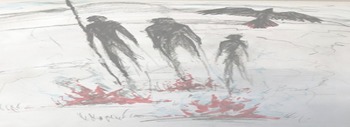
What manifests during the cultural burning is a spiritual enlivening of [Boodja], where Country is renewed and the spirit of the land is awakened. Ngaariny is our sacred practice of burning Country. (See Figure 2).
Yaraguia, spiritual enlivening of Boodja during cultural burning (Artist: Barry McGuire).

Noongar Boodja – Oral’s story
In the Figure 3 below, Oral is applying ngaariny on sacred lands, Noongar boodja. It shows one way of caring for Country in which boodja gives people identity, connectedness and spirit.
Kaarl Ngaariny, Noongar cultural fire on Oral’s sacred lands in Noongar boodja.

Pre-colonisation and for perhaps 65,000 years, Noongar lands were managed by cycles of creation through First Law ways. However, since 1829, Boodja has been suffering from the introduced destructive cycles of colonialism, developmentalism, capitalism and industrialisation (SWALSC: SouthWest Aboriginal Land and Sea Council et al., Reference Land, Council, Host and Owens2009). These have all contributed significantly to climate change on Noongar boodja.
Part of Oral’s relationship with fire included having an 18-year-long career as a professional firefighter in Perth. It is here that he learned a deep respect for the destructive force of fire and its awesome power. The quotes below are from Oral’s 2024 Ted Talk,Footnote 12 illustrating attitudinal differences between firefighting and fire tending in right fires.
Firefighting experience
Since fire was considered our enemy, [as firefighters], we were trained to control it. So we learned about fire behaviour and fire management. I would have attended over 2,000 bush fires, many of which resulted from controlled burns getting out of control and becoming wildfires. As a professional firefighter, I learned that our mission is to protect property and save life. But as First Nations and traditional custodians of our lands, our two key principles for applying the right fire are to put Boodja first; and to keep [Boodja] balanced. The ground is sacred, and we must protect and preserve it. …
Destructive controlled burns
We cannot keep countries safe by burning everything indiscriminately to the ground. [Hot fires that scorch and remove everything] occurs when incendiary devices are dropped from aircraft in order to take out as much bushland as possible in the shortest amount of time. This burning is destructive to Boodja. … This is not consistent with our cultural lore and standards for applying fire…
Today it is clear that actively caring for Mother Earth is imperative. As Noongar people, our fight to stay connected to our sacred lands is dependent upon our ability and freedom to practice ngaariny. As Oral says, the right fire, naariny, requires us to be able to read Country. Keeping Boodja healthy keeps us healthy. … When we burn the right way, we know Country will regenerate in balance.
Cultural burns heal
Balanced health is dependent on how and when fire is applied. Oral explains that Country needs the right fire at the right time, in the right place. He says fire is medicine for Country; it heals the land and cleanses it while renewing the spirit of Boodja.
In 2008, Oral’s family took possession of 2,100 acres of ancestral lands in the wheatbelt region of western Australia. This country had been badly overcleared, overgrazed, overfertilized and overcropped. (See Figure 4 above.) Their vision – which they saw as responsibility – was to heal the land. So, they set out to plant native endemic species of plants which in turn attracted all sorts of other native birds, animals, flowers and grasses to also return. Their whole families, with children, have been practising kaarl-ngaariny on this Boodja now for more than 15 years.
Yaraguia, Noongar boodja: Garlagoorliny, avondale park. 2008 pre-planting.

Boodja regeneration
For this section, here are the words from Oral’s Ted Talk.Footnote 13
Today, the trees in the foreground are so large, they restrict the view of this landscape. (See Figure 5.) The right fire at the right time is very good for our environment. It’s very good for Boodja and it’s very good for us. A big part of what helped us achieve our goal, our patient ambition, was the application of ngaariny across our landscape.
This is a 2025 photo of Oral’s ancestral lands, called Yaraguia. Results of the right fire at the right time.

Kaarl-ngaariny is an important element of our First Nations regenerative land management model, which is a contemporary version of our traditional practice of caring for country. Seeing Country in a holistic sense and understanding how it is a part of us and we are a part of it, is important in the practice of caring for country.
Fire management in Australia is critical to the biodiversity and ecological health of our land. When ecological health is poor or non-existent, biodiversity and spirit is also poor or non-existent. Therefore, to heal the spirit of our lands, we must protect, conserve and regenerate the biodiversity and ecology of Boodja everywhere. Fire can be either a very important ally or a massively destructive threat, if we don’t commit to manage and apply the right fire at the right time in the right place.
The Elders’ priority to heal and “save us all from the madness” is to teach young people and ensure they connect with Country, write Steffensen and O’Malley (Reference Steffensen and O’Malley2022 p. 39). They also say there is no good blaming people who caused climate change, rather, the mess needs to be cleaned up together as there is no other way.
Returning to the work of Ehrrnström-Fuentes and Hokkanen (Reference Ehrnström-Fuentes and Hokkanen2025) we note:
These resurgences of alternative ways of farming challenge the economic structures of the dominant extractivist food regime in many forms, some which are often gradual and not-so-obvious in nature. (p. 15)
They also comment that building alliances within the regenerative movement within and between communities of practice can help reimagine and bring alternative worlds into being.
Firestick wisdom, rubbing the authors together as method
Deborah Bird Rose (Reference Bird Rose2011) calls for “firestick wisdom” – a method that invites friction for learning, where ideas are rubbed together to see what sparks might arise (p. 25). Firestick wisdom does not seek consensus; it seeks illumination. Here we rub several thinkers together.
Donna Haraway (Reference Haraway2016) proposes multispecies kinship as an ethical task for the Chthulucene. Here, a Noongar relational ontology offers a frame for making kin; in Noongar Boodja, local species are kin, tying place and people through reciprocal familiarities, care and obligation. Rubbing these ideas together raises a creative opportunity. For Haraway, making kin is an urgent imaginative and political task in response to ecological collapse whereas in Noongar culture, kinship is normative, embedded in language, law and practice. The spark here is regeneration: environmental education in settler societies might seek multispecies kinship by attunement. We need to learn to dwell within existing territorial boundaries and form relationships for learning – with local species in our parks, bushland and gardens. We suggest learners watch, listen, feel, imagine, sense, respond and talk-with species. English language is sufficient, though your local Aboriginal language can be more suitable. After learning to put Country first in thinking and practice and gradually improving familiarity, notice which species is always watching you – from a distance or more assertively, wherever you are in your local ecosystem. That might be your totem, that which in Noongar boodja is called borungur.
Muecke (Reference Muecke, Behr and Rösch2025) describes cosmography as writing the world “in the midst of things” – where multiple beings, agencies and ontologies come together in a shared ecological collectivity. This cosmography does not reduce the world to a single explanatory frame; it shows how realities meet, trade, function and dwell together. In this way, Oral McGuire’s account of fire is a cosmographic happening. He situates himself as participant, acknowledging fire as a friend and part of his being and spirit. Here, culture (ontology) is relational presence. Oral takes multiple cosmologies simultaneously. As a professional firefighter he is trained to control fire and he says: “our mission is to protect property and save life”. Within the modern fire-management cosmos, fire is enemy, hazard, destructive force and property is central.
Yet within Noongar law, Oral says: “Our two key principles for applying the right fire are to put Boodja first; and to keep [Boodja] balanced”. In this cosmos, fire is medicine when in balance, destructive when misapplied. Property is not primary; Country is. Rather than collapsing one view into the other, Oral holds both. He recalls the Elder who lit grass into a gentle fire while they watched insects and small fauna scrambling up tree trunks, in plenty time to escape the slow fire, while explaining this phenomenon as the best sign of a right fire. Here, insects are indicators; trees participate, and speed matters. Balance is read through multispecies response while agency is distributed across species. In this way, learning-with knowledge holders and Country is a type of pyro-pedagogy.
Muecke (Reference Muecke, Behr and Rösch2025) writes that in cosmography, more-than-humans “also have a voice in society” (p. 25). In Oral’s account, insects, critters, trees and Country are co-actors in determining whether fire is right. Oral writes: “Fire is medicine for Country. It heals the land and cleanses it and renews the spirit of Boodja”. Here, healing is ecological and spiritual, material and relational. It resists the reductionism that would dismiss spirit as mythical. This cosmography allows multiple levels of reality to co-exist without hierarchy; it shows how pyro-pedagogies give more-than-humans a voice in society. Similarly, Oral critiques high-intensity burns, as it is not consistent with our cultural law. In cosmographic terms, industrial burning belongs to another cosmology – one oriented toward individualism, speed, liability and risk reduction and measurable outputs. It speaks in the language of risk and control.
When Oral describes restoring 2,100 acres through kaarl-ngaariny and regeneration, he is narrating contemporary, adaptive stewardship within a damaged modern landscape. Fire, biodiversity, climate, professional training, family responsibility – all co-exist. In Muecke’s (Reference Muecke, Behr and Rösch2025) terms, this is practiced pluralism – knowing both ways.
Through Oral’s storytelling, we see what Muecke (Reference Muecke, Behr and Rösch2025) means when he suggests that belonging may arise through dwelling in story with fire. The listener acquires a reconfigured sense of fire: not enemy, not resource, not symbol alone – but relational power requiring balance, that ties us ever closer to Country in a familial sense of belonging. In Noongar language, this sense of belonging to place is called koortaboodja (heartlands).
For us, kaarl is a lived cosmography. It situates the narrator, gathers multiple vitalities and holds them in co-presence without collapsing difference. Insects escaping flame, trees signalling heat, Elders reading smoke – these are dialogical exchanges. The circle of the fire becomes a multispecies parliament, where humans learn to listen to Country rather than speak over it. In this configuration, governance is not human-only decision-making but attunement within an ecological collective.
In summary, kaarl is not only symbol but structure and relational practice. As campfire it is a flat space of governance in which no one stands above others, and where knowledge circulates rather than descends. Around the fire, listening is active, embodied and multispecies. The crackle of flame, the insects, nightbirds and creatures, the night air, the land itself are participants. Authority does not sit outside the circle; it moves within it. In this sense, kaarlaboorn kaartdijin (firestick knowledge) is epistemology – knowledge generated through relational presence rather than abstraction. As practice, the circle contrasts sharply with an aspiration that lifts one away from ground, kin and Country. In this place-based society of beings (Weber, Reference Weber2026) we comprehend fire in the home and landscape as vitality with active voice, enacting intent to heal or control, as gentle healer (right fire: teacher), or raging enemy (wrong fire: climate change).
In this sense, Muecke’s cosmography is method and pedagogy. It shows how multiple realities can be held together without erasure – and how regenerative practice emerges from or within that holding.
Conclusion: Noongar cosmography as regenerative paradigm
We show that modern suburban life attempts to insulate itself from flame while remaining powered by distant combustion. It seeks security through control and comfort through growth. Yet fire cannot be eliminated; it can only be relation. When fire is treated as enemy, it escalates. When gently tended within limits, it heals.
Thinking with the environmental humanities, the Chthulucene, as proposed by Donna Haraway (Reference Haraway2016), is a time when humans live in connection with earth in place, entangled with multispecies “composting” together – integral within earth systems. Here, there are no quick fixes on a damaged planet, so we “stay with the trouble” by being in a making-with process. To make kin with the more than-human, we reweave ourselves within life by creating refuges (ecological and cultural) for new hope of shared possibilities. This aligns with a Noongar cultural point of view in boodja, where “making-with” is a continuing process. We gather around the kaarl (campfire) for dialogue and community. Together, we create a profound respect for Country, kaarl and culture as First Law. It involves care of culture and cherishing ancestral forever stories. This way, to walk together requires dwelling together in story, practising deep listening with place, and putting boodja first. The land is the law. Governance is Country. As Oral says, you cannot belong to property and consumption. You can only belong to Country. This needs karni waangkiny – truth telling. Boodja first.
Symbolically, planetary boundaries mark the outer limits of industrial fire. Metaphorically and practically, Noongar cosmography teaches us how to tend the aspirational fires like desire, ambition, mobility and growth that shape our suburban lifeways. The problem is not fire itself, but its dislocation from balance and storied relationship. Regeneration therefore is reorientation. It is learning to read Country again. It is softening aspiration towards hearth rather than wildfire. It is accepting ecological limits as the containers within which life can thrive.
Regeneration begins by re-gathering – sitting and yarning around kaarl, the campfire – in practice and as metaphor. Sitting with fire invites reflection, nurture and renewal. Through gathered attention, people may come to experience themselves as participants in living Country rather than isolated asset holders, where ecological limits are understood not as constraints but as conditions for balance and flourishing. Cosmography helps situate us within the fires we already inhabit –combustion, desire, ambition –so aspiration becomes hearth rather than wildfire.
In this paper, we asked how the Indigenous environmental humanities might assist environmental educators prompt regenerative change among those who appear resistant. Kaarl offers a guiding frame. Around both literal and metaphorical campfires, learning is relational, cultural and reciprocal. No one stands above the circle; humans and the more-than-human co-become through listening, responding and care. Cultural burning teaches attentiveness: the right fire, at the right time, in the right place. As metaphor, practice, culture and story, kaarl offers educators a regenerative pedagogy grounded in Country. Boodja first.
Acknowledgements
We wish to acknowledge traditional owners and cultural custodians in Noongar Boodja and where you are in Australia and in the world. Thanks to the reviewers for their useful, practical feedback. Many thanks to Emeritus Professor Freya Mathews for her very helpful comments on the earlier draft of this paper.
Financial support
This research received no specific grant from any funding agency, commercial or not-for-profit sectors.
Competing interests
The authors would like to disclose that Professor Sandra Wooltorton is an Associate Editor of The Australian Journal of Environmental Education (AJEE). In accordance with AJEE protocols, Professor Wooltorton was not involved in the editorial process or decision-making regarding this manuscript.
Ethical standards
This research was implemented ethically, as per Notre Dame HREC Approval 2023-062, Noongar Sense of Place Studies. Some minor use of Copilot AI was made, to assist with crafting the abstract and some light word count reductions elsewhere.
Author Biographies
Sandra Wooltorton is a transdisciplinary researcher, Professor and Senior Research Fellow at Nulungu Research Institute, at the University of Notre Dame Australia’s Broome Campus. Sandra lives in Noongar boodja and has an interest in nurturing place-relations as decolonial praxis.
Len Collard is an Adjunct Professor at the Nulungu Research Institute at the University of Notre Dame Australia, an Emeritus Professor at the University of Western Australia and Director of Moodjar Holdings Pty Ltd., an Indigenous-led cultural education company.
Oral McGuire is the Principal Consultant of Gundi Consulting. His core principles in life and business are Cultural Integrity (CI), Cultural Lore (CL), Cultural Values (CV) and Cultural Governance (CG). His active work in Nyungar regenerative land management has seen him become a key leader in his work with Noongar Land Enterprise Inc., Danjoo Koorliny, Healing Country and on their Land in Beverley with Yaraguia Enterprises.



 Open access

