Introduction
Health care industry has been subject to numerous regulations over the last 60 years or so in an attempt to provide necessary oversight of skyrocketing costs. The cost issue is especially problematic in the recent decades wherein United States has seen the largest surge in health care spending when compared with rest of the economy (McKinsey, 2011). To get an idea regarding the seriousness of this issue, one just needs to look at health care expenditures as a percentage of the gross domestic product. According to the Centers for Medicare and Medicaid Services (CMS), this percentage in 2014 was 17.8 [Centers for Medicare and Medicaid Services (CMS), 2015]. Inpatient care-related costs – in particular hospital visits for chronic conditions – account for a significant share of this spending. Further, US lags behind other industrialized nations in hospitalization rates and quality of health outcomes even though they spend significantly less (OECD, 2009). Given these facts, it becomes especially important to evaluate if laws enacted over the years have done what they were intended to.
An important law in this context are the Certificate of Need (CON) laws. A Federal CON law was put into effect by the National Health Planning and Resource Development Act (NHPRDA) in 1974. While, CON first began in 1964 in New York state, it then greatly expanded to all but one state as a consequence of the 1974 Federal law, which did not mandate that states adopt CON but instead gave them strong financial incentives to enact their own laws. The primary motivation behind its enactment was to ensure the availability of health care services while guarding against unnecessary capacity (supply), and costly duplication of services. In addition, the law was intended to improve quality of care and enhance competition (Conover and Sloan, Reference Cutler, Huckman and Kolstad1998). The Federal government repealed NHPRDA in 1986 which is what precipitated the repeal of CON in 15 states in subsequent years. This law continues to impact health care market in various ways in 36 states. The decision by the remaining states to repeal the law is a debated issue in the literature.Footnote 1 Before making any substantial expansion of capacity or equipment purchase, a health care provider needs to get approval of the government in states with CON law. This would translate to significant legal costs for the applicant. One of the primary motivations behind CON laws is the so-called Roemer effect (Delamater et al., Reference Delamater, Messina, Grady, WinklerPrins and Shortridge2013) or the supplier-induced demand hypothesis (De Jaegher and Jegers, Reference De Jaegher and Jegers2000). Health care can be classified as a credence good whose quality cannot be determined by the consumer even ex post (Dulleck and Kerschbamer, Reference Dulleck and Kerschbamer2006). Therefore, the buyer (in this case the patient) would have to rely on expert (the health care provider) opinion to choose a treatment. This in turn could provide an incentive to the health care providers to subject patients to unnecessary treatment to maximize their profits. Finally, one cannot ignore the importance or relevance of third-party payment. That is, even fully informed patients lack the incentive to resist provider recommendations for hospital treatment, so the problem of supplier-induced demand would exist even if health care were not a credence good.
Supporters of the law therefore argue that if hospitals are allowed to add capacity unchecked, then they will pass on the costs of such excessive capacity to the patients in the form of cost of care (Morrisey, Reference Morrisey2000; Delamater et al., Reference Delamater, Messina, Grady, WinklerPrins and Shortridge2013). Proponents of CON laws further argue that the state regulator’s ability to set standards and monitor utilization rates serves as a mechanism that positively impacts the quality of health care services (Steen, Reference Smith and Forgione2004; Thomas, Reference Steen2015). This argument is based on research that links procedural volume with better outcomes. For example, as practitioners encounter more patients with the same condition and perform more of the same procedure they become more specialized and proficient, leading to better patient outcomes (Halm et al., Reference Halm, Lee and Chassin2002). By artificially restricting the number of providers through CON laws, regulators aim to allocate more patients to the existing providers, thereby increasing their expertise and improving patient outcomes (Cimasi, Reference Cimasi2005). Providing additional support to the law, Rosenthal and Sarrazin (2001) find that coronary artery bypass grafting (CABG) mortality rates are higher in states without CON regulations. This finding is confirmed by Vaughan-Sarrazin et al. (Reference Thomas2002). Similarly, Paul et al. (Reference Paul and Lin2014) find that CON laws reduce the average length of stay in emergency department (ED) in a statistically significant manner, which positively impacts health care quality in ED.
Opponents of the law on the other hand argue that the CON laws levy high compliance costs and interfere with normal business decisions such as capacity expansion or equipment purchase. As it is difficult for a potential entrant to demonstrate need for a new facility, therefore the CON laws effectively act as a barrier to entry. In addition, there is a possibility that the approval process could be impacted by lobbying from competing hospitals. From this perspective, the CON laws are anti-competitive (Ford and Kaserman, Reference Ford and Kaserman1993; Greenberg, Reference Greenberg1998; Department of Justice and Federal Trade Commission, 2004; Zeta, Reference Zeta2008). It is argued that less competition in health care markets can result in an increase in treatment costs. For example, Polsky et al. (Reference Polsky, David, Yang, Kinosian and Werner2014) examine the effects of CON laws for home health services and find no significant differences in re-hospitalization rates or expenditures between CON and non-CON states. As for health care outcomes, five studies have found no statistically significant impact of CON on mortality risk: DiSesa et al. (Reference DiSesa, O’Brien, Welke, Beland, Haan, Vaughan-Sarrazin and Peterson2006), Robinson et al. (Reference Robinson, Nash, Moxey and O’Connor2001), Ho (Reference Ho2004, Reference Ho2007) and Popescu et al. (Reference Popescu, Vaughan Sarrazin and Rosenthal2006), one study has shown adverse effects of CON on mortality in general: Shortell and Hughes (Reference Shortell and Hughes1988). All of the remaining studies have focused on CON’s adverse impact on CABG outcomes, one done with national data (Ho et al., Reference Ho, Ku‐Goto and Jollis2009) and the remainder using single state case studies (Cutler et al., Reference Conover and Sloan2010).
One can use the fact that the CON laws require regulatory approval before major capacity expansion (or before the purchase of an expensive equipment) as an argument in its support as it applies to incumbents as well. Specifically, Industrial Organization literature indicates that excess capacity investment can act as deterrent to entry in an oligopoly (Bulow et al., Reference Bulow, Geanakoplos and Klemperer1985). CON laws therefore by preventing such predatory behavior may in fact be pro-competitive in nature. In theory, CON laws may have both beneficial and harmful effects on competition. Its true impact on competition therefore remains an open empirical question, and we investigate it in this paper. There are at least two underlying reasons to support such an analysis. First, one would expect that enhanced competition would reduce treatment costs, and this has been empirically tested in some studies (Mayo and McFarland, Reference Mayo and McFarland1989; Kessler and McClellan, Reference Kessler and McClellan2000). Second, it has been found that enhanced competition also leads to quality improvements. For example, hospitals in markets involving intense competition have been found to respond in ways associated with reduced mortality rates (Rivers and Fotter, Reference Rivers and Fotter2004).
Empirical analysis of the impact of CON laws on inpatient market competition forms the primary motivation for this paper. In addition to modeling whether a state has CON regulation or not, we capture variations across states with regard to the stringency of the law. Specifically, stringency is measured by thresholds on expenditures for new services (e.g. CAT scanners, cardiac catheterization) that states with CON have put into place, beyond which any proposed new expenditure has to undergo a formal review. This essentially means that health care providers would have to obtain the government’s approval if they plan to substantially expand capacity or enter a new market. Note that a higher threshold indicates lower stringency since in such a case few projects need to undergo a CON review. In this paper, we specifically focus on the stringency of CON laws across states by using information on the thresholds for service.Footnote 2 In addition, our empirical models take into account both the supply and demand side of the inpatient market carefully. These variables include but are not limited to health care supply, economic indicators, demographic characteristics, health status, health insurance coverage of local population and state political environment/policy-based variables.
Next, we extend our analysis to test whether CON indicator and its stringency should be treated as endogenous, which could be a result of possible existence of unobserved state heterogeneity.
Data and summary statistics
In this study, we investigate the impact of CON laws on inpatient market competition in the United States. Before presenting our empirical analysis, we provide theoretical arguments to establish why such an analysis is worthwhile.
We measure market competition using the normalized Herfindahl–Hirschman Index (HHI) in each health referral region (HRR). We develop these HHI indices using inpatient volume (admissions) data from each acute care hospital in an HRR. The HHI is defined as
 $10,000\mathop{\sum}\nolimits_{i{\equals}1}^n {s_{i}^{2} } $
, where n is the number of firms in that market and s
i
the market share of the ith firm, and market share is calculated using the proportion of patients availing inpatient services at a specific hospital out of the total inpatient volume of that HRR in a given year; i=1, 2, … , n (Tirole, Reference Vaughan-Sarrazin, Hannan, Gormley and Rosenthal1988: 221–223).Footnote
3
It can range between
 ${{10,000} \over n}$
(lower limit, when all firms have equal share) and 10,000 (upper limit, when one firm is a monopoly). Building on this, we adopt a normalized HHI:
 $10,000 \ \Big( {{{\mathop{\sum}\nolimits_{i{\equals}1}^n {s_{i}^{2} } {\minus}{1 \over n}} \over {1{\minus}{1 \over n}}}} \Big).$
The normalized HHI measures the extent of inequality of market shares in the health care industry. Unlike the traditional version that has a variable lower limit, this normalized index takes a value between 0 and 10,000 with a higher value of the index representing less competition or greater concentration (monopolization) and vice versa. This provides for a consistent comparable range for all states and has been suggested in earlier work (Hirsch and Schumacher, Reference Hirsch and Schumacher2005; Owen et al., Reference Owen, Ryan and Weatherston2007).
Our outcome measure is the normalized HHI built using inpatient volume data of acute care hospitals in each HRR for the years 2000, 2002, 2004, 2006 and 2009.Footnote 4 Our key variables of interest are CON law and its stringency.
We use a binary variable to describe whether a state has a CON law or not. Given that there is a distinction between states that retained CON for long-term care (states such as Iowa, Massachusetts and Wisconsin) and those who retained any sort of CON, our indicator only captures those who have CON for acute care. Namely, our indicator of CON law is zero for states which only maintain CON law for long-term care. The stringency of CON law is measured by an index based on the CON threshold for service-related expenditures in the state, beyond which hospitals need to get permission from the state government if they plan to acquire a new service. A small value of this threshold indicates a relatively stringent CON law whereas a large value of this threshold indicates a relatively lenient version of the law. It is important to include a measure on this feature of CON law not only to differentiate between states with CON laws but also to differentiate between states with and without CON laws. This is mainly because there exist some states with CON laws that have a high threshold on new service-related spending, which means very few service acquisitions are subject to review. These states are therefore not very different from states without CON laws where no spending is subject to review. The index of the threshold on equipment spending is defined as follows:
 $$\left( {{\rm Stringency}\,{\rm Index}_{{{\rm State}_i}} {\equals}\left[ {{{{\rm max}_{{j \in I}} {\rm CON}\,{\rm Threshold}_{{{\rm State}_{j} }} {\minus}{\rm CON}\,{\rm Threshold}_{{{\rm State}_{i} }} } \over {{\rm max}_{{j \in I}} {\rm CON}\,{\rm Threshold}_{{{\rm State}_{j} }} }}} \right]} \right).$$
A high value of this index implies a stringent environment and a low value indicates a lenient environment.
In general, competition in the health care market is affected by three broad kinds of factors: (i) supply side factors, (ii) demand side factors and (iii) political factors. The first two factors determine the profitability of operating in a market, and consequently have a role in explaining entry as well as capacity expansion by incumbents. Apart from these two, it is also important to control for political factors. Health care is a highly regulated industry, and regulation in a state depends on the political environment in a state. Below, we explain in greater detail how we control for political factors.
First, we discuss the supply side factors. The factors include important hospital characteristics, such as the number of teaching hospitals per 1000 population, number of physicians working in the ED in each state per 1000 population, number of beds in for-profit hospitals per 1000 population and the percentage of population that make use of ED services. The ED-related inputs are incorporated to account for the fact that a large proportion of inpatient volume comes from the ED and therefore the ED volume and number of ED physicians that impact ED throughput can have a significant impact on inpatient competition (Paul and Lin, Reference Paul, Ni and Bagchi2012). Specifically, given their impact on the patient turnaround rate, a shortage of emergency physicians might make it harder for smaller EDs to expand, adversely affecting their ability to serve greater patient volumes. This in turn can negatively impact inpatient volume and therefore competition. That is, other factors equal, we expect an increase in the number of emergency physicians to enhance inpatient competition. Similarly, because of the greater role of resident physicians, an increase in the proportion of teaching hospitals can negatively impact the turnaround rate, adversely affecting the market share of such facilities. If the slack is picked up by one large hospital, then the Herfindahl Index would increase because it is affected more by the share of large hospitals. On the other hand, if the slack is picked up by small hospitals, then the Herfindahl Index would decrease. Therefore, the effect of teaching hospitals on competition can go either way.
Next, we discuss demand side factors. For this, we construct measures to capture the health need of the population in a given market (state). First, we control for the demographic characteristics of the state population using measures on distributions of different age, gender and ethnicity groups. An increase in population in a state increases the demand for health care and hence is expected to enhance competition. Further, on average, females have more health care needs when compared with men, and hence an increase in their proportion might increase demand for inpatient care which in turn is expected to enhance competition. An increase in the proportion of the elderly similarly might enhance competition in the inpatient market by increasing the demand for care. Health outcomes and socio-economic status have been found to significantly vary by race (NCHS, 2012; Census Bureau, 2013) and therefore any substantial changes in the racial mix of the population can influence the demand for inpatient care and related competition.
Second, we include the proportion of population covered by different types of health insurance, which could be a natural measure of individuals’ accessibility to health care. For instance, if the number of individuals with employer-provided insurance increases, it can potentially lead to a reduction in demand for inpatient care as these individuals are generally younger and healthier. The opposite might hold true for those on Medicaid. They are likely to be one of the most vulnerable groups as well. Third, we measure the health status of a state population using the prevalence of obesity, percent of population that never smoked in the state and infant mortality rate (CDC, 2014a, 2014b, 2014c). For instance, infant mortality rate is a good indicator of health status as it has been found to be directly related to health of expecting women which in turn is influenced by their lifestyle and behavioral choices (CDC, 2014d). The positive relationship noted between obesity and smoking to health costs provides another motivation for considering them in our empirical models (NCHS, 2012).
We also control for the degree of economic prosperity in a state. This is because in a richer state, inpatient care providers have a stronger incentive to obtain a bigger share of the market and hence increase the degree of competition. We use median household incomeFootnote 5 and poverty rate to capture the degree of economic prosperity.
Finally, we control for political factors. The political environment of a state influences the policies implemented in the health care market which can either promote or discourage competition. We construct several measures on the political environment of a state: (1) party affiliation of the state governor; (2) voting records of the two senators from a state: both the number of affirmative votes on liberal issues and deviation of their votes. We include these variables in our study for the following reasons: first, voting record of senators is an indicator of the political climate in that state since rational senators would not vote in a manner that jeopardizes their chance of winning future elections. A higher number of affirmative votes on liberal issues therefore is an indication that the political climate of the state leans liberal. Also, a low deviation in the voting record of the senators is an indication of agreement between the senators and is possibly a result of a cooperative political climate in a state, either because one party is overwhelmingly dominant or because both parties enjoy a working relationship. Legislative changes can be made relatively easily in such a state. In such an environment, powerful (influential) groups with special interests can get laws passed or modified in their favor and such changes might not be conducive to competition. The inclusion of political variables in health care-based studies is supported by prior work such as Lanning et al. (Reference Lanning, Morrisey and Ohsfeldt1991). Lanning et al. (Reference Lanning, Morrisey and Ohsfeldt1991) focus on impact of CON law on rate setting whereas our study features market competition. We include them in our study as control variables since politics can influence the share of market power by relocating scarce resources and therefore competition in a state. Additional support for impact of politics on health care can be noted in articles by Bodenheimer (Reference Bodenheimer2005b) and Kaplan and Babad (Reference Kaplan and Babad2011).
To the best of our knowledge, there is no single data set that includes all of the variables we need for our analysis. Therefore, we collect information on these variables from a variety of sources (online Appendix Table A.1). We end up with a sample of 1395 observations at the HRR level, which covers the period of years: 2000, 2002, 2004, 2006 and 2009. We lost 130 observations (1525–1395) due to missing information on variables included in our study: number of teaching hospitals per 1000 population (30), thresholds of CON laws (50), infant mortality rate (12), senators’ opinions on proposals (35) and the beds owned by for-profit hospitals per 1000 population (3). We do not notice any pattern of missing information to raise concerns about sample selection.
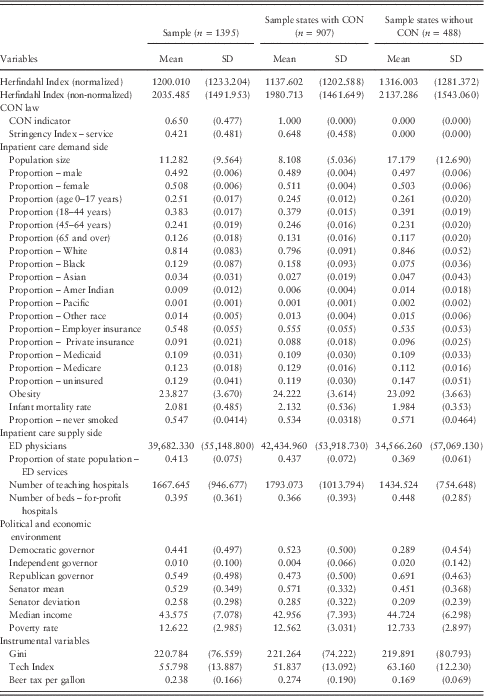
Table 1 provides the summary statistics of our sample with a comparison between states with and without CON laws. A detailed description of the variables can be found in the online Appendix Table A.2.
Summary statistics for variables

CON=Certificate of Need; ED=emergency department.
From Table 1, it seems the inpatient market is quite competitive since the HHI averages at 1200. Compared with HRRs that are in states without CON laws, those with CON laws on average have smaller populations, higher black population, lower proportion of people with no health insurance rate. A higher proportion of population use inpatient service in HRRs in states with CON, where we observe a lower proportion of beds are owned by for-profit hospitals. The governors of HRRs in states with CON are more likely to be Democratic, and their senators seem to be more cooperative as well.Footnote 6 HRRs in states with CON also have (1) higher Gini indices, which indicates a higher dispersion in income; (2) lower tech index, which indicates a slower speed to implement newer technology and (3) higher tax on beer, which implies the local government has a stronger incentive to promote healthy life style.Footnote 7
Methodology
Following the literature, we begin our analysis using a binary variable to indicate whether a state has CON law or not. In this model, we also control for other important variables as described previously that measure both the demand and supply side of inpatient care market, and the political environment of a state.Footnote 8 The estimated model is specified belowFootnote 9 :
 $${\rm HHI}\, {\equals}\, \alpha _{0} {\plus}\alpha _{1} {\rm CON}{\plus}{\mib{\alpha }} _{2} {\mib{X}} {\plus}{\epsilon},$$
where HHI measures inpatient market competition for each HRR, CON is a dummy variable that indicates if a state has the CON law or not, X includes all the other covariates and ε represents the error term.
Since the decision to retain the CON law in a state depends on state-specific characteristics, some of which are unobserved (state’s attitude towards inpatient care market competition for instance), we cannot rule out the possibility that the CON indicator is correlated with the error term in equation (1) without testing for it. That is, there is a possibility that the CON indicator may be an endogenous variable, which could result in biased estimates if we fail to tackle this issue properly. Therefore, we use a two-stage least squares (2SLS) modelFootnote 10 to estimate the effects of the CON laws treating CON law indicator as endogenous. We then use the Durbin–Wu test to investigate whether we have strong empirical evidence to believe that the CON indicator should be treated as an endogenous variable. The 2SLS estimation is done using the following specifications:
 $${\rm Stage}\,{\rm one\,\colon\,}\,{\rm CON}\, {\equals}\, \theta _{0} {\plus}{\mib{\theta }} _{1} {\mib{IV}} {\plus}{\mib{\theta }} _{2} {\mib{X}} {\plus}\zeta ,$$
 $${\rm Stage}\,{\rm two\,\colon\,}\;{\rm HHI}\, {\equals}\, \gamma _{0} {\plus}\gamma _{1} \,\widehat{{{\rm CON}}}{\plus} \gamma _{2} \mib X{\plus}\mu .$$
In the first stage, we estimate the likelihood of a state having CON law as a function of instrumental variables (IVs) and other covariates. And in the second stage, we estimate the market competition as a function of the estimated likelihood of having CON law from the first stage and other covariates. Theoretically, we need to include at least one IV for each endogenous variable in order to identify the model. In this specification, we use the index of science and technology in a state, the excise tax rate on beer and GINI index as our IVs.
These three variables are likely to influence whether a state has CON law but not likely to influence the inpatient care market competition for the following reasons: (1) the index of science and technology in a state is likely to be associated with the attitude of the state administration regarding how quickly new technologies can be adopted. A technologically advanced state will usually have a large technology sector that provides both jobs and taxes. Everything else remaining constant, such a state is less likely to have CON law since the law can hurt business interests in the state. Moreover, states worried that benefits yielding from such technology and innovation do not match the associated costs are highly likely to have the law. Extant literature supports these concerns that the efforts to innovate often overtake the effort to economize (Bodenheimer, Reference Bodenheimer2005a). As a result, these states are more likely to be behind those without the law from a technology and innovation standpoint. (2) The excise taxes on beer are a way to discourage drinking and hence prevent related chronic diseases in a state. As taxes paid per gallon of beer increase, the population will be motivated to pursue a healthier lifestyle in the form of reduced alcohol consumption. This would in turn reduce the state spending on population availing inpatient services on health issues as a consequence of drinking (NCHS, 2014). It could serve as a proxy for the attitude of a state towards promoting health of the state population, as well as towards reducing health care cost. A state with higher taxes on beer is more likely to have CON in effect because such a state is likely to be more concerned about health care expenditure. (3) Gini index is a good measure of the income inequality (World Bank, Reference Zeta2013).
In this case, it is possible that a large fraction of the population may be unable to pay for health care, particularly for inpatient services. Hospitals in states that have a higher proportion of low-income patients get subsidies towards the cost of care. For instance, as per the Medicare Inpatient Prospective Payment System (IPPS), the base payment rate (determined by the diagnosis-related group of a patient) to hospitals is adjusted by an add-on payment known as the disproportionate share hospital (DSH) adjustment (CMS, 2014). DSH basically provides for a percentage increase in Medicare payment for hospitals that serve a disproportionate share of low-income patients. In addition, it includes a provision to increase this IPPS payment for expensive patient cases. Therefore, the governments of such states would be concerned if hospitals could easily pass on the cost of unnecessary treatment to them and are more likely to have CON laws. This would help the state curb excessive expansion of hospital. This indicates that GINI index is less likely to influence the competition but rather is more likely to impact whether a state has a CON law or not. We use statistical tests to investigate the validity of these three IVs as well as apply a Durbin–Wu (Hausman type) test to determine if there is empirical evidence to suggest that the CON indicator is an endogenous variable.
Next, we extend our analysis by controlling for the stringency of the CON laws on service spending as well. By using the CON indicator, we can differentiate between CON states and non-CON states. However, within CON states, there is a large variation in the features of the law and one source of variation we are interested in is the stringency of the law. Moreover, states with CON laws can act similarly to those without it by setting a very high threshold (in some cases, threshold is listed as ‘None’) beyond which hospital expenditures are subject to review. As a result, it is vital to take this measure of the stringency of CON laws into account.Footnote 11 We construct an index to measure the stringency of CON law. This index takes value of 0 for states with CON law where a high threshold (where the law states ‘None’) is suggested, and it takes value of one for states with CON law where a low threshold (where the law states ‘any amount’) is suggested. Similar to the previous section, we start our analysis by treating the stringency of CON laws as exogenous as follows:
 $${\rm HHI}\, {\equals}\, \beta _{0} {\plus}\beta _{1} {\rm CON}{\plus}\beta _{2} {\mathop{\rm CON}\nolimits} \,stringency{\plus}{\mib{\beta }} _{3} {\mib{X}} {\plus}\eta .$$
For the reasons highlighted earlier, it is possible that the CON stringency may be an endogenous variable as well. In order to tackle this empirical issue and test for the endogeneity of the law’s stringency, we estimate the effect of the CON laws on market competition by using a 2SLS model as followsFootnote 12 :
 $${\rm Stage}\,{\rm one}\,\colon\,\,{\rm CON}\,{\rm stringency}\, {\equals}\, \varphi _{0} {\plus}{\mib{\varphi }} _{1} IV {\plus}\varphi _{2} {\rm CON}{\plus}{\mib{\varphi }} _{3} {\mib{X}} {\plus}\omega ,$$
 $${\rm Stage}\,{\rm two\,\colon\,}\;{\rm HHI}\, {\equals}\, \delta _{0} {\plus}\delta _{1} \,{\rm CON}\widehat{{{\rm String}}}{\rm ency}{\plus}\delta _{2} {\rm CON}{\plus}\delta _{3} \mib X{\plus}\vartheta .$$
In this specification, we use three IVs for stringency: tech index, GINI index and the excise tax rate on beer. The relationship between tech index and service stringency could go either way. On the one hand, in a technologically advanced state, hospitals would have a greater tendency to upgrade technology frequently which can lead to an increase in the price of health care. To counter this, the government of the state would want a stringent CON law. On the other hand, such technologically advanced states will also have a large technology sector that provides both jobs and taxes. Since a strict CON law hurts the technology industry, therefore this reduces the incentive of a technologically advanced state to have a strict CON law.
As noted above, the governments of states that serve a high proportion of low-income patients and have concerns about hospitals easily passing on the cost of unnecessary treatment to patients due to support from the IPPS setup, would have an incentive to curb excessive expansion of hospital by lowering the threshold on service expenditures by health care providers. This indicates that GINI index is less likely to influence the competition but rather is more likely to impact the CON law in a state.
Similarly, as noted above, a state with higher taxes on beer is more likely to have a stringent CON law because such a state is likely to be more concerned about health care expenditures that result from poor behavioral (increased alcohol consumption) choices of citizens. The validity of these IVs and the endogeneity of CON law stringency are tested as well.
Results
In this paper, we explore the effects of CON laws on market competition in the inpatient market at the HRR level, wherein the competition is measured by the HHI. The market in an HRR is more competitive when it has a smaller HHI. The main results of our empirical analysis are presented in Tables 2 and 3, with our preferred specification presented in Table 3. Our main findings include: (1) in general, CON laws (represented by the variable CON indicator in the result tables) are associated with higher competition in the inpatient market. However, the magnitude and statistical significance of this effect diminishes when we incorporate a measure of the stringency of the law. (2) Durbin–Wu test shows that we cannot reject the hypothesis that CON laws and their stringency could be treated as exogenous in estimation.
Effects of Certificate of Need (CON) indicator on inpatient market competition: Herfindahl–Hirschman Index using health referral region level market shares
ED=emergency department; Gov_demo=democratic governor; Gov_ind=independent governor.
*Statistical significance at the 10% level.
**Statistical significance at the 5% level.
***Statistical significance at the 1% level.
Effects of Certificate of Need (CON) indicator and its stringency on inpatient market competition: Herfindahl–Hirschman Index using health referral region level market shares

ED=emergency department; Gov_demo=democratic governor; Gov_ind=independent governor.
*Statistical significance at the 10% level.
**Statistical significance at the 5% level.
***Statistical significance at the 1% level.
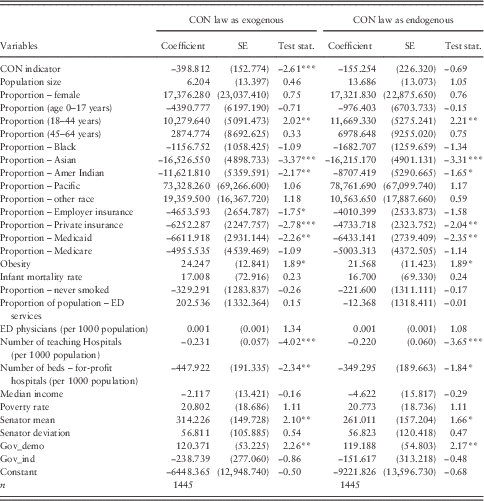
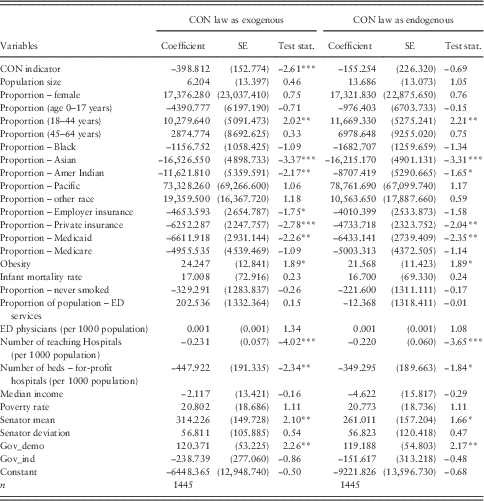
Table 2 presents the results of estimation on inpatient market competition only controlling for a binary indicator of whether a state has CON law or not. We have included results from both models where we treat CON indicator as exogenous and endogenous. The results of the first stage estimation are reported in online Appendix Table A.3.
In the endogenous model, the Durbin–Wu test (with a p-value of 0.4299) shows that we cannot reject the hypothesis that CON indicator could be treated as exogenous.Footnote 13 In both specifications, CON indicator is associated with a lower HHI, which implies a more competitive market. Specifically, states with CON laws are associated with a 32.44% decrease in HHI, which indicates a more competitive market. This could indicate that the effect of CON laws to prevent incumbents from excessive expansion dominates that of preventing new entrants to the market.Footnote 14
Other findings from Table 2 include the following: (1) we find that inpatient competition is negatively related to the proportion of population that is aged between 18 and 44. Intuitively, this could be due to better health outcomes of this age group compared with the 65 and older group and therefore reduced needs for inpatient services of a hospital. This in turn would discourage competition. (2) We also find that inpatient competition is positively related with the proportion of Asians. This can be attributed to the relatively higher socio-economic status (Census Bureau, 2013) and better health outcomes (NCHS, 2012) associated with this population group compared with Whites. (3) An increase in the proportion of obese population is associated with a less competitive market. An increase in obesity rates could mean an increase in population that makes poor life style choices often due to their poor socio-economic standing. These individuals would also have a reduced ability to afford hospital inpatient services and this negatively affect competition. (4) An increase in the number of beds that are owned by for-profit hospitals (per 1000 population) relates to a more competitive market. (5) We also find that everything else remaining constant, a liberal state (captured by a high value of the senator mean variable) is likely to have a less competitive inpatient market.
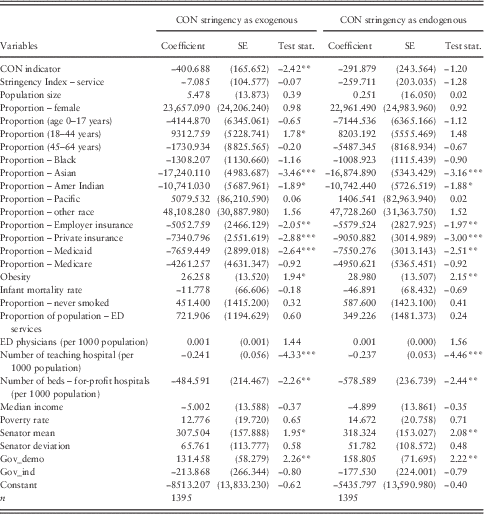
As mentioned earlier, only accounting for the presence or absence of the CON law can be problematic not only because the stringency of the CON law can vary a lot across states that have this legislation in effect, but also because a state with a very relaxed CON law is essentially not very different from a state without the law. Therefore, it is vital to take into account CON law characteristics in order to better understand the effects of CON laws. In Table 3, we present our estimates of CON law effects with the stringency of the laws taken into account. The estimation result of first stage is presented in the online Appendix Table A.4.
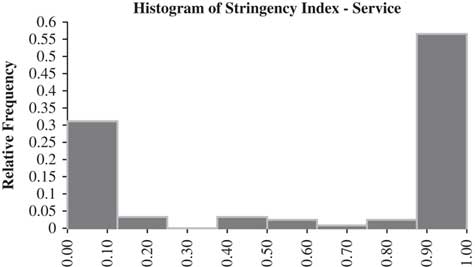
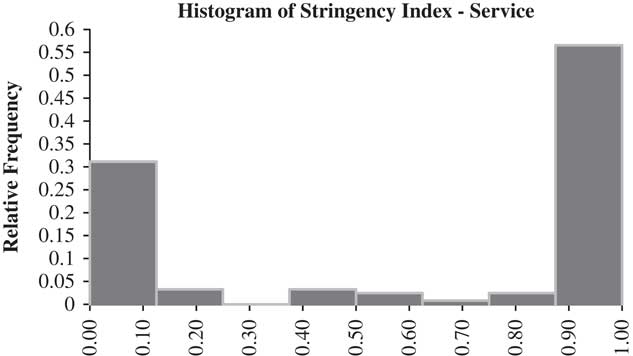
The Durbin–Wu test (with a p-value of 0.5048) indicates that we do not have sufficient empirical evidence to reject the exogeneity assumption of the CON stringency.Footnote 15 Further, in both specifications, there is no major difference in the direction and magnitude of the estimated effects of CON law. Although only the coefficient of the CON indicator is statistically significant at the 5% level, CON indicator and equipment stringency index are tested to be jointly significant at the 5% level.Footnote 16 Specifically, states with CON laws are associated with a 32.55% decrease in HHI, which indicates a more competitive market. Furthermore, we believe the effects of CON laws become less significant possibly due the fact that most states with the law have a rather strict version of the law, whereby they set very low thresholds for requiring CON approval (see Figure 1). Specifically, less than 40% of the states have a stringency index value <0.5, and more than 60% of the states have this index value >0.75 (which indicates a strict law).
Distribution of service stringency index (Certificate of Need states)
Compared with results presented in Table 2 wherein we only control for the binary CON indicator, our findings (such as the effects of population demographics and obesity rate) still hold.Footnote 17
Conclusions
As discussed in the first section of the paper, CON laws could not only prevent new entrants from entering the inpatient care market, but also promote market competition by restricting excessive expansion. It is not clear which of the two effects would dominate. Our results indicate that CON laws and their stringency are associated with a more competitive inpatient market. Besides, we do not find sufficient statistical evidence to reject the exogenous assumption of CON and its features.
The other key findings include the following: (1) we find that inpatient competition is negatively related to the proportion of population that is aged between 18 and 44. (2) We also find that inpatient competition is negatively related with the proportion of Asian-Americans in a state. (3) An increase in the proportion of obese population is associated with a less competitive market. (4) An increase in the number of beds that are owned by for-profit hospitals (per 1000 population) relates with a more competitive market. (5) A liberal state is likely to have a less competitive inpatient market.
In summary, our results indicate that CON laws can help increase inpatient market competition. Our findings have significant policy implications with regard to CON law’s impact on health care. The implication of our results can aid public policy makers when deciding the appropriate health programs or legislative framework to promote health care market competition and thereby facilitate high-quality health care.
There are two limitations and therefore potential avenues for future research in this study that are worth mentioning. (1) The threshold CON laws impose on capital expenditure may also be relevant to inpatient market besides one imposed on service-related expenditures. However, during the period we study, we noted significant inconsistency in how information on this threshold of capital expenditure was collected. We leave this matter for future investigation when we are able to obtain cleaner information on it. (2) The causality between CON laws and inpatient market competition is not studied in this paper. But it can be an interesting future research question.
Acknowledgments
We thank the editor and an anonymous referee for helpful comments and suggestions. We would also like to thank the Center for Excellence in Teaching and Learning (CETL), Coles College of Business and Department of Economics, Finance and Quantitative Analysis at Kennesaw State University for their financial support to this research.
Financial Support
This research was funded by Kennesaw State University through three separate grants from CETL, Coles College of Business and Department of Economics, Finance and Quantitative Analysis.
Supplementary Material
To view supplementary material for this article, please visit https://doi.org/10.1017/S1744133117000184