INTRODUCTION
Intercropping cereals with legumes for forage or food production is used in many parts of the world for soil conservation and because intercrops, including legumes, are known to enhance forage crude protein concentration compared with cereal sole cropping and to utilize resources more efficiently (Anil et al., Reference Anil, Park, Phipps and Miller1998; Lauriault and Kirksey, Reference Lauriault and Kirksey2004; Lesoing and Francis, Reference Lesoing and Francis1999; Papastylianou, Reference Papastylianou2004; Qamar et al., Reference Qamar, Keatinge, Mohammad, Ali and Khan1999). Also, intercropping can enhance weed suppression (Banik et al., Reference Banik, Midya, Sarkar and Ghose2006; Carr et al., Reference Carr, Gardner, Schatz, Zwinger and Guldan1995; Szumigalski and Van Acker, Reference Szumigalski and Van Acker2005). In particular, Carr et al. (Reference Carr, Gardner, Schatz, Zwinger and Guldan1995) found that wheat (Triticum aestivum)–lentil (Lens culinaris) intercrops suppressed weed biomass more than either sole crop. Szumigalski and Van Acker (Reference Szumigalski and Van Acker2005) found that wheat–canola (Brassica napus) and wheat–canola–pea (Pisum sativum) intercrops provided greater weed suppression than sole crops, indicating synergism among crops within intercrops. The apparent increased competitiveness of intercropping systems makes them potentially useful for adoption of low-input and organic farming systems in which chemical weed control can be reduced or eliminated (Anil et al., Reference Anil, Park, Phipps and Miller1998; Szumigalski and Van Acker, Reference Szumigalski and Van Acker2005).
Common vetch (Vicia sativa) is grown extensively in the Mediterranean region. It is an annual legume with a climbing growth habit and contains high levels of protein (Hadjichristodoulou, Reference Hadjichristodoulou1978). Sole crops of common vetch or winter cereals provide unsatisfactory forage production (Osman and Nersoyan, Reference Osman and Nersoyan1986). Common vetch produces low yields particularly in areas with low rainfall (Hadjichristodoulou, Reference Hadjichristodoulou1978) and hinders harvest because of lodging (Robinson, Reference Robinson1969). Winter cereals produce high yields in terms of dry weight, but their forage has a low concentration of crude protein (Lawes and Jones, Reference Lawes and Jones1971). Mixtures of annual legumes, such as common vetch, lentil, pea and faba bean (Vicia faba), with winter cereals are widely used for forage production in many countries (Carr et al., Reference Carr, Gardner, Schatz, Zwinger and Guldan1995; Papastylianou, Reference Papastylianou2004; Qamar et al., Reference Qamar, Keatinge, Mohammad, Ali and Khan1999). Intercropping of cereals with legumes provides structural support for legume growth, improves light interception and facilitates mechanical harvesting, and common vetch in mixtures improves the quality of forage by increasing protein concentration (Anil et al., Reference Anil, Park, Phipps and Miller1998; Robinson, Reference Robinson1969; Thompson et al., Reference Thompson, Stout and Moore1992).
Despite the fact that competitive ability against weeds is one of the factors which can affect forage yield and quality, winter cereal–legume intercrop ability to suppress weeds has still not been extensively studied (Banik et al., Reference Banik, Midya, Sarkar and Ghose2006). In particular, the effect of common vetch and its intercrops with winter cereals on the population dynamics of sterile oat (Avena sterilis spp. sterilis), one of the most common and troublesome grass weeds of winter cereals and legumes grown in Mediterranean countries (Damanakis, Reference Damanakis1983; Navarrete and Fernandez-Quintanilla, Reference Navarrete and Fernandez-Quintanilla1993), is not clearly defined. Dhima and Eleftherohorinos (Reference Dhima and Eleftherohorinos2001), who conducted experiments in northern Greece, found that 110 sterile oat plants m−2 reduced winter wheat and triticale grain yield by 61%. Also, the yield reduction of fine barley varieties due to 120 sterile oat plants m−2 ranged from 8 to 67% (Dhima et al., Reference Dhima, Eleftherohorinos and Vasilakoglou2000). Sterile oat control in cereals or legumes is usually achieved by application of selective herbicides. However, competitive intercrops, used in rotations for improving forage production, could be a useful tool for sterile oat population reduction.
The objective of this study was to determine the competitive ability of common vetch and four winter cereal sole crops (wheat, triticale (× Triticosecale), barley (Hordeum vulgare) and oat (Avena sativa)) as well as intercrops of common vetch with each of the above winter cereals, in a 35:65 cereal:common vetch seeding ratio based on seed numbers, against sterile oat. The 35:65 seeding ratio of common vetch–cereal intercrops was used because data from preliminary experiments (Lithourgidis et al., Reference Lithourgidis, Dhima, Vasilakoglou and Yiakoulaki2004) indicated that this ratio generally had a protein yield advantage over other seeding ratios, without great reduction in total dry biomass yield.
MATERIALS AND METHODS
Site
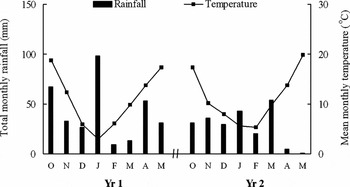
A field experiment was conducted in the 2003/2004 (Yr 1) and 2004/2005 (Yr 2) growing seasons at the University Farm of the Aristotle University of Thessaloniki in northern Greece (22°59′6.17″E, 40°32′9.32″N). The experiment was established on a sandy loam soil with pH 7.0 and organic matter content 0.99%, N–NO 35.7 ppm, P (Olsen) 7.8 ppm and K 156.6 ppm (0–30 cm depth). Mean monthly temperature and rainfall data recorded daily about 200 m away from the experimental area are given in Figure 1.
Total monthly rainfall and mean monthly temperature from October (O) through May (M) when field experiments were conducted.

Experimental design and treatments
In both years, the preceding crop in the experimental area was winter wheat that was harvested in mid June. Volunteer plants of winter wheat were observed at very low densities during the experiment. In Yr 1, a uniformly distributed natural sterile oat infestation of 20–30 plants m−2 (a common sterile oat density in winter cereals in Greece) was observed in early December (Damanakis, Reference Damanakis1983), while the infestation in Yr 2 was 8–9 plants m−2 (lower than common density for sterile oat in winter cereals in Greece). The uniform distribution of the natural sterile oat infestation in the experimental plots was confirmed by its similar emergence pattern in the 3-m uncultivated buffer zone around the experimental area. Sterile oat-free plots were not included in this study because of the lack of one herbicide which could be used in all cereal–common vetch intercrops. The experimental design was a randomized complete block design with nine treatments and four replications. Common vetch variety ‘Melissa’ and four winter cereal sole crops, winter wheat variety ‘Yecora’, triticale variety ‘Thisvi’, two-row barley variety ‘Thessaloniki’ and oat variety ‘Pallini’ were sown on 5 November 2003 and 7 November 2004, at a seeding rate of about 150 kg ha−1 (280, 400, 410, 400 or 415 seeds m−2, respectively) to reflect the common practice. Intercrops of each of the four winter cereals with common vetch were sown in 35:65 winter cereal–common vetch seeding ratio based on seed numbers. This seed ratio corresponded to 340–347 seeds m−2 (119–122 and 221–226 seeds m−2 for cereals and common vetch, respectively). In all plots, crops were planted with commercial equipment (16-row sowing machine, Model 400, Bekam Co., Greece). The row spacing was 16 cm and the seeds were mixed and sown together. All crops were fertilized with 80 and 40 kg ha−1 of N and P2O5, respectively, as diammonium phosphate (20-10-0), which was incorporated into the soil two weeks before planting. The experimental plots were 5 m × 20 m, separated by a 2-m cultivated buffer zone. Irrigation was not applied during either growing season and no serious incidence of insects or diseases was observed.
Sampling
Winter cereal, common vetch and sterile oat densities were determined by counting plant number in a 1 m × 1 m area in the centre of each plot on 15 January of both growing seasons (about nine weeks after planting) when crops and most sterile oat seedlings had emerged. Common vetch, cereal and sterile oat plants were harvested in a 1 m × 1 m area located in the centre of each plot three weeks after tillering of cereals (Zadoks growth stage 30) (Zadoks et al., Reference Zadoks, Chang and Konzak1974) in order to determine the sterile oat stem number and fresh weight, as well as the fresh weight of the sole crops and intercrops grown with sterile oat. The samples were taken on 31 March 2004 and 2 April 2005.
The sole crops and the intercrops were harvested at the pod-setting stage of common vetch and about the milky ripe stage of cereals (Zadoks growth stage 75) (Zadoks et al., Reference Zadoks, Chang and Konzak1974). The harvest was conducted on 23 May 2004 and 26 May 2005 (about 10 weeks after tillering) by taking random samples from a 1 m × 1 m area of each plot. The plants were cut to ground level, and each species (common vetch, cereal and sterile oat) was separated by hand; their dry biomass (DB) evaluated by drying the samples in an oven at 70 °C to constant weight. Then, the DB of each species was expressed as a percentage of the total DB.
Competition indices
The relative sterile oat density (RSOD) expressed as stem number m−2, the relative sterile oat dry biomass (RSOB), the ability to compete (AC) and the land-equivalent ratio (LER) were calculated to allow for the interpretation of results.
The RSOD and RSOB were calculated as in Equation 1 (Szumigalski and Van Acker, Reference Szumigalski and Van Acker2005):

where Id(b) is the sterile oat density (or biomass) in the intercrop, and Sd(b)i and Sd(b)ii are the sterile oat density (or biomass) within the sole crops that make up the given intercrop. RSOD or RSOB <1 indicates possible synergistic sterile oat suppression between the component crops of a mixture, whereas a value >1 indicates a possible antagonism of the sterile oat suppression effect (Szumigalski and Van Acker, Reference Szumigalski and Van Acker2005).
The ability to compete (AC), which measures the ability of a crop treatment to suppress sterile oat, was calculated according to Equation 2 (Szumigalski and Van Acker, Reference Szumigalski and Van Acker2005):

where bw is the sterile oat DB and bt is the total biomass (crops and sterile oat DB).
LER, which shows relative area under sole crops to achieve intercrop DB under the same conditions, was calculated as in Equation 3 for crop DB yield (Oyejola and Mead, Reference Oyejola and Mead1982):

where Ia and Ib are the DB of common vetch and winter cereal, respectively, as intercrops, and Sa and Sb are the DB of common vetch and cereal, respectively, as sole crops. The LER was used as the criterion for mixed stand advantage as both common vetch and cereal were desired species. LER >1 indicates that the intercropping favoured the growth and yield of the species; LER <1 indicates that intercropping affects negatively the growth and yield of the plants grown in intercrops (Oyejola and Mead, Reference Oyejola and Mead1982).
Statistical analyses
A combined over year analysis of variance (ANOVA) was performed for sterile oat stem number and fresh weight, as well as for crop plant densities and yield data. Environments were analysed separately when an interaction between years and treatments was found for any trait. A combined over year ANOVA was performed for RSODs, RSOBs and LERs taking the four intercrops as fixed factors, as well as for ACs taking the five sole crops plus the four intercrops as fixed factors. Homogeneity of variances was examined with Bartlett's test. Variances not meeting ANOVA assumptions were transformed appropriately. Sterile oat plant and stem number, RSOD and RSOB were square-root(x) transformed prior to ANOVA, while sterile oat fresh weight data were log10(x) transformed.
The RSODs, RSOBs, ACs and LERs were calculated separately for each sole crop/intercrop replicate with the replicate stem number or biomass values for the numerators and the mean sole crop/intercrop values across all replicates for the denominators in equations 1, 2 and 3 (Szumigalski and Van Acker, Reference Szumigalski and Van Acker2005).
The SPSS (version 14) program was used to conduct the ANOVA.
RESULTS
Sterile oat response
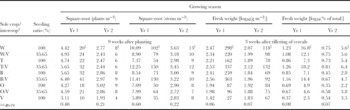
In both years, at nine weeks after planting crop plant densities mirrored the seeding ratios used (data not shown). Fewer sterile oat plants emerged in common vetch sole crop than in other treatments (Table 1). Sterile oat plant densities in intercrops were similar to those in corresponding cereal sole crops.
Sterile oat plant number (nine weeks after planting), as well as stem number and fresh weight (three weeks after cereal tillering) in different sole crop–intercrop treatments during the 2003/2004 (Yr 1) and 2004/2005 (Yr 2) growing seasons.

†W: wheat, T: triticale, B: barley, O: oat, V: vetch.
‡Back-transformed values.
At three weeks after tillering of cereals, sterile oat stem number, fresh weight and fresh weight percentage were significantly affected by sole crop–intercrop treatments (p < 0.001). In Yr 1, stem number or fresh weight of sterile oat grown in common vetch sole crop was lower than that in cereal sole crops or their intercrops with common vetch, except for sterile oat stem number in oat sole crop (Table 1). The stem number or the fresh weight of sterile oat grown in cereal sole crops was similar to that in their intercrops with common vetch, except for sterile oat fresh weight in intercrop of triticale and sterile oat stem number in intercrops of triticale or barley (Table 1). In Yr 2, sterile oat stem number and fresh weight recorded in common vetch sole crop were similar to those recorded in most of the cereal sole crops or intercrops with common vetch with the exception of sterile oat fresh weight in wheat sole crop and common vetch intercrop with triticale where it was greater than that in common vetch sole crop. In Yr 1, the lowest sterile oat fresh weight percentage was recorded in common vetch sole crop, whereas in Yr 2 the lowest fresh weight percentage was recorded in oat sole crop.
At harvest, sterile oat DB was significantly affected by sole crop–intercrop treatments (p < 0.001). In Yr 1, sterile oat DB in common vetch sole crop was lower than that in the other sole crops or intercrops (Figure 2); however, sterile oat DB in common vetch sole crop was in most cases similar to that in cereal sole crops or their intercrops in Yr 2. In particular, sterile oat DB in common vetch sole crop was lower by 43 to 75% in Yr 1 than that in the other sole crops or intercrops. In Yr 1, sterile oat DB in triticale–common vetch intercrop was larger than in triticale sole crop. However, in wheat–common vetch intercrop sterile oat DB was significantly reduced compared with wheat sole crop, but intercropping with barley or oat did not affect this sterile oat trait (Figure 2).
Sterile oat and total dry biomass (DB) at harvest in different sole crop - intercrop treatments during the 2003/2004 (Yr 1) and 2004/2005 (Yr 2) growing seasons. W: wheat, T: triticale, B: barley, O: oat, V: vetch, DB: dry biomass.

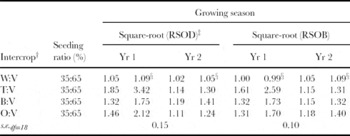
The RSOD and RSOB were significantly affected by the sole crop–intercrop treatments (p < 0.05). In particular, the greatest RSOD and RSOB in Yr 1 were recorded in triticale–common vetch intercrop (Table 2). However, RSOD in oat–common vetch intercrop did not differ from those in the other cereal–common vetch intercrops. Also, sole crops or intercrops did not affect the RSOD or RSOB in Yr 2. In both years, a significant RSOD or RSOB <1 was not observed in the intercropping treatments, whereas both RSOD and RSOB of triticale, barley and oat intercrops with common vetch were > 1, mainly in Yr 1.
Relative sterile oat density (RSOD) and biomass (RSOB) for different intercropping treatments during the 2003/2004 (Yr 1) and 2004/2005 (Yr 2) growing seasons.

†W: wheat, T: triticale, B: barley, O: oat, V: vetch.
‡RSOD: relative sterile oat density, RSOB: relative sterile oat biomass.
§Back-transformed values.
Crop response
In both years, sole crop-intercrop treatments significantly affected the total DB yield (p < 0.001). Total DB was the greatest in cereal sole crops, whereas common vetch sole crop provided less DB than the cereal sole crops (Figure 2). However, triticale and oat provided larger DB than winter wheat and barley. The total DB was reduced when the cereal was grown with common vetch as an intercrop compared with cereal sole crop, except for triticale and triticale–common vetch intercrop in Yr 1.
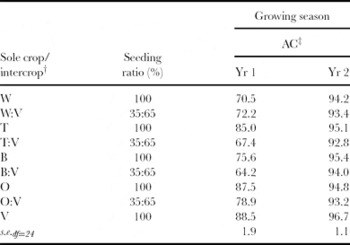
The AC indices were significantly affected by the sole crop–intercrop treatments (p < 0.001) in Yr 1, but not in Yr 2 (Table 3). In Yr 1 common vetch, triticale and oat sole crops tended to have a greater AC than the other crop treatments. In Yr 1, the AC of intercrops with common vetch of triticale, barley or oat was lower than those of the corresponding cereal sole crops. However, the AC of the wheat–common vetch intercrop was similar to the AC of the wheat sole crop.
Ability to compete for different sole crop – intercrop treatments during the 2003/2004 (Yr 1) and 2004/2005 (Yr 2) growing seasons.

†W: wheat, T: triticale, B: barley, O: oat, V: vetch.
‡AC: ability to compete = 100 − [(bw/bt)100], where bw is the sterile oat dry biomass and bt is the total biomass (crops and sterile oat dry biomass).
In both years, the LER indices ranged from 0.77 to 1.03 (data not shown). Significant differences in LER were not recorded among the intercropping treatments.
DISCUSSION
Sterile oat response
The fact that intercropping of most cereals with common vetch generally did not affect sterile oat growth and biomass indicates that most of the intercrops did not offer a significant synergistic competitive effect against sterile oat compared with sole crops. Mohler and Liebman (Reference Mohler and Liebman1987) in intercropping studies with barley–pea found that crop treatments had no significant effect on weed density and biomass relative to barley sole crop, but provided a synergistic suppressive effect on weed productivity relative to pea sole crop. Banik et al. (Reference Banik, Midya, Sarkar and Ghose2006) found significant reduction of winter weed population and biomass under an intercropping system of wheat with chickpea (Cicer arientinum) compared with wheat sole crop, while the weed population and biomass in these intercrops were comparable with those in the chickpea sole crop. In agreement with these findings, Carr et al. (Reference Carr, Gardner, Schatz, Zwinger and Guldan1995) reported that intercropping lentil with wheat was effective in reducing biomass production of weeds compared with lentil sole crop. The greater weed suppression observed in these experiments, compared with the results of our study, could be attributed to different seeding ratios and different species used in intercrops, which may have resulted in higher complementarities between intercrop species and consequently greater competitive ability towards weeds (Banik et al., Reference Banik, Midya, Sarkar and Ghose2006; Carr et al., Reference Carr, Gardner, Schatz, Zwinger and Guldan1995). An increase of common vetch seeding proportion in intercrops with cereals could provide an increased common vetch contribution to competition (Caballero et al., Reference Caballero, Goicoechea and Hernaiz1995) and possible greater suppressive effect on sterile oat.
The greater competitive ability of common vetch sole crop during Yr 1 could be attributed to its vigorous growth rate during the early stages of growth, which resulted in greater stem density compared with cereal sole crops or intercrops (data not shown), as well as to less sterile oat emergence. Banik et al. (Reference Banik, Midya, Sarkar and Ghose2006) found less weed biomass production under chickpea sole crop than wheat sole crop and this difference was attributed to greater chickpea weed smothering efficiency. Lemerle et al. (Reference Lemerle, Verbeek and Diffey2006) and McDonald et al. (Reference McDonald, Hollaway and McMurray2007) also found that the competitive ability of both field pea and lentil was increased with increasing plant population. However, competitiveness of intercrop against sterile oat could also be increased by maximizing crop density and biomass produced through selecting the appropriate seeding ratios or by growing crops under more favourable environmental conditions (Carr et al., Reference Carr, Gardner, Schatz, Zwinger and Guldan1995). In Yr 2, the lower sterile oat emergence along with the lower rainfall recorded during April–May 2005, which may have reduced sterile oat competitive ability, could account for the lack of differences among common vetch sole crop and most of the other sole crop or intercrop treatments on sterile oat growth. These results are consistent with those of Gonzalez Ponce (Reference Gonzalez Ponce1988), who found that sterile oat was more sensitive to dry soil conditions than wheat.
Crop response
The generally lower total DB of the four intercrops than that of the cereal sole crops is in agreement with the results reported by Caballero et al. (Reference Caballero, Goicoechea and Hernaiz1995), who found that the oat–common vetch intercrop produced 57% less DB, than the oat sole crop, whereas the same intercrop produced 34% more DB than the common vetch sole crop. However, the same researchers reported that intercrops provided higher forage quality than oat sole crop. The economic advantage of common vetch intercropping systems with the four winter cereals was reported by Dhima et al. (Reference Dhima, Lithourgidis, Vasilakoglou and Dordas2007) using the monetary advantage index (MAI) and the intercropping advantage (IA). In particular, the intercropping system of common vetch-oat provided the greatest MAI (+105.29) and IA (+4.55), which indicated an economic yield advantage compared with the other intercropping systems.
The overall AC results suggest that intercropping of wheat, triticale, barley or oat with common vetch generally did not enhance the ability of cereal–common vetch intercrops to compete with sterile oat. In contrast to these findings, Szumigalski and Van Acker (Reference Szumigalski and Van Acker2005) reported that AC was slightly greater in wheat–pea intercrop than in the wheat sole crop. The AC findings also showed that intercrops had in most cases less ability to compete with sterile oat than the common vetch sole crop. The lack of AC differences in most of crop treatments during Yr 2 could be attributed to lower sterile oat population and the lower rainfall recorded in Yr 2.
The lack of significant differences in LER among the four intercropping treatments agree with results published by Szumigalski and Van Acker (Reference Szumigalski and Van Acker2005) who found that the biomass LER ranged from 0.91 to 1.30 for wheat–pea intercrops without great differences between intercropping treatments. Chen et al. (Reference Chen, Westcott, Neill, Wichman and Knox2004) found that LER, on a biomass basis of three barley–pea intercropping systems, ranged from 1.05 to 1.24, which indicates a production advantage of intercropping systems. Carr et al. (Reference Carr, Gardner, Schatz, Zwinger and Guldan1995) also reported advantage from wheat and lentil sown in the same row at a wheat:lentil ratio of 214:218 seeds m−2.
CONCLUSIONS
The results of this study indicated that intercropping of the four cereals with common vetch in a 35:65 seeding ratio did not enhance their combined competitive ability against sterile oat compared with sole crops. Also, the LER was not greater than 1 and did not differ among the intercrop treatments studied. The least sterile oat emergence or total DB was observed in the common vetch sole crop. However, all cereal sole crops showed higher total DB yields than their intercrop treatments or the common vetch sole crop. These findings show that further intercropping experiments with other legumes and in various seeding ratios should be conducted in order to find intercrops that are more productive and competitive against aggressive weeds, such as sterile oat, and could be used in the future in sustainable production systems.