

Nanotechnology — the modern, rapidly expanding scientific field that considers the use of nanoparticles (particles of different composition, and in particular with a size of less than 100 nanometers [nm]) — is a multidisciplinary field that is revolutionizing medicine. Nanomedicine involves the design, fabrication, and use of nanoscale materials for preventive, therapeutic, and diagnostic purposes. Reference Mamo, Moseman, Kolishetti, Salvador-Morales, Shi, Kuritzkes, Langer, von Andrian and Farokhzad1
Early in this century, Jürgen Altmann found that there had been little scholarly research on possible military uses of nanotechnology, but there had been discussions of such applications in governments and in military journals. Reference Altmann2 In reviewing the information available at that time, he concluded that in regard to chemical and biological weapons, nanotechnology would provide “qualitatively new options” but that most applications of nanotechnology would “need 10 to 20 years to mature.” Then, toward the end of the first decade of the century, Margaret Kosal considered dual-use issues such as novel nanotechnology-enabled biochemical weapons and nanoparticles with toxic or deleterious health effects in detail in her book Nanotechnology for Chemical and Biological Defense. Reference Kosal3 Using a similar methodology to that employed in this article, she noted that “nanotechnology has emerged as a well-funded discipline that, like biotechnology, carries the potential for groundbreaking applications and the potential for unpredictable harm.” Nanotechnology-enabled biochemical weapons were identified as a significant threat by the participants in an associated workshop, but, again, it was concluded that “the world is likely 20 years away from the full impact of nanotechnology on defensive capabilities.”
In its study of the security implications of synthetic biology and nanobiotechnology for the 2011 Seventh Review Conference of the Biological and Toxin Weapons Convention (BTWC), the United Nations Interregional Crime and Justice Research Institute (UNICRI) added the issue of the convergence of science and technology to its considerations by referring to a 2002 U.S. National Science Foundation report that suggested that there could be developments of concern based on synergistic combinations of advances in nanotechnology, biotechnology, information technology, and cognitive neuroscience. In regard to the risks of hostile applications of nanobiotechnology, the UNICRI once again saw these mainly in the future:
In the short term, it is highly unlikely that non-state actors would choose the nanotechnology path over easier means of acquiring and employing bioweapons, but it might occur in specific cases in the medium term. There could be a significant risk of nefarious applications in the longer term as the underlying technologies mature. 4
Of course, state-level capabilities would likely arise faster than those of nonstate actors. The possible use of nanotechnology for defensive purposes Reference Zukas, Cabrera, Harper, Kunz, Lyszczarz, Parameswaran, Rothschild, Sennett, Switkes, Viswanath, Nagarajan, Zukas, Hatton and Lee5 and in a variety of weapons systems Reference Leins6,7,Reference Altmann, Martellini and Malizia8 has continued to be a topic of extensive discussion. Not surprisingly, international legal analyses have also been published about the implications of such developments. Reference Nasu9 These include an extensive review of the implications of nanotechnology weapons for the prohibitions embodied in the chemical and biological nonproliferation regime which is the focus here. In this analysis, Evan J. Wallach concluded:
As a matter of practical science and governing international law, there is really no justifiable argument that any of these potential nanoweapons are uncovered by existing law; but it would certainly do no harm to modify both the BWC and CWC to include supplementary language making clear that the states parties intend to cover all new forms of analogous weapons. In fact, that just might do the world some good. Reference Wallach10
So, in his view, the regime is basically sound but needs continued care and attention as science and technology develops.
The Chemical Weapons Convention (CWC) and the Biological and Toxin Weapons Convention (BTWC) are the international treaties that prohibit the development and use of chemical and biological agents as weapons. There is an increasing need for consideration of the convergence of biology and chemistry within the two conventions, as both cover the development and use of what have been termed biochemical agents, in particular toxins and bioregulators, that can affect the functions of physiological systems such as the central nervous system (CNS). Although these treaties contain strong bans on chemical and biological weapons, some aspects present cause for concern. A major shortcoming of the BTWC is the lack of a verification regime that would bolster assurance that states parties are complying with the prohibitions, including those covering biochemical weapons. While the CWC is equipped with a comprehensive verification regime, it has yet to fully deal with the relatively new challenges that bioregulators pose to the treaty.
In light of the upcoming Fourth Review Conference of the CWC in late 2018, this article examines the situation now, toward the end of the second decade of the century, when it is becoming almost routine to find papers in the open literature with titles such as “Nanomedicine as a non-invasive strategy for drug delivery across the blood brain barrier.” Reference Tam, Sosa, Liu, Yao and Priestley11 The article begins by reviewing how nanotechnology has contributed greatly to improvements in targeted delivery of biochemical agents, at the same time addressing critical issues in dispersal and targeting. This is followed by an investigation of recent work on the direct targeting of nanomaterials to affect the functions of synapses in the CNS and then a discussion of how critical neuronal networks might be targeted through such means by those with hostile intentions. Our primary interest is whether recent advances could facilitate hostile misuse. To that end, we consider specifically whether the convergence of these fields of research should be of particular concern.
Nanotechnology and targeted delivery of biochemicals
It stands to reason that the successful application of bioactive materials for either therapeutic or hostile purposes depends on how effectively they are delivered to their target. In medicine, delivery is a crucial aspect of drug development, gene therapy, and immunotherapy. Also, the process of converting a biochemical agent into a weapon involves packaging it into a form that can be disseminated effectively to its target. Analysts noted early on that, ultimately, successful delivery of such agents would involve the development of a vector (carrier of the payload) that encapsulates, protects, penetrates, and releases protein-based or nucleic acid (DNA, RNA)-based agents into target cells while avoiding rejection by the immune system. Reference Petro, Plasse and McNulty12 Additionally, DNA-based gene agents would have to be efficiently expressed (activated) and the gene product synthesized in adequate amounts for a prolonged period of time after release of the gene by the carrier.
Toxins and bioregulators as relevant biochemical agents
In the run-up to the Third Review Conference of the CWC in 2013, the Royal Society released a report on convergent trends in biology and chemistry and their impact on the scope of the CWC. The report stated that
Some characteristics of biological weapons, such as incubation period and contagiousness, clearly distinguish them from chemical weapons. However, the increasing convergence of chemistry and biology makes such sharp distinctions problematic when considering agents such as toxins (toxic chemicals derived from living organisms) and peptide-based bioregulators (chemicals that control many physiological functions in the human body). 13
Toxins are “extremely poisonous products of the metabolism (independently of their nature) of living organisms.” Reference Pitschmann and Hon14 Toxins have long been considered as agents that fall well within the scope of both the CWC and the BTWC. Several toxins exercise their effects on the nervous system, such as anatoxin A, botulinum toxin, and saxitoxin.
Bioregulators increase the spectrum of chemical and biological agents over that of classical agents consisting of standard toxic chemicals, microorganisms, and toxins. Reference Kagan15,16 The functions of vital physiological systems such as the nervous, endocrine, and immune systems are controlled to a great extent by bioregulators, which are biochemical molecules primarily in the categories of hormones (endocrine system), cytokines (immune system), and neuropeptides and neurotransmitters (nervous system). Reference Dando17,Reference Germain, Meier-Schellersheim, Nita-Lazar and Fraser18
Bioregulators play a key role in controlling many essential physiological functions such as respiration, cardiac activity, body temperature, consciousness, and immune reactions. Normally, bioregulators are produced in optimal amounts to ensure the regulatory balance of physiological functions. If they are produced in amounts greater or less than optimal, this can cause an imbalance of physiological responses that can be harmful or even lead to death. Reference Kelle, Nixdorff and Dando19 A case in point is the famous mousepox experiment. Reference Jackson, Ramsay, Christensen, Beaton, Hall and Ramshaw20 Studies in the past few decades have revealed a great deal of information about the molecular mechanisms involved while continuing to identify new targets for bioregulators. The main aim of these studies has been to learn more about how to steer vital functions in a positive direction toward improving health. It is certainly not difficult to see that this same information could be misused in a malign way to disrupt vital functions.
Aerosol delivery of biochemicals
Aerosol dissemination is the primary delivery mechanism for biological warfare agents. 21 Almost all pathogenic microorganisms are infectious when inhaled. Furthermore, the toxicity of most toxins is much higher when inhaled than when administered via other routes. Reference Nagai, Tanaka, Hasui, Shirahama, Kitajima, Yonezawa, Xu and Matsuyama22 There are numerous examples of successful dissemination of chemical and biological agents via aerosols in military settings. In the early years of the Cold War, the United Kingdom and the United States carried out numerous aerosol field tests within their defense programs. Reference Balmer, Wheelis, Rosza and Dando23,Reference Cole24 Although many technical details remain unavailable, the tests were judged to be either successful, partially successful, or a failure. Success meant that at least many animals became infected.
As for the use of aerosols for therapeutic purposes, the inhalation route is being increasingly used to deliver drugs. Delivery via the aerosol route is attractive for a number of reasons. The surface area of the lung is between 80 and 140 square meters. Also, the cell lining of the air sacs in most lung regions is only about 0.1 to 0.2 micrometers thick, which should facilitate drug uptake. Reference Scheuch, Kohlhaeufl, Brand and Siekmeier25 Among the various mucosal (mucous membrane) sites, nasal delivery is especially attractive because this is a site of relatively high permeability as well as low activity of destructive enzymes, such as those encountered in gastrointestinal and hepatic regions with oral administration. Uptake after nasal delivery is achieved by various methods: absorption into olfactory (region of the sense of smell) blood vessels and entry into the general circulation, absorption into olfactory lymphatic vessels, or entry into the cranial compartment via olfactory nerve bundles. Thus, the nasal route is not only an entry port into the general circulation, it is also a direct route to the CNS. Reference Lochhead and Thorne26,Reference Chapman, Frey II, Craft, Danielyan, Hallschmid, Schiöth and Benedict27 Although aerosol dissemination of some microorganisms, toxins, and bioregulators is limited because of their instability when released into the environment, Reference Pitschmann and Hon14 advances in microencapsulation techniques for aerosol delivery of drugs Reference Singh, Hemant, Ram and Shivakumar28,Reference Zeng, Han, Zhao, Gong, Zhang and Sun29 show great promise for stabilizing labile toxins or other agents and agent vectors for more effective aerosol dissemination.
The following is a general discussion of how nanotechnology has improved the efficacy of delivering bioactive agents to cells in a therapeutic setting as well as for hostile purposes.
Improvements in aerosol delivery of biochemicals through nanotechnology
In a recent review of advances in aerosol delivery of medications for gene and peptide therapy, Beth Laube noted that
Inhalation therapy has matured to include drugs that: (1) deliver nucleic acids that either lead to the restoration of a gene construct or protein coding sequence in a population of cells or suppress or disrupt production of an abnormal gene product (gene therapy); (2) deliver peptides that target lung diseases such as asthma, sarcoidosis, pulmonary hypertension, and cystic fibrosis; and (3) deliver peptides to treat diseases outside the lung whose target is the systemic circulation (systemic drug delivery). Reference Laube30
Shoyele and Slowey Reference Shoyele and Slowey31 have produced a list of 15 peptides/proteins that could feasibly be administered over the aerosol route. This list includes several cytokines, erythropoietin, calcitonin, insulin, amylin, and the growth hormone. Nanotechnology has improved the permeability properties of proteins and nucleic acids by incorporation of these biochemicals into nanotech-scale carriers (vectors) of special design. Reference Karimi, Eslami, Sahandi-Zangabad, Mirab, Farajisafiloo, Shafaei, Ghosh, Bozorgomid, Dashkhaneh and Hamblin32 Nanoparticles up to 100 nm are taken up by cells more efficiently than larger particles. Reference Suri, Fenniri and Singh33 In addition to particle size, the shape (cube, sphere, rod-like, worm-like) and core composition, as well as the physicochemical properties of the nanoparticles, including surface structures, are critical factors governing uptake. Reference Hoshyar, Gray, Han and Bao34
Accordingly, several strategies to enhance their affinity for mucosal surfaces have been explored. Coating the particles with cationic (positively charged) substances such as chitosan (a polysaccharide derived from shellfish chitin) has been shown to improve uptake. Most cell membranes contain components that are negatively charged and thus repel negatively charged proteins, peptides, and nucleic acids. Cationic carriers, on the other hand, bind to cell membranes and have a better chance to be taken up into the cell. The stability of the particles can be increased by incorporating encapsulating substances such as poly ethylene glycol derivatives into the nanocarrier. Reference Csaba, Garcia-Fuentes and Alonso35 To reduce immune responses to the nanoparticles, successful “stealth” strategies have been developed that involve outfitting the particles with self peptides that can specifically inhibit immune reactions. Reference Rodriguez, Harada, Christian, Pantano, Tsai and Discher36
The gene-silencing RNA interference (RNAi) system has also been investigated for therapeutic purposes. This can be a potent, effective method of interfering with or silencing the expression of unwanted gene activities by effecting the degradation of specific gene transcripts (specific messenger RNA expressed by that gene). This essentially turns off or “knocks down” the activity of that specific gene since no product can be synthesized from the degraded gene transcript. Reference Sandy, Ventura and Jacks37 Numerous formulations are being investigated that package small interfering RNAs (siRNAs) into nanoparticles suitable for uptake by cells, and some studies have used the nasal route for delivery, Reference Merkel, Rubenstein and Kissel38 demonstrating proof of concept for efficacy. A large group of nanocarriers for RNAi is currently being developed with cell-specific targeting capabilities that can be chemically modified to avoid activation of the immune system. 39
Improvements in overcoming the blood-brain barrier through nanotechnology
The brain is protected from the potentially harmful effects of most substances or cells in the circulation by the blood-brain barrier (BBB). The continuous, extremely tight junctions between cells lining brain capillaries prevent the passage of most substances and cells from the circulation into the brain. Reference Gao40 Nanotech-based carriers can, with special design, be made to cross the BBB. Reference Kosal41,Reference Ljubimova, Sun, Mashouf, Ljubimov, Israel, Ljubimov, Falahatian and Holler42 For example, nanoparticles that are lipophilic (hydrophobic) in character can enhance penetration of the BBB and thus delivery to the CNS. Reference Wong, Wu and Bendayan43
One relatively new variant of the design strategies to enhance penetration of this barrier utilizes a special property of the BBB to achieve uptake of nanotech carrier agents. At these barrier sites, there are specific transporters of certain substances that precisely control permeation of circulating solutes including drugs. Among these are transporters containing receptors that promote uptake of the substances that bind to them:
On the BBB many receptors are overexpressed, including the transferrin (Tf) receptor, insulin receptor, low-density lipoprotein receptor–related protein, nicotinic acetylcholine receptor, insulin-like growth factor receptor, diphtheria toxin receptor, scavenger receptor call B type, leptin receptor and the neonatal Fc receptor. 44
Thus, nanoparticles containing a particular cargo can be outfitted with surface structures that bind to the specific receptors on the transporter to mediate their uptake through the BBB. Receptor-mediated transport has been the most successful strategy to deliver nanotech-designed substances to the brain. For example, transferrin-modified nanoparticles could deliver significantly more cargo to the brain than unmodified nanoparticles. 45
Experimental and clinical delivery of nonviral vectors
Viral vectors are very efficient as delivery vehicles. The viruses act as ferries that carry and deliver foreign genes encoding biologically active proteins to the host. The modified viruses infect host cells and release their genetic material, including the foreign genes in the cells. If all functions properly, this will lead to the expression of the foreign genes and synthesis of the biologically active substance (the gene product), which can then exert its effect.
Nonviral vectors are being actively developed to overcome the negative aspects of using viruses as vectors, such as safety and manufacturing problems, immunogenicity, limited targeting ability, and limited cargo transport capacity. Nonviral vectors usually consist of some cargo substance that is to be delivered (e.g., DNA, RNA, proteins) compacted into nanoparticles with polycationic substances for enhanced uptake. Reference Douglas46,Reference Laube47
Nonviral vectors in the form of nanoparticles for delivering components of the CRISPR-Cas system Reference Doudna and Charpentier48 that has revolutionized genome editing have been constructed and used both in vitro (on cells in a laboratory vessel) and in vivo (in a living being). For example, Miller and colleagues developed nanoparticles consisting of lipid-like materials termed zwitterionic amino lipids capable of delivering both main components of the CRISPR-Cas9 system from the same nanoparticle. Reference Miller, Zhang, Kos, Xiong, Zhou, Perelman, Zhu and Siegwart49 For in vivo delivery to mice, the intravenous route of injection was used. The expected activity could be detected in liver, lung, and kidney tissues, showing that delivery was effective. In addition, platforms to use CRISPR-Cas genome editing technology for multiple gene targeting have been developed. Reference Cao, Wu, Zhang, Lu, Cheung, Cai, Gale, Xu and Yan50 CRISPR-Cas9 system components have been successfully delivered over the aerosol route to mice (intratracheal instillation) using an adenovirus vector. Reference Maddalo, Manchado, Concepcion, Bonetti, Vidigal, Han, Ogrodowski, Crippa, Rekhtman, de Stanchina, Lowe and Ventura51 While this was a viral vector delivery system, it nonetheless demonstrates that there may be potential for aerosol delivery of CRISPR-Cas components using nonviral vectors.
Although efficient gene transfer activity comparable to that of viral vectors remains a problem with nonviral vectors, improvements are continually being achieved. Reference Chen, Guo, Tian and Chen52 For example, a recent review described new advances in therapeutic genome engineering using the Sleeping Beauty transposon system. Reference Hodge, Narayanavari, Izsvak and Ivics53 Transposons are DNA elements that can change their position in the genome by “jumping” out and reintegrating into the chromosome. Through evolution, transposons became dormant in vertebrates, but Sleeping Beauty is an active form that was reconstructed (“awakened”) from an inactive transposon isolated from a fish and converted into a vector capable of delivering a DNA element.
The transposon components have been packaged into nanoparticles that can be delivered to specific cells, also in vivo, usually by intravenous injection. Reference Izsvak, Hackett, Cooper and Ivics54,Reference Hudecek, Izsvak, Johnen, Renner, Thumann and Ivics55 When expressed in the host cell, the transposase enzyme component mediates the excision of the DNA element that is to be transferred to the host from the donor plasmid component and integrates it into the genome of the host cell at a designated site. Sleeping Beauty vectors have the capacity to provide safe and long-term expression of transferred genes both in vitro and in vivo. The latest-generation Sleeping Beauty transposon vectors enable “high-level stable gene transfer and sustained transgene expression in multiple primary human somatic cell types, thereby representing a highly attractive gene transfer strategy for clinical use,” 56 so clinical applications can be expected in the near future.
Critical issues in targeting and dissemination
Numerous clinical and experimental studies involving the administration of therapeutics via the nasal passages or respiratory routes have established proof of principle and, in some cases, proof of effect. But do the methods of therapeutics delivery apply to delivery of toxins and bioregulators in a biochemical warfare scenario? For therapeutic application, biochemical agents that have been complexed into nanoparticles are usually administered by injection or by aerosol application.
In the case of aerosol applications, therapeutics are administered by using nebulizers or atomizers to create aerosols that are inhaled through a face mask or by using metered-dose inhalers/dry powder inhalers. In experiments employing animals, aerosols are normally administered by intratracheal application, nasal instillation, or nose-only or head-only application in specialized aerosol chambers. All of these methods are designed to deliver the agent with minimum loss of the biologically active substance. In a weapons delivery scenario, the agent would most likely be released as an aerosol cloud, which would be subject to possible dilution by wind dispersion or to detrimental effects of environmental stress parameters such as temperature, ultraviolet light, drying out, etc. Despite such contingencies, significant effects after release of agents as an aerosol cloud have been achieved, as documented by the results of numerous field tests in military defense programs or actual agent deployment settings.
Nanotechnology has played a fundamental role in improving nonviral vector delivery capabilities. While the efficacy of these systems in the past has been only modest, new vector platforms have made significant improvements. Advances include packaging the CRISPR-Cas components or the Sleeping Beauty transposon system into nanoparticles to achieve long-lasting expression of delivered transgenes in a safer way than that provided by genome-integrating retroviral vectors for knock-in and knock-out genetic modulation of the nervous system. Also, engineering nonviral vectors to target specific transporters in the BBB region greatly facilitates targeted uptake of biochemical agents into the CNS.
Certainly, with growing experience gained in experimental and clinical applications, aerosol delivery of biochemical agents via nanotech-based vectors is becoming increasingly feasible. For the final judgment on the feasibility of nano-neuroweapons delivery, questions remain that can only be answered by direct testing of the particular agent in a designated scenario.
It should nevertheless be remembered that the goals of using armed nanotech-based carriers for therapeutic purposes and for biochemical warfare are quite different. Stringent efficacy demands for therapeutic use might not be so crucial in the case of weapons delivery, and safety concerns about off-target effects of CRISPR-Cas systems or neurotoxic effects of some nanoparticles that limit clinical use would presumably be of little concern to a determined aggressor with malign intent. The potential neurotoxic effects of nanoparticles on synaptic functions in the CNS is discussed in the following section, particularly in relation to properties of nanoparticles that are acquired from surroundings (exogenously) as well as those that are so designed.
Neurotoxic potential, safety and misuse feasibility of engineered nanoparticles
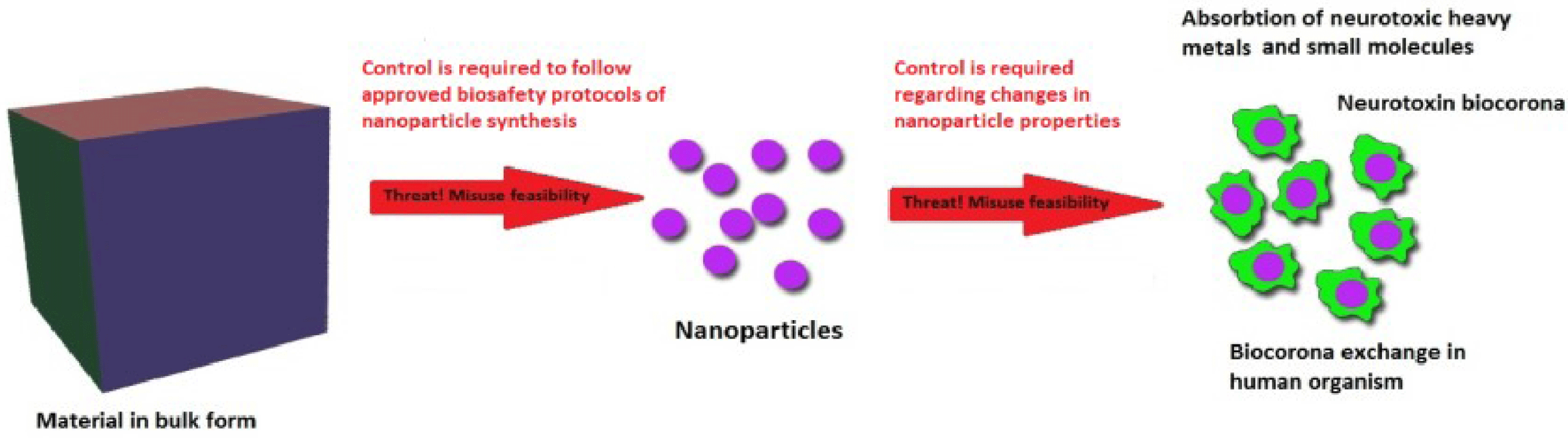
Safety issues such as the neurotoxic potential of nanoparticles and the feasibility of their misuse are far from being clear. Nanoparticles have different properties in comparison with the compounds and materials they are synthesized from. Well-characterized materials in bulk form can change their properties twice before they act as nanoparticles at the cellular level on tissues and organs of individuals. First, change occurs during transformation of bulk materials into nanoscale structures and during surface functionalization of the resulting nanoparticles. Second, nanoparticles can change properties during interaction with environmental factors and upon entry into the living organism, where they can interact with proteins, lipids, nucleic acids, etc., to produce a coating of biocorona (a layer or layers of biomolecules that absorb onto the surface of a nanoparticle). We suppose that the modern weaponeer could consider making the nanoparticles toxic and misuse them for threat delivery at each of these steps of changes in the properties of the bulk materials (see Figure 1). Therefore, work with nanoparticles requires constant monitoring of their potential neurotoxicity, safety and misuse feasibility. 57,58
Probable changes in nanoparticle safety and misuse potential.

Effects of nanoparticles on synaptic neurotransmission in vitro: A comparative analysis of neurotoxic potential of different types of synthesized nanoparticles
There is a lack of research concerning the impact of composition, size, shape, and surface properties of nanoparticles on their neurotoxicity.
Reference Murashov and Howard59
Recently, the neurotoxicity of nanoparticles of different compositions based on their effects on key characteristics of glutamate- and gamma-aminobutyric acid (GABA)-ergic (effect-producing) neurotransmission in brain nerve terminals has been assessed. Disturbance of the dynamic balance of excitatory and inhibitory signals contributes to the pathogenesis of major neurological disorders.
Reference Danbolt60
The normal homeostatic concentrations of glutamate and GABA in the synaptic cleft are maintained throughout neurotransmitter uptake by the plasma membrane transporters of nerve terminals
Reference Borisova61,Reference Borisova and Borysov62
. The neurotoxic properties of carbon nanodots have been revealed, including those synthesized from
 $\unicode[STIX]{x1D6FD}$
-alanine
Reference Borisova, Nazarova, Dekaliuk, Krisanova, Pozdnyakova, Borysov, Sivko and Demchenko63
and thiourea,
Reference Borisova, Dekaliuk, Pozdnyakova, Pastukhov, Dudarenko, Borysov, Vari and Demchenko64
nanodiamonds,
Reference Pozdnyakova, Pastukhov, Dudarenko, Galkin, Borysov and Borisova65
native particles of volcanic ash containing a nanosize fraction and a mixture of volcanic ash and carbon particles,
Reference Pozdnyakova, Pastukhov, Dudarenko, Borysov, Krisanova, Nazarova and Borisova66
nanocrystals consisting of sodium, the rare earth element yttrium and fluoride (NaYF
 $_{4}$
) doped with the rare earth ion europium (Eu
 $^{3+}$
),
Reference Sojka, Kociolek, Banski, Borisova, Pozdnyakova, Pastukhov, Borysov, Dudarenko and Podhorodecki67
and maghemite nanoparticles containing iron-3-oxide (gamma-Fe
 $_{2}$
O
 $_{3}$
).
Reference Borisova, Krisanova, Borysov, Sivko, Ostapchenko, Babic and Horak68,Reference Horak, Benes, Prochazkova, Trchova, Borysov, Pastukhov, Paliienko and Borisova69
A comparative analysis of different types of nanoparticles demonstrated that the CNS and synaptic neurotransmission in particular are extremely sensitive to nanoparticle influence
Reference Win-Shwe and Fujimaki70
and so can be a potential target for misuse of neurotoxic nanoparticles.
Nanoparticle size is a very important parameter for interaction with cells and consequent cellular internalization. This parameter can be altered during synthesis of nanoparticles, and changes in nanoparticle properties can significantly influence neurotoxicity, biocompatibility and dual-use feasibility. Nanoparticles with a diameter of less than 5 nm have been suggested to be the most hazardous because of possible nuclear penetration and extraordinarily high surface area over volume ratios. Larger nanoparticles with a diameter over 40 nm showed a diminished internalization efficiency with lesser cytotoxic effects. Reference Soenen, Rivera-Gil, Montenegro, Parak, De Smedt and Braeckmans71,Reference Soenen, Parak, Rejman and Manshian72 However, the size dependence of nanoparticle effects is still under investigation. 73 Hence, careful control of approved laboratory protocols is required to avoid possible changes in nanoparticle size during synthesis, production, and functionalization.
Nanoparticle shape is also an important feature that can influence the toxicity of nanoparticles. Gold nanorods were less toxic than spherical ones, and the diffusion of quantum dots of higher ratios of length to diameter in the plasma membrane was found to be less effective. Reference Qiu, Liu, Wang, Xu, Bai, Ji, Wu, Zhao, Li and Chen74,Reference Aaron, Greene, Kotula, Bachand and Timlin75,Reference Tarantola, Pietuch, Schneider, Rother, Sunnick, Rosman, Pierrat, Sönnichsen, Wegener and Janshoff76 In other experiments, native particles of volcanic dust, the shape of which contains sharp angles, can interact with the plasma membrane of nerve terminals, change their surface properties and cause an increase in glutamate binding. In contrast, native volcanic particles of spherical form did not possess such features. Reference Pozdnyakova, Pastukhov, Dudarenko, Borysov, Krisanova, Nazarova and Borisova66
The surface characteristics of nanoparticles should also be designed very cautiously. Surface charge has a significant effect on determining the physical and chemical properties of nanoparticles, the capability of interaction with the cells, and therefore their neurotoxic potential. It was shown recently that carbon nanodots with diverse surface characteristics (synthesized from
 $\unicode[STIX]{x1D6FD}$
-alanine and thiourea) caused unidirectional alterations in synaptic neurotransmission, which however exhibited a diverse neurotoxicity level.
Reference Borisova, Dekaliuk, Pozdnyakova, Pastukhov, Dudarenko, Borysov, Vari and Demchenko64
Also, nanodiamonds of various surface shapes and charges showed different intensity in neurotoxic effects. It was shown that cationic nanoparticles were less stable and exerted the highest cytotoxic effects.
Reference Soenen, Rivera-Gil, Montenegro, Parak, De Smedt and Braeckmans71,Reference Singh, Manshian, Jenkins, Griffiths, Williams, Maffeis, Wright and Doak77,Reference Geys, Nemmar, Verbeken, Smolders, Ratoi, Hoylaerts, Nemery and Hoet78
Cationic nanoparticles produced higher disruption of the integrity of the plasma membrane and damage of mitochondria and lysosomes than anionic ones.
Reference Fröhlich79
Functionalized cerium oxide nanoparticles (which have shown great potential as antioxidant and radioprotective agents) were localized to the cytoplasm or lysosomes depending on their surface charge (neutral, positive or negative); negatively charged cerium oxide nanoparticles exhibited substantial toxicity when they accumulated in the lysosomes of cancer cell lines under investigation.
Reference Asati, Santra, Kaittanis and Perez80
Reduction of positive surface charge can diminish cellular internalization. However, for successful biotechnological applications the optimal balance between decreased toxicity and internalization efficiency has to be determined.
Reference Soenen, Rivera-Gil, Montenegro, Parak, De Smedt and Braeckmans71,Reference Soenen, Baert and De Cuyper81
The occupational safety and health publications emphasize that “employees who use nanomaterials in research or production processes may be exposed to nanoparticles through inhalation,” and “although the potential health effects of such exposure are not fully understood at this time, scientific studies indicate that at least some of these materials are biologically active.” 82 Nanoparticle versus microparticle toxicity is now the subject of much research in occupational safety and health. Significant differences, such as a high surface area per unit volume, more reactivity, and biocorona formation capability were observed when properties of new-generation engineered nanoparticles were compared to larger particles. Reference Oberdorster, Kane, Klaper, Hurt and Klaassen83,Reference Bakand and Hayes84 Notably, the agglomeration state has been considered as a nanoparticle property that may be important for understanding nanoparticle toxic effects. 82 Primary engineered nanoparticles tend to homo- and hetero-aggregate into clusters, the size of which can be up to several microns. This aggregation plays a significant role in determining nanoparticle reactivity and toxicity. Reference Hotze, Phenrat and Lowry85 The translation of well-developed aggregation science into nanotechnology remains a challenge because of the unique and diverse physical and chemical properties of nanoparticles. Therefore, health and safety in the workplace legislation requires further scientific information to fill the current gap in complete understanding of the molecular mechanisms of the neurotoxicity of nanoparticles.
Consequently, alterations in approved laboratory methodological protocols aiming to change the composition, size, shape, or surface properties of synthesized nanoparticles can deliberately transform nanoparticles from nontoxic to toxic. This can be viewed as a covert nanoparticle misuse potential.
Certainly, it can be expected that efforts will be made to obtain a comprehensive understanding of the impact of composition, size, shape, surface structure and properties (charge, presence of the functional groups on nanoparticles surface, etc.) on their neurotoxic properties. It is necessary to acquire new experimental data to enhance existing knowledge and to specify guidelines for safety assessment of nanoparticles and prevention of their misuse feasibility worldwide.
Probable modulation of nanoparticle neurotoxicity that is acquired from surroundings rather than designed: Increasing the toxicity of engineered nanoparticles by absorbance of neurotoxic heavy metals and low-molecular weight compounds
The potential threat is inherent not only with porous nanoparticles but also with many other types of nanoparticles. They can interact per se with physiological and nonphysiological ions, small organic molecules, and other compounds associated with vital processes of biological systems resulting in features harmful to health. This also occurs during nanoparticle interaction with environmentally derived biological molecules and different pollution components, which can thereafter be delivered to the living organism. Unfortunately, this fact of spontaneous nanoparticle–biomolecule interactions can be used by the modern weaponeer for modification of nanoparticle properties from nontoxic to harmful to human health. The mechanisms of these complex interactions are far from being clear and have to be analyzed separately for each type of nanoparticle and biomolecule.
One pertinent example of the significance of nanoparticles of exogenous origin is the recent finding of the presence of maghemite nanoparticles in the human brain. Reference Maher, Ahmed, Karloukovski, MacLaren, Foulds, Allsop, Mann, Torres-Jardon and Calderon-Garciduenas86 From the misuse feasibility point of view, maghemite nanoparticles are of special significance not only because of their superparamagnetic properties and practical application potential but also because of their high absorption capability. Functionalized maghemite nanoparticles showed significant capacities to absorb lead and copper from aqueous media. Reference Ramos Guivar, Sadrollahi, Menzel, Ramos Fernandes, Lopez, Torres, Arsuaga, Arencibia and Litterst87 Also, maghemite nanoparticles with an average size of around 5 nm possess high efficiency for rapid adsorption of fluoride.
Hence, nanoparticles with high absorption capability as well as porous ones can be easily enriched with toxic and bioactive substances. For the prevention of misuse, the absorbance ability of low sized nanoparticles may have to be subject to stringent control because they can easily enter deep lung areas and penetrate nasal mucosa.
Modulation of engineered nanoparticle neurotoxicity by biocorona formation acquired from surroundings
Nanoparticles (nonporous and porous ones), because of their nanosize and large surface-to-mass ratio, can interact with a wide variety of biomolecules — that is, proteins, lipids, nucleic acids, carbohydrate polymers, etc. Reference Saptarshi, Duschl and Lopata88 Nanoparticles can absorb proteins and different biomolecules, including neurotoxic substances having potential misuse features, thereby acquiring a self-assembling dynamic coating termed biocorona. Biocorona plays a crucial role in nanoparticle–cellular interactions and in the development of consequent biological effects, degradation of nanoparticles, and their accumulation and clearance from the organism. Thus, there is a crucial need to define the molecular mechanisms of biocorona formation.
Not only can biocorona change nanoparticle properties, but vice versa, nanoparticles per se can change the conformation, structure, dynamics, and function of absorbed protein. Reference Shemetov, Nabiev and Sukhanova89,Reference Lin, Mortimer, Chen, Kakinen, Riviere, Davis, Ding and Ke90 Also, not all types of nanoparticles can form biocorona.
The following facts should be considered in the assessment of dual-use feasibility. On the one hand, biocorona formation depends on a wide variety of properties of synthesized nanoparticles — that is, nanoparticle composition, size, shape, and surface characteristics. On the other hand, there is a huge diversity of biomolecules that biocorona can be composed of.
The composition of nanoparticles, their hydrophobicity, specific functional groups, pH, and temperature were demonstrated to influence adsorption of proteins on the surface of nanoparticles. Reference Soenen, Rivera-Gil, Montenegro, Parak, De Smedt and Braeckmans71,Reference Soenen, Parak, Rejman and Manshian72,Reference Kirchner, Liedl, Kudera, Pellegrino, Munoz Javier, Gaug, Stölze, Fertig and Parak91 The interrelation between effectivity of protein biocorona formation and the size of nanoparticles is unclear and the experimental data is contradictory. Reference Saptarshi, Duschl and Lopata88,Reference Lundqvist, Sethson and Jonsson92,Reference Dutta, Sundaram, Teeguarden, Riley, Fifield, Jacobs, Addleman, Kaysen, Moudgil and Weber93 The influence of the shape and surface charge of the nanoparticles on biocorona formation is also far from being clear. Reference Deng, Mortimer, Schiller, Musumeci, Martin and Minchin94 Uncharged nanoparticle surfaces bind less protein than those with negative and positive charges. Reference Deng, Liang, Toth, Monteiro and Minchin95,Reference Fertsch-Gapp, Semmler-Behnke, Wenk and Kreyling96 Nanoparticle-induced changes in the protein conformation can not only attenuate protein functionality but also cause their misfolding and aggregation. Reference Lin, Mortimer, Chen, Kakinen, Riviere, Davis, Ding and Ke90,Reference Linse, Cabaleiro-Lago, Xue, Lynch, Lindman, Thulin, Radford and Dawson97 Curved nanoparticle surfaces can irreversibly affect the secondary structure of protein. Reference Saptarshi, Duschl and Lopata88,Reference Lin, Mortimer, Chen, Kakinen, Riviere, Davis, Ding and Ke90,Reference Linse, Cabaleiro-Lago, Xue, Lynch, Lindman, Thulin, Radford and Dawson97 The hydrophobicity of nanoparticles can increase BBB penetration and liposomes per se, and nanoparticles encapsulated in liposomes are considered to be prospective for both brain therapy and imaging. Reference Vieira and Gamarra98,Reference Wen, Zhang, Al-Suwayeh, Yen and Fang99 Also, specific nanoparticles Reference Horak, Benes, Prochazkova, Trchova, Borysov, Pastukhov, Paliienko and Borisova69 could be loaded by the modern weaponeer with hydrophobic neurotoxic substances and this possibility of brain delivery is a threat that should be monitored and prevented.
The literature data have demonstrated that the interaction of nanoparticles and proteins in biocorona is constantly changing because of continual adsorption and desorption of proteins by nanoparticles. Reference Saptarshi, Duschl and Lopata88,Reference Casals, Pfaller, Duschl, Oostingh and Puntes100,Reference Monopoli, Walczyk, Campbell, Elia, Lynch, Bombelli and Dawson101 Taking into account biocorona formation ability, the potential modern weaponeer could modify nanoparticle features from non-neurotoxic to neurotoxic ones by absorbing different well-known protein neurotoxins to their surface. These modified nanoparticles can deliver these compounds directly to the nerve cells, where they can affect the mechanisms of presynaptic exocytotic neurotransmitter release, synaptic vesicle recycling, etc. One of the approaches to prevent uncontrolled neurotoxic biocorona formation and misuse potential of nanoparticles is modulation of their surface. Experimental work defining and characterizing the potential misuse feasibility of neurotoxic biocorona formation shown in experiments in vitro has to be enhanced with data determining effects on living organisms and interactions with the environment, taking into account the route of nanoparticle delivery to the organism. Reference Lin, Mortimer, Chen, Kakinen, Riviere, Davis, Ding and Ke90,Reference Monopoli, Walczyk, Campbell, Elia, Lynch, Bombelli and Dawson101
Some neuronal circuits of concern
From the study of single neurons to the manipulation of circuits
There has been no lack of warnings about the possible misuse of nanotechnology to attack the brain. For example, a 2008 report on Emerging Cognitive Neuroscience and Related Technologies published by the U.S. National Academies stated that
New technologies, particularly nanotechnologies, will enable unparalleled access to the brain. Nanotechnologies can also exploit existing transport mechanisms to transmit substances into the brain in analogy with the Trojan horse. Advances in nanotechnology and BBB pharmacology …will allow chemical disruption of the BBB. Additionally, increased experimentation with neuropeptides will have profound implications for the neuropsychopharmacological modulation of behaviour. 102
The text then directed the reader to a series of tables giving examples of warning signs of potential misuse that might be detected in the open literature. The report also gave a reasonable explanation of how such concerns might get out of hand. It identified a “degradation market” in which customers were interested in seeking advantage by “degrading, temporarily or permanently, the cognitive abilities of others.” However, the work on which this report was based is now at least a decade old, and much has changed in neuroscience and neuroscience technology since then.
Until very recently, it was only possible to obtain a mechanistic understanding of the neuronal control of simple behaviors or in very specialized systems. Reference Zupanc103,Reference Simmons and Young104,Reference Berkowitz105 But now advances in technologies such as neuroimaging, knock-in and knock-out genetic manipulation, optogenetics, and multiple simultaneous recording of neuronal activity have changed that situation radically. Reference Dando106 It now appears possible to successfully investigate the activity of neuronal circuits that underlie more complex behaviors. As a report for the U.S. National Institutes of Health stated in 2014:
In considering the goals and the current state of neuroscience, the working group identified the analysis of circuits of interacting neurons as being particularly rich in opportunity, with potential for revolutionary advances. 107
Indeed, the initiation of multiple state-level brain research projects in recent years 108 and their coordination into a global effort Reference Grillner, Ip, Koch, Koroshetz, Okano, Polachek, Poo and Sejnowski109 indicates clearly that the possibilities of major advances in neuroscience being made for beneficial purposes in the next decade is widely recognized.
This approach is expected by serious neuroscientists to become extremely successful. In his essay on “The unsolved problems of neuroscience” Reference Adolphs110 in 2015, Ralph Adolphs included a table setting out the problems and when they might be solved. Among the problems considered solvable in the next 50 years were “How do circuits of neurons compute” and “What causes psychiatric and neurological illnesses.” Given the rate of development of novel technologies for investigating the circuits of the brain, 50 years may well be an underestimate. Reference Lerner, Ye and Deisseroth111 Indeed, it has been argued that we are witnessing a paradigm shift in neuroscience at this time. Rafael Yuste has noted that for the last 100 years, we have regarded the neuron as the “structural and functional” unit of the nervous system, but now, however,
[N]ewer multineuronal recording methods have revealed that ensembles of neurons, rather than individual cells, can form physiological units and generate emergent functional properties and states. Reference Yuste112
He noted further that such neural network models can potentially incorporate knowledge gained within the earlier neuronal doctrine and thus enable us to understand better how the nervous system generates behavior.
Research on the generation of rhythmic movements by neuronal circuits in invertebrates over the last five decades has also led to an increasing understanding of how such rhythms are produced. As one review concluded in 2015,
[S]tudy of small circuits that generate rhythmic movements has revealed principles of circuit organization and function that generalize to the organization of large circuits and the mechanisms by which they combine into functional units. In particular, it is clear that circuit function can be surprisingly robust to variation in many parameters. Reference Marder, Goeritz and Otopalik113
This review also noted that
A wealth of data has shown that neuromodulators and modulatory neurons can reconfigure oscillatory networks, changing their frequency, phase relationships, and functional interactions among neurons …Notably, neurons can switch among different rhythms, and the same neuron can be part of oscillatory circuits with very different cycle times.
Indeed, there is now a good understanding of the general principles of neuromodulation of neurons and circuits. Reference Bucher and Marder114 These can be summarized as follows: every stage of neuronal processing can be under neuromodulatory control; neuromodulators are released in a variety of ways; neuromodulators act in a variety of ways; and all neural circuits are multiply modulated and activated differentially through diverging and converging neuromodulatory effects.
This developing understanding of neuronal circuits and their modulation is important because, as the report on Emerging Cognitive Neuroscience and Related Technologies stated in 2008, 115 “increased experimentation with neuropeptides will have profound implications for the neuropsychopharmacological modulation of behaviour” and thus for the potential for misuse. The question then that arises is, how far has the study of such circuits and their modulation gone? The next section takes up this question in regard to one important neuromodulatory system that could be subject to misuse.
(Endo)Cannabinoids
In August 2017, the Observer newspaper in London carried a story that might have been set in a post-nuclear war world:
Among the abandoned shopping trolleys, empty vodka bottles and piles of discarded clothes, several men and two women stumble around on a windy grey afternoon, apparently oblivious to their surroundings. Reference Doward116
But this was not fiction, as the article continued:
They stand outside their tents, shaking their heads, shuffling back and forth, their eyes staring way off into the distance …. One thing unites them: they all use spice, the “zombie drug” — so called because of the way it almost instantly reduces users to a semi-comatose state.
The authors of the report on Emerging Cognitive Neuroscience and Related Technologies noted 117 that in a degradation market, “[I]f a particularly effective degradation product is developed that had few side effects, escalation of this market will be self-fulfilling.” Anyone interested in the possibilities of rendering people into a zombie-like state could hardly miss the implications, as the three-page special report was titled “The Spice Crisis: How the ‘Zombie Drug’ Is Devastating Britain.” States certainly investigated the possible use of tetrahydrocannabinol (THC), the active constituent of cannabis, as an incapacitating chemical weapons agent early in the Cold War, but it was not found to have powerful enough effects for weaponization. However, since then, two things have radically changed: we now know, as the weaponeers then did not, that there is an endogenous cannabinoid system in the brain and that it is possible to make much more powerful synthetic agents like spice that affect the cannabinoid system. Reference Dando, Crowley, Dando and Shang118 Drug dealers are certainly targeting vulnerable groups with these drugs, and the effects are serious and profoundly damaging. Reference Doward119
In the 1960s, Raphael Mechoulam managed to isolate, elucidate the structure of, and synthesize THC for the first time. In 2013, he and Linda Parker, the author of a recent study titled Cannabinoids and the Brain, Reference Parker120 reviewed current knowledge of the endocannabinoid system of the brain in the Annual Review of Psychology. Reference Mechoulam and Parker121 At the beginning of their review, they briefly recounted the history of the use and study of cannabis, noting that in 1845 Moreau described numerous effects of cannabis use on experimental subjects, including
…feelings of happiness, excitement and dissociation of ideas, errors of time and space, enhancement of the sense of hearing, delusions, fluctuations of emotions, irresistible impulses, and illusions and hallucinations.
But they added that Moreau’s subjects probably consumed rather large amounts of hashish, whereas today, most would probably inhale rather lower doses of the drug. Moreover, another constituent of the plant cannabidiol, the structure of which was also elucidated by Mechoulam and colleagues in the 1960s, seems to alleviate some of the symptoms of THC.
Nevertheless, there are clear effects in human beings of taking the drug. Mechoulam and Parker discussed a wide range of issues, including the impact on cognition:
When under the influence of THC, humans demonstrate transient impairment in short-term episodic and working memory and consolidation of these short-term memories into long-term memory, but no impairment in retrieval of information once it has been previously encoded into long-term storage.
They added that,
Consistent with the human literature, most reports using animal models suggest that acute administration of CB1 agonists selectively disrupts aspects of short-term or working memory while leaving retrieval of previously learned memory …largely intact.
Following on from the discovery of THC, as the authors related, the cannabinoid receptors in the brain (CB1 and CB2) and the endogenous cannabinoids arachidonoyl ethanolamide (anandamide, AEA) and 2-arachidonoyl (2-AG) were discovered in the 1980s and 1990s, and much work has been carried out since then on this endocannabinoid system in the brain and how it can be affected by drugs.
CB1 and CB2 are members of the G protein-coupled (GPCR) family of receptors, with CB1 being predominantly expressed in the brain and CB2 more in the periphery. AEA and 2-AG are not stored in vesicles like well-known transmitters but synthesized when they are needed. 2-AG is a highly efficient agonist for CB1 and CB2 receptors, while AEA acts with low efficiency at CB1 and very low efficiency at CB2 receptors. The activity of these receptors can produce many changes for example in gene transcription as well as synaptic functions.
CB1 receptors are abundantly expressed in the CNS, notably in the cortex, basal ganglia, hippocampus and cerebellum. These receptors have an unusual mode of action:
The presynaptic localization of CB1 receptors and their ability to inhibit synaptic transmission, coupled with the postsynaptic localization of some endocannabinoid synthesizing enzymes, and the observation that postsynaptic activity …increases endocannabinoid production suggests that endocannabinoids, particularly 2-AG may be retrograde messengers. This hypothesis is supported by considerable experimental evidence. Reference Lu and Mackie122
An example of such experimental evidence indicates that in the prefrontal cortex,
Physiological and anatomical lines of evidence suggest that 2-AG serves as a retrograde signal from pyramidal neurons to nearby CCK basket neuron axon terminals that contain high concentrations of the CB1 …receptor. In a process known as depolarization-induced suppression of inhibition (DSI), the rapid depolarization of a pyramidal neurons induces short-term depression of GABA release from local CCK axon terminals. Reference Volk and Lewis123
This kind of inhibition forms part of a complex system, as Parker explained:
[E]ndogenously released 2-AG and AEA are produced only where and when they are needed and act to feed back on the pre-synaptic neuron to ‘turn off’ neurotransmitter release. Fine tuned regulation of synaptic activity is the primary function of this ubiquitous neuromodulatory system. 124 (emphasis added)
On the other hand, she noted that
THC administered through smoking or ingestion of marijuana activates all of the CB1 receptors to which it binds, producing global activation. (emphasis added)
The endocannabinoid system is used in the brain to regulate the production of diverse neurotransmitters in numerous circuits. It is not surprising, therefore, that cannabis has been implicated in a variety of behavioral modifications. Parker’s book, for example, has chapters on cannabinoids and emotional regulation, psychosis, learning and memory, reward and addiction, body weight, feeding and appetite, nausea, pain, epilepsy, and neurodegenerative diseases.
It is on this complex system Reference Di Marzo and Piscitelli125 that THC and synthetic cannabinoids (SCBs) predominantly act. There is widespread agreement on some of the impacts of taking these drugs, for example, that “Verbal learning and memory and attention are most consistently impaired by acute and chronic exposure to cannabis. Psychomotor function is most affected during acute intoxication.” Reference Broyd, van Hell, Beale, Yücel and Solowij126 Cannabis use has also been reported to increase the risk of schizophrenia and to make its symptoms worse:
Both of these outcomes might be attributable to the disruption by cannabis of the endogenous cannabinoid systems’ spatiotemporal regulation of the inhibitory circuitry in the prefrontal cortex that is essential for core cognitive processes such as working memory that are impaired in schizophrenia. 127
Moreover, it is likely that one of the mechanisms that could cause this is “disruption of the brain’s ability to generate and maintain synchronized neural oscillations across distributed brain circuits” Reference Skosnik, Cortes-Briones and Hajos128 that are required to organize complex behaviors. There is much left to be understood in such a recently discovered complex and widely distributed system, but given the potential medical benefits — for example, in understanding the role of the endocannabinoid system in the control of food intake and pain — it can realistically be assumed that there will continue to be rapid advances in our knowledge of the system and how it can be affected by drugs.
It is understandable that in an illicit market, such as that for addictive drugs such as marijuana/cannabis, dealers would be interested in finding ways to increase the THC content of the products, and therefore it is not surprising that there has been a substantial increase in the strength of the products. Reference Dando, Crowley, Dando and Shang118 However, the development of synthetic cannabinoids is a very different case: it is, in fact, a classic case of benignly intended scientific work later being “hijacked” by people with malign purposes — drug dealing. Concerned scientists described what happened in a paper published in 2011. Reference Wiley, Marusich, Huffman, Balster and Thomas129
About 20 years previously, medicinal chemists trying to develop a new analgesic had created a compound WIN 55,212-2. They dropped the research when they discovered that it and related compounds had effects that were cannabimimetic. However, the CB1 receptor had been identified, and so Dr. John Huffman and his colleagues “hypothesized that the position of the morpholinoethyl group of WIN55, 212-2 might overlay the C3 side chain of THC in the then-accepted 3-point attachment model of cannabinoid receptor binding.” They proceeded to test their hypothesis by “synthesizing cannabinoids with comparable carbon chains attached to the nitrogen in the indole substituent.” The compounds created were sent to Dr. Billy Martin, Reference Wiley, Marusich and Huffman130 who evaluated the structure activity relationship in a two-step methodology to “measure binding affinity at CB1 and CB2 receptors and to assess the cannabinoids in a tetrad of in vivo tests in which cannabinoid agonists produce a characteristic profile of effects in mice, including suppression of motor activity, antinociception, hypothermia and catalepsy” (emphasis added). An orderly relationship was found between the structure of the compounds and their binding to the two cannabinoid receptors, greatly increasing scientific understanding of the endogenous cannabinoid system when it was published in the open scientific literature. Unfortunately, as the authors of the paper on hijacking point out, this is not the first or the last instance in which “research on novel synthetic drugs conducted by legitimate scientists …has led to compounds that have subsequently been subject to abuse.” Reference Wiley, Marusich, Huffman, Balster and Thomas129
It is now known that there are numerous classes of synthetic cannabinoid drugs (SCBs) Reference Baumann, Solis, Watterson, Marusich, Fantegrossi and Wiley131 and that
Importantly, the distinct structures of the SCBs also typically result in increased affinity for and efficacy at cannabinoid CB1 receptors, which are thought to be responsible for the psychoactive effects of delta
 $^{\text{9}}$
-THC and its analogues.
Reference Tai and Fantegrossi132
Thus, while these novel SCBs may not be structurally related to THC, they can be much more powerful in their impact on the user’s nervous system. Reference Rech, Donahey, Cappiello Dziedzic, Oh and Greenhalgh133,Reference Kemp, Clark, Dobbs, Galli, Sherman and Cox134 Moreover, as some of these novel SCBs were made illegal, others were developed to get around the law:
As a consequence of that, three generations of SC[Bs] have been developed based on slight modifications of the first generation compounds such as JWH-018, CP47,497 and HU-210 …that are full CB1 agonists with affinities 4.5, 8.6, and 55 times that of delta
 $^{9}$
-THC respectively.
Reference Miliano, Serpelloni, Rimondo, Mereu, Marti and De Luca135
This account continued to stress that these synthetic cannabinoids
…are remarkably different from and more dangerous than THC. Indeed, while THC is a partial CB1 agonist, in vivo studies have clearly shown that these compounds are full agonists with higher potency and efficacy as compared to delta
 $^{9}$
-THC.
The drugs could also, for example, produce other compounds with activity at CB receptors when metabolized Reference Tai and Fantegrossi136 or when the compounds are smoked, or the metabolites produced could affect other receptors in different circuits directly or indirectly with unknown behavioral consequences.
That these consequences can be dramatic is well illustrated by reports on the state of intoxicated car drivers who had caused major accidents in Japan. Reference Kaneko137 One such driver was described as follows:
The driver looked emotionless. He kept flooring the accelerator pedal even after the crash, and the tyres were melted down. Driver had no memory of the crash.
A second was described similarly:
Even after the crash, the driver did not step off the accelerator pedal, but kept on moving the steering wheel and gear lever in a stereotyped manner. Driver had no memory of abnormal driving.
And a third was described as
…awake but motionless, and did not respond for 10 min. He started moving 15 min after the crash and responded by talking thereafter. Driver had no memory of the crash.
The first driver damaged five cars and injured six people; the second hit four people on the sidewalk without braking; and the third ignored a red light, caused successive vehicle collisions, and injured eight people. The precise cause of such selective malfunctions of the drivers’ brains may not be clear at the present time, but the development and investigation of these synthetic cannabinoid drugs and their impact on the recently discovered endocannabinoid system is surely still in its early stages. Of course, the cannabinoid system is not the only system in which our understanding has considerably developed in recent years and which could be subject to dual use. Examples are psychedelics such as Psilocybin and LSD, benzodiazepines, alpha2-adrenoreceptor agonists, and neuropeptides such as orexin and oxytocin. Reference Dando, Crowley, Dando and Shang118
Conclusion
Technological change and advanced CBW weapons
In 2003 three U.S. government defense analysts published a paper titled “Biotechnology: Impact on Biological Warfare and Biodefense,” in which they considered how the evolution of technology would affect the threat from biological and, by implication, chemical weapons. In their view,
Advances in biological research likely will permit development of a new class of advanced biological warfare (ABW) agents engineered to elicit novel effects. In addition, biotechnology will have applications supporting ABW weaponization, dissemination, and delivery. 138
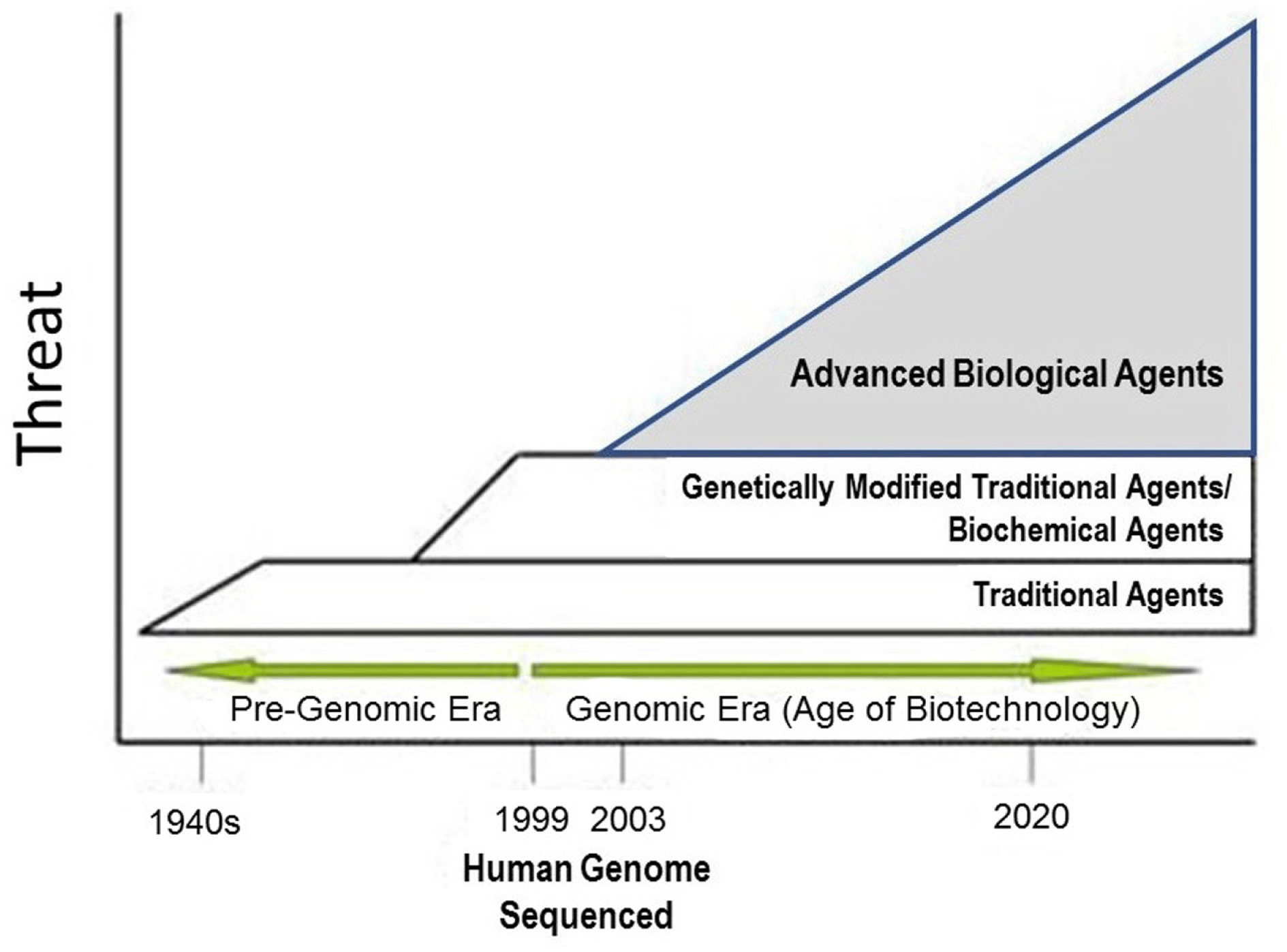
Their argument, as illustrated in their diagram, pictured in Figure 2, was that while the threat from traditional and genetically modified agents would level off, there would be an ever-expanding range of potential advanced agents made possible by developments in biotechnology.
The evolving threat. Timeline describing the three phases of the evolution of potential biological warfare agents and their impact on the biological weapons threat level. Source: Petro, Plasse and McNulty 2003, reference Reference Petro, Plasse and McNulty12 , with permission of Mary Ann Liebert, Inc.

These analysts considered that there would be a paradigm shift in agent development as the traditional focus of attention on the natural agent shifted to the rational design of novel agents to target specific parts of the living system at the molecular level.
Figure 2 shows the growth of the threat from advanced biological agents as a single block, but of course there are many different technologies that could be of concern being developed, and these will develop at different speeds and have different implications. Indeed, as we have seen with CRISPR-Cas, there could be significant step changes in the security implications of individual and unexpected technology developments. Therefore, to assess the likely implications of the technologies discussed here, it is necessary to review their likely development and integration over the next 5 to 10 years.
Future targeted delivery
Nanotechnology has played a fundamental role in improving targeted delivery of therapeutics by packaging DNA, proteins, and drugs into defined nanotech-based particles that greatly facilitate their uptake over the mucous membranes of the nasal passage and respiratory tract and across the BBB. New approaches for more effective application of therapeutics to the CNS include the use of specific transporters found on cells at the BBB that precisely control permeation of circulating solutes including drugs. Nanoparticles containing a particular cargo can be outfitted with ligands that bind to the specific receptors on the transporter to mediate their uptake through the BBB.
Additional advances include packaging the so-called Sleeping Beauty transposon system into nanoparticles to achieve long-lasting expression of delivered transgenes in a safer way than that provided by retroviruses. Also, incorporating CRISPR-Cas-based genome editing components into nanotech scaled carriers offers improved ease and specificity in targeting single or even multiple genes in the nervous system. Considering the rate at which advances have been made in the last 5 to 10 years, it is clear that improvements in aerosol delivery of biologically active nanoparticles to the CNS will continue to be made on an exponential scale. Steady improvements in aerosol delivery of nanotech-based agents are making dissemination of biochemicals in this form more and more feasible, so we can certainly expect further major advances in the next 5 to 10 years.
Future nano-neurotechnology
Bulk materials alter their properties before they act as nanoparticles at the cellular level on tissues and organs of individuals. It is extremely difficult to predict whether newly synthesized nanoparticles from well-characterized bulk materials will have a potential threat to brain health. By changing the size and shape of nanoparticles and modifying their surface, the weaponeer could transform nanoparticles with a high level of safety so that they pose a threat to human health and can be deliberately used to cause damage. Spontaneous nanoparticles–biomolecule interactions can also be used for modification of nanoparticle properties. In addition, biocorona can make nanoparticles more biocompatible, and so their distribution and clearance from the organism can be altered. The mechanisms of complicated nanoparticle–biomolecule interaction are far from being clear and have to be analyzed separately for each type of nanoparticle–biomolecule complex. The misuse potential of nanoparticles depends on their size, shape, composition, stability, surface properties, and ability to form dust particles and interact with different biomolecules forming biocorona.
New experimental data and systematic analytic knowledge will need to be acquired in order to understand in detail the feasibility of civil nanoparticle use. Neurotoxicity risk monitoring, development of algorithms, recommendations, and guidelines for prevention of nanoparticle misuse potential should also be advanced.
Future neuroscience
In October 2017, a new editor in chief took over the journal Neuron and contributed an editorial to set out her view of the journal’s future plans:
These are exciting times for neuroscience, when many of the …traditionally separate efforts are beginning to converge, and one can envisage the day we may be able to respond to some fundamental questions, such as how molecules, cells and circuits interplay to make us feel, act, and ultimately understand who we are. Reference Zirlinger139
In her opinion, these developments are “transforming the kinds of questions that can be asked, extending beyond studying activity in one area under one particular condition into looking at how ensembles change over time, or regions interact with other structures.” It is possible to gain some insight into these “exciting times” of technology convergence by looking at some of the papers reviewing recent and forthcoming developments.
One such review Reference Kim, Adhikari and Deisseroth140 considered optogenetics, “in which single genes encoding light-activated ion-conductance regulators or biochemical signalling proteins are introduced into targeted cells.” The development of this technology has taken place over the last 10 years and has reached the stage at which “researchers can now control activity in defined neuronal populations and projections while examining the consequences on behaviour and physiology.” The paper explained that this new technology has recently been used in combination with other technologies and included discussions, for example, of how electrophysiology is being combined with optogenetics to allow closed-loop interventions “in which optical stimulation is guided by real-time readout of ongoing activity” achieved by the fast readout of the electrophysiological data. The review clearly envisaged further development of the idea behind optogenetics, which is defined as “genetic introduction of a transducer for external energy,” and, for example, discussed the exploration of magnetothermal work in which “magnetic fields cause neuronal depolarization via introduced nanoparticles through hysteresis,” which, in turn, activates “overexpressed heat-sensitive transient receptor potential cation channels.”
The review argued that “[T]he rapidity of targeting-strategy developments suggests that the specificity of optogenetic manipulations will continue to grow” and gave a number of examples of what could be done to enhance the work on precise excitation and inhibition with this technology. But it also suggested the possibility of developments in other directions, for example, in neuromodulation, achieved “by driving neuromodulatory neurons (for example, dopaminergic, noradrenergic, cholinergic and peptidergic projections),” and noted that “several strategies have been devised to create neuromodulatory optogenetics in the form of chimeras of GPCRs and non-microbial rhodopsins, which enable light-activated biochemical signalling.”
The review ended by noting methods by which anatomical discoveries could be made by combining optogenetics with the recently discovered brain clearing techniques. It is obvious from the examples given in the paper that the development of optogenetics and its integration with other technologies used to investigate the nervous system is not going to stop any time soon. Compare, for example, the 2015 second edition of Carter and Shieh’s Guide to Research Techniques in Neuroscience with the 2010 first edition.
Given the concentration of the initial stages of the new state-funded brain research projects on technology development (see references 107,108,Reference Grillner, Ip, Koch, Koroshetz, Okano, Polachek, Poo and Sejnowski109 ), similar views of the rapid pace of change are to be found in regard to other areas of technology. For example, there is great excitement about the possibilities of understanding the brain as a network of interactions between neuronal populations in different areas of the brain. As one recent review suggested,
Recent innovations in noninvasive imaging techniques have resulted in comprehensive network maps of the anatomical connections among neural elements (connectomes) as well as the simultaneous recording of patterned neural activity. Reference Misic and Sporns141
These technological and theoretical developments are taking place at the time at which there are national and global initiatives creating “large repositories of high-quality and openly shared neuroscience data” which “creates fundamentally new opportunities for analysis and discovery.” The National Institutes of Health (NIH) Human Connectome Project (http://www.humanconnectomeproject.org/) is an ambitious effort to map the neural pathways that underlie human brain function. The overarching purpose of the project is to acquire and share data about the structural and functional connectivity of the human brain. It will greatly advance the capabilities for imaging and analyzing brain connections, resulting in improved sensitivity, resolution, and utility, thereby accelerating progress in the emerging field of human connectomics.
Altogether, the Human Connectome Project will lead to major advances in our understanding of what makes us uniquely human and set the stage for future studies of abnormal brain circuits in many neurological and psychiatric disorders. The Blueprint (NIH Blueprint for Neuroscience Research RFA: The Human Connectome Project) has funded two major cooperative agreements that will take complementary approaches to deciphering the brain’s complex wiring diagram. (For more information see the NIH press release, https://www.nih.gov/news-events/news-releases/40-million-awarded-trace-human-brains-connections). It is little wonder that these authors also see a new era of transformational change in neuroscience.
Convergence
In the Organisation for the Prohibition of Chemical Weapons (OPCW) 2014 report on Convergence of Chemistry and Biology, the Temporary Working Group of the Scientific Advisory Board (SAB) included a statement regarding convergence with other scientific disciplines:
Nanotechnology is playing an important role in improving drug delivery to the body, protective equipment, and in the development of biosensors. Nanotechnology may have some potential for application to purposes prohibited by the CWC. 142
It therefore recommended that
“The SAB should monitor advances in nanotechnology prior to the next review conference. Regular engagement with subject matter experts will be required.” (original emphasis)
These concerns about nanotechnology and convergence have continued since the publication of the report.
A note by the OPCW director general on “The Impact of the Developments in Science and Technology in the Context of the Chemical Weapons Convention” at the 85th Session of the OPCW Executive Council in May 2017, for example, stated that
With regard to the programme of the Twenty-Fifth Session of the SAB, the Director-General notes that questions and concerns about the impact of nanotechnologies have frequently been raised, especially with regard to advances in nanomedicine drug delivery. In this regard, he commends the SAB for engaging experts involved in the development of nanomedicines in order to better understand the state of the field and its technical realities. 143
The briefing by the chair of the SAB for states parties at the 25th Session contained slides on nanotechnology, nanotoxicology, nanomedicine, and nanocatalysis, all indicating the continuation of scientific and technological developments.
Our own findings on the convergence of developments in nanotechnology, drug delivery, and neuroscience have concentrated on the potential dual use of such developments. We believe that dealing with such issues will need coordinated national and international actions over a protracted period. At the international level, a wide range of international agreements may become useful in such an holistic approach including international humanitarian law and human rights law; however, the key must be the strengthening of the CWC. Reference Crowley144 The states parties will have to deal with numerous difficult issues at the Review Conference in 2018. Reference Crowley, Dando and Shang145 For example, with the widespread use of chemical weapons in Syria and the implications of such use for the maintenance of the norm of non-use, (as has been pointed out by numerous states parties with respect to developments in science and technology), nowhere is the immediate threat greater than in regard to the possible development of so-called nonlethal incapacitating agents for law enforcement, which were developed under the assumption that Article II.9(d) of the CWC — by stating as a peaceful purpose “law enforcement including domestic riot control” — legitimizes the search for a larger category of “law enforcement” chemicals other than standard riot control agents. As a large number of states parties pointed out in 2016, 146
Toxic (and potentially lethal) chemicals that target the central nervous system (CNS), so-called “incapacitating chemical agents or ICAs,” and their potential use in certain law enforcement scenarios, have been discussed in numerous forums. We believe these chemicals pose a serious challenge for the Convention.
Therefore, they concluded that
…we are looking to promote discussion on this issue among as many States Parties as possible, and with the OPCW Technical Secretariat. Such discussion should focus on developing concrete recommendations for how to address CNS-acting chemicals in a way that would significantly advance one of the OPCW’s priorities — preventing the re-emergence of chemical weapons.
This issue needs to be resolved in the 2018 Review Conference with a very restricted agreement on what may be done with novel chemical agents for law enforcement. The alternative seems to leave open the possibility of the reemergence of chemical weapons. Analysts argued in 2003 that we would increasingly see the development of rationally designed agents targeted at specific sites in living systems at the molecular level (Figure 2). It is hard to argue that the evidence considered here in regard to the cannabinoid system does not support their argument. In short, it seems clear that the next 5 to 10 years will provide an ever-increasing understanding of possible targets for malign manipulation within the CNS, that drug delivery methods into the CNS will improve, and that nanotechnology, besides assisting the development of drug delivery means, may increasingly become a means in its own right of affecting the synaptic organization of the brain. Clearly, such developments could be subject to misuse.