





Extended abstract
Project description and rationale
Bradbaori is a speculative architectural intervention and a thought experiment that attempts to repair the watershed in Los Angeles by reimagining the city’s famed landmark – the Bradbury Building – as a stepwell or baori. As climate change accelerates, Los Angeles is increasingly experiencing extreme swings between drought and heavy rainfall, a phenomenon scientists describe as hydroclimate whiplash (Lin II, Reference Lin II2025). Intense storms follow periods of prolonged dryness, causing flood warnings and wildfire seasons. Yet much of this sudden influx of rainwater is lost as runoff, rushing through urban channels and out into the Pacific without being captured. The future of water access in Los Angeles is therefore directly tied to reconciling this drought-and-deluge cycle. Building resilience against hydroclimate whiplash requires rethinking how large-scale engineering and infrastructure projects engage the city’s watershed, shifting from reactive flood control measures like the concretization of the LA River, toward systems that can absorb, store and steward water during moments of excess. Represented through a short film, Bradbaori is a worldbuilding research project that explores ways to build resilience.
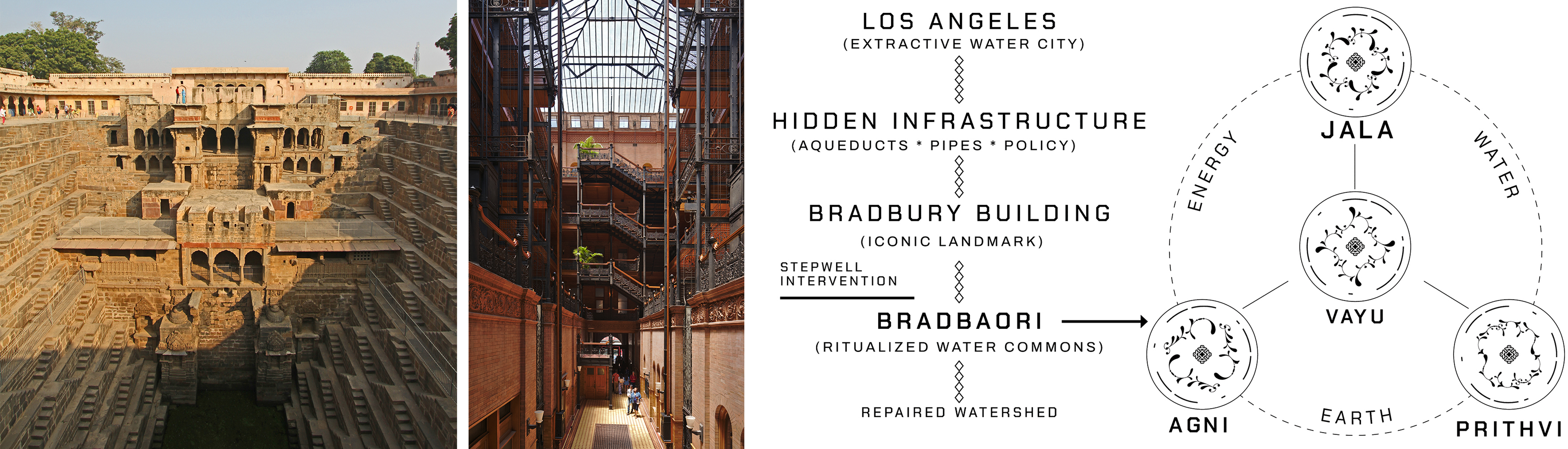
For centuries, stepwells, or baoris, across South Asia functioned as climate-adaptive water infrastructures designed to capture monsoon rainfall and recharge groundwater during dry seasons (Lautman, Reference Lautman2017). More than reservoirs, they operated as shared social spaces where water access, maintenance and governance were collectively negotiated by slowing water, holding it within the ground and embedding stewardship into everyday use (Figure 1).
The Chand Baori Stepwell, Abhaneri, India (left), and the Bradbury Building in Los Angeles (center). Diagrammatic breakdown of the intervention and the microcosm of the Bradbaori’s systems (right).

The Bradbury Building (Figure 1) in Los Angeles is both an architectural landmark and a movie star – a recurring character in film noir such as D.O.A. (Maté Reference Maté1950) and science fiction like Blade Runner (Scott Reference Scott1982). Situated at the center of downtown LA and the city’s fraught water politics, the building has long anchored the collective imagination of a future Los Angeles. But where Blade Runner cast it against a Neo-Tokyo-inspired, neon-drenched LA skyline, this project imagines something different: the Bradbury Building reaches into the past to address contemporary water infrastructure issues for our cities.
This combination of Bradbury and baori forms the Bradbaori – a hydrological urban experiment that uses ancestral hydrological knowledge to ask how traditional wisdom could hold the key to a more sustainable future for contemporary cities (Figure 2).
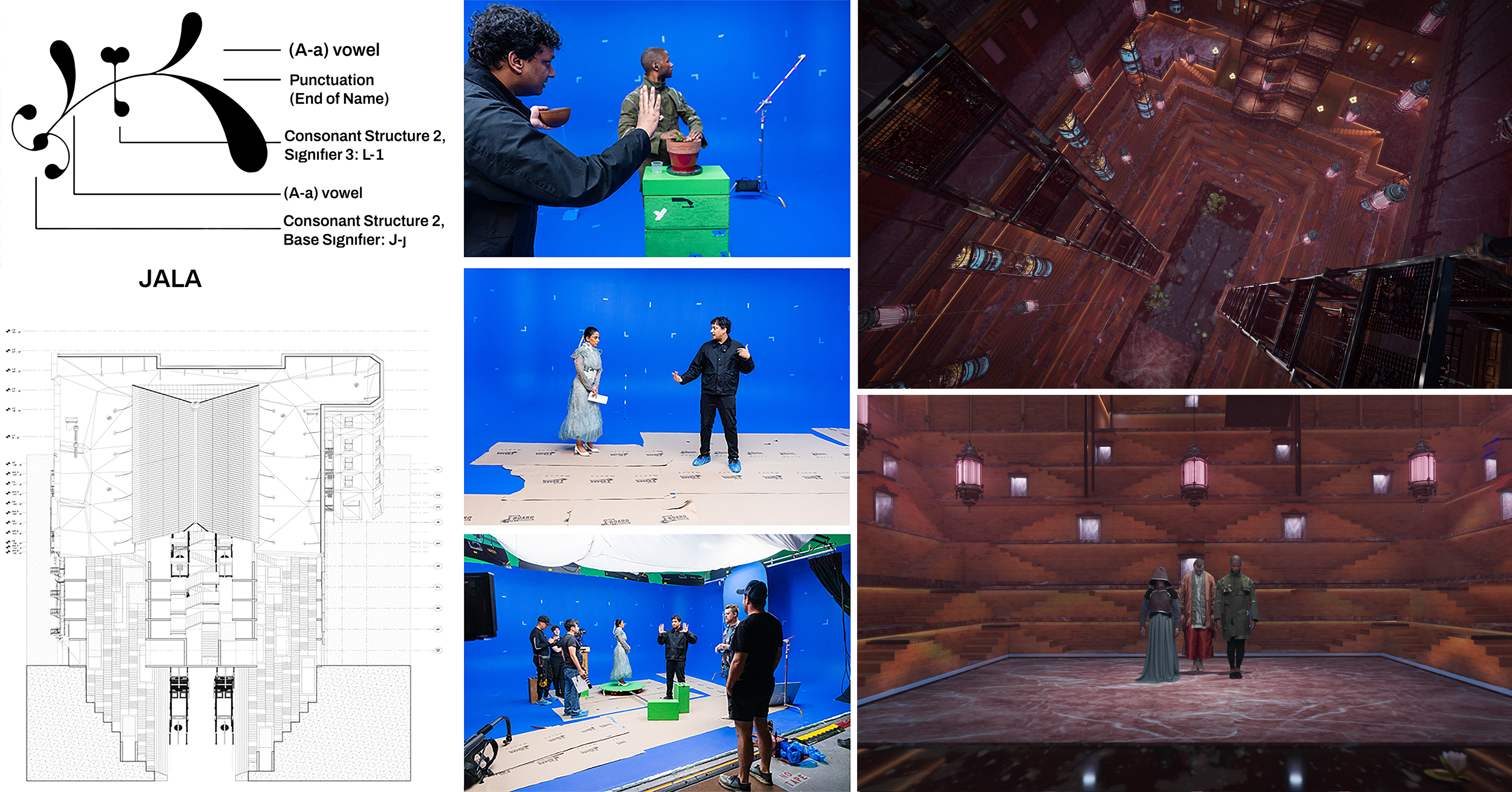
Glyph language diagram that spells “Jala,” Sectional views of the Bradbaori (left); Production shoot of the short film (center); Bradbaori film stills and its characters that represent the earth–energy–water nexus (right).

Outcomes and future perspectives
Within the process of worldbuilding, a single storyline is often understood as a slice of the world or a piece of design fiction (McDowell Reference McDowell2017). The slice of the world of Bradbaori is represented through a short film where the characters within this world, or the Baorians, as I call them, are a personification of the systems within the Bradbaori (Figure 2). If the Bradbaori is a microcosm of the city of Los Angeles, then the Baorians represent its infrastructure. The Baorians make visible the otherwise abstract systems of water governance, translating technical processes into legible social and political relationships. The world of the Bradbaori also has its own written language that is derived from the glyphs of the Bradbury Building, built for the purposes of communication, creation and control of its systems, and is reflected in the costumes and interfaces (Figure 2). These costumes are both inherent in representing the specificity of the fictional culture of the Bradbaori as well as its utilitarian purpose. The narrative of the short film follows the characters as they perform a ritual that activates the Bradbaori’s machine systems. Their gestures blur the boundary between ceremony and technology, fusing infrastructure with ritual. Bradbaori aims to reimagine policy as poetry and regulation as a ritual (Figure 2).
Bradbaori will be officially announced at the 2026 DEMO Festival at the New Museum through a track talk, with subsequent future presentations and screenings, including an exhibition of the worldbuilding assets hosted by Climate House US, and a future immersive mixed reality experience at the Bradbury Building itself – returning the work to the very site that inspired it. Other outputs and representations of the world of Bradbaori include a feature-film screenplay and a zine that serves as the project’s worldbuilding codex.
Creative Science reflection
The dominant mode of thinking in architecture, urban planning and policy is solution-first. We identify a problem and move immediately toward resolution. But this urgency to answer often forecloses the more important work: asking whether we are solving the right problem in the first place. For me, Creative Science storytelling intervenes at this earlier stage. It is a methodology for framing the right questions before reaching for solutions and for slowing the process down long enough to understand what is actually being asked. Speculation becomes a tool for iteration, a way of playing out the holistic and far-reaching consequences of our assumptions before we commit to action – as opposed to the ways in which we conventionally think of speculation, which is as a tool for prediction or futurism (Shima Reference Shima2024).
Bradbaori should not be interpreted as an architectural proposal, because it is merely a thought experiment that asks “what if” and “why not” to generate new questions, not necessarily answers. By simulating these conditions and playing out the future where this prototype exists through fiction, the work surfaces assumptions embedded in how we think about water, cities and the future and also produces questions that could not have been formed without first making the work.
Data availability statement
Data availability is not applicable to this article as no new data were created or analyzed in this study.
Acknowledgments
The author would like to specially thank track mentor Elizabeth Henaff, the NEW INC staff, mentor Alex Darby and the Creative Science cohort for supporting this project through their community and fellowship. The author would like to thank Alex Stolz and the Future of Film Incubator for supporting the inception of this project. The author would like to thank the mentorship and support from Future Humans, Studio B and the cohort of the Berggruen Institute’s Vaster Than Empires III retreat (much of which was conducted at the Bradbury Building). The author would like to thank choreographer Jennifer Rose and the entire cast and crew of the Bradbaori short film for helping him look like a competent director. The author would also like to thank Sherry Chen for her continued support and belief in the work.
Author contributions
Joshua Ashish Dawson solely conceived and developed the project, conducted the research, produced the visualizations and wrote and revised the manuscript.
Financial support
This research received no specific grant from any funding agency, commercial or not-for-profit sectors.
Competing interests
None.
Ethical Statement
Ethical approval is not applicable because this research did not involve human or animal subjects.

 Open access

