
I. Introduction
A taxonomy—a systematic scheme of classification—can be a powerful tool. When Dmitri Mendeleev created a periodic table of elements all he did, at one level, was arrange some items in a list. He simply grouped the sixty-three then-known elements in rows by their atomic mass and in columns according to their properties. Yet the resulting pattern allowed Mendeleev to predict the properties of as-yet unknown elements based on gaps in the table and it prefigured the discovery of the electron structure of the atom.Footnote 1 Alexander Rosenberg has observed, “Every successful scientific typology is a miracle of question begging and the result of pulling oneself up by one’s own bootstraps.”Footnote 2 In the natural sciences, any “miracle” is no doubt underpinned by the physical universe being organised according to beautifully ordered patterns. Man-made systems, such as legal orders, are, by contrast, no doubt less beautifully ordered. And many of the relevant ideas, being products of human minds, are already partially systematized. Might efforts at classification in this area nonetheless prove valuable?
This article proposes a taxonomy of ideas about how legal systems might get individuals to do as their laws require. Readers will be familiar with several such theories and their accompanying nomenclature. The law has been said to secure compliance, or aim to do so, by presenting agents with exclusionary reasons for action,Footnote 3 commands,Footnote 4 a union of primary and secondary rules,Footnote 5 a coordination equilibrium,Footnote 6 or obligations,Footnote 7 among other things. A frequent procedure in legal theorizing is to treat each such idea as a more-or-less independent topic for investigation. The process begins with a writer setting out a theory offering an impressive, comprehensive account of law, with a single guiding idea at its apex. If such a theory is considered interesting, others produce a secondary literature in which each one of its component manoeuvres is unpicked. That approach—what might be termed methodological “one-at-a-time-ism”—has its drawbacks. It may encourage one to overgeneralize about concepts at the periphery of one’s enquiry. It may also tend to smother insights that can emerge at the intersection of different conceptualisations.Footnote 8
The approach adopted here assumes that we can improve our understanding of differing types of explanation for compliance if we consider them side by side. This permits them to be compared and categorised. The exercise forces us to consider what is conceptually important. In this context, important features are, I propose, ones that are salient—present in some cases but not others—and consequential practically and/or morally. A feature is consequential in practical terms if it affects the ease by which compliance may be secured. It is consequential in moral terms if it raises or abates some ethical concern around the law’s intervention in the lives of individuals.
Important features, so understood, include those captured in these four separate questions:
(1) Given the explanation for compliance, can one be said to be acting willingly?
(2) Given the explanation for compliance, does one act on one’s own assessment of the merits of action or else defer to the assessment of others?
(3) Given the explanation for compliance, is one conforming for content-dependent or content-independent reasons?
(4) Given the explanation for compliance, will one regard the law’s intervention as having changed one’s moral position?
My method is this. Each of these questions will be posed of each putative explanation for compliance. The resulting pattern of answers will be used to set out the emerging taxonomy.Footnote 9 I argue that all compliance-generating mechanisms can be grouped into three categories: 1. collateral motivation, a category that includes coercion and reward, 2. authority, and 3. strategic intervention, or, broadly speaking, what is often referred to as “coordination”. Along with these one must consider, in due course, mere conformity as another possible type of motivating relationship between the law and an individual.
The major point where this three- or four-part categorisation departs from other categorisations (generally speaking, other implicit categorisations) is in its treatment of the law’s coordinating effect, the third category. Other discussions tend to assimilate this effect to authority and/or to place it as a unifying concept at the top. Such a treatment, I will argue, obscures important differences between coordination and other mechanisms. For coordination, as here conceived, implies at least some individuals comply wholeheartedly and without surrendering autonomy.
II. The Particular Remedial Goals of My Taxonomy
If we are considering how the law might secure compliance, a many-conceptions-at-once approach (as opposed to a one-at-a-time approach) makes good sense for two main reasons. One is that, plainly, different motivations for compliance can coexist within the same legal system. That being the case, an account of law that does not seek to collapse various forms of relationship between law and subject into a single, idealised paradigm might be rather more realistic than one that does. The possibility of coexisting motivations is recognised, for example, in H.L.A. Hart’s contention that there is a distinction between the attitudes of officials towards the law and those of ordinary citizens.Footnote 10 On that view, officials need to buy into the legitimacy of the system whereas such acceptance is less necessary, and usually less true, of the rest of us.
My suggestion, however, is not merely that a theory of law should capture the diversity of possible explanations for compliance. It is that to understand adequately any one of those explanations—authority, coercion, and so on—one must pay attention to the possibility space within which that explanation sits. This, then, is the second reason for the approach taken here. For a taxonomy is a way of representing the full range of possible explanations side by side.
In this connection, active consideration of the range of possibilities can counter the risks of both under- and overgeneralization. The risk of undergeneralization is obvious enough where one may fail to appreciate that what one writer describes as the law’s “legitimacy” is equivalent to what another calls its “authority,” or that “social pressure” ought to be considered a form of “coercion”, and so on. But what of overgeneralization? My suggestion is that this occurs when the operation of law is seen to boil down always to one of two fundamental mechanisms of compliance: either coercion or authority. In some accounts, coercion expands out to include rewards and, perhaps, other motivational tools. The law’s authority, meanwhile, might be expounded using different language (e.g., providing a guide to practical reasoning) or regarded from the perspective of the subject (obedience). At any rate, the implicit dichotomy is supposedly between complying because of an incentive or else complying because one considers that one ought to do as the law says. We are invited to conclude that if the law makes a difference at all, compliance must be characterised in one or other of these two ways. The assumption that law-as-an-incentive-mechanism sits opposed to law-as-a-guide-to-practical-reason is implicit, for instance, in Leslie Green’s summation of a jurisprudential near-consensus that “[l]aw is … not essentially a motivational device, it is essentially an informational device.”Footnote 11
This article shows that such a conceptualization is incomplete and misleading. There is a third, distinct mechanism by which a person may come into compliance with the law. This involves a person complying as a result of the law’s securing the compliance of others, and it thereby solving some problem of social coordination. The notion of law’s coordinating potential has been recognised by several writers, yet they have, I contend, tended to assimilate it to other forms of legal control, authority in particular. Joseph Raz, for example, states, “Authority can secure co-ordination only if the individuals concerned defer to its judgement and do not act on the balance of reasons, but on the authority’s instructions.”Footnote 12 I argue that there is good reason for regarding coordination as a separate mechanism. For it generates, we will see, a unique pattern of answers to the four classificatory questions identified above.
III. Notes on the formal structure
The items in this taxonomy are all formulated as explanations. Someone does as the law requires: how might we explain that fact? In formal terms, where S is a subject of a law (a person to whom it applies) and ϕ is some action or forbearance, we are considering explanations for a concurrence of two facts, namely: (a) the law requires S to ϕ; and (b), S does, in fact, ϕ.
Given that formal structure, the items in this taxonomy, it is important to see, all relate to the actions of one individual subject at a time, not of subjects (plural), still less those of the population at large. Hence, we are not talking about how authority et al gets “people” generally to comply with the law, but rather, quite specifically, how any such mechanism gets an individual to comply. Hence, given a certain explanation for S’s compliance, other individuals may be complying with ϕ simultaneously for different reasons. The significance of the point becomes clear when it comes to the discussion of strategic intervention below.
IV. The four explanations
A. Mere conformity
S ‘merely conforms’ to a legal requirement to ϕ when S will ϕ regardless of the fact that the law requires this act.
The statement above indicates a null category. It does not describe a form of legal control because the law effects, on the definition above, no difference to the subject. Were the law to cease requiring ϕ-ing, S would continue doing so nonetheless. Still, the statement is, like the other items in this taxonomy, an explanation of a connection between the facts of (a) the law requiring S to ϕ, and (b) S in fact ϕ-ing. It is therefore possible to analyse it in the same way as the other explanations to be considered—and for comparisons to be drawn in due course.
Note that the above definition of ‘mere conformity’ might still be satisfied even if the fact that the law required ϕ-ing at some past time causes S’s conformity today. Suppose a legal ban on smoking in bars is introduced. As the owner of a bar, S complies reluctantly. Later, S comes to see the benefits. Hence, if the ban were reversed tomorrow, S would keep the bar smoke free. To satisfy the proposed definition it is sufficient that the law as it is now does not control S’s conformity. On this definition, S’s continued conformity with what the law was is a matter of mere conformity; the earlier, reluctant (not mere) alignment would need to be explained on some other ground (specifically, by one of the other explanations comprised in my taxonomy), since at that point the law did control S’s behaviour.
Whilst there is no warrant for being dogmatic about this,Footnote 13 there is a certain conceptual clarity in having a definition that pinpoints the attitude of a single subject at a particular moment. Historical enquiry might in many cases reveal a long, winding chain of influence, from individuals who obeyed purely out of fear of punishment, through those who sought reluctantly to align themselves with those original coercees, down to S, whose experiences of the norm in action may have led to an acceptance of its rationale. If our interest is in the present relationship between S and the law, we should avoid collapsing those varying attitudes into a single, diachronic but rather muddled picture—a kind of palimpsest of the law’s effects over time. It seems better to frame the definitional question as: what factor determines S’s decision to conform now?
When S is in mere conformity with the law, we can say the following about that relationship. Here I am following the four questions I set out in the Introduction.
1. In ϕ-ing, S acts willingly. If S ϕs regardless of the law, in mere conformity with it, it is reasonable to presume that S unreluctantly desires to ϕ. The notion of willingness is, of course, difficult philosophical territory. Clearly, one needs to give precision to the notion; but it is sensible for this to await the consideration, below, of instances when the law makes a difference as it does not here. This will be where difficulties do arise of deciding whether the law’s intervention overpowers S’s willingness. Here it is reasonable to presume S acts willingly, free of intervention.
2. In ϕ-ing, S is acting on S’s own assessment of the considerations affecting S. If the law has no bearing on one’s conduct, this suggests that one is acting on one’s own, and not the law’s, assessment of what to do.
3. In ϕ-ing, S is acting for content-dependent rather than content-independent reasons. One follows the law for content-dependent reasons to the extent that one’s compliance depends on the merits, as one sees them, of what the law requires—depends on, in short, what ϕ-ing involves.Footnote 14 It is true that talk of one’s attitude to the content of the law may be strictly inapt where one is not following the law at all. Content-dependence seems to be a concept that is more pertinent to cases where the law is making a difference. Nonetheless, it is more reasonable to say that S is acting for content-dependent reasons and not content-independent reasons in the case of mere conformity. This is because where the law itself is making no difference one can reasonably presume that S is acting for reasons that relate to the merits of ϕ-ing.
4. In ϕ-ing, one will not consider that the law has altered one’s own moral position. If S considers that ϕ-ing would remain obligatory (or permissible) even if the legal requirement was dropped, then S will surely also consider that ϕ was morally obligatory (or permissible) independently of what the law had required. This will be so even if S is someone whose views have shifted historically in the train of a change in the law (as in the earlier discussion of smoking-ban example). One would regard the legislative change as having changed one’s mind but not the rightness or wrongness of ϕ-ing.
Several writers have emphasised the value of keeping in mind the possibility of mere conformity. Frederick Schauer rightly cautions vigilance against observing instances of conformity and falling into the trap of reflexively (mis-) ascribing these to the law’s authoritative guidance, and hence granting authority a greater explanatory role than it deserves.Footnote 15 Raz, similarly, points out that one has reasons to eschew killing or assault which have “no connection with the law.”Footnote 16 Mere conformity is a useful null category.
But should this sort of compliance be of any interest to legal theorists beyond this? Yes, I suggest. The reasons for this are connected with the following propositions: A) securing obedience is only a secondary aim of a legal system, because ultimately such control is a mere means to the end of having people act a certain way; B) whilst the law per se cannot influence rates of mere conformity, society at large can, by educating people in an attempt to bring their views into line and/or, conversely, by picking its battles in passing and retaining only those laws that command widespread support; and C) if individuals conform based on their own assessments so much the better, because under this condition their autonomy is preserved and because one thereby also avoids depleting the resources of authority and coercion. One might have imagined that these propositions, which imply that attainment of high rates of mere conformity is a desirable social goal, would be uncontroversial. However, Green contends that mere conformity is, from a legal system’s perspective, secondary to obedience. As he describes it, those who conform to the law for law-independent reasons are, far from celebrated, excused, merely given a pass: “Luckily for them, the law does not generally punish failure to obey unless it is accompanied by failure to conform. … The law claims obedience, but it mostly settles for conformity.”Footnote 17 That seems to me an odd proposition. In a modern democracy one would think that laws were passed with the aim of securing, for rational reasons the conduct that they require—getting people to ϕ—rather than putting citizens to a tyrannical test of loyalty by asking that they do what they would otherwise not do. Whenever people ϕ of their own accord, it can hardly be an occasion for disappointment or grudging toleration from the perspective of the system.
B. Collateral motivation (coercion and reward)
S’s compliance is secured by collateral motivation to the extent that S’s reason for ϕ-ing is some advantage imposed by the law for ϕ-ing or disadvantage for not ϕ-ing.
A motivating factor imposed by the law is a “collateral” one inasmuch as S is motivated by something other than the advantages inherent in the action of ϕ-ing. When one does up one’s seatbelt to avoid injury, there is a case of mere conformity. In the case of collateral motivation, the law has injected an additional motivating factor into the situation faced by S and this influences S’s decision to ϕ.
This category is wide. Following Grant Lamond, action can be regarded as coercive if it makes the taking of an option the condition for the imposition of any sort of disadvantage and this is designed to induce one not to take that option. This would include not just criminal or regulatory sanctions or even damages, but arguably also the loss of entitlements or the imposition of taxes designed to price a certain activity out of the market.Footnote 18 One might debate whether certain legal effects are primarily coercive in character (for instance, Hart disputed that this was true about nullity for want of formalities)Footnote 19 but such questions are not in issue the way the matter is framed here. What matters here is simply whether S is motivated by the effect in question. Even adverse effects not formally authorised by the law but entrained, such as social pressure, would count.
But my category goes wider still because it bundles coercion and reward. This is by no means idiosyncratic. As earlier mentioned, Green posits a fundamental difference between “motivational” and “informational” approaches to influencing human conduct in arguing that the latter approach (i.e., providing a guide to practical reasoning) is more characteristic of law as a technique of social control.Footnote 20 Bentham portrayed rewards and sanctions as equivalent for virtually the opposite end, namely to promote the idea that law should be understood in motivational terms,Footnote 21 and recently Schauer has emphasised the role of incentives for similar purposes.Footnote 22 My reason, though, for joining coercion and reward together at this high rank in a taxonomy is that the relationship between S and the law’s directive can, in light of each of the four tests applied throughout this article, be analysed in similar terms whether S is coerced or bribed.
1. When coerced or rewarded, S, in ϕ-ing, acts unwillingly. Questions of what it means to act willingly (or else voluntarily, freely, and so on) are problematic if one attempts to grasp these terms in some essentialist, absolute sense. The meaning is surely clear in everyday discourse, though, when the speaker is understood to refer, at least tacitly, to a particular constraint the removal of which would change the agent’s intentions. “I don’t want to go into work today,” is perfectly intelligible, said by someone struggling into the office, as a statement about the slenderness of that person’s present desires: but for my job I wouldn’t be on my way there. Similarly, we can say that a person complying with a directive to ϕ does so willingly if that person would have no desire to edit the directive, given the opportunity, so as no longer to require ϕ-ing. Footnote 23 In this sense, S does not act willingly if S is coerced. Such an S would change the directive to remove the requirement to ϕ and hence be free to act otherwise. But, on this view, neither does S act willingly where S is bribed to act, albeit the analysis bifurcates here. For an unscrupulous S would narrowly edit the directive merely to remove the condition that one must ϕ to be entitled to the reward; a more conscientious S would remove not only the condition but also any entitlement to the reward (since this would then be unearned). But either way, neither the fair nor the unscrupulous S would ideally wish to leave intact the requirement to ϕ where they regard ϕ-ing as harmful or simply not worth doing, reward apart. That a person can be considered at once motivated and unwilling is not paradoxical. One might be very eager to earn a reward. But, as the earlier example of work-dread highlights, it is quite normal to distinguish one’s desire to perform an action in light of some defined reward from one’s general desire (or lack thereof) to perform the action reward apart.
2. In ϕ-ing, S is acting on S’s own assessment of the considerations affecting S. When one or more of one’s options have been eliminated as an eligible choice by a threat and one acts as demanded, can one really be said to act on one’s own assessment of the relevant considerations? I think so. Note, again, that the question applies to the moment of S’s decision. In acting on the threat, S is presumed, not the least by the person issuing the threat, to be acting rationally, balancing the advantages and disadvantages of the contemplated courses. Coercion is, as Lamond says, “rational compulsion …. It is ‘rational’ in the sense that it works through our reasoning faculties―it involves making a choice―and it presupposes that the person presented with the choice will act rationally by settling for the lesser evil.”Footnote 24
Coercion undoubtedly has this obvious morally troubling aspect: it removes otherwise viable choices from agents and, in this way, interferes with their autonomy. Hence, Lamond is surely right to suggest that coercion is prima facie wrong, something in need of justification.Footnote 25 Yet in another respect coercion holds up well against its rival technique of politico-legal control, authority. The morally challenging aspect of authority is that it leads one to act blindly, to untether one’s moral judgement from one’s actions. That particular problem does not apply to coercion. Generally, whatever the other ways coercion may interfere with one’s autonomy, it does not interfere with rational agency, as do successful claims of authority. There is a special case, however, of a form of coercion which does interfere with rational agency: torture.
Jeremy Waldron points out that torture involves the application of pain (or its immediate apprehension) deliberately to break the will of its victim, “by reducing him to a quivering mass of ‘bestial, desperate terror’.”Footnote 26 In this respect, Waldron explicitly distinguishes ordinary forms of coercion such as threats of incarceration, confiscation and so on: “If law is forceful or coercive, it gets its way by nonbrutal methods which respect rather than mutilate the dignity and agency of those who are its subjects.”Footnote 27 So to the extent torture can be regarded as a form of collateral motivation (or indeed a form of legal control at all) it should be distinguished at the next available branch of a taxonomy from all other such forms.
3. In ϕ-ing, S is acting for content-independent reasons to the extent motivated by coercion or reward. Again, a reason for action provided by a directive is content-independent if it does not relate to the matters that the directive seeks to govern.Footnote 28 The notion is often connected with authority. If I act on someone else’s say-so, I am acting on reasons other than those connected with the intrinsic merits of that action. But, as Raz correctly points out, the same can be said of responding to a threat.Footnote 29 If I act because I am threatened, the decisive thing is my desire to avoid the threatened eventuality. This concern is something aside from any reasons provided by the features of the situation that the directive seeks to govern. (Hence the taxonomic description: collateral motivation.)
4. One will not consider that the law has changed one’s own moral position. If, the law aside, I would think that not-ϕ-ing is acceptable, or even mandatory, and if the law would need to coerce me to get me to ϕ then following the imposition of the law I must continue to think not-ϕ-ing is acceptable or (as the case may be, and to the extent I can escape the sanctions) mandatory. It is true that in the case of action that I consider to be mandatory my moral position may be changed to the extent that coercion may excuse me from complying with what would otherwise be my duty. But then it would not strictly be the law that would be changing my moral position—not even the part of the law purporting to impose the sanction—but the contingency of effective coercion, that is, actually feeling threatened—that is making the difference. If I possessed the Ring of Gyges (the mythical invisibility ring deployed by Plato in a thought experiment to probe human motivations for acting ethically),Footnote 30 and so could be sure of avoiding the sanction, I would be obliged still not to ϕ in compliance with my background moral duty.
C. Authority
S’s compliance is secured by authority to the extent that S treats the law’s requirement as a reason to ϕ, and such reason makes no reference to the merits or consequences of ϕ-ing.
This description of authority requires that the subject be motivated to act at least partly by considerations independent of the merits, and consequences, of undertaking or not undertaking the required conduct. But it permits authority to have a dimension of motivational weight. It may be added to one’s other considerations; it may merely tip the balance. This is at odds with Joseph Raz’s well-known “pre-emption thesis,” which asserts that treating a directive as authoritative involves disregarding at least some of the considerations that would otherwise bear on one’s decision. However, I suggest that the definition proposed here is defensible and appropriate, particularly in the context of an inclusive taxonomy.
First, it must be noted that the proposed definition involves a stricter notion than does Raz’s theory about what it means to treat the directive itself as a relevant reason for action in the first place. Raz would apparently regard an anarchist, who complies with an order to evacuate a ship purely because he assesses that this will avert chaos, as treating the order as a reason for action—just as someone who accepts the captain’s authority would be treating the order as a reason for action.Footnote 31 The anarchist’s denial of authority comes because he does not then cede considerations of the consequences of non-compliance to the judgment of the captain. In my one-step analysis of authority, however, one would simply say that the anarchist’s reason for action does not fall within the set of reasons that count as authority-motivated reasons, because it is a reason bound up with the consequences of compliance.
Both Raz and I are emphasising that obedience to authority involves a disregard of the merits of the action in question. But the architecture of our respective analyses is different. On the view advanced here, such disregard enters in the immediate way that a directive regarded by a subject as authoritative is brought to bear in the subject’s reasoning—namely, via a reason which in itself incorporates no assessment of the merits of compliance in this case. On Raz’s analysis the disregard (exclusion) of merits enters in at a second stage (which my analysis makes do without) with the ousting of some or all of S’s other considerations. Given the structure of the approach proposed here, the argument that Raz makes from his “dependence thesis” (the proposition that decisions reflect and replace their underlying reasons)Footnote 32 to the pre-emption thesis has no application, I suggest. Raz’s argument is that one cannot without logical violation (in particular, double-counting) treat a decision as authoritative and add to it the same sort of considerations that were factored into the decision itself. But to the extent that (as my definition of an authority-motivated reason requires) the relevance one assigns to a directive relates not to one’s assessment of the merits of the action but rather to a concern for, say, institutional loyalty, or the premium one places on the decision-maker’s expertise, or any other content-independent ground, there is no double-counting or similar violation when one adds such reason to one’s own balance-of-the-merits assessment.
Secondly, authority and obedience (I take “obedience” to be authority’s perspective-of-the-subject correlate: the conferring of authority) are often discussed in terms which do not express the notion of pre-emption. Typically, what, instead, is implied to be focal about the concept is simply the treating of another’s word as a content- (and consequences-) independent reason for action. Schauer, for instance, isolates the notion of complying with “the law just because it is the law.”Footnote 33 This phlegmatic formulation—which Schauer equates with “taking the very existence of law as at least a prima facie reason to follow it”—seems a not unreasonable summation of what is involved. A tolerant taxonomy ought to be able to accommodate such approaches.Footnote 34
Thirdly, real-life exercises of authority do sometimes operate as if they have dimensions of weight and not just domains of application. Consider how, in contexts where there are two or more co-possessors of authority (parents, teachers, bosses) over the same subject we often talk about one having more or less authority than the other—meaning not that they possess different jurisdictions but that their respective words weigh more or less heavily on those in their charge. Or consider the experience of faithfully following a requirement that seems increasingly absurd up until some mental tipping point is reached and one snaps and abandon the rule. Such behaviours and psychologies indicate that it is not only perfectly intelligible but in line with our normal conceptions to describe authority as something which has a dimension of weight and which creates reasons for action that may be placed in the balance with one’s own assessment of the situation.Footnote 35
As done with collateral motivation, let us now subject authority, as conceived, to the fourfold questioning that is being applied to each element in the emerging taxonomy. Here are the results.
1. In ϕ-ing, as authority demands, S acts unwillingly. This seems a reasonable conclusion given S’s conception of what the balance of reasons requires is at odds with the authoritative directive. Apart from the law, S would not ϕ, e.g., serve in the military. If S could change the directive to eliminate the requirement of military service, presumably S would. One might wonder, though, whether such conclusion always holds. Does it depend on the nature of the authority in question? Suppose the person issuing a directive has Weberian charismatic authority over S.Footnote 36 Isn’t a hallmark of charismatic leaders that their subjects are devoted and follow directives with enthusiasm?Footnote 37 Perhaps. Charismatic leaders are, let us assume, good at persuading us as to the rightness of their demands. But such an assimilation of belief cannot have yet happened if we are talking about an exercise of authority. At the point of compliance there must be a conflict present between what S considers is appropriate and what the charismatic leader has ordered. The same point applies to expertise-based justifications of authority. One way that theoretical authority (believing on another’s say-so) differs from practical authority (acting on another’s say-so) is that the former implies a transitory rather than a continuing state: once we accept the advice we update our beliefs and the prior scepticism ends. By contrast, practical authority presupposes a present conflict between what S thinks is correct to do and what the law requires.
2. In ϕ-ing, S is acting not on S’s own assessment of the considerations affecting S, but that of the person in authority issuing the directive. Where authority is making the difference, what matters is the fact of the directive having been issued, which in turn results from someone else’s assessment of the relevant considerations.
3. In ϕ-ing, S is acting for content-independent reasons. As discussed above, to the extent that S follows an authority, S’s decisive reason for compliance is collateral to the content of the directive itself, collateral to the merits of ϕ-ing. On the analysis proposed here, S may be influenced by other reasons as well and these need not be content-independent, whereas on Raz’s view content-dependent reasons are pre-empted. But on either view, it is a content-independent reason that is making the difference where obedience to authority is the decisive factor.
4. In ϕ-ing, as authority demands, one will (generally) consider the law to have changed one’s own moral position. I would suggest that being motivated by obedience to authority generally will alter, in one’s thinking, the permissible into the proscribed or the obligatory as the case may be (or the impermissible into the obligatory). Such a change in one’s moral assessment would appear to be implied by most cases of obedience to authority. If, for instance, I comply with a directive because I consider that morally I must always follow the majority’s decision or because I must always obey a certain religious leader’s ruling, any such belief implies I would not have considered myself obligated/prohibited had the authoritative directive not made it so.
However, in one case some qualification seems necessary. This is where one obeys because one believes that one is thereby more likely to do what one should be doing already, prior to the directive being issued, than by following one’s own judgement. We are here supposing that the subject defers to the lawmaker’s presumed greater expertise or superior powers of judgement. Then, at one level, the subject will believe that one’s moral position has changed. The previous, personal judgement was that ϕ-ing was not required—but, now, because of the directive, one considers one should ϕ. Yet, at another level, this person will suspect that the directive reflects what was required all along, implying no real change in the moral position. To that extent, expertise-based authority can be seen to operate differently from all other guises of authority.
Expertise-based authority is often associated with Raz’s well known “normal justification thesis” (NJT). This holds that authority is justified where it helps you better comply with the reasons that apply to you.Footnote 38 Given the prominence of Raz’s theory, it is interesting to ask, parenthetically,Footnote 39 whether the result derived above—no change in one’s moral position—applies to authority justified via NJT. This turns on whether NJT really is equivalent to the notion of expertise-based authority articulated in the previous paragraph. The question is: if a given exercise of authority is justified according to NJT, does this necessarily imply that one is being directed to do what was already required?
Answering this question is hard because Raz is ambiguous on a crucial question: for the purposes of NJT, when we are considering the reasons that following the authority may help us promote, are we supposed to count those reasons that are only generated by the fact of the authority having issued a directive, or are such reasons supposed to be excluded from the calculus? Do the relevant reasons include, in other words, standing reasons for treating the directives of a given authority as binding (reasons such as, e.g., “democracy requires that I obey laws passed by Parliament”), and so does the thesis ultimately embrace any kind of valid justification for obedience? If such reasons are excluded, Raz’s thesis does indeed imply that authority must only demand what was already required of S, directive apart. If, however, such reasons are admissible, then the two notions (i.e authority-getting-you-to-do-what-you-already-should and NJT) are not equivalent. And so, in this case, the law’s intervention may potentially cause a change in one’s moral position. It would also then be hard to see how NJT, since it would encompass any valid justification, avoids collapsing to the tautology that authority is rationally justified if and only if it is justified rationally.Footnote 40
D. Strategic intervention (coordination)
S’s compliance is secured through the law’s intervention in S’s strategic situation to the extent that what is decisive in S’s decision to ϕ is that the law secures, or is thought by S likely to secure, the compliance of others.
Previous attempts to apply game theoretic ideas to the law have tended to embody three features which, for reasons explored below, undermine their effectiveness: they focus on “coordination problems” (in the conventional, rather specific sense of this phrase in game theory, shortly to be explained) to the neglect of other forms of strategic interaction; they propose, over-ambitiously, the resolution of such problems as a universalised explanation of law’s operation; and connected to this last feature, they seek conceptually to assimilate to coordination other mechanisms of securing compliance (i.e., authority and coercion).Footnote 41
What is meant by a coordination problem? The classic example is the choice of whether to drive on the left or the right side of the road. Matching the choice of everyone else by driving on the same side as them is clearly preferable to not doing so.
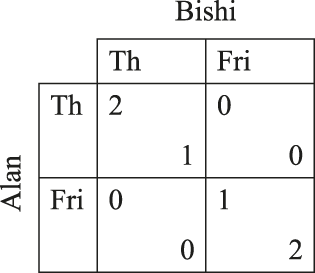
The situation where all parties are indifferent as between two or more outcomes so long as their selections coincide is a perfect coordination problem. A situation where the parties have different preferences and yet still prefer outcomes where their selections coincide is an imperfect coordination problem (sometimes called the “battle of the sexes” game). So, to give a second example, Alan and Bishi believe that rain will come only if they both perform a dance together on the same day. Alan would prefer to dance on Thursday, Bishi prefers Friday. However, both would prefer, above all, any day that the other also turns up. The scenario is represented in the pay-off matrix at Figure 1. (Here, Alan is row-chooser and, as is conventional, his pay-offs are indicated in the top-left corner of each cell; Bishi is column-chooser and her pay-offs are indicated in the bottom-right corner of the cell.) This is a case of a clear, if imperfect, coordination problem.
(Impure) coordination problem

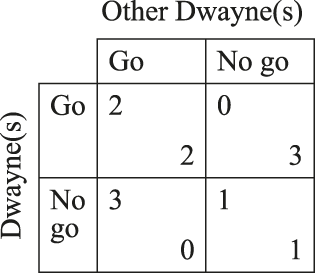
However, plainly there exist many social scenarios that do not have the structure of even imperfect coordination problems. Developing the last example, suppose another person, Dwayne: (1) believes that rain will come so long as enough others join the dance, yet not everyone need do so; (2) calculates that his presence is unlikely to tip the balance; and (3) has, rightly or wrongly, no qualms about free-riding on the efforts of others. In the terminology of game theory, people like Dwayne regard the situation in Prisoner’s Dilemma terms.Footnote 42 Figure 2, which imagines the pay-offs of Dwayne, or one group of “Dwayne(s)”, as against those of a similarly minded person/group, is a classic Prisoner’s Dilemma matrixFootnote 43.
The Prisoner’s Dilemma

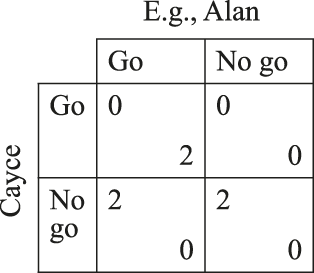
Or consider the position of a further character, Cayce. She simply does not believe that rain dances (or substitute: military interventions, vaccinations …) have any beneficial effect and would just prefer for the nonsense to end. There is, for Cayce, no strategic problem at all. Her preference (which is not to attend at all) remains the same whatever the choice of the others. It is hard to see how this situation—“Cayce’s Case”, represented at Figure 3—can have anything to do with coordination.
Cayce’s Case

Gerald Postema side-steps the problem presented by such possibilities by assuming that “[t]he citizen, for his part, seeks coordination of interpretation because he wishes to live within the law, to seek the common good, to achieve his own ends with the assistance of the facilities provided by the law, or to avoid the sanctions threatened by the law.”Footnote 44 This is questionable if intended as a general description; it also muddies the waters by referring to sanctions as a possible motivating factor. Postema’s focus, in fairness, is in exploring the consequences of the (more plausible) proposition that judges and other law-applying officials, as opposed to citizens, generally seek to coordinate their respective interpretations of the law. The suggestion is that this creates a higher-order coordination problem which, for them, the law itself serves to solve. Waldron, in a similar vein, contends that a need for coordination may arise around the margins of an otherwise universal desire for regulating certain conduct. He alleges that, in this way, “many more issues addressed by the law can be associated with [imperfect coordination problems] … than might at first appear.”Footnote 45 Even in the case of something as universally condemned as rape there are aspects of the law that are controversial, such as the nature of mistakes about consent that are exculpatory. People have an interest in a “common scheme” of law governing sexual offences that “deals unequivocally with such matters.”Footnote 46 However, even if this example convinces on its own terms,Footnote 47 it is a long way from Cayce’s Case, the occasion where the individual considers that it is just plain silly, or wrong, for the law to be regulating the situation at all.
John Finnis addresses more directly the possibility of situations where an actual desire for coordination is lacking amongst numbers of the participants.Footnote 48 Like Postema and Waldron, Finnis invokes, in effect, the notion of a second-order coordination problem—coordinating not between possible actions but between possible rules about such actions, i.e., legislative outcomes. But Finnis goes further by stipulating that such a problem arises simply because there is disagreement about which such legislative outcome should prevail. On this approach, it seems, granted that someone like Cayce sees no immediate, first-order strategic problem in the choice of whether or not to attend the rain dance, the fact that others do consider attendance to be important means that a problem does arise of coordinating—mediating between—the desire of the community that attendance be mandatory with Cayce’s desire that it not be.Footnote 49 The preference for coordination in this second-order problem is, moreover, constructive—supplied by Finnis’s political theory—rather than one that Cayce actually holds: “For a legislator or judge, considering the problems of social order generically, the pure conflict situation cannot be conceded to exist as between the members of a community.”Footnote 50 But, as Green rightly suggests, a preparedness to ignore actual preferences is to throw away any explanatory advantage that the invocation of game theoretic ideas might have brought.Footnote 51 The challenge of a theory of political obligation such as Finnis seeks to advance is to explain why individuals ought to conform to laws that they regard as pointless or wrong. Such a project is not advanced by stipulating that one ought to discern a need for coordination in such circumstances.
Before we are tempted to dismiss entirely the relevance of game theory, what if, though, someone does find that the law in a given case resolves a strategic problem?
For sure, someone who regards the preferences of the community as always generating coordination problems effectively treats the expression of any such preferences as authoritative. (Edna Ullmann-Margalit proposes, drily, that a technical definition of a “conformist” might be someone who possesses such an attitude.Footnote 52)
But this cannot be said of those who, in a particular case, take advantage of the law resolving what they already regard as a coordination problem and who act in accordance with their own preferences. Authority is not required here at all. Finnis is wrong to suggest that there are “in the final analysis, only two ways of making a choice between alternative ways of co-ordinating action to the common purpose or common good of any group” namely “either unanimity, or authority.”Footnote 53 Game theory’s relevant insight is precisely that all that is needed for successful coordination is the salience to the participants of one of the potential equilibria. Such salience can be generated by accident (e.g., the happenstance of what the first person on the scene did) or by the coercion of some, as well as by anything resembling the exercise of authority. And once equilibrium has thus been established, by whatever means, continued conformity to it can be explained simply by reference to the fact that the participants, looking to their own preference matrices, have no reason to depart from it. As Ullmann-Margalit says, “one is using a co-ordination norm [her term for a norm pointing to a solution to a coordination problem], or … taking advantage of its existence by acting in accordance with it, rather than … just conforming to (complying with) it.”Footnote 54
In fact, the interesting point about the relationship between law and strategic interaction is almost the opposite of the one drawn by Finnis. In those cases where the law affects S’s choice of action merely by altering the choice of others, there is no need to invoke either coercion or authority to explain S’s conformity. In such cases, the law is not altering S’s own pay-offs (as with coercion) nor need S be acting on the law’s say-so (authority). Instead, S is simply looking to S’s own preference matrix and acting accordingly.
So far, we have considered only “coordination problems” in the technical game-theoretic sense of the term, namely a situation where all participants prefer matching the preferences of others to any other outcome. In such cases, we have seen that the law can, simply by making one solution salient to the participants, secure a subject’s compliance whilst avoiding overriding or manipulating that subject’s preferences. But the law may also achieve this feat where it intervenes in another type of strategic context that in some respects more closely resembles the Prisoner’s Dilemma paradigm.
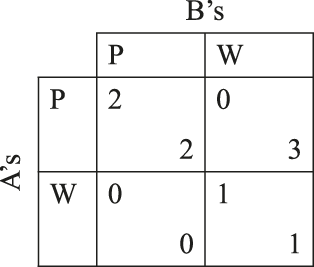
Consider the matrix at Figure 4, representing the respective pay-offs of members of two segments of a community,Footnote 55 the A’s and the B’s, as to two choices: paying (P) a certain contribution towards some communal service, or withholding (W) that contribution. The A’s are row-choosers; the B’s are column-choosers.
‘The Reasonable Person’s Dilemma’

Here, the pay-off structure is asymmetric as between the participants. Both A’s and B’s would each prefer the situation where both groups pay (top-left cell) directly over the one where neither do (bottom-right cell). And both would rank the situation where they themselves pay and the other does not (top-right cell from the As’ perspective; bottom-left cell from the Bs’) as undesirable. But the two groups regard the opposite scenario, i.e., where they themselves withhold whilst the others pay, differently. The B’s—the more unscrupulous lot—would prefer such outcome (top-right cell) above all others. Hence, the B’s are motivated to withhold regardless of what the A’s do. Their payoffs are ordered exactly as in the Prisoner’s Dilemma. The A’s, however, regard free-riding in this way as morally wrong. We can suppose they have internalised this attitude such that any sense of advantage they might otherwise have obtained from free-riding is for them stripped away (or counteracted by guilt?). So, in their preferences, this outcome (the bottom-left cell) is less desirable than the outcome where both they and the B’s pay up (top-left cell). Consequently, the As’ preferred action depends on the Bs’ anticipated choice. If B’s withhold payment the A’s prefer to do likewise. But if the B’s will pay then the A’s wish to do so too.
Therefore, the law can make a difference to the A’s decision by making it less likely—through the credible threat of sanction—that B’s will escape payment. One could represent the effect of the law’s intervention either by covering up the right-hand column of the matrix or by imagining a new matrix in which the Bs’ pay-offs in the top-right cell are adjusted downwards to reflect the anticipation of a sanction being applied.
Prior to the law’s intervention, one might call the unadjusted matrix, from the perspective of the As, the “Reasonable Person’s Dilemma.”Footnote 56 There are glancing references to the possibility of something akin to the Reasonable Person’s Dilemma, and so to this mode of the law making a difference, in the writings of both Hart and Raz.Footnote 57 But neither one arrives at the conclusion drawn here, namely, that an explanation of S’s compliance based on the law’s control of others is a competitor to the explanations “S was coerced” and “S obeyed.”
The interestingness of this conclusion, which should at a conceptual level be clear enough, would be reinforced by a finding that scenarios broadly corresponding to the matrix in Figure 4 are pervasive in the real world. Exploring the empirical validity of such a proposition is beyond the scope of this article. But suffice to say I can imagine pro-social actions that I do not currently undertake but might if, but only if, many others did as well (paying a little more tax perhaps?). And I can suspect that there are behaviours that are happily second-nature to me, such as restraint from the use of pre-emptive or punitive violence, which might not be the case, had I lived instead in a pre-modern milieu where the prospects of reciprocation were poor.Footnote 58
When the law secures S’s compliance by affecting the likelihood of the compliance of others, the following can be said.
1. In ϕ-ing, S acts willingly, to a greater-or-lesser extent. Footnote 59 This point is of significance if one considers the following possible objection: if coordination is parasitic on some people being either coerced or obeying, does it really deserved to be conceptualised as an entirely separate mechanism of legal control? The narrow answer to this objection is that there is certainly no double-counting. Those who are coerced (the B’s in the example above) would be duly categorised as such when the time comes to consider their position qua S’s. The broader answer is as follows. The ultimate purpose of drawing conceptual distinctions about how the law secures compliance is, I presume, to say something consequential—conceivably with some practical implications, however indirect—about the structuring of a legal order. Imagine two societies of 5 million people. In both, there exists a body of law that, for a minority of citizens, say, 1 million of them, is complied with only out of fear of sanction. In the first society, the remaining 4 million think this body of law is unnecessary, or even unjust, but comply, through gritted teeth, out of loyalty to the system. In the second, the remaining 4 million instead comply wholeheartedly because they see the value in the actions required by the law, but only so long as virtually everyone complies, including the 1 million coercees.
It is an open question whether, all other things being equal, the long-term prospects of the legal order of the second society might be stronger than those of the first (my intuition is that they might well be).Footnote 60 Yet a conceptualization that chalks up any instance of compliance-conditional-on-coercion-of-others to coercion-in-general will tend to yield the misleading conclusion that one is looking at 5 million coercees in the second society as against only 1 million in the first and that hence, since coercion is regarded as “law’s ‘Plan B’”,Footnote 61 the second legal order is in a more parlous condition than the first. Better, as was suggested in Section IV.A above, to separately assess the individual relationships between each S and the law before drawing overarching conclusions about the resulting society-wide legal order.
2. In ϕ-ing, S is acting on S’s own assessment of the considerations affecting S. Where the law makes a difference to S’s decision purely by getting others to comply, as noted before, this implies S is simply looking to S’s own pre-existing preferences and is acting accordingly. There is then no room for authority as an explanation of S’s decision.
3. In ϕ-ing, S is acting for content-dependent reasons. We have seen that coercion and authority move one to ϕ by appealing to something other than the merits of ϕ-ing as one sees them. Here, the merits of ϕ-ing as S sees them are decisive. If the pay-off matrix for ϕ-ing had been sufficiently different, S would have made a different choice.
4. One will consider the directive to have changed one’s moral position. The logic of the Reasonable Person’s Dilemma is that after the law intervenes, securing the compliance of enough others, the ethical position of S, as an A, does indeed change. The relevant action (paying the contribution in my example) switches to being the one that practical reason requires.
It is true that this depends on a contingency, namely whether, in S’s prediction, the law will actually succeed in securing the compliance of others. Earlier, in the case of coercion, the contingent nature of enforcement was found to be a reason for concluding that S will not consider the law to have changed S’s moral position. However, the degree of contingency here is considerably lesser and of a rather different quality. The chances of breach occasioning sanction for a given individual will fluctuate continually (am I currently on CCTV?); individuals can continually update their view of such chances. But society-wide levels of compliance are not something that will fluctuate from moment to moment. Nor will such society-wide compliance be within S’s control. The key point is surely this: if S was supplied with the Ring of Gyges, S would not use this (as one would if coerced) as an opportunity to cease to ϕ. Incidentally, this was the point that I take Thomas Hobbes to be making about the changed stance of persons living within a civilised society towards the use of violence. Hobbes held that such persons living there are not entitled to act as they would in an anarchic state of nature, the famous “Warre of every man against every man.” In a functioning social order, he considered that one ought (apparently in the full, moral sense) to refrain from the use of force and fraud.Footnote 62 That Hobbes combined that conclusion with a (rather humane) refusal to condemn those who act otherwise under different social conditions,Footnote 63 seems to have led to the canonisation in political philosophy of his view as being that ethical standards are merely a matter of expediency.Footnote 64 The modern association between Hobbes and the Prisoner’s Dilemma is in line with such a reading.Footnote 65 Yet it might be fairer to say that Hobbes saw the problem of achieving a civil society in terms, instead, of the Reasonable Person’s Dilemma outlined above. He assumed that his readers would readily assent to ethical demands about the restraint from force (“seek Peace, and follow it”) that arguably correspond to the preferences of the A’s in that scenario (Figure 4) and not necessarily to the purely selfish preferences of the B’s.
V. Assembling the taxonomy
To recap, this article has explored four categories of explanation for compliance with the law. These are: Mere Conformity; Collateral Motivations (sanctions/rewards); Authority; Coordination, the law’s intervention in the subject’s strategic situation.
Of each explanation—each form of relationship between law and subject—four questions have been asked: (1) does the subject act willingly? (2) does the subject act on the subject’s own assessment of the merits? (3) does the subject act for content-dependent, or content-independent reasons? and (4) will the subject regard the law as having changed one’s moral position? A further question can be posed: simply, does the law make a difference to the subject’s conduct? (The answer to this last question is plainly “yes” for all explanations excepting mere conformity, hence there being three forms of legal control.)
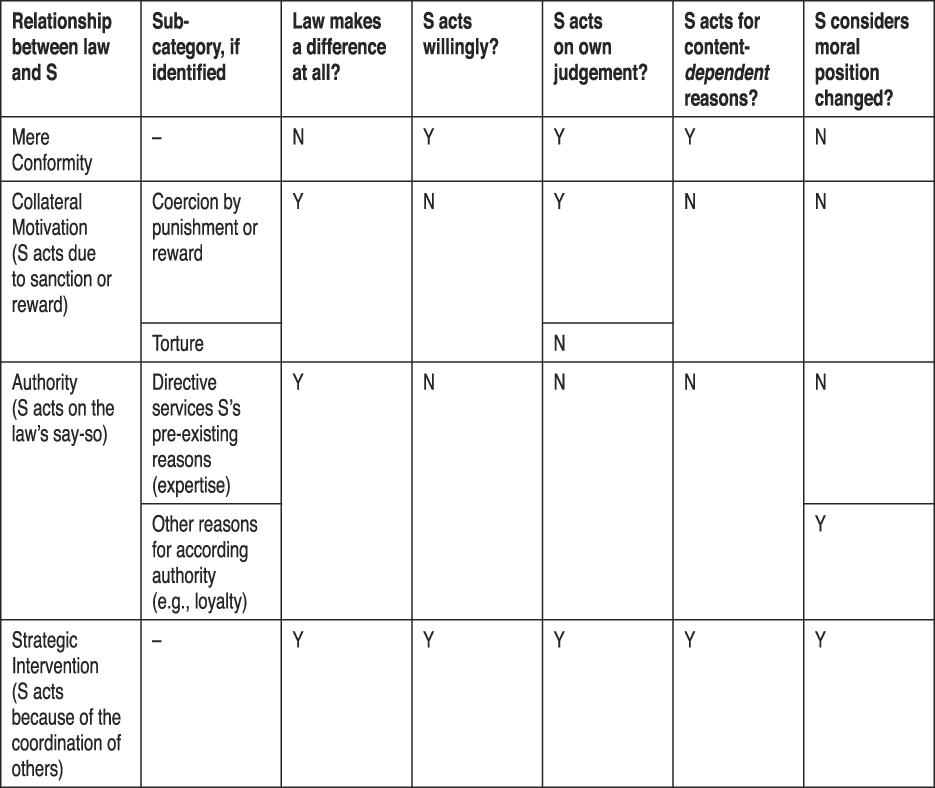
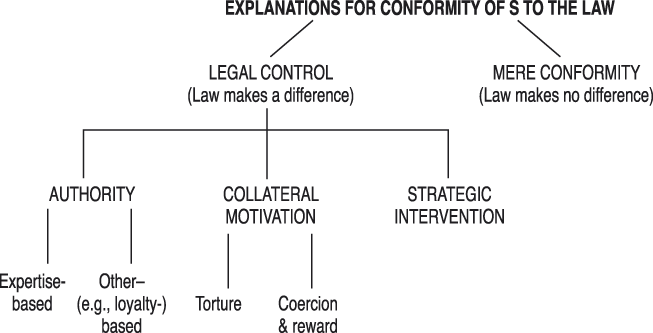
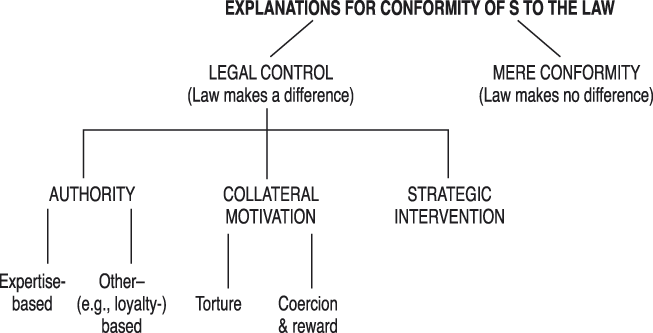
Each explanation yields a different pattern of answers to those questions. These findings are tabulated in Figure 5; they are represented in tree diagram form in Figure 6.
The taxonomy in table form

The taxonomy in a tree diagram
It is worth clarifying that the categorization is not designed to pre-empt the question of whether differing motivations can be combined within the deliberation of a particular subject. A conceptual separation of various vectors of action implies no claim that each vector must operate in isolation. It looks merely to each explanation pro tanto: what is S’s relationship to the law to the extent that such explanation applies? Might, for instance, a subject be moved to act out of a mixture of a sense of obedience and of coercive threat? Or where the law secures the conformity of others, might this tip the balance if one is somewhat, but not decisively, predisposed to comply—whether out of respect for the law or fear of sanction? A provisional view is that any such combination is both conceptually possible and psychologically plausible.
One proviso is that if obedience to authority does, or can, operate as a reason for action that excludes other considerations (as Raz argues) then, obviously, to that extent it might not be combinable with other motivations for compliance. Although I have earlier criticised the view that authority necessarily, or even typically, operates in such manner, it nonetheless seems reasonable to acknowledge the possibility that it may sometimes do.
VI. Implications and extensions
The taxonomy that emerges in this article is merely suggestive. It is only a sketch. Beyond the top-rank taxa only a few additional sub-divisions are considered. This might be as far as my category-building questions (“Does S act willingly?”, and so on) will take us. Perhaps extension to further taxonomic ranks would require the injection of some new questions.
Another dimension in which the taxonomy could be extended is side-ways: to cover any form of social or political power in general. My sense is that this would not, in fact, require the creation of additional top-rank categories. True, individuals and organizations can influence others in one obvious way that “the law” or “a legal system” simply cannot: one can persuade, demonstrate, inform, educate, appeal. One can, that is, change someone’s mind. But once S’s mind has indeed been changed—once S is brought around to thinking that ϕ-ing is a good idea—a proper explanation for S’s continued compliance is mere conformity, as was pointed out at Section IV.A above.
To put it another way, the ongoing conformity brought about by successful persuasion is more-or-less indistinguishable from mere conformity. A subject’s “educated conformity,” as it were, is not dependent on some ongoing exercise of power. It does not create the psychological tensions associated with coercion and authority; one is not pulled one way by the directive and another by one’s desires or conscience. (In this feature consists, perhaps, the unique, if insidious, advantage of persuasion: once the persuasion succeeds it all but drops out of the picture.)
The taxonomy is suggestive in another sense. It has something to tell us about the relative merits of the different forms of relationships between law and subject that it categorises. We may consider what is likely to make for a “healthier” (more stable? less harm-inducing?) legal order. Heavy reliance on authority or coercion is contraindicated, because those methods imply less than wholehearted compliance as well as interference with autonomy. No doubt a minimum condition for a stable, healthy legal order is widespread alignment of conduct to the pattern prescribed by the law. Beyond this, the analysis here indicates that the more such alignment can be explained in terms of subjects’ mere conformity and/or the law’s coordinating effect, the better. Those explanations imply wholehearted action and preservation of personal autonomy.
Such conclusions may escape the theorist who holds that one must focus on situations where the law is at odds with what people generally want—perhaps in the belief that there is little in need of explanation in any other case. Such an approach seems to be adopted by several of the writers discussed in this article. It is distortionary in a couple of important ways.
Firstly, such a focus frames the matter in a way that obscures the possibility of the law aligning itself with the attitudes of its subjects. This is a possibility that for the legislator or political scientist is arguably of more practical promise than its converse, namely, a strategy of exhorting greater respect for the law. For sure, it makes no sense to posit “a law” bringing about mere conformity with itself. But it is not nonsensical to say that the design of a legal system may bring about high levels of mere conformity with its constituent laws—in particular, by adjusting such laws in line with the views of its subjects.
Secondly, whilst writers from Hart onwards have acknowledged that people comply with the law for various reasons, the temptation is to “average out” such reasons, or else find excuses to leave some of them out of the account. The deficiencies of such an approach are particularly debilitating when seeking to understand the law’s impact on strategic problems. It is impossible properly to conceptualize scenarios such as the Reasonable Person’s Dilemma without carefully articulating the interaction of differing motivations of differing groups of actors. Such scenarios are well worth understanding. For, as this article has discussed, where the law operates to resolve strategic problems, it can make a difference to the actions of numbers of people without making them act against their preferences and without requiring that they suspend their judgement on the merits. On this view, if there was ever an “ideal” mode of action for the law, strategic intervention would surely be it.
What about the least ideal mode of action, the wooden spoon award? Traditionally, this has been awarded to coercion, law’s alleged “Plan B.”Footnote 66 Yet a glance at the table at Figure 5 above calls into question this placing. True, coercion makes you do things that you do not wish to do. But then so does authority. Yet at least in the case of coercion one acts on one’s own judgement, whereas authority requires acting on someone else’s say-so. Thus, authority is arguably more invasive of autonomy than coercion.
True: that conclusion does not account—because the taxonomy is orientated around cases of compliance—for the broken eggs, that is, the costs incurred should the attempted exercise of control fail. In the case of coercion, these costs include the expense of enforcing the law in default of the subject’s compliance as well as the suffering inflicted on the offender through punishment. With failed exercises of authority, the costs are limited to, at most, perhaps the undermining of future attempts to exercise authority. Failed coercion is messy, failed authority is not. (But one might argue that coercion being costly is in fact a feature in its favour vis-à-vis authority. There is an argument that getting other people to do what you want against their preferences shouldn’t be made too easy, too frictionless.)
The fact that the taxonomy only speaks to successful rather than failed instances of legal control is a limitation, potentially a distorting factor even. Perhaps it is one that could, in principle, be addressed by supplementing the analysis (in a further extension) with a kind of “mirror” taxonomy focusing on such failed instances.