Introduction
Materials development has always been at the forefront of technological innovations, which have governed the growth of human civilizations since ancient times. Alloys have been an integral part of materials evolution, since their first accidental discovery (arsenic bronze, 3000 BCE) in the primeval cave fires [Reference Murty, Yeh and Ranganathan1]. The conventional alloy design strategy involved adding one or more elements to a parent metal to achieve enhancement in desired properties. A plethora of currently used alloys, like steels, bronzes, aluminum alloys, and magnesium alloys, were developed using this traditional approach. It followed that the exploration of phase diagrams was largely limited to three dimensions and terminal composition range. However, a shift in this paradigm occurred more than a decade ago when parallel works of Cantor et al. [Reference Cantor, Chang, Knight and Vincent2] and Yeh et al. [Reference Yeh, Chen, Lin, Gan, Chin, Shun, Tsau and Chang3] marked the beginning of a new class of multicomponent alloys termed high-entropy alloys (HEAs).
HEAs are defined as multicomponent alloys containing 5 or more constituents in equiatomic or near equiatomic ratio [Reference Murty, Yeh and Ranganathan1]. They tend to exhibit solid solution structures, instead of complex phases, stabilized by their high configurational entropy of mixing. HEAs have shown some fascinating properties, like high strength [Reference Li, Pradeep, Deng, Raabe and Tasan4], high fracture toughness at cryogenic temperatures [Reference Gludovatz, Hohenwarter, Catoor, Chang, George and Ritchie5], enhanced thermal stability [Reference Yang, Liu, Ruan, Wu, Wang and Lu6], superior oxidation [Reference Butler, Alfano, Martens and Weaver7, Reference Laplanche, Volkert, Eggeler and George8], and corrosion resistance [Reference Zhao, Ji, Shan, Fu and Yao9]. The advent of HEAs has also generated a lot of fundamental curiosities and led to the investigation of hitherto unexamined questions: atomic occupancy in a multicomponent lattice, visualization of higher dimensional phase diagrams, entropy contribution to phase stability, and atomic transport in multielement matrices being some of them. HEAs have been produced by melting and casting route, powder metallurgical synthesis, and deposition techniques [Reference Murty, Yeh and Ranganathan1]. While the bulk HEAs form the major share of HEAs synthesized so far, nanocrystalline HEAs have also been consistently developed. Nanocrystallinity adds another exciting facet to the vast compositional space and complex dimensions of HEAs. Nanostructured HEAs have shown improved mechanical properties [Reference Schuh, Mendez-Martin, Völker, George, Clemens, Pippan and Hohenwarter10], excellent magnetic behavior [Reference Zhang, Zuo, Cheng and Liaw11], and high thermal stability [Reference Praveen, Basu, Kashyap and Kottada12].
Mechanical alloying (MA) is a well-known solid-state, non-equilibrium, top-down approach to produce nanocrystalline materials. It involves milling of elemental powders to achieve alloying at atomic scale. MA process is described by the repeated welding and fracturing of powder particles entrapped between milling media, extent of which depends on the mechanical attributes of powder constituents [Reference Murty and Ranganathan13]. Originally invented to produce oxide dispersion strengthened (ODS) alloys [Reference Benjamin and Volin14], the technique has been successfully applied to produce a variety of materials, like intermetallics, ordered compounds, solid solution alloys, amorphous structures, quasicrystalline phases, and nanocomposites [Reference Suryanarayana15]. In addition to nanoscale processing, MA also offers the advantage of extended solid solubility even in immiscible systems. It can be attributed to the enhanced diffusion rates due to nanosize of powder components before alloying. Therefore, besides increased configurational entropy, MA lends enhanced stability to solid solution phases in HEAs. The effect of various milling parameters, like type of milling, ball-to-powder ratio, milling speed, and milling time, has been well documented [Reference Murty and Ranganathan13] and can thus help in tailoring the microstructure and properties of HEAs. Unlike chemical routes and deposition techniques to synthesize nanomaterials, large-scale production of powder is feasible through MA using devices like planetary ball mill, attritor mills, and uni-ball mills. This has already proven useful to produce plasma sprayed HEA coatings [Reference Ang, Berndt, Sesso, Anupam, Praveen, Kottada and Murty16] and would be apt when nanocrystalline HEAs are to be processed at industrial scale.
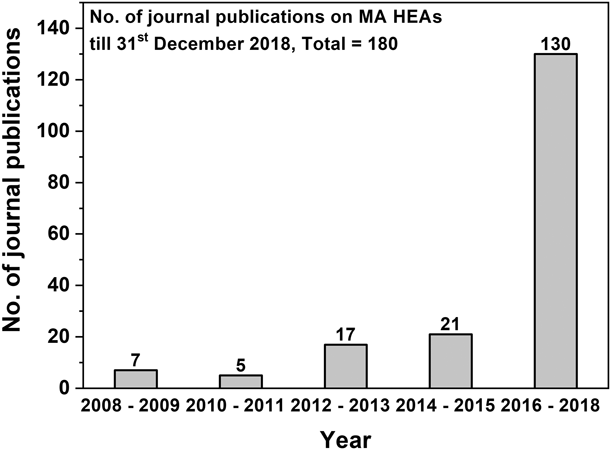
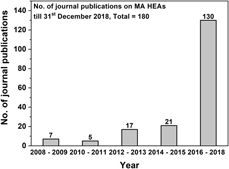
The first synthesis of HEAs by MA is credited to Varalakshmi et al. [Reference Varalakshmi, Kamaraj and Murty17], who produced nanocrystalline AlCrCuFeTiZn alloy in 2008. Since then, MA has progressively been used to produce nanocrystalline HEAs, as depicted in increased number of journal publications on mechanically alloyed HEAs (Fig. 1). Although several review articles have appeared on HEAs (see, e.g., [Reference Miracle and Senkov18, Reference MacDonald, Fu, Zheng, Chen, Lin, Chen, Zhang, Ivanisenko, Zhou, Hahn and Lavernia19, Reference Shi, Yang and Liaw20, Reference Guruvidyathri, Hari Kumar, Yeh and Murty21, Reference Pickering and Jones22]), only two reviews have been published so far, which discuss the aspects of HEAs produced by MA [Reference Sharma, Yadav, Biswas and Basu23, Reference Koch24]. The present review attempts to provide a comprehensive and critical analysis of potentials and limitations of mechanically alloyed HEAs. The aspects of phase evolution during MA and subsequent thermal exposure, structural and functional properties obtained, and challenges faced during MA of HEAs form the core sections of the current report.
Number of journal publications on mechanically alloyed HEAs.

Synthesis methodologies
Mechanical alloying
MA of nanocrystalline HEAs has been carried out in high-energy ball mills. The majority of HEA synthesis by MA utilizes planetary ball mills; some of the other variants include SPEX mills [Reference Gómez-Esparza, Baldenebro-López, González-Rodelas, Baldenebro-López and Martínez-Sánchez25] and shaker rod mills [Reference Sun, Li, Xi, Zhou, Li and Yang26]. Grinding vials and balls of WC, hardened chrome steel, ZrO2, and stainless steel have been frequently employed. Both dry and wet millings have been commonly used to synthesize HEAs by MA. The most common process control agent (PCAs) used is toluene, while some others include n-heptane [Reference Rogal, Kalita, Tarasek, Bobrowski and Czerwinski27], dodecane [Reference Zaddach, Niu, Oni, Fan, LeBeau, Irving and Koch28], ethanol [Reference Fu, Chen, Fang and Li29], methanol [Reference Moravcik, Cizek, Gavendova, Sheikh, Guo and Dlouhy30], cyclohexane [Reference Wu, Chen, Jiang, Chen and Fu31], and stearic acid [Reference Dwivedi, Koch and Rajulapati32]. Ar atmosphere has frequently been employed [Reference Zhang, Sun, Ke, Li, Ji, Wang and Fu33, Reference Kang, Lee, Ryu and Hong34, Reference Ge, Wu, Wang, Xu, Shang, Zhang and Wang35] when dry milling of HEAs is carried out to avoid oxidation of powders. A combination of dry and wet milling has also been increasingly used to produce HEA powders. To illustrate, Al0.8CoCrFeNiTi0.2 and Al0.8CoFeNiTi0.2 HEAs have been prepared by 45 h of dry milling, followed by 4 h milling in ethanol [Reference Fu, Chen, Jiang, MacDonald, Lin, Chen, Zhang and Lavernia36]. The effects of milling parameters, like milling speed, type of mills, milling time, milling media, and atmosphere of milling, have been fairly well understood for conventional alloys [Reference Suryanarayana15]. For HEAs, a systematic investigation for influence of these factors, barring milling time, is scarce in the literature. Salemi et al. [Reference Salemi, Abbasi and Karimzadeh37] have shown that alloying is not complete in AlCoCuNiZn even after 50 h of milling when the balls of diameter 20 mm and rotation speed of 300 rpm are used. However, on increasing the milling speed to 350 rpm and using balls of varying diameter (20, 16, and 10 mm), single-phase FCC is obtained. The energy transferred to the powders is estimated to be 1.7 times higher in the latter case and hence accounts for the complete alloy formation. Tan et al. [Reference Tan, Zhang, Zhi and Liu38] synthesized Al2NbTi3V2Zr in low-energy (150 rpm) and high-energy (350 rpm) modes and showed that only high-energy mode is effective in alloying and achieving nanocrystallinity. CoCrFeMnNi shows a single-phase FCC structure when synthesized using WC vials and balls [Reference Vaidya, Karati, Marshal, Pradeep and Murty39], while a minor BCC peak is observed when the alloy is milled in stainless steel media [Reference Ji, Wang, Wang, Zhang, Wang, Zhang and Fu40]. This can be attributed to the incorporation of excess Cr from stainless steel media during milling.
The influence of milling time on phase evolution is an obvious outcome of most of the reports on synthesis of HEAs by MA. The extent of alloying during milling is often determined by taking X-ray diffraction (XRD) patterns of powders at regular intervals. Most of the solid solution phases in HEAs form within 15–40 h of milling. Prolonged milling hours are often used for production of amorphous HEAs. AlBCFeNiSi and AlBCeFeNiSi alloys [Reference Xu, Zhao and Wang41] show complete amorphization after 140 h of milling, while duration of 240 h is required to get amorphous phase in AlBFeNiSi [Reference Wang, Gao, Niu, Shi, Xu and Wang42]. While the extended milling time leads to more homogenous alloy formation, it also increases the likely contamination induced during milling. Therefore, sometimes, powders are milled only for short milling time and then annealed or consolidated to achieve the alloy formation. This is referred to as mechanical activation. Colombini et al. [Reference Colombini, Rosa, Trombi, Zadra, Casagrande and Veronesi43] used mechanical activation to synthesize AlCoCrFeNi, which involved ball milling for 1 h, followed by spark plasma sintering (SPS) at 1000 °C. The final alloy showed a mixture of BCC and FCC phases. MA for 35 h followed by SPS at 1000 °C also led to the similar structure. Al2O3 dispersed AlCoCrFeMnNi alloys were synthesized by mechanical activation, followed by pyrolysis at 500 °C for 1 h [Reference Prasad, Singh and Panigrahi44]. A slightly modified approach has recently been reported by Kang et al. [Reference Kang, Lee, Ryu and Hong45], where a minimum milling time is identified based on average HEA (Al0.1CrMoNbV) powder size and interlamellar spacing. Although alloying is not complete at this milling time, it goes to completion during consolidation. In a very recent study [Reference Kumar, Tiwary and Biswas46], cryomilling of bulk cast ingots of AlCrFeMnV and CoCrFeMnNi has been performed to produce nanocrystalline HEAs. Large-scale production of powders and lower contamination serve as the major advantages of mechanical milling of HEAs.
One of the intuitive questions in the context of MA of HEAs is the role of configurational entropy on alloying kinetics. While the HEAs are expected to stabilize the solid solution structure, can they accelerate the rate of alloy formation during MA? Vaidya et al. [Reference Vaidya, Karati, Marshal, Pradeep and Murty39] have shown in their recent report that the milling times required to obtain single-phase FCC in FeNi is 20 h, while for CoFeNi, CoCrFeNi, and CoCrFeMnNi, it is 15 h. Varalakshmi et al. [Reference Varalakshmi, Kamaraj and Murty47] reported the synthesis of Al–Co–Cu–Ni–Ti–Zn system from binary CuNi to hexanary AlCoCuNiTiZn and 20 h of milling was required in each case for phase formation. This indicates that the increased configurational entropy does not have a significant effect on the dissolution rates during MA.
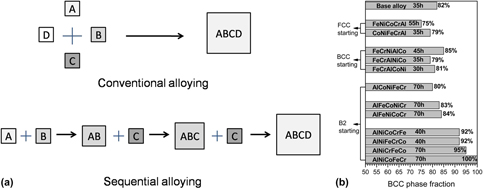
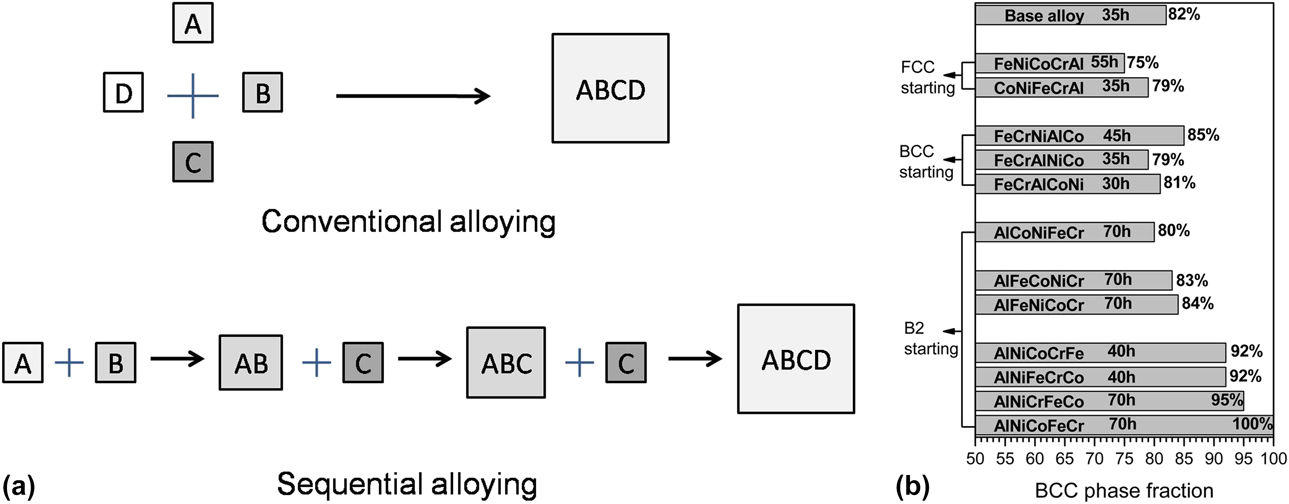
The conventional way to form HEA by MA requires mixing individual elements in required proportion in a single step. Phase formation, therefore, is governed by inherent thermodynamic and kinetic factors of the system. Vaidya et al. [Reference Vaidya, Prasad, Parakh and Murty48] have proposed a new approach to produce HEAs by MA, which involves step by step addition of constituent elements. This strategy is termed as sequential alloying and is schematically presented in Fig. 2(a). They have illustrated it through the formation of nanocrystalline AlCoCrFeNi by MA. For example, first, binary CoNi is formed by milling elemental Co and Ni powders. In the subsequent steps, Fe, Cr, and Al are added to form ternary (CoFeNi), quaternary (CoCrFeNi), and then quinary (AlCoCrFeNi) alloys, respectively. Similarly, AlCoCrFeNi was produced by 13 different sequences. The path dependence of phase formation was indicated in varied fractions of BCC and FCC phases obtained at the end of each sequence [Fig. 2(b)].
(a) Scheme of conventional alloying versus sequential alloying. (b) Phase fractions of BCC phase obtained in AlCoCrFeNi synthesized through different sequences [Reference Vaidya, Prasad, Parakh and Murty48].
Consolidation techniques
Milled powders need to be consolidated to obtain dense pellets for measuring various mechanical and functional properties. The sintering method is usually chosen to achieve the best combination of density and nanocrystallinity. SPS has been the most widely used technique to consolidate milled HEA powders. The other sintering methods used typically include vacuum hot pressing sintering (VHPS) [Reference Ge, Wu, Wang, Xu, Shang, Zhang and Wang35, Reference Xie, Cheng, Tang, Chen, Chen and Dai49, Reference Cheng, Chen, Liu, Tang, Xie and Dai50, Reference Varalakshmi, Kamaraj and Murty51, Reference Fu, Chen, Chen, Wen and Lavernia52], microwave sintering [Reference Shivam, Basu, Shadangi, Singh and Mukhopadhyay53], and hot isostatic pressing (HIP) [Reference Varalakshmi, Appa Rao, Kamaraj and Murty54]. Nearly instantaneous heating of powder particles occur due to the application of high-amperage pulsed current during SPS [Reference Omori55]. It implies that shorter times are required for consolidation during SPS relative to conventional sintering. Thus, the time available for grain growth is significantly less and better retention of nanocrystallinity is expected through SPS. To illustrate, AlCoCrCuFeTix HEAs prepared by MA exhibit grain sizes of the order of 13–20 nm, which increase to 45–50 nm during SPS at 1173 K [Reference Murali, Kumaresh Babu, Majhi, Vallimanalan and Mahendran56]. Nanocrystallinity is retained in Al–Co–Cr–Cu–Fe and Co–Cr–Cu–Fe–Ni milled powders consolidated using SPS [Reference Praveen, Murty and Kottada57].
However, in many cases, it has been observed that SPS is not able to retain the crystallite size strictly in the regime (<100 nm) of nanocrystalline HEAs. Joo et al. [Reference Joo, Kato, Jang, Moon, Kim, Hong and Kim58] reported that the average grain size of CoCrFeMnNi HEA obtained after 60 h of MA is 11 nm. SPS at 1173 and 1373 K lead to increase in grain size up to 0.28 μm and 1.87 μm, respectively. Wang et al. [Reference Wang, Cai and Cheng59] have demonstrated that for CoCr2−xCuFeNix HEAs, grain size grows from 10 nm to several hundred nanometers during SPS. Thus, the grain growth rates during SPS are relatively high, which corroborate with the recent results on non-sluggish grain boundary diffusion in HEAs [Reference Vaidya, Pradeep, Murty, Wilde and Divinski60]. An optimum combination of various SPS parameters is often needed to achieve desired densification and avoid coarsening of nanocrystallites. SPS of CoCrFeNi HEA powders at 800 °C resulted in a relative density (ρrel) of 0.84 and a crystallite size (d) of 35 nm. When SPS of same powders was carried out at 900 °C and 1000 °C, (ρrel, d) values are (0.95, 60 nm) and (0.95, 80 nm), respectively, which clearly indicate the optimum temperature of sintering to be 900 °C [Reference Praveen, Murty and Kottada61]. Recent studies on SPS have shown that applying a maximum pressure at higher temperature helps in better bonding between the powder particles and enhanced ductility [Reference Praveen, Anupam, Sirasani, Murty and Kottada62].
The densification mechanisms of HEAs during sintering have not been probed extensively so far. SPS for most of the HEAs is carried out at temperatures well below melting point and hence densification proceeds mostly by solid-state sintering. Mane et al. [Reference Mane, Rajkumar and Panigrahi63, Reference Mane and Panigrahi64, Reference Mane and Panigrahi65] have attempted to understand the sintering mechanism of mechanically alloyed (MAed) and annealed CoCrFeNi and CoCrFeMnNi. Sintering of annealed powders is controlled by volume diffusion, while complex combination of ultrafine grains, high grain boundary fractions and chemical homogeneity governs the densification of milled powders. Mane and Panigrahi [Reference Mane and Panigrahi66] have demonstrated that the increasing configurational entropy from CoFeNi to AlCoCrFeMnNi leads to reduced densification rates owing to increased activation energies of diffusion with increasing number of elements. Varalakshmi et al. [Reference Varalakshmi, Appa Rao, Kamaraj and Murty54] have shown that better densification rates in AlCrCuFeTiZn are achieved with HIP, compared with conventional sintering and VHPS. The evolution of phases also has been shown to differ if the consolidation technique is varied [Reference Fu, Chen, Chen, Wen and Lavernia52]. SPS has also been used to facilitate reactive sintering of SiC and AlCoCrFeNi HEA to produce composites with isomorphic structures and improved mechanical properties [Reference Colombini, Lassinantti Gualtieri, Rosa, Tarterini, Zadra, Casagrande and Veronesi67]. AlCoCrFeNi HEA consolidated using microwave sintering exhibited larger fraction of porosity than SPS and this difference is reflected in their respective mechanical properties [Reference Colombini, Rosa, Trombi, Zadra, Casagrande and Veronesi43].
Phase evolution during MA and consolidation
Solid solution formation rules
HEAs have tendency to show solid solution phases, which is attributed to their enhanced configurational entropy of mixing (∆S config). High ∆S config reduces the free energy (∆G mix) of solid solution formation in accordance with the equation ∆G mix = ∆H mix − T∆S mix, where ∆H mix is the enthalpy of mixing and ∆S mix is the entropy of mixing. ∆S mix is summation of two entropy contributions, namely, thermal and configurational. Following Boltzmann analysis, the expression for ∆S config is given as ∆S config = −R∑X i ln X i, where X i is mole fraction of ith constituent and R is universal gas constant. This attains maximum for equiatomic composition, for which, X i = 1/n and hence ∆S config (max) = R ln n (n is the number of elements in the alloy). As an increasing number of HEAs are studied, it has been observed that the configurational entropy is not alone sufficient to stabilize the solid solution [Reference Pickering and Jones22]. Consequently, a number of thermodynamic and topological parameters have been put forward to determine the criteria for solid solution formation [Reference Liu, Lei, Gray and Wang68]. For instance, Zhang et al. [Reference Zhang and Zhou69] argued that following conditions need to be satisfied for solid solution formation.
 $$\eqalign{\Delta {S_{{\rm{config}}}} > 1.61R,\; - 15\;{{{\rm{kJ}}} / {{\rm{mol}}}} \lt \Delta {H_{{\rm{mix}}}} \cr\lt 5\;{{{\rm{kJ}}} / {{\rm{mol}}}}\;{\rm{and}}\;\delta \lt 6.6\% \quad ,$$
where δ is the size factor,  $\delta = \sqrt {{{\sum {{C_i}\left( {1 - {{{r_i}} / {{\rm{avg}} \cdot {r_i}}}} \right)} }^2}}$, and r i is the atomic size of ith element. Guo et al. [Reference Guo, Ng, Lu and Liu70] showed that valence electron concentration (VEC) will play a major role in deciding the type of solid solution as follows—VEC ≤ 6.87: BCC solid solution, VEC ≥ 8: FCC solid solution, and 6.87 ≤ VEC ≥ 8: FCC + BCC. These rules can be used to predict the major phase formed after MA and consolidation.
To illustrate, Kumar et al. [Reference Kumar, Dhekne, Swarnakar and Chopkar71] explained the formation of FCC and BCC phases in AlCoCrCuFeNiSix HEAs on the basis of VEC, Ω, δ, and mismatch entropy. However, in many cases, the parametric approaches can only predict the major phases formed during MA and sintering. For example, CoCrFeMnNi HEA formed by casting and MA displays a single-phase FCC structure [Reference Murty, Yeh and Ranganathan1], which is in accordance with the Ω, δ, and VEC parameters. However, SPS of MAed CoCrFeMnNi powders leads to the formation of Cr7C3. During MA at room temperature, the FCC structure is supersaturated with Cr, which diffuses out of lattice and forms carbide when exposed to high temperatures during SPS [Reference Vaidya, Karati, Marshal, Pradeep and Murty39]. Similar instance of precipitation of ordered phase in CoCrCuFeNi [Reference Praveen, Murty and Kottada57] and σ phase in AlCoCrFeNi [Reference Mohanty, Maity, Mukhopadhyay, Sarkar, Gurao, Bhowmick and Biswas72] could not be predicted using the above parameters. Some exceptions to these rules have also been observed. Dwivedi et al. [Reference Dwivedi, Koch and Rajulapati32] observed a single-phase FCC structure in CrNbTiVZn HEA, which has VEC of 6.4 and hence predicted to have a BCC structure.
HEAs with simple solid solution phases
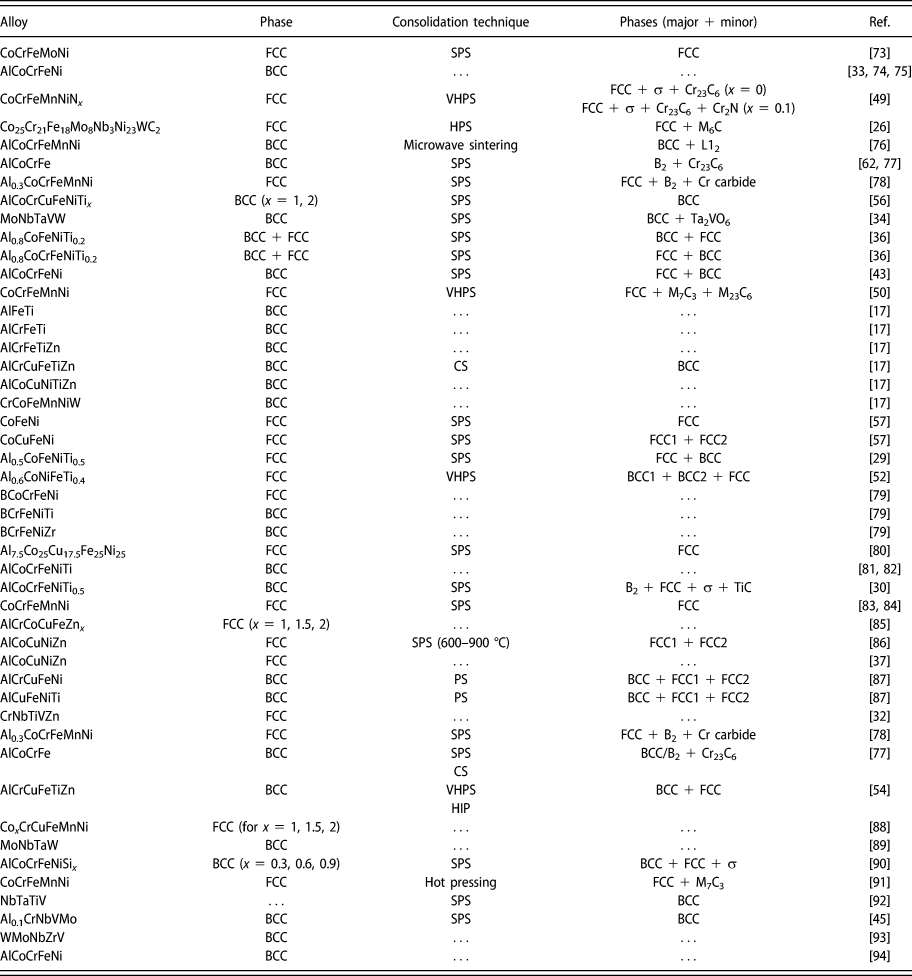
The maximized configurational entropy of HEAs is expected to result in simple solid solution structures. Furthermore, MA has been shown to extend solid solubility even in immiscible systems like Fe–Cu [Reference Murty and Ranganathan13]. Therefore, the propensity of getting simple solid solution phases is higher during MA of HEAs. Table I lists the various HEAs, which show single-phase structure when processed by MA. Both single-phase FCC and BCC HEAs have been produced by MA, while no hexagonal close pack (HCP) system has been obtained by milling so far. CoCrFeMoNi shows a single-phase FCC structure [Reference Zhang, Zhang, Liu, Liu and Wang73], while AlCoCrFeMnNi crystallizes in BCC structure [Reference Shivam, Basu, Shadangi, Singh and Mukhoupadhyay76]. Non-equiatomic HEAs, like Al0.3CoCrFeMnNi, have also shown single-phase structure during MA [Reference Pohan, Gwalani, Lee, Alam, Hwang, Ryu, Banerjee and Hong78]. AlCoCrCuFeZnx [Reference Murali, Babu, Krishna and Vallimanalan85] and AlCoCrCuFeNiTix [Reference Murali, Kumaresh Babu, Majhi, Vallimanalan and Mahendran56] exhibit FCC and BCC structures, respectively. Light HEAs (density <3 g/cm3) is a class of HEAs being developed to achieve high specific strength suitable for energy-saving applications. These alloys contain elements like Mg, Li, and Be, and hence, it is challenging to produce them by liquid metal route. MA, if performed in an inert atmosphere, could prove useful to produce light HEAs. Youssef et al. [Reference Youssef, Zaddach, Niu, Irving and Koch95] processed single-phase FCC structured AlLiMgScTi HEA by MA.
Single-phase HEAs observed during MA and consolidation.

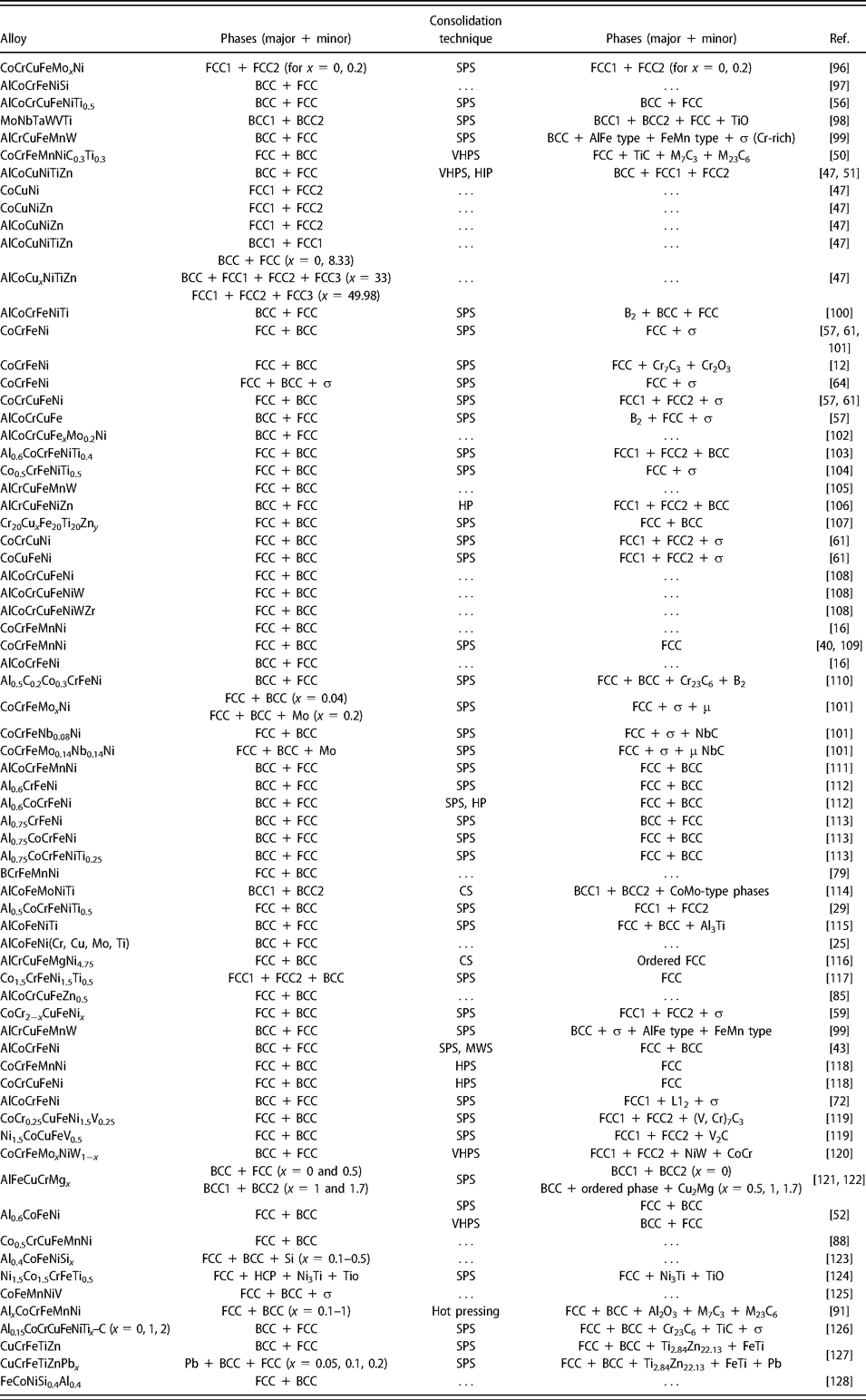
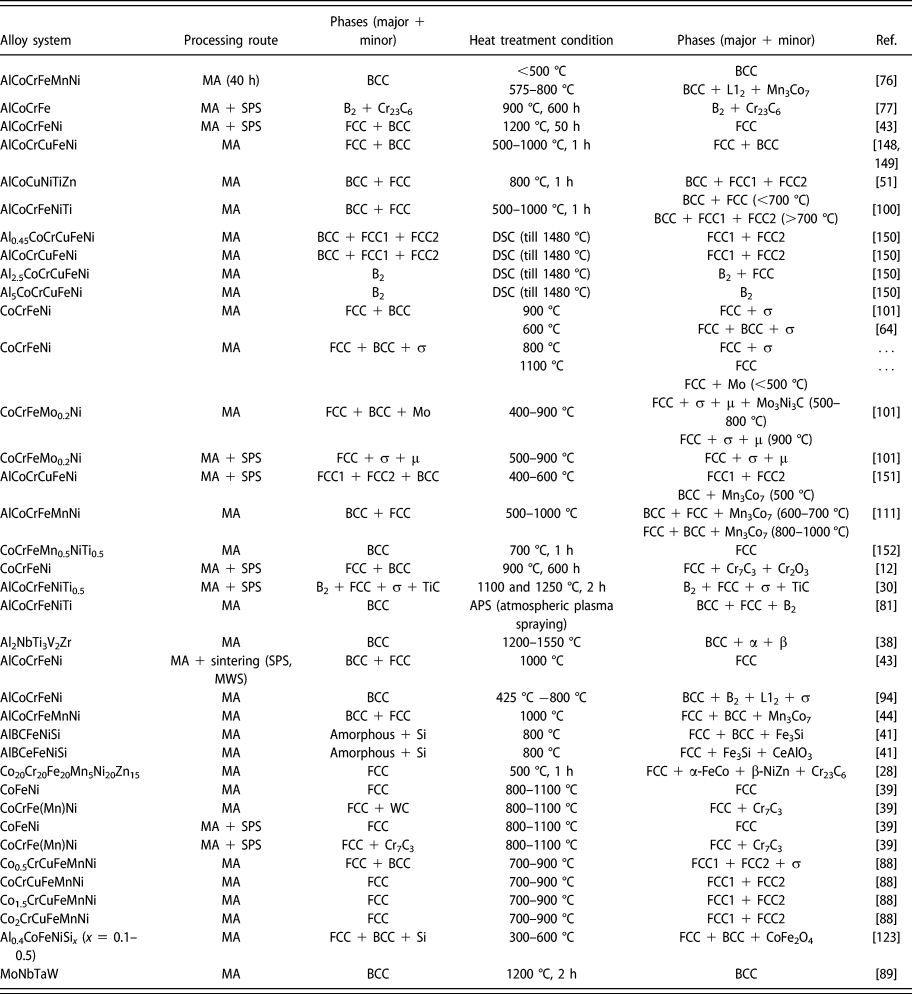
HEAs with multiple solid solution phases are commonly observed, particularly in the non-equiatomic systems, as is evident in Table II. The formation of multiple phases in multielement HEAs is primarily governed by the thermodynamic interaction between binary constituents. To illustrate, in Al–Co–Cr–Fe–Ni system, B2 phase observed is rich in Al–Ni, BCC phase is rich in Cr–Fe, and FCC phase is enriched in Co–Fe–Ni [Reference Fang, Chen and Fu110], which correlates with the phases observed in their respective binary phase diagrams [Reference Baker and Okamoto129]. Praveen et al. [Reference Praveen, Murty and Kottada57] highlighted the role of enthalpy in evolution of phases during MA and SPS and showed that complex σ phase precipitates in AlCoCrCuFe and CoCrCuFeNi. The phase evolution during MA and consolidation is often different from that observed during casting. While the high melting phase usually forms first during liquid metal processing routes, kinetics of dissolution during MA is further determined by factors like room temperature diffusivity, atomic radius, and ease of nanocrystallization. AlCoFeMoNiTi exhibits BCC solid solutions in the sintered and as-cast state, with additional CoMo-rich phases present in sintered condition. Fine alumina particles are also seen in sintered sample [Reference Baldenebro-Lopez, Herrera-Ramírez, Arredondo-Rea, Gómez-Esparza and Martínez-Sánchez114]. Cu separates out as an FCC phase during casting of HEAs like CoCuFeNi, while a single-phase FCC structure is observed when it is made by MA (Table I). A single-phase FCC structure is seen for as-cast CoCrFeMnNi, whereas mixture of FCC and Cr7C3 is observed when the HEA is processed by MA + SPS [Reference Vaidya, Karati, Marshal, Pradeep and Murty39, Reference Vaidya, Guruvidyathri and Murty130]. Chen et al. [Reference Chen, Hu, Hsieh, Yeh and Chen131] demonstrated that the alloying rate varies in the order Al → Co → Cr → Cu → Fe → Mo → Ni → Ti, which correlates with the melting point of the elements and consequently their room temperature diffusivities. It may be noted that the complex phases are formed, excluding the trace contaminations from milling media, which have not been observed during MA of HEAs.
MAed HEAs with multiple solid solution phases.

The simple solid solution structures formed during MA are often metastable in nature and undergo phase transitions to different solid solution and complex phases on consolidation (Tables I and II). To illustrate, a mixture of FCC and BCC phases in AlCoCuNiTiZn is retained on annealing at 800 °C, while VHPS at the same temperature results in the formation of two FCC phases and a BCC phase [Reference Varalakshmi, Kamaraj and Murty51]. CoCrFeMnN0.1Ni shows a single-phase FCC structure after 45 h of MA, while VHPS of the milled powders gives σ, Cr23C6, and Cr2N phases [Reference Xie, Cheng, Tang, Chen, Chen and Dai49]. AlCrCuFeMnW exhibits FCC and BCC phases after MA, which transforms to a mixture of BCC + AlFe type + FeMn type + σ (Cr-rich) phases [Reference Kumar, Maulik, Kumar, Prasad and Kumar99]. SPS of BCC-structured NbMoTaVW leads to the formation of Ta2VO6 phase [Reference Kang, Lee, Ryu and Hong34]. Al0.5CoFeNiTi0.5 undergoes phase transition from FCC to FCC + BCC during SPS [Reference Fu, Chen, Fang and Li29], while FCC phase in Al0.6CoFeNiTi0.4 transforms to two BCC phases and an FCC phase during VHPS [Reference Fu, Chen, Chen, Wen and Lavernia52]. Growth of Cr-rich σ phase occurs in Cu2Mg phase of AlCrCuFeMgx HEAs owing to the positive enthalpy of mixing between binary constituents [Reference Maulik, Kumar, Kumar, Fabijanic and Kumar121]. A decomposed microstructure (FCC + L12 + σ) of AlCoCrFeMnNi HEA obtained after MA + SPS shows high hardness and better densification but suffers from poor fracture toughness [Reference Mohanty, Maity, Mukhopadhyay, Sarkar, Gurao, Bhowmick and Biswas72].
Amorphous HEAs
Since the advent of HEAs, glasses or amorphous alloys with high configurational entropy have been explored. Cantor et al. [Reference Cantor, Chang, Knight and Vincent2] studied glass formation in (Ti, Zr, Nb, Hf)–(Ni, Cu, Ag)–Al system, which was formed by equiatomic substitution in Zr–Cu–Al glass-forming alloy. Ma et al. [Reference Ma, Wang, Zhang and Inoue132] reported the first equiatomic bulk metallic glass (BMG) in CuHfNiTiZr in the form of a 1.5 mm rod through Cu mold casting. Ge et al. [Reference Ge, Wang, Shang, Zhang and Wang133] reported amorphous phase formation in AlCuNiTiZr HEAs based on Cu60Zr40 binary glass composition. These alloys can be referred to as pseudo-binary alloys, which are formed by suitable substitution in binary or ternary glass forming alloys. Some other pseudo-binary alloys reported include AlBFeNiSi [Reference Wang, Gao, Niu, Shi, Xu and Wang42] and BeCoMgTi and BeCoMgTiZn [Reference Chen, Tsai, Juan, Chuang, Yeh, Chin and Chen134], which can be thought to be based on Fe80B20 and Ti80Be20 glassy compositions, respectively. The alloys such as AlCoCrCu0.5Ni [Reference Chen, Hu, Hsieh, Yeh and Chen131, Reference Chen, Hu, Tsai, Hsieh, Kao, Yeh, Chin and Chen135, Reference Chen, Hu, Tsai, Yeh, Chen and Chang136] and CrFeNbNiSi [Reference Vaidya, Armugam, Kashyap and Murty79] have also been shown to exhibit amorphization during milling. These alloys do not fit under the category of pseudo-binary alloys but can be better referred to as true high-entropy glasses.
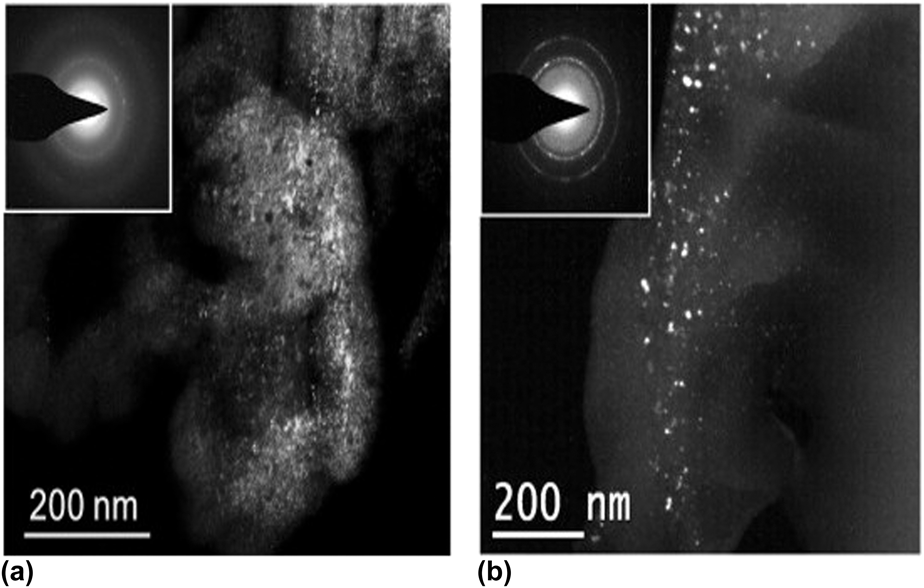
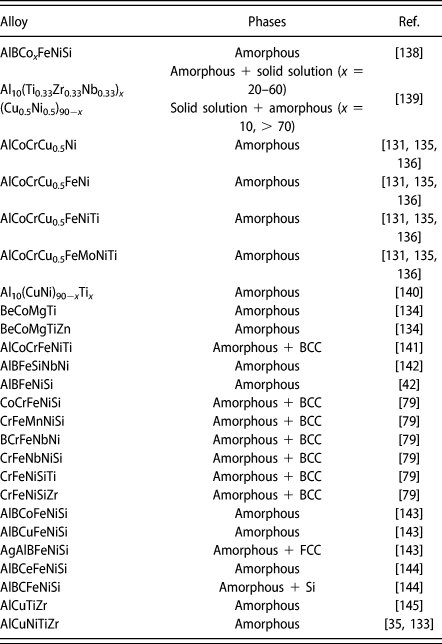
Prolonged milling hours have shown to produce amorphous phases in HEAs [Reference Chen, Hu, Hsieh, Yeh and Chen131]. Al–Co–Cr–Cu–Fe–Mo–Ni–Ti alloys form solid solution phases and then change to amorphous structure on extended milling [Reference Chen, Hu, Tsai, Hsieh, Kao, Yeh, Chin and Chen135, Reference Chen, Hu, Tsai, Yeh, Chen and Chang136], which conforms to first type of amorphization classified by Weeber and Bakker [Reference Weeber and Bakker137]. Amorphous phase is formed in BeCoMgTi and BeCoMgTiZn [Reference Chen, Tsai, Juan, Chuang, Yeh, Chin and Chen134] by type II mechanism, as classified by Weeber and Bakker [Reference Weeber and Bakker137]. These alloys are particularly interesting as all the constituents have HCP structure, yet no solid solution structure is formed during milling. Vaidya et al. [Reference Vaidya, Armugam, Kashyap and Murty79] studied the amorphization in CrFeNi–MX (M = Co, Mn, Nb, Ti, Zr metal and X = B, Si) alloys by MA. Although Fe80B20 is a good glass former, B containing HEAs did not form amorphous phase, except for M = Co. On the other hand, when B was replaced by Si, amorphous phase was observed for all M. Figure 3 shows the transmission electron microscope (TEM) micrographs illustrating the major amorphous phase formed in CrFeNi–ZrSi and the presence of nanocrystalline BCC structure in CrFeNi–ZrB. The lower melting point of Si and its larger size difference with other constituents enhance the amorphization in HEAs during MA. As presented in Table III, while many of the HEAs can be milled to fully amorphous structure, some alloys exhibit a minor amount of nanocrystalline solid solutions or undissolved elements.
Dark-field image and corresponding selected area diffraction (SAED) patterns (shown in inset) depicting presence of (a) amorphous phase in FeCrNi–ZrSi and (b) nanocrystalline BCC structure in FeCrNi–ZrB [Reference Vaidya, Armugam, Kashyap and Murty79].

Amorphous HEAs formed by MA.

Co addition has been to shown to enhance the glass-forming ability of AlBFeNiSi alloys, indicated in shorter time to get amorphous structure and higher onset temperature of crystallization [Reference Wang, Li, Zhai, Xu, Niu, Xu and Wang138, Reference Xu, Shang, Ge, Jia, Liaw and Wang143]. A similar effect of shortening the time to amorphization has been observed on C and Ce addition to AlBFeNiSi HEA [Reference Xu, Axinte, Zhao and Wang144] and Ti addition to AlCuZr [Reference juan Ge, ting Li, Li, chao Qiao, wei Du, Xu and Wang145]. C and Ce both enhance the thermal stability of amorphous phase in AlBFeNiSi alloy [Reference Xu, Axinte, Zhao and Wang144]. Cu and Ag, on the other hand, have detrimental effect on thermal stability of amorphous phase in AlBFeNiSi alloy. Higher amount of ductile elements, like Cu and Ni, increases the thermal stability of amorphous phases in Al10(CuNi)90−xTix alloys. The amorphous phases formed in (Ti, Zr–Nb)–(Cu, Ni)–Al system exhibit a large supercooled region (∼125 K), indicating a high thermal stability again crystallization [Reference Zhang, Kim, Yu, Zhang, Kunz and Eckert139]. Annealing of amorphous HEAs can lead to the formation of simple solid solution phases or complex phases. AlBCoFeNiSi and AgAlBFeNiSi show greater phase stability than AlBFeNiSi and AlBCuFeNiSi HEAs, as indicated by the appearance of simple solid solution structures and complex phases, respectively, on annealing [Reference Zhu, Zhou, Yu, Wei, Xu and Wang146].
Effect of alloying elements
Several investigations have been performed to understand the influence of various elements during MA of HEAs. Atomic radius, crystal structure, and enthalpy of mixing with other constituents are the key criteria, which determine the elemental effect on phase formation. Al has the most significant effect on phase evolution in HEAs. It has FCC crystal structure but forms ordered BCC compounds with most of the common constituents like Co, Fe, and Ni. Therefore, most of the Al–Co–Cr–Fe–Ni systems show BCC as the major phase at higher Al content. Vaidya et al. [Reference Vaidya, Prasad, Parakh and Murty48] demonstrated the impact of Al in promoting BCC phase formation through sequential alloying. A single-phase BCC structure is obtained at the end of alloying sequence AlCoCrFeNi, while 75% of BCC phase is present for the sequence FeNiCoCrAl, where Al is added at the last step. Further, because of its high ductility, it causes relatively less erosion of milling media and therefore results in lower contamination levels. Al addition (Al0.3CoCrFeMnNi) hardens and induces ordered B2 precipitates in a soft FCC alloy based on CoCrFeMnNi [Reference Pohan, Gwalani, Lee, Alam, Hwang, Ryu, Banerjee and Hong78]. Transition from single-phase FCC to FCC + BCC matrix has been demonstrated in sintered microstructure of AlxCoCrFeMnNi HEAs for x > 0.1 [Reference Cheng, Liu, Tang, Wang, Yan and Dai91]. Co, during MA, has been shown to undergo polymorphic transformation from HCP to FCC structure [Reference Portnoi, Leonov, Filippova, Streletskii and Logacheva141] and hence stabilizes FCC structure [Reference Vaidya, Prasad, Parakh and Murty48]. Co promotes FCC phase formation, and its removal from Al0.75CoCrFeNi and Al0.6CoCrFeNi results in decreased fraction of FCC phase [Reference Fu, Chen, Chen, Wen and Lavernia52, Reference Fu, Chen, Wen, Chen and Lavernia112]. Cr addition promotes the formation of BCC phase during MA [Reference Vaidya, Prasad, Parakh and Murty48] and has been shown to reduce the nanoscale twin formation when dissolved in FCC phase [Reference Fu, Chen, Fang and Li29]. Cr containing HEAs have invariably been shown to form carbides on annealing and consolidation of milled powders [Reference Praveen, Murty and Kottada61, Reference Praveen, Anupam, Sirasani, Murty and Kottada62] due to its highly negative free energy of formation [Reference Shatynski147].
Earlier studies had identified them as σ phases [Reference Praveen, Murty and Kottada61], but detailed microscopy later confirmed the presence of carbides. Praveen et al. [Reference Praveen, Anupam, Sirasani, Murty and Kottada62] argued that the Cr delays the densification rates in HEAs although leading to maximum final densification in 3d transition HEAs. Cu has positive enthalpy of mixing with most of the 3d transition elements and hence often separates out as FCC phase [Reference Koundinya, Sajith Babu, Sivaprasad, Susila, Kishore Babu and Baburao106, Reference Mridha, Samal, Khan, Biswas and Govind107]. AlCoCuxNiTiZn HEAs exhibit FCC phase for all the values of x [Reference Varalakshmi, Kamaraj and Murty47]. Cu-rich FCC phase is observed in AlCoCrCuFe during MA and SPS [Reference Praveen, Murty and Kottada57]. Mg addition leads to an increase in fraction of BCC phase in AlCrCuFeMgx HEAs [Reference Maulik and Kumar122]. An optimum hardness was achieved for x = 0.5 for these alloys consolidated by SPS [Reference Maulik, Kumar, Kumar, Fabijanic and Kumar121]. The thermal stability of alloys was reduced with increasing content of Mg, as the transformation of solid solution structure occurs at lower temperatures [Reference Maulik, Kumar, Kumar, Fabijanic and Kumar121]. The addition of Mo leads to the appearance of complex σ and μ phases in CoCrCuFeMoxNi (for x = 0.6, 0.8) [Reference Yang, Tang, Wen, Zhang, Deng and Nai96] and CoCrFeMoxNi (x > 0.04) alloys [Reference Praveen, Murty and Kottada101]. Annealing at higher temperature leads to dissolution of Mo in CoCrFeMoxNi alloys but leads to the formation of Mo-rich μ phase and carbides [Reference Praveen, Murty and Kottada101]. Sun et al. [Reference Sun, Li, Xi, Zhou, Li and Yang26] demonstrated that addition of amorphous Cr(Mo) powders accelerates the dissolution of Mo into FCC phase to produce a single-phase structure. Nb dissolves in FCC matrix of CoCrFeNi during MA but results in the formation of NbC on consolidation or heat treatment at high temperature [Reference Praveen, Murty and Kottada101]. Nb addition to AlBFeNiSi leads to an increase in time required to achieve amorphization but imparts high thermal stability and heat resisting properties to the alloy [Reference Wang, Zheng, Xu and Wang142]. The increase in Ni/Cr ratio promotes the formation of FCC phase and more homogenous microstructure in CoCr2−xCuFeNix HEAs due to FCC structure of Ni [Reference Wang, Cai and Cheng59]. The increase in the amount of Si increases the mismatch entropy (ΔSσ/k), which facilitates the BCC phase formation over FCC phase in AlCoCrCuFeNiSix HEAs [Reference Kumar, Dhekne, Swarnakar and Chopkar71] and further leads to complex phase precipitation at x = 0.9 [Reference Kumar, Swarnakar and Chopkar90]. Incorporation of Si to CrFeNi (M = Co, Mn, Nb, Ti, Zr) HEAs enhances the ease of obtaining amorphization, in contrast to B [Reference Vaidya, Armugam, Kashyap and Murty79]. Addition of Ti enhanced the formation of nanotwins slightly in Al0.6CoFeNiTi and Al0.6CoCrFeNiTi0.25 HEAs [Reference Fu, Chen, Fang and Li29, Reference Youssef, Zaddach, Niu, Irving and Koch95]. When added to Al-containing HEAs, Ti promotes the formation of BCC structure [Reference Murali, Kumaresh Babu, Majhi, Vallimanalan and Mahendran56]. The mixing of Ti and C with CoCrFeMnNi results in the formation of composite microstructure containing carbides [Reference Fang, Chen and Fu110, Reference Nam, Kim, Hwang and Choi126]. Incorporation of W to magnetic AlCoCuCrFeNi converts it to partially paramagnetic, which on further addition of Zr results in completely paramagnetic AlCoCrCuFeNiWZr HEA [Reference Tariq, Naeem, Hasan, Akhter and Siddique108].
Thermal stability of MAed HEAs
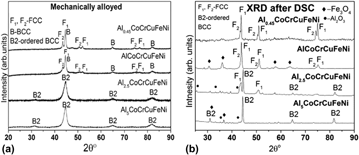
To advance the exploration of HEAs for high temperature applications, their performance needs to be adjudged by creep behavior, microstructural stability, and mechanical properties at elevated temperatures. It is particularly critical for nanostructured HEAs as they have additional driving forces for grain growth, enhanced kinetics due to reduced diffusion distances, and hence have high proclivity for reduction in mechanical properties with temperatures. However, systematic study of thermal stability of nanocrystalline HEAs has been limited in the available literature. There are two aspects of thermal stability that need to be looked at for MAed HEAs, namely, stability of the phases formed and the retention of nanocrystallinity. Table IV lists the various investigations of phase stability of HEAs reported so far. Nanocrystalline AlCoCrFe reveals excellent phase stability and consequently enhanced resistance to annealing-induced softening [Reference Praveen, Anupam, Tilak and Kottada77]. Figures 4(a) and 4(b) compare the phase evolution in AlxCoCrCuFeNi after MA for 20 h and heat treatment using differential scanning calorimetry (DSC) till 1480 °C, respectively [Reference Sriharitha, Murty and Kottada150]. The BCC + FCC1 + FCC2 structure of the as-milled Al0.45CoCrCuFeNi and AlCoCrCuFeNi transformed to FCC1 + FCC2 mixture. Al2.5CoCrCuFeNi exhibited B2 structure after MA and its thermal exposure in DSC resulted in the appearance of FCC phase. The highest thermal stability was observed for Al5CoCrCuFeNi, which retained its single-phase B2 structure (except for formation of minor oxides) after DSC. Shivam et al. [Reference Shivam, Basu, Pandey, Shadangi and Mukhopadhyay94] showed that disordered BCC phase in AlCoCrFeNi partially transforms to L12 phase on annealing at low temperatures and to B2 + L12 + σ phases on thermal exposure at high temperatures. Vaidya et al. [Reference Vaidya, Karati, Marshal, Pradeep and Murty39] studied the phase stability of nanocrystalline FCC HEA powders and SPSed pellets. Formation of Cr7C3 occurs on heat treatment (800–1100 °C) of CoCrFeNi and CoCrFeMnNi MAed powders, while retaining the major FCC phase (depleted in Cr). SPSed as-milled powders exhibited dominant FCC phase and a small fraction of Cr7C3, which is retained on thermal exposure at 1373 K. AlCoCuNiTiZn exhibits high thermal stability, retaining solid solution structure and nanocrystallinity on heat treatment at 800 °C for 1 h [Reference Varalakshmi, Kamaraj and Murty47, Reference Varalakshmi, Kamaraj and Murty51].
Phase stability of HEAs formed by MA and subsequent consolidation.

(a) Phase evolution of MAed AlxCoCrCuFeNi and (b) their thermal stability investigated using DSC till 1480 °C [Reference Sriharitha, Murty and Kottada150].

Koundinya et al. [Reference Koundinya, Sajith Babu, Sivaprasad, Susila, Kishore Babu and Baburao106] used DSC traces to determine the activation energy for recrystallization (∼85 kJ/mol) for AlCrCuFeNiZn. Cr-rich BCC phase is observed in Cr-containing HEAs at the end of milling, which dissolves during sintering or heat treatment at elevated temperatures [Reference Sriharitha, Murty and Kottada150]. An interesting distinction observed between many HEAs and conventional alloys is the nature of room temperature phase in relation to the high-temperature phase. Pure elements and conventional alloys possess close-packed structure at room temperature and a more open structure at higher temperatures. Classic example in this regard is Ti, which changes from HCP to BCC at elevated temperatures. Furthermore, in conventional alloys, a disordered structure becomes ordered at lower temperatures. However, some HEAs are found to show an opposite tendency [Reference Praveen, Murty and Kottada57, Reference Zhang, Fu, Zhang, Shi, Wang, Wang, Wang and Zhang148]. High strain due to lattice distortion exists in complex matrix of HEA. A closed packed structure will have higher strains. Thus, atoms tend to crystallize in a more open structure at room temperature, so that additional strain can be compensated. Thermal exposure relives the extra component of lattice strain and existence of close-packed structure becomes more viable [Reference Murty, Yeh and Ranganathan1]. As noted in Table IV, complex phases also precipitate during annealing of MA powders and sintered pellets. Precipitation of L12 and Mn3Co7 phases is observed on heat treatment of BCC-structured AlCoCrFeMnNi formed by MA [Reference Shivam, Basu, Shadangi, Singh and Mukhoupadhyay76]. Heat treatment of FCC-structured Co20Cr20Fe20Mn5Ni20Zn15 powders at 500 °C for 1 h leads to the formation of complex phases α-FeCo, β-NiZn, and Cr23C6 [Reference Zaddach, Niu, Oni, Fan, LeBeau, Irving and Koch28]. AlCoCrFeMnNi HEA produced by mechanochemical synthesis has shown thermal stability up to 500 °C, after which it undergoes diffusional transformation to complex phases [Reference Shivam, Basu, Shadangi, Singh and Mukhopadhyay53].
High resistance to grain growth has been observed in CoCrFeNi during long-term heat treatment (600 h) at 900 °C [Reference Praveen, Basu, Kashyap and Kottada12]. Nanocrystallinity of milled powders is retained in Al–Co–Cr–Cu–Fe–Ni HEAs even after heat treatment at elevated temperatures [Reference Sriharitha, Murty and Kottada150, Reference Sriharitha, Murty and Kottada151]. Praveen et al. [Reference Praveen, Basu, Kashyap and Kottada12] demonstrated the exceptional resistance to grain growth observed for CoCrFeNi on long-term heat treatment at 900 °C for 600 h. Presence of fine oxide and carbide particles together with slow rates of diffusion was believed to be responsible for high thermal stability of the alloy. The activation parameters for grain growth in SPSed CoCrFeNi and CoCrFeMnNi HEAs have been determined (private communications). The activation energy (Q) values are 175 and 241 kJ/mol for CoCrFeNi and CoCrFeMnNi, respectively, which is in close agreement with the Q GB of Ni grain boundary diffusion in these HEAs [Reference Vaidya, Pradeep, Murty, Wilde and Divinski60]. This highlights the key role of grain boundaries in determining thermal stability of nanocrystalline HEAs.
Properties of MAed HEAs
Mechanical properties
HEAs produced by MA and subsequent consolidation often get benefits of multiple strengthening mechanisms. The cast HEAs primarily derive their strength from solid solution strengthening and to some extent from fine precipitation, e.g., as observed in case of B2 + BCC structured AlCoCrFeNi. For HEAs produced by MA and subsequent consolidation, grain boundaries (due to nanocrystalline nature), precipitates, and nanoscale twins formed during consolidation provide enhanced contributions to strength. SPSed CoCrFeNi exhibits hardness of 570 HV [Reference Praveen, Murty and Kottada101], which is nearly 4 times the hardness value (150 HV) of the as-cast CoCrFeNi [Reference Wang, Guo, Li, Jia and Kou153]. AlCoCrFeNi processed by MA + SPS exhibits compressive yield strength of 2.6 GPa [Reference Mohanty, Maity, Mukhopadhyay, Sarkar, Gurao, Bhowmick and Biswas72], which is twice the strength levels achieved for the as-cast alloy [Reference Zhu, Fu, Zhang, Wang, Li and Hu154]. Formation of nanoprecipitates during MA and SPS imparts higher strength to AlCoFeMoNiTi HEA than reported for the cast alloy [Reference Baldenebro-Lopez, Herrera-Ramírez, Arredondo-Rea, Gómez-Esparza and Martínez-Sánchez114]. Refractory NbMoTaVW HEA processed by MA and SPS has shown to exhibit significantly high compressive yield strength (2612 MPa) and a plastic strain of 8.8% at room temperature. The same HEA processed by arc melting route shows a compressive yield strength of 1246 MPa and a plastic strain of 1.7% at room temperature [Reference Kang, Lee, Ryu and Hong34]. Nonequiatomic Co1.5CrFeNi1.5Ti0.5 HEA, produced by SPS, exhibited attractive combination of mechanical properties (bend strength = 2.6 GPa, tensile strength = 1.4 GPa, microhardness = 4.4 GPa, and 4% tensile elongation to fracture), which are superior to conventional as-cast HEAs.
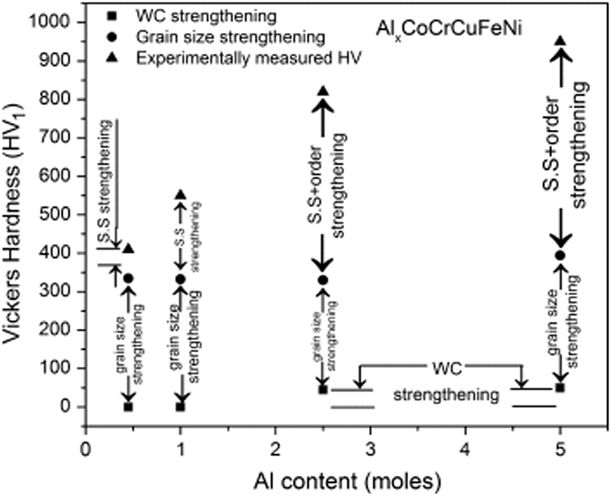
The combination of various strengthening mechanisms has resulted in the development of HEAs with exciting properties. Figure 5 shows the various contributions to strengthening assessed for AlxCoCrCuFeNi HEAs, produced by MA + SPS, with increasing Al content. The solid solution strengthening increases with higher Al content, while the grain size strengthening remains nearly same due to similar level of nanocrystallinity observed for all the alloys [Reference Sriharitha, Murty and Kottada151]. AlCoFeNiTi, after SPS, shows major FCC phase along with fine precipitates of B2 phase and Al3Ti particles [Reference Fu, Chen, Wen, Morgan, Chen, Zheng, Zhou, Zhang and Lavernia115]. Thus, solid solution strengthening, grain boundary strengthening, twin boundaries formed in FCC phase, and precipitation hardening, all contribute to give an ultra-high compressive strength of 2.9 GPa and a failure strain of 5.9% to the HEA [Reference Fu, Chen, Wen, Morgan, Chen, Zheng, Zhou, Zhang and Lavernia115]. Composite microstructure of FCC and M6C carbides in C2Co25Cr21Fe18Mo8Nb3Ni23W exhibits attractive high temperature properties, namely, ultimate tensile strength of 795 MPa and elongation of 13.3% at 650 °C [Reference Sun, Li, Xi, Zhou, Li and Yang26]. Presence of nano-sized TiO2 particles and coherent Ni3Ti precipitates in FCC matrix of Co1.5CrFeNi1.5Ti0.5 imparts a good combination of strength (1460 MPa) and ductility (14.5%) [Reference Moravcik, Gouvea, Hornik, Kovacova, Kitzmantel, Neubauer and Dlouhy124]. Al0.3CoCrFeMnNi shows high compressive strength of 979 MPa and failure strains of 39%, resulting from the combination of ultrafine grained structure and presence of second phase formed during SPS [Reference Pohan, Gwalani, Lee, Alam, Hwang, Ryu, Banerjee and Hong78]. The solid solution strengthening and nanocrystalline nature of AlCoCuNiTiZn impart a high compressive strength (>2.36 GPa) to the alloy, which is greater than most commercial hard-facing alloys [Reference Varalakshmi, Kamaraj and Murty47, Reference Varalakshmi, Kamaraj and Murty51]. The nanocrystalline Al7.5Co25Cu17.5Fe25Ni25 HEA exhibits an ultra-high compressive yield strength of 1795 MPa and a hardness of 454 HV. The calculated values of the quantitative contributions from solid-solution strengthening, twin boundary strengthening, dislocation strengthening, and grain boundary strengthening are 28, 71, 600, and 1136 MPa, respectively, suggesting that the ultra-high strength of the nanocrystalline Al7.5Co25Cu17.5Fe25Ni25 HEA is primarily attributed to grain boundary strengthening and dislocation strengthening [Reference Fu, Chen, Wen, Zhang, Chen, Zheng, Zhou and Lavernia80]. Hadraba et al. [Reference Hadraba, Chlup, Dlouhy, Dobes, Roupcova, Vilemova and Matejicek83] showed that the increase in strength up to 30% at room temperature and 70% at elevated temperature could be observed for CoCrFeMnNi HEAs with nano Y2O3. The ODS alloy shows 3 times lower creep strain rates than the alloy without oxide particles, suggesting effective pinning mechanism.
Various contributions to strengthening depicted for AlxCoCrCuFeNi HEAs as a function of Al content [Reference Sriharitha, Murty and Kottada151].

Chen et al. [Reference Chen, Chen, Wu, Cao, Liu and Fu113] demonstrated that the strength levels of Al–Cr–Fe–Ni alloys vary as Al0.75CrFeNi < Al0.75CoCrFeNi < Al0.75CoCrFeNiTi0.25 with Co and Ti addition, which is attributed to enhanced solid solution strengthening present in the HEAs. Light HEA AlLiMgScTi produced by MA shows a high hardness of 5.9 GPa because of its nanocrystalline structure [Reference Youssef, Zaddach, Niu, Irving and Koch95]. Nanoscale twins formation has been observed in FCC phase formed during MA and SPS [Reference Fu, Chen, Fang and Li29, Reference Fu, Chen, Wen, Zhang, Chen, Zheng, Zhou and Lavernia80, Reference Youssef, Zaddach, Niu, Irving and Koch95, Reference Fu, Chen, Fang, Zhang, Xiao and Zhu103, Reference Koundinya, Sajith Babu, Sivaprasad, Susila, Kishore Babu and Baburao106, Reference Fang, Chen and Fu110, Reference Wang, Cai, Zhou and Xu119]. The presence of nanotwins along with the high solid solution strengthening results in excellent compressive properties of the alloy [Reference Fu, Chen, Fang, Zhang, Xiao and Zhu103]. Age hardening during SPS of AlCoCuNiZn was demonstrated owing to fine precipitation of α phase within γ grains [Reference Mohanty, Gurao and Biswas86]. Threefold increase in hardness is observed during peak-ageing compared with as-milled and solutionized state [Reference Mohanty, Gurao and Biswas86]. Nonmetallic additions have also been made to HEAs to improve their mechanical properties. Addition of 0.1 at.% N to CoCrFeMnNi leads to increased ultimate compressive strength (by 154 MPa) and plasticity (by 9.9%) [Reference Xie, Cheng, Tang, Chen, Chen and Dai49]. Solid solution strengthening, ultra-fine grain size, interstitial strengthening (from C, O dissolved during MA and SPS), and presence of oxide inclusions contribute to the significant hardening achieved in the SPSed alloy [Reference Kang, Lee, Ryu and Hong34]. AlCoCrFe shows excellent resistance to softening during annealing at 900 °C for 600 h, after which the drop in hardness is only 10% [Reference Praveen, Anupam, Tilak and Kottada77]. Exceptional retention of strength (∼5 GPa) up to 600 °C has been demonstrated for nanocrystalline MoNbTaW HEA films [Reference Zou, Wheeler, Ma, Okle and Spolenak155]. They also have been shown to possess high strength to density ratio (>0.4 MJ/kg) and very low strain-rate sensitivity (∼0.005), making them promising materials for high stress and high temperature applications [Reference Zou, Wheeler, Ma, Okle and Spolenak155].
Functional properties
The functional properties of HEAs have been studied relatively less than their mechanical behavior, yet some promising attributes have been observed for HEAs. Diverse and appealing properties like high hardness, reasonable ductility, and fracture toughness make HEAs suitable candidates for wear resistance applications. Varalakshmi et al. [Reference Varalakshmi, Appa Rao, Kamaraj and Murty54] demonstrated significantly reduced wear loss rates for AlCrCuFeTiZn HEA compared with commercially used Ni-hard faced alloy. The alloy was processed by MA, followed by HIP, and exhibited very high hardness of 10 GPa, which led to its excellent wear resistance. The wear behavior of CoCrFeMoNi has been observed to be superior to HFXP-58 [Reference Zhang, Zhang, Liu, Liu and Wang73]. The mechanical and tribological properties of the (CuCrFeTiZn)100−xPbx composites show a good combination of hardness (3.5–6 GPa), compressive strength, plasticity (15–20%), and wear resistance [Reference Yadav, Sarkar, Aggarwal, Kumar and Biswas127]. Atmospheric plasma sprayed AlCoCrFeNiTi coating showed good wear resistance at room temperature and at 500 °C, when compared with BCrNiSi alloy and stainless steel. Adhesive wear was identified as major wear mechanism at room temperature, while abrasive wear also takes place at higher temperatures [Reference Tian, Xiong, Liu, Lu and Fu81]. AlCuNiTiZr HEA has been shown to possess better corrosion resistance than 304 stainless steel in the seawater environment as indicated by the higher corrosion potential, wider passivation region, and secondary passivation [Reference Ge, Wu, Wang, Xu, Shang, Zhang and Wang35, Reference Ge, Wang, Shang, Zhang and Wang133]. AlBCoxFeNiSi exhibits semi-hard magnetism with a high value of M s = 26.1 emu/g for x = 0.8 [Reference Wang, Li, Zhai, Xu, Niu, Xu and Wang138]. The soft magnetic properties of CoxCrCuFeMnNi (x = 0.5–2) alloys have been shown to improve with increasing cobalt content, with Co2CrCuFeMNNi exhibiting a high M s value of 52 emu/g and coercivity of 14 Oe [Reference Zhao, Ren, Zhang, Liu and jian Zhang88]. Ji et al. [Reference Ji, Wang, Wang, Zhang, Wang, Zhang and Fu40] demonstrated magnetic transition from soft magnetic to paramagnetic behavior when milled powders of CoCrFeMnNi HEA are consolidated using SPS. The saturation magnetization of AlBFeNiSi(Nb) HEAs decreases with increasing content of amorphous phase [Reference Wang, Zheng, Xu and Wang142]. The addition of Co, Cu, Ce, and Ag has been shown to decrease the saturation magnetization of AlBFeNiSi alloys [Reference Xu, Shang, Ge, Jia, Liaw and Wang143, Reference Xu, Axinte, Zhao and Wang144], while C increases the saturation magnetization [Reference Xu, Axinte, Zhao and Wang144]. Annealed AlBFeNiSi(Co, Cu, Ag) alloys show improved magnetic properties due to the presence of FeB- and FeSi-rich phases [Reference Zhu, Zhou, Yu, Wei, Xu and Wang146]. Yang et al. [Reference Yang, Liu, Zhao, Cheng and Li156] demonstrated that the crystalline Al0.8CoCrFeNi exhibit superior electromagnetic wave absorption properties than its amorphous counterpart. CoCrCuFeNi exhibits higher M s value than CoCrFeMnNi produced by identical processing route.
HEAs produced by HPT
Other than MA, high-pressure torsion (HPT) has increasingly been used to produce nanocrystalline HEAs. Therefore, it is worth comparing the salient features of HEAs produced by these two severe plastic deformation (SPD) routes. Like MA, HPT produces HEAs usually at room temperature and in few cases at cryogenic temperatures. Moon et al. [Reference Moon, Qi, Tabachnikova, Estrin, Choi, Joo, Lee, Podolskiy, Tikhonovsky and Kim157] demonstrated that a diffusionless transformation from FCC to HCP structure occurs in Co20Cr26Fe20Mn20Ni14 HEA during HPT at 77 K. The high strains imparted during HPT processing often result in the formation of metastable phases, which decompose during thermal treatment. AlNbTiV HEA formed by HPT exhibits a single-phase BCC structure. During annealing at temperatures above 700 °C, precipitation of Nb2Al and Ti3Al is observed [Reference Schuh, Völker, Maier-Kiener, Todt, Li and Hohenwarter158]. It has been shown in the section “Amorphous HEAs” that prolonged milling times lead to the formation of amorphous HEAs. Similarly, use of very high strains during HPT generates excessive vacancies in the material, which result in appearance of new phases. To illustrate, at equivalent strain values, e = 50, HPT of HfNbTaTiZr forms a single-phase BCC structure, which decomposes into BCC and HCP phases at e > 100, as reflected in the loss of ductility and strength [Reference Čížek, Haušild, Cieslar, Melikhova, Vlasák, Janeček, Král, Harcuba, Lukáč, Zýka and Málek159]. Wu et al. [Reference Wu, Ni, Liu, Liu and Song160] demonstrated that continuous deformation during HPT of CoCrFeNi causes the nucleation and growth of amorphous phase at twin–twin intersected regions, owing to enhanced defect accumulation. Since alloying of elemental powders happens during milling, a wide range of HEAs can be produced by MA. HPT is performed often on a cast ingot and therefore deformation characteristics of the alloy determine its suitability for successful HPT processing. A novel methodology of using elemental powder mixture for HPT has been used by Kilmametov et al. [Reference Kilmametov, Kulagin, Mazilkin, Seils, Boll, Heilmaier and Hahn161] to produce nanocrystalline CoCrFeMnNi. Pressure of 5 GPa and shear strain equivalent to 100 rotations were used to drive the alloying during HPT. One distinct advantage of MA over HPT is the uniformity of microstructure obtained. For example, CoCrFeMnNi produced by MA and SPS showed a uniform microstructure of FCC and carbides, with a grain size of 185 nm. HPT processing of CoCrFeMnNi results in the formation of non-uniform microstructure, with grain sizes being 60 nm and 4 μm at periphery and center, respectively. The inhomogeneity leads to the gradient in strength along the disc (5.3 GPa at periphery and 2.4 GPa at center). HPT is certainly a much cleaner process, with minimal risk of contamination that is frequently encountered in HEAs formed by MA. Also, consolidation of milled HEA powders is frequently performed, which leads to a slight increase in grain size. A much finer microstructure can be obtained using HPT. To illustrate, Shahmir et al. [Reference Shahmir, He, Lu, Kawasaki and Langdon162] obtained a grain size of ∼10 nm in CoCrFeMnNi HEA, which exhibited superplastic elongations (>400%) at 873 and 973 K.
Together, MA and HPT form attractive options to produce a wide variety of nanocrystalline HEAs with exciting features and properties. Reports on processing of HEAs by other SPD routes, like equal angular channel pressing, have been scarce (see, e.g., Ref. Reference Shahmir, Mousavi, He, Lu, Kawasaki and Langdon163), which certainly forms an area to be explored in future.
Potential applications
The field of HEAs can still be considered in early stages of development. Although 3d transition metal HEAs and refractory HEAs have shown some exciting features and properties, further enhancement in their processing and properties is required before they can compete with materials like superalloys [Reference Miracle and Senkov18]. One of the promising applications foreseen for HEA powders is in coatings. Cold spraying, plasma spraying, and thermal spraying are being used to produce HEA coatings. CoCrFeNi(MoxW1−x) coatings exhibit good metallurgical bonding to Q235 steel substrate and possess superior strength and wear resistance than the substrate. Mo addition provides more protective coating as reflected in its more positive corrosive potential and reduced corrosion rates [Reference Shang, Axinte, Sun, Li, Li, Du, Qiao and Wang120]. AlCoCrFeNiTi coatings produced by atmospheric plasma spraying show better strength and wear resistance than 316 stainless steel [Reference Tian, Xiong, Liu, Lu and Fu81]. AlCoCrFeNiSi coating formed by atmospheric plasma spraying has shown good combination of mechanical and wear properties, making it suitable for abrasive environments [Reference Tian, Fu and Xiong97]. Ang et al. [Reference Ang, Berndt, Sesso, Anupam, Praveen, Kottada and Murty16] prepared AlCoCrFeNi and CoCrFeMnNi HEA coatings using thermal spraying. Both the coatings showed prominent FCC structure and consequently nearly same hardness (>4 GPa). The unique lamella structure is observed for AlCoCrFeNi coating and results in anisotropic mechanical response. Laser cladding of BCoCrFeNiSi self-fluxed powders has been used to produce novel amorphous/crystalline coatings with attractive wear properties [Reference Shu, Liu, Zhao, He, Sui, Zhang, He and Xu164]. Addition of Al2O3 to AlCoCrFeMnNi improves the thermal, oxidation, and mechanical properties of HEAs and indicated the potential of ODS HEAs as high-temperature coating material [Reference Prasad, Singh and Panigrahi44]. AlCoCrFeNi HEA powders have been explored for their electromagnetic interference properties and are shown to be an attractive candidate for microwave shielding applications [Reference Zhang, Zhang, Li, Zhao and Guo74, Reference Zhang, Duan, Cui, Ma, Wang and Dong128, Reference Yang, Liu, Zhao, Cheng and Li165].
Zhang et al. [Reference Zhang, Zhang, Liu, Liu and Wang73] have suggested that CoCrFeMoNi coatings can be a promising material for diamond tool applications, as they possess higher hardness (350–520 HV) than many of the conventional metal matrices used, e.g., Cobalite HDR (309 HV). MAed HEAs are also being explored to form composites and as additives in cermets. Addition of AlCoCrFeNi and AlCoCrFeNiTi powders to TiB2 has been shown to exhibit excellent wettability, thereby lowering the sintering temperature required to process the ceramic composite [Reference Zhang, Sun, Ke, Li, Ji, Wang and Fu33, Reference Ji, Zhang, Wang, Wang, Zhang, Wang and Fu82]. AlCoCrFeNi HEA was used as binders to fabricate Ti(C, N)-based cermets with simultaneous enhancement of hardness and toughness [Reference Zhu, Liu and Ye166]. Mohanty et al. [Reference Mohanty, Gurao and Biswas86] demonstrated fine-scale precipitation in AlCoCuNiZn HEA, similar to that observed in superalloys and indicate potential of HEAs for high thermal stability. Cu matrix composites have been formed using addition of AlCoCrFeNi powders. Moravcik et al. [Reference Moravcik, Cizek, Gavendova, Sheikh, Guo and Dlouhy30] designed the TiC and AlCoCrFeNiTi0.5 composites and obtained good mechanical properties (comparable to as-cast counterparts). Tan et al. [Reference Tan, Wang, Xue, Zhang, Cao and Cheng167] fabricated composites of amorphous Al65Cu16.5Ti18.5 and crystalline (FCC + BCC) Al0.6CoCrFeNi HEA. These composites exhibited very high yield strength of 3.1 GPa but a low ductility. Yang et al. [Reference Yang, Yan, Yang and Fu168] reported the fabrication of nanoscale Al2O3-reinforced Al0.4CoCrFeNi1.2Ti0.3 HEA composites, which possess major FCC phase along with minor fractions of BCC and Al2O3. The nanoscale Al2O3 provides precipitation strengthening to the alloy and seems to increase the fraction of nanotwins.
Challenges in processing of MAed HEAs
HEAs processed by MA offer exciting properties and promising applications. However, this synthesis route also faces some challenges, which need to be surmounted to further advance the production of nanocrystalline HEAs.
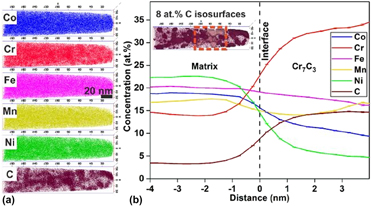
(i) Contamination from milling media is commonly observed during MA of HEAs [Reference Sharma, Yadav, Biswas and Basu23]. The type and extent of contamination that occur during milling are chiefly determined by the milling media, PCA, duration of milling, speed of milling, and the characteristics of the materials milled [Reference Suryanarayana15]. It needs to be emphasized here that as far as MA of HEAs is concerned, there is no significant degradation of properties reported due to contamination. In fact, there have been numerous cases in which contaminants have proven beneficial. To illustrate, formation of TiO phase during SPS of MAed MoNbTaTiWV leads to excellent mechanical properties with a compressive yield strength of 2709 MPa, fracture strength of 3115 MPa, and fracture strain of 11.4% [Reference Long, Su, Zhang, Liang, Peng and Li98]. The oxide inclusions formed during SPS of MoNbTaVW contribute to an ultra-high compressive strength obtained for the HEA [Reference Kang, Lee, Ryu and Hong34]. Formation of V and Cr carbides in CoCr0.5−xCuFeNi1.5Vx HEAs results in high compressive yield strength (>1 GPa) [Reference Wang, Cai, Zhou and Xu119]. The real challenge lies in understanding the mechanism and controlling the extent of contamination, both of which have not been investigated in detail so far. The formation of Cr carbides is not only observed during consolidation of Cr-containing HEAs [Reference Praveen, Basu, Kashyap and Kottada12] but also during heat treatment [Reference Zaddach, Niu, Oni, Fan, LeBeau, Irving and Koch28] and prolonged milling [Reference Vaidya, Prasad, Parakh and Murty48]. Therefore, the source of carbon to form carbides during milling has been identified as PCA like toluene [Reference Vaidya, Karati, Marshal, Pradeep and Murty39, Reference Wang, Cai, Zhou and Xu119, Reference Vasanthakumar, Karthiselva, Chawake and Bakshi169]. Vaidya et al. [Reference Vaidya, Karati, Marshal, Pradeep and Murty39] have shown, using atom probe tomography, that Cr7C3 is present in CoCrFeMnNi powders milled for 15 h (Fig. 6), which hints toward the possibility of Cr7C3 formation at milling stage itself. However, the exact mechanism of decomposition of toluene to form C and subsequent reaction with Cr to form carbides has not been investigated yet. Meticulous analysis of milled powders and PCA at different stages of milling, using spectroscopic techniques like NMR, may shed light on the progression of toluene decomposition. While advantageous effects of contamination have been reported in the literature, its levels are often unsolicited and extent of it has not been controlled.
(ii) The vast compositional space of HEAs necessitated the development of computational tools for predicting the phase structure in these alloys using CALPHAD and first principle techniques. While the phase predictions are increasingly becoming accurate for HEAs produced by equilibrium methods, limited efforts have been made for the assessment of phases formed during MA or any other nonequilibrium process. Youssef et al. [Reference Youssef, Zaddach, Niu, Irving and Koch95] showed that HCP phase formed after annealing of MAed AlLiMgScTi is in agreement with the DFT (density functional theory) calculations. Sun et al. [Reference Sun, Huang and Luo170] discussed in detail that the CALPHAD calculations for predicting phases formed during MA have low accuracy. Using the “liquid state” assumption, the calculated primary phase during solidification is considered as the major phase formed in the as-milled microstructure, but this treatment is rather tentative and not always valid. Elements like Mg and Si can cause the intermetallics to form during casting but get dissolved during MA to form simple solid solution structures (see, e.g., Tables I–III).
(iii) “Sluggish diffusion” was proposed as one of the core effects in HEAs. However, recent measurements using interdiffusion [Reference Vaidya, Mohan Muralikrishna, Divinski and Murty171] and tracer diffusion techniques [Reference Vaidya, Pradeep, Murty, Wilde and Divinski172] have demonstrated that the diffusion in HEAs need not be assumed sluggish. The diffusion measurements for HEAs have been limited and only measured in cast alloys [Reference Divinski, Pokoev, Esakkiraja and Paul173]. There have been no investigations of atomic transport in HEAs formed after MA and consolidation. A reliable measurement of diffusion in, say, SPSed HEAs, would prove critical to deepen the current understanding on phase stability and deformation behavior of these alloys. A major obstacle for dependable diffusivity measurements in HEAs produced by MA is to get a contamination-free sample. Another challenge is to ensure the stability of nanostructured alloys at the temperatures and time used for diffusion annealing.
(iv) The milled powders are rarely used for any applications directly and often required to be either consolidated in form of dense pellets or sprayed as coatings. As noted in Tables I, II, and IV, phases formed during MA are often metastable and most of the HEAs undergo phase transitions to other solid solution structures and/or complex phases. Therefore, the choice of alloy compositions and milling conditions need to be made keeping in view the processing intended after MA. Some concerns like restricting grain growth of milled powders during consolidation, handling of nanocrystalline powders, maintaining an inert atmosphere during milling, and maintaining optimum milling schedule apply to MA of HEAs also, as it does for MA of conventional alloys.
(v) The multicomponent nature of HEAs makes it difficult to comprehend the alloying kinetics and delineate the influence of individual element on phase formation. This is further complicated for 3d transition element HEAs, when elements have similar atomic size and can possess similar structure and lattice parameters. For example, both Fe and Cr have BCC structure and similar lattice parameters. Furthermore, binaries like FCC CoNi and FeNi have similar unit cell dimensions as Ni, and therefore, their deconvolution XRD is not straightforward. The novel strategy of sequential alloying can prove useful to understand the role of alloying elements better. To illustrate, Vaidya et al. [Reference Vaidya, Prasad, Parakh and Murty48] demonstrated using sequential alloying strategy that BCC phase formed during MA of AlCoCrFeNi is FeCr rich and not disordered AlNi.
Atom probe tomography of CoCrFeMnNi HEA showing (a) elemental distribution of 15 h milled powder and (b) proximity histogram obtained from the highlighted region (dotted box) of the 8 at.% C isoconcentration surfaces revealing the presence of chromium carbide (Cr7C3) [Reference Vaidya, Karati, Marshal, Pradeep and Murty39].

Conclusions
MA has increasingly been adopted as a popular route to synthesize nanocrystalline HEAs. The present review aimed to bring out key aspects of phase evolution, thermal stability, mechanical behavior, and functional properties of HEAs produced by MA and subsequent consolidation. Further intent was to discuss the potential applications of MA and the challenges, which lie ahead for the advancement of the field.
It has been shown that only solid solution phases are formed in HEAs after MA. Phase transformations to multiple solid solution phases and complex structures are observed on consolidation and annealing, which indicate the metastable nature of phases during MA. Several amorphous HEAs have been successfully produced by employing prolonged milling hours. The increasing configurational entropy does not significantly accelerate the alloying kinetics. The parametric approaches utilizing combination of thermodynamic and topological factors can be used to reasonably predict the phase structure of MAed HEAs. The effect of various alloying elements on phase evolution HEAs has also been discussed. Al has significant influence on phase formation as it dissolves in FCC phases at lower concentration and leads to the formation of B2 phase when its content is high. Cr facilitates the evolution of BCC and σ phases. Cr-containing HEAs invariably show the appearance of carbides when milled powders are exposed at elevated temperatures. SPS is the most widely adopted technique to consolidate HEA powders, as it gives an excellent combination of densification and retention of nanocrystallinity. The dense pellets have been examined for various mechanical and functional properties. Multiple strengthening mechanisms contribute to the excellent compressive properties exhibited by SPSed HEAs; these include solid solution strengthening, precipitation hardening, and grain boundary and twin boundary (FCC phase) strengthening. The high hardness lends wear-resistant properties to HEAs, and few studies on corrosion behavior hint at protective nature of HEA coatings. Use of HEA powders in fabrication of cermets and development of HEA coatings and composites are some of the potential applications presented so far, for the alloys produced by MA.
Further advancement of HEAs processed by MA requires overcoming the challenges of reducing contamination, reliable phase predictions using CALPHAD, and first principle calculations, measuring kinetic properties and understanding the phase evolution during MA in greater detail. Use of high-purity inert atmosphere, milling of cast ingots, mechanically activated annealing, and sequential alloying methodology can help in achieving lower contamination levels. Production of contamination-free alloys will also facilitate the reliable measurements of diffusion and in turn provides comprehensive understanding of their phase stability and mechanical behavior. Careful optimization of milling parameters and sintering conditions can further help to control the microstructure of the HEAs and achieve enhanced properties.