

Published online by Cambridge University Press: 02 September 2005
I am grateful for the opportunity to respond to the rejoinders to my article, “The Flawed Logic of Democratic Peace Theory” (Rosato 2003). In each case, I summarize the core issues at stake and explain why I do not believe that my critics have succeeded in casting serious doubt on my original argument.
David Kinsella's (2005) first major claim is that my criticism of democratic peace theory is misdirected because I test the theory's causal logics as if they are monadic when they are in fact dyadic. Evidence from conflicts between democracies and nondemocracies is irrelevant, he argues, because the logics state that democracies will only externalize their domestic norms of conflict resolution or act cautiously in conflicts with other democracies.
What Kinsella fails to realize is that although the democratic peace finding is dyadic, the logics adduced to explain it are monadic. The six logics that I identified in my article all begin with the claim that democratic norms and institutions cause democracies to behave differently from nondemocracies in systematic ways: there are fewer reasons available to them for going to war, they are more constrained in the use of violence, they are slower to resort to force, and they are better at signaling their levels of resolve. In essence, the argument is that democracies are less violence-prone than are other kinds of states and/or more effective at engaging in the kind of behavior that makes war less likely. Proponents of the democratic peace then use these monadic tendencies to explain why democracies have not fought one another. Simply put, in a crisis involving two democracies, each side has a low propensity for violence and a high aptitude for the kind of behavior that makes war less likely, and each knows that its democratic opponent also has these qualities. Therefore, they are able to remain at peace (Bueno de Mesquita et al. 1999; Russett 1993; Schultz 2001).1
The perceptual versions of these logics are also monadic. They take the following form. Democracy A is constrained and, because it perceives State B as a democracy, believes B is also constrained. B carries out the same calculation. Thus, A and B are able to remain at peace. Doyle's (1997) claim that democracies remain at peace because they trust and respect one another and fight nondemocracies because they neither trust nor respect them is the only example of democratic peace theorists proposing a dyadic logic. As I explained in my article, however, this logic is ad hoc (Rosato 2003, 589–90).
Let me approach this same point from a slightly different perspective. The logics underpinning the democratic peace refer to how democracies act with respect to all states, whether democratic or not. The public constraint logic, for example, states that pairs of democracies remain at peace because both parties face above average constraints in deciding to go to war with any adversary, not just with other democracies. Similarly, the information logic suggests that members of democratic dyads do not fight because they are both good at signaling their level of resolve, not because they are only good at signaling other democracies. In short, democratic peace theory's logics rest on a “multiplier” argument: if a state with a low propensity for violence comes into contact with another state that also has a low propensity for violence, then the likelihood of war breaking out is very low indeed.2
Similarly, if a state that can effectively reveal private information about its level of resolve comes into contact with another state that can do the same, then the likelihood that they will fight is quite low.
Therefore, in order to evaluate democratic peace theory's logics, we must determine whether democratic norms and institutions actually cause democracies to behave differently from nondemocracies in systematic ways. For example, is there good evidence that democracy causes greater elite accountability, better access to the policy process for peace-loving interest groups, better signaling in crises, and a greater commitment to the use of peaceful norms of conflict resolution? If there is, then we have a plausible explanation for the democratic peace finding. If not, then the peace that exists among democracies may not be caused by the democratic nature of those states.
This is the kind of evaluation that I carried out in my article before concluding that democracy does not have the effects that proponents of the democratic peace attribute to it (Rosato 2003, 599). Liberal democracies do not reliably externalize their domestic norms of conflict resolution. Democratic leaders are not especially accountable to peace-loving publics or pacific interest groups. Democracies are not particularly slow to mobilize or incapable of surprise attack. And open political competition offers no guarantee that a democracy will reveal private information about its level of resolve. Therefore, the existing logics cannot explain the democratic peace finding: two democracies, each relatively unconstrained and expecting the other to be similarly unconstrained, may well fight one another.
In sum, the logics underpinning democratic peace theory are monadic in form; thus the tests that I carried out provide good evidence that the absence of war between democracies may not be caused by their democratic nature.
Kinsella's other major claim is that the criteria that I adopted to reject democratic peace theory are unfair. He argues, first of all, that I cannot reject the theory on the basis of a handful of select historical examples that belie its causal logics. Moreover, he faults me for claiming that democratic peace theory is a degenerating research paradigm because scholars in that tradition focus on perceptions. I agree that had I adopted either of these approaches, then my critique of democratic peace theory would have been inadequate. However, I used neither strategy in my article.
Rather than relying on a few examples to show that democratic peace theory's causal logics occasionally fail to play out as advertised, I used large numbers of cases to show that the causal mechanisms often fail to operate as stipulated. Moreover, I tested the logics on sets of cases that were most likely to support democratic peace theory. My reasoning was that if there was little evidence that the logics operated in these “easy” cases, then this would cast serious doubt on the theory. That said, Kinsella is right to note that I did not make either point explicit in my article. A brief summary and evaluation of my findings is therefore in order.3
I deal with the accountability and information mechanisms in my response to Slantchev, Alexandrova, and Gartzke below.
In examining the argument that democracies generally externalize their domestic norms of conflict resolution, I identified 33 wars in which they failed to do so. In each case, I looked for evidence that the war in question could plausibly be justified on the grounds of self-defense or the inculcation of liberal values and found that it could not. I also argued that there may be up to 33 more wars in which democracies attempted to perpetuate or reimpose autocratic rule in direct violation of their domestic norms of conflict resolution. In the case of the trust and respect logic, I cited a total of 18 examples of democracies failing to trust and respect one another. Because every case involved a pair of democracies, they should have lent support to the logic rather than contradicting it. My analysis of the group constraint mechanism found that prowar groups in the United States and Britain have often prevailed over antiwar groups in domestic debates during the last two centuries. Similarly, an analysis of U.S. foreign policy decisions since 1789 suggests that American presidents have been able to circumvent or overcome checks and balances almost at will. My decision to focus on Britain and the United States when evaluating these mechanisms was intentional: if the logics fail to operate in the most democratic of states, then they are likely to fare even worse in states that are less democratic. Finally, in the case of the public constraint mechanism, I showed that the logic failed to operate as stipulated in 12 of 15 cases where democratic peace theorists would most expect it to apply. In addition, I cited a dozen crucial examples where democratic publics appear to have imposed no constraints on their leaders even though the other state was democratic (Rosato 2003, 588–99).
These findings would cast doubt on any set of causal logics, but they are especially damaging to democratic peace theory because its principal finding holds that democracies have rarely if ever fought one another. If democratic peace theory's causal logics are to explain this finding, then they should rarely fail to operate as stipulated. But they appear to fail fairly frequently, and we therefore have reason to doubt their explanatory power.
I did not argue that democratic peace theorists' attempts to repair their logics by introducing perceptions are an indication that the research program is degenerating. If there is good evidence that, in order to remain at peace, states must not only be democratic but also perceive one another as such, then a focus on perceptions is entirely appropriate. In other words, I agree with Kinsella that the turn to perceptions need not be an indication that the research program is degenerating. In fact, Kinsella appears to acknowledge this, noting that I did not use the term “degenerating research program” in my evaluation of democratic peace theory's causal logics.
My point about perceptions was different. In essence, I argued that bringing in perceptions can only improve a logic's power if we can predict how democracies will categorize other states with a high level of confidence and if this categorization is relatively stable. I then provided evidence that strategic interest or policymakers' personal beliefs and party affiliations have often prevented democracies from forming coherent, accurate, and stable assessments of other states' regime type, thereby lessening our confidence that joint democracy can enable democracies to remain at peace. Moreover, I argued that democratic peace theorists have failed to come up with a compelling theory of perceptions; they cannot tell us when democracies will perceive other states as democratic and when they will not (Rosato 2003, 592–93). Because Kinsella disputes neither my reasoning nor my findings, I find his critique unconvincing.
Branislav Slantchev, Anna Alexandrova, and Erik Gartzke's (2005) first criticism of my article is that I mistakenly treat theories as if they are deterministic rather than probabilistic and that I evaluate them on that basis.
I agree that social science theories are probabilistic: they are designed to simplify reality and, in the course of simplifying, theorists are bound to sacrifice some explanatory power. It is for this reason that I chose to cast doubt on the causal logics by citing large numbers of anomalies rather than selected historical cases. I reasoned that this would allow me to claim that the logics rarely operated as stipulated or were frequently overwhelmed by other factors. Although such an approach cannot decisively disconfirm probabilistic logics, it can suggest that their explanatory power is highly circumscribed.
My analysis of the information logic explicitly recognizes the fact that it is probabilistic and demonstrates that it frequently fails to operate as advertised.4
I focus on Schultz's (2001) information logic in order to reply directly to Slantchev, Alexandrova, and Gartzke. Schultz himself argues that his contribution to democratic peace theory is suggestive rather than conclusive.
The important fact to note about opposed threats is that they are rare. This should not surprise us because, as I have just noted, opposition parties will overwhelmingly support their governments. This means that we need only cite a handful of examples where opposition parties opposed the use of force but governments went to war anyway in order to cast doubt on the logic. This is what I did in my article (Rosato 2003, 599). Alternatively, we can identify crises in which an opposition party opposed a deterrent threat—as Schultz does—and check to see whether deterrence failed more often than it succeeded. Contrary to what democratic peace theorists would expect, we find that the opposite is true: deterrence succeeded in three of the five cases (Schultz 2001, 167). In sum, there are good reasons to believe that democracies are not especially good at conveying information about their levels of resolve. Most of the time they convey little if any information, and on the rare occasions that they do convey information, that information does not appear to exert a substantial impact on crisis outcomes.
Although I identified several cases where the information logic does not apply or does not operate as stipulated, Slantchev, Alexandrova, and Gartzke argue that it cannot be rejected because there are still some cases that itcan explain. What fraction of a given set of cases must a logic explain for us to accept it? My critics are prepared to endorse a logic with a 10% success rate.
I do not find this argument convincing for two reasons. First, although I agree that theories are probabilistic, it is not clear to me that we should be satisfied with a logic that has a 10% success rate. This is not to say that it is useless, but we should make every effort to come up with logics that explain a larger fraction of the empirical record. A related issue here is the question of falsifiability. All logics can explain at least some cases because scholars generate theories from their observation of historical events (Powell 1999). If we note this fact and couple it with the claim that even theories that explain a small percentage of cases are useful, we are in effect arguing that theories cannot be falsified: all theories can explain a few cases (the cases that they are based on) and theories that can explain a few cases cannot, apparently, be thrown out.
Second, a theory with a 10% success rate is hardly satisfying if we consider that democracies have rarely fought one another. Instead, we are left wondering what other factors are at work in bringing about this result. A possible fallback position here would be the claim that there are several logics associated with democracy, and although each logic only explains a fraction of the cases, they explain most of the cases when taken together. The implication of this argument would be that democracy is a “master variable” that explains the democratic peace through several causal mechanisms. We should, however, be wary of claims such as this one. Any research program can presumably proliferate logics that explain a fraction of the cases from a single master variable, but were we to adopt this approach we would simply be engaging in “curve-fitting” exercises rather than coming up with powerful logics that propose simple explanations for large numbers of cases.
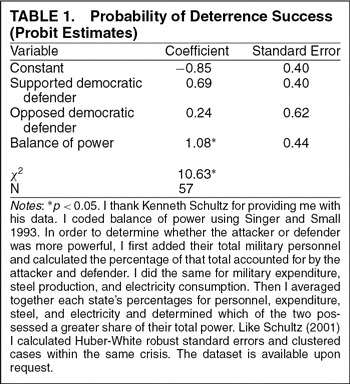
There is, however, no need to engage in a debate about the requirements of a good theory to make my point. Recall that my central claim about the information logic is that democracies are not especially good at revealing their levels of resolve in a crisis because the stance taken by opposition parties rarely sends an informative signal. This implies that if we conduct a statistical test of the kind recommended by Slantchev, Alexandrova, and Gartzke, then we should find little support for the information logic. In order to evaluate this proposition, I took the cases of attempted deterrence that Schultz used to test the information logic in his own work and carried out a probit analysis to determine whether the stance taken by opposition parties correlates with the probability of deterrence success. I included one control variable—the balance of power—based on my intuition that states are more likely to deter potential attackers if they are more powerful than they are and less likely to do so if they are weaker.
According to the results, neither “supported democratic defender” nor “opposed democratic defender” are significant at the 5% level (Table 1). The coefficient on “balance of power” is, however, both large and significant (p=0.01). These results suggest that (1) opposition party support or lack of support is not significantly associated with the probability of deterrence success, and (2) threats made by democratic governments and supported by opposition parties are no more likely to succeed than are threats by nondemocracies.5
I ran another probit that included the 10 independent variables that Schultz (2001) used with one exception: I replaced his balance of forces variable with my balance of power variable. Neither supported nor opposed democratic defender were significant at the 5% level, whereas the coefficient on the balance of power variable was both large and significant (p<0.001). We must treat these results with caution, because they rest on a sample of only 57 cases. At a minimum, however, we can conclude that support for the information logic is not robust.
Slantchev, Alexandrova, and Gartzke's other major criticism is that my analysis of the accountability logic is plagued by selection bias, which leads me to cite evidence that supports the logic rather than discrediting it. I am puzzled by the accusation of selection bias. I did not select cases on the dependent variable in my analysis, and my critics give no evidence that I did so.
This methodological quibble aside, the evidence in my article casts significant doubt on the accountability logic. According to Slantchev, Alexandrova, and Gartzke, my finding that democratic leaders are more likely than autocratic leaders to be removed from office for losing a war lends credence to democratic peace theorists' claims that democrats are more accountable than are autocrats. In my article, however, I argued that accountability is determined not only by the probability of removal, but also by the costs that leaders will incur in the event they are removed from office. These costs include imprisonment, exile and death or, simply, “punishment.” Thus I argued (Rosato 2003, 593–94) that leaders make decisions based on expected costs. Slantchev, Alexandrova, and Gartzke do not dispute this claim; they simply ignore it.
What do we see when we factor in costs? Using a well-known dataset I compared the fates of democratic and autocratic leaders who took their countries into costly or losing wars. In the case of costly wars, there is little debate: autocrats are both more likely to be removed and more likely to be punished. Losing wars provide a more complicated picture. On the face of it, democratic losers are removed 75% of the time, whereas autocratic leaders are removed 35% of the time. But as I argued in my article, we should not count the Menzies resignation as an example of removal and therefore democrats are more likely to be removed 50% to 35%. Autocrats are, however, far more likely to be punished (29% to 0%). Because democrats are more likely to be removed and autocrats are more likely to be punished, I argued that we cannot claim that either are more accountable (Rosato 2003, 594).
There is now more evidence for my claims. Chiozza and Goemans (2004) use a dataset of all leaders between 1919 and 1999 to determine whether defeat in war affects the tenure of democratic and nondemocratic leaders. Their findings are stronger even than mine: defeat in war significantly reduces the tenure of nondemocratic leaders, but does not significantly affect the tenure of democratic leaders. In other words, autocrats know that war involvement can reduce their time in power, and democrats know that war involvement has little if any effect on their chances of retaining power. In sum, the evidence does not support the claim that democrats are more accountable than autocrats.
Faced with these findings, my critics shift their position on the accountability issue. Their new argument goes as follows. If we assume that democrats are more likely than autocrats to be punished for losing a war, then it follows that democrats will only get into wars that they can win and will therefore win most of the wars that they fight. Slantchev, Alexandrova, and Gartzke then note that democracies do indeed win most of their wars and assert that this must be because democratic leaders are more accountable than their autocratic counterparts.
This argument is unconvincing. The problem is that, as I have shown, there is scant evidence for the initial premise of my critics' new argument. Slantchev, Alexandrova, and Gartzke are wrong to assume that democrats are more likely to be punished for losing a war and are therefore more accountable than autocrats. Therefore, they cannot assert that democrats will only get into wars that they can win and will consequently win most of the wars that they fight. This is not to say that democracies do not win a lot of wars—there is good evidence that they do—but their war-winning cannot be attributed to their greater accountability.
Slantchev, Alexandrova, and Gartzke do more than simply question the persuasiveness of my critiques: my article, they argue, legitimizes “a fundamentally incorrect method of evaluating social science theories.” For them a causal logic ought to be evaluated in two ways. First, we must establish whether it is logically consistent. Second, we must determine whether, all else equal, its independent and dependent variables are correlated. Take their restatement of the accountability logic: they argue that it must be considered powerful because it is logically consistent and because democracies win most of the wars that they fight (democracy and war-winning are highly correlated).
My approach to theory testing is different. In addition to checking for logical consistency and correlation, I seek to establish whether the logic actually operates as stipulated (Rosato 2003, 585–86). Where is the evidence that democratic leaders think and act in accordance with the logic and choose easy wars for fear of losing office if they are defeated? In short, where is the evidence that the relationship is causal rather than merely correlational?
Despite Slantchev, Alexandrova, and Gartzke's claims, this debate cannot be won by asserting that their testing method is scientific while mine is not—both of our approaches have a scientific basis (MacDonald 2003). Indeed, democratic peace theorists appear to be gravitating toward my way of doing business. Having established that there is a correlation between joint democracy and peace, they have turned to the task of developing a set of causal logics connecting the two variables.6
Note, however, that the finding itself has recently come under attack (Henderson 2002).
According to Michael Doyle (2005), my article ignores his seminal claim that democracies remain at peace because they are simultaneously cautious, respectful towards one another, and committed to promoting peace among themselves. I do not doubt that states that are fundamentally cautious, respect each other, and want to remain at peace, will remain at peace. Instead, my claim was that democratic norms and institutions do not reliably cause caution and respect, and therefore cannot be the cause of the peace that exists among democracies.
Doyle's explanation for the democratic or liberal peace rests on three logics. The first logic states that democratic institutions and processes “create an accountable relationship between the state and the voters.” This in turn induces “caution” in the international arena because there are a variety of circumstances in which voters—broadly defined to include the general public, interest groups and legislatures—are likely to oppose war. According to the second logic, elites in democracies “act according to the principles they profess to be just,” assume that other democracies are also just, and therefore respect one another. The institutional and normative logics that I describe in my article are identical to these two logics (Rosato 2003, 586–87). Doyle's third logic holds that a basic commitment to liberal economic norms encourages a “spirit of commerce” among democracies, which in turn impels them to promote peace and try to avert war with one another. I did not lay out or test a logic analogous to this one since most democratic peace theorists focus on regime type and ignore economic interdependence. Moreover, as I demonstrate below, the fact that I ignored this “third pillar” does not weaken my claims.
Having elaborated these three logics, Doyle goes on to argue that they operate “together and only together” to bring about peace between democracies. In other words, the democratic peace finding exists because all three of the following obtain simultaneously: democracies are fundamentally cautious about using force, democracies respect one another, and democracies work hard to promote peaceful relations with fellow democratic states. It follows—and Doyle is explicit about this—that if any one of these factors does not obtain, then we should not expect to see peace among democracies.
I did not question this core argument in my article. In fact, I agree that two states that are fundamentally hesitant to use force, respect one another, and work to remain at peace will rarely if ever fight one another. I am also satisfied with the claim that in the absence of one of these factors states may well fight one another.
My argument was different: I checked the historical record to see whether there is good evidence that democratic institutions do indeed induce caution and whether a domestic commitment to democratic norms does indeed cause states to respect one another. In other words, I did not ask whether caution plus respect causes peace; rather, I asked whether democracy reliably causes caution and respect. I found that it does not. Democratic leaders do not appear to be especially accountable to peace-loving publics or pacific interest groups, therefore casting doubt on the claim that democracy induces caution (Rosato 2003, 593–99). Similarly, there is substantial evidence that democracies do not reliably externalize their domestic norms of conflict resolution and do not respect one another when their interests clash (Rosato 2003, 588–93). In sum, democracy does not reliably induce caution or respect and, crucially, rarely causes both simultaneously.
By Doyle's own reasoning this finding means that we should see several wars between democracies and, because democracies appear to act little differently from nondemocracies, as many wars between democracies as between other kinds of states. Yet democracies have rarely if ever fought one another and have created a separate peace. There is, in short, a mismatch between the outcome predicted by Doyle's logic and what we actually observe in the world. The source of this mismatch is obvious: having discovered that democracies are consistently peaceful in their relations with one another, Doyle has explained the finding with a set of criteria that, as I demonstrated in my article, do not reliably obtain separately and rarely obtain simultaneously.
Curiously, Doyle's critique actually undermines democratic peace theory by making it harder to validate. When I wrote my article, I reasoned that I would have to show that neither the institutional logic nor the normative logic operated as stipulated. Doyle's rejoinder, however, makes it clear that in order to cast doubt on democratic peace theory we need only find evidence that one logic rarely operates as advertised. If democracy does not reliably lead to caution, for example, then he would predict at least a handful of wars between democracies. Because democracies have not fought one another a handful of times, his argument falls short.
My purpose in writing “Flawed Logic” was to cast doubt on the logics underpinning the democratic peace. I do not find the criticisms leveled at the piece convincing and stand by my claim that, although there is peace among democracies, it does not appear to be caused by the democratic nature of those states. Nevertheless, I did not intend or expect to have the last word on the subject. Rather, my intention from the start was to spark a debate about the most important liberal theory of war and peace. I thank my critics for joining that debate and hope that others will follow suit.
I thank Alexander Downes, John Mearsheimer, John Schuessler, Robert Trager, and my colleagues at the Olin Institute for their comments and suggestions.
Probability of Deterrence Success (Probit Estimates)
Comments
No Comments have been published for this article.