INTRODUCTION
Coppicing or resprouting is a well-recognized mode of regeneration in tropical dry forests following human or natural disturbances (Ewel Reference EWEL1980, Gerhardt & Hytteborn Reference GERHARDT and HYTTEBORN1992, Kennard et al. Reference KENNARD, GOULD, PUTZ, FREDERICKSEN and MORALES2002, McLaren & McDonald Reference MCLAREN and MCDONALD2003a, Mostacedo et al. Reference MOSTACEDO, PUTZ, FREDERICKSEN, VILLCA and PALACIOS2009, Murphy & Lugo Reference MURPHY and LUGO1986a, Van Bloem et al. Reference VAN BLOEM, MURPHY and LUGO2003) where successful regeneration by seed is highly influenced by rainfall seasonality (McLaren & McDonald Reference MCLAREN and MCDONALD2003b, Vieira & Scariot Reference VIEIRA and SCARIOT2006). In dry forests where edaphic and climatic constraints are the main limiting factors affecting tree growth and survival (Murphy & Lugo Reference MURPHY and LUGO1986a), shoots perform better than seedlings because they obtain water, nutrients and carbohydrates from a well-developed root system of the parent tree. Therefore, resprouting is considered an efficient mechanism by which trees regain above-ground biomass immediately after disturbance (Bellingham & Sparrow Reference BELLINGHAM and SPARROW2000). This will ensure that tropical dry-forest species are able to replace themselves in situ much faster than via sexual regeneration (Bond & Midgley Reference BOND and MIDGLEY2001). Accordingly, resprouting can significantly influence the succession and dynamics of tropical dry forests. The importance of resprouting to forest dynamics depends on the frequency of disturbance, the probability of resprouting after disturbance and the survival and growth rates of coppice shoots (Paciorek et al. Reference PACIOREK, CONDIT, HUBBELL and FOSTER2000). However, little is known about the mechanisms that govern the long-term dynamics of shoots. For this reason, an assessment of shoot dynamics is crucial to providing a better understanding of the importance of coppicing in tropical dry forest succession.
The ability of Caribbean dry-forest tree species to resprout following human (McLaren & McDonald Reference MCLAREN and MCDONALD2003a) and natural disturbances (Van Bloem et al. Reference VAN BLOEM, MURPHY and LUGO2003) has been studied, but shoot dynamics over time have received little attention except following hurricane events (Van Bloem et al. Reference VAN BLOEM, MURPHY and LUGO2003, Reference VAN BLOEM, MURPHY and LUGO2007). Resprouting has also been seen as a robust means to ensure the continuity of the species in situ (Ewel Reference EWEL1980, Murphy & Lugo Reference MURPHY and LUGO1986a, Van Bloem et al. Reference VAN BLOEM, MURPHY and LUGO2007). Nevertheless, little evidence exists of whether shoot dynamics can influence the continuity of the species in situ for a prolonged period after cutting. Studies conducted in other forest ecosystems have demonstrated that stump diameter is the most important predictor of resprouting potential and shoot growth (Luoga et al. Reference LUOGA, WITKOWSKI and BALKWILL2004, Mostacedo et al. Reference MOSTACEDO, PUTZ, FREDERICKSEN, VILLCA and PALACIOS2009, Neke et al. Reference NEKE, OWEN-SMITH and WITKOWSKI2006, Sands & Abrams Reference SANDS and ABRAMS2009, Weigel & Peng, Reference WEIGEL and PENG2002). In Pennsylvania, USA, Sands & Abrams (Reference SANDS and ABRAMS2009) assessed the number of coppice shoots 3 y after clear-cutting three oak species with stump diameters ranging from 6.4 to 76.2 cm. The authors found that shoot number and height decreased with increasing stump diameter. Similarly, Mostacedo et al. (Reference MOSTACEDO, PUTZ, FREDERICKSEN, VILLCA and PALACIOS2009) found that shoot number declined with increasing stump diameter (from 40 to 100 cm) in a tropical dry forest in Bolivia. A converse response was reported for savanna tree species in South Africa, where the number of coppice shoots increased with stump diameter (from 1 to 35 cm) (Neke et al. Reference NEKE, OWEN-SMITH and WITKOWSKI2006). In a semi-deciduous rain forest in Uganda, Mwavu & Witkowski (Reference MWAVU and WITKOWSKI2008) reported a higher number of shoots per stump, for stumps having between 5.1 and 20 cm in diameter, than those with a smaller diameter. However, long-term shoot dynamics are not considered in most studies of coppice regrowth in tropical dry-forest ecosystems. Generally, shoots are only monitored over several months, a few years, or in some cases, during a single assessment. Caribbean tropical dry forests have attributes that are largely influenced by strong seasonality in rainfall and hurricanes, such as low stature and a different assemblage of species, compared with other forest types (Loveless & Asprey Reference LOVELESS and ASPREY1957, Murphy & Lugo Reference MURPHY and LUGO1986a), which make comparisons with other dry-forest ecosystems difficult.
This study examined the long-term rate of recovery and dynamics of coppice shoots 10 y after human disturbance. The number of living and dead coppice shoots and the diameter and height of the living shoots were assessed 14 mo (2000) and 10 y (2009) after experimental cutting with stumps and roots remaining in place in 1999, in a primary tropical dry forest located in the Hellshire Hills forest reserve, Jamaica. The overall objective was to examine the long-term resilience of different forest tree species after disturbance and to test the hypothesis that coppice shoots are able to rapidly recover the above-ground biomass lost on clearance. Specifically, we considered the following research questions: how does the number and size of resprouted shoots compare 10 y and 14 mo following cutting? Does the size of the stump and the number of shoots per stump have any influence on shoot dynamics? We predicted that the number of shoots, the basal area and the height of the shoots would all be higher for larger stumps. Also, we assumed that there was a constant relative mortality rate (i.e. the number of dead shoots would be proportional to the number of shoots per stump per unit time) due to competition for resources.
METHODS
Study area and field methods
This study was conducted in the Hellshire Hills forest reserve, an extensive area of undisturbed tropical dry forest over limestone, part of the Portland Bight Protected Area located on the south coast of Jamaica (17°54′N, 77°58′W). A detailed site description is described in McLaren & McDonald (Reference MCLAREN and MCDONALD2003a, Reference MCLAREN and MCDONALD2003c). In the present study, the fate of coppice shoots on a total of 481 stumps, representing 51 species was followed over 10 y (1999–2009) after experimental cutting in eight permanent sample plots measuring 15 × 15 m (225 m2). The trees were cut with machetes or chainsaws at a standard height of 50 cm similar to the methods used by charcoal burners in adjacent areas. In June 2000, approximately 14 mo after cutting, all cut stumps were assessed. For each stump sampled, a maximum of 10 largest/leading shoots were identified, tagged and diameter at the base of the shoots and height of the shoots were recorded. Un-measured shoots and the number of dead shoots were also counted during this census (McLaren Reference MCLAREN2001). Stump diameters were not measured after cutting in 1999 and during the first survey in 2000 and nor in 2009 because of the state of decay of some stumps. Therefore, the dbh of the stems before they were cut (1998) was used and is hereafter referred to as stump diameter. In May–June 2009, the same stumps were re-sampled and the dbh and height of the leading shoots were measured. However, because of the high incremental growth of the coppice shoots between both censuses, almost all shoots had lost their tags at the time of sampling in 2009, making monitoring of the tagged shoots over time impossible. Thus, the same method that was used for the first survey in 2000 was repeated for this study, that is, the 10 largest/leading shoots per stump identified were measured, and the un-measured shoots and the number of living and dead shoots were recorded.
Data analysis
For the analysis, the number of stumps recorded for each species was considered as a replicate and the number of living and dead shoots, basal area and height of the leading shoots were used as dependent variables of stump diameter to indicate long-term species response to cutting. The number of shoots per stump per species in 2000 and 2009 was compared using quasi-likelihood generalized linear model (GLM) with a Poisson distribution and logarithm link function because of the nature of the data, i.e. count data (Payne Reference PAYNE2008, Payne et al. Reference PAYNE, BAIRD, CHERRY, GILMOUR, HARDINGS, KANE, LANE, MURRAY, SOUTAR, THOMPSON, TODD, WILSON, WEBSTER and WELHAM2003), and were preferred to linear regression models (Dobson Reference DOBSON2002, McCullagh & Nelder Reference MCCULLAGH and NELDER1989). Quasi-likelihood GLMs were used because the data showed overdispersion. For all species combined, to assess the relationship between the number of living and dead shoots and the stump diameter, the shoot inventory data were pooled and separated into 2-cm stump diameter classes. At the species level, the effects of stump diameter on the number of living and dead shoots recorded in 2009 were analysed using GLMs with Poisson distribution and logarithm link function. Linear regressions were used to test the relationship between the stump diameter and the basal area and the height of the leading shoots. The heights of the leading coppice shoots were compared in 2000 and 2009 among species using one-way ANOVAs. For the dbh of the leading coppice shoots, a one-way ANOVA was used to contrast the average dbh among species in 2009. No comparison of average dbh was made between the years 2000 and 2009 because for the year 2000, the root collar diameter of the leading shoots was measured instead of the dbh. For the analysis of height and dbh, three species that did not coppice, i.e. Clusia flava, Thrinax parviflora and Cassia emarginata, and three species that did not produce any shoot ≥ 2 cm at 1.3 m for any stump, i.e. Ateramnus lucidus, Capparis cynophallophora and Psidium sp., were left out of the analysis, thus only 22 species were used.
It is assumed that resilience corresponds to a measure of the rate at which a system returns to its initial condition following disturbance (Ewel Reference EWEL1980). Therefore, in this study, percentage diameter recovered by coppice shoots was used as an indication of resilience of tree species 10 y after cutting. For this, the approach of Kelly & Bowler (Reference KELLY and BOWLER2002) and McLaren & McDonald (Reference MCLAREN and MCDONALD2003a) was used, where the leading shoots per stump were converted to cross-sectional basal area, summed, and back-calculated to give a corresponding equivalent single bole diameter, so that dbh represented a single stem. Then, the single bole diameter calculated was expressed as a percentage of the dbh of the stump before cutting and a one-way ANOVA was used to compare the percentage of dbh recovered among the species. The percentage data were arcsine transformed before computation (McDonald Reference MCDONALD and McDonald2008). All statistical tests were performed with GenStat release 8.0 (VSN International, Hemel Hempstead, UK). Species nomenclature follows Adams (Reference ADAMS1972).
RESULTS
Post-disturbance dynamics of the coppice shoots
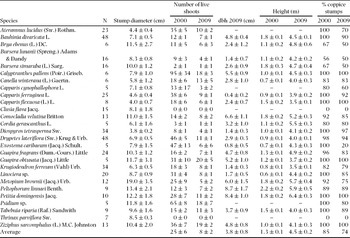
In both 2000 and 2009, a total of 481 stumps, representing 51 species were monitored across all plots. Ten years after cutting, 48 species were recorded with at least one coppice shoot per stump at the time of sampling in 2009. The cut stumps of three species, Thrinax parviflora, Clusia flava and Cassia emarginata, that failed to produce coppice shoots in 2000, had all died. For all of the 27 species represented by more than five individuals, the GLM revealed that the average number of shoots per stump was significantly lower in 2009 compared with 2000 (F = 11.5, df = 1, 26; P < 0.001). An average (±SE) of 25 ± 6 shoots per stump was recorded in 2000, but in 2009, this number was reduced to an average of 8 ± 2 shoots per stump (Table 1). A significant decrease in the number of shoots was recorded for Calyptranthes pallens, which had the highest number of shoots per stump in 2000 (95 ± 34). For this species, only an average of 18 ± 3 shoots per stump was recorded in 2009 (Table 1). In 2009, Guapira obtusata had the highest average number of shoots recorded per stump (20 ± 5), followed by Ziziphus sarcomphalus with 19 ± 2 shoots per stump. The lowest number of shoots recorded in 2000 and 2009 was 2 ± 1 and 1 ± 1 shoots per stump, respectively, for Bursera simaruba (Table 1).
Coppice shoots dynamics of the 27 species represented by ≥5 stems 10 y after cutting in a tropical dry forest in Jamaica. Means for each species are given for the total number of stumps sampled for each species (N). Average stump diameter before cutting, average number of live shoots in 2000 and in 2009, average diameter at breast height of the shoots in 2009 (dbh 2009), and average height of the shoots in 2000 and in 2009, all represented with standard error. The percentage of coppice stumps of each species in 2000 and in 2009 is also shown.
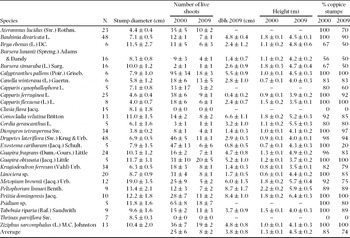
In 2000, 14 mo after cutting, 85% of all the stumps had at least one living shoot, but this proportion declined to 74% in 2009. At the species level, the per cent of individuals with living shoots varied among species in 2000 and in 2009, and there was a significant difference between the years (Paired t24 = 3.91, P = 0.002). Five species maintained 100% of stumps with living coppice shoots, whilst the percentage of stumps with living shoots for Exostema caribaeum decreased considerably from 100% to 20% (Table 1).
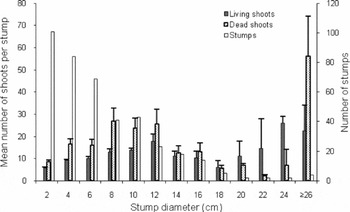
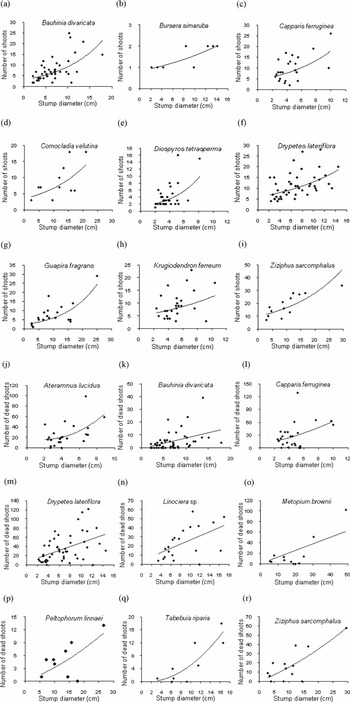
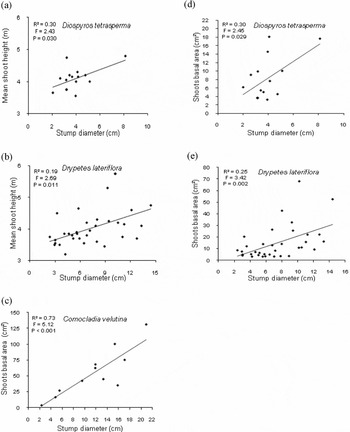
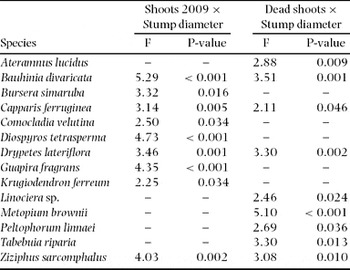
Among all species, sprouting stumps diameter ranged from 2.0 cm for Diospyros tetrasperma to 48.8 cm for Metopium brownii. The diameter distribution of the stumps had the shape of a negative exponential function, where 83% of the sampled stumps had a diameter ≤10 cm, with only 2.5% being ≥18 cm (Figure 1). For the 2-cm size-class intervals between 2 and 18 cm, the number of living and dead shoots recorded across size-classes showed a bell-shape distribution with the number of living and dead coppice shoots increasing with an increase in diameter and declining beyond the 12 cm stump size-class (Figure 1). However, the mean number of living and dead shoots per size-class increased for size-classes ≥20 cm. At the species level, there were significant positive relationships between both stump diameter and the number of living and dead shoots for nine of the 22 species used in the assessment (Table 2, Figure 2). However, only four of nine species showed a significant positive relationship between stump diameter and both the number of living and dead shoots. Two species recorded a significant positive linear relationship between shoot height and stump diameter, and three species showed significant positive linear relationships between shoot basal area and stump diameter (Figure 3). A positive relationship was recorded for Comocladia velutina, where stump diameter explained 73.2% of the shoot basal area variation.
For 481 cut stems, relationship between stump diameter size-classes for the number of stumps (right Y-axis), and mean number of living and dead coppice shoots per stump (+ SE) (left Y-axis) 10 y after cutting in the Hellshire Hills dry forest, Jamaica.

GLMs of stump diameter on the number of living shoots in 2009 for nine tree species (a–i), and the number of dead shoots for nine tree species (j–r) showing a significant relationship 10 y following cutting in a tropical dry forest in Jamaica.

Regression analysis of stump diameter on the mean height (a–b) and the basal area of the leading coppice shoots (c–e) produced by two and three tree species respectively, that showed a significant relationship 10 y following cutting in a tropical dry forest in Jamaica.

Results of the GLMs of stump diameter against the number of living and dead shoots in 2009. Only species ≥5 individuals showing significant relationship are shown.

The growth of coppice shoots
The average height of the leading shoots was significantly different in 2000 (F = 24.3, df = 1, 21; P < 0.001) and in 2009 (F = 8.14, df = 1, 21; P < 0.001) among the species (Table 1). Average height increased significantly between 2000 and 2009 from 1.3 m to 4.5 m. In June 2000, 14 mo after cutting, the species with the tallest leading shoots was Peltophorum linnaei (2.2 ± 0.2 m). Nine years later, the same species recorded the second tallest (5.9 ± 0.5 m) leading shoots whilst Petitia domingensis had the tallest shoots (6.4 ± 0.3 m) (Table 1). Even for Linociera sp., the species that recorded the shortest shoots in 2000 (0.6 ± 0.1 m), its leading shoots were significantly taller in 2009 (4.4 ± 0.2 m). The average dbh of the leading coppice shoots was significantly different among the species in 2009 (F = 5.75, df = 1, 21; P < 0.001). The average dbh recorded of the leading shoots was 3.8 ± 0.8 cm. The species that had the largest dbh was Peltophorum linnaei with 8.7 ± 1.7 cm. This was significantly higher than 20 of the remaining 21 species. Capparis ferruginea was the species that recorded the smallest average diameter of the leading shoots 0.4 ± 0.2 cm (Table 1).
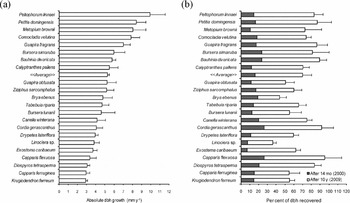
For the 10-y period (1999–2009), the average dbh growth rate of shoots was 5.3 mm y−1 and at the species level, dbh growth rates of shoots ranged from 2.9 mm y−1 for Krugiodendron ferreum to 9.9 mm y−1 for Peltophorum linnaei (Figure 4a). In general, species with a higher absolute dbh growth of coppice shoots also recorded a higher percentage of dbh recovered (Figure 4b). The average per cent of dbh recovered 14 mo and 10 y after cutting was 16% and 70%, respectively, for all species. Ten years following cutting, the species showed a significant difference for the percentage of diameter recovered (F = 2.29, df = 1, 21; P = 0.02). In 2009, the highest percentage of dbh recovered was recorded for Capparis flexuosa, which had recovered an average of 95%. Cordia gerascanthus and Bauhinia divaricata followed with 92% and 89% of dbh recovered. For some individuals of three species, Capparis flexuosa, Cordia gerascanthus and Petitia domingensis the percentage of dbh recovered was greater than 100%. This was due to the ability of small stems (2–4 cm dbh) to recover their initial dbh faster than larger stems 10 y after cutting. The lowest dbh recovered 14 mo and 10 y after disturbance was recorded for Linociera sp., with 7% and 36% of dbh recovered, respectively.
For 22 species represented by five or more stumps, absolute dbh growth rates for the coppice shoots for the period 1999–2009 (a) and average percentage of dbh recovered 14 mo and 10 y after cutting in a tropical dry forest in Jamaica (+SE) (b). For dbh growth rates, it was assumed that all shoots resprouted just after cutting and reached breast height within a few months. Per cent of dbh recovered was based on the dbh of the stems before cutting. Species were ranked from highest to lowest dbh growth rates.

DISCUSSION
Coppice shoot dynamics
Our results indicate that stumps produced a high number of coppice shoots in the months following cutting, but shoot number decreased significantly over time. One possible explanation why stumps produce multiple coppice shoots rapidly after cutting is to supply carbohydrates to nourish the large volume of respiring roots and to restore carbohydrate reserves invested in the production of shoots. A large number of small coppice shoots collectively, will record a higher total girth and consequently a larger leaf area than a few large shoots since stem girth scales positively with leaf area. It is assumed that root biomass (below-ground carbohydrate reserve) scales positively with stem biomass (Enquist & Niklas Reference ENQUIST and NIKLAS2002), and this scaling relationship might be even higher in tropical dry forests where approximately 50% of total tree biomass occurs below ground (Murphy & Lugo Reference MURPHY and LUGO1986b). If this is true, large stumps are expected to produce a larger number of shoots than small diameter stumps, and a large number of shoots per stump would yield a higher shoot basal area. Large stumps should also produce taller shoots. Our results partially support these hypotheses. We found that when data for all species were pooled the number of living and dead shoots were significantly higher for stumps with a diameter ranging from 8 to 12 cm and also for stumps larger than 20 cm. However, at the species level, only nine of the 22 species analysed recorded an increase in the number of shoots with increasing stump diameter. Similarly, shoot basal area and shoot height increased with stump size for three and two species, respectively. These results indicate that for some species, factors other than stump diameter may have contributed to their resprouting potential and the size of the shoots. Crown position and vigour before cutting, microsite and genetic differences between trees and species were highlighted as possible factors affecting the degree of resprouting (Weigel & Peng Reference WEIGEL and PENG2002). Usually, there is a trade-off between storage and growth when trees are allocating resources and this varies among species (Chapin et al. Reference CHAPIN, SCHULZE and MOONEY1990). Consequently, resprouting is more successful for some species or trees that have larger reserves to support regrowth (Bond & Midgley Reference BOND and MIDGLEY2001, Knox & Clarke Reference KNOX and CLARKE2005). Indeed, it is assumed that the effectiveness of resprouting varies according to the age of the tree at the time of cutting (Luoga et al. Reference LUOGA, WITKOWSKI and BALKWILL2004, Weigel & Peng Reference WEIGEL and PENG2002). For instance, some studies reported that many tree species sprout as juveniles and then lose their ability to sprout as adults (Bellingham & Sparrow Reference BELLINGHAM and SPARROW2000, Bond & Midgley Reference BOND and MIDGLEY2001, Reference BOND and MIDGLEY2003; Del Tredici Reference DEL TREDICI2001). However, this was not the case here because there was also a tendency for larger stumps ≥20 cm (mature trees) to have a high number of shoots. Similar results were found in a semi-deciduous tropical rain forest in Uganda by Mwavu & Witkowski (Reference MWAVU and WITKOWSKI2008). They found that stump diameter was a significant positive predictor of resprouting ability when the species data were pooled, but this relationship was only found in five species at the species level, indicating a species-specific relationship between resprouting intensity and stump diameter.
The number of living shoots per stump decreased over time for all species, and there was a positive relationship between shoot mortality and the number of shoots per stump. The reduction in shoot number over time may be explained by the intense competition for resources among clumped coppice shoots, and the development of competitive dominance (Vandermeer et al. Reference VANDERMEER, BOUCHER, PERFECTO and DE LA CERDA1996) which results in natural thinning. The larger, more dominant and vigorous shoots were more likely to survive than the shoots that were smaller in diameter (<1 cm root collar diameter) (pers. obs.). A possible explanation is that when root carbohydrate reserves are restored, the self-thinning of less vigorous shoots would allow the remobilization of the resources to the most vigorous shoots to reoccupy the dominance of the tree in the canopy. Therefore, if the number of shoots increases with stump diameter and a high number of shoots increases competition for limited resources, over time, shoot mortality will be higher for larger stumps, as reported here. A similar decrease in the number of shoots over time has been reported for other tropical dry forests. In a study of post-hurricane sprouting in Guanica forest in Puerto Rico, Van Bloem et al. (Reference VAN BLOEM, MURPHY and LUGO2007) found that the mean number of shoots per stem decreased from 12.3 in January 1999 to 5.8 in March 2005. They also noted that the percentage of stems with at least one surviving shoot had decreased from 34% to 18% in 7 y. In a slash-and-burn experiment in a tropical dry forest in Mexico, Miller (Reference MILLER1999) recorded a reduction in average (±SE) shoot production over time from 11 ± 1 shoots per stump 3 mo after the application of treatments; this number had decreased to 8 ± 0.3 shoots per stump 1 y later. These observations are consistent with our results.
Resilience of the tree species
Fourteen months after disturbance, the average growth rate for height and diameter of the leading shoots were 1.07 m y−1 and 0.85 cm y−1, respectively. Ten years following cutting, an average growth rate of 0.45 m y−1 for height and 0.38 cm y−1 for diameter were recorded. High early growth rates of coppice shoots allow individual trees to quickly reoccupy their own gap (Bond & Midgley Reference BOND and MIDGLEY2001) by maximizing their occupancy rate at the site (Bellingham & Sparrow Reference BELLINGHAM and SPARROW2000) using the existing below-ground carbohydrate reserves and the support of the already established roots to capture water and nutrients (Van Bloem et al. Reference VAN BLOEM, MURPHY and LUGO2007). Later, a reduction in the growth rates of shoots is expected because the production of a flush of shoots following cutting depletes the below-ground storage considerably.
In this study, moderate intensity disturbance, that is, tree cutting with stumps and roots remaining in place, promote and favour resprouting, and the long-term persistence and resilience of established trees. Ten years after cutting, 48 of 51 species exhibited a capacity to survive by means of coppicing and 74% of stems survived in this way. It has been postulated that resprouting reduces seedling recruitment opportunities in both space and time affecting potentially the forest diversity (Bond & Midgley Reference BOND and MIDGLEY2001, Tanner & Bellingham Reference TANNER and BELLINGHAM2006). In our study, three species (Cassia emarginata, Clusia flava and Thrinax parviflora) failed to produce coppice shoots, and experienced a 100% mortality of cut stems. Clusia flava, a hemi-cryptophyte, and T. parviflora, a monocotyledon, are both incapable of producing coppice shoots and the small sample size of C. emarginata (3) may not have been enough to determine the species' ability to coppice. Nevertheless, to ensure the long-term persistence of some species solely dependent on reproduction by seeds, adequate microclimatic conditions will be necessary to ensure their establishment success (McLaren & McDonald Reference MCLAREN and MCDONALD2003c). In this sense, coppicing can allow the amelioration of microsite conditions by recovering a fraction of a canopy lost and provide a facilitative environment in which seedlings can successfully establish and eventually reach the canopy, but this remains to be tested. In addition, it is expected that repeated disturbance events could reduce the ability of some species to produce a second flush of coppice shoots thus affecting the resilience of this dry forest. Yet, very little is known about the effects of repeated cutting or disturbance on shoot production and stump mortality, so future research should address these questions.
ACKNOWLEDGEMENTS
This work would not have been possible without the support of the Department of Life Sciences at the University of the West Indies and the School of Environment, Natural Resources and Geography at Bangor University. The senior author was supported by the SUTROFOR Commission and the European Union through the Erasmus Mundus scholarship during this study, their financial assistance is gratefully acknowledged. The Peter Henry Forestry Postgraduate Award provided funds during the field work in Jamaica. We thank Dr James Gibbons for statistical advice and an anonymous reviewer for valuable comments on an earlier draft.