Introduction
It is estimated that 84% of people aged 65 and above have one or more chronic medical illness (Hoffman et al., Reference Hoffman, Rice and Sung1996). The most common chronic medical illnesses associated with old age are cerebrovascular diseases, heart diseases, arthritis, and cataract, though considerable variability exist in the general population (Patten et al., Reference Patten2005). Chronic physical diseases have high comorbidity (co-occurrence) with mental disorders (Ortega et al., Reference Ortega, Feldman, Canino, Steinman and Alegría2006). Major depression and depressive symptoms affect between 5% and 10% of the elderly in the outpatient setting (Harpole et al., Reference Harpole2005).
It is well-known that chronic medical conditions result in impaired physical functioning and reduced quality of life. According to the Medical Outcomes Study, those with diabetes, myocardial infarction, congestive heart failure, chronic lung problems, arthritis, back problems, gastrointestinal disorders, and angina showed significantly worse physical, role and social functioning with poorer health perception compared to those without these conditions (Stewart et al., Reference Stewart1989). In particular, gastrointestinal conditions, cerebrovascular conditions, renal diseases, and musculoskeletal conditions contribute to poorer quality of life as compared to other conditions (Sprangers et al., Reference Sprangers2000).
Depression is a principal leading cause of disability-adjusted life years lost and is associated with increased healthcare utilization in the elderly (Golden et al., Reference Golden2008; Penninx et al., Reference Penninx, Leveille, Ferrucci, van Eijk and Guralnik1999). In a longitudinal study, depressed older persons had increased risks of disability in activities of daily living (67%) and mobility (73%) at the end of 6 years, irrespective of their chronic medical conditions at baseline (Penninx et al., Reference Penninx, Leveille, Ferrucci, van Eijk and Guralnik1999). An increase in the number of depressive symptoms is also associated with increased mortality, suggesting a dose-response relationship (Whooley and Browner, Reference Whooley and Browner1998). The severity of depressive symptoms is inversely related to patients’ health-related quality of life even after controlling for age, gender, and medical comorbidities (Unützer et al., Reference Unützer2000; Pyne et al., Reference Pyne1997). Effective treatment of depression on the other hand improves functional outcomes (Coulehan et al., Reference Coulehan, Schulberg, Block, Madonia and Rodriguez1997).
The nature of the combined impact of both physical and mental disorders on functional well-being and quality of life in an aging population is not well delineated, and may be described by additive and interactive models of comorbidity (Schettini Evans and Frank, Reference Evans and Frank2004). An additive model suggests that the individual components of comorbid disorders have independent effects on functioning and the combined effect is approximately equal to the sum of the parts. On the other hand, an interactive model suggests that multiple comorbidities may be associated with significantly greater levels of functional outcomes than the summed effect of each individual disorder, as the presence of one disorder may alter the association of another disorder.
Some studies have reported that the combined negative effects of mental disorders and chronic medical conditions on functioning are additive in nature (Buist-Bouwman et al., Reference Buist-Bouwman, de Graaf, Vollebergh and Ormel2005; Wells et al., Reference Wells1989), while others have found that the combined effects are interactive and nonadditive (Lim et al., Reference Lim, Jin and Ng2012; Scott et al., Reference Scott2009). These studies have mainly focused on the effects of individual chronic medical disorders with mental conditions not limited to solely depression. Furthermore, the populations surveyed in these studies were of relatively younger age at 20–59 years old (Lim et al., Reference Lim, Jin and Ng2012) and had lesser Asian representation that comprised of people from only Japan and several parts of China out of a total of 17 countries surveyed (Scott et al., Reference Scott2009).
In this population-based prospective cohort study with 2-year follow up of older persons, we investigated whether the presence of depression and medical comorbidity was independently associated with poorer functional and/or quality of life outcomes, and whether their combined presence had a multiplicative (nonadditive) association with function and/or quality of life outcomes.
Method
Study population
This study was based on baseline and follow up data collected from the first wave cohort (SLAS-1, N = 2805) of participants who were older adults aged 55 or above, who were recruited from door-to-door census in South East region of Singapore between 2003 and 2004, and followed up at 2 years after baseline interviews. Details of the SLAS study design, population sampling and measurements have been described in previous publications. (Niti et al., Reference Niti, Yap, Kua, Tan and Ng2008) Residents who were physically or mentally incapacitated, such as those suffering from terminal illnesses, aphasia from stroke, and profound dementia were excluded. The study was approved by the National University of Singapore Institutional Review Board and all participants provided written informed consent. Trained interviewers conducted the interviews in the language or dialect that the respondents were most conversant in.
Baseline data
Socio-demographic characteristics included age, gender, ethnicity, education, marital status, living arrangement (as surrogate of socio-emotional support), and housing type and size (as surrogate of income and socio-economic status).
Chronic medical illnesses. Baseline data on chronic medical illnesses within the past 1-year was based on questions asked by the trained interviewer: “Have you been told by the doctor that you had any of the following medical conditions?” The list of medical conditions included hypertension, diabetes, dyslipidaemia, ischemic heart diseases, heart failure, asthma, chronic obstructive pulmonary disease, stroke, gastric problems, thyroid problems, arthritis, and major eye problems (cataract and glaucoma). Chronic medical conditions reported were further corroborated with related reports of surgical operations or procedures, and physical identification of medications that they took for their illnesses. Comorbidity was defined as the co-occurrence of two or more medical disorders.
Depressive symptoms. The presence of depressive symptoms in the past week was assessed using the locally validated English, Chinese, and Malay versions (Nyunt et al., Reference Nyunt, Jin, Fones and Ng2009) of the 15-item Geriatric Depression Scale (GDS) (Yesavage, Reference Yesavage1998). The total score was based on counting the responses that were in yes/no format and it ranged from 0 (no depressive symptoms) to 15 (severe depressive symptoms), with scores of 5 or more indicating the presence of depression. GDS is an appropriate scale to use in this study, as it is relatively free of measurement artifact due to overlapping somatic symptoms of physical illness and depression. The translated versions of GDS have been found to have good reliability (coefficient of 0.90), sensitivity (96.3%) and specificity (87.5%) for assessing late-life depression in community-living older Asian adults (Lim et al., Reference Lim2000; Nyunt et al., Reference Nyunt, Jin, Fones and Ng2009).
Cognitive functioning was measured using the modified Mini-Mental State Examination (MMSE) (Folstein et al., Reference Folstein, Folstein and McHugh1975), which has been validated in the local population with high sensitivity and specificity in identifying dementia (Ng et al., Reference Ng, Niti, Chiam and Kua2007) Respondents with MMSE score of 23 or less were classified as cognitively impaired.
Outcome measures
Functional disability, quality of life, and hospitalization were measured at baseline and at follow-up.
Physical functioning This was assessed by the respondent's level of dependency in performing basic activities of daily living (BADL) (Mahoney and Barthel, Reference Mahoney and Barthel1965) and instrumental activities of daily living (IADL) (Lawton and Brody, Reference Lawton and Brody1969). Functional disability was defined as needing at least some personal assistance in at least one task, and was divided into two categories (IAD-BADL disability versus none). Good construct validity for the basic and instrumental ADL scales were previously demonstrated (Ng et al., Reference Ng, Niti, Chiam and Kua2006; Niti et al., Reference Niti, Ng, Chiam and Kua2007).
Quality of life This was measured using the Medical Outcomes Study 12-item Short Form (SF-12) (Ware et al., Reference Ware, Kosinski and Keller1998), which comprised of two subscales: the Mental Component Summary (MCS) and the Physical Component Summary (PCS) measuring mental and physical health functioning, respectively. The scores were computed using the weighted summed scores from the 12 questions, and ranged in values from 0 to 100, with 0 score indicating the lowest level of functioning and 100 score indicating the highest possible level of functioning. The scores of SF-12 were measured at baseline and at 1 year later.
Hospitalization. Participants were asked whether they were hospitalized and the number of hospitalizations in the previous 1 year at baseline and follow-up interviews.
From among 1,850 participants who were reinterviewed at 2-year follow-up visit, and after excluding 6 participants with missing data on depression, the present study included 1,844 participants with complete data for hospitalization and IADL-BADL outcomes. The analytical sample for PCS and MCS quality of life measures was based on 1,822 participants with complete data at baseline, and 1,788 participants with complete data at follow up. Compared to the participants in the study, those who were excluded were significantly (p < 0.05) more likely to be male, lived in lower end public housing apartments, and showed a higher rate of cognitive impairment and depressive symptoms.
Statistical analysis
The baseline covariates and outcome variables were compared between depressed and nondepressed participants by t test or Wilcoxon rank-sum tests for continuous variables or by Chi-square test for categorical variables. Hospitalization and functional disabilities at baseline and follow up were analysed as binary variables, and PCS and MCS measures of quality of life at baseline and follow up were analysed as continuous variables. Multiple logistic and linear regression analyses were performed to examine the main and interactive effects of medical comorbidities and depression on binary and continuous outcome variables. Adjustment covariates in the models included age, gender, education, ethnicity, marital status, housing type, living arrangement, cognitive impairment, and their corresponding baseline outcome measurements (in longitudinal analyses). Main effects (omitting interaction term from the model) in the whole sample for all the outcomes were reported as odds ratio (OR) and 95% confidence interval (CI) for binary outcomes, and regression coefficients and their standard errors (SE) for continuous outcomes. When there was a significant interaction effect of medical comorbidity and depression, OR and corresponding 95% CI of association of medical comorbidity and outcomes were estimated separately for strata of depressed and nondepressed participants, least square means for continuous outcomes based on depression and medical comorbidity subgroups. Bonferroni correction was used to control type I error due to multiple comparison. The family-wise error rate (overall significance level) was controlled at 0.05 for two-sided test, and all analysis was performed with SAS 9.2 (SAS Institute, Inc., Cary, NC).
Results
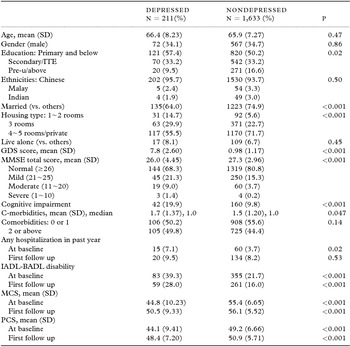
Among the total of 1,844 respondents in the survey, 11.4% had a GDS score of 5 or more, and they were classified as depressed. Subjects in both depressed and nondepressed groups had a mean age of greater than 65 and the majority was female. Significantly more individuals in the depressed group were unmarried and living in lower cost housing (p < 0.001), and significantly more had cognitive impairment (19.9% vs. 9.8%, p < 0.001), compared to the nondepressed group. The principal comorbid medical conditions were hypertension (N = 1,015, 55.4%), eye diseases (N = 526, 28.5%), diabetes (N = 308, 16.7%), and arthritis (N = 249, 13.5%). The proportion of individuals with two or more medical comorbidities were not significantly different in the two groups (p = 0.14). However, a greater proportion of those depressed had at least one hospitalization within the past year at baseline (7.1% vs. 3.7%, p = 0.02). Depressed individuals had significantly more BADL and IADL disability and lower MCS and PCS measures of quality of life at baseline and on follow-up (all p values <0.001) (Table 1).
Baseline characteristics of the study population by depressive status (n = 1,844)

Note: SD, standard deviation; GDS, geriatric depression scale; MMSE, mini-mental state examination; ADL, activities of daily living; IADL, instrumental activities of daily living; MCS, mental component score of SF-12; PCS, physical component score of SF-12.
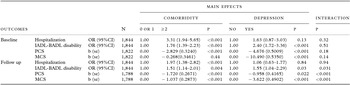
Table 2 shows the associations of medical comorbidities and depression with health outcomes. In main effect analyses of cross-sectional and longitudinal data, both medical comorbidity and depression were independently associated with greater odds of IADL-BADL disability, and lower PCS and MCS scores at baseline and at follow up (Table 2). The estimates of the OR and regression coefficients of association with IADL-BADL disability and PCS and MCS measures of quality of life were larger for depression than for medical comorbidity. For hospitalization, medical comorbidity but not depression was associated with greater odds of hospitalizations at baseline (OR 3.31; 95% CI: 1.94–5.65) and on follow-up (OR 1.97; 95% CI: 1.38–2.82).
Cross-sectional and longitudinal analyses of main and interactive effects: associations of comorbidity and depression with functional and quality of life outcomes

Note: Covariates adjusted in the models included: age, gender, education, ethnicity, marital status, housing type, living alone, cognitive impairment, and corresponding baseline outcome measurement (for follow-up analysis only).
OR (95%CI): odds ratio (95% confidence interval); b(se): regression coefficient (standard error); ADL: activities of daily living; IADL: instrumental activities of daily living; MCS: mental component score of SF-12; PCS: physical component score of SF-12.
Significant interactions of medical comorbidity and depression were observed in longitudinal analyses of relationships with IADL-BADL disability (p = 0.03), PCS (p < 0.01), and MCS (p < 0.01) quality of life scores at follow up. Whereas medical comorbidity was associated with 1.3 times increased odds of IADL-BADL disability among nondepressed individuals, it was associated with 3.3 times increased odds of IADL-BADL disability among depressed individuals. Correspondingly, there was an approximately 1 point (1%–2%) decrease in PCS and MCS scores among nondepressed individuals, but an approximately 5 point (9.5%) decrease in PCS and MCS among depressed individuals (Table 3).
Longitudinal analyses of significant interactive effects of medical comorbidity and depression (baseline) on ADL disability and PCS and MCS scores of SF12 quality of life (follow up)

Covariates adjusted in the models included: age, gender, education, ethnicity, marital status, housing type, living alone, cognitive impairment, and corresponding baseline outcome measurement (for follow-up analysis only).
OR (95%CI): odds ratio (95% confidence interval); SE: standard error; MCS: mental component score of SF-12; PCS: physical component score of SF-12; ADL: activities of daily living.
¶ Bonferroni correction was used for comparison between different subgroups.
Discussion
The prevalence of depressive symptoms in our study population was 11.4%, slightly lower than that of Chinese elderly reported elsewhere using the same screening instrument in Hong Kong (12.5%) (Chi et al., Reference Chi2005) and Taiwan (20.1%) (Chiu et al., Reference Chiu, Chen, Huang and Mau2005). Depressed elderly were more likely to be widowed, divorced or separated, living alone, and staying in lower end housing suggesting lower socio-economic status and lesser social support which are likely to contribute to poorer health outcomes. Our analyses, however, adjusted for the possible confounding effects of age, gender, education, ethnicity, marital status, housing type, living alone, and cognitive impairment.
Associations between depression and medical comorbidities on health outcomes
As expected, both depression and physical illnesses were shown to impact negatively on activities of daily living ability and quality of life. Our OR and regression coefficient estimates further indicated that depressive symptoms, compared to physical comorbidities, was associated with relatively greater negative impact on functional disabilities and quality of life. This is consistent with published reports that depression is currently the leading cause of disability in developed countries (Wells et al., Reference Wells, Strom, Sherbourne and Meredith1996) and the fourth leading cause of disability worldwide (Murray and Lopez, Reference Murray and Lopez1997), contributing to almost 12% of all total years lived with disability globally (Ustün et al., Reference Unützer2000). Depression not only impairs one's cognition, motivation, and emotional regulation, but also amplifies physical symptoms such as pain and lethargy (VonKorff, Reference VonKorff, Tansella and Thomicroft1999; Ormel et al., Reference Ormel1994), thereby resulting in more disability than physical comorbidity alone. Several prospective studies have reported depression to be a risk factor for the development of functional disability (Ormel and Vonkorff, Reference Ormel and VonKorff2000; Ormel et al., Reference Ormel1999) and effective treatment of depression improved physical functional outcomes (Tiemens et al., Reference Tiemens1999). Furthermore, depression was found to be associated with the lowering of both MCS and PCS scores on the SF-12 measure of quality of life. Given the interdependent and reciprocal relationship between physical and mental health, depression could reduce one's psychological capacity to tolerate illness and alters one's perception of physical health (Taft et al., Reference Taft, Karlsson and Sullivan2001).
While the independent effects of depression and medical comorbidity are expected, our study is important in showing the multiplicative (nonadditive) effects of coexisting depression and medical comorbidity on functional disability and quality of life impairment. We observed that depression appeared to multiply several folds the adverse effect of medical comorbidity on functional disability and quality of life. This is consistent with published reports that depression increases the level of healthcare utilization and economic burden in the presence of comorbidities. (Hunkeler et al., Reference Hunkeler, Spector, Fireman, Rice and Weisner2003; Katon et al., Reference Katon2003).
Various mechanisms have been proposed to explain how the co-occurrence of both physical and mental conditions could have more deleterious effects on disability and quality of life than either alone. One possible mechanism is the bidirectional relationship between chronic physical illnesses and depression (Kiecolt-Glaser et al., Reference Kiecolt-Glaser, McGuire, Robles and Glaser2002). Deteriorating health can lead to huge emotional distress and precipitate depression (Golden et al., Reference Golden2008). Conversely, depression can affect and worsen physical disease progression directly through biological mechanisms such as inflammation and cardiovascular response to stress, or indirectly through poor compliance to treatment regime and engagement in unhealthy habits (Penninx et al., Reference Penninx, Leveille, Ferrucci, van Eijk and Guralnik1999). Furthermore, depression can impair the ability to adjust to physical conditions (Sharpe and Curran, Reference Sharpe and Curran2006) and affect the perception and tolerability to pain (Campbell et al., Reference Campbell, Clauw and Keefe2003), thereby leading to a reduction in functionality and quality of life. A second possible mechanism is that both conditions have common underlying physiological pathways such as those involving the neuroendocrine system (hypothalamic-pituitary-adrenocortical axis) and autonomic system (sympathetic-adrenal-medullary axis). Malfunction of these systems leads to increased levels of glucocorticoids and catecholamines that have been found to be associated with depression (Goodyer, Reference Goodyer and Steptoe2007) and a range of medical conditions mediated by cardiovascular, metabolic, and immune systems (Chrousos and Kino, Reference Chrousos and Kino2007; Cohen et al., Reference Cohen, Janicki-Deverts and Miller2007; McEwen, Reference McEwen1998).
The findings from our study have important clinical ramifications on the treatment and management of individuals with both physical and mental illnesses, given that their co-occurrence predicts poorer health outcomes and greater requirements for resources and monitoring to prevent disability. Depression is often poorly recognized and receives suboptimal treatment in the primary setting (Unützer et al., Reference Unützer2000). Some medical practitioners might view mental illness as an understandable consequence of physical disorders and thus would not require specific treatment, or that mental illness would automatically recover when physical conditions get better. Thus, when faced with the need to treat multiple chronic medical illnesses, they often overlook or allocate less priority for depression treatment (Williams et al., Reference Williams1999). Our study showed that depression is closely related to disability and poor quality of life, and importantly, the co-occurrence of physical comorbidities and depression amplifies this effect negatively. It is essential to recognize this association as depression can be cured if treatment is timely, unlike many chronic physical illnesses that are often managed only to prevent deterioration. The adequate treatment of depression could lead to significant improvement in daily functioning, better quality of life, and reduction in healthcare cost and burden. For these reasons, comorbid conditions that exert synergistic effects should have special treatments designed and targeted to particular comorbidity to reduce their combined disease burden, whereas conditions that have additive effects would require concurrent individual treatments targeted at each condition. (Schettini Evans and Frank, Reference Evans and Frank2004) A fundamental step, however, is to get physicians to appreciate the deleterious effects of mental illness on the global health of patients, especially in the context of multiple physical comorbidities, and to initiate early treatment for both groups of conditions.
Strengths and weaknesses. To our knowledge, this study is unique in clearly demonstrating the multiplicative effects of comorbid depressive symptoms and chronic physical illnesses on functional well-being and quality of life in an elderly population. The study has strengths in a large population sample and adequately controlled for important confounders.
There are, however, some limitations in this study. The GDS is used to detect depressive symptoms rather than diagnose major depressive disorder. In addition, the presence of chronic physical conditions relied solely on self-reports of respondents and there were no verifications by physicians or hospital records. This could possibly lead to underestimation of the prevalence of chronic physical illnesses due to recall problems. Nevertheless, self-report of most chronic illnesses in large population health surveys have been shown to be valid and acceptable for research (Centre for disease control and prevention, 2009). Our study did not have information on the chronicity and severity of depressive symptoms and physical comorbidities, which could potentially influence the strength and direction of the associations. Other factors that could influence functional well-being and quality of life such as degree of rehabilitation, coping skills, emotional, and social support were not addressed in this study. Future studies could investigate how these factors could modify the impact of mental-physical comorbidities to optimize health outcomes.
Conclusion
Depression among older persons was associated with relatively worse daily activity functioning and quality of life than medical comorbidity, and together, they predicted much worse functional disability and quality of life impairment than either alone. These findings have important implications on healthcare utilization and cost. Physicians need to accord equal priority to both mental and physical conditions, recognize depressive symptoms early and execute timely interventions to prevent and treat medical comorbidities.
Conflict of interest
This study was supported by a grant (No. 03/1/21/17/214) from the Biomedical Research Council, Agency for Science, Technology and Research (A*STAR), Singapore.
Description of authors’ roles
CSH Ho wrote the paper. L Feng was responsible for the statistical design of the study and for carrying out the statistical analysis. J Fam, R Mahendran, and EH Kua revised and assisted with writing of the paper. TP Ng designed the study, supervised the data collection, responsible for the statistical design and analysis of data, and revised the paper.
Acknowledgments
We thank the following voluntary welfare organizations for their support of the Singapore Longitudinal Ageing Studies: Geylang East Home for the Aged, Presbyterian Community Services, Thye Hua Kwan Moral Society (Moral Neighbourhood Links), Yuhua Neighbourhood Link, Henderson Senior Citizens’ Home, NTUC Eldercare Co-op Ltd, Thong Kheng Seniors Activity Centre (Queenstown Centre), and Redhill Moral Seniors Activity Centre.