

The effect of a relationship separation on the wellbeing of an individual is substantial, with emotional, psychological, and physical health affected (Chung et al., Reference Chung, Farmer, Grant, Newton, Payne, Perry and Stone2003). The negative consequences of divorce are well established, with research indicating that the psychological responses to the stress associated with separation may actually alter individual physiology (Hasselmo, Sbarra, O'Connor, & Moreno, Reference Hasselmo, Sbarra, O'Connor and Moreno2015) and increase the risk for all-cause mortality (Sbarra, Law, & Portley, Reference Sbarra, Law and Portley2011). However, non-marital cohabitation dissolution can be just as distressing (Tavares & Aassve, Reference Tavares and Aassve2013; Wu & Hart, Reference Wu and Hart2002), with evidence that cohabitors have higher risks of union dissolution than people who married without prior cohabitation (Liefbroer & Dourleijn, Reference Liefbroer and Dourleijn2006) and are more prone to experience relationship churning (relationships that end and renew; Vennum, Lindstrom, Monk, & Adams, Reference Vennum, Lindstrom, Monk and Adams2014).
As family structures continue to shift and traditional relationship definitions are no longer the norm, research exploring the negative effects of non-marital relationship separation warrants further investigation. Romantic relationships feature as a cyclical experience for many individuals as they progress through various stages of their lives, with up to 85% of individuals experiencing at least one intimate partner relationship separation in their lifetime (Morris, Reiber, & Roman, Reference Morris, Reiber and Roman2015). Increased psychological distress and a decline in life satisfaction are associated with a non-marital separation, with cohabitation and plans for marriage associated with even larger declines in life satisfaction (Rhoades, Kamp Dush, Atkins, Stanley, & Markman, Reference Rhoades, Kamp Dush, Atkins, Stanley and Markman2011). Further, relationship instability is reportedly 25% higher for cohabitors compared to reports by married couples (Brown, Reference Brown2000), with non-marital couples who engage in cyclical dating experiencing a greater chance of permanent separation, uncertainty, and lower satisfaction (Vennum et al., Reference Vennum, Lindstrom, Monk and Adams2014). The breakup of dating relationships has also been found to be associated with increased substance use (Fleming, White, & Catalano, Reference Fleming, White and Catalano2010), with insecurely attached young adults reporting significantly higher anxiety, depression, and loss of behavioural and/or emotional control and affect following a relationship breakup (Gilbert & Sifers, Reference Gilbert and Sifers2011).
The distinction between separation and divorce interventions relies on the area of service provision — primarily conciliation, mediation, or post-divorce adjustment — and the three major foci: adult-focused, child-focused, and family-focused treatment (Lee, Picard, & Blain, Reference Lee, Picard and Blain1994). A limited number of reviews have been conducted that explore the efficacy of interventions for adults experiencing relationship separation. The primary focus of these reviews has been on divorce adjustment interventions (adult and child-focused), with all of the reviews finding consistent methodological issues, including small sample sizes, inadequate study design, and a lack of standardised treatments (Lee et al., Reference Lee, Picard and Blain1994; Sprenkle & Storm, Reference Sprenkle and Storm1983; Strouse & Roehrle, Reference Strouse and Roehrle2011; Zimpfer, Reference Zimpfer1990). Further, many of the reviewed studies only focused on divorce, with fewer studies examining cohabitation dissolution and fewer still investigating the effects of separation from dating relationships.
A large proportion of separation studies have explored mediatory divorce processes, with traditional mediation services having been found to be an effective intervention for separating couples (Emery, Sbarra, & Grover, Reference Emery, Sbarra and Grover2005). Integrative approaches such as the Conjoint Mediation and Therapy (CoMeT) model have demonstrated initial support for parents engaged in high-conflict separations (Jacobs & Jaffe, Reference Jacobs and Jaffe2010), and online e-mediated services have reported increased agreement rates and benefits for females (Bollen, Verbeke, & Euwema, Reference Bollen, Verbeke and Euwema2014). However, from a mental health and adjustment perspective, interventions focusing on community-based groups, forgiveness approaches, and expressive writing interventions have been found to be more widely used to impact overall adult adjustment. Forgiveness as a therapeutic post-separation intervention has gained momentum with studies exploring post-divorce dynamics, including divorce adjustment (Rohde-Brown & Rudestam, Reference Rohde-Brown and Rudestam2011; Rye, Folck, Heim, Olszewski, & Traina, Reference Rye, Folck, Heim, Olszewski and Traina2004; Yárnoz-Yaben, Reference Yárnoz-Yaben2015), mental health (Rye et al., Reference Rye, Folck, Heim, Olszewski and Traina2004), attachment style (Yárnoz Yaben, Reference Yárnoz Yaben2009), religiosity (Rye et al., Reference Rye, Pargament, Pan, Yingling, Shogren and Ito2005), and co-parental relationship quality (Bonach & Sales, Reference Bonach and Sales2002). The integration of expressive writing strategies and forgiveness after divorce has also been shown to improve mental health outcomes and facilitate both dispositional and situational forgiveness (Rye et al., Reference Rye, Fleri, Moore, Worthington, Wade, Sandage and Cook2012). Expressive writing studies following separation have explored the impact of writing on physical health (Lepore & Greenberg, Reference Lepore and Greenberg2002), and the influence of the type of writing task (Primeau, Servaty-Seib, & Enersen, Reference Primeau, Servaty-Seib and Enersen2013). Although Sbarra, Boals, Mason, Larson, and Mehl (Reference Sbarra, Boals, Mason, Larson and Mehl2013) reported that expressive writing may be iatrogenic for highly ruminative individuals and those engaged in an active search for meaning concerning their separation, evidence has suggested that writing techniques, when targeted correctly, can have a positive effect on separation adjustment (Primeau et al., Reference Primeau, Servaty-Seib and Enersen2013; Sbarra et al., Reference Sbarra, Boals, Mason, Larson and Mehl2013).
No systematic review exists that examines interventions for a non-marital relationship separation, or that focuses specifically on mental health outcomes. Given the impact of separation on mental health and societal prevalence, the area warrants further investigation. Furthermore, the elevated level of risk, including increased suicidality associated with separation (Batterham et al., Reference Batterham, Fairweather-Schmidt, Butterworth, Calear, Mackinnon and Christensen2014; Heikkinen, Aro, & Lönnqvist, Reference Heikkinen, Aro and Lönnqvist1992a, Reference Heikkinen, Aro and Lönnqvist1992b), suggests a pressing need to develop appropriate therapeutic interventions for individuals experiencing a relationship separation. Relationship separations differ from other distressing events in that most people will be exposed to a number of different romantic relationships and subsequent breakups over a lifetime (Tashiro & Frazier, Reference Tashiro and Frazier2003). It is important to acknowledge that a separation may also be an opportunity for personal growth and benefit finding, with the experience potentially improving the quality of future romantic relationships (Samios, Henson, & Simpson, Reference Samios, Henson and Simpson2014; Tashiro & Frazier, Reference Tashiro and Frazier2003). Also, as relationship separations may be perceived as a valid impetus for seeking help through more formalised support channels, understanding the support mechanisms assisting positive adjustment following separation has important clinical implications.
The aim of the current review, therefore, was to identify and describe existing interventions targeting the mental health of individuals who have experienced a non-marital relationship separation. The current review builds upon the information garnered from the divorce intervention meta-analysis conducted by Strouse and Roehrle (Reference Strouse and Roehrle2011) by focusing on non-marital relationship separation, specifically post-breakup, due to temporal risk factors associated with this time period (Batterham et al., Reference Batterham, Fairweather-Schmidt, Butterworth, Calear, Mackinnon and Christensen2014). For the purposes of this review, a non-marital relationship is defined as an interpersonal relationship between unmarried, heterosexual or same-sex partners current and former that involves emotional and physical intimacy. Relationship separation is defined as the mutual cessation of an intimate partner relationship by any means other than death. The focus centres on romantic/dating relationships (generally categorised as boyfriend/girlfriend relationships) and cohabiting relationships.
Method
Search and Screening Procedures
A systematic review of the literature was conducted to identify published studies. The Ovid database was electronically searched with one or more of the following key search terms: heartbreak OR romantic OR break-up OR relationship dissolution OR relationship separation AND intervention OR trial. The titles and abstracts of the 2,866 articles identified by these searches were screened by the primary author to determine their relevance to the review. Completely irrelevant articles that were unrelated to the topic were excluded, while potentially relevant articles were retained and the full-text article examined for inclusion. Additional articles were also obtained from relevant reference lists and Google Scholar searches. The search was conducted in October 2015, and all articles published prior to the search were considered.
The inclusion criteria for the current review required that the study: (1) recruited individuals on the basis of having experienced a non-marital relationship separation; (2) involved the evaluation of a trial designed to target the separation experience; (3) included a broad mental health outcome (a mental health outcome included mood, emotional or cognitive processing of emotion/trauma); (4) used a control condition; (5) used a quantitative approach; and (6) was published in a peer-reviewed English language journal. Due to the expected limited number of studies, no restrictions were placed on the types of mental health outcomes measured (i.e., any mental health outcome was acceptable), intervention setting or method of delivery (e.g., individual vs. group, face-to-face vs. distal), or trial design (i.e., randomised controlled trial or non-randomised controlled trial), to ensure a comprehensive review of the field. Following the database search, abstracts and titles were reviewed and irrelevant studies were removed; the remaining full-text articles were assessed for eligibility by all authors. Studies that fulfilled the inclusion criteria were double-coded by the primary author (DK) and one of two independent reviewers (ALC, PJB), with all relevant data collected and recorded. Disagreements between reviewers were resolved through discussion with a third coder.
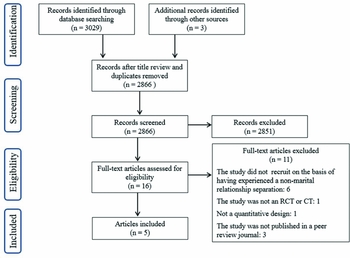
A preformulated coding sheet was used to code the final articles. Included studies were coded for: (1) participant details, (2) study characteristics, and (3) outcome details. Data coding regarding participant details included the following: inclusion/exclusion criteria, time since breakup, average length of the relationship, measure of relationship quality, demographic information (i.e., socio-economic status, sexual orientation, race/ethnicity), total number of participants, age and gender. Data coding of study characteristics comprised the following: study design, method of recruitment, number of comparisons to control group, type of relationship (dating or de facto), intervention content, therapeutic approach, intervention medium, program leader, intervention duration, intensity, number of follow-ups, measurement points and dropout (n, %). Finally, coding of outcome details included the following: primary/other outcomes, outcome pre- to post-intervention, significant differences at post-intervention and follow-up, and relevant effect size information. This process yielded five published empirical papers that are presented in the proceeding sections. Figure 1 depicts the PRISMA flow diagram for article inclusion.
PRISMA flow diagram.

Effect Size Calculations
To allow comparisons regarding the efficacy of the intervention programs, standardised effect size (ES) estimates were calculated using Cohen's d. Cohen's d was calculated by subtracting the mean intervention score from the mean control score at post-test and final follow-up assessment and dividing by the pooled standard deviation. Positive standardised ES estimates indicate that the intervention group improved more than the control group. According to Cohen (Reference Cohen1988), an ES of 0.20 is considered small, while 0.50 is considered moderate and 0.80 is considered large. In some cases an ES could not be calculated as insufficient data were reported. Due to the low quality ratings of the studies and inconsistent measurement of mental health outcomes, a formal meta-analysis was not completed.
Quality Ratings
Quality ratings were completed by two coders, with study quality assessed using the risk-of-bias criteria proposed by the Cochrane Effective Practice and Organisation of Care Group (EPOC, 2015). The risk-of-bias criteria assesses the extent to which the study adequately: (1) randomised participants to conditions (including the generation of the allocation sequence, the concealment of the sequence during randomisation and participant knowledge of condition allocation), (2) assessed baseline differences between the conditions (including demographic and preintervention outcome measures), (3) accounted for incomplete data, (4) protected the study from contamination, and (5) reported trial outcomes without selectively reporting outcomes. Quality ratings are reported in the current review, as poor quality intervention studies can overestimate the size of intervention effects (Moher et al., Reference Moher, Jones, Cook, Jadad, Moher, Tugwell and Klassen1998).
Results
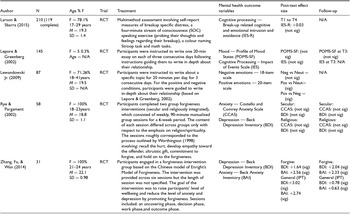
Five randomised controlled trials meeting inclusion criteria were identified in the review. One of the studies was conducted in China, and the remaining studies were from the United States (n = 4). Table 1 presents the results and program details for each trial.
Interventions Targeting Individuals Who Have Experienced a Non-Marital Relationship Separation

Note: F = female, M = mean, SD = standard deviation, RCT = randomised controlled trial, sig = significant difference between the intervention and control condition, not sig = no significant difference between the intervention and control condition, T1–T4 = Measurement occasion 1 to 4.
Trial and Program Characteristics
Program content
The content of the identified interventions varied, with many of the programs combining components of different therapeutic approaches. However, there did not appear to be one specific therapeutic modality that underpinned the program content across all of the interventions. The main therapeutic approaches employed were expressive writing and forgiveness. The primary intervention for two (40%) of the studies focused on cognitive and emotional processing through the use of writing tasks (Lepore & Greenberg, Reference Lepore and Greenberg2002; Lewandowski Jr., Reference Lewandowski2009). Two (40%) of the studies used a forgiveness-focused intervention (Rye & Pargament, Reference Rye and Pargament2002; Zhang, Fu, & Wan, Reference Zhang, Fu and Wan2014) and one (20%) study employed a multimethod assessment, including self-report and cognitive measures, and a stream of consciousness-speaking exercise (Larson & Sbarra, Reference Larson and Sbarra2015). Suicidal thoughts or behaviours were not reported as outcomes for any of the five trials identified in the review.
Program participants and target population
The number of participants in a trial varied considerably and ranged from 31 to 210. The median number of participants in a trial was 120.5. A total of 531 participants were recruited across all studies. The average age of the participants was 20 years (n = 4). All five of the identified programs targeted individuals who had experienced a non-marital dating relationship breakup. All of the participants were recruited from universities (100%). Two studies had all female participants and the remainder recruited mixed gender participants, with limited information provided regarding socio-economic status. Available information pertaining to racial status reported that the majority of participants were of Caucasian background (n = 3), with one study focusing entirely on participants of a Christian faith. Adults who had experienced a non-marital relationship separation were the primary target audience for all of the programs identified.
Relationship factors
The average time since the relationship breakup, per study, was 9 weeks (range = 0 weeks–≥2 years, n = 5). The average length of the relationship prior to the breakup was 30 months (range = 1 month–288 months, n = 5). The nature of the relationship in all five studies was a ‘romantic relationship’, with no information indicating cohabiting status. Relationship quality prior to separation was only assessed by two of the studies describing a variety of types of ‘wrongdoing’ or ‘transgressions’ within the romantic relationship, including infidelity, emotional and/or verbal abuse, physical abuse or threats, deceit, rape, and broken commitment/unwanted relationship dissolution (Rye & Pargament, Reference Rye and Pargament2002; Zhang et al., Reference Zhang, Fu and Wan2014).
Program leaders and session structure
The program leaders were members of the research team (80%) with one study using graduate students (20%) to facilitate the progress of the interventions. Two of the interventions (40%) integrated face-to-face group sessions, two (40%) were individual self-initiated writing tasks, and one (20%) looked at self-reflection through a speaking exercise. Program sessions ranged in length from 1 day to a maximum of 6 weeks. Session length was also variable, with task and session time differing for the face-to-face group interventions compared to the self-initiated writing task interventions. Interventions that utilised writing tasks as the primary exercise ranged from one isolated writing task of up to 100 words, through to 20-minute writing tasks spaced across 3 days. The speaking exercise was comprised of a 4-minute free-association response task completed over four sessions. Group intervention sessions were run face to face, with 90-minute to 2-hour sessions, run over 6 weeks.
Randomisation and follow-up
All five of the interventions reported randomly allocating participants to the intervention and control condition. However, one trial (Rye & Pargament, Reference Rye and Pargament2002) reported a process of randomisation and was published as a randomised controlled trial but described a reallocation of participants to different conditions that compromised the quality of the trial. Of the trials identified, only one did not provide follow-up comparison data past post-test, with the trials recording a follow-up period from 2 days to up to 15 weeks post-intervention.
Evaluation control group
All five trials employed control groups in various formats. Two (40%) of the trials used an attention control, two (40%) employed a no-intervention control group, and one (20%) used a wait-list comparison. Three (60%) of the trials also employed a comparative effectiveness approach, comparing two or more treatments within the trial.
Mental health measures and study quality
A variety of mental health measures were used in the trials, including the Beck Depression Inventory (BDI; Beck, Ward, & Mendelson, Reference Beck, Ward and Mendelson1961), the Beck Anxiety Inventory (BAI; Beck, Epstein, Brown & Steer, Reference Beck, Epstein, Brown and Steer1988), the Impact of Events Scale (IES; Horowitz, Wilner, & Alvarez, Reference Horowitz, Wilner and Alvarez1979), Impact of Events Scale — Revised (IES-R; Weiss, Reference Weiss, Wilson and Sokum Tang2007), Profile of Mood States (POMS-SF; Shacham, Reference Shacham1983), Costello and Comrey Anxiety Scale (Costello & Comrey, Reference Costello and Comrey1967), Negative Emotions Scale (Lewandowski Jr. & Bizzoco, Reference Lewandowski and Bizzoco2007), and the Positive Emotions Scale (Lewandowski Jr. & Bizzoco, Reference Lewandowski and Bizzoco2007).
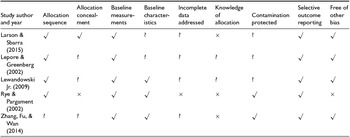
In general, studies were of average quality, scoring an average 5 out of 9. A number of criteria were unclear or indicated a higher risk of bias including allocation concealment, and incomplete outcome data and knowledge of allocation. Table 2 displays details of each study based on EPOC quality rating criteria. Lower quality scores may result from a range of conditions, including limited randomisation details, withdrawals, reallocation of participants to conditions, and analytical methods that did not account for attrition and low retention rates. Poor quality scores were often attributable to limited detail in the trial reports, as opposed to a confirmation of a poorly designed trial. The effect sizes were variable, which were likely the result of the differences between program structure, content, delivery, and trial quality. Poorly controlled trials may have also potentially over- or underestimated effects. Interventions that obtained small-to-medium effects may have masked potential benefits by not finding a significant difference due to a lack of power from a small sample size. The length or duration of the program or proximity of separation did not appear to have a clear influence on the available effect sizes.
Quality Rating Criteria Met by Each Study Using the Cochrane Effective Practice and Organisation of Care (EPOC) Guidelines

Note: ✓ = low risk of bias, ? = unclear risk of bias, × = high risk of bias.
Intervention Efficacy
The first trial that demonstrated efficacy in addressing mental health symptoms targeted female university students (Zhang et al., Reference Zhang, Fu and Wan2014) who were randomly allocated to one of two intervention conditions (group-based forgiveness or interpersonal psychotherapy [IPT]) or a control condition. The forgiveness intervention consisted of six weekly group sessions that focused on increasing wellbeing and reducing anxiety and depression by promoting forgiveness. The main premise of forgiveness therapy is the targeting of ongoing resentment, which if not addressed may lead to negative psychological outcomes (Enright & Fitzgibbons, Reference Enright, Fitzgibbons, Enright and Fitzgibbons2000). The IPT intervention also consisted of six 2-hour weekly group sessions that aimed to reduce negative emotional symptoms and improve interpersonal functioning by communication and other interpersonal skills (Mufson, Gallagher, Dorta, & Young, Reference Mufson, Gallagher, Dorta and Young2004; Zhang et al., Reference Zhang, Fu and Wan2014). When compared to the control group, a significant post-test decrease in depression and anxiety was apparent for both the forgiveness (depression, d = 1.64; anxiety, d =2.56) and IPT (depression, d = 3.02; anxiety, d = 2.74) interventions. At follow-up, the forgiveness group maintained a significantly lower level of depression (d = 2.04) and anxiety (d = 2.33) symptoms compared to the control condition, while the effect of the IPT intervention compared to the control condition decreased (depression, d = 0.79; anxiety, d = 0.63) but still remained significant.
The second trial to demonstrate change in mental health symptoms, post separation, targeted male and female participants (Lewandowski Jr., Reference Lewandowski2009). The intervention randomly assigned participants to one of three writing conditions (negatively focused, positively focused, and neutral [control condition]) to determine whether the type of writing could have an impact on a change in emotions, post relationship dissolution. Participants were instructed to write about a specific topic (for the positive and negative conditions, participants were guided to write in depth about their relationship with either a positive or negative stance) for 20 minutes per day, for 3 consecutive days. Participants in the positive writing condition reported increased positive emotions at post compared to the control group test, F(1, 60) = 9.40, p = .01, and the negative writing condition, F(1, 54) = 4.43, p = .04.
None of the remaining trials demonstrated a significant intervention effect for mental health outcomes. These included a trial of a forgiveness intervention (Rye & Pargament, Reference Rye and Pargament2002), which showed no significant effect for measures of anxiety or depression post-treatment. Also, a trial of expressive writing (Lepore & Greenberg, Reference Lepore and Greenberg2002) and a multi-method assessment including self-report and cognitive measures and a stream of consciousness speaking exercise (Larson & Sbarra, Reference Larson and Sbarra2015) showed no significant intervention effect for reported mental health outcomes.
Discussion
The aim of the review was to identify and describe existing interventions targeting individuals who have experienced a non-marital relationship separation, and to assess the impact of the intervention on participant mental health and/or suicidal thoughts and behaviours. Overall, two of the five (40%) trials identified in the present review yielded a positive effect on anxiety and depression, or positive emotions, relative to the control group, at post-intervention and/or follow-up (Lewandowski Jr., Reference Lewandowski2009; Zhang et al., Reference Zhang, Fu and Wan2014). The effective interventions were based on a range of therapeutic approaches, including forgiveness, IPT, and expressive writing. The forgiveness-based intervention was presented in a group setting and the writing intervention was self-initiated. Unfortunately, it was not possible to calculate the size of effects for all of the interventions. However, post-test effect sizes for the forgiveness intervention (anxiety, d = 2.56; and depression, d = 1.64), and IPT intervention (anxiety, d = 2.74; depression, d = 3.02) were reported. Given the small standard deviations presented by the authors (Zhang et al., Reference Zhang, Fu and Wan2014), the large effect sizes are interpreted and reported with caution.
The results of the review suggest that there is a paucity of trials available that adequately assess the effect of non-marital relationship separation interventions on mental health outcomes and none that assess suicidality. The evidence to date has not been of the highest quality, with improvements needed in the facilitation of evidence-based trials and reporting outcomes. Nevertheless, of the research that has been conducted, it is evident that: (a) the current evidence for writing interventions post separation is low and there is a clear need to identify what differentiates effective writing interventions from non-effective ones; (b) there is preliminary evidence for forgiveness interventions, with a need for larger, more appropriately powered studies; and (c) there is preliminary evidence for the effectiveness of IPT, an evidence-based psychological intervention, with the need to further test this and other evidence-based approaches.
Three of the trials evaluated did not report specific or significant mental health effects. The first trial evaluated a writing intervention (Lepore & Greenberg, Reference Lepore and Greenberg2002), which reported no effect on levels of intrusions and avoidance or feelings and attitudes toward their ex-partner. Although some research has suggested that writing interventions can be an effective method for dealing with stressful life events (Frattaroli, Reference Frattaroli2006; Hirai, Skidmore, Clum, & Dolma, Reference Hirai, Skidmore, Clum and Dolma2012; Krpan et al., Reference Krpan, Kross, Berman, Deldin, Askren and Jonides2013), a study by Sbarra et al. (Reference Sbarra, Boals, Mason, Larson and Mehl2013) reported that up to 9 months after an expressive writing intervention aimed at separated individuals, participants who were found to be highly ruminative and those engaged in an active search for meaning concerning their separation reported significantly worse emotional outcomes. Their results suggested that instead writing about factual daily activities in the vein of behavioural activation may actually help to re-engage separated adults with their day-to-day routine, allowing people to develop a restoration focus when coping with loss (Sbarra et al., Reference Sbarra, Boals, Mason, Larson and Mehl2013). Evaluating the speaking exercise, Larson and Sbarra (Reference Larson and Sbarra2015) reported that the group who completed four speaking exercises over a 9-week period experienced greater improvements in self-concept clarity, improving their sense of self independent from their former partner. This finding may have implications for mental health outcomes, as reorganising self-concept could be an important psychological tool in implicitly effecting change following a separation. The final non-effective trial assessed a forgiveness intervention (Rye & Pargament, Reference Rye and Pargament2002). However, the magnitude of the effects obtained suggest that the forgiveness trial may have been underpowered to detect effects, and thus further investigation of this particular intervention is warranted with a large sample that is properly powered.
Limitations
There are a number of limitations to the current review that should be noted. Due to insufficient available information to calculate effect sizes for some of the studies, considerable variability in participant characteristics, interventions, and measurement of outcomes, a meta-analysis could not be conducted. It is also possible that publication bias was present in the current review, due to the risk that only articles reporting significant results in English language papers may have been accessible and that the systematic search may have inadvertently not identified all potential articles. The need for randomised controlled trials addressing consistent outcomes and using standardised mental health measures is warranted. In particular, the use of existing standardised measures of social-emotional, mental health, and suicidality outcomes will enable comparison to existing data and help produce more robust evaluations.
Implications for Future Research
The findings from the forgiveness-based interventions suggest that looking toward acceptance, problem solving, and finding the positive in light of negative circumstances may facilitate growth following a relationship separation. Although most people will manage to readjust to life post separation, a proportion will continue to experience difficulty (Sbarra, Hasselmo, & Bourassa, Reference Sbarra, Hasselmo and Bourassa2015). Research suggests that help-seeking for depression, and mental health more broadly, is fraught with issues relating to self and perceived stigmatising responses (Barney, Griffiths, Jorm, & Christensen, Reference Barney, Griffiths, Jorm and Christensen2006), poor mental health literacy, and a preference for self-reliance (Gulliver, Griffiths, & Christensen, Reference Gulliver, Griffiths and Christensen2010). However, redefining the issue as context-experience specific (i.e., a relationship separation) may elicit strengthened help-seeking strategies, normalise the separation experience, and propose more adaptive coping strategies that may have a lifelong impact. Interpersonal psychotherapy is an evidence-based treatment premised on a time-limited, structured approach that addresses interpersonal issues and has been found to be an efficacious psychotherapy for depressive spectrum disorders (de Mello, de Jesus Mari, Bacaltchuk, Verdeli, & Neugebauer, Reference de Mello, de Jesus Mari, Bacaltchuk, Verdeli and Neugebauer2005; Cuijpers et al., Reference Cuijpers, Geraedts, van Oppen, Andersson, Markowitz and van Straten2011). Brief, theory-based, social-psychology interventions have the potential to yield improvements across achievement, health, and wellbeing (Yeager & Walton, Reference Yeager and Walton2011), and have been used to protect declines in marital quality (Finkel, Slotter, Luchies, Walton, & Gross, Reference Finkel, Slotter, Luchies, Walton and Gross2013) and promote psychoeducation for divorce adjustment (Brotherson, White, & Masich, Reference Brotherson, White and Masich2010). The diathesis-stress model provides a platform from which an intervention like IPT can focus on identifying life events or interpersonal issues that precipitate and maintain mental difficulties (Lipsitz & Markowitz, Reference Lipsitz and Markowitz2013). Working to resolve the interpersonal problem area, IPT shifts to focus on the relationship separation in order to enhance social support, decrease interpersonal stress, facilitate emotional processing, and improve interpersonal skills (Lipsitz & Markowitz, Reference Lipsitz and Markowitz2013). This approach may be effective in dealing with relationship breakdown and offers a potential avenue for future research. However, no other studies in the review tested IPT specifically in a sample of separated individuals.
Suicidal thoughts or behaviours were not reported as outcomes for any of the trials identified in the review. Given the association between intimate partner separation and suicidality, it is important to develop and evaluate interventions that aim to support people through this difficult time and promote long-term recovery (Kazan, Calear, & Batterham, Reference Kazan, Calear and Batterham2016). There is also lack of additional research evaluating the reciprocal impact of mental health and relationship separation. The determination of whether separation plays a direct causal role in the emergence of mental health issues or whether other variables predict the likelihood of separation is difficult to define. However, studies have highlighted that history of mental illness likely predisposes an individual to relapse following a divorce (Sbarra, Emery, Beam, & Ocker, Reference Sbarra, Emery, Beam and Ocker2014). Research also suggests that the effect of separation on mental health problems may be short term, which is often not adequately addressed through longitudinal studies (Blekesaune, Reference Blekesaune2008; Gibb, Fergusson, & Horwood, Reference Gibb, Fergusson and Horwood2011). A more robust approach to assessing and identifying causal associations may be to establish randomised controlled trials to assess whether mental health interventions reduce the rate of relationship separation or whether interventions aimed at recently separated individuals reduce rates of subsequent mental health issues (Gibb et al., Reference Gibb, Fergusson and Horwood2011).
Conclusion
Overall, the current findings identify the shortage of comprehensive randomised controlled trials in the area of non-marital relationship separation. Further, the review suggests that there is a paucity of trials available that adequately assess the effect of non-marital relationship separation interventions on mental health outcomes and none that consider suicidal thoughts and behaviours. Overall, two of the five trials identified in the present review yielded a positive effective on anxiety and depression and positive emotions. These programs comprised of a forgiveness-focused group intervention, IPT, and a self-initiated writing intervention. The available data were variable, which were likely the result of the differences between program structure, content, delivery, and trial quality. The inconsistent measurement of mental health outcomes also highlights the lack of evidence-based direction in the area of non-marital separation, with the lack of trials testing theory-driven interventions for relationship separation of particular concern. The review demonstrates the need for more randomised controlled trials addressing consistent outcomes, including standardised measures of social/emotional, mental health, and suicidality outcomes following non-marital relationship separation.
Acknowledgments
This research and DK are supported by the National Health and Medical Research Council (NHMRC) Centre of Research Excellence in Suicide Prevention (1042580). PJB and ALC are supported by National Health and Medical Research Council (NHMRC) fellowships 1083311 and 1013199.