INTRODUCTION
The study of plant–nectarivore interactions has gained renewed importance in the context of habitat fragmentation that now occurs in tropical habitats (Aguilar et al. Reference AGUILAR, ASHWORTH, GALETTO and AIZEN2006, Ashworth et al. Reference ASHWORTH, QUESADA, CASAS, AGUILAR and OYAMA2009, Groom Reference GROOM2001). Even if a fair number of studies have addressed the spatial distributions of the participants of these interactions at different scales (Feinsinger et al. Reference FEINSINGER, TIEBOUT and YOUNG1991, Gill & Wolf Reference GILL and WOLF1977, Goulson Reference GOULSON2000, Pyke Reference PYKE1978, Schmitt Reference SCHMITT1983, Thomson Reference THOMSON1981), few have statistically explored the scale of joint aggregations (Baum & Grant Reference BAUM and GRANT2001, Cartar & Real Reference CARTAR and REAL1997, Cresswell Reference CRESSWELL1997, Somanathan et al. Reference SOMANATHAN, BORGES and CHAKRAVARTHY2004). Lack of spatially explicit models of ecological processes has greatly limited our ability to extrapolate inferences regarding occurrences in nature at various scales (Turner Reference TURNER1989, Wiens Reference WIENS1989).
The spatial scale of any ecological study is defined by three values: (1) the size of the minimum sampling unit (grain), (2) the total area of all the sampling units (extent) and (3) the distance between sampling units (interval) (Dale Reference DALE1999). Although explicit reporting of the three values of the scale of studies is rare in the literature, there is evidence to suggest that, at least in extents of centimetres to metres and of tens to hundreds of metres, nectarivore–plant interactions may depend on the spatial distribution of both resources and users (Caraballo-Ortiz et al. Reference CARABALLO-ORTIZ, SANTIAGO-VALENTIN and CARLO2011, Carpenter Reference CARPENTER1978, Cartar & Real Reference CARTAR and REAL1997, Feinsinger et al. Reference FEINSINGER, BUSBY, MURRAY, BEACH, POUNDS and LINHART1988, Reference FEINSINGER, TIEBOUT and YOUNG1991; Johnson et al. Reference JOHNSON, PETER, NILSSON and ÅGREN2003, Thomson Reference THOMSON1982). Although this evidence suggests that density and degree of resource and user aggregation could be important drivers for the plant–nectarivore interaction, to our knowledge, no studies have formally and explicitly addressed the relationship between the spatial patterns of the actors of such interaction. In fact, spatially explicit patterns in general are poorly addressed in studies of plant–animal interactions (for exceptions see Carlo & Morales Reference CARLO and MORALES2008, García et al. Reference GARCÍA, CHACOFF, HERRERA, AMICO, Medel, Aizen and Zamora2009, Johnson et al. Reference JOHNSON, SEIP and BOYCE2004, Morales et al. Reference MORALES, RIVAROLA, AMICO and CARLO2012, Steffan-Dewenter et al. Reference STEFFAN-DEWENTER, MÜNZENBERG, BÜRGER, THIES and TSCHARNTKE2002).
In this study, we use the interaction between P. padifolia and hummingbirds as a study model to test, under natural conditions, the following hypotheses: (1) floral resources of P. padifolia and hummingbird activity exhibit a spatially aggregated distribution at the same scale, (2) the spatial distribution of this floral resource and hummingbird activity is associated, and (3) if hummingbird activity responds to the supply of floral resources, it will be more frequent (per sampling unit) in areas where the floral resource is clustered in larger patches.
STUDY SITE
This study was carried out in the El Santuario del Bosque de Niebla reserve (19° 30′N, 96° 56′W), in Xalapa, Veracruz, Mexico. This 33-ha reserve is a remnant of tropical mountane cloud forest located at 1225 m asl (Williams-Linera Reference WILLIAMS-LINERA2002, Reference WILLIAMS-LINERA2003).
STUDY SPECIES
Palicourea padifolia (Willd. ex Roem. & Schult.) C.M. Taylor & Lorence (Rubiaceae) is a distylous shrub of 2–7 m in height, mostly found in open disturbed sites and roadside edges of tropical montane cloud forest (Taylor Reference TAYLOR1989) and not all individuals bloom every year, or with the same intensity (Ornelas et al. Reference ORNELAS, JIMÉNEZ, GONZÁLEZ and HERNÁNDEZ2004a). In El Santuario, P. padifolia is one of the dominant shrub species (Williams-Linera Reference WILLIAMS-LINERA2003) and its phenology and nectar, flower and fruit production have been previously studied (Contreras & Ornelas Reference CONTRERAS and ORNELAS1999, González et al. Reference GONZÁLEZ, ORNELAS and JIMÉNEZ2005, Ornelas et al. Reference ORNELAS, JIMÉNEZ, GONZÁLEZ and HERNÁNDEZ2004a). The flowers are yellow and tubular (10–15 mm), last for 1 d and are grouped in pyramidal panicles (Contreras & Ornelas Reference CONTRERAS and ORNELAS1999, Taylor Reference TAYLOR1989). Palicourea padifolia features two entirely self-incompatible floral morphs (long-styled pin and short-styled thrum) which are present in a 1:1 ratio (Contreras & Ornelas Reference CONTRERAS and ORNELAS1999, Taylor Reference TAYLOR1989). No significant differences have been found between floral morphs in nectar production and sugar content, the number of inflorescences per plant and flowers per inflorescence (Contreras & Ornelas Reference CONTRERAS and ORNELAS1999, Ornelas et al. Reference ORNELAS, GONZÁLEZ, JIMÉNEZ, LARA and MARTÍNEZ2004b). At our study site P. padifolia flowers from March until August, and maximum flower availability is reached between May and mid-June (Contreras & Ornelas Reference CONTRERAS and ORNELAS1999). During its blooming season P. padifolia is one of the most rewarding floral resources for nectarivores in tropical montane cloud forest remnants near Xalapa (Ornelas et al. Reference ORNELAS, JIMÉNEZ, GONZÁLEZ and HERNÁNDEZ2004a). It produces approximately 30–80 inflorescences, each opening two to four yellow flowers per day and 80–90 floral buds eventually reach the flower stage during the blooming season (González et al. Reference GONZÁLEZ, ORNELAS and JIMÉNEZ2005).
Reported visitors to P. padifolia at our study site include butterflies, bees, bumble bees and hummingbirds; with the latter being the most frequent (Ornelas et al. Reference ORNELAS, JIMÉNEZ, GONZÁLEZ and HERNÁNDEZ2004a). Eleven species of hummingbirds have been reported to visit the flowers of this plant at our study site. Hummingbird species differ in frequency, duration and intensity of flower visits (number of flowers tested) and occurrence of territorial defence (agonistic encounters) (Ornelas et al. Reference ORNELAS, JIMÉNEZ, GONZÁLEZ and HERNÁNDEZ2004a).
METHODS
Spatial sampling design
During June and July in 2009 and 2010, we recorded the floral resource abundance and hummingbird activity along a transect 1 km long and 10 m wide, covering a total area of 10 100 m2 (extent). The transect was established on a non-straight existing path. We divided the transect into 101 observation stations (OS) consisting of contiguous 10 × 10-m quadrats, i.e. 100-m2 grain.
Over 12 d in 2009 and 16 d in 2010, we travelled the length of the transect between 9h00 and 13h00 and in each of the 101 OSs, we recorded all hummingbird activity detected visually or by sound within the space of 1 min. In order to avoid an association between OSs position and recording time, we rotated the order of observations daily between four variations: (1) travelling from OS 1 to 101, (2) from 101 to 1, (3) from 50 to 1, then 51 to 101 and (4) from 51 to 101, then 50 to 1.
The recording of hummingbird activity consisted of the observer standing in the centre of each OS for 1 min conducting a radial visual and auditory scan covering the entire OS in order to record all hummingbird behaviours. Behavioural patterns were: feeding (inserting the beak at least once into the flower), perching (for at least 5 s), vocalizing (singing or making calls), flying past (the OS) and agonistic behaviour (flying towards or behind another hummingbird). When possible, we also recorded the species of hummingbird performing each behavioural pattern although this information was not included in the spatial analysis of hummingbird activity. We have no record of the number of individuals observed since they were not tagged, and thus, we could not distinguish between individuals of the same species. However, our records did distinguish between individual visit bouts, which consist of sequences of behavioural patterns performed by the same individual.
An inflorescence census was taken in each OS at the end of each behavioural observation period (2009 and 2010). The number of inflorescences of all P. padifolia plants was considered representative of the floral resource availability during the behavioural observations period (the previous 15–20 d). We did not discriminate between floral morphs, because they are present in similar proportions and their distribution is not grouped (Ornelas et al. Reference ORNELAS, JIMÉNEZ, GONZÁLEZ and HERNÁNDEZ2004a). We defined three measures for each of the 101 OSs in each year: (1) the Total Number of Inflorescences in a count at the end of flowering (TNI); (2) Overall Hummingbird Activity (OHA) – the sum of hummingbird behavioural patterns recorded during all observation periods; and (3) Agonistic Hummingbird Activity (AHA) – measured as the proportion of visit bouts that included agonistic behaviour. This measure of proportion was multiplied by 100 to obtain whole numbers as required for analysis with SADIE.
Spatial distribution of floral resources and hummingbirds
Unlike previous studies in which a patch or gap of floral resources is defined a priori by the observer at a subjective perception scale, to test our hypotheses, we used the analytical tool Spatial Analysis by Distance IndicEs (SADIE) (Perry Reference PERRY1998) to statistically identify patches and gaps in the distribution of individual and joint plant–hummingbird variables. SADIE is a tool for the analysis of count data that is spatially explicit in one or two dimensions (e.g. transects or surfaces). SADIE permits the characterization of patterns of spatial distribution of variables as aggregated (and to what degree) or random. SADIE uses a global approach, meaning that it considers distribution over the entire study area in order to assess the degree of local aggregation or dispersion at each point within that area. This is achieved by producing an Index of Aggregation (Ia) and, using a permutation method, calculating its statistical significance. To calculate Ia, we used 5967 permutations, the maximum available. The variables show an aggregated distribution when Ia > 1, random when Ia ≈ 1 and regular when Ia < 1 (Maestre & Quero Reference MAESTRE, QUERO, Maestre, Escudero and Bonet2008, Perry Reference PERRY1998). In the case of an aggregated distribution, the magnitude by which the value of Ia surpasses unity indicates the degree of aggregation. Thus, a variable whose Ia value is 1.5 has a distribution 50% more aggregated than would be expected by chance (Perry Reference PERRY1998).
Once the degree of global aggregation of the variables was calculated, we identified the location and length (along the transect) of significantly aggregated (patches) or dispersed (gaps) zones of inflorescences and hummingbird activity. To do this, we calculated the SADIE Index of Clustering (v) for each of the 101 OSs. This index measures the degree of aggregation of the data into patches (areas with v > 1.5) or gaps (areas with v < −1.5). This index quantifies the degree to which each sample (OS) contributes to the overall aggregation of the data, in turn allowing the spatial delimitation of patches (where v is positive and called vi) or gaps (where v is negative and is called vj) (Maestre & Quero Reference MAESTRE, QUERO, Maestre, Escudero and Bonet2008, Perry Reference PERRY1998). Since measurements of vi and vj are equal to 1 and −1 when local aggregation is similar to that expected under a random distribution, any absolute value greater than 1 represents, as for the global case (I a), the degree of aggregation at any given point. In order to be conservative in interpreting the size of patches and gaps, these were delimited by all the adjacent OS with 50% more aggregation or dispersal than would be expected by chance (vi > 1.5 in the case of patches and vj < −1.5 for gaps) (Negrete-Yankelevich et al. Reference NEGRETE-YANKELEVICH, FRAGOSO, NEWTON, RUSSELL and HEAL2006). We defined four patch and gap size categories grouped in ranges of transect length: small: 10–39 m; small–medium: 40–69 m; medium–large: 70–100 m; and large: greater than 100 m.
The minimum length of both patches and gaps was 10 m (the length of a single OS). This occurred when a station had an absolute value of the Index Clustering greater than 1.5 and was flanked by OS with values lower than 1.5. It is important to note in such cases that, given the global approach of SADIE, despite the fact that the limits of the patch are located around a single OS because its v is greater than 1.5, the definition of the patch is also governed by the values of the nearby units (Perry Reference PERRY1998).
For the detection of areas of association–dissociation between floral resource and hummingbird activity, we used the SADIE method to calculate the Index of Association (X i) for each sampling unit, the global Index of Association (X: average of the local values of X i) and their statistical significance (Maestre & Quero Reference MAESTRE, QUERO, Maestre, Escudero and Bonet2008, Perry & Dixon Reference PERRY and DIXON2002). X i compares the Index of Clustering values (vi – vj) for each pair of variables with the same coordinates such that the spatial coincidence of a patch on one variable with a patch on another, or the coincidence of two gaps, generates a positive covariance value (X i > 0, association). However, if a variable shows a patch where the other has a gap, the covariance is negative (X i < 0, dissociation) (Maestre & Quero Reference MAESTRE, QUERO, Maestre, Escudero and Bonet2008, Perry & Dixon Reference PERRY and DIXON2002). For the test of significance of X, we used the maximum number of permutations possible in SADIE (10 000), in order to reduce the probability of type II error (Winder et al. Reference WINDER, ALEXANDER, HOLLAND, WOOLLEY and PERRY2001).
Relationship between resource patch size and hummingbird activity
To test the hypotheses of a relationship between the size of floral resource patch and hummingbird activity, we conducted linear regression analyses between the size of the patches of TNI (transect length with vi > 1.5), as the independent variable, and the averages of OHA and AHA per patch as dependent variables. Since the observations have a strong spatial correlation and probably a skewed distribution along the x-axis (small patches are more frequent), hypothesis testing of the analysis of variance associated with the regression was performed using a permutation test (Legendre & Legendre Reference LEGENDRE and LEGENDRE1998). We generated a random distribution of correlation coefficients using the observed values in both variables and pairing them at random 5000 times. The reported P value in each case is the proportion of random correlation coefficients higher than the observed correlation coefficient.
RESULTS
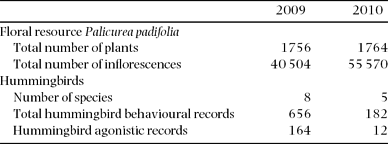
Throughout the study transect, there was always at least one individual of P. padifolia per OS in flower. The number of plants surveyed was very similar in both years, although inflorescence production was higher in 2010 (Table 1): the number of inflorescences found per OS ranged from 2 to 1406 (2009) and from 4 to 2175 (2010). The majority of OS (80%, 2009 and 89%, 2010) had more than 100 inflorescences.
Two-year comparison of floral resource abundance of Palicourea padifolia and hummingbird activity along a 1010-m transect in central Veracruz, Mexico.

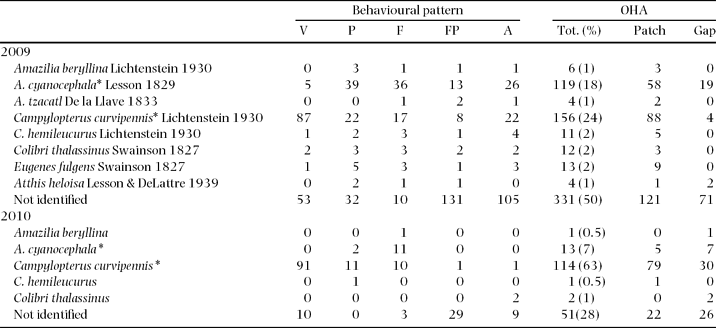
Although inflorescences abundance was greater in 2010, the OHA and the number of species recorded in that year were lower than in 2009 (Table 1). Of the behavioural patterns observed in both years, 50% (2009) and 28% (2010) were from hummingbirds observed too rapidly for identification or whose singing was not species specific; the remaining behavioural patterns were produced by eight species of hummingbird: Campylopterus curvipennis, C. hemileucurus, Colibri thalassinus, Amazilia cyanocephala, A. beryllina, A. tzacatl, Atthis heloisa and Eugenes fulgens. The last three species listed here were observed in 2009 only (Table 2). Campylopterus curvipennis and A. cyanocephala were the resident species most frequently identified in both years. The main behavioural patterns of these species were vocalizing, perching and agonistic behaviour in the case of Campylopterus curvipennis, and feeding and perching for Amazilia cyanocephala (Table 2). Most behavioural patterns were recorded in zones where the resource was present in patches (Table 2).
Number of behavioural records by pattern, total and percentage and overall hummingbird activity (OHA) in patches and gaps, for each species in 2009 and 2010, along a 1010-m transect of Palicourea padifolia, in central Veracruz, Mexico. V = vocalization, P = perching, F = feeding, FP = flying past, A = agonistic behaviour. * Resident species that also exhibit territorial behaviour (Schuchmann Reference SCHUCHMANN, Del Hoyo, Elliott and Sargatal1999). OHA = the sum of hummingbird behavioural patterns recorded during all observation periods; note that some behavioural patterns occurred in areas where floral resources were not significantly distributed in patches or gaps.

Spatial distribution of Palicourea padifolia and hummingbird activity
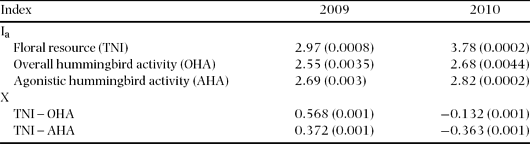
The global spatial aggregation analysis showed that the floral resources (TNI) were 196% (2009) and 278% (2010) more aggregated than would be expected by chance. Hummingbird activity (OHA) had a global spatial distribution that was 155% (2009) and 168% (2010) more aggregated than expected by chance, while their aggressive activity (AHA) was 168% (2009) and 181% (2010) more aggregated than expected by chance (Table 3).
Index of aggregation (Ia) and index of association (X) of floral resources and hummingbird activity, for the years 2009 and 2010, along a 1010-m transect of Palicourea padifolia, in central Veracruz, Mexico. TNI = total number of inflorescences, OHA = the sum of hummingbird behavioural patterns recorded during all observation periods, AHA = the proportion of visit bouts that included agonistic behaviour. P values in parentheses.

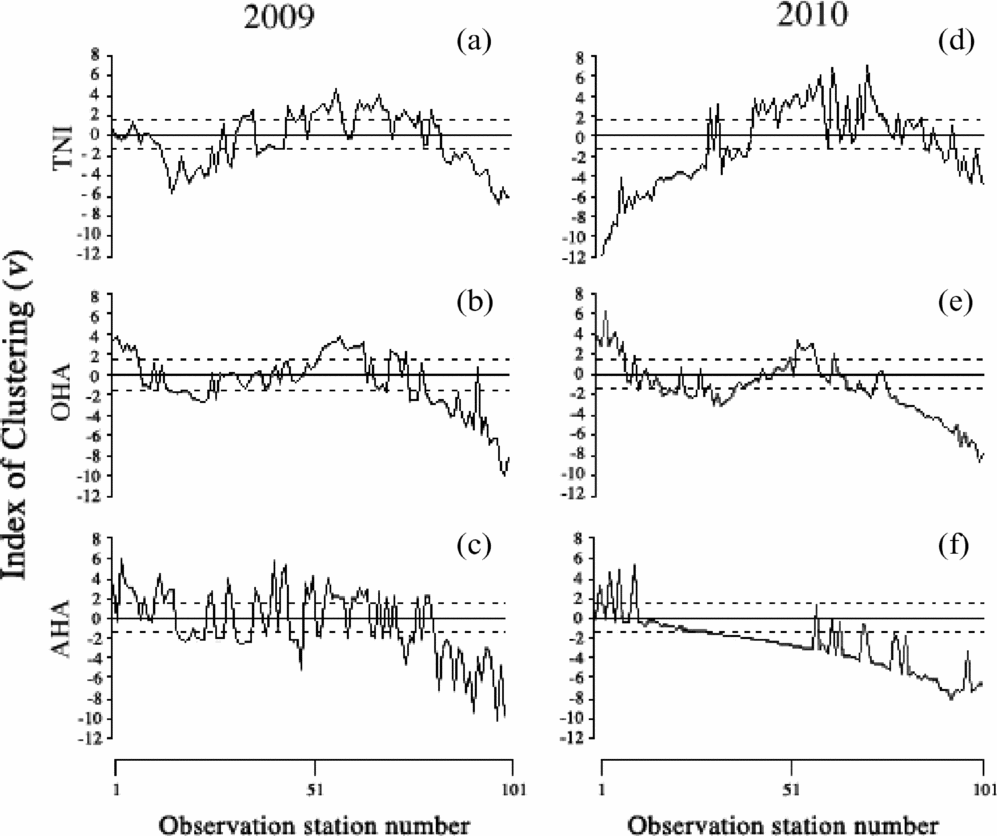
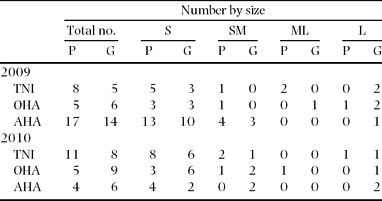
In both years, the patches of inflorescences (significantly aggregated OSs, v > 1.5) were clustered in the middle of the transect. In contrast, zones of gaps (significantly dispersed OSs, v < −1.5) dominated the start and end of the transect (Figure 1a, b). In 2010, the gap of inflorescences at the start of the transect presented the lowest v j values (−3 and −12) found in the study. The size and number of TNI patches were similar between years, mainly being between 10 and 30 m in length (Table 4). Each OS that formed part of a patch had an average (± SE) of 679 ± 49.5 (2009) and 1058 ± 67.9 (2010) inflorescences, while each OS located in a gap had an average of 164 ± 27.5 (2009) and 202 ± 19.7 (2010) inflorescences.
Index of clustering of total number of inflorescences (TNI), overall hummingbird activity (OHA) and agonistic hummingbird activity (AHA) in 2009 (a–c) and 2010 (d–f), along a 1010-m transect of Palicourea padifolia in central Veracruz, Mexico. Index values above 1.5 (v i) indicate aggregation patches, values below −1.5 (v j) indicate gaps (dashed horizontal lines).

Number and size of patches (P) and gaps (G) of inflorescences (TNI), overall hummingbird activity (OHA) and agonistic hummingbird activity (AHA), for the years 2009 and 2010, along a 1010-m transect of Palicourea padifolia, in central Veracruz, Mexico. TNI = total number of inflorescences, OHA = the sum of hummingbird behavioural patterns recorded during all observation periods, AHA = the proportion of visit bouts that included agonistic behaviour. Size categories grouped in ranges of length: S = small, 10–39 m; SM = small–medium, 40–69 m; ML = medium–large, 70–100 m; and L = large, > 100 m.

Much like TNI, a patch zone predominated for OHA around the middle of the transect but became dispersed by the end (Figure 1c, d). However, unlike TNI, the initial zone of the transect showed patch zones for OHA. In 2010, these zones had v values greater than in 2009 (Figure 1). We found five patches for OHA each year, most between 10 m and 30 m in length (Table 4). In both years, the majority of patches and gaps were small and there were more gaps than patches (Table 4).
AHA in 2009 was aggregated into small abundant patches located mostly in the first two-thirds of the transect (Figure 1e, f). It is important to remember that this concentration is not the consequence of a greater OHA, since its frequency is standardized by the number of visit bouts. We also found a significant gap (v < −1.5) at the end of the transect, similar to the gaps found in the distributions of the TNI and OHA for the same year (Figure 1). The incidence of AHA recorded in 2010 was 92% lower than in 2009 (Table 1), with an aggregated distribution pattern at the start of the transect (v > −1.5), and random (1.5 < v > −1.5) to dispersed (v < −1.5) distribution towards the middle and the end (Figure 1). The interval range of the Index of Clustering (v) was similar in both years, between 6 and −6 (Figure 1). AHA in 2009 was distributed in 17 patches, mostly between 10 and 30 m in length; however, in 2010 there were only four patches, all less than 30 m long and distributed within the first 20 OSs of the transect (Figure 1).
Spatial covariation between floral resources and hummingbird activity
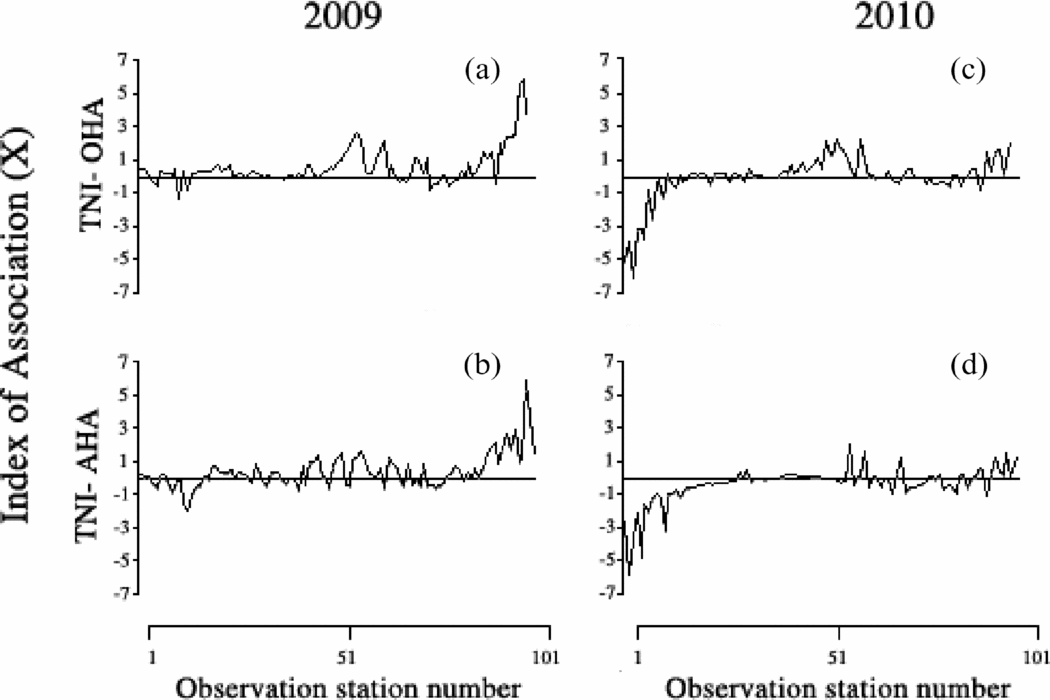
The SADIE global Index of Association (X) was positive and significant in 2009 between TNI and OHA and between TNI and AHA. However in 2010 there was a significant dissociation (negative X) both between TNI and OHA and between TNI and AHA (Table 3).
In 2009, both the resource and hummingbirds had a high correspondence to aggregated areas located mainly in the middle of the transect, and to dispersed areas at the end (Figure 2a, c). In this year, dissociation values below −1.5 were only found in the section of the transect comprising the first 20 observation stations. During 2010, however, the initial part of the transect had high values of local dissociation (xj of between −1 and −6), i.e. in the first 20 OS of the transect where the resource was less aggregated (vj of between −3 and −12) there were high values (v > 1.5) of aggregation of hummingbird activity, both OHA and AHA (Figure 2b, d).
Spatial association of total number of infloresences (TNI), overall hummingbird activity (OHA) and agonistic hummingbird activity (AHA) in 2009 (a, b) and 2010 (c, d) along a 1010-m transect of Palicourea padifolia in central Veracruz, Mexico. Index values above 0 (X i) indicate association, values below 0 (X j) indicate dissociation.

Hummingbird activity and sizes of resource patches
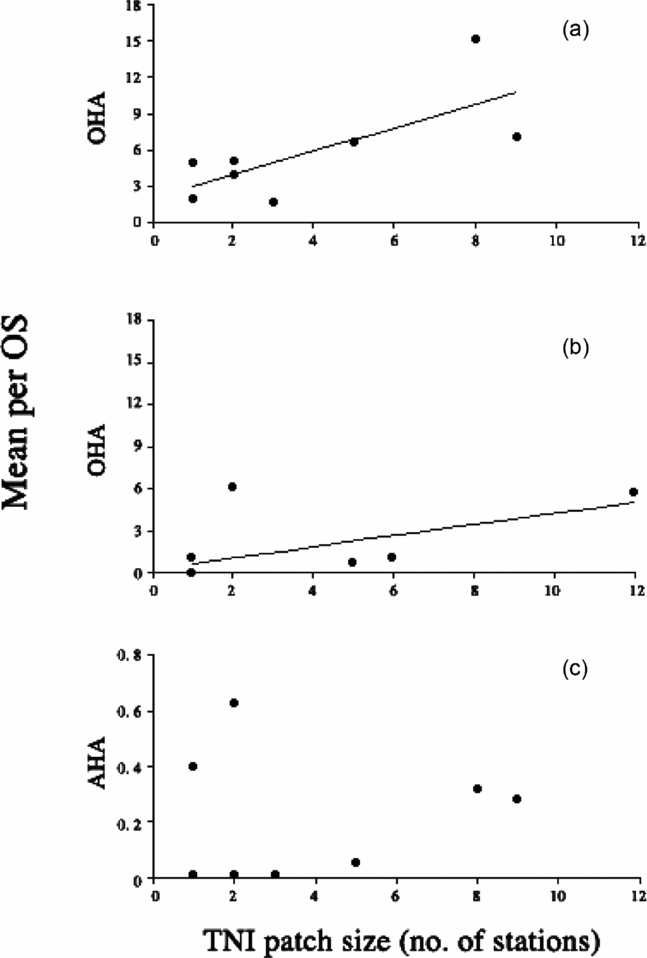
Along the length of the transect we found eight TNI patches in 2009, and 11 in 2010, ranging from 10 to 120 m long, most (68%) between 10 and 30 m in length (Table 4). In both years of study, we found a significant positive relationship between the size of patches of TNI aggregation and the average of OHA per observation station located within those patches (2009: R2 = 0.445, P = 0.034 and 2010: R2 = 0.309, P = 0.038, Figure 3a, b). However, in 2009, we found no significant relationship between aggregation patch size of TNI and the average AHA per observation station (R2 = 0.009, P = 0.164, Figure 3c). It was not possible to make an analysis for 2010 since only two agonistic encounters occurred within the aggregation patches.
Relationship between length of floral resource patches measured as number of observation stations (OS) and mean overall hummingbird activity (OHA) per OS in 2009, y = 0.976x + 2.02 (a), mean OHA per OS in 2010, y = 0.396x + 0.280 (b), and mean agonistic hummingbird activity (AHA) per OS in 2009 (c), along a 1010-m transect of Palicourea padifolia in central Veracruz, Mexico. Since the observations have a strong spatial correlation and probably a skewed distribution along the x-axis, hypothesis testing of the analysis of variance associated with the regression was performed using a permutation test (Legendre & Legendre Reference LEGENDRE and LEGENDRE1998).

DISCUSSION
Although it is acknowledged that spatial distribution of primary resources and their users is not random (Kotliar & Wiens Reference KOTLIAR and WIENS1990), this has not been tested for most interactions (for exceptions see Winder et al. Reference WINDER, ALEXANDER, HOLLAND, WOOLLEY and PERRY2001 for predator–prey and García et al. Reference GARCÍA, ZAMORA and AMICO2011 and Saracco et al. Reference SARACCO, COLLAZO and GROOM2004 for bird frugivores). This study shows that, in a montane cloud forest remanent, not only are aggregation of the floral resource P. padifolia and of hummingbird activity not random, they are also spatially associated, and the level of activity may be related to the size of the resource patch.
Aggregation of the organisms
We found that P. padifolia floral resource was significantly aggregated in areas of large open disturbed sites in the middle part of the transect. Moreover, as initially hypothesized, we found that hummingbird activity was also aggregated in patches of tens to hundreds of metres in length. Although hummingbirds are mobile organisms that can travel long distances (Baum & Grant Reference BAUM and GRANT2001, Cotton Reference COTTON2007, Feinsinger et al. Reference FEINSINGER, BUSBY, MURRAY, BEACH, POUNDS and LINHART1988, Montgomerie & Gass Reference MONTGOMERIE and GASS1981), their aggregated activity at this scale is probably related to the resource aggregation: floral patches are the favourable places in which to feed and establish a territory.
We should highlight differences between species in the frequency of behavioural patterns around feeding floral resources (Table 2). For example, Campylopterus curvipennis was the most vocal species while A. cyanocephala was the species most often found feeding and involved in more agonistic encounters. Consistently, C. curvipennis and A. cyanocephala are both resident species in the study area and their feeding behaviour is usually territorial (González & Ornelas Reference GONZÁLEZ and ORNELAS2005, Ornelas et al. Reference ORNELAS, GONZÁLEZ, JIMÉNEZ, LARA and MARTÍNEZ2004b, Schuchmann Reference SCHUCHMANN, Del Hoyo, Elliott and Sargatal1999).
In common with overall hummingbird activity, most of the patches of agonistic activity (13 out of 17 in 2009 and all four in 2010) were small. Since these aggregations are formed by an accumulation of agonistic encounters over several days of observation, this is likely to be the result of recurring defence of feeding territories, which can last an entire flowering season or even more than one season (Temeles & Kress Reference TEMELES and KRESS2010).
Association–dissociation between floral resources and users
The close correspondence in size, location and frequency between hummingbird activity and floral patches in 2009 implies that hummingbirds not only visit and exhibit agonistic behaviour where the resource is more aggregated, but that hummingbird activity is less frequent in areas where the floral resource is less abundant. In contrast, in 2010 we found a negative association between resource aggregation and hummingbird activity due to spatial correspondence between patches of floral resources and gaps of hummingbird activity. In this year we can see a large gap of floral resource in the first 30 observation stations (Figure 1), which corresponds to the only large floral resource gap of the eight gaps found. One third of all hummingbird activity in that year (and the great majority of activity observed in gaps) was observed in this floral resource gap. This may cause the contrasting pattern of global associations between years. In 2009, there was 72% more overall hummingbird activity, and three species more than in 2010. The activity of resident-territorial species, C. curvipennis and A. cyanocephala, also differed between years. These species performed 42% of all hummingbird activity in 2009 while in 2010 they performed 70% (Table 2). The low recorded activity of migratory species in 2010 may reflect lower densities of those species that year. Lower densities of migratory species may have highlighted the density of resident species, the aggregation of which may be a response to long-term established territories regardless of the patchiness of the floral resource in a given year. We know that not all P. padifolia plants flower every year, nor do they flower with the same intensity (Ornelas et al. 2004a), and thus the scenario of resource distribution and aggregation differs between years (Figure 1). Strong site fidelity and possible residence effects may explain why some males defend poor-quality patches (Temeles & Kress Reference TEMELES and KRESS2010). It is possible that high-density areas of inflorescence in one year may show low density in another, as was the case in the initial observation stations of the transect (Figure 1). If these are areas where resident species traditionally maintain territories, the limited resource could be monopolized thus provoking a higher overall AHA than in large areas where the resource is densely aggregated and where territorial defence could be too costly due to high intrusion pressure (Kodric-Brown & Brown Reference KODRIC-BROWN and BROWN1978, Stiles & Wolf Reference STILES and WOLF1970). Goulson (Reference GOULSON1999) suggests that optimal foraging in bees can be linked to the search patterns of the foragers in areas featuring a low density of resource. The systematic search for floral resources may allow pollinators to visit all inflorescences in small patches with fewer errors and avoid a large investment of time. By contrast, in large patches, the chance of finding an unvisited flower is smaller and the probability of committing an error is higher (Goulson Reference GOULSON1999). These results highlight the need to study foraging spatial patterns to elucidate whether the covariance of the resource and user distributions depend on territorial foraging and defence strategies of each species. Hummingbirds may perceive the environment as a hierarchy of habitat patches and food items at different scales (Baum & Grant Reference BAUM and GRANT2001). Large-scale decisions limit the options available at small scales and vice versa. The optimal use of this environment depends on the density and distribution of the resource, in addition to the density and identity of other users at different scales.
As predicted, hummingbird activity was higher per observation unit in areas where the floral resources exist in larger patches in both years. However, larger patches of floral resource did not have more hummingbird agonistic activity per observation unit than smaller patches. These findings support the idea that there is no monopolization by territorial species in areas where the resource is more abundant, allowing hummingbird access to many different resource aggregations (Carpenter Reference CARPENTER1987).
In this study we have only described how the spatial structure of the actors in mutual interaction can be detected at specific scales (tens to hundreds of metres of patch length). However, we suggest that this association may depend on the specific composition of the users. Although other floral resources such as Tillandsia deppeana and T. macrophylla bromeliads may attract some of the observed species of hummingbird, we consider unlikely that a magnet species effect (Johnson et al. Reference JOHNSON, PETER, NILSSON and ÅGREN2003) could be playing a central role, because most patches of P. padifolia were in open disturbed sites where trees and epiphyte bromeliads are scarce.
It is worth mentioning that the spatial structure of floral resources and users can have implications for the reproductive system of the plant (Carlo Reference CARLO2005, Linhart Reference LINHART1973). For example, in distylous Narcissus assoanus plants the floral morph composition of local neighbourhoods and their spatial clustering has been found to determine lower fertility of the less frequent morph (Stehlik et al. Reference STEHLIK, CASPERSEN and BARRETT2006). Because P. padifolia is heterostylous, the plant is dependent on cross-pollination between morphs (Ornelas et al. 2004b) and since some low-density areas of the plant species were dominated by hummingbird species of known territorial habits, there may be a risk that visiting hummingbirds restrict the flow of pollen between plants, especially in gaps.
We have studied quantitatively and in a spatially explicit manner hummingbird activity associated with the distribution of the floral resource within a natural habitat. Neither resource nor user activity were found to have a homogeneous or random distribution. Although we know that resource aggregation can vary at different scales, most studies of foraging behaviour have used individual plants as units of study, thus delimiting patches a priori. We have explored and quantified aggregation of floral resources, with regard to their global distribution. The results obtained with this innovative approach suggest that the aggregation patterns of this resource and of the activity of its hummingbird users are spatially associated in patches of tens to hundreds of metres in length, and that such activity is related to the size of the resource aggregation. Given the scale and the extent of our study, we recognize that generalization of our conclusions to other sites and environments should be done with caution. However, we believe that in order to test the response of users to the distribution and aggregation of the resource, future studies that formally define and study spatial parameters (i.e. patches, gaps, grain, extent and interval) will be very valuable. In addition, characterization of the community of users and their individual behaviours will allow inferences regarding different foraging strategies as a function of the resource distribution.
ACKNOWLEDGEMENTS
We are grateful to María del Coro Arizmendi, Vinicio Sosa and Silvana Marten for invaluable comments to the manuscript and to Perla Rodríguez, Isis de la Rosa, Alejandro Hernández, Sergio Ramos, Miguel Castañeda and Pedro Démanos for fieldwork assistance. The Santuario del Bosque de Niebla reserve kindly allowed us to conduct fieldwork. The Consejo Nacional de Ciencia y Tecnologia, Mexico financed the research through the scolarship No. 204477 granted to LJ.