Introduction
Salvia is an important and also the largest genus of the Lamiaceae family, which includes nearly 1000 species (Walker and Sytsma, Reference Walker and Sytsma2007). Fifty-eight annual or perennial species of the genus have been found in Iran, 17 of which are endemic (Walker and Sytsma, Reference Walker and Sytsma2007). Some of the Salvia species are considered as a valuable spice in food industries (Gali-Muhtasib et al., Reference Gali-Muhtasib, Hilan and Khater2000), and grown in parks and gardens as ornamental plants.
Identification of Salvia species is complicated due to the morphological similarity and common occurrence of natural hybridization within species (Reales et al., Reference Reales, Rivera, Palazon and Obon2004; Walker et al., Reference Walker, Sytsma, Treutlein and Wink2004). Molecular markers have been widely used in the identification of species and genotypes (Skoula et al., Reference Skoula, El-Hilali and Makris1999; Karaca et al., Reference Karaca, Saha, Callahan, Jenkins, Read and Percy2004, Reference Karaca, Ince, Tugrul-Ay, Turgut and Onus2008; Bertea et al., Reference Bertea, Azzolin, Bossi, Doglia and Maffei2005). Numerous SSR markers have also been developed for the most important Salvia species, S. officinalis L. (Mader et al., Reference Mader, Lohwasser, Börner and Novak2010; Radosavljević et al., Reference Radosavljević, Jakse, Javornik, Satovic and Liber2011, Reference Radosavljević, Satovic, Jakse, Javornik, Greguras, Jug-Dujakovic and Liber2012; Wang et al., Reference Wang, Zhou, Gao, Cui, Huang and Lui2011). Among the different molecular marker systems, sequence-related amplified polymorphism (SRAP) is a relatively simple and highly reproducible DNA marker (Li and Quiros, Reference Li and Quiros2001).
Within the genus Salvia, there are few species of significant economic importance, and numerous studies have focused on cultivation, effective ingredients and pharmacological properties of these species (Gali-Muhtasib et al., Reference Gali-Muhtasib, Hilan and Khater2000; Delamare et al., Reference Delamare, Pistorello, Artico, Serafini and Echverrigaray2007; Kelen and Tepe, Reference Kelen and Tepe2008). According to the literature, no report has been recorded regarding genetic diversity at the inter-specific level among Salvia species using SRAP markers. Therefore, this study aimed at the utilization of SRAP markers in assessing the genetic diversity of Salvia species including S. virgata Jacq., S. nemorosa L., S. officinalis L., S. sclarea L. and S. cereal L.
Experimental procedure
Aerial parts of 54 sage samples belonged to S. virgata (12), S. nemorosa L. (14), S. officinalis L. (15), S. sclarea L. (3) and S. cereal L. (10) species, which were collected from different regions in Iran (Supplementary Table S1 and Fig. S1, available online). Genomic DNA was extracted from the ground powder using a HiYield genomic DNA mini kit (HiYield™ Genomic DNA Mini Kit, Real Biotech Corporation, Banqiao City, Taiwan) following the manufacturer's instructions.
PCRs and amplifications were performed according to Li and Quiros (Reference Li and Quiros2001). The amplified products were separated on 8% non-denatured polyacrylamide gel electrophoresis and visualized by silver staining (Bassam et al., Reference Bassam, Caetano-Anolles and Gresshoff1991).
Based on the presence of reproducible polymorphic bands on the gel, DNA fragments were scored in all the 54 Salvia species samples. A dendrogram was constructed based on Jaccard's similarity coefficient using the UPGMA (unweighted pair group method with arithmetic mean) algorithm, and genetic relationships among genotypes were further analysed by the principal coordinate analysis (PCoA) of a similarity matrix using NTSYS-pc version 2.02 (Rohlf, Reference Rohlf1998).
The PIC was calculated for all selected markers according to Smith et al. (Reference Smith, Chin, Shu, Smith, Wall, Senior, Mitchell, Kresovich and Zeigle1997).
Genetic diversity within and among species was measured by the percentage of polymorphic bands, the effective number of alleles, the observed number of alleles, Nei's gene diversity, Shannon's information index and gene flow. The UPGMA dendrogram of species was constructed using NTSYS-pc version 2.02, and based on co-ancestry coefficients obtained from the pairwise F st distance matrices using POPGENE 1.32 software (Yeh and Yang, Reference Yeh and Yang1999).
Results and Discussion
A total of 32 different SRAP primer combinations (PCs) were evaluated for their ability to prime the PCR amplification of five randomly selected sage samples from different species. Fourteen selected PCs were amplified by 265 bands among the 54 Salvia species samples, of which 255 bands were polymorphic (96%). The high polymorphism rate found in this study is in agreement with the previous observations of genetic diversity among Salvia species (Song et al., Reference Song, Li, Wang and Wang2010; Sepehry Javan et al., Reference Sepehry Javan, Rahmani and Heidari2012; Zhang et al., Reference Zhang, Li and Wang2013; Peng et al., Reference Peng, Ru, Wang, Wang, Li, Yu and Liang2014). The mean PIC value for the PCs was 0.308, which ranged from 0.201 to 0.394 (Supplementary Table S2, available online), indicating that SRAP markers showed medium polymorphism and could contribute to the genetic variation of Salvia species.
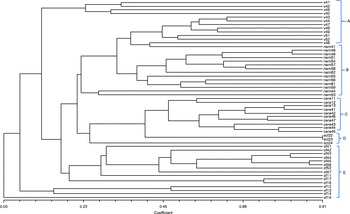
The UPGMA dendrogram with a high cophenetic correlation coefficient (r= 0.920) based on SRAP markers grouped the five species into five distinct clusters (Fig. 1), which is in agreement with the previous observations of Sepehry Javan et al. (Reference Sepehry Javan, Rahmani and Heidari2012). The A, B, C, D and E groups consisted of S. virgata, S. nemorosa L., S. cereal L., S. sclarea L. and S. officinalis L., respectively. The SRAP analyses showed S. virgata Jacq. and S. officinalis L. as the most divergent ones.
UPGMA dendrogram of 54 sage genotypes using SRAP markers based on Jaccard's coefficient. A, B, C, D and E groups consist of S. virgata, S. nemorosa L., S. cereal L., S. sclarea L. and S. officinalis L., respectively.

Genetic relationships among the sage samples were also analysed by the PCoA. The first three principal coordinates explained 26.2% of the total variation, showing that the original data were not highly correlated in the PCoA.
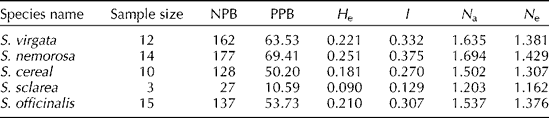
The 54 sage samples were grouped into five groups by their species. On the whole, among the five species, the highest Shannon's information index, Nei's gene diversity index, the observed and effective number of alleles, and the percentage of polymorphic loci were found in S. nemorosa L. (Table 1). The largest genetic distance (0.565) was observed between S. nemorosa L. and S. sclarea L. and the smallest one (0.126) occurred between S. nemorosa L. and S. virgata Jacq. (Supplementary Table S3, available online).
Summary of genetic variation statistics for all loci in the five Salvia species

NPB, number of polymorphic bands; PPB, percentage of polymorphic bands; H e, Nei's gene diversity; I, Shannon's information index; N a, observed number of alleles; N e, effective number of alleles.
In conclusion, SRAP markers, which targeted ORFs (open reading frames) as functional regions of the sage genome and reached the resulting sufficient polymorphism, can be successfully used for determining the genetic diversity and population structure of Salvia species.
Supplementary material
To view supplementary material for this article, please visit http://dx.doi.org/10.1017/S1479262115000593
Acknowledgements
The authors thank the Department of Biotechnology, College of Agriculture, Isfahan University of Technology for the use of facilities.