Today there is good evidence for the theory that dyslexia is caused by a deficit in phonological abilities (e.g., Snowling, Reference Snowling2000). The specific nature of the phonological deficit, however, is still unclear. It has been suggested that the deficit is one of indistinct phonological representations (Elbro, Reference Elbro1996; Elbro & Jensen, Reference Elbro and Jensen2005; Fowler & Swainson, Reference Fowler and Swainson2004), less segmented lexical representation (e.g., Fowler, Reference Fowler, Brady and Shankweiler1991; Metsala, Reference Metsala1999), or deficient mechanisms for handling output representations (Griffiths & Snowling, Reference Griffiths and Snowling2001; Hulme & Snowling, Reference Hulme and Snowling1992).
This paper addresses the central question: at what stage(s) in processing phonological processing do dyslexics experience difficulties; specifically, whether dyslexics also experience difficulties in input processing stages in addition to production stages. The question arises because, although there have been clear and robust findings of group differences in production-based tasks, results on perception-based tasks have been mixed. I present evidence to suggest that dyslexics do have difficulties in input processing.
PRODUCTION
It is well documented that dyslexics have difficulties in tasks that require speech production. In picture-naming studies, it has been demonstrated that dyslexics perform worse compared to both chronological age (CA) and reading age (RA) controls (for a recent review, see Nation, Reference Nation2005). Furthermore, it has been argued that the picture-naming difficulties are related to the phonological deficit because they mainly are associated with phonologically complex (i.e., long) words (Nation, Marshal, & Snowling, Reference Nation, Marshal and Snowling2001; Swan & Goswami, Reference Swan and Goswami1997), and because there is an overrepresentation of phonological errors in the dyslexics’ error patterns (Dietrich & Brady, Reference Dietrich and Brady2001; Nation et al., Reference Nation, Marshal and Snowling2001; Swan & Goswami, Reference Swan and Goswami1997). In addition, Dietrich and Brady found that dyslexics were more likely than controls to make different naming errors when tested on the same word on two separate occasions, suggesting that the naming difficulty is a result of indistinct phonological representations (Elbro, Reference Elbro1996, Reference Elbro1998) or difficulties with accessing phonological representations (Ramus & Szenkovits, Reference Ramus and Szenkovits2008).
There is also robust evidence that dyslexics have difficulties when having to rapidly and repeatedly name a limited number of known words in the rapid automatized naming (RAN) task (Denckla & Rudel, Reference Denckla and Rudel1976). There are indications, however, that this deficit is distinct from the phonological deficit (Clarke, Hulme, & Snowling, Reference Clarke, Hulme and Snowling2005; Manis, Seidenberg, & Doi, Reference Manis, Seidenberg and Doi1999; Wolf et al., Reference Wolf, O'Rourke, Gidney, Lovett, Cirino and Morris2002). It has been suggested that the RAN task taps the ability to arbitrary links between orthographic symbols and sounds (Manis et al., Reference Manis, Seidenberg and Doi1999) or control over reading strategy (Clarke et al., Reference Clarke, Hulme and Snowling2005) rather than phonological ability. The proposed difference in causes for picture-naming and RAN deficits would also explain why there appear to be no timing deficit associated with picture naming (Nation et al., Reference Nation, Marshal and Snowling2001; Snowling, van Wagtendonk, & Stafford, Reference Snowling, van Wagtendonk and Stafford1988), whereas this is the hallmark of the RAN difficulty.
PERCEPTION
A number of studies have found that some dyslexics perform worse on phoneme perception tasks such as phoneme discrimination and phoneme identification (Adlard & Hazan, Reference Adlard and Hazan1998; Manis et al., Reference Manis, McBride-Chang, Seidenberg, Keating, Doi and Munson1997; Mody, Studdert-Kennedy, & Brady, Reference Mody, Studdert-Kennedy and Brady1997). However, perception deficits in the dyslexic groups appear to affect only a minority (Adlard & Hazan, Reference Adlard and Hazan1998; Manis et al., Reference Manis, McBride-Chang, Seidenberg, Keating, Doi and Munson1997; Ramus et al., Reference Ramus, Rosen, Dakin, Day, Castellote and White2003). Furthermore, Joanisse, Manis, Keating, and Seidenberg (Reference Joanisse, Manis, Keating and Seidenberg2000) found that the subgroup with perceptual difficulties also had more pervasive language difficulties. Goswami and collegues (Pasquini, Corriveau, & Goswami, Reference Pasquini, Corriveau and Goswami2007; Thomson, Ben Fryer, & Goswami, Reference Thomson, Ben Fryer and Goswami2006) have in recent studies found that dyslexics have difficulties on some beat detection measures, but they are still surrounded by some controversy (Rosen, Reference Rosen2003).
The question, then, is, why is it difficult to find robust group differences in perception studies, but relatively easy in production studies? One probable answer is that dyslexia is not caused by a perception deficit. In a review of auditory perceptual difficulties in dyslexia and specific language impairment, Rosen (Reference Rosen2003, p. 524) concluded that perceptual difficulties are neither necessary nor sufficient for explaining dyslexia, even though it appears that there is an overrepresentation of individuals with perceptual impairment in these populations (cf. also Bailey & Snowling, Reference Bailey and Snowling2002).
However, if we instead ask the question of the input/output asymmetry in an effort to understand the nature of the phonological deficit, for example, which subsystems are affected, a few other possibilities present themselves: (a) the phonological deficit is restricted to output processing systems, (b) the tasks used in previous perception studies have not tapped into the relevant input processing resources, and (c) the tasks used in previous studies of perception have not been sufficiently sensitive. I will discuss these three possibilities in turn.
Poor production performance has been linked to the phonological deficit through the rationale that poor representations explain inaccurate and/or slow performance on tasks that utilize the representations, for example, speech production tasks. The simplest assumption would be that there is a shared set of phonological representations between input and output processing, and according to this assumption we would expect dyslexics to have difficulties with input tasks as well as output tasks. However, this is not what we clearly find in the dyslexia literature.
In the aphasia literature, however, it has been suggested that there are separate input and output phonological representations (e.g., Nickels & Howard, Reference Nickels and Howard1995) or that there are separate access procedures (Hillis, Reference Hillis and Rapp2001), and it is thus possible that the input/output asymmetry in the literature on dyslexia reflects a selective deficit in either output processing representations or the output processing systems that access the representations (Griffiths & Snowling, Reference Griffiths and Snowling2001; Hulme & Snowling, Reference Hulme and Snowling1992).
However, there is also work in the aphasia literature suggesting that the phoneme identification and discrimination tasks that have been used in the dyslexia literature do not assess all phonological input processes. There are cases of patients without identification or discrimination problems, but who have difficulties rejecting nonsense words in lexical decision tasks (Martin & Saffran, Reference Martin and Saffran2002; Martin, Breedin, & Damian, Reference Martin, Breedin and Damian1999). Martin and Saffran (Reference Martin and Saffran2002) furthermore found that in a group of aphasics, nonsense word performance correlated with the number of phonological picture-naming errors, and that the one patient who had a picture-naming deficit but no difficulty with phoneme identification/discrimination, actually did make a high proportion of nonsense word errors on the lexical decision task. Saffran and Martin argued that whereas word errors can occur as a result of either phonological or semantic disturbances, nonsense word errors occur mainly as a result of disturbances in phonological processing. The rationale is that weak phonological representations makes it more difficult to differentiate a nonsense word from neighboring real words and thus to reject the nonsense word (cf. Constable, Stackhouse, & Wells, Reference Constable, Stackhouse and Wells1997). Weak representation could in principle also result in errors on real words through insufficient activation of lexical representations, but this would probably entail more widespread difficulties in general on receptive vocabulary tasks, of which there is limited evidence in dyslexia (e.g., Swan & Goswami, Reference Swan and Goswami1997). To the extent that the weak representations simply translate into more accepting behavior on the lexical decision task, there should be little or less impact on real word performance. Errors on real words could, however, also stem from plain lack of vocabulary or from insufficient feedback activation from weak semantic representations (Martin & Saffran, Reference Martin and Saffran2002). According to this analysis of the lexical decision task, nonsense word performance is the cleaner and more relevant measure of phonological processing. It is thus possible that there are disturbances somewhere in the process that maps phonemic representations to the phonological representations of words, and that the reason why phonological deficits have been better documented in output processing studies of dyslexia is that most of the input studies have used tasks that do not tap the relevant phonological processing resources.
There are a few dyslexia studies that have used lexical decision tasks. Nicolson and Fawcett (Reference Nicolson and Fawcett1994) found no differences in accuracy between dyslexic and control groups, but they did find that dyslexics were slower than CA controls, whereas the results of the RA comparisons were somewhat unclear. The exact interpretation is complicated, however, because the dyslexics were slower than the controls on other nonphonological reaction time (RT) measures. Contrary to Nicolson and Fawcett, Snowling, Goulandris, Bowlby, and Howell (Reference Snowling, Goulandris, Bowlby and Howell1986) found that dyslexics were less accurate than CA controls (but as accurate as RA controls) in accepting words, but they did not report nonsense word performance. Using a task similar to lexical decision Fowler and Swainson (Reference Fowler and Swainson2004) found that poor readers were more tolerant than good readers when judging the acceptability of deviant pronunciations of long words. Carroll and Snowling (Reference Carroll and Snowling2004) have similarly presented results indicating that children at risk for dyslexia were worse at detecting word mispronunciations. In the present paper I provide further data on the lexical decision performance of dyslexics.
Other studies have investigated word-level input processing. Desroches, Joanisse, and Robertson (Reference Desroches, Joanisse and Robertson2006) conducted an eye-tracking study where children were instructed to look at one of four items in a computer display. Analyses of the eye-movement data revealed that the control children were momentarily distracted by the existence of pictures with either the same rhyme as the target picture or the same beginning phonemes. Dyslexic children identified the target pictures and were, just as controls, distracted by words with the same beginnings, but they were not distracted by the words with the same rhyme as the target. This suggests that they did not have difficulties with phoneme perception as such, but that there was problem at a higher level of sound representation that also influenced the perception of words. Elbro, Nielsen, and Petersen (Reference Elbro, Nielsen and Petersen1994) reported that after semantic vocabulary was taken into account, adult dyslexics performed worse than controls on a task where participants had to pick the synonym of a test word out of three spoken, phonologically similar words. Again this indicates that dyslexics have word-level input processing difficulties, a notion that is further supported by some studies showing that dyslexics need more material to identify words in gating task compared to age controls (Bruno et al., Reference Bruno, Manis, Keating, Sperling, Nakamoto and Seidenberg2007; Metsala, Reference Metsala1997), but not all results have been positive (Griffiths & Snowling, Reference Griffiths and Snowling2001).
Looking across these different word-level input studies the results are somewhat mixed, in part because there has been no positive results in RA comparisons. However, compared to the results of the identification/discrimination studies, the results are more suggestive of a phonological deficit shared between the input and the output systems.
It is worth noting that most of the input studies described here have used short stimuli items, whereas many of the production studies have either used only long words (Dietrich & Brady, Reference Dietrich and Brady2001) or have found the clear group differences on long words (Nation et al., Reference Nation, Marshal and Snowling2001; Swan & Goswami, Reference Swan and Goswami1997). RAN studies are obvious contradictions to this trend, but as mentioned above, there is growing evidence that RAN difficulties are associated with other deficits instead of or in addition to a phonological deficit. That long stimuli appear to be more likely to produce group differences in output studies raises the possibility that previous input studies have not used sufficiently sensitive stimuli to produce group differences (for similar discussion in relation to naming studies, see Swan & Goswami, Reference Swan and Goswami1997). Sensitivity is also relevant to consider in relation to the nature of the tasks used when testing and comparing input and output processing. In most, if not all, output tasks, informants have to produce the entire response from scratch, that is, access the right word representation, make a fully specified articulatory plan, and follow through with the plan under the constraint of time and memory limitations. Most, if not all, input tasks, in contrast, are forced choice tasks, where the opportunity for error is much lower. This task asymmetry makes simple comparisons between input and output tasks difficult (cf. Allport, Reference Allport1984; Martin & Saffran, Reference Martin and Saffran2002).
In sum, it is possible that dyslexia is associated with input processing difficulties, but that the mixed results are because of the possibility that (a) phoneme discrimination and identification tasks do not test the relevant stage in processing; (b) previous lexical decision studies have not focused on the right data, that is, nonsense word performance; and (c) previous lexical decision studies have not used the most sensitive stimuli, that is, long words, a problem that is accentuated because input tasks, due to their forced choice nature, are less sensitive than open ended output tasks.
There are two research questions for the present paper. (a) Are dyslexics slower and less accurate than controls when judging nonsense words in lexical decision? (b) Does performance on nonsense words in lexical decision correlate with performance on phonological output tasks such as phoneme awareness and nonsense word reading? The first question deals with some of the shortcomings of the possible lack of sensitivity in previous lexical decision designs by using more sensitive materials and RT measures in a RA-match design. The second question deals with validation of the lexical decision task as a measure of those phonological processes relevant for dyslexia. If the ability to reject deviant pronunciations is contingent on phonological representations or processes that are shared between input and output systems, performance on such tasks should correlate with output tasks that are assumed to rely upon the same processes and systems.
METHOD
Participants
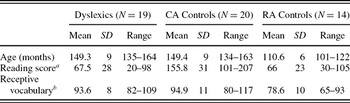
The dyslexic children were recruited from five schools with special reading programs for Grades 5 and 6 in the Copenhagen area. Only children who were native speakers of Danish with no reported overt general learning or behavioral problems were selected. The test is not normed beyond Grade 3, but a few of the children turned out to score above the 25th percentile for their grade level on the OS-400 Word Decoding Test (Søegård & Petersen, Reference Søegård and Petersen1974) used for RA matching (see below for details) based on the scores in the CA screening sample. These children were excluded from all the following analyses because of the suspicion that they had been referred to reading programs because of other concerns than a specific reading impairment. RA and CA controls were selected from second to third grade and fifth to sixth grade at some of the same schools based on screening using the OS-400 test. Children in the control groups that read below the 25th percentile in their grade group were excluded out of a concern that they might have had undiagnosed learning disabilities. For the RA control group, children were chosen to match the dyslexic group on mean reading. A balancing issue in the lexical decision experiment made it necessary to remove four dyslexics and six RA controls from the sample. These were chosen on the basis of silent decoding and receptive vocabulary score such that reading level match and vocabulary match between the dyslexics and CA controls was upheld, but without looking at data from the other experiments (Table 1).
Summary of participant characteristics

aNumber of correct answers within 5 min on the OS400 silent word decoding test.
bNumber of correct answers on the Danish translation of the Peabody Picture Vocabulary Test.
Tests and materials
Except for the silent word decoding test used for RA matching, the children were tested individually in quiet rooms at the schools over two sessions lasting 30–45 min, each on separate days. Each session consisted of a number of tests that were administered in the same order for every child. Some of the tests were carried out on a Thinkpad laptop with an attached serial response box using the E-prime experimental software. The tests are described in the order of administration in the following.
Silent word decoding. The paper based OS-400 test (Søegård & Petersen, Reference Søegård and Petersen1974) was used for RA matching. It was administered on a group basis. The test consists of 400 isolated test items. For each item the participants had to select which of four pictures matches a written word. Items were presented in rows in a booklet, and the participants were instructed to complete as many as possible within a time limit. The score was computed as the number of correct responses made within a 5-min time limit. Test–retest correlation has previously been reported at 0.93 (Elbro, Rasmussen, & Spelling, Reference Elbro, Rasmussen and Spelling1996).
General RT. In this computer-based task, the children saw three symbols lined up vertically on the screen: two asterisks and a plus sign. The goal was to determine as quickly as possible where the plus sign was, and push one of three buttons on the button box corresponding to the spatial position on the screen.
Lexical decision. In the computer-based lexical decision task, the children were asked to decide whether spoken words were real words or nonsense words. They were told to be careful because the nonsense words sounded very similar to real words, but also that they should decide fast. The test started with 10 practice items illustrating that the nonsense words closely resembled real words. Children scoring below 80% correct on the practice items were given new rounds of practice until they met the 80% criterion.
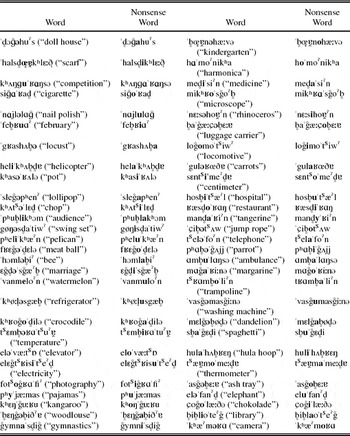
Materials for the experiment consisted of 56 words and 56 nonwords. The words were three to five syllables long, and pronounced distinctly. To make the stimuli maximally sensitive, nonsense words were derived from words by changing a weak vowel for another full vowel, while keeping the stress patterns unchanged. For example, tseləˈfoˀn (“telephone”) was changed to tselaˈfoˀn (vowel reduction in unstressed syllables is not obligatory in Danish, especially not in distinct pronunciation). A weak vowel was defined as schwa or a vowel that routinely is reduced to schwa or completely omitted (see Appendix A for a full list of items). Weak vowels were determined using a dictionary of pronunciation (Brink, Heger, & Lund, Reference Brink, Heger and Lund1991) and judgments made by the author and a trained phonetician. The rationale was that if dyslexics have poor-quality representations, weak vowels would constitute the least stable parts of the representations because a person will be subjected to much variation in these segments in their listening experience.
Average duration of words and nonsense words were 637 and 642 ms, respectively. This difference was not significant (F = 0.11). Two counter balanced lists with 26 words and 26 nonsense words each were created. A list only contained one of a word–nonsense word pair. Each list was seen by an equal number of participants from each group. Items were read aloud with distinct pronunciation by a male speaker and recorded in a sound studio. Recordings were digitized at a 44.1-kHz sampling rate using Praat. Sounds were played at a comfortable listening level through headphones. The children made decisions by pressing one (right) button for word and another (left) button for nonsense word. RT from the beginning of a stimuli presentation was recorded along with accuracy.
Receptive vocabulary. Raw score (number of correct answers) on a Danish translation of the Peabody Picture Vocabulary Test (Dunn & Dunn, Reference Dunn and Dunn1981) was used to assess receptive vocabulary. The Danish version has been used for research previously (Elbro, Borstrøm, & Petersen, Reference Elbro, Borstrøm and Petersen1998), but has not been standardized.
Nonsense and irregular word reading. Participants had to read out loud 20 irregular words followed by 40 nonsense words. Items were printed on three separate sheets with 20 items on each. Irregular words were taken from Elbro (Reference Elbro1990). The nonsense words were from Elbro (Reference Elbro1990) and Elbro et al. (Reference Elbro, Nielsen and Petersen1994). In both tasks the items were between two and nine characters long, and generally increased in difficulty through each sheet. The nonwords were phonotactically legal. The irregular words were mostly frequent words. The participants were asked to read the items one at a time without going back, and to take the time they needed. The score for each task was the total number of correctly read items.
Phoneme deletion. This phonemic awareness task was adapted for computer administration from Arnbak and Borstrøm (Reference Arnbak, Borstrøm and Jandorf2007). It consisted of two separate subsections. In both sections the participants had to listen to a word, remove a specific sound from the word, and say out loud the resulting word, for example, what is left if you remove /k/ from kost (“broom”). Answer: ost (“cheese”). In the first section, only the first phonemes were to be deleted (10 items). In the second section medial and final phonemes are to be deleted (20 items alternating between medial and final deletion). Test items were recorded using a male speaker. A section was terminated if a participant made four errors in a row. The score was the total number of correctly produced words across the two sections. The correlation between the first and second section was at .75.
RESULTS
Phoneme awareness, reading aloud, and general RT
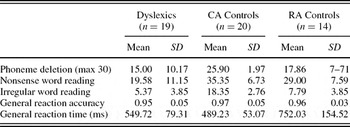
Summary data from reading aloud, phoneme awareness and general RT tasks can be found in Table 2.
Summary of data from phoneme deletion, reading aloud, and reaction time

Note: CA, chronological age; RA, reading age.
The CA controls outperformed dyslexics on all tasks (all Fs > 16). There was no difference between dyslexics and RA controls on phoneme deletion (F < 1), a marginal difference on irregular word reading, F (1, 32) = 3.18, p = .08, and the RA controls outperformed the dyslexics on nonsense word reading F (1, 32) = 7.43, p < .05). These results confirm that the dyslexic group was reading impaired not only in terms of fluency as measured by the OS-400 Silent Decoding Test but also in terms of reading precision, and more so on nonword reading than irregular word reading. In the phoneme deletion task, 74% of the dyslexics performed below 1 SD of the CA group mean, 100% fell below in irregular word reading and 74% fell below in nonsense word reading. On the measure of general RT, CA controls outperformed the dyslexics, F (1, 37) = 7.91, p < .01, and the dyslexics outperformed the RA controls, F (1, 31) = 24.14, p < .001. There was no difference in accuracy in any of the comparisons on this measure.
Lexical decision
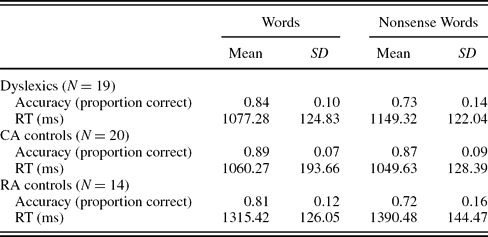
I present separate analyses of accuracy and RT for the comparison between dyslexics and CA age controls on the one hand, and the dyslexics and RA controls on the other. Analyses of accuracy were performed on percentage of correct answers. All children except one from the younger group answered above chance level of 60%. In analyses of RT, only RTs from correct responses were used, and for each subject RTs above or below 2 SD of the subjects mean for a certain condition were left out of the analysis. This affected less than 5% of the data. The RTs were then log transformed to normalize distributions for use in the following analyses of variance (ANOVAs; Table 3).
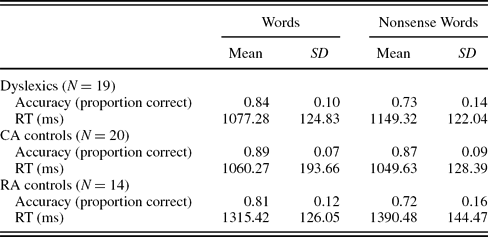
Summary of lexical decision data
Note: RT, reaction time; CA, chronological age; RA, reading age.
Dyslexics and CA controls. The accuracy data were subjected to a 2 (Group) × 2 (Condition) ANOVA with repeated measures on the condition factor. There were main effects of group, F (1, 37) = 13.3, p < .001, and condition, F (1, 37) = 8.44, p < .01. The interaction was marginally significant, F (1, 37) = 3.81, p = .06.Footnote 1 Tests of simple main effects showed that the dyslexics were marginally less accurate on words, F (1, 37) = 2.98, p = .09, but significantly less accurate on nonsense words, F (1, 37) = 12.48, p = .001.
A similar analysis was performed on the RT data. There was a marginally significant main effect of condition, F (1, 37) = 3.59, p = .07, but no effect of group, F (1, 37) = 2.32, p = .14. The interaction was, however, significant, F (1, 37) = 4.28, p < .05.
Tests of simple effects showed that dyslexics were reliably slower on nonsense words, F (1, 37) = 6.16, p < .05, but not on words (F < 0.2).
To sum up, the dyslexics had clear difficulties with rejecting the nonsense words, whereas the group differences are less clear on word performance. As a measure of how widespread deviant performance in the dyslexia group was, 63% of the dyslexics scored below 1 SD of the CA group mean in nonsense word accuracy, compared to 15% in the CA group.
Dyslexics and RA controls. ANOVAs of the accuracy data with group and condition as factors only revealed a main effect of condition, F (1, 31) = 9.26, p < .01 (all other Fs < 1). In the RT analysis, there were main effects of group, F (1, 31) = 35.16, p < .001, and condition, F (1, 31) = 17.52, p = .001. The dyslexics were faster than the RA controls. There was no interaction (Fs < 1). In sum dyslexics were faster than RA controls, and words were responded to faster and with greater accuracy than nonsense words.
Because the groups differed in general RT performance, all RT ANOVAs were rerun with the residuals of regressions of general RT on lexical decision RT. This removed the main effect of group in the RA comparison, F (1, 31) = 2.76, p = .11, but the remaining conclusions remain the same. In other words, when general RT is taken into account, the dyslexics seemed to perform like the RA controls.
Correlations
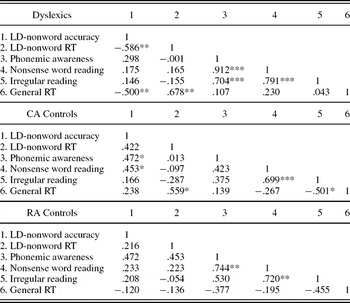
Table 4 shows correlations between nonword performance, phonemic awareness, nonsense word, and irregular word reading, and general RT computed separately for each group.
Simple correlations between key measures

Note: LD, lexical decision, RT, reaction time; CA, chronological age; RA, reading age.
*p < .05. **p < .01. ***p < .001.
The hypothesis was that if lexical decision is a measure of phonological processing, lexical decision performance should correlate with other traditional measures of phonological processing, specifically phonemic awareness and nonsense word reading. Such correlations were only reliably found in the CA group, where lexical decision accuracy on nonsense word accounted for 22% of the variance in phonemic awareness and 20% of the variance in nonsense word reading. In the RA group, lexical decision accuracy also accounted for 22% of the variance in phonemic awareness, but this was not significant because of the smaller sample size.
The correlation analyses did reveal one unexpected pattern with regard to the relationship between speed and accuracy in the lexical decision data. In the CA control group there was a tendency for accuracy being positively correlated with speed (r = .42, p = .08) such that the individuals who spent more time on this task were more accurate. The trend was the opposite for the dyslexia group where the individuals who spent most time on nonsense words were the ones who scored the lowest (r = −.59, p < .05). There was no significant trend in the RA control group. A possible explanation for this pattern might be that there is a normal speed accuracy trade-off in the CA control group, such that spending more time on the task yields better performance, whereas the slowest performers in the dyslexia group are slow because they find the task very difficult. This finding suggests that the dyslexics process this task differently from the other groups.
GENERAL DISCUSSION
The central aim of the present study was to find out whether dyslexics have word-level difficulties with auditory input processing. This turned out to be the case. The dyslexics performed less accurately than chronological controls on a lexical decision task with long stimuli, and the difference was disproportionally large with regard to the ability to reject nonsense words. Furthermore, the dyslexics were slower to reject nonsense words, even when they did answer correctly. These results indicate that the dyslexics may have an input processing difficulty. The implication is that the cognitive disturbances associated with dyslexia are not restricted to output processing as has been suggested (Griffiths & Snowling, Reference Griffiths and Snowling2001; Hulme & Snowling, Reference Hulme and Snowling1992). The results complement previous studies demonstrating dyslexics’ age-related deficits in input processing that supposedly depend on high-level representations (Desroches et al., Reference Desroches, Joanisse and Robertson2006; Elbro et al., Reference Elbro, Nielsen and Petersen1994). These results and the more mixed results on phoneme-level tasks in the literature (Adlard & Hazan, Reference Adlard and Hazan1998; Landerl & Wimmer, Reference Landerl and Wimmer2000; Manis et al., Reference Manis, McBride-Chang, Seidenberg, Keating, Doi and Munson1997; Ramus et al., Reference Ramus, Rosen, Dakin, Day, Castellote and White2003) are suggestive of a word-level deficit in the quality of phonological representations (Elbro, Reference Elbro1996; Fowler & Swainson, Reference Fowler and Swainson2004) shared between input and output processing. A different possibility is that the representational deficit is at a sublexical level, but in such a way that phoneme perception is relatively intact. Finally, the result pattern may also be compatible with a theory that explains deficits in input and output performance in terms of a deficit in phonological memory or access to phonological representations (Ramus & Szenkovits, Reference Ramus and Szenkovits2008), for example, because of rapid decay at phoneme level (e.g., Martin et al., Reference Martin, Breedin and Damian1999). It should be noted that these different possibilities are not mutually exclusive. For example, a phonological memory problem would probably lead to impaired sublexical and lexical representations, and impaired lexical representation would provide less support for establishing memory efficient sublexical representations. Dyslexics have been shown to have difficulties with repeating nonsense words (Snowling et al., Reference Snowling, Goulandris, Bowlby and Howell1986; Stone & Brady, Reference Stone and Brady1995), and this has been interpreted to show that the problem resides at the sublexical level (Szenkovits & Ramus, Reference Szenkovits and Ramus2005). However, dyslexics have also been shown to have difficulties with learning new word forms despite having good immediate recall of the forms (Mayringer & Wimmer, Reference Mayringer and Wimmer2000). This has been interpreted to show that the problem rather is of establishing precise lexical representations. The present results do not allow us to choose between these interpretations, and because establishing word representation presumably draws on sublexical skills, it is a big challenge to figure out ways to tease these issues apart. The goal of the present study was, however, simply to establish whether dyslexia is associated with an input processing problem.
Given the recent controversy on the existence of auditory rise-time perception deficits in dyslexia (Pasquini et al., Reference Pasquini, Corriveau and Goswami2007; Richardson, Thomson, Scott, & Goswami, Reference Richardson, Thomson, Scott and Goswami2004; Rosen, Reference Rosen2003), it should be noted the present results are probably only loosely related to this issue. Such a deficit has been suggested as the cause of poor phonological representations, and as such is compatible with the present results. However, it is doubtful whether a rise-time perception deficit could be the immediate cause of the present lexical decision result pattern, and the present results do not rule out such a deficit.
The present experiments also demonstrated a group difference between the dyslexics and the CA controls in the nonlinguistic RT task. This could be interpreted as deficit in stimulus classification speed (Nicolson & Fawcett, Reference Nicolson and Fawcett1994), but another possible interpretation is the difference arises from differences in approach to being tested. The dyslexics were used to being tested on tasks that they find very difficult (e.g., reading), and this might have made their initial approach more careful than that of their age peers, even on tasks they find easy. As a subjective observation, the dyslexics did seem more anxious than the controls upon starting the test sessions. In anticipation of this, tasks that the dyslexics would know they would have difficulty with (reading, phoneme deletion) were placed last in the test sessions. A possible explanation for the findings that dyslexics were just as fast as the CA controls in accepting real words in the lexical decision task could be that they had they calmed down during the nonlinguistic RT task, which was the first task. Given this possibility we do not want to conclude that the dyslexics had a general RT deficit. In any event, the classification speed hypothesis cannot explain the result that the dyslexics had disproportional difficulties with nonsense words.
The precise interpretation of the lexical decision results as characteristic of a cognitive deficit underlying reading failure is made difficult by two factors, however. First, the dyslexics performed as the RA controls on the lexical decision task, making it impossible to conclude whether the poor performance was because of the underlying cognitive cause of dyslexia or to poor reading ability or experience. It is perfectly possible that a stabilization or specification of lexical phonological representations is a side effect of reading experience; robust experience with how weak segments are spelled may help specify the phonological representations of these words. However, neither can we rule out that unstable phonological input processing or representations are an attribute of the cognitive impairment that causes dyslexia. This is a limitation of the RA match design (Bryant & Goswami, Reference Bryant and Goswami1986). Notice that there was a similar problem with phoneme awareness in this study, because the expected group difference in RA comparisons on the traditional dyslexia measures was only obtained reliably in the nonsense word-reading task. Because there were age-related differences in both vocabulary and general RT further highlights the problem of the RA comparison: even though the dyslexic and the RA control group were matched on reading level, the dyslexics had additional age related nonphonological resources that they could potentially draw on in solving a task, and this could hide actual differences in the ability that a given task is designed to measure. One way to progress beyond the limitation in the RA match design is to investigate how lexical decision performance predicts reading ability in longitudinal designs.
Second, the other problem of interpretation stems from the lack of clear correlations between lexical decision performance and the traditional phonological measures of phoneme awareness and nonsense word reading. The lack of correlation could be taken as an indication of the lack of validity of lexical decision performance as indexing phonological processing, or that it indexes another kind of phonological processing.
Yet another possible explanation for the unclear correlation between lexical decision and traditional phonological measures is that the shared phonological component between the tasks is washed out by differences in task demands. Nonsense word reading is obviously contingent upon reading ability in addition to phonological processing. The phoneme deletion task is quite complex in that it, in addition to phonological resources, depends on the ability to perform two distinct operations (identifying a specific segment, deleting the segment) on a representation held in working memory (Yopp, Reference Yopp1988), and phoneme awareness tasks have been shown not to correlate with other phonological tasks once reading ability is taken into account (Foy & Mann, Reference Foy and Mann2001). In this light, lexical decision appears to be a more “clean” task, primarily requiring a match between an auditory input and a word representation. However, it is obvious that more research is needed to establish the validity of this task as a measure of phonological distinctness.
The present data do not allow us to differentiate between these possibilities, but validation of lexical decision as a phonological measure and the factoring out of the phonological components of nonsense word reading and phoneme awareness tasks are both good subjects for further research. If it turns out that phoneme awareness does rely heavily on nonphonological skills, such as the ability to attend to and manipulate representations held in working memory, and these skills are important for reading acquisition, then this would explain why performance on phoneme awareness tasks are such good predictors of reading development (Scarborough, Reference Scarborough, Shapiro, Accardo and Capute1998); by being dependent on several component abilities of reading, a task will have a better chance of detecting weaknesses that may lead to reading failure than tasks that only test one subcomponent. The price of measures that aggregates different abilities is that they contribute less to our understanding of the precise nature of the problem.
Lexical decision measures are not going to replace phoneme awareness or nonsense word reading as a diagnostic of dyslexia, but they may provide insight into the nature of the cognitive problems that are the source of reading disability.
APPENDIX A
Table A.1 provides the 56 items in the auditory lexical decision task. Each item consists of a word and a derived nonsense word. Each participant saw only the word or the nonsense word of a specific item. Weak vowels are indicated in bold. The items are transcribed in a version of the IPA font that is slightly accommodated to Danish (Grønnum, Reference Grønnum2000).
Items in the auditory lexical decision task

ACKNOWLEDGMENTS
This work was made possible by a grant from the Danish Research Council for the Humanities awarded to the author. The paper has benefited greatly from discussions with Carsten Elbro, Holger Juul, and Nicolai Pharao. I am greatly indebted to the children and teachers who volunteered to participate in this work.