Introduction
Infections caused by gastrointestinal nematodes are responsible for making a significant impact on sheep production, with important implications (Acharya et al., Reference Acharya, Hildreth and Reese2014). Haemonchus contortus is a parasite of utmost importance in this context, and the most pathogenic (Fernandes et al., Reference Fernandes, Seno, Amarante, Souza and Belluzzo2004). The description of cases of gastrointestinal nematodes resistant to antiparasitic drugs – the primary means of control and treatment of this infection – has become frequent (Torres-Acosta & Hoste, Reference Torres-Acosta and Hoste2008). These observations have led researchers to develop alternatives, such as the use of phytotherapy and nanotechnology.
Essential oils have been used in nutrition and also as phytotherapy in ruminants by modulating ruminal fermentation to improve nutrient utilization (Hristov et al., Reference Hristov, McAllister, Van Herk, Cheng, Newbold and Cheeke1999). This characteristic may lead to a higher production rate in these animals as well as to pathogen control, since the antimicrobial properties of the oils have been demonstrated against a wide range of micro-organisms, including bacteria, protozoa and fungi (Benchaar et al., Reference Benchaar, Calsamiglia, Chaves, Fraser, Colombatto, McAllister and Beauchemin2008).
The essential oil of melaleuca, popularly known as ‘tea tree oil’ (TTO), is obtained from the leaves of the native Australian plant Melaleuca alternifolia (Mulla & Su, Reference Mulla and Su1999). Medicinal properties, such as antibacterial, antifungal, antiviral, anti-inflammatory, analgesic, antineoplastic, antiparasitic and insecticidal activities, are described for both this oil and its major component, terpinen-4-ol (Carson & Riley, Reference Carson and Riley1993; Hart et al., Reference Hart, Brand, Carson, Riley, Prager and Finlay–Jones2000; Hammer et al., Reference Hammer, Carson and Riley2003; Caldefie-Che'zet et al., Reference Caldefie-Chézet, Fusillier, Jarde, Laroye, Damez, Vasson and Guillot2006; Furneri et al., Reference Furneri, Paolino, Saija, Marino and Bisignano2006; Baldissera et al., Reference Baldissera, Da Silva, Oliveira, Santos, Vaucher, Raffin, Gomes, Dambros, Miletti, Boligon, Athayde and Monteiro2014). However, there are no reports in the literature of the activity of this oil on endoparasites, which raises great interest in evaluating the oil with in vitro tests and, afterwards, in in vivo research.
Given that this endoparasitism is responsible for severe infections associated with large economic losses and that there are few studies of nanostructured systems in the therapy of this disease, the aim of this study was to assess the in vitro activity of free and nanostructured TTO and of terpinen-4-ol on eggs and larvae of H. contortus.
Materials and methods
Preparation of test solutions and essential oils of M. alternifolia
TTO was purchased from Importadora Química Delaware Ltda® (Porto Alegre, Brazil). Solid lipid nanoparticles were prepared with 7.5% of the essential oil of M. alternifolia (nanoTTO) obtained from the company Inventiva® (Porto Alegre, Brazil). The other solutions used – terpinen-4-ol (terp-4-ol), Tween 80 (TW), thiabendazol (TBZ) and levamizol (LEV) – were acquired from Sigma-Aldrich® (Saint Louis, Missouri, USA). The composition and yield of the oil were analysed using gas chromatography (GC) by means of a system Agilent Technologies 6890N GC-FID, equipped with a DB-5 capillary column. The relative concentrations of the components of the oil were calculated from the GC peak areas without the use of correction factors, and their identifications were based on the retention index, comparing with a library of mass spectra (Adams, Reference Adams1995).
Eggs and larvae of H. contortus
The infective third-stage larvae (L3) and eggs were obtained by means of a donor sheep, which was infected and maintained with a monospecific pure culture of H. contortus. Eggs were recovered according to the methodology described by Bizimenyera et al. (Reference Bizimenyera, Githiori, Eloff and Swan2006). Faeces were homogenized in water and filtered through a set of sieves (250, 75, 43 and 25 μm), and eggs were separated by means of centrifugation (3000 rpm for 5 min) with a sodium chloride saturated solution. L3 were obtained by faecal culture, following the technique of Roberts and O'Sullivan modified by Ueno & Gonçalves (Reference Ueno and Gonçalves1994).
Egg hatch test (EHT)
This in vitro test, which assesses the ovicidal activity of the tested solutions, was based on the method described by Coles et al. (Reference Coles, Bauerb, Borgsteedec, Geertsd, Kleie, Taylora and Wallerf1992) and standardized by Von Samson-Himmelstjerna et al. (Reference Von Samson-Himmelstjerna, Coles, Jackson, Bauer, Borgsteede, Cirak, Demeler, Donnan, Dorny, Epe, Harder, Höglund, Kaminsky, Kerboeuf, Küttler, Papadopoulos, Posedi, Small, Várady, Vercruysse and Wirtherle2009). Five concentrations of TTO, nanoTTO and terp-4-ol (3.5, 1.7, 0.85, 0.4 and 0.2 mg/ml) were prepared with 0.5% of TW, which was used as an emulsifier for TTO and terp-4-ol. In addition, three controls were carried out: negative control, with distilled water; positive control, with a solution of 0.05 μg of TBZ; and a control with TW. A suspension of 500 μl containing approximately 100 eggs was distributed in 24 wells of cell culture plates; afterwards, 500 μl of the test solutions were added per well. Subsequently, plates were incubated in an oven for 24 h at 27°C. After the incubation period, drops of low Lugol (1%) were added to each well, and eggs and first-stage larvae (L1) were quantified using an inverted optical microscope and a 10 × objective. The test was validated when the negative control and the control of TW had a hatching greater than 90%. In order to calculate the percentage inhibition of larval hatching (Coles et al., Reference Coles, Jackson, Pomroy, Prichard, von Samson-Himmelstjerna, Silvestre, Taylor and Vercruysse2006), the formula (%) inhibition = [(A − B)/A] × 100 was used, where A = number of larvae hatched in the negative control and B = number hatching in test solutions. Tests were performed six times.
Larval migration inhibition test (LMIT)
This test determines the larvicidal effect of the test substances, by assessing the motility and/or migration of infective larvae (L3) according to the methodology described by Demeler et al. (Reference Demeler, Küttlerb, El-Abdellatic, Staffordd, Rydzike, Varadyf, Kenyong, Colesd, Höglunde, Jacksong, Vercruyssec and Samson-Himmelstjerna2010). For testing, a serial dilution of TTO, nanoTTO and terp-4-ol was performed to give five concentrations (56, 28, 14, 7 and 3.5 mg/ml). In addition, three controls were prepared: negative control, with distilled water; positive control, with a solution of 20 μg LEV; and a control with TW. Before starting the test, L3 were exsheathed with a solution of sodium hypochlorite (0.3%). Approximately 150 larvae were incubated in a greenhouse in different concentrations of test solutions in quadruplicate, for 24 h at 28°C (using rows A and C of 24-well cell culture plates) in a final volume of 1000 μl per well. After 24 h, 1000 μl of each well was withdrawn, and 25-μm sieves were mounted on wells. In each well, an aliquot of 1000 μl of the solution containing the larvae was repositioned, incubating again at 28°C for 24 h. After the second incubation, sieves were carefully removed and the remaining larvae that did not migrate were washed with distilled water into the well just below the one that was used (rows B and D). Finally, the migrating larvae (rows A and C) and those that did not migrate (rows B and D) were read in the inverted optical microscope at 10 × magnification. The percentage of inhibition of larval migration was calculated by the inhibition formula (%) inhibition = [(A − B)/A] × 100, where A = number of larvae migrating in the negative control and B = number of larvae migrating in the corresponding treatments.
Statistical analysis
Data were subjected to post-hoc Tukey's one-way analysis of variance (ANOVA) to verify the accuracy of the data. Values of P< 0.05 were considered to be significant. Then, LC50 and LC90 were described, calculated from Graphpad Prism® 5.0.
Results
Fifteen components were identified in TTO, representing 95.86% of the total composition. Results indicated that the most representative compounds were terpinen-4-ol (41.98%), followed by γ-terpinen (20.15%), α-terpinene (9.85%), 1.8-cineole (6.03%) and terpinolene (4.15%). Currently, the composition of the TTO is regulated by an international standard, the ISO 4730 (International Standards Organization, 1996). In this study, the phytochemical characterization of the oil confirms its suitability.
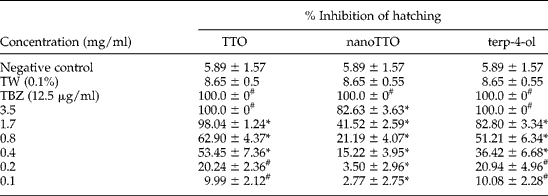
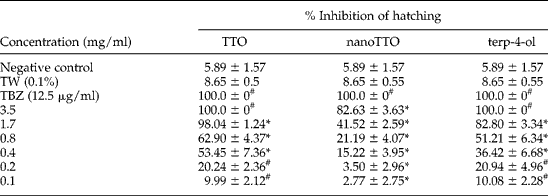
The mean percentages of hatching inhibition of the EHT are given in table 1. The negative control and the TW control had a hatching of 94.11% and 91.35%, respectively, validating the test performed and proving that TW had no effect on eggs. All solutions tested, in the four highest concentrations, demonstrated the inhibition of hatching of larvae of H. contortus compared to the control, and in the highest concentration, TTO and terp-4ol obtained a total inhibition at hatching of the larvae equal to that of TBZ, which was used as positive control for this test. NanoTTO, at its highest concentration, obtained less inhibition (82.63%), thereby showing lower activity at all the concentrations when compared to TTO and terp-4-ol.
Egg hatch test (EHT): mean percentage (%) inhibition of hatching (± SD) of H. contortus eggs in the essential oil (TTO) and nanoparticles (nanoTTO) of the essential oil of M. alternifolia, and terpinen-4-ol (terp-4-ol) in concentrations ranging from 0.1 to 3.5 mg/ml, using negative and 0.1% Tween 80 (TW) controls plus positive controls with thiabendazole (TBZ) at 12.5 μg/ml.
*, Level of significance with P< 0.05 compared with negative controls
#, levels in the same row are not significantly different.
The LC50 and LC90 of TTO for inhibition of hatching of larvae of H. contortus, were 0.43 mg/ml and 1.75 mg/ml, respectively, thus TTO was considered to be the most effective solution tested. The next most effective solution, again with approximate data, was terp-4-ol, showing 0.63 mg/ml (LC50) and 3.12 mg/ml (LC90), and lastly, with lower activity, since it requires a higher concentration, was nanoTTO with 1.81 mg/ml (LC50) and 6.29 mg/ml (LC90).
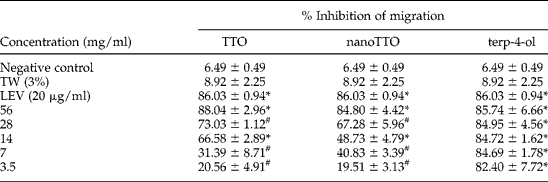
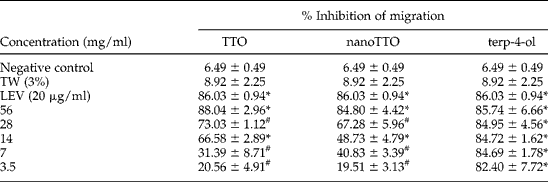
Results of LMIT can also be validated since negative and TW controls had a migration of 93.51% and 91.07%, respectively, suggesting that the larvae used were viable. From table 2, it is possible to observe that TTO and nanoTTO had similar activity on the inhibition of larval migration; at the highest concentrations the inhibition percentages were 88.04% and 84.80%, respectively. This result was similar to that observed in the positive control with LEV (20 μg/ml), with an inhibition of 86.03%, with no significant differences.
Larval migration inhibition test (LMIT): mean percentage (%) inhibition of migration (±SD) of H. contortus larvae in the essential oil (TTO) and nanoparticles (nanoTTO) of the essential oil of M. alternifolia, and terpinen-4-ol (terp-4-ol), in concentrations ranging from 3.5 to 56 mg/ml, using negative and 0.1% Tween 80 (TW) controls plus positive controls with levamizole (LEV) at 20 μg/ml.
*, Level of significance with P< 0.05 compared with negative controls
#, levels in the same row are not significant.
In tests with terp-4-ol, no difference was noted in larval migration for the different concentrations tested: 85.74, 84.95, 84.72, 84.69 and 82.40% in the respective concentrations of 56, 28, 14, 7 and 3.5 mg/ml. This inhibition was equivalent to that of the positive control (LEV); terp-4-ol had a large effect on larvae, which was higher when compared to TTO and nanoTTO.
From the LC50 and LC90 calculated based on LMIT, it was possible to observe that TTO and nanoTTO had similar activity on the larvae, with an LC50 of 10.68 mg/ml for TTO and 12.64 mg/ml for nanoTTO.
Discussion
The use of essential oils represents another option of the phytotherapeutic approach, due to the presence of substance classes that have reported antiparasitic activity (Anthony et al., Reference Anthony, Fyfe and Smith2005). The extensive medicinal activity of the essential oil of M. alternifolia is already established. In the literature, there are reports of action against protozoa and ectoparasites (Baldissera et al., Reference Baldissera, Da Silva, Oliveira, Santos, Vaucher, Raffin, Gomes, Dambros, Miletti, Boligon, Athayde and Monteiro2014; Pazinato et al., Reference Pazinato, Klauck, Volpato, Tonin, Santos, de Souza, Vaucher, Raffin, Gomes, Felippi, Stefani and Da Silva2014); however, studies on the action of endoparasites are still insufficient. Payne et al. (Reference Payne, Kotze, Durmic and Vercoe2013), when assessing the action of extracts of Australian native plants on the larval development of cyathostominae of horses, observed low activity of plants of the genus Melaleuca, such as M. artroviridis, M. stereophloia and M. uncinata.
To date, studies showing an anthelmintic effect of TTO in gastrointestinal nematodes of sheep are unknown; however, the present study showed that TTO and terp-4-ol showed an ovicidal effect. A great number of studies have been performed to assess the in vitro efficacy of products with anthelmintic activity. According to recommendations by the World Association for the Advancement of Veterinary Parasitology (WAAVP), potential anthelmintics are considered highly effective when their efficacy exceeds 98%, effective when they average in the range 90–98%, moderately effective in the range 80–89% and ineffective when efficacy is less than 80% (Wood et al., Reference Wood, Amaral, Bairden, Duncan, Kassai, Malone, Pankavich, Reinecke, Slocombe and Taylor1995). Therefore, TTO and terp-4-ol were highly effective against eggs and moderately effective against larvae of H. contortus.
Zhu et al. (Reference Zhu, Dai, Yang and Qiu2013) performed an experiment similar to the current one, using the essential oil of Artemisia lancea and its major constituents, 1,8-cinelone and camphor. The oil of A. lancea and 1,8-cinelone at a dose of 10 mg/ml had an ovicidal activity of 99.4% and 74.8% and LC50 of 1.82 and 4.64 mg/ml, respectively. When comparing the results obtained in this study, it can be said that the solutions tested here had more action, since the inhibition of hatching was 100% in the concentration of 3.5 mg/ml, and the LC50 was 0.43 and 0.63 mg/ml for TTO and terp-4-ol, respectively. For the inhibition of larval migration, terp-4-ol also demonstrated higher activity in relation to 1,8-cinelone, which showed an inhibition of only 60.3% at the dose of 10 mg/ml. It is important to highlight that at the dose of 3.5 mg/ml (the lowest dose assessed), terp-4-ol inhibited 82.40% of the migration of larvae of H. contortus.
There have been several studies assessing the efficacy of different essential oils of plants. The essential oils of Eucalyptus citriodora and of Eucalyptus globulus have been described, with a reduction in the hatching of eggs of 98.8% and 99.3%, respectively, in in vitro tests (Macedo et al., Reference Macedo, Bevilaqua, Oliveira, Camurça-Vasconcelos, Vieira, Oliveira, Queiroz, Portela, Barros and Chagas2009, Reference Macedo, Bevilaqua, Oliveira, Camurça-Vasconcelos, Vieira and Amóra Sdos2011), similar to the results found in this study. The essential oil of Eucalyptus staigeriana reduced the number of eggs/g faeces (EPG) by 76.57% (Macedo et al., Reference Macedo, Bevilaqua, Oliveira, Camurça-Vasconcelos, Vieira, Oliveira, Queiroz, Tomá and Nascimento2010) in in vivo tests. Katiki et al. (Reference Katiki, Chagas, Bizzo, Ferreira and Amarante2011) found LC50 values of only 0.04 mg/ml, 0.13 mg/ml and 0.26 mg/ml when assessing the essential oils of Cymbopogon schoenanthus, Cymbopogon martinii and Mentha piperita against trichostrongylidae parasites, using the EHT, lower values than those of the current experiment.
The essential oil of the peppermint was shown to exhibit activity against the protozoal parasite Giardia (Vidal et al., 2007). It is possible that other essential oils, or their components, may also have activity against other parasites that reside in the intestine, such as coccidia, protozoa or nematodes (Benchaar et al., Reference Benchaar, Calsamiglia, Chaves, Fraser, Colombatto, McAllister and Beauchemin2008). Further studies are needed to confirm that TTO can be used in vivo, since the effects of these oils on parasites in the lower digestive tract could be dependent on the ability of the components that they contain to remain active after passing through the rumen (Benchaar et al., Reference Benchaar, Calsamiglia, Chaves, Fraser, Colombatto, McAllister and Beauchemin2008). Furthermore, it is necessary to assess the effect of TTO on bacteria and protozoa present in the gastrointestinal tract of ruminants to observe whether the antimicrobial effect has a harmful effect on the commensal flora of the animal.
NanoTTO showed weaker action at the highest dose, compared with TTO and terp-4-ol, with an inhibition of hatching of 82.63%. However, taking into account the duration of the EHT, this minor action can be justified, since nanoparticles have a characteristically slow, gradual and controlled drug release, increased bioavailability and reduced toxic effects (Roco, Reference Roco2001). As observed by Zanoto-Filho et al. (Reference Zanotto-Filho, Braganhol, Edelweiss, Behr, Zanin, Schröder, Simões-Pires, Battastini and Moreira2012), the nanoparticles of the tested substance presented a gradual release and the serum levels remained stable for a longer period of time. On the other hand, the same substance tested in its free form quickly reached peak concentrations, but its effect did not last as long. Other tests of longer durations, or even in vivo tests, are necessary to better assess the action of nanoTTO.
The in vitro activity obtained with phytotherapy against a life stage of a parasite is not sufficient to suggest a direct anthelmintic effect in naturally infected animals. Moreover, if animals are dosed with the plant extract, it is difficult to estimate how much will be needed to account for the size of the reticulum–rumen before it reaches the target organs (i.e. abomasum, small intestine, large intestine) (Sandoval-Castro et al., Reference Sandoval-Castro, Torres-Acosta, Hoste, Salem and Chan-Péreza2012). Therefore, in vivo tests are essential for a better assessment of anthelmintic activity, both of the essential oils and their compounds as nanostructures.
In conclusion, the essential oil of M. alternifolia in free and nanostructured forms, as well as its main component, terpinen-4-ol, had a positive effect on the inhibition of hatching and the migration of larvae of H. contortus. Terpinen-4-ol showed excellent results and can be considered one of the compounds responsible for the activity displayed by the oil. The therapeutic success demonstrated in this study suggests that the essential oil of M. alternifolia, terpinen-4-ol and, mainly, the nanostructured form obtained from the oil, can be targeted in in vivo studies, besides being a promising line of research into the control and treatment of endoparasitism, which is one of the biggest problems facing the world sheep industry.
Conflict of interest
None.
Ethical standards
The authors assert that all procedures contributing to this work comply with the ethical standards of the relevant national and institutional guides on the care and use of laboratory animals. The experimental protocol was approved by Comitê de Ética no Uso de Animais (CEUA – Ethics Committee on Animal Use) of Universidade Federal de Santa Maria, under registration number 043/2014.