Recent years have seen several investigations into variation and change among the complementizers that can link one or more of the verbs seem, appear, look, sound, and feel to a finite subordinate clause. In present-day North American English, five such complementizers exist, with the fullest extent of the variation as follows:
(1) It seems (as if/as though/like/that/Ø) the traffic jam has cleared.
There are several challenges inherent in studying this set of forms. A lexical effect contributing to the choice of complementizer could more accurately be labeled a lexical schism: that and Ø are not grammatical after look and sound (Gisborne, Reference Gisborne2010:276; Huddleston & Pullum, Reference Huddleston and Pullum2002:962). There are also differences between the verbs according to type of matrix subject. Seem and appear can only take that and Ø when the subject is an expletive (as in the invented example It seems that/Ø the computer is running better) rather than a noun phrase (NP) (Huddleston & Pullum, Reference Huddleston and Pullum2002:960).Footnote 1 Meanwhile, feel is typically a simple experiencer verb (Asudeh & Toivonen, Reference Asudeh and Toivonen2012:325) conveying views and beliefs belonging to an animate entity in the matrix subject position. It resists the complementizers that and Ø when the matrix subject is an expletive, but permits both with a matrix NP that is doing the experiencing (Brook Reference Brook2014:2) (as in, I feel (that/Ø) the computer is running better).
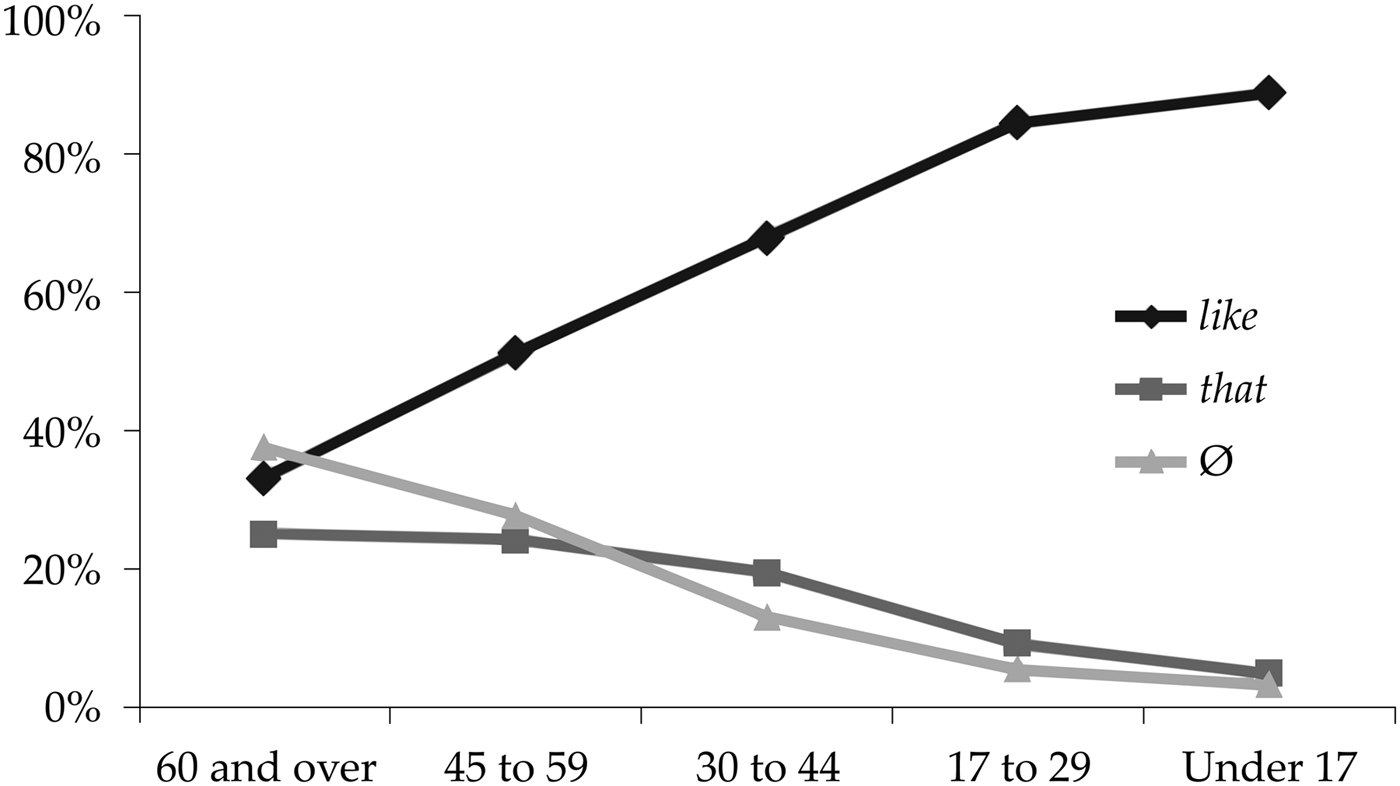
Despite this internal division, there are two ways in which these verbs, taken together, show signs of being unstable in apparent time, that is, across a range of speaker ages (Labov, Reference Labov1972:21–24), in Canadian English as represented by the Toronto English Archive (TEA) (Tagliamonte, Reference Tagliamonte2003–2006, Reference Tagliamonte2006b).Footnote 2 One is a straightforward lexical replacement. Although the complementizer like is the newest variant, attested only from 1864 onward (López-Couso & Méndez-Naya, Reference López-Couso, Méndez-Naya and Vázquez2012a:316), it has been catching on at the expense of the other four complementizers in apparent time (Brook, Reference Brook2014). As if and as though in this context are found at nearly negligible rates in the TEA (López-Couso & Méndez-Naya, Reference López-Couso and Méndez-Naya2012b:185); that and Ø are in decline such that among the youngest generations in this corpus there is little use of any of the complementizers other than like (Brook, Reference Brook2014).
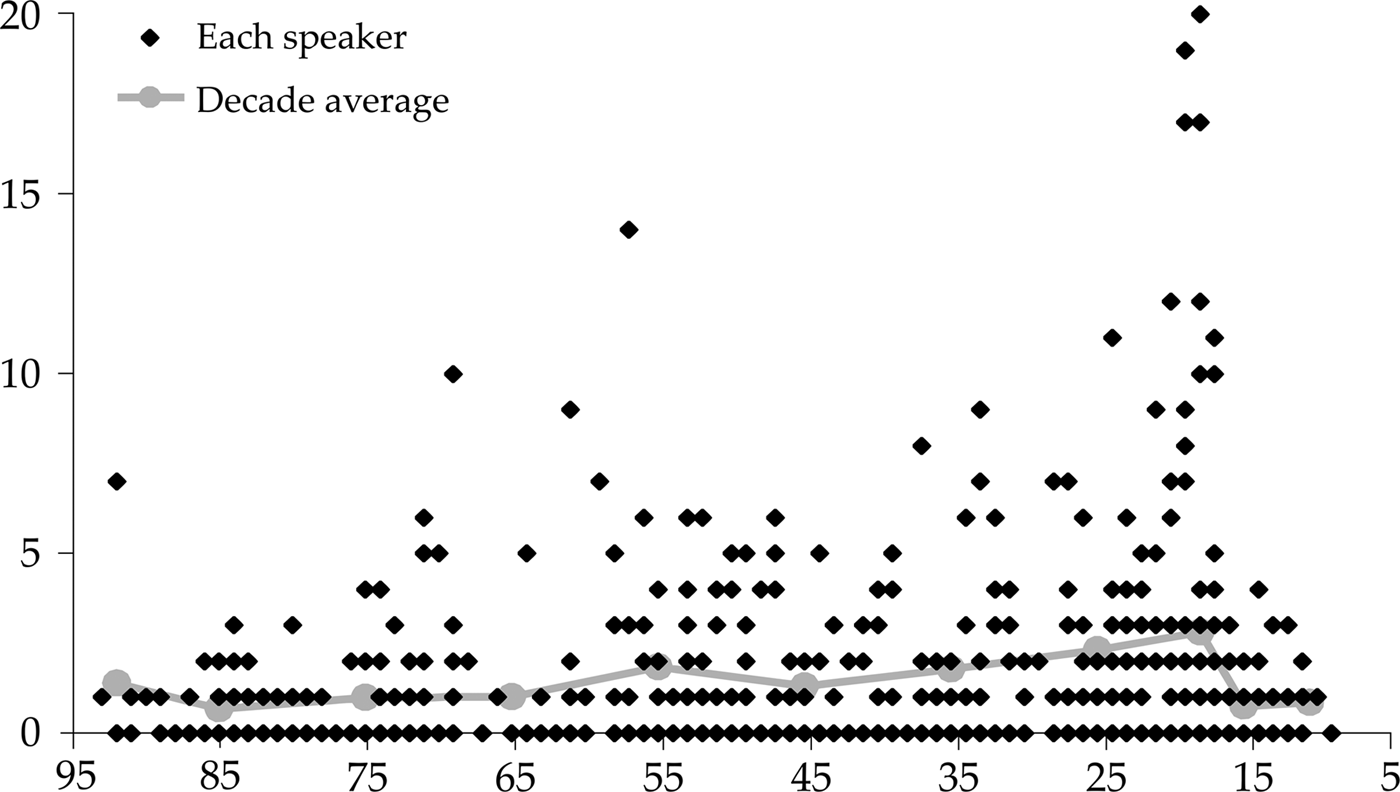
The other source of apparent-time instability is subtler: the numbers of tokens of these finite subordinate clauses in the TEA are unevenly distributed in apparent time (Brook, Reference Brook2014:5). The average number of tokens per age group generally increases with decreasing age of speakers in the corpus, with the 17- to 19-year-olds using the constructions the most.Footnote 3 A lexical replacement within the set is not enough to account for a result of this sort.
Earlier, I proposed two accounts of these age effects. The first of these has to do with the grammaticalization of (it) seems like, (it) looks like, and (it) sounds like into markers of epistemicity (Brook, Reference Brook2014:4–5; cf. Gisborne, Reference Gisborne2010:269; Kärkkäinen, Reference Kärkkäinen2003:45; López-Couso & Méndez-Naya, Reference López-Couso and Méndez-Naya2010, Reference López-Couso and Méndez-Naya2014). Arguably the most familiar epistemic markers in present-day English are the ones that, taken in the most literal sense, refer to the speaker's own cognitive activity, for example, I think, I believe, I guess, I reckon, I suppose, and even I feel (Biber, Johansson, Leech, Conrad, & Finegan, Reference Biber, Johansson, Leech, Conrad and Finegan1999:667–669; Denis, Reference Denis2015; Kärkkäinen, Reference Kärkkäinen2003:38–39; Rodríguez Louro & Harris, Reference Rodríguez Louro and Harris2013; Thompson, Reference Thompson2002; Thompson & Mulac, Reference Thompson and Mulac1991a, Reference Thompson, Mulac, Traugott and Heine1991b). The structures with seem, appear, look, and sound differ from the I think class in two major ways. One, their subjects are not experiencers. Two, seem, appear, look, and sound are not about thoughts or any other kind of mental processes. Rather, they are about general apparentness. Nonetheless, the collocations (it) seems like, (it) looks like, and (it) sounds like share with the I think class the ability to take a finite subordinate clause. They can also likewise be used as hedges (Aijmer, Reference Aijmer2009:78–79), which is unsurprising given that there is considerable overlap between hedging and epistemicity (Denis, Reference Denis2015:206–207; Kärkkäinen, Reference Kärkkäinen2003:22; López-Couso & Méndez-Naya, Reference López-Couso and Méndez-Naya2014:55).
This leads to two potential explanations—not mutually exclusive—for the subtle age effect in the token numbers of seems like and related structures in Toronto English. One is grammaticalization itself: since this process tends to go hand-in-hand with an increase in raw frequency (Bybee, Reference Bybee, Joseph and Janda2003:602, Reference Bybee2006:720–721), a widening range of grammatical functions could be proposed to account for the higher numbers of tokens among younger speakers. The other possible explanation involves age-grading across a wider range of phenomena. If hedging strategies in general (including both (it) seems like and older epistemic parentheticals with the same verbs, e.g., it seems) are age-graded such that younger speakers tend to express more hesitancy about their own opinions than older adults do, then seems like, looks like, and sounds like in their function as epistemic markers might be just one of many strategies that younger speakers use to put more distance between themselves and their statements.
Nevertheless, each of these ideas is somewhat unsatisfying. On the one hand, grammaticalization of the structures seems like, looks like, and sounds like into epistemic markers cannot be the sole cause of the overall age effect, as only a small number of tokens from younger speakers in Toronto show evidence of new functions and/or greater degrees of semantic bleaching (Brook, Reference Brook2011:40). On the other hand, age-grading cannot explain my earlier findings because there are multiple signs that the age effect is actually a reflex of linguistic change. One is that the use of structures such as seems like “seems to be on the increase in the present day” (López-Couso & Méndez-Naya; Reference López-Couso, Méndez-Naya and Vázquez2012a:329). Another is the commonalities among the speakers with the highest token counts (where n ≥ 10). Seven of the nine individuals are both female and under the age of 25, which suggests some kind of additional linguistic shift led by young women (Labov, Reference Labov2001:275, 292–293) even beyond the introduction of the complementizer like.
The present work identifies a stronger reason for interpreting the age effects as signs of linguistic change: a trade-off that is occurring on the syntactic level. In Ontario English, the entire finite subordination option after seem is increasing in apparent time and doing so at the expense of infinitival subordination (sometimes called subject-to-subject raising; see, e.g., Davies & Dubinsky, Reference Davies and Dubinsky2004; Rosenbaum, Reference Rosenbaum1967). In other words, it is not only that younger speakers in Toronto English are increasingly using structure (2a) rather than (2b) and (2c). They are also increasingly saying (2a) rather than (2d).
- (2)
a. He/it seems like he's ill.
b. He seems (as if/as though) he's ill.
c. It seems (as if/as though/that/Ø) he's ill.
d. He seems to be ill.
The notion of finite and infinitival structures after seem competing with each other is not inherently far-fetched; Hopper and Traugott (Reference Hopper and Traugott2003:175) expected it to occur. Both structures are means of taking the proposition seeming to be ill and applying it to the matrix NP he. Both involve a nominal originally associated with an embedded clause that can come to occupy the matrix subject position. They occupy similar syntactic, semantic, and functional territory (cf. Sankoff & Thibault, Reference Sankoff, Thibault, Johns and Strong1981).
There are thus two levels of change associated with these complementizers in Toronto English. Figures 1 and 2 replicate them for Ontario more generally, incorporating data collected in comparable ways from the southeast of the province (Tagliamonte, Reference Tagliamonte2007–2010; Tagliamonte & Denis, Reference Tagliamonte and Denis2014) and from the north (Tagliamonte, Reference Tagliamonte2010–2013, Reference Tagliamonte, Green and Meyers2014). The more familiar of these two changes (Figure 1) is the lexical replacement whereby like replaces the other complementizers. The broader change (hinted at by the age effect in the overall token count in Figure 2) involves the whole finite subordinate structure after seem (now mostly represented by like) overtaking infinitival subordination. Ultimately, I argue that this larger change can be reasonably interpreted as a consequence of the narrower one: that like has overtaken its complementizer covariants in Canadian English and unified the finite subordinate template after seem to the point that the whole construction has begun competing with an abstract syntactic alternative. I draw on findings from theoretical and acquisition-based studies of copy-raising to provide insights into the implications of these changes for expressions of epistemicity and/or evidentiality with seem in English. Finally, I consider how to categorize the broader level shift and what it might mean for a linguistic change to overflow in this way from one envelope of variation into another.
Tokens of the verbs seem, appear, look, sound, and feel across three complementizers in apparent time (n = 994).

Each speaker in the Ontario data (Toronto, Southeastern Ontario, and Northern Ontario), by age and number of tokens, with average number of tokens per age cohort in gray.

SYNTACTIC BACKGROUND
English is one of several Germanic languages with verbs that denote apparentness and convey epistemic/evidential qualities. Among other examples are the German scheinen (De Haan, Reference De Haan2007; Diewald & Smirnova, Reference Diewald and Smirnova2010; Poortvliet, Reference Poortvliet2016; Whitt, Reference Whitt2015), the Dutch lijken (Aijmer, Reference Aijmer2009; Poortvliet, Reference Poortvliet2016; Sanders & Spooren, Reference Sanders and Spooren1996; Van Egmond, Reference Van Egmond2004) and/or schijnen (Aijmer, Reference Aijmer2009; De Haan, Reference De Haan2007; Sanders & Spooren, Reference Sanders and Spooren1996), and the Swedish verka (Aijmer, Reference Aijmer2009:73; Asudeh & Toivonen, Reference Asudeh, Toivonen, Zaenen, Simpson, King, Grimshaw, Maling and Manning2007, Reference Asudeh and Toivonen2012).
Still, as mentioned, the complementizers that can follow these verbs are not a uniform set. The that and Ø complementizers appear alongside a wide range of verbs in present-day English (Tagliamonte & Smith, Reference Tagliamonte and Smith2005). As if, as though, and like—sometimes referred to collectively as comparative complementizers Footnote 4 (López-Couso & Méndez-Naya, Reference López-Couso and Méndez-Naya2012b; Rooryck, Reference Rooryck2000:48)—are more specialized; they are found in a narrower range of contexts and have additional properties.Footnote 5 Most notably, the comparative complementizers permit a syntactic alternation known as copy-raising.
According to the traditional analysis (Rogers, Reference Rogers, Adams, Campbell, Cohen, Lovins, Maxwell, Nygren and Reighard1971, Reference Rogers1974:72), copy-raising involves the movement of an embedded subject NP to the matrix subject position, which leaves behind a coreferential—and bound (Lappin, Reference Lappin, Sells and Jones1983)—pronominal copy:
- (3)
a. It seems like [the girl]i wants to try out the diving board.
b. [The girl]i seems like [she]i wants to try out the diving board.
Subsequent theoretical work has not led to a consensus as to the syntactic nature of copy-raising. Some accounts argue for a true case of movement (Asudeh, Reference Asudeh2012; Fujii, Reference Fujii, Corver and Nunes2007; Horn, Reference Horn1981:355; Postal, Reference Postal1971:163, Reference Postal1974:19; Rogers, Reference Rogers, Adams, Campbell, Cohen, Lovins, Maxwell, Nygren and Reighard1971, Reference Rogers1974:72; Ura, Reference Ura1998), others for the NP matrix subjects being generated in situ (Asudeh, Reference Asudeh, Andronis, Debenport, Pycha and Yoshimura2002; Gisborne, Reference Gisborne2010; Heycock, Reference Heycock1994; Matushansky, Reference Matushansky2002; Potsdam & Runner, Reference Potsdam, Runner, Andronis, Ball, Elston and Neuvel2001; Rogers, Reference Rogers1974:74–75). This controversy is largely outside the scope of the present work, and the results do not speak to it one way or the other. The relevant point for these purposes is that regardless of what copy-raising is, it is disallowed by that and Ø (as in, *John seems (that/Ø) he is ill). In an analysis of copy-raising that involves syntactic movement, for instance, the movement of the NP upward out of the embedded clause must be blocked by these complementizers (Fujii, Reference Fujii, Corver and Nunes2007:309–310; Gisborne, Reference Gisborne2010:275).Footnote 6
The approach suggested by Heycock (Reference Heycock1994; building on Maling, Reference Maling, Heny and Richards1983) that has since received acceptance from multiple authors (Asudeh, Reference Asudeh, Andronis, Debenport, Pycha and Yoshimura2002:6–8, Reference Banfi, Bechert, Bernini and Buridant2012; Poortvliet, Reference Poortvliet2016:338; Potsdam & Runner, Reference Potsdam, Runner, Andronis, Ball, Elston and Neuvel2001:465–466; see also Asudeh & Toivonen, Reference Asudeh and Toivonen2012:324; Fujii, Reference Fujii, Corver and Nunes2007:301–302) is that while that and Ø are true complementizers, as if, as though, and like are better categorized as prepositions. This would make copy-raising—whatever it is—permissible with a prepositional phrase (PP) but not with a complement phrase (CP).Footnote 7 While such a restriction might be expected to permit the occasional exception (cf. Fujii Reference Fujii, Corver and Nunes2007:309n19), a search of the Corpus of Contemporary American English (Davies, Reference Davies2008–) on November 2, 2014, found no unequivocal cases of the collocations “seems that” or “seemed that” with a matrix NP subject when introducing a finite subordinate clause–a testament to copy-raising being impermissible with the complementizer that in American English.Footnote 8
METHODOLOGY
Envelope of variation
Among the verbs seem, appear, look, sound, and feel, there are only so many chances to find active variation between finite and infinitival subordination (Landau, Reference Landau2011:784; Mack, Reference Mack2010:chap. 4; Matushansky, Reference Matushansky2002:228; Park & Turner, Reference Park and Turner2017:474). Seem and appear each support both types of subordinate clause, but feel generally does not allow infinitival subordination (Mack, Reference Mack2010:179; Park & Turner Reference Park and Turner2017:474), and the acceptability of look to V (verb) and sound to V appears to be “lexically and dialectally conditioned” (Mack, Reference Mack2010:179; see also Algeo, Reference Algeo1988:23).Footnote 9
Restricting this study to the verb seem risks restricting the extent to which a broader look at the syntax can explain the apparent-time patterning of the number of tokens of these five verbs as seen in Figure 2. However, doing so is necessary given that seem is the only one of these verbs that shows robust variation between the two types of subordination in the corpora under study. An exploratory search of the TEA yields one token of feel* to VP (verb phrase)Footnote 10 and three tokens of appear to VP; appear is also hard to find with a finite subordinate clause (n = 1). I interpret this as an effect of register: the corpora under study here are of vernacular speech, and appear must be more characteristic of formal/written contexts.Footnote 11 All the rest of the tokens of infinitival subordination after any of these five verbs in the TEA (n = 248) are with seem. For this reason, I consider only this verb when it comes to finite versus infinitival subordination in Ontario English.
Variants
With a variable that is truly syntactic in the sense of Romaine (Reference Romaine1984:419), the variants need to be defined as whole structures. For now, one variant in this case is finite subordination after seem, regardless of how it is realized (i.e., with any of the five complementizers and either of the two types of matrix subject). The other variant is infinitival subordination after seem, which is always realized the same way (raised NP, infinitival to marker). There are some subtle differences in meaning and epistemic value (see, e.g., Aijmer, Reference Aijmer2009:85), but not enough to undermine the criterion of near-synonymy or “functional equivalence in discourse” for a morphosyntactic variable (Tagliamonte, Reference Tagliamonte2006a:76; cf. Sankoff & Thibault [Reference Sankoff, Thibault, Johns and Strong1981] on “weak complementary”).Footnote 12 Kim (Reference Kim2014:168), for instance, quickly concludes that when it comes to “truth conditional meaning, both the typical [subject-to-subject] raising and [copy-raising structures] … are synonymous to their counterparts with the expletive subject.” In other words, Hei seems PROi to be ill, Hei seems like hei’s ill, and It seems like he's ill are all synonyms.
It is also essential to show that the finite and infinitival seem patterns exhibit variation within individuals rather than merely between them (cf. Sankoff & Thibault, Reference Sankoff, Thibault, Johns and Strong1981:209). Across the 290 Ontario speakers who use at least two tokens of seem + any subordinate clause, nearly 40 percent of them (113 of 290) show variation between seem + an infinitival subordinate clause and seem + a finite one. Occasionally, both variants can be found adjacent to each other in a single person's speech, which is a key sign of within-speaker variation (Tagliamonte, Reference Tagliamonte2006a:96):
(4) Now it seems like that's really changed. Like, a lot of people seem to be having casual sex. (Erin Tam, F, 19, Toronto)
With variability established between finite and infinitival subordination after seem, the final large methodological question is whether the finite tokens truly represent a single variant opposite the infinitival ones, or whether it would make more sense to divide them. Considering them together is a necessary first step when it comes to ascertaining the overall patterning; there is no a priori guarantee that the finite tokens are best examined as multiple, separate entities. The problem is that there is no obvious best way of splitting them. Two elements of the finite template vary internally. One is the realization of the matrix subject: NP or expletive. The other is the particular complementizer being used (the incoming like versus the older options). Which factor to hold constant is not obvious from the outset.
The strategy I employ is to try both approaches. The methodology of comparative sociolinguistics can be used not only to compare similar analyses of different data sets (Tagliamonte, Reference Tagliamonte, Chambers, Trudgill and Schilling2002, Reference Tagliamonte2012:chap. 6), but also to evaluate separate analyses of the same data set (cf. Tagliamonte & Poplack, Reference Tagliamonte and Poplack1993). I thus treat the matter of how to best divide the finite tokens opposite the infinitival ones as an empirical question.
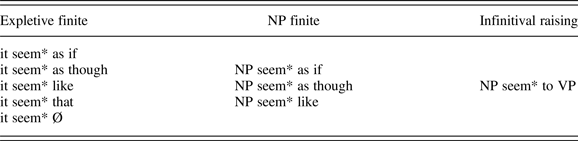
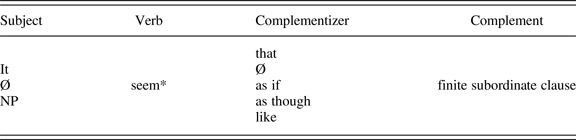
The first potential way of splitting the finite tokens is by the type of subject: expletives (it or a null version) versus NPs (nouns or pronouns, copy-raised from the subordinate clause). I refer to this approach as the envelope of variation division, since it goes hand in hand with the range of complementizers that are available. With an expletive, that and Ø are permitted; with a copy-raised subject, that and Ø are necessarily not found. This envelope of variation division is, in effect, the same as the approach taken by López-Couso and Méndez-Naya (Reference López-Couso and Méndez-Naya2012b), who first examine variation when the subject is an expletive and then when it is an NP. As applied to the present study, alongside infinitival subordination as the third variant construction, the envelope of variation division splits the finite tokens into two variants, as defined in detail in Table 1.
The three variants under the envelope of variation division of the finite tokens

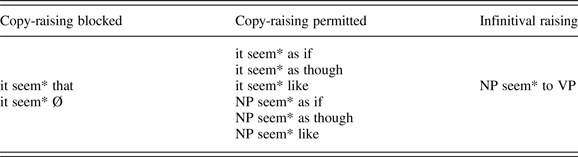
The alternative way of dividing the tokens is according to whether copy-raising is possible. Because this depends on the complementizer, I refer to this strategy as the type of complementizer division. However, the crucial difference is not of surface form but of underlying properties: the split is between places where copy-raising is forbidden (that/Ø) (Fujii, Reference Fujii, Corver and Nunes2007:309–310; Gisborne, Reference Gisborne2010:276; Huddleston & Pullum, Reference Huddleston and Pullum2002:962) and those where it is permitted regardless of whether it is realized (like, as if, and as though). With the type of complementizer division of the finite tokens, the three variants are as shown in Table 2.
The three variants under the type of complementizer division of the finite tokens

The fundamental difference between these two ways of splitting up the finite tokens can be illuminated by drawing attention to what is being held constant. In the envelope of variation approach, matrix subject is controlled for, which means that all the expletive subjects are in one variant but a few of the complementizers are found in both. Conversely, in the type of complementizer approach, a particular complementizer will be found in only one variant, but there are expletive subjects in both. In the type of complementizer approach, it seems like is put with NP seems like because in both cases, copy-raising is permitted. The fact that it has occurred in one case but not the other is irrelevant.
DATA
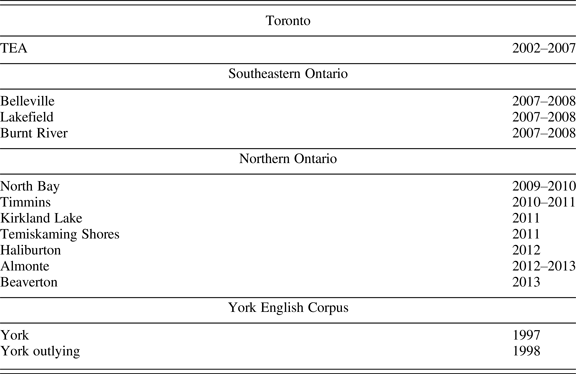
Table 3 outlines the data sources and their dates of collection. The Canadian English data comprise the TEA (Tagliamonte, Reference Tagliamonte2003–2006, Reference Tagliamonte2006b) and two corpora of outlying dialects: Southeastern Ontario (Tagliamonte, Reference Tagliamonte2007–2010; Tagliamonte & Denis, Reference Tagliamonte and Denis2014), encompassing three smaller communities to the northeast of Toronto, and Northern Ontario (Tagliamonte, Reference Tagliamonte2010–2013, Reference Tagliamonte, Green and Meyers2014), which includes data from seven towns, primarily along the province's Highway 11. As a control condition, I also consider British English as represented by the York English Corpus (Tagliamonte, Reference Tagliamonte1996–1998, Reference Tagliamonte1998), collected in and around the city of York. All these corpora are composed of sociolinguistic interviews (Labov, Reference Labov, Baugh and Sherzer1984), each about 1 hour in length; the sample designs for each corpus are roughly balanced for age and sex.
Sources of data: Locations and dates of collection

Extraction and coding
Using AntConc (Anthony, Reference Anthony2014), I extracted all tokens from the corpora that matched either the finite (Table 4) or the infinitival (Table 5) syntactic templates. Exclusions were as follows: dative arguments of seem (e.g., seems to me), which in these corpora are only found with that/Ø complementizers (cf. Aijmer, Reference Aijmer2009:82–83); elided embedded verbs; it seems + adjective + that (Aijmer, Reference Aijmer2009:80); parenthetical uses of seems or seems like (Aijmer, Reference Aijmer2009:79; López-Couso & Méndez-Naya, Reference López-Couso and Méndez-Naya2010, Reference López-Couso and Méndez-Naya2014); and any tokens cut off before the VP. Then all tokens were coded for speaker age and sex, finite/infinitival status, and the syntactic variants they belonged to as per each of the two approaches to splitting the finite tokens.
Syntactic template for the extraction of finite subordinate clause tokens

Syntactic template for the extraction of infinitival subordinate clause tokens

RESULTS AND INTERPRETATION
Finite versus infinitival subordination
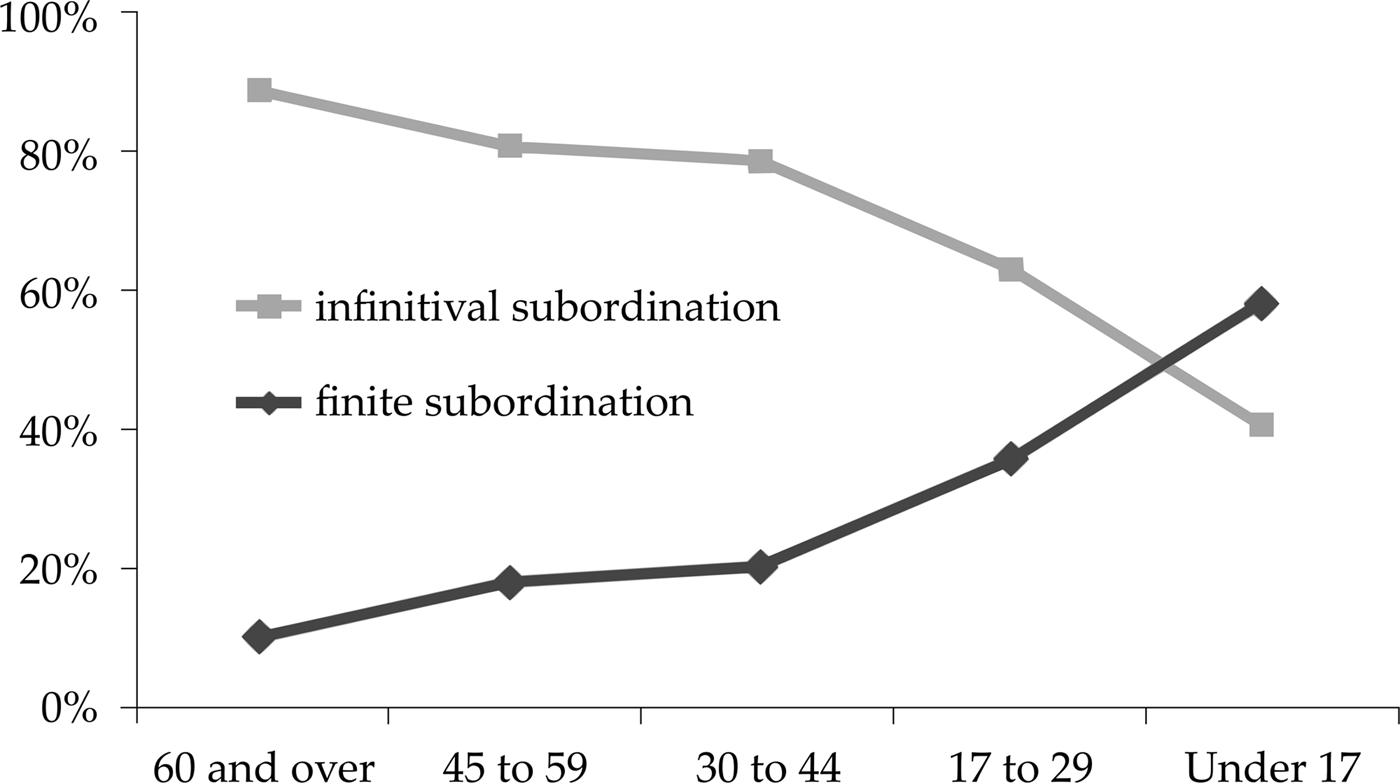
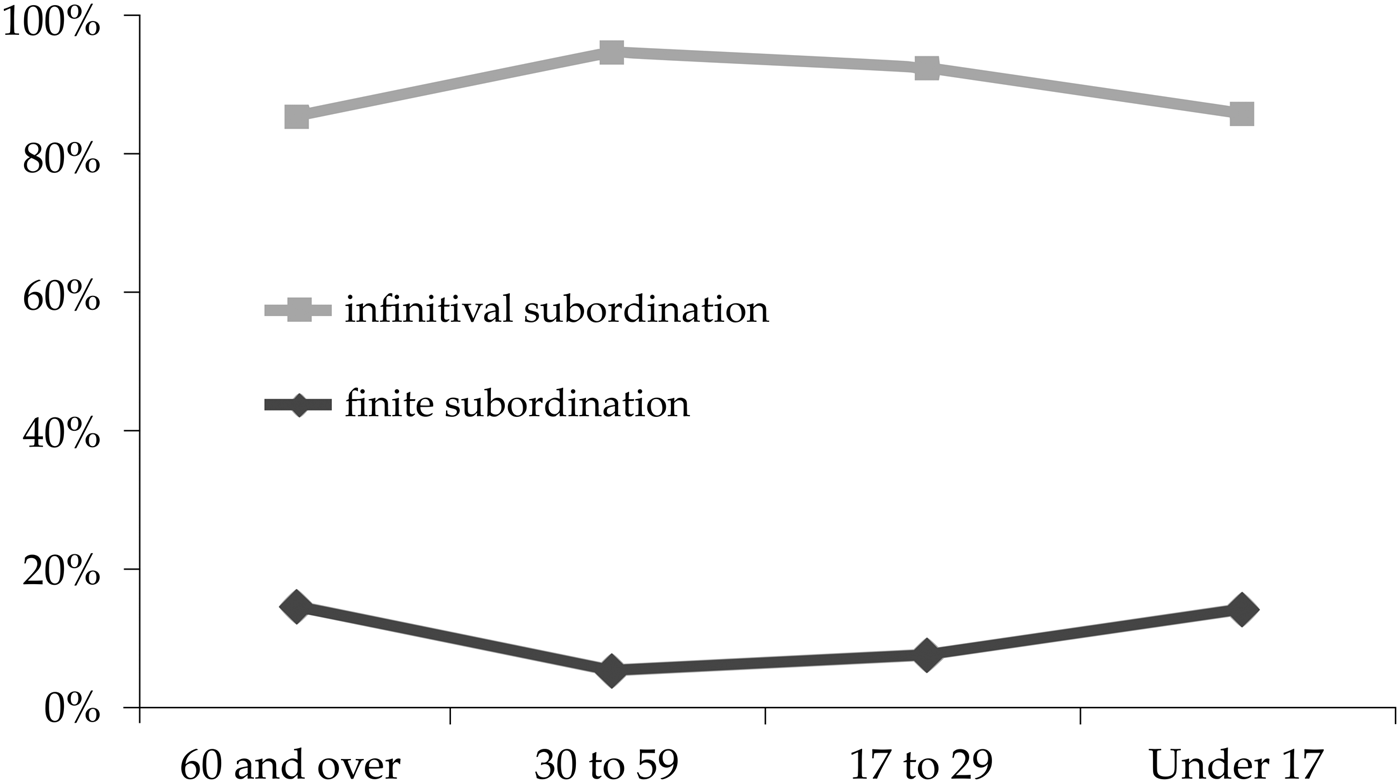
Table 6 shows the overall distribution of finite and infinitival subordination with seem in the Ontario data.Footnote 13 Tokens of the infinitival option are more than three times as prevalent as the finite ones. A breakdown in apparent time, as seen in Figure 3, shows that the finite structures after seem are increasing in the beginning of a recognisable S-curve of change (Bailey, Reference Bailey1973; Kroch, Reference Kroch1989; Labov, Reference Labov1994:65–67). While Ontario speakers over the age of 60 use the finite subordinate structures only occasionally, younger speakers are increasingly likely to say It/he seems like he's ill rather than He seems to be ill. This result suggests that the structures are covarying. Since the finite tokens are combined here, the pattern is an attestation not to like catching on among the complementizers, but to the whole finite structure coming to occupy a higher proportion of the tokens of seem plus subordination. There are two changes occurring in Canadian English, this one on a more abstract syntactic level than the arrival of like in and of itself.
Overall proportions of infinitival and finite subordination after seem in Ontario, split by speaker age cohort (n = 735).

Overall tokens of infinitival and finite subordination after seem in Ontario English

This finding yields part of an answer as to why the numbers of finite tokens are not evenly distributed in apparent time in Figure 2. It is also consistent with the sense that López-Couso and Méndez-Naya (Reference López-Couso, Méndez-Naya and Vázquez2012a:329) had of comparative complementizers “seem[ing] to be on the increase in the present day.” Caution is necessary since Figure 2 shows raw token numbers (with all five verbs) and Figure 3 proportions (with only seem), but Figure 3 raises the possibility that Figure 2 looks as it does because it is showing only half of an abstract syntactic change in progress, with the other component represented by a decline in infinitival subordination, at least after seem.
Dividing the finite tokens
Now that it has been determined that the finite tokens are increasing against the infinitival ones, the next step is to evaluate the two ways of dividing the finite tokens and investigate whether either one provides additional informative value.
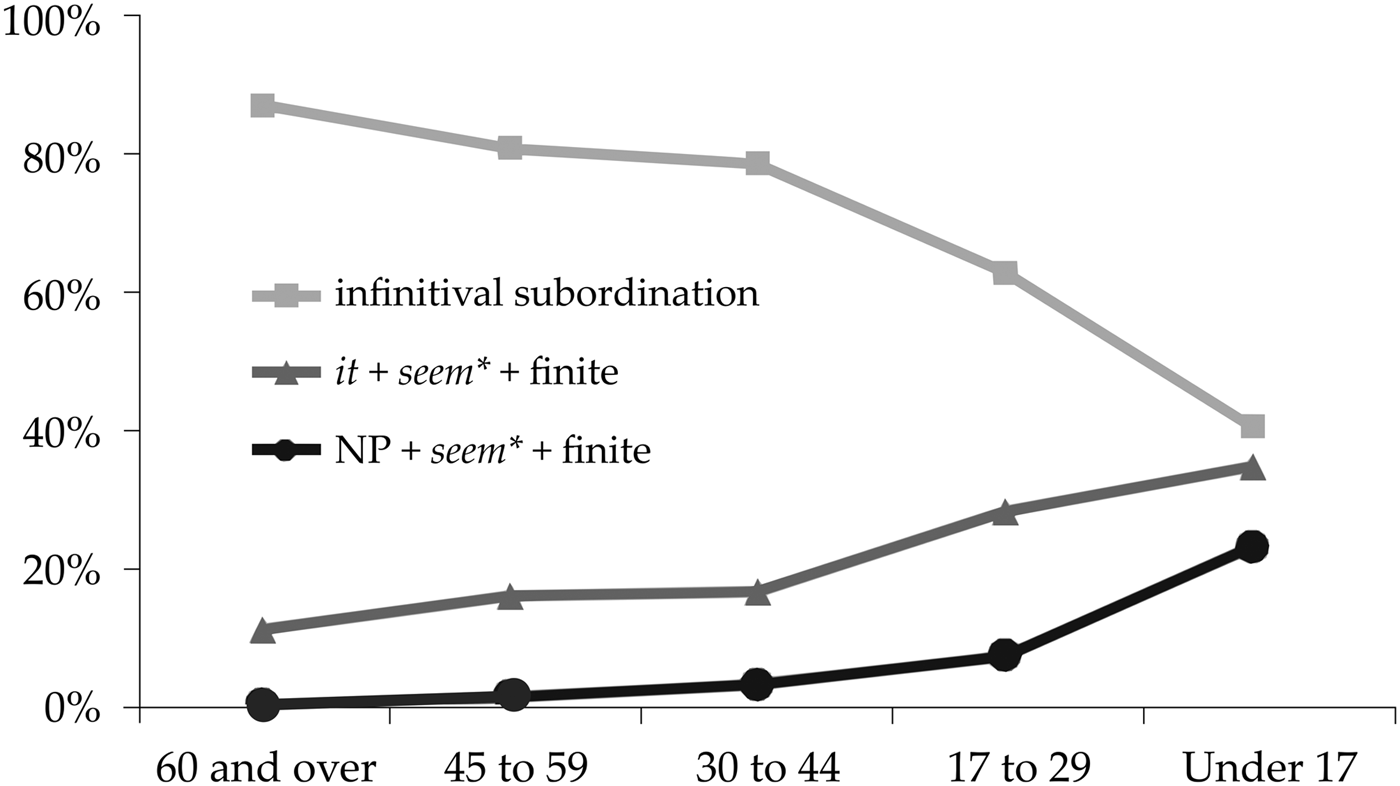
Figure 4 shows the results of splitting the finite subordination tokens by envelope of variation. The infinitival tokens are defined exactly as they were in Figure 3, but the finite tokens have been divided into (it) seem* (expletives as matrix subject) and NP seem* (NPs as matrix subject). Both of these subtypes of finite tokens are increasing relative to infinitival subordination, with the expletives consistently more prevalent than the NPs. The latter is found at negligible rates except in the youngest cohort. There are at least two separate reasons for this finding. One is that like is the only extant complementizer in vernacular speech that permits copy-raising (NP subjects); as if and as though are defunct. The other is that the copy-raising operation itself appears to be catching on even within the like tokens.
Infinitival and finite tokens of seem plus a complement in apparent time in Ontario English, with the finite tokens split by type of matrix subject (it seem + finite and NP seem + finite) (n = 735).

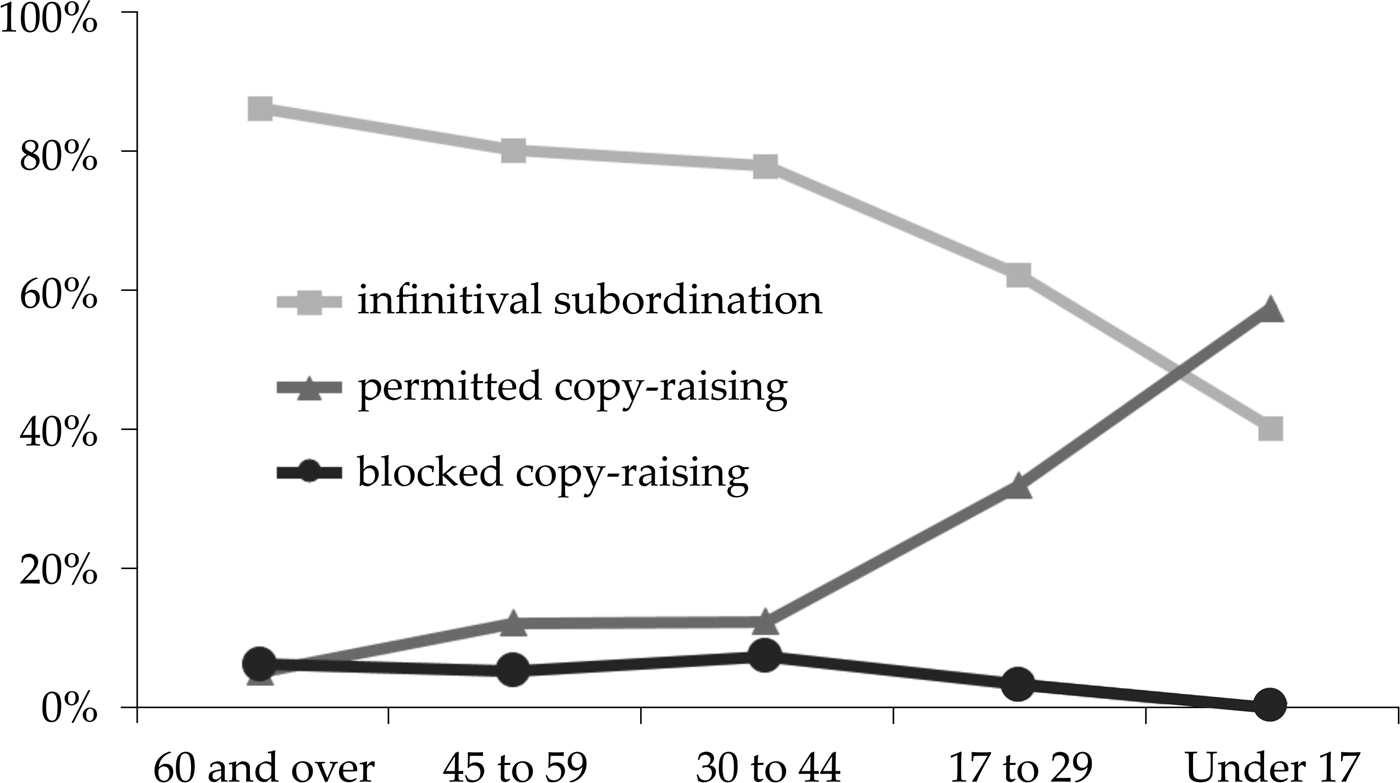
Figure 5 shows the alternative approach: infinitival subordination as before, but with the finite tokens divided into “blocked copy-raising”—that is, that and Ø–and “permitted copy-raising”—like, as if, and as though. In one sense, these results may seem redundant. Since like has overtaken as if and as though in vernacular Canadian English, it is the only active complementizer that supports copy-raising; like is now increasing at the expense of both that and Ø (Brook, Reference Brook2014).
Infinitival and finite tokens of seem plus a complement in apparent time in Ontario English, with the finite tokens split by type of complementizer (as if, as though, and like being permitted copy-raising, and that and Ø being blocked copy-raising) (n = 735).

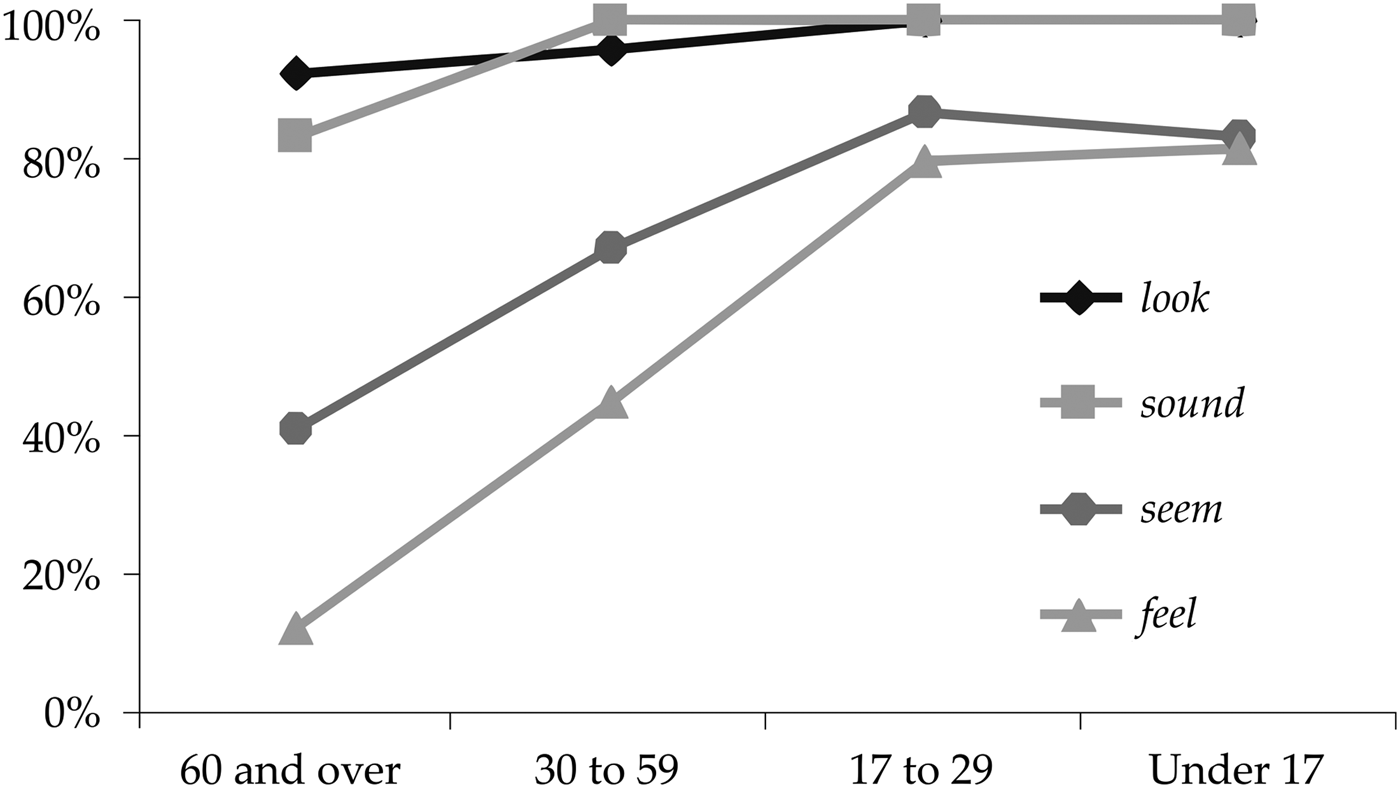
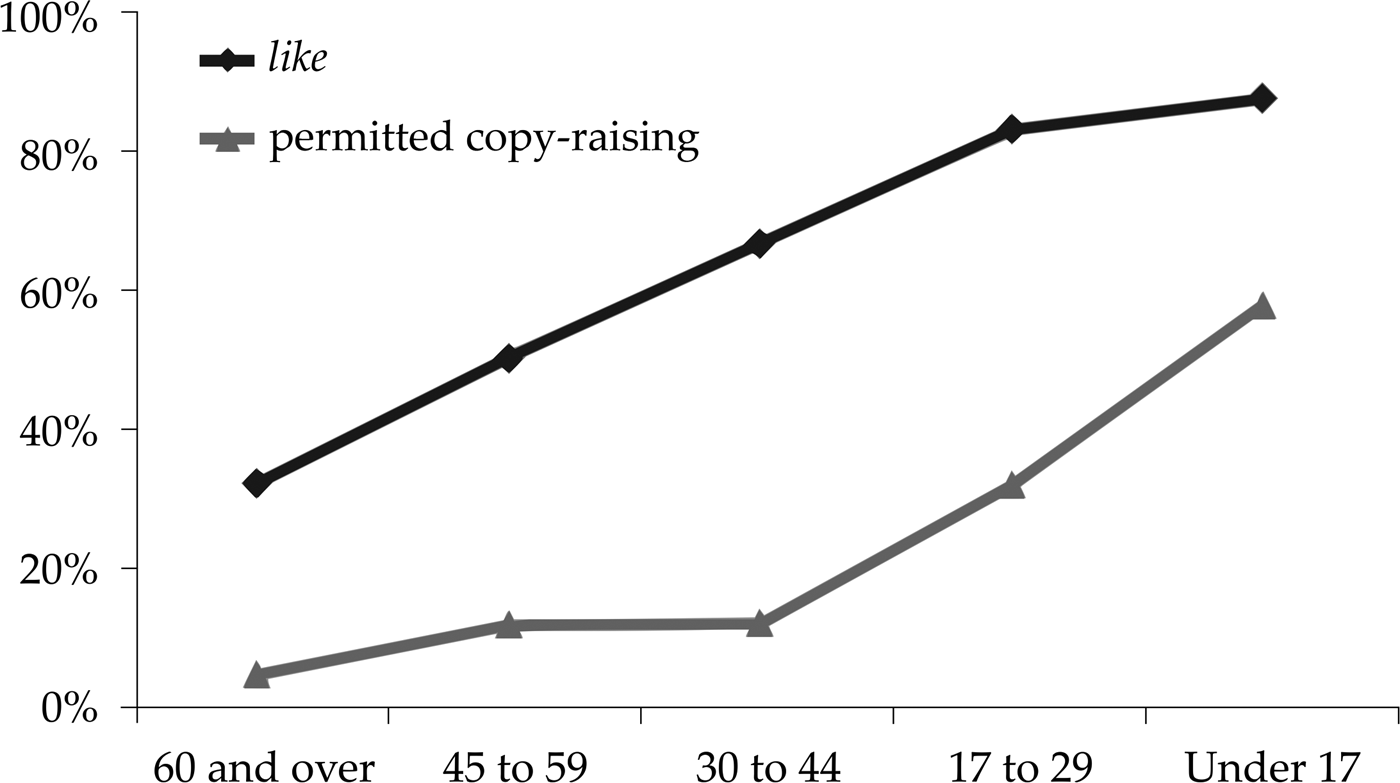
However, it is important to note that this finding is not a trivial replication of the lexical replacement (Brook, Reference Brook2014). Note, for instance, that there is very little increase in rates of the permitted copy-raising variant in speakers 30 and over. This is the case even though, as Figure 6 shows, within the finite variation in the same data set in the same age cohorts, like can be seen to be increasing after seem. Figure 5 is therefore not a redundancy. It does not speak to like catching on among the complementizers in apparent time the way Figure 6 does. Rather, it shows the entire finite structure beginning to increase against a more distantly related construction.
Proportions of like complementizer in Ontario among all finite complementizers, split by verb, in apparent time (n = 1010).

When it comes to the interpretation of change, Figure 5 is more informative than Figure 4 in that it squarely identifies what is coming in to replace infinitival subordination: contexts (mostly with like) where copy-raising is permitted, whether or not it is realized. The tokens of blocked copy-raising—it seems that and it seems Ø—are infrequent to begin with and are vanishing in apparent time.
A secondary expectation set up by the results in Figure 5 is that the option of blocked copy-raising—that and Ø—is something quite set apart from permitted copy-raising, that is, like, as if, and as though. If this is the case, then like should have a much easier time competing with as if and as though (within its syntactic variant) than with that and Ø (part of a separate variant). This is consistent with what has been found (see Figure 1 and Brook, Reference Brook2014). In vernacular Ontario English, neither as if nor as though appears frequently enough to be considered on an apparent time graph. If like has caught on at their expense, as suggested by early Canadian writing (Brook, Reference Brook2011, Reference Brook2014), then this change has gone to completion. Like has competed with that and Ø more recently, but perhaps such a thing could not have happened before like had overtaken as if and as though—its nearest syntactic neighbors. The findings also suggest that from a variationist standpoint, the set of the five finite complementizers is best described as a pair of subtly different envelopes of variation (cf. López-Couso & Méndez-Naya, Reference López-Couso and Méndez-Naya2012b:188). One of them involves like, as if, and as though. The next stage comes only when like unifies the variants within its original envelope and the whole permitted copy-raising structure begins competing with blocked copy-raising (i.e., that and Ø).
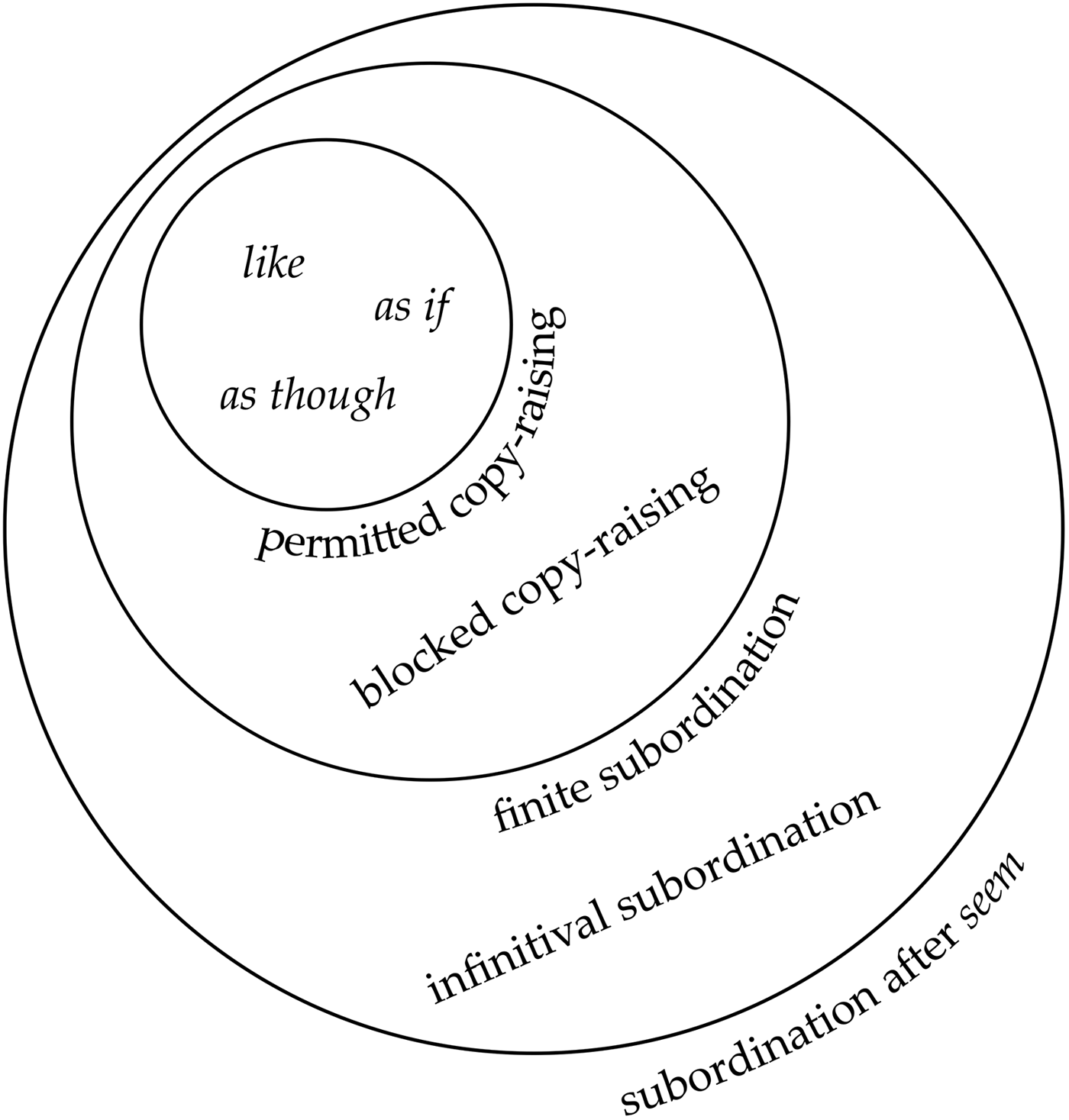
Which of these is competing with infinitival subordination? At first glance, the answer by default is permitted copy-raising—the only one that is increasing. It is possible, however, that a more nuanced view is called for, as illustrated in Figure 7. Under this analysis, the number of envelopes of variation is not two, but three—representing subtly nested syntactic contexts. According to this model, the change proceeds through a cascade effect, as follows. First, like overtakes as if and as though in apparent time, yielding a unified permitted copy-raising variant (mostly featuring like) that begins competing with blocked copy-raising. Second, permitted copy-raising overtakes blocked copy-raising, creating a unified finite subordination variant (mostly featuring permitted copy-raising) that starts to compete with infinitival subordination. This culminates in a single type of subordination after the verb seem (finite subordination, mostly represented by permitted copy-raising, in turn mostly represented by like).
Schematic of proposed analysis whereby three nested envelopes of variation exist for subordination after seem.

Regardless of whether this subtle three-level interpretation is correct, there are only a very small number of blocked copy-raising tokens in the data, so for the rest of the analysis I disregard them entirely and assume competition between the incoming permitted copy-raising structure and outgoing infinitival subordination one, even if this might be a small oversimplification. In other words, I acknowledge the possibility that there are three levels of change, but collapse the model into two.
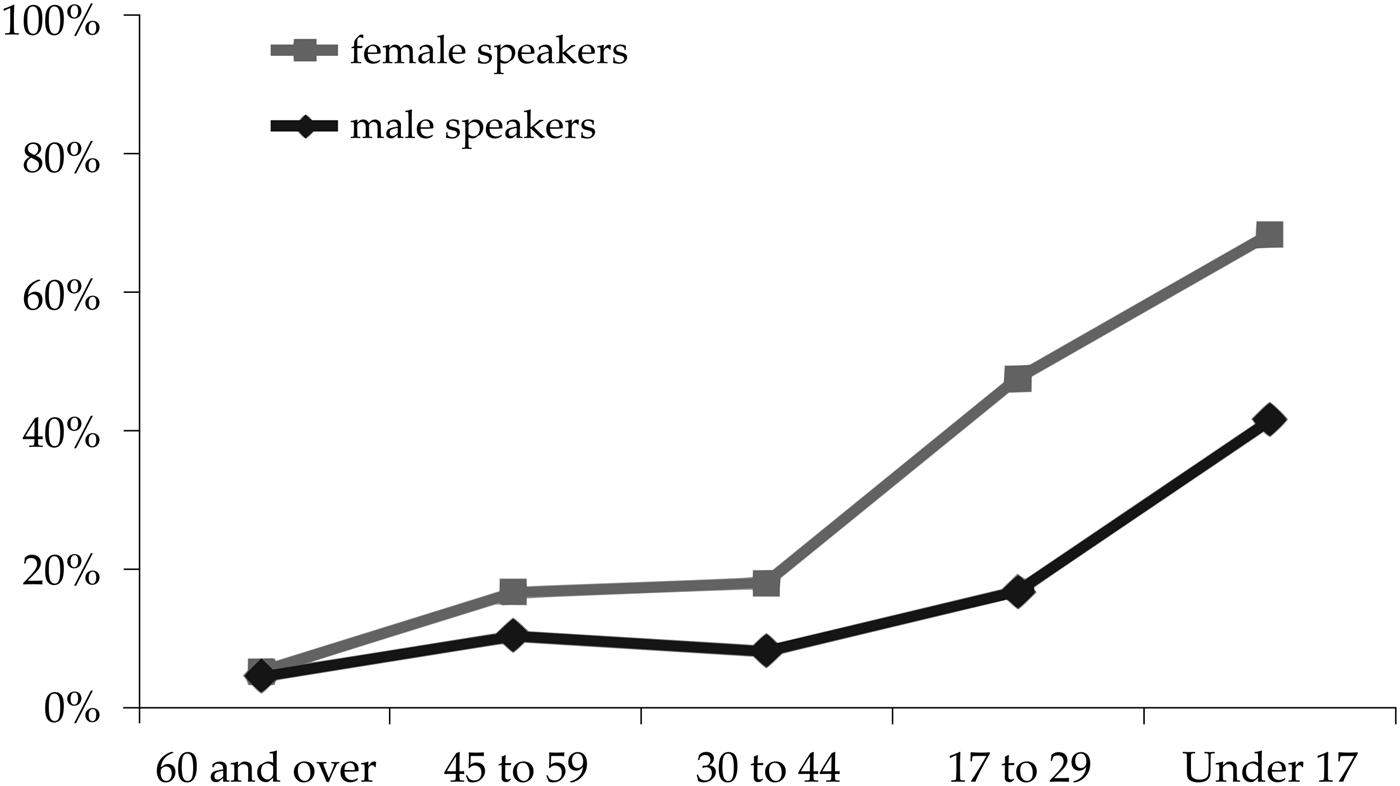
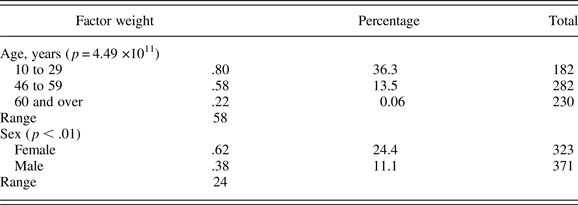
This change—the broader level syntactic shift—is a well-behaved change in progress in terms of both age and sex. Women favor the innovative permitted copy-raising overall, and this effect of sex is highly significant (Pearson's χ2: df = 1, p < .0001) (n = 694). Figure 8 shows the sex effect in apparent time. Women use permitted copy-raising construction more often than men do within every age group except the oldest, who hardly use this structure at all. The male speakers are consistently behind by about 15 years; this is consistent with the expected female lead in apparent time for a change in progress (Labov, Reference Labov2001:501). It is even possible to run a multivariate analysis on the variation between permitted copy-raising and infinitival subordination, though only with a very simple model due to the small number of tokens and factors being analyzed. This is shown in Table 7, conducted using Rbrul (Johnson, Reference Johnson2009). Even with individual included as a random effect, both age and sex significantly condition the variation in the directions anticipated for a change in progress. This finding is statistical verification of a syntactic-level change that is linked to—but is not the same as—the lexical shift toward like within the set of complementizers.
Proportions of permitted copy-raising (considered opposite infinitival subordination, excluding blocked copy-raising), split by speaker sex (n = 694).

Factors selected as significant to the probability of the permitted copy-raising structure (versus infinitival subordination) for seem, as produced by Rbrul (Johnson, Reference Johnson2009), with individual included as a random effect
Corrected mean: .11
Total: 694

Historical precedents
The change in progress from infinitival subordination after seem to permitted copy-raising could straightforwardly be labeled a change “from one syntactic structure to another” (Campbell, Reference Campbell2004:296), but it is of a sort that tends to be less than obvious. Just as for Heine and Kuteva (Reference Heine and Tania2005:75), “a change where an existing use pattern simply acquires a higher frequency of use and comes to be used in new contexts … is hard to identify, especially since it does not affect the conventionalized structure of grammatical categorization; it therefore comes as no surprise that—more often than not—this process tends to go unnoticed in the relevant literature.”Footnote 14 But it is certainly not unheard of for infinitival and finite subordination to engage in covariation or even change. Curiously, in the history of English, the shift has generally occurred in the opposite direction. Notably, Los (Reference Los2005:18) traced in detail how a “massive increase in to-infinitives in [Middle English] is due to a corresponding decrease not in bare infinitives but in subjective that-clauses.” Several classes of complement-taking verbs preferred finite subordination with that in Old English, but yielded to infinitival to-complements in Middle and Early Modern English (see also Denison, Reference Denison and Romaine1998:256; Rohdenburg, Reference Rohdenburg1995, Reference Rohdenburg, Dalton-Puffer, Kastovsky, Ritt and Schendl2006). This, presumably, helps explain why Hopper and Traugott (Reference Hopper and Traugott2003:175) anticipated a shift from “(It) seems that he is right [to] He seems to be right,” which they describe as the clausal boundary being eroded over time, presumably from a subordinate CP to a subordinate infinitival phrase (IP) (Los, Reference Los2005:39–40). At first glance, my findings attest to a change in the opposite direction: infinitival to finite subordination after seem. However, there is the possibility that a like-clause is not a CP but a PP as suggested by Heycock (Reference Heycock1994, adapting Maling [1983], which proposes an adjectival analysis) (see also Asudeh, Reference Asudeh, Andronis, Debenport, Pycha and Yoshimura2002, Reference Asudeh2012; Asudeh & Toivonen, Reference Asudeh and Toivonen2012:324; Poortvliet, Reference Poortvliet2016:388; Potsdam & Runner, Reference Potsdam, Runner, Andronis, Ball, Elston and Neuvel2001:465–466). Under this analysis, a shift from infinitival subordination after seem to permitted copy-raising mostly with like is a shift from an IP to a PP, which is consistent with the notion of the clausal boundary continuing to break down to smaller components. While “like takes an IP or CP complement, depending on dialect” (Asudeh, Reference Asudeh2012:335; Fujii Reference Fujii, Corver and Nunes2007:301n7), and those are both larger constituents, the point is that if the PP analysis holds, the matrix clausal boundary is what is getting more and more porous.Footnote 15
At any rate, shifts from infinitival to finite subordination are typologically well-attested. A prominent example occurs between Latin and the Romance languages, where most notably an accusative + infinitival complementation option was replaced by a new complementizer + finite structure (Roberts, Reference Roberts2007:161–175). Other cases of finite subordination strategies taking over from infinitival ones have been observed in Old Hungarian (Bácskai-Atkári & Dekány, Reference Bácskai-Atkári, Dekány and Kiss2014) and the languages of a Sprachbund found at the eastern edge of the Mediterranean Sea, including Greek and Balkan Turkish (Banfi, Reference Banfi, Bechert, Bernini and Buridant1990; Campbell, Reference Campbell2004:293; Joseph, Reference Joseph1983; Matras, Reference Matras, Boeder, Schroeder, Wagner and Wildgen1998; Meillet, [Reference Meillet1912] Reference Meillet1948; Terzi, Reference Terzi1992, Reference Terzi1997). If a shift from infinitival to finite subordination within a language can occur in general, there is no reason to suspect it could not do so within a limited syntactic domain—such as a specific verb in English that has both infinitival and finite complementation strategies available to it. The change from one subordinate structure after seem to another in Canadian English is thus a lexically restricted version of a type of change that is cross-linguistically not unusual. With respect to the Latin to Romance shift in complementation strategies, Roberts (Reference Roberts2007:175) concluded that “there is nothing particularly unusual about these developments, and they are representative of the kinds of changes which can take place in complementation systems.” I propose that the example uncovered here is another example, but a minor one confined to the verb seem in present-day Canadian English.
The question of causation
Earlier results for written Canadian English (Brook, Reference Brook2011, Reference Brook2014) suggest that like first competed with the other comparative complementizers (as if and as though). Once that presumed change was complete, the unified strategy—permitted copy-raising—began drawing off the variants of blocked copy-raising (i.e., the that and Ø complementizers). With those in decline, the permitted copy-raising structure is now beginning to draw off infinitival subordination with seem. This cascaded effect points toward the conclusion that each step caused the next. Is this the case?
It is not an impossibility. Even setting aside the easy example of chain shifts in the phonological domain, one linguistic change might well affect another, either in the form of a morphosyntactic “chain reaction” (Lightfoot, Reference Lightfoot1991:167; Martins & Nunes, Reference Martins, Nunes, Longobardi and Crisma2009), or in terms of variants across morphosyntactic variables that share forms (Aaron, Reference Aaron2010; D'Arcy, Reference D'Arcy and Collins2015, Reference D'Arcy2017; Dinkin, Reference Dinkin2016). To begin evaluating the possibility that the change(s) toward like among the complementizers set off the change toward permitted copy-raising after seem, I look to British English.
The comparative complementizer like has been slow to catch on in British English; in the real-time corpus study conducted by López-Couso and Méndez-Naya (Reference López-Couso and Méndez-Naya2012b:185), it does not appear in British English until the 1990s, which is considerably later than in Canadian English (see Figure 1). This lag is of a sufficient extent to be inferred even from the linguistics literature in each country. Aside from Gisborne (Reference Gisborne2010), British sources describe considerable resistance to the upstart like complementizer. According to Quirk, Greenbaum, Leech, and Svartvik (Reference Quirk, Greenbaum, Leech and Svartvik1985:1175) it is “often regarded as nonstandard.” Likewise, Mair and Leech (Reference Mair, Leech, Aarts and McMahon2006:318) called the complementizer like “strongly stigmatized,” and Huddleston and Pullum (Reference Huddleston and Pullum2002:1158) acknowledged a “strong tradition of prescriptive opposition” to it.Footnote 16 Perspectives from the other side of the Atlantic describe the complementizer like, at worst, as informal (Asudeh & Toivonen, Reference Asudeh, Toivonen, Zaenen, Simpson, King, Grimshaw, Maling and Manning2007). Thus, I predict that the lexical replacement featuring the like complementizer in the York English Archive (Tagliamonte, Reference Tagliamonte1996–1998, Reference Tagliamonte1998) is well behind where it is in Ontario. If so, and if the broader syntactic change can only occur given considerable incursion of like into a community's system of complementizers, there will be no sign of the broader-level change in York English.
Following the methodology laid out, I extracted and coded all of the tokens of seem plus subordination in the York English Archive. As Table 8 shows, there are 200 such tokens in total, but only a small proportion of them (n = 24) are finite. That said, in spite of how few they are, the finite tokens span four different complementizers: as though (n = 12), as if (n = 6), like (n = 4), and Ø (n = 2). While small token counts are not necessarily dependable, these numbers—particularly the high proportions of both as though and as if—speak to the like complementizer having yet to catch on in York to the same extent that it has in Ontario. This is as anticipated and sets up the prediction that if there is a causal link between the two levels of change observed in Ontario—if the onset of the syntactic change depends on the lexical replacement having happened first—then the syntactic change should not be visible here.
Overall tokens of infinitival and finite subordination after seem in the York English Archive

Figure 9 shows the division between finite and infinitival tokens in York along the lines of Figure 3 for Ontario. Stability is evident; in accordance with the hypothesis, the syntactic change from infinitival subordination to finite subordination with permitted copy-raising is not observed. For every age cohort, the rates of the finite structures are under 20 percent, and there is no sign of change in apparent time.
Overall proportions of infinitival and finite subordination after seem in York, split by speaker age cohort (n = 200).

In and of itself, this stability in York is necessarily inconclusive; however, the key is that the findings are consistent with the hypothesis that the broader-level syntactic change (infinitival subordination to permitted copy-raising after seem) can only begin once like has reached a certain threshold among the complementizers in the community grammar. As an illustration of this possibility, Figure 10 superimposes the two innovations in Ontario English, each within its own envelope of variation, onto a single graph in apparent time. If the hypothesis about causation holds and if Ontario English is representative, then the proportion of like among the complementizers (i.e., opposite mostly that and Ø) needs to reach about 70 percent before the whole structure begins overtaking infinitival subordination after seem.
Superimposition of the proportions of like (out of the comparative complementizers) and the proportions of permitted copy-raising (out of the seem complements) in apparent time in Ontario English.

A question remaining is what has enabled the complementizer like to set off such a change. In this context, like is young; the earliest examples I am aware of come from 1864 (López-Couso & Méndez-Naya, Reference López-Couso, Méndez-Naya and Vázquez2012a:316) and 1866 (Oxford English Dictionary, 2015). It seems to have evolved via grammaticalization from the conjunction like that introduces adjunctive clauses of manner across a range of verbs, for example, He sat down (as if/as though/like) he's never seen a chair before (Bender & Flickinger, Reference Bender, Flickinger, Bouma, Hinrichs, Kruijff and Oehrle1999; López-Couso & Méndez-Naya, Reference López-Couso, Méndez-Naya and Vázquez2012a). While this like does have the useful and flexible ability to support (but not demand) copy-raising, this is hardly unique; as if and as though permit it as well and are much older (López-Couso & Méndez-Naya, Reference López-Couso, Méndez-Naya and Vázquez2012a; Poortvliet, Reference Poortvliet2016:390–391). How can the complementizer like plausibly be said to have set off a change toward greater proportions of finite subordination when as if and as though never did so?
I suggest that the answer rests on the threshold argument. In Figure 10 terms, the change from permitted copy-raising to infinitival subordination depended on like hitting a certain proportion of the complementizers in this lexical/syntactic context. To the best of my knowledge, in previous eras, the small set of complementizers that can link seem and similar verbs to finite complements has always been too deeply divided for any to have become dominant over the others. Again, the 24 tokens of finite subordination after seem in York are scattered across four active complementizers. If this is a reasonably good indication of the sort of complementizer system that existed in spoken English before like, it was too split (in terms of either raw numbers or the model in Figure 7) to set off a cascade effect toward abstract syntactic change.
The effects are not necessarily restricted to the verb seem, either. If like has unified the set of complementizers (by first taking over from as if and as though and then that and Ø), then the verbs seem, look, sound, and feel now share a primary finite subordination strategy in vernacular Canadian English. Unlike the variants that and Ø, the complementizer like is equally grammatical across verbs and types of subjects. Because infinitival subordination is found productively after seem but not after look, sound, and feel, the incipient decline of infinitival subordination with seem may reflect another case of leveling: the loss of an idiosyncratic alternative subordination structure—infinitives—found productively with only one of these verbs. One definite advantage is that copy-raising can handle matrix subjects that are coindexed with embedded objects (5a). With infinitival subordination, the coindexed PRO in the lower clause has to be in the subject position (5b):
- (5)
a. He seems like they chased him.
b. *He seems to they chased.
Cases of apparent copy-raised NPs that correspond to embedded objects—or, indeed, to no overt embedded nominals at all—are typically considered noncanonical (e.g., Bender & Flickinger, Reference Bender, Flickinger, Bouma, Hinrichs, Kruijff and Oehrle1999:17; Heycock, Reference Heycock1994; Kim, Reference Kim2014; Landau, Reference Landau2011; Park & Turner, Reference Park and Turner2017:479–481; Potsdam & Runner, Reference Potsdam, Runner, Andronis, Ball, Elston and Neuvel2001; Rogers, Reference Rogers1974) and might be subject to dialectical variation in terms of their acceptability (Asudeh, Reference Asudeh2012; Asudeh & Toivonen, Reference Asudeh, Toivonen, Zaenen, Simpson, King, Grimshaw, Maling and Manning2007, Reference Banfi, Bechert, Bernini and Buridant2012), but they are not nearly as protest-worthy as attempting to force an object into infinitival subordination with seem, as in (5b).
Consequences for evidential marking
Given that like always allows copy-raising, there are two possibilities in terms of the matrix subject: expletive and NP. A necessary question is what conditions the variation. While an examination of the present data does not make this obvious, an answer comes from the literature on language acquisition, which points to the expletive and NP subjects having very different evidential values.
An NP subject before a perception verb such as seem is normally interpreted as the source of perception regardless of what sort of constituent follows the verb (Aijmer Reference Aijmer2009:80; Asudeh & Toivonen, Reference Asudeh and Toivonen2012; Poortvliet, Reference Poortvliet2016:373; Rett & Hyams, Reference Rett and Hyams2014:177; Rett, Hyams, & Winans, Reference Rett, Hyams, Winans, Baiz, Goldman and Hawkes2013; Rogers, Reference Rogers1974:76–78). In this way, the perception verbs seem, appear, look, and sound have been described as evidential expressions (Gisborne, Reference Gisborne2010:chap. 7; Poortvliet, Reference Poortvliet2016:378; Thompson, Reference Thompson2002:138), which generally invoke specific human senses as the source of the observation in the complement (Aijmer, Reference Aijmer2009:72; Asudeh & Toivonen, Reference Asudeh and Toivonen2012:368; Heycock, Reference Heycock1994:289; Rett et al., Reference Rett, Hyams, Winans, Baiz, Goldman and Hawkes2013; Rett & Hyams, Reference Rett and Hyams2014:182–183; Rogers, Reference Rogers1974:91). Unlike look and sound, seem is inherently “neutral with respect to evidential type” (Rett & Hyams, Reference Rett and Hyams2014:188; see also Asudeh & Toivonen, Reference Asudeh, Toivonen, Zaenen, Simpson, King, Grimshaw, Maling and Manning2007; Heycock, Reference Heycock1994:289; Landau, Reference Landau2011:788; Poortvliet, Reference Poortvliet2016). However, seem may still be an evidential marker as it indicates the level of reliability of the information (Poortvliet, Reference Poortvliet2016:377–378). Copy-raised subjects with seem, appear, look, or sound are NP subjects, which makes them sources of perception; copy-raising therefore involves evidential uses of the verbs (Asudeh & Toivonen, Reference Asudeh and Toivonen2012:370; Gisborne, Reference Gisborne2010:chap. 7; Poortvliet, Reference Poortvliet2016).
An expletive matrix subject of a copy-raising verb, on the other hand, is not an evidential construction and does not commit to representing direct perception; conclusions from both theoretical linguistics (Asudeh & Toivonen, Reference Asudeh and Toivonen2012; Rogers, Reference Rogers1974:77–78) and acquisitional/experimental approaches (Poortvliet, Reference Poortvliet2016; Rett & Hyams, Reference Rett and Hyams2014; Rett et al., Reference Rett, Hyams, Winans, Baiz, Goldman and Hawkes2013) speak to this. As the argument goes (Asudeh & Toivonen, Reference Asudeh and Toivonen2012:331; Rett & Hyams, Reference Rett and Hyams2014:177; Rett et al., Reference Rett, Hyams, Winans, Baiz, Goldman and Hawkes2013; Rogers, Reference Rogers1974:76–78), a speaker saying that John looks like he's sick is reporting having seen John and spotted evidence of sickness affecting him.Footnote 17 However, a speaker saying that it looks like John's sick has not necessarily seen John at all; this sentence is necessarily ambiguous when it comes to the speaker's source of evidence. As Rett et al. (Reference Rett, Hyams, Winans, Baiz, Goldman and Hawkes2013) noted, any number of things other than direct perception could suggest the notion of John being ill, and some of these are indirect: a doctor's note asking John to be excused from work/school, a lot of tissues and cough drop packages in John's wastebasket, to name a couple. Asudeh and Toivonen (Reference Asudeh and Toivonen2012:363) made the same point with the respect to It seems as if Tom's cooking: here the source of perception is, for example, the state the kitchen is in, and if Tom is not present to be the perceptual source, Tom seems as if he's cooking is infelicitous.
Table 9 shows how Rett et al. (Reference Rett, Hyams, Winans, Baiz, Goldman and Hawkes2013) and Rett and Hyams (Reference Rett and Hyams2014:177) laid out the differing evidential properties of the two subject options. The central point is not so much that expletive subjects are ambiguous—or “unmarked with respect to evidentiality” (Rett & Hyams, Reference Rett and Hyams2014:174)—but that copy-raised subjects are not. Although copy-raised subjects “are acceptable (to some degree) in direct scenarios, they are absolutely unacceptable in indirect scenarios” (Rett & Hyams, Reference Rett and Hyams2014:182). That is, John looks like he's sick cannot be used to comment on, for example, John's wastebasket if there is no evidence drawn from the perception of John himself (cf. Asudeh & Toivonen, Reference Asudeh and Toivonen2012:363). In the corpus-based portion of the study, which focused on child language (Rett & Hyams, Reference Rett and Hyams2014; Rett et al., Reference Rett, Hyams, Winans, Baiz, Goldman and Hawkes2013), there were zero cases in which children were observed to use a copy-raised subject when they had only indirectly observed evidence for their assertion (Rett et al., Reference Rett, Hyams, Winans, Baiz, Goldman and Hawkes2013; see also Asudeh & Toivonen, Reference Asudeh and Toivonen2012:331–335). When they had direct evidence, the children used a copy-raised matrix NP subject about half of the time (21 of 41 tokens), otherwise opting to use an expletive it. With only indirect evidence, there were 14 tokens, none of which had a matrix NP subject (Rett & Hyams, Reference Rett and Hyams2014:189). Likewise, a corpus of adult speech yielded 112 tokens. Of the 45 examples of raised NPs, all 45 were in the context of direct evidence (Rett & Hyams, Reference Rett and Hyams2014:191). In other words, matrix NP subjects necessarily indicate direct evidence.Footnote 18 The alternative (the expletive) is ambiguous.
Evidential values of perception verbs with subordinate clauses, depending on the type of subject and type of evidence the speaker has for the assertion (adapted from Rett et al. [2013, Table 1] and Rett & Hyams [Reference Rett and Hyams2014:177, Table 1])

If NP matrix subjects do indeed convey direct evidentiality, and if the expletive matrix subjects are grammaticalizing toward becoming speaker-centered epistemic markers (López- Couso & Méndez-Naya, Reference López-Couso and Méndez-Naya2010, Reference López-Couso and Méndez-Naya2012b:180, Reference López-Couso and Méndez-Naya2014:57), then the variation between the two types of subject is clear cut. Rachel seems like she won the game is reserved for direct perception of Rachel and evidence supporting the statement in the subordinate clause; it/Ø seems like Rachel won the game is the evidentially unmarked, multipurpose statement meaning that for whatever reason(s), the speaker wants to express a lower level of commitment to the observation or impression. With like representing most of the finite tokens, the verb seem now expresses these two functions in a streamlined binary system according to the type of subject, as follows: a copy-raised subject is marked for direct evidentiality, while an expletive subject indicates unmarked evidentiality.
The latter was not always so delineated, diachronically speaking. Before the dominance of like among the complementizers after seem, an expletive subject might have indicated one of two things: unmarked evidentiality (in the case of as if, as though, or like) or merely the fact that the expletive it was the only grammatical choice (in the case of that and Ø).Footnote 19 The exact same disadvantage affects infinitival subordination after seem; there is only one option for the matrix subject, meaning that the evidential value of the construction is nearly beside the point. According to Aijmer (Reference Aijmer2009:75), Grimm (Reference Grimm2010), and Rett and Hyams (Reference Rett and Hyams2014:177), the matrix subject of infinitival subordination after seem is unmarked for evidentiality, the same way a matrix expletive structure with seem is. That is, the raising is mandatory, but Rachel seems to have won the game can refer to either direct or indirect evidence.
If so, then the matrix subject of infinitival subordination after seem is an anomaly. It is the only case in which a NP is the subject of seem but the clause does not have direct evidential marking. Now, with like as the predominant option for a finite verb, if the speaker wants to indicate direct evidentiality, they use a copy-raised matrix NP subject. If they do not want to commit to this, for any reason(s) (e.g., indirect evidence only, uncertainty, hedging), the epistemic option with it seems like is available.Footnote 20 In this way, as an interesting side effect of the linked changes involving seem* like, the system is becoming organized such that there is essentially a one-to-one mapping between semantic/pragmatic function and syntactic structure.
CONCLUSION
The lexical replacement whereby the complementizer like overtakes its covariants in Ontario English (Brook, Reference Brook2014) is only one part of a larger picture. After like reached a certain proportion of the complementizers after seem (and feel) in Ontario English, a change has begun on a broader syntactic level: after the verb seem, a large subclass of finite subordination (permitted copy-raising) started gaining at the expense of infinitival subordination. As with the lexical replacement, the change between syntactic constructions is subject to a straightforward age effect and female lead as per most changes in progress (Labov, Reference Labov2001:501). Given two sources of supporting argumentation—that no such broader level change has begun occurring in British English, where the shift toward like among the complementizers is less advanced, and that there are ample typological precedents for infinitival variation giving way to finite variation—I interpret the correlation as causation. I propose that when like is prevalent enough, the newly unified finite structure after seem starts competing with its next-closest relative: infinitival subordination. While like is not the only complementizer that permits copy-raising—as if and as though do as well—to my knowledge it is the only one that has reached rates as high as 70 percent of a productive complementizer system after the verb seem in any community. I argue that this is why like has been able to lead the finite structure to covary with infinitival subordination.
These results highlight how the central variationist notion of orderly heterogeneity (Weinreich, Labov, & Herzog, Reference Weinreich, Labov, Herzog, Lehmann and Malkiel1968:100–101) can apply to abstract syntactic categories as they are employed in vernacular speech. On the surface, there is no reason to distinguish It seems that something is wrong and It seems like something is wrong simply because the latter happens to have a syntactic property that could have allowed the speaker, had they so chosen, to raise the embedded subject to matrix subject position. If we were to disregard this, the variable contexts for It seems that something is wrong and It seems like something is wrong are identical, just with the complementizer swapped. But attributing this shift simply to like being the incoming form and happening to have this property, while not completely incorrect, would be insufficient. It would overlook the fact that seem* like is taking over not only from seem* that, seem Ø, seem* as if, and seem as though, but also seem to VP—a different construction altogether. On the broader level, the incoming form is not the like in and of itself, but the whole permitted copy-raising structure.
Copy-raising allows for two different types of matrix subject—a choice that the experimental, theoretical, and acquisitional literature suggests is governed by evidential/epistemic status. A copy-raised subject, like other NP subjects, indicates direct perceptual evidence supporting the assertion in the subordinate clause, whereas an expletive matrix subject yields multifunctional epistemic phrase that can represent uncertainty, evidential ambiguity, and/or hedging. The structures that do not allow this choice—blocked copy-raising and infinitival subordination—are both declining opposite permitted copy-raising, yielding a new streamlined system of evidential marking after the verb seem in Canadian English. Following the shift, the type of subject aligns with the information source and level of commitment.
One major takeaway message of the present study is very similar to that of Aaron (Reference Aaron2010:30): when it comes to morphosyntax, “sensitivity to quantitative patterns outside the variable context may be the key to understanding otherwise inexplicable changes in distribution within the variable context.” Her interpretation of the alternation between Peninsular Spanish periphrastic and synthetic future hinges on what is happening when it comes to epistemic markers that share a form—but not a function—with the synthetic future. Even though these are outside the conventional envelope of variation, they exert an influence. The emergence of the periphrastic future as the dominant expression of futurity in Peninsular Spanish makes sense given the synthetic form drifting toward a different function, in a manner that is reminiscent of a pull-chain in phonetic/phonological change (Dinkin, Reference Dinkin2016). My findings, while more of a push-chain, are illuminated to a substantial degree by a wider look at the syntactic neighborhood as per Aaron (Reference Aaron2010): constructions that are related to the ones within the traditional variable context have proven to be vitally implicated (see also Los, Reference Los2005:306).
This sort of result should not come as a surprise given the periodic overt reminders in historical and/or sociolinguistic research that no part of the grammar exists in isolation (e.g., D'Arcy, Reference D'Arcy2012:344; Labov, Reference Labov2001:84; Los, Reference Los2005:306). The present work suggests that amid a morphosyntactic change, it is advisable to check on the behavior of grammatical phenomena closely related to the main variable under study. If there are neighboring syntactic structures that can be substituted with little or no appreciable change in meaning/function, they ought to be examined to see whether there might be cascade effects involving larger envelopes of variation, or any other patterns reminiscent of chain-shifts. This is especially true when, as is the case here, the token counts associated with a morphosyntactic phenomenon are not stable in apparent time—a sign that the entire construction might well be varying with something else on a more abstract syntactic level.
There is a tantalizing question running through variationist literature: how closely related two morphosyntactic constructions need to be in order to covary, or what might serve as a diagnostic of the potential for covariation (cf. Sankoff & Thibault, Reference Sankoff, Thibault, Johns and Strong1981; Tagliamonte, Reference Tagliamonte2006a:75–78). On the morphosyntactic level, could we quantify “near synonymy” in the sense of Tagliamonte (Reference Tagliamonte2006a)? The present work provides a piece of the puzzle in the form of a model for cascaded changes. The precise extent to which envelopes of variation are, themselves, dynamic and subject to change is left to future research.