Ventricular septal defect is the most common type of CHD, with perimembranous ventricular septal defect as the most common type of ventricular septal defect found in children. Left to right shunt in ventricular septal defect patient will cause an excessive volume overload dilatation of the left ventricle. The increment of cardiac volume will result in congestive heart failure, and later in the future, this might cause ventricular dysfunction.Reference Lewin, Rubio, Allen, Shaddy, Driscoll and Feltes1
There are still controversies whether small ventricular septal defect needs to be treated or not. The small, restrictive, and isolated ventricular septal defects with a small left to right shunt has lower probability to cause pulmonary hypertension, and generally, patients with this abnormality will have an excellent long-term prognosis.Reference Ali, Hassan and El Fiky2,Reference Gersony, Hayes and Driscoll3 However, a study conducted by Karonis et al about the long-term prognosis of left ventricular dysfunction in adulthood suggested that it might be better to do small ventricular septal defect closure in childhood.Reference Karonis, Scognamiglio and Babu-Narayan4 We hypothesised that in children with small ventricular septal defect, there might still be the risk of chronic volume overload due to left ventricular end-diastolic diameter dilatation despite the small size of the ventricular septal defect. Left ventricular dilatation is one of the complications of the left ventricular volume overload which might be caused by ventricular septal defect.
The left ventricular end-diastolic pressure will reflect ventricular compliance, intravascular volume, and pressure. It is found to be related acutely and chronically to clinical conditions that affect ventricular performance.Reference Mielniczuk, Lamas and Flaker5 N terminal pro B-type natriuretic peptide (NT-proBNP) is a neurohormone which primarily is secreted from the ventricles in response to increased left and right ventricular pressure and volume load.Reference Nir, Lindinger and Rauh6,Reference Kim and Choi7 In children, the normal levels of NT-proBNP will change from birth to neonatal period.Reference Kim and Choi7–Reference Clerico, Passino, Franzini and Emdin9 The normal range of level NT-proBNP in children is still not available yet. However, the plasma B-type natriuretic peptide value showed significant correlation in adult with congestive heart failure.Reference Dokainish, Zoghbi and Lakkis10
There are still limited data about the correlation of left ventricular end-diastolic pressure with the NT-proBNP, especially in children with small perimembranous ventricular septal defect. This study was performed to find out more about the aforementioned issue.
Materials and methods
The study was conducted at two tertiary hospitals in Jakarta and Bandung, Indonesia. Inclusion criteria were patients with small perimembranous ventricular septal defect which was determined using echocardiography and angiography who were younger than 18 years old. Subjects were excluded if the patient has small ventricular septal defect accompanied with syndromes. This study was done at paediatric cardiology outpatient clinic and paediatric ward before cardiac transcatheter closure procedure was done. Small ventricular septal defect in this study was defined as a ventricular septal defect with a size of less than one-third of the aorta diameter. Generally, ventricular septal defect can be classified as small, medium, and large. The classification is based on the size of the defect compared with the size of the annulus aorta. Ventricular septal defect is considered as small when the size is <33% the size of the annulus aorta. When the size of the defect is between 33% and 50%, the ventricular septal defect is considered as medium and when it is >50% of the annulus aorta, it is considered as large.Reference Lewin, Rubio, Allen, Shaddy, Driscoll and Feltes1 Measurement of heart dimension and function and plasma NT-proBNP level were performed before the catheterisation procedure. The heart dimension and function were measured using the 2D and m-mode echocardiography with Philips epic 7. Forty-one subjects participated in this study. Prior to data collection, inform consent was obtained from the patient’s parents.
This study was approved by the Health Research Ethics Committee of the Faculty of Medicine, Universitas Padjadjaran/Dr Hasan Sadikin General Hospital and Faculty of Medicine, Universitas Indonesia/Dr Cipto Mangunkusumo General Hospital LB.02.01/X.2.2.1/19256/2018.
Clinical assessment
All children underwent clinical examinations and assessments, including a complete cardiac examination. The severity of hearf failure was determined using the Modified Ross’s Clinical Score for heart failure diagnosis. This score classified patients into: no heart failure (0–2 points), mild heart failure (3–6 points), moderate heart failure (7–9) points, and severe heart failure (10–12 points).Reference Ross, Bollinger and Pinsky11
Echocardiography assessment before catheterisation procedure
Echocardiography assessment was done by trained paediatric cardiologist carefully to determine the characteristic of ventricular septal defect from each patient. Each patient was examined by one paediatric cardiologist. Five paediatric cardiologists were involved in this study. Ventricular septal defect assessment was performed, which included the site and the size of ventricular septal defect from both sides of the defect, and the abnormality of the valve.
Amino-terminal pro-brain natriuretic peptide measurements
All blood samples for NT-proBNP measurement were collected before the ventricular septal defect closure procedure and 1 month after the procedure. Samples were collected in a tube and centrifuged for 10 minutes at 3000 rpm. Serum was extracted and stored in −80°C until analysis was performed. The plasma concentration of NT-proBNP in the plasma was determined using ELISA method (Elabsience Biotechnology Inc).
Catheterization
Cardiac catheterisation was performed to measure the haemodynamic variables. Pressure recordings were obtained by using by pigtail catheter, and the system was calibrate to zero before procedure was done at the midaxillary line. Pigtail catheter was inserted retrogradely from femoral artery to left ventricle to measure left ventricular end-diastolic pressure. The closure was performed using Amplatzer Duct Occluder (ADO 2) device and antegrade technique.
Statistical analysis
Results are presented as mean ± standard deviation and percentage ratio. Paired t-test or Wilcoxon test was used to compare the mean differences between both experimental groups. Spearman’s correlation analysis was performed to determine the relationship between NT-proBNP levels and left ventricular end-diastolic pressure. To achieve the linearity of the NT-proBNP levels, log-transformation was applied. Statistical analysis was performed using standard statistical software (SPSS version 18). In all tests, p < 0.05 was considered as statistically significant
Results
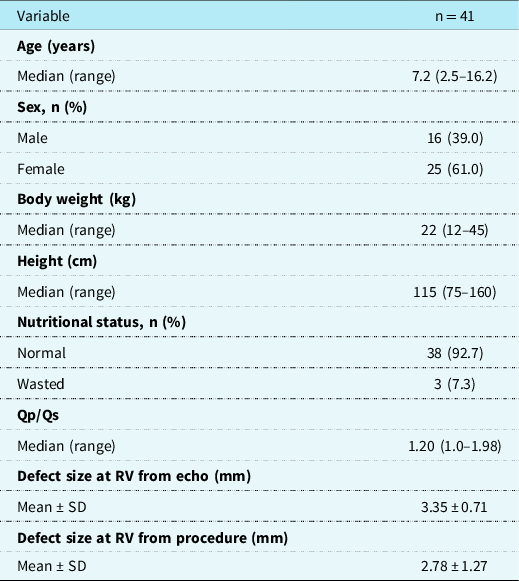
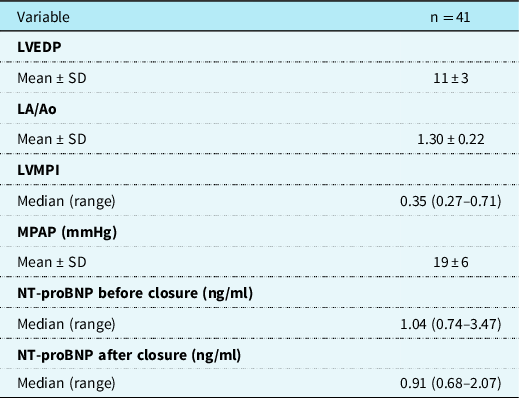
The general characteristics of the study subjects are described in Tables 1 and 2. Upon the data collection process, three patients did not come for the NT-proBNP evaluation after the closure; thus, we excluded their data from the analysis. The mean age of the children enrolled in our study was 7.2 years old, with the youngest subject was 2.5 years old and the oldest was 16.2 years old. More girls were affected by ventricular septal defect compared to boys. Based on the World Health Organization’s growth chart, only three children’s nutritional status were wasted while the rest were having normal nutritional status in our study. The size of the cardiac defect of the children who were included in our study was small when determined both from echocardiography or from the catheterisation procedure. All children who were enrolled in our study showed QP/QS below 2 with low pulmonary artery pressure. None one of the children had clinical sign of heart failure which was proved by the Ross score result below 6.
Patient characteristic.

Variable distribution.

LVEDP: left ventricular end-diastolic pressure, LA/Ao: left atrial to aortic root ratio, LVMPI: left ventricular mass index, MPAP: mean pulmonary arterial pressure, NT-proBNP: N terminal pro B-type natriuretic peptides.
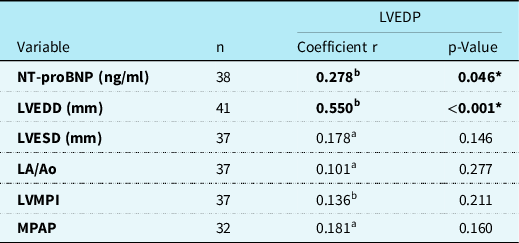
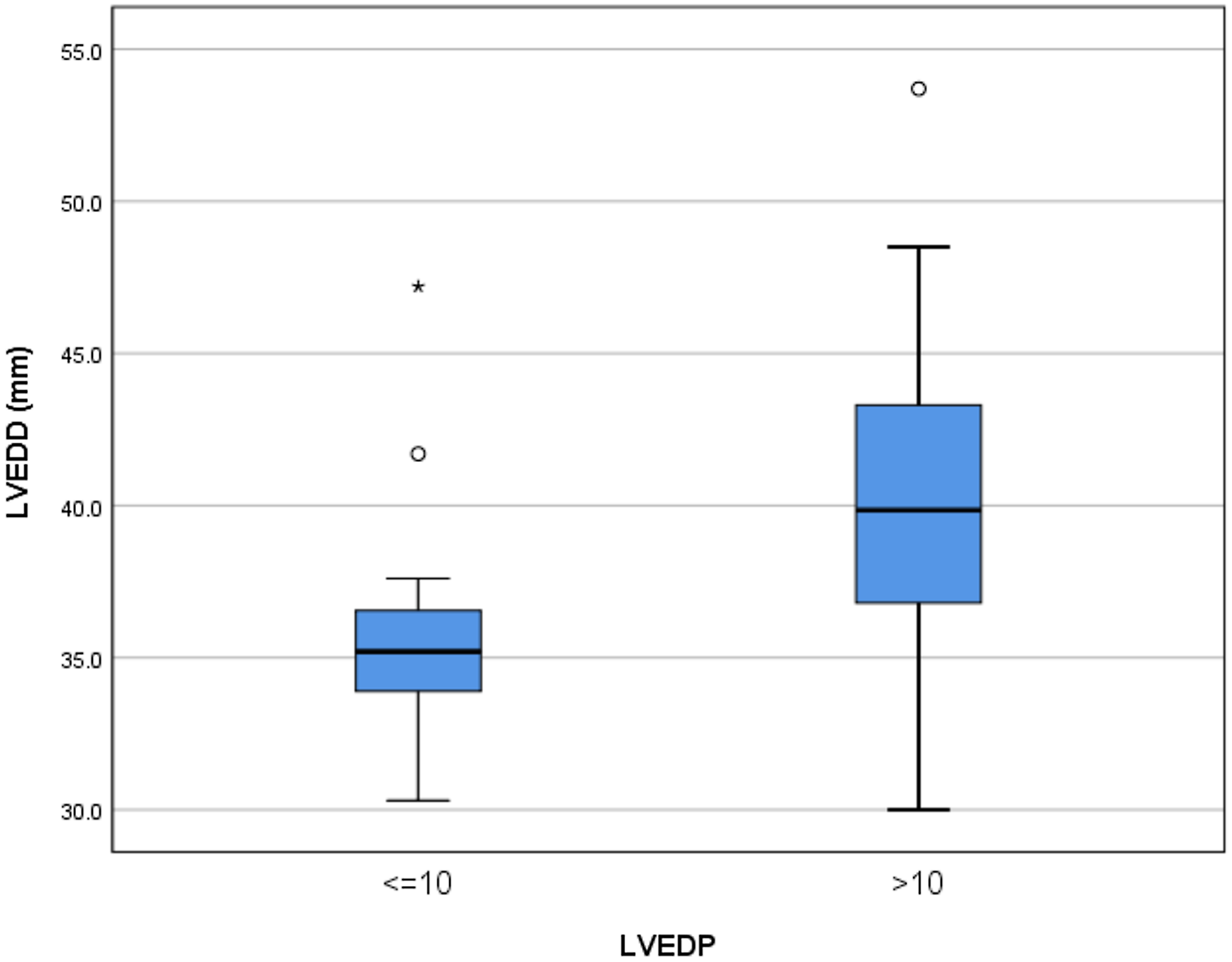
Our statistical analysis in this study is shown in Table 3 and Figure 1. We found positive correlation between NT-proBNP with left ventricular end-diastolic pressure (r = 0.278, p = 0.046) and also positive correlation between left ventricular end-diastolic diameter and left ventricular end-diastolic pressure (r = 0.550, p < 0.001). No correlation was found between other variables with left ventricular end-diastolic pressure (p > 0.05).
Scatterplot of NT-proBNP with LVEDP.

Correlation between LVEDP and variables.

Analysis method: aPearson’s correlation, bRank Spearman’s correlation n, *Significant.
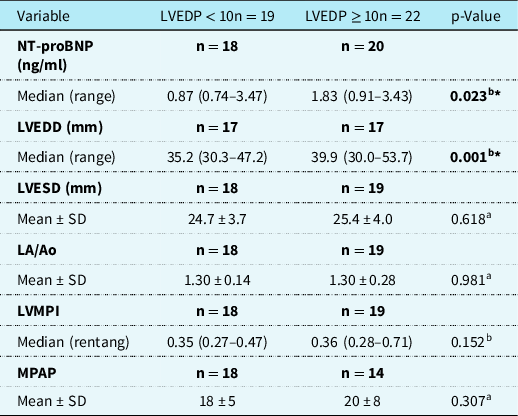
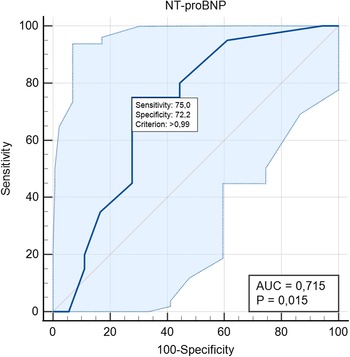
As shown in Table 4 and Figure 2, there was a significant difference between NT-proBNP and left ventricular end-diastolic pressure <10 mmHg and left ventricular end-diastolic pressure ≥10 mmHg. Left ventricular end-diastolic pressure is considered high when the value is ≥10 mmHg.Reference Park and Salamat12 The median NT-proBNP at left ventricular end-diastolic pressure <10 mmHg was lower than at left ventricular end-diastolic pressure ≥10 mmHg (0.87 ng/ml versus 1.83 ng/ml, p = 0.023). NT-proBNP cut-off of >0.99 has a sensitivity of 78.9% and specifity of 73.7%.
Boxplot distribution of NT-proBNP between LVEDP < 10 and LVEDP > 10.

Difference of NT-proBNP and other variables between LVEDP < 10 and LVEDP≥10.

Analysis method: aUnpaired t-test, bMann–Whitney test, *Significant p-values.
The results of the NT-proBNP diagnostic test for predicting left ventricular end-diastolic pressure ≥ 10 mmHg using Receiver Operating Characteristic (ROC) analysis in Figure 3 showed that the area under the curve value of 0.715 (95% CI: 0.546–0.849). It means that NT-proBNP has sufficient accuracy to predict left ventricular end-diastolic pressure ≥ 10.
Sensitivity and specificity of NT-proBNP.

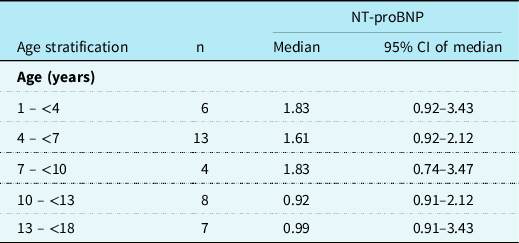
We have also tried to predict the value of NT-proBNP range stratified by age based on our study before, and the result was described in Table 5.
Age stratified NT-proBNP value range.

Notes: CI = confidence interval.
Discussion
The controversies about the treatment for small ventricular septal defect is still under debate. There is a lower probability to develop pulmonary hypertension in small, restrictive, and isolated ventricular septal defects with a small left to right shunt. Reference Ali, Hassan and El Fiky2,Reference Gersony, Hayes and Driscoll3 However, in a study conducted by Karonis et al about long-term prognosis of left ventricular dysfunction in adulthood, it was supported to do closure on the small ventricular septal defect in childhood.Reference Karonis, Scognamiglio and Babu-Narayan4 Another study by Miyake et al showed that when QP/QS is >1.2, the possibility of spontaneous closure of ventricular septal defect is low. When it stayed opened, even when the defect is small, previous study showed that the heart function might still be affected in adulthood. Despite the theory that stated that QP/QS is not significant and intervention might not needed when the value is <2, there will still be flow from left ventricle to pulmonal artery which will continuously happen in each cardiac cycle, and in the future this phenomenon can increase cardiac volume and might be dangerous when the child reaches adulthood.Reference Soufflet, Van de Bruaene and Troost13,Reference Miyake, Shinohara, Fukuda, Ikeoka and Takemura14
Brain natriuretic peptide is a neurohormone released by cardiac ventricles in response to volume or pressure overload. This natriuretic hormone is thought to be a very sensitive and specific indicator to determine ventricular function.Reference Kaya, Akdemir and Gunduz15 In children, the normal level of NT-proBNP changes. The level of NT-proBNP will be elevated immediately after birth and gradually decreases after the neonatal periode. However, NT-proBNP reference levels and intervals in the children have not yet been fully evaluated. Furthermore, the concentration of NT-proBNP in patients with CHD has not been completely understood yet in the paediatric field.Reference Kim and Choi7
We can predict volume overload from NT-proBNP levels in children. Previous study by Kaya et al showed that serum natriuretic peptide was elevated in small to moderate ventricular septal defect patient, and the serum level would be decreased about 1 month after percutaneous closure of the defect.Reference Kaya, Akdemir and Gunduz15
Left ventricular end-diastolic pressure is associated with symptoms of congestive heart failure and is needed to calculate the pulmonary vascular resistance, which is important for determining the indications for closure in patients with large ventricular septal defect.Reference Oyamada, Toyono and Shimada16 In this study, we found that in small ventricular septal defect, more than half (53%) of the small ventricular septal defect patients show left ventricular end-diastolic pressure above 10 mmHg.
We also found that there is a correlation between NT-proBNP and left ventricular end-diastolic pressure in patient with small perimembranous ventricular septal defect. NT-proBNP level in patients with cardiac disease is higher than in normal cardiac. The value of NT-proBNP was found to be increased when there is an increase in regurgitation or shunt. Ventricular septal defect will create shunts in heart, causing left heart dilatation, increasing the pressure, and in turn increased the left ventricular end-diastolic pressure. This might be the mechanism which caused NT-proBNP to increase when left ventricular end-diastolic pressure value is increased too.Reference Karonis, Scognamiglio and Babu-Narayan4,Reference Chanda, Rajasekhar and Kanth17
The study conducted by Nevo et al showed that NT-proBNP level over 1 ng/ml is related to acute cardiac disease and NT-proBNP level below 0.4 ng/ml is related to acute non-cardiac disease in children.Reference Nevo, Erlichman, Algur and Nir18 However, we have not known yet about the cut-off values of NT-proBNP. Thus, it is still not applicable in infants. The study conducted by Fried et al showed that a threshold of NT-proBNP level of 11 ng/ml was a marker of cardiac disease.Reference Fried, Bar-Oz and Algur19 Another study conduct by Hyun et al showed that the level of NT-proBNP in cardiac disease was 0.55 ng/ml, and the range was quite wide between patients with normal cardiac and CHD.Reference Kim and Choi7 We have tried to establish the NT-proBNP value range though, through the result in our study stratified by the age.
In our study, using ROC curve, we found that area under the curve value was 0.715 (95% CI: 0.546–0.8649), meaning that the NT-proBNP has a 71.5% likelihood of correctly classifying the left ventricular end-diastolic pressure ≥10. Thus, it was proven to be quite accurate. This result showed that even in small perimembranous ventricular septal defect, volume overload can still be found. This result was in line with a research conducted by Chen et al which showed that there was a reverse remodelling of left ventricular end diastolic diameter in asymptomatic and minimally symptomatic adolescent patient small perimembranous ventricular septal defect.Reference Chen, Wang and Lin20
Nevertheless, this study have several limitations. First, it did not reflect the total population because the study was only performed in two hospitals using different types of device to close ventricular septal defect that might cause bias. Second, patients recruited in both groups were not matched for the age and sex. We also had a broad age range in our samples, and since the NT-proBNP value might be different for each age group, the result might be affected.
In conclusion, NT-proBNP higher than 0.99 ng/ml was correlated with left ventricular end-diastolic pressure ≥10 mmHg in small perimembranous ventricular septal defect. Level of serum NT-proBNP level in small perimembranous ventricular septal defect may indicate that left ventricular volume overload could be happen in small perimembranous ventricular septal defect, and this might lead to lung volume overload and left ventricular dysfunction later in life. Thus, we suggest for small perimembranous ventricular septal defect closure to be performed in children as early as possible. We also suggest for future study similar to this to be conducted in the future, with narrower age range for the samples included.
Acknowledgement
None.
Financial support
The authors would like to thank PITTA funding from University of Indonesia for helping to fund this study.
Conflicts of interest
None.
Ethical standards
The authors assert that all procedures contributing to this work comply with the ethical standards with the Helsinki Declaration. This study has been approved by by the Medical Research Ethics Committee of Dr. Cipto Mangunkusumo General Hospital Jakarta and Dr. Hasan Sadikin General Hospital Bandung, Indonesia.