1. Introduction
The role of Daphne Oram as an early pioneer of electronic music in the UK, most especially for the design and construction of an unusual – and in many respects visionary – graphical synthesiser, has yet fully to command the critical attention it deserves. The design and development of her Oramics synthesiser during the 1960s was to prove groundbreaking in a number of respects, and this achievement is all the more remarkable when consideration is given to the limitations of the technology available to her at the time and the highly personal nature of the project, working completely independently of any institutional support.
The work of earlier key pioneers of graphical music such as the Bauhaus artists László Moholy-Nagy, Oskar Fischinger and Paul Arma during the 1930s experimenting with the possibilities of ‘drawn sound’, in turn inspired to a degree by the innovative work of the German filmmaker Walter Ruttman, has been well documented. Other significant innovators in the field include Vevgeny Sholpo, Jack Ellitt and Norman McLaren (Manning Reference Manning2003: 5–6). Such initiatives were to bear further fruit during the 1940s and early 50s: for example, McLaren's further work with optical soundtracks, and projects such as John and James Whitney's development of an optical synthesiser in 1941–42, using pendulums to draw waveforms. Percy Grainger's subsequent use of a graphical control system for his Free Music Machine (1952) came at a time when the creative use of optical techniques had become very much a minority pursuit. The reasons for this decline in activity can be attributed to a number of factors, notably the impact of magnetic tape recording on the film industry and its eventual abandonment of optical sound tracks. Oram's endeavours were thus to gain momentum in an increasingly unfavourable climate. Before considering the development of her unique optical synthesiser, the Oramics Machine, it is useful to indentify some key characteristics of her technical and musical background. A comprehensive account of her life and work is to be found in an article written by Joe Hutton for an earlier volume of Organised Sound (Hutton Reference Hutton2003), and this research provides an important source of reference.
Oram's interest in electronics was stimulated during her prewar childhood by her two brothers, sharing their passion for building radio receivers and transmitters. One brother, John Anderson, was indeed subsequently to play a major role assisting Daphne in the construction of her Oramics system. Her destiny was sealed in this regard in 1943, when at the age of eighteen she turned down the offer of a place to study at the Royal College of Music and entered the BBC as a junior programme engineer. Her appointment to the BBC, which was to last until January 1959, was to prove momentous and frustrating in almost equal measures. It was momentous in the sense that her quest to develop a studio for electronic music within the Corporation was indeed finally to be rewarded by the establishment of the BBC Radiophonic Workshop in 1958. The obstacles that she encountered along the way were nonetheless significant, not least in terms of denying her any material recognition for her own creative and technical endeavours. This lack of support made the situation all the more challenging for her in terms of developing the resources she aspired to, and explains why within the space of a year she had resigned from her position as the first director of the Radiophonic Workshop to establish her own private studio in Tower Folly, a former oasthouse in Fairseat, Wrotham, Kent.
In considering the circumstances that led Oram to investigate the creative possibilities of optical sound synthesis and the extent to which her work was to prove original, it is important to take some further considerations into account. With the benefit of hindsight one might conclude that the technical principles that she pursued were not truly groundbreaking, given the achievements of earlier pioneers in the field. Such a judgement, however, overlooks some pertinent issues. In particular it is clear that until a very late stage in the design of Oramics her knowledge of other important initiatives was exceedingly limited. The extensive repertory of notes and logbooks to be found in the Oram archive of documents and recordings (Oram Reference Oram2007) provides useful evidence to support such a conclusion. In mitigation it may be noted that her research took place in an era when the powerful communication resources such as the Internet were completely unknown. Access to relevant information, especially in the context of a lone pioneer such as Oram, was at best fragmentary and at worst extremely limited. To reinforce the extent of her isolation there are no references, for example, in either the musical or the technical sections of the Oram archive to the scanning synthesis technique used by Sholpo for his Variophone (1932). Of all optical synthesis methods developed during the interwar period this is perhaps the closest in terms of its functional characteristics and underlying design philosophy to that she subsequently adopted for Oramics (Aldoshina and Davidenkova Reference Aldoshina and Davidenkova2010). Similarly it appears that she was similarly unaware of Percy Grainger's use of linear shapes drawn with a pen in his graphic scores of ‘Free Music’ for Theremins (1936–37).
The relevance of Grainger's work in this context is all the more pertinent when it is appreciated that in writing these pieces he was actively seeking a means of applying such data to the associated Theremins without the intermediate services of a performer. Indeed he was subsequently to develop a series of ‘Free Music’ music machines, otherwise known as ‘Tone Tools’, with Burnet Cross during the 1950s, including a model that used photocells to detect hand-drawn pitch and volume settings on an associated control strip (Lewis Reference Lewis1991). The inclusion in the archive of a number of documents relating to later developments in America, however, suggests that by the mid-1960s Oram had become aware of similarities between her ideas and developments elsewhere. These issues were indeed subsequently to come of material concern to her as she embarked upon the processes necessary to patent her optical scanning system. A key archive document in this context is a copy of an article by Max Mathews and Lawrence Rosler describing the Graphic 1 computer system at Bell Telephone Laboratories following an earlier presentation to the Acoustical Society of America in 1966 (Mathews and Rosler Reference Mathews and Rosler1968). As a letter written on 4 February 1965 to James Thornton, the Director of the Calouste Gulbenkian Foundation, confirms (Oram Reference Oram2007: 1.2.x) the similarities between this highly sophisticated facility, the result of a research project led by the founding pioneer of computer music and funded by the research division of a major communications company, and her own system built in a private capacity on a minuscule budget were indeed a matter of considerable concern. She remained confident nonetheless that key features of her own design remained unique, and this perspective was materially confirmed with the subsequent award of patents for the Oramics waveform scanning system in both the UK (Patent Office GB 1970) and the USA (Patent Office US 1969).
In terms of developments that were known to her during the construction of the Oramics Machine there are strong similarities between the functional characteristics of the punched tape control system specially developed for the RCA Synthesiser (Olson and Belar Reference Olson and Belar1955) and the optical version she devised for the digital control of pitch, a design feature that will be studied more closely in due course. She indeed makes an explicit reference to this key characteristic of the RCA synthesiser in her book An Individual Note, published in 1972 (Oram Reference Oram1972: 109). Beyond this instance of a material external influence on the design of one aspect of the control system for Oramics it is very hard to identify any other features that were specifically derived from the work of other pioneers other than of a purely coincidental nature. The tools for her craft, with the possible exception of the cathode ray oscilloscope, were the repertory of individual components provided by the electronics industry, from resistors, capacitors and thermionic valves to more specialist components associated with optical sensing, and the craft itself lay in the design of the electronic circuits and associated hardware necessary to develop a viable system.
2. Early Conceptions
The initial inspiration for her optical method of sound synthesis came during her initial BBC technical training course at Evesham in 1944. Here she encountered for the first time the cathode ray oscilloscope in the context of its use as an item of laboratory test gear. Her recollections of this encounter are revealing:
And there I saw for the first time the oscilloscope which as you know is showing on the screen the patterns of whatever is incoming from the microphone, and I was allowed to sing into it and there I saw my own voice as patterns on the screen, graphs, and I asked the instructors why we couldn't do it the other way around and draw the graphs and get the sound out of it, I was eighteen I think and they thought this was pretty stupid, silly teenage girl asking silly questions, but I was quite determined from that time on that I would investigate that, but I had no oscilloscope. (Oram Reference Oram1991: 8)
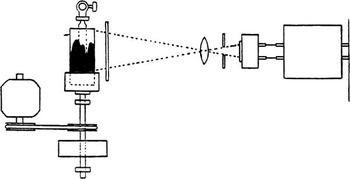
It is thus deeply ironic that unknown to her, or indeed so it would appear any member of the BBC technical training department, the practical viability of such an approach had been publically demonstrated in the UK just three years previously by E. G. Richardson, a researcher at King's College, Newcastle upon Tyne (at that time a College of the University of Durham), as part of a lecture presented to the Musical Association in March 1940 and subsequently published in its Proceedings (Richardson Reference Richardson1940). The technique described involved recording on a moving photographic film the vertical movements of the light beam from a cathode ray oscilloscope in response to applied audio signals. This mode of display, rather than the normal X/Y display trace, was generated by disconnecting the normal horizontal time-base facility. A short length of film representing the registration of three or four wavelengths, suitably highlighted by rendering one side of the line completely opaque with masking ink, was then wrapped around a glass cylinder containing a light source and rotated at a constant speed by a motor. The resulting fluctuations in light intensity were then detected by a photocell light mounted on the other side of the film and converted back into an electrical waveform signal for acoustic reproduction (figure 1) (Richardson Reference Richardson1940: 56). The principles that Oram was subsequently to embrace in the design of a prototype optical scanning system for her synthesiser during the late 1950s had thus already been established, but she had no knowledge of this work until the author of this article drew her attention to Richardson's paper in about 1972, many years after the construction of the Oramics Machine.
The schematic diagram for Richardson's optical scanning system, 1940

The earliest technical drawing in the Oram archive (Oram Reference Oram2007: 1.1.001), dated December 1951, is a diagram of an optical playback system using two loops of film threaded via a simple playback system consisting of a light source and a photocell, the necessary tension for each loop being maintained by an associated pulley. Although the diagram is not annotated, it is clear from the drawing that the data on the two loops are to be read by different photocells, anticipating the system of parallel control film strips that was to become a key feature of the Oramics system. Although further documentation from this early period is very limited, the next inventory of technical data consisting of a series of notes written almost a year later, it is clear that over the intervening period her ideas were beginning to take shape. She was also subsequently to note that by this stage several of her colleagues in the BBC, including members of the training school who had previously been so dismissive of her ideas, were starting to take an interest (Oram Reference Oram1991: 8).
A memo drafted on 21 October 1952 and sent on 11 November to an unidentified colleague in the training school states: ‘Here are the tape speeds and the detail of my wave writing contraption. This is just the elementary principle – I'm sure yourself will have plenty of ideas on the practical set up needed.’ Although the associated diagram is missing from the Oram archive the accompanying notes provide useful clues as to the intended design:
a) One cycle drawn by hand – vertical movement of period converted into voltage while horizontal movement turns drum (at b1) one exact revolution. b2) The drum is either coated itself or else has length of tape wound around it – tape already biased at 30kcs. If at b2 this drum is to be revolved at 100 rpm its circumference is 9″ to retain bias at 30 kcs. b2) Same recording head and drum as b1. Drum revolves at a steady 100 rpm. c) Written cycles are always drawn with the same amplitude, so all variation is made here. d) Normal tape machine with special speed control. (Oram Reference Oram2007: 1.1.002)
By early 1953 she was already thinking of ways in which constituent waveforms could be combined to create composite sounds. A letter to Dr Alexander, a member of the BBC technical support division, sent on 23 January 1953 notes that:
I visualise recording a number of short lengths of tape which one then dubs together by using three tape machines. The German way of superimposing the one on the other would be most useful if it left you with the originals as well as the combined but if not, I foresee much lost effort if the process of superimposing happened not to give the desired results.
Would you mind keeping all these musings of mine ‘under your hat’ at the moment until the time is ripe? Meanwhile can you recommend any books giving photos of sound waves other than Dayton Miller? Until I can start making sounds from squiggles I might as well study the squiggles we get from sounds! (Oram Reference Oram2007: 1.1.003)
By now, feeling considerably empowered by her progress, she decided to approach the BBC Research Department, resulting in a meeting that was to define the future course of her quest to develop an optical synthesiser:
I went to see the Head of Research and said I've got an idea of writing graphic music could I have some equipment please and he pulled himself up to his full height and said ‘Miss Oram, we employ a hundred musicians to make all the songs we want, thank you’. And this imprinted on my mind and I thought you so and so, but that was the attitude, that was the official attitude, they had, the BBC Symphony Orchestra, and it was there to make all the music they wanted, and nothing else was of any interest. (Oram Reference Oram1991: 10)
Although this major setback did not dissuade her from continuing to lobby, ultimately successfully, for the establishment of the Radiophonic Workshop, it became clear to her there was no future in continuing to seek institutional funding and support for the development of her proposed graphical music system. Her primary activities for the next few years were thus focused on furthering more traditional approaches to electronic music, seeking in essence to establish a studio for electronic music at the BBC to match those already established elsewhere in Europe. The establishment of the Radiophonic Workshop and her role in its development have been considered elsewhere (Manning and Candlish Reference Manning and Candlish2008), and her tenacity and determination in this regard are indicative of the qualities that were to come to bear in the subsequent development of Oramics. Indeed, these qualities go a long way to explain why less than a year into her appointment as the first Director of the Workshop she suddenly resigned from the BBC and set up her own private studio.
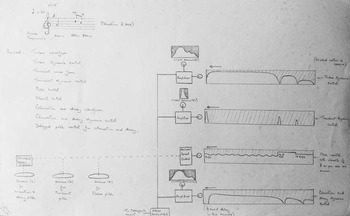
The preparatory steps for this move were already well under way by this point. On 4 April 1957 she wrote to Alan Nisbett, a BBC colleague who shared her interest in pursuing new ideas for audio engineering. Her letter consisted of a remarkably comprehensive set of specifications for the prototype version of her proposed synthesiser, including a detailed set of requirements for the waveform scanning system and an overall schematic diagram (figure 2) (Oram Reference Oram2007: 1.1.008). Nine years were to elapse between this proposal and the completion of the first working version of Oramics, and the scope and nature of the changes that had to be made to the design over the intervening period provide a useful insight into the unique nature of her approach to optical sound synthesis and the significant hurdles that had to be overcome in bringing her vision to fruition. Before embarking upon a detailed scrutiny of these developments, it is important to understand that it was never her intention to develop a definitive, final version of her system. In particular her underlying desire to research new possibilities of working with optically produced sound was to result in a number of continuing changes to the configuration of the control system.
Daphne Oram's initial design for Oramics, 1957

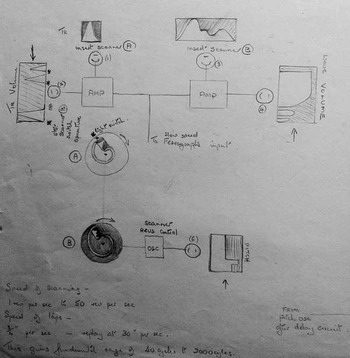
Two methods of optical scanning were envisaged back in 1957. The first almost exactly replicated the method of re-synthesis described by Richardson in his lecture to the Musical Association in 1940, consisting of a circular glass tube mounted on a motor-driven turntable with an internal fixed light source and an external photocell light detector. The second, a development of the first, consisted of a flat glass disk mounted on a spindle and positioned between a light source on one side and a photocell on the other (figure 3) (Oram Reference Oram2007: 1.2.004). Oram notes in her letter to Nisbett that ‘[The] wave form of [the] timbre is painted on glass or cut out of black paper according to which scanning method is used. It is scanned according to the pitch required at a speed between 1 rev per sec and 50 revs per sec. This gives a range of the fundamental between 40 cycles per sec and 2000 cycles per sec’ (Oram Reference Oram2007: 1.2.004). It can be deduced from these specifications that forty complete cycles of the waveform had to be coded for each revolution, a challenging prospect in terms of drawing the functions entirely by hand. A related problem concerns the possibility of an audible discontinuity at the join between the start and the end of the circular trace. Here the use of the spiral format methodology permitted a small degree of overlap, thus facilitating a smoother transition.
The proposed design for a disk-based waveform scanner, 1957

Two further optical scanners were proposed in order to shape the resulting timbres. Whereas the first scanner was dedicated to producing the basic waveform, the second superimposed an attack transient at the start of each new note/event, and the third provided an opportunity to add an element of sound colouration, whereby ‘a modified form of the timbre wave (probably the higher harmonics altered somewhat) is scanned in the same way as the timbre and transient waves except that pitch variations are somewhat delayed’ (Oram Reference Oram2007: 1.2.004). In the case of the attack transient, the intention was to register a representation of the transient itself within the time constraints associated with a single revolution of the associated scanner.
The schematic diagram provides useful further insight into the overall design principles (figure 2). The control system consists of four 35 mm clear film strips containing hand-drawn functions, rendered opaque on the upper side so that the resulting characteristics could be converted into equivalent electric functions by passing the strips simultaneously from right to left over an associated bank of four photocells. It is thus possible to correlate the score details of the three-note musical phrase inserted in the top left-hand corner of the diagram with the information that has been entered on the associated control strips. The first track articulates the basic volume envelope of each note, the successive reductions in level ensuring that the shorter second and third notes are progressively quieter than the first, in accordance with the score. The second track articulates the timing, length and amplitude of the associated attack transient for each note, and the third provides the pitch of each note, including an element of expressive vibrato in the case of the longer first note. The fourth strip adds the colouration and delay component, the associated characteristics being articulated by registering a progressive decay function for each onset, which in turn is slightly delayed relative to that of the primary timbre.
Nisbett's response to Oram's proposal (undated) is significant in two particular respects. He acknowledged the viability of the proposed scanning methods and the associated control system, suggesting for example the Philips–Miller system of optical recording, suitably adapted to register corresponding control voltages. He also expressed the view that this data could be better recorded using magnetic tape, either in a multi-track format or more simply by using a single track of control tones, each function associated with tones of a specific frequency. Oram was subsequently to reject this suggestion on the grounds that it defeated the whole purpose of her system in terms of providing an entirely visual means of controlling the processes of sound synthesis.
His second, altogether more substantive reservation, however, was to prove materially significant: ‘I am doubtful of the value of controlling pitch by means of this or any other system of a similar value … it would be very difficult to construct a sufficiently accurate device of the type shown’ (Oram Reference Oram2007: 1.2.004). This drawback is self-evident from a closer scrutiny of the proposed pitch-control track. Whereas the timing and duration of each note could be well assured in terms of the horizontal positioning of the data along the moving film strip (the proposed transport speed after much deliberation was finally established as 10 cm/sec), the accurate articulation of pitch in terms of the vertical positioning of the associated line trace between the two edges of the film was clearly not feasible. In due course this necessitated a major reconsideration of the method of pitch control, and the development of a much more refined system of event coding. Major problems with the technology required for the optical scanners were also to emerge, and the substantive changes that were made in both contexts will be returned to in due course.
3. The development of the oramics machine
By far the biggest barrier to further progress at this time, however, was the lack of funding. Although Oram was able to make a modest living via freelance work, such engagements reduced the time available to work on her synthesiser and did not in any event provide the funding necessary to turn her ideas into a practical reality. The turning point was to be a successful application to the Calouste Gulbenkian Foundation for financial support, leading to an award of £3,550 over three years in January 1962. Although this was less than half the amount originally applied for, it nonetheless provided a viable basis for the development of a fully working version of her synthesiser. A study of her thinking at the time of this application, both in terms of public communications with the Foundation and also the content of her notebooks, gives a clear and ultimately revealing sense of the purpose and direction that were to inform the subsequent development of Oramics. Her logbook for January 1961, for example, contains the following set of criteria:
Needs:
1) To have complete control of timbre, pitch, dynamics, vibrato, reverberation, attack, decay, timbre changes within the note.
2) To control these characteristics in a visual form so that all alterations within the aural comprehension of the human ear and mind have an easily recognisable counterpart in the visual medium.
3) To achieve this controlled complexity of waveform whilst keeping all parameters within the scope of written waveforms.
4) To obtain sounds which are more ‘musical’ than those achieved by electronic devices and which have a greater range of timbre. (Oram Reference Oram2007: 1.1.016)
An earlier letter sent to the Gulbenkian Foundation on 27 October 1960 by way of an initial enquiry deals more specifically with the musical aspects of her proposed system:
1) The assessment of the powers of the human ear and mind to comprehend acoustic sensations outside those normally employed in Western Music.
a) Comprehension of frequency intervals not used in the chromatic scale.
b) Comprehension of rhythmic patterns and note durations.
c) Comprehension of tonal changes of varying durations and at varying fundamental frequencies.
2) The designing of electronic circuitry to satisfy the requirements of the above assessment.
3) The application of the foregoing in composition techniques. To produce an art form, electronic sounds must be submitted to complete organisation by the human mind; the rules and techniques employed must be inherent in the medium itself and not be imposed only because they previously existed in another form of musical composition. (Oram Reference Oram2007: 1.2.x)
Whereas her subsequent, more formal application to the Foundation expands on these key considerations (Oram Reference Oram2007: 1.2.x), it is only from a detailed scrutiny of her private writings that the full extent and depth of her envisioning in this context becomes fully apparent. The following undated extract from a slightly earlier logbook (c. 1959) quintessentially captures the true essence of her vision:
For the study of sound, and in order to compose music outside the scope of present day orchestral instruments it is intended to build an electronic device (here called ‘the sound wave instrument’) which will convert drawn information into sound. The composer will draw, by hand, some dozen or more patterns which will give the electronic device not only the basic complex tone colours but the information on how they are to be blended, reshaped, pitched, phrased, dynamically controlled and reverberated. The result will be one ‘line’ of musical sound recorded on one track of a multi-track recording machine. Numerous lines can be built up in this way and later combined to make the final composition, which will therefore be in the form of a recorded tape. The effects of noise, of sounds below and above the human sound spectrum, of induced resonances and strange insistent rhythms could be studied by the use of this sound wave instrument – both the bad effects on health and nerves and any possible therapeutic effects by the controlled use of musical sound. (Oram Reference Oram2007: 1.4.x).
The reference to a multi-track recorder is especially interesting in that she fully recognised the need to use such a device to assemble a polyphonic work, for in common with most other analogue synthesisers of the time Oramics could only generate a monophonic output. Her expectations in this regard were nevertheless somewhat optimistic, given that at the time of writing the commercial four-track tape recorder was still a relatively new invention and it would be a number of years before truly multi-track recorders would become available:
It is necessary to have a tape recorder which has numerous recording heads each operating a separate track of tape. I visualise a 12 track tape so that 12 lines of music can be recorded separately – but these can then be played back all at once, mixed by the composer to his requirements and finally recorded on a normal tape recorder. (If 12 lines are not enough for the composer's counterpoint and ‘orchestration’ requirements then he can mix together 11, record them onto the 12th line, and add 11 more!) (Oram Reference Oram2007: 1.4.x)
It would seem that it was the musical objectives that were ultimately to persuade the Foundation to support her work since the application included only a general overview of the associated technology that would have to be developed in order to construct a fully working system. The award of a grant was all the more remarkable in that it was made to an individual rather than an institution, which was entirely contrary to the normal requirements of the Trustees. Given the difficulties that lay ahead, it was fortunate that the Foundation was prepared to fund a project that was to a significant degree speculative. The conditions of the grant were simply as follows: ‘to enable Miss Oram to concentrate to a greater extent on part of her programme of research in electronic music, the ground-work of the research being concerned mainly with designing and building electronic equipment for the purpose of converting drawn information into musical sound’ (Oram Reference Oram2007: 1.2.x).
With the award of this grant work began in earnest in terms of completing a viable design for the construction of the Oramics Machine. With assistance from her brother John Anderson (who started work sourcing and assembling the mechanical components for the system) and Fred Wood, a design engineer for the Post Office (who concentrated on electronic aspects) Daphne Oram finally started to make some material progress. It was at this stage, however, that the earlier-mentioned problems in constructing the optical scanners became all too apparent. The root cause of these difficulties was the electromechanical components of the proposed design. Despite all their collective efforts it proved impossible to achieve the step changes in the speed of the scanned waveform images necessary to move accurately and smoothly from one pitch to the next, let alone introducing a speed modulation characteristic to produce a convincing musical vibrato. The original idea of superimposing an additional attack transient was also quickly abandoned. Oram had envisaged a procedure whereby at the start of each new note or event the light source for this scanner would be automatically switched on simultaneously with the release of a catch that would allow the disk to complete a single revolution, whereupon the catch would re-engage and the energising light would switch off again ready for the next note. Even when working with the lighter and physically more responsive method of scanning using flat, turntable-mounted optical disks it proved impossible to control the procedure in a reliable manner, especially when adding transients to faster-moving sequences of note/events.
By the end of 1963, now well into the second year of her three-year grant, the lack of solutions to these problems brought Oram close to the point of desperation. It was thus extremely fortunate that towards the end of the year she was to renew her acquaintance with Graham Wrench, an electronics engineer whom she had first met during her time working at the BBC. His interest in her work led to an offer of help. Her annual report to the Gulbenkian Foundation, dated April 1964, notes that ‘In London a young engineer, Graham Wrench, has taken over for me the final research stages of the high speed scan equipment and is delivering the prototype, assembled and working in June–July’ (Oram Reference Oram2007: 1.2.x). In the event she seriously underestimated the time it would take for Wrench to develop a substantially revised method of optical waveform synthesis and construct a fully operational scanning system. Notwithstanding his move to Tower Folly in October 1964 to work on the project full time, it was to take a further twelve months before the prototype scanner was completed.
In the meantime her three-year grant from Gulbenkian had come to an end, creating a new funding crisis. Daphne Oram was to spend some considerable time developing a new funding proposal, finally submitting an application for a further three years of funding early in 1965. This also included a proposal to establish an arts/science education centre, a project that had attracted interest from other leading practitioners including Hugh Davies and Tristram Cary (Oram Reference Oram2007: 1.2.x). After several months of deliberation the Trustees turned down the application. The rejection letter, dated 20 October 1965, however, contained an important silver lining in that the Foundation was nonetheless prepared to consider advancing a supplementary award of £1,000, on the understanding that the machine would be completed by the spring of 1966 (Oram Reference Oram2007: 1.2.x). This award came just in time since a few days earlier she had received a letter from her bank manger seeking to review her credit arrangements (Oram Reference Oram2007: 1.2.x). Had this overdraft been withdrawn it is unlikely that the Oramics Machine would ever have been completed.
In June 1966 she wrote again to Gulbenkian as follows:
We are delighted to tell you that we have succeeded in proving that graphic information can be converted into sound. We can draw any wave form pattern and scan this electronically to produce sound. By varying the shape of the scanned pattern the timbre is varied accordingly. The speed of the scanning is controlled by digital information written on the clear 35 mm films of the programmer, and this determines the pitch of the sound produced. A number of scanners can be controlled for pitch this way.
By writing information on the other films of the programmer the following parameters are controlled: duration of each note; timbre mixture; the overall volume envelope of each separate waveform which is contributing to the timbre mixture; reverberation (either on the timbre mixture or on a selected waveform of the timbre mixture); and vibrato.
We believe that no similar piece of equipment exists anywhere else in the world. As you will know from the ‘New Scientist’ article which we sent you last year, much work is going on in the U.S.A. in developing computer music. But, as far as we can tell, the difficulties, which the composer experiences in programming the computer, have not yet been overcome. We have high hopes that the Oramics equipment will prove to be the answer. (Oram: 2007 1.2.x)
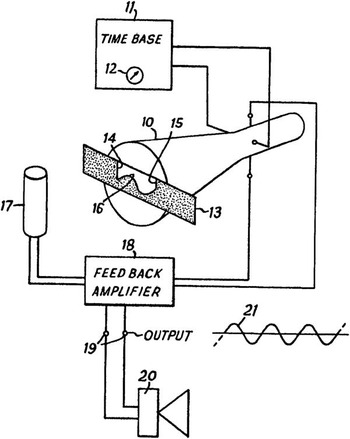
This report is notable on two counts. Firstly, it demonstrates Daphne Oram's growing concerns at this time about possible competition from the USA. Secondly, it gives the impression that the Oramics Machine was essentially complete. In truth this was not the case since considerable work had yet to be done on the control system. The inspiration for Wrench's solution to the optical scanning problem came from a period of national service during the mid-1950s that allowed him to explore the characteristics of radar detection systems. This led him to develop a technique very similar to that used by Richardson in the late 1930s to register the functional characteristics of audio waveforms using an oscilloscope and a moving strip of photographic film, but operating instead in the reverse direction. Accordingly he devised a scanning system where the characteristics of a waveform are registered on a 5 × 4 inch photographic slide, mounted on the front of a standard 6-inch cathode ray tube. These characteristics are then scanned optically using a repeatedly cycling beam of light generated by the oscilloscope, an associated photocell registering and electronically converting the corresponding variations in light intensity into an equivalent voltage function, the speed of repetition determining the frequency of the resulting audio wave (figure 4) (Oram Reference Oram2007: 1.3.x).
Wrench's scanner for Oramics, 1966

Having thus eliminated the need for any moving parts, it would have been practicable to revisit her original idea of superimposing a transient component at the start of each new sound event. Oram, however, had become especially interested in the production of timbres that could be not only enveloped in a conventional manner as discrete note/events but also dynamically varied in terms of their spectral content. Her original specification for three scanners, each assigned to a specific task (waveform synthesis, attack transient and delay colouration) was thus changed to four general-purpose scanners, the timbre of each waveform being shaped dynamically via a uniquely assigned control strip with their outputs connected in parallel. Similarly the specification of the associated control system of moving 35 mm filmstrips was also expanded not only to accommodate the additional scanner but also to create a significantly improved method for controlling the pitch of the resulting timbres. At the time of writing her report to the Gulbenkian Foundation, however, only a single waveform scanner had been built and tested, requiring just six film strips to control the available functions (Wrench Reference Wrench2009: 97).
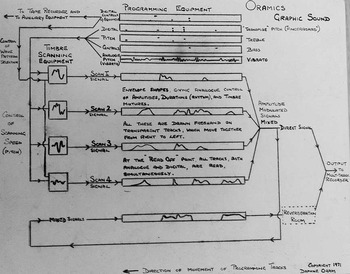
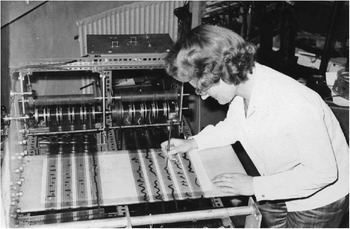
With Wrench's permanent departure just a few months later, never to work on the project again, Oram had to rely on part-time assistance from her brother and Fred Wood to complete the construction of the synthesiser. A fully operational version of Oramics was finally completed around 1970, and the accompanying diagram of its 1971 configuration provides a useful template for a more detailed study of its operating characteristics (figure 5) (Oram Reference Oram2007: 1.4.x). A contemporary photograph of Daphne Oram working with the system during the early 1970s adds an extra dimension to this perspective (figure 6) (Oram Reference Oram2007: 7.9.011).
The schematic diagram for the completed Oramics system, 1971

Daphne Oram working with Oramics c. 1973 (track 1 not in use)

The control system accommodates ten film strips, divided into two groups of five. Four of the tracks in the lowest group (nearest to the programmer) provide the amplitude envelopes for the individual waveform scanners. The fifth is used to control the amount of enhancement to be applied to the resulting timbre using feedback from a reverberation unit. Wrench was able to simplify the coding of information applied to these tracks by devising a photocell system that registered the variations in track position of a single line drawn with a marker pen, thus eliminating the need to mask the function on one side. The problem of controlling pitch accurately was solved using a digital coding system, again devised by Wrench. As noted earlier, the principles used were essentially an extension of the punched tape control system previously developed for the RCA synthesiser, albeit implemented in an altogether more sophisticated manner (Olson and Belar Reference Olson and Belar1955). Whereas the RCA synthesiser used a group of four hand-punched tracks on paper tape to create a binary code for the desired pitch class plus a further group of three tracks to specify the octave, Oram used four of the five 35 mm film strips in the upper group, each configured to register four discrete tracks of binary code. In place of mechanical wire brushes sensing the presence or absence of the associated holes in a hand-punched tape, banks of individual photocells were deployed to detect the changing patterns of rectangular neumes drawn on the associated control tracks.
Using a decade principle to determine the waveform frequency, one group of tracks (the lowest) specifies the required value in 1000-Hertz steps, the second the value within that step to the nearest 100 Hertz, the third to the nearest 10 Hertz, and the fourth to the nearest Hertz. The major drawback to this original configuration of the system is the complexity of the coding that is required. A further problem was the tendency of the digital-to-analogue converters to drift over time. These problems were never fully resolved, and many hours were sometimes necessary ‘tuning’ the associated circuits to deliver the required values. Whereas these could usually be achieved with reasonable accuracy in one part of the frequency spectrum, she discovered that such adjustments would inevitably generate inaccuracies in other areas. The consequence, however, was a certain charm in the resulting timbres that gave pieces composed on the system a distinctive quality, a characteristic directly experienced by the author.
Oram subsequently reconsidered the configuration of the pitch coding system, devising a similarly cascaded system of coding but this time based on a conventional scale of twelve tempered pitches per octave, thus facilitating a more manageable system of pitch coding. She was, however, to modify the latter from time to time in order to access intervals of less than a semitone and indeed on occasion revert to the initial frequency-based configuration. A memo in the Oram archive concerning differences in the information provided in two books, one written by the author (Manning Reference Manning1985: 129–132), the other by Alan Douglas (Douglas Reference Douglas1973: 92–98), confirms this working practice, noting ‘this is because of the flexibility of the system. Dr Manning noted one simple method of notation; Alan Douglas came on a day when my experiments called for 1/4 and 1/8 tones. I could also notate in weighted binary coding of the cycles per second’ (Oram Reference Oram2007: 4.4.x).
The ‘simple’ version illustrated in the 1971 configuration (figure 5) uses a total of three pitch-control strips, assigning each of the individual track lines on the second and third film strips of the upper bank to a specific pitch, starting with top E in the treble clef (660 Hertz) and moving down stepwise through a cycle of fifths in the manner used for tuning stringed instruments. The chromatic intervals within each span are then selected by combinations of additional neumes on the fourth strip, the lowest transposing the root pitch upwards a semitone, the second a tone, and the third a minor third. If so desired the resulting sequence of pitches can then be transposed in its entirety upwards or downwards using a master tuning control. In this configuration the uppermost strip, providing a further four digital tracks, becomes available for the control of auxiliary equipment such as a tape recorder. Her more elaborate configuration allowing the production of 1/4 and 1/8 tones required an altogether more complex mapping of multiple neumes, combining the resources of the upper two strips and in so doing, as in the case of the original frequency-control configuration, sacrificing the auxiliary equipment-control facility. Alternatively the uppermost track can be configured to allow individual notes on a basic semitone scale to be transposed upwards or downwards. The lowest control strip in the upper bank allows a vibrato to be superimposed, using the full width of the strip to articulate the speed and depth. Similarly the lowest control strip in the lower bank is configured to allow dynamic control of the reverberation mix.
4. Mini-Oramics and Beyond
Although Daphne Oram continued to explore the creative possibilities of the Oramics Machine during the 1970s and beyond, her thoughts by the start of the decade were already turning to the possibility of developing a new version of her synthesiser that would be much smaller and potentially marketable as a commercial product. She had a strong commitment to supporting electronic music in schools and envisaged the production of commercially produced systems that could easily be interfaced to a standard laboratory oscilloscope. Accordingly she registered a company, Essconic Ltd, in September 1972 with this purpose in mind (Oram Reference Oram2007: 9.4.61). However progress on the project, originally conceived as the Mark 2 and subsequently known as Mini-Oramics, was to prove very slow. Wrench had long since departed and a ‘live-in’ arrangement with a design technician providing free board and lodging in return for assistance proved highly unsatisfactory and was soon terminated (Oram Reference Oram2007: 9.4.16). Her attempts to attract interest from commercial manufacturers proved unsuccessful and yet another approach to Gulbenkian in 1973 was also to bear no fruit. Help, however, was forthcoming from two quarters.
It was during the early 1970s that the author first became acquainted with Daphne Oram and the Oramics Machine, and following discussions at Fairseat in the autumn of 1975 it was agreed to investigate the possibility of establishing a research partnership with Durham University. John Emmett, the technical designer for the Durham electronic music studio, was to play a key role in this context, and in June 1976 he supplied her with the circuit designs for a transistorised version of the Oramics scanning system (ORAM Reference Oram2007: 1.5.x). Further assistance was forthcoming from another engineer, Norman Gaythorpe, who assisted Oram in developing other key aspects of the proposed new synthesiser, notably a system whereby three different waveforms could be scanned simultaneously using a single oscilloscope. It was also envisaged that a mechanism could be developed to accommodate a ‘disc of masks – revolve disc to select 3 (adjacent masks). While scanning 3, others can be manually replaced’ (Oram Reference Oram2007: 1.5.x).
Oram completed the draft design specification of Mini-Oramics in May 1981 (Oram Reference Oram2007: 1.5.x), but sadly the prototype was never built. The most significant stumbling block proved to be the design of the control system. The old approach using 35 mm film strips was totally impracticable in the new context, both in terms of devising a suitably compact design that could be mass-produced economically and the prohibitive cost of blank film strips. Oram was forever wiping clean previously used film with solvents for reuse, and such a working environment would in any event not have been acceptable in schools. Her quest therefore was for an alternative medium and she pinned her hopes on sourcing rolls of plastic that would prove sufficiently robust for the purpose. Problems of stretch and sideways creep when transporting the film sheet over the photocells proved insurmountable, and as a last resort she investigated the possibility of using greaseproof paper. Even this significantly more robust medium proved difficult to manage and its semi-opaque nature posed additional problems in terms of the operation of the photocell sensors.
In essence the world had moved on, and with the start of the personal computer revolution she realised that the future lay elsewhere. In 1981 she purchased an Apple II computer and with assistance from Stephen Brett developed a simplified software version of Oramics (Oram Reference Oram2007: 2.15.x). Having thus seen the world of computing in the first instance as a threat she now came fully to embrace it. In 1987 she transferred her work to an Acorn Archimedes 310 computer, programming it directly in machine code. Sadly the project was never completed. Further work was abruptly terminated by a stroke in 1994, forcing her to leave Tower Folly and move into a nursing home. Daphne Oram died on 5 January 2003, marking the end of a remarkable career. Although the technologies she explored have long since become obsolete, her innovative ideas and the practical means she pursued to bring them to fruition make a significant contribution to our knowledge and understanding of the medium of visual music.
Acknowledgements
Tim Boon, Chief Curator, Science Museum, London Nicola Candlish, Cataloguing Archivist, Hugh Davies Archive, British Museum
Mick Grierson, Director, Daphne Oram Collection, Goldsmith's College, London