Introduction
Crop–livestock mixed farming systems are the mainstay of smallholder livelihoods in the developing world (Herrero et al., Reference Herrero, Thornton, Notenbaert, Wood, Msangi, Freeman, Bossio, Dixon, Peters, Van De Steeg, Lynam, Rao, Macmillan, Gerard, Mcdermott, Sere and Rosegrant2010; Ryschawy et al., Reference Ryschawy, Choisis, Choisis, Joannon and Gibon2012). Population growth, increase in livestock population, increased income and rate of urbanization in the developing countries tend to increase the pressure on these systems (Herrero et al., Reference Herrero, Thornton, Notenbaert, Wood, Msangi, Freeman, Bossio, Dixon, Peters, Van De Steeg, Lynam, Rao, Macmillan, Gerard, Mcdermott, Sere and Rosegrant2010; Herrero et al., Reference Herrero, Thornton, Notenbaert, Msangi, Wood, Kruska, Dixon, Bossio, Steeg, van de, Freeman, Li and Parthasarathy Rao2012). These challenges also tend to increase intensity of land use which leads to continuous cultivation of farmlands without fallowing (Collier and Dercon, Reference Collier and Dercon2009; Drechsel et al., Reference Drechsel, Gyiele, Kunze and Cofie2001). Without adequate investment in agricultural land management, this may contribute to land degradation and low agricultural productivity (Lal, Reference Lal2009). Scientific reports on the use and importance of crop residue (CR) have shown that leaving 30% of the residue on crop farm plots reduces soil erosion by up to 80% (Rockström et al., Reference Rockström, Kaumbutho, Mwalley, Nzabi, Temesgen, Mawenya, Barron, Mutua and Damgaard-Larsen2009; Thornton and Herrero, Reference Thornton and Herrero2015). In mixed crop–livestock farming systems, the use of CR for livestock feeding is becoming increasingly important due to the expansion of cropland and low productivity of natural pastures (Alkemade et al., Reference Alkemade, Reid, Van Den Berg, De Leeuw and Jeuken2012). The contribution of CR to the total dry mater intake of the livestock in Ethiopia ranges from 10 to 70% (Alemayehu, Reference Alemayehu2003; Zinash et al., Reference Zinash, Aschalew, Alemu, Tegegne and Wall2001). The CR from cereals and pulses has different nutritive values as livestock feed. According to Keftasa (Reference Keftasa and Dzowela1988), 1 kg of residue from cereal (pulse) contains on average 47 (69) g of crude protein (CP), 6.50 (6.95) MJ of metabolizable energy (ME) and 0.75 (0.55) g of phosphorus (P) and 2.5 (9.2) g of calcium (Ca), indicating that CR from pulses have better nutritive value compared with CR from cereals. Using pulse residue for soil mulching would therefore deprive livestock of valuable nutrients that could be used to improve dairy and meat production. Utilizing 1 kg of pulse residue as mulch would deprive the livestock of 22 g of CP, 0.4 MJ of ME, and 6.7 g of Ca. This is equivalent to a loss of 0.25 kg of cow milk of 4% fat [estimation from Kearl (Reference Kearl1982)]. Under such situations, better utilization of CR could be achieved by maximizing the use of pulse CR for livestock feeding and optimizing the use of cereal CR for both mulching and livestock feeding. Studies on the utilization of CR are limited and have mainly focused on maize residue (Jaleta et al., Reference Jaleta, Kassie and Shiferaw2013; Jaleta et al., Reference Jaleta, Kassie and Erenstein2015). Therefore, this study aimed at identifying the determinants of the utilization of cereal and pulse CR as livestock feed and soil mulch considering that CR from cereals and pulses is one of the major contributors to livestock feed and soil fertility in the highlands of Ethiopia.
Materials and methods
Study sites and data
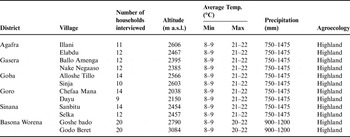
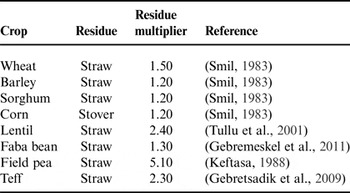
The study was carried out in cereal-based farming systems in two regions of Ethiopia, Oromia and Amhara where smallholder mixed crop–livestock systems prevail. These regions represent highlands, which have potential for both cereal and pulse production. The average minimum temperature ranges between 8 and 9°C and the average maximum temperature between 20 and 22°C. The mean annual rainfall ranges between 750 and 1200 mm (Table 1). There are two cropping seasons, between January and March and between June and September. Crop harvest takes place between June and July and between October and December. The dominant soil types are vertisols, nitisols and camisols. The source and provision mechanism of agricultural extension services are similar across districts varying only in the skills of the extension agents. Data were drawn across six districts. Two peasant associations (PA) were randomly selected within each district (Table 1). Farmers within each PA were selected using a proportionate to size sampling method. The total number of the farmers participated in the study was 160 farmers (Table 1). Data were collected using a structured questionnaire. The data collected included household characteristics, resource ownership by the households, and CR production and utilization. The CR production (ton per household) was estimated from the grain production of each crop using conversion factors (Table 2).
General information about the studied areas (N = 160).

Multipliers used to estimation CR production.

Calculations and statistical analysis
The extent of utilization of cereal and pulse residue per household was measured in terms of percentage. In this particular case, our formulation presumes that there will be limited farmers who do not account for any CR utilization. The implication is that our latent dependent variable (y*), which denotes interest in a specific CR, is not observed until the interest in the CR utilization exceeds some known constant threshold (L); i.e., we observe y* only when y* > L. Using an ordinary least squares (OLS) method to regress the intensity of use on the explanatory variables will generate inconsistent estimates because the censored nature of the variable. Therefore, the Tobit model censored only from the left side (L = 0) was employed in this study. Our model is specified as an unobserved latent variable, y*. The observed y was defined by the following measurement equation:
 $$y = \left( \matrix{ {y^{\ast}} & {{\rm if}} & {y^{\ast} \gt L} \cr L & {{\rm if}} & {y^{\ast} \le L} \cr} \right).$$
Each type of residue is used as feed or mulch which leads to joint decision about the utilization of cereal and pulse residue. The allocation functions of CR are inter-related and hence our estimation needs to take simultaneity into account. There is also efficiency gain in estimating these equations simultaneously. This study therefore employs multivariate Tobit model (Lee, Reference Lee, Manski and MCFADDEN1981; Cornick et al., Reference Cornick, Cox and Gould1994; Arias and Cox, Reference Arias and Cox2001) as specified below. Following the discussion above, let
 ${\rm Y}_j^* $
be a (G × 1) vector of latent allocation of the jth consumption of cereal (c) or pulse (l) residue for feed (f) or mulching (m) (this implies that ‘j’ takes four values), related to a (G × K) matrix of explanatory variables X
j
by (suppressing observation indices):
 $$Y_j^{\rm {\ast}} = X_j{\rm \beta} _j + \xi _j{\rm,} \quad j = {\rm 1,}...{\rm,} N,$$
where ξ
j
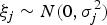
is an (G × 1) vector of error terms and
 ${\rm \xi} _j\sim N(0,\sigma _j^2 )$
, β is a (K × 1) vector of estimated coefficients, K is the number of explanatory variables, G is the number of households, and N is the number of allocations (N = 4). The relationship between latent (
 $Y_j^* $
) and observed (Y
j
) allocation can be represented by:
 $$Y_j = {\rm Max}(\,f_j(X;{\rm \beta} ) + {\rm \xi} _j,0).$$
Since the four types of allocation of the CR are determined simultaneously, the error terms of the models are likely to be correlated. If that is the case, efficiency gains can be achieved by estimating the equations in Equation (3) as a system. Formally, the likelihood function of the system of equations for an observation in which the first m allocation equations are censored out of the four equations is given by:
 $$L = \int_{ - \infty} ^{ - X_1{\rm \beta} _1} \cdots \int_{ - \infty} ^{ - X_m{\rm \beta} _m} {\,f\,{\rm (}{\rm \xi} _{\rm 1}{\rm,}... {\rm,} {\rm \xi} _{\rm 4}{\rm )d}{\rm \xi} _{\rm 1}{\rm,}... {\rm, d}{\rm \xi} _{\rm m}.} $$
Here f is the multivariate normal probability density function. Since there are four kinds of allocations we are dealing with, we have to evaluate definite integrals in up to four dimensions to work out the likelihood function of the system. As Equation (4) does not have a closed form solution, we have to evaluate it numerically. Approximating the integral with a weighted sum of integrand values at a finite number of sample points in the interval integration, numerical quadrature serves as an alternative to calculating multi-dimensional integrals. Although quadrature works well for small-dimensional integrals, it is not as effective with higher dimensions (Train, Reference Train2003). Actually, if the dimension of integrals is greater than two, quadrature techniques cannot compute the integrals with sufficient speed and precision (Hajivassiliou and Ruud, Reference Hajivassiliou, Ruud, Engle and Mcfadden1994; Revelt and Train, Reference Revelt and Train1998). As the integral to be calculated in this paper has a dimension of four, we employ the Geweke–Hajivassiliou–Keane (GHK) simulator in the estimation reported in the paper (Geweke, Reference Geweke1989; Keane, Reference Keane1994; Hajivassiliou and McFadden, Reference Hajivassiliou and Mcfadden1998). Suppose the value of the following integral with dimension N (N = 4 in our case) needs to be calculated by the GHK:
 $${\rm Pr}(a \lt \xi \lt b) = \int_a^b {g({\rm \xi} ){\rm d\xi}}, $$
where ξ is a random vector with
 ${\rm \xi} \sim N(0,\Sigma )$
and g is the density function of
ξ
. The idea of the GHK simulator is to draw u from a univariate normal distribution and recursively compute multivariate probability values using Choleski factorization (Cappellari and Jenkins, Reference Cappellari and Jenkins2006). Let L be the lower triangular Choleski factor of ξ satisfying L′L = Σ and
e
is a vector of independent standard normal random draws, then:
 $$\eqalign{{\rm Pr}(a \lt {\rm \xi} \lt b) & = {\rm Pr}(a \lt Le \lt b) \cr & = {\rm Pr}(A_{\rm 1}){\rm Pr}({\rm A}_{\rm 2}{\rm \vert} A_{\rm 1}) \cdots \cr & \quad\ {\rm Pr}(A_N{\rm \vert} A_{\rm 1}{\rm,}... {\rm,} A_{N - {\rm 1}}),}$$
where A i represents the event in the right-hand side of Equation (5), i = 1,2, …, 4.
 $$\eqalign{A_1 = & \left( {\displaystyle{{a_1} \over {l_{11}}} \lt e_1 \lt \displaystyle{{b_1} \over {l_{11}}}} \right), \cr A_2 = & \left( {\displaystyle{{a_2 - l_{12}e_1} \over {l_{22}}} \lt e_1 \lt \displaystyle{{b_2 - l_{12}e_1} \over {l_{22}}}} \right), \cr.... & \cr A_N^{} = & \left( {\displaystyle{{a_N - l_{1N}e_1 - \cdots - l_{N - 1,N}e_{N - 1}} \over {l_{NN}}} \lt e_N} \right.\cr & \quad \left.\lt \displaystyle{{b_N - l_{1N}e_1 - \cdots - l_{N - 1,N}e_{N - 1}} \over {l_{NN}}} \right).}$$
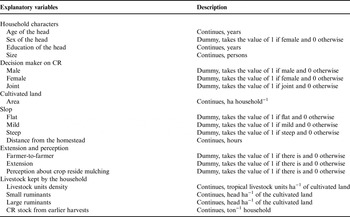
By taking draws of e i recursively and repeating the process for R times, we can get the simulated value of Pr(a < ξ < b) and then the likelihood function. The explanatory variables included in the model were household characters, farmland characters, extension and awareness, livestock wealth and CR stock from earlier harvests (Table 3).
Brief description of the explanatory variables used in the Tobit model.

Results
Descriptive analysis
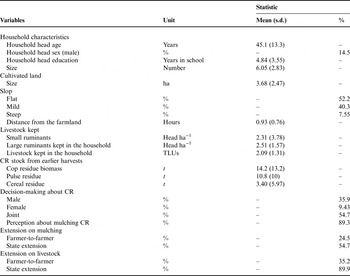
The summary of the descriptive statistics of the variables used in the regression model is presented in Table 4. The result showed that 14.5% of the sample households were female headed. The average age (years) and the education level (years in school) of sample household heads were 45.1 and 4.48, respectively. The average family size was six persons. The average farmland size was 3.68 ha. The walking distance between the cropping land and the homestead was 0.93 h. It was observed that 52.2, 40.25 and 7.55% of the households cultivated flat, mild slope and steep slope plots, respectively. Manure was the main input used for land fertilization by the sample households. The studied households kept 2.09 tropical livestock units (TLU) ha−1 of cultivated land. The households kept on average 5.26 heads of small ruminants, 7.64 heads of large ruminants and 7.64 TLU. On the decision to undertake CR utilization, the men made the decision in 35.85% of the interviewed households, the women made the decision in 9.43% of the households, and men and women made the decision jointly in 54.7% of the cases. It was observed that 89.3% of the interviewed farmers were aware of the role of mulching CR in improving the quality of the soil. It was also observed that 35.2 and 89.9% of the household heads respectively got farmer-to-farmer and state extension on mulching. The total CR production per household was 14.2 t yr−1, and of which 76.1% were cereal residue and 23.9% were pulse residue. Considering only the cereal residue, 98.1% of the households used it for livestock feeding whereas 88.8% of the households used it for mulching. For pulse residue, 98.7% of the interviewed households were using it as feed and 71.8% of the interviewed households were using it as soil mulch. However, 3–4% of the farmers reported CR sales and burning in situ. The biomass of cereal and pulse residue utilized as feed was 84.6 and 89.6%, respectively, and 15.4 and 10.4% as soil mulch, respectively. The results of t-test presented in Table 5 show that the proportion of the pulse residue used as feed was significantly higher than the proportion of cereal residue used as feed (P < 0.01). Contrary to that, the proportion of CR used for soil mulch was significantly higher in cereal residue compared with pulse residue (P < 0.01).
Descriptive statistics of variables used in the empirical analysis.

TLU, tropical livestock units adopted from (Jahnke, Reference Jahnke1982); s.d., standard deviation.
Utilization of cereal and pulse residue by the interviewed households.

Values between parentheses are noted for the standard deviation.
Regression analysis
Household characters
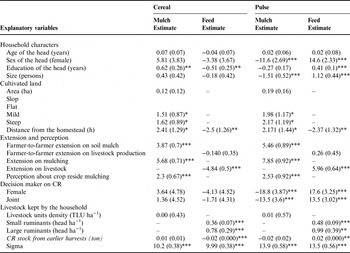
Female headed households allocated significantly larger proportion of pulse residue as feed compared to the male headed households (P < 0.01). The higher the literacy level of the household head, the larger the proportion of pulse and cereal residue used as soil mulch (P < 0.01). The bigger the household size, the higher the proportion of pulse residue used as feed and the lesser proportion of pulse residue used as soil mulch (P < 0.01). No significant effect of household size on the utilization of cereal residue was detected (P > 0.1). It was observed that when the female joined in making the decision on CR utilization, more proportions of pulse residue were used as livestock feed and lesser proportions of pulse residue were used as soil mulch (P < 0.01). However, the decision maker did not significantly affect the utilization of cereal residue (P > 0.1).
Cultivated land
The households who cultivated steep and mild slope plots used higher proportion of both cereal and pulse residue as soil mulch compared with the households which cultivated flat plots. The distance between the cultivated land and the homestead decreased significantly the proportion of both cereal and pulse residue used as livestock feed and increased significantly the proportions used as soil mulch.
Extension and perception
Household heads who got farmer-to-farmer extension and state extension on mulching using CR allocated larger proportions of cereal and pulse residue for soil mulching (P < 0.01). The extension services on livestock production increased the proportion of pulse residue used as livestock feed (P < 0.01) and decreased the proportion of cereal residue used as livestock feed (P < 0.01). The household heads who were aware of the importance of soil mulching used greater proportions of cereal and pulse residue as soil mulch.
Livestock kept by the household
The livestock herd size (TLU ha−1) of the household did not decrease the proportions of CR used for mulching. As the number of small ruminants increased, the use of both cereal and pulse residue as feed significantly increased (P < 0.01). Significant and positive correlation between the number of large ruminants and the use of cereal and pulse residue as feed was detected (P < 0.01).
CR stock from earlier harvests
The availability of CR stock from previous harvests within the household negatively affected (P < 0.01) the proportion of cereal residue allocated as feed, while it positively affected (P < 0.01) the proportion of pulse residue allocated as feed (Table 6).
Discussion
Descriptive analysis
There was high awareness among the farmers about the importance of mulching CR to improve the soil quality. However, the average proportion of CR allotted for soil mulching only met 50% of the recommendation for mulching. Farmers in the studied areas tried to maximize the utilization of CR by using as much of the proportion of pulse residue as they could for livestock feeding and to minimize the use of pulse residue as mulch. Introducing new feed resource such as forages and grass, aiming to increase the biomass production of feed in the household, would allow the farmers to increase the use of CR as soil mulch. According to FAO (2015) and Kearl (Reference Kearl1982), one TLU needs 239 g CP, 28.7 MJ ME and 7.5 kg dry matter day−1 for the maintenance propose. Thus, the livestock kept in the households need an average of 20.91 ton of dry matter, 666.48 kg of CP and 80,033 MJ of ME. In the current situation, the CR per household could provide 11.19 ton of dry matter, 503.55 kg of CP and 75,420 MJ of ME. Therefore, the cereal and pulse residue could cover only 53.51, 75.55 and 94.24% of the maintenance requirement of the household's livestock from dry matter, CP and ME, respectively. Although pulse residue has better feeding value compared with cereal residue, 10.43% of it is still lost as it was used as soil mulch. Calculation shows that using 100% of pulse residue as feed can provide the livestock with additional 1128 kg of pulse residue biomass, which can be converted into 282 kg of 4% fat cattle milk annually. According to Thornton and Herrero (Reference Thornton and Herrero2015) and Rockström et al. (Reference Rockström, Kaumbutho, Mwalley, Nzabi, Temesgen, Mawenya, Barron, Mutua and Damgaard-Larsen2009), 30% of CR production should be retained in the plot to reduce soil runoff by 80%. Compared with the previous recommendation, the proportion of straw left in the plot covers around 50% of the recommendation for soil mulch. However, to optimize the livestock productivity in the household and to enable more use of CR as mulch, introducing new feed resources at household level is required. Using pulse residue exclusively to feed the livestock could provide them with more nutrients and therefore increase their production levels.
Regression analysis
Household characters
Female headed households allocated more proportion of pulse residue as feed compared with the male headed household (P < 0.01). Meaning that when farmers notice the differences in livestock intake and preference between the cereal and pulse straw, they increase the use of pulse residue as feed. This signifies the importance of on-farm trials to demonstrate the difference in the nutritive value between cereal and pulse residue. Jaleta et al. (Reference Jaleta, Kassie and Shiferaw2013) stated that labor is important to increase the CR collection and transportation from the field to the homestead. The results of this study showed a positive effect of household size on the use of pulse residue as feed, while it did not affect the use of cereal residue as feed. This implies that when active labor is available within the household, the household head prefers to use them to transport and store pulse residue rather than cereal residue. When women joined the decision-making process on CR utilization, they used more proportion of pulse residue as livestock feed and less proportion of pulse residue as soil mulch. However, there was no significant effect of decision maker on the utilization of cereal residue. This means that the farmers who were in constant contact with the livestock could perceive more about the differences in palatability between cereal and pulse residues.
Cultivated land
The farmers who cultivated steep and mild slope plots used higher proportion of both cereal and pulse residue as mulch compared with the farmers that cultivated flat sloped plots. This result agrees with what Jaleta et al. (Reference Jaleta, Kassie and Shiferaw2013) reported. As the slope of the plot increased, the use of the residue for mulching increases. That means that farmers who cultivate sloppy plots are aware of the soil erosion more than the farmers who cultivated flat plots. The distance between the cultivated plots and the homestead is correlated positively with allocating more CR as mulch which agrees with the results of Jaleta et al. (Reference Jaleta, Kassie and Shiferaw2013). This result implies the importance of the need of labor for collecting and transporting the CR to the homestead to use it as livestock feed.
Extension and perception
The household heads who got farmer-to-farmer extension allocated higher proportion of cereal and pulse residue for mulching. The state extension service increased the utilization of the CR as mulch which agrees with Jaleta et al. (Reference Jaleta, Kassie and Erenstein2015) and Jaleta et al. (Reference Jaleta, Kassie and Shiferaw2013). The result of the study also showed an important role of extension service on increasing the use of pulse residue as feed. However, the same extension negatively affects the utilization of cereal residue as feed. The overall results showed the significant role of the extension service in maximizing the utilization of CR through increasing the use of pulse residue as feed and the use of cereal residue mainly as soil mulch. Extension services on livestock and soil mulch, in addition to informal social networks, could effectively enhance of the utilization of CR.
Livestock kept by the household
When the number of the small ruminants in the household increases, the use of both cereal and pulse residue as feed increases. This demonstrates clear pressure the livestock has on cereal and pulse residue. Such result was obtained by Jaleta et al. (Reference Jaleta, Kassie and Shiferaw2013) on maize stover. The result shows the importance of the CR as a crucial feed resource in the mixed farming system of Ethiopia highlands.
CR stock from earlier harvests
The stock of CR negatively affected the proportion of cereal residue allocated as feed while it positively affected the use of pulse residue as feed. This reflects the preference of the farmers towards using pulse residue as feed compared with cereal residue. CR is the sole in-house feed resource for the livestock. When the production of CR increases, the household start to show clear preference towards using pulse residue (which has better feeding value compared with cereal residue) as feed over cereal residue. That means the increase in the biomass availability, by introducing new feed resource like grasses and introducing food-feed varieties, which have high grain and CR yields, could increase the efficiency of CR utilization in the mixed farming system.
Conclusions
CR is an important source of feed and soil mulch in the mixed cropping–livestock systems of Ethiopia highlands. Pulse residue has better nutritive value and palatability as livestock feed compared with cereal residue (Keftasa, Reference Keftasa and Dzowela1988). Under limited resources in the households, better utilization of CR could be achieved by maximizing the use of pulse residue as feed and optimizing the use of cereal residue as soil mulch. Institutional factors like extension services on mulching and livestock as well as access to information about the importance of CR mulching may lead to better utilization of CR. Providing extension and training services on the importance of the use of CR as mulch may help to improve the awareness among farmers and lead to enhance their use of CR as soil mulch. Better utilization could also be promoted by the extension service through bringing out the difference in nutritive value between the cereal and pulse residue. On-farm trials could play an important role by showing the farmers the superiority of pulse residue over cereal residue as livestock feed. Policy interventions should encourage informal social networks that stimulate group discussion and better information flow to enhance better utilization of CR. Special attention of the livestock extension should be given to the sloppy areas to maximize the farmers’ utilization of pulse residue as feed. Increasing the feed availability in the household could by introducing new varieties of cereal and pulse crops with superior food-feed traits and alternative feed resources, such as grasses, at household level could decrease the pressure on the use of CR as feed. Generally, interventions introducing conservative agriculture should account for tradeoffs related to alternative and competing uses of CR. However, better utilization of CR could be achieved by using pulse residue exclusively for livestock feeding and cereal residue exclusively for soil mulching.
Multivariate Tobit estimation results on the CR uses as feed and soil mulch.

Value between parentheses is noted to the standard error of the estimate.
TLU, tropical livestock unit.
***, ** and *, significant at 0.01, 0.05 and 0.1, respectively.
Acknowledgements
Research was technically supported by the International Center for Agricultural Research in Dry Areas (ICARDA) with funding from the AfricaRISING project, the Feed the Future initiative of the United States Agency for International Development (USAID). The authors gratefully acknowledge the helpful assistance of the AfricaRISING coordinators in the study sites. Council for Academic at Risk (CARA) is acknowledged for providing finical support to the study.