1. Introduction
This paper investigates the link between judicial resources and individuals’ perception of justice. Understanding what is likely to affect perception of justice is an important issue because public confidence in the judiciary constitutes an important aspect of judicial quality. According to the European Court of Human Rights, an effective judiciary must not only provide good substantial and procedural rules, but should also inspire citizens with confidence and respect (Pham, Reference Pham and Breen2002). Although scholars in both law and economics acknowledge that public confidence in justice is a crucial element of justice effectiveness, the literature on what determines it remains scant.
Theoretically, identifying the potential factors of trust in the judiciary is central because it has been common knowledge for a long time that credible and reliable formal institutions, including judicial ones, are necessary to enhance economic performance (North, Reference North1990; Knack and Keefer, Reference Knack and Keefer1995; Zak and Knack, Reference Zak and Knack2001; Acemoglu et al., Reference Acemoglu, Johnson and Robinson2001, Reference Acemoglu, Johnson, Robinson, Aghion and Durlauf2005; Glaeser et al. Reference Glaeser and Shleifer2004). The intuition is that if individuals feel that they can count on formal institutions to insure them against opportunistic and harmful behaviours, they do not spend resources to protect their property rights. Instead, they spend on productive activities.
It has also been shown in law and economics literature that good faith in the judiciary may improve the performance of the judiciary itself (Priest and Klein, Reference Priest and Klein1984; Dari-Mattiacci and Deffains, Reference Dari-Mattiacci and Deffains2007); trust in justice reduces the number of incoming cases in courts and hence courts’ congestion by decreasing both the number of disputes and litigations. Indeed, a credible, reliable and predictable judicial system tends to provide sound incentives to individuals, who are then less likely to cheat or break the law. It also encourages parties to avoid litigation costs by finding a mutually beneficial arrangement out of court (Friedman and Wittman, Reference Friedman and Wittman2007).
The literature that investigates what makes individuals confident in the judiciary is both theoretical and empirical. In empirical studies, confidence in the justice system has often been used as a proxy for the efficiency of the judiciary. As noted in the survey by La Porta et al. (Reference La Porta, Lopez-de-Silanes and Shleifer2008), these studies often present the substance of (financial) legal rules and procedures as the foremost determinant of confidence in the judiciary (La Porta et al., Reference La Porta, Lopez-de-Silanes, Shleifer and Vishny1997, Reference La Porta, Lopez-de-Silanes, Shleifer and Vishny1998, Reference La Porta, Lopez-de-Silanes and Shleifer2006; Djankov et al., Reference Djankov, La Porta, Lopez-de-Silanes and Shleifer2003, Reference Djankov, Hart, McLiesh and Shleifer2008). Exploring various fields, scholars have empirically shown that both substantial and procedural rules are better in common-law than in civil-law countries because they better guarantee the security of property rights. Consequently, rules of law and judicial procedures within common-law systems are better at providing a positive perception of the legal environment and at structuring economic incentives.
Aghion et al. (Reference Aghion, Algan, Cahuc and Shleifer2010) have recently interestingly pointed out the paradox that people tend to demand more regulation when they distrust both the regulator and each other. Nevertheless, the authors do not consider the possible reverse effect of supply of regulation on trust. With this paper, we will make a step towards considering it. Focusing on judicial institutions, we will examine why, and to which extent, higher provision of justice – approached by judicial resources indicators – may positively affect the level of trust in justice.
Examining the link between judicial resources and trust allows us to build on a recent literature that looks for new judicial factors that are likely to improve judicial efficiency and hence economic performance. This new and limited strand of research proposes to go beyond the dichotomy between common-law and civil-law regimes and to focus more on the functioning aspects of the judicial systems instead (Hadfield, Reference Hadfield2008). For example, Hadfield (forthcoming) proposes to explore the role of organisational factors on both parties and judicial professionals’ behaviour, to further understand the link between judicial institutions and growth. She identifies some organisational factors, such as the structure of judicial rewards, judicial training, or judicial information-processing that shape the capacity of the legal system to adapt to changing conditions, and then to improve social welfare through their incentive effects on judges and litigants. Moreover, Deffains and Roussey (forthcoming) focus on the outcome of the functioning cost of the judiciary. Precisely, they investigate the impact of a marginal increase in public expenditure on justice on the efficiency of both the judiciary and a specific market: the rental housing market. They look at the multiplier mechanism by which a slightly higher justice budget first increases the productivity of courts and then provides incentives to landlords to make decisions that improve the functioning of the rental market.
In the present paper, we are interested in further exploring the impact of the budget on people's perceptions of justice. We believe that if the effective quality of the judiciary matters for individuals’ economic decisions, then what individuals think about the quality of the judiciary matters too.
Scholars generally approach the issue of confidence in the judiciary with the assumption that individuals are knowledgeable about and interested in the law and the judicial system. However, as revealed by many surveys, most individuals do not precisely know or understand the content of the rules of law or the enforcement procedures that constitute the judiciary. Consequently, agents do not know its effective quality. In this context, individuals have to infer the quality of the legal environment from signals that are believed to be linked with the true quality of the justice system.
In the remainder of the article, we argue that the justice budget may constitute an important signal that shapes people's perception of the judiciary when facing uncertainty regarding the legal environment, because it is relatively easily accessible and understandable information. We then test if judicial resources may positively affect individuals’ declared trust in the justice system. To do so, we use cultural individual data from the 2008 European Value Study (EVS, 2008a).Footnote 1 We also use 2006 national judicial data produced by the European Commission for the Efficiency of Justice (CEPEJ, 2008). The CEPEJ provides an original dataset on the functioning and organisation of European judicial systems that has never before been used by scholars. The results of our empirical work are the following: there is a strong positive correlation between judicial resources and individuals’ trust even after controlling for individual socio-demographic and cultural traits, and for national institutional characteristics. We confirm this link by using three different measures of judicial resources – the justice budget per incoming case, the number of magistrates, and the intensity of legal aid. Finally, our econometric approach indicates that the justice budget has a greater impact on trust when individuals declare themselves satisfied with democracy.
The paper is structured as follows: The next section presents our argument to support the idea of a signal effect of the justice budget. In section 3, we describe our econometric model. Section 4 presents the data. Section 5 reports our empirical results. The last section concludes.
2. The justice budget as a signal
There are many clues that in many fields of economic life people often do not know or understand the legal rules and judicial procedures that can guide their decision making. For example, for the last two decades, opinion polls about the judiciary in France have revealed that 90% of people recognise their general lack of knowledge about the functioning of the judiciary and assert that legal language is too complicated. Moreover, 30% of people who have ever had business before the courts admit that they did not understand the court rulings (Bargues and Ferey, Reference Bargues, Ferey and Breen2002; François, Reference François, Cadiet and Richier2003). This argument is consistent with recent research on the uncertainty of law (Dari-Mattiacci and Deffains, Reference Dari-Mattiacci and Deffains2007; Dari-Mattiacci et al., Reference Dari-Mattiacci, Deffains and Lovat2011). Legal uncertainty is generally defined as the difficulty to precisely know ex ante what the outcome of the judicial system will be ex post. According to Dari-Mattiacci and Deffains (Reference Dari-Mattiacci and Deffains2007), the identified causes of such uncertainty are ‘unforeseen contingencies, the inherent ambiguity of language itself, the use of vague notions (such as bona fides, reasonable man, or bonus pater familias), and a natural process of obsolescence due to continual changes in society and technology’.
North (Reference North1990) identifies the possible problem of knowledge regarding third-party enforcement, i.e. the legal system, but without further exploring the issue:
A coercive third party is essential. One cannot have the productivity of a modern high income society with political anarchy. Indeed, effective third-party enforcement is best realized by creating a set of rules that then make a variety of informal constraints effective. Nevertheless, the problems of achieving third-party enforcement of agreements via an effective judicial system that applies, however imperfectly, the rules are not only very imperfectly understood and are a major dilemma in the study of institutional evolution (1990: 35).
Here, it is appropriate to raise the point that institutions – particularly legal ones – are indeed necessary to reduce the uncertainty of the environment surrounding exchanges, but that uncertainty may also arise regarding these institutions themselves. Under this uncertainty individuals cannot know precisely the functioning and performance of judicial institutions, but can only obtain an imperfect representation of the justice system through their perceptions. Whether individuals’ perceptions are correct or not, i.e. to whatever extent beliefs match reality, these beliefs will shape individuals’ feeling that the judicial environment is fair or unfair, secure or insecure.
This raises the question as to what shapes individuals’ beliefs about the legal environment. North (Denzau and North, Reference Denzau and North1994; North, Reference North2005) draws on Hayek (Reference Hayek1952) to explain the construction of beliefs and shares Hayek's view that individuals refer to ‘signals’ received from the environment and to their personal system of interpretation to form expectations about the world around them.
We argue here that the justice budget may constitute one important signal to build perceptions – and further trust – in the justice system. First, it is likely that resources invested by the government in the justice system reflect, in people's minds, the government's willingness to pay to enforce contracts and protect individual and property rights. This is likely to increase the feeling of insurance and consequently raise the level of trust in the justice system. Second, compared with the plethora of complicated and inaccessible rituals, symbols, rules and procedures that make up the judiciary, the justice budget is relatively clear information, easy to obtain, often communicated and discussed in the mass-media.Footnote 2 Of course, an increase in the justice budget is not sufficient to guarantee that people will trust in the judiciary. Clearly, people must believe that the new budget will effectively be used to improve the organisation of the judiciary. In other words, they cannot have cause to fear that these public resources will be simply misused or misappropriated by public officials, that is, that judicial institutions are corrupt. However, if the corruption concern is not too pronounced, which is the case in most modern democracies, the public may find it reasonable to believe that higher justice budgets will contribute to yield a better quality of judicial services.
Indeed, as remarked by the CEPEJ in evaluating the quality of European judicial systems, although a large justice budget is not a sufficient condition for judicial performance, it is a necessary one:
[A] correlation can be noted between the lack of performances and efficiency of some judicial systems and the weakness of their financial resources. However, the opposite is not always true: high financial resources do not always guarantee good performance and efficiency of judicial systems (CEPEJ, 2008: 249).
Evidently, people's trust in justice is likely to be driven by many other individual, cultural, institutional and economic factors, which will be discussed in the next section. Moreover, the impact of the justice budget on trust in justice is likely to be only a short-term effect, since people may change their belief in justice according to more objective criteria or to their own experiences in the long term. We do not deny or reject these arguments but would just like to highlight here that judicial resources may also have a significant effect on an individual's trust in justice when making decisions under uncertainty regarding the legal environment – at least in the short term.
In the following sections we investigate to what extent the justice budget may affect individuals’ confidence in the judiciary.
3. The econometric model
If our hypothesis that the justice budget acts as a signal on individuals’ confidence in justice (at least in the short term) were true, it should mean that confidence in judicial institutions should be higher in countries with a high level of justice budget. The problem is that a naive estimation of the impact of the justice budget on the national average level of confidence in judicial institutions might suffer from severe shortcomings and biases.
First, it has been shown in the literature on cultural determinants, including trust in judicial institutions, that justice systems have very local traits (Putnam, Reference Putnam1993; Guiso et al., Reference Guiso, Sapienza and Zingales2004; Tabellini, Reference Tabellini2010). That is, a national average measure of trust in the justice system would miss the microeconomic socio-demographic characteristics that could affect trust in justice. To try to mitigate this problem, we use individual measures of declared trust in the justice system, and add individual controls: the age of the respondent, their gender, and their level of education.
Second, the literature on culture or social capital has also highlighted the importance of the historical factor. It has been shown both theoretically and empirically that inter-individual trust and trust in institutions present very persistent features (e.g. Guiso et al., Reference Guiso, Sapienza and Zingales2006; Tabellini, Reference Tabellini2008, Reference Tabellini2010). These values have been transmitted from parents to children across generations (Bisin and Verdier, Reference Bisin and Verdier2000, Reference Bisin and Verdier2001; Bisin et al., Reference Bisin, Topa and Verdier2004). It is reasonable to assume that these unobservable generation factors affect present-day perception of judicial institutions, as is the case with any formal institution. Therefore, we attempt to address this problem by including a measure of respondents’ trust in formal institutions in general. This variable should synthesise individuals’ trust in different formal institutions such as the government, police, civil service, etc.
It should be noted that including this variable would also constitute a first step to solving potential endogeneity problems, i.e. the fact that the budget could be affected by trust. Actually, our use of individual measures for trust in the justice system seems to have already contributed to the mitigation of this problem. Indeed, we find it unlikely that individual trust in justice affects the global (i.e. national) level of justice budget. Nevertheless, we attempt to address this potential endogeneity problem in different ways.
First, we use lagged values of justice budget. More precisely, we regress 2008 individual trust in justice on 2006 judicial resources. We expect that it will allow both to capture the short-term effect of the budget on trust, and to avoid capturing possible feedback effects.
Second, we include several control variables that could potentially be correlated both with trust in the justice system and the justice budget.
-
(a) It could be the case that countries with an above-average level of individual trust in justice also tend to be better developed and wealthier, and consequently dedicate more resources to their judicial system. For this reason, a measure of the economic development of the considered countries must be included in the econometric model.
-
(b) It is reasonable to assume that in countries where the judiciary is more trustworthy, individuals better support transferring resources to the judiciary because they know, or believe, that resources will be employed to improve the quality of the judiciary. That is, their perception of corruption would affect both the justice budget and their level of trust in justice and should also be included in the regressions.
-
(c) The real performance of the judiciary is also likely to have an impact both on trust in the judiciary and on the justice budget. Intuitively, it is clear that the impact of the judiciary's performance on trust in it should be positive. However, the impact of the judiciary's performance on the justice budget is intuitively not easy to determine. On the one hand, if the performance is good, people are likely to choose to end conflicts through formal institutions, i.e. through the judiciary instead of informal institutions. In this case, the number of incoming cases should increase and consequently, the judiciary may need more resources to function. On the other hand, one can argue that if the judiciary is efficient, it should decrease both the number of incoming cases and the need for more resources, as we have explained in the previous section. This is the case for two reasons: first, because a good judiciary will offer people incentives to comply more with the law, resulting in fewer conflicts; and second, because conflicting parties will be offered the incentive to spare the cost of litigation by settling out of court.
-
(d) The latter remark means that the demand for judicial services is also to be controlled, as it is also likely to be correlated both with confidence in the judiciary and the justice budget.
Statistically speaking, our econometric model will not allow us to conclude on the causal link between the justice budget and trust in justice. However, controlling for all such individual and national potential determinants and using lagged values of the justice budget makes it much more likely that a correlation between the justice budget and trust in justice reflects the signal effect of the justice budget than reverse causality.
The function for individual trust in justice can then be written:

where trust_justij measures the level of trust in justice of individual i in country j in 2008; budget_casej is the budget allocated to the judiciary per incoming case in country j in 2006, Xij is a vector of individual characteristics of individual i in country j in 2008 and Yj is a vector of national characteristics of country j in 2006.
More precisely, vector Xij allows control for individual i of country j's characteristics, such as his/her gender, age, level of education, satisfaction with democracy (used as a proxy for perception of corruption), and level of generalised trust in formal institutions (parliament, police, European Union, press, trade unions, government, political parties, church, education system, social security system and civil service).
Vector Yj allows control for national characteristics of country j, such as population, level of Human Development Index (HDI) and effective performance of the judicial system measured by two indicators, the clearance rate and the disposition time. The clearance rate indicates if courts are ‘keeping up with the number of incoming cases without increasing backlog of cases’ (CEPEJ, 2008: 125). It is obtained by dividing the number of resolved cases by the number of incoming cases (multiplied by 100). The disposition time measures the time needed to resolve a case in days based on the number of resolved cases and the number of unresolved cases at the end of a period (generally one year).
In equation (1), the coefficient β0, which measures the impact of the justice budget per incoming case on individual confidence in the judiciary, is our parameter of interest.
For more robustness, we also regress trust in justice on two other budget-related variables that are easily accessible to the public and likely to affect their level of trust in justice. We do not include all the explanatory variables in the same regression because they are likely to be highly correlated, which could cause collinearity problems.
First, we examine the impact of the number of magistrates (judges and prosecutors). We include the same control variables as in equation (1) and an additional control, which is the number of incoming cases in first-instance courts in 2006 (case). (Further details will be provided in the next section.)

We also test the impact of the intensity of legal aid (la_indexj ) on confidence in justice. Legal aid is an important parameter in judicial systems because it offers access to justice for citizens who do not have sufficient means. Intuitively, this variable is likely to have a predominant impact on individuals who have already had to deal with the judiciary. Unfortunately, our individual datasets do not allow this information to be checked. In equation (3) we use the same control variables as in equation (2):

Another equation of interest that could be investigated concerns interactions between the justice budget, trust in justice and satisfaction with democracy. Indeed, when people are satisfied with democracy, it is likely that they will anticipate that the justice budget can effectively improve the quality of courts because it will not be misused by corrupt officials. Then the impact of the justice budget on trust in the justice system should be higher when the public declares a higher level of satisfaction with their democracy. To test this hypothesis we include an interaction term between the budget per incoming case and variable democracyij in equation (4):

The next section details the data we use to estimate these equations.
4. The data
To estimate equations (1), (2), (3) and (4), we need individual cultural and socio-demographic data as well as standardised national data on judicial systems. We have matched two databases to obtain the final dataset that we use: the EVS 2008 database (EVS, 2008a) and the 2006 database provided by the CEPEJ (CEPEJ, 2008).
Individual data from the EVS 2008
The EVS is a survey research programme based on basic human values. This survey provides individual data on moral, religious, societal, political, work and family values in 47 European countries and regions. To measure individuals’ trust in judicial institutions, we constructed a binary variable obtained from the following question of the EVS 2008 that was asked to 1500 adults (aged 18 years and older)Footnote 3 in each country:
Please look at this card and tell me, for each item listed, how much confidence you have in them, is it a great deal, quite a lot, not very much or none at all? The justice system, (. . .).
If the individual answered ‘a great deal’ or ‘quite a lot’, trust in the justice system was coded to have trust_justij = 1. If the individual answered ‘not very much’ or ‘none at all’, it was coded trust_justij = 0. A similar question was asked for parliament, police, European Union, press, trade unions, government, political parties, church, education system, social security system and the civil service. The answers were coded the same way. We then created a new variable trust_institutionsij , measuring the intensity of generalised trust in formal institutions for each individual by adding the answers of each respondent about the 11 formal institutions (except the justice system). This indicator runs from 0 to 11 and will be used to control for early factors that could affect trust in the justice system today, as it could have affected trust in other formal institutions.
In addition to this control variable, we also included a proxy for corruption perception, which is an individual measure of satisfaction with democracy. The question asked in the EVS 2008 was:
On the whole are you very satisfied, rather satisfied, not very satisfied or not at all satisfied with the way democracy is developing in our country?
If an individual answered ‘very satisfied’ or ‘rather satisfied’, we defined democracyij as 1 and zero otherwise.
The EVS 2008 also contains information on respondents’ education. To control for the level of education of individuals, we used answers to the question:
What is the highest level you have completed in your education?
-
0: Pre-primary education or no education
-
1: Primary education or first stage of basic education
-
2: Lower secondary or second stage of basic education
-
3: (Upper) secondary education
-
4: Post-secondary non-tertiary education
-
5: First stage of tertiary education
-
6: Second stage of tertiary education
We created two dummies: educmedij = 1 if the respondent answered 1, 2 or 3, zero otherwise, educsupij = 1 if the respondent answered 4, 5 or 6, zero otherwise. Thus, we defined two levels of education, a medium level of education (educmedij ) and a high level of education (educsupij ).
Finally, EVS 2008 was also used to control for age and gender of respondents.
National data on justice budget from the CEPEJ 2006
The second dataset is provided by the 2006 evaluation process of the CEPEJ. The CEPEJ was set up in 2002 by the Committee of Ministers of the Council of Europe to improve the quality and efficiency of European judicial systems. As stated in the first report of the CEPEJ (2004), the aim of the Commission is ‘to improve the efficiency and the functioning of the justice system of Member States, with a view to ensuring that everyone in their jurisdiction can enforce their legal rights effectively, thereby generating increased confidence of citizens in the justice system’. With this aim, the main tasks of the CEPEJ are (1) to evaluate European judicial systems in terms of their internal organisation, and (2) to propose concrete solutions to the States to prevent violation of property rights. In order to do so, once every two years since 2002, the CEPEJ has collected quantitative and qualitative data concerning the functioning of justice in the Member States of the Council of Europe (40 States for the pilot exercise in 2002 and 47 in 2006). Data collection is based on the Member States’ own responses to an evaluation scheme elaborated by the CEPEJ. According to the CEPEJ, the evaluation scheme is elaborated to ‘minimize as far as possible the difficulties of interpretation and to facilitate a common understanding of the questions by all national correspondents, allowing therefore to guarantee uniformity of the data collected and processed’. Thus the data provided by the CEPEJ offers a high level of quality despite differences between countries regarding the organisation of their justice system.
From the CEPEJ 2006 database (CEPEJ, 2008), we have extracted several budget-related variables. We employed the budget allocated to the justice system including courts, legal aid and public prosecution for the following two reasons. First, according to the CEPEJ, including the budget spent on the public prosecution system in the budget allocated to the courts allows ‘the comparison of the means allocated to the functions of prosecuting and judging, in spite of the differences in the organization of the systems, between countries where the prosecution system is fully separated from courts and those where both institutions are joined.’ Then, including the budget devoted to legal aid tells us about the financial effort made by countries to guarantee equal access to justice for all citizens.Footnote 4 We finally divide the budget by the number of incoming cases to use the justice budget per incoming case (budget_casej ).
As an alternative measure of the justice budget, we used the number of judges and prosecutors (in full time equivalent). To control for diversity in the status of judges in Europe, we used a proxy built by adding the number of professional (including professional judges sitting occasionally) and non-professional judges (excluding jurees). It provides us with the variable judgej . We also created a variable prosecutorsj by adding the number of persons with similar duties as public prosecutors and prosecutors.Footnote 5
From information on legal aid provided by the CEPEJ, we created an index of the intensity of legal aid in each country (la_indexj ). According to the CEPEJ, legal aid is ‘essential to guaranteeing equal access to justice for all’. It provides people of insufficient means with the possibility to defend themselves before a court or to initiate a court proceeding. This consists, for example, of free legal assistance or the provision of financial aid. It is obviously of great importance for people who must deal with the justice system but also for the general public who often express great concern about financial access to justice. The legal aid index that we build runs from 0 to 9. It is obtained by adding answers to nine ‘yes-or-no-questions’ about legal aid in European countries. The answer ‘yes’ has been replaced by 1 and ‘no’ by zero. The questions were:
A Does legal aid concern:

B. Does legal aid foresee the covering or the exoneration of court fees?
C. Can legal aid be granted for the fees that are related to the execution of judicial decisions?
D. In a criminal case, can any individual who does not have sufficient financial means be assisted by a free of charge (or financed by public budget) lawyer?
For a measure of incoming cases (casej ) we aggregated the number of civil litigious incoming cases plus the number of criminal incoming cases in first-instance courts.Footnote 6 Although this measure is far from perfect, it does seem to broadly capture the demand for judicial services, i.e. the burden on courts. Moreover, it gives a global indication of delinquency and criminality rates in each country.
We have also used two performance indicators of courts developed by the CEPEJ: the clearance rate (cl_ratej ) and disposition time (disp_timej ) as defined above.
The CEPEJ (2008: 14) also provides the population in each country in 2006.
Merging these two datasets allows us to base our empirical study on both empirical and individual data coming from 31 European countries: Albania, Azerbaijan, Austria, Bosnia and Herzegovina, Croatia, Czech Republic, Denmark, Estonia, Finland, France, Georgia, Germany, Hungary, Italy, Latvia, Lithuania, Malta, Moldova, Montenegro, Norway, Poland, Portugal (dropped for the estimation of equation 1), Romania, Russian Federation, Serbia, Slovakia, Slovenia, Spain, Sweden, Switzerland, and the FYRO Macedonia.
To control for the development of countries, we used countries’ HDI. We created two dummies: a dummy HDImedj taking value 1 if the HDI of the country is between 0.85 and 0.93, zero otherwise; and a dummy HDIhighj taking value 1 if the HDI of the country is lower than 0.93, zero otherwise.
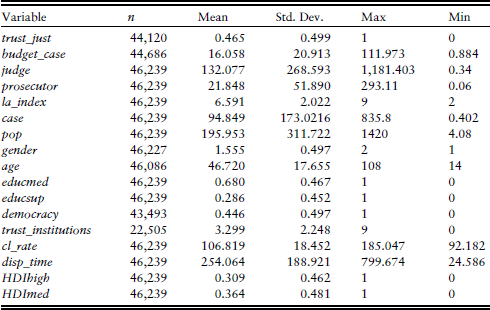
Table 1 presents sample sizes, means, standard deviations, maximum values and minimum values for the variables used in the analysis.Footnote 7

5. Results
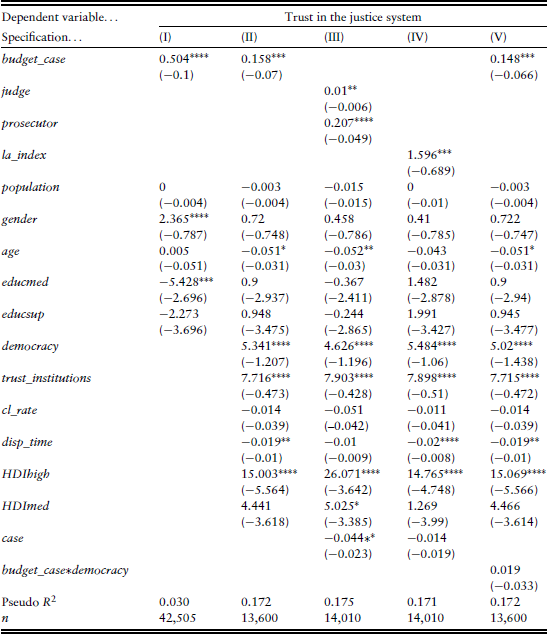
This section examines the results of estimation of equations (1), (2), (3) and (4) using a linear probability model with clustered standard errors. We have also estimated a probit model. Since the results are basically the same, we have reported them in the Appendix (Table A1).
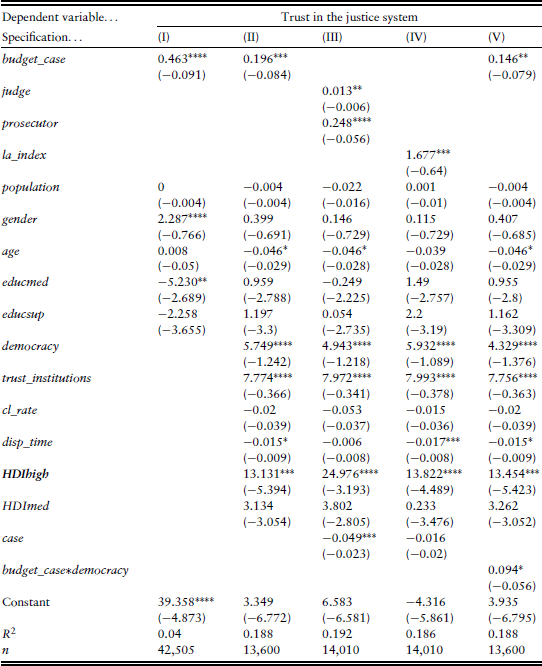
Table 2 reports the ordinary least squares estimates of the effect of the justice budget on trust in the justice system using the three different measures of the justice budget – the justice budget per incoming case (specifications I, II and V), the number of magistrates (specification III) and the intensity of legal aid (specification IV). The standard errors have been corrected for the potential clustering of the residual at the country level.

Notes: The coefficients have been multiplied by 100. Robust standard errors, clustered by country, are shown in parentheses and have also been multiplied by 100. * Coefficient is statistically different from zero at 15%. ** Coefficient is statistically different from zero at 10%. *** Coefficient is statistically different from zero at 5%. **** Coefficient is statistically different from zero at 1%.
Globally, Table 2 shows that the judicial resources are positively correlated to individuals’ trust in the justice budget, even after controlling for some socio-demographic and cultural individual variables and economic and institutional national variables. The positive and significant effect of judicial resources on individuals’ trust in justice is robust across all the regressions.
The first two specifications of Table 2 show the results of estimating equation (1) with or without controlling for all the control variables. In particular, in specification (I), we did not control for democracy, generalised trust in formal institutions, clearance rate, disposition time or level of HDI, i.e. variables that have been identified in section 3 as potential causes of endogeneity problems.
Specification (I) displays a strong impact of the justice budget per incoming case on trust in the justice system. Specification (II) shows that the coefficient falls but remains significant when adding institutional control variables. Every additional 100 Euros per incoming case allocated to the judiciary increases the probability of trust in justice by 0.196 percentage points. The number of magistrates and the intensity of legal aid also appear to be significantly and positively associated with individuals’ trust in justice. In particular, specification (IV) exhibits a strong link between the intensity of legal aid and individuals’ trust in justice. One point more in the legal aid index increases the probability of trusting in justice by 1.677 percentage points.
Regarding specification (III), the number of prosecutors seems to have a greater impact on trust than the number of judges. It is worth noticing that in specification (III), including the number of incoming cases as an additional control variable is strongly significant. As expected, the coefficient on this control variable is negative: The probability that people trust in the justice system decreases when the number of cases coming into courts increases (which roughly indicates litigiosity/criminality rate in society).
The coefficients on the two individual characteristics gender and education are significant in specification (I) but lost their significance as soon as we added cultural and institutional controls. Conversely, the control variable age seems to have a negative impact on trust when controlling for institutional variables. This would mean that young people tend to be more confident in the justice system than older, but the significance of the coefficients on age is weak in specifications (II), (III) and (V) (significant at the 15% level only).
Most of the control variables added in specification (I) display a significant impact on trust in justice. In particular, as we had anticipated in section 3, respondents’ satisfaction with democracy or generalised trust in formal institutions has a strong positive impact on the probability to trust in justice. Moreover, at the country level, a high development index seems to boost the public's confidence in the justice system compared with countries with a low development index (a medium development index has no significant impact on trust in justice compared with a low development index). It is also the case when regressing trust in the justice system on magistrates and intensity of legal aid (specifications III and IV, respectively).
We find that the disposition time also has a statistically (weakly) significant effect on the probability of trusting in the justice system (except in specification III). This impact is negative as expected. That is, when the time needed to resolve cases increases, the probability that individuals trust in justice decreases. More precisely, the probability of trusting in justice decreases by 0.015 percentage points when the duration of proceedings increases by one day. However, including the clearance rate is insignificant in all the regressions. As stated, the clearance rate indicates the ability of a justice system to deal with incoming cases in a given time period without increasing the backlog of cases. Compared with the second performance indicator used by the CEPEJ – disposition time, measuring the length of proceedings – clearance rates appear to be less significant to the public. Intuitively, it is likely that individuals relate more to time measurement than to volume measurement to assess the performance of the judiciary.
Our last equation of interest concerns the interaction between the justice budget and democracy (equation 4). The fact that the justice budget should have a bigger impact on individuals’ trust in justice when people are satisfied with the level of democracy in their country is very intuitive. Thus, estimating equation (4) not only allows us to check if this relation can be observed empirically, but also offers a new chance to test the robustness of our econometric model. Indeed, using lagged values of the budget and individual measures of trust in justice (including different cultural, institutional and economic control variables) was a first attempt to mitigate potential statistical bias. Using different measures of justice budget was another way. If both corrections have not allowed us to eliminate all the suspicion that the causality is running from trust in justice to the justice budget, we nevertheless expect that it has eliminated most doubt.
As reported in specification (V) we find that the interaction of the budget and democracy is positive, as expected, although the coefficient on the interaction term is only significant at the 15% level. This tends to support the idea that the justice budget may positively affect trust in justice when individuals are satisfied with the level of democracy.
6. Conclusion
This paper examines the relationship between judicial resources and individuals’ trust in the justice system. The theoretical intuition we wanted to highlight here is that the justice budget may act as a signal on individuals’ perception of justice when there is uncertainty regarding the effective quality of the legal environment. We investigated this relationship empirically using individual cultural data from the EVS 2008 on the one hand, and an original dataset on organisational aspects of European judicial systems, provided by the CEPEJ, on the other hand. The results presented here show that different simple measures of judicial resources such as the budget per incoming case, the number of magistrates, or the intensity of legal aid, are strongly correlated with individuals’ declared trust in the justice system. This relationship is robust to the introduction of socio-demographic, cultural, institutional and economic control variables.
We would like to emphasise that investigating what is likely to affect an aspect of judicial effectiveness such as public confidence in the judiciary is strongly connected to the debate on the possible transmission channels from legal institutions to economic development. Hadfield (Reference Hadfield2008, forthcoming) recently proposed exploring more organisational aspects than just substance of legal rules. We have proposed a first step in this direction and some further research has to be developed on the empirical as well as normative dimension of institutional design of legal systems.

Notes: The coefficients have been multiplied by 100. The reported coefficients are the effect of a marginal change in the corresponding regressor on the probability of trusting in the justice system, computed at the sample average of the independent variables. For dummy variables, the reported coefficient is for discrete change of dummy variable from 0 to 1. The standard errors reported in parentheses are clustered by country and have been multiplied by 100. * Coefficient is statistically different from zero at 15%. ** Coefficient is statistically different from zero at 10%. *** Coefficient is statistically different from zero at 5%. **** Coefficient is statistically different from zero at 1%.