Introduction
Neuropsychiatric symptoms (NPS), also referred to as behavioral and psychological symptoms of dementia, are traditionally considered to represent the “non-cognitive” aspects of dementia (Cerejeira et al., Reference Cerejeira, Lagarto and Mukaetova-Ladinska2012). NPS are ubiquitous to neurocognitive disorders, affecting 50% of individuals with mild cognitive impairment (MCI) (Peters et al., Reference Peters2012) and up to 97% of people with neurocognitive disorders over the course of their illness (Steinberg et al., Reference Steinberg, Shao, Zandi, Lyketsos, Welsh-Bohmer and Norton2008). They are of particular clinical relevance, having been linked to higher progression rates from MCI to dementia, earlier institutionalization and higher rates of mortality (Ismail et al., Reference Ismail2017).
NPS are increasingly being acknowledged as an intrinsic aspect of prodromal stages of dementia (e.g. MCI) and as an early marker of cognitive decline, which may even precede the onset of cognitive symptoms and clinical diagnosis (Mortby and Anstey, Reference Mortby, Anstey and Pachana2015). Research has linked NPS in MCI to an increased risk of dementia (Peters et al., Reference Peters2013; Rosenberg et al., Reference Rosenberg, Mielke, Appleby, Oh, Geda and Lyketsos2013; Pink et al., Reference Pink2015). For example, Taragano et al. (Reference Taragano, Allegri, Krupitzki, Sarasola, Serrano and Lon2009) found NPS in MCI to be linked to a fourfold higher risk of progressing to dementia compared to those with MCI but without NPS. Similarly, Rosenberg et al. (Reference Rosenberg, Mielke, Appleby, Oh, Geda and Lyketsos2013) found the presence of NPS in MCI to be associated with an increased incidence of dementia (hazard ration (HR) = 1.37, 95% confidence interval (CI) = 1.17–1.84) and an estimated annual conversion rate of 25% for comorbid MCI and NPS. This is in contrast to the 10%–15% progression rate observed in MCI only (Petersen et al., Reference Petersen, Stevens, Ganguli, Tangalos, Cummings and DeKosky2001). Furthermore, Forrester et al. (Reference Forrester, Gallo, Smith and Leoutsakos2016) recently linked patterns of NPS in incident MCI to an increased likelihood of progression to dementia, demonstrating the severe symptom class (consisting of agitation, anxiety, apathy, night-time behaviors, inhibition) to have a twofold higher risk of progressing to dementia (HR = 2.69, 95% CI: 1.12–2.70), while the affective class (consisting of depression, anxiety, irritability, night-time behaviors) had a one-point-five-times higher risk of progressing to dementia (HR = 1.70, 95% CI: 1.12–2.70) when compared to the asymptomatic class.
Likewise, in cognitively healthy older adults (aged >70 years) the presence of NPS, specifically agitation, apathy, anxiety, irritability, depression, has been shown to be associated with an increased risk of developing MCI in comparison with cognitively healthy without NPS (Geda et al., Reference Geda2014). Prevalence estimates of NPS in cognitively healthy older adults aged above 70 years are reported between 18% (Okura et al., Reference Okura, Plassman, Steffens, Llewellyn, Potter and Langa2010) and 25% (Geda et al., Reference Geda2008).
The concept of “mild behavioral impairment” (MBI) has been proposed as a late-life transitional state between normal aging and dementia (i.e. prodromal stage of dementia), in which the presence of later-life onset NPS in cognitively normal individuals or those with MCI confers an increased risk of developing dementia (Ismail et al., Reference Ismail2016). Specifically, MBI has been proposed as a diagnostic construct aimed at identifying individuals at an increased risk of developing dementia who do not exhibit overt cognitive symptoms to enable earlier detection of incipient neurodegenerative illness (Ismail et al., Reference Ismail2016).
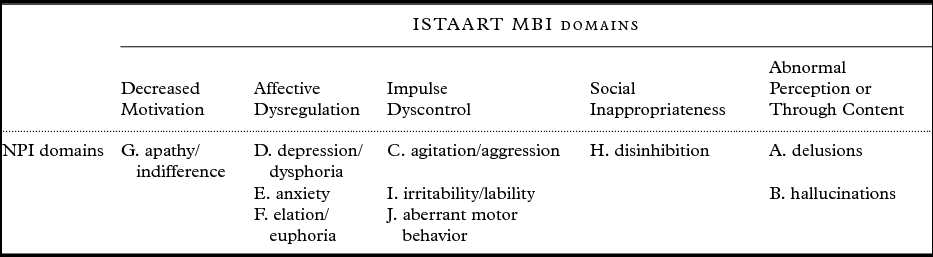
The NPS Professional Interest Area (PIA) of the International Society to Advance Research and Treatment (ISTAART), a subgroup of the Alzheimer's Association (AA), have developed and published research diagnostic criteria for MBI (Table S1, available as supplementary material attached to the electronic version of this paper at www.journals.cambridge.org/jid_IPG). According to the operationalized criteria published by Ismail and colleagues (Reference Ismail2016), MBI is hallmarked by changes in behavior or personality which start in later-life (after the age of 50 years), representing a clear change from the person's usual behavior or personality and are evidenced by changes in the domains of decreased motivation, affective dysregulation, impulse dyscontrol, social inappropriateness, and abnormal perception or thought content. Importantly, these domains reflect areas of NPS shown to be valid and related to the syndromes of cognitive decline.
ISTAART mild behavioral impairment domain matrix

NB: NPI Domains of K. Sleep and Nighttime Behavior and L. Appetite and Eating Disorders excluded.
The diagnosis and detection of NPS in pre-clinical populations is currently an understudied area, which traditionally has fallen under the areas of adult and geriatric psychiatry with the aim of diagnosing other psychiatric syndromes. NPS are most commonly assessed in clinical and research settings using the neuropsychiatric inventory (NPI) (Cummings et al., Reference Cummings, Mega, Gray, Rosenberg-Thompson, Carusi and Gornbein1994) or its short-form, the neuropsyciatric inventory questionnaire (NPI-Q) (Kaufer et al., Reference Kaufer, Cummings, Ketchel, Smith, MacMillan and Shelley2000). The NPI is a well-known global assessment scale widely used in both research and clinical practice. It is a structured informant interview with established reliability and validity (Cummings et al., Reference Cummings, Mega, Gray, Rosenberg-Thompson, Carusi and Gornbein1994). The NPI provides a subjective assessment of NPS from the caregiver of the presence, frequency, and severity of ten NPS domains (delusions, hallucinations, agitation/aggression, dysphoria/depression, anxiety, irritability, disinhibition, euphoria, apathy, aberrant motor behavior) and two neurovegetative domains (sleep and night-time behavior change, and appetite/eating change).
There is currently a lack of population-based epidemiological research on NPS, with most prior research being conducted in clinical settings. Cohort studies provide the opportunity to examine the distribution of NPS in the population, and across the full spectrum of cognitive phenotypes or across the continuum from normal (cognitive) aging to dementia. Likewise, given that MBI is a new construct, with new diagnostic criteria, no validated rating scale for its assessment is currently available to determine its prevalence in sub-clinical populations. Understanding the prevalence of MBI sub-clinical populations will help inform our understanding of NPS as a risk factor for incident MCI and dementia and will assist with clinical assessment.
Using the NPI, to our knowledge this study is the first epidemiological study worldwide to (1) operationalize the recently published diagnostic criteria for MBI; and (2) used these criteria to determine the prevalence estimates of MBI in a nationally representative population-based study.
Method
Subjects
Subjects were sampled from wave four of the oldest cohort (aged 60–64 at baseline) of the personality and total health through life (PATH) study (Anstey et al., Reference Anstey2011). The PATH study is a, representative community-based longitudinal cohort study which commenced in 2001. Follow-up assessments were every four years up to 12 years. Participants are residents of the city of Canberra and the adjacent town of Queanbeyan, Australia, and were randomly recruited through the electoral roll (Anstey et al., Reference Anstey2011). Enrolment to vote is compulsory for Australian citizens. The study was approved by the Australian National University Human Research Ethics Committee.
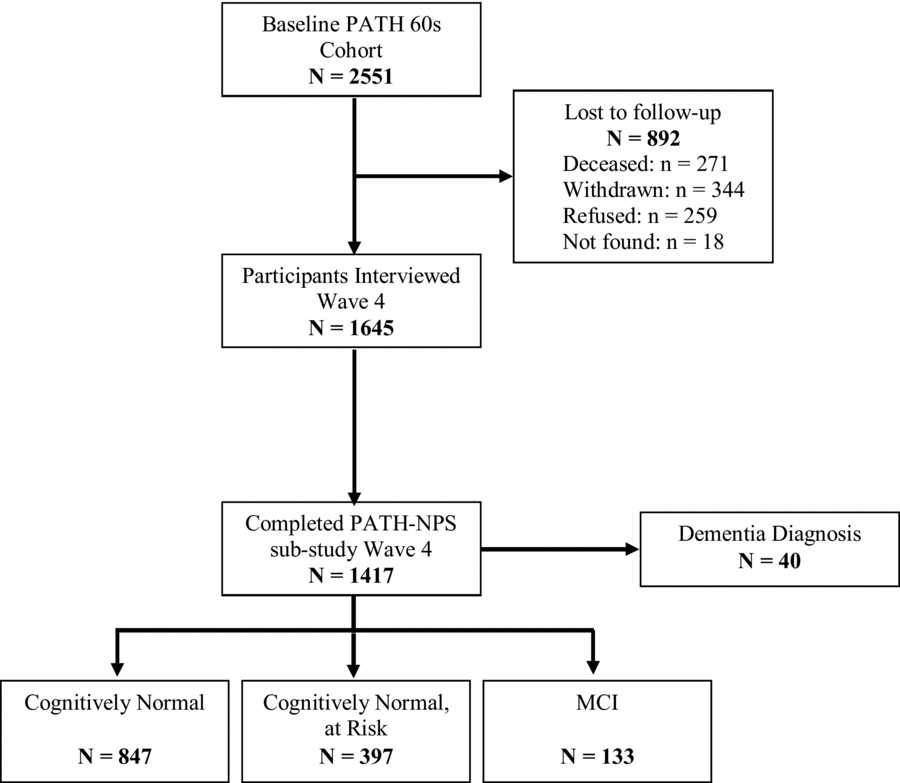
Of the 2,551 older PATH subjects at baseline, 1,644 completed the fourth wave of assessments. One thousand four hundred and seventeen subjects completed the informant-based PATH NPS sub-study (PATH-NPS) at wave four. The final sample included in this study consisted of 1,377 participants, of which, 133 were classified as having MCI; 397 were classified as “cognitively normal, but-at-risk” (CN-AR); and 847 were cognitively normal. Figure 1 presents the sample selection flow chart, including information on cognitive status of subjects.
Sample selection flow-chart.

Cognitive function states and clinical diagnosis
Diagnostic procedures used to determine cognitive function states and clinical diagnoses at Wave four are published elsewhere (Eramudugolla et al., Reference Eramudugolla, Mortby, Sachdev, Meslin, Kumar and Anstey2017). In summary, for the 1,644 participants assessed at Wave four, their data was screened for signs of decline based on the following criteria: a previous PATH diagnosis of dementia or a mild cognitive disorder, or evidence of current objective cognitive impairment (based on performance ≤ 6.7th percentile on at least one cognitive measure, or MMSE ≤ 24), and evidence of subjective decline on the Memory and cognition questionnaire (MAC-Q; Crook et al., Reference Crook, Feher and Larrabee1992) or decline on the MMSE of > 3 points since wave three, or consistent MMSE ≤ 24 at waves three and four (Eramudugolla et al., Reference Eramudugolla, Mortby, Sachdev, Meslin, Kumar and Anstey2017).
Clinical diagnoses of MCI were based on a case file review by a research neurologist and confirmed following a consensus diagnosis with a clinician specializing in Psychiatry. Case files were reviewed by the research neurologist and included neuropsychological test data, informant data, structural brain MRI scans to aid differential diagnosis of dementia subtypes, self-reported medication list, and contact of participant for further clarification of details relevant to diagnosis (Eramudugolla et al., Reference Eramudugolla, Mortby, Sachdev, Meslin, Kumar and Anstey2017). Inter-rater reliability indicated high agreement between the neurologist and psychiatrist in the independent review of a subsample of 29 cases (Eramudugolla et al., Reference Eramudugolla, Mortby, Sachdev, Meslin, Kumar and Anstey2017).
MCI was assessed using the Winblad criteria for MCI (Winblad et al. Reference Winblad2004). Subjects were considered CN-AR if they did not meet the Winblad et al. (Reference Winblad2004) criteria for MCI or the DSM-IV criteria for dementia; but demonstrated signs of impairment as identified by the screening criteria outlined above (Eramudugolla et al., Reference Eramudugolla, Mortby, Sachdev, Meslin, Kumar and Anstey2017). Individuals who did not meet any of the above criteria were classified as cognitively normal.
Informants
Informants were nominated by the PATH participant and provided information on the participant's physical and mental health via a telephone interview. Informants were predominantly spouses (49.4%), children (33.8%), or a close friend (9.7%).
Mild behavioral impairment
MBI was assessed in accordance with Criterion 1 of the ISTAART-AA research diagnostic criteria for MBI (Ismail et al., Reference Ismail2016) using the NPI (Cummings et al., Reference Cummings, Mega, Gray, Rosenberg-Thompson, Carusi and Gornbein1994). The NPI is a structured informant interview with established reliability and validity (Cummings et al., Reference Cummings, Mega, Gray, Rosenberg-Thompson, Carusi and Gornbein1994). The NPI assesses the presence, frequency, and severity of ten NPS domains (delusions, hallucinations, agitation/aggression, dysphoria/depression, anxiety, irritability, disinhibition, euphoria, apathy, aberrant motor behavior) and two neurovegetative domains (sleep and night-time behavior change, and appetite/eating change).
Mild behavioral impairment domains
Table 1 presents a transformation matrix of the ISTAART-AA MBI criteria and the NPI domains used to approximate whether individuals met the domain criteria for MBI. The ISTAART-AA MBI criteria are characterized by five behavioral domains of decreased motivation (e.g. apathy, aspontaneity, indifference); affective dysregulation (e.g. anxiety, dysphoria, changeability, euphoria, irritability); impulse dyscontrol (e.g. agitation, disinhibition, gambling, obsessiveness, behavioral perseveration, stimulus bind); social inappropriateness (e.g. lack of empathy, loss of insight, loss of social graces or tact, rigidity, exaggeration of previous personality traits); and abnormal perception or through content (e.g. delusions, hallucinations). The NPI neurovegetative domains of sleep and appetite changes are not reflected in the ISTAART-AA MBI criteria.
In order to meet the operationalized MBI criteria for a specific MBI domain, participants needed to present with a minimum of one of the NPI symptoms constituting said specific domain. For example, to meet the criteria for affect dysregulation, participants needed to present with either depression, anxiety, or euphoria as assessed by the NPI (Table 1). Participants met the overall criteria for MBI if at least one of the five MBI domains was present. If all domain symptoms were absent the domain is scored as zero.
Statistical analyses
Statistical analyses were performed using IBM SPSS Statistics 22.0. Prevalence estimates and CIs for MBI are reported for the three study groups (MCI, CN-AR, cognitively normal). χ 2 tests and analysis of variance were used to compare demographic characteristic between the study groups (MCI, CN-AR, cognitively normal) with p < 0.05 as the level of significance. Post-hoc comparisons were done using Bonferroni correction.
Results
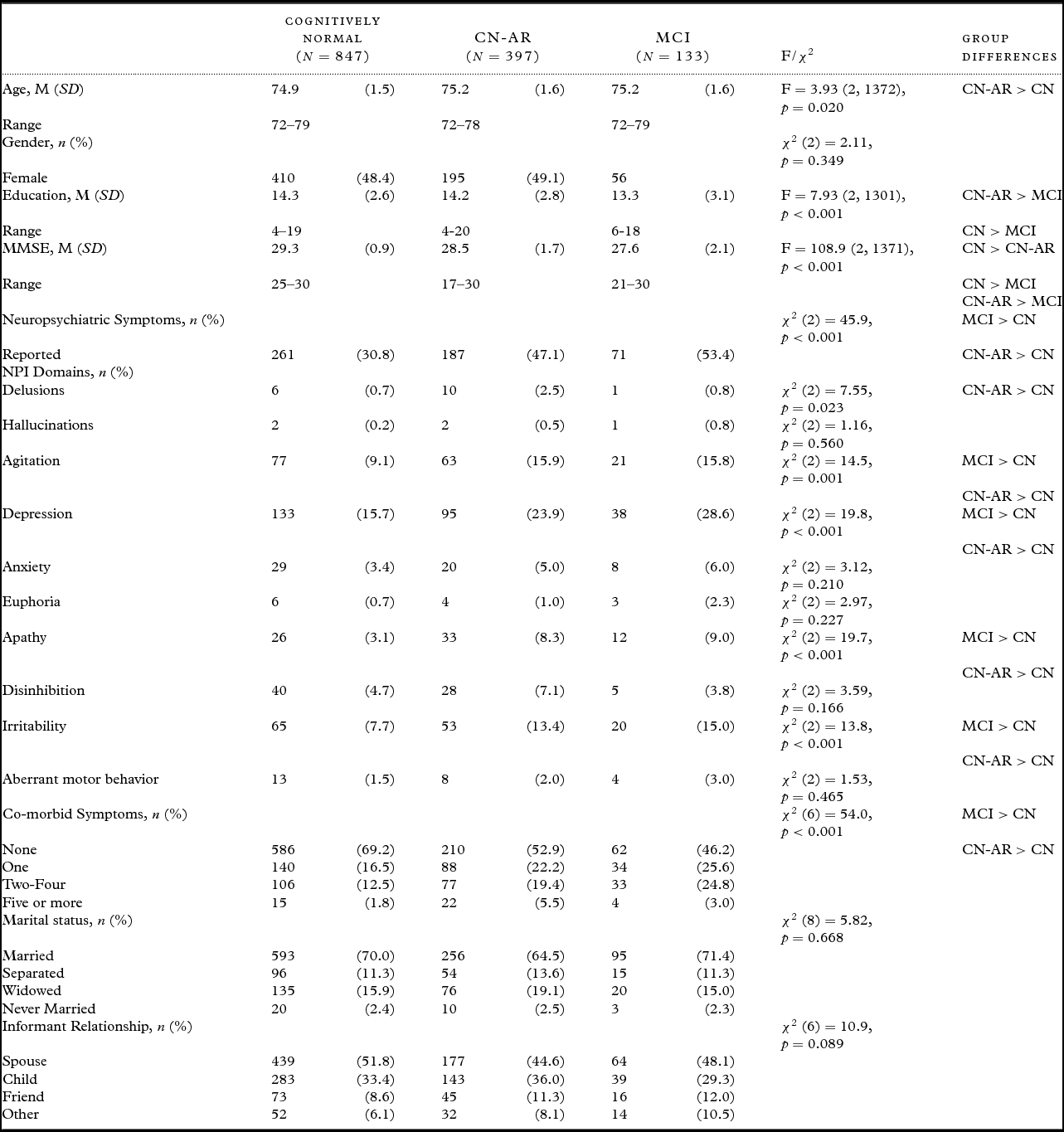
Socio-demographic characteristics are presented in Table 2. As would be expected, the three diagnostic groups differed significantly in age (F (2, 1,372) = 3.93, p = 0.020), years of education (F (2, 1,301) = 7.93, p < 0.001), and MMSE scores (F (2, 1,371) = 108.9, p < 0.001).
Sample characteristics

Abbreviations: CN = Cognitively normal; CN-AR = Cognitively normal, but-at-risk; MCI = Mild Cognitive Impairment; MMSE = Mini-Mental State Exam; NPI = Neuropsychiatric Inventory.
Informant relationship type (i.e. spouse, child, friend, other) was not associated with higher reporting of NPS (χ2 (3, N = 530) = 1.17, p = 0.759), with 51.0% of spouses, 47.3% of children, 44.3% of friends, and 47.8% of informants reflecting other relationship types reporting NPS amongst participants. Similarly, no significant differences were either observed between informant relationship type and frequency of the NPI domains.
Prevalence rates of NPS amongst the study groups (MCI, CN-AR, and cognitively normal) are reported elsewhere (Mortby et al., Reference Mortby, Burns, Eramudugolla, Isamil and Anstey2017). In summary, the most commonly reported NPS in the MCI group were: depression, agitation, irritability, apathy, anxiety, disinhibition, aberrant motor behavior, and euphoria. As expected, delusions and hallucinations were the most uncommon symptoms. Amongst the CN-AR group, the most commonly reported NPS by informants included: depression, agitation, irritability, apathy, disinhibition, anxiety, delusions, and aberrant motor behavior. Euphoria and hallucinations were the most uncommon symptoms reported in less than 1% of the CN-AR group. The most commonly reported NPS in the cognitively normal group were: depression, agitation, irritability, disinhibition, anxiety, apathy, and aberrant motor behavior. As expected, euphoria, delusions, and hallucinations were the most uncommon symptoms.
The three diagnostic groups differed significantly in prevalence for delusions (χ2 (2, N=1,377) = 7.55, p = 0.023), agitation (χ2 (2, N = 1,375) = 14.5, p < 0.001), depression (χ2 (2, N = 1,377) = 19.8, p < 0.001), apathy (χ2 (2, N = 1,377) = 19.7, p < 0.001), and irritability (χ2 (2, N = 1,377) = 13.8, p < 0.001). Interestingly, no significant group differences were found between the MCI and CN-AR, while significant differences were found between the cognitively normal and both the CN-AR and MCI groups for these behaviors (Table 2).
Mild behavioral impairment prevalence estimates
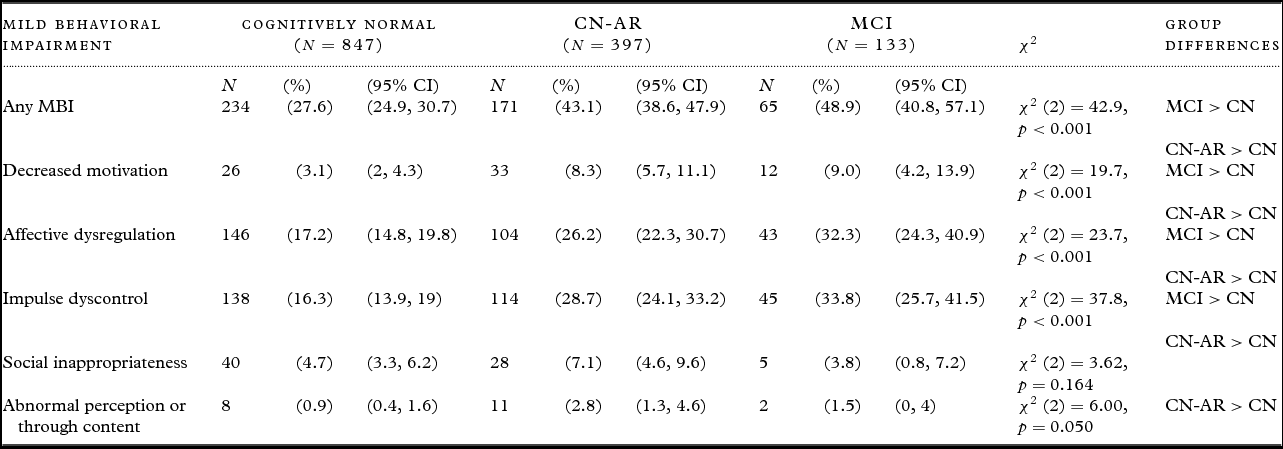
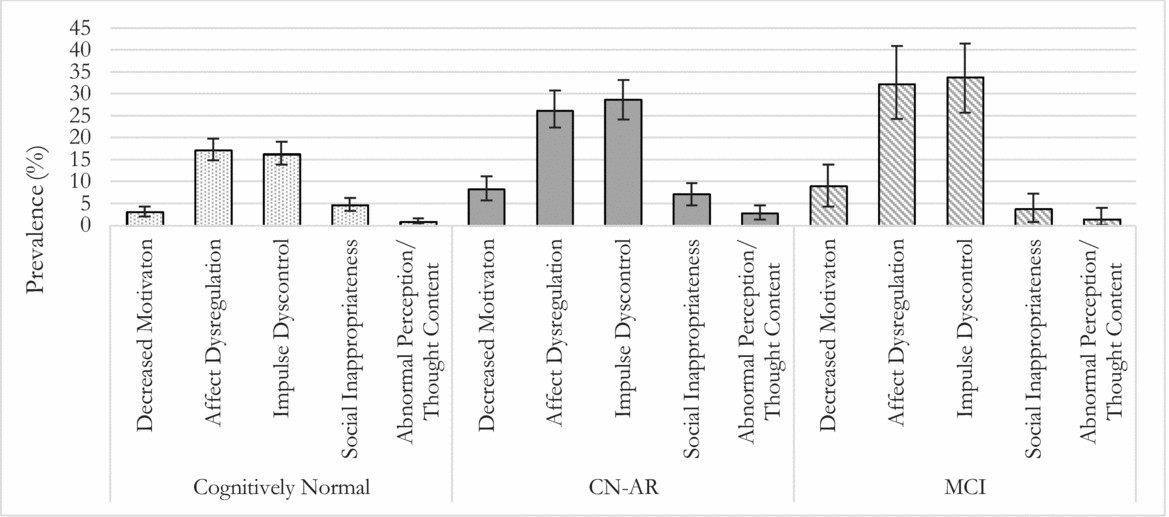
Prevalence estimates of MBI in the PATH Through Life study according to the ISTAART-AA criteria as reported in Table 3 and Figure 2. Amongst the 1,377 participants, 34.1% (CI = 31.7–36.6) met the ISTAART-AA criteria for MBI. As expected, significant differences across the diagnostic groups were found (χ2 (2, N = 1,377) = 42.9, p < 0.001), with the highest proportion of MBI being reported amongst the MCI group (48.9%; CI = 40.8–57.1), compared to the CN-AR group (43.1%; CI = 38.6–47.9) and the cognitively normal group (27.6%; CI = 24.9–30.7).
Prevalence of mild behavioral impairment in the PATH through life study

Abbreviations: CN = cognitively normal; CN-AR = cognitively normal, but-at-risk; MCI = mild cognitive impairment.
Prevalence of individual mild behavioral impairment domains according to cognitive domain. Whiskers indicate 95% confidence intervals for the entire sample.

The most common MBI domains in the MCI group were: impulse dyscontrol (33.8%; CI = 25.7–41.5) and affective dysregulation (32.3%; CI = 24.3–40.9). Less common symptoms in this group included decreased motivation (9.0%; CI = 4.2–13.9), social inappropriateness (3.8%; CI = 0.8–7.2) and abnormal perception or thought content (1.5%; CI = 0.0–4.0).
Amongst the CN-AR group, the most common MBI domains met included impulse dyscontrol (28.7%; CI = 24.1–33.2), affective dysregulation (26.2%; CI = 22.3–30.7) and decreased motivation (8.3%; CI = 5.7–11.1). Less common symptoms criteria in this group included, social inappropriateness (7.1%; CI = 4.6–9.6) and abnormal perception or thought content (2.8%; CI = 1.3–4.6).
Finally, the most common MBI domains in the cognitively normal group were: impulse dyscontrol (17.2%; CI = 13.9–19.0) and affective dysregulation (16.3%; CI = 14.8–19.8), social inappropriateness (4.7%; CI = 3.3–6.2), and decreased motivation (3.1%; CI = 2.0–4.3). In this group, less than 1% met the met criteria for abnormal perception or thought content (0.9%; CI = 0.4–1.6).
Gender differences in prevalence estimates of mild behavioral impairment
Gender differences were also found amongst the 470 participants meeting the ISTAART-AA criteria for MBI, with 56.2% of those meeting the criteria being male (χ2 (1, N = 1,377) = 4.98, p = 0.026). Interestingly, significant differences between men and women were found in this study, demonstrating that men more frequently met the MBI domain criteria for decreased motivation (63.4% vs. 36.6%; χ2 (1, N = 1,377) = 4.1, p = 0.049) and impulse dyscontrol (64% vs. 36%; χ2 (1, N = 1,377) = 21.8, p < 0.001). No significant differences were found between the genders for the MBI domains of affective dysregulation, social inappropriateness, and abnormal perception or thought content.
Discussion
To the best of our knowledge, this study is the first population-based study to determine prevalence estimates of MBI in accordance with the recently published ISTAART-AA diagnostic criteria. Four important findings were made: (1) high prevalence of MBI was reported across the spectrum from cognitively normal to MCI; (2) similar estimates of MBI were reported in the pre-clinical groups of MCI and CN-AR; (3) high prevalence of MBI was reported in cognitively normal older adults; and (4) prevalence estimates of MBI were, in part, gender-specific.
Findings from this study show a high prevalence of MBI using the recently published ISTAART-AA criteria across the spectrum from cognitively normal to MCI in this population-based sample. As expected, the highest prevalence estimates were reported amongst the MCI group, with nearly half of the MCI group meeting the MBI criteria (48.9%). Importantly, these findings are consistent with previous reports of NPS in community-based clinical samples, where 43%–51% of individuals with MCI were found to have NPS (Lyketsos et al., Reference Lyketsos, Lopez, Jones, Fitzpatrick, Breitner and DeKosky2002; Geda et al., Reference Geda2008). The current findings are the first to have operationalized the ISTAART-AA criteria for MBI, and to have used them to investigate MBI prevalence in non-clinical and pre-clinical states.
Despite not meeting the criteria for MCI, our CN-AR group reported similar proportions of MBI (43.1%) as the MCI group. The CN-AR group represents a cognitively “at-risk” subgroup within the cognitively normal spectrum who do not meet criteria for MCI but which, in a clinical setting would likely be considered to represent subjective cognitive complaints. It may therefore be that the characterization of this “at-risk” group may therefore also preferentially select participants with NPS that are etiologically related to emerging neurodegenerative disease. Research has not yet started to consider the role of NPS in subjective cognitive concerns/impairment. To the best of our knowledge, the only link between NPS and subjective cognitive decline considered so far is in relation to the role that affective states may play when considering the accuracy of subjective memory complaints as a predictor of progression to dementia (Roberts et al., Reference Roberts, Clare and Woods2009). Findings by Minett et al. (Reference Minett, Da Silva, Ortiz and Bertolucci2008) showed a stronger association between depressive symptoms and subjective memory complaints than between poor cognitive performance and subjective memory complaints, leading them to suggest, that subjective memory complaints are more likely to reflect depression rather than an accurate appraisal of memory. Research is needed which investigates how NPS and the concept of MBI may help with early identification of individuals at risk of cognitive impairment and how the ISTAART-AA criteria for MBI can best be used to assist in the diagnostic process, specifically amongst individuals without any signs of cognitive impairment or those presenting with only subjective cognitive concerns/impairments.
Importantly, the prevalence estimates of MBI amongst the cognitively normal group (27.6%) were comparable to those reported by Geda et al. (Reference Geda2008) in the Mayo Clinic Study of Ageing, in which 25% of cognitively normal community dwelling older adults aged 70–91 years (n = 1,590) reported NPS, as captured by the short questionnaire version of the NPI (NPI-Q). Similarly, Okura et al. (Reference Okura, Plassman, Steffens, Llewellyn, Potter and Langa2010) reported prevalence estimates of NPS amongst 18% of cognitively normal participants (n = 303) aged 71 and older drawn from the Ageing Demographics and Memory Study. These findings highlight the importance of NPS as a diagnostic construct both in clinical and research settings. Furthermore, they are in accordance with other studies which have confirmed the role of NPS as a risk factor for developing MCI or conversion from MCI to dementia (Palmer et al., Reference Palmer2010; Dillon et al., Reference Dillon, Serrano, Castro, Leguizamón, Heisecke and Taragano2013). These findings lend support to the notion of MBI (Ismail et al., Reference Ismail2016) as a clinical entity and risk state accompanying the transition from normal to abnormal cognitive aging. Longitudinal follow-up of this PATH sample will be important to track the evolution of MBI in relation to cognitive decline and diagnosis.
Finally, this study also identified gender-specific trends in prevalence of MBI and its domains. MBI was more frequently observed amongst men (52.6%). Interestingly, the prevalence estimates of decreased motivation (i.e. apathy) and impulse dyscontrol were almost double amongst men compared to women (63.4% vs. 36.6% and 64% vs. 36%, respectively). These findings are not unsurprising, at it is well established in the literature that apathy is more common in men in preclinical and clinical states (Zuidema et al., Reference Zuidema, de Jonghe, Verhey and Koopmans2009; Brodaty et al., Reference Brodaty, Altendorf, Withall and Sachdev2010; Holtta et al., Reference Holtta, Laakkonen, Laurila, Strandberg, Tilvis and Pitkala2012; Geda et al., Reference Geda2014; Guercio et al., Reference Guercio2015). Similarly, there is evidence demonstrating aggression, irritability, and aberrant motor behaviors to be more commonly observed in men (Buchanan et al., Reference Buchanan, Wang, Ju and Graber2004; Lovheim et al., Reference Lovheim, Sandman, Karlsson and Gustafson2009; Zuidema et al., Reference Zuidema, de Jonghe, Verhey and Koopmans2009; Cerejeira et al., Reference Cerejeira, Lagarto and Mukaetova-Ladinska2012; Kitamura et al., Reference Kitamura, Kitamura, Hino, Tanaka and Kurata2012). However, despite findings of higher estimates of apathy, aggression, irritability, and aberrant motor behaviors amongst men, the mechanisms underlying these gender-specific associations remain unclear (Brodaty et al., Reference Brodaty, Altendorf, Withall and Sachdev2010; Cerejeira et al., Reference Cerejeira, Lagarto and Mukaetova-Ladinska2012; Gotovac et al., Reference Gotovac, Nikolac Perkovic, Pivac and Borovecki2016). It is important that research continues to investigate these gender-specific presentations and possible determinants of gender differences in NPS as these may be indicative of different neuropathology which may require different management and treatment strategies.
A number of limitations of the present study must be considered. First, while PATH is a longitudinal study, the PATH-NPS sub-study was only conducted at Wave four, resulting in the cross-sectional design of this study. It is therefore, not possible to make any conclusion in relation to changes in prevalence of NPS over time, nor the risk of progression to cognitive impairment from these findings. Second, MBI was assessed in this study based on the NPI domains which reflect the ISTAART-AA MBI domain criteria. Ideally, MBI would be assessed using a measure specifically developed to assess MBI; however, at the time of this study, such a measure was not yet available. The recently published MBI-C (www.MBItest.org) has specifically been developed to assess MBI in a pre-dementia population (Ismail et al., Reference Ismail2017). The MBI-C is a 34-item questionnaire which reflects the ISTAART-AA MBI criteria. Thus MBI prevalence estimates are approximations, limited by the use of a non-MBI specific rating scale. More research is needed to evaluate the comparability between the methods of assessment used in this study and the newly developed MBI-C. Third, consideration must also been given to the characterization of the CN-AR group, as this group may represent a heterogeneous group of individuals, which may include people who could possibly meet criteria for MCI if other diagnostic criteria were used. Fourth, biomarkers were not available in this study, and thus the population was characterized using clinical parameters. Nonetheless, we provide a cost and time-effective approach to characterize a clinical risk state (i.e. MBI) for cognitive decline. Finally, while the NPI is the most widely applied measure to assess NPS, both in a clinical and research setting, data is acquired from the informant, making the results susceptible to caregiver recall and interpretation bias. Reports may therefore be influenced by caregiver mood, cultural beliefs, denial, and/or caregiver's education.
Despite these limitations this study also characterized by a number of strengths, including a large population-based sample (n = 1,377), detailed neurocognitive assessments and consensus diagnoses. The limited age range is both a strength and weakness, as it reduces the impact of age on results but also reduces generalizability of findings to a wider age-range.
In summary, this study provides the first population-based assessment of prevalence estimates of MBI in accordance with the recently published ISTAART-AA diagnostic criteria. The concept of MBI provides recognition of another population at risk of developing dementia and provides a further dimension relevant to clinicians and diagnostic approaches. Acceptance of the syndrome of MBI as a prodromal stage of dementia and implementation of screening will have significant implications for improving early detection, prevention, and treatment of dementia by providing a better understanding of the very early consequences of neurodegenerative disease.
Conflict of interest
None.
Description of authors’ roles
M.E. Mortby developed the study objectives, supervised the data collection for the PATH-NPS sub-study, was responsible for the statistical design of the study, carrying out of the statistical analysis, and writing the paper. Z. Ismail devised the NPI transformation matrix, advised on the methodology for data analysis, contributed to the interpretation of data, and assisted with the writing of the paper. K.J. Anstey designed the PATH study, supervised data collection, advised on data analysis, contributed to the interpretation of data, and assisted with the writing of the article.
Acknowledgments
We thank the study participants, PATH Interviewers, Kristine Koh, Trish Jacomb, and Karen Maxwell. We acknowledge the contribution of Helen Christensen, Peter Butterworth, Nicolas Cherbuin, Andrew McKinnon, and Simon Easteal. The wave four of the PATH Through Life Study was funded by NHMRC Grant #1002160. We would also like to acknowledge support from the Australian Research Council (ARC) CE110001029. M.E. Mortby is supported by the Australian National Health and Medical Research Council (NHMRC) and Australian Research Council (ARC) Dementia Research Development Fellowship #1102028. Z. Ismail is funded by the Hotchkiss Brain Institute with support from the Alzheimer Society Calgary. K.J. Anstey is funded by NHMRC Fellowship #1102694.
Supplementary material
To view supplementary material for this article, please visit https://doi.org/10.1017/S1041610217001909