Introduction
Studies worldwide have reported population increases in depression and anxiety resulting from the ongoing COVID-19 pandemic (Abbott, Reference Abbott2021; Gloster et al., Reference Gloster, Lamnisos, Lubenko, Presti, Squatrito, Constantinou and Karekla2020; Xiong et al., Reference Xiong, Lipsitz, Nasri, Lui, Gill, Phan and McIntyre2020). Because most studies were initiated after the pandemic began, they lack prospectively collected pre-pandemic clinical data on individuals. This may result in inaccurate conclusions about the pandemic-associated pathology, and limit identification of newly at-risk individuals.
A literature search yielded 13 studies with contemporaneously procured pre-pandemic data, albeit with varied research questions, measures, and circumscribed populations of interest. Two studies focused on older adults (age 52+), and/or senior citizens (mean age 77 years) with disabilities (Mishra et al., Reference Mishra, Park, York, Kunik, Wung, Naik and Najafi2021; Steptoe & Di Gessa, Reference Steptoe and Di Gessa2021), and one study focused on younger adults (mean age 24 years) and teenagers (Hawes, Szenczy, Klein, Hajcak, & Nelson, Reference Hawes, Szenczy, Klein, Hajcak and Nelson2021; Rogers, Ha, & Ockey, Reference Rogers, Ha and Ockey2021). Three studies investigated psychological symptoms among pregnant women or mothers (Layton, Owais, Savoy, & Van Lieshout, Reference Layton, Owais, Savoy and Van Lieshout2021; Racine et al., Reference Racine, Hetherington, McArthur, McDonald, Edwards, Tough and Madigan2021; Zilver et al., Reference Zilver, Broekman, Hendrix, de Leeuw, Mentzel, van Pampus and de Groot2021). One study examined pandemic effects on eating disorders, exercise addiction, and body dysmorphia among health club users (Trott, Johnstone, Pardhan, Barnett, & Smith, Reference Trott, Johnstone, Pardhan, Barnett and Smith2021). The remaining six studies were population-based.
Among the six population-based studies, three leveraged cohorts from the UK (Kwong et al., Reference Kwong, Pearson, Adams, Northstone, Tilling, Smith and Timpson2020; Niedzwiedz et al., Reference Niedzwiedz, Green, Benzeval, Campbell, Craig, Demou and Katikireddi2021; Pierce et al., Reference Pierce, McManus, Hope, Hotopf, Ford, Hatch and Abel2021), and the remaining three were based respectively in Spain (Ayuso-Mateos et al., Reference Ayuso-Mateos, Morillo, Haro, Olaya, Lara and Miret2021), Ireland (Hyland et al., Reference Hyland, Shevlin, Murphy, McBride, Fox, Bondjers and Vallières2021), and the Netherlands (Pan et al., Reference Pan, Kok, Eikelenboom, Horsfall, Jörg, Luteijn and Penninx2021). Most of these studies revealed variable changes in mental health from pre- to post-pandemic, depending on age, gender, race/ethnicity, elements of socioeconomic status (SES), and pre-existing physical and or mental health status. Moreover, significant increases in symptoms (decreased mental health) were observed among younger individuals, women, racial/ethnic minorities, and individuals from lower SES backgrounds (Ayuso-Mateos et al., Reference Ayuso-Mateos, Morillo, Haro, Olaya, Lara and Miret2021; Kwong et al., Reference Kwong, Pearson, Adams, Northstone, Tilling, Smith and Timpson2020; Niedzwiedz et al., Reference Niedzwiedz, Green, Benzeval, Campbell, Craig, Demou and Katikireddi2021; Pierce et al., Reference Pierce, McManus, Hope, Hotopf, Ford, Hatch and Abel2021). In addition, pre-existing psychiatric or psychological symptoms were associated with decreased mental health from pre- to post-pandemic (Kwong et al., Reference Kwong, Pearson, Adams, Northstone, Tilling, Smith and Timpson2020; Pierce et al., Reference Pierce, McManus, Hope, Hotopf, Ford, Hatch and Abel2021).
These increases in symptoms found in the prospective longitudinal studies are consistent with findings from cross-sectional prevalence studies, including those from two US epidemiological studies, showing greater prevalence of anxiety and depression symptoms from pre- to post-pandemic, particularly among younger and lower SES groups (Daly, Sutin, & Robinson, Reference Daly, Sutin and Robinson2021; Ettman et al., Reference Ettman, Abdalla, Cohen, Sampson, Vivier and Galea2020; Wanberg, Csillag, Douglass, Zhou, & Pollard, Reference Wanberg, Csillag, Douglass, Zhou and Pollard2020).
However, there have been some suggestions that individuals with an existing psychiatric history may be at decreased risk for adverse mental health during the pandemic. For example, a report of three large Dutch cohorts (Pan et al., Reference Pan, Kok, Eikelenboom, Horsfall, Jörg, Luteijn and Penninx2021) with pre- and post-pandemic data found that individuals with past psychiatric history did not get worse, whereas the most affected were those with no history of psychiatric disorders. Other studies have reported similar resilience against suicidal behaviors following the pandemic in those with a psychiatric history (Ahmad & Anderson, Reference Ahmad and Anderson2021; Pirkis et al., Reference Pirkis, John, Shin, DelPozo-Banos, Arya, Analuisa-Aguilar and Spittal2021). To our knowledge to-date, there have been no comparable US-based studies examining within-person pandemic effects on psychiatric symptomatology according to pre-existing psychiatric health status. This gap should be addressed, given the pronounced impact of the COVID-19 pandemic on work protocols, social interactions, medical practices, and other facets of living in the USA.
Accordingly, we report on participants from a US cohort, followed for up to 38 years with direct clinical interviews on themselves and their relatives, with diagnoses across the lifetime independently confirmed by a psychiatrist or psychologist (Weissman et al., Reference Weissman, Gammon, John, Merikangas, Warner, Prusoff and Sholomskas1987, Reference Weissman, Wickramaratne, Nomura, Warner, Pilowsky and Verdeli2006). These participants had most recently been interviewed 0–2.5 years prior to the pandemic's onset in March 2020 (pre-pandemic onset, T1). We then reassessed participants during the pandemic between September 2020 and February 2021 (post-pandemic onset, T2). In addition to the personal history of psychiatric disorders, data on family history as a potential risk factor were available. We examine changes in depression, anxiety, trauma, suicidality, and wellbeing (positive affect), as well as COVID-19-related concerns, during the pandemic in individuals with and without a family or personal (recent and past) psychiatric history.
Method
The analyses are based on a longitudinal family study of three generations at high and low risk for depression (Weissman et al., Reference Weissman, Gammon, John, Merikangas, Warner, Prusoff and Sholomskas1987, Reference Weissman, Wickramaratne, Gameroff, Warner, Pilowsky, Kohad and Talati2016). Briefly, the study began in 1982 with the recruitment of two groups of first generation probands (G1). The first was recruited from outpatient clinics and included probands with moderate-to-severely impairing major depressive disorder (MDD) but no schizophrenia, antisocial personality disorder, bipolar disorder, or primary substance use disorder. The second was selected from an epidemiologic sample in the same community, and had no lifetime history of psychiatric illness, as confirmed through several interviews. Second (G2) and third (G3) generation offspring of probands with and without MDD constitute the high and low-risk groups, respectively (Weissman et al., Reference Weissman, Gammon, John, Merikangas, Warner, Prusoff and Sholomskas1987).
The families had been followed for up to 38 years, across seven waves (Weissman et al., Reference Weissman, Wickramaratne, Nomura, Warner, Pilowsky and Verdeli2006, Reference Weissman, Wickramaratne, Gameroff, Warner, Pilowsky, Kohad and Talati2016). Clinical assessments included a semi-structured clinical interview based on the adult or child version of the Schedule for Schizophrenia and Affective Disorders (Endicott & Spitzer, Reference Endicott and Spitzer1978; Kaufman et al., Reference Kaufman, Birmaher, Brent, Rao, Flynn, Moreci and Ryan1997) by a clinician with each family member, blind to family history. Each interview covered the time period from the previous interview; thus, total assessment timeframe was always lifetime until most recent interview, regardless of the number of intervening interviews. Final diagnoses were made by a M.D. or Ph.D. clinician using the best-estimate procedure (Leckman, Sholomskas, Thompson, Belanger, & Weissman, Reference Leckman, Sholomskas, Thompson, Belanger and Weissman1982).
Procedures
The T1 assessments and interviews were conducted 0–2.5 years prior to pandemic onset. Participants from T1 were invited to complete an online survey administered through Qualtrics software, version 2020/2021 (Qualtrics, Reference Qualtrics2020). All T2 participants provided consent, and the study was approved by the Internal Review Board (IRB) of the New York State Psychiatric Institute. T2 data collection began in August 2020, approximately 6 months after presidential (Staff, Reference Staff2021) and governor-issued executive orders for lockdowns and social distancing in Connecticut and New York (Hughes & Haynes, Reference Hughes and Haynes2020), where most participants or their close relatives reside. T2 data collection ended in February 2021, when restrictions were still widely in place, and vaccine rollout had not been widely established.
Analytical sample
Two-hundred forty-nine (249) individuals completed assessments and clinical interviews at T1. These individuals were invited via email or telephone to participate at T2. In total, 204 (82%) individuals participated in the study at T2. Non-participants had higher suicidality (IDAS score, 8.0 v. 7.0) and traumatic symptoms (7.8 v. 6.7), and lower wellbeing scores (20.1 v. 23.1) (all ps < 0.05) than participants, but the groups did not differ on other baseline and clinical characteristics, including MDD familial risk and psychiatric history (online Supplementary Table S1).
For analyses involving psychiatric history, we excluded eight people who completed their T1 interview after 20 March 2020, and six people who missed one or more assessment time points up to T1, yielding an analytic sample of 190. Individuals in the analytic group completed their T1 assessments between July 2017 and February 2020. Average time from T1–T2 completion was a mean of 25.8 months and a median of 27 months. The 14 excluded individuals did not differ significantly from the included group on demographics (age, sex, marital status, education), risk factors (MDD status), and time of T2 survey completion. In addition, we found no significant correlation between T1–T2 interval length, and magnitude of change in IDAS II Depression (r = 0.10, p = 0.17), Suicidality (r = −0.03, p = 0.71), Anxiety (r = 0.05, p = 0.51), Traumatic symptoms (r = 0.02, p = 0.84), and Wellbeing (r = −0.03, p = 0.64).
Psychiatric history
Psychiatric history was primarily defined by the lifetime presence/absence of one or more ‘definite’ best-estimated DSM-IV/5 psychiatric disorders. Guided by distribution analysis of psychiatric history, we categorized psychiatric history in three groups: (1) ‘No psychiatric history’, consisting of individuals with no lifetime psychopathology (n = 45); (2) ‘Only-past’ history, comprising individuals whose most recent disorder offset occurred prior to 2 years of their T1 interview (n = 66), and (3) ‘Recent’ history comprised individuals who met the criteria for psychiatric disorders within 2 years of their T1 interview(n = 79). This group could also include a subset of individuals who still met the criteria for DSM-IV disorders at the time of T2 assessments. The past and recent groups included major mood (n = 59), anxiety (n = 60), substance use (n = 36), and psychotic (n = 1) disorders before or by T1 [categories are not mutually exclusive; 90 (62%) had multiple disorders].
Change in symptoms from T1 to T2 was assessed using the Inventory of Depressive and Anxiety symptoms – Version II (IDAS-II) (Watson et al., Reference Watson, O'Hara, Naragon-Gainey, Koffel, Chmielewski, Kotov and Ruggero2012; Watson & O'Hara, Reference Watson and O'Hara2017), a multidimensional measure of depression and anxiety symptoms derived through factor analysis (Nelson, O'Hara, & Watson, Reference Nelson, O'Hara and Watson2018; Stasik-O'Brien et al., Reference Stasik-O'Brien, Brock, Chmielewski, Naragon-Gainey, Koffel, McDade-Montez and Watson2019). The dimensions are internally consistent, with good convergent and discriminant validity, include a broad range of symptoms, and are predictive of clinical diagnoses (Watson et al., Reference Watson, O'Hara, Naragon-Gainey, Koffel, Chmielewski, Kotov and Ruggero2012). The IDAS-II has been successfully utilized in several or more longitudinal studies of depression, anxiety, or similar internalizing psychological conditions (Bartlett et al., Reference Bartlett, Klein, Li, DeLorenzo, Kotov and Perlman2019; Jin et al., Reference Jin, Narayanan, Perlman, Luking, DeLorenzo, Hajcak and Mohanty2017; Meyer, Nelson, Perlman, Klein, & Kotov, Reference Meyer, Nelson, Perlman, Klein and Kotov2018), including a recent pre/post-COVID-19 study (Ayaz et al., Reference Ayaz, Hocaoğlu, Günay, Yardımcı, Turgut and Karateke2020).
We selected five domains a priori: (i) general depression, (ii) anxiety (average of social anxiety, panic, and claustrophobia scales), (iii) traumatic symptoms (avoidance and intrusion scales), (iv) suicidality, and (v) positive affectivity (wellbeing subscale). Changes in these five domains from T1 to T2 (adjusting for T1 scores) served as our primary outcome.
COVID-19 Worry Scale A 14-item worry scale was developed and implemented at T2, based on CDC recommendations and scientific discussions, given that there were no a priori data. Participants were asked questions like ‘to what degree have you been worried about…e.g. family members getting COVID-19, etc.’ Items were scored on a four-point Likert scale (1 – Not at all/2 – A little/3 – A moderate amount/4 – A lot).
We used exploratory factor analyses (EFA), using the Principal Axis Factoring method with Oblimin rotation (Costello & Osborne, Reference Costello and Osborne2005) to delineate the conceptual domains of worry associated with COVID-19, using the 14 items on the COVID worry scale. EFA (online Supplementary Table S2a) on the worry items scale yielded three domains, with factor loadings ranging from 0.62 to 0.94. One item was dropped due to poor loading on all domains and leaving 13 items. The three domains were named to be conceptually consistent with the heaviest-loading items: Worry domain 1 was named Illness & Death (I); domain 2, Financial (F); domain 3, Social Isolation (S).
Statistical analyses
The χ2, independent sample t tests, and basic descriptive procedures were used to characterize the sample. Mean IDAS-II symptom score changes from T1 to T2 were evaluated using generalized linear mixed models (GLMM). We then examined these symptom changes as a function of psychiatric history (absent, past, recent). In all GLMM analyses, we specified fixed effects of time (T1 and T2) and moderators, using psychiatric symptom and wellbeing measures (T1–T2) as dependent variables. We included a random-effects intercept with variance components for individuals. We specified robust covariance estimates to address any heteroscedasticity and other violations of model assumptions, and diagonal covariance structure for repeated measures. GLMM is uniquely suited to handle correlated measurements within the same individual, within clusters (family), and random individual fluctuations. In addition, the analysis of covariance reduces the likelihood of regression to the mean being solely responsible for symptoms change from T1 to T2 (Barnett, van der Pols, & Dobson, Reference Barnett, van der Pols and Dobson2005). We controlled for family membership, and one more of the following based on their relationship to psychiatric history and/or dependent variable of interest: MDD risk status, generation, age, sex, marital status, education, and time of survey response, which we dichotomized into 0 = before November 2020, and 1 = after November 2020. Bonferroni adjustments were used for multiple comparisons.
Using independent samples t tests and χ2 analyses, we investigated the demographic and clinical characteristics associated with the three worry domains identified by the EFA. Second, we used univariate linear regression to assess the impact of COVID worries on symptom levels at T2, controlling for demographics, family risk, and symptom levels at T1. Third, and using multinomial logistic regression, we evaluated the association between COVID worries and T1–T2 symptom increases in depression, suicidality, anxiety, traumatic responses, and decreases in wellbeing (controlling for demographics, MDD risk, and time of survey completion). These analyses were stratified according to psychiatric history (no/past v. recent). In the logistic regression models, the reference categories for depression, anxiety, suicidality, and traumatic symptoms were ‘stayed the same/decreased’. For wellbeing, the reference category was ‘stayed the same/increase’.
Results
Baseline characteristics
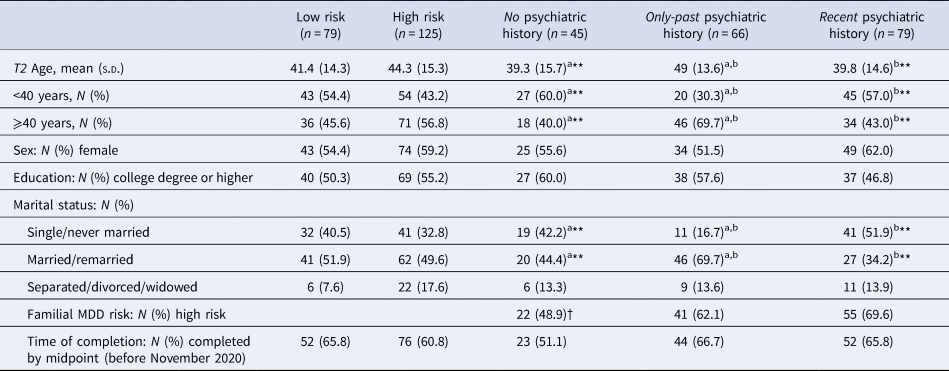
Individuals with a ‘Only-past’ psychiatric history were older and more likely to be married compared to the ‘no’ and ‘recent’ history groups (ps < 0.05). Psychiatric history was not significantly associated with sex, education, or month of survey completion. MDD risk was marginally associated with psychiatric history (no/past/recent history: 48.9%/62.1%/69.6%, p < 0.10). MDD risk was not associated with any demographic characteristics (Table 1).
Sample (n = 204) characteristics by familial MDD risk status and psychiatric history

For continuous variables, independent samples t test two-tailed test of significance used. Categorical/dichotomous variables, Pearson χ2 two-tailed test of significance used: †p < 0.10; *p < 0.05; **p < 0.01; ***p < 0.001. Bonferroni corrections were used for multiple comparisons.
a Significant difference between no and only-past psychopathology.
b Significant difference between only-past and recent psychiatric history.
Change in symptoms
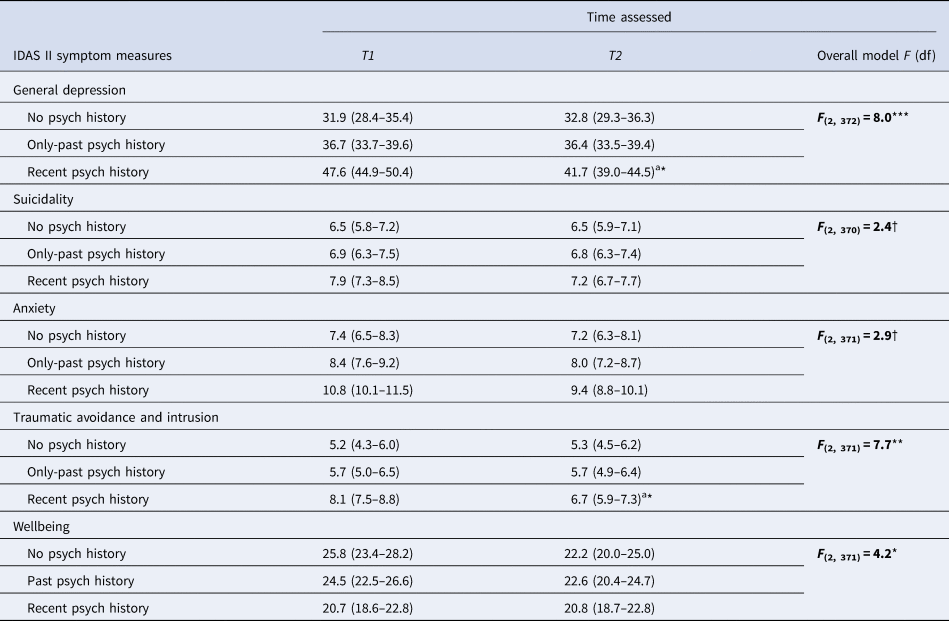
There were significant differences between those with and without a psychiatric history. Specifically, there were no T1–T2 mean score changes in depression, suicidality anxiety, or traumatic symptoms among individuals with no history or only-past history, but there was a trend of lower wellbeing at T2, relative to T1 (Table 2). Conversely, those with recent psychiatric history had significant decreases in general depression (47.6–41.7, p < 0.001) and traumatic symptoms (8.1–6.7, p < 0.01). MDD risk was not associated with change from T1 to T2 (not shown).
Mean score changes from T1 to T2 according to lifetime psychiatric history (3-category)

Estimates (mean scores with 95% confidence intervals) obtained using general linear mixed models (GLMM) analysis, with mean IDAS II scores as a dependent variable. Higher mean scores indicate greater psychiatric symptoms or greater wellbeing. Bonferroni corrections were used for multiple comparisons. All models shown are controlling for family relatedness, and one or more of age, marital status, and MDD risk (variables found to be marginally or significantly associated with psychiatric history and significantly associated with T1–T2) symptom change. Bold results on the rightmost column indicate the significance of overall time × psychiatric history model. †p < 0.10; *p < 0.05; **p < 0.01; ***p < 0.001.
a Significant decrease in symptoms from T1 to T2 among individuals with recent psychiatric history.
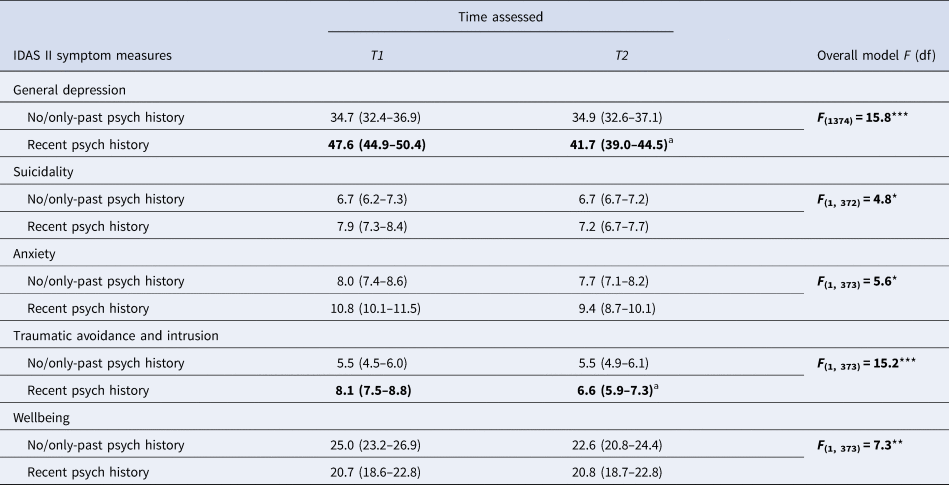
The analyses in Table 2 showed that the ‘only-past history’ and ‘no history’ groups were like each other but different from the ‘recent history’ on symptom changes from T1 to T2. Therefore, we combined the only-past and no history groups in subsequent analyses, and as shown in Table 3 (and online Supplementary Fig. S1), the results were similar when the two groups were combined into a ‘no/only-past’ psychiatric history group. A formal group-by-time interaction (right-most column) indicated that T1-to-T2 course differed significantly between the recent and no/only-past psychiatric history groups on depression, suicidal behavior anxiety, traumatic symptoms, and wellbeing.
Mean score changes from T1 to T2 according to lifetime psychiatric history (2-category)

Estimates (mean scores with 95% confidence intervals) obtained using general linear mixed models (GLMM) analysis, with mean IDAS II scores as a dependent variable. Higher mean scores indicate greater psychiatric symptoms or greater wellbeing. All models shown are controlling for family, and one or more of age, marital status, MDD risk, and generation. Bold results on the rightmost column indicate the significance of overall time × psychiatric history model. *p < 0.05; **p < 0.01; ***p < 0.001.
a Significant decrease in symptoms from T1 to T2 among individuals with recent psychiatric history.
Further analyses showed that the pattern of decreases in symptoms among those with recent psychiatric history was evident across those with depressive, anxiety, and/or substance use disorders (online Supplementary Table S3).
T1–T2 symptom changes associated with COVID worries
The EFA identified three factors from the COVID worry scales, which we named Illness/death, Financial, and Social Isolation. Scores on all three worry domains were significantly higher among those under age 40 years, and single/never married; and the Illness/death and Social Isolation domains were higher among females (online Supplementary Table S2b).
Individuals with recent psychiatric history had significantly higher mean scores than those with no/past psychiatric history on illness/death (2.7 v. 2.4, p < 0.05) and financial (1.9 v. 1.5, p < 0.001), and a trend of higher mean scores on the social isolation worries (2.4 v. 2.2) worries (online Supplementary Table S2b). MDD risk was associated with social isolation worries (2.4 v. 2.1, p < 0.05).
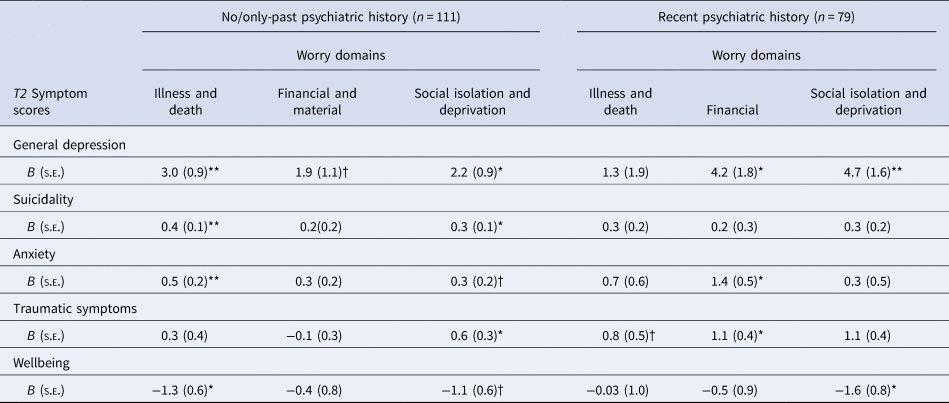
We next tested whether the COVID-related worries were associated with change in symptoms from T1 to T2 in each group. In individuals with no or only-past history, worries about illness and death were associated with T2 increases in depression (B = 3.0, s.e. = 0.9), anxiety (B = 0.5, s.e. = 0.2), suicidal symptoms (B = 0.4, s.e. = 0.1), (ps < 0.01), and decrease in wellbeing (B = −1.3, s.e. = 0.6, p < 0.05). Among individuals with recent psychiatric history, financial worries were associated with T2 increases in depression (B = 4.2, s.e. = 1.8), anxiety (B = 1.4, s.e. = 0.5), and traumatic symptoms (B = 1.1, s.e. = 0.4) (ps < 0.05). For both groups, COVID-related worries about social isolation were associated with T2 increases in depression and traumatic symptoms (ps < 0.05) (Table 4).
T2 Psychiatric and wellbeing symptom changes associated with COVID worry scores according to psychiatric history

Regression estimates (B) and standard errors obtained from univariate general linear model (GLM), two-tailed tests. For general depression, suicidality, anxiety, and traumatic symptoms figures represent unit increase in symptoms at T2 associated with each unit increase in mean COVID score. For wellbeing, figures represent unit decrease in mean scores for each unit increase in mean COVID score. All models control for IDAS II symptoms at T1, sex, age, education, generation, MDD risk, marital status, and time of survey completion.
†p < 0.10; *p < 0.05; †p < 0.10; **p < 0.01.
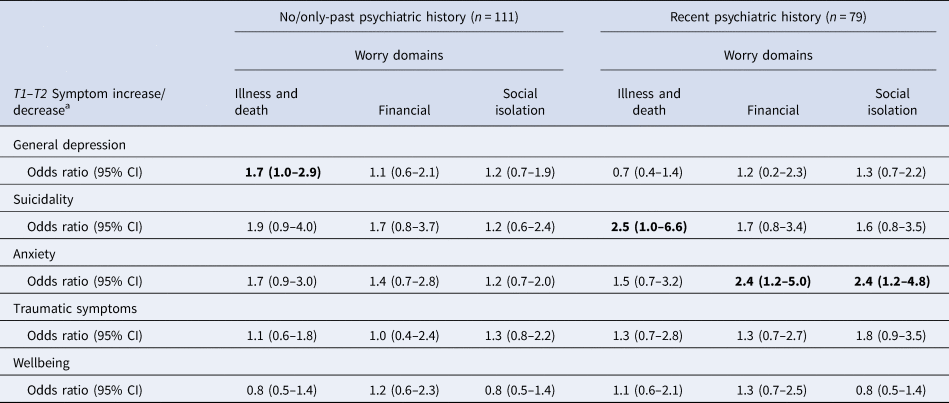
We also tested whether COVID-worry domains would predict whether a person would do better v. worse [defined as a dichotomously coded variable denoting decrease v. increase/no change in symptoms from T1 to T2 (and the reverse for wellbeing)]. Among individuals with recent psychiatric history, COVID worries about illness and death had greater odds of increased suicidality (p < 0.05) from T1 to T2; those with COVID worries on financial matters and social isolation had greater odds of increased anxiety from T1 to T2 (ps < 0.05). Among individuals without psychiatric history, those with illness/death worries had greater odds of increased depression (p < 0.05) from T1 to T2 (Table 5).
Impact of COVID worries on symptom changes from T1 to T2 according to psychiatric history

Odds ratios (and 95% confidence intervals) obtained via multinomial logistic regression, two-tailed tests.
a For general depression, suicidality, anxiety, and traumatic symptoms, estimates represent the odds that an individual's depression, suicidality, anxiety, or traumatic symptoms would be higher [v. staying the same or becoming lower at T2, relative to T1 (for wellbeing, direction is reversed)]. All models control for sex, age, education, MDD risk, marital status, and time of survey completion. Bold results denote statistical significance at p < 0.05.
Exploratory analysis of age-related effects on T1–T2 symptom changes
Given suggestions of increased pandemic-related vulnerability for younger adults (Daly et al., Reference Daly, Sutin and Robinson2021; Varma, Junge, Meaklim, & Jackson, Reference Varma, Junge, Meaklim and Jackson2021), we investigated age-associated T1–T2 symptom changes. We divided our sample into two age groups, guided first by our distribution analysis, which yielded a median age of 41.6 years (mean age = 42.8 years), and second, by a systematic review of COVID-related mental health across eight different countries, which noted symptom pattern differences surrounding the 40-year mark (Xiong et al., Reference Xiong, Lipsitz, Nasri, Lui, Gill, Phan and McIntyre2020). We used an overall cutoff of <40 v. 40 years and older. In the no/past psychiatric history group, wellbeing decreased from T1 to T2 in both age groups (<40 and 40+), but the 40+ group had significant decreases in anxiety from T1 to T2 that were not observed in the younger group. Moreover, the younger group showed increasing trends in depression and traumatic symptoms, compared to the older group which showed decreasing trends in these symptoms (online Supplementary Table S4a). These age-associated divergent patterns were not observed among those with recent psychiatric history, where both age groups showed decreases in psychiatric symptoms from T1 to T2 (online Supplementary Table S4b).
Discussion
In the context of research on the COVID-19 pandemic mental health effects, our study contrasts the findings of many studies showing overall population increases in depression, anxiety, and other psychiatric symptoms (Abbott, Reference Abbott2021; Daly et al., Reference Daly, Sutin and Robinson2021; Ettman et al., Reference Ettman, Abdalla, Cohen, Sampson, Vivier and Galea2020; Gloster et al., Reference Gloster, Lamnisos, Lubenko, Presti, Squatrito, Constantinou and Karekla2020; Wanberg et al., Reference Wanberg, Csillag, Douglass, Zhou and Pollard2020). We found no summary increase in mean symptom scores from T1 to T2. We found that individuals with a recent psychiatric history had reduced depressive symptoms following emergence of the pandemic. The effect was not disorder-specific: individuals with a recent history of depressive, anxiety, or substance use disorders each showed reduced symptoms. Those with either no lifetime psychiatric history or a history that was more than 2 years old but not recent, had no overall changes in symptoms, but lower wellbeing. In these groups, COVID worries were associated with greater depression and anxiety during the pandemic. Since individuals with current or recent psychopathology do not appear to be developing more symptoms, these findings suggest that a new population of persons (e.g. younger, recently non-ill) may contribute to the increased rates of depression and anxiety being reported across the world during the pandemic.
The differences between our study and some other studies may be explained in part by differences in study design (e.g. cross-sectional, or retrospective longitudinal v. prospective longitudinal). With respect to other prospective longitudinal studies, the divergent findings may stem from variations in geographical regions, or subtle differences in sample, symptom measures or analytic approaches. Our findings differed in part from those of Kwong et al. (Reference Kwong, Pearson, Adams, Northstone, Tilling, Smith and Timpson2020), which found that pre-existing anxiety was associated with significantly increased anxiety during the pandemic, but in agreement with our study, pre-existing depression was not associated with increased depression during the pandemic. Our findings also differed from that of Pierce et al. (Reference Pierce, McManus, Hope, Hotopf, Ford, Hatch and Abel2021), which showed an increase in pandemic-associated symptoms among persons with pre-existing psychiatric illnesses. In contrast, some of our results are consistent with the aforementioned Dutch study (Pan et al., Reference Pan, Kok, Eikelenboom, Horsfall, Jörg, Luteijn and Penninx2021) showing reduced depression and with recent studies showing decreased suicide during COVID-19 among individuals with psychiatric history (Ahmad & Anderson, Reference Ahmad and Anderson2021; Pirkis et al., Reference Pirkis, John, Shin, DelPozo-Banos, Arya, Analuisa-Aguilar and Spittal2021). A recent study showing decreased depression and anxiety and increase in quality of life in those with multiple sclerosis suggests that these patterns may extend beyond psychiatric history (Capuano et al., Reference Capuano, Altieri, Bisecco, d'Ambrosio, Docimo, Buonanno and Gallo2021). While we cannot formally test mechanisms, external stressors may distract from personal worries and reduce rumination in the psychiatric ill. Personal suffering may also seem more endurable with a perception of shared suffering as well as increased social/family support, phenomena reported after other major-scale events (e.g. 9–11) (Bonanno, Galea, Bucciarelli, & Vlahov, Reference Bonanno, Galea, Bucciarelli and Vlahov2006; Suedfeld, Reference Suedfeld1997).
The group with no/only-past psychiatric history had no overall increases in symptoms, but a reduced sense of wellbeing during the pandemic, a pattern also reported elsewhere (Gloster et al., Reference Gloster, Lamnisos, Lubenko, Presti, Squatrito, Constantinou and Karekla2020; Ruiz et al., Reference Ruiz, Devonport, Chen-Wilson, Nicholls, Cagas, Fernandez-Montalvo and Robazza2021). This was particularly true among those under 40 years, consistent with studies showing age-related vulnerabilities during the pandemic (Varma et al., Reference Varma, Junge, Meaklim and Jackson2021). Wellbeing, as assessed by the IDAS-II scale, is not simply the absence of depression; rather it encompasses a sense of positive affect, including positive accomplishment, self-pride, optimism, and energy. Lower wellbeing has been shown to predict future psychiatric illness and lower life expectancy (Keyes, Dhingra, & Simoes, Reference Keyes, Dhingra and Simoes2010; Shankman, Nelson, Harrow, & Faull, Reference Shankman, Nelson, Harrow and Faull2010; Wood & Joseph, Reference Wood and Joseph2010) and should not be overlooked, even in the absence of formal symptoms.
COVID-19-related worries were significantly higher in younger individuals and in women. Both groups have been shown in other studies to be more severely impacted by this pandemic relative to their older and male counterparts, respectively (Daly et al., Reference Daly, Sutin and Robinson2021; Varma et al., Reference Varma, Junge, Meaklim and Jackson2021; Wenham et al., Reference Wenham, Smith, Davies, Feng, Grépin, Harman and Morgan2020; Xiong et al., Reference Xiong, Lipsitz, Nasri, Lui, Gill, Phan and McIntyre2020). Our exploratory analyses among those without psychiatric history showed decreased wellbeing from T1 to T2 that was accompanied by slight increases in depression and anxiety among those under age 40, relative to their older counterparts. This younger age could partly explain our T1–T2 decrease in wellbeing among those with no psychiatric history.
We note several study limitations which should be considered in interpreting our findings. We found that individuals who did not participate at T2 had more traumatic and suicidal symptoms pre-COVID-19. The differences were small, and non-participation rates were low (18%), so these should not impact our findings. However, other studies have also reported greater burden of mental disorders in non-responders (Pan et al., Reference Pan, Kok, Eikelenboom, Horsfall, Jörg, Luteijn and Penninx2021); thus COVID-19 studies – particularly those with lower retention rates – should be cognizant that participation in surveys may underrepresent more severe psychopathology. Second, among individuals with recent psychiatric history, their decrease, or no change in symptoms at T2 relative to those without psychiatric history may be attributed to treatment interventions that they were receiving prior to and during the pandemic. However, we did not have specific treatment data in this study. The impact of treatment among individuals with pre-existing mental illness on pandemic-related stressors is worthy of additional empirical investigation. Third, the sample was not population-based, but of European ancestry, as restriction to one ancestral group was the norm for family studies when the project was initiated (1982). Thus, findings may not generalize to all racial/ethnic or other groups of interest. Fourth, although we found no significant correlation between time of T2 assessment and outcomes on IDAS symptom measures at T1 or T2, the manuscript was developed amid rapidly evolving situations surrounding the pandemic, which included fluctuating infection and mortality rates, and closing/reopening of schools, businesses, and social arenas (although our survey was completed prior to broad implementation of vaccines). Therefore, we acknowledge the limitation of our and other similar studies to accurately capture the temporal effects beyond a general month-to-month time variable of assessment. Despite these limitations, we may have detected a new vulnerable group of individuals experiencing decreased wellbeing due to irreversible loss and damage from this pandemic.
Conclusion
Our data suggest that persons with recent psychiatric history did not experience overall increased depression during the pandemic, which may be in part due to unmeasured treatment effects between T1 and T2, as well as regression to the mean statistical effects. In contrast, there was an increase in psychiatric symptomatology or a decrease in wellbeing among persons who had no or past only history of psychiatric disorders. Given the absence of a recent psychiatric history, these individuals without psychiatric history may be new/incident cases of anxiety and depression who are more likely to seek medical attention in primary or non-specialty care settings. Attention to screening should be paid to these individuals, who may newly or in isolation experience symptoms related to the COVID-19 pandemic, and who may be at possible risk for future mental illness. Additional consideration should also be given to the development of assessment and treatment protocols targeted toward younger adults (under age 40) in clinical and public health settings. Integration of mental health screening and application of treatment templates within primary care systems are goals that can be beneficial in international health settings.
Financial support
This project was supported by funding from the National Institute of Mental Health (R01 MH-036197, MMW, JP), the John J. Templeton Foundation (MMW), and a Columbia University Depression Center award (AT).
Conflict of interest
In the last 3 years, Dr Weissman has received funding from NIMH, John J Templeton Foundation and Brain and Behavior (NARSAD) and has received royalties from Oxford University Press, Perseus Books Group, American Psychiatric Association Publishing, and Multi-Health Systems. Dr Posner has received funding from Takeda (formerly Shire) and Aevi Genomics. None of these present any conflict with the present work, and no other authors report any disclosures.
Supplementary material
The supplementary material for this article can be found at https://doi.org/10.1017/S0033291721004372