




No CrossRef data available.
Article contents
Performance of illiterate and literate nondemented elderly subjects in two tests of long-term memory
Published online by Cambridge University Press: 01 July 2004
Abstract
Cognitive evaluation in developing countries is a difficult undertaking due to low levels of schooling and particularly the illiteracy still frequent in the elderly. This study was part of the epidemiologic evaluation of dementia in Catanduva, Brazil, and had the objective of comparing the performance of illiterate and literate nondemented elderly individuals in 2 tests of long-term memory—the delayed recall of a word list from the CERAD and the delayed recall of common objects presented as simple drawings from the Brief Cognitive Screening Battery (BCSB). Fifty-one elderly subjects (23 illiterates) were evaluated, and the performance of the illiterates and literates differed in the CERAD memory test, but not in the BCSB memory test. This test may be more suitable for the assessment of long-term memory in populations with a high frequency of illiterates, and therefore might prove to be a useful screening tool for the diagnosis of dementia. (JINS, 2004, 10, 634–638.)
Information
- Type
- BRIEF COMMUNICATION
- Information
- Journal of the International Neuropsychological Society , Volume 10 , Issue 4 , July 2004 , pp. 634 - 638
- Copyright
- 2004 The International Neuropsychological Society
INTRODUCTION
One of the difficulties in the diagnosis of dementia, especially in epidemiological studies, is related to the differences in the performance of subjects in neuropsychological tests due to educational and cultural factors (Manly et al., 1999; Ostrosky-Solis et al., 1998). Tests that evaluate long-term memory are considered to present the highest sensitivity for the neuropsychological diagnosis of dementia (Bondi et al., 1994), but might also be influenced by the factors mentioned previously. One neuropsychological battery that has been recommended for the diagnosis of Alzheimer's disease (AD), is that proposed by the Consortium to Establish a Registry for Alzheimer's Disease (CERAD; Morris et al., 1989), in which the long-term memory test (delayed recall of a word list) is the one which presents the best diagnostic accuracy (Bertolucci et al., 2001; Welsh et al., 1991).
In recent years, we have developed and employed some tests for the diagnosis of dementia in low educated subjects, both for epidemiological and clinical purposes. One of these tests, the delayed recall of 10 common objects presented as simple drawings, part of the Brief Cognitive Screening Battery (BCSB), has shown a high accuracy for the diagnosis of dementia in case–control studies (Nitrini et al., 1994; 1999).
The goal of the present study is to compare the performance of elderly individuals, with no memory complaints and without dementia, in two tests of long-term memory—the one from the CERAD battery and the one from the BCSB—and to verify the impact of illiteracy on each of these tests.
POPULATION AND METHODS
As part of the population-based study that we have been performing in the city of Catanduva, São Paulo State, Brazil (Herrera et al., 2002), we evaluated 1,119 individuals to investigate the incidence of dementia using a general questionnaire covering health and cognitive status, the Mini-Mental State Examination (MMSE; Folstein et al., 1975) and the Pfeffer Questionnaire of Functional Activities (PQFA; Pfeffer et al., 1982). Based on the performance in the MMSE and PQFA, participants with suspected dementia along with a control group matched for age and schooling were selected for the next phase of the study. Individuals in the control group were Portuguese-speaking subjects, with no clinical history of memory loss or only with mild complaints, had scores below 6 in the PQFA and scores above specific education-adjusted scores in the MMSE (i.e., 18 for illiterates, 23 for those with 1–7 years of schooling and 26 for those with 8 years or more). These cut-off scores of the MMSE have previously been used in Brazil for illiterates (Caramelli et al., 1998; Herrera et al., 2002) and for other educational levels (Bertolucci et al., 1994). Participants were considered illiterates when they fulfilled all of the following three conditions: they had never attended school or had attended for less than 1 year, they considered themselves as unable to read, and they were unable to read the phrase, “Close your eyes” from the MMSE. When an individual informed that he had not attended school but was able to read, and then read the MMSE phrase, he was considered to be literate and was classified as having 1 year of schooling.
One hundred and five individuals were selected for the control group based on the MMSE and PQFA scores. Twelve refused to participate and 3 could not be located. Another 31 individuals who had referred memory disturbances in the general questionnaire covering health and cognitive status were excluded. The remaining 59 individuals were submitted to the Brazilian version of the CERAD neuropsychological battery (Bertolucci et al., 2001), to the BCSB and to the Cornell scale for depression in dementia (Alexopoulos et al., 1988). Individuals with antecedents of stroke (2), or who had scored higher than 7 in the Cornell scale for depression (6), were also excluded. The final sample comprised 51 individuals.
In the CERAD word list memory task, 10 words are read aloud, one by one, by the subject (or by the examiner in case of reading difficulty). Recalling is done immediately after the presentation, and the procedure is repeated twice more. After a test of constructional praxis, the subject is then requested to recall the words previously presented (Bertolucci et al., 2001).
The BCSB consists of the presentation of a sheet of paper with 10 simple line drawings of common items (a shoe, spoon, hair-comb, tree, turtle, key, airplane, house, book, and a bucket), that had to be named out loud by the individual and then recalled immediately after, in an incidental way (without prior information that the items should be memorized). Then the simple line drawings are presented twice more, being followed on each occasion by the immediate recall and by subsequent interference with a semantic verbal fluency test (usually animals/min, but substituted in this study by fruits/min) and the clock drawing test (Sunderland et al., 1989). After this interference, a delayed recall of the 10 items is requested, followed by a final recognition test (10 target simple drawings together with 10 distractors). The BCSB is administered in approximately 7 to 10 min (Nitrini et al., 1994).
The performances of the illiterate individuals were first compared to those of the literate individuals. Subsequently, the literate individuals were classified according to mean years of schooling, either as very low educated (below the mean) or as standard educated (above the mean), and the performances of the three groups were compared.
For statistical analyses, the Mann-Whitney test was used to compare literates and illiterates on age and scores of the neuropsychological tests. When there were more than two groups, the Kruskal-Wallis test was employed. Chi-square analysis was used to compare the proportion of women in each group. The value of significance accepted was .05. Epi-Info 6.0 software (Centers of Disease Control and Prevention, Atlanta, Georgia) was used.
The study was previously approved by the Ethics Committee of the Hospital das Clínicas of the São Paulo University School of Medicine. All subjects had given written consent for their participation in the study, or relatives had given written consent on behalf of subjects unable to sign.
RESULTS
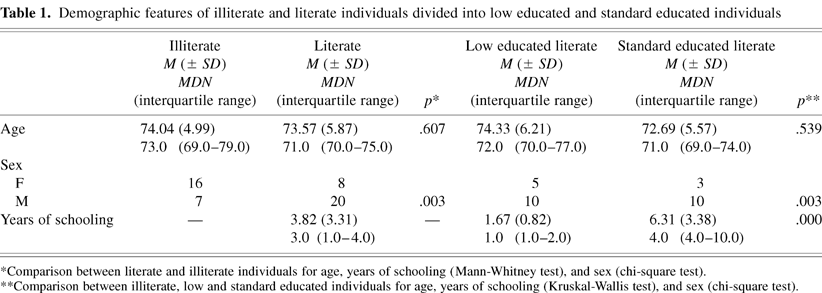
The 51 normal subjects (24 women and 27 men) had a mean age of 73.78 ± 5.44 years, 23 being illiterate and 28 having had one to 13 years of schooling (M = 3.82 ± 3.31). The ages of the illiterate and literate individuals did not differ but there were 16 women and 7 men in the illiterate group, while in the literate group, 8 were women and 20 were men (Table 1).
Demographic features of illiterate and literate individuals divided into low educated and standard educated individuals

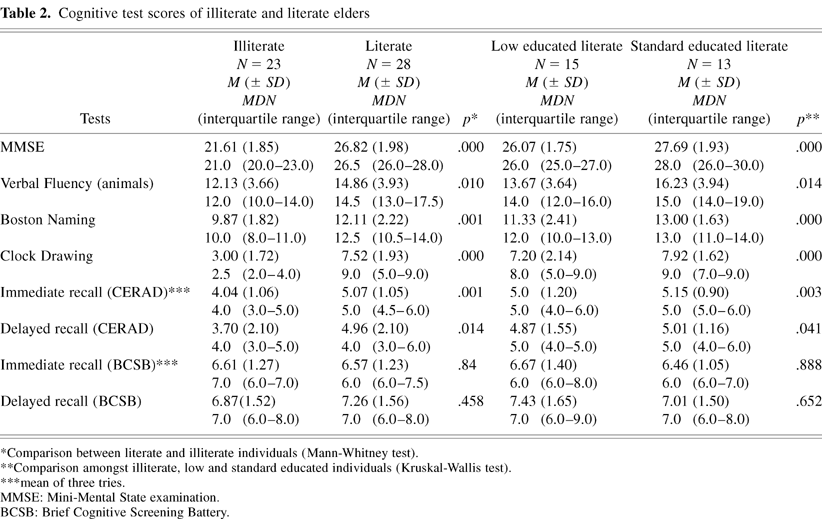
When the literate individuals were divided into two subgroups, low and standard educated individuals, the ages of the three groups also did not differ (Table 1). The performances of the groups differed significantly in the MMSE, verbal fluency (animals in 1 min), Boston naming (15-item version), clock drawing and in the CERAD memory test (immediate and delayed recall of a word list), but did not differ in the immediate and delayed recall of the items presented as simple drawings, from the BCSB, neither when the illiterate group was compared with the whole literate group nor when the literate group was divided according to mean years of schooling (Table 2). For the immediate recall scores, the mean of three tries both for the CERAD and the BCSB was taken into account.
Cognitive test scores of illiterate and literate elders

The low educated individuals obtained scores that fell midway between the illiterate and standard educated individuals for most of the tests, especially for the verbal fluency and Boston naming tests, but not for the BCSB memory tests. There were no differences in performance between men and women for the two memory tests (p > .2).
DISCUSSION
The results from the present study confirm that a considerable difference exists between the performance of illiterate and literate individuals, even in simple neuropsychological tests (Ostrosky-Solis et al., 1998). The difference between the groups in the MMSE is somewhat expected, since the inclusion criteria of the study considered different cut-off values as a function of educational level. Moreover, the difference in verbal fluency has been previously reported in the Brazilian population (Brucki et al., 1997). In the clock drawing test the difference was striking.
Notwithstanding, in the delayed recall of items presented as simple drawings from the BCSB, the performances of the groups did not differ, contrary to what was observed in the CERAD delayed recall of the word list. One explanation for the poorer performance of the illiterates in the delayed recall of the word list from the CERAD battery may be related to the different administration of this test for literate and illiterate individuals. While literate subjects read the 10 words presented in the cards out loud, the illiterates listen to the examiner, who read to them (Bertolucci et al., 2001). It is probable that this distinct form of presentation of the test determines a less favorable encoding condition for the illiterates, as reflected by the illiterates' lower scores in the immediate recall of the word list, since only auditory input is used, while the literate individuals read the words as well as saying them out loud (thus employing both auditory and visual inputs). On the other hand, the way of administrating the memory test from the BCSB is the same, regardless of the level of schooling, and as the immediate recall of the items by the illiterate and literate individuals did not differ, the encoding process of the of items presented as simple drawings from the BCSB is probably not more difficult for the illiterate.
Although there were more women in the illiterate group, our findings are probably unaffected by this feature because there were no differences in performance by men and women in the two long-term memory tests, when illiterate and literate subjects were analyzed together. The predominance of women in the illiterate group in our study is not a matter of chance, but rather, is related to the restricted access of girls to formal education in the first half of the 20th century that has been also reported in other studies (Li et al., 1989; Reis & Castro-Caldas, 1997).
Consistent with our findings, the performance in the delayed recall of line drawings of common objects, was also uninfluenced by literacy status in a community-dwelling elderly population in Spain (Zunzunegui et al., 2000).
In a recent paper, an adapted version of the CERAD word list memory task was used in which the list was read out to the subject, thus making it more appropriate as a diagnostic test for dementia in developing countries (Prince et al., 2003). However, the performance was still affected by education.
In a study evaluating the effect of illiteracy on neuropsychological test performance, Manly et al. (1999) reported that there was no difference between literate and illiterate nondemented elders in the delayed recall of the Selective Reminding Test (Buschke & Fuld, 1974). In this test, participants learn a list of 12 words over six trials. The entire list is read aloud once to the participants, and after each recall attempt, participants are reminded only of those words that were not successfully recalled (Buschke & Fuld, 1974). The absence of difference with the use of this test suggests that when the encoding is reinforced, the performance of illiterates in delayed recall tests is similar to that of literates.
In another study, Ostrosky-Solis et al. (1998) observed that the scores obtained by illiterates and literates in the delayed recall of a word list were not different when the words belonged to the same semantic category, thus reducing the difficulty of the encoding.
Our data suggest that when the items to be recalled are presented as simple drawings, the encoding is made easier for the illiterate. Given the sample in this study was relatively small and did not include highly educated individuals, further studies should be done before concluding that the BCSB memory test is less influenced by educational level. Nevertheless, the current data suggest that for evaluation of populations with a high number of illiterate and low-educated individuals—a common feature in developing countries—such a test may be more suitable for the assessment of long-term memory, and therefore might prove to be a useful screening tool for the diagnosis of dementia.
ACKNOWLEDGMENTS
This work was supported by FAPESP (Fundo de Amparo à Pesquisa do Estado de São Paulo). We thank Andrew Davis for his assistance with English usage.
References
REFERENCES
Alexopoulos, G.S.,
Abrams, R.C.,
Young, R.C., &
Shamoian, C.A.
(1988).
Cornell Scale for depression in dementia.
Biological Psychiatry,
23,
271–284.CrossRefGoogle Scholar
Bertolucci, P.H.F.,
Brucki, S.M.,
Campacci, S.R., &
Juliano, Y.
(1994).
O mini-exame do estado mental em uma população geral
[The Mini-Mental State Examination in a general population: Impact
of educational status].
Arquivos de Neuropsiquiatria,
52,
1–7.Google Scholar
Bertolucci, P.H.,
Okamoto, I.H.,
Brucki, S.M.,
Siviero, M.O.,
Toniolo Neto, J., &
Ramos, L.R.
(2001).
Applicability of the CERAD neuropsychological battery to Brazilian
elderly.
Arquivos de Neuropsiquiatria,
59,
532–536.CrossRefGoogle Scholar
Bondi, M.W.,
Salmon, D.P., &
Butters, N.M.
(1994).
Neuropsychological features of memory disorders in Alzheimer
disease. In
R.D. Terry,
R. Katzman, &
K.L. Bick (Eds.),
Alzheimer disease (pp.
41–63).
New York:
Raven Press.
Brucki, S.M.D.,
Malheiros, S.M.F.,
Okamoto, I.H., &
Bertolucci, P.H.F.
(1997).
Normative data on the verbal fluency test in the animal category in
our milieu.
Arquivos de Neuropsiquiatria,
55,
57–61.Google Scholar
Buschke, H. &
Fuld, P.A.
(1974).
Evaluating storage, retention, and retrieval in disordered memory
and learning.
Neurology,
24,
1019–1025.CrossRefGoogle Scholar
Caramelli, P.,
Herrera, E., &
Nitrini, R.
(1998).
The mini-mental state examination in a cohort of illiterate elderly
patients [Abstract].
Annals of Neurology,
44,
495.Google Scholar
Folstein, M.F.,
Folstein, S.E., &
McHugh, P.R.
(1975).
“Mini-mental state”: A practical method for grading the
cognitive state of patients for the clinician.
Journal of Psychiatric Research,
12,
189–198.CrossRefGoogle Scholar
Herrera, E., Jr.,
Caramelli, P.,
Silveira, A.S.B., &
Nitrini, R.
(2002).
Epidemiologic survey of dementia in a community-dwelling Brazilian
population.
Alzheimer Disease and Associated Disorders,
16,
103–108.CrossRefGoogle Scholar
Li, G.,
Shen, Y.C.,
Chen, C.H.,
Zhao, Y.W.,
Li, S.R., &
Lu, M.
(1989).
An epidemiological survey of age-related dementia in an urban area
of Beijing.
Acta Psychiatrica Scandinavica,
79,
557–563.CrossRefGoogle Scholar
Manly, J.,
Jacobs, D.M.,
Sano, M.,
Bell, K.,
Merchant, C.A.,
Small, S.A., &
Stern, Y.
(1999).
Effect of literacy on neuropsychological test performance in
non-demented, education-matched elders.
Journal of the International Neuropsychological Society,
5,
191–202.CrossRefGoogle Scholar
Morris, J.C.,
Heyman, A.,
Mohs, R.C.,
Hughes, J.P.,
van Belle, G.,
Fillenbaum G., Mellits E.D.,
Clark, C., &
CERAD investigators.
(1989).
The Consortium to Establish a Registry for Alzheimer's disease
(CERAD). Part 1. Clinical and neuropsychological assessment of
Alzheimer's disease.
Neurology,
39,
1159–1165.Google Scholar
Nitrini, R.,
Caramelli, P.,
Herrera, E., Jr.,
Bahia, V.S.,
Porto, C.S.,
Charchat, H.,
Oliveira, B.A.,
Rigatto, M., &
Smid, J.
(1999).
Diagnosis of dementia in illiterate elderly subjects
[Abstract].
Neurology,
52
(Suppl. 2),
A435–A436.Google Scholar
Nitrini, R.,
Lefèvre, B.H.,
Mathias, S.C.,
Caramelli, P.,
Carrilho, P.E.M.,
Sauaia, N.,
Massad, E.,
Takiguti, C.,
da Silva, I.O.,
Porto, C.S.,
Magila, M.C., &
Scaff, M.
(1994).
Testes neuropsicológicos de aplicação simples
para o diagnóstico de demência [Neuropsychological
tests of simple application for diagnosing dementia].
Arquivos de Neuropsiquiatria,
52,
457–465.CrossRefGoogle Scholar
Ostrosky-Solis, F.,
Ardila, A.,
Rosselli, M.,
Lopez-Arango, G., &
Uriel-Mendoza, V.
(1998).
Neuropsychological test performance in illiterate subjects.
Archives of Clinical Neuropsychology,
13,
645–660.CrossRefGoogle Scholar
Pfeffer, R.I.,
Kurosaki, T.T.,
Harrah, C.H.,
Chance, J.M., &
Filis, S.
(1982).
Measurement of functional activities in older adults in the
community.
Journal of Gerontolology,
37,
323–329.CrossRefGoogle Scholar
Prince, M.,
Acosta, D.,
Chiu, H.,
Scazufca, M.,
Varghese, M., &
10/66 Dementia Research Group.
(2003).
Dementia diagnosis in developing countries: A cross-cultural
validation study.
Lancet,
361,
909–917.CrossRefGoogle Scholar
Reis, A. &
Castro-Caldas, A.
(1997).
Illiteracy: A cause for biased cognitive development.
Journal of the International Neuropsychological Society,
3,
444–450.Google Scholar
Sunderland, T.,
Hill, J.L.,
Melow, A.M.,
Lawlor, B.A.,
Gundersheimer, J.,
Newhouse, P.A., &
Grafman, J.H.
(1989).
Clock drawing in Alzheimer's disease: A novel measure of
dementia severity.
Journal of the American Geriatrics Society,
37,
725–729.CrossRefGoogle Scholar
Welsh, K.,
Butters, N.,
Hughes, J.,
Mohs, R., &
Heyman, A.
(1991).
Detection of abnormal memory decline in mild cases of
Alzheimer's disease using CERAD neuropsychological measures.
Archives of Neurology,
48,
278–281.CrossRefGoogle Scholar
Zunzunegui, M.V.,
Gutiérrez Cuadra, P.,
Béland, F.,
Del Ser, T., &
Wolfson, C.
(2000).
Development of simple cognitive function measures in a community
dwelling population of elderly in Spain.
International Journal of Geriatric Psychiatry,
15,
130–140.3.0.CO;2-C>CrossRefGoogle Scholar
Demographic features of illiterate and literate individuals divided into low educated and standard educated individuals
Cognitive test scores of illiterate and literate elders
 You have
Access
- 193
- Cited by