Introduction
It is sometimes said that the World Trade Organization (WTO) exists either to negotiate, or to settle disputes, a view that obscures transparency mechanisms, the third way through which WTO rules and practices influence the trading system. One part of the collective response to the financial crisis that began in 2008 was to use those transparency mechanisms to develop what WTO Director-General Pascal Lamy called a ‘radar picture’ of new trade measures. Better he thought to have an open discussion of all the new subsidies for factories and banks in the Trade Policy Review Body than risk a flurry of acrimonious disputes that would be a distraction for the WTO and damaging to public support for multilateral trade rules. G-20 leaders at their April 2009 Summit in London supported such efforts to use transparency as a tool to ward off the dangers of protectionism in any domestic policy actions (G-20, 2009). Leaders promised that ‘we will notify promptly the WTO of any such measures and we call on the WTO, together with other international bodies, within their respective mandates, to monitor and report publicly on our adherence to these undertakings on a quarterly basis’. The reports subsequently prepared by the WTO Secretariat depend heavily on the routine information Members supply under existing notification obligations. Is this system up to the new task?
Our goal in this paper is to investigate how the WTO uses transparency as a trade policy tool, and whether it is effective. We find that the WTO's windows on its Members and on the trading system are cloudier than they ought to be. But they are not equally cloudy. The notification of obligations and the monitoring procedures are a disappointment in some areas and excellent in others. Discussions in some committees are perfunctory, while other committees are an apparent forum for learning. We show the differences between selected agreements, and draw out implications for the role of the WTO in supporting an open multilateral trading system.
Why transparency?
Transparency, one of the fundamental norms of the trading system (Lamy, Reference Lamy2007), is generally seen both as legitimate in itself, and as essential to modern governance. The WTO Glossary defines it as the ‘Degree to which trade policies and practices, and the process by which they are established, are open and predictable.’ It refers to a number of inter-related actions, including how a rule or a policy is developed at home, how the rule is enforced or a policy is implemented, how the rule is published, how a new rule or a policy action is notified to the other Members of the WTO, how a notification is discussed in Geneva, and how the results of the Geneva process are published. Transparency refers therefore both to generating information and to generating agreed interpretations of the information. The monitoring and surveillance function absorbs around half of the Secretariat's resources (Lamy, Reference Lamy2007).
One reason international regimes are said to exist is to supply the demand for high-quality information about the parties to an international bargain. Regimes are said to collect information either to evaluate their own performance or to evaluate the performance of individual parties (Mitchell, Reference Mitchell1998: 113). Transparency of this sort features in regimes for everything from arms control to climate change, although performance rarely meets expectations (Chayes and Chayes, Reference Chayes and Chayes1995). Effectiveness-oriented systems (is world trade growing?) usually pose less challenging political obstacles and less demanding resource requirements than those faced by compliance-oriented systems (does a given Member act consistently with its obligations?) (Mitchell, Reference Mitchell1998: 114). Even more important is creating transparency about the beliefs and intentions of actors without which no regime can function.
The dozens and dozens of transparency procedures in the WTO Agreements go beyond what is normally found in multilateral regimes. The WTO transparency norm, however, is not about the ‘accountability’ or transparency of the WTO itself, a common theme in the literature on international organizations (Grant and Keohane, Reference Grant and Keohane2005; Chesterman, Reference Chesterman2008; Grigorescu, Reference Grigorescu2007; Hale, Reference Hale2008), nor is it directly about whether governments and other centres of authority disclose enough information to the public (Florini and Stiglitz, Reference Florini and Stiglitz2007; Holzner and Holzner, Reference Holzner and Holzner2006). Transparency to the public can be part of the broader WTO transparency norm, but in the first instance the objective is neither to enhance the capacity of citizens nor to promote domestic objectives that can be achieved without the need for international obligations. The aim is to enhance the effectiveness of the WTO agreements.
One way in which trade agreements make a difference to economic activity is by reducing uncertainty about policy, both for trading partners and economic actors. Under conditions of ‘imperfect information’, everybody would be better off if partners reduce their asymmetrical information about each other. Trade policy transparency can provide reassurance for governments about what trading partners are doing. Having an opportunity to discuss a measure with trading partners can help to avoid conflict and prevent disputes.
A trade agreement is first a set of rules that should govern policy in a given domain. If nobody knows what the policy is, however, the agreement cannot reduce uncertainty. Simple publication of tariff schedules, though still an essential form of transparency, is no longer sufficient. Now trading partners and economic actors need to have information about a wide range of domestic policies that have the capacity to affect the flow of transactions across borders, domestic policies that are increasingly subject to WTO obligations.Footnote 1 An ad valorem tariff imposed at the border is transparent in itself, and can readily be compared to the rate bound in a Member's published Schedules, but trading partners cannot see what is going on ‘behind the border’ without help. Domestic standards and regulations, notably those related to product safety and animal health, are hard to observe, and they are ambiguous in trade policy terms. Creating opportunities to discuss new measures in advance can reduce the potential for conflict between states, for example when the measure is modified to accommodate the interests of partners, and it provides time for economic actors to adjust.
Transparency is not always benign, especially if it mobilizes particular interests against the general interest. The transparency that modern governance demands undermines the privacy essential for negotiations (Stasavage, Reference Stasavage2004). It might also undermine liberalization, or force protection into less transparent forms (Kono, Reference Kono2006). That admitted, knowing what the rules are reduces risk and uncertainty for economic actors. It gives firms the confidence to make investment decisions, and not just decisions about investment abroad – building a plant at home, or developing export infrastructure, also depends on confidence in assured market access (Kerr, Reference Kerr2008).
Plan of the paper
Assessing transparency presents a challenge: how would we know if it is an effective tool?Footnote 2 Legitimate doubt exists about the extent to which imperfect information in fact reduces consumer welfare, or can be ameliorated by a transparency policy (Winston, Reference Winston2008). In contrast, some evidence based on selected Asian economies' bilateral trade suggests that a more transparent trading environment is associated with increased trade (Helble et al., Reference Helble, Shepherd and Wilson2009). We also know that WTO Members seem to value transparency. They insist that the current notification mechanisms should continue, and in many aspects of the Doha Round they propose that more elaborate requirements be put in place.
We do not assess the effects of transparency on transaction flows nor do we attempt to investigate whether government actions actually change. The important prior step is to ask if the transparency system in Geneva seems to function. Given what can be observed of the effects of transparency requirements, in practice, we ask (a) under what circumstances are they likely to work; and (b) what advice can we offer to institutional designers? Do the WTO procedures for monitoring and surveillance help Members acquire more complete and standardized information about each other, and do they facilitate learning about conditions in the trading system?
In the next section, we briefly develop the concept of transparency as a policy tool. In the second section, we use the typology introduced in Section 1 to sort all WTO transparency obligations into three broad groups, paying particular attention to the various notification requirements. We then present a case study in Section 3 of the 60-year attempt to use notifications to discipline subsidies. Since that effort can hardly be judged a success, in the fourth section we look for reasons for the difficulties in a comparison of subsidies notifications to transparency with respect to agriculture subsidies and to standards for food safety and goods. We conclude with suggestions for how WTO transparency can be improved.
1. Transparency as a policy tool
Transparency is now widely used as policy tool in OECD countries, but especially in North America.Footnote 3 Transparency can comprise many instruments, each of which embeds assumptions about the relations between citizens and the state. Environment Canada smog alerts reduce complex data about auto and power plant emissions in the summer to a simple warning about when citizens should limit physical activity outside. Detailed health inspections can be reduced to a simple sign in a restaurant window indicating a pass or a failure. One of the most interesting examples is the American effort to force manufacturers to build sport utility vehicles (SUVs) that would not roll over (Fung et al., Reference Fung, Graham and Weil2007: 2ff). The Transportation Recall Enhancement, Accountability, and Documentation (TREAD) Act, approved in November 2000, required manufacturers to provide the facts about each vehicle's risks, in easy to use four star ratings, and it worked: when sales of risky cars declined, manufacturers improved their designs to get the top rating, and five years later the roll over problem was significantly diminished. Successful ‘targeted transparency’ policies always work this way (Fung et al., Reference Fung, Graham and Weil2007: 6). Information users make better choices based on new information; information disclosers improve practices or products in response to the changed behaviors of users.
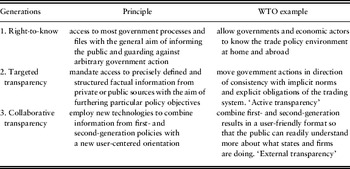
Targeted transparency is what Fung et al. call a ‘second-generation’ transparency policy, since it came into prominence after the earlier ‘right-to-know’ set of policies – see Table 1. More than simply making information available, a policy objective in its own right, second-generation policy tools try to use information to achieve some other policy objectives more readily than through other types of tools, such as regulatory standards or formal rules of behavior.
Transparency generations

Note: Based on Fung et al. (Reference Fung, Graham and Weil2007: 25).
Analysts consider five factors in assessing whether transparency can be a useful policy tool in a given context:
1. A specific policy purpose: information works well when users and providers share objectives, it works poorly when uniform compliance is important, and it does not work at all if nothing an information user is able to do will change the situation (Weiss, Reference Weiss and Salamon2002: 233–234). Weather reports help me decide whether to cancel my picnic, but they do not give me the means to change the climate.
2. Specified discloser targets: who must provide the information? Who must collect climate data?
3. Defined scope of information: what information is needed to address the policy problem? Transparency works best if providers and users of information can agree on how to measure temperature, or on the definition of a hurricane. In the WTO, the most basic information, on trade flows, is based on well-developed theory about which ‘statistics’ are useful and specification of how the data are to be collected.
4. Evident benefits: providers of information must see how doing so helps them meet their own objectives. Do they believe that their provision of information will be analyzed, aggregated, and disseminated in a way that is helpful to them or crucial for the regime?
5. Defined information structure and vehicle: information must be aggregated and presented in useful forms. A great deal of data are needed before a meteorological service can generate a web page forecast with symbols for ‘partly sunny’ in the morning, and ‘risk of thunderstorms near the lake’. It is even harder to generate aggregate data that allow quick comparisons between countries that can influence policymakers. One example is the annual Word Bank report ‘Doing Business’ which can show cross-country comparative data likely to resonate with governments and business, like the number of days it takes a package to clear customs (Bown and Hoekman, Reference Bown and Hoekman2007).
In the next section, we use this analytic framework to describe WTO transparency provisions.
2. Transparency in the WTO agreements
The importance of ‘transparency’ is invoked on a daily basis at the WTO, more often even than the other two fundamental norms of nondiscrimination and reciprocity. The purpose of this section is typology: what are the provisions, what seems to be the behavioral assumption of the institutional designers, and why might they work as a policy tool? For convenience, we have created three groups of WTO transparency practices, using the analytic framework developed in the previous section – see Table 1. Note that Agreements vary in many aspects of these procedures, which can be significant for whether Members provide the information, and whether it is effective for the purpose.
2.1 Right-to-know
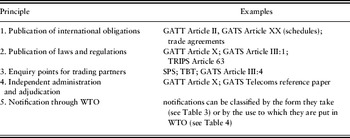
First generation WTO transparency provisions (Table 2) have their deepest roots in Anglo-American administrative law, where they go back centuries. These principles relate to the obligations incumbent on governments at home, not in Geneva. In the trading system, they predate the GATT by decades. The basic right-to-know principle is publication of all trade-related international obligations (1), most notably the codification of Members' specific mutual obligations in the thousands of pages of ‘schedules’ attached to the general obligations of the WTO agreements. Firms cannot navigate global markets if they do not know what the tariffs or rules are.
WTO right-to-know provisions

Notes: An earlier version of this list was developed in (Wolfe, Reference Wolfe2003); for a conceptual elaboration of that list, see (WTO, 2007c: 163ff ); and for a legal description of the provisions, and an analysis of WTO case law on Article X, see (Ala'i, Reference Ala'i and Alexandroff2007).
A more formal type of transparency is the many provisions requiring publication of all legal requirements affecting trade (2), and publication in sufficient time for anyone affected by the rules to know about them before they come into force, both to allow time to comment and time to prepare to take advantage of the new opportunities created. ‘Notice and comment’ provisions are common in many administrative law systems. The WTO obligation is first to do it domestically, and then to extend the same courtesy to trading partners. This requirement is straightforward for Members where such provisions are a normal part of the domestic regulatory process, but more difficult for some developing countries (Wolfe, Reference Wolfe2003).
Given the complexity of measures affecting trade, and the large number of notification requirements, some agreements require the establishment of an Enquiry Point (3) where other Members can obtain information on domestic regulations. The GATS even provides for the establishment of ‘contact points’ where private companies from developing countries can obtain relevant information (Article IV:2).
An important right-to-know obligation is having regulators who are independent of the executive (4), whose actions are therefore made more visible. This principle is first seen in the GATT/WTO system in Article X of GATT 1947, but it is also found in other WTO agreements, most obviously Government Procurement, where transparency before and after the fact is meant to discipline the discretionary award of government contracts. Arms-length administration is an essential aspect of the competitive principles for services regulation embodied in the Reference Paper for the basic telecoms agreement. The contemporary surge of interest in this kind of transparency is said to be a ‘neoliberal’ effort to discipline administrative discretion with a rule-based process (Best, Reference Best2005: 143). Others have argued that Article X of the GATT 1947, like the US Administrative Procedures Act of 1946, whose language it appears to replicate (Ostry, Reference Ostry1998: 16), was based on an American belief that transparency was the best way to control the discretion of administrative agencies (Ala'i, Reference Ala'i and Alexandroff2007: 112). But the GATT provisions, based on earlier international agreements, are traditional. Article X was partly based on Articles 4 and 6 of the 1923 International Convention Relating to the Simplification of Customs Formalities (WTO, 2005: para 3). Transparency and independent judicial review had been part of English administrative law since the seventeenth century. By the middle of the nineteenth century, English administrative law had all the features familiar to us today, including independent agencies, regulation-making, and sunset clauses (Arthurs, Reference Arthurs1979, Reference Arthurs1985).
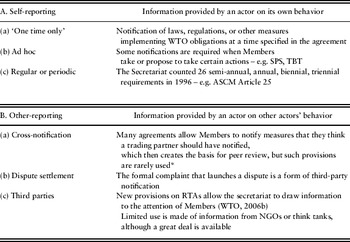
Types of WTO notifications

Notes: Adapted from WTO (1996), Mitchell (Reference Mitchell1998: 116).
* For an example of a rare cross-notification, see WTO (2009a) .
In the WTO Glossary, a ‘notification’ is defined as ‘a transparency obligation requiring member governments to report trade measures to the relevant WTO body if the measures might have an effect on other Members’. The types of WTO notifications are listed in Table 3. The requirements are all inherently ambiguous, in that Members are asked to notify something that other Members might find negative, from a new food safety rule to the level of subsidies to farmers. Many are ex post; others are ex ante, and require consultations with trading partners, which is an unusual constraint on sovereignty, although it is becoming more common (Chayes and Chayes, Reference Chayes and Chayes1995: 168).
The basic principles were agreed at the creation of the WTO, based on prior GATT practices. In one of the ‘decisions’ adopted at the end of the Uruguay Round (WTO, 1995a), Members recalled the general obligations to notify, ‘such notification itself being without prejudice to views on the consistency of measures with or their relevance to rights and obligations’. They established a Central Registry of Notifications to receive and maintain the notifications, to inform each Member annually of their regular notification obligations, and to draw the attention of individual Members to regular notification requirements which remain unfulfilled (e.g. WTO, 2007b). They also mandated a review of the requirements. The first review found at least 175 notification requirements of three major types in the agreements on trade in goods (WTO, 1996); the GATS and TRIPS agreements also include notification requirements.Footnote 4 Notification is a right-to-know tool, but it has been evolving in a way designed to elicit changes in policy or practice, especially with ex ante notification requirements, which makes notification the first step in targeted transparency.
2.2 Monitoring and surveillance: targeted transparency in WTO
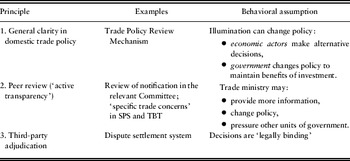
Some WTO notifications are effectively ‘tombstone’ data because no discussion takes place, but some are linked to the possibility of review by a relevant WTO body before or after the measure takes effect. Second-generation WTO transparency policies can be grouped as monitoring and surveillance – see Table 4. Sunshine procedures, or giving the relevant actors information, is sometimes more effective than sanctions (Charnovitz, Reference Charnovitz2001). The behavioral assumption is that as a result of questions and challenge in a committee, a government may provide more information, change policy, or pressure other units of government to respond. Information and transparency are important as the basis for learning. Learning involves something more than the acquisition of new ‘facts’. The trade regime makes participants comprehensible to each other. To call the need for information merely an attempt to monitor defections in order to deter non-compliance assumes that behavior is self-explanatory, in the terms of the contract, if only actors had the information. But it is much more often the case that actors cannot seek information until they know what it is they are looking for, and actors do not really know what to make of the information until they discuss it.
Principal WTO monitoring and surveillance provisions

The first WTO principle is general clarity in domestic trade policy, the purpose of the Trade Policy Review Mechanism (TPRM), which aims at ‘achieving greater transparency in, and understanding of, the trade policies and practices of Members’. The review is based on major reports written by the Secretariat and the Member. The TPRM is not meant to be part of the dispute settlement system: the reports provide a commentary, but the TPRM is explicitly not allowed to interpret the rules. The behavioral assumption is that illumination can change policy. If they understand the obstacles in a given market, economic actors can make alternative decisions, which might induce the government to change policy to maintain the benefits of investment. Illumination might also generate political pressure for change.Footnote 5
The second is peer review, or discussion of things like notifications in the various committees. The third, adjudication, is a significant form of monitoring and surveillance, although it is based on the dubious behavioral proposition that ‘legally binding’ judicial decisions are somehow implemented automatically. The dispute settlement process also incidentally provides hitherto unavailable information.
2.3 Collaborative transparency at the WTO
Third generation transparency policies are the most recent and least developed at WTO. With collaborative transparency (Table 5), the internal challenge is to create a more inclusive process in Geneva by ensuring that all Members have and can make use of information, a major issue for developing countries. After much debate, and considerable adaptations, the negotiation process seems to work well, but whether developing countries have the capacity to analyze the information generated by the transparency mechanisms is a different matter, one that affects both the operation of existing agreements and new negotiations.
Collaborative transparency at WTO

As to external transparency, the challenge is to enable better policymaking in capitals, engaging both economic actors and citizens. If trade policy is made in the light of day, it may not always be captured by interest groups (Halle and Wolfe, Reference Halle and Wolfe2007). WTO Members are committed to making information available in Geneva, but that information is largely a by-product of information otherwise generated by the system. Nevertheless, much of what the WTO Secretariat does can serve both needs – e.g. compilation of negotiation proposals aids both smaller delegations and citizens.
Our discussion so far has sketched a typology of WTO transparency provisions, and how they might be used as a policy tool. This exercise suggests some of the questions that we might ask about the effectiveness of transparency at WTO. We now turn to a consideration of how these provisions work in practice in one domain.
3. Case study of WTO transparency: subsidies
The trading system has struggled with the question of what to do about subsidies for a long time. On the one hand, they are an effective tool with which governments can accomplish legitimate policy objectives. On the other hand, they distort the terms of competition both in the territory of the government that provides them and in markets to which subsidized products are exported.Footnote 6 Most discussions of subsidies address either their economic effects, or the evolution of the GATT/WTO texts on subsidies and associated jurisprudence. We have a different focus: not which subsidies should be disciplined, or the circumstances in which discipline would be appropriate, but how is the disciplinary objective to be achieved? The trading system has struggled with this question. In this brief case study, we first provide some background on the evolution of subsidy disciplines and then assess the implementation of their transparency provisions.
3.1 Evolution of subsidies disciplines
The original GATT approach to subsidies discipline as set out in Article XVI was simply a notification provision. Countries maintaining any subsidy were required to notify the extent and nature of the subsidization, the estimated effect of the subsidization on the quantity of the affected product or products imported or exported from its territory and the circumstances making the subsidization necessary. It is true that Article VI authorized the imposition of countervailing duties in specified cases, but only in response to subsidies affecting imports into a country's own market, which had no disciplining effect on export competition in third markets or domestic competition in the subsidizing country. Only later did GATT signatories agree to impose substantive constraints on their ability to grant subsidies, beginning with additional provisions governing subsidies agreed to in 1955.
During the Tokyo Round negotiations of the 1970s, participants recognized that the GATT notification obligation did not work because it implied an admission of guilt: a Contracting Party was to notify subsidies that operate to increase exports or replace imports. In consequence, negotiators attempted to make notification more effective by giving a Party the right to request information from another Party about a subsidy. Article 7 of the Tokyo Round Agreement on Subsidies and Countervailing Measures expands on GATT Article XVI notification measures by authorizing a second Party to request information on the nature and extent of any subsidy granted or maintained by another signatory and, in the event of insufficient response, to bring the matter to the attention of the Subsidies Committee. The Code also provided the authority to cross-notify subsidies that another Party had failed to notify under Article XVI. These provisions did not work either. Disputes on agriculture subsidies were a huge source of unresolved conflict, until agriculture was placed in a separate Agreement after the Uruguay Round. In contrast, during the period 1947–1986, no cases involving subsidies on industrial goods were brought under Article XVI (Jackson, Reference Jackson1989: 100). And if countries did notify industrial subsidies in this period, the notifications do not seem to have been discussed in the relevant committee.
The Uruguay Round, launched in the 1980s, marked a far more comprehensive attempt to deal with subsidies issues, including for the first time agreeing on a definition of what is a subsidy. In addition to elaborating a new structure of subsidies disciplines, the 1995 Agreement on Subsidies and Countervailing Measures (ASCM) expanded the notification obligations of WTO Members. Article 25 of the ASCM sets out detailed conditions for annual notification of any defined subsidy. Article 26 then mandates the WTO Subsidies Committee to examine these subsidy notifications on a regular basis.
After the entry into force of the Agreement, the new Subsidies and Countervailing Measures Committee (SCM) designed a questionnaire for subsidy notifications and established procedures for annual Committee review of notifications. It soon became apparent, however, that WTO Members, including many of the largest developed Members, were woefully deficient in meeting the notification obligations. In 2001, the Committee decided that resources would be better used in providing full notifications only every other year. In 2002, the Committee examined problems Members had experienced in meeting the notification obligations. It found that some Members face resource constraints, while others face complications of internal government co-ordination and jurisdictional authority – some federations, for example, have never notified subsidies granted by sub-national government entities. Other impediments to notification that participants identified were intrinsic to the ASCM itself, notably a lack of understanding of some of the key elements of its substantive subsidy disciplines, including the definition of a subsidy and the concept of specificity (WTO, 2003b). The exercise also revealed deficiencies in the notification requirements, notably the complexity of the questionnaire format, but in the end changes were minimal (WTO, 2003c). Apparently some Members were unwilling to compromise notification obligations by foregoing any amount of detail set out in the questionnaire, even if one of the principal obstacles to the process being useful was the lack of resources other Members have to obtain and prepare the detailed information required.
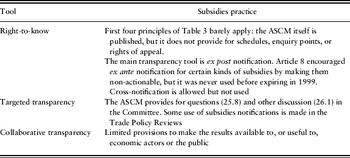
We have organized the ASCM subsidy provisions in Table 6 using the typology set out above. In the rest of this section, we use these categories to assess the effectiveness of the provisions. We ask, first, is the ‘right-to-know’ respected? Second, does monitoring and surveillance contribute to the use of transparency as a policy tool in this domain?
ASCM transparency tools

3.2 The right-to-know about subsidies
The first question about the notification requirement is whether it is observed. Do Members notify? Some Members have never notified, but most of the largest traders attempt to comply, though few are ever on time and the notifications are not always complete, or contain only limited quantitative data (WTO, 2006c: XXXI, 111, 117). Of course, the majority of WTO Members do not have enough money for any subsidies they maintain to have a substantial effect on trade flows – their actions are not of systemic importance. For this reason, we looked more closely at the top 20 traders, since their subsidies could be expected to have some significance for their trading partners. We found that in 1999 only seven of the largest Members met their notification requirements on time. Members continue to be deficient in meeting their notification obligations. As of February 2006, only 12 of 21 major WTO players had met their notification obligations for 2005 on time.Footnote 7
The second question about the notification requirement is whether the data are useful. Notifications that are submitted are often notoriously incomplete and demonstrably understate the value of subsidies that should be reported. The 2006 World Trade Report cites numerous inconsistencies between data on the value of subsidies gathered from other sources with the data submitted by Members to the WTO. Comparing National Accounts data from the OECD versus WTO notifications for the years 1998–2002 shows the USA with an average WTO annual notification of $16.3 billion versus the National Accounts figure of $43.5 billion; Japan with a WTO notification of $4.2 billion versus a National Accounts figure of $34.3 billion (WTO, 2006c: 116). The Global Subsidies Initiative case study of Germany finds similar discrepancies in the data (Thöne and Dobroschke, Reference Thöne and Dobroschke2008).
Given the inadequacies and ambiguities of the notification questionnaire, admittedly derived from the ASCM, the poor quality of the data is not surprising.Footnote 8 The questionnaire first states that the following subsidies are subject to notification: ‘a) all specific subsidies … and b) all other subsidies, which operate directly or indirectly to increase exports …’. Some questions require detailed information that may exceed a given Member's capacity. Most difficult are the requests for ‘Statistical data permitting an assessment of the trade effects of the subsidy’. Whether a subsidy is specific or has trade effects requires a judgment by the notifier, one that does not lend itself to a quick assessment by government officials. Given the uncertainty of the concept of specificity, it might be better assessed in the context of a trade dispute, most often on the basis of an extensive examination of evidence. Trade effects are best assessed by the affected actors.
Almost all Members have been delinquent in providing statistical data, not least because the Agreement is almost silent on quantification and measurement. The agent of notification to the WTO, likely the Treasury or Trade Ministry, may be remote from the myriad of domestic agencies in government designing and handing out support to industries who would have little incentive to provide information to the WTO in the form and detail required by the Agreement. Notification will not work if officials are being asked to notify something without knowing the consequences.
In sum, current notifications do not provide a clear or accurate picture of subsidies in each Member. (That they also do not help with cross-country comparisons is of less importance in assessing the value of transparency as a trade policy tool.) In the next sub-section, we consider whether these right-to-know deficiencies are remedied through an active surveillance process.
3.3 Monitoring and surveillance
Following the typology of Table 4 above, we would expect subsidy notifications to be used in the Committee on Subsidies and Countervailing Measures (SCM), in the Trade Policy Review Mechanism (TPRM), and in dispute settlement.
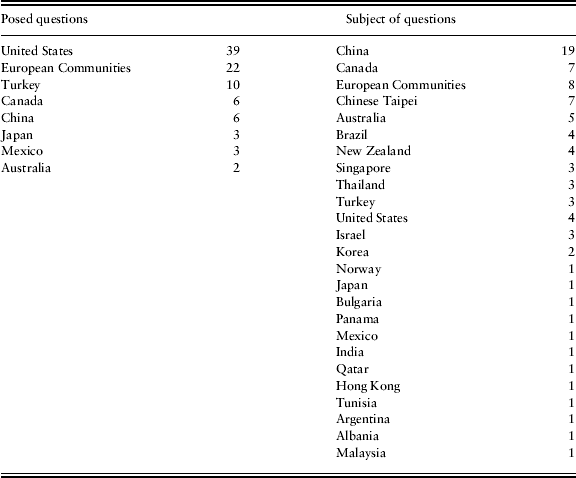
The Committee review, the main surveillance function, is conducted largely on the basis of written questions posed by Members relating to the notifications submitted by their trading partners. We looked at Committee minutes from 2006 and 2007 (G/SCM/M/56-61) to determine who is asking questions, who is being questioned, and what answers are being provided – see Table 7. We found that the questioning is dominated by a few large Members, most notably the United States and European Communities (EC).Footnote 9 In 2006 and 2007, while 24 Members were subject to questions, only eight Members posed questions with the USA accounting for 38 and the EC for 18 of the 91 questions asked. Canada, Japan, and Australia ask questions more rarely. China was on the receiving end of 18 of those questions, nearly three times the number of the next most-questioned Member. Members for the most part do respond to the questions posed, either at Committee meetings, in both oral and written form, or shortly afterward. The exception appears to be China, with quite a backlog of unanswered questions.
Subsidies questions in 2006–2007
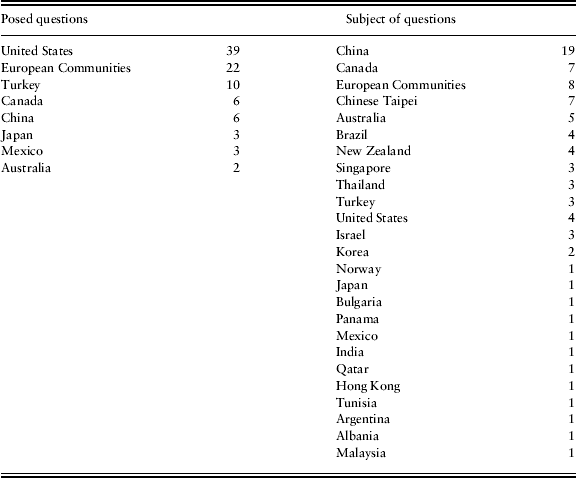
The purpose of discussion in the committee could be to (1) verify the adequacy of the notification, and (2) learn more about the incidence of subsidies, and understand the reason for their use, and, perhaps, (3) deliberate over the meaning and evolution of the disciplines.Footnote 10 The first is hampered by inadequate notifications; the second and especially the third are limited by the small number of active questioners. Members who do not engage in the deliberative process will learn less than those that do.
In our analysis of SCM Committee minutes for 2006 and 2007, questions were codified as ‘clarification’ that asked a Member to provide information regarding the technical details of a given policy. Questions that asked a Member to give reasons, to elaborate a policy rationale, to explain why a given policy was not notified, or that pointed to inconsistencies between a given policy and an obligation were codified as ‘justification’. We found that 496 questions were technical, whereas only 199 questions required a Member to justify or defend a given trade practice. Of those questions involving justification, the majority were based on inconsistencies between a notification and a more recent Trade Policy Review report.
Apart from large trading nations, few Members can expect to be questioned about their subsidy notification. Most Members will take an interest only in the case of a specific trade issue affecting them. Canadian officials in Ottawa admit, for example, that despite their large trade policy bureaucracy, it is hard to pay careful attention to the subsidies notifications of any but their largest trading partners, which means that Canadian delegates in Geneva are not able to pose many questions. Data are so limited that it is hard to know if the questions that are posed concern the most trade-distorting subsidies.
One way in which the data might be most useful would be in the TPRM, but the availability of subsidies data in such reports is known to be highly variable (WTO, 2006c: 110). Our analysis of the most recent TPR reviews of the largest WTO MembersFootnote 11 suggests that substantive reference to the Member's subsidy notifications occurred only in a small number of cases, notably those of Brazil and Chinese Taipei, with nine references each, and the US with 15. The most recent review documents for the EC, Malaysia, Indonesia, and Singapore make no reference at all to subsidy notification submissions. The Secretariat questionnaire for a TPR asks Members to provide data missing from their notifications, but the response to the request is not part of the report.
Another aspect of monitoring and surveillance where notifications might be put to use is dispute settlement, even though Article 25.7 of the ASCM clearly states that the notification of a measure does not prejudge the measure's legal status under GATT 1994 and the SCM agreement, its effects under the SCM agreement, or the nature of the measure itself. It is not our purpose to assess the success of disputes in disciplining subsidies, but we are interested in whether the data in a notification figured in a dispute. Our examination of 15 recent WTO cases involving subsidies and countervailing duties found not a single reference to a Member's subsidy notification.Footnote 12 Trade practitioners are not surprised that Members do not seem to have provided self-incriminating information to meet a notification obligation.
These inadequacies have real consequences. The 2005 US Highway Bill included an alternative fuels tax credit of 50 cents per gallon for a variety of fuels. In 2007, coverage was extended to ‘black liquor’, a by-product of the paper-making process, which can be added to diesel fuel. When the US finally notified the 2006 bill to the WTO in 2009, the document offered little information about alternative fuel subsidy programs, the specific fuels covered, or the likely trade effects (WTO, 2009d). This subsidy was worth billions of dollars to the pulp industry before it expired at the end of 2009. It altered the global price of pulp, and made Canadian producers less competitive in their home and US markets, contributing to the loss of tens of thousands of jobs in the sector. The ASCM was helpless.
Transparency might be the best tool for disciplining subsidies in the trading system, but the conclusion to be drawn from this case study is gloomy. Transparency as a trade policy tool does not work as well as it might. Unfortunately, Members have shown no inclination to discuss subsidies transparency in the Doha Round Rules negotiations, although a number of good proposals were made early in the Rules negotiations (WTO, 2003a). Before considering whether reform is needed, or possible, in the next section we take a comparative look at other domains.
4. Comparative analysis of notifications
Analysis of all WTO transparency provisions is beyond the limited ambitions of this paper, but understanding the significance of our subsidies case study requires some sense of how it compares to other parts of WTO. We first look at the other main subsidies disciplines in the Agreement on Agriculture (AoA), which effectively removed farm subsidies from the purview of GATT Article XVI and the ASCM. We also look at the two standards agreements, Technical Barriers to Trade (TBT) and Sanitary and Phyo-sanitary Measures (SPS), since notifications are important in both.Footnote 13 The first point of comparison is ‘right-to-know’ and the second is ‘monitoring and surveillance’, using indicators similar to those used for the ASCM case.
4.1 Agriculture
The AoA was one of the great achievements of the Uruguay Round. One of its most striking aspects is its heavy use of right-to-know transparency measures. Unlike the ASCM, Members' agriculture export subsidy and domestic support commitments must be set out in their Schedules along with their market access commitments, and those Schedules define the ex post notification requirements (WTO, 1995b). In deciding what to notify, no further judgement is needed on the effects of a measure or the specificity of a subsidy. The agent of notification, likely the Agriculture Ministry, is also responsible for the subject matter being notified. The provision allowing cross-notification is not used. Article 18 of the AoA also has significant second-generation tools: progress in the implementation of commitments is to be reviewed by the Committee on Agriculture on the basis of the notifications submitted by Members.
Since 1995, the Agriculture Committee has reviewed over 2,300 notifications (WTO, 2008a). The number may seem small compared to other Agreements, but many Members have little to notify. Less than 40 Members have a Special Safeguard (SSG) or a Tariff Rate Quota in their Schedules, for example, and only a handful have export subsidies to notify. Even so, notifications under the AoA are sometimes late, by several years, or incomplete (WTO, 2006c:133). By the end of March 2008, only 11 members had fully complied with their notification obligations for the period 1995–2006 (WTO, 2008a). A number of major players in the negotiations had not notified their spending since 2002 or earlier, including Argentina, Norway, and the US. Canada had not notified since 2003, the EC since 2004, and Japan, Korea, and Switzerland not since 2005. Some Members ignore the requirement to notify SSGs; others ignore the requirement to notify before implementation, and most do not provide sufficient information to allow an estimate of the significance of the additional duties imposed (Hallaert, Reference Hallaert2005). After the March 2009 meeting, the Secretariat reported that an unprecedented number of questions were asked about overdue notifications, which, as some delegations pointed out, is also relevant for proposals in the current negotiations to strengthen members' monitoring and surveillance of how commitments are implemented. Members had an active discussion of proposals to improve notification at the July 2009 meeting.
The delays in notifications in recent years may be due to the need to devote scarce analytic resources to the Doha Round. Domestic support data, for example, must be collected from sub-national governments and then verified. Members may also hold back a notification if the data are thought likely to affect a negotiating position or a pending dispute. These factors may have influenced the US decision to delay domestic support notifications of the first four years of implementation of the 2002 Farm Bill, despite the significant change in policy that the Bill represented.
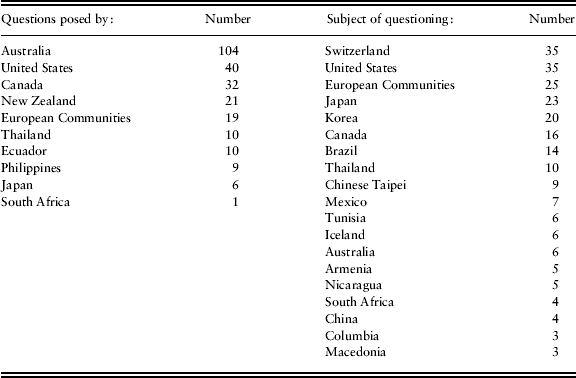
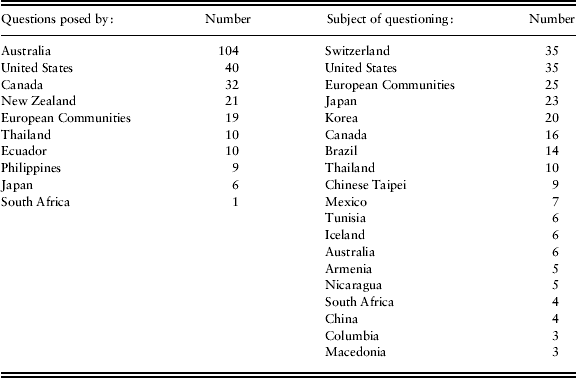
The record on monitoring and surveillance is also spotty. The Committee on Agriculture was more active in its early years than it has been since the Doha Round began. We took a close look at the work of the Committee in 2006 and 2007. Members posed 228 questions over the six meetings, compared to 135 posed at the March 2001 meeting alone. (The total for that meeting also exceeded the total for all three meetings in 2008.) Table 8 shows who posed questions, and the targets. As in the SCM, the questions involve a handful of Members. It is striking that Brazil and India, leaders in the Doha Round negotiations, asked no questions.
Questions in Committee on Agriculture meetings in 2006 and 2007
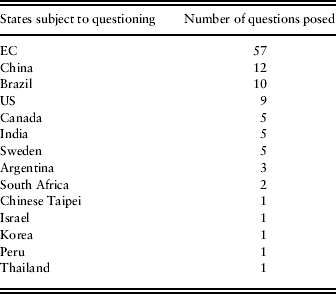
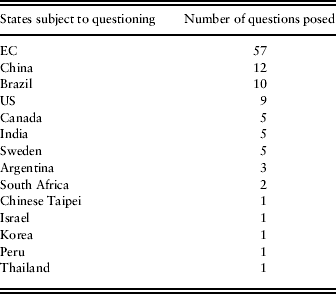
Questions at the November 2008 TBT meeting
The Committee minutes include summary information on the questions asked and answers received. In order not to have to rely solely on the Secretariat summary, the full text of the questions are made available in a Room Document prior to the meeting and the written answers are later posted to an internal website. Unlike the SCM process, the answers come quickly, and the Member being questioned rarely replies that the information is not available. The largest number of questions concerned subsidies and domestic support initiatives (190), with a smaller number being asked about market access issues (67). The longest questions and answers in the Committee are about clarifying domestic support programs under the Green Box, since transparency is the most effective discipline on these measures that supposedly do not distort trade.
4.2 Sanitary and Phyto-sanitary Measures
We now turn from subsidies to the first of the two standards agreements, where the use of transparency tools seems more active than in the rest of the WTO. The central trade problem for risk analysis in food safety is whether regulatory action is legitimate or protectionist. It is not easy to tell the difference, however, between a necessary measure, and protectionism. One of the ways that the Agreement on Sanitary and Phyto-sanitary Measures (SPS) seeks to address the tension is regulatory transparency (Wolfe, Reference Wolfe2003). ‘Transparency’ here is a device for managing administrative discretion. It refers not only to Members keeping each other informed about their SPS measures, but also to ensuring that other Members, citizens, and producers are able to ask whether a given SPS measure is the most appropriate solution to a problem.
Annex B of the SPS Agreement contains detailed requirements for ex ante and ex post notifications. As of 31 August 2008, Members had submitted 9,426 SPS notifications, including 6,416 regular notifications with 1,628 addenda/corrigenda; and 1,042 emergency notifications, with 326 addenda/corrigenda (WTO, 2008c). The Secretariat cautions that these statistics do not necessarily indicate the extent to which new or changed SPS measures are indeed being notified. The specific trade concerns raised at meetings of the SPS Committee still regularly include failures to notify measures. Over half the notifications come from developed countries. While two thirds of Members have submitted at least one SPS notification, 23 developing countries and 23 LDCs have submitted none.
Many developing country Members continue to struggle with the transparency provisions of the SPS Agreement (WTO, 2009f; Wolfe, Reference Wolfe2003). The Committee held a third special workshop on the implementation of the transparency provisions of the Agreement in October 2007. A number of institutional and national challenges were identified, the Secretariat reported, including raising awareness at the political level and among the public at large, coordinating among different ministries, mobilizing the relevant private sector representatives, overcoming difficulties in regional/ intergovernmental cooperation, managing the inflow of notifications, and ensuring the sustainability of efforts.
Article 12.2 of the Agreement provides for informal ad hoc consultations on any SPS issue. Members raise what have come to be called ‘specific trade concerns’ under this provision at each meeting of the SPS Committee. Specific trade concerns are carefully tracked by the Secretariat. They have proved to be much more numerous and more significant than the small number of formal SPS cases in the dispute settlement system (Wolfe, Reference Wolfe2005), and an important venue for Members to learn about adaptation to scientific uncertainty regarding new heath threats (Cooney and Lang, Reference Cooney and Lang2007). Members raised 277 specific trade concerns in the 14 years between 1995 and the end of 2008, with 16 new concerns raised in 2008 (WTO, 2009g). (Only two new disputes cited the SPS agreement in 2008.) Developing country Members have raised 135 specific trade concerns compared to 188 raised by developed country Members and three raised by least-developed country Members. In 173 cases, the measure at issue was maintained by a developed country Member, and in 135 cases it was maintained by a developing country Member.
4.3 Technical Barriers to Trade
Transparency is also important in the other standards agreement, on Technical Barriers to Trade, with numerous provisions specifying good practice in adopting new regulations, and maintaining an Enquiry Point. Many provisions require ex ante notification both of the procedures used and of proposed measures. By the end of 2008, all Members had made at least one TBT notification; and 27 Members had made more than 100, including Brazil (430), China (514), Korea (291), and Thailand (393). It is perhaps surprising that India had made only 82 (WTO, 2009b). In 2008, Members submitted 1,251 new notifications of technical regulations and conformity assessment procedures, up from 1,030 in 2007, bringing the total to 10,026 such notifications.
The TBT Agreement like the SPS Agreement has a ‘specific trade concerns’ procedure, which is actively used. At the November 2008 meeting, the procedure took up the bulk of the meeting time. One EC notification was the subject of intense discussion designed to ameliorate the impact of a new regulation on trading partners, and more than three dozen other issues were discussed (WTO, 2009c). In 2008, Members raised 33 new concerns, and continued discussion of 26 ongoing concerns. In contrast, Members launched three new requests for consultations on TBT issues in the dispute settlement system (all among NAFTA countries).
In looking at the minutes of the November 2008 meeting, we found a wider range of Members active in the process than in other agreements. The EC, US, and Japan were the most active, but a total of 37 Members posed at least one question, compared to just ten in Agriculture and seven in SCM for the entire 2006–2007 period. Also unlike the other committees, questions came from smaller Members such as Botswana, the Dominican Republic, Qatar, and Zimbabwe. Table 9 shows the Members who received and answered questions.
The Committee takes transparency seriously. It has held five special meetings on information exchange, where Members both discuss how to improve the system, and share best practices in implementing existing obligations. Knowing what to notify and how is not straightforward. As required by the Agreement, the Committee keeps itself under close review. As part of preparations for the required fifth triennial review of the Agreement, a number of delegations made proposals at the June 2009 meeting of the Committee to improve the TBT transparency procedures. The Committee is not afraid of general comments about compliance with transparency requirements (WTO, 2006a), but here too Members seem reluctant to identify the laggards.
4.5 Under what circumstances does transparency work?
This brief comparison of experience in three other agreements to that in the ASCM shows that although transparency might be the best hope for discipline on subsidies in general, the practice is weaker than that with respect to agriculture subsidies. The standards agreements come closer to meeting the hopes for ‘right-to-know’ and ‘monitoring and surveillance’ as policy tools. Indeed transparency seems to be the favoured form of discipline of TBT and SPS measures. In this summary we attempt to generalize from an analysis of the differing experiences with the four Agreements, having in mind the five factors elaborated under Table 1 of this paper designed to assess whether transparency can be a useful tool in a given context: (1) a specific policy purpose, (2) specified discloser targets (3) defined scope of information (4) evident benefits, and (5) defined information structure and vehicle.
Our analysis demonstrates that observance of notification provisions in WTO Agreements varies relative to what is being notified and who is the agent of the notification. The clearer and better defined the subject matter of the notification, the more likely WTO Members have been to notify. A lack of notifications, for example under GATS Articles III:3 and VII:4, may be due to the fact that it is usually the trade ministry that must submit the notification, but they cannot compel the domestic ministries responsible for regulation to provide the information (Adlung, Reference Adlung2009: 4–5, 21–22). It is also significant that the GATS has no committees that would engage experts from capitals in a review of complex notifications, unlike SPS and TBT. The most general observation is that transparency mechanisms too often seem to have been an afterthought in the negotiations. Transparency is a fundamental WTO norm, but few agreements are designed from the ground up to make significant use of transparency as a tool. Transparency does not work as a tool if it is thought to be merely an elegant appendage to third-party ‘enforcement’. It does not work if negotiators do not think carefully about the government behaviour they wish to modify using transparency. Even when Members willingly notify, they can only notify what has been agreed. In Agriculture, the type of subsidies to be notified and their measurement have been defined in some detail in the terms of the Agreement and to some extent set out in Members' Schedules of commitments and associated tables.Footnote 14 In contrast, the ASCM has a broad definition of covered subsidies and the Agreement says little about quantification.
The nature of the subject matter and its relationship to WTO obligations is also an important factor. When the thing to be notified bears on new negotiations or dispute settlement, it can expose capacity constraints on the key players, or a desire not to show one's cards. We observe a difference between notifying things that could be subject to a dispute (actionable subsidy, or a measure that ‘significantly affects trade in services’), that could be questioned (so-called non-trade distorting support for farmers), or those that involve some policy change (SPS, TBT). Differences can also be related to whether the things to be notified have to do with the operation of the regime itself (direct compliance with a WTO rule), some set of government policies or actions (subsidies or regulations), or something about economic circumstances within a Member (statistics). Not surprisingly, the closer the agent of notification within the notifying Member government is to the subject matter of notification, the more consistent the record of notification.
The record of SPS notifications suggests another difference most notably again with that of subsidies, being the use to which the information is put. SPS measures are well-defined, what is being notified are changes in policy or measures, and usually the agent of notification also has responsibility for the policy or measure in question. Furthermore, the outcome of notification in the SPS Committee is engagement in a dialogue in which the measure can be understood by trading partners and concerns addressed. This dialogue normally takes place among officials responsible for the policies being notified who can apply the information directly to their own experience.
A final observation about our comparative analysis: the Agreements differ in their requirements for the relevant Committees to reflect on their own performance. The triennial reviews required in the TBT Agreement seem to be the most systematic effort to keep transparency provisions under review. Most committees take general note of compliance with their provisions, but Members are loathe to direct too much attention to each other's shortcomings. The WTO Annual Report, based on committee reports to the three councils, has some useful but scattered information on transparency. The 2008 edition records laconic observations by the Committee on Import Licensing that the lack of compliance with notification requirements was a preoccupation, and by another committee that 50 Members had yet to make an notification on their customs valuation procedures (WTO, 2008a). It would be helpful if the Report had a separate section on notifications, with a comparative analytic discussion of where committees see problems. The Report also notes apparently mild injunctions to improve notifications in seven TPR reports. Members encouraged one African country to fulfil its notification obligations, while two others were invited to make notifications in a more timely and complete manner. But the Secretariat needs more scope to contribute an assessment of Members' performance in observing their commitments, both within the TPRM and in other committees of the Organization.
Conclusion: washing the cloudy windows?
What is to be done about the WTO's cloudy windows? In this concluding section we draw the implications of our analysis for ongoing work, for the current negotiations, and for the future.
Our analysis has shown weaknesses in the Subsidies Agreement from a transparency perspective. As mentioned above, item 10 in the ASCM questionnaire (WTO, 2003c) asks for ‘Statistical data permitting an assessment of the trade effects of the subsidy’. Such data are so rarely provided that the Global Subsidies Initiative dropped the question from its proposed notification template (Steenblik and Simón, Reference Steenblik and Simón2007). If a notified subsidy is potentially ‘actionable’, then doing a preliminary analysis of trade effects is simply an invitation to a dispute, yet the only reason that subsidies are a legitimate subject for discipline is their potential effects on trade. The history of effects tests is not a happy one, since the causal effects of a specific government action on trade flows might never be proved (Hudec, Reference Hudec1998: 10). In this instance, the solution would appear to be to let Members notify a clearly defined subsidy, and let trading partners ask about its effects in the SCM Committee. We observed that the more clearly defined notification provisions under Agriculture work better in practice.
The purpose to be served by the transparency provisions is also a problem. Transparency seems to work best in the trading system where it furthers goals of sharing information and increasing understanding of the intent of trade measures. The TBT and SPS agreements provide examples of collaborative approaches where information is shared and Committee examination promotes understanding of questions before they transform into trade disputes. In the case of subsidies, the nature and detail of the information required appears to give rise to apprehension of self-incrimination. As a consequence, Members' record of subsidies notification is abysmal both in respect of timeliness and completeness. The Committee's capacity to conduct real surveillance of the Agreement's transparency provisions, much less to assess the impact of subsidy practices, is hamstrung. Attempts by the Committee to address these problems have resulted only in cosmetic changes without addressing the underlying issues. The Council for Trade in Goods and the General Council have never held the SCM Committee accountable for this lamentable performance.
Our gloomy conclusions notwithstanding, we believe that transparency should play a significant and increased role in subsidies' disciplines. Many Members need help, however, to meet their own reporting obligations and to digest subsidy notifications by others. Scope exists for enhancing the Secretariat's role, especially with regard to highly detailed and complex notifications. More work is needed on the old chestnuts of defining and measuring subsidies, because transparency works best if providers and users of information can agree on what and how much is to be notified. The WTO could also expand third-party notification of subsidies. Many international organizations and NGOs have detailed information on subsidies' practices that would be useful to the SCM Committee, if the Members were prepared to devote time to verification of the data.
The Committee should pay closer attention to the intended audience. Members should consider how to aggregate information both for internal WTO purposes in the Committee, and for use by other economic actors and the public. Closer co-ordination of notification and surveillance provisions with the Trade Policy Review function might reinforce Members and the Secretariat's efforts. Providers of information must see how doing so helps them meet their own objectives, but if transparency is to be a force for reform, the information must be analyzed and made widely available for those who can influence governments. Members should be more willing to spend time in the Trade Policy Review Body discussing how to provide better information to the public about the extent to which a Member's trade measures are helping or hindering its own public policy objectives.
Members often see no measurable incentive to observe transparency requirements, but costs are readily perceived in the time and effort of government officials. Can the threat of, or use of dispute settlement, become an incentive to notify? Since the answer is no, how can a Committee construct a notification template that is easy to use, and serves a notifier's own purposes? The new template for subsidies notification proposed by the Global Subsidies Initiative is designed to standardize the way that information is reported, which could be a useful contribution in presenting information that is more comprehensible to Committee Members, as well as to others interested in the data (Steenblik and Simón, Reference Steenblik and Simón2007). Clarity and to the maximum extent possible, simplicity, would appear to be watchwords. Proper reporting could be a precondition for participation in the TPRM, and a recent TPR report could form the basis for reviewing all applications for technical assistance in the WTO, providing a significant inducement to notify.
It might be said that such inducements can have little effect on more powerful Members of the WTO. Consistent with the logic of transparency in the first place, transparency about transparency should help. ‘Naming and shaming’ is a popular strategy to enforce international human rights norms and laws, and although it has a mixed record (Hafner-Burton, Reference Hafner-Burton2008) perhaps it deserves more prominence within the WTO using simple metrics about how well countries comply with transparency obligations. The WTO has mechanisms to aggregate observance of performance in meeting notification requirements but something better is needed than the regular ‘Updating of the Listing of Notification Obligations and the Compliance Therewith’ (WTO, 2007b). It is important to ensure that transparency procedures themselves are subject to review in committees and in new negotiations.
Most recently, the Secretariat has been given a prominent role in monitoring and analyzing governments' trade measures that have been taken in response to the global economic crisis. The Director-General reportedly told the Trade Policy Review Body that 30 WTO members have notified the Secretariat about their general economic stimulus measures, while 19 members notified with respect to support programs for financial institutions. The periodic reports presented by the Director-General to the TPRB assessing the extent of these measures while useful are hampered by the failure of governments to notify more, partly at least due to the lack of resources dedicated to developing and compiling the necessary data sets. Governments and international organizations need to assign higher priority to this lacuna. Many groups including NGOs have detailed information on trade policy practices.Footnote 15 The secret is to find ways for constructive engagement so that such information can be brought to bear in a useful way. The WTO G-20 group supported third-party notification proposals in the agriculture negotiations but other Members have resisted, claiming the WTO should remain ‘Member-driven’. We think that this familiar blocking device should not prevent the acquisition and aggregation of better information as long as such third-party data are subject to verification by Members in the relevant WTO body. It will be important to assess the success of the crisis monitoring exercise, both the Secretariat's expanded role and that of Members themselves.
Transparency is not on the current Doha Round negotiating agenda as such, but consideration of the notification requirements or other aspects of transparency is found throughout the negotiations. The most extensive proposals relate to the Agreement on Agriculture, and to trade facilitation (based on Article X of the GATT), but transparency also figures in the Rules text (especially with respect to the proposed provisions on fish subsidies and regional agreements), in intellectual property, and in trade and development. Transparency as a tool also figures in some of the ideas in the services negotiations for new disciplines on licensing or qualification requirements and procedures for professionals (WTO, 2008b).
Outside the negotiating context, in a coordinated attempt to address some of the evident shortcomings in current practice, the Chairperson of the General Council wrote to all Chairs of WTO bodies in February 2009 asking them to consult Members on ways to improve the timeliness and completeness of notifications. Not surprisingly, the most extensive discussions took place in bodies already committed to the notification process, notably the Agriculture, TBT, and SPS Committees – the latter two regularly use the provisions of their respective Agreements to review their transparency procedures. The Director-General reported later that year that in general, ‘Members recognize the need to improve timely compliance with their notification obligations, the importance of enhancing institutional capacity to analyze notified information, and to improve access to information flows on trade measures.’ Discussion of proposals on how to improve compliance with notification obligations was expected to continue in 2010, with the possibility of creating common formats utilizing electronic means for handling, storing, and disseminating data and cooperation with other inter-governmental organizations (see WTO, 2009e: paras 144ff). Updates on this topic should be on the agenda of every biennial Ministerial Conference.Footnote 16
In thinking about the future negotiations, Members might consider whether the need for some new disciplines could better be addressed with more transparency. Such proposals should focus on clarity of purpose, better defined scope of information more targeted to the providers of such information, and defined monitoring and surveillance procedures.
Transparency is well established as a trade policy tool and its value appears to be increasingly appreciated. The mutual obligations of WTO Members to each other are often understood as ‘binding’ and ‘legal’ in themselves, as if calling something ‘law’ automatically ensures that life will follow the prescribed course. Public administration is rarely so simple, and trade policy never is. The challenge for governance, therefore, is choosing the right tool for the job. Trade negotiators have believed for decades that transparency instruments belong in the tool kit. When properly designed, such provisions are flexible, decentralized, and give everyone involved in the trading system the autonomous capacity to exercise influence. But to take full advantage of what transparency has to offer to the trading system, its techniques need significant reform.