This year alone has seen outbreaks of epidemics of Ebola, Chikungunya, and other emerging infectious diseases (EIDs). We must look to the responses of recent outbreaks to help guide our strategies in current and future outbreaks or we risk repeating the same mistakes. The H1N1 influenza outbreak can provide insight into the gap between health organizations and the public. This is because, although the health organizations declared a pandemic, the public was skeptical and vaccination compliance was relatively low in some countries.Reference Poland 1 , Reference Rubin, Amlot and Page 2 Moreover, in light of technological advances, it might have been expected that the health organizations would harness social media more competently than was done, and much can be learned from articles about the communication gaps that persisted between the organizations and the public. H1N1 was first identified in the United States in April 2009. During the following year, approximately 61 million cases were reported, with a total of 12,470 deaths resulting from the virus. 3 During the peak of the H1N1 influenza pandemic and after it ended, many studies evaluated the effectiveness of how governments and health agencies worldwide (ie, the World Health Organization [WHO], the Centers for Disease Control and Prevention [CDC]) and the Federal Emergency Management Agency (FEMA) communicated information about influenza and the vaccine. Some studies focused on how messages were framed in mass media; others focused on the participation of health experts in designing those campaigns. Each of the studies used a particular method in order to examine the campaigns, mostly either quantitative or qualitative. Some studies focused on the communication strategies of local governments, whereas others examined health agencies worldwide.
The campaigns of government agencies and health organizations acknowledged the importance of risk communication during an outbreak and included related guidelines and strategies.Reference Covello 4 - Reference Sandman 7 Risk communication is widely used in planning communication strategies and draft guidelines of EIDs. Previous reviews have also found a shift from communicating the risk top-down to a more two-way flow of communication and have addressed the communication conveyed from bottom-up.Reference Gesser-Edelsburg, Mordini and James 8
The contribution of this literature review is in its mapping of the categories of EID communication that the literature on the H1N1 pandemic addresses. This mapping is important for 3 key reasons: (1) it can reveal whether the literature follows the recommendations of risk communication, (2) it can expose the use of different methods and what this means for the discourse on H1N1, and (3) it can help organizations build more effective risk communication campaigns in the future and can help to pinpoint research gaps needing attention.
This literature review examined how the literature mapped EID communication—whether through different communication channels or by analyzing content and strategies—and exposes how the factors mentioned above were expressed from an empirical perspective. We investigated whether the literature gave equal weight to traditional media channels (television, newspapers) and to new social media (Internet forums, blogs, etc). One question we posed is whether the studies focused mainly on the end result of compliance or on the process of engaging the public and empowering them to make the best possible decisions for themselves and society. These issues are treated in this systematic literature review of studies about health communication campaigns surrounding the 2009 H1N1 pandemic outbreak.
WHAT IS EID COMMUNICATION AND WHY IS IT IMPORTANT?
Risk communication examines how both governments and organizations convey risk to the public and facilitate communication and coordination between the different organizations involved in the risk management process. Analyzing risk communication processes and their outcomes during EID outbreaks can help us understand their effects on public compliance and behavior.Reference Falagas and Kiriaze 9 , Reference Roche and Muskatvitch 10
By EID communication, the present study adopts a broader understanding of the term as its basis, referring not only to new and traditional media channels through which risk is conveyed, but also to barriers to complying with the organizations’ suggestions, to framing the communication process, and to public discourse. EID communication is important because it can affect public compliance (ie, vaccination, in the case of H1N1). The aim of EID communication is to change the behavior of the public.Reference Covello 4 - Reference Holmes, Henrich and Hancock 6 , Reference Crosier, McVey and French 11
Experts differ with regard to the degree of success or failure of health communication campaigns during the H1N1 outbreak.Reference Poland 1 , Reference Rubin, Amlot and Page 2 In light of such differences of opinion on the critical role played by the media, many studies evaluated media campaigns and communication channels during the 2009 pandemic crisis. Hence, the need arose for a comprehensive updated literature review of studies from 2009 through 2013 to determine what kind of retrospective picture would emerge and what would require further study. Notably, Barrelet et alReference Barrelet, Bourrier and Burton-Jeangros 12 reviewed articles on H1N1, but their scope was limited (2009-mid-2011); they did not include articles from the PubMed database and their discussion was more general, not homing in on specific categories.
RISK COMMUNICATION CATEGORIES
Previous studies have found that trust, empowerment, rationality, and uncertainty are crucial factors in the process of EID communication. Although there are other factors, many studies can be categorized within these concepts. Regarding trust, studies have found that when the individuals who make up the general public feel they have no control over the situation, trust in government organizations becomes key and perhaps even the most important variable in the public’s reception of the risk management approach.Reference Cvetkovich and Winter 13 Regarding empowerment, the literature refers to the authorities’ exercise of powerReference Covello, Peters and Wojtecki 14 when optimally they should be empowering the public to make decisions about risks for itself. Studies indicate an implicit assumption that organizations’ and governments’ prevailing perception is that the system’s role is to direct, guide, and manage the crisis and that the public must heed its recommendations and act accordingly.Reference Frewer, Hunt and Brennan 15 - Reference Velan, Kaplan and Ziv 17 Regarding rationality, governments and organizations have often explained the public’s failure to follow certain recommendations as irrational. Early theories of risk communication focused on persuading the public by lifting so-called irrational barriers by presenting accurate, credible, and scientific information.Reference Fischhoff 18 , Reference Powell and Leiss 19 Current studies show that individuals make decisions not because they are irrational but because they evaluate the risk according to its relevance to their lives.Reference Velan, Kaplan and Ziv 17 , Reference Alaszewski 20 The public’s behavior in a crisis is driven by motives that are sometimes self-contradictory: rationality with emotionalityReference Slovic, Finucane and Peters 21 and seeking official sources of security while tending to think independently. Unpredictability and lack of control influence how risk is communicated to the public during crises that create situations of uncertainty. Frewer et alReference Frewer, Hunt and Brennan 15 argued that few studies appear in the literature about communication in conditions of uncertainty. The public wants full transparency of information, including updates about uncertainty and differences of opinion between experts.
METHODS
The current study comprised a systematic review of the literature synthesizing the findings of articles retrieved from searches of computerized databases, hand searches, and authoritative texts, following the steps described by Hek et alReference Hek, Langton and Blunden 22 as adapted by Martenson and Fagerskiold.Reference Martenson and Fagerskiold 23
Search Strategy for Identification of Relevant Articles
The databases used were Communication and Mass Media, MEDLINE EBSCO, and PubMed. The studies drew from the fields of public health research and communication. We conducted the search in October 2013 by using a combination of the following search terms: communication, risk communication, H1N1 influenza, and swine flu. The rationale for using only general search terms was that the use of more specific search terms (such as barriers, vaccination, participation, acceptance) might have limited the results to certain topic categories. Using broad keywords allowed us to examine the core literature and to identify the main topic categories of the studies.
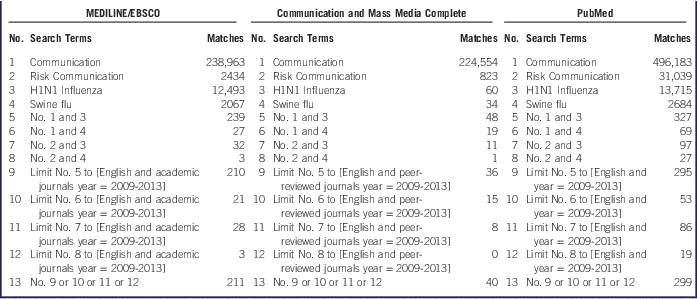
The search was limited to English-language academic journals from 2009 through 2013. The inclusion criterion was the relevance of the articles to EID communication. Theoretical articles and studies about risk management, seasonal influenza, other types of influenza, and comparisons between influenza types were excluded. Accordingly, 550 articles were narrowed to 61. The search process is shown in Table 1.
Search Results

Review Methods and Further Classification
During the second stage, the 61 articles were reviewed and classified by using a mixed qualitative and quantitative content analysis.Reference Oleinik 24 The articles were evaluated by 2 researchers who focused on the narrative. Each of the researchers reviewing the articles coded them according to methods used and different topic categories and themes that emerged from the articles.
After each researcher completed the coding process, the results were compared and disagreements were discussed and resolved. Owing to the paucity of articles, there was no need for an intercoder reliability, because all the articles were deliberated. Articles were than divided into subtables and categorized according to main topic and methods.
This review was not a quantitative meta-analysis of the literature; therefore, we did not aggregate data from previous studies. The aim of this review was not to compare the different studies with one another but rather to map the different topic categories examined and the methods by which they were measured.
RESULTS
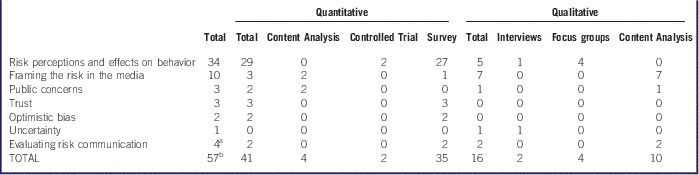
Seven different topic categories were found in the 61 articles: risk perception and effects on behavior, framing the risk in the media, public concerns, trust, optimistic bias, uncertainty, and evaluating risk communication. Of 61 articles, 41 were quantitative, 16 were qualitative, 2 articles used either an empirical meta-analysis or a method that was neither quantitative nor qualitative (eg, screening), and 2 articles used both qualitative and quantitative methods. Table 2 shows the breakdown of the 57 articles classified according to topic categories and quantitative or qualitative methodology, not including the 4 additional articles (mixed methods and nonstandard methods), all of which were part of the last topic category.
Breakdown of the Articles According to Theme and Quantitative or Qualitative Methodology

a Four articles were omitted from the table: 2 studies that used a mixed method, quantitative and qualitative, and 2 studies that used nonstandard methods. Therefore, the number of articles analyzed in the category of evaluating risk communication is 8.
b Further to comment 1, the total number of articles that were analyzed was 61.
Of the 41 articles that used quantitative methods, most used surveys (n=35), but also content analyses (n=4) and controlled trials (n=2). The 16 articles that used qualitative methods were divided between content analyses (n=10), semi-structured interviews (n=2), and focus groups (n=4). The two mixed-methods articles used surveys and semi-structured interviews.
Risk Perceptions and Effects on Behavior
We found 34 studies on this topic, making it the most prevalent in our literature review, reflecting that a central concern of risk communication studies is to examine the effect of communication on attitudes and behavior. In addition, it reflects the preoccupation of researchers with more generic-minded studies that try to pinpoint cause and effect. Five of the studies were qualitative, whereas 29 were quantitative. The main method used by the quantitative studies was a survey; the other 2 used control trials. The 5 qualitative studies were based on semi-structured interviews (n=1) and focus groups (n=4).
Many of the articles addressed the following topics: perceived risk, severity of disease, recent behavioral changes, compliance with pandemic (H1N1) 2009 vaccine and issues relating to uptake and perceived safety, corresponding attitudes toward vaccination during the 2009-2010 influenza season, and vaccination perceptions, barriers, and practices. Most often the articles addressed these topics vis-à-vis the general public, but several concentrated on these topics with regard to health care workers.Reference Anikeeva, Braunack-Mayer and Rogers 25 - Reference Virseda, Restrepo and Arranz 30 Many focused on strategies for influencing public risk behavior by increasing influenza vaccine coverage and mitigating barriers. In such articles, the target groups were generally the general public, public health workers, and experts (media and policymakers). A few articles treated specific subpopulations including parents,Reference Jung, Lin and Viswanath 31 children from 6 months to age 18 years,Reference Stockwell, Kharbanda and Martinez 32 and students.Reference Yang 33 One study treated ethnic and gender segments in the context of risk perception and barriers to the flu vaccine.Reference Galarce, Minsky and Viswanath 34
The articles revealed that different populations have distinctive and diverse attitudes and risk perceptions regarding compliance with the H1N1 vaccination, which influences communication between the government and the public. Empirical studies on H1N1 point to recurring dominant barriers as outcomes of risk perception regarding vaccination: barriers related to mistrust of governments and authorities,Reference Poland 1 , Reference Allen Catellier and Yang 35 - Reference Walter, Bohmer and Reiter 37 cognitive barriers related to the risk perception that “a healthy person does not need to get vaccinated,”Reference Bults, Beaujean and de Zwart 38 fear of vaccine side effects, concerns about vaccine safety and the manufacturing process, and a perception of the vaccine as only partially protective.Reference Poland 1 , Reference Walter, Bohmer and Reiter 37 , Reference John and Cheney 39 - Reference Seale, Heywood and McLaws 41 Two articles addressed barriers concerning erroneous perceptions of vaccine components by those who believed it to have dangerous or unwanted side effects.Reference Virseda, Restrepo and Arranz 30 , Reference Hollmeyer, Hayden and Poland 42
Framing the Risk in the Media
The recent rise in studies on framing risk in the media indicates an increased emphasis on the iterative process of risk communication in studies on H1N1, focusing on the role of the media as a medium for actual communication with the public. As shown in Table 2, a total of 3 quantitative and 7 qualitative studies addressed how the risk was framed in media sources. Whereas all 7 qualitative studies used content analysis, only 2 of the quantitative studies used this method, and the third was based on a survey. The articles on framing treated the question of which components were used to frame H1N1 in the news,Reference Lee and Basnyat 43 differences in framing across different periods,Reference Pellegrino, Martino and Balli 44 comparisons between framing across different countries,Reference Liuccio, Amorese and Miconi 45 , Reference Sandell, Sebar and Harris 46 a critical approach to framing in order to promote awareness of “framing contests” within competing media sourcesReference Holland, Blood and Imison 47 and use or nonuse of alarmist strategies.Reference Fogarty, Holland and Imison 48 Although media studies can study a broad range of channels, most of the articles reviewed in this topic category focused on the use of mass media, not social or other digital media.
Public Concerns
Of the 3 studies treating public concerns as expressed through the social media, 2 were quantitative and 1 was qualitative. All 3 used content analysis. Until 2013, this topic comprised a research gap, as most studies tended to be descriptive and not discursive, focusing on the role of the media as representing information and not as a medium for actual communication with the public. We located only 1 study on this topic prior to 2013, which treated the emotional responses of the public to media releases.Reference Henrich and Holmes 49 Two later studies analyzed media releases in FinlandReference Luoma‐aho, Tirkkonen and Vos 50 and investigated professional and public online information needs around major infection outbreaks and correlated these with media coverage.Reference Kostkova, Fowler and Wiseman 51
Relationship Between Organizations and the Public: Trust, Uncertainty, and Optimistic Bias
Trust, uncertainty, and optimistic bias are considered 3 components of risk communication crucial to the relationship between government and health organizations and the public. While they are considered key categories in EID communication, their presence in the articles we analyzed was limited. We located only 3 studies on trust, all of which were quantitative and based on surveys. The studies addressed the following 2 issues: the public’s trust in the government in situations in which the public feels it has no control over the situationReference Cvetkovich and Winter 13 and the connection between positive/negative affect and the relationship between trust and information-seeking on H1N1.Reference Allen Catellier and Yang 35
Regarding optimistic bias, only 2 quantitative studies treated this topic, both of which were based on surveys. They discussed the effect of risk communication on self-protecting behavior. Cho et alReference Cho, Lee and Lee 52 suggested that it is important for practitioners to understand and take into account optimistic bias when designing risk communication messages. Kim and Niederdeppe’sReference Kim and Niederdeppe 53 study explored possible roles for optimistic bias in the Integrative Model of Behavioral Prediction.
In addition, although the 2009 H1N1 pandemic created a situation of uncertainty, notably, in the literature we reviewed, only one study treated this crucial and controversial issue, indicating a research gap. A qualitative study by Locatelli et al,Reference Locatelli, LaVela, Hogan, Kerr and Weaver 54 which employed interviews, addressed this issue in the context of communication barriers. These barriers included uncertainty and inconsistent, or contradictory, information during the H1N1 pandemics, with a focus on the factors that influence communication in health care settings, including barriers to effective communication. The findings of this study provide insight into improving communication efforts within health care facilities during emergent events.
Evaluating Risk Communication
Of the 8 studies we located that evaluated risk communication campaigns on H1N1, 2 were qualitative, using content analysis. Two were quantitative studies employing surveys. Two used mixed methods and 2 used nonstandard methods.Reference Gresham, Ramlawi and Briski 55 , Reference Smith, Burkle and Holman 56 The studies examined the following issues: health communication by the Chinese government,Reference Li, Guo and Li 57 the role of the community engagement process in incorporating community-based input to create up-to-date and culturally appropriate community-level pandemic plans,Reference Charania and Tsuji 58 accuracy of communication of health information,Reference Blank, Bonnelye and Ducastel 59 and a comparison of efficacy of various channels for communicating health issues regarding H1N1.Reference Leslie 16 Other topics addressed included the trustworthiness of the communicator, accessibility and availability as contributing factors to successful communication,Reference Matsui, Shigeta and Ozasa 60 better definition of roles and responsibilities,Reference Nhan, Laprise and Douville-Fradet 61 and evaluating the role of regional disease surveillance networks in shaping and managing cohesive policies on current and future threats.Reference Gresham, Ramlawi and Briski 55
The quantitative studies and the quantitative parts of the mixed-method studies focused on 2 elements. The surveys examined the public response to the risk communication campaigns, measuring public attitudes toward the vaccine, and factors influencing vaccination. The content analysis, which was part of one of the mixed-methods studies (Li et alReference Li, Guo and Li 57 ), focused on the content of the official press releases by the health organizations and compared them with the content reported by the media, measuring the differences between both.
DISCUSSION
This literature review on the H1N1 influenza outbreak reveals that most of the studies treated issues of communication with the public about the flu and the vaccine through mass media. Few studies addressed new media. Most studies that did address new media focused on the public’s risk perceptions, fears, and concerns about the pandemic. Our findings, which pinpointed the studies’ topic categories and methods, showed that most of the studies were quantitative (n=39) and some were qualitative (n=18). It is important to categorize the methodologies used by researchers because this exposes the perspective emphasized by the studies, especially with regard to how they addressed public concerns.
Upon a closer look at the categories, it emerged that studies that treated framing tended to be qualitative studies. This allowed the studies to focus on the narratives of the outbreak campaigns. The studies on risk perceptions and effects on behavior were based mostly on surveys and few attempted to understand the motives behind particular risk perceptions leading to particular behaviors. Those that did address this issue (n=5) were qualitative studies. Studies that addressed two of the components of EID communication—trust and optimistic bias—relied mainly on quantitative methods. They tended not to address why people acted as they did and instead focused on the influence of both factors on the relationship between the organizations and the public. Only 2 studies used mixed methods, which allowed a more complex examination of the H1N1 outbreak.
Although trust, uncertainty, and optimistic bias are considered key categories in EID communication, their presence in the articles we analyzed was limited. This could be because of the complexity of these issues and the fact that they are difficult to measure. Frewer et al, for example, claimed that uncertainties are hard to conceptualize and can lead to public distrust.Reference Frewer, Hunt and Brennan 15 These factors are also hard to isolate, which raises questions such as, Are the low trust levels in the organizations a result of the H1N1 campaigns? How is uncertainty measured after H1N1 risk communication campaigns?
Until 2013, the studies tended to be more quantitative with little focus on new media, such as social networks sites (eg, Facebook and Twitter) or mobile phones. As a result, the literature did not give equal weight to traditional media channels (television, newspapers) and to social media (Internet forums, blogs, etc) but rather favored the former. Overall, these studies tended to be descriptive and not discursive, focusing on the role of the media as representing information and not as a medium for actual communication with the public. New media has the potential for being more discursive, allowing a two-way flow of communication, not just from the organizations and governments to the public, but also vice versa. Focusing on new media channels can provide insight into the immediate responses of the public and how the communication process between organizations and governments and the public was conducted.Reference Gesser-Edelsburg 62 , Reference Hesse, O’Connell and Augustson 63
More recent studies, however, examined the public sphere through social media including online behavior on infection portals and public online information needs. These studies showed that public health agencies responsible for EID communication need to collaborate with the media to ensure that coverage is profound and evidence-based while scientific information remains accessible through online open access to key resources.Reference Kostkova, Fowler and Wiseman 51
Studies until 2013 also tended not to delve into risk communication as an iterative process but to focus primarily on the success rate of vaccination compliance, analyzing the strategies and tactics of the campaigns. Most of the studies until 2013 were quantitative and relied mainly on surveys. Most were not qualitative studies of what actually occurred in the communication chain or how (or why) it led to results of noncompliance with the vaccination campaigns. Several studies from 2012, and increasingly more in 2013, addressed issues of discourse and framing and tended to employ qualitative methods that emphasized the complexity of conveying information to the public.
Risk communication emphasizes the importance of public engagement and involvement,Reference Holmes, Henrich and Hancock 6 as well as building trustReference Cvetkovich and Lofstedt 64 - Reference Lofstedt 66 under the unique conditions that prevail during an EID outbreak.Reference Covello 4 , Reference Sandman 7 , Reference Frewer, Hunt and Brennan 15 The public’s behavior in a crisis is driven by motives that are sometimes self-contradictory: rationality with emotionalityReference Slovic, Finucane and Peters 21 and seeking official sources of security while tending to think independently. These different motives challenge campaign architects to create effective communication with the public. Theoretical studies on risk communication tend to treat important components such as trust, empowerment, rationality, and uncertainty. However, our literature review indicated that few studies focused on issues of uncertainty during the process of communication, tending to focus on the outcomes. It is crucial that studies on H1N1 compliance apply these concepts from risk communication, such as the ones we focused on above, to understand more deeply the minutiae of the process of EID communication and the importance of vaccination. The gap between risk communication theory and its inclusion in the literature we examined may be explained by the fact that researchers hailed from diverse disciplines and may not have been familiar with risk communication or that researchers were often driven by the goal of explaining compliance versus noncompliance and thus focused on the outcome. Whatever the reason, it is important to stress that the trajectory of recent H1N1 research exhibited a noticeable shift, particularly evident in 2013, with more studies focusing on public discourse and framing the risk. Although many studies included summary evaluations, hardly any formative research studies followed campaigns from the planning stage when they could still address public inclusion, trust-building, and working in conditions of uncertainty.
CONCLUSION
Our main recommendations are for formative evaluations that employ recommendations from past research in the design of communication campaigns from the first stages after the current crisis and before the next one. We also suggest that research be based on diverse triangulation processes,Reference Moran-Ellis, Alexander and Cronin 67 consisting mainly of deliberative interviews and discussions with different stakeholdersReference Webler and Tuler 68 to help understand the questions, needs, and concerns of different segments of the population to make them feel like involved partners.
Further studies should address the potential offered by social media to create dialogue with individuals and the public at large. It is important that the studies focus not only on the communication from the organizations to the public but also on public response, and the responses to that response. Methodologically, more studies should continue to adopt a qualitative discourse analysis approach that takes into consideration the context of the text (for example, a blog entry or a post): tone, participants and respondents, target audience, etc. Such studies contribute to defining how social media can be used for two-way communication to carry out the objectives of risk communication campaigns.
Acknowledgments
The research leading to these results received funding from the European Union Seventh Framework Programme (FP7/2007-2013) under grant agreement no. 278723 (TELL ME).