Introduction
Animal genetic resources are defined as animal species that are used, or may be used, for the production of food for man. In terms of biodiversity, conservation and utilization, these genetic resources require further identification and evaluation to assess their potential contribution to food and agricultural production now and in the near future. Biodiversity can be described at several levels ranging from phenotypic observations to molecular data. An increasing loss of genetic diversity has been observed for all agriculturally used species, and more than half of common livestock breeds especially poultry are now endangered or at risk of extinction (Dohner, Reference Dohner2001; Hoffmann, Reference Hoffmann2005).
Biodiversity encompasses not only the world's species with their unique evolutionary histories, but also genetic variability within and among populations of species and the distribution of species across local habitats, ecosystems, landscapes and whole continents or oceans (FAO, 2009). According to FAO (2000), animal genetic diversity allows farmers to select stocks or develop new breeds in response to environmental change, threat of disease, new knowledge of human nutrition requirements, changing market conditions and societal needs.
The utilization of appropriate animal genetic resources to achieve and maintain sustainable production systems that are capable of responding to human needs is necessary to national and global food security. Over 75 percent of the world's food and agriculture is produced by fewer than 25 domestic plant and animal species (FAO, 2007). Adapted genetic material must form the foundation for improving food and agriculture production systems. Globally, this will involve the use of a much wider spectrum of farm animal genetic resources for each of the major species. Unfortunately, global farm animal genetic resources are disappearing very fast (FAO, 2007). The number of domestic animal species is low, perhaps 40 in total, and with less than 14 accounting for over 90 percent of global production (FAO, 2004).
Existing poultry varieties comprise a wide range of breeds and strains that have evolved in the process of domestication and systemic breeding programmes. Since domestication, chickens have been distributed to various countries, continents and cultures. The use of chicken for food has been limited to a few specialized commercial breeds and a vast range of non-commercial chicken breeds.
The Nigerian indigenous chicken is a dual-purpose bird that is used both for meat and egg production in the rural and peri-urban areas of the country. They are found in large numbers distributed across different agro- ecological categories under a traditional family based scavenging management system (Sonaiya and Olori, Reference Sonaiya, Olori and Sonaiya1990). Most of the birds are kept in small flocks under a scavenging system and the feed resources for the birds are household refuse, homestead pickings, crop residues, herbage, seeds, green grasses, earthworms, insects and small amount of supplemented feeds offered by the flock owner. They are well adapted to the adverse climatic conditions of the tropical environment and low management inputs. They contain a highly conserved genetic system with high levels of heterozygosity (Wimmers et al., Reference Wimmers, Ponsuksili, Hardge, Valle-Zarate, Mathur and Horst2000). These indicate that they are highly important farm animals, kept for good source of animal protein, for income and socio-cultural roles. Ebozoje and Ikeobi (Reference Ebozoje and Ikeobi1995) reported the adaptive potentials of the Nigerian indigenous chicken to varied ecological conditions, stresses and diseases.
There have been some efforts at characterizing the Nigerian indigenous chickens. These efforts include classification based on ecotypes (Sonaiya and Olori, Reference Sonaiya, Olori and Sonaiya1990), plumage and shank colour (Ebozoje and Ikeobi, Reference Ebozoje and Ikeobi1995; Ikeobi et al., Reference Ikeobi, Ozoje, Adebambo, Adenowo and Osinowo1996), possession of the major genes of feather distribution and feather structure (Ibe, Reference Ibe1993, Ebozoje and Ikeobi, Reference Ebozoje and Ikeobi1995; Peters et al., Reference Peters, Ikeobi, Ozoje and Adebambo2002, Reference Peters, Ikeobi, Ozoje and Adebambo2005, Reference Peters, Ikeobi, Ozoje, Famakinwa, Oshodi and Adebambo2007, Reference Peters, Shoyebo, Ilori, Ozoje, Ikeobi and Adebambo2008a, Reference Peters, Ilori, Ozoje, Ikeobi and Adebambo2008b). Major genes effect on growth, fertility, hatchability and semen quality characteristics have also been reported (Peters et al., Reference Peters, Ikeobi, Ozoje and Adebambo2002, Reference Peters, Ikeobi, Ozoje and Adebambo2005, Reference Peters, Shoyebo, Ilori, Ozoje, Ikeobi and Adebambo2008a, Reference Peters, Ilori, Ozoje, Ikeobi and Adebambo2008b). Wekhe (Reference Wekhe1992) earlier reported that Nigerian indigenous chickens are more resistant to infectious disease agents than their exotic counterparts. These chicken population estimated at about 140 million (FAO, 2006) is currently underutilized in the development of acceptable improved breeds. There is a need to expand the narrow genetic base in which the world's poultry breeding company currently operates by including local chicken resources that has been widely reported to be well adapted to the local conditions.
In addition to the phenotypic characterization that has been done and reported above, there is a need to perform molecular characterization for information with regard to phylogeny, diversity and relatedness. To take advantage of the differences in the strain of chickens and bring about genetic progress in breeding, a diversity study is imperative. Most diversity and phylogenetic studies are mainly based on microsatellite loci (Erhardt and Weimann, Reference Erhardt and Weimann2007) although a number of other polymorphism systems such as protein polymorphisms, blood groups or other molecular markers systems were alternatively used (Baumung, Simianer and Hoffmann, Reference Baumung, Simianer and Hoffmann2004). The use of microsatellite has become a standard method to estimate genetic diversity in livestock. To define species-specific standards, the International Society for Animal Genetics (ISAG) formed a FAO/ISAG advisory group on animal genetic diversity in 1995, which set up recommended species-specific lists of microsatellites loci (about 30 per species) for cattle, chicken, sheep and swine to be used in diversity studies (http://dad.fao.org/). Protein polymorphisms have been used as marker systems to estimate genetic variation within and between chicken populations (Mina et al., Reference Mina, Sheldon, Yoo and Frankham1991; Romanov, Reference Romanov1994) and while we were aware that microsatellites and other DNA markers are more polymorphic and informative than protein markers in diversity studies, there is a need to use protein markers to do a preliminary screening on genetic diversity of Nigerian local chickens. This investigation therefore sought to find the genetic diversity, as a preliminary assessment, among Nigerian indigenous chickens reared intensively using blood protein polymorphisms by estimating genetic similarity.
Materials and methods
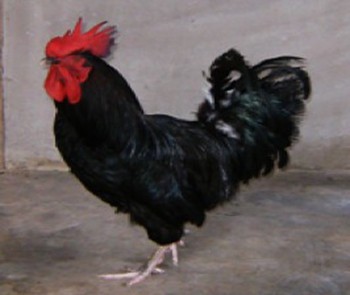
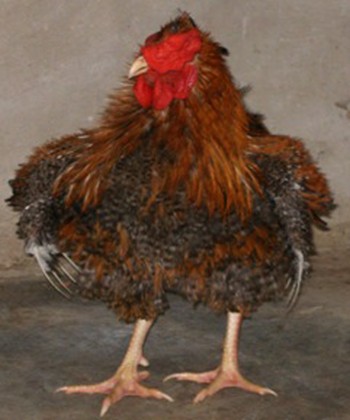
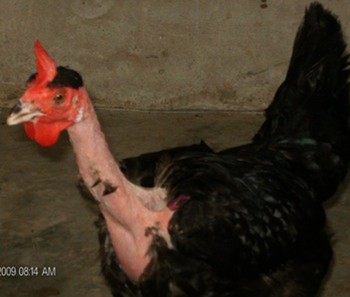
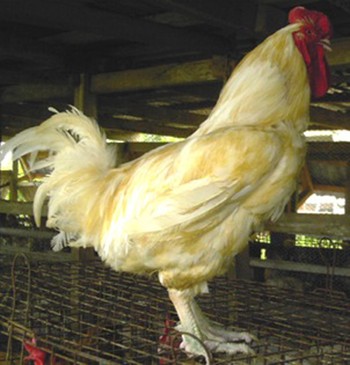
Local chickens comprising naked neck, frizzle feathered and normal feathered were collected from different villages of Abeokuta in Nigeria. The same strains were mated using artificial insemination to generate progenies raised for this study and the birds were maintained at the Poultry Breeding Unit of the University of Agriculture, Abeokuta. A total of 15 sires were used in inseminating 80 dams belonging to three local chicken genotypes and one exotic chicken. A total of 200 blood samples (50 per genotype) from the chicken populations were used for this study. About 2 ml of blood was collected from wing vein of each chicken using 2 ml syringes. The blood was collected from purebred local chickens (normal feathered, naked neck and frizzled feather) and exotic broiler breeder (Anak Titan) shown in Figures 2–5.
Normal-feathered indigenous cock.

Frizzle-feathered indigenous cock.

Naked neck indigenous cock.

Anak Titan cock.

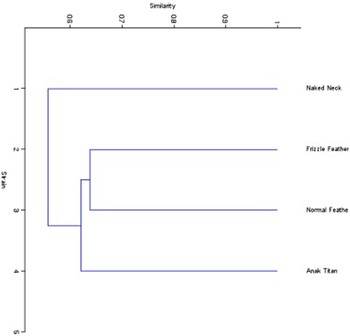
Dendrogram developed by UPGMA cluster analysis showing the coefficient of genetic similarities among the chicken populations studied.

Whole blood samples were taken to the laboratory for analysis. Serum was separated from the whole blood using centrifugation. The supernatant serum protein was carefully transferred into a clean 2 ml eppendorf microtube and stored at −35°C. The sodium dodecyl sulphate–polyacrylamide gel electrophoresis (SDS–PAGE) analysis was carried out using the Bio-Rad Mini Protean II (10 ml capacity) for three blood proteins: globulin, transferrin and albumin. This method of analysis is a discontinuous buffer system, which means that the buffer in the reservoir is of a different pH and ionic strength from the buffer used to cast the gel. The stacking gel contained distilled water (6.1 ml), 0.5 M Tris-HCl at pH of 6.8 (2.5 ml), 10 percent SDS (100 µl), acrylamide/bisacrylamide solution (1.3 µl), 10 percent ammonium tetraoxosulphate (vi) (50 µl) and Initiator or N'N'N'N-Tetramethylene diamine (TEMED) (C6H16N2) (10 µl). B-mercaptoethanol (7.5 percent) in sample buffer was used for the preparation of the chicken blood samples. The serum and sample buffer were added at ratio 1:2 and heated at 95°C for 5 min in a water bath. The mixture was placed inside the deep freezer for 5 min and then loaded into the wells on the gel. The separation of protein was carried out with the aid of Bio-Rad Electrophoresis system using the Bio-Rad Mini Protean II Cell at 150 V for 2 h. The separating gel composed of 0.375 M Tris at pH of 8.8, distilled water (3.5 ml), 1.5 M Tris-HCl (2.5 ml), 10 percent SDS (100 µl), acrylamide/bisacrylamide (4.0 µl), 10 percent ammonium tetraoxosulphate (vi) (50 µl) and TEMED (5 µl). At the completion of the electrophoresis, the gels were carefully removed under water and placed in a staining solution of 0.1 percent Coomassie Blue in 1:4 glacial ethanoic acid (CH3COOH) and methanol (CH3OH). The staining solution was later removed and the gels were de-stained with the de-staining solution that contained 40 percent distilled water in 1:4 glacial ethanoic acid and methanol. The de-stained gels were then scanned and the bands visually scored.
Statistical analysis
The presence of bands was designated as (1) and band absent was coded as (0). The computer program PAST (Hammer, Harper and Ryan, Reference Hammer, Harper and Ryan2001) designed for protein electrophoretic data analysis was used to develop the dendrogram produced by the unweighted pair group method with arithmetic mean UPGMA (Sneath and Sokal, Reference Sneath and Sokal1973). Genetic distance was calculated using the formula: D = 1 − S, where D represents genetic distance and S the genetic similarity.
Results
Gene constitutions of Nigerian local and exotic chickens were compared using polypeptide chains at three loci controlling blood protein types. The electrophoretic banding patterns of SDS–PAGE of the four strains revealed a maximum of 18 bands for the three loci examined (globulin, transferrin and albumin). All these 18 bands were not necessarily present in all the four strains. Two postalbumin bands appeared to be present in only naked neck chickens. This might be taken as rare or uncommon alleles. The phylogenetic relationships among the strains studied were summarized in Figure 5. The dendrogram showed that the strains were clearly separated from one another. Mean genetic similarity among the four strains was 55 percent with the naked neck being the most distant among the chicken populations. Genetic similarity between Anak Titan and frizzle-feathered with normal-feathered breed was 63 percent while frizzle feathered and normal feathered being the same local strains were 65 percent similar. The birds were divided into two clusters, with the first cluster consisting of only naked neck as a distinct strain on the evolutionary scale with other strains diverging progressively. The second cluster composed of frizzle and normal feathered as first subcluster while Anak Titan formed the second subcluster, respectively. The values of the genetic similarities used for the construction of the dendrogram are presented in Table 1 with the genetic distances in parentheses.
Genetic similarities and distances among the chicken population studied.

Values in parentheses represent genetic distances.
Discussion
The strains were clustered according to their overall genetic similarity. Each band in the electrophoretic analysis corresponds to a different protein, the synthesis of which is controlled by one, two or polygenes. The protein phenotype (bands) observed on the gels can therefore be interpreted in terms of presence of alleles for the specific protein studied. Using different proteins, Mohammed et al. (Reference Mohammed, El-sayed, Hamdoon and Ame2001) had earlier made similar observation on different breeds of chickens studied. They stated further that electrophoretic analysis of protein provides information on the molecular weights and charges of protein, the subunit structures of protein and the purity of the particular preparation. In addition, different forms of mutation may occur in the codon, particularly, the replacement of certain nucleotide by others which may explain the observed banding pattern across the different strains in this study. Two postalbumin bands present in naked neck appeared to be private/rare alleles (that is alleles detected in only one population but completely absent in another populations). Probably, these bands may have to do with feather distribution gene that gives its characteristic phenotype. Granevitze et al. (Reference Granevitze, Hillel, Chen, Cuc, Feldman, Eding and Weigend2007) also reported the presence of private alleles in the chicken populations studied with the highest number of five carried in H'mong chickens followed by Red Jungle Fowl with four private alleles.
The dendrogram constructed from this study showed that the strains were clearly separated from one another. This is in agreement with the phenotypic variation of these strains of chickens. Naked neck among these chicken populations appeared to be closest to the origin in the evolutionary trend, hence the most remote as shown by its distinct and separate cluster. The exotic breed (Anak Titan) in this study is the most outbred being the farthest from naked neck and also shows that Anak Titan has a line of descent with all the local strains examined.
The dendrogram constructed indicates that frizzle- and normal-feathered chickens in this study are closely related. This indicates that frizzle- and normal-feathered chickens share a more recent common ancestor than either shares with any of other strains on the phylogenetic tree. Investigating blood protein polymorphisms of local chicken in Laos, Okamoto et al. (Reference Okamoto, Tsunekawa, Kawamoto, Worawut, Kawabe, Maeda and Nishida1999) reported small genetic differentiation among the chicken populations studied. It appears from this preliminary analysis that native strains of chickens are good reservoir of allelic diversity that is the major basis for genetic improvement, although genetic diversity observed among the chicken populations was low. This, however, will have to be studied further using more polymorphic DNA markers.
Conclusion
Low polymorphism exists among Nigerian local chickens and Anak Titan with respect to the few blood protein types examined. Both frizzle- and normal-feathered chickens formed the same cluster and are genetically close to Anak Titan while these three strains are genetically far from naked neck chickens which appeared to be the most remote of all the strains examined. Nigerian local chickens, particularly naked neck, should be conserved as a reservoir of rare genetic chicken resource and its similarity and genetic distance between and among other ubiquitous chicken populations may be tested in further research using more polymorphic DNA markers.
Acknowledgements
The authors acknowledge the Research and Development Centre, University of Agriculture, Abeokuta Nigeria for the research grant (RG 206) to support this work.