Introduction
The encapsulation of a single water molecule, nitrogen, hydrogen, and other molecules/atoms in a C60 opens up new opportunities for designing new nanoscale devices.[Reference Kurotobi and Murata1–Reference Pupysheva, Farajian and Yakobson3] The endohedral fullerenes have different structural and mechanical properties compared with empty fullerenes. Pupysheva et al. showed that a buckyball can be used for storage of multiple hydrogen molecules.[Reference Pupysheva, Farajian and Yakobson3] Shen studied the effect of having Si and Ge inside C60 on the mechanical response under compression.[Reference Shen4] In our previous study, we have investigated the mechanical properties of water-filled C60.[Reference Min, Farimani and Aluru5] It has recently been shown that the rotational diffusion and entropy of a single water molecule inside C60 is an order of magnitude higher compared with the bulk molecule.[Reference Farimani, Wu and Aluru6]
The electronic properties of C60 can be highly affected from the interaction with molecules. Rivelino et al. studied C60 and hydrated C60 using Monte Carlo/density functional theory (DFT) and showed that the electronic properties (specifically, energy gap) change due to the interaction between C60 and outside water molecules.[Reference Rivelino and de Brito Mota7] Kawahara et al. showed that the density of states (DOS) of C60 can be significantly modified when deposited on Cr(001) surface.[Reference Kawahara, Lagoute, Repain, Chacon, Girard, Rousset, Smogunov and Barreteau8] It is noteworthy that mechanical deformation can also significantly affect the electronic properties of nano materials. In a relevant study, Ni et al. showed that the uniaxial tension of graphene can open a band gap of about 300 meV.[Reference Ni, Yu, Lu, Wang, Feng and Shen9] Similar study was done by Yang et al. for carbon nanotubes (CNT), and they demonstrated that the uniaxial and torsional deformation can modify the band gap of CNT.[Reference Yang, Anantram, Han and Lu10] Mechanically induced electronic changes in nano structures can enable the design of novel electronic devices such as bio-sensors and field effect transistors (FETs).[Reference Ni, Yu, Lu, Wang, Feng and Shen9–Reference Scalise, Houssa, Pourtois, Afanas'ev and Stesmans11] Scalise et al. showed that the semiconducting to metallic transition of MoS2 occurs when a compressive or tensile deformation is applied.[Reference Scalise, Houssa, Pourtois, Afanas'ev and Stesmans11] The effect of mechanical stimuli on the electronic properties of fullerenes and water-filled fullerenes’ is still unknown and understanding these effects can enable new applications such as molecular sensing devices.
In this study, we present the effect of mechanical deformation on the electronic structure of empty and water-filled fullerenes [H2O(n)@C60, H2O(10)@C180, and H2O(18)@C240, where n is the number of water molecules inside the fullerenes]. We first filled fullerenes with water molecules using molecular dynamic simulations (MD), and then exported the geometries for quantum simulations using the DFT. A point load is applied for mechanical deformation tests by considering both tension and compression. The change in energy gap of all structures with respect to the applied strain is studied.
Methods
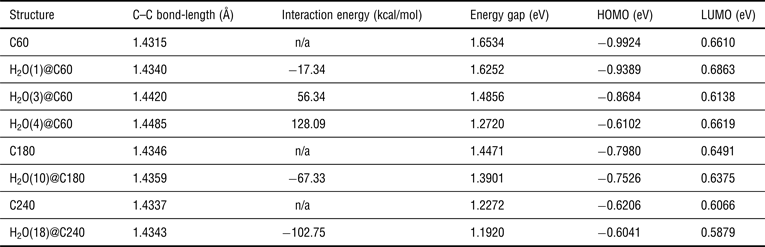
DFT calculations were performed using the SIESTA package on empty and water-filled fullerenes to understand the change in structural and electronic properties under mechanical deformation.[Reference Soler, Artacho, Gale, García, Junquera, Ordejón and Sánchez-Portal12] DFT calculations have been shown to be accurate for mechanical and electronic properties of nano materials under various conditions.[Reference Min, Farimani and Aluru5, Reference Rivelino and de Brito Mota7, Reference Kawahara, Lagoute, Repain, Chacon, Girard, Rousset, Smogunov and Barreteau8, Reference Dumitrică, Belytschko and Yakobson13–Reference Farimani, Min and Aluru18] However, DFT Kohn–Sham (KS) calculations may underestimate the value of band gap, and the exact exchange-correlational functional or many-body perturbation theories are necessary for improved accuracy.[Reference Seidl, Görling, Vogl, Majewski and Levy19, Reference Lany and Zunger20] For further verification, we used Slater's transition state theory (Supporting Information) to compute the fundamental energy gap variation of C60 under a compressive point load, and it is observed to be qualitatively consistent with current results. Therefore, for the rest of the simulations, we obtained the variation of the energy gap under mechanical deformation using the DFT KS theory. For parameterization of the exchange-correlation functional, generalized gradient approximations with revised Perdew–Burke–Ernzerhof is employed.[Reference Perdew, Burke and Ernzerhof21, Reference Hammer, Hansen and Nørskov22] The core electrons are replaced by the norm-conserving pseudopotentials.[Reference Troullier and Martins23] For the basis set generation, double zeta basis plus polarization numerical atomic orbital is used, and the Γ point is applied for the k-point mesh generation. To remove any artificial effect of interaction between structures in the periodic simulation box, a vacuum region of about 15 Å is used in all directions. Structural relaxation is performed until the maximum residual force of the system is less than 0.03 eV/Å. To understand the electron clouds overlap/charge transfer due to the interaction between water and fullerene, the charge density rearrangement (Δρ) is obtained, which is defined as Δρ = ρ Fullerene+Water − (ρ Fullerene + ρ Water), where ρ Fullerene and ρ Water represent the charge density distribution of each isolated structure (fullerene and water), and ρ Fullerene+Water is the charge density distribution of the total system. The interaction energy between water molecules and fullerene, shown in Table I, is calculated as  ${E_{{\rm Interaction}}} = {E_{{\rm Total}}} - \lpar {E_{{{\rm H}_{\rm 2}}{\rm O}\lpar n\rpar }} + {E_{{\rm Fullerene}}}\rpar $, where
 ${E_{{{\rm H}_{\rm 2}}{\rm O}\lpar n\rpar }}$ and E Fullerene are the energies of isolated water and fullerene (C60, C180, and C240), respectively, and E Total is the energy of the total system.
The effect of water encapsulation inside fullerenes (C60, C180, and C240) on structural and electronic properties. (Second column) Initial average bond-length of carbon–carbon, (third column) interaction energy between water and fullerene, (fourth column) the initial energy gap of all systems. The bond-length and interaction energy for H2O(n)@C60 are taken from the previous work.[Reference Min, Farimani and Aluru5] (Fifth column) HOMO and LUMO.

The change in energy gap of water-filled fullerenes under a point load is obtained using the following procedure. (a) The structure is relaxed for calculation of the initial energy gap, which is defined as the energy difference between the highest occupied molecular orbital (HOMO) and the lowest unoccupied molecular orbital (LUMO) of the system. (b) Tensile or compressive point load is applied on the two outermost carbon atoms of fullerenes in the x-direction. The applied strain (ε) is defined as ε=(d s−d 0)/d 0, where d 0 is the initial distance of the two outermost carbon atoms in the fullerene, and d s is the distance of the two outermost carbon atoms when the strain is applied. (c) The two strained atoms are fixed while other fullerene carbon atoms and water molecules inside the fullerene are relaxed. (d) The energy gap of the deformed structure is obtained. (e) Steps (b)–(d) are repeated for each system (empty versus water-filled structures) to determine the energy gap. Valentini et al. used plates at both ends to apply compression on a nanosphere, and showed the load distribution on the surface of the nanosphere.[Reference Valentini, Gerberich and Dumitrică24] As discussed in the previous study,[Reference Min, Farimani and Aluru5] using the point load method performed here is a reasonable approach to apply tension and compression on the fullerenes.
Each fullerene structure is initially filled with water molecules using MD simulations. Kurotobi and Murata used a chemical surgery approach to fill C60 with a single water molecule.[Reference Kurotobi and Murata1] In their method, aromatic and functional oxygen groups were attached to C60 to open up the C60. After C60 is opened wide enough (equivalent to removing eleven carbon atoms), C60 is placed in water vapor with the temperature of 420 °C to fill the C60. In our MD simulations, for each fullerene, we removed the minimum number of carbons needed to initiate the filling process. In each case, we ran the simulation long enough to ensure an equilibrated number of water molecules were encapsulated in fullerenes. The number of equilibrated water molecules inside C60, C180, and C240 are 1, 10, and 18, respectively. For C60, a higher number of water molecules (3 and 4 water) are also studied. In MD simulations, first, for each fullerene, 11–15 carbon atoms were removed from the structure. Then, the holed fullerene structure was inserted in a bath of water molecules (a water box of 8 nm × 8 nm × 8 nm was used). SPC/E (Simple Point Charge/ Extended) water model was used. SPC/E is a three point water model which provides a good approximation to the experimental diffusion coefficient of water (2.59 × 10⁻⁵ cm2/s for SPC/E compared with 2.3 × 10⁻⁵ cm2/s for experimental data). The fullerene structures were then minimized using NPT (number, pressure, temperature) simulation for 2 ns. For all the structures, complete water-filling occurred in <500 ps. After water-filling was observed, the simulation was continued and the average number of water molecules in each structure was calculated. The fullerene structure with the average number of water molecules was selected, and the atomic coordinates were imported into DFT. Then the structures were further relaxed in DFT before applying deformation.
Results and discussion
Structural and electronic properties of fullerenes
Three different types of fullerenes—H2O(n)@C60, H2O(10)@C180, and H2O(18)@C240 are considered in this study. The schematic of these structures is shown in Fig. 1(a). When water molecules are encapsulated inside the fullerenes, there is a clear rearrangement of the charge density (Δρ) due to the interaction between water and fullerene [Fig. 1(a)]. It can be inferred from Fig. 1(a) that there is an exchange/overlap of electrons in the system due to water encapsulation.
(a) (Left) Molecular structures and (Right) three-dimensional charge density rearrangement (Δρ) of water-filled fullerenes. (Red and blue isosurface represent charge accumulation and depletion, respectively. Isosurface level is set at 0.0003 Å−3). (b) DOS and (c) PDOS of C60 and H2O(n)@C60, where n = 1, 4.
We computed the initial bond-length for all the fullerenes (shown in Table I) and they are in reasonable agreement with previous studies.[Reference Rivelino and de Brito Mota7, Reference Calaminici, Geudtner and Köster25, Reference Zope, Baruah, Pederson and Dunlap26] The bond-length of fullerenes is elongated when water molecules are inside, but the increase is not significant. The interaction energy calculations (shown in Table I) for H2O(1)@C60, H2O(10)@C180, and H2O(18)@C240 confirm that water molecules can be naturally encapsulated in the fullerene. The interaction energy becomes positive if more water molecules are encapsulated as observed for 3 and 4-waters in C60. The energy gap of empty C60 is shown to be 1.65 eV, which shows agreement with previous DFT result (1.88 eV using LDA).[Reference Rivelino and de Brito Mota7] The energy gap of naturally water-filled structures is slightly lower compared with the empty ones as shown in Table I. In addition, the energy gap decreases as the size of the fullerene increases. It can also be inferred from Table I that introducing more waters (3 and 4 water molecules in C60) can further affect the fullerene structures and decrease the energy gap. It is also shown that more water can increase HOMO, while LUMO is not significantly affected. In addition, DOS for the total system (water + fullerene) and PDOS for the fullerene in the total system are shown in Figs. 1(b) and 1(c). They confirm that when more water is added, there are new energy states introduced about −0.8 eV for H2O(4)@C60 compared with C60. As a result, the energy gap of H2O(4)@C60 is further reduced compared with the empty C60.
Energy gap of H2O(n)@C60 under a point load
First, we applied a compressive point load on an empty C60, and computed the energy gap for each applied strain [Fig. 2(a)]. As the applied strain increases, the energy gap first decreases. It should be noted that after about −0.4 strain, the energy gap starts to increase slightly and drops around the fracture point. Interestingly, when one water molecule is encapsulated [H2O(1)@C60], we observe a different response on the energy gap variation. It should be noted that the initial water orientation effect is not considered in this study because previously, we showed that the orientation of water molecules does not play a significant role under an applied compression load.[Reference Min, Farimani and Aluru5] Unlike in the empty C60, the energy gap of H2O(1)@C60 decreases with the increase in strain. To further verify the effect of water encapsulation, the same mechanical tests are performed on H2O(3)@C60 and H2O(4)@C60, and the same response as in H2O(1)@C60 is observed. We also performed the tensile test, but the change in the energy gap for all the structures is similar to each other, i.e. the energy gap decreases with the increase in strain. No water encapsulation effect is observed for the tension case. This means that under compression, the increased interaction between water and the fullerenes plays a significant role in the variation of the energy gap.
Energy gap as a function of strain for C60 and H2O(n)@C60 under (a) compressive strain and (b) tensile strain.
The change in the energy gap observed under compression can be explained by the interaction energy, and the atomic bond distance between water and carbon atoms in H2O(n)@C60 during deformation. For H2O(1)@C60 and H2O(3)@C60 structures under compression, the interaction energy is almost the same as its initial value up to about −0.35 strain, but increases rapidly as the compressive (negative) strain is increased further [Fig. 3(a)]. This strain of about −0.35 is when the energy gap variation starts to deviate between empty and water-filled C60 s [Fig. 2(a)]. The change in the interaction energy during deformation confirms that the decrease in the energy gap in H2O(n)@C60 is due to the enhanced interaction between C60 and water molecules. The distance between carbon and oxygen atom in H2O(1)@C60 is obtained to support the increased interaction between them [Fig. 3(b)]. As the compressive strain increases, carbon atoms come closer to the water molecule. After a compressive strain of about −0.4, an oxygen atom in water is strongly attracted to one [carbon (B)] of the carbon atoms where the point load is applied, and this eventually leads to the formation of a covalent C–O bond around the fracture strain.[Reference Min, Farimani and Aluru5] Similar behavior is also observed for H2O(3)@C60 and H2O(4)@C60 structures (Supporting Information).
(a) Interaction energy between C60 and water for H2O(n)@C60 under compressive (negative) and tensile (positive) strain. (b) Atomic distance of carbon-carbon and carbon–oxygen under compressive strain for H2O(1)@C60. (Inset: Carbon atoms A and B represent atoms where the point load is applied).
Under tension, on the other hand, the interaction energy stays almost the same as its initial value [Fig. 3(a)]. This explains why there is no characteristic change in the energy gap for water-filled C60 under tension, compared with empty C60. We calculated the induced strain in the transverse (y and z) directions due to the point load for H2O(1)@C60. Transverse strain (ε trans) is defined as ε trans = (d ts−d to)/d to, where d ts is the diameter in the transverse direction for the deformed structure, and d to is the diameter in the transverse direction for the undeformed structure. The calculated values for ε trans are −0.018 and −0.017 in the y- and z-directions for a tensile strain of 0.15, and −0.030 and −0.026 in the y- and z-directions for a tensile strain of 0.30. This implies that under tension, the distance between water and carbon wall increases in the loading direction while it stays almost the same in the transverse direction. Therefore, the interaction energy is not affected significantly.
Energy gap change of fullerenes [H2O(10)@C180, H2O(18)@C240] under a point load
We extended our work to investigate other endohedral fullerene structures such as H2O(10)@C180 and H2O(18)@C240. The compressive point load is applied to both empty and water-filled fullerenes, and the change in the energy gap with applied strain is obtained (Fig. 4). Similar to C60 and H2O(n)@C60 cases, there is a clear deviation in the variation of the energy gap between empty and water-filled structures during deformation. It is interesting to note that the threshold strain (the strain at which the energy gap of the endohedral structure deviates from the corresponding unfilled water structure) for all three fullerene structures (C60, C180, and C240), is about −0.35 to −0.40. These results can be used as a signature for differentiating between the empty and water-filled fullerenes.
Energy gap as a function of compressive strain of empty and water-filled fullerenes (C60, C180, and C240).
Conclusion
In this study, we investigated the effect of encapsulated water molecules inside fullerenes [H2O(n)@C60, H2O(n)@C180, and H2O(n)@C240] on the variation of energy gap under mechanical deformation using DFT calculations. The point load is applied using both tension and compression. The effect of encapsulated water molecules is clearly observed in all the structures under compression. A clear variation of the energy gap is observed for all the water-filled fullerenes, compared with the empty fullerenes, as the applied compressive strain increases. This is due to the increase in the interaction energy between water molecules and the strained carbon wall. Unlike compression, no clear effect of water on the energy gap is observed under tension. This is because of the weak interaction between the water molecules and the fullerene wall.
Supplementary materials
For supplementary material for this article, please visit http://dx.doi.org/10.1557/mrc.2015.22
Acknowledgments
The charge density rearrangement [Fig. 3(a)] is generated using XCrySDen program.[Reference Kokalj27] This work was supported by the National Science Foundation under grant 1127480.