


Societies in which genocides occur are often said to have distinctive political cultures in which deference to authority and conformity run high. Whether obedience is traced theoretically to child-rearing practices (Adorno et al. Reference Adorno, Frenkel-Brunswik, Levinson and Sanford1950), cultures within large bureaucratic organizations (Arendt Reference Arendt1963), highly centralized authority (Chalk and Jonassohn Reference Chalk and Jonassohn1990), or individuals’ motivation to reduce internal dissonance (Hinton Reference Hinton2005), genocidal perpetrators and fellow-travelers in Germany (Craig Reference Craig1980; Lewin Reference Lewin1948), Cambodia (Chandler Reference Chandler1999), and Turkey (Ramsauer Reference Ramsauer1957) are said to be unusually compliant and unusually reluctant to express dissent.
The cultural origins of genocide have special resonance for the interpretation of the Rwandan genocide in 1994 and for efforts to develop interventions to prevent future ethnic violence. Journalistic accounts stress Rwanda's “entrenched culture of obedience” when accounting for the swiftness with which Hutus killed their Tutsi victims (Lacey Reference Lacey2004). A scholarly history of the genocide likewise describes the Rwandan citizen's mind-set: “[w]hen the highest authorities in that state told you to do something, you did it, even if it included killing” (Prunier Reference Prunier1995, 245). Political and human rights observers concur (African Rights 1995, 249; Dallaire and Beardsley Reference Dallaire and Beardsley2003; Prendergast and Smock Reference Prendergast and Smock1999, 13). Rural Rwandan interviewees have commented to various academic researchers that Rwandans are meek followers, “like cows” (Lyons and Straus Reference Lyons and Straus2006; Paluck Reference Paluck2006; Zorbas Reference Zorbas2007). The current Tutsi-led government, moreover, decries the “[p]assivity, lack of initiative and dependency syndrome on the part of the majority of the population” (Republic of Rwanda 2001, 4).
The adequacy of such cultural explanations of genocide is debatable.Footnote 1 Nevertheless, many post-conflict policies and programs target culture, which is believed to exacerbate intergroup enmity and facilitate structural problems that perpetuate antagonism. Governments and international and nongovernmental organizations have embarked on ambitious cultural change campaigns to address violence, corruption, and other post-conflict problems (e.g., Transparency International 2008; United Nations 1999). The government of Rwanda, for example, officially promotes development policies incorporating “open debate with collective responsibility for development . . . to replace the culture of passive obedience” (Republic of Rwanda 2002, 4).
These efforts raise fundamental questions about the extent to which, and the conditions under which, political culture changes. To answer this question, one must first define political culture and explain how it guides political conduct. Although there is little consensus on this matter, Sewell (Reference Sewell and Sewell2005) argues that contemporary work on culture falls into two general categories. The first characterizes culture as a broad system of shared meanings and symbols (e.g., Laitin Reference Laitin1986; Schatzberg Reference Schatzberg2001).Footnote 2 The second characterizes culture largely as behavioral practice, stressing forms of conduct that constitute an individual's behavioral repertoires or “toolkit” (Swidler Reference Swidler1986; see Wedeen Reference Wedeen2002).Footnote 3 Drawing on Sewell (2005), we treat political culture as neither one nor the other; for us, culture is a system of meaning linked to a set of available behavioral practices. For our purposes, we focus on the practices believed to be most closely related to genocide—deference to authority, willingness to speak out in defiance of a group norm, and acceptance of collective responsibility for the mediation of disputes.Footnote 4
Shifting the locus of culture away from national character to everyday behavior allows for the possibility that interventions can change culture by targeting political conduct. Sewell notes that the relationship between system and practice “[possesses] a real but thin coherence that is continually put at risk in practice and therefore subject to transformation” (Reference Sewell and Sewell2005, 169). However, most observational research on political cultural change has examined change through shifts in large-scale forces, to the neglect of more modest interventions aimed at affecting political conduct. For example, Rogowski (Reference Rogowski1974) argues that German political attitudes shifted dramatically after World War II, with relatively muted differences between age cohorts socialized under the Third Reich and those who came of political age afterward (see also Laitin Reference Laitin1986 on British colonial rule). Likewise, Rwandans’ deference to authority has been traced to institutional arrangements imposed by Belgian colonial rulers, who refashioned the intricate monarchical system characterized by competing patterns of local allegiance into a more centralized, oppressive, and ethnically homogenous system of governance (Lemarchand Reference Lemarchand1970; Newbury Reference Newbury1988).
Such examples, however, are small consolation to domestic policy makers and international actors who hope to bring about cultural change. Rarely do those who intervene in post-conflict societies have the capacity to effect fundamental shifts in political institutions (Jackman and Miller Reference Jackman and Miller2004; Putnam Reference Putnam1993) or economic conditions (Inglehart Reference Inglehart1997), or the mandate to wait decades for results. The question of immediate practical concern is whether change can be induced in the short run. This question is also of enormous theoretical importance.
How malleable are the aspects of political culture thought to be associated with genocide? Past research has examined cross-regime, cross-national, and long-term temporal variation in aspects of political culture, but thus far no studies have traced change in response to an experimental intervention. This study considers one such intervention, a Rwandan radio program designed to challenge norms of deference, legitimize expressions of dissent, and encourage local problem solving and dispute resolution. We present the results of an unusual experiment, one that randomly exposes rural Rwandans either to this program or to a parallel program about health over the course of one year. We measured changes in listeners’ attitudes, perceptions of typical or desirable conduct (i.e., “social norms”; Miller, Monin, and Prentice Reference Miller, Monin, Prentice, Terry and Hogg2000), and behavior using an array of qualitative and quantitative measures. The study cannot adjudicate among different accounts of political culture and cultural change as a whole. However, the results contribute to the study of political culture by demonstrating how important aspects of cultural practice do or do not change in the wake of exposure to media messages over the course of a year.
Our results indicate that although the program did little or nothing to change many domains of individual belief and attitude, it effected profound changes in behavior. Radio listeners in the treatment group became more likely to express dissent with peers and less likely to defer to local officials when solving local problems. These changes were balanced by an increased sense of collective responsibility and local initiative. Our findings suggest that certain aspects of political culture are susceptible to short-term change in the wake of noninstitutional interventions, such as media programs. Evidently, the mass media can influence the set of culturally available behavioral practices that citizens use—the “toolkit” of political cultural conduct (Swidler Reference Swidler1986). Using appealing, archetypal rural Rwandan characters to act out the behaviors of interest, the radio program made dissent and local collective action acceptable and available for use in everyday life. Such changes do not constitute a fundamental transformation of Rwandan political culture. Still, our results show that modest interventions, at least in the short term, can have large and significant behavioral effects. This represents a significant step forward for theories attentive to the role of political conduct in cultural change.
The article is structured as follows. We begin by discussing media interventions as a general tactic for influencing culture and the special role of radio in the Rwandan setting. Next, we describe in detail the experimental design and measurement strategies used to assess the impact of a post-genocide reconciliation radio program in relation to a comparison program dealing with health. The results section describes findings from closed-ended interviews, focus group discussions, role-playing exercises, and unobtrusive measures of collective decision making. We conclude by discussing the implications of our findings for ongoing theoretical debates about media influence, the malleability of political culture, and post-conflict intervention.
Media as Agents of Change in Post-genocide Societies
In 2004, a nongovernmental organization in Rwanda began broadcasting a radio soap opera (Musekeweya, or New Dawn) to teach listeners about the roots of violence, the importance of independent thought, and the dangers of excessive deference to authority. This media intervention, which enfolds educational messages in a dramatic fictional story, is part of a global phenomenon called “entertainment education,” which has become a popular technique among social change campaigns in developed and developing countries (Rosin Reference Rosin2006; Singhal et al. Reference Singhal, Cody, Rogers and Sabido2004). Such campaigns are especially popular in post-conflict countries where government agencies and civil society are often unreliable vehicles for promoting social or political change. Entertainment-education programs weave messages about health, conflict resolution, or development strategies into a story featuring realistic and entertaining characters. The theory, which draws on psychological social learning theory (Bandura Reference Bandura, Schmuch and Schultz2002), is that media can “both entertain and educate, in order to increase audience members’ knowledge about an educational issue, create favorable attitudes, shift social norms, and change overt behavior” (Singhal and Rogers Reference Singhal, Rogers, Singhal, Cody, Rogers and Sabido2004, 5).
The soap opera, launched in Rwanda one decade after the genocide, featured a fictional story of two Rwandan communities. Due to government restrictions against public discussion of ethnicity, the story of the communities serves as a transparent allegory for the history of cooperation and conflict between Rwandan Tutsis and Hutus. Intercommunity tensions created by a land shortage are set aflame by demagogic authorities who seek to accumulate power, and relations between the fictional communities disintegrate as the less prosperous community attacks its rival. Against this backdrop of communal violence, a romantic storyline unfolds between a young man and woman, each from a different community. Instead of falling victim to the violence and prejudices between their two communities, the Rwandan Romeo and Juliet form a coalition for peace with citizens from both communities. Their coalition defies the power-hungry authorities and seeks to mediate the conflict and help the victims.
We ask the following questions regarding the impact of this media program. First, can a drama written to reflect common experiences of the average Rwandan citizen encourage the adoption of norms and behaviors portrayed by the program's heroes? More broadly, can media interventions influence an aspect of a country's political culture? Questions about media influence on political behavior and culture abound, but rarely are investigators able to observe a media program unfold and deploy a methodological design that isolates its causal effects. We conducted a randomized experiment to assess whether one year after the radio program began changes could be observed in Rwandan radio listeners’ deference to authority, willingness to dissent, and collaborative participation in dispute resolution. By deference to authority, we mean submissive behavior toward another on the part of a subordinate actor or group (Shils Reference Shils1972), and by dissent, we mean the expression of opinions that are at variance with those previously, commonly, or officially expressed by peers or authorities (Oxford English Dictionary). In Kinyarwanda, the language in which the interviews were conducted, dissent was signified as ndabivuga, “I speak [when I disagree],” in opposition to ndicecekera, “I keep quiet.”
The project is part of a broader assessment of the impact of media on citizen beliefs, norms, and behavior. The radio program's social psychological effects have been described elsewhere. Paluck (Reference Paluck2009) shows that the radio program shifts listeners’ perceptions of social norms, or perceptions of typical and desirable behaviors, without affecting factual beliefs regarding the causes or consequences of those behaviors. In this article, we ask whether the media can influence Rwandans’ perceptions of the desirability of certain political behaviors, and whether these perceptions translate into political conduct.
EMPIRICAL METHOD AND RESULTS
Sampling of Participants
We selected 14 research sites to represent salient political, economic, and ethnic categories of present-day Rwanda: two genocide survivor communities (mostly Tutsi), two Twa communities (the Pygmy minority), two prisons, and eight general population communities from the four general provincial regions of Rwanda. The four provincial regions (excluding the capital) represent differing social and political circumstances. The northwest region was the base of Hutu extremism and support for former President Habyarimana, whose assassination marked the starting point of the genocide. The current (Tutsi-led) regime distrusts and monitors this region. The western region was the site of some of the most rapid genocidal killing in 1994 (in one prefecture, more than three fourths of its 59,050 victims were killed in less than two weeks; Straus Reference Straus2006, 56–8). The southern region is the historical seat of Tutsi royalty, and in modern times, has been the intellectual heart of the country, hosting the national university. The largest percentage of Rwandan Tutsis lived in the south prior to the genocide, and the region had one of the latest onsets of genocidal violence due to initial resistance by local authorities. The northeast region was in the Tutsi rebel (RPF) army's path as it invaded from Uganda in 1993 and 1994, eventually ending the genocide, but carrying out reprisal violence aimed at Hutu along their route to the central capital, Kigali.
Because prison, survivor, and Twa communities are relatively scarce and scattered across the country, we worked through the prison system and Twa and survivor advocacy groups to obtain demographic, socioeconomic, and detainee characteristics (for the prisons) for a range of sites, and we chose the two most similar sites of each community type, even if they were located in different provinces. We chose each general population community site on the basis of its accessibility by paved or dirt road (we eliminated sites unavailable by road for logistical reasons), and on the quality of its demographic and socioeconomic match with another site in the region, a site far enough away that the communities did not share markets (to prevent spillover) but close enough to be similar on a range of characteristics. We used Rwandan census data to match the sites, including gender ratio, quality of dwellings, religion, and education level. Figure 1 shows the exact locations of each research site within the four provincial boundaries.Footnote 5
Research Sites by Location and Experimental Assignment

We randomly assigned one site in each pair to listen to the reconciliation program, and the other to the health program. Random assignment ensures that, in expectation, the treatment groups have the same observable and unobservable attributes. Block randomization of sites helps minimize observable differences between the communities in small samples. Even after blocking, there could be remaining observable differences, but these were controlled in multivariate analyses of the outcome data. Because the reconciliation and health sites have similar background attributes, these controls turned out to have little effect on the results.
Because radios and batteries are relatively expensive for Rwandans, they usually listen to the radio in groups. Thus, we used a group-randomized design in which adults from a community listened together either to the treatment (reconciliation) program or to the control program (another entertainment-education radio soap opera about health and HIV). Forty adults within each community were randomly sampled from official lists of the population after stratifying for sex and age (18–30 and 30 and older). The sampling technique invited at most one person per family.
The first author visited each community with four Rwandan research assistants who represented Hutu and Tutsi ethnic backgrounds. Research assistants sought out the selected individuals and explained the purpose and procedure of the study. The purpose—“to understand Rwandans’ opinions about radio programs and the issues addressed in those programs”—was defined broadly so as not to create expectations of any particular set of future questions. Nearly all individuals selected to participate accepted the invitation. On average, one or two selected individuals at each site turned down the invitation to participate due to poor health or indifference. We drew replacements from a randomized backup list created in advance.
Pretest
When an individual agreed to participate, the researcher conducted a brief pretest interview to collect information about the individual's background. Baseline pretest data for each community cluster confirmed that the matched randomization had divided the sample into two groups with similar background attributes. The pretest data also provided covariates that help minimize disturbance variance in the posttest analyses.
Table 1 presents statistics on the characteristics of participants at each research site. The total participant sample was 50% male, and the average age was 38.9 years. We did not achieve a male–female balance in every site because of the disproportionate loss of men during the genocide in some areas (in survivor, Twa, and in two general population villages). Ninety-three percent of men and 81% of women reported regular listening to the radio. Only 53% of the participants actually owned a radio; 83% of those who did not have a radio reported listening in groups with family or friends, which affirms the logic of our group listening study design. Seventy-nine percent of participants identified themselves as farmers, and 73% of men and 67% of women in the total sample had some schooling. The Twa and survivor communities were the poorest of all research sites.
Sample Characteristics by Research Site

R, reconciliation, H, health.
Note: Figures are percentages for each research site.
Ninety-nine percent of the sample was in Rwanda at the start of the genocide, and approximately 50% was displaced by the violence for a time of one week to a few years. Sixty-nine percent of the sample reported one or more of their relatives were killed in 1994; similar proportions of each community claimed material losses (property looted or burned) during the genocide. Twenty-eight percent of the general population participants had a relative in prison compared to 7% of survivors and 57% of Twa participants. As a randomization check, we regressed the binary treatment variable on background characteristics (including dummies for missing data in the pretest and accounting for clustered random assignment). An F test was insignificant (F = .73, p = .65), meaning that there was no unexpected association between characteristics of the participants and radio program to which they were assigned.
Experimental Design
The same Rwandan research assistants visited each community over the course of one year and played each month's four 20-minute episodes on a portable stereo for the listener groups. Although research assistants were aware of the program differences, they were blind to specific research hypotheses. Participants gathered in their respective community spaces as they do for nonresearch occasions to listen to the radio. Program content was the only difference between the two conditions—listening protocol, frequency, and outcome measurements were the same.
Control groups listened to the education-entertainment radio soap opera Urunana, which aims to change beliefs, norms, and behaviors about reproductive health and HIV. Comparing the outcome of groups listening to a radio soap opera with a different message isolates the impact of the content of the radio program from the social environment that accompanies media consumption. An alternative design would involve a no-listening control group. But the no-listening subjects would then differ along many dimensions (e.g., participation in groups, common knowledge about other listeners’ reactions, a monthly schedule) that potentially threaten the experiment's internal validity.
Monthly field visits ensured that participants listened to the program but preserved the most natural environment possible. Research assistants who visited every month sat and listened with the group as part of what was designed to be a casual community gathering. The group shared customary local drinks (purchased by the research team) and often lingered afterward to chat. Research assistants never initiated or guided discussion. They filled out standardized observation sheets after they left each site to record attendance and to rate the group's levels of observable enthusiasm, attentiveness, confusion, emotional expressions, and the amount and subjects of discussion during and after the program.
A content analysis of the radio program's scripts confirms the essential similarity of the two soap operas.Footnote 6 As Table 2 makes plain, the principal topics of each program are distinct. Health issues (e.g., AIDS testing, health insurance, pregnancy precautions) appear in 83% of Urunana episodes compared to 2% of Musekeweya episodes. Expressions of dissent, coded when opposition to authorities or peers was voiced (e.g., disagreeing with plans to attack the neighbors; denouncing looters; proclaiming friendship with “the enemy”; excluding minor interpersonal disagreement, such as the best way to make banana beer), never appear in Urunana episodes but arise in 56% of the episodes in the Musekeweya reconciliation program. That the programs’ messages do not overlap boosts confidence that any observed change pertaining to the reconciliation program content can be attributed to listening to the reconciliation program. In other respects, the programs are similar in format and present the same or homologous topics, providing study participants with relatively equivalent listening experiences. Like all soap operas, the radio dramas were filled with romance, humor, villains, deceit, and emotion. In the reconciliation program, the lovers were the Romeo and Juliet from opposing communities (27% of episodes); the health program also featured two young lovers, and a comedic and affectionate married couple expecting their first baby (25% of episodes). The reconciliation program villains were local authorities and elders who fomented hatred and violence between the two communities (29% of episodes); health program villains included elders who covered up the rape of a young girl, an ignorant work supervisor who stigmatized people with HIV, and “quack” doctors who charged high prices for unhygienic and retrograde medicine (17% of episodes). When violence was depicted, it was primarily interpersonal (rape) in the health program (10%), and mostly intergroup (attacks and looting) in the reconciliation program (8%). Equivalent amounts of conflict spurred positive but different resolutions in each program: interpersonal apology and economic cooperation in the health program (23%), and empathy and cooperation for peace in the reconciliation program (21%). As indicated by Table 2, both programs portrayed rural Rwanda communities in which some people lived comfortably but others struggled in poverty.
Topics of Reconciliation and Health Radio Programs as Percentage of Total Episodes Played to Participants

Note: Percentages are calculated by dividing the number of episodes in which each theme appears by the 48 total episodes. Each episode contained more than one theme; thus, percentages do not total 100.
Overall, the reconciliation program focused on social and political conflict and citizens’ responsibility for conflict reduction, whereas the health program focused on social and familial conflict and citizens’ responsibility for their health. Both programs were penned by Rwandan scriptwriters relying on traditional Rwandan storytelling styles (one reconciliation scriptwriter originally worked for the health program) and were financed by nongovernmental organizations.
Random assignment of listeners to one of the radio programs addresses the chronic problem of self-selection—listeners’ preexisting tastes may guide their choice of media programs and their attitudes and behaviors. To ensure the health group remained “untreated” by the reconciliation program, which was broadcast nationally during the evaluation period, we asked the health program listeners to refrain from listening to the reconciliation program for one year. As an incentive to comply, we promised 14 cassette tapes containing the year's worth of reconciliation program episodes at the end of the year. Thus, health participants understood their promise as a postponement and not a sacrifice. To maintain symmetry across experimental groups, these cassettes were also promised to the reconciliation group. (See Appendix I for a detailed discussion of the experimental procedure and the ethical considerations that guided the design.)
Health participants do not appear to have listened to broadcasts of the reconciliation program. We instructed research assistants to make casual comments to health participants about the reconciliation program halfway through the year, but participants indicated that they were not listening and seemed unaware of its main characters. The high rate of compliance may reflect the fact that the new reconciliation drama had yet to build up a following, and three alternative programs were aired on other stations in its time slot. If, however, some participants “crossed over” to the treatment group without our knowledge, our statistical findings would underestimate the true effect of the reconciliation program (Freedman Reference Freedman2006). Our results therefore provide a conservative estimate of the reconciliation program's impact.
Data and Statistical Considerations
At the end of one year, a team of seventeen Rwandan researchers (including those who had visited the communities throughout the year) accompanied the first author to each research site for three days. Researchers conducted individual structured interviews, semistructured focus groups, “role plays,” and unobtrusive observations of community negotiations. Before analyzing the results, we first comment on some statistical issues.
Analytic Issues of Clustered Random Assignment. With fourteen clusters and approximately 40 individuals per community, the total sample is 556 individuals (fewer than 10 people left the study over the course of the year; there was no differential attrition for reconciliation and health). However, the “effective N” of this study is lower because individuals within each cluster are not independent observations. Participants living together in each cluster may share unobservable characteristics. Their shared characteristics violate the assumption of independent disturbances, an assumption on which conventional standard errors are calculated. We therefore present robust cluster standard errors, which account for within-cluster covariance (Arceneaux Reference Arceneaux2005). We also increase the power of the experiment by including covariates from the pretest, which potentially reduce the intracluster correlation among the disturbances and decrease the disturbance variance.
Evidence of Equivalent Listening Experiences. A mean of 35.6 participants attended each month's listening sessions at each site, with no meaningful difference in attendance between health (m = 35.8, sd = 3.5) and reconciliation (m = 35.4, sd = 3.7) treatment groups. There were no differences between reconciliation and health groups’ observed interest in the program, using the research assistants’ ratings combined across all visits (using a scale from least to most, 1–5; m = 4.0, sd = .75; m = 4.2, sd = .83, respectively), enthusiasm (m = 3.3, sd = .96; m = 3.6, sd = .90), distraction (m = 1.9, sd = .90; m = 1.7, sd = .78), confusion (m = 1.5, sd = .60; m = 1.5, sd = .78), and discussion during the broadcast (m = 2.9, sd = .90, m = 3.3, sd = 1.1). After the broadcast ended, researchers observed any further spontaneous discussion and reported that participants spent, on average, 63% of their time discussing the program (as opposed to other topics) before leaving, a rate that was almost identical in the two experimental conditions. These results indicate that the listening experience was similar for reconciliation and health, with the key difference being the content of the media program.
Individual Interviews and Focus Groups. In the structured individual interviews, researchers read each participant a series of statements. Participants specified how much they agreed or disagreed with each statement by pointing to one of four progressively larger circles printed on a large index card; the smallest circle represented “disagree strongly” and the largest “agree strongly.” We focus here on the item used to measure perceptions of a prescriptive (“that is the way people should act”) norm about dissent: When I disagree with something that someone says, I should dissent. Because the response options are a series of ordered categories, we used ordered probit regression to analyze the results.
Table 3 shows the effect of the reconciliation program on responses to this item across three specifications. The first specification includes only the random treatment (“reconciliation program”) as a predictor. The second includes dummy variables for each community pair—from the northwest sites to the survivor community sites. The final specification includes the community dummies as well as measures from the pretest survey. These pretest measures included whether the respondent was ever displaced by the violence in Rwanda, respondent sex, and amount of radio listening.
Ordered Probit Estimates of Reconciliation Program's Effects on Willingness to Express Dissent

Notes: *p <. 05; **p <. 001, two tailed. The response scale for dissent is 1 (I should stay quiet) to 4 (I should dissent); pairs of communities are entered 1-0 dummies for each general population (NW–S), and Twa, prison, and survivor pair. The omitted pair of communities is the western pair. Sex is a dummy variable with males equal to one. Age is measured in years. Displacement and radio listening are coded from 1 (never displaced, do not listen often) to 3 (displaced a long time, listen often).
The results show that reconciliation listeners were .26 to .29 probits more likely than health listeners to indicate that they should speak up. These estimates are statistically significant (p < .001) regardless of model specification, including the most conservative specification, a linear model using the research site as the unit of analysis (ß = 1.70, se = .63, p < .05, N = 14). They are also substantively large. A shift of .26 probits implies, for example, that a health group respondent with a 30% chance of strongly agreeing to dissent would move to a 40% chance if assigned to the reconciliation program group. This is a large, but not implausibly large, shift in opinion.
Focus Group Results
Does a perception that one should express an unpopular viewpoint translate into actual behavior? To test this, we raised the question of trust in both the private interview and the public focus group, to determine if participants would express similar views in the two contexts. From knowledge of the research site and previous research (e.g., Gabisirege and Babalola Reference Gabisirege and Babalola2001), we expected trust to be low in the wake of the genocide. However, we also knew that the expression of mistrust would go against the official government line of unity and reconciliation.
In privately conducted individual interviews, participants were asked to rate their agreement with the statement: There is mistrust in my community. The vast majority (80%) of participants agreed with this statement. There was no difference in privately reported mistrust comparing reconciliation and health listeners. This finding is consistent with other evidence demonstrating that social desirability did not guide the responses of reconciliation listeners. Paluck (Reference Paluck2009) reports that reconciliation listeners did not become more sanguine about the effects of intermarriage and other types of cross-group social interaction.
Half of all participants were organized into single-sex focus groups of 10 before their private interview, and the other half took part in a focus group after the interview.Footnote 7 Researchers posed open-ended questions and encouraged participants to discuss them with each other. With little moderation by researchers, the focus groups were more like community forums than-question-and-answer sessions; on average, there were 11 contributions for each question, and there was no significant difference in the average amount of talking between reconciliation and health focus groups (ß = −4.96, se = 3.59, p = .22).
Among other topics, researchers asked focus groups to discuss whether there was mistrust in their community. Figure 2 shows that in these public settings denials of mistrust became much more frequent—but only among health groups.Footnote 8 With the exception of the survivor communities (described later), more than 60% of the health group comments were denials of mistrust, compared to less than 20% of reconciliation group comments (ß = .96, se = .37, p < .01). In light of the uniformly high levels of mistrust reported in the individual interviews, the difference in focus group responses seems to reveal more about the reconciliation group's willingness to speak out on difficult subjects than about actual levels of community mistrust.
Denials of Mistrust Are More Frequent When Made in Public among Health Listeners

The one exception to this finding was the survivor groups—none of whom modified their strong stance that there is mistrust in their community. A plausible explanation for this break in the pattern, which we discuss further in this section, is that their identity as genocide survivors and as coethnics with the current regime grants them greater license to speak out about the social effects of the genocide. Although the current governmental regime pressures Rwandans to adhere to their official line of “unity and reconciliation,” genocide survivors (backed by strong political interest groups within Rwanda and featured in government appeals for aid) are to a certain extent granted exception.
Social Distance Attitudes
It should be emphasized that the behavioral changes just described were not accompanied by a more general willingness to affiliate with members of other groups. Our questionnaire asked whether participants were interested in greeting, sharing beer with, working with, and intermarrying a child with a member of a different group (the implication was a different ethnic group, although the prohibition on using ethnic terms prevented us from specifying this directly).Footnote 9 We found no reduction in social distance when comparing the health and reconciliation groups. The null results reported in Table 4 are important insofar as they run counter to the hypothesis that demand characteristics of the experiment caused respondents in the reconciliation group to express more tolerant opinions.Footnote 10
Linear Regression Estimates of Reconciliation Program's Effects on Social Distance

Notes: *p < .05; **p < .001, two tailed. Social distance is an index of willingness to greet, share a beer, work together, or marry child to another group. The response scale for each social distance item is 1 (not willing) to 4 (very willing). Pairs of communities are entered as 1-0 dummies for each general population (NW–S), and Twa, prison, and survivor pair. The omitted pair of communities is the western pair. Sex is a dummy variable with males equal to one. Age is measured in years; displacement and radio listening are coded from 1 (never displaced, do not listen often) to 3 (displaced a long time, listen often).
Role Playing
We were also interested in measuring group-generated outcomes because dissent and deference to authority is expressed socially and conditioned by one's social surroundings. In particular, we want to test participants’ approach to a collective dispute. To single-sex groups of participants at each site, we played recordings of unfinished radio scenes written by the nongovernmental organization's (NGO's), scriptwriters and the first author. Each unfinished scene centered on a common problem in Rwandan society that had also been addressed in the reconciliation radio program. In the scene relevant to the present analysis, the characters argue about how to handle a group of refugees fleeing a famine.
This refugee scene (reprinted in the Appendix III) presented three main characters. One alarmed and angry man comes running to tell two neighbors that he has learned about the fleeing neighboring community. He exclaims that their own community is too poor to help the refugees and asks the other two to help him block the border and, if necessary, use force to repulse the refugees. The two neighbors hearing the news are divided: one agrees, but the other argues that they should welcome the refugees. The three men debate, raise a few different points about why they should or should not help the refugees (i.e., violence is wrong, these neighbors may help us in the future, we have no money, I suspect them of stealing money from me in the past), when the scene suddenly ends. The narrator who introduces the scene announces that she would like the participants to act out the end of the scene: “What do you think should happen now?”
This exercise was performative by definition—our aim was not to approximate what group members would actually do in such a situation, but rather to gauge their prescriptive ideas about what they should do. Educators, therapists, and activists use participatory theater in other settings (e.g., Boal Reference Boal and Jackson1992; Breed Reference Breed, Anheier and Isar2007), but rarely have social scientists measured group dynamics or social prescriptions with role playing, making this an exploratory measure. After listening to a scene about a community meeting that familiarized them with the exercise, both male and female participants seemed to enjoy and even “lose themselves” in the role plays. One group of women staged an argument in their practice scene with such conviction that the group attracted the attention of a military guard who was patrolling the general area (he was persuaded to leave by the first author).
Seventeen groups were formed across eight research sites. Each group, on average, performed approximately two unique new endings (allowing different members of the group to assume the primary roles) for a total of twenty-one scenes. Typically, the entire group participated in each scene; those who did not assume one of the three primary roles acted as bystanders or invented new characters who joined the action (e.g., a local authority or a family relation of a main character). Two researchers hand-recorded their speech and action in script format.Footnote 11
Content Analysis of Role-Play Scripts
The first author coded each speaking turn in the “scripts” that resulted.Footnote 12 We were interested in how each group solved the problem (i.e., by welcoming them or mobilizing in various ways to provide for them). We noted patterns in the vocabulary participants used to argue for and against various ideas.
Problem Resolution Codes. We coded whether the script ended by helping the refugees; if the refugees were offered help, we coded how participants mobilized to help them. It turned out that the means of helping, and not whether they did help, was the distinguishing factor among the scenes. Specifically, we found, as illustrated in the following two excerpts, that actors either helped the refugees themselves or called on the Rwandan government or on NGOs or international organizations (IOs) for help.
Scene resolution 1: Helping refugees with own resources
[Action: The refugees, dragging their feet and looking hungry and tired, approach the two men at the border who want to fight them (Mukama and Cacana).]

[Action: Mukama and Cacana walk away from the refugees to talk, where others from their community stand watching.]
Scene resolution 2: Helping refugees with state or NGO resources
[Action: Important local authority calls a meeting with the ten smaller authorities (Nyumbakumi), each in charge of a block of ten households.]
[Action: Approval of the group, arrival of donors.]
Language. We also content analyzed the vocabulary used in each scene. A remarkable aspect of these transcripts is the way the “public transcript” of the Rwandan government appeared to influence the language used in each research site. Following Scott (Reference Scott1990), we use public transcript to mean government discourse, with which Rwandan peasants are familiarized through speeches broadcast on the radio and in community “sensitization” meetings in which local authorities teach citizens about new policies.
Some of the most important policies publicized and enacted by the Rwandan government in recent years draw on language of forgiveness (e.g., community court processes that emphasize public apologies and acts of forgiveness), reeducation (e.g., ingando or reeducation camps to which newly released prisoners convicted of crimes of genocide visit before returning home), and decentralization of state power. This discourse appeared frequently in the role plays, for example: “I publicly ask for forgiveness for trying to block the refugees”; “These people have bad ideology and need to change!”; and “As the decentralization system stipulates, it's up to you to take a final decision.” We coded each of these speaking turns to note their themes and prevalence.
Role-Play Results
We coded 359 “lines” from the scripts, which include turns of speech and notes about action. Each scene featured, on average, seventeen unique speech or action lines, and each line could receive more than one code.Footnote 13 We calculated the relative frequency of each code in terms of the total number of codes using two methods: weighting all sites equally, and weighting according to scene length. The results do not change appreciably in either method (see Appendix IV for calculations), and we present results weighting sites equally in Figure 3.
Content Analysis of Reconciliation and Health Listeners’ Resolutions of Role-Play Dilemma
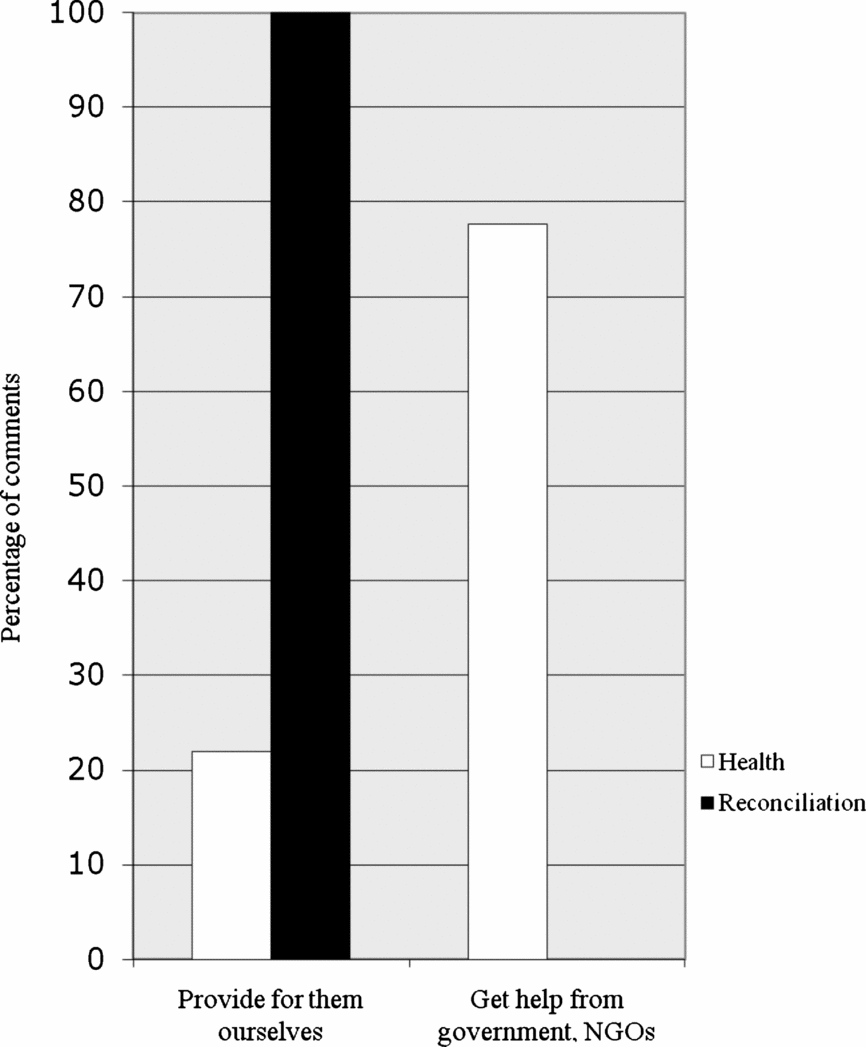
Problem Resolution Results. In every role play, participants decided to welcome the refugees and to shame and sometimes punish those who wanted to keep them out. The striking difference between reconciliation and health scenes lies in how participants arranged to care for the refugees. The two dominant motifs were to handle the problem within the community, by collectively organizing shelter and gathering resources from each family, or to request assistance from the government or NGOs/IOs.
Figure 3 shows that reconciliation groups never asked for help from the government or from an NGO/IO—each time they decided to welcome the refugees, they agreed that they would share with them “the little they had.” By comparison, 16 of the health group's 21 “resolution” comments about how they would provide for the refugees involved asking the government or an NGO to help out (p < .001). Requesting assistance from the state or aid organizations was not a dominant theme of the health program (see Table A1 in Appendix V for precise ratios of speaking turns focusing on community vs. government/NGO/IO help). Some reconciliation scenes did not reach one particular conclusion about how to provide for the refugees (e.g., in three scenes played at the reconciliation prison group, one role-play group self-organized to help the refugees, and the two others were resolved by punishing those who wanted to fight off the refugees). In the health condition, some scenes chose both community and government/NGO/IO help (e.g., deciding to feed the refugees until the Red Cross came).
Despite this striking difference between local responsibility and external aid, it is important to point out that both reconciliation and health participants invented authority characters for each scene. Twenty-six percent and 15% of all “process” comments in scenes in health and reconciliation groups, respectively, concerned the local government. Characters in scenes across all research sites called on important local authorities or on the police for help and advice.
Results for Language Use. The percentage of comments that used government language shows that, on average, 8% of all comments made in each scene drew from the “public transcript.” There were no differences between the reconciliation and health listeners in the percentage of comments using government language. More important, the use of government language was not reliably associated with any particular decision regarding the refugee dilemma. Participants used government language to justify whatever actions they took. (“This is the time of decentralization” was used to argue for providing for the refugees themselves and also for applying to international organizations such as the Red Cross for help.) This finding reveals participants’ opportunistic use of elite parlance, rather than a passive acceptance of media-borne messages “coming from the top.”
Behavior: Unobtrusive Measurement of Community Negotiations
Thus far, we have measured behavior within artificial settings—in focus group discussions and in role-playing activities. We also sought to trigger a more natural dilemma for our participants that would not feel simulated or monitored so that we could observe behavior that is closer to “actual” behavior. At the end of our time in each community, the first author and the research team gathered community members together to thank them for their participation and to share refreshments. During this goodbye party, we presented the group with one battery-operated portable stereo and a set of 14 cassette tapes of the radio program. We acknowledged that there was only one, and suggested that because they were all together they could use this time to decide how to share the stereo, when the group members would listen, and how to keep it supplied with batteries. After this casual suggestion, the research team thanked the participants and sat back down.
Given the monetary value of a portable stereo, this discussion was of great significance to the participants. The measure also captured spontaneous behavior that participants believed to be “off record”—their discussions took place immediately after the research team's presentation. Two researchers sitting discreetly in the back of the group recorded these ensuing discussions by hand, with notebooks in front of them to appear as if they were finishing notes from earlier in the day.
Did the reconciliation radio program's messages have an effect on actual participant behaviors regarding community issues of consequence? Of interest was whether the participants allowed for multiple viewpoints and whether they expressed optimism about cooperating to share this community property. We were also interested in the groups’ ultimate decisions about how to share the communal stereos.
During the health groups’ deliberations about the portable stereo and cassettes, we frequently observed the following pattern: the first member of the group to speak would propose handing over the stereo and cassettes to the village's local authority, who could regulate usage and financial contributions for the batteries. Following this proposal, group members would overwhelmingly support the motion and close the discussion.
In the reconciliation groups, deliberations typically followed a different pattern. After the same initial proposal to entrust the stereo to the authorities, one or more of the participants would challenge this suggestion, for example, claiming that the group should be collectively responsible or should elect one of their members to manage it. Comments about the group's ability to cooperate came up more frequently, such as “We've been coming together to listen all of this time, why can't we come together to listen to this stereo together, just as we did before?”
These different patterns were borne out by statistical analyses of the coded transcripts. Table 5 presents the number of dissenting propositions that followed the initial proposal to assess the extent and openness of the deliberation session. This indicator reveals that reconciliation groups proposed and debated a significantly greater number of views on how to share the communal stereo compared to health groups (using a Mann-Whitney test, z = −2.6, p < .01; using Wilcoxon signed-rank test, which controls for the site strata, z = −2.2, p < .05). The number of positive comments made about group cooperation was also more frequent in reconciliation groups (using a Mann-Whitney test, z = −2.6, p < .01; using Wilcoxon signed-rank test, which controls for the site strata, z = −2.2, p < .05). Importantly, these results were the same for ethnically homogenous Twa and survivor communities and for heterogeneous communities in the general population.
Behaviors Observed During Discussion of Community Resource

Notes: Letters a–g each represent a pair of communities; in each pair, one community was randomly assigned to listen to the health program and the other, the reconciliation program. Transcripts from community discussions were assigned one point for offering a dissenting opinion about the initial position taken by one or more members of the group and for any comment made about the group's ability to cooperate.
Heterogeneity of Experimental Effects
Table 6 summarizes individual- and group-level results for each separate research site, underscoring the remarkable homogeneity of the reconciliation program effects across a range of Rwandan communities. As described in this section, we do find exceptions to this homogeneity in two ethnic subcommunities: the northwest (predominantly Hutu) communities, and the genocide survivor (Tutsi) communities. We test but find little evidence of significant interactions between individual characteristics and exposure to the reconciliation program.
Overview of Results

R, reconciliation; H, health.
Notes: *p < .05; **p < .01. Pluses and minuses represent the prediction for each variable, where a plus indicates that we expect higher scores for the reconciliation listeners.
Entries for columns 1 & 2 are averages of the ratings reported by each individual to statements about dissent and social distance; entries for columns 3–7 are counts of group-generated behavior observed in focus groups (3), role plays (4 & 5), and community negotiation (6 & 7).
a Columns 1 & 2 present ordered probit estimates of treatment effects at the individual level, columns 3–5 present ordered probit estimates of treatment effects at the group level, and the Z statistics in columns 6 & 7 are Mann-Whitney test results of treatment effects at the group level. Focus groups and role plays were not conducted in Twa, western, and northeastern pairs.
Community Characteristics. At the community level, Hutu living in the northwestern research sites and Tutsi living in the genocide survivor communities deviated from the general pattern of experimental findings. Although our small sample of each type of community does not allow us to rule out the possibility of chance fluctuations, these interactions between community identity and reaction to the radio program seem to accord with the communities’ political standings in Rwanda.
As described previously, the predominantly Hutu communities in the northwest region (the seat of Hutu extremism prior to the genocide) are closely monitored by the current Tutsi regime. During data collection, citizens in this region were keenly aware of government surveillance as a result of attacks launched by ex-Habyarimana military from the nearby border, which were reportedly supported by members of the local population (in focus groups, many participants discussed the importance of trusting that your neighbor will not harbor “infiltrators” and thus invite repercussions on the whole community). Table 6 shows that unlike the rest of the sample, the northwest reconciliation listeners were not more likely than the northwest health listeners to perceive a norm of dissent or actually to dissent in the group deliberation (in fact, neither group dissented at all). However, we observe an experimental effect on northwest reconciliation listeners’ open discussions of mistrust, cooperation in group deliberation, and reliance on local aid in the role plays. These findings tell a story consistent with the region's political standing: the reconciliation program successfully facilitated better local interaction and cooperation, but had no effect on willingness to speak out in the context of government surveillance and censure.
Results for the genocide survivor communities stand out in a different way. Genocide survivors are the least likely of all communities in the sample to be censured for politically incorrect speech, as coethnics of the current government and as the government's living justification for speech restrictions and international aid. At odds with government rhetoric about Rwandan unity, and contrary to the rest of the communities’ patterns, no genocide survivor publicly denied the existence of mistrust in their communities. In addition, Table 6 shows that reconciliation listeners in the survivor community called on the government for aid almost as frequently as they offered their own aid in role plays. In line with the rest of the sample, however, survivor reconciliation listeners were more likely to perceive a norm of dissent and to express dissent in the group deliberation compared to survivor health listeners.
Although the two communities react differently to the radio program with respect to certain outcomes, it is important to remember that these communities are similar to other communities with respect to other outcomes—dissent among survivors, and collective action among the northwest communities. In other words, the communities’ politicized identities did not push them entirely out of the radio's range of influence.
Individual Characteristics. Our data do not reveal differences in experimental effects according to individual characteristics such as age, experience of violence, and access to media (see Appendix V, Tables A2 and A3). Although some theories of political cultural change predict that younger generations are more likely to adopt new cultural values (Inglehart Reference Inglehart1997, 15; c.f. Prewitt Reference Prewitt1975), like Rogowski (Reference Rogowski1974), we find no real differences for older and younger cohorts.Footnote 14 Models of self-interest (Sears and Funk Reference Sears and Funk1991) or grievance and blame (Gurr Reference Gurr1970; Iyengar Reference Iyengar1991) might predict the radio impact would vary according to the magnitude of participants’ personal losses in the 1994 violence—but we do not find this to be the case. Treatment effects do not appear to vary by a pretest question asking how many family members were killed by war, genocide, or related violence in 1994. Finally, theories of media sophistication and socialization (Gerbner et al. Reference Gerbner, Gross, Morgan, Signorielli, Shanahan, Bryant and Zillmann2002; Heath and Bryant Reference Heath and Bryant1992) would predict that radio ownership might affect participants’ responses; radio ownership also does not interact with experimental media exposure. This finding also addresses concerns that participants with radios surreptitiously listened to radio programs not assigned to their group in their own time. If contamination had been a serious problem, we might have found different effects for those who own radios.
Discussion
Our evidence suggests that certain behavioral aspects of political culture are malleable in the short run. A mass media program was sufficient to shift perceived norms of open expression and local responsibility for community problems, as well as actual open expression and dissent about sensitive community issues such as trust and resource distribution. Listeners did not become contrarians or antiauthoritarians—for example, when reconciliation listeners decided to take collective responsibility for the hypothetical refugee problem, they created roles for local authorities in their decision-making process. Moreover, the radio program was not a panacea—attitudes toward interaction across social lines were resistant to change. Personal convictions about social group boundaries may be more difficult to change; however, as we have shown in other work, personal convictions may be less important motivations for political behavior than perceptions of what is socially and politically normative (Paluck Reference Paluck2009).
When accounting for change or continuity in some aspect of political culture, most theories point to far-reaching changes in institutional structure or economic conditions (Eckstein Reference Eckstein1988; Inglehart Reference Inglehart1997; Laitin Reference Laitin1986). We do not claim that the radio program, after one year, induced transformative change in Rwanda's political culture. However, the radio drama's portrayal of Rwandan attitudes and behavior toward authority and toward other citizens appears to have influenced the availability of a certain set of behavioral practices (or the cultural “toolkit” of behaviors; Swidler Reference Swidler1986). Theories of political culture that take seriously the role of political practice (see Sewell Reference Sewell and Sewell2005) might regard this as a potential first step toward more fundamental cultural change. We return to this point later.
The behavioral changes induced by this radio program seem to reflect something other than “blind obedience” to the radio or to the research team. For one, we obtained our key measures of behavior in a situation that was putatively off record, in which participants believed researchers were not gauging their response. In addition, we repeatedly find that listeners did not merely endorse what they heard on the radio—reconciliation listeners were not more likely to report that they would affiliate with members of another group, did not adopt beliefs the soap opera encouraged (reported in Paluck Reference Paluck2009), and selectively aligned with characters that broke with rather than conformed to traditional expectations.Footnote 15 As further evidence against passive acceptance of media messages, role-play participants in both listening groups opportunistically used the same government rhetoric to justify different decisions about how to resolve the hypothetical refugee crisis.
The direction of media influence in this study is, in large part, vertical and top-down. It is a program written by educated Rwandans and broadcast on national radio. However, our results suggest that the radio program sparked horizontal peer influences as well. Research assistants’ observation notes from the listening sessions describe high levels of spontaneous discussion about both media programs. The participants’ individual and group-generated responses (regarding social norms, speaking about sensitive social topics, responding as a group to a hypothetical crisis, and group management of a communal resource) suggest that they had come to a joint understanding about the acceptability of dissent and desirability of collective action in their group. Certain group responses may also have been moderated by assessments of the local political context (e.g., northwestern Hutu communities). Separate research programs in very different contexts concur that much of the media's influence is channeled by audience discussion (e.g., Katz and Lazarsfeld Reference Katz and Lazarsfeld1955). We suggest an appropriate way to think about the media's role in influencing political culture is as a connective tissue that transmits messages about culturally appropriate behavior, messages that are discussed and, in some cases, adopted by all levels of society.
A balance of dissent and collective action emerges from various measures. We found an increase in the perceived acceptability of dissent, as well as actual dissent in the individual interviews and the focus groups. Then, holding dissent constant (by presenting dissenting actors in the unfinished radio scenes to all participants), we observed an increase in willingness to collectively provide for hungry refugees among the reconciliation listeners. Our behavioral measurement strategy captured the two phenomena at once: we observed more dissenting opinions on how to share the communal resource (the stereo and cassettes), along with more expressions of cooperation about how to accomplish this feat among reconciliation listeners.
From a normative standpoint, a balance of dissent and collective action seems desirable. On one hand, fully realized collective action with little dissent may lead to phenomena such as blind obedience, crowd behavior, and collective violence. As Gourevitch (Reference Gourevitch1998, 95) observed, “[g]enocide, after all, is an exercise in community building.” On the other hand, unrelenting dissent thwarts collective action. This dilemma calls for a behavioral theory of dissent and collective action that describes mechanisms for achieving productive balances between the two. One mechanism used by social psychologists to explain collective action is collective efficacy, or group members’ belief in the power of the group to achieve goals through collective action (Bandura Reference Bandura2000, 75). Researchers propose that the act of participating in group discussion and decision making enhances the sense of efficacy necessary to the execution of collective action and may teach individuals to avoid blind obedience (e.g., Kelman and Hamilton Reference Kelman and Hamilton1989, 324–5).
Political science is concerned with the ways institutions are internalized—it is one thing to write legislation and enact policies, and it is another for citizens to recognize opportunities and constraints set by these institutions. Clearly, mass communication is an important way in which institutions are translated for public understanding.Footnote 16 This leads to the question: is institutional change a necessary condition for changing public understanding of institutional opportunities and constraints? The provocative suggestion of our current findings is that perhaps it is sufficient to encourage a new understanding of social norms of dissent, deference, or dispute resolution using the media, rather than to launch far-reaching changes in law or policy. Perceptions of social norms—of the typicality and desirability of certain behaviors—may be sufficient to alter which behaviors are selected from the “cultural toolkit.”
Restated, perhaps it is possible to instigate changes in deference, dissent, and collective action by modeling or communicating new social norms rather than by reshaping institutions (formal or informal). This study did not track the effects of an institutional change, yet the observed shifts in rural citizens’ normative perceptions and behavior were of the magnitude that we might expect from institutional or economic adjustment (Jackman and Miller Reference Jackman and Miller2004), not from a radio soap opera. Most citizens have very poor understanding of how institutions work, even those especially interested or motivated (Robinson and Darley Reference Robinson and Darley2003). Citizens also refashion externally imposed institutions according to local traditions (Galvan Reference Galvan2004). Our proposition is social psychological as opposed to structural: what matters, most social psychologists would posit, is the way people perceive rules and structures, rather than the rules or structures themselves. Incentives and constraints can have psychological reality even without a structural basis. Institutional changes and noninstitutional changes may be close cousins when they affect citizens’ perceptions of descriptive norms (i.e., perceptions of what others in their environment are doing) and prescriptive norms (i.e., perceptions of what people in that environment should do).
These results suggest that new perceptions of norms and new patterns of political conduct can develop without institutions, but the next question is whether they can endure without institutional backing. This question is of special relevance for Rwanda, where the current government relies on the same mechanisms previously recognized as facilitating conditions for subordination and conformity. The government has largely maintained a pre-1994 bureaucratic structure and regulation of rural life, including “sensitization” meetings in which peasants gather to receive instructions from state-designated local authorities and umuganda, or forced monthly labor, for the state. Speech is limited—citing previous hate media, the government censors journalists and only recently allowed private radio and press. Speech about ethnicity is criminalized as “divisionist.” One wonders whether a fledgling norm of open dissent can long survive in this context. Moreover, our own findings remind us of the coercive power of institutions for shaping political behavior. The different patterns of dissent we found in communities that are favored or mistrusted by Rwanda's current regime are consistent with other micro-level research showing how institutional authority can channel media messages in Rwanda, with important behavioral consequences (Straus Reference Straus2007).
Given the behavioral constraints that Rwandans face, it is unclear whether the behavioral changes induced by the reconciliation program can precipitate broader changes in Rwandan political culture. We lack systematic evidence with which to gauge long-term change in Rwandan political culture. Recall that our experiment concluded after one year, at which point we provided the reconciliation program to the health group, and follow-up research showed the expected convergence in survey responses across the two experimental groups a year later. To assess the long-term impact of the reconciliation program, now into its fifth year of broadcast, we would at very least need longitudinal survey data, but to our knowledge no such surveys exist. From our long-term research engagement in the country, we know that knowledge of the soap opera is widespread, but its long-term effects remain unknown. Research in years to come may investigate the rate of change and the dynamics of contestation between tradition and transformation in Rwanda.
Deepening our understanding of media influence, behavioral change and political culture requires more studies in a variety of media and institutional settings. This study presents a provocative set of findings, but more important it provides a template for future work. This template brings together a number of elements that are often recommended but seldom used in concert: the use of random assignment to create treatment and control groups, the study of real world media interventions in naturalistic settings, and the development and implementation of a variety of qualitative and quantitative approaches to the measurement of outcomes. Like other recent experiments and quasiexperiments in developing countries (Blattman Reference Blattman2008; Wantchekon Reference Wantchekon2003), this study calls into question the presumed infeasibility of this type of political science research. Nevertheless, this line of research remains in its infancy, and the task ahead is to use this template to study longer time frames, different interventions, and varying political contexts.
APPENDIX I: PROCEDURAL AND ETHICAL PROTOCOL DETAILS OF THE EXPERIMENT
To conduct this experiment, we worked in close collaboration with the nongovernmental organization (NGO), LaBenevolencija, a Dutch-based NGO that works in the Great Lakes region of Africa (specifically, Rwanda, DRC, and Burundi). The NGO began work in Rwanda in 2003, with funding from international government donors. The direct research costs of this study were funded by budget lines the NGO's donors reserved for an evaluation, as well as by funds the authors raised in academic grants awarded specifically for this project and in funds for field experimentation conducted out of the Institution for Social and Policy Studies at Yale.
Our collaboration with the NGO began when the first author contacted the NGO in 2003, after learning through a Web site about its aims to create a radio soap opera. The NGO's stated purpose, in their words, was to create more “active bystanders” in the population, to encourage citizens to speak out against discrimination and violence, and to educate people about the evolution of violence. The NGO had solicited the help of two psychologists to provide the Rwandan scriptwriters with theoretically informed messages about dissent and the progression of violence.
The first author spent one month conducting qualitative research in Rwanda for the NGO, directing focus groups with rural Rwandans about media and the topics of the prospective soap opera. After this research, the authors presented the NGO with a methodological design for measuring the impact of the radio soap opera. The NGO contracted us to conduct their impact evaluation as pro bono consultants; their two stipulations were that the study test acceptance of specific messages written by the consulting psychologists, and that it sample from the Twa, genocide survivor, and prison subpopulations, as well as the general population (to reflect their wide target population as well as the sample used in background research on the soap opera plot conducted by Suzanne Fisher and Solange Ayanone; see Fisher Reference Fisher2004).
We sought ethics reviews for the proposed study protocol in Rwanda and in the United States from Yale's institutional review board (IRB). Because there was no official IRB in Rwanda at the time, we reviewed our design with several Rwandan academics, with international researchers who had experience conducting surveys or program evaluations in Rwanda, and with advocacy and human rights groups in Rwanda, including prison advocacy groups. Yale University's IRB reviewed and approved the entire research design, including the unobtrusive behavioral measurement.
The final research protocol, developed under the supervision of the Yale IRB, included a protocol for participant informed consent. This verbal consent informed participants that they could opt to drop out of the study at any time or refuse to answer any questions posed to them. It warned them about the possibility that some questions might be emotionally evocative and underscored their right to free psychological treatment for emotional disturbance. The Yale University IRB required that we pay for any necessary trauma counseling subsequent to the interview. In addition, our research team traveled with a trained Rwandan psychologist whose services were used only once, for a woman who became upset after speaking about her experience during the genocide in her individual interview. Participants were also informed about the protection and confidentiality of their data. Each participant discussed the verbal informed consent twice: once when agreeing to participate in the study, and the second time at the end of the year prior to participation in the outcome measurement. The IRB did not require us to debrief participants after the unobtrusive behavioral measurement procedure. Widely adopted ethical standards for IRBs state that recording behaviors anonymously (without recording the names of people enacting the behavior) does not require informed consent or debriefing.
When this report was drafted, the first author was at Harvard, where we reapplied to the Harvard IRB for permission to use the data collected with the prison population. The prison data technically belonged to the NGO. We collected these data at the request of the NGO, at the same time and using the same protocol described previously. However, we had not obtained permission to work with this population as academics through the Yale IRB because the board was concerned that the prison authorities had reserved the right to exclude some prisoners from participation. (Their judgment ran contrary to our local Rwandan review, where a local prison advocacy group and several Rwandan academics reviewed and approved the protocol.) As requested by the NGO, we proceeded with the data collection in the two prisons; however, as stipulated by US IRB procedures, we did so as consultants and did not use prison data in academic presentations or writing. In the prisons, we worked closely with prison authorities to determine whether any prisoner was forced to comply with our request to join the study. It turned out that our study was of no particular concern to prison authorities, who did not attend the radio listening gatherings and limited their communication with us after ensuring that high-security prisoners were ineligible for participation in our study. Given that the project was locally endorsed and we observed no interference from prison authorities, we applied to the Harvard IRB to use the prisoner's data in the analyses for this article. The Harvard IRB reviewed the case and granted our request. We believed that the data were important to include because they demonstrate how the media affects different populations.
APPENDIX II: INDIVIDUAL QUESTIONNAIRE
Introduction (after informed consent): This interview contains many statements and opinions given by other people in Rwanda. We want to know whether you agree or disagree with them, and if you agree or disagree somewhat or a lot (four-point scale is repeated after each statement where appropriate).
1. I am helpless to prevent violence in my community. (Program content question)
2. If my colleagues endorse a bad ideology, I cannot change their mind by speaking out against it. (Program content question)
** Empathy scale: I'm going to ask you if you ever try to imagine the thoughts or feelings of other people who you don't know in Rwanda.
3. Do you ever try to imagine the thoughts or feelings of other people who are prisoners in Rwanda? (When asking this question in the prisons, researchers explained that they should respond as though they were speaking about prisoners in other prisons, not themselves or their fellow prisoners.)
4. Do you ever try to imagine the thoughts or feelings of other people who are survivors in Rwanda? (When asking this question in the survivor communities, researchers explained that they should respond as though they were speaking about survivors in other communities, not themselves or their neighbors.)
5. Do you ever try to imagine the thoughts or feelings of other people who are poor in Rwanda? (Control question)
6. Do you ever try to imagine the thoughts or feelings of other people who are leaders in Rwanda?
7. When people marry each other from different (regions, religions, ethnicities, etc.) this contributes to the peace.
8. People who cannot meet their physical and psychological needs are more likely to blame someone else for their problems.
9. One group of people (this is referring to regions, religions, ethnicity, etc.) is often blamed for troubles experienced by the whole country.
[Note: This question was not used for analysis because it was mistranslated in the questionnaire. It was intended to read as “one group of people is often responsible for troubles experienced by the whole country.]
10. What if a member of your family dies suddenly, and you hear that that person had a meal at the neighbor's house right before he or she died and they poisoned his or her food. (Program content question)
• What would you think when you heard this story?
• What would you do after you heard the story?
11. Violence like the violence that happened in Rwanda in 1994 comes about suddenly.
12. Mass violence comes out of small actions, like spreading negative ideas about a group of people, or stealing from them.
13. Think back to the years of 1993, 1994, and 1995. Did you know anyone during that time who did or said things that you admire?
IF YES: why did you think so?
[Note: This question was not used for analysis because researchers experienced difficulties in posing the question to participants.]
14. If I stand by while others commit evil actions, I am also responsible. (Program content question)
15. If I disagree with something that someone is doing or saying, I should keep quiet.
16. In Rwanda's history, there has been much violence, but many people from each group (again, I'm referring to regions, religions, and ethnicity) have not participated in that violence.
[Note: This question was not used for analysis because researchers experienced difficulties in posing the question to participants.]
17. **Social distance scale: Think about a person from a different religion, region, or ethnicity who has done harm to a person from your group in the past. Would you be willing to
a. Greet this person on the street?
b. Work with this person?
c. Share a beer (question for males) share food (question for females) with this person?
d. Allow your child to marry one of his or her children?
18. I advise my children (or the ones I will have in the future) to only marry people from the same group (regions, religions, ethnicities) as theirs.
19. Traumatized people are “mad” (crazy).
20. Traumatized people can recover.
21. Bad memories and grief can make people seek violent revenge.
22. It is better for my mental health to never talk about the experiences that have caused me great pain and suffering.
23. I have told someone, like a friend or a family member, about my experiences that have caused me great pain and suffering. (yes/no) (Program content question)
• IF NO: I want to tell someone about my memories that caused me great pain and suffering.
24. Perpetrators of violence can also be traumatized by their own actions.
25. Someone has talked to me about their experiences that have caused them great pain and suffering.
26. Recovering from grief (intimba) and from trauma (ihungabana) may take a very long time.
27. There is mistrust (ukutizerana) in my village.
28. It is naïve to trust people.
29. A pregnant woman who has AIDS can be given a chance to have a healthy baby.
30. You can safely share something with someone who has AIDS.
31. It is necessary that every woman who is pregnant go to the health center to be tested.
APPENDIX III: UNFINISHED RADIO SCENE USED FOR ROLE PLAY
NARRATOR: We are in the village of MAHINYUZA at the border. Some of the villagers of Mahinyuza have started to discuss the rumor they have heard that the villagers of MAKOBA in the neighboring country are going to migrate from their village, fleeing a rampant famine that is going to kill them. KANDONYI, MUKAMA, AND CACANA are discussing this news, but there are other people around. [For women's version: After the conversation between the three men is over, I would like to ask the women present here to give comments on the scene, and after, to take a role and finish the story.]
KANDONYI: Mukama, do you know why I have come to see you? Although I know that this rampant famine didn't spare you either, please do your best and find me one thousand francs to lend me, to buy beans for my children. They didn't eat last night!
MUKAMA: Even me, I'm so poor and hungry that when I sneeze, my teeth fall out. But let me give you the last two hundred that I have. (Starts to check in his pockets) My father Rwabuzisoni gave me a cow! Where is the money that I had from that?
KANDONYI: Do you mean you can't find it? Please check well so that can I go and save my children before hunger kills them.
MUKAMA: Where is it? When I left Makoba I had it! Maybe it's the people of Makoba who stole it! I don't trust them.
CACANA: (Runs up to them, out of breath) You, people at Mukama's place!
MUKAMA: (Surprised) Cacana, what happened to make you run so fast you cut through trees and stones?
KANDONYI: Cacana, is the situation peaceful?
CACANA: I have passed here to tell you what I have heard in the pub so that we can consider what we can do.
MUKAMA: (Worriedly) What's that you have heard in the pub?
KANDONYI: Let it be of sweat and not of blood!
CACANA: (Fearfully) I have heard that our neighbors of Makoba have packed all their things to come settle here, because in their village it takes five men to close a door (a Kinyarwanda proverb meaning they're weak and hungry).
MUKAMA: (Shocked) My goodness! They want to migrate here! Do they think that we were spared from the famine! Even us, we're so hungry that when the flies buzz around our eyes we try to kill them and eat them. They have to look for somewhere else instead of coming here to finish the little we have!
CACANA: I have come to tell you the measures we have already taken with the people who have told me that. We have decided to go to the border and stop them from coming to Mahinyuza. Because you know the problem we have here.
KANDONYI: Yah, babababababa. (exclamation) Why do you think like that? Instead of looking at how to receive and welcome them warmly as neighbors, you are setting up tricks to stop them!
MUKAMA: Can you believe what this man is saying! While we are crying, you are singing! If we let them come, what will you eat? You were saying that your children are suffering from hunger, and you are borrowing money! They can't put their feet on this soil, they have to go elsewhere!
CACANA: You are delaying! And if we delay, they will be here in a very short time.
KANDONYI: Let's welcome them warmly and share the little we have. They may save us in the future, you never know. What if you stop them and they fight you?
CACANA: Fighting us! Are they stronger than we? Mukama and I are resolved to arm ourselves with our traditional weapons, so that if they try to force entry into our village, we'll make them tremble with our threats.
KANDONYI: What you want to do is not good. That's violence.
MUKAMA: (Talks as he leaves) Caca, let me get my sword from its girdle and chase them away. (His voice becomes more distant as he leaves.) Maybe it's they who took my money, as I was saying! It's possible it's them! They were all made from the same hammer. Leave alone Kandonyi who is talking nonsense!
APPENDIX IV: CALCULATION OF ROLE-PLAY STATISTICS
We describe two methods for calculating the relative frequency of each code for reconciliation and health role plays in comparison to the total number of codes. First, let Ck denote the code assigned to line k. We are interested in the relative frequency with which lines are assigned to code k = K and, in particular, the way this rate varies between treatment and control groups. One simple approach is to calculate the total number of k = K codes in each experimental group and divide by the sum of all codes assigned to those lines. For example, the rate of k = K codes in the reconciliation group across all sites s, all groups g within those sites, and all versions v enacted by each group is

An alternative approach calculates the percentage of codes k = K within each site and then averages these percentages across sites. Thus, for example, the rate in the reconciliation group would be calculated as
where the number of sites S is 7. The main difference between these two approaches is that the latter weights all sites equally, whereas the former weights the data so that all line codes have equal weight.
APPENDIX V: SUPPLEMENTAL TABLES
Ratio of Community-Based and Government/NGO-Based Solutions Proposed per Scene in Reconciliation and Health Role Plays

NGO, nongovernmental organization.
Note: Entries are counts or ratios of actions from the role plays conducted in each research site.
Conditional Effects of Radio Treatment on Dissent: Interactions with Age, Experience of Violence, and Access to Media

Notes: *p < .05, **p < .001, two tailed. None of the estimated interaction effects approaches statistical significance. Dissent is measured using a survey item that ranges from 1 (I should stay quiet) to 4 (I should dissent). Reconciliation is scored 1 if for the reconciliation program and 0 for the health program. Age is measured in years. Experience of violence is coded 1 = no family members lost and 2 = yes, family members lost. Access to media is coded 1 = does not own a radio and 2 = owns radio.
Conditional Effects of Radio Treatment on Social Distance According to Age, Experience of Violence, and Access to Media

Notes: *p < .05, **p < .001, two tailed. None of the estimated interaction effects approaches statistical significance. See Table 4 for scoring of social distance scale, which is the sum of four survey responses. Reconciliation is scored 1 if for the reconciliation program and 0 for the health program. Age is measured in years. Experience of violence is coded 1 = no family members lost and 2 = yes, family members lost. Access to media is coded 1 = does not own a radio and 2 = owns radio.
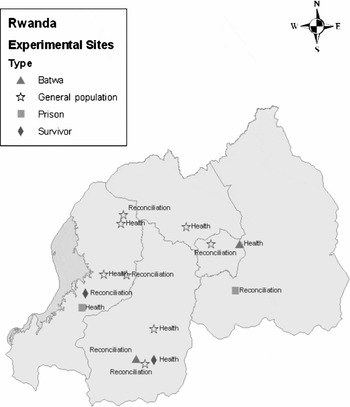
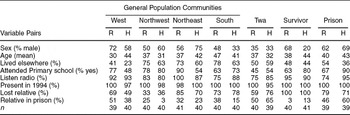
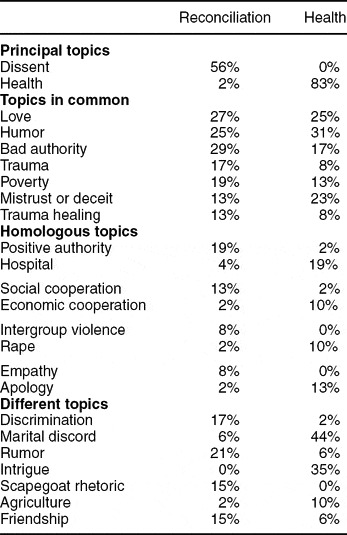
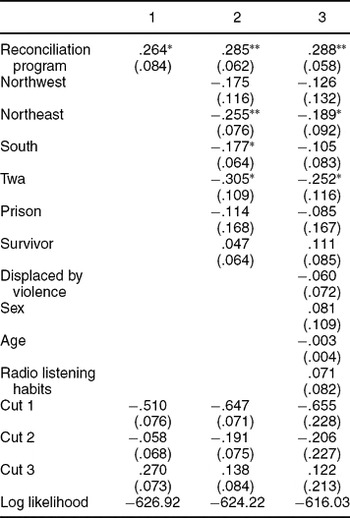
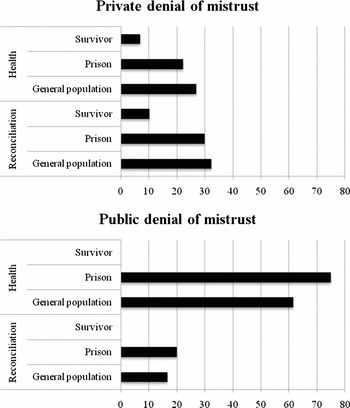
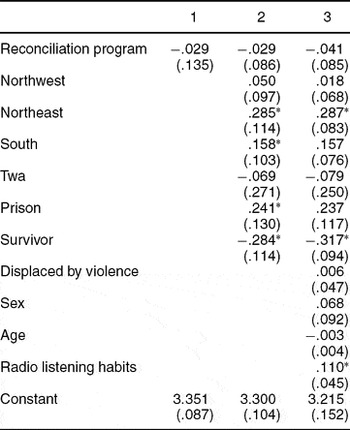
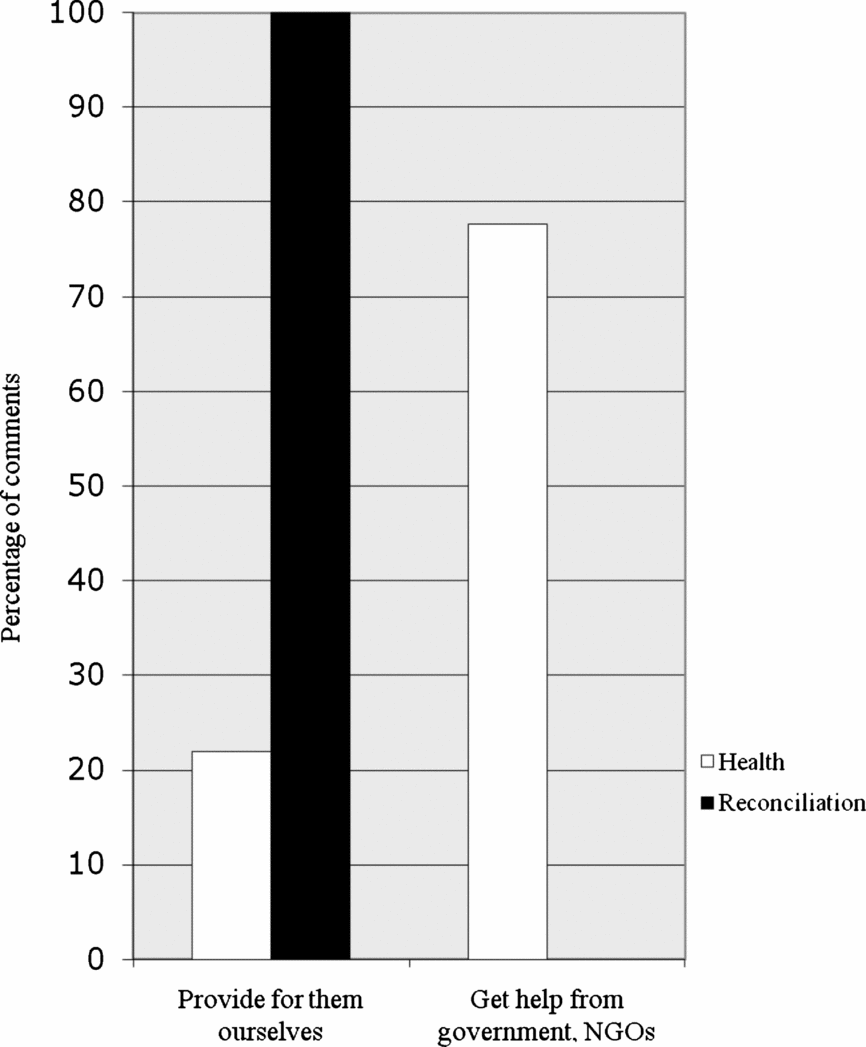
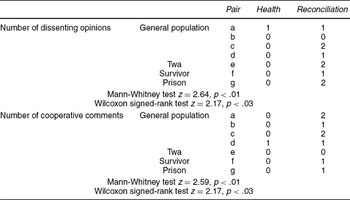
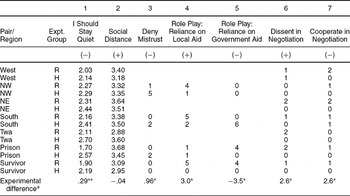
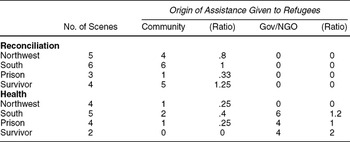
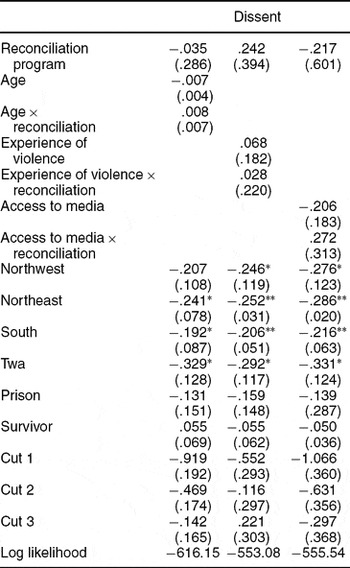
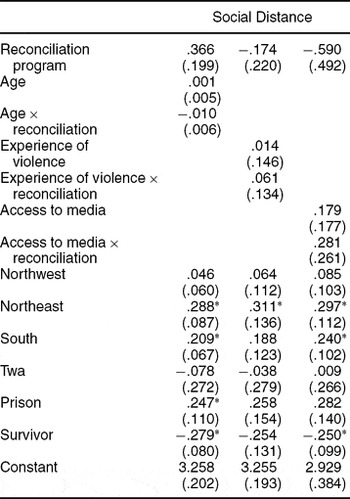



Comments
No Comments have been published for this article.