


Introduction
Job shadowing refers to ‘extended time, often a full workday or several workdays, spent by a youth in a workplace accompanying an employee in the performance of his or her daily duties’ (Luecking, Reference Luecking2009, p. 13). For pre-service rehabilitation professionals, job shadowing is their first exposure to their future career and predominantly orbits around the tasks associated with the position of case manager. Typical tasks include: providing emotional support to clients, interviewing individuals and families, developing written documentation of interactions, advocacy, identifying and coordinating community resources and responding to clients when conflicts arise (Herbert, Barrett, Evenson, & Jacob, Reference Herbert, Barrett, Evenson and Jacob2010). These capabilities require understanding of specific services as well as the process required to coordinate all aspects of a case. The pedagogic value of job shadowing is explained by the learning gains that come with experiential learning: concrete experience, reflective observation, abstract conceptualisation, and active experimentation (Kolb, Reference Kolb1984).
Job Shadowing and Rehabilitation Education
Current rehabilitation practices infuse job shadowing, a best practice for young adults, when working with clients (Lozada, Reference Lozada2001). This practice is based on research-supported advantages of job shadowing for building commitment to an organisation (Earnest, Allen, & Landis, Reference Earnest, Allen and Landis2011) and acquisition of effective job performance skills (Gilboa, Shirom, Fried, & Cooper, Reference Gilboa, Shirom, Fried and Cooper2008). Early realistic job shadowing experiences also increases involvement and engagement by participants (Bauer & Green, Reference Bauer and Green1994). Moreover, job shadowing promotes interprofessional learning (Kidgell, Reference Kidgell2009) through and acquisition of requisite professional predispositions important for overall future career choice (Winship, Reference Winship2014). A typical job shadowing experience assignment involves rehabilitation students observing a professional during a typical workday inclusive of coordination of available services within agencies (Lozada, Reference Lozada2001). While the field of rehabilitation has largely supported job shadowing in assisting clients with career exploration and attitude development, there have been few educational research studies published that have examined the impact of brief job shadowing experience at the undergraduate level.
This study sought to provide preliminary evidence of the efficacy of a brief job shadowing intervention for undergraduate rehabilitation services students learning about the roles and functions of the case manager position.
Method
Research Design
Interpretative Phenomenological Analysis (IPA) was determined to be an appropriate analysis tool based on the relatively small sample, allowing the researchers to perform an in-depth analysis with each individual as the unit of analysis, while exploring all issues across the sample (Smith et al., Reference Smith, Flower and Larkin2009). This approach explores in detail how participants create an understanding of their personal and social world. Further, this analysis places great emphasis on including considerable attention to the verbal descriptions of the phenomenon given by the participants themselves. The main emphasis for an IPA study is to reflect on the meanings of certain experiences and events for participants. As a result, the analysis becomes not only phenomenological (in that it represents the personal view), but also becomes interpretative in nature (dependent on the researcher's stance). Also, it is important to understand that meaning cannot be separated from the object nor can it be separated from the interpretation by the individual.
Participants and Setting
Participants were 61 undergraduate rehabilitation services students enrolled in a case management course (females = 90 per cent, age range 18–22 for 79 per cent of sample. The sample was reflective of the overall student body in undergraduate rehabilitation services programmes, yet much higher than the university of study's average enrollment of 52 per cent female to 48 per cent male ratio.
Description of the Job Shadowing Instructional Features
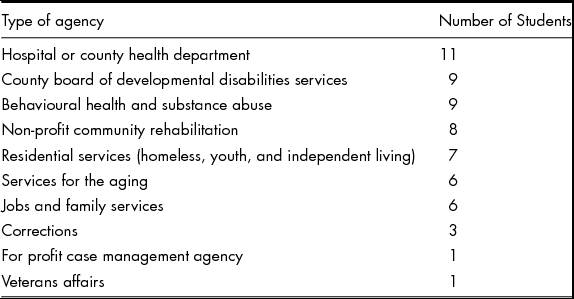
As a part of the course offering on the role and function of case managers, students were required to complete an 8-hour job shadowing experience with an approved agency of their choosing. Every student was required to locate his or her own case manager to job shadow based on future career interests, preferred geographic location, and previous networking opportunities. Frequencies of the types of case management agencies utilised for the job shadowing experiences is presented in Table 1. Upon completion of the job shadowing experience, students were directed by the instructor to submit a form signed by the job shadowed case manager verifying completed hours.
Frequency of Types of Agencies Utilised for the Job Shadowing

Data Collection
At the end of the placement, each student was to submit a three to five page reflection ‘describing the experience and learning achieved’. Student could elect to report on significant learning from their individual perspectives rather than reporting on aspects pre-selected by the instructor.
Data Analysis
The unit of analysis being the individual was a logical choice in order to more fully understand the meaning and interpretation of the lived experiences of undergraduate students as relayed by their written descriptions (Denzin & Lincoln, Reference Denzin and Lincoln2013). Reflections were analysed in accordance with the principles of IPA by two researchers (Creswell, Reference Creswell1998; Reference Creswell2007). These include organising, reflecting, and describing emerging themes. As themes began to emerge from the experiences, they were clustered into larger units and named based on the words of the participants. After repeating this process, common themes were outlined across individual job shadowing experiences. After completion of the analysis, triangulation occurred in which a third researcher conducted an independent analysis of the themes and student perceptions.
Results
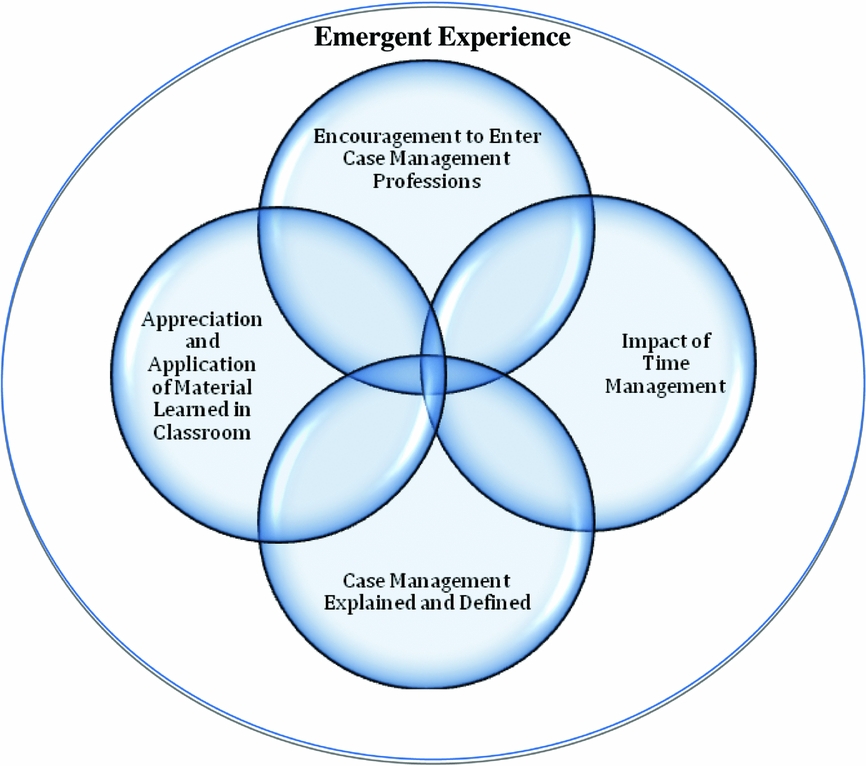
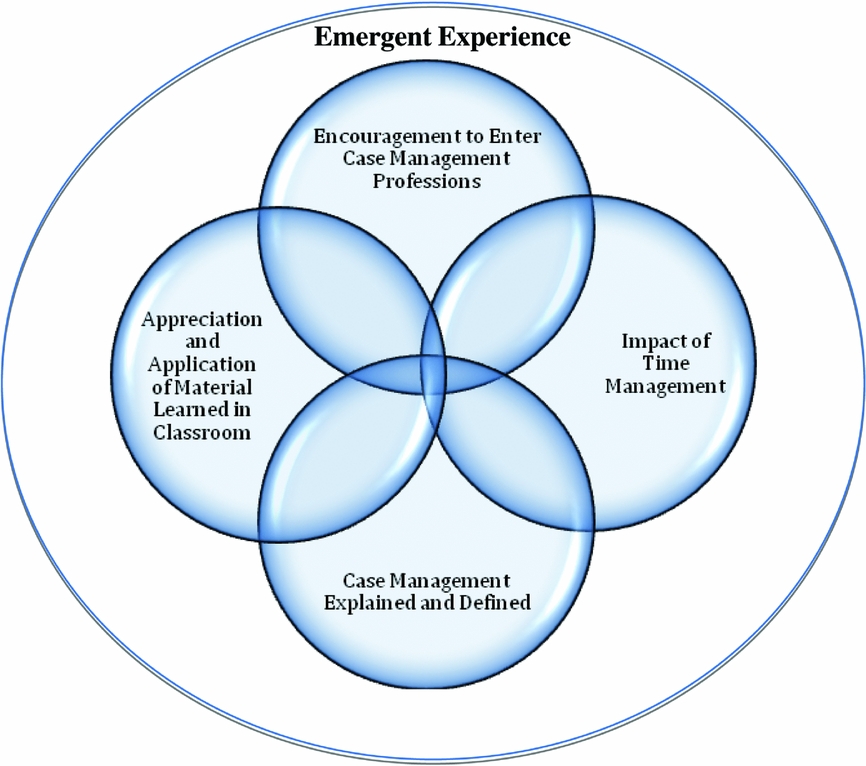
Based on the thematic analysis, several themes emerged as key elements when focusing on the personal meanings associated with exposure to the case manager (see Figure 1). These personally significant learning outcomes are described below.
Graphic representation of the thematic structure, including ground and emergent themes.
Thematic Grounding
The thematic ground was identified as ‘positive experience’ and/or ‘negative experience’ or emergent experience. The ground was a pervasive aspect of each experience as well as a unifying foundation underlying each of the figural themes.
Positive experience
Each student described their personal experience of job shadowing a case manager as positive in many ways, illuminating this common ground. Although diversely expressed through specific examples, each written work comprised positive statements in regard to the assignment. The overarching message from the undergraduate students’ descriptions was that this was a beneficial, useful, and overall positive experience that unmistakably created this emergent thematic ground as the most prominent theme across participants.
Positive experience was illustrated by the participants’ use of the concepts related to enjoyment throughout their reflections to illustrate the positive ways in which they experienced case management job shadowing. Forms of the words enjoy and like were used repeatedly by each participant to describe his or her experience. For example, one student stated, ‘I truly enjoyed this experience and thought it was a great assignment to complete this class’ (Participant #09, female, age 21, services for the aging). Another student stated, ‘I really enjoyed my time shadowing {name omitted}. . .the experience was a great one’ (Participant #03, female, age 24, county board of developmental disability services). Another noted, ‘I really enjoyed my day job shadowing and would recommend it to classes to come’ (Participant #12, female, age 21, services for the aging).
Understanding professional roles
Specific aspects of the positive experience involved the personal benefits and understanding of professional roles derived from their experiences as observers in the field. These benefits were described in terms of prospective career choice. One participant described the positive impact that the activity had on her possible career choice as, ‘After completing this assignment I have gained a brand new perspective. . . I think working in the field of developmental disabilities as a caseworker would be a life changing experience as well as one to love’ (Participant #15, female, age 27, county board of developmental disability services). Another student remarked, ‘While casework in a hospital is not my ideal job I do think that I could be very good at casework management and I believe that it's a job I would enjoy’ (Participant #22, female, age 52, hospital or county health department).
Case management skills
Skill development was also addressed in the reflections. One participant focused on the case management skills gained through job shadowing to describe the benefits that made shadowing the case manager a positive experience, ‘I've learned as a case manager, we have to do paperwork in order to have time with clients. . .the interaction with the clients is enjoyable and fulfilling portion of the job. . .not the mounds of paperwork’ (Participant #05, female, age 27, non-profit community rehabilitation). Another participant stated, ‘Prior to my job shadowing experience, I was not able to apply my knowledge in the field. Through this experience, I was able to use what I have learned of case management thus far, and implement my knowledge to the field’ (Participant #17, male, age 22, non-profit community rehabilitation).
Negative aspects of job shadowing
Although the ground of positive experience was prevalent in each transcript, it must be noted that students did intermittently refer to the negative aspects of being in the case management job shadowing experience. However, when the negative aspects were mentioned, it seemed that they were intertwined with positive aspects that typically overshadowed the negative. One student discussed past shortcomings she was able to recognise after the experience stating, ‘After this job shadowing experience, I feel stupid about inaccuracies and lack of thorough explanation from my group presentation {in another class}. . .. On a positive note, after this experience, I am highly considering becoming a VRC as a possible career option. I believe I have the skills and traits that would make a good VRC’ (Participant #6, female, age 21, veteran affairs). Another student remarked, ‘While sitting in class hearing so many times about the need of documentation I never thought it was serious, but she definitely made it clear that without documentation one could be in trouble or even lose their job after so many mishaps’ (Participant #30, female, age 22, residential services). Another participant described how the negative aspects of the case management job shadowing experience were offset by the positive aspects:
I was overwhelmed with the amount of information that I was presented with while at my field experience but it was worth every moment. I was able to learn a great deal in a short amount of time and I feel strongly that my experience was beneficial to my learning and future career path. I learned a wide variety of responsibilities, skills, systems, and practices involved in this field (Participant #25, female, age 26, county board of developmental disability services).
Emergent Themes
The thematic structure included a ground from which four broad themes emerged with each theme representing an aspect of the students’ experience that was both distinguishable from, yet interrelated too, the others: encouragement to enter case management professions, case management explained and defined, impact of time management, and appreciation/application of material learned in the classroom.
Encouragement to enter case management professions
All of the participants shared statements that suggest a change in their perspectives as a result of their job shadowing experience with case managers. This theme embodied a greater understanding of students’ feelings toward the field of case management. One participant illustrated how important their experiences had been in shaping their future career choices in the area of case management. ‘After spending a day in a case manager's shoes it made me think twice about case managing. . .instead of thinking of this occupation as just paperwork, you are still being hands on and still beginning and sustaining relationships with your clients. . . I may just like it’ (Participant #52, female, age 22, non-profit community rehabilitation agency). Another participant explained, ‘It {job shadowing} allowed me to see all that goes into case management and how much time is spent on written details. It seems like {name omitted} finds it to be a very rewarding occupation, and this makes me excited for my future career’ (Participant #35, female, age 24, county board of developmental disability services). ‘Without this opportunity I would have not pursued this field and my future goals have been positively impacted’ (Participant #38, female, age 27, corrections) was another concise statement to this effect.
Case management explained and defined
A second primary theme emerged with participants’ observation of basic elements, duties, responsibilities, and techniques of the case management position. There emerged from this observation the need to explain the case manager's roles, functions, and responsibilities in the context of their positions. One participant described the intense way in which the case manager walked her through understanding of the case management process. ‘She walked me through every procedure she did with the clients. She gave me background information on clients before we arrived so I could establish a connection with the client before I met them, and understand exactly what she was doing’ (Participant #09, female, age 21, services for the aging). Another student described her experience through focusing on the skills and techniques of the case manager. ‘I learned that a case manager has many duties and responsibilities and techniques that she must use continually. Not only does a case manager need excellent people skills, but also skills to complete a massive amount of paperwork after each client interaction’ (Participant #48, female, age 22, behavioural health and substance abuse). Still another participant explored how the case manager explained her caseload through demonstration as such roles, functions, and responsibilities are crucial for case management success in professional practice. ‘{She} showed me how her computer system works. She explained that she has a caseload of clients that are hers. . . to write down and document everything. . . She showed me how she inputs all her case notes, letters, drug screens, and all important information’ (Participant #50, female, age 25, behavioural health and substance abuse). Undergraduates were also challenged to explore the importance of understanding the varying roles and functions of the professional in diverse rehabilitation settings. This is best illustrated by the following statement:
She wore many hats throughout the day and she handled it all with grace and professionalism. She was caring and attentive. It was apparent that she was in charge of many aspects of a patient's care. . .but she also works to get them any other services they need in order to make their quality of life better. At times it seemed she was juggling a number of things for a number of different cases. . .but through the challenge she made it look easy. (Participant #23, female, age 47, services for the aging).
Time management resourcing
Another primary theme emerged with participants’ exploration of the struggle by case managers to achieve functional control over their case management duties and responsibilities. Regardless of the setting or specialisation, this struggle involved the ongoing process of managing varying sizes of caseloads, and providing services in an effective and efficient manner within the context of time. One participant described the need for time efficiency in the overall case management process. ‘We had two patients not show up at all. We talked about the concept of double booking and taking your chances that everyone would show up. Time is needed between clients to document the services provided and referred, so if you are double booked, it would be difficult to do case management effectively’ (Participant #26, female, age 49, hospital or county health department). Another participant explored the element of time management in the context of caseload size, activities, and outcomes in the rehabilitation process. ‘It's truly amazing how case managers have time to keep everything organized from client to client, contact to contact, and document everything while having such a big caseload’ (Participant #58, female, age 21, behavioural health and substance abuse agency). The same participant reflected on the need to not only address time management, but to understand personal limitations in this area, ‘. . .case managers gotta have excellent time management skills and multitasking skills. . .two skills which I greatly need to improve on’ (Participant #58, female, age 21, behavioural health and substance abuse agency). Coming full circle, one participant was encouraged to develop personal time management techniques that would support successful case management services by stating, ‘The biggest lesson I learned in my volunteer experience was time management. To me this was a very important lesson. And I learned that I want to be an efficient case manager because to me if you do not do things in a timely manner the client is the one who suffers behind it’ (Participant #24, female, age 22, residential services agency).
Appreciation and application of material learned in the classroom
A final primary theme emerged with participants’ realisation that material learned in the classroom could be applied to the ‘real life’ case management process, for instance: documentation and tracking, initial interviews, case planning, referrals, and staffing cases. Another student reflected that ‘I always hear my peers say things like, ‘I don't know why I am taking this class, this has nothing to do with my career choice. Job Shadowing at this facility, that one work day, touched almost every subject I have covered in my Rehabilitation classes, even counseling classes’ (Participant #41, female, age 21, jobs and family services agency). Another participant stated, ‘Many of the jobs and tasks I took part in or observed reminded me of the case management process found in Chapter 3 of the course text book’ (Participant #61, female, age 23, residential services agency). One student summarised her experience by engaging in self-reflection that included the following, ‘Overall my experience at the facility was a success. I was nervous at first walking into the facility because it was out of my comfort zone and the class was fairly new. I realize now that after being in the course for 11 weeks that a lot that I have learned was applied in the workplace. I wouldn't mind and think it would benefit me more going into a site like this with all the knowledge I have gained from this class’ (Participant #60, male, age 22, jobs and family services agency).
Discussion
Four themes that emerged from the case management job shadowing experience were: encouragement to enter case management professions, case management explained and defined, impact of time management, and appreciation and application of material learned in the classroom. Each theme was distinctive yet interrelated with representative quotations provided to lend credence and support from the overall participants’ experiences. These qualitative results are significant as they provide evidence of the effect of this type of learning activity on undergraduate rehabilitation students’ learning, an area largely ignored in the greater body of rehabilitation education research.
Positive and Negative Aspects of Job Shadowing
Each participant in the study described the activity of shadowing a case manager as overwhelmingly positive. The concept of personal benefit, knowledge, expertise, and understanding were used to describe the positive aspects of this experience. These findings extend general research supporting the importance of job shadowing experiences (Kidgell, Reference Kidgell2009; Lozada, Reference Lozada2001), to the field of undergraduate rehabilitation education and professional development. Furthermore, the perceptions of negative aspects of the shadowing experience were contained within and overshadowed by comments about positive aspects, thereby refuting a negative outcome for the overall job shadowing experience. While all job shadowing experiences are unique, within this experience was a hidden conversion opportunity for greater understanding of the self. Self-awareness appears intertwined with encouragement propelling certain participants to consider future case management opportunities, while others emerge disillusioned, choosing to avoid this area of professional practice.
Case Management Explained and Defined
Historically, it has been suggested that explaining and defining the position of case manager is one that is extremely challenging for the field, as there are some ambiguous descriptions for guiding the professional (Cassell & Mulkey, Reference Cassell and Mulkey1985; Griffith & Frieden, Reference Griffith and Frieden2000). Specifically, definitions of the roles and functions of a case manager commonly range from general to specific, and vary extensively regardless of setting or specialisation. Therefore, exploring the diverse meanings and roles of a case manager is both important for a pre-service professional in order to perform job tasks, duties, and responsibilities once in the field, albeit challenging. This theme demonstrates undergraduates grappling with the exploring and comprehending of varying roles and functions of the professional in diverse rehabilitation settings.
Impact of Time Management
Time management in rehabilitation settings is both essential and problematic for even the most seasoned professionals (Cassell & Mulkey, Reference Cassell and Mulkey1985; Grubbs, Cassell & Mulkey, Reference Grubbs, Cassell and Mulkey2006). The perception of rehabilitation professionals that time is viewed as the most formidable of all elements to be managed (Casssell & Mulkey, Reference Cassell and Mulkey1985; Grubbs, Cassell & Mulkey, Reference Grubbs, Cassell and Mulkey2006; Rawlins-Alderman & Dunn, Reference Rawlins-Alderman and Dunn2015) is reflected in this theme emerging from undergraduates. The vast array of activities required of professionals, and the frequency by which they interact with others, becomes a typical barrier to efficient management in the overall caseload. Although there were times professionals exhibited a lack of establishing time management priorities, the experience shared with undergraduates suggest encouragement to develop personal time management techniques that would support their successful case management practice in the future.
Two of the emergent themes of this study (case management explained and defined, and impact of time management) have been evident concepts throughout rehabilitation research (Dunn, Grubbs & Mulkey, Reference Dunn, Grubbs and Mulkey2007; Lustig & Strauser, Reference Lustig and Strauser2009), and, therefore, lend credence to the thematic structure of the study as reported by representatives of the experience and the benefits of a short-term job shadowing experience for undergraduate rehabilitation students. In addition, the third emergent theme, encouragement to enter case management, extends current research to include the influence of practicing professionals on the occupational choices of undergraduates in the field of rehabilitation.
Appreciation and Application of Classroom Materials
The ability to apply what has been learned at the conceptual level in a classroom or through a textbook when on the job can be difficult for pre-service students. This research demonstrates that even a one-day observational experience allowed the students an opportunity to observe the application of theoretical concepts and classroom materials in a real-world setting. Through this activity, students were able to develop an appreciation for the materials/theories being offered in the classroom setting.
Implications for Rehabilitation Education Practice and Research
The study also provides preliminary evidence on the benefits of short-term job shadowing experiences in deepening student understanding of case manager roles. Rehabilitation agencies are unique partners in education that, by providing shadowing opportunity for a student, not only supports the development of future rehabilitation professionals but also provides opportunities for recruitment of future interns and employees, allows professionals to share their knowledge and passion for the field with pre-service professionals, and creates additional networking channels for possible future referral sources. Further research is needed on the influence of practitioner qualities and interaction on personal understanding of case management duties and responsibilities by students new to the profession.
Limitations
There were three important limitations noted within the study. The first limitation was noted with the phenomenological inquiry method. This qualitative method does not produce generalisable data, making it difficult to develop assumptions regarding other samples/populations. A second limitation emerges from the homogeneity of the sample. Although the sample was reflective of the programme as a whole, homogeneity of the sample would need to be addressed by future studies ensuring replication of the study with students from diverse backgrounds. Based on the power differential between instructor and student, students may have represented their experiences inaccurately to seek approval from the instructor or impact grading of the assignment. Varied replication studies will be necessary to demonstrate level of impact and generalisability of the learning activity outcomes.
Conclusions
Undergraduate rehabilitation students are faced with a variety of challenges as they progress through their academic programs, including knowledge acquisition, skill development, and career exploration. Current results demonstrate the significance of the impact of a short-term job shadowing experience on assisting students with these educational milestones. The experiences described offer insight leading to several recommendations for educational programs, rehabilitation professionals, and future research.