INTRODUCTION
The world's islands are increasingly recognized as providing a wide range of important benefits to human society. Islands host a diversity of indigenous and distinct cultures, identities and languages, which form part of a valued heritage (Depraetere Reference Depraetere2008), with many islanders deriving a significant part of their wellbeing directly, or indirectly, from a wealth of natural resources (CBD 2016). Globally, island habitats host more than half of the world's marine biodiversity and 20% of all bird, reptile and plant species (UNEP 2014b). These rich ecosystems provide a foundation for food security, livelihoods and industry – for example, biodiversity-based tourism and fisheries account for over half of the GDP of the economies of small island developing states (SIDS) (CBD 2016).
Recognition of the importance of islands has, in recent years, been catalysed by global concern as to the many threats that face islands and their inhabitants. A combination of sensitive endemic ecology and intense human use and dependency tend to magnify aspects of island vulnerability (Baldacchino & Berttram Reference Baldacchino and Berttram2009). For example, many islands experience high levels of species extinction (64% of all recorded extinctions in recent history have happened on islands; CBD 2014), whilst climate change and ocean acidification pose growing threats to loss of life and property from sea-level rise and extreme weather, as well as loss of wave-attenuating habitat, such as coral reefs and mangroves (UNEP 2014a).
In the SIDS literature, it is often highlighted that islands share similar sustainability challenges, many of which are exacerbated by specific island characteristics, including smallness, isolation, susceptibility to natural disasters and vulnerability to external shocks (Guillotreau et al. Reference Guillotreau, Campling and Robinson2012; Nurse et al. Reference Nurse, McLean, Agard, Barros, Field and Dokken2014). Many islands experience historical peripheralization and economic marginalization, out-migration and community decline and loss, where sustaining a viable island society becomes a challenge (Kennedy Reference Kennedy2006), whereas other islanders can also demonstrate strong attachment to place and way of life. This has been witnessed in disputes over island displacements, such as in the campaigns led by some former Chagos Island inhabitants to return to the islands 40 years post-displacement (Jeffery Reference Jeffery2013), or where potential island ‘climate refugees’ argue their desires to remain in their homelands (McNamara et al. Reference McNamara and Gibson2009). The South Pacific archipelago of Vanuatu is an example of the contradictory and diverse nature of the island–wellbeing relationship; the islands are renowned for storm surge incursion and human displacement, prompting the United National Environment Programme (UNEP) to label their inhabitants as the world's first climate refugees (Ballu et al. Reference Ballu, Bouin, Siméoni, Crawford, Calmant, Boré, Kanas and Pelletier2011), and yet, for several years, Vanuatu also boasted the world's highest levels of self-reported happiness (Abdallah et al. Reference Abdallah, Michaelson, Shah, Stoll and Marks2012).
The relationship between islands and human wellbeing is therefore clearly complex, not easily generalizable and heavily influenced by ecological, social, historical and political context. Furthermore, people's perceptions can often explain the very different interpretations of island living, with common divisions between mainlander perceptions, and the views of islanders themselves, the former often harbouring more negative and marginalizing connotations (McCall Reference McCall1994). Recognition of this is perhaps reflected in the fact that SIDS have recently been referred to as ‘large ocean states’ (UN-OHRLLS et al. 2014), rather than ‘small island states’.
Given these observations, any exploration of how islands, and the conservation activities within them, affect peoples’ lives requires a sufficiently broad conceptual framework that can capture some of this context specificity and complexity, but in a way that can also encourage aspects of comparability and cross-learning between islands. This paper uses a concept of social wellbeing to explore the interplay between islands, wellbeing and the impact of nature conservation. Wellbeing provides a holistic and multi-dimensional framing of human life, and therefore can serve as a powerful tool that is capable of capturing a wide range of social impacts, including those stemming from conservation activities (Coulthard Reference Coulthard2012; Milner-Gulland et al. Reference Milner-Gulland, McGregor, Agarwala, Atkinson, Bevan, Clements, Daw, Homewood, Kumpel, Lewis and Mourato2014).
A social wellbeing framework (Gough & McGregor Reference Gough and McGregor2007) structures wellbeing analysis around three closely related dimensions: a material dimension that emphasizes the objective resources a person has access to; a relational dimension that considers how social relationships influence what people can (or cannot) do; and a subjective dimension that takes into account a person's level of satisfaction with the quality of life they achieve. As such, it broadens attention from a traditional focus on tangible material conservation impacts, such as changes in employment, finance or health, into a broader range of considerations, including the relational (social relationships such as family and community relations, conflict and cohesion) and the subjective (how people think and feel about their experiences of island life and conservation within it). As Coulthard et al. (Reference Coulthard, Johnson and McGregor2011) argue, it is crucial to understand how conservation interacts with all aspects of living in order to comprehend the synergies and trade-offs that exist between people and their environment (see also Woodhouse et al. Reference Woodhouse, Homewood, Beauchamp, Clements, McCabe, Wilkie and Milner-Gulland2015). An overly narrow framework can miss many important connections. For example, a conservation project that has successfully provided income and jobs (material wellbeing) could also stimulate conflict between beneficiaries and non-beneficiaries, leading to erosion of relationships and cohesion, aspects of social wellbeing that are particularly important in islands (Foale Reference Foale2001; West Reference West2006). Likewise, a project that has little impact in terms of tangible material gains may still be valued by local people who perceive other contributions, such as a sense of security and sustainability benefits for future generations (subjective wellbeing gain), which can be enhanced for the endemic species or unique habitats that characterize some islands (Pieraccini & Cardwell Reference Pieraccini and Cardwell2016). Understanding a fuller range of conservation impacts through a multi-dimensional wellbeing framework could arguably provide important evidence to support decision-making at both community and management levels (Agarwala et al. Reference Agarwala, Atkinson, Palmer Fry, Homewood, Mourato, Rowcliffe, Wallace and Milner-Gulland2014; Howe et al. Reference Howe, Suich, Vira and Mace2014).
As has been recognized within the conservation literature, there is a need to move beyond narrow (often monetized) approaches to assessing the impacts of conservation (Ban et al. Reference Ban, Mills, Tam, Hicks, Klain, Stoeckl, Bottrill, Levine, Pressey, Satterfield and Chan2013; Igoe & Brockington Reference Igoe, Brockington, Haenn, Harnish and Wilk2016), and conceptual arguments have been made that wellbeing could be useful in conservation research by offering a broader lens with which to explore how conservation efforts affect society as well as nature (Milner-Gulland et al. Reference Milner-Gulland, McGregor, Agarwala, Atkinson, Bevan, Clements, Daw, Homewood, Kumpel, Lewis and Mourato2014). This paper advances this conceptual debate and starts to unpack details of how wellbeing could be applied, using the context of island conservation and published examples in the literature. A recognized challenge is the need to build up conservation case studies that can speak to a wellbeing framing, so as to draw out generalizable aspects (Milner-Gulland et al. Reference Milner-Gulland, McGregor, Agarwala, Atkinson, Bevan, Clements, Daw, Homewood, Kumpel, Lewis and Mourato2014). This paper is a contribution from the perspective of islands – which often share characteristics, captured in the term ‘islandness’, that transcend local context (Conkling Reference Conkling2007), thus providing a useful setting for a more generalizable approach to wellbeing assessment.
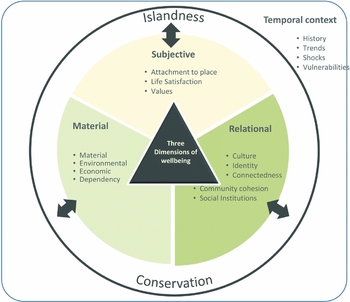
The paper starts with a brief overview of the current wellbeing debate and relevant frameworks and describes the three-dimensional (3D) social wellbeing framework, which explores wellbeing through material, relational and subjective dimensions. We apply and adapt this framework to an islands context (see Fig. 1) to first explore how islands and wellbeing relate, drawing from a range of published island research that speaks to these three wellbeing dimensions. Whilst many aspects of the island–wellbeing relationship could be applied to other non-island contexts, we draw attention to particular characteristics that are common to many islands in order to illuminate the relevance of the three dimensions of wellbeing to island life. We then turn to the question of how conservation can influence the island–wellbeing relationship, drawing from two contrasting case studies: (i) the Solomon Islands archipelago; and (ii) offshore islands of the UK, which were selected due to the availability of knowledge on specific conservation interventions in relation to wellbeing and to enable discussion in the context of the global north and south. Our contribution is timely, since it is embedded in the growing global concern as to the vulnerability of island life and a prioritization of island conservation, but it also seeks a more holistic understanding that avoids defining island life in terms of these threats alone.
Conceptual framework for the study of wellbeing and island conservation (adapted from White (Reference White2010) in order to illustrate its applicability to an islands context).

APPLICATION OF A WELLBEING FRAMEWORK TO AN ISLANDS CONTEXT
In recent decades, there has been a flurry of research aiming to conceptualize and operationalize the study of wellbeing. This has been stimulated in particular by two events: first, the centrality of wellbeing in the Millennium Ecosystem Assessment (MA 2005), which encouraged environmental scholars to better articulate how ecosystems translate into human wellbeing; and second, recognition of the potential for wellbeing to serve as a more meaningful measure of social progress in the face of growing criticism of economic measures (Stiglitz et al. Reference Stiglitz, Sen and Fitoussi2009). The result has been a plethora of different frameworks and approaches to measure wellbeing, spanning several academic disciplines and policy arenas (Alkire Reference Alkire2002; Coulthard Reference Coulthard, Johnson and McGregor2011; White & Blackmore Reference White and Blackmore2015).
As McGregor et al. (Reference McGregor, Coulthard and Camfield2015) point out, there is an emerging consensus across wellbeing frameworks: first, on the importance of measuring wellbeing through multiple domains, rather than single indicators; and second, that measures should include both objective data (e.g. life expectancy) alongside subjective data (e.g. satisfaction with life) in order to provide a more complete view of how people are doing and how people subjectively think and feel about their achievements. Furthermore, they argue that the various lists or ‘domains’ promoted across different frameworks can roughly be organized to fit into three overarching dimensions, which form the basis of the ‘3D’ framework (Gough & McGregor Reference Gough and McGregor2007) in which three perspectives are taken into account: material, relational and subjective wellbeing.
The appeal of exploring these broad dimensions of wellbeing in the context of islands is that it provides three clear and relatively simple platforms in which to unpack the island–wellbeing relationship (allowing that the three dimensions also overlap). Figure 1 illustrates the three dimensions of the social wellbeing framework, noting aspects of wellbeing under each dimension that our review of the literature suggests are highly relevant for island settings. In addition, we argue that wellbeing in islands is structured by an important temporal context, which brings the dynamism of islands to the fore, including historical change, shocks, trends and vulnerabilities, as well as also a common sense of ‘islandness’ that transcends local context (Conkling Reference Conkling2007) and aids comparability across diverse settings.
The following text provides a brief synthesis of the existing literature in order to showcase how islands relate to wellbeing in material, relational and subjective terms. The case studies that follow address how conservation influences these existing island–wellbeing relationships.
Islands and material wellbeing
Material wellbeing is perhaps the most familiar dimension to development and conservation approaches, with its focus on the tangible assets that people have (or are denied), such as education, healthcare, income and work, natural resources and sanitation. The historical underpinning of island life has been a rich environment that supports predominantly agricultural, forest, fisheries and, increasingly, tourism and heritage-based livelihoods. Beyond this, natural resources contribute a significant proportion of island GDP through exports, and are also important for island food security (Connell Reference Connell2013). The environmental richness of islands is, however, bounded by issues of scale, limitation and isolation (Kerr Reference Kerr2005) that, if exacerbated by other aspects of fragility such as endemism or threats by invasive species, limits natural resource availability and increases the likelihood of over-exploitation (UNEP 2014b). Connell (Reference Connell2013) argues that pressures on land, including forest loss and ‘coastal squeeze’, are being equally matched by pressures in the marine environment.
Island economic development is similarly recognized as being constrained by small size (Briguglio Reference Briguglio1995; McGillivray et al. Reference McGillivray, Wim and Santos-Paulino2010). Economies of scale are absent and skills bases are often small, while remoteness and fragmentation (particularly of archipelagic states) render the costs of providing basic services (e.g. transport, communication, energy, health and education) exceptionally high (Connell Reference Connell2013). Economic and export diversity is frequently low, and while connection to international markets brings vital foreign income, power and information, asymmetries in trade arrangements are commonplace, leading to suboptimal wellbeing outcomes (PANG 2016).
As a result of limited economic development, islands, and in particular small island states, generally have a high dependency on subsistence agriculture, fisheries and wild harvest for the food security of the local population (UNEP 2014a). In many island states, food production is growing at a slower rate than population increase, with a growing dependency on more expensive food imports and store items, which has implications for nutrition, especially among the urban poor (Connell Reference Connell2013). Small island dependency on agriculture, fisheries and wild harvest is changing, however, with SIDS now diversifying their economies, especially through investment in the tourism sector (Connell Reference Connell2013). As Kerr (Reference Kerr2005) points out, of the 31 countries in the world with ≥20% of their GDP generated by tourism, 27 are island states.
Islands and relational wellbeing
The inclusion of a relational dimension in the 3D wellbeing framework focuses attention on the critical, but often underappreciated role that social relationships play in facilitating – or hindering – wellbeing and the dynamics of power and social structure. Our exploration of relational wellbeing in an islands context first gives emphasis to culture and identity – the bonds that connect people through shared values, beliefs or common activities, and that fundamentally determine what people can and cannot do and how they feel about the lives they lead. Rich cultures and a strong island identity are central attributes of islandness (Pitt Reference Pitt1980), often accompanied by a distinct language and framed by a dynamic heritage and history. A recent analysis of islander identity in two small islands off the coast of Ireland distinguishes between a ‘historical’ and a ‘contemporary’ islander identity, with the former being shaped by shared hardship and self-sufficiency necessitated by island remoteness and the latter being founded on more positive perceptions of isolation, a sense of belonging, culture and tradition (Burholt et al. Reference Burholt, Scharf and Walsh2013). These layered identities can also underpin tensions between ‘island’ and ‘mainland’ allegiances (Bainton Reference Bainton2009). Debates in the Shetland Islands during the 2015 Scottish referendum for independence offer a good example. Whilst Scotland as a nation was debating the pros and cons of leaving the UK, the debate in Shetland, which has a strong Nordic heritage, was more often tuned towards scope for islander independence and forms of self-governance (The Guardian 2014).
An islander identity permeates across individual and community levels and can lead to a strong sense of community as people are bonded by a shared sense of place and isolation that “generates a unique sense of difference from other populations” (Anderson Reference Anderson2003: 48, as cited in Hay Reference Hay2006: 22). Being ‘close knit’ is a typical characteristic of isolated communities (Schilling-Estes Reference Schilling-Estes2002). Geographic isolation does not, however, translate into a general characteristic of island life, with many arguing that islanders can be much more interconnected and aware of global others than non-islanders (Hay Reference Hay2006). Social connections within, but also between islands, which is captured by the idea of ‘connectedness’, stresses the importance of mobility and social networks, often operating over significant distances across island clusters. As Weisler et al. (Reference Weisler, Bolhar, Ma, St Pierre, Sheppard, Walter, Feng, Zhao and Kirch2016) demonstrate in the context of the Pacific, many trade patterns between islands have operated for millennia and over distances of thousands of kilometres, attesting to the complexity and durability of social relationships amongst island networks. Kerr (Reference Kerr2005) also highlights the dynamics of community by noting that large numbers of islanders may only inhabit the island for part of the year, or part of their lives.
Whilst a strong sense of community is often seen as central to island living, this does not automatically translate into social cohesion – where society works inclusively to improve the wellbeing of all of its members (OECD 2011). Identity is both internally and externally defined – “to be part of a group is to be not part of another group” (Pitt 1985: 1054) – and shifting patterns of wealth and growth can pose risks to cohesion through disparate benefits and inequalities (OECD 2011). The pursuit of wellbeing can be hindered by social division and conflict, and is often exacerbated by development processes. A good example is Hawaii, which is often heralded as an island of tolerance and equality, where ethnic tensions are rising through unequal access to resources (Okamura Reference Okamura2008). Modernization and fast-changing social and cultural trends, whilst contributing to wellbeing for some, also have the scope to break down social cohesion, reminding us that social relationships, and their influence over wellbeing, are dynamic and ever-changing, perhaps particularly so in an island context.
Islands and subjective wellbeing
A subjective dimension of wellbeing enables the assessment of wellbeing to take into consideration people's own experiences and subjective reflections about their lives. The subjective dimension is placed at the apex of the 3D triangle to reinforce the inter-connectedness between dimensions, reflecting that each dimension of wellbeing is ultimately framed by people's own perceptions and values, which are grounded in social context and culture (White Reference White2010). This is especially important given the tendency of many island realities to be narrated by ‘mainlanders’, who may hold very different and disconnected perspectives.
It has been argued that ‘islandness’ is linked to several aspects of quality of life, including life satisfaction (Podgorelec et al. Reference Podgorelec, Gregurović and Bogadi2015), sense of place and belonging (Petrosillo et al. Reference Petrosillo, Costanza, Aretano, Zaccarelli and Zurlini2013), connectedness with nature (Nisbet et al. Reference Nisbet, Zelenski and Murphy2011) and perceptions of social capital (Randall Reference Randall, Kitchen, Muhajarine, Newbold, Williams and Wilson2014). A recent study in three small islands in Croatia found life satisfaction to be underpinned by common social values (such as islander solidarity), a sense of security (maintained by such values and informal mechanisms of social control) and that both islanders and in-migrants positively valued the island way of life (Podgorelec et al. Reference Podgorelec, Gregurović and Bogadi2015).
On the other hand, islands can also be seen as points of departure whereby the sea does not act as a barrier, but as the beginning of a journey (Connell Reference Connell2013). This view emphasizes the mobility of island populations with experience of long-term and circular migration (Byron Reference Byron1999) and the rapid development of tourism, which affects island populations. This can contribute to differences between the lifestyle of islanders and mainland populations and can change place perceptions of local populations. Furthermore, the Podgorelec et al. (Reference Podgorelec, Gregurović and Bogadi2015) study warns against generalizing life satisfaction within the island population; despite providing a valued way of living, the Croatian islands in their study have experienced extensive out-migration, especially of young people, accompanied by population ageing, a phenomenon that has also been witnessed among the islands of Ireland (Royle Reference Royle and Baldacchino2007). As Nunn (2003) comments, the perception of islands as small – often driven by perspectives of continental populations – can shape young peoples’ perceptions of their own island nations as unimportant, and have consequences for self-esteem and desires to migrate to larger countries. Amoamo (Reference Amoamo2013) contends that this view contributes to ‘geographical erasure’, serving to minimize island importance and even render them ‘invisible’, with consequences for how people perceive their quality of life in a global context.
Temporal context and islandness
The island–wellbeing framework is bounded by a temporal context and a sense of ‘islandness’. Throughout history, islands have been coveted for their many purposes, including cash crop production and resource extraction (Nunn Reference Nunn2004), which has often resulted in complex and dynamic histories and politics. Many islands face challenges of sustaining growing populations with limited resources (Reenberg et al. Reference Reenberg, Birch-Thomsen, Mertz, Fog and Christiansen2008); for example, in the South Pacific, colonization underpinned a transition from food surpluses to deficits as land was converted for cash crops by a land-owning elite (Barnett & Campbell Reference Barnett and Campbell2010). These historical changes, which are often driven by markets, demography and technology, have resulted in fundamental and dramatic changes to many island ecosystems that, once they have occurred, are particularly difficult to reverse (Hicks et al. Reference Hicks, Crowder, Graham, Kittinger and Cornu2016).
Political ties to former colonial powers continue to direct the flow of people and money to and from islands, and foreign aid and remittances are important elements of island economies (Gillis Reference Gillis2014). The histories of islands can also have important implications for conservation and underpin many environmental impacts experienced by islands, including species introductions (with rats being especially problematic) (Nunn Reference Nunn2004), whilst many remote island territories have been exploited as politically neutral places in which to dispose of waste (e.g. Marshall Islands) or to conduct nuclear tests (e.g. Micronesia) (Malm Reference Malm, Hornborg and Crumley2007).
Whilst it is important to recognize diversity and local context in any study of island life, ‘islandness’ is a characteristic that is common to many islands. As is argued by Conkling (Reference Conkling2007: 192), “Islanders across different archipelagos share many of the characteristics imposed by the boundedness and isolation of island life. If the characteristics of islanders resonate through time and across space, then certain island qualities must transcend local culture.” As such, the concept of islandness provides a useful framing in which to explore the wellbeing–island attributes that could hold relevance at a more generalizable level of analysis, and is therefore included in our adaptation of the wellbeing framework.
HOW DOES CONSERVATION AFFECT WELLBEING DYNAMICS IN ISLAND COMMUNITIES?
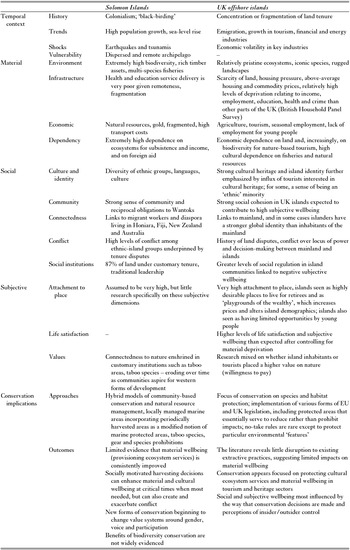
Here, the Solomon Islands and the UK islands are taken as pertinent case studies in order to critically reflect on the ways in which specific conservation activities interact with social wellbeing. Table 1 outlines the key aspects of context and material, relational and subjective wellbeing in the two cases, with the following sections focusing specifically on predominant conservation approaches in the two cases.
A summary of the dimensions of wellbeing that are highlighted in the literature in two different island contexts: Solomon Islands and UK offshore islands.

A Solomon Islands case study
The Solomon Islands constitute a double-stranded archipelago of 990 islands in the south-western Pacific that has attracted extensive western scientific and conservation interest due to the islands’ extremely high marine and terrestrial biodiversity. Solomon Islanders were historically and still are heavily dependent upon natural resources, with a majority of the growing population directly engaging in small-scale agriculture and with exceptionally high nutritional dependence on seafood (Andersen et al. Reference Andersen, Thilsted and Schwarz2013). There are few sources of cash income, other than producing and marketing agricultural commodities including crops and fruit, coconut, cocoa, timber, fish and marine products. Rainforests and commodified reef products such as Trochus shells, bêche-de-mer, pearl oysters and live fish have provided rapid cash incomes for many coastal people without the need for external capital inputs, while also proving attractive for large-scale extraction by international interests. Since the 1990s, the high dependency of material wellbeing on natural resources has raised international alarm at the rate of degradation of marine and terrestrial ecosystems. The discourse among international conservation agencies in the Solomon Islands is one of ubiquitous ecological crisis, exacerbated in recent times by climate change (Barnett & Campbell Reference Barnett and Campbell2010).
Crisis narratives and conflicting interests over natural resources and the distribution of wellbeing benefits in the Solomon Islands have precipitated a myriad of conservation initiatives employing tools such as protected areas, species protection (e.g. turtles) and resource management tools (e.g. fishing gear prohibitions) (Cinner & Aswani Reference Cinner and Aswani2007). Importantly, all conservation initiatives in the Solomon Islands are mediated through a strong customary tenure system (a property regime that allocates ownership to indigenous peoples) that is enshrined in the national constitution and natural resources legislation. Most land (87%) and inshore seas are governed by customary tenure (Govan Reference Govan2009a) and the Wantok system, a loosely culturally based code of reciprocal obligations based on shared kinship, language and place, which remains influential in processes of leadership, decision-making and distribution of resources.
The centrality of customary institutions – which themselves are founded on relationships (relational wellbeing) between resource users – means that conservation agencies negotiate directly with the local resource owners, who have power in defining the nature of these relationships. Negotiations over such complex customary arrangements can trigger internal disputes, but can also illuminate highly competent and powerful institutions for dealing with ‘outside’ agents, through strengthened local culture. Anthropologist Hviding (Reference Hviding2003: 533) makes clear that it is important not to assume that Solomon Islanders are by any necessity victims of one-sided pressure from global forces of political economy, nor are they “willing and eager participants in biodiversity rescue operations.”
Hybrid models of community-based resource management (CBRM) have emerged from these interactions. These consider customary tenure boundaries, traditional knowledge and governance institutions, but are modified to incorporate contemporary conservation, as well as scientific and resource management tools (Foale et al. Reference Foale, Cohen, Januchowski-Hartley, Wenger and Macintyre2011). Marine protected areas, for instance, are reconfigured as locally managed marine areas (LMMAs), avoiding specific references to ‘protection’ and ‘no-take’ (Govan Reference Govan2009b), thereby better aligning with traditional ‘taboo’ systems of periodic harvest (Foale et al. Reference Foale, Cohen, Januchowski-Hartley, Wenger and Macintyre2011). These hybrid approaches aim to be sensitive to place, values, identity and existing social institutions (Hviding Reference Hviding2003; Foale et al. Reference Foale, Cohen, Januchowski-Hartley, Wenger and Macintyre2011), and therefore directly consider aspects of relational wellbeing – and the nature of relationships between conservation actors and resource users – in their approaches to resource governance.
There is, however, mixed evidence about the effectiveness of hybrid systems in delivering material wellbeing by enhancing sustainable provision of natural resources. For example, in marine systems, evidence suggests that periodically harvested closures can support higher catches for a limited time when opened to fishing, particularly for sessile invertebrate species. However, these short-term benefits do not necessarily compensate for the opportunity cost of the closure, and there is little evidence of spill-over or long-term sustainability benefits (Cohen & Alexander Reference Cohen and Alexander2013). Researchers and communities have both argued that the emphasis on ‘information sharing’ by conservation organizations, rather than on lasting economic benefits for associated communities, can limit the effectiveness, attractiveness and durability of conservation initiatives (Keppel et al. Reference Keppel, Morrison, Watling, Tuiwawa and Rounds2012), illustrating that interpretations of which aspects of wellbeing matter most can differ among stakeholders (Palmer Fry et al. Reference Palmer Fry, Agarwala, Atkinson, Clements, Homewood, Mourato, Rowcliffe, Wallace and Milner-Gulland2017).
Interestingly, the reviewed literature suggests that customary tenure systems and associated rules are socially rather than ecologically motivated (see also Jentoft Reference Jentoft2004). Protected areas are opened in response to social need, including paying respects, feasts, health needs and schooling (see review by Cohen & Steenburgen Reference Cohen and Steenbergen2015). This can provide important material and relational wellbeing, including subsistence, income and community cohesion, at critical times. However, customary institutions are often employed to reaffirm or assert power relationships and claims on resources, particularly resources with high exchange values (Foale et al. Reference Foale, Cohen, Januchowski-Hartley, Wenger and Macintyre2011). Spatial closure decisions under hybrid management have, in some cases, further delineated what were vague, flexible or contested boundaries. Thus, CBRM has sometimes disproportionately strengthened the rights of particular groups (such as chiefs and their families), and thereby precipitated or reinforced negative relational wellbeing in terms of community splits and conflicts (Cohen & Steenbergen Reference Cohen and Steenbergen2015).
In response, CBRM approaches have evolved towards egalitarian representation (e.g. women and men have the same voice as chiefs) and a focus on ‘community’ over position, tribe or clan (i.e. land-holding groups and residents of a village correspondingly). This approach aims to ensure more evenly distributed material and relational wellbeing is derived from CBRM, and it is now mainstream among government and non-governmental organization practitioners (Weeratunge et al. Reference Weeratunge2012). However, this approach requires a fundamental shift in the norms, beliefs and power relations in communities, and “run[s] counter to indigenous notions of hierarchy, leadership, land tenure and kinship structure” (Hviding, Reference Hviding2003: 541). It is not clear whether these changes in values around community-level decision-making are imposed by external agents or generated predominantly within communities, either to achieve desired change or in response to wider influences. Nevertheless, there are examples of the broad integration of conservation objectives with wellbeing priorities that are meaningful at the community level. For instance, Guadalcanal village self-initiated and implemented a reef closure that has been in place and widely supported by the community since 2008. Key to this success was matching community aspirations of wellbeing (an example of subjective wellbeing) through increased economic development and high social cohesion with outside organizations’ environmental protection values. The traditional leadership also enabled and empowered the youth (who are traditionally marginalized) to lead the CBRM process (Abernethy et al. Reference Abernethy, Bodin, Olsson, Hilly and Schwarz2014). Indeed, this process was able to achieve its expected wellbeing gains through innovations in governance and forming alliances with outside organizations.
A UK islands case study
To examine the linkages between conservation and wellbeing on islands in a high-income context, we focus on the small islands and British Crown dependencies that make up 8% of the UK's land area. These islands are renowned for their natural beauty and are of conservation interest because of their role as critical habitats for marine mammals, endemic animals and rare birds. The economies of these islands are concentrated on a small number of sectors, with agriculture and nature-based tourism being important industries. For example, Scotland's archipelago has a reputation for ruggedness and isolation, and supports a tourism industry sustained by ‘cold tourists’ (Baldaccino Reference Baldacchino2006) who seek sustainable experiences away from mass consumption and are attracted by the islands’ cultural and natural heritage. The literature suggests that the impact of natural resource extraction appears to have been relatively minor on these islands, and instead, conservation is motivated by biodiversity and cultural preservation.
Conservation in UK islands is underpinned by both European and national legislation, including the most recent UK Marine and Coastal Access Act 2009, which aims to establish a network of marine protected areas around the UK comprising European protected areas and marine conservation zones (MCZs). In the UK, MCZs are spatially designated before the specific rules of use are outlined. In practice, the new legislation tends not to establish no-take zones, but protects key habitat ‘features’ from destructive gears (e.g. bottom-towed gear) and otherwise continues to allow many existing practices, suggesting minimal decline in material wellbeing for resource users.
A comparative study by Pieraccini and Cardwell (Reference Pieraccini and Cardwell2016), however, demonstrates the important impacts of this conservation tool on subjective wellbeing. The authors contrast islanders’ responses to recent marine protected area policy in the Isles of Scilly off Cornwall and the Isle of Barra in the Scottish Outer Hebrides. The Isles of Scilly, a relatively pristine biodiversity hotspot that include a high number of nationally important marine feature species (Hiscock & Breckels Reference Hiscock and Breckels2007), designated 11 new MCZs in 2013. Pieraccini and Cardwell (Reference Pieraccini and Cardwell2016) argue that, compared to other experiences in the UK, the designation of MCZs in the Isles of Scilly was unique. It was bottom-up, underpinned by high levels of consensus among island stakeholders, a sense of empowerment and ownership of the process and supported by a relatively strong scientific basis enhanced through tourist diving surveys.
By contrast, the similarly sized community of the Isle of Barra strongly contested the designation of a candidate Special Area of Conservation under the EU Habitats Directive for over 13 years (2000–2013), to the extent that they attempted to employ the UN Declaration on the Rights of Indigenous Peoples to query the legality of the designation. Pieraccini and Cardwell (Reference Pieraccini and Cardwell2016) attribute islanders’ resistance to conservation legislation in the Isle of Barra to a perception that it was imposed by outsiders and to a history of conflict over land-based conservation. Past experience of terrestrial protected areas, which created additional bureaucracy and delays for crofters seeking government support for land management, now plays into antagonism against outsiders wanting to impose further seemingly unnecessary marine conservation; this is given that environments are perceived to be relatively pristine.
In other Scottish Islands, conservation initiatives have been more readily accepted through integration with crofting heritage. Community initiatives supporting the practice of crofting have the potential to promote occupational diversity and cultural heritage, but also to contribute to maintaining natural heritage and biodiversity through low-intensity agriculture (Mackenzie Reference Mackenzie2010). Mackenzie (Reference Mackenzie2010) argues that new community land ownership movements are closely tied to claims of sustainable stewardship and land management, in contrast to more external conceptions of nature preservation. More participatory and culturally sensitive approaches to conservation planning that better account for people's values, sense of place and occupational attachments – elements of subjective wellbeing – appear to result in better outcomes for social wellbeing and longer-term sustainability.
CONCLUSION
Our framework and case study discussion illuminate how a holistic interpretation of the wellbeing–island relationship can inform understanding about how different forms of conservation interact and influence wellbeing outcomes. Islands represent a useful microcosm in which to explore the wellbeing impacts of conservation because the challenges and vulnerabilities they face are more acute and have comparable elements. Our two case studies demonstrate, in contrasting contexts, how conservation can be interpreted with a wellbeing lens, and suggest that conservation presents different threats and opportunities. In the Solomon Islands, material wellbeing including food and nutritional security, income (for education and healthcare) and housing (mangroves and forest timber) derived from direct extraction or the selling of extraction rights to companies stand to gain or lose from conservation. In the medium to long term, outcomes depend on how successful conservation actions are at preserving or enhancing the supply of services, but more immediately on how access to natural resources is altered. This potential redistribution of resources by conservation in turn impacts on relational wellbeing by affecting social cohesion, the durability of customary institutions and access to resources and places for cultural practices (e.g. feasts, traditional shell money for paying bride prices and sacred sites). State-supported customary institutions very much shape the model of conservation implemented in the Solomon Islands. Conservation objectives are pursued through hybrid models such as CBRM or LMMAs. These approaches aspire to promote community decision-making and are considerate of social and cultural priorities, which can, in one sense, preserve the valued aspects of material, relational and subjective wellbeing derived from natural ecosystems, such as the opening of a closed marine area when school fees are due. On the other hand, the approach can exacerbate local-level inequalities that can exist within customary institutions or contemporary community structures, and may concentrate wellbeing benefits in more powerful individuals, tribes or groups. Moreover, these hybrid models may also be limited in their ability to counter the powerful interests and abundant resources of extractive corporations that are arguably more of a threat to the environment, or to deliver meaningful development and material wellbeing improvements to communities in order to meet basic needs and contemporary development aspirations. Thus, while processes of conservation implementation may appear to be complementary to diverse wellbeing outcomes, the substantive outcomes of conservation action are falling short of local to international expectations.
In the UK's small islands, given a different set of dependencies, conservation impacts occur through other pathways. The effects of conservation on material wellbeing (food and income) derived directly from resource extraction are mostly limited to the regulation of agriculture. In some islands, terrestrial conservation and land management have proved highly controversial, and even where real impacts on material wellbeing are arguably minimal, adverse effects on subjective wellbeing and perceptions of conservation processes are significant. Instead, the impacts of conservation on material wellbeing (income, employment and housing) occur primarily through its implications for nature-based tourism and property development. The literature points to the mutual material benefits of conservation for biodiversity, cultural heritage and the tourism sector, but highlights how rapid tourism declines and limited property development opportunities pose huge challenges for island communities and underpin a discourse of deprivation. In particular, aspects of relational wellbeing, including cohesion, culture and identity, are impacted by out-migration due to a lack of jobs and housing, especially for young people. The subjective wellbeing of islanders that stay and those that leave is also affected, although positive feelings of place attachment and identity can remain strong, even for those who live and work elsewhere (sometimes termed ‘rootedness’; Gustafson Reference Gustafson2001). The politics of conservation implementation also have implications for relational and subjective wellbeing. In these island contexts, policy implementation processes are highly sensitive to social identity – us and them, insiders and outsiders – and perceptions of control and autonomy, all of which can positively or negatively influence responses to marine conservation, as evident in the contrasting reactions in the Scilly Isles and the Isle of Barra.
Conservation approaches that engage with all three dimensions of wellbeing seem to be associated with success. We argue therefore that a social wellbeing lens can be useful in enabling a holistic interpretation of how islands and wellbeing connect, as well as the role of conservation in influencing wellbeing and sustainability outcomes. The case studies reveal how important material, relational and subjective aspects of wellbeing are to islanders and, indeed, how intertwined and mutually impacted they are – positively and negatively – by drivers of change, including conservation interventions. A social wellbeing framework explicitly gives equal importance to all three dimensions, and argues that all must be considered in relation to each other in order to provide an adequate assessment of wellbeing (McGregor et al. Reference McGregor, Camfield and Woodcock2009). This is supportive of a growing literature that calls for multi-dimensional assessments that use both objective and subjective criteria in order to understand how people and their environment relate (see Howe Reference Howe, Suich, Vira and Mace2014).