For British music scholars of the nineteenth and twentieth centuries, the Hallé Orchestra is central to institutional narratives of the growth and expansion of music production in Great Britan.Footnote 1 The orchestra formed in 1858 under the aegis of Charles Hallé, a German immigrant to the United Kingdom. Hallé was a pianist who – through his orchestra – carved out a reputation as one of Northern England’s first virtuosic conductors.Footnote 2 Under Hallé’s tenure, the orchestra grew a reputation similar to (and in some cases greater) than that of contemporary London orchestras; Percy Scholes referred to it as the United Kingdom’s ‘First Great Provincial Orchestra’.Footnote 3 Aside from its regular run of performances within Manchester’s Free Trade Hall (and, since 1996, the purpose-built Bridgewater Hall), the orchestra soon began touring throughout the United Kingdom (including regular concerts in London) and beyond. The orchestra also regularly performed at nineteenth-century British musical festivals, including at Bristol from 1873 to 1893 and Chester from 1885 to 1900Footnote 4. Under later conductors – including Hans Richter, Hamilton Harty, Thomas Beecham, Malcolm Sargent, John Barbirolli, Kent Nagano and Mark Elder – the Hallé Orchestra presented premieres of a number of important British works, including Edward Elgar’s Symphony no. 1 in A-flat major, op. 55; Ralph Vaughan Williams’s Symphony no. 7 (Sinfonia Antartica) and Symphony no. 8 in D minor and Thomas Adès’s These Premises are Alarmed. To peruse the music programmed by the Hallé Orchestra in its various concerts is to watch British orchestral and choral repertoire grow and expand into the engine of the British Musical Renaissance, and beyond.
If for no other reason than this, the Hallé Archive (https://archive.halle.co.uk/) – a web-based series of databases that are linked to each other (as opposed to a larger relational database, where data from separate tables is connected in such a way that information retrieval creates items or lists of linked data) – can be an important resource for those studying the dissemination of orchestral repertoire and concert life in the nineteenth and twentieth centuries. As of writing this review, the Hallé Archive covers the orchestra’s regular-season concerts in Manchester from 1858 until the 1990s, and some of the Hallé’s ‘main run’ of concerts outside of Manchester from ‘1945 to the late 1979/1980 season’.Footnote 5 It claims that its online search tool includes 40,000 entries within its cross-referenced database.
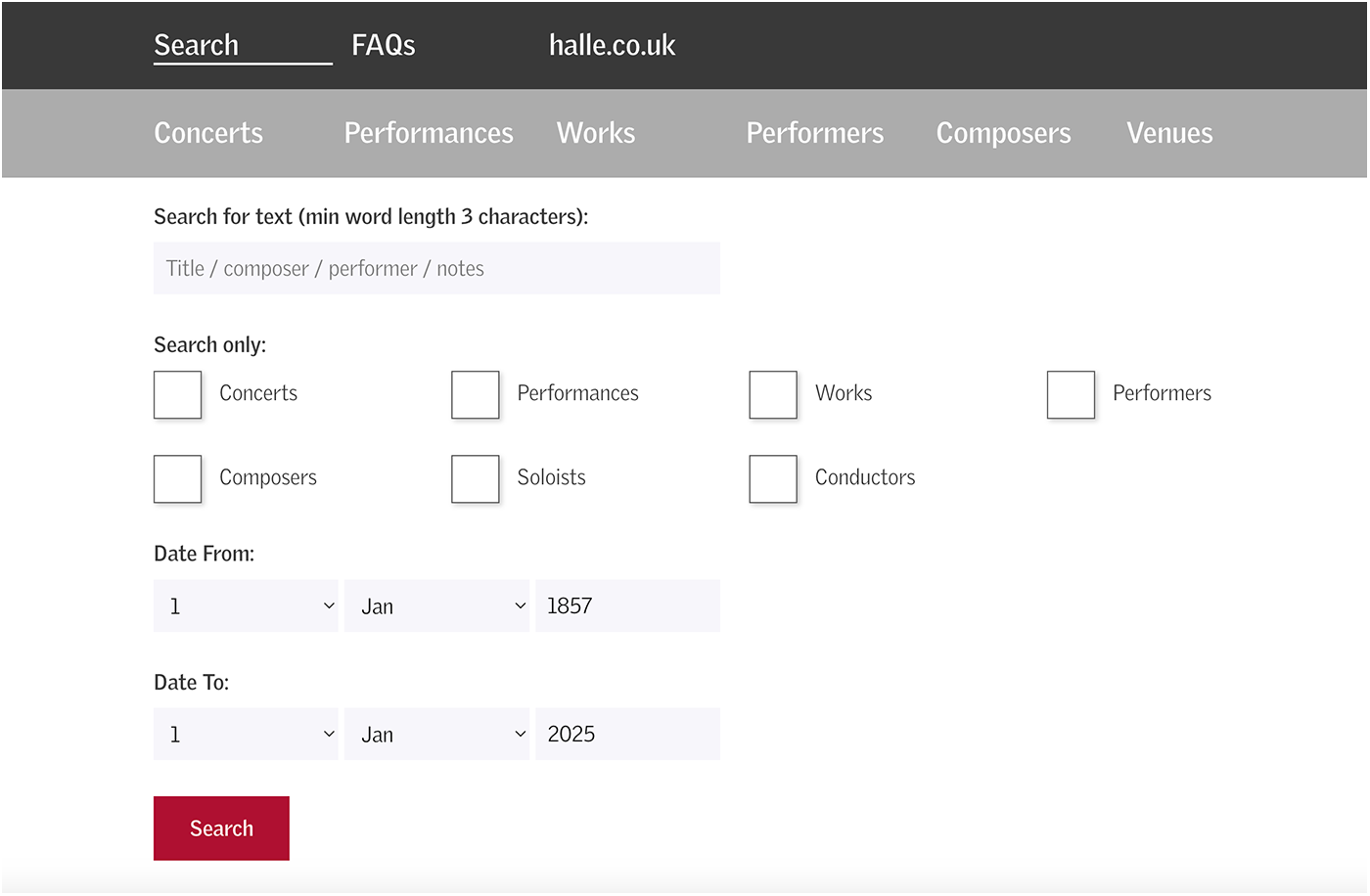
The design of the database and its user interface can be most easily described as requiring maximum user effort while presenting maximum output redundancy. The search window (Figure 1) allows the user to search via keyword text (with a required minimum of three characters to be entered; without entry of characters, you cannot search from this point). One can delimit a search by date as well by categories, which include concerts, performances, works, performers, composers, soloists, and conductors.
Hallé Archive: Search Page.

Additional tabs – seen in Figure 1 as Concerts, Performances, Works, Performers, Composers, and Venues – lead to lists with further hyperlinked pages, all with similar construction and redundancies. Clicking on the ‘Concerts’ tab leads to a list of performances that begins on 30 January 1858 (ref 001/1 – season 1/concert 1); the list ends hundreds of entries later with Concert 132P/12 (7 July 1990). In this list, two items are hyperlinked: clicking on the concert reference number takes you to a detailed record of the concert (Figure 2), beginning with the basic information, including the concert’s title, (e.g. ‘1st Concert of the 3rd Season’), venue, orchestra, and the date; the performers at each concert (frequently the conductor), and a list of all of the pieces performed at that concert. In the basic information, the only hyperlink is to the venue. Clicking through this will take you to a chronological list of all the performances of the Hallé Orchestra on record within this database. Performers are similarly hyperlinked; clicking on their links reveals a sub-level with the individual’s role announced and a chronological listing of all their performances with the Hallé, organized not by concert, but by composition performed/conducted.
Hallé Archive: Detailed Concert Record.

In the ‘Performances’ information, there are three additional hyperlinks. The first is to the reference number for that work; this takes you to a summary data page for the performance of that composition (see Figure 3); this record has much the same information as the first tier of data described in the paragraph above. Within this record are further hyperlinks to the composer and composition (each in at two places in the record), the concert, the venue, and any identified performers. Clicking on each of these leads to further pages; the ‘Concert’ link returns one to the main page for that particular concert; the ‘Venue’ link to a list of Hallé Orchestra concerts in that location; the title link to a chronological list of performances of that work by the Hallé Orchestra; the composer link to an alphabetical list of works by that composer played by the Hallé Orchestra and a chronological list of performances; and the ‘performers’ link to a chronological list of the recorded performances by that individual with the Orchestra.
Hallé Archive: Summary Data Page for Composition Performed in a Specific Concert.

The other tabs function in similar ways, but organizing their data alphabetically instead of chronologically. Thus, clicking on the ‘Works’ tab (Figure 4) presents a list which starts with numbered compositions (e.g. Pytor Ilyich Tchaikovsky’s 1812 Festival Overture, op. 49) before beginning the alphabetical list. Here, as is the case in all parts of the Hallé Archive databases, there are no navigation tools whatsoever, such as a helpful alphabet across the top or along the side to take you quickly into another section of the list, or an intra-page search box; brute force searching can be done via the search command from one’s web browser (e.g. command-f on the Apple OS platform).
Hallé Archive: Beginning of List of Works Catalogued (as of February 2025).

The limited searching and navigating abilities bring up a series of issues regarding the Hallé Archive. The information it allows access to is enormously useful and could be helpful in any number of research contexts. But beyond finding out what works were presented in a specific concert, or the frequency of the performances by a composer (such as the fact that between 1858 and 1990, the Hallé Orchestra played four different compositions by Samuel Coleridge-Taylor) or of a particular work (during the same period, there were four complete performances of Hiawatha’s Wedding Feast and two additional performances of the aria ‘Onaway! Awake Beloved’ from the same work), there is little that this database can reveal without the researcher making detailed notes via multiple searches. The dataset has not been made available publicly, so that a researcher could manipulate elements in ways they find useful (which is the case for the digital archive of the New York Philharmonic orchestra).
Moreover, there is almost no explanatory context given for the Hallé Archive. The only element on the website aside from the search tabs themselves is the ‘FAQs’ section, which leads to a series of basic questions whose answers pertain mostly to the current limits of the linked databases (e.g. that Orchestra and Choir performers are not listed on the database). Aside from the funding logos at the bottom of each page of the archive, the only notice about how the database was compiled or its future is a short paragraph within the FAQs, including the sentences: ‘This is a work in progress and will continue to be updated for as long as we are performing. It has been a labour of love for volunteers working diligently for two decades, taking the information from our programmes archive’. No specific volunteers or archivists are identified anywhere on the site, though a general email address for the archive can be found in the answers to two FAQs questions: one about buying copies of particular programmes, and another about further resources if one cannot find the information sought.Footnote 6 This seems a missed opportunity to identify those who completed this work.
These issues are by no means particular to the Hallé Orchestra’s digital archive. The organization should be applauded for making the content of its programmes so widely available; there are many Anglophone orchestras that have a limited digital archival presence, frequently without links to much if any performance data. The London Symphony Orchestra’s digital archive, for instance, is a highly curated one that includes a timeline and discography of the ensemble, as well as some digital images, but little programme information.Footnote 7 The English Chamber Orchestra includes even less information; just a short article on the history of the organization and no mention of where archives might be, or how interested researchers could find them.Footnote 8 For many ensembles, digital archival footprints seem to be not even a remote consideration. Or if they are a consideration, the design of the user interface is so bad as to make information unretrievable, as is the case with the BBC Proms digital archive. One can access an alphabetical listing of composers heard at the Proms ‘all the way back to 1895’; but the interface is such that you must scroll from 2024 backwards to your year of choosing, three or four years at a time, or hope that the composer you wish to research had a performance in a recent year.Footnote 9
Digital archives for North American orchestras are no different, though some of them have cultivated relationships with special collections at local Universities. Thus, the Los Angeles Philharmonic’s accessible digital archives includes a short history of the ensemble and a link to ‘explore the archives’, which leads to 184 images digitized and organized in the Calisphere search engine by the University of California.Footnote 10 The Philadelphia Orchestra doesn’t even link to its archive, which is now at the University of Pennsylvania.Footnote 11 A number of North American orchestras have named archival collections with dedicated archivists, such as the Rosenthal Archives of the Chicago Symphony Orchestra; their online presence includes a number of curated articles about the history of the ensemble, as well as an online search engine for materials that can be viewed at the archive itself.Footnote 12 North American orchestras that present successful digital archives include the Boston Symphony Orchestra and the New York Philharmonic; each of these organizations has made a spate of digital collections available alongside a performance history database. The Boston Symphony Orchestra’s HENRY system, for instance, provides all of the same information that the Hallé Archive’s does, but with a more intuitive user interface; moreover, records are linked to digital copies of complete programmes.Footnote 13 The Shelby White & Leon Levy Digital Archives of the New York Philharmonic includes similar linkages between its searchable digital catalogue of past performances and digitized programmes, and moreover has made its dataset open for public access and researcher use.Footnote 14 To accomplish the creation of this collection, the New York Philharmonic partnered with the Special Collections Library of the Institute for Advanced Study in Princeton, New Jersey. Thus, while the Hallé Archives is by far not the worst example of a searchable symphonic ensemble database, there is certainly much it could grow into.
Perhaps a better modality would be to compare the Hallé Archive to the various digital concert programme finding aids. Here, the advantage of the Hallé Archive becomes apparent. Most of the European concert programme finding aids, as Mascha van Nieuwkert and Harm Nijboer note, are ‘searchable by means of metadata but do not provide a sufficient data structure for the actual content of these documents’.Footnote 15 This is the case with the Concert Programmes database, which is an excellent way to find locations where concert programmes are held in the United Kingdom, but doesn’t give full details for many.Footnote 16 Those resources that do provide either content or the documents themselves, like Nineteenth-Century Collections Online (which includes, amongst other things, the British Library’s Concert Programme Exchange (1901–1914) collection) are behind paywalls.Footnote 17 Against this list, the Hallé Archives, being both free to use and relatively full of information, stands up rather well for itself; while its interface might not necessarily be intuitive, it can allow for relatively painless gathering of comparative information.
Whichever the mode of comparison, the Hallé Archive website presents an accessible trove of information, useful to the scholar, student, and practising musician seeking programming guidance. The disadvantages of its user interface and lack of internal navigational aids are a small matter when compared to the large amount of searchable data the site contains, and that it is presented for free. While the fact that the Hallé Archive was able to put together this resource largely using volunteer labour is commendable, doing so meant that – like so many of the archives and websites discussed in this short review – it largely created its own systems. Perhaps in the near future digital cultural archives will learn from the practices now apparent in some library catalogue systems, and both use a standardized platform and regularize the allowance of public access to datasets.