Nomenclature
- FSW
-
Friction Stir Welding
- MF
-
Membership Function
- RMSE
-
Root Mean Square Error
- NDT
-
Non-Destructive Testing
- TRS
-
Tool Rotational Speed
- WS
-
Welding Speed
- AF
-
Axial Force
- FIS
-
Fuzzy Inference Systems
- TS
-
Tensile Strength
- NH
-
Nugget Hardness
- TMAZ
-
Thermo Mechanically Affected Zone
- HAZ
-
Heat Affected Zone
- SEM
-
Scanning Electron Microscope
-
 ${\sigma _y}$
-
Yield strength
-
${\sigma _0}$
-
Original yield strength
- d
-
Average grain size
- k
-
Hall-Petch constant


1.0 Introduction
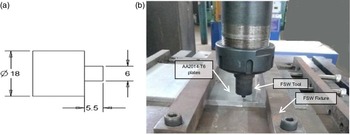
Friction stir welding (FSW) is a solid state welding process widely used for joining Aluminum alloys, because of its ability to produce defect-free joints, which is shown in Fig. 1. The joints produced by FSW have high tensile strength, improved hardness and low distortion compared to the conventional welding processes [Reference Chauhan and Kumar1–Reference Franchim, Fernandez and Travessa6]. The aluminum alloy AA2014-T6, a copper-based aluminum alloy, is used predominantly in aeronautical, naval and automotive applications because of its superior mechanical properties. Many researchers have studied the effect of process parameters on the tensile strength and hardness characteristics of the aluminum alloy AA2014-T6 in the recent past [Reference Vagh and Pandya8–Reference Ghetiya and Patel16].
FSW tool and fixture (all dimensions are in mm).

Kadaganchi et al. [Reference Kadaganchi, Gankidi and Gokhale15] developed a regression model by employing the response surface methodology to optimise the process parameters of friction stir welded joints of AA2014-T6. It was observed that the developed model could predict the ultimate tensile strength and percentage elongation with less than 10% error. Ghetiya and Patel [Reference Ghetiya and Patel16] developed a mathematical model to predict the tensile strength of immersed friction stir welds of AA2014-T4. It was reported that the developed model could predict the tensile strength with less than 3.23% error.
Babajanzade Roshan et al. [Reference Babajanzade Roshan, Behboodi Jooibari, Teimouri, Asgharzadeh-Ahmadi, Falahati-Naghibi and Sohrabpoor17] have employed an adaptive neuro-fuzzy inference system (ANFIS) and a simulated annealing algorithm to predict the tensile strength, yield strength and hardness. Using the developed model, they optimised the welding parameters. They have developed four different ANFIS models using four different membership functions (MFs) for input parameters. The model that yielded the least Root Mean Square Error (RMSE) value was chosen for the predictive model. It was observed that the generalised bell-type MF has resulted in the lowest RMSE of 6.64. Rahimzadeh Ilkhichi et al. [Reference Rahimzadeh Ilkhichi, Soufi, Hussain, Vatankhah Barenji and Heidarzadeh18] have developed a mathematical model using RSM to predict the hardness and grain size of FSW joints of aluminum alloy AA 7020. They have observed that the minimum value of grain size (10.9μm) and maximum amount of hardness (82HV) were obtained with the optimised rotational speed, traverse speed and axial force of 800rpm, 125mm/min, 8kN respectively. Vaira Vignesh et al. [Reference Vignesh, Padmanaban, Arivarasu, Karthick, Abirama Sundar and Gokulachandran19] have employed the ANFIS model for predicting the tensile shear failure load (TSFL) of friction stir spot welding (FSSW) joints of the aluminum alloy AA 6061. They have adopted the Box-Behenken design for conducting experiments.
Dewan et al. [Reference Dewan, Huggett, Warren Liao, Wahab and Okeil20] have predicted the tensile strength of FSW joints of the aluminum alloy AA2219-T87 by adaptive neuro-fuzzy inference system (ANFIS) and an artificial neural network (ANN). Shanavas and Dhas [Reference Shanavas and Dhas21] developed fuzzy logic model and regression model for the prediction of ultimate tensile strength and percentage elongation of friction stir weld joints of AA 5052 H32 aluminium alloy. They have developed a Mamdani-type fuzzy logic model and a regression model. It was observed that the regression model and the fuzzy logic model predicted the output function with a maximum error of 7% and 4% respectively.
There is much research being conducted on the prediction of mechanical characteristics like tensile strength and nugget hardness of friction stir welded aluminum alloys [Reference Kadaganchi, Gankidi and Gokhale15–Reference Wakchaure, Thakur, Gadakh and Kumar24]. However, there are only a few works that developed efficient predictive models for FSW joints of the aluminum alloy AA2014-T6 for predicting mechanical characteristics. In the proposed research work, a Mamdani-type fuzzy logic-based model has been developed to predict the tensile strength and nugget hardness of friction stir welded joints of aluminum alloy AA2014-T6. The membership functions for input parameters and output responses are chosen as Gaussian and triangular membership functions respectively. The proposed model predicts the responses with an error of less than 2.5%.
2.0 Materials and methods
The plates of aluminum alloy AA2014-T6, cut to a size of 100mm × 50mm × 6mm were friction stir welded using an FSW machine. The FSW machine has a maximum spindle speed of 3,000rpm, a maximum welding speed of 200mm/min and can apply an axial load of up to 20kN. The chemical composition of the aluminum alloy plates was tested for spectrograph before being used in the experiments. It was found that the percentage of various elements present is well within the acceptable range. The measured chemical composition based on the spectrograph is shown in Table 1. Rajendran et al. [Reference Rajendran, Srinivasan, Balasubramanian, Balaji and Selvaraj22] have investigated the effect of FSW parameters on the strength of AA2014-T6 aluminum alloy joints. The plates are of 2mm thickness. They have employed five levels for the welding parameters, namely tool rotational speed, welding speed, tool shoulder diameter and tool tilt angle. They have varied the tool rotational speed ranging from 1,300 to 1,700rpm, welding speed ranging from 20 to 60mm/min, tool shoulder diameter from 4 to 8mm and tool tilt angle from 0.5° to 2.5°.
The measured chemical composition of AA2014-T6 plates

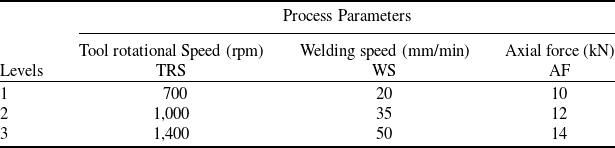
Preliminary experiments were conducted with various process parameters at different levels. The specimens were subjected to ultrasonic Non-Destructive Testing (NDT). Ultrasonic test method of (NDT is being utilised for testing FSW joints. The ultrasonic test method is effective in determining most of the flaws in FSW joints like tunnel defects, warm holes and kissing bonds [Reference Węglowski and Sikora25, Reference Adamus and Lacki26]. It was observed from the tests that the specimens welded with tool rotational speeds of less than 700rpm and greater than 1,400rpm contain defects such as lack of penetration and wormhole respectively due to less plasticised material flow and high heat input respectively. The specimens welded with a welding speed greater than 50mm/min were observed to contain tunnel defect due to less plasticised material flow. Hence, the tool rotational speed was limited between 700 and 1,400rpm and the welding speed was limited between 20 and 50mm/min. In the current work, friction stir welding was carried out by varying tool rotational speed (TRS), welding speed (WS) and axial force (AF) at three levels. The welding process parameters and the levels are shown in Table 2. The tool was made of H13 tool steel. The tool used in the experimentation had a square cross section of side 6mm and length of the probe was 5.5mm. The tool had a shoulder diameter of 18mm. The dimensions of the tool and the fixture used are shown in Fig. 1. The tool tilt angle was kept constant at 2° throughout the experiment.
Friction stir welding process parameters

The experiments were conducted as per Taguchi’s L27 orthogonal array for the three process parameters at three levels. Mohamed MA et al. [Reference Mohamed, Manurung and Berhan23] have utilised the Taguchi L9 orthogonal array for predicting the mechanical properties and weld quality of FSW joints of the alloy AA6061-T651. They have varied rotational speed and traverse speed at three levels. They have employed the Multi-objective Taguchi Method (MTM) and Response Surface Methodology (RSM) for model development and optimisation. Wakchaure et al. [Reference Wakchaure, Thakur, Gadakh and Kumar24] have utilised the Taguchi L27 orthogonal array for predicting the tensile strength of FSW joints of the alloy AA6082- T6. They have employed the Taguchi-based Grey Relational Analysis (GRA) and the Artificial Neural Network (ANN) for model development and optimisation.
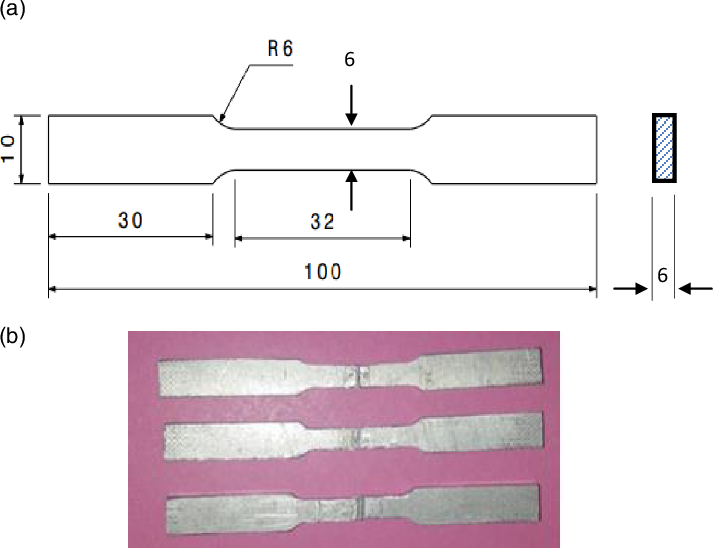
The tensile specimens have been prepared in accordance to ASTM E8M-04 guidelines. The welded plates have been cut using power hacksaw and finished to the required dimension by machining. The tensile test was carried out using a 100kN, universal testing machine. The tensile specimens have been cut in such a way that the weld region is in the middle of the specimen. All tensile tests have been carried out perpendicular to the welding direction to determine the tensile properties of the welded joints. The specimen was subjected to load at a rate of 1.5kN/min. The tests were repeated three times, and the average values were taken for evaluation. The dimensions of the tensile specimen and sample tensile specimen after the test are shown in Fig. 2.
(a) Dimensions of the tensile specimen in mm (b) Sample tensile specimen (after the test).

A Mitutoyo-make Vickers hardness tester was used to measure the hardness of the welded specimens. Hardness measurements across the transverse cross-section of the welded specimen were made with a load of 100g and a dwell time 30s.
The base metal was tested for tensile strength and hardness as per the procedure and standards stated above. Three samples were tested for each of the tests. The average values of tensile strength and the Vickers hardness number for the base metal are 461N/mm2 and 155, respectively.
3.0 Development of fuzzy logic model
3.1 Fuzzy inference systems
There are two main types of fuzzy inference systems namely, (i) Mamdani-type and (ii) Sugeno-type. The main difference between the two types of FIS is how the output is generated from the fuzzy input. The defuzzification of a fuzzy output is done in the Mamdani-type FIS, whereas weighted average is used in the Sugeno-type FIS to compute the crisp output.
In the Mamdani-type fuzzy inference system, the output of each rule is a fuzzy set. The Mamdani-type systems are well suited to expert system applications as the rule bases used are comprehensible and highly instinctive.
In this work, a Mamdani-type fuzzy logic model was developed using the chosen input parameter range and output responses. The development of fuzzy logic model involves the following three steps:
-
Step 1. Fuzzification of variables
-
Step 2. Fuzzy inference process
-
Step 3. Defuzzification
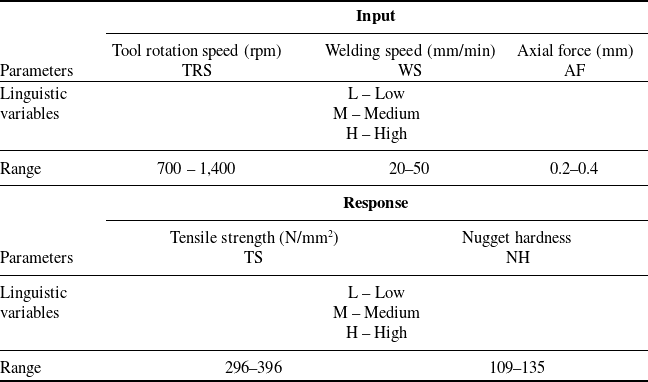
In the fuzzification step, the input parameters and the output responses are coded into linguistic variables as Low, Medium and High. The linguistic variables, the range of input process parameters and output responses are shown in Table 3. In the second step membership functions are selected for input variables and output responses.
Fuzzy variables, range of input parameters and responses

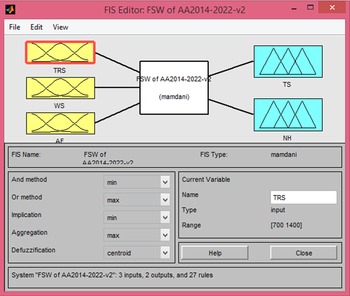
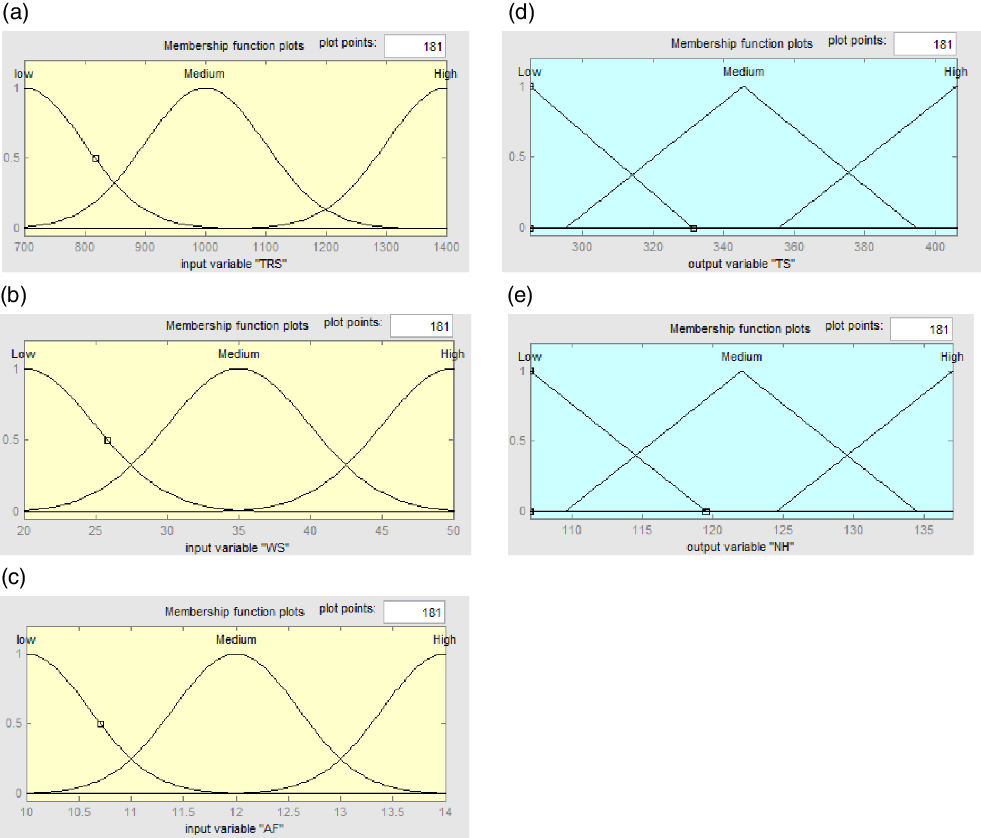
The membership functions can be of different types, such as triangular, trapezoidal, Gaussian, bell-shaped, sigmoidal and S-curve. The exact type to be used is selected based on the actual applications. In this work, Gaussian membership function was used for the input parameters because of the complex interactions between the input parameters and triangular membership function was used for the output parameters. The fuzzy logic model is shown in Fig. 3. The membership function plots for the input parameters and the output responses are shown in Fig. 4.
Fuzzy logic model.

Membership function plots (a) Tool rotation speed (b) Welding speed (c) Axial force (d) Tensile strength (e) Nugget hardness.

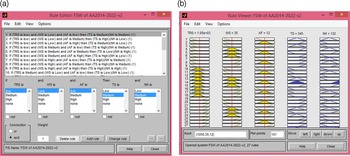
Defuzzification process was carried out using the centroid method. The fuzzy rule set used for simulating the model and the rule viewer are shown in Fig. 5.
(a) Fuzzy rules (b) Fuzzy rule viewer.

4.0 Results and discussion
4.1 Experimental results
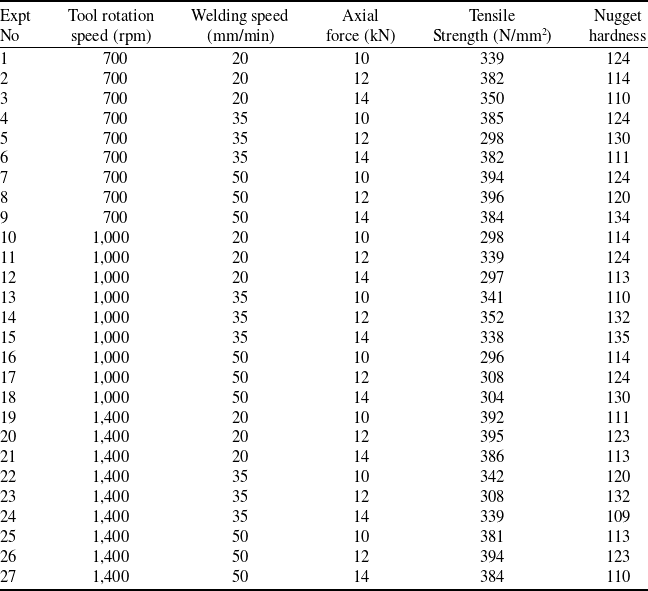
The experiments were conducted as per the Taguchi L27 full factorial design for the three welding parameters at three levels [Reference Wakchaure, Thakur, Gadakh and Kumar24]. Each of the 27 experiments has been replicated three times, and the average values are taken for evaluation in order to eliminate the errors that might have been caused during the experimentation. The average tensile strength and average Vickers hardness values as obtained from the experiments are shown in Table 4.
Experimental tensile strength and nugget hardness values

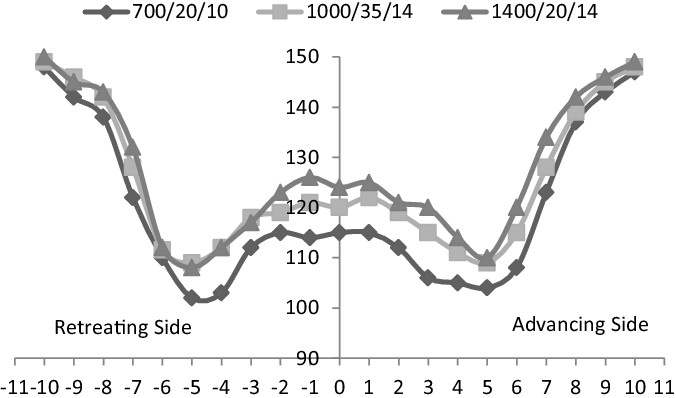
The hardness profiles of three sample specimen are shown in Fig. 6.
Hardness profiles of sample specimen.

The hardness profile shows a “W” shape, which is unsymmetrical about the centreline of the weld. The hardness in the nugget region of the specimen is higher compared to the TMAZ and HAZ regions. It is also observed that the hardness values are slightly lower on the retreating side compared to the advancing side. The drop in the hardness value in the retreating side may be due to the stress that is incurred during the tool rotation and traverse as the direction of tool rotation is opposite to the tool movement in that side. It is also observed that the hardness values of the samples welded with low tool rotation speed (700rpm) is lower compared to the samples welded with 1,000 and 1,400rpm. It is also observed from the results that the nugget, HAZ and TMAZ regions have lower hardness compared to the base metal. This is due to the coarsening and or dissolution of strengthening precipitates during the weld thermal cycle.
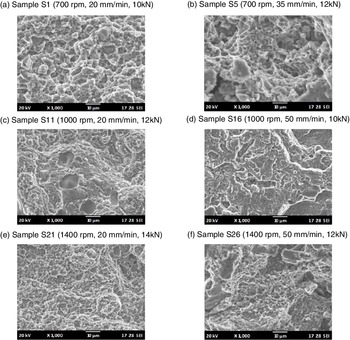
The fracture surfaces of the tensile specimen are analysed by the SEM images of the fractured region. The SEM images of the fracture surfaces are shown in Fig. 7. It can be perceived from the images that there are dimples of various shapes and size on the fracture surfaces. The density of dimples is higher in samples welded with low tool rotation speed of 700rpm compared to the higher tool rotation speeds. This is evident from the Fig. 7(a) and (b). The larger density of dimples corresponds with the higher tensile strength of the joints. The enhanced strength of the joints is in accordance with the Hall-Petch relationship, which is given in Equation (1).
 \begin{align}{\sigma _y} = \;{\sigma _0} + k{d^{ - 1/2}}\end{align}
SEM images of fractured surfaces of the tensile samples.

According to this relationship, the yield strength (
 ${\sigma _y}$
) of the material is inversely proportional to the square of the grain size (d). Hence, the strength of the material increases with the decrease in grain size [Reference Heidarzadeh, Testik, Güleryüz and Barenji27]. The finer grain size is due to the large heat input attributed to the low tool rotation speeds.
The SEM images of the samples S11 and S16 are shown in Fig. 7(c) and (d). Fewer dimples with cleavage facets are seen in the fracture surfaces of the joints welded with 1,000rpm. The coarser dimples are attributed to plastic fracture. The coarser dimples are attributed to the low heat input during welding, which is caused by the higher tool rotation speed [Reference Rahimzadeh Ilkhichi, Soufi, Hussain, Vatankhah Barenji and Heidarzadeh18].
The increase in tool rotation speed has resulted in a combined mode of failure. It can be observed from Fig. 7(d) and (f) that there are finer dimples with cleavage facets in the microstructure of the sample S16 and S26, respectively. Deep holes and pluck out regions are observed on the microstructure of the joints welded with higher tool rotation speed.
4.2. Accuracy of the developed fuzzy model
Root Mean Square Error (RMSE) metrics has been used to find the accuracy of the developed model [Reference Babajanzade Roshan, Behboodi Jooibari, Teimouri, Asgharzadeh-Ahmadi, Falahati-Naghibi and Sohrabpoor17]. The RMSE can be calculated by the Equation (2)
 \begin{align}RMSE = \sqrt {\frac{{\mathop \sum \nolimits_{i = 1}^N {{\left( {{x_i} - {{x'}_i}} \right)}^2}}}{N}} \end{align}
where
-
i = variable
-
${x_i}$
= Actual observations
-
${x'_i}$
= Estimated values
-
N = Total data points


An RMSE was calculated between the experimental values and the values as obtained from the model. The calculated RMSE values for tensile strength and nugget hardness are 5.51and 2.16, respectively. The lower the value of the RMSE, the higher the accuracy of the model. The obtained values of RMSE are found to be lower and hence the accuracy of the model is higher.
4.3. Confirmation experiment results vs predicted results
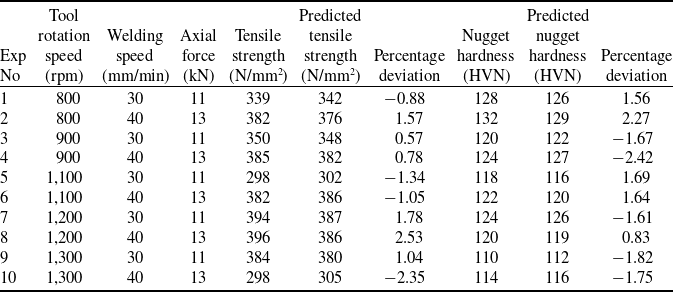
To evaluate the fuzzy model, confirmation experiments were conducted by using ten new welding parameter values that are not used in the experiments used for developing the model. The values of the ten new welding parameters used for confirmation experiments are shown in Table 5.
Results of confirmation experiments and results predicted by the model

The developed fuzzy logic model is validated by comparing the results of the confirmation experiments with that of the predicted values by the fuzzy model. The percentage of error between the experimental and predicted value is calculated using Equation (3)
 \begin{align}\% \;Error = \;\frac{{Experimental\;Value - Predicted\;Value}}{{Experimental\;Value}}\; \times \;100\end{align}
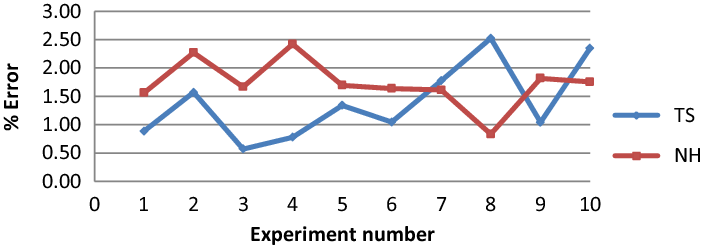
The variations between the results predicted by model and experimental values are shown in Fig. 8.
% Error between the experimental and predicted values.

It is inferred from the results that the % error between the experimental values and the predicted values are minimum. The maximum % error is 2.53% for tensile strength and 2.42% for weld nugget hardness.
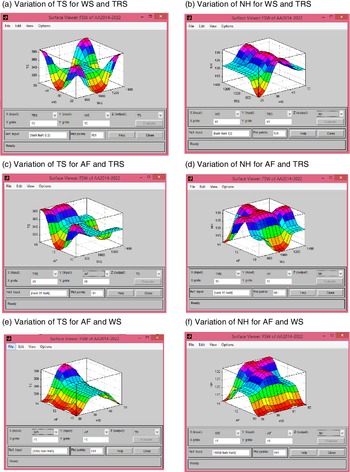
The interaction of input parameters on the output responses is represented by surface plots. Figure 9(a), (c), and (e) represent the variation of tensile strength in response to the input parameters, TRS, WS and AF. High tensile strength is predicted when both WS and TRS are lower and when WS or TRS is higher in the test range. The variation of nugget hardness is represented in Fig. 9(b), (d) and (f). The decrease in TRS and AF has resulted in increased hardness. The increase in WS has resulted in increased hardness for lower values of TRS. The higher TRS, lower WS and higher AF, due to more heat generation during FSW, have resulted in grain coarsening and hence lower hardness [Reference Kadaganchi, Gankidi and Gokhale15].
Interaction of input parameters with output responses.

5.0 Conclusion
The aluminum alloy AA2014-T6 was friction stir welded by varying the tool rotational speed (TRS), welding speed (WS) and axial force (AF) at three levels. The experiments were conducted as per the Taguchi L27 full factorial design. A Mamdani-type fuzzy logic model was developed using selected data ranges. The RMSE metric was used to test the accuracy of the developed model. It was found that the RMSE values for tensile strength and hardness are 5.51 and 2.16, respectively. The developed model was validated by comparing the values obtained from the confirmation experiment with the values predicted by the model. The calculated maximum error was 2.53% and 2.42% for tensile strength and nugget hardness, respectively. The proposed model has resulted in lesser error compared to the fuzzy logic model and the regression model developed by Shanavas et al. [Reference Shanavas and Dhas21]. Rajendran et al. [Reference Rajendran, Srinivasan, Balasubramanian, Balaji and Selvaraj22] have predicted the tensile strength of AA2014-T6 with a maximum error of 5%. The developed model can be used to predict the tensile strength and nugget hardness of FSW joints of the aluminum alloy AA 2014-T6 within the parameter ranges used in the model.