Introduction
Grain sorghum is the fifth most important cereal crop grown in the world (USCP 2016). This crop is naturally drought tolerant and can be used for food, feed, and fuel. In the United States, grain sorghum is the fourth largest crop harvested for grain behind the main commodities of corn (Zea mays L.), soybean [Glycine max (L.) Merr.], and wheat (Triticum aestivum L.). Sorghum grain is primarily used for livestock feed and ethanol production in the United States but is becoming increasingly popular in the consumer food industry because of its gluten-free property (USCP 2016). In 2016, grain sorghum was harvested from nearly 2.5 million ha in the United States, yielding 12,200 million kg of grain (USDA-NASS 2019c). The major grain sorghum-producing states are located in the semi-arid regions of the central and southern Great Plains, with 65% of the production from Kansas and Texas (USDA-NASS 2019b, 2019c).
Weeds are a significant concern in grain sorghum production as a result of substantial yield losses caused by weed interference, limited weed control options, and reduced harvest efficiency (Burnside et al. Reference Burnside, Wicks, Warnes, Somerhalder and Weeks1969; Moore et al. Reference Moore, Murray and Westerman2004; Smith et al. Reference Smith, Murray, Green, Wanyahaya and Weeks1990; Stahlman and Wicks Reference Stahlman, Wicks, Smith and Frederiksen2000; Thompson et al. Reference Thompson, Dille, Peterson, Ciampitti and Prasad2019). Grain sorghum is typically seeded later in the spring after corn, cotton (Gossypium hirsutum L.), and soybean seeding, and it is essential to implement weed management strategies that allow for seeding into weed-free conditions. Grain sorghum seedlings grow slowly in comparison to weed species for the first 20 to 25 d (Vanderlip Reference Vanderlip1993); thus, grain sorghum is susceptible to weed interference early in the growing season (Burnside and Wicks Reference Burnside and Wicks1969). Sorghum should remain weed-free for the first 4 to 5 wk after seeding to prevent yield loss from weed interference (Burnside and Wicks Reference Burnside and Wicks1967).
Common grass weed species that occur in grain sorghum include large crabgrass [Digitaria sanguinalis (L.) Scop.], foxtail (Setaria spp.), shattercane [Sorghum bicolor (L.) Moench], longspine sandbur [Cenchrus longispinus (Hack.) Fernald], prairie cupgrass (Eriochloa contracta Hitchc.), fall panicum (Panicum dichotomiflorum Michx.), and witchgrass (Panicum capillare L.) (Albers Reference Albers2018; Franke et al. Reference Franke, Kelsey and Royer2017; Smith et al. Reference Smith, Murray, Green, Wanyahaya and Weeks1990). It is recommended to apply a PRE herbicide that provides effective control of annual grass weeds in grain sorghum, as there are limited options for POST grass control (Ciampitti et al. Reference Ciampitti, Ruiz Diaz, Jardine, Peterson, Hay, Whitworth and Rogers2019). It is strongly recommended to not seed grain sorghum into fields infested with shattercane or johnsongrass [Sorghum halepense (L.) Pers.], because these are related species, resulting in few viable options for their control (Ciampitti et al. Reference Ciampitti, Ruiz Diaz, Jardine, Peterson, Hay, Whitworth and Rogers2019; Werle et al. Reference Werle, Jhala, Yerka, Dille and Lindquist2016, Reference Werle, Tenhumberg and Lindquist2017).
Common annual broadleaf weeds in grain sorghum fields include kochia [Bassia scoparia (L.) Schrad.], Russian thistle (Salsola kali L.), Palmer amaranth [Amaranthus palmeri (L.) Wats.], waterhemp (Amaranthus rudis L.), redroot pigweed (Amaranthus retroflexus L.), tumble pigweed (Amaranthus albus L.), Venice mallow (Hibiscus trionum L.), velvetleaf (Abutilon theophrasti Medik.), common cocklebur (Xanthium strumarium L.), morningglory (Ipomoea spp.), Devil’s claw [Proboscidea louisianica (Mill.) Thell.], and common sunflower (Helianthus annuus L.) (Franke et al. Reference Franke, Kelsey and Royer2017; Staggenborg et al. Reference Staggenborg, Rogers, Thompson, Jardine, Roozeboom, Whitworth, Gordon, Harner and Taylor2010). For example, grain sorghum yield losses in response to competition with specific broadleaf weed species have ranged from 7% to 22% yield loss with one to two Palmer amaranth plants per meter of row (Unruh Reference Unruh2013), up to 40% when redroot pigweed emerged at the one-leaf stage of grain sorghum (Knezevic et al. Reference Knezevic, Horak and Vanderlip1997) in eastern Kansas.
Weeds can be managed in grain sorghum with an integrated weed management program consisting of mechanical (tillage), cultural (crop rotation, row spacing), and chemical (herbicides) weed control practices (Peerzada et al. Reference Peerzada, Ali and Chauhan2017; Stahlman and Wicks Reference Stahlman, Wicks, Smith and Frederiksen2000; Walker et al. Reference Walker, Norris and McGuire1991; Werle et al. Reference Werle, Tenhumberg and Lindquist2017). Herbicides are a significant component of any sorghum weed management program (Thompson et al. Reference Thompson, Dille, Peterson, Ciampitti and Prasad2019). The main herbicide options for control of annual grasses in sorghum are applied PRE. However, because sorghum is typically produced in areas with dry conditions, the efficacy of PRE herbicides is variable because of lack of moisture, which is needed to dissolve the herbicide into the soil–water solution so that it can be taken up by the developing weed seedlings. Grass escapes must be controlled through cultivation or herbicides applied POST. However, an effective broad-spectrum POST grass control herbicide is not currently available in sorghum (Peterson et al. Reference Peterson, Fick, Currie, Kumar and Slocombe2019).
Grain sorghum producers have been requesting the development of herbicide-resistant crop hybrids to expand their options for weed control. Recent development of grain sorghum hybrids with resistance to acetolactate synthase (ALS)–inhibiting herbicides has allowed the use of several ALS inhibitors, applied POST, to control weeds in the crop. Recent research demonstrated that although nicosulfuron applied POST provided control of emerged annual grass weeds, it should be part of a PRE followed by POST herbicide program to provide acceptable annual grass control (Hennigh et al. Reference Hennigh, Al-Khatib, Currie, Tuinstra, Geier, Stahlman and Claassen2010; VanLoenen Reference VanLoenen2018). The use of ALS-resistant sorghum hybrids has been approved in the United States but has not yet been made commercially available. Other technologies for POST grass control in sorghum include sorghum hybrids resistant to imidazolinones and acetyl CoA carboxylase–inhibiting herbicides. The imidazolinone-resistant sorghum hybrids were commercialized in Argentina and Australia in 2018 (Advanta 2018). The acetyl CoA carboxylase inhibitor–resistant sorghum hybrids are being developed and are anticipated to be commercially available in the United States in the next few years (Crist Reference Crist2019; USCP 2019).
In a previously published survey, the Weed Science Society of America (WSSA) Weed Loss Committee estimated that grain sorghum yield loss in the United States ranged from 11% to 18% between 1975 and 1979 (Chandler et al. Reference Chandler, Hamill and Thomas1984). When using best management practices (BMPs) for grain sorghum production, such as best hybrids, seeding rates, fertility, and management of insects, diseases, and weeds, estimated yield losses ranged between 5% and 15%, whereas under conditions of BMPs and no herbicides, estimated yield losses ranged between 15% and 60% (Bridges Reference Bridges1992). These earlier reports (Bridges Reference Bridges1992; Chandler et al. Reference Chandler, Hamill and Thomas1984) relied on estimates from research and extension personnel, as well as comments from producers. The level of potential grain sorghum yield loss due to weed interference that includes national production data would highlight the need for research on new integrated weed management strategies for grain sorghum production across the United States.
The WSSA Weed Loss Committee combined quantitative data from replicated small-plot experiments with production statistics from each of the major grain sorghum-growing states in the United States to estimate the potential yield loss in grain sorghum due to weed interference.
Materials and Methods
Weed scientists and extension specialists researching weed control in grain sorghum across the United States were contacted and asked to provide data on grain sorghum yield loss due to weed interference. Specifically, results were requested from weed control experiments in grain sorghum from up to 10 individual experiments per calendar year over 10 yr between 2007 and 2016. Other sources of quantitative data were identified in weed control reports available online or in published papers. These methods are similar to those used in previous WSSA Weed Loss Committee reports for other crops (Soltani et al. Reference Soltani, Dille, Burke, Everman, VanGessel, Davis and Sikkema2016, Reference Soltani, Dille, Burke, Everman, VanGessel, Davis and Sikkema2017, Reference Soltani, Dille, Gulden, Sprague, Zollinger, Morishita, Lawrence, Sbatella, Kniss, Jha and Sikkema2018a, Reference Soltani, Dille, Robinson, Sprague, Morishita, Lawrence, Kniss, Jha, Felix, Nurse and Sikkema2018b).
From each experiment, two key data points were requested from each researcher: the mean values for “weedy grain sorghum yield” and those for “weed-free grain sorghum yield.” Means were based on replicated experiments. The “weedy yield” represented the mean grain sorghum yield from weedy check plots and were based on BMPs for optimal grain sorghum yield but with no weed control tactics applied. “Weed-free yield” was defined as the mean yield from plots with >95% weed control as visually assessed by the researcher and based on BMPs for optimal grain sorghum yield.
Potential grain sorghum yield loss (YL%) was calculated as a percentage of yield loss for each experiment as in Equation 1.
 $${{{\rm{Potential}}\,YL\,\% = \, \left( {{\rm{Weed}} \hbox- {\rm{free\,\, yield }} - {\rm{ weedy\,\, yield}}} \right)/ \\ {\rm{weed}} \hbox- {\rm{free\, yield}} \times 100}}$$
The result was averaged within each year and then averaged across the 10 yr for each state.
The overall impact on the grain sorghum-growing region was described based on total area harvested (hectares), total grain production (kilograms), grain sorghum yield (kg ha−1), and yearly average commodity prices (US$ per 1,000 kg) for each state from USDA-NASS (2019a, 2019b, 2019c) reports. Yield and the monetary loss were weighted by the quantity of grain sorghum produced in each state. The estimated grain sorghum yield loss due to weed interference was multiplied by average grain sorghum price for 2007 to 2016 to determine the potential monetary loss in each region. The average price of grain sorghum between 2007 and 2016 was US $166.16 per 1,000 kg; this value was used to estimate potential monetary loss across the United States.
Results and Discussion
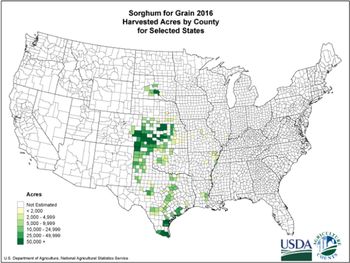
Weed control research data were obtained from Arkansas, Kansas, Missouri, Nebraska, South Dakota, and Texas; these are the six major grain sorghum-growing states in the United States and represent 85% of grain sorghum production (Table 1; Figure 1). The potential loss of production and monetary value of grain sorghum due to weed interference, based on typical agronomic practices for optimal grain sorghum yield in each state from 2007 to 2016 (averaged), are presented in Table 1.
Potential annual average grain sorghum area harvested, total production, yield, and total value as well as estimated yield loss (%), losses in grain sorghum production and in value from weed interference for each state that provided data for the period of 2007 to 2016.a

a Annual grain sorghum production and value (US$), and annual potential loss in production and value (US $) from weed interference for the United States based on 2016 production data (USDA-NASS 2019a).
b Abbreviation: NA, not applicable.
Grain sorghum-growing regions within the United States in 2016. Image from USDA-NASS (2019b). https://www.nass.usda.gov/Charts_and_Maps/graphics/AS-HA-RGBChor.pdf.

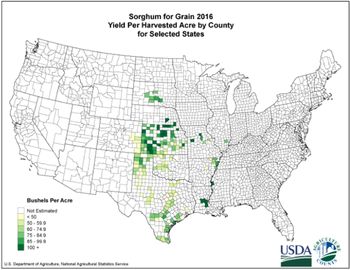
Kansas and Texas are the main two sorghum-producing states, representing 76% of the harvested hectares and 65% of the production (Table 1). On average in Kansas, across the 10 yr of this study, grain sorghum was produced on 1,054,000 ha, with a total annual production of 4,800 million kg and a monetary value of almost US $800 million. Average grain sorghum yield (bushels per acre) for 2016 are shown for each county in selected states (Figure 2). Weed interference was estimated to cause 37.9% yield loss, resulting in 1,800 million kg of lost production equal to a monetary value of US $302 million each year. This percentage yield loss is consistent with a comparison of nontreated versus highest yielding rainfed grain sorghum receiving PRE and PRE followed by POST treatments averaged over 78 site-years in eastern and central Kansas from 1973 to 1988 (Phillip Stahlman, personal communication). Sorghum yields increased by 42% with the use of PRE herbicides and by 48% for highest yielding sorghum, which often received PRE followed by POST herbicide treatments (Phillip Stahlman, personal communication). On average, in Texas, grain sorghum was grown on 852,000 ha, with a total annual production of 3,100 million kg (Table 1) adding up to a monetary value of US $520 million. Annually, Texas grain sorghum farmers could lose an estimated 60.3% of their yield as a result of weed interference, resulting in 1,900 million kg of lost production equal to lost monetary value of US $314 million (Table 1).
Grain sorghum yield per each harvested acre in each county within the United States in 2016. Image from USDA-NASS (2019b). https://www.nass.usda.gov/Charts_and_Maps/graphics/AS-YI-RGBChor.pdf.

Grain sorghum yield losses for Arkansas, Kansas, Missouri, Nebraska, South Dakota, and Texas were 37%, 38%, 30%, 56%, 61%, and 60%, respectively, if weeds were uncontrolled while maintaining best agronomic management practices for optimum yield (Table 1). The variation in yield loss across the states corresponds to expected differences in hybrids and maturities grown throughout the central and southern Great Plains, differences in planting dates and corresponding environmental and growth conditions as one travels from Texas to South Dakota, and differences in key weed species that emerge and compete with grain sorghum.
Previous estimates of yield loss in grain sorghum were based on nonquantitative survey data and expert opinion; they were generally lower than the calculated yield loss in this study. For example, only 11% to 18% grain sorghum yield loss was estimated in the WSSA survey conducted between 1975 and 1979 (Chandler et al. Reference Chandler, Hamill and Thomas1984). In the subsequent WSSA survey, only 5% to 15% grain sorghum yield loss was estimated when using BMPs, including weed management, in the survey conducted from 1989 to 1991 (Bridges Reference Bridges1992). If no weed control was used, it was estimated that between 15% and 60% of grain sorghum yields would be lost.
Potential yield loss in grain sorghum was calculated based on quantitative data from weed-free and weedy check plots in experiments designed to study weed interference and management in grain sorghum, and these data were used to reduce the bias from nonquantitative data based on expert opinion. Qualitative data gathering and analysis is often described as subjective, heuristic (estimates or educated guesses), textual, and visual, whereas quantitative data gathering and analysis is described as objective, formal, and numeric (Tapio et al. Reference Tapio, Paloniemi, Varho and Vinnari2011). Both have value, but our goal was to be more quantitative in calculating grain sorghum yield losses and to validate the estimated losses from previous surveys.
Based on these results, grain sorghum producers in the United States could potentially lose 47% of their crop yield if weeds were left uncontrolled. The losses reported by Bridges (Reference Bridges1992) fall in line with this overall estimate. However, several researchers and extension specialists were unable to provide yield data. This occurred if (1) experiments required only that herbicidal weed control efficacy be evaluated and yield data were not required, (2) the weed infestation was so severe that the crop was a total loss and impossible to harvest, or (3) as is often the case in areas where grain sorghum is produced, drought conditions resulted in complete crop losses, not necessarily due to weed interference (Fromme et al. Reference Fromme, Dotray, Grichar and Fernandez2012, Reference Fromme, Grichar, Dotray and Fernandez2014). These situations would result in calculating a potential yield loss that was less than the real impact of weeds in grain sorghum production areas of the central and southern Great Plains. Average potential yield loss (47%) in grain sorghum due to weed interference is lower than the predicted 50%, 52%, 71%, and 80% yield loss in corn, soybean, dry bean (Phaseolus vulgaris L.), and sugar beet (Beta vulgaris L.), respectively, using similar sources of quantitative data (Soltani et al. Reference Soltani, Dille, Burke, Everman, VanGessel, Davis and Sikkema2016, Reference Soltani, Dille, Burke, Everman, VanGessel, Davis and Sikkema2017, Reference Soltani, Dille, Gulden, Sprague, Zollinger, Morishita, Lawrence, Sbatella, Kniss, Jha and Sikkema2018a, Reference Soltani, Dille, Robinson, Sprague, Morishita, Lawrence, Kniss, Jha, Felix, Nurse and Sikkema2018b). The values may be lower because of the drought tolerance of grain sorghum compared to many of the competing weed species that succumb to dry conditions, or the ability of grain sorghum to compete and tolerate the presence of weed species (Hewitt Reference Hewitt2015). The calculated yield loss may also be low because of severe weed infestations that prevented the collection of yield in many trials in many states, and these were not included in the analysis (e.g., Fromme et al. Reference Fromme, Dotray, Grichar and Fernandez2012, Reference Fromme, Grichar, Dotray and Fernandez2014).
Across the United States in 2016, grain sorghum was grown on 2,495,000 ha and produced 12,200 million kg valued at approximately US $2.03 billion (Table 1). At an average yield loss of 47%, US growers would annually lose 5,700 million kg valued at approximately US $953 million (Table 1). The cost of an effective herbicide program that achieves >95% in-crop weed control in grain sorghum, including burndown, PRE, and POST applications, is estimated to be US $100 ha−1 (Anita Dille, unpublished results; Ibendahl et al. Reference Ibendahl, O’Brien and Shoup2019). Based on the potential losses estimated in this study, there would be US $3.80 return for every US $1.00 invested in weed management in grain sorghum production. The modest return on investment in weed management highlights the importance of continued weed science research for sustaining high crop yield and profitability of grain sorghum production in the United States.
Acknowledgments
No conflicts of interest have been declared. This research received no specific grant from any funding agency, commercial, or not-for-profit sectors. We would like to thank the members of the WSSA Weed Loss Committee for their valuable input. This is contribution No. 20-159-J from the Kansas Agricultural Experiment Station.