1. Introduction
Ultrapotassic magmas (K2O >3 wt %; K2O/Na2O >2; Foley et al. Reference Foley, Venturelli, Green and Toscani1987) are widely distributed among the collisional and post-collisional orogenic belts of the Mediterranean region (Boari & Conticelli, Reference Boari and Conticelli2007; Prelević et al. Reference Prelević, Foley, Romer and Conticelli2008, Reference Prelević, Akal, Foley, Romer, Stracke and van den Bogaard2012, Reference Prelević, Akal, Romer, Mertz-Kraus and Helvaci2015; Conticelli et al. Reference Conticelli, Guarnieri, Farinelli, Mattei, Avanzinelli, Bianchini, Boari, Tommasini, Tiepolo, Prelević and Venturelli2009; Gülmez et al. Reference Gülmez, Genc, Prelević, Tüysüz, Karacık, Roden and Billor2016). They are predominantly lamproites, which are associated with leucite-bearing ultramafic rocks and more evolved trachytes, shoshonites and high-K calc-alkaline rocks (group III of Foley et al. Reference Foley, Venturelli, Green and Toscani1987). As a rule, the mafic ultrapotassic magmas are characterized by more radiogenic isotope signatures with 87Sr/86Sr >0.710, which can be explained by melting of metasomatized sub-continental lithospheric mantle caused by interaction with sediments or continental crust-derived melts percolating through the upper mantle (e.g. Foley et al. Reference Foley, Venturelli, Green and Toscani1987; Conticelli, Reference Conticelli1998; Peccerillo & Martinotti, Reference Peccerillo and Martinotti2006; Prelević & Foley, Reference Prelević and Foley2007; Conticelli et al. Reference Conticelli, Guarnieri, Farinelli, Mattei, Avanzinelli, Bianchini, Boari, Tommasini, Tiepolo, Prelević and Venturelli2009; Zhang et al. Reference Zhang, Guo, Zhang, Cheng and Sun2017; Förster et al. Reference Förster, Prelević, Buhre, Mertz-Kraus and Foley2019). Such melts re-fertilize the otherwise refractory lithospheric mantle and help to establish new mineralogy and complex metasomatized vein networks (Foley, Reference Foley1992; Müntener et al. Reference Müntener, Kelemen and Grove2001; Tomanikova et al. Reference Tomanikova, Savov, Harvey, DeHoog, Churikova, Gordeichyk and Yogodzinsky2019).
Compared to other Mediterranean regions, the Palaeogene ultrapotassic rocks in the Rhodope Massif are rare. Until recently, such rocks have only been recognized in the eastern Rhodopes, in particular from basaltic and trachyte lava flows from the periphery of the Oligocene Borovitsa caldera (Marchev et al. Reference Marchev, Rogers, Conrey, Quick, Vaselli and Raicheva1998, Reference Marchev, Raicheva, Downes, Vaselli, Chiaradia and Moritz2004; Yanev, Reference Yanev2003; Yanev & Ivanova, Reference Yanev and Ivanova2009). The petrogenesis of these rocks and their relationship with the widespread shoshonites (K2O/Na2O >1) remain a subject of controversy. Some authors have suggested the eastern Rhodope ultrapotassic rocks were derived from a partially molten, phlogopite-bearing, metasomatized mantle source (Yanev & Ivanova, Reference Yanev and Ivanova2009), possibly re-fertilized by a subduction component (Kirchenbaur et al. Reference Kirchenbaur, Münker, Schuth, Garbe-Schönberg and Marchev2012 a), while the role of crustal contamination was considered minimal. Conversely, other authors, based on the variations of the isotopic data with crustal thickness in the Rhodopes, have argued that magma crustal contamination was indeed an important factor (Marchev et al. Reference Marchev, Rogers, Conrey, Quick, Vaselli and Raicheva1998, Reference Marchev, Raicheva, Downes, Vaselli, Chiaradia and Moritz2004).
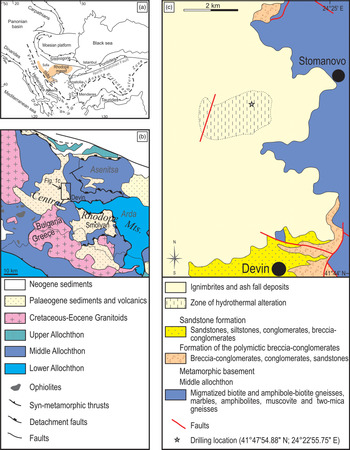
Until recently, ultrapotassic rocks from the western Rhodope Massif have not been reported. A 2007 gold exploration project produced 15 drill holes within the hydrothermally altered Stomanovo prospect, located in the SE part of the Bratsigovo–Dospat volcanic district (Fig. 1). One of them (SV010; coordinates: 41° 47′ 54.88″ N; 24° 22′ 55.75″ E) intersected a monzonite porphyry interpreted as a shallow intrusion stock, which was proposed to be the cause for the hydrothermal alteration observed at the surface (Harkovska & Velinov, Reference Harkovska and Velinov2002). Preliminary petrological studies of the monzonite porphyry (Marchev & Jelev, Reference Marchеv and Jelev2010), designated as monzonite from here onward, revealed that the rock contains high-Mg clinopyroxene (Cpx) with inclusions of high-Fe green Cpx, suggesting a rather complex magmatic evolution. Here we present new data, which include age determinations, whole-rock and mineral major- and trace-element abundances, and Sr and Nd isotope ratios for these rare ultrapotassic Stomanovo monzonites. We use these data to offer an alternative view on the K2O and large-ion lithophile element (LILE) enrichments characteristic for the ultrapotassic post-collisional magmatism globally.
(a) Location of the Rhodope and Serbo-Macedonian Massifs in the structural system of the Alpine region in the Balkan Peninsula and western Turkey. (b) Geological map of the Central Rhodopes. (c) Geology of the Stomanovo area after geological map of Bulgaria, M 1:50 000 (Sarov et al. Reference Sarov, Naydenov, Zhelezarski, Marinova, Georgieva, Ivanova, Popov and Markov2009) and Harkovska & Velinov (Reference Harkovska and Velinov2002).

2. Geological setting
The Rhodope Massif represents a major tectonic zone in the Alpine–Himalayan mountain belt of the eastern Mediterranean region (Fig. 1a), occupying a large part of southern Bulgaria and northern Greece. It was actively involved in the Alpine orogeny, with nappe stacking and crustal thickening events, which may have started by Late Jurassic time (Papanikolaou, Reference Papanikolaou2009; Krenn et al. Reference Krenn, Bauer, Proyer, Klötzli and Hoinkes2010; Turpaud & Reischmann, Reference Turpaud and Reischmann2010; Burg, Reference Burg, Skourtsos and Lister2012; Froitzheim et al. Reference Froitzheim, Jahn-Awe, Frei, Wainwright, Maas, Georgiev, Nagel and Pleuger2014) and lasted until Late Cretaceous to early Tertiary times (Burg et al. Reference Burg, Ivanov, Ricou, Dimov and Klain1990, Reference Burg, Ricou, Ivanov, Godfriaux, Dimov and Klain1996; Collings et al. Reference Collings, Savov, Maneiro, Baxter, Harvey and Dimitrov2016). The nappes were successively exhumed in middle Tertiary time, followed by late Eocene to early Oligocene syn- and post-orogenic extension (Burg et al. Reference Burg, Ivanov, Ricou, Dimov and Klain1990, Reference Burg, Ricou, Ivanov, Godfriaux, Dimov and Klain1996; Koukouvelas & Doutsos, Reference Koukouvelas and Doutsos1990; Kilias et al. Reference Kilias, Falalakis and Mountrakis1999; Bonev & Beccaletto, Reference Bonev, Beccaletto, Taymaz, Yilmaz and Dilek2007). We use the model of Janák et al. (Reference Janák, Froitzheim, Georgiev, Nagel and Sarov2011), who separate four nappes: the Lower, Middle, Upper and Uppermost allochthons.
The Lower Allochthon includes three orthogneiss-dominated metamorphic domes: the Arda, Kesebir and Biala Reka, and the marble-dominated Pangeon–Pirin dome. The protolith ages of the orthogneiss are Variscan and range between 328 and 300 Ma (Peytcheva & von Quadt, Reference Peytcheva and von Quadt1995; Ovtcharova et al. Reference Ovtcharova, Cherneva, von Quadt and Peytcheva2002; Peytcheva et al. Reference Peytcheva, von Quadt, Ovtcharova, Handler, Neubauer, Salnikova, Kostitsyn, Sarov and Kolcheva2004). The ages of gneisses of the Pangeon–Pirin dome appear to be younger and fall between 291 and 270 Ма (P. Turpaud, unpub. Ph.D. thesis, Johannes Gutenberg-Universität Mainz, 2006). The rocks of the Middle Allochthon are heterogeneous, represented by amphibolitized ophiolites that are closely associated with marbles, ortho- and paragneisses and eclogites. Their protolith ages vary from Neoproterozoic to Late Cretaceous (Turpaud & Reischmann, Reference Turpaud and Reischmann2010; Liati et al. Reference Liati, Gebauer, Fanning, Dobrzhinetskaya, Faryad, Wallis and Cuthbert2011; Collings et al. Reference Collings, Savov, Maneiro, Baxter, Harvey and Dimitrov2016; Miladinova et al. Reference Miladinova, Froitzheim, Nagel, Janák, Georgiev, Fonseca, Sandmann and Münker2018). Relevant to our study are the biotite orthogneisses of the Assenitsa and Startsevo units of the Middle Allochthon, which are Jurassic (163–134 Ма; von Quadt et al. Reference von Quadt, Peytcheva, Sarov and Naydenov2008; Turpaud & Reischmann, Reference Turpaud and Reischmann2010). The Upper Allochthon crops out in the Serbo-Macedonian Massif (Vertiskos–Ograzhden unit), the Pirin mountains and in the eastern Rhodopes (incl. Kimi Complex; Mposkos & Krohe, Reference Mposkos and Krohe2006). The Vertiskos–Ograzhden unit is composed of orthogneisses with protolith ages of 460–426 Ma (Macheva et al. Reference Macheva, Peytcheva, von Quadt, Zidarov and Tarassova2006; Himmerkus et al. Reference Himmerkus, Reischmann and Kostopoulos2009; Peytcheva et al. Reference Peytcheva, von Quadt, Sarov, Voinova and Kolcheva2009). The Kimi unit consists of high-pressure and ultra-high-pressure gneisses, marbles, eclogites, amphibolites and metaperidotites with Early Cretaceous ages (Krohe & Mposkos, Reference Krohe, Mposkos, Blundell, Neubauer and von Quadt2002; Kirchenbaur et al. Reference Kirchenbaur, Pleuger, Jahn-Awe, Nagel, Froitzheim, Fonseca and Münker2012 b). The Uppermost Allochthon includes Jurassic (177–164 Ma) greenschist-facies sedimentary and volcano-sedimentary rocks of the Circum-Rhodope Belt (Koglin et al. Reference Koglin, Reischmann, Kostopoulos, Matukov and Sergeev2007; Bonev et al. Reference Bonev, Marchev, Moritz and Colling2015).
From Late Cretaceous time onwards, the Rhodope Massif was affected by widespread subduction-related magmatic activity (Blundell et al. Reference Blundell, Arndt, Cobbold and Heinrich2005; Gallhofer et al. Reference Gallhofer, von Quadt, Peytcheva, Schmid and Heinrich2015; Marchev & Filipov, Reference Marchev and Filipov2012; von Quadt & Peytcheva, Reference von Quadt, Peytcheva, Yanev and Nedialkov2005; Wortel & Spakman, Reference Wortel and Spakman2000) followed by early–middle Eocene post-collisional magmatism represented by numerous felsic to mafic intrusions (Peytcheva et al. Reference Peytcheva, Kostitsin, Salnikova, Kamenov and Klain1998; Kamenov et al. Reference Kamenov, Peytcheva, Klain, Arsova, Kostitsin and Salnikova1999; Soldatos et al. Reference Soldatos, Koroneos, Kamenov, Peytcheva, von Quadt, Christofides, Zheng and Sang2008; Marchev et al. Reference Marchev, Georgiev, Raicheva, Peytcheva, von Quadt, Ovtcharova and Bonev2013). The early–middle Eocene magmatism was followed by slab break-off and asthenospheric uplift in the Rhodopes, which caused heating, fast exhumation of the massif and core complex formation during 42–35 Ma. Following the core complex exhumation, steep faulting and widespread extension in late Eocene–Oligocene times resulted in emplacement of large volumes of volcanic and plutonic rocks (34–30 Ma) that cover almost the entire Rhodope Massif (Del Moro et al. Reference Del Moro, Innocenti, Kyriakopoulos, Manetti and Papadopoulos1988; Harkovska et al. Reference Harkovska, Yanev and Marchev1989, Reference Harkovska, Marchev, Machev and Pecskay1998; Jones et al. Reference Jones, Tarney, Baker and Gerouki1992; Yanev et al. Reference Yanev, Innocenti, Manetti and Serri1998; Yanev, Reference Yanev2003; Marchev et al. Reference Marchev, Kaiser-Rohrmeier, Heinrich, Ovtcharova, von Quadt and Raicheva2005, Reference Marchev, Georgiev, Raicheva, Peytcheva, von Quadt, Ovtcharova and Bonev2013). Generally, this magmatism is divided into three zones: the Eastern Rhodope Magmatic Zone, the Central Rhodope Magmatic Zone and the Struma Magmatic Zone (Harkovska et al. Reference Harkovska, Marchev, Machev and Pecskay1998; Marchev et al. Reference Marchev, Rogers, Conrey, Quick, Vaselli and Raicheva1998). Most of the subvolcanic bodies in the Eastern Rhodope Zone are intruded into the volcanic cover forming volcano-plutonic associations (e.g. Madjarovo, Zvezdel, Borovitsa; Mavroudchiev et al. Reference Mavroudchiev, Nedyalkov, Eleftheriadis, Soldatos and Christofides1993) closely associated with Pb–Zn–Cu and Ag–Au deposits (Marchev et al. Reference Marchev, Kaiser-Rohrmeier, Heinrich, Ovtcharova, von Quadt and Raicheva2005). Much deeper and larger plutons, coeval with the volcanic eruptions, are known in the Struma Magmatic Zone in the western Rhodopes (e.g. Vrondou, Teshovo and Central Pirin plutons; Kolokotroni & Dixon, Reference Kolokotroni and Dixon1991; Soldatos et al. Reference Soldatos, Koroneos, Kamenov, Peytcheva, von Quadt, Christofides, Zheng and Sang2008; Filipov et al. Reference Filipov, Marchev, Peytcheva, von Quadt, Georgiev, Zaitsev and Ermolaeva2017; Zagorchev et al. Reference Zagorchev, Balica, Kozhoukharova and Balintoni2017).
3. Bratsigovo–Dospat volcanic area
The Bratsigovo–Dospat volcanic area occupies the westernmost part of the Central Rhodope Magmatic Zone and comprises the largest felsic ignimbrite complex in the Rhodopes, covering ∼700 km2 with ∼200 km3 of erupted material (Fig. 1b). The geology of the area was studied by Katskov (Reference Katskov1980) and Kackov (Reference Kackov1987), who reported two altered andesite dykes, intruded into the Bratsigovo–Dospat ignimbrites. These ignimbrites are underlain by a sedimentary succession of upper Eocene (Priabonian–lower Oligocene) breccia-conglomerates, sandstones, siltstones and lenses of limestones. All of the volcano-sedimentary associations are underlain by the Rhodopean metamorphic basement, represented by the amphibolites, marbles, gneisses and schists of the Middle Allochthon and migmatized biotite and amphibole-biotite orthogneisses and eclogites of the Lower Allochthon (Arda dome; Fig. 1b). The entire volcano-sedimentary succession can be examined in an outcrop north of the town of Devin, ∼2 km south of the studied Stomanovo ultrapotassic monzonite intrusion. The age of the Bratsigovo–Dospat ignimbrite is determined by K–Ar dating of biotite as 32–30 Ma (Harkovska et al. Reference Harkovska, Marchev, Machev and Pecskay1998). In the southern part of the Bratsigovo–Dospat volcanic area, the ignimbrites directly overlie the Paleocene Elatia–Barutin–Buynovo granodiorite (55.93 ± 0.28 Ma; U–Pb zircon; Soldatos et al. Reference Soldatos, Koroneos, Kamenov, Peytcheva, von Quadt, Christofides, Zheng and Sang2008).
The Stomanovo monzonite is intruded into the Bratsigovo–Dospat ignimbrites and forms an alteration halo (Fig. 1c). Alteration products are described in detail by Harkovska & Velinov (Reference Harkovska and Velinov2002) and Velinov et al. (Reference Velinov, Kunov and Velinova2007), who report quartz-sericite-alunite and quartz-diaspore zones without mineralization. The alteration zone has an E–W elongated shape (2.5 × 1 km) and, most probably, formed as the result of hydrothermal activity linked to the intrusion of the Stomanovo monzonite.
4. Sampling and analytical method
The Stomanovo monzonite is covered by only 10–12 m of altered ignimbrite. Three unaltered sections were selected from the SV010 drill core at depths of 62 m (SV010-62), 83 m (SV010-83) and 129 m (SV010-129).
The abundances of the major and selected low abundance trace elements (Sc, V, Cr, Co, Ni, Zn, Cu, Pb, Ga, Zr, Hf, Nb, U, Y, Th, Rb, Sr, Ba, La, Ce, Nd) were determined on fused and pressed pellets, respectively, using a Philips PW2400 spectrometer at the University of Lausanne. Freshly broken cross-sections of the fused pellets from the X-ray fluorescence (XRF) analyses of samples (SV010-83 and SV010-129) were analysed for trace and rare earth elements (Zr, Hf, Nb, Ta, U, Y, Th, Rb, Cs, Sr, Ba and REEs) using a New Wave Research Excimer 193 nm laser-ablation system UP-193FX attached to a Perkin-Elmer ELAN DRC-e inductively coupled plasma mass spectrometer (LA-ICP-MS) at the Geological Institute of Bulgarian Academy of Sciences (GI BAS) in Sofia. We used a 100 µm laser beam diameter and 5 to 10 Hz repetition rate. The NIST 610 glass material was used as an external calibration standard, and the XRF values for SiO2 were used as an internal standard and for cross-checking.
Major elements in minerals were determined using a JEOL 870 SUPERPROBE at the University of Florence. A 15 keV accelerating potential, 10 nA beam current and 1 μm beam diameter were used. In situ concentrations of trace-element abundances in Cpx, plagioclase, biotite and sanidine crystals were determined on polished thin-sections using the LA-ICP-MS at the GI BAS, Sofia. The laser-spot diameter was 35 to 50 μm and the energy of laser ablation was 5–10 Hz and 8–10 J cm−2. The NIST 610 glass standard was used for external calibration, with SiO2 and CaO from the microprobe measurements as internal standards for cross-checking.
Zircon crystals for age determination were extracted from sample SV010-129, hand-picked and fixed in epoxy resin before polishing. Cathodoluminescence (CL) images and back-scatter electron images (BSE) were taken at the University of Belgrade and used to check the internal structure of individual zircon grains. U–Pb ages of zircons were subsequently measured at the LA-ICP-MS laboratory of the GI BAS. The laser crater was set at 35 μm, and GEMOC-GJ1 zircon was used as an external standard. Fractionation correction and results were estimated using GLITTER 4.0 software (Macquarie University).
Thermal ionization mass spectrometry (TIMS) was used for the analysis of 87Sr/86Sr and 143Nd/144Nd isotope ratios. Strontium (Sr) and Neodymium (Nd) were extracted from unspiked rock powders that were dissolved first in ultrapure HNO3:HF acid mixture (1:3), dried and re-dissolved in optima grade ultrapure HNO3 acid producing clear final solutions. The rock digestions were followed by conventional ion-exchange chromatographic techniques (Sr Spec and LN Spec resins) in a clean lab at the University of Leeds, UK. Sr and Nd isotope ratios were measured on a Triton series (Thermo Scientific) multi-collector mass spectrometer running in static mode. The normalization ratio used for Sr fractionation correction was 86Sr/88Sr = 0.1194 and for Nd it was 146Nd/144Nd = 0.7219. Instrument errors for determinations of 87Sr/86Sr and 143Nd/144Nd are reported as 2σ. External precision (2σ) for Sr and Nd isotopic ratios from successive replicate measurements of standards were <20 ppm for the NIST SRM-987 standard and <20 ppm for the La Jolla Nd standard.
5. U–Pb zircon ages
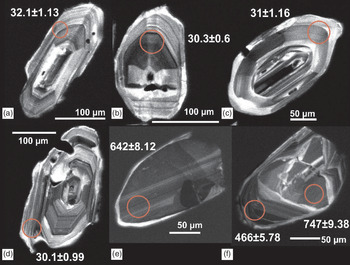
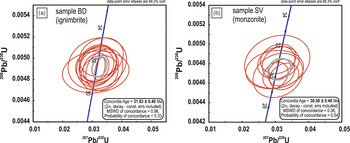
Recently Filipov et al. (Reference Filipov, Marchev, Peytcheva, von Quadt, Georgiev, Zaitsev and Ermolaeva2017) used LA-ICP-MS U–Pb zircon dating to show that the age of the host ignimbrites is between 30.93 ± 0.28 Ma and 30.55 ± 0.25 Ma. Here we report new results from the host ignimbrites and the Stomanovo monzonite using U–Pb in zircon dating (online Supplementary Material Table S1). The CL images of the zircon grains selected for our study show either prismatic or rounded to ovoid shapes. They have typical oscillatory magmatic zonation (Fig. 2a, b) with some xenocrysts or cores, mantled by 30–80 µm overgrowths with planar zonation (e.g. Fig. 2c, e). Many crystals show an irregular surface or small embayments, indicative of resorption (Fig. 2d). Our newly determined age for the host ignimbrite of 31.63 ± 0.40 Ma (Fig. 3a) is based on determinations of 12 concordant zircon grains. The age we report here is nearly identical to the ages reported by Filipov et al. (Reference Filipov, Marchev, Peytcheva, von Quadt, Georgiev, Zaitsev and Ermolaeva2017). Nine zircon analyses from the monzonite yield a concordia age of 30.50 ± 0.46 Ma, interpreted as the time of crystallization of the intrusion (Fig. 3b). These ages, along with the field relationships, indicate that the intrusion occurred shortly after the ignimbrite eruption.
Cathodoluminescence images showing the range of textures and ages observed in zircons from the Stomanovo monzonite porphyry, sample SV010-129: (a) grain c09 – prismatic oscillatory zoned crystal; (b) grain a10 – rounded crystal with resorbed core, followed by oscillatory outer rim; (c) grain a13 – rounded crystal with corroded planar core, followed by oscillatory zone resorbed by light outer rim; (d) grain c15 – embayed oscillatory zoned crystal; (e) grain a06 – planar xenocrysts (642 Ma) with thin light rim; (f) grain a15 – xenocryst with older (747 Ma) corroded core and younger (466 Ma) oscillatory rim. Circles – location of LA-ICP-MS U–Pb analyses. Ages for LA-ICP-MS analyses in Ma.

Zircon U–Pb concordia diagrams for (a) the Bratsigovo–Dospat ignimbrite, and (b) the Stomanovo monzonite.

6. Petrography and mineral chemistry
The Stomanovo ultrapotassic monzonite intrusion consists of visually undeformed rocks with porphyritic textures consisting of zoned plagioclase, K-feldspar, orthopyroxene, Cpx and biotite, with accessory apatite, opaque minerals and zircon within a holocrystalline groundmass of plagioclase, sanidine and quartz.
6.a. Major-element chemistry
Orthopyroxene is completely replaced by Fe–Mg hydrosilicates of the iddingsite–bowlingite group and was not analysed as a result.
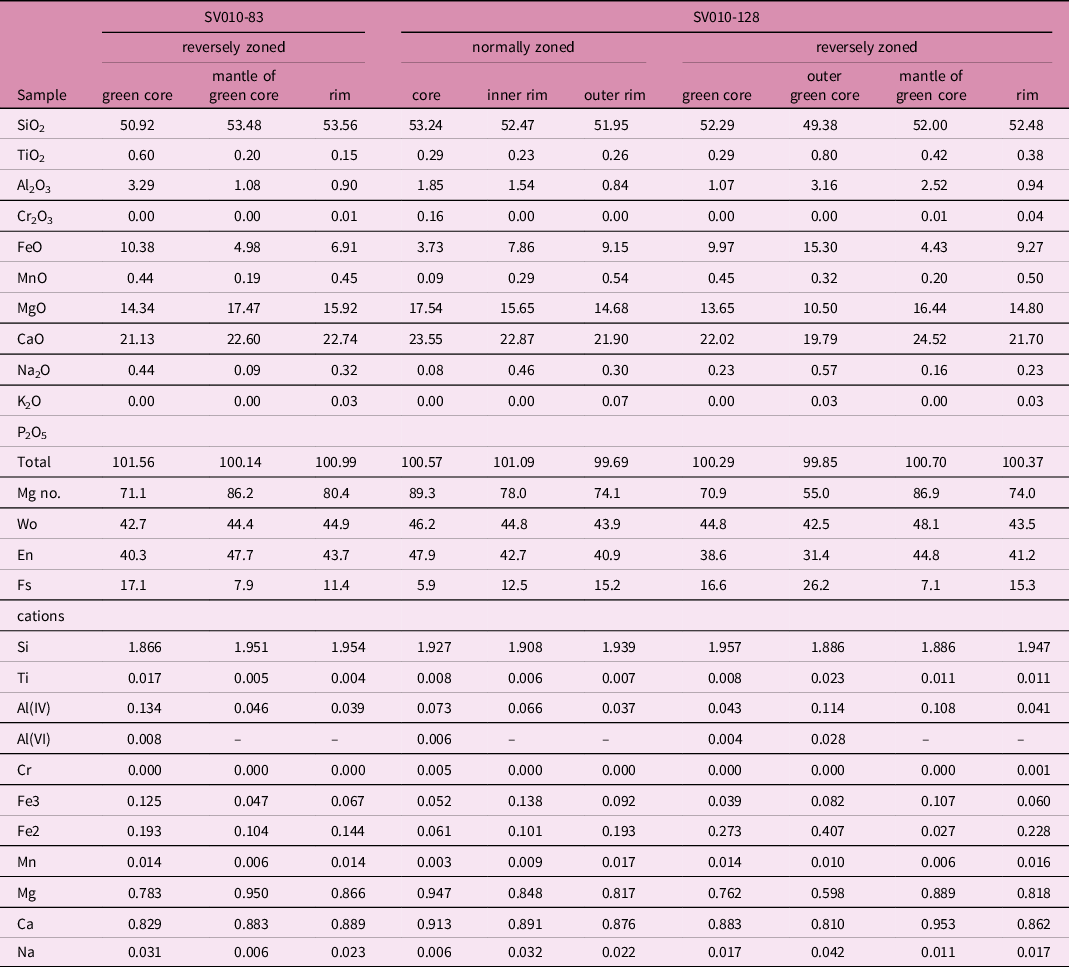
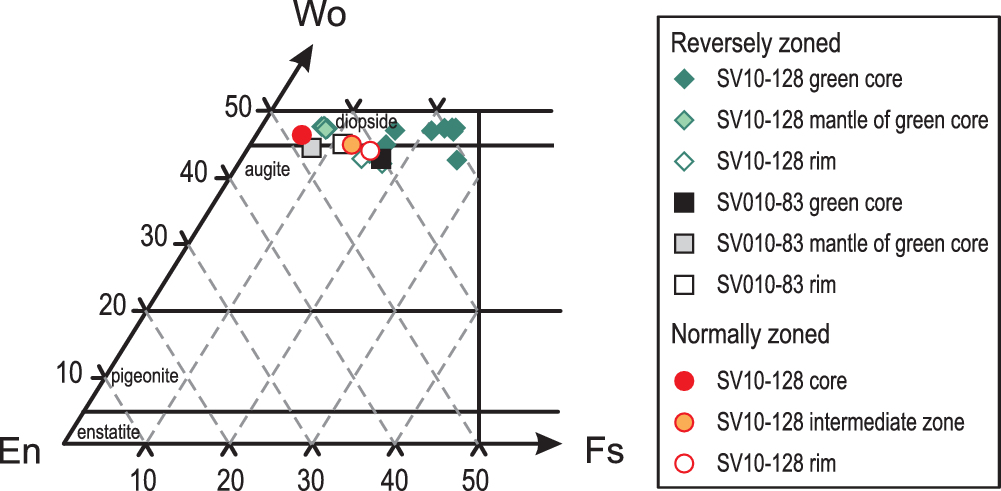
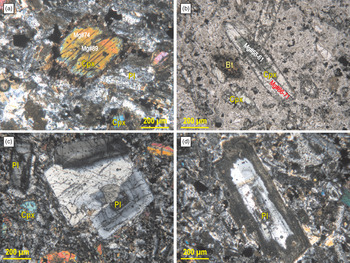
Clinopyroxene is the most common mafic mineral and shows normally and reversely zoned major-element compositions (Table 1). In the pyroxene quadrilateral they plot in the fields of diopside and augite (Fig. 4). Normally zoned Cpx phenocrysts have a gradual core-to-rim decrease in Mg no. (89–74) and Cr (3864–17 ppm; Fig. 5a). They also have low TiO2 (0.23–0.29 wt %), Al2O3 (0.84–1.85 wt %) and Na2O (0.08–0.46 wt %) and also similar Ti/Al ratios (0.06–0.16). Reversely zoned Cpx (Fig. 5b) have green Fe-rich cores with widely varying Mg no. (71–55) and low Cr (24–118 ppm) and higher TiO2 (0.29–0.80 wt %), Al2O3 (1.07–3.29 wt %) and Na2O (0.23–0.57 wt %) abundances. They are wrapped by normally zoned Cpx mantle (Mg no. 87–74), compositionally similar to the normally zoned Cpx.
Representative chemical analyses and structural formula (O = 6) of pyroxenes from the Stomanovo ultrapotassic monzonite

Clinopyroxenes from the Stomanovo monzonite plotted on conventional Ca–Mg–(Fe + Mn) diagram (Morimoto et al. Reference Morimoto, Fabries, Ferguson, Ginzburg, Ross, Seifert, Zussman, Aoki and Gottardi1988).

Microphotographs showing zoning types of clinopyroxenes and plagioclase. (a) Normally zoned clinopyroxene with Mg-rich core and lower Mg rim; the lowest value is measured in the very thin rim. (b) Reversely zoned clinopyroxene with Fe-rich green core and Mg-rich rim. (c) Normally zoned plagioclase. (d) Sieve-textured plagioclase. Bt – biotite; Cpx – clinopyroxene; Pl – plagioclase.

Plagioclase occurs as two populations (online Supplementary Material Table S2): either as clear and normally zoned grains with An53–45 (Fig. 5c), or showing larger compositional variation (An67–25) and sieved textured outer rims with abundant small glass inclusions (Fig. 5d).
Sanidine has a relatively homogeneous composition (online Supplementary Material Table S2; Or75.5–69.1 Ab26.2–21.0 An1.1–2.1 Cn 2.8–1.2).
Biotite (online Supplementary Material Table S3) forms either phenocrysts or occurs as inclusions in the sanidine. It has Mg nos. of 74.0–71.4, showing slight decreases from cores to rims and Mg nos. similar to the outer rims of the normally zoned Cpx. On the classification diagrams (not shown) it falls in the field of phlogopite, close to the boundary with high-Mg biotite. The analysed phlogopite is characterized by high TiO2 (5.64–6.37 wt %), Al2O3 (13.3–14.2 wt %) and K2O (9.18–10.04 wt %). The F content reaches up to 3.3 wt %.
Ilmenite, which is enriched in Mn (6.0–6.4 wt %; online Supplementary Material Table S3), forms small crystals, and also contains a small amount of MgO (0.2–0.5 wt %).
6.b. Trace-element chemistry
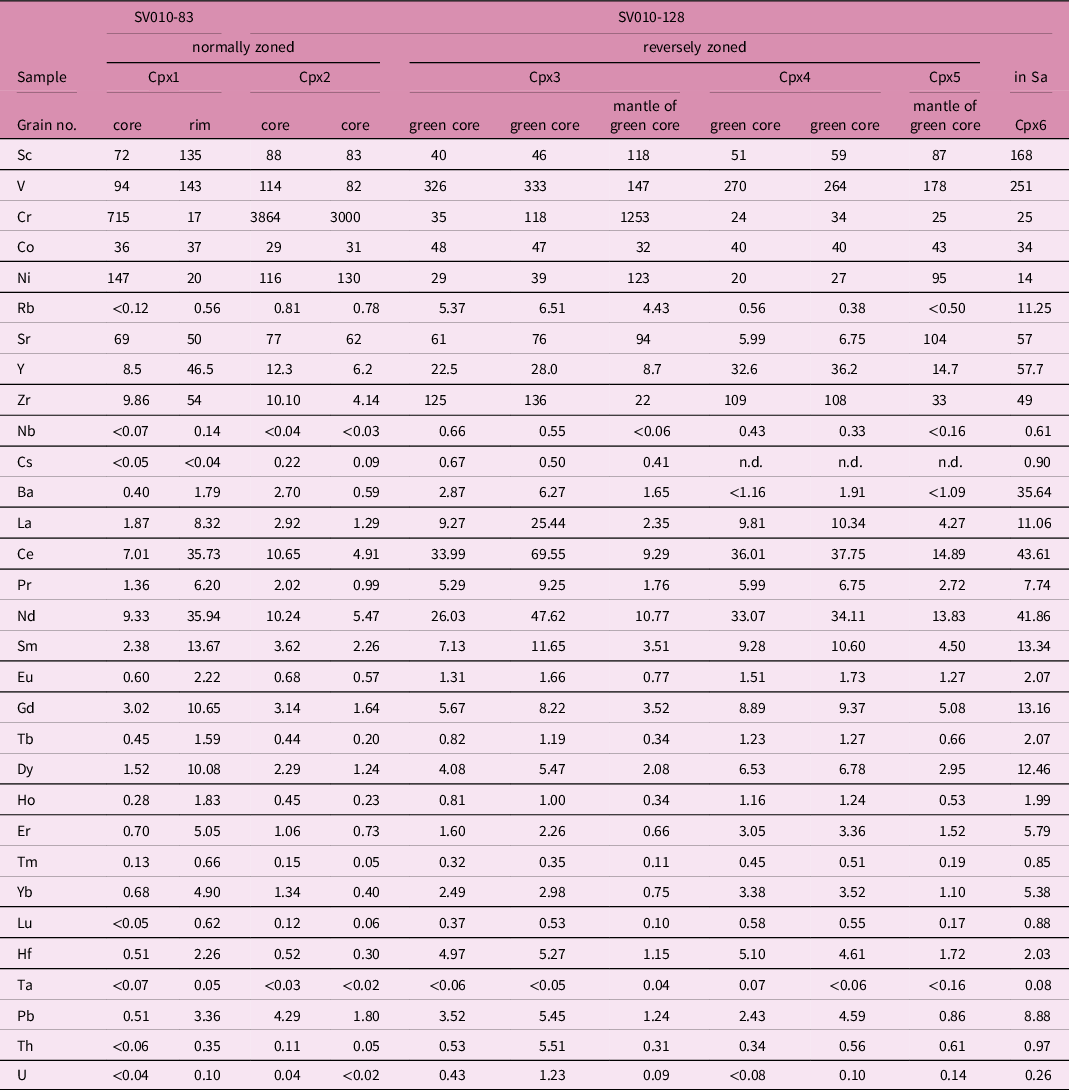
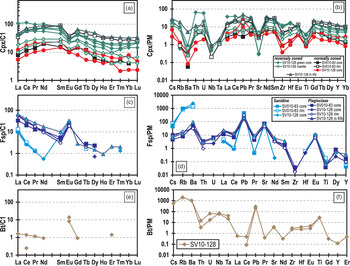
Clinopyroxene. Normally zoned Cpx and the mantles of the green cores have similar trace-element concentrations (Table 2), characterized by high Cr and Sc and low Ti. The green pyroxene cores have higher Ti, V, Rb, Zr, Nb, U and Th and distinctively higher REE abundances. The chondrite (CI)-normalized REE patterns of the normally zoned Cpx and the mantles of the green-core Cpx (Fig. 6a) display parallel and generally convex-upward REE patterns peaking at Nd and Sm and decreasing from Pr to La and Gd to Lu. The most Mg rich cores have a small negative Eu anomaly (Eu/Eu* = 0.91), getting stronger in the outer low Mg zones to 0.56. All green Cpx have more elevated REE abundances and a pronounced Eu anomaly in the range 0.51–0.63, with one of them showing a slightly enriched flat profile from La to Sm (Table 2; Fig. 6a). The primitive mantle (PM)-normalized trace-element patterns of these two groups (Fig. 6b) are rather similar, with troughs in Ba, Nb, Ta, Sr, Zr and Ti and peaks at Cs, Th, U, Pb, Nd and Sm, but these features are more pronounced in the green cores.
Representative trace-element (LA-ICP-MS) concentrations of clinopyroxene in the Stomanovo ultrapotassic monzonite

Chondrite-normalized REE patterns (left panel) and primitive mantle-normalized multi-element patterns (right panel) for (a, b) clinopyroxene, (c, d) feldspars and (e, f) biotite. Chondrite and PM normalization values are from Sun & McDonough (Reference Sun, McDonough, Saunders and Norry1989).

Plagioclase and sanidine. The CI-normalized REE patterns (Fig. 6c) show a decreasing trend from La to Sm and a positive Eu anomaly. With few exceptions, the medium REEs (MREEs) and heavy REEs (HREEs) are below detection limit. The PM-normalized trace-element patterns (Fig. 6d) are characterized by enrichments in Sr, Pb and Ba (online Supplementary Material Table S4).
Biotite has high Rb, Ba, Sr, Pb and Nb contents (online Supplementary Material Table S4). These values are similar to or slightly higher than those in the compositionally similar trachytes from Campi Flegrei, Italy (Fedele et al. Reference Fedele, Lustrino, Melllluso, Morra, Zanetti and Vannucci2015).
7. Whole-rock major- and trace-element compositions
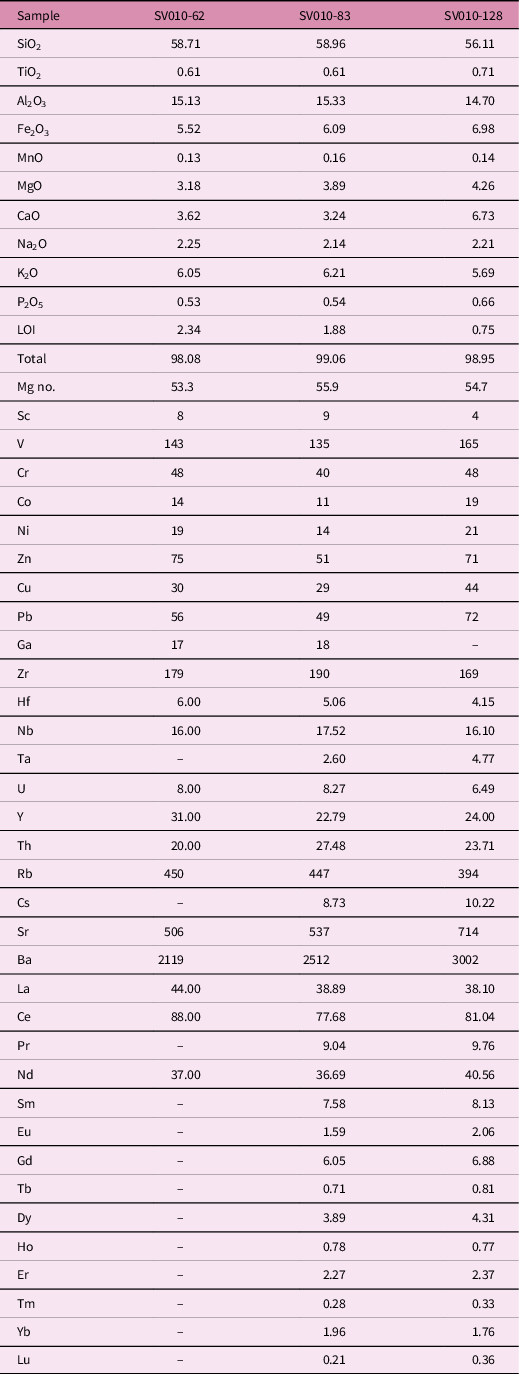
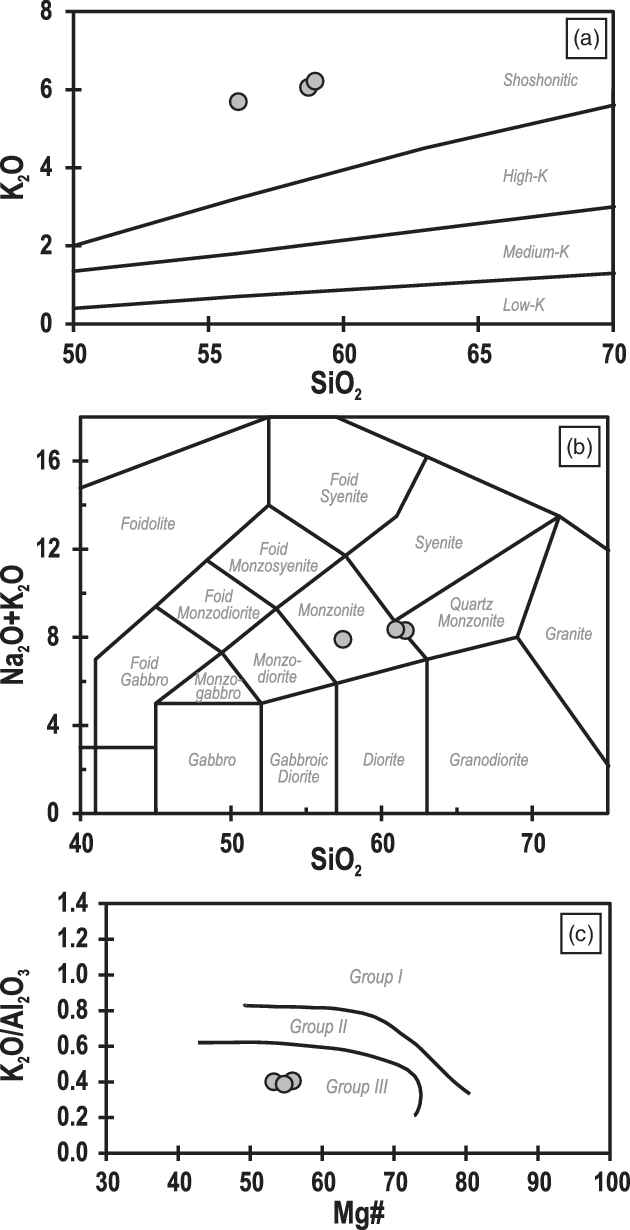
The whole-rock compositions of the Stomanovo monzonite are presented in Table 3. The samples span a narrow compositional range for SiO2 (56 to 59 wt %), as well as for the other major elements. The monzonite has very high K2O (5.7–6.2 wt %) and relatively low Na (∼2.2 wt %) contents and K2O/Na2O ratios ranging from 2.6 to 2.9, thus showing ultrapotassic affinity (Foley et al. Reference Foley, Venturelli, Green and Toscani1987). Considering the presence of phlogopite, the loss on ignition (LOI) is low (0.8 to 2.3 %) suggesting only weak alteration. On the SiO2 versus K2O diagram (Fig. 7a) the samples plot in the field of the high-K (shoshonitic) series. On the total alkali–silica (TAS) diagram (Fig. 7b), the samples classify as monzonites, falling close to the quartz-monzonite field. Using the classification scheme of Foley et al. (Reference Foley, Venturelli, Green and Toscani1987), the Stomanovo monzonites fall in the Group III orogenic ultrapotassic series (see Fig. 7c).
Major- and trace-element analyses of the Stomanovo ultrapotassic monzonite

Classification diagrams for the Stomanovo intrusion. (a) K2O v. SiO2 classification diagram after Peccerillo & Taylor (Reference Peccerillo and Taylor1976). (b) Total Alkali v. SiO2 (TAS) diagram (Middlemost, Reference Middlemost1994). (c) K2O/Al2O3 v. Mg-number variation in ultrapotassic rocks (after Foley et al. Reference Foley, Venturelli, Green and Toscani1987).

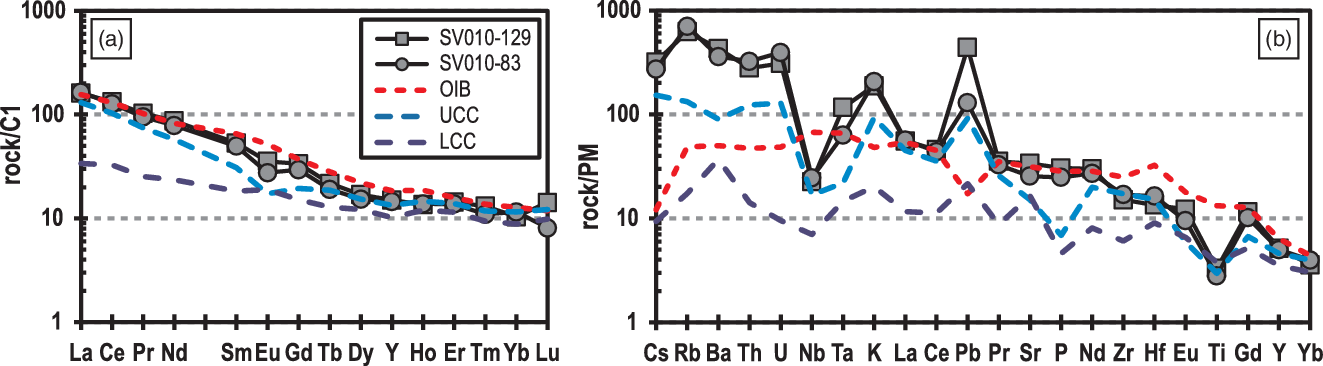
The Stomanovo monzonite has high Rb (∼450 ppm) and Ba (2119–3002 ppm) contents, as well as low Nb (16–17.5 ppm). Their CI-normalized REE patterns (Fig. 8a) exhibit clear light REE (LREE) enrichment (LaN/YbN = 14.3–15.55), flat HREE patterns (TbN/YbN = 1.7–2.1) and moderate negative Eu anomalies (Eu/Eu* = 0.72–0.84) (Fig. 5a). In the PM-normalized multi-element diagram (Fig. 8b), the Stomanovo monzonite samples exhibit enrichments of LILEs (Cs, Rb, Ba, Th, U) and Pb, and negative high field strength element (Nb–Ta and Ti) anomalies considered typical for orogenic ultrapotassic magmas (Foley et al. Reference Foley, Venturelli, Green and Toscani1987).
(a) Chondrite-normalized REE patterns and (b) primitive mantle-normalized multi-element patterns for bulk rocks of the Stomanovo monzonite porphyry. Normalizing values are from Sun & McDonough (Reference Sun, McDonough, Saunders and Norry1989). Average composition of ocean island basalt (OIB) (Sun & McDonough, Reference Sun, McDonough, Saunders and Norry1989) and upper (UCC) and lower continental crust (LCC) (Rudnick & Gao, Reference Rudnick, Gao and Rudnick2003) are given for comparison.

8. Sr and Nd isotopes
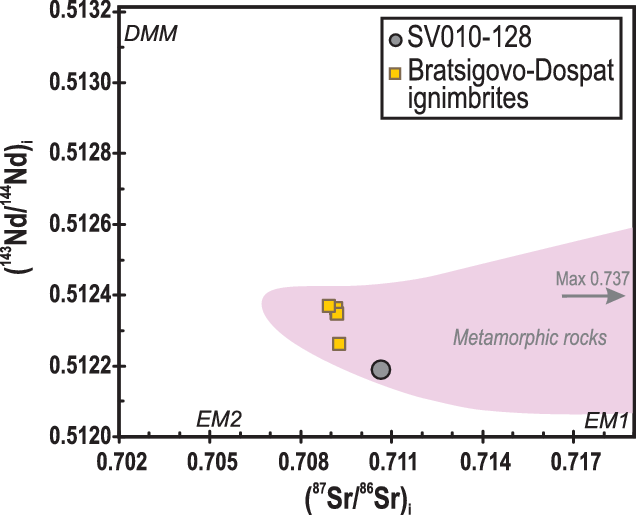
Sr and Nd isotopic compositions of representative unaltered Stomanovo monzonite sample are given in Table 4 and shown in Figure 9. The monzonite has relatively radiogenic 87Sr/86Sr (0.71066) and unradiogenic 143Nd/144Nd (0.51220–0.51219) ratios, corresponding to a ϵNdi of −7.8 to −8.0. In contrast, the host ignimbrite displays less radiogenic 87Sr/86Sr (0.70917–0.70927) and more radiogenic 143Nd/144Nd (0.51228–0.51238) and ϵNdi (−4.6 to −6.5) (Filipov et al. Reference Filipov, Marchev, Peytcheva, von Quadt, Georgiev, Zaitsev and Ermolaeva2017).
Sr and Nd isotopic composition of the Stomanovo monzonite

* replicate
Sr and Nd isotopic compositions of the monzonite, compared with those of the host ignimbrites. Data for the Bratsigovo–Dospat ignimbrites are from Filipov et al. (Reference Filipov, Marchev, Peytcheva, von Quadt, Georgiev, Zaitsev and Ermolaeva2017).

9. Discussion
9.a. Sources for the Stomanovo ultrapotassic monzonite
The most notable feature of the Stomanovo monzonite is the large diversity of mineral compositions that cannot be achieved via simple fractional crystallization and thus suggests mixing of two components: (i) mafic magma, containing high-Mg Cpx (Mg no. 86–89) and (ii) green high-Fe and high-Na Cpx, crystallizing before the high-Mg Cpx. In addition, we observe a large quantity of zircon xenocrysts, demonstrating possible involvement of large volumes of crustal material from the underlying older basement.
Cpx-melt Fe–Mg exchange equilibrium (KdFe–Mg ∼0.27 ± 0.03; Putirka, Reference Putirka2008) was used to calculate the composition of the magma from which both types of Cpx crystallized. Our results show that the high Mg no. (86–89) cores and rims of the normally and reversely zoned Cpx crystallized from mafic magmas with Mg nos. = 63–69. These Mg nos. are much higher when compared with the Mg nos. (53.3–55.9) of the whole rocks, signalling lack of equilibrium with the host magmas. Cpx in equilibrium with such primitive mantle-derived melt indicates significant mantle contribution to the source of the Stomanovo monzonite. Such relationships have also been observed in the alkaline syenites from Armenia (Sokol et al. Reference Sokol, Halama, Meliksetian, Savov and Sudo2018). The rims of the phenocrysts with Mg no. 74 have crystallized from differentiated magmas with a lower Mg no. (∼44), which is probably the composition of the magma at the place of solidification.
Green Cpx with Mg nos. of 55–71 correspond to highly fractionated magmas with Mg nos. of 25–40. Such high-Fe green cores of reversely zoned Cpx with enriched LREEs are more typical for alkaline basalts (e.g. Brooks & Prinzlau, Reference Brooks and Printzlau1978; Wass, Reference Wass1979; Duda & Schmincke, Reference Duda and Schmincke1985; Dobosi, Reference Dobosi1989; Neumann et al. Reference Neumann, Wulff-Pedersen, Simonsen, Pearson, Martí and Mitjavila1999; Shaw & Eyzaguirre, Reference Shaw and Eyzaguirre2000; Marchev et al. Reference Marchev, Arai, Vaselli, Dilek and Pavlides2006). Cpx with such compositions are not common in convergent margins but have been found in shoshonitic and ultrapotassic rocks in Italy (e.g. Varekamp & Kalamarides, Reference Varekamp and Kalamarides1989; Di Battistini et al. Reference Di Battistini, Montanini, Vernia, Bargossi and Gastotina1999); Leucite Hill, Wyoming (Barton & van Bergen, Reference Barton and van Bergen1981); North Kazakhstan (Zhu & Ogasawara, Reference Zhu and Ogasawara2004); and the Yangtze craton (Xu et al. Reference Xu, Huang, Menzies and Wang2003; Huang et al. Reference Huang, Niu, Xu, Chen and Yang2010). Rare green Cpx grains have been observed also in the high-K rocks from the eastern Rhodopes of Bulgaria (R. Raicheva, unpub. Ph.D. thesis, Geol. Inst. BAS, 2013). The origin of the green high-Fe Cpx has been interpreted as either: (1) cognate phases of high-pressure origin that crystallized from evolved magmas (Barton et al. Reference Barton, Varekamp and van Bergen1982; Duda & Schmincke, Reference Duda and Schmincke1985; Dobosi, Reference Dobosi1989; Xu et al. Reference Xu, Huang, Menzies and Wang2003; Marchev et al. Reference Marchev, Arai, Vaselli, Dilek and Pavlides2006); (2) locally metasomatized upper mantle or lower crustal wall rock (e.g. Brooks & Printzlau, Reference Brooks and Printzlau1978; Wass, Reference Wass1979; Barton & van Bergen, Reference Barton and van Bergen1981; Dobosi & Fodor, Reference Dobosi and Fodor1992; Huang et al. Reference Huang, Niu, Xu, Chen and Yang2010; Jankovics et al. Reference Jankovics, Dobosi, Embey-Isztin, Kiss, Sági, Harangi and Ntaflos2013); or (3) xenocrysts from subducted continental materials (Zhu & Ogasawara, Reference Zhu and Ogasawara2004).
The major compositional difference between the green Cpx in most alkaline rocks and the Stomanovo green Cpx is the lower Al2O3 in the latter. Compared to the high-Mg Cpx mantles, they have slightly higher Al2O3 (<3.3 wt %) and overall higher trace-element abundances, but Sr. Nevertheless, the green Cpx and high-Mg Cpx show similar PM-normalized and CI-normalized multi-element patterns (Fig. 6a, b) suggesting crystallization from common parental magma. We suggest that differentiated orogenic magmas can crystallize as gabbroic (Cpx–plagioclase) to clinopyroxenite cumulates in the lower crust. Such xenoliths, composed of compositionally similar green clinopyroxenes, have been described in the Oligocene alkaline basalts from the eastern Rhodopes (Marchev et al. Reference Marchev, Arai, Vaselli, Dilek and Pavlides2006, Reference Marchev, Arai, Ishida, Shirasaka and Downes2008). Intrusion of a later batch of mafic mantle-derived magmas into such cumulate rocks can trigger reaction and mixing between the melt and disrupted green Cpx.
9.b. Conditions of magma crystallization
The documented crystal–melt mixing events preclude the calculation of meaningful crystallization temperatures and pressures of the monzonite based on mineral–melt or mineral–whole-rock equilibrium. Further, the use of the two-pyroxene geothermometer is hindered by the complete alteration of the orthopyroxenes. However, we are able to estimate pressure–temperature (P–T) conditions using compositionally similar Cpx, coexisting with fresh orthopyroxene and high-Al amphibole, found in the coeval neighbouring Mesta trachydacites (Marchev et al. in prep.). The two-pyroxene thermobarometer of Putirka (Reference Putirka2008) for these rocks gave a P of ∼3.8–4.5 kb (12–15 km) and T of ∼1030 °C. A similar pressure (P ∼4.6 kb, ∼15 km) and a slightly lower temperature (T ∼938 °C) was obtained when we used a Cpx Mg core (Mg no. 80) – whole-rock pair from Stomanovo, applying Putirka’s (2008) equations 31 and 33, respectively. However, comparison of the Cpx core composition with other Cpx with similarly high Cr content (up to 3850 ppm) and very low Al2O3 (<2.5 wt %) reported for websterites crystallized from primitive mantle melts at the base of the volcanic arc crustal section in Alaska and the Jijal complex in Kohistan (Jan & Howie, Reference Jan and Howie1981; DeBari & Coleman, Reference DeBari and Coleman1989) suggest that the crystallization of the Cpx might have happened at much higher pressure. Such Cpx has also been obtained from the experiments of high-Mg andesites at a pressure of 12 kb (Müntener et al. Reference Müntener, Kelemen and Grove2001). Therefore, the core of the Stomanovo high-Mg Cpx may have crystallized in a much deeper magma chamber within the lower crust. Overgrowth relationship between green Cpx and their high-Mg rims indicate that green Cpx must have formed at pressures similar to, or higher than, those of the high-Mg Cpx grains.
For the temperature of crystallization in the late stage, we use the plagioclase–K-feldspar thermometer of Putirka (Reference Putirka2008), yielding much lower temperatures of 810–890 °C. We interpret this temperature as reflecting the post-mixing shallow crustal to sub-surface conditions.
9.c. The role of crustal contamination
There is a general consensus that in continental arcs crustal contamination is an inevitable process and that more evolved magmas are commonly complex hybrids of mantle-derived basaltic melts and crustal (cumulate) rocks (e.g. Hildreth & Moorbath, Reference Hildreth and Moorbath1988; DePaolo et al. Reference DePaolo, Perry and Baldridge1992; Davidson et al. Reference Davidson, Hora, Garrison and Dungan2005; McLeod et al. Reference McLeod, Davidson, Nowell and de Silva2012; Crummy et al. Reference Crummy, Savov, Navarro-Ochoa, Morgan and Wilson2014). A surprising result of our study is the more radiogenic composition of 87Sr/86Srii (0.71066) and unradiogenic ϵNdi (−7.8 to −8.0) of the monzonite compared to the host felsic ignimbrites (87Sr/86Sri = 0.7092–0.7093; ϵNdi = −4.6 to −6.5; Fig. 6; Filipov et al. Reference Filipov, Marchev, Peytcheva, von Quadt, Georgiev, Zaitsev and Ermolaeva2017). One possible explanation is the derivation of the monzonite by re-melting of a mantle source that has been thoroughly metasomatized by melts and/or fluids of previously subducted crustal sediments. However, this suggestion is at odds with the large amount of zircon xenocrysts in the monzonite, suggesting that a more reasonable explanation is extensive crustal contamination. From the total number of 25 dated zircons, 44 % are xenocrysts. It is worth nothing that zircon xenocrysts are more abundant than in the host ignimbrites. These zircons fall into four major populations: (1) 51–39 Ma; (2) 271–261 Ma; (3) 466 Ma and (4) 857–552 Ma. The ages of the zircon xenocrysts can be easily correlated with the ages of the rocks from the local outcrops of the metamorphic basement of the Upper Allochthon (462–426 Ма) and Lower Allochthon (345–261 Ma) of the Rhodope Massif. They are broadly similar to the spectrum of ages determined for the metamorphic core complexes of the entire Rhodope Massif (see summary in Burg, Reference Burg, Skourtsos and Lister2012; Bonev et al. Reference Bonev, Ovtcharova-Schaltegger, Moritz, Marchev and Ulianov2013; Abbo et al. Reference Abbo, Avigad and Gerdes2020) and xenozircon age spectrums in other Oligocene magmatic rocks from the Rhodopes (e.g. Bonev et al. Reference Bonev, Ovtcharova-Schaltegger, Moritz, Marchev and Ulianov2013; P. Filipov, unpub. Ph.D. thesis, Geol. Inst. BAS, 2014). The youngest zircon xenocryst population (51–39 Ma) is similar in age to the nearby Barutin–Buynovo pluton (56–42 Ma; Soldatos et al. Reference Soldatos, Koroneos, Kamenov, Peytcheva, von Quadt, Christofides, Zheng and Sang2008).
The above arguments suggest that the most plausible location for the onset of the majority of crustal contamination is the middle crustal magma storage regions (12–15 km), as also indicated from the conditions of crystallization. However, initial contamination may have started also in the lower crust and continued in shallow subvolcanic magma chambers. The high-Mg contents of the cores of the normally zoned Cpx and of the inner zones of the reversely zoned Cpx rims may indicate that crustal contamination occurred after their crystallization. Furthermore, the coincidence of the ages of the xenozircons with those from the basement lithologies indicates that the entrainment of the zircons and the crustal contamination continued en route of the magma from the middle crust to the surface. Crustal contamination of the magma can be enhanced by its small volume and alkaline affinity, as well as the high temperature of the mafic magmas. This is because a small volume of magma can easily entrain foreign material during its travel to the surface, whereas its higher temperature and alkaline character can facilitate dissolution and contamination processes owing to the low melt viscosities and thus increased mobility in the crust (see also Section 9.d).
The crustal contamination is also evident from the similarity of the whole-rock Sr–Nd isotope compositions of the Stomanovo monzonite and the Rhodope metamorphic rocks (Fig. 9). Quantification of the process generally is made by assimilation-fractional-crystallization (AFC) or simple mixing models. However, the large variety of zircon xenocrysts in the Stomanovo monzonite reveals the complex composition of the underlying basement and potential participation of different contaminants, making the selection of end-member values difficult. Similarly, selection of the primitive magma composition is problematic, owing to the scarcity of exposed mafic magmas, and the common fractionation and/or crustal contamination recorded in the crust of the Rhodopes (Marchev et al. Reference Marchev, Raicheva, Downes, Vaselli, Chiaradia and Moritz2004). Thus, the process of crustal contamination is difficult to reconcile quantitatively by any simple two-component crust–magma interaction (bulk mixing or AFC) models (McLeod et al. Reference McLeod, Davidson, Nowell and de Silva2012). Nevertheless, just to demonstrate the potential role of crustal contamination, we constructed an AFC model using the equations of DePaolo (Reference DePaolo1981). A highly radiogenic gneiss from the Lower Allochthon (sample RH346; N. Cornelius, unpub. Ph.D. thesis, Johannes Gutenberg-Universität Mainz, 2008), recalculated for 30 Ma, and the least radiogenic absarokite (sample Bg109b) from the eastern Rhodopes (Kirchenbaur et al. Reference Kirchenbaur, Münker, Schuth, Garbe-Schönberg and Marchev2012 a) have been selected as possible end-members. Details of the end-member selection and the calculation are given in online Supplementary Material Figure S1. Using these isotopic end-member values, it seems that the Stomanovo monzonites can be produced by fractionation of absarokitic magma and a high rate of gneiss assimilation (r = 0.5, where r is ratio of assimilated material to crystallized material).
9.d. Potassium enrichments
Most current models for the origin of mafic ultrapotassic and shoshonitic magmas propose derivation from a metasomatized sub-continental lithospheric mantle source. The metasomatic agent is assumed to be derived from subducted sediments or subducted continental crust (e.g. Foley et al. Reference Foley, Venturelli, Green and Toscani1987; Conticelli, Reference Conticelli1998; Prelević & Foley, Reference Prelević and Foley2007; Conticelli et al. Reference Conticelli, Guarnieri, Farinelli, Mattei, Avanzinelli, Bianchini, Boari, Tommasini, Tiepolo, Prelević and Venturelli2009; Avanzinelli et al. Reference Avanzinelli, Elliott, Tommasini and Conticelli2008; Crummy et al. Reference Crummy, Savov, Navarro-Ochoa, Morgan and Wilson2014; Zhang et al. Reference Zhang, Guo, Zhang, Cheng and Sun2017). Recycled materials, in forms of fluids and/or melts, re-fertilize the refractory lithospheric mantle aiding crystallization of new minerals, possibly accommodated in a vein network or through pervasive metasomatism of peridotites (Foley, Reference Foley1992; Conticelli et al. Reference Conticelli, Guarnieri, Farinelli, Mattei, Avanzinelli, Bianchini, Boari, Tommasini, Tiepolo, Prelević and Venturelli2009; Tomanikova et al. Reference Tomanikova, Savov, Harvey, DeHoog, Churikova, Gordeichyk and Yogodzinsky2019) or by forming a mantle–crustal mélange (Zhang et al. Reference Zhang, Guo, Zhang, Cheng and Sun2017). Based on experimental data and Sr, Nd, Pb and Hf isotopic evidence, large amounts of mica-bearing lithologies (e.g. glimmerite, phyllites, blueschists, terrigenous siliciclastic sediments, marly sediments, among others) have been proposed to have a role in the metasomatic process (Avanzinelli et al. Reference Avanzinelli, Elliott, Tommasini and Conticelli2008; Prelević et al. Reference Prelević, Foley, Romer and Conticelli2008; Wang et al. Reference Wang, Foley and Prelević2017; Förster et al. Reference Förster, Prelević, Schmück, Buhre, Marschall, Mertz-Kraus and Jacob2018, Reference Förster, Prelević, Buhre, Mertz-Kraus and Foley2019).
Although the model of mantle metasomatism via subduction fluids and melts can explain the K-enrichment of the Stomanovo monzonite, it is inconsistent with the large quantity of zircons from the underlying Rhodopean metamorphic basement. It is interesting to point out that apart from the zircons, no other types of xenocrysts have been found. As already mentioned, prevailing rock lithologies comprising the underlying metamorphic basement of the Rhodope metamorphic core complex are biotite, K-feldspar and muscovite-bearing gneisses and two-mica schists (Cherneva et al. Reference Cherneva, Dimov, Stancheva and Daieva1995; Mposkos & Krohe, Reference Mposkos and Krohe2006; Collings et al. Reference Collings, Savov, Maneiro, Baxter, Harvey and Dimitrov2016 and references therein). Entrainment, disintegration, disaggregation and dehydration-melting reactions of xenoliths of such composition, which can reach complete fusion at a magmatic temperature of ∼1000 °C and greater depth (Beard et al. Reference Beard, Abitz and Lofgren1993; Reiners et al. Reference Reiners, Nelson and Ghiorso1995), can explain the lack of xenocryst mineral diversity. Particularly suitable for potassium enrichment are some K-feldspar porphyroclastic rocks like charnockites, which start to melt at 900 °C, losing all modal K-feldspar (Beard et al. Reference Beard, Abitz and Lofgren1993). Similar rocks (e.g. augen gneiss) are largely distributed in the Lower Allochthon of the Rhodope Massif, and melting of their K-feldspars can ensure elevation of K2O. Rohrmeier et al. (Reference Rohrmeier, von Quadt, Dreisner, Heinrich, Handler, Ovtcharova, Ivanov, Petrov, Sarov and Peytcheva2013) demonstrated that micas and K-feldspars from the basement metamorphic rock have high 87Sr/86Sr ratios and high Rb (up to 1372 ppm in the biotite, 878 ppm in the muscovite and up to 897 ppm in the K-feldspar). Therefore, elevated concentrations of Rb and Ba in the monzonite, along with the reported high 87Sr/86Sr ratio, can be explained by assimilation of biotite, muscovite and K-feldspar lithologies.
In summary, we propose that assimilation of biotite, K-feldspar, muscovite and other minerals of the underlying metamorphic rocks can increase K, Ba, Rb and LREE concentrations, as well as 87Sr/86Sr ratios of an originally lower K magma and reach the values observed in the Stomanovo monzonite. Our small-scale focused study supports the modelling results of Beard et al. (Reference Beard, Ragland and Crawford2005) that concerns crust–mantle mixing in silicic magmas. Perhaps a combination of age determination of zircon xenocryst populations and petrology and geochemistry of even larger high-K igneous bodies can prove a powerful method to decipher the true origins of such ‘exotic’ and yet very informative magmatic rock varieties.
10. Conclusions
-
(1) Compositional diversity and complex zoning of the Cpx, variable zircon populations and crustal Sr–Nd isotopic signatures indicate a complex origin for the Stomanovo ultrapotassic monzonite involving fractional crystallization, crystal–melt mixing and crustal contamination.
-
(2) The elemental and isotopic characteristics of the Stomanovo ultrapotassic monzonite can be explained as the result of assimilation of K-rich minerals into a calc-alkaline primitive magma. The process is inferred by the high 87Sr/86Sr and low 143Nd/144Nd isotopic ratios and the abundant presence of zircon xenocrysts. Correspondence of the isotopic compositions and ages of the zircon xenocrysts with the underlying metamorphic basement indicates that the Rhodope metamorphic and igneous basement was the major crustal contaminant.
-
(3) High-Fe Cpx cores crystallized in a highly fractionated and probably contaminated magma, whereas high-Mg Cpx crystallized in a primitive mantle-derived mafic magma. Inclusion of the high-Fe Cpx into high-Mg Cpx indicates mixing between disrupted evolved cumulate rocks and the primitive magma.
-
(4) Crystallization and crystal–melt mixing occurred at high to moderate pressure, most probably in the lower and middle crust. The final composition was formed by combined fractional crystallization and crustal contamination in the middle and upper crust.
Acknowledgements
We thank Orlando Vaselli for the assistance in microprobe analyses and Fabio Caponi for the XRF analyses. D. Prelević, an anonymous reviewer and Associate Editor Chun-Jing Wei are thanked for their comments and suggestions that improved the final manuscript. This study was partially supported by the Bulgarian Ministry of Education and Sciences National Research Programme ‘Environmental Protection and Reduction of Risks of Adverse Events and Natural Disasters’ approved by DCM # 577/17.08.2018.
Supplementary material
To view supplementary material for this article, please visit https://doi.org/10.1017/S0016756821000868