In the mid-1890s, a young Theodore Dreiser visited the exclusive easternmost point of Coney Island. Perhaps foretelling his future as a successful novelist, he described the beach as a “fairyland” in which women's bathing suits transformed their wearers into “nymphs, nereids, sirens in truth.”Footnote 1 These sensual, mythical creatures enchanted Dreiser just a short distance away from where crass beachgoers crowded the more democratic western end of the island. One of these, Minnie Smith, even made the paper for being “hopelessly intoxicated” and belligerent to a police official.Footnote 2
Such vignettes speak to the attitudes of middle-class writers and reformers more than they do the character of the women who flocked to Coney Island. Those privileged enough to write for popular magazines, medical journals, or publishing houses articulated a popular idea: bodily filth signaled not just a lack of access to bathing and laundry facilities, but also moral degeneration.Footnote 3 This was especially apparent during the summer, when heat and humidity threw the cleanest and filthiest urban residents into stark contrast with one another. Writers like Dreiser, Ladies’ Home Journal editor Edward Bok, and reformers Marie and Mrs. John van Vorst implied that women had the greatest propensity toward cleanliness, and also had further to fall. Regardless of economic background, a respectable woman maintained a clean body, clothing, and reputation. Those who achieved this hygienic ideal represented the apotheosis of civility in a stratified society. Those who did not were debased, possibly irredeemable creatures whose natural filth manifested itself in their persons and deportment. Not surprisingly, filth tended to reinforce not just gender but also class constructs; middle-class women tended toward cleanliness, working women toward filth.Footnote 4 While some well-heeled urbanites found this simplistic dichotomy reassuring, others—including the allegedly unwashed masses—found it problematic. City borderlands like Coney Island offered city dwellers a place to challenge this perception. Along Coney's shoreline, all but the most elite beachgoers divorced themselves from everyday expectations of gender and class performance to enact their own, more fluid, versions.Footnote 5
The seaside resort as a subversive space, especially Coney Island, is not a new concept. The massive and flashy amusements that dominated Coney's West End (also known as West Brighton) have long captured the attention of essayists and historians. Scholars like John Kasson have pinpointed manufactured entertainments, with their accessibility and diversity, as the locus of Coney's subversity. In this reading, the seashore was a backdrop in which people could wear skimpy outfits and fraternize informally.Footnote 6 Historians of gender and sexuality, most notably Kathy Peiss, have also acknowledged that gender subversion manifested in “freer sexual expression” taking place on beaches. Like Kasson and others, Peiss has located the ultimate sexual abandon in amusement park rides and games, where puffs of wind blew up skirts and jostled women and men indiscriminately.Footnote 7 These manufactured amusements set the terms for the activities contained within.
In exploring gender and class subversion through the lens of Coney Island, this essay engages the scholarship of urbanization and popular amusements. While acknowledging the cultural significance of burgeoning entertainments such as theatrics, circuses, and sports, this essay directs attention to the original attraction of those amusements outside the city proper: natural landscapes at the edge of cities in which popular amusements were constructed.Footnote 8 Here, the heart of subversive possibility was located where the immutable, uncontrollable natural elements interacted with constructed ones. In the case of Coney Island and similar coastal landscapes, this meant the seaside; inland, this meant recreational camping and dramatic natural features.Footnote 9 At the seashore, the beach broke down manufactured limitations, exposing all beachgoers—particularly women—as the same under the sun. I examine the impact that Coney's seashore had on defining class-bound womanhood. I argue that within the island's liminal confines, the beach's natural elements exposed the fallacy that well-off women were naturally cleaner, both physically and morally, than their working-class counterparts. Nature trumped the manufactured to sully both the bodies and, metaphorically, the respectability of the women who flocked to Coney. At the end of a long summer day, the beach democratized its allegedly hygienic visitors, rendering their differences null.
From the dawn of Coney as a bathing destination in the late 1870s to the start of its slow fade in the 1910s, the seashore edging the entire stretch of Coney Island was physically and metaphorically contested ground, an “interstitial” space in which individuals who had essentialized characteristics associated with gender and class renegotiated individual and communal notions of identity.Footnote 10 They became, as Victor Turner put it, “threshold people.” As such, beachgoers ritualistically transitioned from the city to the beach through the built-up landscape, transportation, and clothing, stripping themselves of symbols representing their former existence to achieve a state of “no longer/not yet” and “betwixt and between.”Footnote 11 This was an especially complex act for women, whose social value in the city hinged on physical cleanliness, a state almost impossible to maintain on the beach.
This essay first establishes the beach as a liminal space, a combination of the natural landscape that drew overheated urbanites and the manufactured structures that offered a veneer of civility. Having set the scene, the essay then takes a liminal journey, much as turn-of-the-century beachgoers did, deeper into an increasingly filthy world. Transportation severed them from their quotidian realities, and they shed their urban identities as they shed their clothing. By separating and layering landscape, transportation, and clothing into their own chronological narratives, this essay demonstrates how, over time, loosened gender and social strictures became less shocking and even socially acceptable.
The Liminal Landscape
The seaside had established itself as the liminal heart of the island before Sea Lion Park—the first of the major amusement parks at Coney—opened in 1895. In the last quarter of the nineteenth century, the prospect of sea breezes and chilly ocean water provided an appealing alternative to sweltering city heat. The popular local newspaper The Brooklyn Daily Eagle went toe-to-toe with national magazines like Harper's as well as early guidebooks in extolling the unparalleled sensory experiences to be had at Coney. The proliferation of information on the newly developing stretch of sand, in addition to word of mouth, led to hordes of beachgoers descending on Coney starting in the 1870s.
The geography of Coney Island was at the heart of its appeal. The island was less than ten miles from Manhattan and skirted the edge of Brooklyn, so was both accessible to the cities and secluded. The seashore was more than two miles in length and boasted fine sand, salt marshes, and the ocean. Its natural beauty inspired many writers to err on the side of poetry rather than sober description. An early guidebook summed up this attitude, describing a seafront that was “fringed by a sandy beach, whose beautiful curves wind in and out, and upon which unceasingly rolls the majestic surf.”Footnote 12
Coney remained a relatively natural space when compared to the city, but was not truly a virgin landscape by the late nineteenth century. Hotels and bathing pavilions—essentially ramshackle shacks—had dotted the West End since the early nineteenth century.Footnote 13 Starting in the early 1870s and accelerating into the twentieth century, developers began to alter Coney's landscape dramatically. They attempted to impose artificial boundaries predicated on, first, social class; and, second, gender onto the bucolic landscape so admired by many writers. Staking their claim on three distinct beaches—the West End, Brighton Beach, and Manhattan Beach—with hotels and bathing pavilions, they implied that the boundaries between the beaches were natural and absolute, and worked in accordance with the island's elements. In reality, the boundaries between the three sections were porous.
The West End, which had long since gained a reputation among elites as a dangerous place filled with cheap saloons, prostitutes, and con men, exploded in popularity once it developed as a resort.Footnote 14 The second wave of entrepreneurs to build facilities to the east of Norton's Point, a hotbed of debauchery, tried, unsuccessfully, to attract a more respectable clientele. Hotels like the Point Comfort House, built in 1874, and the Atlantic Garden, built in 1876, housed and fed thousands over the summer. In the early 1880s, developers incorporated lawns, plank walkways, and benches into the natural beachscape so that refined visitors could gaze out at the picturesque sea.Footnote 15 However, most visitors (including a few New York gangsters) simply colonized the new hotels and bathing pavilions, not to mention the restaurants and saloons.Footnote 16
Starting in 1869, crude bathhouses existed side by side with an impressive combination of pier (which welcomed incoming steamboats) and pavilion. The earlier structures were a source of disgust for discerning visitors, who described them variously as “rude” and “hideous … with no more claim to beauty than the dog-house that the male child constructs with his first set of tools.”Footnote 17 In contrast, the lower floor of the two-story Iron Pier, which stretched 1,200 feet into the sea, held a bathing pavilion from which bathers could descend directly into the water. Similarly, the New Iron Pier was a two-story affair featuring a bathing pavilion and assorted amenities.Footnote 18 Demand for the new facilities was so great that the Iron Pier's bathhouse manager in 1880 often found himself with 300 occupied bathhouses and a line of people waiting to use them.Footnote 19 Conditions improved over the next few years, and by the mid-1880s the Iron Pier boasted 1,200 bath rooms “of superior conveniences.”Footnote 20 Bordering Brighton Beach and the West End was the Vanderveer Bathing Pavilion, named after Coney Island entrepreneurs William and Lucy Vanderveer. Associated with the Ocean Concourse Hotel, the pavilion could accommodate up to 400 bathers and attracted hordes with a bathing bridge extending from the pavilion into the water.Footnote 21
Abutting the West End was Brighton Beach. Hotelier William Engeman purchased the land in 1868, envisioning a resort filled with well-ordered middle-income families who would arrive via steamboat at the Iron Pier to spend the day. The Ocean Hotel, built in 1873, attracted those who wished to spend a week or even part of the season. Three years later, the elaborate Brighton Beach Hotel and Brighton Beach Bathing Pavilion opened, and demand for rooms soon exceeded supply. The hotel grew upwards from three, to five, and finally six stories, trimmed with turrets, piazzas, and a veranda from which guests could take the ocean air. Those who could afford to stay for part or all of the summer—mostly Brooklyn businessmen's wives and families—occupied 300 reserved rooms, while short-term guests took the less desirable rooms. The working poor, who did not have the expendable income or time to stay at posh hotels, could wander into the lobbies or mingle outdoors with hotel guests.Footnote 22
The Brighton Beach Bathing Pavilion, unlike Vanderveer's Pavilion to the west, was an immense building serving a higher-end clientele. When the two-story structure was first built slightly to the east of the Brighton Beach Hotel in 1878, it could service 1,200 to 1,500 people at a time. After changing on the second floor, bathers descended one of two ramps running 213 feet over the sand to the water's edge.Footnote 23 Within a few years, the Brighton Improvement Company moved the bathing pavilion farther up the beach to avoid the encroaching surf and increased the pavilion's size and amenities.Footnote 24
Manhattan Beach, at the island's easternmost point, restricted its clientele to wealthy Manhattanites and a sprinkling of Bostonians. Entrepreneurs invested in this exclusive area acknowledged that day-trippers, curious about their wealthy counterparts, would venture onto Manhattan Beach. Concerned about unseemly behavior, hotel owners vetted the type of transient visitors permitted on the beach, and drew an almost literal line between what such visitors could see and what they could experience. Beginning in 1874, entrepreneur and banker Austin Corbin concurrently constructed a railroad and the Manhattan Beach Hotel, a three-story Queen Anne style edifice situated near the border of Manhattan and Brighton Beaches. It opened as Coney's first luxury hotel in 1877, complete with turrets, minarets, and flying buttresses and stretching 660 feet parallel to the oceanfront. Whereas Brighton Beach discouraged transients, Manhattan Beach tried to separate them from their beachfront. Well-behaved day-trippers were allowed to roam the hotel's manicured gardens and past the esplanade and Grand Pavilion, and eat picnic lunches or purchase inexpensive fish dinners. They could, as some writers pictured them doing, debate which was more awe inspiring—the hotel or the ocean, separated by a mere 400 feet—as they promenaded or sat on benches along the boardwalk.Footnote 25 The especially genteel were allowed as far as the hotel lobby, with its impressive oiled hardwood floors and a front desk of polished mahogany.Footnote 26 Not included in this number were Jewish visitors, whom Corbin banned from the beach in 1879. He feared that this “pretentious class of people” was “driving away the class of people who are beginning to make Coney Island the most fashionable and magnificent watering place in the world.”Footnote 27 Lest the hoi polloi miss the point, management eventually built a wall between Brighton and Manhattan Beaches, and private security tossed out socially suspect day-trippers.Footnote 28
To the east of the Manhattan Beach Hotel was the Oriental Hotel, built in 1880. It was smaller than its neighbor and more removed from Brighton Beach, emphasizing the fact that it catered to an even more select clientele, most of whom settled in for the season. The distinction was not lost on an English observer in 1887, who saw the hotels as a manifestation of a burgeoning class divide in America.Footnote 29 The Oriental dominated the social landscape, shunning the rusticity used by other luxury hotels in favor of polished ash and oak, gleaming mahogany desks and mantelpieces, hardwood walls, and velvet wallpaper. A number of suites led directly out to what was essentially a private beach so that guests could come and go without fear of encountering undesirables. Security officers constantly patrolled the Oriental's grounds to prevent non-guests from invading the hotel or its gardens. The hotel's quiet arrogance and far-flung location at the eastern tip of the island made it clear that it was a high-style retreat.Footnote 30 The Mammoth Bathing Pavilion, situated between the Manhattan Beach Hotel and the Oriental Hotel, boasted similar architecture as those built at the West End or Brighton Beach, though at least one guidebook argued for the superiority of its facilities.Footnote 31 How such accommodations were actually used was determined by those who stepped from various forms of transport to people the beach.
Transportation
Public transportation gave form to the spatial divisions that developers and hoteliers imposed upon the beach. Steamboats and railroads connected Brooklyn and Manhattan with Coney Island, and rail lines within the beach circumscribed where visitors could travel within the island. They thus created what Marina Moskowitz calls “paths” that a historian may read to determine the flow of people.Footnote 32 However, artificial boundaries encouraged physical and metaphorical transgressions. Transportation routes crossed from urban rigidity to beach flexibility, easing beachgoers into becoming “threshold people.” Regardless of the type, public transport blurred manufactured distinctions and forced heterosocial familiarity onto its passengers. The design and schedules of steamboats and trains meant that genders and classes fraternized, or at least were physically proximate. Cramped together, people could not help but experience the innate humanity—with its attendant noises and smells—of others. Far from separating individuals into seemingly natural groupings, travel began reducing individuals to the sum of their sweaty, sunburned parts.
Steamboat culture was well established by the 1870s, when there was a sharp uptick in demand for transportation to Coney.Footnote 33 Often dirty and riotous, early steamboats were relatively small and tossed together middle-income and working-class female and male passengers. On hot days especially, beachgoers crammed onto vessels measuring less than 200 feet in length that disembarked at a crude pier built at Coney Island Point, later christened Norton's Point.Footnote 34 A guidebook author dryly summed up his trip to Coney Island during these early years: “We sailed down the bay in an antiquated steamer, mid scenes of confusion and hilarity.”Footnote 35
By the 1880s, vessels got larger and schedules became more reliable. In 1881, a new fleet of seven steamboats built especially for Coney Island travel began operating under the Iron Steamboat Company. However, steamboats still fostered a jovial sense of chaos, sometimes even before passengers boarded. On the New York end, musicians played for people awaiting their scheduled ships, and portside musical acts recalled popular Coney-style entertainments. Such amusements assuaged tempers when poor weather or too few passengers delayed ships.Footnote 36 Crowds tended to be particularly rough and crowded at the end of the day when a mix of people, some of whom had been drinking, elbowed their way onto the last ship of the day.Footnote 37
Despite the sometimes-lowbrow culture on board, observers implied that rich Manhattan residents boarded a ship alongside Brooklyn families and the working poor because everybody enjoyed the scenic, “cool and delightful” trip. At least one newspaper account asserted that visitors of respectable though modest means—defined by their ability to spend at least 35 cents for a round trip and bathing suit rental—made up an increasing percentage of passengers even as travel options grew.Footnote 38 Although several rail lines ran to Coney Island by the 1890s, many of New York's “uptown half” continued to opt for steamboats.Footnote 39
Women in particular had to bridge a sizable gap between land-based decorum and a beach free-for-all, both in terms of behavior and appearance. Assaulted by harsh sunlight and salt spray, women on crowded steamboat decks reduced visible signifiers of femininity and class, starting with their dress. At the same time, many embodied the notion that all women embodied a baseline capacity for physical (and therefore moral) hygiene. When they began visiting Coney en masse, women dispensed with both working-class fashions and drawing-room couture by leaving towering sleeves and flashy jewelry at home. Edward Bok would have approved their almost timeless uniform of light shirtwaists or blouses coupled with dark skirts. A young woman featured on a turn-of-the-century postcard emblemized this simplicity. She stood at the rail of a steamboat, sporting an ankle length gored skirt and either a light jacket or sturdy blouse, while a hat perched smartly atop her piled-up hair, undoubtedly secured by hatpins.Footnote 40
Steamboat companies and railways enjoyed a concurrent boom. Like steamboat companies, railways coordinated with hoteliers but had little control over where passengers actually ended up. Unlike steamboats, the geography of train cars combined with rail schedules to construct onboard class distinctions. The neighborhoods through which trains ran and the type of tickets passengers purchased determined the kind of people they carried. The Brooklyn, Bath and Coney Island line (BB & CI), for example, first picked up middle- and working-class passengers as it headed down Fifth Avenue between 27th and 36th Street, then to the 39th Street Ferry. The Prospect Park and Coney Island Railroad (PP & CI) likewise catered to Brooklyn's middle-class neighborhoods with its Ninth Avenue and 20th Street station and its stop at the Union Depot. In contrast, the New York and Manhattan Beach Railroad (NY & MB) and the New York and Sea Beach Railroad (NY & SB) carried wealthier passengers from the posh section of Bay Ridge to Manhattan Beach.Footnote 41
Railroad companies appealed to prospective passengers by offering some protection against the outdoor elements and fellow passengers. As early as 1875, the Prospect Park and Coney Island Railroad (PP & CI), the first railroad line dedicated to Coney Island and early favorite for beach-bound travelers, boasted service designed to alleviate congestion. A combination of enclosed and open cars, the rolling stock were “models of comfort and elegance.”Footnote 42 Affordable luxury was also evident in 1877, when the Brooklyn, Flatbush and Coney Island Railway (BF & CI) made its first run to Brighton Beach. It impressed its first customers with its roomy cars and powerful locomotives.Footnote 43 Passengers tried to control their environment by sitting with their party.Footnote 44
However, distinctions and decorum went by the wayside when a heat wave hit. Instead of calmly purchasing tickets and seating themselves with personal space to spare, a crush of humanity scrambled for available seating. Yearning to escape the oppressive city, sweaty ticket holders left few, if any, empty seats. Passengers were loath to get up before their stops, and unlucky ones had to stand in the congested back vestibule or in aisles. As early as 1879, regulars onboard the BF & CI were merely part of “good sized loads.”Footnote 45 Despite the fact that the PP & CI ran every half hour, demand soon outstripped frequency and masses crowded into rail cars. Heat made the travel situation almost vicious, as when a 98-degree day in 1882 caused a veritable “stampede” to Coney Island. Irritated crowds, tired of waiting for trains without enough seats, ended up “pushing and crushing” into overstuffed cars.Footnote 46
Because there were no sex-segregated train cars, women and men found themselves thrown together. Those who were accustomed to crowded tenements and streetcars in the city may not have been discomfited, but others—especially those of the growing middle class—found themselves in unfamiliar situations. Well-off women were in an especially confusing, transitory state. Still clad in street clothes and not quite removed from their urban selves, they could view fully transitioned beachgoers through train windows. Even if they remained within the confines of their seats, there was no guarantee that their neighbors would. A trade card from the 1880s commemorated the free-for-all possible within a railroad car. A well-dressed woman—complete with corset, pinned hat, and fan—modestly looks down as her male companion slides his arm behind her and leans toward her ear. The full-color image—an advertisement for Higgins German Laundry Soap—created a titillating image of what travel to Coney Island was like.Footnote 47
Increased demand for railroad transport led to greater divisions, but did not fix the chaos caused by too many passengers. Railway companies like the BB & CI gave consumers a choice of more terminals, new rail lines, and luxury or economy seating. These changes were wildly successful, transporting thousands of people a day at their height.Footnote 48 Ironically, the railroads’ summertime success muddied class distinctions. The addition of train cars, rail lines, and subways over the next few decades could not keep up with demand, as an “old New-Yorker” found when he returned to the city after twenty years away. On a hot summer Sunday in 1911, “one of those that strain the seating capacity of summer resorts and dump a whole half-million on ‘the people's playground,’” he and a younger friend hopped on a train to Coney. They were unable to converse, as “a living mass in its onslaught upon the train had wedged us far apart.”Footnote 49
On Coney Island itself, entrepreneurs built intra-island railroads around the same time as the connecting city lines in order to move visitors along the seashore. The New York and Coney Island Railroad (NY & CI), a subsidiary of the PP & CI, carried passengers from the West End Depot to eastern points, and by 1890, was serving over one million passengers each year. The Marine Railway, on the other hand, started at Manhattan Beach and traveled west to Brighton Beach. Operating under the auspices of the New York and Manhattan Beach Railroad (NY & MB), the Marine Railway carried increasing numbers of wealthy Manhattanites and respectable Brooklynites between the two beaches. In 1879, the short-lived New York and Sea Beach Railroad (NY & SB) began co-opting some of the Marine Railway's business. It provided an elaborate terminal and fast service, and, most importantly, service to the West End.Footnote 50
The NY & MB capitalized on the idea that many poor and middle-income beachgoers wanted to experience a higher class of beach, and so began selling tickets to anyone who could pay the fare. Hoteliers accepted these interlopers begrudgingly because they were mostly orderly and patronized hotels and dining establishments.Footnote 51 However, even the most well-mannered visitors violated the personal space enjoyed by those of privilege. By the 1879 season, beachgoers had already established a pattern of shuttling between Brighton Beach and Manhattan Beach, with many actually shifting between hotels. This activity was so popular that the trains could not keep up. As soon as crowd waiting at the modest depot near the Oriental Hotel packed onto a train, an observer noted, another crowd took its place.Footnote 52 Even on a cloudy day that had barely given way to sunshine, the Manhattan Beach Railway shuttled hundreds of passengers between Manhattan and Brighton Beaches.Footnote 53 The crowds were even bigger on a beautiful summer Sunday in 1880, when at least 25,000 beachgoers “surged about in a manner reminding one of a storm.” The people waiting for the train spilled out of the depot all the way to the Oriental Hotel, and “it was almost impossible to pass through [the throng], and people moved from place to place slowly and with the greatest difficulty.”Footnote 54
Hoteliers—and probably a number of their clientele—found it troublesome that poorer tourists could breach the artificial divisions between beaches with relative ease. When a storm destroyed the Marine Railway's tracks in 1896, Brighton Beach Hotel owners barred the rebuilding of the railway on their property and erected the wall separating the two beaches.Footnote 55 Many beachgoers had already voiced frustration at paying five cents for a train ride lasting less than a minute.Footnote 56 The wall represented entrepreneurial greed and unnatural separation of class, and was reviled on the beach and vaudeville stage. One man made a mockery of his social betters when he circumvented the “dough-faced trainmen,” squeezed through the fence separating the two beaches, and outsmarted two Pinkerton security guards. “’O, I beat ‘em,’” the man announced to a reporter, who took down the account in working-class patois.Footnote 57 He demonstrated how fluid the beach was and how porous social divisions actually were.
Clothing
Beachgoers began separating from their urban identities on trains and steamboats wearing simple versions of street clothes. They completed their transition clad in bathing suits weighted down with sand and salt water. There were several steps in between: hitting the beach, visiting the bathing pavilions, and plunging into the ocean. With each step, beachgoers loosened their ties to gendered and class-based respectability, embracing (or, in some cases, resisting) subversive filth as they plunged deeper into liminality. This state restricted beachgoers to the seashore, but freed up how they interacted with their surroundings and each other. Some, mostly seasonal visitors to Manhattan Beach and middle-class observers editorializing in popular magazines, objected to the blurring of gender and class lines. Regardless, no matter how fancy the hotel, how private its section of beach, or how expensive the outfits, everyone got crusty on the sand and wet in the water. In the end, the beach won.
By hitting beaches at different parts of the island, beachgoers embodied contradictory messages. On the one hand, they were complicit in arguing that the divisions between beaches were as natural as the elements. They purposefully took transportation to, and, in the case of seasonal visitors, booked reservations at hotels at particular beaches. At the same time, their very presence disputed this idea. They traveled to the beach primarily for the subversive elements that countered any claims that gender and class were essentialized and intertwined.
The struggle to maintain cleanliness—and, therefore, decorum—was strongest at the eastern end of the beach. Highly subjective public record, much of it in thrall to developers, implied that the sand and surf at the eastern part of the island was of a higher caliber than that at the West End. The landscape and its occupants were similarly well-behaved and attractive. On one idyllic summer day in 1877, clouds “were so small that they did not rob the earth of a single ray of sunlight,” and the breeze “brought comfort in its balmy breath to all the people.” A trip to Manhattan Beach was “quiet but pleasurable,” especially among the women, who outnumbered men that day. Wearing “thin, breezy Summer suits,” the women protected their complexions with “generous parasols and … broad brimmed straw hats.”Footnote 58 The Brooklyn Daily Eagle explicitly contrasted the elements at either end of the island. The ocean could act miserably at the West End yet temperately further east. On an August Sunday in 1879, the enormous crowds, excessive heat, and lack of a sea breeze had West End visitors hoping for a thundershower. “But [at Manhattan Beach] how different,” an elite beachgoer noted. The breeze blew freely across the water, refreshing those in the water and on the damp sand. The same waves that could not alleviate the suffering of the common visitors further west were “cool …wooing you to their embrace …” on the eastern beach.Footnote 59
As greater numbers of diverse people had access to Coney Island, attempts to set the demographics and natural elements of Manhattan Beach apart from the rest of the island became more frenetic. A British observer crossed from the West End to Brighton Beach and felt as if he had “immediately [begun] to breathe a purer social and moral atmosphere;” crossing from Brighton Beach to Manhattan Beach gave the sense of ascending to an even “higher social and moral atmosphere.”Footnote 60 In addition to the wall that blocked access to the curious, refined entertainments like outdoor concert venues dotted the beach ready to delight “city folk in search of refreshment for mind and body.”Footnote 61 While hoteliers advertised all seaside properties as being “swept by ocean breezes” in the last two decades of the nineteenth century, Manhattan Beach appropriated the term by the latter 1890s. Concertgoers could enjoy these beach-specific breezes,Footnote 62 and one journalist even referred to a mysterious Manhattan Beach “legend” about the phrase.Footnote 63 By 1910, the association between the beach and the phrase had been secured, as evidenced by an advertisement in a Pittsburgh newspaper. “Beautiful Manhattan Beach,” the text crowed, was “’Swept by Ocean Breezes,’” a perfect marriage of hotels, entertainments, and “the pleasures of the seashore.”Footnote 64
In reality, beachgoers experienced their outdoor environments in similar ways. The only way to differentiate between different beaches was by hotels, piers, and other such structures; the appearance of beachgoers was uniform. By the time they hit the sand, beachgoers had already been whipped by breezes and brined by salty air, having long since given in to the beach's sticky appeal. Women's crisp white blouses, which connoted cleanliness and simplicity, wilted. Dark skirts and shoes collected light-colored granules. And yet, nobody used blankets, towels, or other barriers to protect themselves from the sand. On a warm day in 1880, Manhattan Beachgoers interacted with each other and the landscape, creating identical masses of crusty humanity as a mixed crowd clad in dark bathing suits and muted street clothes clogged the sand and sea.Footnote 65 A less populated and therefore more decorous scene was to be had on Brighton Beach in 1885 on what was perhaps a cooler day. With the Brighton Beach Hotel in the background, women and men mingled on the sand in their street wear.Footnote 66
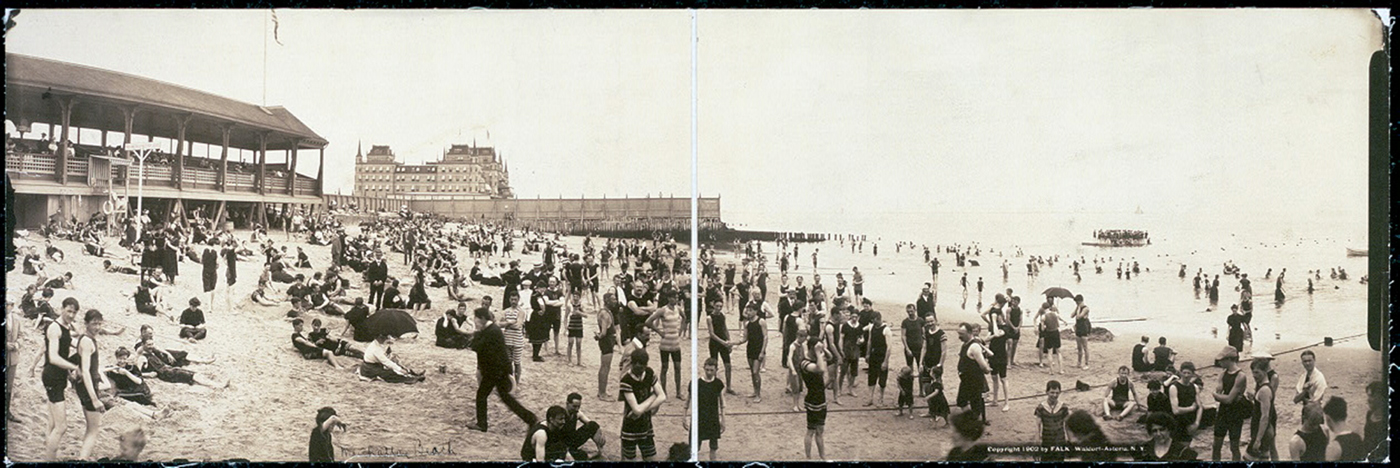
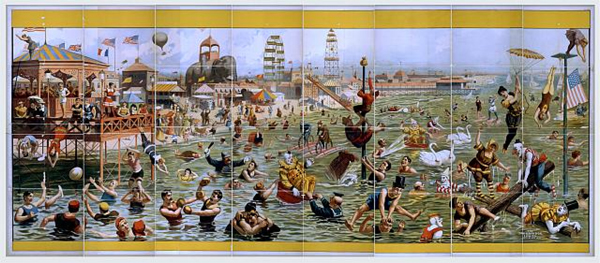
Beach scenes became more populous and raucous as the nineteenth century turned into the twentieth. Improvements in infrastructure did not dim visitors’ love of the equalizing elements. Two panoramic images explicitly link activities at the eastern and western end of the island. A photograph taken in 1902 (in which many beachgoers are clearly aware of being observed) depicts a dynamic crowd enjoying itself on Manhattan Beach. The Oriental Hotel rises behind the crowd, which is situated between the beach's two hotels. Women and men, mostly clad in bathing suits, sprawl on the sand, chat in mixed groups, and go in and out of the water. One of the only people protecting herself from sunburn is a woman in street clothes huddling under a parasol.Footnote 67 A hyperbolic artist's rendering of the West End satirizes the relaxed atmosphere at the beach. The artist imagines what could happen when mixed groups clad in very little are exposed to unpredictable elements. The result includes comely women diving from platforms and tossing a ball, men playing leapfrog, and clowns on a seesaw. While the activities themselves are outlandish, this image does not portray one of the most unseemly components of liminal life seen in the photograph: women and men casually interacting and observing each other in skimpy, soiled dress.Footnote 68
While some stopped at the sand, many—perhaps most—transitioned from street clothes to bathing suits, from a world with loosening rules to one with even greater ambiguity. This change happened in several bathing pavilions dotting Coney Island. From the 1870s to the early twentieth century, increasing numbers of bathers, peaking at tens of thousands, entered bathhouses to change before plunging into the surf. They enacted the same process in reverse when exiting the water. Entrepreneurs like Engeman and the Vanderveers designed these structures not only to tempt visitors through their doors and into the ocean, but also to separate individuals according first to beach (and, therefore, class) and then by gender.
From the New Iron Pier to the Mammoth Bathing Pavilion, the fundamental purpose of bathing pavilions was to provide a space to strip off street wear and replace it with a bathing suit. Regardless of form or amenities, all bathhouse patrons physically and ideologically inserted themselves into another skin. As with the experiences leading up to this point, this was an especially big leap for women. Like men, women were already salty, sandy, and windblown as they donned the skimpiest form of outerwear allowable. Unlike men, however, they presented myriad reimagined versions of the female body to viewers. As Anne Hollander points out, people perceive the reality of the physical body via the clothing constructing it.Footnote 69 Bathing suits allowed wearers and viewers to tacitly acknowledge parts of the body that all women, regardless of social status, kept under wraps off the beach: calves, uncorseted waists and breasts, unbound hair. Further, the suits’ dark color highlighted salt and sand, and the heavy material sagged and clung when wet. Women in bathing suits created a cross-class sartorial sisterhood in which all were subject to the whims of their temporary world and the scrutiny of observers.
Having entered the relative privacy of a pavilion, a beachgoer opted for either an owned or rented suit. It was most likely the better-off beachgoers who owned their own suits. This demographic would have the expendable income to spend on an item that received limited wear, and would probably be seasonal residents who arrived at the beach with luggage. Such purists disdained rented suits and, by implication, the people who wore them. Suits interacted with the body so intimately as to cause squeamishness; even a thorough cleaning might not remove various vaginal secretions, underarm sweat, or hair tangled into the weave of the fabric. Even in the early days of bathing pavilions, guidebook authors such as C. N. Taintor advised against renting suits, citing how “pleasant” it was to own them.Footnote 70 Another early writer was more blunt, urging readers to “not allude to them, much less wear them.”Footnote 71
“Manhattan Beach,” photograph, 1902, Library of Congress Prints & Photographs Division.

Coney Island Beach and Boardwalk Scenes, Lithograph, Cincinnati, New York: Strobridge Lith. Co., ca. 1898, Library of Congress Prints & Photographs Division.

Such recommendations fell upon largely deaf ears, and women rented cheap but serviceable suits in great numbers up and down the island. The demand even outstripped expectation during the early days. On especially hot days in the early 1880s, the relatively new bathing facilities along the entire island had a tendency to run out of suits; this problem was remedied within a season or two.Footnote 72 By the 1910s, overt distaste for renting suits had subsided, though a vocal minority still protested feebly. Acknowledging that rented suits were convenient and modest enough for mixed bathing, one writer warned that bathers would lose money if they rented repeatedly. On a more visceral level, bathers would “look better in [their own suits], feel better, and it will be cheaper.”Footnote 73
From the late 1870s to roughly 1911, women's bathing suits were remarkably democratic in form, color, and material, and resistant to changes seen in street fashions. The standard suit was made of dark wool serge or sometimes flannel, and consisted of three pieces. A high-necked, possibly long-sleeved blouse attached at the waist to baggy, below-the-knee bloomers commonly called Turkish trousers. A voluminous overskirt puffed out from a belted waist to the knee, exposing an inch or so of trousers. Must-have accessories were bathing slippers and black stockings.Footnote 74 Variations on this theme came and went: for example, streamlined suits based on “hygienic” undergarments or light-colored suits. The former were too pedestrian, the latter too risqué when wet.Footnote 75
Beachwear attained a greater athletic panache in the 1890s, and skirtless suits became more acceptable; sailor collars became the most common fashionable feature.Footnote 76 Standard styles were so simple that homemade and mass-produced suits were almost interchangeable. Patterns were available in magazines like The Ladies’ World, and sporting goods companies like Spalding offered affordable and durable garments.Footnote 77 Fashionable bathers could modify “ornamental” features like sleeves from season to season.Footnote 78 Those who indulged in these styles, however, earned scorn from critics, who asserted that “refinement” meant comfort, modesty, and ease of movement and not silly fabrics, loud colors, and laughable frills. Five young women mocked over-the-top fashion fantasies (and perhaps the fantasy that landlocked Americans had of Coney Island) in a set of professionally produced stereoscopic images. They combined light and dark suits with outrageously short skirts and trousers, posed flirtatiously, and unwittingly mimicked the suit styles that one Ladies’ Home Journal editorialist described as “better suited for a Roman chariot race than a sea bath.”Footnote 79
As the nineteenth century turned into the twentieth, the wealthy had greater opportunity to distinguish themselves sartorially. Fashion looked toward a slimmer, more functional fit, and mohair/cotton mixes and silk gained favor as water resistant materials.Footnote 80 Further, colors and patterns once condemned by the fashionable were now praised. In 1904, for example, a Harper's Bazaar columnist touted modern suits as “considerably more attractive than they were in the days when everybody wore just the same style and often the same size, regardless of the individual.”Footnote 81 Judging by a 1902 photograph, Manhattan Beachgoers stuck with conservative bathing wear. While they may have been more avant-garde in their street wear, the women dotting the space between the beach's two sumptuous hotels opted for styles popular several seasons prior. The dark suits may have included some mohair, but were visually consistent; most had sailor colors and simple white trim.Footnote 82 Moreover, they were remarkably similar to those worn further west. A woman lounging in the sand at Manhattan Beach was a virtual doppelganger for a woman lunching at the West End. Both were clad in simply trimmed dark suits and tights encrusted with sand; both embraced the equalizing forces of clothing and environment.Footnote 83
This basic form changed markedly when the world-renowned Australian swimmer Annette Kellerman visited the United States in 1911, popularizing a skintight suit with a round neck, minimal sleeves, and fitted tights.Footnote 84 Until then, bathers got used to running a gauntlet of onlookers populating the most popular place to mingle: in front of the pavilions and more modest bathhouses. Ramps like the one at Vanderveer's Pavilion were essentially promenades, and bathers found themselves with an even longer walk to the water at low tide. They made this trip in dry bathing suits, which slightly resembled everyday garments, though more revealing.
When beachgoers emerged from pavilions, their nearly timeless bathing suits marked them as bathers entering a literal and figurative middle ground. They had stripped away the trappings of their landlocked lives and plunged even further into physical and moral filth as they traversed the space between the changing room and ocean and back again. Regardless of which stretch of beach they patronized, women experienced liberation, harassment, acceptance, and derision as mediated through their suits.
From the 1870s onward, warm days saw women and men clustered around bathhouses up and down the island. Crowd control was greater the further east one traveled. At the West End, the sand fronting the bathing pavilions and smaller bathhouses was consistently jammed, a moving mass of dark suited figures.Footnote 85 The women emerging from these structures transformed from control to abandonment, from corsets and long skirts to loosened breasts and two legs. In 1874, Charles Dawson Shanly (who had already dismissed Coney Island as “unfashionable” because the working poor could access it) watched with dismay as
Out of the bathing-houses come tumbling, indiscriminately, men, women, and children, all of them disguised beyond any possibility of recognition in their “wild attire.” The scene enables one to realize the notion of a lunatic asylum let loose, its inmates chasing each other with mad gesticulations about the shore and into the lapping surf. The women flap about in the water and scream like the fowls to which that element is natural. …Footnote 86
Mixed crowds freely evaluated those disgorged from the bathhouses, a practice that horrified well-heeled observers. In 1887, an English visitor reported,
One need not stand long in this crowd before hearing remarks from lookers on, as the bathers wade their way through them in their bathing suits, not of the most edifying character. Now and then one sees a suggestive smile in the crowd or an askance look as they pass dry or wet. Such is the case especially when men and women pass in pairs.Footnote 87
Traveling to Brighton Beach, this unnamed observer noted that the beachfront was more limited, and in Manhattan Beach, there was a façade of exclusivity and modesty. The observer cynically noted that the wall that shielded bathers was not for “delicacy or for decency,” but to make money. For a penny, the curious could watch bathers from an amphitheater.Footnote 88 He had a point. The luxuriousness of the Mammoth Bathing Pavilion had long attracted bathers from nearby Brighton Beach.Footnote 89 Thousands crowded into the changing rooms, rented bathing suits, and funneled out onto the beach. By the 1890s, the number of people wanting to hire suits outstripped the available garments.Footnote 90 The lines were no better by the turn of the century, even as hoteliers pushed for greater separation.Footnote 91
The horror of the few did not deter the will of the many, as beachgoers appeared to become increasingly accustomed to heterosocial fraternizing. Individual behavior in large crowds suggests that women clad in bathing suits were willing to tolerate being observed in order to enjoy the ocean. On a warm July day in the early twentieth century, visitors to the allegedly respectable Brighton Beach milled about on the sand clad in street clothes and bathing suits, their numbers bleeding into the water. The most concentrated populations were around the stand-alone bathhouses.Footnote 92 Bathhouse shenanigans paled in comparison to “girls in bathing-suits splashing in the surf” creating “a red-hot scene.”Footnote 93
The ocean was the ultimate liminal space. Situated at the edge of the beach, bathers could go no further, physically or ideologically, than the water. The ocean's unpredictability set asunder any efforts to impose order on liminality. The ocean erased boundaries between beaches and among people, seeming to scoff at the idea that women who could afford the exclusivity of Manhattan Beach were cleaner than day-trippers at the West End. Instead, the ocean encrusted everybody's clothes with salt and plastered fabric (or worse) against bodies. The sun reflected off the water onto exposed skin, burning and browning. For their part, bathers could paddle or float between beaches. There was no possibility of pretense in the water.
This lack of order was especially distressing in the early years to hoteliers and wealthier visitors. More than aesthetically pleasing, the ocean washed away unhygienic evidence of urban life. For the working masses, this included oil, grease, and other factory filth. For the better off, it included the detritus that clung to their skirts as they walked dirty streets. Conversely, none were immune to the city garbage—an inconvenient by-product of human existence—that washed up along the island. Starting in the late 1870s, state legislation did little to curb dumping by antiquated scows at high tide. Hog, cow, and even horse carcasses beached and rotted at the high-water mark. A shore cleaner reported that he counted up to fifty dead animals each day; among them were cats, dogs, rats, and chickens. In addition, eggs, vegetable matter, and random items such as clothing and mattresses tainted the beach.Footnote 94 Whether tenement dwellers or wealthy, bathers reacted viscerally to the sight, smell, and feel of filth that invaded their personal space. At Manhattan and Brighton Beaches, would-be waders fretted over unprecedented amounts of offal, scrambling away from
Dead dogs, viscera of midnight cats, rotten cabbages and cornstalks, all in the most advanced state of decomposition. …[S]ome persons who have encountered these misplaced accompaniments of a dip in the surf have been known to effect nausea, and even to make use of such language such as is not permissible in the best society, after drawing from their mouths fragments of the articles just enumerated.Footnote 95
Women bathing at the West End or Brighton Beach had no choice but to brave the ocean. Before the 1890s, bathers along the island simply waded into the water, sometimes keeping company with small craft.Footnote 96 But Manhattan Beach bathers could control their environment from the start. They could claim nervous disorders, congestion of the internal organs, or similar complaints and bathe in cold or hot saltwater baths in the Mammoth Bathing Pavilion.Footnote 97 Nobody could question physical weakness among waterlogged women if they were not all exposed to the same environment.
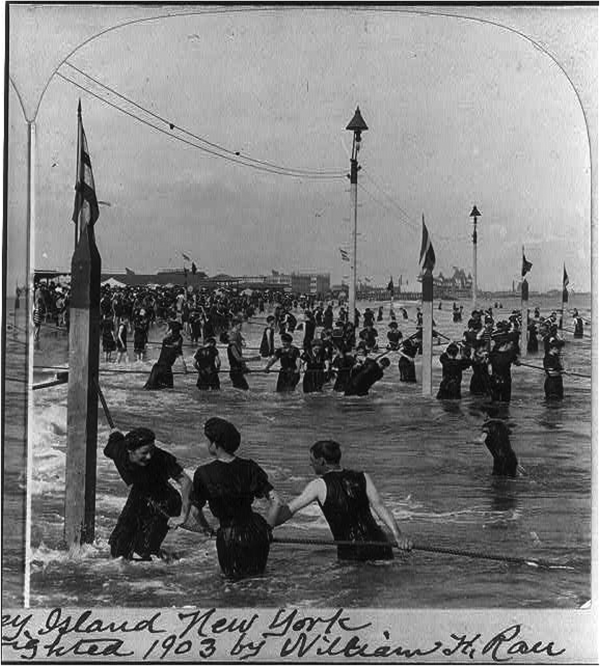
Starting in the early 1890s, hoteliers extended their infrastructure into the ocean by installing lifelines, ropes that extended into the sea. Lifelines offered bathers a way to stay upright and within the bounds of the beach, and were heavily used. At one end of these lifelines, some women waded into the shallows and remained mostly dry and picturesque. Further in, the more adventurous felt their skirts float, swirl, and possibly entwine with garbage, and the trousers become gradually heavier, tugging at the waist and hips.Footnote 98 An early twentieth-century snapshot offers a before and after image. In the foreground, a pair of young women stood, laughing, in water up to their shins. A step further, and they would have resembled the women clutching the lifeline further into the ocean. They hunched, slightly off-balance, as swirling sand and sea foam blurred the pretty trim of their skirts.Footnote 99
Bathers happily embraced the risks, which Harper's Weekly likened to a prizefight. “[T]he frolic we can have with [the ocean], the delicious rough-and-tumble, the falls and fouls, and everything else legitimate and illegitimate. …It is all delightful, and the fact that one must invariably issue from the conflict completely beaten does not alter it at all.”Footnote 100 Bathers waded into this “conflict” until only their torsos, then shoulders, and, finally, carefully coiffed heads were dry. On hot days, this dynamic gradation was on display. In 1896, a photographer (presumably in a small boat) snapped the crowds fanned out along the waterline in front of the Vanderveer Bathing Pavilion. In the foreground were women gradually disappearing into the sea. The slight chop reminds the viewer that the more committed bathers could easily drift into each other or farther down the beach.Footnote 101
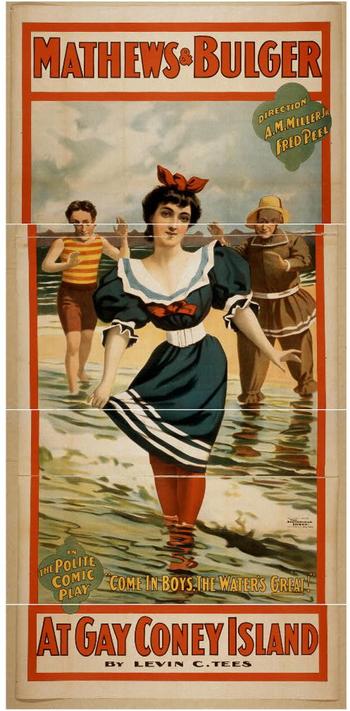
As a bather returned to dry land, whether at the West End or Manhattan Beach, water rushed first from her bodice and then her trousers. On the sand, she could no longer easily transgress physical boundaries, but challenged ideological ones. Cheap rentals or high-style suits rendered bodies down to a sum of their hidden, individualistic parts, making them appear, as Harper's Weekly put it in 1889, “au naturel.”Footnote 102 Even the briefest plunge, one local reporter sniffed, could make a woman into a “caricature of herself.”Footnote 103 However, acceptance quickly became the predominant attitude, as guidebook author C. N. Taintor asked rhetorically in 1886, “[W]here there are hundreds at hand in the same predicament, what does one care for the clinging of wet bathing-clothes …?”Footnote 104 By the 1890s, bathers were largely unselfconscious, apparently accepting their state as the price of sea bathing. For example, in the late 1890s, a thin young woman with messy hair splashed back to the sand, her clinging skirt revealing two legs.Footnote 105 At almost exactly the same point on the beach, another young woman had righted herself on a lifeline. Her hair was perfect, but her suit revealed a figure similar to the one idealized on a poster for a “polite comic play” set in Coney. The bodice clung to broad shoulders and a slender waist, and the skirt emphasized rounded hips.Footnote 106 None, including a bather cavorting with a young man on the sand, appeared uncomfortable in their near-essentialized state.Footnote 107 American bathing aesthetics and etiquette was old news in the years leading up to Kellerman's big splash.
Neither the “nymphs” of Dreiser's imagining nor the Minnie Smiths of the Brooklyn police blotter exemplified the women who populated Coney Island's beaches from the 1870s to the 1910s. These archetypes do, however, demonstrate the ways that the seaside loosened beachgoers’ grip on land-based identities. As the locus of liminality, the beach presented an opportunity for women to challenge the idea that gender and class determined moral hygiene manifested through physical cleanliness. No degree of wealth shielded well-off women from the damp, gritty filth inherent in visiting the seaside. Indeed, the natural elements were the primary draw. Structures built on shifting sands represented futile attempts of Engeman, the Vanderveers, and other well-to-do entrepreneurs to impose order on a place that invited disorder. Agents of that disorder arrived via steamboats docking at elaborate piers and trains arriving from Brooklyn and Manhattan. Willingly or not, they challenged everyday behaviors and expectations. Sweating enough to stain their white blouses, simply dressed women plopped themselves on the sand. On especially hot days, many headed directly to the bathhouses, where they readied themselves to become full-on “threshold people.” Regardless of wealth, women clad in bathing suits looked strikingly similar as they pattered across the wet sand and splashed into the equalizing surf. Over time, most visitors learned not to resist the overpowering force of the seaside. What was shocking in the 1870s had become expected and even acceptable by the 1910s.
“At Gay Coney Island” by Levin C. Tees, Mathews & Bulger, Lithograph, Cincinnati, New York: Strobridge Lith. Co., ca.1896, Library of Congress Prints & Photographs Division.

“A Jolly Crowd in the Surf, Coney Island, NY,” photograph, Library of Congress Prints & Photographs Division.

As a city borderland, Coney shared some of the appeal with other developing resorts. Beaches at Narragansett, Rhode Island; and Revere, Massachusetts, became very popular, as did mountain resorts in, for example, the Adirondacks and the White Mountains. Unlike other manufactured entertainments rooted in natural spaces, Coney attracted a diverse population and resisted the rigorous, largely futile attempts to segregate this population. Coney was thus an especially effective laboratory in which women could experiment with constructs that were falsely essentialized further inland. While visitors enacted this subversion within the wild attractions of the amusement parks, as Peiss and Kasson point out, it did not start there. The Ferris Wheel and the Human Whirlpool were manufactured after the seaside had gained some popularity as a strip of land that was geographically and metaphorically on the edge. The topsy-turvy beach world embraced the cacophonous side of Brooklyn and Manhattan as these areas developed at a dizzying and anxiety-producing pace. Coney Island, developing at a time when gender and social class were increasingly equated with physical hygiene, provided a crucial space for negotiating these powerful concepts.