


Introduction
Population estimates report as many as 65% of individuals have experienced a traumatic event, with 5% estimated to have experienced Post Traumatic Stress Disorder (PTSD) in their lives (Australian Centre for Posttraumatic Mental Health, 2007). Recognizing that most people recover in the first 3 months following trauma poses the question as to why only some people develop PTSD? Furthermore, which factors aid and which impede recovery (Cahill and Foa, Reference Cahill, Foa, Friedman, Keane and Resick2007)? A potentially useful line of inquiry may be to examine cognitive factors that are known to be risk and maintaining mechanisms in order to determine the influence of these on PTSD as they may be particularly salient processes that have been overlooked in understanding PTSD.
Rumination and perfectionism
This study examines whether cognitive processes that have been found to be elevated across numerous disorders, namely perfectionism and rumination, are associated with PTSD symptoms. Perfectionism is elevated in eating disorders, depression, and the anxiety disorders of Obsessive-Compulsive Disorder, Panic Disorder, and Social Phobia (Egan, Wade and Shafran, Reference Egan, Wade and Shafran2011); consequently it is plausible that perfectionism is also correlated with PTSD. To the authors’ knowledge, no research to date has investigated whether there is a relationship between perfectionism and PTSD in a clinical sample. Rumination has also been shown to be elevated across numerous disorders (Ehring and Watkins, Reference Ehring and Watkins2008) and is an important variable to consider as it has been shown to be related to both PTSD and perfectionism (Michael, Halligan, Clark and Ehlers, Reference Michael, Halligan, Clark and Ehlers2007; Harris, Pepper and Maack, Reference Harris, Pepper and Maack2008). Given rumination has been found to be related to perfectionism and PTSD, if a relationship does exist between perfectionism and PTSD it is possible that rumination may serve as a mediator.
Perfectionism
A review has identified perfectionism as a risk and maintaining factor across anxiety disorders, eating disorders and depression (Egan et al., Reference Egan, Wade and Shafran2011). Of the anxiety disorders, PTSD is an exception, with no studies examining perfectionism in clinical samples (Egan et al., Reference Egan, Wade and Shafran2011). Kawamura, Hunt, Frost and DiBartolo (Reference Kawamura, Hunt, Frost and DiBartolo2001) did find a relationship between a PTSD factor and perfectionism; however the methodology involved a college student population and factor derived PTSD.
Rumination has been associated with perfectionism (Flett, Madorsky, Hewitt and Heisel, Reference Flett, Madorsky, Hewitt and Heisel2002) and maladaptive perfectionism has been shown to be correlated with rumination and depressive symptoms (Frost, Marten, Lahart and Rosenblate, Reference Frost, Marten, Lahart and Rosenblate1990). Harris et al. (Reference Harris, Pepper and Maack2008) found that rumination mediated the relationship between maladaptive perfectionism and depressive symptoms. This finding is important as those individuals scoring higher on perfectionism reported higher depressive symptoms through a mechanism of rumination and this suggests that it would be useful to determine whether rumination is also an important mediator across other disorders where it is seen as an important clinical feature, such as PTSD. O'Connor, O'Connor and Marshall (Reference O'Connor, O'Connor and Marshall2007) found that the ruminative response style of brooding was an important mechanism that helped to explain the relationship between perfectionism and psychological distress. In a longitudinal study Olson and Kwon (Reference Olson and Kwon2008) examined the prediction of depressive symptoms over a 4-week period and found that individuals with high self-oriented and socially-prescribed perfectionism on the Hewitt and Flett Multidimensional Perfectionism Scale (HMPS; Hewitt and Flett, Reference Hewitt and Flett1991) as well as brooding rumination experienced the greatest increases in depressive symptoms over time. It was concluded that the role of perfectionism as a diathesis for depression is dependent on rumination and that rumination needs to be targeted in those with elevated perfectionism as they are at risk compared to those low in rumination who did not show the same increases in depression over time. It is thought therefore that rumination may explain how maladaptive perfectionism contributes to future depressive symptoms. Hewitt and Flett (Reference Hewitt, Flett, Flett and Hewitt2002) explain that perfectionists engage in rumination about failure. They state that individuals high on Concern over Mistakes (CM) on the Frost Multidimensional Perfectionism Scale (FMPS; Frost et al., Reference Frost, Marten, Lahart and Rosenblate1990) may be more likely to ruminate.
Rumination
Ehring and Watkins (Reference Ehring and Watkins2008) reviewed the literature and demonstrated that rumination is implicated in 13 different disorders, including depression, PSTD, social phobia, obsessive-compulsive disorder, insomnia, eating disorders, pain disorder, hypochondriasis, alcohol use disorder, bipolar disorder and psychosis. Ehring and Watkins (Reference Ehring and Watkins2008) argue that rumination plays a significant role in the maintenance of psychological disorders. Michael et al. (Reference Michael, Halligan, Clark and Ehlers2007) explained that rumination can maintain PTSD due to focusing on “why” and “what if” questions instead of the actual traumatic experience, having positive metacognitive beliefs about rumination maintaining the PTSD symptoms and cognitive avoidance of emotional issues. A clinical example of how rumination and perfectionism is relevant in PTSD can be considered through the example of Kate, who was in treatment for trauma following a sexual assault. Preceding the trauma Kate described herself as being a perfectionist and having very high standards across numerous areas of her life (e.g. work, appearance, musical performance) and she had always excelled in her studies and work. After the trauma she reported significant rumination over the event, focusing on why it should have happened to her, what she should have done differently for the event not to have occurred, and rumination over feeling like a failure as she should have done something different so as to not be in the situation. Kate also reported feeling that she had failed to meet her standards of being in control of her life and her emotional states, stating that she viewed the PTSD symptoms she was experiencing as a sign of her failure to be in control and not be a “strong” person and that she should cope better. She stated that she was also feeling like a failure as she was not performing in her work to her standards as she was spending a lot of time ruminating over the trauma and feeling anxious. In this case, the two processes of rumination and perfectionism appear to be maintaining factors of her symptoms, and also to interact with each other to keep the symptoms going in a vicious cycle.
Avoidance is a component of the diagnosis of PTSD and is an important variable in rumination and perfectionism. Avoidance is a factor that maintains rumination and may include procrastination, suppression of feelings, and not taking risks (Moberly and Watkins, Reference Moberly and Watkins2006). Ehlers, Mayou and Bryant (Reference Ehlers, Mayou and Bryant1998) examined thought suppression and rumination as possible perpetuating factors for PTSD. They found increases in rumination about an event, in conjunction with suppression of memories, were strongly associated with PTSD. Negative interpretations of intrusions, persistent medical problems, and rumination at 3 months were the most significant predictors of PTSD symptoms at one year. They suggested rumination may impede changes in negative appraisals of trauma events, in addition to the nature of the trauma memory, similar to the process of thought suppression increasing reliving of symptoms. Several other studies have found rumination to be one of the strongest predictors of persistent PTSD (Clohessy and Ehlers, Reference Clohessy and Ehlers1999; Murray, Ehlers and Mayou, Reference Murray, Ehlers and Mayou2002: Mayou, Ehlers and Bryant, Reference Mayou, Ehlers and Bryant2002).
Self-regulation models indicate that negative affect is produced when an individual feels they are not reaching a goal they are trying to achieve (Ehring and Watkins, Reference Ehring and Watkins2008) and Martin and Tesser (Reference Martin, Tesser and Wyer1996) purport that rumination occurs when a goal has not been attained. Ehring and Watkins (Reference Ehring and Watkins2008) explain that cognitive models for rumination suggest people are “driven” by unresolved goals, with repetitive negative thoughts reflecting unattained goals, and individuals with psychological disorders who get stuck in rumination may have more extreme, unattainable or perfectionist goals. This conceptualization is important in highlighting that rumination may be more likely when an individual displays inflexible perfectionist standards, which result in unattainable goals. Consequently, this literature links perfectionism and rumination and suggests the importance of considering the combined roles of these processes in a range of disorders, not just depression as in studies to date (e.g. Harris et al., Reference Harris, Pepper and Maack2008; Olson and Kwon, Reference Olson and Kwon2008; O'Connor et al., Reference O'Connor, O'Connor and Marshall2007).
Rationale
Rumination and perfectionism are two important processes demonstrated to be elevated across a range of disorders (Ehring and Watkins, Reference Ehring and Watkins2008; Egan et al., Reference Egan, Wade and Shafran2011) and given that the relationship between perfectionism and PTSD in a clinical sample remains unexamined, the aim of this study was to examine whether perfectionism and rumination account for PTSD symptoms. Research has not considered that PTSD and perfectionism are both related to rumination in the same sample nor considered the relative roles of these variables. Consequently, the purpose of this study is to ascertain if there is an association between PTSD and perfectionism and, if so, to examine the role of rumination in the process. It was hypothesized that perfectionism and PTSD would be significantly correlated. Additionally, it was hypothesized that rumination would act as a significant mediator of the relationship. The overarching aim of this research was to determine if the processes of rumination and perfectionism are important in the prediction of PTSD symptoms in a preliminary attempt to define their role, with a view to exploring potential intervention for these processes should they be found to be important in explaining PTSD. If rumination and perfectionism are found to be salient processes in PTSD this may suggest that it would be useful for future research to examine whether targeting these processes would confer benefit in removing maintaining factors of PTSD and comorbid disorders.
Method
Participants
There were a total of 30 participants recruited from the Western Australian Department of Health Sexual Assault Resource Centre (SARC) which is a government public sector agency located in Perth, Australia that provides free psychological assessment and treatment for sexual assault. Participants consisted of clients who self-referred to the SARC, were 18 years and older (range 18–81 years), and 75% of the sample were female. Participants were approached on a voluntary basis, including new referrals and individuals currently in treatment over a 3-month period. Inclusion criteria were experience of a sexual trauma and current engagement in psychological counselling at the SARC. The exclusion criterion was less than one month since experiencing the trauma, so that individuals with Acute Stress Disorder (ASD) were excluded from the study. Participants were not reimbursed for the study.
Measures
Personal Standards and Concern over Mistakes subscales of the Frost Multidimensional Perfectionism Scale (FMPS; Frost et al., Reference Frost, Marten, Lahart and Rosenblate1990). The FMPS is a 35-item, self-report measure of perfectionism consisting of five subscales: (1) Concern over Mistakes (CM); (2) Personal Standards (PS); (3) Parental Expectations (PE); (4) Parental Criticism (PC); and (5) Doubts about Actions (DA). The sixth subscale, Organization is not included in the total perfectionism scoring. A 5-point Likert scale is used, ranging from 1 = Strongly disagree to 5 = Strongly agree. Higher scores indicate higher levels of perfectionism. This study used the PS and CM subscales to measure perfectionism as these are the two scales that are most closely linked to the clinical definition of perfectionism (Shafran and Mansell, Reference Shafran and Mansell2001). There is extensive evidence supporting the reliability and validity of the scale (Enns and Cox, Reference Enns, Cox, Flett and Hewitt2002). The internal consistency in this study was good for both PS; alpha = .84 and CM; alpha = .90.
Clinical Perfectionism Questionnaire (CPQ; Fairburn, Cooper and Shafran, Reference Fairburn, Cooper and Shafran2003) is a 12-item self-report measure that assesses the degree to which individuals establish self-worth through achievement of high standards, avoidance of performance related goals and feelings of failure over the past month. A 4-point Likert scale is used, where 1 = Not at all, and 4 = All the time. Higher scores indicate high clinical perfectionism. Steele, O'Shea, Murdock and Wade (Reference Steele, O'Shea, Murdock and Wade2011) investigated the CPQ in 39 women with eating disorders and found acceptable reliability (alpha = .83), and convergent validity with the CPQ being significantly correlated with PS (r = .73) and CM (r = .76) on the FMPS (Frost et al., Reference Frost, Marten, Lahart and Rosenblate1990). The internal consistency for the CPQ in this study was acceptable with a Cronbach's alpha of .81.
Ruminative Response Scale (RRS) from the Response Styles Questionnaire (RSQ; Nolen-Hoeksema, Reference Nolen-Hoeksema1991). The RRS is a self-report measure of rumination. Respondents rate each questionnaire item on a scale of ranging from 1 = Almost never to 4 = Almost always. The RRS was criticised for some of the items being highly correlated with the Beck Depression Inventory (Beck, Ward, Mendelsohn, Mock and Erbaugh, Reference Beck, Ward, Mendelsohn, Mock and Erbaugh1961). Treynor, Gonzalez and Nolen-Hoeksema (Reference Treynor, Gonzalez and Nolen-Hoeksema2003) factor analysed the RRS, identifying the principal components of depression and now these items are able to be removed (to make the 10 items). Thus for this study the depression related items were removed, leaving 10 items. The 10 items selected from the RSQ's RRS self-report measure reflect two principle components of rumination, Reflective Pondering and Brooding. Reflective Pondering is defined as engagement in problem-solving to help alleviate negative affect and Brooding is considered to be thinking anxiously or worrying, in a maladaptive fashion, over some unachieved standard (Harris et al., Reference Harris, Pepper and Maack2008). Moberly and Watkins (Reference Moberly and Watkins2006) calculated the Cronbach's alpha for the subscales of Brooding and Reflective Pondering at .76 and .76 respectively. The internal consistency in this study was alpha = .89 for Brooding and .67 for Reflective Pondering. The internal consistency for the combined subscales of Reflective Pondering and Brooding of the RRS in this study was good, with alpha = .87.
Post Traumatic Stress Checklist (Civilian) for DSM-IV (PCL-C; Weathers, Huska and Keane, Reference Weathers, Huska and Keane1991) is a 17-item self-report measure of the DSM-IV symptoms for PSTD. Respondents are asked to rate how much they were “bothered by that problem in the past month”. Items are rated on a 5-point Likert scale ranging from 1 = Not at all to 5 = Extremely; higher scores indicate higher levels of PTSD. This study used the recommended cut-off of 50 to indicate a diagnosis of PTSD (Weathers, Litz, Herman, Huska and Keane, Reference Weathers, Litz, Herman, Huska and Keane1993). The PCL has been found to have good psychometric properties, with high internal consistency (alpha = .96) (Keane, Brief, Pratt and Miller, Reference Keane, Brief, Pratt, Miller, Friedman, Keane and Resick2007). Weathers et al. (Reference Weathers, Litz, Herman, Huska and Keane1993) found test-retest reliabilities were robust (.96). The internal consistency in this study was a Cronbach's alpha of .89.
Procedure
Ethics approval for the study was granted by the Human Research Ethics Committee (HREC) at Curtin University and King Edward Memorial Hospital. Clients engaging in counselling for PTSD at SARC were offered the opportunity to complete questionnaires anonymously by the receptionist prior to entering their appointment for counselling. Counsellors mentioned to their clients at the end of the counselling session that the research study was taking place. SARC also services clients at various metropolitan offices around Perth. Counsellors at these outreach offices offered clients the opportunity to participate in the study, with clients able to mail back their responses in the reply paid envelope to Curtin University. The participant information sheet was given to each participant; this outlined the aims and procedures of the study. The second author worked at SARC as a counsellor but due to ethical issues did not recruit her own clients to participate in the research.
Results
An adequate sample for testing the proposed model was calculated to be 30 participants. The most complex regression model consisted of four predictors and G*Power 3 suggested that 30 participants were required for an 80% chance of capturing a “large” relationship between the Dependent Variable and each of the predictors (Faul, Erdfelder, Buchner and Lang, Reference Faul, Erdfelder, Buchner and Lang2009). No missing data were found and all correlation and regression assumptions were met.
Descriptive data
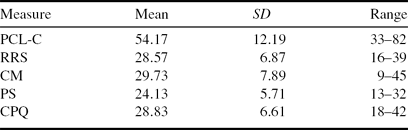
Means and standard deviations are displayed in Table 1. The mean that was found for PTSD in this sample (M = 54.17) slightly surpassed the Weathers et al. (Reference Weathers, Huska and Keane1991) criteria of 50 which indicates a diagnosis of PTSD. The sample range on the PTSD measure was from 33 to 82, with 11 participants not reaching the criteria and 19 reaching the criteria, or 63% reaching the cut-off for PTSD criteria. This emphasized that a majority of the population was indeed a clinical PTSD population, and the mean score of the sample indicated that on average the sample was in a clinical PTSD range.
Mean (and Standard Deviation) of measures of PTSD, perfectionism and rumination

Notes: PCL-C = Posttraumatic Stress Checklist Civilian Version (Weathers, Huska and Keane, Reference Weathers, Huska and Keane1991); RRS = Ruminative Response Scale (Nolen-Hoeksema, Reference Nolen-Hoeksema1991); CM = Concern over Mistakes subscale of FMPS (Frost et al., Reference Frost, Marten, Lahart and Rosenblate1990); PS = Personal Standards subscale of FMPS (Frost et al., Reference Frost, Marten, Lahart and Rosenblate1990); CPQ = Clinical Perfectionism Questionnaire (Fairburn et al., Reference Fairburn, Cooper and Shafran2003)
Correlation analysis
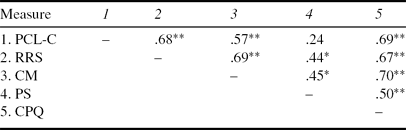
A series of bivariate correlations were conducted, first in order to establish whether the variables were significantly associated and the proposed mediation model could be tested. As seen in Table 2, all variables were significantly associated, with the exception of PS and PTSD. It is noteworthy that perfectionism had a strong correlation with PTSD on both measures of clinical/negative perfectionism, on CM (r = .57) and the CPQ (r = .69). It can also be seen that the relationship between PTSD and rumination was strong (r = .68). Furthermore, there was also a significant association between rumination and all perfectionism measures. This indicates, as hypothesized, that significant relationships do exist between the variables of PTSD, perfectionism and rumination.
Summary of bivarate correlations for PTSD, rumination and perfectionism measures

Notes: PCL-C = Posttraumatic Stress Checklist Civilian Version (Weathers et al., Reference Weathers, Huska and Keane1991); RRS = Ruminative Response Scale (Nolen-Hoeksema, Reference Nolen-Hoeksema1991); CM = Concern over Mistakes subscale of FMPS (Frost et al., Reference Frost, Marten, Lahart and Rosenblate1990); PS = Personal Standards subscale of FMPS (Frost et al., Reference Frost, Marten, Lahart and Rosenblate1990); CPQ = Clinical Perfectionism Questionnaire (Fairburn et al., Reference Fairburn, Cooper and Shafran2003), *p < .05, **p <.01, two tailed.
Standard multiple regression analyses and mediation models
In order to determine the beta-weights of the proposed mediation model for the two perfectionism measures, a series of two-step standard multiple regression analyses were conducted, as seen in Tables 3 and 4. As PS was not correlated with PTSD it was not added to the standard multiple regression analyses.
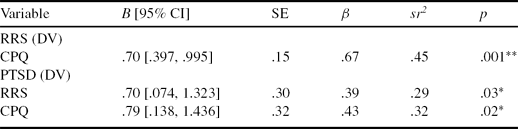
Unstandardized (B) and standardized (β) regression coefficients and squared-semi partial correlations (sr2 ) for each predictor in the regression models predicting rumination and PTSD for the CPQ (N = 30)

Notes: PCL-C = Posttraumatic Stress Checklist Civilian Version (Weathers et al., Reference Weathers, Huska and Keane1991); RRS = Ruminative Response Scale (Nolen-Hoeksema, Reference Nolen-Hoeksema1991); CM = Concern over Mistakes subscale of FMPS (Frost et al., Reference Frost, Marten, Lahart and Rosenblate1990); PS = Personal Standards subscale of FMPS (Frost et al., Reference Frost, Marten, Lahart and Rosenblate1990); CPQ = Clinical Perfectionism Questionnaire (Fairburn et al., Reference Fairburn, Cooper and Shafran2003), p < .05; ** p < .01; *** p < .001. SE = Standard Error, CI = Confidence Interval
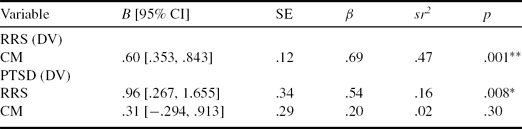
Unstandardized (B) and Standardized (β) regression coefficients and squared-semi partial correlations (sr2 ) for each predictor in the regression models predicting rumination and PTSD for the CPQ, (N = 30)

Notes: PCL-C = Posttraumatic Stress Checklist Civilian Version (Weathers et al., Reference Weathers, Huska and Keane1991); RRS = Ruminative Response Scale (Nolen-Hoeksema, Reference Nolen-Hoeksema1991); CM = Concern over Mistakes subscale of FMPS (Frost et al., Reference Frost, Marten, Lahart and Rosenblate1990); PS = Personal Standards subscale of FMPS (Frost et al., Reference Frost, Marten, Lahart and Rosenblate1990); CPQ = Clinical Perfectionism Questionnaire (Fairburn et al., Reference Fairburn, Cooper and Shafran2003), p < .05; ** p < .01; *** p < .001. SE = Standard Error, CI = Confidence Interval
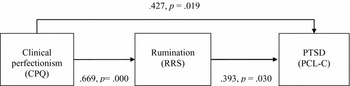
The following set of standard regression analyses used the CPQ as the perfectionism measure to determine the beta-weights to test the proposed rumination mediation model between the perfectionism and PTSD relationship. Rumination was the dependent variable in the first regression analysis for the predictor CPQ. Clinical perfectionism accounted for a significant 45% of the variance in rumination, R2 = .45, adjusted R2 = .43, F (1, 28) = 22.74, p = .0001. The second regression analysis placed PTSD as the dependent variable and rumination and CPQ as predictors. Rumination and the CPQ accounted for a significant 56% of the variance in PTSD, R2 = .56, adjusted R2 = .53, F (2, 27) = 17.32, p = .0001. Unstandardized (B) and standardized (β) Regression Coefficients and Squared-Semi Partial (or “part”) correlations (sr2 ) for each predictor in the regression models are reported in Table 3.
The next step was to apply the path coefficients generated by the aforementioned regression analyses to the mediation model as can be seen in Figure 1. The beta weights (i.e. the standardized regression weights) for the predictors provided the path coefficients. The model displayed in Figure 1 revealed that significant pathways exist between the CPQ and rumination, the CPQ and PTSD, and rumination and PTSD. Given that a significant direct pathway existed between the CPQ and PTSD it can be concluded that rumination does not fully mediate the relationship between the CPQ and PTSD. The next step was to determine the impact of rumination on the CPQ and PTSD. In order to test the mediation model Sobel's test statistic (Sobel, Reference Sobel and Leinhardt1982) was used. The test was significant, z = 2.087, p = .036, indicating a partial mediation (Baron and Kenny, Reference Baron and Kenny1986).
Model for rumination as a mediator between clinical perfectionism and PTSD

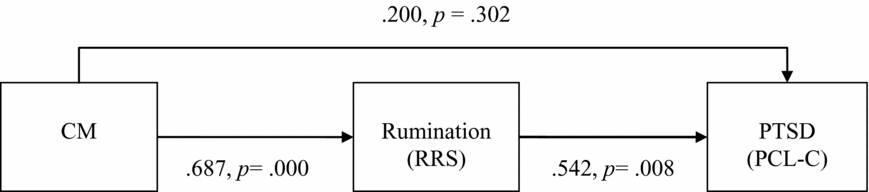
Rumination was the dependent variable in the first regression analysis when CM was the predictor. CM accounted for a significant 47% of the variance in rumination, R2 = .47, adjusted R2 = .45, F (1, 28) = 25.03, p = .0001. The second regression analysis placed PTSD as the dependent variable and rumination and CM as predictors. Rumination and CM accounted for a significant 48% of the variance in PTSD, R2 = .48, adjusted R2 = .44, F (2, 27) = 12.59, p = .0001. Unstandardized (B) and standardized (β) Regression Coefficients and Squared-Semi Partial (or “part”) correlations (sr2 ) for each predictor in the regression models are reported in Table 4.
Following these regression analyses the next step was to again apply the path coefficients to the mediation model. The model displayed in Figure 2 revealed that significant pathways exist between CM and rumination, rumination and PTSD, but not for CM and PTSD. Given that a nonsignificant pathway existed between the CM and PTSD, it can be concluded that rumination fully mediated the relationship between CM and PTSD.
Model for rumination as a mediator of Concern over Mistakes and PTSD

Discussion
The hypothesis that there would be a significant relationship between PTSD and perfectionism was supported. In addition, it was found that rumination was a mediator of the relationship between PTSD and perfectionism when measured using the CM subscale of the FMPS (Frost et al., Reference Frost, Marten, Lahart and Rosenblate1990). Consequently, results supported the hypothesis that perfectionism would be a significant predictor of PTSD symptoms, but this relationship would be mediated by rumination.
Implications
To the authors’ knowledge, this is the first study to date to show a relationship between perfectionism and PTSD in a clinical sample, and this was using both the CM subscale of the FMPS (Frost et al., Reference Frost, Marten, Lahart and Rosenblate1990) and the CPQ (Fairburn et al., Reference Fairburn, Cooper and Shafran2003). This finding is consistent with Egan et al.'s (Reference Egan, Wade and Shafran2011) review of perfectionism where CM is associated with symptoms across many disorders, and gives further evidence to this aspect of perfectionism being a transdiagnostic process. The finding that PS was not associated with PTSD symptoms is also consistent with Egan et al.'s review that showed PS is generally not associated with anxiety disorder symptoms. Moreover, the results lend support to the notion of PS being not consistently associated with psychopathology, and the distinction between PS representing “positive striving” and CM representing “maladaptive evaluative concerns” (see Stoeber and Otto, Reference Stoeber and Otto2006 for a review).
The general pattern of significant bivariate correlations existing across most measures is noteworthy as it highlights the related and to some degree overlapping nature of the variables. The processes of rumination and perfectionism are associated, and both of these processes are also associated with PTSD symptoms. The finding of a significant relationship between rumination and PTSD is consistent with previous research (Michael et al., Reference Michael, Halligan, Clark and Ehlers2007). The finding that rumination and perfectionism were significantly correlated also supports previous research (Flett et al., Reference Flett, Madorsky, Hewitt and Heisel2002).
Rumination did fully mediate the relationship between perfectionism and PTSD, when the CM subscale of the FMPS (Frost et al., Reference Frost, Marten, Lahart and Rosenblate1990) was used, but not when the CPQ (Fairburn et al.,2003) was utilised as the measure of perfectionism. The finding that rumination acted fully as a mediator with CM but not the CPQ in PTSD requires examination. This finding may indicate the CPQ warrants further work on validity as a measure of perfectionism. The FMPS scales are a widely used and validated measure of perfectionism, while evidence supporting the validity of the CPQ is scant. Hewitt and Flett (Reference Hewitt, Flett, Flett and Hewitt2002) have explained that perfectionists engage in rumination about failure; hence perfectionists high on Concern over Mistakes are likely to ruminate. The current result of rumination acting as a mediator between CM and PTSD is therefore in keeping with this previous research. The results are also consistent with rumination being found as a mediator between maladaptive perfectionism and depressive symptoms (see Harris et al., Reference Harris, Pepper and Maack2008) and the brooding ruminative response style mediating perfectionism and psychological distress (O'Connor et al., Reference O'Connor, O'Connor and Marshall2007). The findings overall lend support to the rationale of both perfectionism and rumination acting as transdiagnostic processes across different disorders (Egan et al., Reference Egan, Wade and Shafran2011; Ehring and Watkins, Reference Ehring and Watkins2008).
Limitations of the study
The following limitations are acknowledged. First, the sample consisted of sexual violence survivors who may compose a unique interpersonal trauma population compared to that of other traumas. Second, the study was voluntary and it is possible that the sample selection is biased; for example, individuals with higher degrees of perfectionism may have chosen to participate in the study. Third, the internal consistency of the Reflective Pondering scale was poor (Cronbach's alpha of .67). Finally, as only 63% of the sample had a diagnosis of PTSD, it may be useful in the future to restrict a further sample to only those who meet a diagnosis of PTSD. Despite this, the mean score of the sample was in a clinical PTSD range, and as it was a preliminary study, it was useful to include all cases including those that did not fully reach diagnostic criteria.
A major limitation of the study was that a cross-sectional design was utilised and while the results are useful in identifying correlations between variables, causal statements regarding the relationship between perfectionism, rumination and PTSD cannot be made. This was a preliminary attempt to establish whether relationships exist. However, in the context of the data being cross-sectional, conclusions need to be interpreted with caution as the design limits the interpretation of the mediation models, as they do not show temporal precedence. It is unclear whether perfectionism predicts rumination or vice versa, and thus future longitudinal research is required to determine the direction of these relationships.
Strengths of the study
The aim to investigate whether a relationship existed between perfectionism and PTSD in a clinical sample addressed a significant gap in the literature. In addition, it was the first study to date to investigate rumination as a mediator of the relationship. The present results may be useful in suggesting future research in to the role of perfectionism and rumination in PTSD and if intervening with these processes may potentially be useful in treatment for PTSD.
Future directions
In terms of understanding the relationship between rumination, perfectionism and PTSD, future research could aim to investigate whether perfectionism has a unique contribution to the relationship between perfectionism and PTSD. This could be achieved by using a measure of PTSD related rumination as a dependent variable, and to include perfectionism measures, in addition to other important variables including responsibility and self-esteem as independent variables, with a larger sample. It would be useful also if possible to conduct longitudinal research to determine if levels of perfectionism preceding a trauma can account for greater likelihood of development of PTSD symptoms post trauma. Despite this being a difficult study to conduct as it needs to follow people pre- and post-trauma, it may be possible to conduct the research within groups where there are more frequent experiences of trauma (for example emergency workers).
It would also be useful for future research to examine the content of rumination in PTSD to determine if this is specific to PTSD rather than the typical rumination pattern in depression. For example, it would be useful to determine if perfectionism is related to specific trauma-related negative appraisals.
The clinical implications of this research indicate that a useful direction for future research would be to investigate interventions for the relationship between perfectionism and PTSD, and the additional impact of rumination that this study has established. This may be important given that perfectionism has been shown to be a maintaining factor for other disorders, and also impedes treatment (Egan et al., Reference Egan, Wade and Shafran2011). Furthermore, the preliminary findings from this study suggest that it would be useful for future research to determine whether targeting rumination and perfectionism in PTSD treatment is effective. Treatments exist for both of these processes but as far as the authors are aware there have not been any studies for treatment of perfectionism in PTSD. There has been some research examining the treatment of rumination in PTSD; for example Wells (Reference Wells2009) described a treatment using metacognitive therapy to address rumination in PTSD. This encompasses analysing the advantages and disadvantages of rumination, with provision of training to acknowledge symptoms as they are occurring, referred to as detached mindfulness and rumination/worry postponement. Further research is required on the effectiveness of this approach, and it would be useful to investigate if also targeting perfectionism may lead to further amelioration of PTSD symptoms.
Conclusions
If future studies, using prospective designs, confirm the relationship between perfectionism and PTSD and if treatments that target perfectionism and rumination are found to lessen the impact of PTSD, then this research may potentially help to increase treatment efficacy in PTSD.



Comments
No Comments have been published for this article.