Introduction
Carbonatites are currently the most important source of rare earth elements (Wall, Reference Wall2013; Goodenough et al., Reference Goodenough, Schilling, Jonsson, Kalvig, Charles, Tuduri, Deady, Sadeghi, Schiellerup, Müller, Bertrand, Arvanitidis, Eliopoulos, Shaw, Thrane and Keulen2016), which are essential for new and green technology applications. For the purposes of this paper, the REE are divided into the light rare earth elements (LREE) La to Pm, the middle rare earth elements (MREE) Sm to Dy, and the heavy rare earth elements (HREE) Ho to Lu, including Y. Carbonatites are generally particularly enriched in the LREE (Chakhmouradian and Wall, Reference Chakhmouradian and Wall2012; Weng et al., Reference Weng, Jowitt and Mudd2015; Verplanck et al., Reference Verplanck, Mariano and Mariano2016; Goodenough et al., Reference Goodenough, Wall and Merriman2018).
Carbonatite complexes are also the main source of niobium (Mitchell, Reference Mitchell2015); an important source of fluorite, apatite and baddeleyite; potential ores for iron (from magnetite) and lime (from calcite); and also vermiculite and baryte. Intrusions are typically surrounded by aureoles of country rock that have undergone alteration by alkaline fluids associated with the cooling magma. These rocks are termed fenites (Bardina and Popov, Reference Bardina and Popov1994). Previous studies of the fenitisation process include Garson and Campbell Smith (Reference Garson and Campbell Smith1958), McKie (Reference McKie, Tuttle and Getting1966), Woolley (Reference Woolley1969), Morogan and Woolley (Reference Morogan and Woolley1988), Andersen (Reference Andersen1989), Morogan (Reference Morogan1989), Platt and Woolley (Reference Platt and Woolley1990), Verschure and Maijer (Reference Verschure and Maijer2005) and Carmody (Reference Carmody2012). Reviews of fenite have been provided by Le Bas (Reference Le Bas2008) and Elliott et al. (Reference Elliott, Wall, Chakhmouradian, Siegfried, Dahlgren, Weatherley, Finch, Marks, Dowman and Deady2018).
The REE are defined as ‘critical metals’ (European Commission, 2017), with current production almost entirely dependent on China (Brown et al., Reference Brown, Idoine, Raycraft, Shaw, Deady, Hobbs and Bide2017; European Commission, 2017). Exploration and development at carbonatite centres in other countries, thus providing greater security of supply, could be facilitated by an improved knowledge of the fluid regimes associated with enrichment in REE at carbonatite complexes. A key aspect is the evolution of fluids exsolved from the magma, of which the fenitisation process is an important component. A better understanding of fenitisation will therefore improve our knowledge of carbonatitic magma composition and evolution.
The alkaline fluids that fenitise country rock around a carbonatite intrusion were originally a component of the carbonatite magma. Temporal and spatial segregation of Na- and K-rich fluids is common, with fenite aureoles commonly comprising an outer sodic zone and a, generally later, inner potassic fenite (Le Bas, Reference Le Bas2008). Calcite and ferroan dolomite carbonatites can produce both Na- and K-rich fluids (Le Bas, Reference Le Bas2008), which suggests that the composition of the parent magma might not be the main determining factor, although the magmatic evolution of any individual carbonatite could control the earlier preferential loss of Na over K (Woolley, Reference Woolley1982). A dependence on magma temperature appears to be important, with sodic fenite being associated with magma at deeper levels in the complex, with higher temperature and possibly lower CO2 content. In contrast, potassic fenite may be produced from magma at higher levels and lower temperatures, and be richer in CO2 (Woolley, Reference Woolley1982; Rubie and Gunter, Reference Rubie and Gunter1983; Le Bas, Reference Le Bas2008; Viladkar and Ramesh, Reference Viladkar and Ramesh2014).
As carbonatite magmas undergo fractional crystallisation, they typically evolve from calcitic composition to dolomitic/ferroan dolomitic and then to sideritic composition (Heinrich, Reference Heinrich1966; Le Bas, Reference Le Bas1981; Wall, Reference Wall2013). The carbonatite differentiation experiments of Anenburg et al. (Reference Anenburg, Mavrogenes, Frigo and Wall2020) mimic this observed sequence. An associated increase in Fe, Ba, Mn and REE accompanies this trend, with the highest concentrations of these elements being found in late-stage carbonatites (Goodenough et al., Reference Goodenough, Wall and Merriman2018). Rare earth element mobility in fluids is a well established model, with an early study by Martin et al. (Reference Martin, Whitley and Woolley1978) identifying magma-derived REE enrichment of a barren quartzite rock during emplacement of the Borralan alkaline rock/carbonatite complex in Scotland. Bühn and Rankin (Reference Bühn and Rankin1999) commented on the high capability of these fluids to transport the high-field-strength elements (HFSE) and REE at the Kalkfeld carbonatite in Namibia. Further studies of fluid inclusions related to fenite have demonstrated that REE–HFSE-bearing fenitising fluids are generally aqueous-CO2 alkali-bicarbonate brines of variable salinity (Palmer, Reference Palmer1998; Bühn and Rankin, Reference Bühn and Rankin1999; Bühn et al., Reference Bühn, Rankin, Radtke, Haller and Knoechel1999, Reference Bühn, Wall and Le Bas2001; Williams-Jones and Palmer, Reference Williams-Jones and Palmer2002; Carmody, Reference Carmody2012; Dowman et al., Reference Dowman, Wall, Treloar and Rankin2017b). However, it is acknowledged that element partitioning in natural magma systems is highly complex and only reasonably well understood for a few geochemically simple systems (Chakhmouradian and Reguir, Reference Chakhmouradian and Reguir2013).
Until recently, apatite was the only mineral mentioned in literature on REE-bearing minerals in fenite aureoles around carbonatites (Kresten and Morogan, Reference Kresten and Morogan1986; Morogan and Woolley, Reference Morogan and Woolley1988; Andersen, Reference Andersen1989; Morogan, Reference Morogan1989; Smith, Reference Smith2007; Le Bas, Reference Le Bas2008). However, growing interest in REE has been accompanied by increased reporting of REE mineralisation in altered rocks. Cordylite-(La) was first found in fenite from the Biraya Fe–REE deposit in Irkutsk, Russia (Mills et al., Reference Mills, Kartashov, Kampf, Konev, Koneva and Raudsepp2012), together with other REE minerals, such as daqingshanite-(Ce),(La), monazite-(Ce) and bastnäsite-(Ce). Apatite associated with fenite at the Songwe carbonatite complex in Malawi can be HREE enriched, and the fenite rocks contain occasional xenotime-(Y) (Broom-Fendley et al., Reference Broom-Fendley, Wall, Brady, Gunn, Chenery and Dawes2013). Xenotime-(Y) is the principal REE-bearing mineral at the carbonatite of Lofdal in Namibia, and is found in albitised fault zones (Wall et al., Reference Wall, Niku-Paavola, Müller and Jeffries2008; do Cabo et al., Reference do Cabo, Wall, Sitnikova, Ellmies, Henjes-Kunst, Gerdes and Downes2011; Loye, Reference Loye2014). At Bandito in the Yukon, a fenite, associated with nepheline syenite rather than carbonatite, was found to be REE-rich, with up to 3.49 wt.% REE in areas of highly metasomatised syenite, contained in minerals such as monazite, bastnäsite and apatite (Endurance Gold Corporation, 2013).
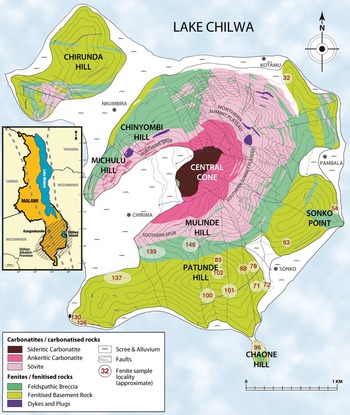
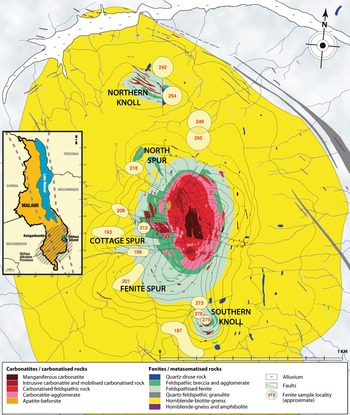
This contribution compares the mineralogy and whole-rock composition of fenites at two of the largest carbonatite complexes in Malawi, both of which have well-developed metasomatic aureoles located in broadly similar protoliths (Figs 1, 2). Kangankunde is considered a world-class REE deposit and Chilwa Island has pyrochlore, fluorapatite and magnetite-bearing calcite carbonatite (Garson, Reference Garson1965; Simonetti and Bell, Reference Simonetti and Bell1994). In selecting complexes situated in similar country rock, the effect of the protolith is minimised. In this investigation, as part of trying to achieve a better understanding of metasomatic processes at carbonatite complexes, we will comment on similarities seen at the two locations, however we are particularly interested in identifying any differences in the mineralisation and in the alteration of the fenites with respect to the contrasting REE enrichment of their host carbonatite. We also consider how differences between the carbonatites of the two complexes, in terms of relative size, composition and emplacement order, may influence the sequence and composition of metasomatic fluids expelled into the country rock.
Geological map of Chilwa Island (adapted from Garson and Campbell Smith, Reference Garson and Campbell Smith1958)

Geological map of Kangankunde (adapted from Garson (1963) Geological Survey Dept. Nyasaland)

Geological background
The carbonatite complexes of Chilwa Island and Kangankunde lie in Malawi's Cretaceous Chilwa Alkaline Province, at the extreme southern end of the East African Rift system. The ~300 km2 area experienced repeated episodes of emplacement of alkaline and carbonate magmas into amphibolite- and granulite-facies basement rocks (Bailey, Reference Bailey1977; Kröner et al., Reference Kröner, Collins, Hegner, Muhongo, Willner and Kehelpannala2001). Crustal extension and decompressional melting between 138 and 107 M.y. drove the most recent alkaline magmatism in the Province (Eby et al., Reference Eby, Roden-Tice, Krueger, Ewing, Faxon and Woolley1995). This produced 28 intrusions and vents of alkaline rocks and carbonatites (Woolley, Reference Woolley2001). These lie in two main belts: a western belt associated with lines of rifting and an eastern chain within a zone of depression (Garson, Reference Garson1965).
Chilwa Island is located at the north end of the eastern chain and is the largest of the Malawi carbonatites. It is a ring structure ~4 km in diameter, surrounded by brecciated country rock and fenitised Precambrian granulites and gneisses, with the outer margins of country rock alteration hidden beneath the lake and its sediments at a distance of at least several kilometres. The fenite aureole comprises an inner zone of potassic feldspathic breccia surrounding the outermost calcite carbonatite (sövite) passing outwards to progressively less altered rock (Fig. 1). Outermost areas have mineralogy inherited principally from the basement, dominated by plagioclase and quartz, with a thin network of veins of mineralisation that includes aegirine and riebeckite. Between these outer areas and the breccia lie rocks of moderate alteration, where the vein network promoting alteration is more developed, with the replacement of basement minerals by orthoclase, aegirine and sodic amphiboles, such as arfvedsonite and riebeckite (Woolley, Reference Woolley1969).
Chilwa Island carbonatites were surveyed comprehensively by Garson and Campbell Smith (Reference Garson and Campbell Smith1958), with further descriptions by Garson (Reference Garson1965), Le Bas (Reference Le Bas1981) and Woolley (Reference Woolley2001). The complex consists of multiple carbonatite intrusions, with structural relationships indicating sequential emplacement from earlier outer calcite carbonatite, called ‘sövite’ by Garson (Reference Garson1965) inwards to ferroan dolomite (or ‘ankerite’) carbonatite and the youngest central ‘sideritic’ carbonatite. The calcite carbonatite varies from almost pure calcite to compositions containing apatite and/or pyroxene and pyrochlore. Garson and Campbell Smith (Reference Garson and Campbell Smith1958) suggested that some areas might have been replaced by more ferroan dolomitic carbonatite. The ‘sideritic’ carbonatite was reclassified as ‘ankerite' by Buckley and Woolley (Reference Buckley and Woolley1990) though it consists of an alteration assemblage of calcite and iron and manganese oxides, with substantial quartz (Garson and Campbell Smith, Reference Garson and Campbell Smith1958; Woolley, Reference Woolley2001; Dowman, Reference Dowman2014). For convenience, we will use the term sideritic carbonatite in this manuscript.
A late-stage hydrothermal and silicification event partially altered the carbonatite, creating quartz and quartz–fluorite veins, and introducing secondary minerals into the sideritic carbonatite.
Kangankunde is situated in the western chain of carbonatites, in the western Shire Valley. It is the largest carbonatite vent complex in Malawi, forming a hill rising 180 m above the plain. Together with the two knolls at its northern and southern ends, it forms an elongated structure of ~0.80 km by 0.65 km, the shape being influenced by its location in a zone of weakness parallel with, and related to, the main rift fault in the west (Garson, Reference Garson1965). The carbonatite is surrounded by fenitised granulites, gneisses and amphibolites, extending out to a distance of over a kilometre from the foot of the hill (Fig. 2). The innermost part of the aureole comprises breccia which is less shattered than that of Chilwa Island. Outer areas of the aureole are more fractured than at Chilwa Island and have a more extensive network of veins of mineralisation. These veins are formed of aegirine, commonly intergrown with sodic amphibole, and iron oxides, reported as limonite and goethite by Garson (Reference Garson1965). Carbonate is evident throughout the aureole, and is concentrated within, or adjacent to, fenite veins (Woolley, Reference Woolley1969; Dowman, Reference Dowman2014).
The Kangankunde carbonatite is unusual due to the dominance of ferroan dolomite carbonatite, and the absence of calcite carbonatite and major associated silicate rocks (Garson, Reference Garson1965; Woolley, Reference Woolley1969; Wall, Reference Wall2000). All of the ferroan dolomite carbonatites, apart from occasional dark brown veins, contain REE minerals, and Kangankunde has the highest concentration of LREE in the Chilwa Alkaline Province.
In addition to the main REE-rich carbonatite, the complex hosts two older intrusions of medium-grained, apatite-rich dolomite carbonatite, which are not related petrographically or by composition to the main carbonatite (Wall, Reference Wall2000). Isotope studies also suggested no direct link with REE mineralisation (Broom-Fendley et al., Reference Broom-Fendley, Wall, Spiro and Ullmann2017), although this carbonatite did experience a subsequent influx of REE mineralising fluids from the main carbonatite (Wall and Mariano, Reference Wall, Mariano, Jones, Wall and Williams1996).
Carbonate-free, monazite-bearing quartz rocks were mapped and described by Garson and Campbell Smith (Reference Garson and Campbell Smith1958) both within the main area of carbonatite and in the fenite aureole. In these rocks, strontianite is absent and florencite–goyazite is more abundant than in the carbonatite. Further REE-bearing quartz-rich rocks occurring in the outer fenite aureole (Wall and Mariano, Reference Wall, Mariano, Jones, Wall and Williams1996; Wall, Reference Wall2000) are quartz–florencite rocks and quartz–apatite rocks. In contrast, quartz–fluorite rocks, located 1.5 km from the carbonatite, contain accessory crystals of strontianite and baryte, but lack REE minerals. At Chilwa Island, REE-bearing rocks of secondary quartz were identified in fenite by Dowman (Reference Dowman2014). These contain a variety of minerals including monazite, fluorapatite, bastnäsite, xenotime and a Th–REE phase (possibly thorian synchysite), and are considered to be highly altered.
Fenites at both Chilwa Island and Kangankunde contain fluid inclusions, with quartz being the most important host mineral (Dowman, Reference Dowman2014). The fluid inclusions of both complexes were found to have similar patterns and characteristics. They are secondary, small and heterogeneous, forming cross-cutting trails probably representing different fluid-inclusion assemblages, suggesting that multiple fluid events occurred during metasomatism. Aqueous and/or CO2-bearing inclusions are present, and daughter minerals such as nahcolite, burbankite, rutile and apatite were identified. Methane, nitrogen and chlorides including halite all appear to be absent.
At Chilwa Island, a time bracket for the complex is provided by Snelling (Reference Snelling1965) whose K–Ar radiometric age of 138 Ma of biotite in early calcite carbonatite, and Eby et al. (Reference Eby, Roden-Tice, Krueger, Ewing, Faxon and Woolley1995) who determined a titanite fission-track age of 126 Ma for a nepheline-syenite plug intruding carbonatite. Apatite fission-track ages of 87 ± 9 Ma were obtained from the same rock, and 99 ± 4 Ma for low-grade fenite (Dowman et al., Reference Dowman, Wall, Jeffries, Treloar, Carter and Rankin2017a).
At Kangankunde, a K–Ar age of 123 ± 6 Ma was obtained from phlogopite in carbonatite by Cahen and Snelling (Reference Cahen and Snelling1966). Wall et al. (Reference Wall, Barreiro and Spiro1994) reported a Sm–Nd isochron age of 136 ± 11 Ma for the main carbonatite, with an isochron linking monazite and secondary apatite from the carbonatites with monazite, florencite and REE-rich apatite from the quartz rocks. However, the quartz–fluorite rock did not plot on the same isochron, and although the age is not of high precision, this rock appears to be considerably younger at 80 ± 45 Ma. The technique failed for the apatite-dolomitic carbonatite, and thus no Sm–Nd data are available for this rock (Wall, Reference Wall2000).
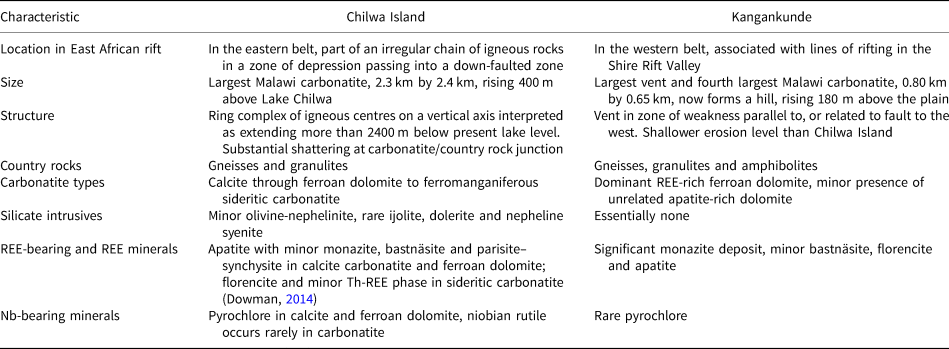
Key aspects regarding the two complexes are summarised in Table 1.
Summary of characteristics of the Chilwa Island and Kangankunde carbonatites.

Methodology
Thirty-one fenite samples from the Natural History Museum, London collection BM1968 P37 were investigated. Mineralogy assemblages and compositions were determined at Kingston University, London, UK using an Oxford Instruments INCA energy-dispersive spectrometer (EDS) and a Gatan Chroma CL system, both hosted on a Zeiss EVO50 scanning electron microscope (SEM). Whole-rock analyses were carried out at the Natural History Museum, London. Supplementary Tables S1–S8, providing details of the samples, analyses and analytical techniques, including quality control, have been deposited with the Principal Editors of Mineralogical Magazine, and are available as supplementary data.
Fenite terminology
Elliott et al. (Reference Elliott, Wall, Chakhmouradian, Siegfried, Dahlgren, Weatherley, Finch, Marks, Dowman and Deady2018) noted that fenites are described as a metasomatic family by the International Union of Geological Sciences (IUGS) (Zharikov et al., Reference Zharikov, Pertsev, Rusinov, Callegari and Fettes2007), forming at high temperatures and possessing a characteristic suite of minerals. The IUGS does not provide a more detailed nomenclature. Attempts at classification include those based on spatial relationship to the source intrusion (Kresten, Reference Kresten1988); ratios of Na to K (Verwoerd, Reference Verwoerd1966); by adding ‘fenitised’ to the name of the protolith (Arzamastev et al., Reference Arzamastev, Arzmasteva and Zaraiskii2011; Kozlov and Arzamastsev, Reference Kozlov and Arzamastsev2015) or by adapting the scheme used by the IUGS for metamorphic rocks (Elliott et al., Reference Elliott, Wall, Chakhmouradian, Siegfried, Dahlgren, Weatherley, Finch, Marks, Dowman and Deady2018). In this paper, we adopt the method used by Morogan (Reference Morogan1994) where fenites are classified using a continuous scale of fenitisation intensity into low-grade, medium-grade and high-grade fenite. Low-grade and medium-grade fenites approximately match the earlier petrographic descriptions of Garson and Campbell Smith (Reference Garson and Campbell Smith1958) and Woolley (Reference Woolley1969) of ‘quartz fenite’ and ‘syenite fenite’. The term ‘high-grade fenite’ is used to refer to breccia and other altered monophasic rock.
SEM identification of matrix minerals and assemblages
Low-grade fenite
At both complexes, low-grade fenite has a matrix of quartz and feldspar in similar proportions. The feldspar is mostly plagioclase (albite to oligoclase) with orthoclase forming in cracks and at margins of grains, as noted by Woolley (Reference Woolley1969). The perthitic textures noted at Chilwa Island were not seen at Kangankunde.
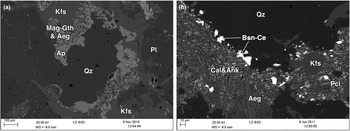
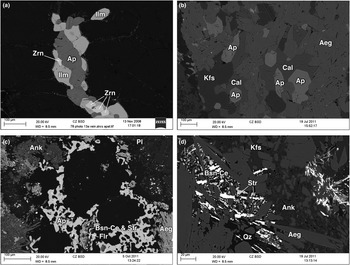
Fenite veins typically represent up to 10 modal % of low-grade fenite at both sites. These contain aegirine, accompanied by orthoclase at Chilwa Island, and by iron oxides at Kangankunde. Rutile and fluorapatite are also components of the veins, particularly at Kangankunde, where zoned rutile grains can be seen as segregations in areas of iron oxide, or intergrown with aegirine. Fluorapatite at Kangankunde can exhibit zoning and is associated with monazite-(Ce) and sub-micrometre-sized zircon. Veins at Kangankunde (Fig. 3a,b) have a more diverse mineral assemblage than those at Chilwa Island, with calcite and ferroan dolomite as common components. Strontianite and fluorite occur in most Kangankunde sections, with pyrochlore found occasionally in carbonate-rich samples.
Back-scattered electron images showing the mineralogy of low-grade fenite at Kangankunde. (a)Sample BM1968 P37 193, typical vein of mineralisation in plagioclase matrix containing apatite and intergrown aegirine and iron oxides, fringed by K-feldspar. (b) Sample BM1968 P37 218, vein of mineralisation with aegirine and K-feldspar, but which also contains pyrochlore and various carbonates including bastnäsite, suggesting the mobility of Nb and REE extends into the outer aureole. Symbols: Ab – albite, Aeg – aegirine, Ank – ‘ankerite' (ferroan dolomite), Ap – apatite, Brt – baryte, Bsn-Ce – bastnäsite-Ce, Cal – calcite, Daq-Ce – daqingshanite-(Ce), Flr – fluorite, Ilm – ilmenite, Kfs – K feldspar, Mag-Gth – magnetite-goethite, Mnz-Ce – monazite-(Ce), Olig – oligoclase, Pcl – pyrochlore, Pl – plagioclase, Qz – quartz, Rt – rutile, Str – strontianite, Xtm-Y – xenotime-Y, Zrn – zircon.

REE minerals are scarce in this zone at both complexes. Monazite-(Ce) is most common, particularly at Kangankunde, where it is seen in most sections. Parisite-(Ce) was detected in one section at each site. Bastnäsite-(Ce) was seen in several sections from Kangankunde, however it appears to be absent in Chilwa Island low-grade fenite.
Medium-grade fenite
In the matrix of medium-grade fenite sections, orthoclase continues to develop at the expense of plagioclase. The proportion of primary quartz is <25% of sections although secondary quartz occurs more frequently in mineralised veins. The vein network becomes more extensive in medium-grade fenite at both complexes. This trend is more marked at Kangankunde, where veins typically comprise 15%–25 modal% compared to 10%–20% at Chilwa Island.
Minerals common in veins in medium-grade fenite at both complexes include orthoclase (commonly located at vein margins), aegirine and sodic amphibole (magnesio-arfvedsonite and richterite). Iron oxide is a major component of veins at Kangankunde.
The accessory mineral assemblages in veins in medium-grade fenite differ between the two complexes. At Chilwa Island, veins of orthoclase and aegirine typically contain micro-assemblages of zircon, fluorapatite and ilmenite (Fig. 4a). Ilmenite contains areas of dissociation into rutile and magnetite. Rutile crystals increase in size and frequency with alteration and can fringe ilmenite. Zoning, when present, is caused by variations in Nb content (Dowman, Reference Dowman2014). Fluorapatite is the most important REE-bearing mineral, typically with complex concentric zoning and sometimes with monazite inclusions. Back-scattered electron images show bright REE-bearing zones, and dark zones in which the REE are below the detection limits (Dowman, Reference Dowman, Wall, Treloar and Rankin2017b). In more altered areas of this grade, apatite zoning and the mineral microassemblages disappear and fluorapatite is associated with aegirine, orthoclase and occasionally carbonate (Fig. 4b). The carbonate is generally calcite, although ferroan dolomite was also detected. Apart from fluorapatite, REE-bearing minerals are not abundant, although monazite-(Ce) and bastnäsite-(Ce) are found in most medium-grade samples except in the more altered parts of this zone, where they become rare to absent, and parisite-(Ce) forms part of the mineral assemblage. Rutile becomes more porous and can contain parisite and inclusions of sub-micrometre zircon.
Back-scattered electron images showing the mineralogy of medium-grade fenite. (a) Chilwa Island (sample BM1968 P37 78): zircon, fluorapatite and ilmenite found in veins of aegirine and K-feldspar, a characteristic mineral assemblage of this grade of fenite. (b) Chilwa Island (sample BM1968 P37 68): fluorapatite in slightly more altered fenite associated preferentially with calcite, aegirine and K-feldspar. Micro-assemblages of zircon, fluorapatite and ilmenite are now becoming rarer as the alteration stage progresses. (c) Kangankunde (sample BM1968 P37 242): mineralised veins are more diverse than at Chilwa Island and have more REE minerals than lower-grade fenite. Here skeletal fluorapatite is associated with bastnäsite-(Ce), strontianite, fluorite, aegirine and ferroan dolomite. (d) Kangankunde (sample BM1968 P37 198): vein of mineralisation of bastnäsite-(Ce) and strontianite with secondary quartz and ferroan dolomite. Symbols: see Fig. 3.

At Kangankunde, a more diverse range of accessory minerals occur in veins (Fig. 4c,d). These include rutile, strontianite, fluorite (sometimes intergrown with aegirine), carbonate as well as fluorapatite and the REE minerals, dominantly monazite-(Ce), but also bastnäsite-(Ce). Parisite-(Ce), pyrochlore and ilmenite are occasional members. Fluorapatite is much less common than at Chilwa Island. It may still be zoned however it is commonly porous, frequently contains sub-micrometre zircon grains and its abundance declines with increasing fenitisation. Alteration promotes carbonate, chiefly dolomite and ferroan dolomite rather than calcite. The formation of REE minerals, monazite-(Ce) and, to a lesser extent, bastnäsite-(Ce) are favoured by alteration, and were found in every rock section of this grade. Both these minerals are more abundant than at Chilwa Island.
Breccia
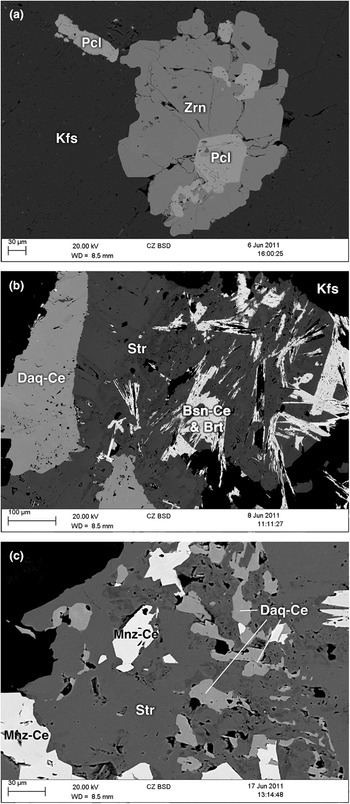
The breccias exhibit the greatest contrast in mineral assemblages in fenite at the two complexes. Breccia at Chilwa Island is almost monophase orthoclase with a few assemblages of pyrochlore and ragged resorbed zircon (Fig. 5a). A Th-REE phase, with grains too small to analyse was also noted.
Back-scattered electron images showing the mineralogy of the brecciated fenite in: (a) Chilwa Island (BM1968 P37 146) breccia predominantly composed of K-feldspar containing occasional associations of zircon and pyrochlore; (b) Kangankunde (BM1968 P37 212) highly mineralised breccia containing strontianite, and REE-bearing minerals daqingshanite and bastnäsite-(Ce) intricately intergrown with baryte; and (c) Kangankunde (BM1968 P37 254) also highly mineralised, with strontianite, daqingshanite and monazite-(Ce). Symbols: see Fig. 3.

Orthoclase, together with quartz and carbonates, of which calcite is less common than dolomite, ferroan dolomite and siderite, form the matrix of the breccia at Kangankunde. Plagioclase is very rare.
The mineralogy of the breccia at Kangankunde is diverse (Fig. 5b,c). Although veins of aegirine and iron oxides, characteristic of medium- and low-grade fenite, are generally absent, fluorapatite is present, preferentially located in carbonate. This is usually porous but can also occur with a cumulate habit. Pores contain monazite and sub-micrometre zircon. Strontianite is most common in this part of the aureole and is accompanied by newly-appearing daqingshanite-(Ce), (Sr,Ca,Ba)3(Ce,La)(PO4)(CO3)3(OH,F) and florencite-(Ce)–goyazite. Monazite-(Ce) is abundant, and bastnäsite-(Ce) is more common than further out in the aureole, although parisite appears to be absent. Pyrochlore and rutile occur in areas of carbonate, however fluorite is rare.
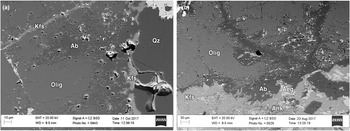
In summary, regarding similarities in fenite mineralogy, alkaline alteration at both complexes is seen to be widespread and pervasive. Moving from low-grade to medium-grade fenite, this alteration becomes less confined to veins and fractures and spreads increasingly inwards from grain margins, creating the turbidity in feldspar noted by Woolley (Reference Woolley1969) where country-rock feldspar of oligoclase composition has undergone alteration to albite (Fig. 6a,b).
Back-scattered electron images showing alteration of oligoclase feldspar grains to albite by alkaline fluids in medium-grade fenite in: (a) Chilwa Island (BM1968 P37 100) and (b) Kangankunde (BM1968 P37 250). Olig = oligoclase. Albite alteration of oligoclase extends beyond the grain boundaries. K-feldspar formation in veins occurs subsequent to plagioclase alteration. Symbols: see Fig. 3.

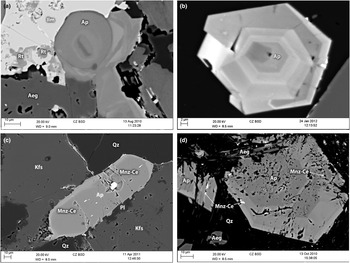
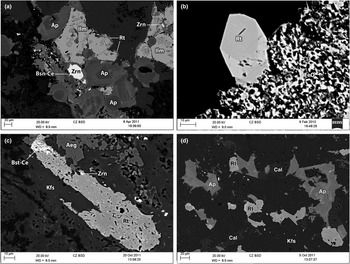
Fluorapatite and rutile at both complexes exhibit zoning and can host inclusions of sub-micrometre secondary zircon and monazite. Fluorapatite and rutile become porous in appearance in more altered areas of medium-grade fenite (Figs 7a–d, 8a–d).
Back-scattered electron images of fluorapatite in fenite with zoning and/or with inclusions. (a) Chilwa Island (BM1968 P37 78): fluorapatite in medium-grade fenite showing complex multiple zoning, with contiguous ilmenite grain showing areas of dissociation into rutile and magnetite. (b) Kangankunde (BM1968 P37 193): multiple zones in fluorapatite in low-grade fenite. (c) Chilwa Island (BM1968 P37 126): zoned fluorapatite grain with monazite-(Ce) inclusions of varying size in medium-grade fenite. (d) Kangankunde (BM1968 P37 193): zoned fluorapatite grain exhibiting porosity in low-grade fenite. Bright grains infilling pores are monazite-(Ce). Symbols: see Fig. 3.

Back-scattered electron images of rutile in fenite. (a) Chilwa Island (BM1968 P37 101): assemblage of ilmenite, fluorapatite and zircon in medium-grade fenite. Segregation of rutile and magnetite from ilmenite has developed and rutile now forms rims around the outside of ilmenite. Also note two generations of zircon present: one larger resorbing original grain and a secondary grain forming in apatite at the top right corner of the image. (b) Kangankunde (BM1968 P37 193): zoned rutile segregating at the edge of an iron oxide vein in low-grade fenite. (c) Chilwa Island (BM1968 P37 54): porous rutile in more altered medium-grade fenite. Bright areas in pores are secondary zircon. (d) Kangankunde (BM1968 P37 242): zoned rutile and fluorapatite in medium-grade fenite. Both minerals are becoming porous. Symbols: Bst-Ce = bastnäsite-Ce, see Fig. 3.

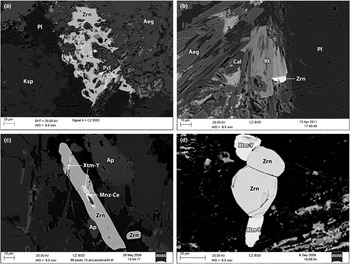
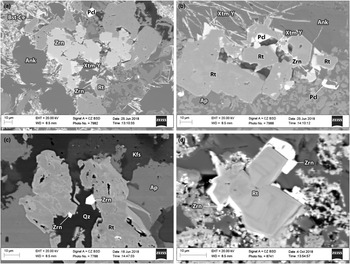
Overgrowths on minerals are present at both locations. These include rutile around ilmenite, pyrochlore on zircon, xenotime on zircon and zircon on rutile (Fig. 9a–d).
Back-scattered electron images of mineral overgrowths in fenite. (a) Chilwa Island (BM1968 P37 102): resorbing zircon with developing pyrochlore in more altered medium-grade fenite. (b) Kangankunde (BM1968 P37 218): zoned rutile with zircon overgrowth in low-grade fenite. (c) Chilwa Island (BM1968 P37 96): zircon in medium-grade fenite with xenotime forming in fracture zones, also with monazite-(Ce). (d) Kangankunde (BM1968 P37 201): xenotime formed on rims of zircon grains in low-grade fenite. Symbols: Ksp = K-feldspar, see Fig. 3.

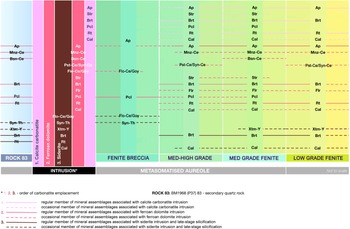
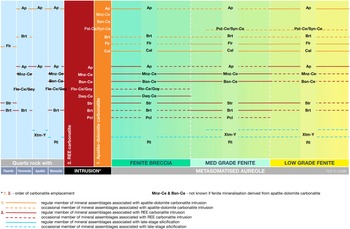
At each complex, all carbonatitic minerals have a fenite counterpart in their respective metasomatic aureole. The only exception is baddeleyite at Kangankunde, a mineral in the apatite–dolomite carbonatite, which has not been detected in the fenite aureole. The main and occasional components of alteration-derived mineral assemblages in fenite at each complex are set out in Fig. 10 and Fig. 11. The location of these minerals in the carbonatites of the complex is also shown.
Alteration-derived mineral assemblages across the carbonatite complex at Chilwa Island (area shown not to scale).

Alteration-derived mineral assemblages across the carbonatite complex at Kangankunde (area shown not to scale). Note the complex mineralogy of the breccia compared to paucity of minerals in the breccia at Chilwa Island.

The major differences between the fenites at the two complexes are a more diverse array of minerals at Kangankunde, a contrast that increases with proximity to the carbonatite; in the more altered parts of the aureoles, a greater abundance of REE minerals at Kangankunde than at Chilwa Island; and the identity of the main REE-bearing mineral, which is monazite-(Ce) at Kangankunde and fluorapatite at Chilwa Island.
LREE composition of REE-bearing minerals
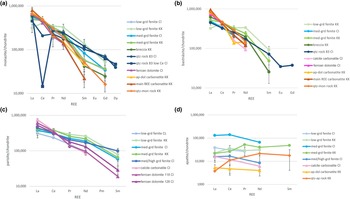
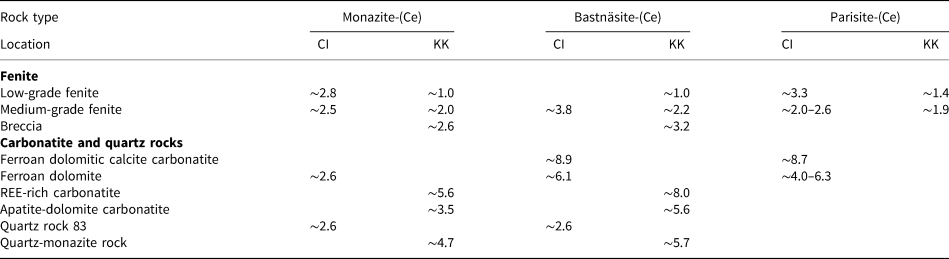
Having established the presence of REE-bearing minerals throughout the fenite sequence at both complexes, their LREE distribution profiles were investigated further using SEM-EDS analysis. Chondrite-normalised La/Nd ratios in REE-bearing minerals at Chilwa Island and Kangankunde are given in Table 2. Further analysis by laser ablation was not possible as the grains were too small. The profiles of these minerals in the fenites are compared to those of their carbonatitic counterparts in Fig. 12a–d. All non-fenite data for Kangankunde are taken from Wall (Reference Wall2000). The chondrite normalising ratios used are those of McDonough and Sun (Reference McDonough and Sun1995).
Chondrite-normalised LREE profiles of REE-bearing minerals at the carbonatite complexes of Chilwa Island (CI) and Kangankunde (KK): (a) monazite; (b) bastnäsite; (c) parisite; and (d) fluorapatite. Error bars represent one standard deviation.

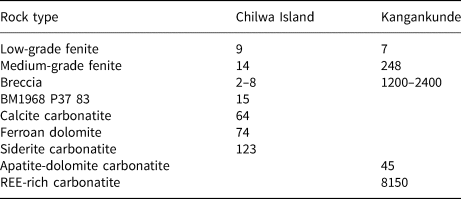
(La/Nd)cn ratios for REE minerals at Chilwa Island (CI) and Kangankunde (KK).

REE-bearing minerals are generally absent from highly altered rock at Chilwa Island except for the areas of secondary quartz, which contain monazite-(Ce) and monazite-(La). Monazite-(La) has not been detected elsewhere at either complex, hence all reference in this paper to monazite, bastnäsite and parisite is to the -(Ce) member. Fluorapatite grains at both complexes have variable REE content, and are commonly zoned in low and/or medium-grade fenite. All analysis was undertaken on REE-enriched zones as REE contents in dark zones in back-scattered electron images are below detection by SEM-EDS.
Other REE-bearing minerals, such as the thorian-synchysite of Chilwa Island, florencite–goyazite, and daqingshanite at Kangankunde were not analysed because of their small grain size and/or low REE content.
Summary of REE-mineral profiles at the complexes
REE-bearing minerals across the fenite aureole at both complexes have flatter REE profiles, lower LREE/MREE ratios, and are more enriched in MREE than their carbonatite analogues (Fig. 12).
Monazite-(Ce) and bastnäsite-(Ce) traces in lower grade fenites differ in that Kangankunde displays a convex distribution pattern between La and Nd that is not apparent in Chilwa Island profiles (Fig.12a,b).
Fluorapatite distribution patterns are relatively flat, however La/Nd ratios are lower at Kangankunde than at Chilwa Island. The (La/Nd)cn ratios are typically ~2 in medium-grade fenite at Chilwa Island but close to 0.5 in equivalent fenite grade at Kangankunde.
With the exception of fluorapatite, distribution profiles of REE-bearing minerals from quartz rocks at Kangankunde are flatter than those of the same minerals from associated carbonatites, though they are steeper than those from fenites. At Chilwa Island, minerals from the quartz-rich rock BM1968 P37 83 are the most MREE enriched in the aureole. Monazite-(Ce) and bastnäsite-(Ce) in this rock are more MREE enriched than these minerals from the quartz-monazite rock at Kangankunde. However, it is noted that the quartz-rich specimen at Chilwa Island is from the fenite aureole, whereas the quartz-monazite rock at Kangankunde is found within the carbonatite zone.
Whole-rock composition of fenites
Whole-rock compositions for all the samples investigated are given in Supplementary Table S8.
Similarities
The mineralogical variation across the fenite aureoles into discrete zones comprising breccia, medium-grade fenites and low-grade fenites is reflected in the whole-rock data for major and trace elements, as well as the REE.
Data confirm the pattern of alkaline alteration at both complexes as described above. We note that marked Na depletion occurs in breccia and quartz-rich rock, which are the most highly metasomatised areas in the aureoles (Fig. 13a,b). Depletion of Na and also Si in generally more altered rock reflects progressive metasomatic replacement of primary quartz and plagioclase by carbonate at Kangankunde, and by orthoclase at both complexes, particularly at Chilwa Island.
Plots of wt.% K2O vs. wt.% Na2O for: (a) Chilwa Island; and (b) Kangankunde.

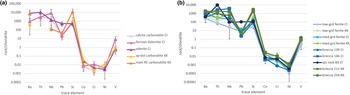
Among the trace elements, a ‘carbonatitic-style' of enrichment in Ba, Th, Nb, Pb and Sr and depletion in Co, Cr, Ni and V occurs in fenite. As would be expected, this becomes generally more pronounced as fenitisation grade and proximity to the carbonatite increases. The similarity in element distribution profiles exhibited by carbonatites and fenites is illustrated in Fig. 14. It also hints at a possible paragenetic relationship between rock 83 and siderite at Chilwa Island.
Chondrite-normalised trace-element distribution profiles for whole-rock data across the carbonatite complexes at Chilwa Island (CI) and Kangankunde (KK): (a) carbonatite; and (b) fenite. The values plotted are averages, except for breccia and quartz-rich rock. Error bars represent one standard deviation. The chondrite ratios used are from McDonough and Sun (Reference McDonough and Sun1995).

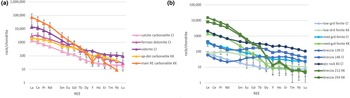
Carbonatites are typically LREE enriched, and the LREE content of fenite increases with alteration. Chondrite-normalisation of carbonatite and fenite (Fig. 15a,b) shows that fenites of both complexes display flatter profiles, with lower La/Yb ratios, than those of their respective carbonatites (Table 3). The exception is at Kangankunde where breccia is more LREE enriched than the apatite–dolomite carbonatite. The outcrop of this carbonatite is very small and any influence on breccia appears to be overprinted by the later main REE carbonatite as evidenced by the existence of negative Y anomalies in both of these REE profiles.
Chondrite-normalised REE distribution profiles for whole-rock data across the carbonatite complexes at Chilwa Island (CI) and Kangankunde (KK): (a) carbonatite; and (b) fenite. The values plotted are averages except for breccia and quartz-rich rock. Error bars represent one standard deviation. The chondrite ratios used are from McDonough and Sun (Reference McDonough and Sun1995).

(La/Yb)cn ratios from whole-rock data at the Chilwa Island and Kangankunde complexes.

Differences
Kangankunde exhibits a greater continuity of trends in element abundance across the aureole, as indicated by the mineralogy. Of the major elements, inwards towards the carbonatite, Fe and Mg (and also Mn) increase as the Na/K ratio decreases. At Chilwa Island, only the high K content of the breccia is in agreement with either of these trends, and any increase in Fe and Mg from low-grade to medium-grade fenite does not appear to have a strong relationship with Na and K content or ratios (Fig. 16a,b).
Plots of wt.% Fe2O3 + MgO vs. Na/K: (a) Chilwa Island; and (b) Kangankunde.

A key difference is the lack of Fe, Mg, Mn and Ca in Chilwa Island breccia, which interrupts increasing trends in these elements from low-grade to medium grade fenites.
Trace elements at Kangankunde show a clear increase in carbonatite-associated elements from the outer aureole inwards to the breccia. At Chilwa Island, this trend is again disrupted by the breccia, in which the Ba and Pb contents are below those of the medium-grade fenite. The comparatively low level of certain major and trace elements in the breccia at Chilwa Island is not surprising given the paucity of mineralogical diversity in this part of the aureole. Differences between the complexes are also seen in the details of the trace-element enrichment of fenite. In the aureole outside of the breccia, Chilwa Island contains more Ba, Pb and Y than Kangankunde, which can probably be ascribed to the relative enrichment of their respective carbonatites in these elements. However, Nb levels in fenite at Kangankunde are higher than that of the carbonatites, apart from a pyrochlore-bearing breccia sample, and are also greater than the Nb content in fenite at Chilwa Island. This is unexpected because Chilwa Island carbonatites include pyrochlore-bearing calcite carbonatite, and are more Nb-enriched than Kangankunde carbonatite by a factor of 10. The reason for this difference in Nb content is not known and requires further investigation. The high mobility of Nb (and Ti) has been noted in the fluctuating physico-chemical conditions occurring in the late hydrothermal fluids associated with carbonatite formation (Kozlov et al., Reference Kozlov, Fomina, Sidorov and Shilovskikh2018). Rutile was found in a fluid inclusion in medium-grade fenite at Kangankunde by Dowman (Reference Dowman2014) and, Nb-bearing goethite is associated with a hydrothermally-altered carbonatite in Russia (Chebotarev et al., Reference Chebotarev, Doroshkevich, Klemd and Karmanov2017). It is possible that goethite in the altered iron oxides of medium-grade fenite at Kangankunde could contain Nb, though this has not been investigated. Strontium is most enriched in the main REE carbonatite at Kangankunde and this is reflected in the higher Sr content of the fenite compared to Chilwa Island, particularly in the breccia (Fig. 14a,b).
Chondrite-normalised REE distribution profiles of the carbonatites at the complexes (Fig. 15a) highlight the two contrasting carbonatites at Kangankunde. The main REE-rich carbonatite is strongly enriched in the LREE both in absolute abundance and proportionately (Table 3). The apatite–dolomite carbonatite is more similar in profile to ferroan dolomite at Chilwa Island, except for a negative Y anomaly. This is also present in both carbonatites at Kangankunde, however it is notably more pronounced in the REE-rich carbonatite. Chilwa Island carbonatite distribution profiles are flatter than those of the REE carbonatite at Kangankunde, containing less LREE and more HREE. They also follow the trend in that magmas in the emplacement sequence at Chilwa Island become sequentially more enriched in REE.
The contrast in carbonatite REE distribution profiles is seen in those of their associated fenites (Fig. 15b). In medium-grade fenite and more altered areas, chondrite-normalised REE distribution profiles of Chilwa Island are flatter than those of Kangankunde with (La/Yb)cn ratios of 2–15 in fenite compared to 248–2400 in carbonatite (Table 3), with each zone containing less LREE than its Kangankunde equivalent. The reverse is seen with respect to HREE, where higher-grade fenites at Chilwa Island are enriched in comparison with their Kangankunde counterparts, both as a proportion and in absolute abundance. This trend may be related to the higher HREE contents of sideritic carbonatite at Chilwa Island compared to the main REE carbonatite at Kangankunde.
The Ho and Er content of the quartz rock BM1968 P37 83 from Chilwa Island is the highest measured anywhere in either complex, and the rock is more HREE enriched than most of the ferroan dolomite and calcite carbonatites at Chilwa Island. Whole-rock data are not available for quartz-rich rocks at Kangankunde and it can only be noted that the quartz-monazite rocks should show marked LREE enrichment, with quartz–florencite and quartz–apatite rocks being more MREE–HREE enriched.
REE fractionation further investigated
At both complexes, EDS compositional data for the REE-bearing minerals shows that those in fenite have lower (La/Nd)cn ratios than those of their associated carbonatite. Mixing of country rock with a dominant REE mineral derived from the carbonatite or by REE fractionation are two possible explanations of this trend.
The first option was tested by investigating if mixing a dominant REE-bearing carbonatitic mineral with country rock would produce an approximation to fenite whole-rock REE distribution profiles. Monazite-(Ce) from Kangankunde was chosen as it is the mineral that exerts the strongest control over REE distribution profiles at both complexes.
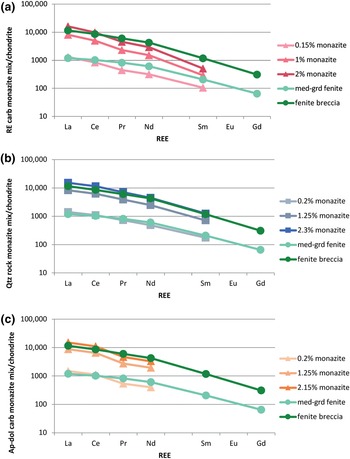
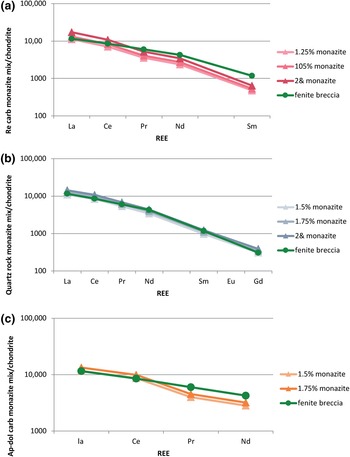
Monazite-(Ce) REE compositions at Kangankunde vary across the two carbonatites and the quartz-rich rocks. In the model, low percentages of three different monazite compositions were added to: (a) low-grade fenite whole-rock composition, to ascertain whether the results might approximate medium-grade and/or breccia compositions (Fig. 17a–c); (b) medium-grade fenite whole-rock composition, to test if the resulting composition could approximate that of breccia (Fig. 18a–c).
Chondrite-normalised REE distribution profiles generated by addition of monazite-(Ce) percentages to low-grade fenite at Kangankunde: (a) addition of monazite from REE-rich carbonatite to low-grade fenite whole-rock composition; (b) addition of monazite from quartz-monazite rock to low-grade fenite whole-rock composition; and (c) addition of monazite from apatite–dolomite carbonatite to low-grade fenite whole-rock composition.

Chondrite-normalised REE distribution profiles generated by addition of monazite-(Ce) to medium-grade fenite at Kangankunde: (a) addition of monazite from REE-rich carbonatite to medium-grade fenite whole-rock composition; (b) addition of monazite from quartz-monazite rock to medium-grade fenite whole-rock composition; (c) addition of monazite from apatite–dolomite carbonatite to medium-grade fenite whole-rock composition.

Mixes of country rock with monazite-(Ce) from the carbonatites, particularly from the REE-rich carbonatite, do not resemble the REE distribution profiles of more altered fenite (Figs 17, 18). The profiles generated are too steep and La/Nd ratios are too high. The mixes with monazite-(Ce) from the quartz-monazite rock result in better matches, particularly the close approximation to breccia composition produced by adding this monazite to medium-grade fenite.
We therefore suggest that REE fractionation could be a better explanation for the lower (La/Nd)cn ratios of fenite, particularly noting that the best mixing results came from quartz rock monazite-(Ce), which is of non-primary magmatic origin, and which might have formed from REE-fractionating fluids. This accords with the view of Broom-Fendley et al. (Reference Broom-Fendley, Elliott, Beard, Wall, Armitage, Brady, Deady and Dawes2021a) and Broom-Fendley et al. (Reference Broom-Fendley, Siegfried, Wall, O'Neill, Brooker, Fallon, Pickles and Banks2021b) who suggested that, subsequent to precipitation of LREE minerals in carbonatite, the more incompatible HREE are expelled in residual hydrothermal fluids, and that REE fractionation occurs in most cases of fenitisation.
The carbonatites at Chilwa Island and Kangankunde were not the focus of this investigation although some support for these suggestions regarding early precipitation of LREE-rich minerals in carbonatite might be provided at Chilwa Island by the abundance of apatite, the main REE-bearing mineral at this complex, in the early-forming calcite carbonatite and calcite ferroan dolomite carbonatites. Apatite in early calcite carbonatite is more LREE enriched than the MREE-rich apatite in later ferroan dolomite (Dowman, Reference Dowman2014). Back-scattered electron images of two ferroan dolomite carbonatites suggest that after apatite deposition, later mineralisation occurred involving the HREE and HFSE, with the formation of overgrowths of xenotime-(Y), zircon and pyrochlore (Fig. 19a–d), as is seen in the fenite (Fig. 9a–d). Metasomatic alteration of these carbonatites also includes the formation of K-feldspar and secondary quartz. At Kangankunde, it is not known whether, or how, the REE content of minerals evolved during the emplacement of the small apatite–dolomite carbonatite. However, the REE carbonatite appears to have initially crystallised burbankite before the main phase of REE mineralisation of monazite-(Ce) and bastnäsite-(Ce). Xenotime, florencite–goyazite and apatite appeared later in the paragenetic sequence (Wall, Reference Wall2000).
Back-scattered electron images of HREE and HFSE mineralisation in carbonatite at Chilwa Island. (a) BM1957 1056 102: ferroan dolomite fluorapatite-rich carbonatite with an area of late-stage zircon with xenotime-(Y) overgrowths. (b) BM1957 1056 102: ferroan dolomite fluorapatite-rich carbonatite with patchily-zoned rutile with xenotime-(Y) and pyrochlore overgrowths; zircon is also present. (c) BM1957 1056 128: ferroan dolomite carbonatite with irregularly zoned rutile with zircon overgrowths. Metasomatic alteration of carbonatite is also evidenced by the presence of quartz and K-feldspar. (d) BM1957 1056 113: ‘sideritic’ carbonatite with xenotime overgrowths on zoned rutile. Symbols: Bst-Ce = bastnäsite-Ce, see Fig. 3.

Discussion
Common characteristics
Alkali alteration
Alkaline alteration at both complexes occurs both in veins and fractures and also spreads inwards from grain margins, indicating that crystal boundaries formed additional channels for fluid migration. The existence of interconnected micropores forming fine-scale channels for fluids is common in alkaline feldspars (David and Walker, Reference David and Walker1990; Finch and Walker, Reference Finch and Walker1991 and citations therein; Plümper et al., Reference Plümper, Botan, Los, Liu, Malthe-Sørenssen and Jamtveit2017; Yuan et al., Reference Yuan, Cao, Schulz, Hao, Gluyas, Liu, Yang, Wang, Xi and Li2019; Yuguchi et al., Reference Yuguchi, Shoubuzawa, Ogita, Yagi, Ishibashi, Sasao and Nishiyama2019).
Alkaline alteration could have resulted from fenitising fluids generated from the carbonatite magma either coevally or prior to emplacement, and possibly related to a first boiling episode caused by decompression during magma ascent (Candela, Reference Candela1997). At both Chilwa Island and Kangankunde, early alkaline fluids are more sodic, and later fluids are more potassic, as evidenced by overprinting of sodic fenitisation by potassic fenitisation (Woolley, Reference Woolley1969). This sequence is not uncommon, though it is not wholly understood. Woolley (Reference Woolley1982) suggested that early sodium loss from magma at depth would cause the alkali fraction of the ascending magma to become increasingly potassic. Both Woolley (Reference Woolley1982) and Le Bas (Reference Le Bas2008) observed that this is consistent with field relationships, where potassium fenitisation is generally more evident at higher structural levels. This idea of magma evolution is supported by Koster van Gross (Reference Koster van Gross1990) whose experimental evidence indicated that alkali-rich CO2–H2O fluids become increasingly K-rich and Na-poor with decreasing pressures. In both complexes this suggests that a transition from sodic to a more potassic alteration could accompany the emplacement of the later, more Mg- and Fe-rich magmas at higher levels in the intrusion.
Magma evolution and the plurality of carbonatites would probably have generated repeated episodes of alkaline metasomatism. Carbonatite at both complexes contains orthoclase but not sodic feldspar. Potassic fluids may have introduced some Al and Si, as well as K, into carbonatite. Questions arise about the mechanism responsible, and also about the lack of evidence for carbonatite autometasomatism by sodic fluids. One potential answer is that rather than simple expulsion of magmatic fluids outwards into country rock, a circulation of fluids within the complex might have periodically occurred, during which time any earlier sodic alteration of the carbonatite could have been overprinted by later potassic fluids.
Mineralisation and its pattern
In contrast to the pervasive alkaline alteration of the aureoles, mineralisation is mostly confined to discrete veins (Figs 3b, 4a,c,d). This could result from a partial separation in timing of alkaline and mineralising fluid expulsion. Each carbonatite emplacement may be associated with pulses of mineralisation from a second, possibly episodic, boiling event driven by stages of crystallisation of anhydrous phases which increase vapour pressure in the magma (Candela and Bevin, Reference Candela, Bevin and Clark1995; Candela, Reference Candela1997). Rutile and fluorapatite at both complexes exhibits zoning, attributable to differences in Nb and REE content respectively, suggesting that these minerals were formed from pulses of fluids of varying composition (Figs 7,8). Certain of these fluids may have been aqueous and solute-rich which fenitised the country rock and autometasomatised carbonatite itself (Walter et al., Reference Walter, Giebel, Steele-MacInnis, Marks, Kolb and Markl2021). Primary alkali REE carbonates are absent in both fenites and it is suggested that these are rarely preserved at carbonatite complexes, being dissolved by later fluids and subsequently replaced by monazite-(Ce) and alkali-free REE (fluor)carbonates (Anenburg et al., Reference Anenburg, Broom-Fendley and Chen2022). The presence of cross-cutting trails of heterogeneous fluid inclusions in quartz, with daughter minerals that include nahcolite, burbankite and rutile, provides further evidence that country rocks were metasomatised by a series of alkaline and mineralising fluid expulsions.
Late-stage fluids and silicification
The periodic recirculation of fluids within the aureole suggested above with respect to alkaline alteration could also explain the presence of areas of rocks of secondary quartz and mineral overgrowths at both complexes. The rocks of secondary quartz are located in both fenite and carbonatite, and are indicative of selective silicification across the complexes. No overprint by any later alkaline fluids is seen, thus silicification would apparently postdate alkaline alteration. In carbonatite and fenite, these quartz rocks are REE enriched, implying further mobilisation and concentration of the REE (and HFSE) at the complex, this time under Si-rich conditions. This may also have promoted the overgrowths of xenotime, zircon and pyrochlore in both fenite and carbonatite (Figs 9, 19). It could have been driven by a combination of hydrothermal fluids with Si derived from the country rocks and REE from the magmatic fluids (von Eckermann, Reference von Eckermann1948; Garson and Campbell Smith, Reference Garson and Campbell Smith1958), rather than any late-stage silicic component of magma. Simandl and Paradis (Reference Simandl and Paradis2018) proposed that silica removed from country rock during fenitisation will migrate inwards towards the intrusion, which could explain the presence of quartz rocks within the carbonatite. Woolley (Reference Woolley1969) considered quartz in sideritic carbonatite at Chilwa Island to be the result of secondary processes, suggesting that silicic fluids could be drawn inwards and upwards towards the intrusion. This is interpreted as fluid recirculation, and is supported by the mineralogy of this carbonatite which is composed predominantly of secondary calcite and iron and manganese oxides, with quartz lining the druses. Silica saturation at Chilwa Island could therefore have arisen from late-stage interaction between cooling fluids from the carbonatite melt and groundwater in country rock (Simonetti and Bell, Reference Simonetti and Bell1994). At Kangankunde, Wall (Reference Wall2000) described ground water interacting with fluid systems, and Broom-Fendley et al. (Reference Broom-Fendley, Wall, Spiro and Ullmann2017) indicated a role for meteoric water in the formation of quartz rocks in more distal parts of the aureole. Furthermore, at both complexes, the crystallisation of rutile adjacent to magnetite in fenite is similar to that described by Southwick (Reference Southwick1968) in an investigation of rutile-bearing ultramafic rock in Maryland, USA. He considered this association to be indicative of oxidising events following the laboratory experiments of Lindsley (Reference Lindsley1963) where a simple oxidation of ilmenite could have rutile and magnetite as stable end products. Oxidation is also invoked by Tan et al. (Reference Tan, Wang, He, Xing, Liang and Dong2015) to explain the intergrowth of magnetite and rutile in a Fe–Ti oxide-bearing gabbro in Xinjie, China. Cooling of the geothermal system might have drawn in oxidised surface waters, as suggested by Garson and Campbell Smith (Reference Garson and Campbell Smith1958) at Chilwa Island and by Wall et al. (Reference Wall, Barreiro and Spiro1994) at Kangankunde, with the resulting oxidising fluid events affecting large parts of the aureoles.
There is nothing in our work here that disagrees with the probable role of meteoric fluids in determining the late-stage mineralogical evolution of both complexes.
Mineral REE ratios
The carbonatite REE minerals investigated here have REE compositions with higher (La/Nd)cn ratios than their fenite analogues. Changes in REE ratios have been reported by Chakhmouradian et al. (Reference Chakhmouradian, Reguir, Zaitsev, Couëslan, Xu, Kynický, Mumin and Yang2017), who noted that where apatite is present in carbonatite, (La/Yb)cn ratios fall from between 30 and 500 in igneous apatite to ≤25 in hydrothermal varieties.
The small size and fragility of fluid inclusions hosted in the minerals of the complexes limits full characterisation of the fluids that promoted REE fractionation beyond noting that CO2-bearing and aqueous fluid inclusions are present in both aureoles, and that chlorine was not detected at either aureole. CO2-bearing potassic fluids are implicated in the formation of breccia (Rubie and Gunter, Reference Rubie and Gunter1983), and CO2 fluids may play a more important role than aqueous fluids within higher temperature zones in the carbonatite complexes (Smith et al., Reference Smith, Henderson and Campbell2000). These authors also linked increasing solubility of the MREE and HREE over time to fluids with falling temperature and a change from CO2 to H2O dominance, which may have promoted (re)mobilisation of the MREE and HREE (Andrade et al., Reference Andrade, Möller, Lüders, Dulski and Gilg1999; Broom-Fendley et al., Reference Broom-Fendley, Wall, Brady, Gunn, Chenery and Dawes2013). This was possibly via a dissolution–reprecipitation process (Broom-Fendley et al., Reference Broom-Fendley, Elliott, Beard, Wall, Armitage, Brady, Deady and Dawes2021a; Reference Broom-Fendley, Siegfried, Wall, O'Neill, Brooker, Fallon, Pickles and Banks2021b) as evidenced by the presence of porous fluorapatite containing sub-micrometre zircon in medium-grade fenite and breccia at Kangankunde, and skeletal zircon in breccia at Chilwa Island.
Contrasting characteristics
Breccia composition and mineralogy
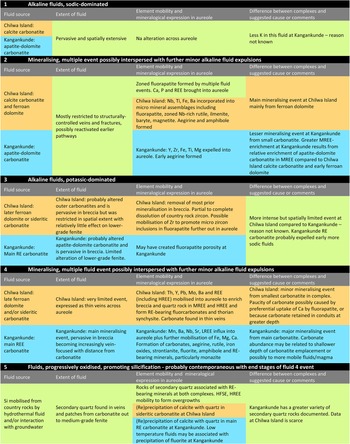
A more extensive survey of carbonatite complexes is required to determine whether intense potassic brecciation is a common feature of complexes lacking REE-rich carbonatite. The reason for the contrasts in the breccias at the two complexes might be associated with CO2-rich potassic fluids involved in a first boiling where magma pulses fracture rock causing a rapid reduction in pressure (Rubie and Gunter, Reference Rubie and Gunter1983). As described above, the breccias at Kangankunde and Chilwa Island differ in that the latter is more K-rich and more shattered. Most Kangankunde minerals are absent from Chilwa Island breccia, with even zircon being altered to a skeletal morphology. This event could therefore have been more intense or concentrated at Chilwa Island than at Kangankunde. The sequence of metasomatising fluids at each complex could also be a key factor, particularly with respect to the relative timing of the expulsion of potassic fluids and of the main mineralising episode (Fig. 20).
Proposed sequence of key metasomatic fluids at Chilwa island and Kangankunde.

Carbonate abundance in fenite
The outer fenite and the breccia at Kangankunde both contain calcite and more ferroan dolomite carbonates, regardless of the absence of a calcite carbonatite at Kangankunde. Conversely, regardless of the presence of substantial calcite carbonatite at Chilwa Island, little calcite, or carbonate in general, is seen in the fenite. Conclusions regarding carbonate mobility in metasomatic fluids are limited here to commenting that the greater mobility at Kangankunde might be attributed to the more fractured country rock outside of the breccia, which provided conduits for carbonate transport. It is not clear whether the evolution of a REE-rich carbonate is associated with greater carbonate mobility, or whether any relationship exists between the degree of REE enrichment of carbonatite and the extent of fracturing of country rock. No theoretical foundation exists for either proposition and it can only be commented that the shallower erosion level at Kangankunde compared to Chilwa Island could imply that magma was not constrained in a pipe network, thus permitting greater magma/fluid mobility and a more pervasive distribution of carbonate in the aureole.
A mineralogical explanation of the differing amount of carbonate in fenite at the two complexes is that Ca at Chilwa Island was taken up in the growth of fluorapatite, which is less common at Kangankunde, perhaps because P was preferentially taken up in monazite. To our knowledge, no relationship between carbonate in fenite and REE-rich monazite-bearing carbonatite has ever been established.
Niobium in fenite
It is unclear why fenite at Kangankunde is richer in Nb than that at Chilwa Island which hosts pyrochlore-bearing carbonatite. The data suggest that Nb in fenite does not provide a reliable indicator of the Nb enrichment of the associated carbonatite. This could be because the principal Nb-bearing mineral, pyrochlore, precipitates from carbonatite magma rather than crystallising during the later hydrothermal stages. However, Nb may be more mobile in fluids generated at Kangankunde, though it is again unclear whether this is characteristic of fenites associated with REE-rich carbonatites.
Main REE-bearing mineral
The dominant REE-bearing mineral in fenite in the two complexes is fluorapatite at Chilwa Island and monazite-(Ce) at Kangankunde. These are also the key REE-bearing minerals in their respective carbonatites. Identifying these minerals in metasomatic aureoles could therefore provide an indicator of the probable style of REE-mineral enrichment in their associated carbonatites. This is considered important as carbonatite deposits that have produced REE on a commercial scale contain monazite as the principal phosphate mineral (Wu et al., Reference Wu, Yuan, Bai, Jones, Wall and Williams1996; Castor, Reference Castor2008; Chakhmouradian et al., Reference Chakhmouradian, Reguir, Zaitsev, Couëslan, Xu, Kynický, Mumin and Yang2017).
Ligands at Chilwa Island and Kangankunde
REE mobility
A detailed investigation into the ligands that could have complexed the REE is beyond the scope of this paper, however a brief summary is included here regarding which ligands may have been dominant at each complex, indicating whether any differences exist between the REE-rich Kangankunde and the REE-poor complex of Chilwa Island.
Fluorine is common in the fenite mineralogy at both locations, though particularly at Kangankunde, where fluorite, fluorapatite and fluorcarbonates are all present. Fluorine appears to be important, commonly in combination with other ligands, at other carbonatite complexes. Activity of F– and PO43– in hydrothermal fluids was associated with fluorapatite formation in fenite at Lofdal in Namibia (Wall et al., Reference Wall, Niku-Paavola, Müller and Jeffries2008) and with HREE mineralisation and evolved ferrocarbonatitic magmatism at the REE–Nb Abitibi carbonatite in Canada (Nadeau et al., Reference Nadeau, Cayer, Pelletier, Stevenson and Jébrak2015). Morogan (Reference Morogan1989), writing about fenitisation at Alnö in Sweden, cited Humphris (Reference Humphris and Henderson1984), suggesting that the ligands able to mobilise REE into fluids and transport them out to the potassic fenite would include F–, PO43–, CO32– and HCO3–.
Broom-Fendley et al. (Reference Broom-Fendley, Styles, Appleton, Gunn and Wall2016) reported transport of REE complexes by both F- and Cl-bearing fluids at Kangankunde and also at Tundulu, a carbonatite complex in Malawi. Following Migdisov and Williams-Jones (Reference Migdisov and Williams-Jones2014) and Williams-Jones and Migdisov (Reference Williams-Jones and Migdisov2014) they considered that Cl is the most probable complexing agent in REE-bearing hydrothermal systems although its presence at Kangankunde and Tundulu is only inferred, as Cl was not detected in apatite compositions or in fluid inclusions. Furthermore, Cl was not present in the fluid inclusions investigated from the outer parts of the aureoles at Chilwa Island and Kangankunde (Dowman, Reference Dowman2014), and is not found in the composition of apatite in fenite.
The laboratory-based cooling experiments of REE-bearing carbonatites carried out by Anenburg et al. (Reference Anenburg, Mavrogenes, Frigo and Wall2020) indicated that Na-REE and K-REE are the dominant complexes stable in REE-mobilising hydrothermal fluids. The authors did not identify the anion(s) that would charge balance these cationic complexes although they commented that Na facilitates solubility of P and F, which could help explain the presence of apatite daughter minerals in fluid inclusions at Chilwa Island (Dowman, Reference Dowman2014). The experiments also noted LREE–HREE decoupling in the presence of alkalis, particularly K, with increased solubility of HREE, which would accord with the low LREE/HREE whole-rock ratios of the potassic breccia at Chilwa Island and help account for (La/Yb)cn ratios of fenite REE minerals being lower than those in carbonatite. The key role that alkaline fluids may play in the mineralisation of hydrothermal REE fluorcarbonates by promoting the simultaneous transport of REE, fluoride and carbonate is further underlined by an investigation of the solubility and speciation of REE in alkaline fluids using in situ X-ray absorption spectroscopy (Louvel et al., Reference Louvel, Etschmann, Guan, Testemale and Brugger2022). This provided evidence that alkaline fluids rich in F and CO32– enhance hydrothermal mobilisation of LREE at temperatures ≥400°C and HREE at temperatures ≤ 200°C. On the basis that F is widely recorded in the fenite assemblages and Cl is not, we would suggest that, contrary to Broom-Fendley et al. (Reference Broom-Fendley, Styles, Appleton, Gunn and Wall2016), F was the dominant ligand in transporting key elements in both complexes described here.
Niobium mobility
Niobium has clearly been transported and precipitated into the fenite at both complexes, especially at Kangankunde.
Experimental studies by Zaraisky et al. (Reference Zaraisky, Korzhinskaya and Kotova2010) of Ta and Nb solubility in fluoride solutions at 300–550°C concluded that hydrothermal transport of Nb and Ta was only possible if the solutions were of concentrated fluoride, especially HF-rich. Timofeev et al. (Reference Timofeev, Migdisov and Williams-Jones2015) investigated the solubility of Nb in fluoride-bearing aqueous solutions at temperatures of 150–250°C, finding that solubility increased markedly at higher HF concentrations, and that precipitation of Nb solids and fluorite could occur if pH increased as a result of an acidic country rock fluid reacting with carbonate rocks. The presence of F-rich minerals such as fluorcarbonates and F-rich pyrochlores (as found at both Chilwa Island and Kangankunde) at the Bailundo Carbonatite Complex in Angola was taken to indicate fenitising fluids enriched in F–, with high HF activity (Roseiro, Reference Roseiro2017; Roseiro et al., Reference Roseiro, Ribeiro da Costa, Figueiras, Rodrigues and Mateus2019). Chebotarev et al. (Reference Chebotarev, Doroshkevich, Klemd and Karmanov2017) also invoked F and low pH to explain the evolution of Nb mineralisation in the Chuktukon carbonatite massif in Russia, commenting that during hydrothermal alteration, fluids were able to dissolve fluorapatite in carbonatite. The idea of low pH is problematic, as although the pH of the metasomatic fluids at Chilwa Island and Kangankunde is not known, it is not thought to have been low in all fluid events, as calcite is present in fluid inclusions at both locations. However, it is noted that fluorapatite at Kangankunde is porous or replaced in the Nb-rich more altered fenite.
Other suggestions include that of Tanis et al. (Reference Tanis, Simon, Tschauner, Chow, Xiao, Burnley, Cline, Hanchar, Pettke, Shen and Zhao2015) who investigated the mobility of Nb in rutile-saturated NaCl- and NaF-bearing aqueous fluids under metamorphic conditions, and found a greater solubility of rutile in Na–F-bearing fluids. In addition, Kozlov et al. (Reference Kozlov, Fomina, Sidorov and Shilovskikh2018), in their study of Ti–Nb mineralisation in the late stage Petyayan-Vara REE carbonatites of the Vuoriyarvi Massif in Russia, reported that Nb and Ti migrated together in metasomatic fluids, in which the ligands were F, and to a lesser extent, PO43– and CO32–. The significance of an alkaline component of fluids has previously been described in relation to REE transportation and fractionation (Anenburg et al., Reference Anenburg, Mavrogenes, Frigo and Wall2020; Louvel et al., Reference Louvel, Etschmann, Guan, Testemale and Brugger2022). Together with higher levels of F at Kangankunde compared to Chilwa Island, this may have facilitated Nb-enrichment of Kangankunde medium-grade fenite. In our view, this suggests that F-rich alkaline fluids were key to REE transportation at both Kangankunde and Chilwa Island.
The role of fluid sequence and fluid composition
Here we outline how different sequences of metasomatising fluids at Kangankunde and Chilwa Island can help explain their respective fenite rock composition and mineral assemblages.
Differences in the size, number and composition of the host carbonatites at each location would have affected both the aggregate fluid events and the detailed fluid components. Some fluid events probably caused only minor alteration, and/or may have been overprinted by later fluids. However, we conjecture that the overall sequence of key fluid expulsions at the complexes could have been broadly similar, as set out in Fig. 20. Each carbonatite expelled sodic-dominated alkaline fluids preceding mineralisation, which may itself have been interspersed or accompanied by further alkaline fluids. Potassic alteration became dominant over sodic alteration in subsequent alkali influxes, and is associated with further mineralisation. In the inner aureoles of both complexes, it appears to have overprinted earlier sodic episodes. The intensity and timing of the potassic alteration in relation to the main mineralising event may exert a strong control on the spatial distribution of REE-bearing minerals in the inner aureole at each complex. The transition from a sodic to a potassic flux is thought to be concurrent with fractionation of carbonatite from Ca-rich compositions to more Mg- and Fe-rich types, emplaced at successively higher levels in the intrusion.
In addition, at Chilwa Island, the predominantly orthoclase mineralogy of the breccia could result from an incursion of a highly potassic late-stage fluid, such as that described by Rubie and Gunter (Reference Rubie and Gunter1983). In this scenario, potassic metasomatism takes place at high temperatures if the fluid is either CO2-rich or boiling as a result of a rapid reduction of pressure, such as by rock fracturing. This fluid episode occurred after the main mineralising events derived from ferroan dolomite carbonatite, and to a lesser extent, calcite carbonatite. In effect, the hot potassic fluid leached nearly all of the prior mineralisation derived from the earlier fluids from the inner aureole, as well as most residual components from the country rock. This potassic fluid was, however, limited in spatial extent. It appears to have been followed by a minor expulsion of mineralising fluids from the central sideritic carbonatite. The higher HREE content of the sideritic carbonatite may have produced the relatively high HREE/LREE ratios of the breccia.
In contrast, at Kangankunde, the effect of late-stage potassic-dominated fluids was less intense though still apparently overprinted sodic alteration associated with the emplacement of the REE carbonatite. Potassic breccia preceded the main REE mineralisation event which was the result of the action of deuteric fluids between 250°C and 400°C (Broom-Fendley et al., Reference Broom-Fendley, Wall, Spiro and Ullmann2017).
A speculative summary of possible fluid characteristics of the major metasomatic episodes at each complex is given in Fig. 20, highlighting differences in the fluids and their local effects.
Conclusion
We report here the mineralogy and whole-rock compositions across metasomatised aureoles associated with two carbonatites of contrasting REE enrichment. The two carbonatites are the Chilwa Island and Kangankunde bodies in southern Malawi. Our data show that, at both complexes, mineralisation and alkaline alteration during carbonatite emplacement occurred in pulses, and that K/Na ratios increased in subsequent alkaline fluids. This change to potassic dominance appears to be associated with carbonatite differentiation to Mg- and Fe-bearing varieties, with these later evolved magmas being emplaced at higher levels within the intrusion. A common feature of both complexes is fluid circulation within the aureoles, as evidenced by the potassic metasomatism of carbonatites and by silicification across the aureoles, together with further mobilisation of REE by late meteoric fluids. These characteristics might apply to most carbonatite complexes with well-developed fenite aureoles.
However, the contrasts between the two complexes revealed by this investigation are more intriguing. The fenite mineral assemblages differ distinctly at each complex. The components of these fenite assemblages match those minerals present within their respective host carbonatites. Furthermore, the main REE-bearing mineral found within fenite – fluorapatite at Chilwa Island and monazite at Kangankunde – is also the key REE-bearing mineral of the carbonatite. Knowing which minerals are present in fenite should thus constitute a general guide to minerals expected to occur in the carbonatite. A particular emphasis should be placed on identifying the main REE-bearing mineral in fenite. This is important as it could predict the style of REE enrichment of the associated carbonatite, and therefore the likelihood of it being a potential economic resource. It should also be noted that fenite REE-bearing minerals typically have lower La/Nd ratios than their equivalents in carbonatite.
A strong contrast in breccia mineral diversity was found between the two carbonatites. Breccia mineralogy may serve as an indicator of the style and level of REE enrichment of the host carbonatite, with greater mineral diversity being associated with REE-rich carbonatites. The presence or absence of a diverse breccia mineralogy can also provide information about the sequence of fluid events that occurred at the complex. The key here appears to be the relative timing and explosivity of potassic fluid expulsion and the main mineralisation event. At Kangankunde, the mineralisation event post-dated potassic alteration, thus preserving a mineral-rich breccia. At Chilwa Island, potassic fluids, which may have been at higher temperatures and more explosive than those at Kangankunde, removed prior mineralisation of the breccia, and subsequent mineralisation events were minor.
The differences outlined above offer a tantalising prospect for predicting whether a fenite is associated with a REE-rich carbonatite. To establish whether these contrasts are significant and/or reliable, a detailed study of further complexes would be recommended. Clarification of certain other aspects touched on in this work would increase our knowledge of carbonatitic systems. Two questions are relevant here. Firstly whether fenite associated with REE-rich carbonatites contains more carbonate and Nb than those fenites surrounding a REE-poor carbonatite and possible reasons for this. The second question is whether breccia fracturing and barren breccias are typically found at apatite-bearing carbonatites, and the extent to which this might be controlled by erosion levels and the magma plumbing structure. A further question involves determining which key ligand or ligand combination operates at carbonatite complexes.
Acknowledgements
The authors gratefully acknowledge the Natural History Museum, London for allowing access to its Chilwa Island rock collection, for the whole-rock analyses. We also thank Kingston University for the assistance of Richard Giddens in using the scanning electron microscope. We also acknowledge the helpful comments from two anonymous reviewers, whose contributions have improved this manuscript.
Supplementary material
To view supplementary material for this article, please visit https://doi.org/10.1180/mgm.2022.134
Competing interests
The authors declare none.