INTRODUCTIONFootnote 1
Demetrias, a royal Macedonian foundation in Thessaly,Footnote 2 has yielded significant coroplastic material from a variety of contexts (Hornung-Bertemes Reference Hornung-Bertemes and Muller1997; Reference Hornung-Bertemes2007; Hornung-Bertemes, Kassab-Tezgör and Muller Reference Hornung-Bertemes, Kassab-Tezgör and Muller1998; Ieremias Reference Ieremias2019). This article will explore the most common male terracotta figurines from Demetrias: the kausia boy iconographic type.Footnote 3 These figurines depict standing boys and youths, wearing a kausia on the head, a chlamys clasped on their right shoulder, a chiton underneath (although some are nude under the chlamys) and krepides, an attire considered typically Macedonian.Footnote 4 A second iconographic type wearing the same attire is that of the so-called ‘shepherds’,Footnote 5 who additionally hold a syrinx and/or a lagobolon. A third – less common – iconographic type is that of boys dressed the same way and carrying an animal on their shoulders, with or without a syrinx, named ‘animal-carrying kausia boys’ or ‘animal-carriers’. The kausia boy figurines were a popular iconographic type in the Hellenistic period as they are found all over the Hellenistic world. Demetrias has yielded the highest number of kausia boy figurines out of any Hellenistic city, namely around 150 specimens. My primary objective in this paper is to re-examine this iconographic type and its interpretation, drawing from a range of media and materials, its distribution geographically and by context, and finally its significance in the wider Hellenistic world.
A small number of kausia boy figurines from Demetrias was studied by Karin Hornung-Bertemes and presented in an article concerning this iconographic type in the city and her monograph (Hornung-Bertemes Reference Hornung-Bertemes and Muller1997; Reference Hornung-Bertemes2007). However, her sample was limited to only 33 kausia boy figurines,Footnote 6 most without context, as the daybooks of Apostolos Arvanitopoulos’ excavations were not available at the time of her study and most of his finds had not been located.Footnote 7 The well-contextualised coroplastic material in Hornung-Bertemes’ study was discovered during the excavations of the German Archaeological Institute, primarily in the Favissa on Hill 35 (henceforth Favissa) and the Anaktoron foundations. Since then, the study of the archival material pertaining to Arvanitopoulos’ excavations in Thessaly and the rediscovery of many of his finds by Maria Stamatopoulou in the store rooms of the VM (2001–3) and the NAM (since 2011 and since 2016 onwards with my collaboration) has yielded more than 60 new kausia boy figurines (complete or fragmentary), making a reappraisal of this iconographic type necessary, especially since eight new technical types have been identified.Footnote 8 All this coroplastic material can be discussed with, and in relation to, the discoveries by the EPhAMag excavations, which have appeared sporadically in reports and publications.
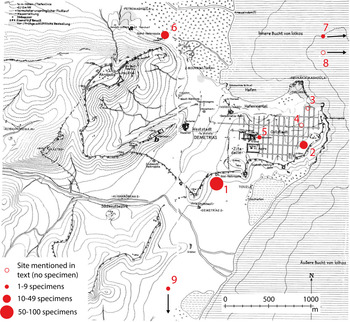
These figurines (of all three iconographic types) have been excavated in a variety of contexts in the city – votive and funerary – though most come from the Pasikrata sanctuary (Fig. 1:1). Thus, they provide valuable insights into aspects of social behaviour in this city. The largest group of kausia boy figurines was unearthed in 1912–14, in pits attributed to the Pasikrata sanctuary, situated immediately outside the fortifications of the city in the southern sector of Demetrias (Arvanitopoulos Reference Arvanitopoulos1928, 45; Stählin, Meyer and Heidner Reference Stählin, Meyer and Heidner1934, 123; Stamatopoulou Reference Stamatopoulou2014; Mili Reference Mili2015, 268–71, 326; Kravaritou Reference Kravaritou, Melfi and Bobou2016, 140). The sanctuary deposits yielded significant numbers of terracotta figurines, the vast majority of which depict women and children (Stamatopoulou Reference Stamatopoulou2014, 212). The excavation photographs show approximately 100 kausia boy figurines (Arvanitopoulos Reference Arvanitopoulos1928, 46–7, figs 52–5; Stamatopoulou Reference Stamatopoulou2014, figs 5–7), of which 61 have been securely identified. The inscriptions on the votive stelai and incense-burners from the sanctuary mention the deities Pasikrata and Artemis Enodia, and are dedicated by both females and males (Stamatopoulou Reference Stamatopoulou2014, 214). The finds from the sanctuary range from the third century bc to the second century ad, but the majority are Hellenistic in date (Arvanitopoulos Reference Arvanitopoulos1928, 48; Stamatopoulou Reference Stamatopoulou2014, 212). Similarly, the terracotta finds mostly fall in the third century, with only a few specimens in the second and first centuries bc (Ieremias Reference Ieremias2019, 40). Stamatopoulou, whose opinion I share, has suggested that the venerated deity (or deities) is kourotrophic in character, protecting significant life passages (Stamatopoulou Reference Stamatopoulou2014, 217–18).
Plan of Demetrias with concentration of kausia boy figurines according to context. 1: sanctuary of Pasikrata and South Cemetery; 2: Favissa on Hill 35; 3: ‘Thesmophorion’; 4: Sanctuary of the Mother of the Gods; 5: Anaktoron; 6: North Cemetery; 7: Agria; 8: Goritsa; 9: Sanctuary of Apollo at Soros. Adapted from Stamatopoulou Reference Stamatopoulou2014, fig. 1.

Seven kausia boy figurines, as well as 16 ‘shepherd’ and eight animal-carrying kausia boys, were found in the Favissa (Fig. 1:2), a votive pit at the eastern sector of the city, containing 53 figurines in total,Footnote 9 mostly boys and girls, as well as a few women.Footnote 10 According to the excavators the pit was a single act of deposition, making this a closed context (Hornung-Bertemes Reference Hornung-Bertemes2007, 40). The Favissa has yielded the largest collection of ‘shepherds’ and of the animal-carrying kausia boys in the city. The identification of the Favissa by the German excavators as part of a Thesmophorion (ArchDelt 28 [B' 2], 345–6; Marzolff Reference Marzolff1980, 31; Hornung-Bertemes Reference Hornung-Bertemes2007, 39–41) should be re-evaluated, as it is situated further away from the site which was excavated and identified as the Thesmophorion/Sanctuary of Demeter by Arvanitopoulos, and then later revisited by the EPhAMag staff (Fig. 1:3).Footnote 11 Friedrich Stählin's surveys in the area of Demetrias, and particularly on Hill 35, had revealed an open-air rock-cut sanctuary, which included a built altar (Stählin, Meyer and Heidner Reference Stählin, Meyer and Heidner1934, 125, fig. 23), and could likely belong to the same cult space as the Favissa. The evidence of the terracotta figurines, mostly boys, girls and women, from the Favissa indicates that there was a second kourotrophic shrine in the city, very close to the east part of the fortification and the east cemetery (Ieremias Reference Ieremias2019, 49–52). Even though the pottery from the Favissa has not been published, the dating of the coroplastic material from the Favissa in the third century is possible, because a significant number of technical types (adult woman, girl, as well as kausia boy figurines) is found in other datable contexts in the city (Ieremias Reference Ieremias2019, 52).
Several kausia boys originate from the cemeteries of, and around, the city. Thirteen examples have been discovered so far in the northern cemetery of Demetrias (Fig. 1:6; Nikolaou Reference Nikolaou2012, 356–7 [excavated between 1994–1995]; ArchDelt 58–64 [A'], 226). Even though the cemetery finds are under study, and therefore detailed information about the tombs and their assemblages is pending, it is clear that at least one tomb, Grave 11, belonged to a child (ArchDelt 58–64 [A'], 225–6). Nine figurines were found at Agria, east of modern Volos, and are possibly from a grave.Footnote 12 The graves found in Agria are believed to belong to the nearby settlement of Goritsa, a foundation connected with Macedonian sovereignty in Thessaly during the time of Philip II, as it sits on a strategic hill overlooking the Pagasetic gulf. S.C. Bakhuizen suggested that with the foundation of Demetrias the population gradually relocated, and the settlement was abandoned c. 250 (Bakhuizen Reference Bakhuizen1992, 314; Hornung-Bertemes Reference Hornung-Bertemes2007, 44). Finally, a group of six fragments of terracotta figurines in the British Museum was said to have been discovered ‘near Volos’; five of them are kausia boys (Burn and Higgins Reference Burn and Higgins2001, 84 n. 1). They are very similar in style and technique to the terracotta figurines from Demetrias. At least three come from the same moulds as the examples from the city (Burn and Higgins Reference Burn and Higgins2001, 86–7, nos 2175–7; Ieremias Reference Ieremias2019, nos 540–2). It is thus likely that they come from the region around Volos (which includes Demetrias), probably from a grave context.
One further fragment was found in the fill of the Anaktoron foundations (Fig. 1:5; Gossel Reference Gossel, Milojčič and Theocharis1976; Hornung-Bertemes Reference Hornung-Bertemes2007, 142, no. 130, pl. 19). This context has yielded 137 terracotta fragments in total, belonging to a variety of iconographic types, the majority being female figurines, followed by child, Mother of the Gods and Aphrodite figurines, among others (Gossel Reference Gossel, Milojčič and Theocharis1976; Hornung-Bertemes Reference Hornung-Bertemes2007, 41; Ieremias Reference Ieremias2019, 100–3). The state of survival of the Anaktoron foundations figurines is extremely fragmentary, and their precise findspots are unknown; however it is possible to assign a large number of these to known technical types from the city (Ieremias Reference Ieremias2019, 100). Hornung-Bertemes (Reference Hornung-Bertemes2007, 41) suggested that this earth fill for the Anaktoron foundations came from the nearby Pefkakia tumulus, presumably since Arvanitopoulos had excavated cultic deposits near that site, but this theory cannot be verified. The high numbers of terracottas could suggest the existence of a sanctuary, either on the ground where the Anaktoron was erected, or in its vicinity, but it is unclear what that sanctuary would have been (Ieremias Reference Ieremias2019, 103). Even though the origin and use of the terracotta figurines from this context is unclear, they are important for dating a large part of the coroplastic production in the city, as they provide a terminus ante quem of c. 200 (Hornung-Bertemes Reference Hornung-Bertemes2007, 41).
Five figurines of unknown provenance, three ‘shepherds’ and two animal-carrying kausia boys, belong to the Scheffel Collection, now in the VM. These figurines belong to technical types from the city, and it is safe to assume that they also come from Demetrias (Hornung-Bertemes Reference Hornung-Bertemes2007, 42; Ieremias Reference Ieremias2019, nos 575–9).
To my knowledge, none of the three iconographic types discussed in this article were found during the excavations of the Thesmophorion (Fig. 1:3; Batziou-Efstathiou Reference Batziou-Efstathiou, Leventi and Mitsopoulou2010), the Metroon (Fig. 1:4; ArchDelt 44 [B' 1], 227–8; ArchDelt 45 [B' 1], 201; Batziou-Efstathiou Reference Batziou-Efstathiou and Kontaxe1996, 22–4; Reference Batziou-Efstathiou2002, 31–2; Reference Batziou-Efstathiou, Stamatopoulou and Morganforthcoming; Batziou-Efstathiou and Triantafyllopoulou Reference Batziou-Efstathiou, Triantafyllopoulou and Kalogerakou2000, 301–3; Ieremias Reference Ieremias2019), or the known Hellenistic houses of the city (ArchDelt 55 [B' 1], 466–8; Kravaritou Reference Kravaritou, Melfi and Bobou2016, 139; Stamatopoulou Reference Stamatopoulou, Kalaitzi, Paschidis, Antonetti and Guimier-Sorber2018a, 359; Ieremias Reference Ieremias2019; Triantafyllopoulou Reference Triantafyllopoulou, Stamatopoulou and Morganforthcoming).
TYPOLOGY
Kausia boy figurines
The kausia figurines were classified by Hornung-Bertemes (Reference Hornung-Bertemes and Muller1997, 192–5; Reference Hornung-Bertemes2007, 95–8) into four types (A–D). Here I will follow her classification and extend it with the newly identified types in the NAM. The criteria of the classification are based on their overall appearance (the stance, the heads, the dress, the way the drapery is formed, the hair, the base), the size, and the differences in the moulds. The technical types’ names are given by number (1, 2, 3), while Roman numerals signify the generation number (I, II, III),Footnote 13 capital letters the version (A, B)Footnote 14 and small letters the variation (a, b, c).Footnote 15 Thus, the full name of a type will be, for example, 3.II.a. The numbering of the technical types will be continuous also for the next two iconographic types to avoid confusion.
The number of fragments given for each type refer to the Number of Remains (NR); in the cases where it is known, I will also provide an estimate for the Minimum Number of Individuals (MNI), which denotes the minimum number of figurines that can belong to the type, based on the NR (Muller Reference Muller1996, 56–7). For instance, even though some figurines within a technical type do not preserve their heads, and even though a plethora of heads exists (within the same technical type), upon inspection none of the surviving heads fit on the headless bodies. In this case, we know that the 17 bodies and the eight heads are 25 MNI and not just 25 NR.Footnote 16
All boys are depicted standing, wearing a short-sleeved chitoniskos, a long chlamys clasped on the right shoulder and reaching below the knees, a kausia on the head, and krepides. All types stand in slight contrapposto, with the right leg bearing the weight (with the exception of Types 1, 2 and 10). The left arm is bent at the elbow inside the chlamys and raised to the neck, or the chin (Type 1),Footnote 17 apart from Type 6. The right arm is lowered to the side wrapped inside the chlamys, except for Types 2 and 6. In addition, only Type 6 is nude, apart from the chlamys. The faces are round with chubby cheeks, suggesting a young age early in the teenage years (or perhaps a bit younger), although Types 4, 5 and 7–9 have less rounded contours, suggesting an older age in mature puberty. The hair is curly and reaches the shoulders in most examples, or the level of the chin, except for Type 9 which has short hair. For discussing age differentiation in this context, I mostly follow the change in body and facial features, from small size, chubby, rounded contours to taller, leaner and slimmer, and – to a lesser extent – the hair, although I think that in this case, the dress and attributes are not indicative as they are also worn by adults.Footnote 18 The area between the legs is covered with clay, at least for all the types that survive complete (Types 1–4, 6 and 8).
Type 1
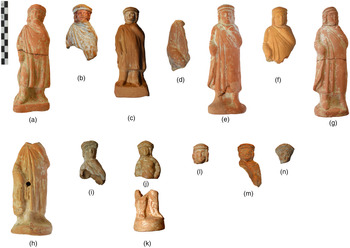
Type 1 (Fig. 2ab) is one of the three most popular kausia boy types in Demetrias with at least 12 examples (MNI) surviving from several contexts: the Pasikrata sanctuary (Ieremias Reference Ieremias2019, nos 131–8, pl. 8), the Favissa (Ieremias Reference Ieremias2019, no. 241, pl. 15), the North Cemetery (Nikolaou Reference Nikolaou2012, 356–7, no. Γ.1.1, n. 44, fig. 15), Agria (Ieremias Reference Ieremias2019, no. 531, pl. 43), and the BM group (Ieremias Reference Ieremias2019, no. 540, pl. 44). Another head fragment of the same type is known from the sanctuary of Apollo at Soros (Leventi Reference Leventi2012, 304, fig. 22) and may predate the foundation of Demetrias, although an overlap of the sanctuary's use for a short time after the synoecism should not be excluded. In the complete example (Hornung-Bertemes Reference Hornung-Bertemes2007, no. 121; Ieremias Reference Ieremias2019, no. 131) the height is 15.2 cm. The figurines of Type 1 are depicted with the head turning slightly to the right and looking slightly upwards. The drapery is fine and detailed compared to the majority of the kausia-wearing figurines from Demetrias. The face is rounded with almond-shaped eyes and chubby cheeks. The hair is curly and falls to the shoulders. The base is low and rectangular.
Kausia boy types. (a) and (b): Type 1; (c): Type 2; (d), (e), (f) and (g): Type 3; (h): Type 4; (i): Type 5; (j) and (k): Type 6; (l): Type 7; (m): Type 8; (n): Type 9. (a): VM M 2014; (b): NAM 32667; (c): NAM 30604; (d): NAM 32756; (e): VM M 2016; (f): NAM 32745; (g): VM M 2013; (h): VM M 5678 XLIII; (i): NAM 30581; (j): NAM 30579; (k): NAM 30606; (l): NAM 30589; (m): NAM 32676; (n): NAM 30592. Author's photographs.

Type 2
This type (Fig. 2c) is represented by 35 specimens (33 MNI) with the vast majority coming from the sanctuary of Pasikrata (Ieremias Reference Ieremias2019, nos 139–69, pls 8–10), three from the Favissa (Ieremias Reference Ieremias2019, nos 242–4, pl. 15), and one from the Anaktoron fills (Ieremias Reference Ieremias2019, no. 457, pl. 26). In complete examples the height is 13.2 cm. The figure is depicted in a more frontal position compared to Type 1. The short-sleeved chiton is visible on the right side, at the opening of the chlamys. The face is flat and round in shape. The hair is curly and falls to the shoulders. The base is rectangular.
Type 3
Type 3 (Fig. 2d–g) survives in at least 40 examples (NR; 36 MNI), from the sanctuary of Pasikrata (Ieremias Reference Ieremias2019, nos 170–204, pls 10–12) and Agria (Ieremias Reference Ieremias2019, nos 532–6, pl. 43), and is easily distinguishable from the other kausia boy types. It is taller and has a larger head. The head in this case turns to the left instead of the right, and the rendering is less refined than in Type 1 or 2. The faces are chubby with rounded cheeks and double-chin. The hair falls to the shoulders. The chlamys creates only two wide and flat folds on the front, as well as a deep fold at the neck that is absent in the abovementioned types. The base is cylindrical.
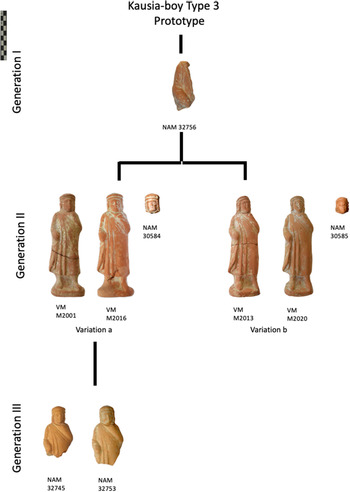
Hornung-Bertemes (Reference Hornung-Bertemes and Muller1997, 192–3) distinguished two variations within this type; the difference between the variations is the very slight arch on the lower left side of the body that extends to the base (Fig. 2eg; Ieremias Reference Ieremias2019, nos 200–4). The figurines reach a height of 15.9 cm in variation a, and 15.7 cm in variation b.
Type 3 is the only type so far that has more than two generations (Fig. 3). Only one specimen may belong to a first generation (Fig. 2d), as its size is significantly larger than the others (Ieremias Reference Ieremias2019, no. 170, pl. 10). The mould of Generation II must have been in use for a longer period, as the detail of its products keeps deteriorating. Generation III (Fig. 2f) is reduced in size, which is mainly discernible from the dimensions of the faces (width: 2 cm in Generation III, compared with 2.8 cm in Generation II), since the two specimens of this generation do not survive intact.
Genealogical tree of kausia boy Type 3. Author's photographs.

Type 4
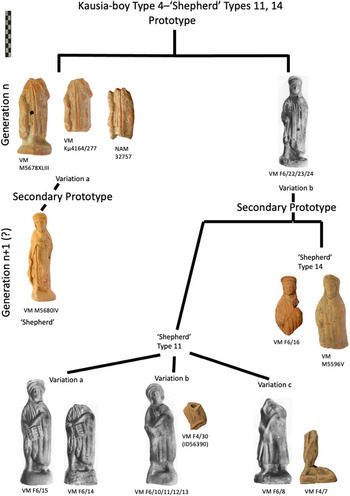
Four figurines (MNI) from the sanctuary of Pasikrata (Ieremias Reference Ieremias2019, nos 205–7, pl. 12) and the Favissa (Ieremias Reference Ieremias2019, no. 245, pl. 15) constitute Type 4 (Fig. 2h); they fall in two variations (Fig. 4). The figures have more slender shoulders than the other types, with thinner folds in deeper relief, while the chiton is visible at the right side, with clearly defined folds. Type 4.b is distinguished from the first variation because the edge of the chlamys on the right arm is more pronounced, which might indicate the use of a different mould. The height of Type 4.b, which survives intact, is 15.5 cm. The head of Type 4.b (Ieremias Reference Ieremias2019, no. 245, pl. 15) faces forward, the hair falls to the shoulders, while no heads survive for 4.a (Ieremias Reference Ieremias2019, nos 205–7, pl. 15). Compared to the other types, the kausia of 4.b is worn higher on the head (Ieremias Reference Ieremias2019, no. 245, pl. 15), it has a thinner band, and the top has a thick brim. The folds of the chlamys’ edge on the right side, below the arm, create two shallow curves on top of each other. The base is ellipsoid.
Genealogical tree of kausia boy Type 4 and ‘shepherd’ types 14 and 15. Author's photographs, unless indicated. Sources: F6/22/23/24: adapted from Hornung-Bertemes Reference Hornung-Bertemes2007, no. 160, pl. 23; F 6/15: adapted from Hornung-Bertemes Reference Hornung-Bertemes2007, no. 167, pl. 24; F 6/14: adapted from Hornung-Bertemes Reference Hornung-Bertemes2007, no. 168, pl. 24; F6/10/11/12/13: adapted from Hornung-Bertemes Reference Hornung-Bertemes2007, no. 171, pl. 24; F6/8: adapted from Hornung-Bertemes Reference Hornung-Bertemes2007, no. 173, pl. 24.

Type 5
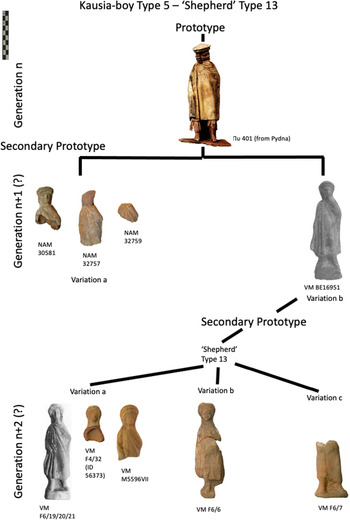
Type 5 (Fig. 2i) is represented by six examples (MNI), four from the Pasikrata deposits (Ieremias Reference Ieremias2019, nos 208–11, pl. 12), one from the Favissa (Ieremias Reference Ieremias2019, no. 246, pl. 15) and one from the North Cemetery (Nikolaou Reference Nikolaou2012, 357, no. Γ.1.3, fig. 15), and it differs noticeably from the other types. Since the Pasikrata specimens survive fragmentarily, it is not possible to provide the height of the full type, but it reaches a maximum width of 4.2 cm.Footnote 19 Two variations can be discerned for this type (Fig. 5), the second one represented by the North Cemetery example. Many thin folds fan out from the right shoulder where the chlamys is clasped. In 5.a, the kausia is wider (Ieremias Reference Ieremias2019, nos 208–11, 246), with a thin band and a thick but flat top, and is worn higher. The head is slightly turned to the left and tilted downwards. The face is flat with furrowed eyebrows and deep-set eyes. The cheeks are thinner than the other types, and the face appears slightly older in age. In 5.b, which survives intact (Nikolaou Reference Nikolaou2012, 357, no. Γ.1.3, n. 44, fig. 15), the head faces forward, tilted slightly to the right, with a narrower kausia, which is worn lower on the head, and the hair falls to the shoulders. Compared to the first variation, in 5.b the lower left part of the chlamys drapery seems to flare out more to the right side. The figure stands on a trapezoid base.
Genealogical tree of kausia boy Type 5 and ‘shepherd’ Type 13. Author's photographs unless indicated. Sources: Πυ401: see Fig. 6; BE 16951: Nikolaou Reference Nikolaou2012, fig. 15; F 6/19/20/21: adapted from Hornung-Bertemes Reference Hornung-Bertemes2007, no. 176, pl. 25.

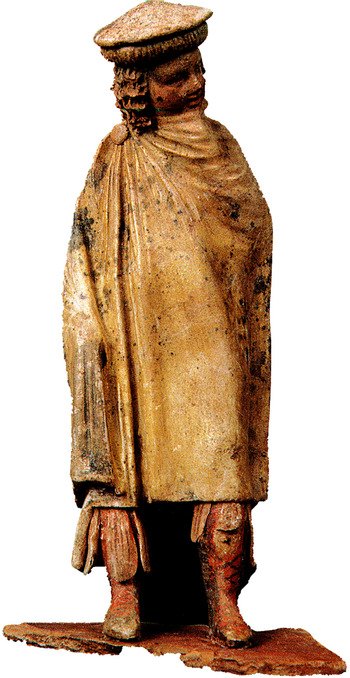
Kausia boy figurine from Pydna-Alykes Kytrous c. 320–310 bc (Archaeological Collection of Makrygialos, inv. no. Πυ 401), belonging to the ‘Pydna Group’ (after Bessios Reference Bessios2010, 224). © Hellenic Ministry of Culture and Sports-Ephorate of Antiquities of Pieria (N. 3028/2002).

This type displays many similarities with a kausia boy technical type (‘Pydna Group’; Fig. 6), which was diffused in the Aegean during the second half of the fourth and the beginning of the third centuries.Footnote 20 The Demetrias type seems to be a derivative (surmoulage) of a ‘Pydna Group’ example,Footnote 21 but with the simplification of the production technique; the head, which has changed, the body and legs are taken from one mould with clay filling the space between the legs, while in the ‘Pydna Group’ the legs are made from separate moulds from the body. In addition, the drapery is less detailed, more summarily rendered and flatter towards the hem. We can suppose that Type 5 is a derivative of the ‘Pydna Group’, which could have been created in two ways: from derivative production from one of the original creations (a mould taken from a figurine), or we could imagine another generation between our type and the ‘Pydna Group’ from which a secondary mould was created and then imported to Demetrias. A group of three figurines from Samothrace can shed some light on this in-between stage. They were found in a pithos burial of a 10-year-old child dated in the first quarter of the third century (Dusenbery Reference Dusenbery1998, 459–61, 864–7). The figurines are taken from one mould, which includes the legs and base, contrary to the ‘Pydna Group’ type whose legs are modelled separately. They also display greater definition in detail, such as folds, than the Demetrias examples. Thus, a date for our type in the beginning of the third century is justified.
Type 6
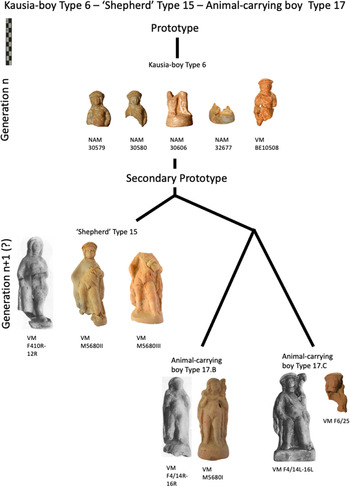
This new type (Figs 2jk and 7) is known from seven examples (MNI), five from the Pasikrata sanctuary (Ieremias Reference Ieremias2019, nos 212–15, pl. 12, as well as one more depicted in Arvanitopoulos’ unpublished photograph A/A 8516, bottom row, fifth from left), one from the North Cemetery (ArchDelt 58–64 [A'], 226, fig. 34; Ieremias Reference Ieremias2019, no. 530, pl. 39), and one in the BM (Burn and Higgins Reference Burn and Higgins2001, no. 2179; Ieremias Reference Ieremias2019, no. 544, pl. 44). No specimens survive intact. Thus, the true height of the type is unknown. However, the North Cemetery example survives to a maximum height of 8.8 cm. In Type 6, the boys are wearing only a chlamys and no chiton, leaving half of the body bare and revealing the genitals. The head turns to the left. Both arms are lowered to the side, the left wrapped inside the chlamys. The face is rounded with chubby cheeks, but smaller compared to Type 3. The hair is formed in rows of pearl-like curls, falling to the shoulders. The base is high and conical.
Genealogical tree of kausia boy Type 6, ‘shepherd’ Type 15 and animal-carrying kausia boy Type 17. Author's photographs unless indicated. Sources: F4/10R-12R: Hornung-Bertemes Reference Hornung-Bertemes2007, no. 187, pl. 26; F4/14R-16R: Hornung-Bertemes Reference Hornung-Bertemes2007, no. 198, pl. 27; F4/14L-16L: Hornung-Bertemes Reference Hornung-Bertemes2007, no. 199, pl. 199.

Type 7
Type 7 (Fig. 2l) survives in two heads (MNI) from the Pasikrata sanctuary (Ieremias Reference Ieremias2019, nos 216–17, pl. 12). Their height is 3 cm. They are similar to Type 3, but here the facial features are slimmer. In addition, the band of the kausia is thicker than Type 3. Overall Type 7 appears to represent boys older in age than the other types, especially Types 3 and 6; the facial features are less rounded, with sharper contours. The hair falls to the shoulders, in curls slightly similar to Type 6.
Type 8
This type (Fig. 2m) is represented by only one fragmentary example from the Pasikrata sanctuary (Ieremias Reference Ieremias2019, no. 218, pl. 12). Its surviving height is 6.9 cm. It is difficult to determine the exact stance, other than the left arm which is bent at the elbow and raised to the level of the chest, wrapped inside the chlamys. The head turns slightly to the left. It is larger than those of the other types, and the facial contours are rounder. Characteristic features of the face are the broad nose and thick lips. The hair falls to the shoulders.
Type 9
Type 9 (Fig. 2n) consists of three figurines (MNI), of which only the heads survive, from the sanctuary of Pasikrata (Ieremias Reference Ieremias2019, nos 219–20, pl. 12) and the BM group (Burn and Higgins Reference Burn and Higgins2001, no. 2177). Their surviving height is 3.6 cm. The kausia has a wider and thicker top and a thick bottom part. The hair is rendered short below the kausia. Unlike the other types, here the eyes are slit, rather than almond-shaped. The nose is wide, and the ends of the mouth are downturned. The contour of the face is sharper than the more rounded shapes of the other types, perhaps portraying older age.Footnote 22
Type 10
This type is represented by two figurines (MNI), one from the BM assemblage (Burn and Higgins Reference Burn and Higgins2001, 86, no. 2176, pl. 32; Ieremias Reference Ieremias2019, no. 541, pl. 44) and the other from the Pasikrata sanctuary, visible in Arvanitopoulos’ photos (Photo A/A8519, third row, third from right) but as-yet not located. The BM figurine survives to a height of 13 cm. The figure stands with the weight on the left leg, while the right leg moves forward. The right forearm is wrapped inside the chlamys. The head is preserved only in the Pasikrata example in Arvanitopoulos’ photo and is shown much worn, and thus one cannot clearly identify facial features and age.
‘Shepherd’ figurines with syrinx and lagobolon
This iconographic type is represented by 23 figurines, discovered mostly in the Favissa, as well as a few from the cemeteries,Footnote 23 the Pasikrata sanctuary, and the Scheffel Collection. They depict young boys wearing the chitoniskos, the chlamys clasped on the right shoulder and the kausia. Only Type 15 and a single fragment are nude under the chlamys. The figurines in this group are much more summarily rendered than the kausia boy types, with folds in lower relief, and not much attention to detail. In addition, the kausia is generally higher than the simple kausia boy types, with a wider upper rim. The hair is long, reaching the shoulders, but rendered with less detail than the kausia boy types. Many types of this group are versions of the kausia boy types as the coroplasts add the syrinx and/or the lagobolon and change the original heads.
Type 11
This type (Fig. 8a–c) is a version of the kausia boy Type 4.b, with the addition of a lagobolon and a syrinx on the right-hand area, and the change of head (Fig. 4 for genealogical tree). Type 11 consists of seven examples (MNI), all discovered in the Favissa (Ieremias Reference Ieremias2019, nos 248–55, pl. 16). In the complete example the type reaches 17 cm in height. The difference in height from the original type is explained because of the higher base that is added to this version. Three variations have been distinguished for this type by Hornung-Bertemes.Footnote 24 They are distinguished by slight changes; in variation 11.b the head is tilted to the right, perhaps because of an accident in the moulding process, and the drapery at the front edge of the chlamys at the level of the calves is less detailed than in 11.a. Variation 11.c is differentiated by the drapery at the lower left side; it seems to extend further to the left than variations 11.a and 11.b, which could have been caused by a change in the manufacturing process, while the overall drapery is less detailed. The head in Type 11 (11.a and 11.b, which preserve the head) is slightly raised upwards compared to the other types discussed above. The kausia has a very wide and flat upper part. The face is long, yet chubby. The curly hair falls to the shoulders and is shown by very fine incisions. The syrinx and the lagobolon are placed over the right hand of the initial Type 4.b. The lagobolon's tip is long and reaches the left arm. The base is rectangular.
‘Shepherd’ types. (a), (b) and (c): Type 11; (d): Type 12; (e), (f) and (g): Type 13; (h): Type 14; (i): Type 15. Author's photographs unless indicated. (a): F 6/15 (adapted from Hornung-Bertemes Reference Hornung-Bertemes2007, no. 167, pl. 24); (b): F 6/10/11/12/13 (adapted from Hornung-Bertemes Reference Hornung-Bertemes2007, no. 171, pl. 24); (c): F 6/8 (adapted from Hornung-Bertemes Reference Hornung-Bertemes2007, no. 173, pl. 24); (d): F 6/17/18; (e): F 6/19/20/21 (adapted from Hornung-Bertemes Reference Hornung-Bertemes2007, no. 176, pl. 24); (f): F 6/6; (g): F 6/7; (h): F 6/16; (i): M 5680 II; (j): M 5680 IV.

Type 12
Type 12 (Fig. 8d) consists of three fragmentary examples (MNI) discovered in the Favissa (Ieremias Reference Ieremias2019, nos 256–7, pl. 16) and the Scheffel Collection (Ieremias Reference Ieremias2019, no. 575, pl. 47). The height reaches 14 cm. The figure wears a rounded kausia and holds the syrinx on the left hand and the lagobolon on the right. The chlamys is formed in curved folds and a long vertical fold below the clasp. The face has round contours, suggesting young age. The hair falls to the shoulders. The base is rectangular.
Type 13
Type 13 (Fig. 8e–g) consists of five examples (MNI), four from the Favissa and one of unknown provenance in the Scheffel Collection.Footnote 25 In the intact examples, its height is 16.5 cm. This type is a version of kausia boy Type 5,Footnote 26 with the addition of the syrinx on the right hand and the change of head. The folds are rendered in less detail than the original type. Hornung-Bertemes (Reference Hornung-Bertemes2007, 66–7, 150–1, nos 176–9) has distinguished three variations in this type. I also think that a figurine surviving fragmentarily, which Hornung-Bertemes did not include in this type, should be added (Hornung-Bertemes Reference Hornung-Bertemes2007, no. 214; Ieremias Reference Ieremias2019, no. 259). The head of the type is similar to (but not the same as) Type 11, wearing a wide and flat kausia, which in this case resembles a halo around the head. The hair is long and falls to the shoulders. He holds a syrinx in the right hand, rendered more carefully than the other types of this iconographic group. The syrinx has been formed around the hand rather than simply being added on it. Variation 13.b has a group of added folds to the right of the right arm. Variation 13.c survives fragmentarily and is too worn for further discussion. The base is rectangular, becoming thinner with each variation.
Type 14
This type (Fig. 8h) consists of only two fragmentary examples (MNI), one from the Favissa (Ieremias Reference Ieremias2019, no. 262, pl. 17) and the other from the Scheffel Collection (Ieremias Reference Ieremias2019, no. 577, pl. 47). The maximum surviving height of the type is 12.4 cm. It is also a version of the kausia boy Type 4.b, making it the second version taken from this type (see Fig. 4 for genealogical tree). In this case, the syrinx is placed above the right hand; there is no trace of a lagobolon in the two surviving fragments. The vertical folds of the chlamys are characteristic for this type. The kausia is smaller than Types 11 and 13, with a larger band above the forehead. The face is chubby with rounded contours. The hair falls to the shoulders.
Type 15
Type 15 (Fig. 8i) consists of four examples (MNI), one from the Favissa (Ieremias Reference Ieremias2019, no. 263, pl. 17), two from Agria (Ieremias Reference Ieremias2019, nos 537–8, pl. 43), and one from the Pasikrata sanctuary shown in Arvanitopoulos’ photos (Photo A/A8516, bottom row, third from left). The height in the complete example is 15.1 cm. This type seems to be a version of the kausia boy Type 6, mostly for the lower part of the figure, below the abdominal area. Furthermore, the chlamys is similar to the kausia boy Type 6 (see Fig. 7 for genealogical tree). Conversely, the right arm is bent at the elbow and rests on the hip; the left arm is also bent at the elbow and holds the syrinx in front of the chest. The head is also different from the original mould; the face is longer, but still with chubby cheeks, the eyes are a downcurved arch and the nose is broad. The hair falls to the shoulders. We can distinguish two versions of this type, one for the Agria and Pasikrata figurines (Version 15.A), and another for the Favissa figurine (Version 15.B). In Version 15.A there is a lagobolon added to the left side of the figurine, resting next to the leg. In Version 15.B the syrinx is placed closer to the centre of the chest, and there is no lagobolon visible on the side. The base is oval in 15.A and rectangular in 15.B.
A stylistic parallel can be observed in a figurine from the Heraion at Foce del Sele, mostly in the nudity under the chlamys, and the stance of the legs and the right arm, but the left side of the figurine seems to be different. The figurine was found in a deposit dated from the late third to the early second century.Footnote 27
Animal-carrying kausia boys
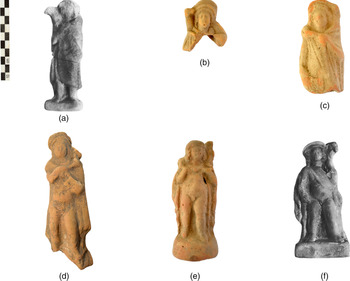
This iconographic group, of 11 specimens in total, in its majority consists of boys dressed in a similar way to the kausia boys but holding or carrying animals. The age groups are the same as those of the kausia boys and the ‘shepherds’. The hair also falls to the shoulders. Hornung-Bertemes has distinguished two types, each with three variants, which should be seen as versions.Footnote 28 The quality and the preservation of these figurines is very bad, making the identifications of types and versions often problematic. The poor state of preservation does not allow us to discern whether or not these figurines wear krepides, as is the case with the previous two iconographic types. The figurines carry a four-legged animal on their shoulders, probably a young goat or lamb, though I am unable to identify it precisely due to the poor state of preservation of these figurines. Only two figurines preserve the head of the animal (Hornung-Bertemes Reference Hornung-Bertemes2007, nos 192 and 199; Ieremias Reference Ieremias2019, nos 269 and 274), which again is too worn to aid the species’ identification. The heads of the animals are portrayed upright in all examples, even if fragmentary.
Type 16
Four figurines (MNI) from the Favissa (Ieremias Reference Ieremias2019, nos 268–9, pl. 17) and the Scheffel Collection (Ieremias Reference Ieremias2019, nos 578–9, pl. 47) constitute this type (Fig. 9a–c), falling into three versions. In all versions the figure is dressed in a short-sleeved chiton and chlamys. The heads wear the kausia, even though they are either very fragmentary or very worn. The head is tilted slightly to the left and is more elongated, compared to the previous types, with less chubby cheeks. The hair falls to the shoulders. The animal is carried on both shoulders. Each version differs in the placement of the boy's arms and in the placement of the animal's head. Version 16.A (Fig. 9a) shows the animal's head on the right side, and the boy's right arm is bent at the elbow and raised to his neck to hold the animal's front and hind legs around it (Ieremias Reference Ieremias2019, no. 268).
Animal-carrying kausia boy types. (a), (b) and (c): Type 16; (d), (e) and (f): Type 17. Author's photographs unless indicated. (a): F 4/18 (adapted from Hornung-Bertemes Reference Hornung-Bertemes2007, no. 191, pl. 26); (b): M 5596 IX; (c): M 5596 VI; (d): F 4/17L; (e): M 5680 I; (f): F 4/14L-16L (adapted from Hornung-Bertemes Reference Hornung-Bertemes2007, no. 199, pl. 28).

In Version 16.B (Fig. 9b) the animal's head is also placed on the right side, but in this case the boy's left arm is raised to the neck to hold the animal's legs (Ieremias Reference Ieremias2019, nos 269 and 578). In Version 16.C (Fig. 9c), the animal is placed on the left side, while the left arm is raised to the neck to hold the legs (Ieremias Reference Ieremias2019, no. 579). The kausia on the former is very wide, while on the latter it is small and narrow.
Type 17
Seven figurines (MNI), six from the Favissa and one of unknown context (Ieremias Reference Ieremias2019, nos 270–5, 573, pls 17, 47), constitute this type (Fig. 9d–f), with three versions. The difference to the previous one is that the boy does not wear a chitoniskos under the chlamys. In all examples, the boy wears the kausia and turns slightly to the left, with the animal's head placed to the left as well. The base in the first two versions is oval, but rectangular in the third.
In Version 17.A (Fig. 9d), the boy carries the animal on his shoulders, holding its legs with his right arm (Ieremias Reference Ieremias2019, nos 270–2). The left arm is bent at the elbow and raised to the middle of the torso, holding the syrinx. The kausia is created with a very wide and flat top part. The face is elongated, but still features chubby cheeks. The hair falls to the shoulders. Its height is 15 cm.
The lower body of Version 17.B (Fig. 9e) is a version of kausia boy Type 6 (Fig. 7) (Ieremias Reference Ieremias2019, nos 273, 573). The animal is placed in a way similar to the previous version, but in this case the boy holds the legs with both hands. The chlamys is clasped in front of the neck and falls to the back. The face has chubby cheeks and rounded contours, suggesting a younger age. The hair falls to the shoulders. The figure stands on an oval base. This version has a height of 13.7 cm.
In version 17.C (Fig. 9f), the stance is again very similar to kausia boy Type 6 (Fig. 7) (Ieremias Reference Ieremias2019, nos 274–5), mostly for the lower part of the body. The chlamys is clasped on the right shoulder, covering only the left part of the torso. The face is rounded and chubby. The hair falls to the shoulders. The boy carries the animal only on his left shoulder in this case. The left arm is bent at the elbow and is raised to hold the animal's front legs. Its height is 14.4 cm.
TECHNIQUE
The clay of the figurines under discussion is fairly consistent, fine to medium fine, with few small inclusions. The colour of the clay is reddish yellow, in the shades of Munsel 5YR, 6/6, 7/6, 7/8, 6/8 and 2.5, 6/6, 7/7, 7/8, 6/8, but the most common being the 5YR, 6/6 shade.Footnote 29 The figurines from Agria are made of a very different clay, very friable, coarse with many inclusions and yellow in colour (7.5YR, 6/6).Footnote 30 This is also the case for two specimens from the Scheffel Collection, which belong to the ‘shepherd’ Types 13 and 14 (Ieremias Reference Ieremias2019, nos 576–7), perhaps indicating their origin from the same clay source or workshop.
The kausia boy figurines from Demetrias show uniformity in their manufacturing technique. The front parts of the figurines are moulded, while the backs are modelled and are either flat or slightly curved. The heads are solid and must have been made from the same mould as the body. Since the head is one of the most fragile parts of the figurine, the coroplasts used a safety measure to avoid breakage; once the two parts (front and back) of the figurine were assembled, the coroplasts would pinch the back of the neck to reinforce this delicate part (Ieremias Reference Ieremias2019, 240). This technique can also be observed in figurines from Alexandria (Kassab-Tezgör Reference Kassab-Tezgör2007, 227) and in a few figurines from Veroia (Tsakalou-Tzanavari Reference Tsakalou-Tzanavari2002, no. 149, pl. 42).
The vent holes vary in shape; the most common are either rectangular or irregular, but square, oval, triangular, and pointed are occasionally encountered. It is also interesting that within the same type we can observe a variety of shapes; for instance, Type 2 has triangular, oval, rectangular, pointed and irregular holes. All examples of this type seem to have been created by the same workshop, with the same clay (Ieremias Reference Ieremias2019, 241–2). Thus, it is clear that, at least in Demetrias, the vent holes’ shape cannot indicate a difference in workshop,Footnote 31 nor is any particular vent shape specific to the city, as has been suggested for Tanagra (square), Myrina (rectangular) and Alexandria (round) (Kassab-Tezgör Reference Kassab-Tezgör2007, 227–8).
Some of the ‘shepherd’ and animal-carrying types are mechanically dependant on some of the kausia boy types. Kausia boy Type 4.b was used to create two versions, ‘shepherd’ Types 11 and 14 (Fig. 4), while Type 4.a was used for the creation of a single fragment belonging to the ‘shepherd’ iconographic type (Fig. 4). Kausia boy Type 5 was used for ‘shepherd’ Type 13 (Fig. 5). Similarly, kausia boy Type 6 was used to create three versions: ‘shepherd’ Type 15, and the animal-carrying kausia boy Types 17.B and 17.C (Fig. 7). What changes from the initial kausia boy technical types to the ‘shepherd’ or animal-carrying technical types is the addition of the syrinx and/or lagobolon, different heads, and animals carried behind the neck. In a few cases the base changes from an oval to a rectangular shape. We are thus able to observe in Demetrias several coroplastic series with their versions and variations,Footnote 32 a feature which, at least for the time being, has not been detected in many of the female figurine types from the city.
The majority of the types reach a height of around 13–17.5 cm, although a 4.4 cm high head in the BM assemblage (Burn and Higgins Reference Burn and Higgins2001, no. 2178, pl. 33) hints at the existence of larger figurines, although this specimen is, so far, unique for the city.
Most of the figurines are covered in white slip on which the rich polychromy is applied (Fig. 2b).Footnote 33 On the best examples, the hair is painted dark red or brown. The flesh is decorated with salmon-pink or pink colours. The chlamys is painted bright pink; in one specimen it is painted blue (Ieremias Reference Ieremias2019, no. 197, pl. 11). The kausia is left white. The krepides are painted red. The area between the legs is painted black in some examples, a practice which can also be observed in figurines from Alexandria and is thought to indicate empty space (Kassab-Tezgör Reference Kassab-Tezgör2007, 237; Blume Reference Blume, Muller and Laflı2016, 151).
CHRONOLOGY
The chronology of the figurines can sometimes be problematic. We accept that most should postdate the foundation of the city in 294/3. Since many were found in buried votive deposits in the Pasikrata sanctuary and the Favissa on Hill 35, this also complicates their chronology. Nevertheless, there are some types that can be dated by external factors, such as those found in graves and in the Anaktoron foundation fills, which provide a terminus ante quem.Footnote 34 In addition, even though the other finds from the Favissa remain unpublished, all the terracotta types fall in the third century.
I will begin with the chronology of the simple kausia boy iconographic type. Type 1 should be dated in the first half of the third century (Hornung-Bertemes Reference Hornung-Bertemes2007, 65), which is also confirmed by the figurine in Grave 668 of the North Cemetery, dated by the grave goods (Nikolaou Reference Nikolaou2012, 356 n. 42). Stylistically it is close to the ‘Pydna Group’ (Fig. 6), primarily the folds on the left arm and the right shoulder, but the differences are significant in the lower body. The type, however, may pre-date the city's foundation, as a head of the same type was discovered in the Sanctuary of Apollo at (nearby) Soros (Leventi Reference Leventi2012, 303, no. ΠΕ 28/05, fig. 22),Footnote 35 which fell out of use either because of the foundation of Demetrias or due to other reasons, such as an earthquake, as the excavators suggest (Mazarakis-Ainian Reference Mazarakis-Ainian and Valavanis2011, 168). Nevertheless, we should not exclude the sanctuary's use for a short period after the foundation of Demetrias, even though the settlement at Soros was abandoned for the city's synoecism (Mazarakis-Ainian Reference Mazarakis-Ainian and Valavanis2011, 168).
Type 2 can be dated in the third century by the fragment from the Anaktoron foundation fill (Hornung-Bertemes Reference Hornung-Bertemes2007, 61). A figurine of the same type was found in Grave 791 at the North Cemetery, together with an unguentarium of the first half of the third century, providing a more precise date for the type (Nikolaou Reference Nikolaou2012, 357 n. 47).
Type 3 is dated by Hornung-Bertemes (Reference Hornung-Bertemes2007, 65) in the ‘last quarter of the third century, or at the turn of the third to the second century’, but a chronological overlap of Types 1 and 3 cannot be excluded (if my hypothesis that the Agria finds belong to the same grave context is correct),Footnote 36 potentially bringing the creation of Type 3 earlier in the third century.
Type 5 is not easily datable, as no chronology is provided for the North Cemetery example (Nikolaou Reference Nikolaou2012, 357, no. Γ.1.3, fig. 15). However, the type's possible relation to the ‘Pydna Group’ could date it in the third century, perhaps towards the beginning of the century.Footnote 37
Type 6 is dated by the finds of Grave 11 of the North Cemetery in the second quarter of the third century (ArchDelt 58–64 [A'], 226).
Two unpublished kausia boy figurines from the North Cemetery are reported to have been discovered in graves 577 and 244, both dated in the second century according to their finds (Nikolaou Reference Nikolaou2012, 352 n. 4 and 357, no. Γ.1.7, n. 48).
Regarding the ‘shepherd’ types, they all seem to be dated in the third century. Type 12 can be dated in the third century, based on the presence of two of its specimens in the Favissa. The dependence of the shepherd types on the kausia boy types provides a relative chronology, thus shepherd Types 11 and 14 should be placed in the third century, as they are versions of Type 4. Similarly, Type 13 should be dated in the early third century, because it is a version of Type 5, and Type 15 should be dated in the second quarter of the same century, since it is a version of Type 6.
The animal-carrying kausia boys are also dated in the third century. Since Type 17.B is mechanically dependant on Type 6.B, it should be dated in the second quarter of the third century. Type 16 is probably dated somewhere in the third century, since it has been found in the Favissa.
It is thus evident that the vast majority of the specimens of these three iconographic types in Demetrias belong to the third century, with only very few examples so far dated in the second century. Most of the coroplastic types coexist and are in circulation at the same time in the city and its environs. This dating coincides with the Macedonian presence in the city since its foundation.
DISTRIBUTION OF THE KAUSIA BOYS OUTSIDE DEMETRIAS
As mentioned above, the iconographic type of the kausia boys saw a wide distribution after the third quarter of the fourth century, and especially in the third century (Fig. 10). The precise beginning of the iconographic type and its origins are unclear. The earliest technical type is that of the ‘Pydna Group’ (Fig. 6), which might have originated in Athens around the second half of the fourth century and quickly disseminated throughout the Aegean.Footnote 38 The technical similarities of the ‘Pydna Group’ with the boy figurines from the ‘Menon's Cistern’ (Miller Reference Miller1974, pls 37–40) could hint at the origin of this iconographic type in Attica, in particular the fact that the bodies are created hollow with separately modelled legs attached inside the figurines. The creation of the kausia boy iconographic type in Attica should be connected with the appearance of the ‘Tanagra style’ in coroplastic art.Footnote 39 Apart from Demetrias, kausia boy figurines are known from Macedonia (Pella,Footnote 40 Thessaloniki,Footnote 41 Agios Athanassios,Footnote 42 Pydna,Footnote 43 Kassandreia,Footnote 44 Akanthos(?)Footnote 45 and Amphipolis),Footnote 46 Paionia (Stobi),Footnote 47 Athens,Footnote 48 Boeotia (TanagraFootnote 49 and Livadeia),Footnote 50 the Aegean Islands (Samothrace,Footnote 51 Lemnos,Footnote 52 Lesvos,Footnote 53 Delos),Footnote 54 Asia Minor (Troy,Footnote 55 Pergamon,Footnote 56 Myrina,Footnote 57 Limyra,Footnote 58 Xanthos),Footnote 59 Thrace (Odessos and Callatis),Footnote 60 Mesopotamia (Seleucia-on-Tigris,Footnote 61 Babylon,Footnote 62 Susa),Footnote 63 Arachosia (Kandahar[?]),Footnote 64 the Levant (Kharayeb,Footnote 65 Phoenician Ptolemais,Footnote 66 Tell Dor,Footnote 67 Maresha,Footnote 68 Samaria,Footnote 69 Jaffa),Footnote 70 Cyprus (Amathous,Footnote 71 Kourion,Footnote 72 Kition),Footnote 73 Egypt (Alexandria)Footnote 74 and in the West, in Morgantina and Rome.Footnote 75 It is interesting to point out that, so far, no other Thessalian site apart from Demetrias has yielded examples of the kausia boy figurines at all, with the exception of two unpublished specimens displayed in the Archaeological Museum of Almyros, from the cemeteries of Phthiotic Thebes and Hellenistic Halos.
Distribution map of kausia boy figurines. Author's map.

Regarding the syrinx-and-lagobolon kausia boys (‘shepherds’), their distribution in other sites is not as widespread as the simple iconographic type. They are known from two graves from the West Cemetery of Pella,Footnote 76 the sanctuary at Kharayeb (Chéhab Reference Chéhab1951–2, pls XLV–XLVI) and the sanctuary of Magna Mater at Rome (Romanelli Reference Romanelli1963, fig. 33). A further specimen in the Louvre collection originates from Italy (Besques Reference Besques1986, no. D3629, pl. 52f).
Animal-carrying boys wearing the kausia are an even rarer iconographic type. To my knowledge parallels in other media which wear the Macedonian dress do not exist. Parallels in terracotta figurines for the motif of children and adolescents holding an animal behind the neck can be seen at KharayebFootnote 77 and at Pergamon (Töpperwein Reference Töpperwein1976, no. 446, pl. 68). Of course, the iconographic motif of children with animals is very common in the Hellenistic period (Schlegelmilch Reference Schlegelmilch2009, 112–13; Bobou Reference Bobou2015), while the motif of the animal-carrier exists already from the Archaic period.Footnote 78 However, this specific iconographic type (boy wearing the short-sleeved chiton, chlamys, kausia, and holding an animal) is so far only known from Demetrias and is dependent on the kausia boy technical types.
Other depictions of boy figurines wearing the kausia, which are not present in Demetrias, are those shown seated on rocks,Footnote 79 or next to/leaning against herms,Footnote 80 or riding animals, mostly horses.Footnote 81
The majority of the kausia boy figurines have been found in funerary contexts. In the better documented cases, they seem to come from burials of children or adolescents. In the case of Pydna and Samothrace, the kausia boy figurines accompanied rich burials. Apart from Demetrias, kausia boys were discovered in votive contexts at Kharayeb, Xanthos, Amphipolis, Lemnos, Kourion, Kition, Seleucia-on-Tigris, Phoenician Ptolemais, and Maresha. Most of these cult spaces have been connected with kourotrophic deities, protecting both boys and girls, but some cannot be neatly identified with a specific deity.
THE DRESS AND ICONOGRAPHY
Kausia wearers are not limited to terracotta figurines, but are also depicted, among other media, in painting, mosaic and sculpture. Their findspots suggest that the imagery was widespread throughout the Hellenistic world.Footnote 82 As the dress used for the kausia boy figurines (chitoniskos, chlamys and krepides) is very common even from the fifth century, in this section I will focus mostly on the iconography of the kausia wearers in other media and what this can tell us about its use. It is also important to point out that the chitoniskos and chlamys were typical attire in both Thessaly and Macedonia. Based on descriptions in ancient sources, some scholars (Saatsoglou-Paliadeli Reference Saatsoglou-Paliadeli1993, 143–5; Kalaitzi Reference Kalaitzi2016, 51) have distinguished two types of chlamys (mostly in sculpture): the Thessalian with angular edges and the Macedonian with rounded edges (Saatsoglou-Paliadeli Reference Saatsoglou-Paliadeli1993, 143). However, at least in the Hellenistic period, both types of chlamys were used interchangeably, and in my opinion, they should not be seen as rigid indicators of cultural identity.Footnote 83 An attempt to distinguish the type of chlamys on the terracotta figurines under discussion in this article is fruitless, because of the small size of the artefacts, the mediocre quality of the relief, and the detail preservation. The use of the kausia in the terracotta figurines is what prevents us from identifying the motivation for the creation of the iconographic type of the kausia boy figurines as Thessalian in origin.Footnote 84
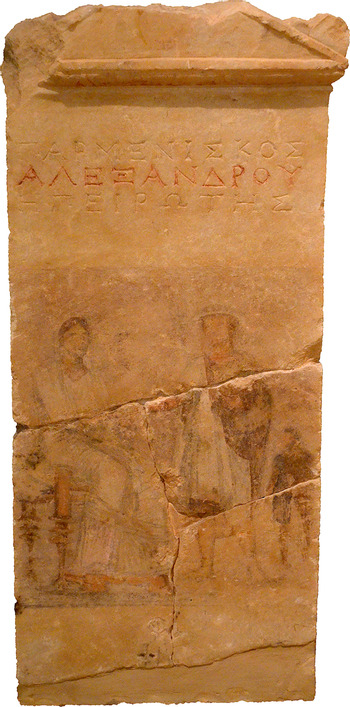
I will begin with the painted funerary stelai from Demetrias, as they provide important information about the use of this dress (kausia, short-sleeved chiton, chlamys and krepides), as well as who wore it. The painted stelai were discovered by Arvanitopoulos in the early twentieth century, during his investigations of the city's fortifications (Arvanitopoulos Reference Arvanitopoulos1909; Reference Arvanitopoulos1928; von Graeve Reference Graeve and Helly1979; Wolters Reference Wolters and Helly1979; Helly Reference Helly and Kypraiou1992; Reference Helly and Kontaxi1996; Reference Helly2012; Stamatopoulou Reference Stamatopoulou1999, vol 2, 8–9; Reference Stamatopoulou, Kurtz, Meyer, Tsingarida and Harris2008; Reference Stamatopoulou, Stamatopoulou and Draycott2016, 406–8; Reference Stamatopoulou, Kalaitzi, Paschidis, Antonetti and Guimier-Sorber2018a, 362–5; Reference Stamatopoulou, Draycott, Raja, Welch and Wootton2018b). They had been used as building material in antiquity to enlarge the tower in the southern sector of the city, at the eve of the Mithridatic Wars, around 88 bc (Helly Reference Helly and Kypraiou1992, 359–64; Reference Helly and Kontaxi1996, 78–9; Stamatopoulou Reference Stamatopoulou, Stamatopoulou and Draycott2016, 409–10), and they originated from the nearby southern cemetery. Their dates range from the city's foundation in the early third century until the early first century (Helly Reference Helly and Kypraiou1992, 364; Stamatopoulou Reference Stamatopoulou, Stamatopoulou and Draycott2016, 409–10). In addition, the painted stelai provide important information about the onomastics in the city (Arvanitopoulou Reference Arvanitopoulou1952; Batziou-Efstathiou Reference Batziou-Efstathiou and Kontaxe1996, 16; Kravaritou Reference Kravaritou, Melfi and Bobou2016, 137; Stamatopoulou Reference Stamatopoulou, Kalaitzi, Paschidis, Antonetti and Guimier-Sorber2018a, 365), as well as iconographic choices. A number of stelai depict men wearing the kausia,Footnote 85 such as the painted grave stele of Parmeniskos, son of Alexandros, from Epiros, who is shown in a dexiosis with a seated woman (Fig. 11). He wears a white short-sleeved chiton, a dark chlamys with white border, a headpiece, which seems to be a white kausia, and krepides.Footnote 86 The stele of Antigenes, son of Sotimos, depicts the deceased as a trumpeter, wearing a broader-rimmed kausia.Footnote 87 As we learn from the epigram, Antigenes died in a battle in Phthiotic Thebes in 217, as a member of the ἡβητὴς λόχος (ephebic corps), and thus he belongs to the age group of the ephebes (Kravaritou Reference Kravaritou, Kalaitzi, Paschidis, Antonetti and Guimier-Sorber2018, 348). Other stelai that portray the deceased wearing the kausia include the stele of Zoilos, son of Aristodemos,Footnote 88 the stele of a man reading,Footnote 89 most likely the stele of Timoanax from Methymna (Lesvos),Footnote 90 and possibly the stele of Hermaphilos, son of Mokapores, from Bithynia.Footnote 91 There is often difficulty in distinguishing between kausia and petasos, as on the stele of Peneis and Herodotos,Footnote 92 the latter young, beardless, in chlamys and chiton (Arvanitopoulos Reference Arvanitopoulos1909, 195).
Painted stele of Parmeniskos, son of Alexandros, from Epirus (VM inv. no. Λ46). Author's photograph.

Alexandria has also yielded a painted tombstone, depicting a man wearing white chiton, yellow-orange chlamys, white kausia and yellow krepides (Rouveret Reference Rouveret2004, 45–6, no. 3; Louvre MA 3632). A further painted tombstone shows a rider wearing the kausia (Brown Reference Brown1957, 24, no. 16, pl. 10; Janssen Reference Janssen2007, 274, no. Ma3, fig. 51; S.E. Cole Reference Cole2019, 4–6, no. 2, figs 2–4). On a lintel in the Moustapha Pasha tomb 1, the central and left riders are depicted wearing the kausia, leading Venit to identify the occupants of the tomb as Macedonians (Venit Reference Venit2002, 55–8; cf. Adriani Reference Adriani1936, 37, 109–12; Brown Reference Brown1957, 52–4, no. 34, 55–7; S.E. Cole Reference Cole2019, 9–11, no. 5, figs 8–9).
On the hunting frieze of Philip's Tomb (Tomb II) at Aigai, two young figures are depicted wearing the kausia and a chlamys and holding a spear.Footnote 93 They have been interpreted as the βασιλικοί παῖδες, the royal pages of the Macedonian king, because they are shown accompanying him.Footnote 94
The slightly later – Early Hellenistic – Agios Athanasios tomb preserves several painted depictions of kausia wearers. On the painted frieze, to the right of the symposion scene, there are, among others, four figures of young men wearing the kausia; three are grouped together, holding spears and wearing white or blue short-sleeved chitons, purple cuirasses, yellow/orange chlamydes with purple borders, white kausiai and krepides (Tsimpidou-Avloniti Reference Tsimpidou-Avloniti2005, pl. 35a; Brecoulaki Reference Brecoulaki2006, pl. 94:1). The fourth, standing further to the right on his own, holds a spear and wears a blue short-sleeved chiton, yellow/orange chlamys with purple borders, white kausia and krepides (Tsimpidou-Avloniti Reference Tsimpidou-Avloniti2005, pl. 35b; Brecoulaki Reference Brecoulaki2006, pl. 94:2). These figures have been interpreted as royal pages, as with the figures discussed above in the hunting frieze of Philip's Tomb, because of their Macedonian dress and armour (Tsimpidou-Avloniti Reference Tsimpidou-Avloniti2005, 138–9). Hatzopoulos (Reference Hatzopoulos2001, 62–3) suggested that they represent the hypaspistes. On either side of the tomb door there are two megalographic figures who have been interpreted as guards. The figure on the left holds a sarissa and wears a grey short-sleeved chiton, a brown chlamys, a white kausia and krepides. The figure on the right holds a sarissa and wears a charcoal short-sleeved chiton, a charcoal chlamys with white borders, a white kausia (narrower than the one that the left figure wears) and krepides (Tsimpidou-Avloniti Reference Tsimpidou-Avloniti2005, 142–7, pls 36–7; Brecoulaki Reference Brecoulaki2006, pls 99–100; Plantzos Reference Plantzos2018, figs 227–8). The importance of these two depictions is that we can see the different ways in which the kausia was worn: tightly on the head, as in the right figure, or more loosely, as in the left figure.
A marble slab belonging to a naiskos monument, found in second use in the Macedonian tomb ΣΤ of Pella, depicts a standing youth wearing the chiton and chlamys; it is considered to be the only securely identified kausia wearer on a relief stele of the fourth century. The monument is thought to belong to a member of the aristocracy (Chrysostomou Reference Chrysostomou1995, 150–1, fig. 17; Reference Chrysostomou1997, 215; Reference Chrysostomou1999, 287–9, fig. 12 [where the kausia is seen clearly], drawings 3–4; Kalaitzi Reference Kalaitzi2016, 52, 201, no. Pella 70).
A male bronze head found off the coast of Kalymnos shows a mature man with a short beard wearing a headpiece which consists of a roll over the forehead and a wider mushroom-like part on the top (Koutsouflakis Reference Koutsouflakis2007, 46–7, no. 2, fig. 6ab; Koutsouflakis and Simosi Reference Koutsouflakis, Simosi, Daehner and Lapatin2015, 78; Daehner and Lapatin Reference Daehner and Lapatin2015, 194–5, no. 5 [Bairami]). This hat looks very similar to the best depictions of the kausia on terracotta figurines, as the Pydna figurine, especially in the rendering of the roll – even though thinner, it shows the relief dots – and is almost certainly a kausia. Palagia (Reference Palagia, Daehner, Lapatin and Spinelli2017) suggested that it depicts a Macedonian ruler.
This particular dress is also depicted on a votive relief from Mesembria Pontica, dated in the second to first centuries bc. It was dedicated by the strategoi of the city in honour of a hero. What is interesting to point out here is that all the adult males, the strategoi, as well as the grammateus are shown wearing the kausia, the short-sleeved chiton, and the chlamys (SEG 30.703, 85–9; Venedikov Reference Venedikov and Velkov1980, fig. 3; Alexandrescu Vianu Reference Alexandrescu Vianu1986, fig. 2; Nawotka Reference Nawotka1991, 222–7, 252–5).
Depictions of the kausia can be found in Hellenistic Italy. On the famous Alexander Mosaic at Pompeii, the person behind Alexander, whose head survives in a bad state, is restored as a kausia wearer. This figure has been thought to be one of Alexander's bodyguards, perhaps even Ptolemy I.Footnote 95 Similarly, in Boscoreale, in room H of the Villa of P. Fannius Synistor, one of the well-known megalographic panels shows two female figures. One of them holds a spear and wears a chiton with a himation and a kausia on the head. This figure has been interpreted as the personification of Macedonia because of the kausia, among other features (Smith Reference Smith1994, 109).
From the collection of depictions of the kausia on paintings and other media, it is evident that it was used by those of various ages, a variety of ethnic groups, and a range of economic and cultural actors. The wearers can be adolescents (Aigai frieze), young men (Antigenes’ stele, Agios Athanasios frieze) or adult males (Demetrias, Alexandria and Pella tombstones, the Kalymnos head, the Mesembria relief and the Alexander Mosaic); in the case of the Boscoreale fresco it is perhaps a personification of Macedonia. The kausia was used by ephebes, soldiers belonging to different armies (Macedonian, Ptolemaic, Thracian), rulers, strategoi and grammateis, hunters, but also citizens without armour, perhaps unrelated to the army, one portrayed as a man of literature. It is evident that the majority of the wearers are Macedonians, but there are exceptions. On the Demetrias stelai mentioned above, in the cases of Parmeniskos, Timoanax, and Hermaphilos, it is used by an Epirote, a Lesbian, and a Bithynian respectively, who resided in Demetrias, which, as already mentioned, was a Macedonian royal foundation in Thessaly. As Stamatopoulou (Reference Stamatopoulou, Stamatopoulou and Draycott2016, 441; Reference Stamatopoulou, Kalaitzi, Paschidis, Antonetti and Guimier-Sorber2018a, 363–5; Reference Stamatopoulou, Draycott, Raja, Welch and Wootton2018b, 391 n. 39, 396) has observed, this dress is not on its own a marker of ethnic identity. In this case, it might have been used as a means of self-identification (possibly being a member of the Macedonian army in some cases).Footnote 96 Kalaitzi (Reference Kalaitzi2016, 53–4) remarked that the use of Macedonian dress by non-Macedonians, and of the kausia in particular, could have indicated a conscious political decision.
INTERPRETATION OF THE KAUSIA BOY FIGURINES
In her monograph on the Hellenistic terracottas of Troy, Burr-Thompson (Reference Burr-Thompson1963) identified the iconographic type as boys who wear the Macedonian attire of kausia, chlamys and short-sleeved chiton, and associated them with the cult of Demeter or Kybele.Footnote 97 In addition, she proposed that their stance indicated the ‘respectful silence’ that might have been performed during the cult activities of these goddesses, especially since they are both mystery cults (Burr-Thompson Reference Burr-Thompson1963, 53–4, 85–6). The figurines were unearthed at the north slope of the citadel and only one from a sanctuary that excavators assumed belonged to one of the two goddesses, comparing the finds with other sanctuaries of the two deities. Since Burr-Thompson's monograph, scholars have taken for granted that this iconographic type should be connected with the cult of these two goddesses. Thus, kausia figurines have been often linked with the cult of Demeter or interpreted as temple boys, even when the contexts of discovery are non-votive, as in Samothrace (Dusenbery Reference Dusenbery1998, 863–4, 866), Lesvos (Acheilara Reference Acheilara2006), Alexandria (Pingiatoglou Reference Pingiatoglou1993), Athens (Miller Reference Miller1974) and Kassandreia (Misaelidou-Despotidou Reference Misaelidou-Despotidou2014, 109, no. 105). Miller (Reference Miller1974) identified the terracottas from Menon's Cistern in Athens as belonging to a sanctuary of Demeter. That was also due to the fact that Burr-Thompson had identified a nearby cistern (Demeter Cistern) as belonging to a sanctuary of Demeter (Burr-Thompson Reference Burr-Thompson1954, 87–107). In the same publication, Miller (Reference Miller1974, 216) tentatively suggested that the sanctuary of Pasikrata in Demetrias was really a Demeter sanctuary, because of the existence of the kausia boys, a suggestion which was later adopted by Batziou-Efstathiou (Reference Batziou-Efstathiou, Leventi and Mitsopoulou2010, 190).
I think that the iconographic type of the kausia boys cannot be connected with the cult of Demeter or the Mother of the Gods. Outside Demetrias this iconographic type is absent not only from key sanctuaries of Demeter, such as Dion (Pingiatoglou Reference Pingiatoglou2015), Pella (Lilimpaki-Akamati Reference Lilimpaki-Akamati1996), the City Eleusinion at Athens (Miles Reference Miles1998), Kythnos (Mitsopoulou Reference Mitsopoulou2005; Reference Mitsopoulou2007), Eretria (Metzger Reference Metzger1985), Corinth (Merker Reference Merker2000), Messene (Themelis Reference Themelis and Hägg1998; Spathi Reference Spathi, Muller and Laflı2015, 438–40), Priene (Rumscheid Reference Rumscheid2006), and the goddess’ Thessalian sanctuaries,Footnote 98 but also from those of the Mother of the Gods at Aigai (Drougou Reference Drougou, Pilz and Vonderstein2011), Pella (Lilimpaki-Akamati Reference Lilimpaki-Akamati2000), and Leukopetra (Stefani Reference Stefani2010; Reference Stefani, Adam-Veleni, Zografou, Koukouvou, Palli and Stefani2017). The exception would be the few figurines from the Koukles sanctuary at Amphipolis (Veymiers Reference Veymiers2009, 491–2, fig. 11). As Poulakakis (Reference Poulakakis2002, 222) has noted, the iconographic type does not appear in sanctuaries of Attis either. In Demetrias, the ‘Thesmophorion’ and the Sanctuary of the Mother of the Gods have not yielded any figurines of this iconographic type so far (Batziou-Efstathiou Reference Batziou-Efstathiou, Leventi and Mitsopoulou2010; Reference Batziou-Efstathiou, Stamatopoulou and Morganforthcoming).
It has also been suggested that the gesture of the hands wrapped inside the chlamys might indicate a rite connected with the farewell of the warrior (Hamdorf Reference Hamdorf1996, 101; Burn and Higgins Reference Burn and Higgins2001, 65, no. 2120). However, this interpretation could not work when considering the findspots of these figurines, mostly in children's graves, and the young age that the figurines represent in most cases.
The stance of the figurines with the arms inside the chlamys can be interpreted in tandem with a passage from Artemidorus (Oneirocritica I.54).Footnote 99 He mentions that ephebes should keep one arm inside the chlamys, in order to behave prudently, making them slow in acts and speeches, and avoid big gestures. The ephebes’ dress is also attested in Hellenistic Thessaly by a late-third-to-early-second-century tombstone of an ephebe from Phthiotic Thebes, who wears a chiton, chlamys and boots (Kravaritou Reference Kravaritou, Kalaitzi, Paschidis, Antonetti and Guimier-Sorber2018, 383; Alexandrou and Kravaritou Reference Alexandrou and Kravaritou2020, 366–7, fig. 7). Indeed, this could have been the goal of the coroplasts when creating this iconographic type, that is, to portray a prudent and well-mannered youth, adopted also for younger boys.Footnote 100 Thus, the covering of the mouth might in fact reflect the prudence of the boys or youths rather than a ritual silence for mystery cults.
Hornung-Bertemes suggested that with the dedication of the figurines to the worshipped deity, the parents were praying that their children would become part of the prestigious body of the ephebes. She accepted, however, that there is no limitation to the context of a single deity and that there is no indication why these garments are linked to the service of Demeter. In addition, she claimed that the arm gesture of the figurines from Demetrias in combination with the kausia might indicate a rite of passage, as it would have been a universally recognised symbol (Hornung-Bertemes Reference Hornung-Bertemes2007, 93). Both Janssen (Reference Janssen2007, 251) and Hornung-Bertemes (Reference Hornung-Bertemes2007, 93) tentatively suggest that the kausia boy figurines might be participants in a rite of passage. However, they both failed to provide literary, epigraphic or visual evidence for this.
The deposits of the sanctuary of Pasikrata have yielded a wide variety of finds. Apart from the kausia boy type, other terracotta finds include figurines of women, young females, girls, two figurines of Aphrodite, animal figurines, a life-size female bust, probably from a large terracotta statue, and figurine-patrices.Footnote 101 Sculptures include a female life-size head, probably belonging to a cult statue, and statuettes of Aphrodite with Eros, an Artemis and a woman (Stamatopoulou Reference Stamatopoulou2014, 213). Among the pottery finds, which are Hellenistic and Roman in date, are incense burners, lamps and drinking vessels (Stamatopoulou Reference Stamatopoulou2014, 213). The inscribed monuments (votive stelai and incense burners) attest to the fact that in this sanctuary there are both female and male worshipers, while the deities mentioned are Pasikrata and Artemis Enodia (Stamatopoulou Reference Stamatopoulou2014, 213–15). Stamatopoulou has argued for a kourotrophic nature of the venerated deity.Footnote 102
In fact, other scholars, based on epigraphic and archaeological evidence, have also argued that Pasikrata must be a kourotrophic deity, most probably connected to Artemis (Garcia Ramon and Helly Reference Garcia Ramon and Helly2007, 307; Mili Reference Mili2015, 273–4; Kravaritou Reference Kravaritou, Melfi and Bobou2016, 140–1). Pasikrata appears as an epithet of Artemis in Epirus (Ambrakia and Panaghia Prevezas) and later, in the third and fourth centuries ad, in Macedonia (Herakleia Lynkestis) in manumission inscriptions.Footnote 103
The other sanctuaries that have yielded kausia boy figurines also have a strong kourotrophic aspect in their cult. The favissa at Kharayeb (in modern Lebanon) shows the closest similarities in terracotta finds to the Pasikrata sanctuary; the sanctuary was in use from the seventh centuries until the first century, but the material which is of interest to us dates to the Hellenistic phase. Among the finds were kausia ‘ephebes’ and boys holding and playing the syrinx, as well as other figurines of children, kourotrophoi, figurines of Artemis, Isis, torch-bearers etc. (Chéhab Reference Chéhab1951–2). The sanctuary has also been interpreted as housing a kourotrophic cult (Bobou Reference Bobou2015, 90; Oggiano Reference Oggiano and Maila Afeiche2015a; Reference Oggiano, Aliquot and Bonnet2015b), perhaps even involving rites of passage (Bonnet Reference Bonnet2015, 245–50). The six kausia boy figurines from Ptolemais were also discovered in a favissa of a sanctuary, which yielded a total of 86 figurines, probably belonging to a fertility deity; the dedicatory practices – hydriaphoroi, peplophoroi, dancing women, kourotrophoi, kausia boys, children – display many similarities with the Kharayeb favissa, according to Erlich (Reference Erlich2009, 43–6). At Seleucia-on-Tigris, some of these figurines were discovered in Tell Umar, a temple of a fertility-healing deity that yielded female figurines and a large number of figurines of children (Menegazzi and Messina Reference Menegazzi, Messina, Lipollis and De Martino2011, 133–4). The figurines from the favissa at Myrina on Lemnos also display strong kourotrophic elements (ArchDelt 18 [Β' 2], 265, pl. 304; Greco and Ficuciello Reference Greco and Ficuciello2012, 163–4; Ficuciello Reference Ficuciello2013, 254–5, fig. 116), as does the coroplastic assemblage at the Letoon in Xanthos;Footnote 104 however both assemblages remain unpublished, except for preliminary reports.
The kausia boys with syrinx and lagobolon (‘shepherds’) have not received much scholarly attention, owing to their rarity. Romanelli (Reference Romanelli1963, 281) interpreted them as images of Attis, even the nude boys with the kausia, although they are not portrayed wearing the typical long sleeves and leggings of Attis, nor do they wear his Phrygian hat. Naoum (Reference Naoum2017, 150) interpreted the specimens from the West Cemetery of Pella as connected to the cult of Attis, since they are holding the attributes with which Cybele's companion is usually portrayed. However, the same symbols also belong to the god Pan, and the lagobolon is a hunting device, used by a shepherd, as well as a hunter.Footnote 105 In fact, the deceased holding a lagobolon on funerary stelai have been interpreted as hunters.Footnote 106 Voutiras (Reference Voutiras, Kalaitzi, Paschidis, Antonetti and Guimier-Sorber2018) has stressed the significance of Pan's cult for Macedonia. He is the god of the ἐσχατιαί, of the border ranging between the polis and the wilderness (Borgeaud Reference Borgeaud, Atlass and Redfield1988, 60). The same god is sometimes depicted carrying an animal on his shoulders, as can be seen on a late Hellenistic statue from Gytheion, portraying the god with the animal, syrinx and lagobolon (Delivorrias Reference Delivorrias1969). The scholiast of Theocritus’ Thalysies (Scholiast of Theocritus 7.106–8a) says that in Arcadia the paides participated in hunting and music rituals in honour of Pan, performed as a rite of passage before becoming ephebes and citizens (Borgeaud Reference Borgeaud, Atlass and Redfield1988, 68–70, 86). In the same region, Pan was worshipped together with Artemis, as is evident from inscriptions found in the sanctuary of Artemis on Mount Kotilon (Kourouniotis Reference Kourouniotis1903, 178–82; Jost Reference Jost1985, 96–7), as well as the sanctuary of Artemis and Pan at Lykochia (Mantineia).Footnote 107 Ammerman (Reference Ammerman, Bellia and Marconi2016, 120–2, 129) connected the syrinx carried by Pan (or associated with the god) on plaques from Metaponto with allusions to marriage. This cannot easily be supported for the syrinx holders from Demetrias, but Pan's sanctuaries in Attica received dedications, such as loutrophoroi, krateriskoi and terracottas, which show a definite association to weddings and coming of age (Arapogianni Reference Arapogianni2000, 225–9; Zampiti Reference Zampiti, Mavridis and Jensen2013; Spathi Reference Spathi, Sioumpara and Psaroudakis2013). Sabetai (Reference Sabetai2018; Reference Sabetai2019) has similarly recognised the god's connection to rites of passage. It is thus not strange that these figurines were found in Demetrias in a sanctuary deposit situated at the edge of the city, potentially indicating the transition from city life to the outside world.
We can suggest that the dedicators might have been in fact Macedonians, or also connected in some way to the Hellenistic ruling class.Footnote 108 All the sites where these figurines have been found had a strong Macedonian connection (Janssen Reference Janssen2007, 250), being capitals of the Hellenistic world (Pella, Demetrias, Alexandria, Seleucia-on-Tigris, Pergamon), being situated in Macedonia (Akanthos, Thessaloniki, Agios Athanasios, Kassandreia, Pydna, Amphipolis), displaying strong Macedonian influence, or being part of the territories of the Ptolemies and the Seleucids (Lesvos, Samothrace, Delos, Kharayeb, Babylon, Susa).Footnote 109 Rotroff proposed that perhaps they depicted ‘Macedonian sympathisers’ in the Hellenistic world.Footnote 110 Janssen has suggested that the people who dedicated and used these figurines could have been Macedonians and/or Greeks who inhabited those areas and belonged to the ruling class or were klerouchoi and katoikoi.Footnote 111 Nevertheless, in Demetrias, since the iconography of the tombstones in combination with the epigraphy shows that this dress was also worn by non-Macedonians, one cannot securely draw such conclusions about the people using and dedicating these figurines.
Concerning the age of the figurines depicted, one could once again turn to epigraphic evidence. The recently published Ephebarchical Law of Amphipolis provides invaluable information about all aspects of the ephebes’ life in Macedonia. In the section regarding the clothing that the ephebes should wear, it is clearly stated that their ‘uniform’ should consist of the chiton, chlamys, krepides and petasos.Footnote 112 This ‘uniform’ can be seen in terracotta figurines of youths, aged at the end of, or after, their teenage years (e.g. Burn and Higgins Reference Burn and Higgins2001, 64–5, pl. 23). Therefore, the kausia-wearing figurines that are shown in an earlier stage of their life, prepubescent or in their early teen years, might in fact represent the paides of the Macedonian society and coincide with the portrayed age group.Footnote 113 It is worth mentioning that some of the Demetrias boys on stelai are shown with similar dress to the figurines, minus the kausia, and are also depicted in an inside setting.Footnote 114 Indeed, the round contours of the figurines’ faces in relation to the posture and musculature of their bodies do indicate an age between 10 and 15/16 years of age, perhaps even younger.Footnote 115 The young age is also supported by the light skin complexion, as it was customary to display young children with salmon-pink colours, and adult men with reddish or brown hues (Brecoulaki Reference Brecoulaki, Adam-Veleni and Tzanavari2012; Blume Reference Blume, Muller and Laflı2016, 150 n. 14; Tzanavari Reference Tzanavari, Adam-Veleni, Zografou, Koukouvou, Palli and Stefani2017, 53). In addition, Brecoulaki (Reference Brecoulaki, Adornato, Falaschi and Poggio2020, 50–1) has recently argued that the pinkish complexions used for the young hunters on the hunting frieze of Philip's Tomb suggest ‘a healthy skin complexion’, and are also an indicator of ‘both aristocratic values of excellence and andragatheia’. We also know from a passage from Plutarch (Moralia 760B) that the royal νεανίσκοι wore the kausia, at least during a specific period of time.Footnote 116 I think that we should exclude the identification of the kausia boys with the kynegoi of Herakles Kynagidas, who we know existed in Demetrias (Hatzopoulos Reference Hatzopoulos1994, 102; Intzesiloglou Reference Intzesiloglou and Pikoulas2006; Mili Reference Mili2015, 205–6; Kravaritou Reference Kravaritou, Melfi and Bobou2016, 142; Stamatopoulou Reference Stamatopoulou, Kalaitzi, Paschidis, Antonetti and Guimier-Sorber2018a, 347; Kravaritou Reference Kravaritou, Kalaitzi, Paschidis, Antonetti and Guimier-Sorber2018, 383–4). The age for the kynegoi would have been 18–20 years (Hatzopoulos Reference Hatzopoulos1994, 108–9; Psoma Reference Psoma, Guimier-Sorber, Hatzopoulos and Morizot2006, 287–8; Kravaritou Reference Kravaritou, Kalaitzi, Paschidis, Antonetti and Guimier-Sorber2018, 382–4), which, naturally, is older than the ages portrayed on the figurines.
The upper age that the kausia boy iconographic type seems to depict – 15/16 years of age – also coincides with the enrolment age (πεντεκαιδεκατής) of Macedonian boys in the gymnasium, as we know it from a fragmentary gymnasiarchical law from Kavala, ancient Neapolis (Hatzopoulos Reference Hatzopoulos2001, 126–7; Reference Hatzopoulos2016, 34). Perhaps figurines of this iconographic type were dedicated as marks of transition when reaching the age of enrolment in the gymnasium. The iconographic type of kausia wearers next to a herm (however not present in Demetrias) also hint at the gymnasium, where herms are known to have been erected.Footnote 117
This age group can also be supported by the fact that most of the figurines are depicted with long hair. This can refer to the threpterios kome,Footnote 118 the hair-growing for ritual cutting and dedication. This practice is usually connected to rites of passage, such as the Koureion in the Athenian Apatouria festival (Parke Reference Parke1977, 88–91; S.G. Cole Reference Cole1984; Parker Reference Parker2005, 458–61). It has been argued that during this festival, 16-year-old boys would cut their hair and dedicate them to the deity, as a ritual of transition from childhood to adulthood, before the ephebeia.Footnote 119 Outside of Attica, the threpterios kome is connected to rites of passage and deities with kourotrophic properties (for example Artemis Amarysia or Poseidon at Phthiotic Thebes).Footnote 120 The kausia boys are thus depicted in an age before the ritual hair-cutting. The types which are portrayed older with short hair could suggest that the youth had passed the ritual and had dedicated his hair.Footnote 121
The presence of the kausia boy figurines in graves should be seen in relation to those dedicated in sanctuaries. As mentioned above, in the (few) cases where an osteoarchaeological study has been conducted, or it can be easily deduced by the size of the skeletal remains and the grave offerings, it is shown that these figurines were placed in graves of children or adolescents. I think that, considering the dedication of these figurines in sanctuaries of kourotrophic deities, which could have been offered as a mark of transition from one age group to another, the kausia boy figurines in burials could signify the unfulfilled transition of the young boy, perhaps not having reached the transition to the enrolment in the gymnasium, and subsequently the ephebeia.Footnote 122
CONCLUSIONS
To sum up, the large numbers and the variety of technical types – with their versions and variations – in Demetrias indicate that the kausia boy iconographic type was an important one for the city and was widely circulated within it, representing approximately 25 per cent of the total 600 known terracotta figurines. Based on the study of the figurines, namely the clay, the manufacturing technique, and comparisons to products from other coroplastic centres, it is clear that the iconographic types of the kausia boy, the ‘shepherd’, and the animal-carriers were created locally; this suggests the existence of a strong local coroplastic tradition in Demetrias. The only exception – based on our current knowledge – is Type 5, which is a derivative from the ‘Pydna Group’, adapted for the needs of the city, and created with local clay. The great numbers and variety of the three iconographic types discussed in this study might also indicate the existence of several coroplastic workshops creating these types simultaneously, covering the high demand for these figurines.
We can see in the kausia boy figurines an iconographic type which shows young boys or paides whose clothing indicates the adoption of an attire which started from Macedonia and spread in all the Hellenistic world as a characteristic of the clothing of the ‘good youths’ of the period.
In addition, even though previous scholarship tended to connect this iconographic type to the mystery cults of Demeter and Kybele, it has been demonstrated above that this interpretation can no longer be sustained. Given the concentration of these figurines in Demetrias in the sanctuary of Pasikrata and the Favissa, it is also evident that their dedication in such large numbers cannot be coincidental but is probably linked to the character of the deities venerated in these sanctuaries. They seem to be common and appropriate for sanctuaries where the deity presided over kourotrophic rites. It is also evident that they are popular in specific votive contexts in the city and not in all sanctuaries. The kausia boy figurines discovered in sanctuaries perhaps marked the transition from one age class to another. However, since they are found in votive deposits, it is impossible to know how they were used during the cult and who dedicated them, the parents or the children. Equally, when discovered in graves they might indicate an offering for the unfulfilled transition cut short by the untimely death. The identification of the dedicants as belonging to the elite cannot be confirmed. It is impossible to identify the social status of the people taking part in these rites, since the evidence from the burials is scant.
Last but not least, the study of the distribution of these terracottas indicates that they are mostly found in areas with strong Macedonian presence, perhaps suggesting that their dedicators were Macedonian, or were involved in some way in Macedonian life or under the cultural influence of Macedonia. Ultimately, it is an iconographic type which experienced a wide diffusion in the Hellenistic period, one of the best examples of the Hellenistic coroplastic koine.
ACKNOWLEDGEMENTS
I would like to thank my thesis supervisor Dr Maria Stamatopoulou for the permission to publish the figurines from the sanctuary of Pasikrata, providing me with the relevant information from Arvanitopoulos’ archive, her notes, and her invaluable advice and constant guidance. I would also like to thank the Director of the National Archaeological Museum, Dr Maria Lagogianni-Georgarakos, for permission to study the relevant material in Athens; Dr Giorgos Kavvadias and Dr Christina Avronidaki and the conservators, Ioanna Dalla, Katerina Xylina, Tina Koutouvali and Katerina Ioannidou, for their generosity and significant help in the National Archaeological Museum. The Director of the Ephorate of Antiquities of Magnesia, Dr Anthi Batziou, granted me permission to study and publish the finds from the excavations of the German Archaeological Institute at Athens. Moreover, Dr Batziou, Elsa Nikolaou and Peggy Triantafyllopoulou have very kindly showed me the finds from their excavations of the cemeteries of Demetrias. Aimilia Kalogianni and Marianthi Raphtopoulou offered significant practical help during my visits in Volos. I wish to thank Athena Athanassiadou from the Ephorate of Antiquities of Pieria for granting me permission to publish the photograph of the figurine from Pydna (Fig. 6). This paper has also benefited from discussions with Professor R.R.R. Smith, Dr Milena Melfi, Dr Sofia Kravaritou, Professor Emerita Eirini Peppa-Papaioannou, Dr Myrina Kalaitzi, Giannis Graekos, Dr Joshua Thomas and Dr Hugo Shakeshaft. I am very grateful to Dr Konogan Beaufay for help with the creation of the plans and maps. The article has also benefited greatly from the anonymous reviewers’ constructive comments, and I wish to thank them.