Introduction
To what extent, and under which circumstances, are political agendas responsive to media agendas? For more than four decades, this question has attracted attention from political and communication scholars. Early studies, mostly conducted in the United States, focused on whether there is an influence of the media agenda on the political agenda. These studies brought about contradictory results: some scholars found evidence of strong media impact (e.g. Protess et al., Reference Protess, Cook, Curtin, Gordon, Leff, Mccombs and Miller1987; Bartels, Reference Bartels1996; Wood and Peake, Reference Wood and Peake1998), others studies revealed that there is no agenda impact of media on politics at all (e.g. Walker, Reference Walker1977; Wanta and Foote, Reference Wanta and Foote1994). In an effort to integrate the literature, Walgrave and Van Aelst (Reference Walgrave, Soroka and Nuytemans2006) attributed these inconsistencies to differences in research designs. They hypothesized the role of the news media in politics to be dependent on various circumstances such as the concrete media agenda, political agenda, issue type, country, and time period under study. In their footsteps, scholars in Europe and the United States started laying bare the contingency of the mass media’s political agenda-setting power (see e.g. Bonafont and Baumgartner, Reference Bonafont and Baumgartner2013; Vliegenthart et al., Reference Vliegenthart and Walgrave2016). There are now plentiful studies addressing how the news media may shift politicians’ attention from one issue to another. Recently, the traditional common time-series approach has been complemented with studies relying on surveys (e.g. Maurer, Reference Marini and Singer2011; Vesa et al., Reference Vasterman2015), interviews (e.g. Davis, Reference Davis2007, Reference Davis2009), experiments (e.g. Helfer, Reference Gunther and Storey2016), and micro-level content analyses (e.g. Thesen, Reference Tresch, Sciarini and Varone2013; Van Aelst and Vliegenthart, Reference Van Aelst, Thesen, Walgrave and Vliegenthart2013) – which has largely enhanced our understanding of how various political actors, depending on the conditions, are to different degrees responsive to information from the news media.
Surprisingly, while the majority of authors discussed above agree that the news media (hereafter simply referred to as ‘media’) matter when it comes to agenda setting, consensus on what ‘media impact’ actually implies, is lacking (Eissler et al., Reference Edwards and Wood2014). In particular, the research field is struggling with causal interpretations of the media’s role in agenda-setting processes. This manifests itself both on a theoretical and on an empirical level. Theoretically speaking, some scholars try to find out ‘who leads and who follows’, making claims about whether the media are the true driving force behind shifts in political attention to issues (Van Noije et al., Reference Van Noije, Kleinnijenhuis and Oegema2008; Vliegenthart and Walgrave, Reference Vesa, Blomberg and Kroll2011; Jenner, Reference Hume2012). Others are less interested in determining whether it is media or politics that is the ‘first-mover’ of political action; they assume that most action starts in the political sphere, but that the media reinforce political processes by providing positive feedback to the system (Wolfe et al., Reference Wolfe, Jones and Baumgartner2013; Wolfsfeld, Reference Wolfsfeld2013). Still others think the media have no role in this process at all (Liu et al., Reference Light2011; Delshad, Reference Delshad2012). On an empirical level, the problem is that the methodological techniques used in some agenda-setting studies are not well suited to test the causal claims that are theoretically being made. For instance, some scholars make causal inferences about media effects on politics without controlling for spurious relationships or endogeneity (as discussed in Soroka, Reference Soroka2002b).
The goal of this paper is to address the ambiguous causal role of the media in political agenda-setting processes. To that end, we do two things. First, we discuss the complexity related to establishing causality in the media–politics relationship. After briefly outlining where the political agenda-setting literature currently stands, we identify the main reasons for the lack of causal clarity in the field. Three problems make it hard to prove that media attention for issues really causes those issues to gain importance on the political agenda: (1) the risk of spurious relationships; (2) possible endogeneity problems; and (3) the lack of an integrated theory explaining why the media influence political agendas.
Second, we offer a theoretical response to those problems, by developing an analytical framework that clarifies the various roles the media may play under various circumstances. Our micro-level model lists (1) what politicians can learn from the media, and (2) why politicians react to it. By understanding where politicians’ information on issues comes from – and what part of it they get from the media – we can reduce the risk of spurious relationships and endogeneity. It allows us to determine whether the media are a necessary condition for a certain political initiative; a facilitator of political action; or whether they have no impact at all. Insight into politicians’ motivations to react to news, on its turn, helps to fulfill the theoretical criterion of causality. Their motivations explain why the media exert influence: because they provide policy-related information; because they are a mediator of the public opinion; because politicians use them as a tool to fight the party competition; or because they offer opportunities to gain media access or political success. Taking both components into account would thus enable agenda-setting scholars to get a better understanding of what ‘media impact’ actually means.
While most agenda-setting research focuses on institutions (macro) or on parties (meso), our theoretical model departs thus from the individual politician (micro). The reason is not that we think individuals are more important than institutions – on the contrary, one could say that in politics, it is the ultimate aggregate output that counts. Yet, to understand the causal mechanisms behind agenda setting, we argue, our measurement level needs to be the individual politician because learning and motivations are cognitive phenomena that take place in the mind of politicians (for a similar argument see Yanovitzky, Reference Yanovitzky2002; Wood and Vedlitz, Reference Wood and Vedlitz2007). We simply cannot observe ‘what parties learn’, or ‘what motivates parliament’, without looking at the individuals who consume news with certain goals in mind. That is why the model tries to shed light on these micro-level mechanisms in the first place.
In the concluding section, we summarize our argument and we link it with existing agenda-setting theory. We explicate how our model builds on previous research, and forms the next step in unraveling the contingency of political agenda-setting processes. And, as our theoretical model has methodological implications as well, we make some suggestions about how to put those ideas into practice in empirical terms. In sum, we hope that our paper may stimulate a thorough theoretical and empirical discussion about the precise causal function of the news media in agenda-setting theory.
Political agenda setting: a matter of information
Political agenda-setting scholars generally agree that media effects on political agendas are a consequence of how politicians process information (Wood and Vedlitz, Reference Wood and Vedlitz2007; Brown, Reference Brown2010; Jones and Wolfe, Reference Jenner2010). Early agenda-building studies have pointed to the importance of information in advancing issues on the political agenda (Baumgartner and Jones, Reference Baumgartner and Jones1993; Kingdon, Reference Kingdon1995). Indeed, politicians need to be informed about problems that exist in society before they can address them (Light, Reference Landerer1982). Various types of information can signal a problem and as such attract political attention. There is a lot of ‘objective’ information that originates from what happens in the real world. Real-world events, such as accidents or natural disasters, happen and may call for political action (Birkland, Reference Birkland1998, Reference Birkland2006). Real-world indicators or figures, such as the number of deaths due to car accidents, are regularly published and may trigger politicians to act as well (Baumgartner and Jones, Reference Baumgartner and Jones1993). On top of that, a broad range of actors in society constantly filter, alter, and frame this information to fit with their goals and world-views. Interest groups or individual citizens, for example, constantly send signals about their opinions and actions which go beyond the ‘objective’ facts (Kingdon, Reference Kernell1973, Reference Kingdon1995).
In contemporary societies, some of the information does not reach politicians directly – or via its original source – but comes via the media instead. As Ball-Rokeach and DeFleur (Reference Ball-Rokeach and DeFleur1976) pointed out 40 years ago, there is so much information floating around that it is simply impossible to observe all signals directly. And the amount of available information has only grown since then. The news media play a key mediating role because they collect and summarize lots of information and make it accessible and manageable. As such they have started to play an important role in politicians’ information gathering behavior. In addition to the many other sources they have, politicians follow the media closely to learn about problems in society, potential solutions for these problems, and the public opinion regarding these problems and solutions (Van Aelst and Walgrave, Reference van der Pas2016). Even if politicians do not personally spend a lot of time consuming media coverage, they have a lot of contacts to inform them about what’s in the news; for instance, many political parties send around press reviews daily.
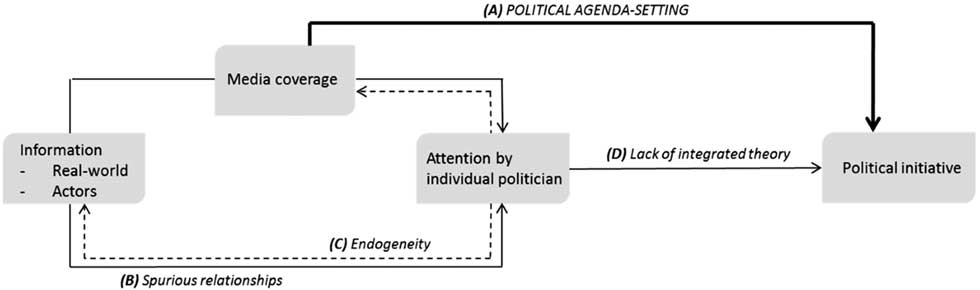
The fact that politicians, using the news media as a source of information for their political work, sometimes display responsiveness vis-à-vis these media in their political initiatives, has attracted scholarly attention. Researchers in the field of political agenda setting focus on the observable agenda relationship between media and politics (Walgrave and Van Aelst, Reference Walgrave, Soroka and Nuytemans2006). They study whether and under which circumstances political action upon issues follows media attention for those issues. In Figure 1, this is represented by path (A): the thick arrow represents how media coverage may lead to political initiatives.
The relationship between information, media coverage, and political initiatives.

Two types of agenda-setting research exist. A large part of the political agenda-setting literature has studied the matter from a broad issue perspective, demonstrating that political institutions respond to changes in the media’s distribution of attention over issues (e.g. Edwards and Wood, Reference de Vreese1999; Van Noije et al., Reference Van Noije, Kleinnijenhuis and Oegema2008; Bonafont and Baumgartner, Reference Bonafont and Baumgartner2013). Those scholars conceive agenda setting as a process of issue prioritization: the mass media convey information about the relative importance of issues (Dearing and Rogers, Reference Dearing and Rogers1996). A smaller number of studies has taken a more specific news story approach, showing how concrete news cues transfer to the political agenda (Van Aelst and Vliegenthart, Reference Van Aelst, Thesen, Walgrave and Vliegenthart2013; e.g. Thesen, Reference Tresch, Sciarini and Varone2013). Here, the idea is that politicians use media coverage as a concrete source of inspiration for their work.
Irrespective of the specific type of research conducted, the basic premise behind it is the same: agenda-setting effects are considered to occur when media attention for an issue – be it a broad policy domain or a concrete news story – temporally precedes political action upon this issue, while controlling for previous political attention for the issue. The large majority of agenda-setting studies establishes such effects and concludes that the media matter when it comes to setting the political agenda.
Criteria for causality
The common procedure to establish agenda-setting impact as described above fulfills some, but not all of the criteria for causality. In order to establish causality, basically, three conditions need to be satisfied: (1) cause and effect need to be correlated; (2) the cause needs to be causally prior to the effect, which implies that the cause must temporally precede the effect, that no external factor may drive cause and effect simultaneously (pointing to spurious relationships), and that the effect may not drive the cause (pointing to endogeneity); and (3) a theory is needed that links the cause to the effect (see the classic work of Hume, Reference Herbst1738; see also Marini and Singer, Reference Liu, Lindquist and Vedlitz1988 who apply those criteria to the social sciences specifically).
The condition of correlation is clearly accomplished: agenda-setting research investigates exactly whether an increase in media attention for an issue goes hand in hand with an increase in political attention for the issue. The second criterion – causal priority – is partly met. Political agenda-setting scholars meet the temporal succession criterion by ‘lagging’ the media agenda to be sure that changes in media attention for issues precede political action upon those issues. However, they have difficulties (1) to rule out the possibility that the relationship is spurious, that is, that an external factor causes both X and Y; and (2) to rule out that Y (invisibly) causes X, which would be an indicator of endogeneity. Third, the theoretical criterion needed to explain why X causes Y is not entirely fulfilled either. Scholars have of course amply theorized about why a politician would respond to the media, but the theory is still scattered and speculative, rather than integrated and empirically tested. We will now consecutively discuss those three problems.
Spurious relationships
The problem of spurious relationships stems from the fact that the media are often just a mediator – transmitting information that is created elsewhere and that may also have reached politicians via other channels, as can be seen in Figure 1, path (B). Agenda-setting studies that do not sufficiently take path (B) into account, may consider as a media effect what would actually better be viewed as a simple ‘information effect’. It may be that politicians are not reacting to media information, but that politicians and the media are simultaneously reacting to external information (Wanta and Foote, Reference Wanta and Foote1994; Soroka, Reference Soroka2003). It is a challenge to disentangle this ‘information effect’ from those ‘media effects’ whereby the media are the true cause of a politician’s political initiative.
Although many agenda-setting scholars agree that this is a valid concern, mismatches occur between causal claims that are being made, and the methods that are used to substantiate these claims. Most studies that test effects across a broad range of issues, do not control for any kind of real-world information, although sometimes acknowledging that this is a limitation of the research (e.g. Tan and Weaver, Reference Thesen2007; Walgrave et al., Reference Walgrave and Van Aelst2008; Green-Pedersen and Stubager, Reference Gans2010; Bonafont and Baumgartner, Reference Bonafont and Baumgartner2013). It is simply difficult to control for the full stream of ‘raw’ information reaching politicians independent of media coverage (Vliegenthart and Walgrave, Reference Vesa, Blomberg and Kroll2011). In-depth studies, focusing on just one or a few issues, do often control for real-world information. Indeed, in many of those studies – both on political and on public agenda setting – efforts were made to include real-world events or indicators in the agenda-setting models (Behr and Iyengar, Reference Behr and Iyengar1985; e.g. Wood and Peake, Reference Wood and Peake1998; Soroka, Reference Soroka2002a; Weitzer and Kubrin, Reference Weitzer and Kubrin2004; Van Noije et al., Reference Van Noije, Kleinnijenhuis and Oegema2008; Delshad, Reference Delshad2012). These studies often, but not always (see e.g. Liu et al., Reference Light2011; Delshad, Reference Delshad2012), show that the media matter in addition to real-world cues. Unfortunately, what almost all research overlooks, is that not only ‘objective’ real-world information underlies media coverage and political action; as said above, many exogenous actors continuously send out information about their opinions, goals, and actions, and this information as well may simultaneously drive media and political attention. In other words, the real-world control variables used in agenda-setting research are necessarily partial indicators of the full exogenous information stream, making it hard to prove that media attention for certain matters causes political attention for those matters.
Endogeneity
Second, critics think that agenda-setting research has an endogeneity problem. In line with indexing theory (Bennett, Reference Bennett1990), policymakers are an important news source themselves and many news facts have their origins in politics. Politicians may ‘go public’ with their plans – via the media – before taking formal political action (Kernell, Reference Jones and Wolfe1997). In Figure 1, this is represented by the dotted lines, see path (C). The consequence is that political reactions to news may thus often be reactions to things that were actually put on the media agenda by politicians. In other words, agenda-setting effects may be largely endogenous (Wolfsfeld and Sheafer, Reference Wolfsfeld and Sheafer2006). It is not the news, but the political evolutions underlying the news, that truly cause the subsequent political action.
Again, agenda-setting studies may falsely interpret their findings as causal effects from media on politics, while what they actually observe is how politicians first make media attention for an issue go up, and then undertake action upon this issue. We know from scholars doing interviews with politicians that this happens: what seems to be a political reaction to the media, is sometimes the consequence of an a priori collaboration between politicians and journalists (Cook et al., Reference Cook, Tyler, Goetz, Gordon, Protess, Leff and Molotch1983; Davis, Reference Davis2007).
Generally, political agenda-setting studies have not been able to take this process into account because it is hard to trace the origins of media stories. News making is indeed a non-transparent process. Instead of studying political elites, one would have to interview journalists about who was the source for a certain news story. But the problem is that journalists are often unwilling to reveal their news sources. As an exception, a few recent studies do try to control for whether a news story was initiated by a political actor or not (Thesen, Reference Tresch, Sciarini and Varone2013; Van Aelst and Vliegenthart, Reference Van Aelst, Thesen, Walgrave and Vliegenthart2013).
Lack of theory
The third regularly voiced criticism concerns the lack of a coherent theory that explains why the media have impact on the political agenda. Going back to Figure 1, scholars have not systematically addressed path (D), reflecting why a politician decides to effectively take action. Of course, political agenda-setting scholars did theorize about why politicians are influenced by media cues. And the theoretical approach of the mediatization literature – a related research field – offers valuable insights as well (Van Aelst et al., Reference Van Aelst, Sehata and Dalen2014). However, political agenda-setting theory is scattered, rather than integrated; and many aspects of it have not empirically been tested. A better and more integrated understanding of the motivations at play – one which can be transformed into verifiable hypotheses – would strengthen the basis for causal inference.
In particular, critics claim that political agenda-setting scholars have long ascribed a too passive role to politicians in the agenda-setting process. They did not sufficiently take into account that politicians are strategic actors who deliberately respond to media coverage in those instances where it fits their personal interests (Green-Pedersen and Stubager, Reference Gans2010). Agenda-setting effects are not necessarily ‘direct’, first-order effects that follow from content; irrespective of the content, politicians can also react to media coverage simply because they know that this coverage impacts other politicians, journalists, and the audience at large (second-order effect or ‘influence of presumed influence’) (Cohen et al., Reference Cohen, Tsfati and Sheafer2008; Meyen et al., Reference Melenhorst2014). Agenda-setting scholars are emphasizing these strategic motivations more and more – see for instance, the work by Elmelund-Præstekær and Wien (Reference Eissler, Russell and Jones2008) who showed that Danish politicians used a media hype merely strategically as a ‘policy window’ to present their ideas about the issue. But, these motivations are not systematically addressed, while they strongly nuance the ‘impact’ that the media really have.
Causal interpretations of agenda-setting effects
Due to the abovementioned reasons, diverging views exist on how to interpret the causal role the media play in this process. Some scholars perceive true media effects as instances where the media are the necessary condition for certain political initiatives. Van Aelst and Vliegenthart (Reference Van Aelst, Thesen, Walgrave and Vliegenthart2013), for instance, in a study on how news coverage leads to political initiatives, test whether the media ‘created’ the coverage that led to the initiative or not; in other words, whether or not they were the ‘real initiator’ of the initiative. The assumption is that an initiative would or could not have been taken, had the media not covered the matter in the first place. This is not often the case, as most of the time alternative sources actually initiated the news coverage.
This causal requirement that media coverage is a true necessity for political action to be taken, is quite demanding. Most authors take a more relaxing probabilistic view on causality. That is, they make inferences with probability about the effect of media attention on political attention for issues. Within this view, one line of research interprets agenda-setting effects as effects whereby media come first, and politics follows. In the words of Gans (Reference Elmelund-Præstekær and Wien1979), the goal of this tradition is to find out ‘who leads the tango?’, politicians or the media. Those authors try to investigate which of the two agendas has the strongest impact on the other agenda (Bartels, Reference Bartels1996; Edwards and Wood, Reference de Vreese1999; Soroka, Reference Soroka2003). They are looking for ‘autonomous’ media effects, whereby the media are the first-mover of certain changes on the political agenda. Others are not so much interested in who leads and who follows. They rather view media and political agendas as mutually reinforcing each other and investigate the simple ‘correspondence’ between the two (Baumgartner and Jones, Reference Baumgartner and Jones1993; Tresch et al., Reference Van Aelst2013; Wolfe et al., Reference Wolfe, Jones and Baumgartner2013). These authors speak in terms of how the media provide positive feedback to the political system, thereby reinforcing existing political processes – or negative feedback, slowing down policymaking, as shown by Wolfe (Reference Wolfe2012). Wolfsfeld (Reference Wolfsfeld2013), who developed the Politics-Media-Politics principle, argues that most changes originate in politics, leading to change in the media environment, which on its turn further changes the political environment. A third group claims that, when adequately controlling for real-world phenomena, the media do not cause changes in political agendas at all (Liu et al., Reference Light2011; Delshad, Reference Delshad2012). In any case, the idea behind the probabilistic line of thinking is not that the media are absolutely necessary for a certain political initiative to be taken; rather, the media boost the likelihood that political initiatives about a certain issue are taken at a certain moment in time.
In the next section, we introduce a model that integrates the existing theoretical views, and that – we hope – may serve as a tool to interpret extant and future empirical agenda-setting results. To be clear, we do not choose sides between the perspectives discussed above. There are good reasons to believe that the media may play various roles in agenda-setting processes: at times being a true necessary condition for a change on the political agenda; at times just being a facilitator of political action; and at times having no causal impact whatsoever. Our goal is to state precisely under what circumstances they adopt which role.
A model of the media’s role in agenda-setting processes
In order to solve the abovementioned ambiguity about the causal role of the media, this model holds, it is useful to consider (1) what politicians learn from the media, and also (2) why politicians react to media coverage.
The basic problem of spurious relationships and endogeneity is similar: there is uncertainty about what politicians get from the media. When agenda-setting studies establish media impact – based on the temporal succession of media and political attention for an issue – it may be that politicians are actually not reacting to media coverage but to exogenous information streams (leading to spurious relationships) or to information that they brought in the media themselves (leading to endogeneity). So, to decide what role the media precisely play in a given instance, we need to know about these alternative ways of learning. If politicians exclusively use other information sources, the media cannot impact their actions. Yet we know that politicians follow the media closely. They may as such learn about the salience or interpretation of an issue – because the media amplify and interpret it – or the media may even reveal information to the politician, about which (s)he would otherwise not be informed at all. It is in such instances that the media have the potential to exert influence on politicians.
Our response to the scattered theoretical foundations of agenda-setting research is situated on another level. We argue that – regardless of what politicians learn from the media – it is crucial to look at their motivations to take political initiatives, because our interpretation of the media’s role in agenda-setting processes is dependent on those motivations. To make a list of motivations, we not only look at the agenda-setting literature, but we also borrow from the mediatization literature, which has addressed how politicians adapt to the media logic in a broader sense (see e.g. Landerer, Reference Kingdon2014; or Strömbäck and Van Aelst, Reference Tan and Weaver2013 who theorize on ‘why political parties adapt to the media’). In addition to policy-making goals, politicians may react to the media because of representational motives, in response to party competition, out of media motivation, or simply because they want to be politically effective, and insight into these motivations helps to understand how the media actually exert influence.
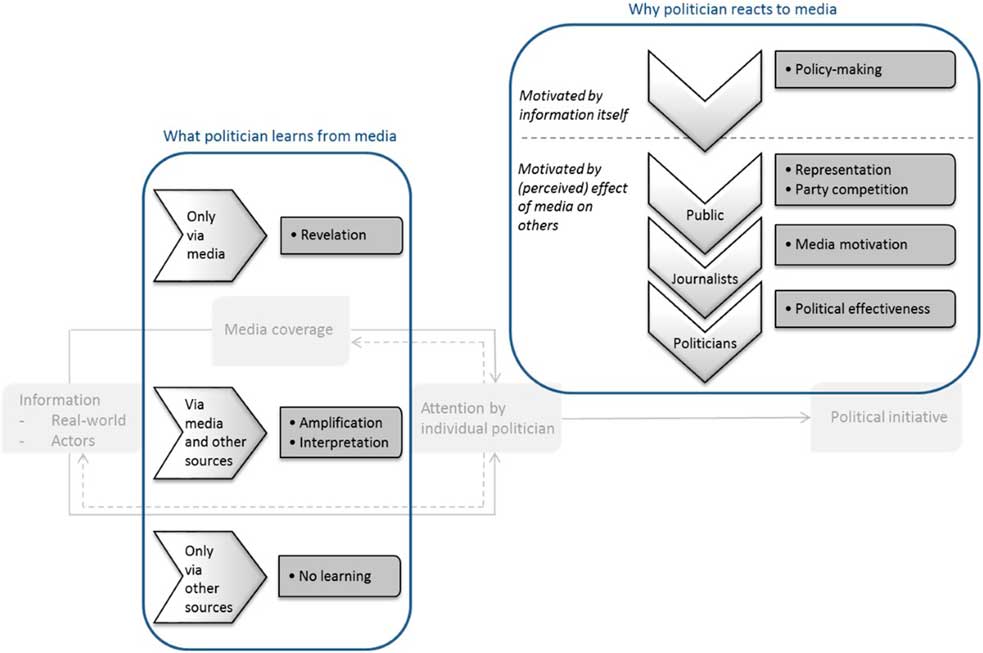
Our model is presented in Figure 2. The gray part of the model displays the basic relationship between information, media coverage, politicians’ attention, and their political initiatives, as discussed in the theoretical review above (identical to Figure 1). On the left-hand side of the panel, we have added the various ways via which politicians may learn from the media. On the right hand side, various reasons why politicians take action are shown.
The role of the media in political agenda-setting processes.

What politicians learn from the media
No learning: When media coverage upon an issue is followed by a political initiative upon the issue, political agenda-setting scholars tend to conclude that the media ‘influenced’ the initiative-taking politician. As the model shows, this is not necessarily true, because it is possible that the politician actually got all the information elsewhere and that the media did not play any role at all. Politicians often have large, specialized information networks at their disposal, making it likely that they get to know about issues via alternative channels (Kingdon, Reference Kingdon1995). This is at least true for the ‘raw’ facts. Note that this does not automatically mean that the media do not matter: as we will discuss now, they transform the reality in various ways, and irrespective of that, they may motivate politicians to take action.
Amplification: On a daily basis, the media transform the reality by choosing what is newsworthy and what is not. First, they select which events or facts make it into the news and which ones do not. Gatekeeping theory focuses on which factors are at play in this process of news selection (Shoemaker and Vos, Reference Soroka2009), showing that it is not necessarily the information that is ‘objectively speaking’ most important that becomes news. Second, the media determine daily how much attention they pay to various matters. Boydstun (Reference Boydstun2013) explains how the amount of media attention for an issue is often disproportionate vis-à-vis its inherent severity as well. Media attention is not evenly spread across issues; instead it is explosive and skewed and lurches from one issue to the other. This means that every day, the media amplify some issues, while – due to the limited media attention available – they minimize or even totally ignore others.
By acting as a ‘megaphone’– giving disproportionally much (or little) attention to a certain real-world condition, compared to the objective seriousness of it – the media influence the perceived importance of the issue in the mind of the audience, including policymakers. It is here that agenda-setting effects occur. The media make it much more likely that politicians react to a certain piece of information, by giving priority to it. Politicians, who are daily confronted with an overwhelming amount of information, use the media to quickly assess what is most important. When media coverage takes extraordinary proportions – scholars speak of media ‘storms’, ‘hypes’, or ‘waves’ to describe those instances where an event or issue suddenly gets extremely high attention in the media (Vasterman, Reference van Santen, Helfer and van Aelst2005; Boydstun et al., Reference Boydstun, Hardy and Walgrave2014) – politicians may even feel forced to respond (Walgrave et al., Reference Walgrave, Boydstun, Vliegenthart and Hardy2017).
Interpretation: When transmitting information, the media may not only take an interventionist stance by manipulating the amount of attention for an issue (amplification); they may also add a certain interpretation to the basic real-world facts they transmit. Many scholars have studied how the media ‘frame’ information by presenting and defining it in a certain way (Scheufele, Reference Semetko and Valkenburg1999; de Vreese, Reference Vos2005). Various studies have demonstrated how media coverage, compared to what happens in reality, for instance, stresses negativity (Soroka, Reference Strömbäck and Van Aelst2012) or conflict (Semetko and Valkenburg, Reference Sevenans2000; Bartholomé et al., Reference Bartholomé, Lecheler and de Vreese2015), or emphasizes certain aspects of a specific issue while ignoring others.
On top of the effects framing may have on people’s cognitions, attitudes, and behavior, news frames may moderate agenda-setting effects. Research has shown that agenda-setting effects are, for instance, stronger when news contains a conflict frame (Sevenans and Vliegenthart, Reference Shoemaker and Vos2016), responsibility attributions (Thesen, Reference Tresch, Sciarini and Varone2013), or when the frame is in line with the frame of the respective political actor (van der Pas, Reference Page and Shapiro2014). In other words, when a news fact is framed in a certain way, it seems to be judged as more (or less) relevant by certain political actors, which increases (or decreases) the chance that they take action upon it. In this sense, the media’s tendency to interpret information has the same effect as amplification, namely: it facilitates, or reinforces, political reaction upon an issue.
Revelation: When considering a political reaction upon a news story, the media are the necessary condition for the political initiative if the media truly reveal information to the politician. That is, the politician would not have been informed about the matter otherwise. Effectively, in those instances where media are the only channel via which politicians learn about a certain problem, they would not have been able to take action upon it, if the media had not spread the information in the first place.
Empirical research has not paid much attention to the concept of revelation, because it is hard to empirically determine whether politicians are dependent on the media for bringing an issue under their attention (but we know that citizens are: see Ball-Rokeach and DeFleur, Reference Ball-Rokeach and DeFleur1976). The pure informative function of the media has so far been understudied (Van Aelst and Walgrave, Reference van der Pas2016). At least, surveys and interviews have shown that policymakers themselves consider the media to be an important source of information. Journalists who have been working on a topic for a long time, are viewed as experts and what they write is valued by politicians due to its informative quality (Davis, Reference Davis2009).
Moreover, the media do not only reveal information coming from elsewhere; they sometimes also spread information that would otherwise not be produced at all. A typical example is ‘investigative journalism’, whereby the news outlet denounces a certain practice or problem (Protess et al., Reference Protess, Cook, Curtin, Gordon, Leff, Mccombs and Miller1987). Potential political effects of such coverage are truly caused by the media. And we know that such effects occur. A series of case studies conducted by Cook, Protess et al. demonstrates how various investigative reports altered politicians’ attitudes and led to political actions (see Cook et al., Reference Cook, Tyler, Goetz, Gordon, Protess, Leff and Molotch1983; Protess et al., Reference Protess, Cook, Curtin, Gordon, Leff, Mccombs and Miller1987). For instance, symbolic and substantial initiatives were taken in response to investigative reporting on home healthcare fraud and abuse, police brutality, or toxic waste disposal. And more recent study by Elmelund-Præstekær and Wien (Reference Eissler, Russell and Jones2008) shows how a piece of investigative journalism, in this case about elderly care fraud, can become a real media hype that generates immediate (yet in this case merely symbolic) reactions from politicians.
Classifying media coverage according to what a politician learns from it is, we argue, a first step in dealing with the problems of spurious relationships and endogeneity as discussed above. We solved the former problem, at least theoretically. By dividing information based on its availability through alternative sources, as we did, we theoretically define which effects are spurious (no learning) and in which instances the media facilitate action (amplification, interpretation) or even uncover the information to politicians (revelation).
Regarding the latter problem, endogeneity, we have not yet specified how information coming from political sources themselves should be classified. If one assumes that politicians know about such news anyway, and they do not need the media at all to learn about it, media effects are purely endogenous, as some scholars presume. But for politically initiated information as well, the media can ‘intervene’ by amplifying or interpreting the information, hence creating a favorable environment with heightened attention for the issue the politician wanted to take action upon (Strömbäck and Van Aelst, Reference Tan and Weaver2013). And, journalists may even ‘reveal’ political information. For instance, they regularly produce polls. Or, they publish statements made by politicians, which those politicians would not have given if the journalist had not approached the politician to ask for the statement, made up ‘on the spot’, in the first place. Indeed, contacts between journalists and parliamentarians are often initiated by journalists, who are looking for a source with a certain viewpoint, instead of by Members of Parliament (MPs) themselves (Van Aelst et al., Reference Van Aelst and Walgrave2010; Bartholomé et al., Reference Bartholomé, Lecheler and de Vreese2015). Furthermore, the media may contain concealed information for a politician about the strategies or plans of other politicians (Brown, Reference Brown2010). To the extent that political action following this kind of news coverage would not happen if the media had not provoked an actor to make a statement in the first place, media impact is real – and not endogenous – even if the news itself is political in nature.
Why politicians take action
We have specified various ways via which politicians may learn from the media. We think this helps in better understanding the causal role of the media in political agenda-setting processes. However, learning alone does not explain why politicians take action based on media coverage. In this section, as a second crucial step toward a better understanding of agenda setting, we describe the motivations explaining why politicians react to media coverage.
Policymaking: The first motivation, policymaking, is very straightforward. Policymakers try to make society better by solving problems – this is their core task. And the media convey information about such problems (Van Aelst and Walgrave, Reference van der Pas2016). Fulfilling a ‘watchdog function’ in society, the media actually deal with problems all the time: they particularly focus on negative developments in society, on conflictuous situations, on crises, etc. Such information is useful for politicians who aim at solving problems in a certain policy domain.
Representation: Politicians are not only ‘policymakers’; they are also ‘representatives’ in the sense that they view it as their task to represent the preferences of the public, or more specifically, their voters (Page and Shapiro, Reference Olds1983). Many scholars in the field of media and politics refer to the idea that the media’s agenda-setting impact is driven by the media’s relationship with the public opinion. Indeed, politicians’ motivation to react to news stories may be: representing what the public deems important.
Some see the media as a reflection of the public opinion. In the words of Pritchard (Reference Pritchard1994), the media fulfill the function of being a ‘surrogate for the public opinion’. In increasingly complex societies, politicians may use the media as a proxy for the priorities and preferences of the public (Herbst, Reference Helfer1998). If a politician reacts upon media information with the underlying motivation to represent public priorities, the media matter because they are valued as representative of the public opinion by the politician. In other words, the media are not just an information provider for policy-related tasks; they can also be sort of a mediator between public opinion and politicians’ actions.
However, the causal relationship suggested here – whereby public opinion comes first and media respond to public preferences – is one that many scholars contradict. Rather, they believe that the inverse is true: that the media, by prioritizing some issues and ignoring others, affect public opinion, just like the public agenda-setting literature shows (McCombs and Shaw, Reference Maurer1972). Politicians’ media responsiveness represents in this case an indirect relationship: politicians are responsive to the media because these media influence the public opinion – or because politicians assume they do (Meyen et al., Reference Melenhorst2014; Van Aelst, Reference Van Aelst and Vliegenthart2014). Cohen et al. (Reference Cohen, Tsfati and Sheafer2008), in Gunther and Storey’s (Reference Green-Pedersen and Stubager2003) footsteps, speak of the media’s ‘influence of presumed influence’ to describe this third-person effect whereby politicians are influenced by the idea that the media influence the public. Many political agenda-setting scholars cite this as a crucial motivation explaining the media’s impact (see e.g. Wood and Peake, Reference Wood and Peake1998; Edwards and Wood, Reference de Vreese1999; Delshad, Reference Delshad2012; Jenner, Reference Hume2012).
Party competition: A variety of political agenda-setting studies builds upon the idea that reactions to media coverage can also be driven by motivations related to party competition. In parliament, there is a constant ‘attack and defense game’ between politicians going on. Politicians’ goal here is not to solve problems, or to represent the public, but to increase the salience of issues on which their party has an advantageous position, while trying to thwart attention for issues on which the party has a detrimental position. For instance, parties react more to media coverage about issues they are issue owner of (Green-Pedersen and Stubager, Reference Gans2010; Helfer, Reference Gunther and Storey2016), especially when the tone of the coverage is beneficial to them and when responsibility for problems is attributed toward other parties (Thesen, Reference Tresch, Sciarini and Varone2013), because they (think they) will receive electoral benefits when such issues become politicized. The specificities of the electoral system determine which strategy works best for a party (Vliegenthart et al., Reference Vliegenthart and Walgrave2016).
Reacting to news coverage for party competition reasons – just like reacting to media for representational reasons – rests upon the idea that the media have influence on the cognitions of the public. It is the media which, according to politicians, (co)determine what people think about political parties and how important they deem various issues to be. But, in contrast to the representational motivation, the goal of politicians here is not to represent the people, but to send signals to the public about which issues are important and how the work of various political parties should be evaluated (Landerer, Reference Kingdon2014). The media are in this sense also a tool used by politicians to fight the party political game.
Media motivation: As policymakers consider media access to be crucial to generate popularity and public support, media motivation likely impacts their behavior (Cohen et al., Reference Cohen, Tsfati and Sheafer2008; Vos, Reference Vliegenthart, Walgrave, Baumgartner, Bevan, Breunig, Brouard, Bonafont, Grossman, Jennings, Mortensen, Palau, Sciarini and Tresch2014). Gaining media access is not only an ‘intermediary’ motivation for politicians – one that is crucial to, for instance, fight the partisan competition and win votes (see above). It is often considered to be a motivation in itself as well, that exists regardless of other goals (Strömbäck and Van Aelst, Reference Tan and Weaver2013). Politicians simply aim to gain positive publicity in the media. The motivation is thus both separate and interwoven with the other motivations addressed above.
Reacting to media coverage out of media motivation is based on the assumption that the news agenda displays stability. Many news stories continue over several days and yesterday’s media agenda is a good predictor of today’s media agenda. This creates what scholars have called the possibility to ‘surf the news waves’: gaining media exposure by reacting to a story that is already in the media (Wolfsfeld and Sheafer, Reference Wolfsfeld and Sheafer2006). Politicians may be responsive to media coverage because they believe that getting media access is easier if you react to something that gets media attention already (Green-Pedersen and Stubager, Reference Gans2010; Bonafont and Baumgartner, Reference Bonafont and Baumgartner2013). This is sort of a third-person effect as well, which goes via journalists: politicians think that a journalist will more easily grant them media access if they are responsive to current coverage. van Santen et al. (Reference Scheufele2013) find that political initiatives indeed have a larger chance of being picked up in the newspapers if the amount of preceding media attention for the topic was larger.
Political effectiveness: Just like media motivation, the motivation to be politically effective is one that serves other goals – such as policy-making goals – but is a free-standing motivation as well. The idea here is that politicians are responsive to media information not because of its (perceived) effect on the public, or on future media coverage, but due to its (perceived) influence on their colleague-politicians. Due to the fact that many politicians are for a variety of reasons very responsive to news coverage, they get the idea that their chances to get something on the political agenda increase if they react to something that is in the media (Strömbäck and Van Aelst, Reference Tan and Weaver2013). In other words, they experience that an efficient way to be successful in parliament is reacting on current events, as their colleagues will easily support such initiatives.
By listing politicians’ motivations to react to news coverage, we hope to have strengthened the theoretical basis underlying agenda-setting theory. In the eyes of politicians, the media can fulfill the role of information source (policy-making goals), mediator of public opinion (representational goals), tool for fighting the partisan game (party competition goals), or they can increase the chances on media access or political effectiveness. This actor-centered approach suggests thus, in line with recent research, that politicians are no passive victims of media coverage. While the media may exert causal influence on politicians – due to a variety of learning processes they can influence whether politicians take certain actions, or at least the timing of those actions – the effects are conditional upon politicians’ decision to effectively act upon the media coverage.
Applying the model
The model listed three ways in which politicians may learn from the media, and gave five reasons why politicians may react to news. Taking these processes into account seems crucial to accurately interpret agenda-setting findings. Indeed, insight in the mechanism behind a certain agenda-setting case – and with ‘mechanism’ we mean the whole of learning processes and motivations involved in it – is necessary to understand what the ‘agenda-setting influence’ really implies. Imagine, for instance, an MP who introduces a bill to deal with a fraud scandal in the healthcare sector, in response to a report on the matter published by the newspaper. If (s)he learned about the scandal through the media (revelation), and is motivated to react because his/her voters are touched by the coverage on the matter (representational motivation), the media are crucial in fighting the fraud. If, however, the MP knew that the problem existed for years – due to insider contacts in a healthcare organization (no learning) – and was already looking for solutions, but now speeds up his work because of the ideal momentum created by the media (political effectiveness), the media’s role in fighting the fraud is more modest.
We acknowledge that the reality is often more complex, in the sense that a politician taking an initiative based upon a news story may have more than one motivation at the same time. For instance, policy-making motivations, representational goals, and media motivation can easily go hand in hand – and one motivation is not necessarily equally decisive as the other. This makes it hard to pinpoint how crucial the media’s role really is in a specific situation. Still, identifying the motivations that may be at play in a systematic manner – as our model does – is a necessary first step in determining the media’s causal role in an agenda-setting process.
Conclusion and discussion
Political agenda-setting scholars are divided on what the exact causal role of the media is in agenda-setting processes. Some authors, when speaking of ‘media influence’, mean that the media are the necessary condition for changes on the political agenda. Due to a variety of reasons – including methodological difficulties like spurious relationships and endogeneity, and the too passive role that has long been ascribed to politicians in this process – others disagree with this kind of causal interpretations. They assume instead that the relationship between media and political agendas is reciprocal and that the media reinforce political processes. Still others think that no causal effects occur and that the media do not exert any agenda-setting power at all.
The model presented in this paper tries to solve this ambiguity by listing the mechanisms underlying political agenda-setting processes, and by classifying them according to the various roles the media may play in these processes. The main argument is that the media’s agenda-setting role is best approached from a micro-level perspective, because it is dependent on what exactly a politician learns from the media; as well as on the motivations why a politician reacts to information that is the media. The media are viewed as a necessary condition for an initiative if the media truly revealed the information that led to the initiative to the politician. Alternatively, the media are considered to be a facilitator of political initiatives if they amplified or interpreted information that was alternatively available to the politician as well. The media exert no impact if the politician does not learn anything from the media. In this process, the precise role of the media depends on the motivations of the politician. In addition to a policy-related information source, the media may be a mediator of the public opinion, they may be used as a tool to fight the party competition, or they may be seen as an opportunity to gain media access or political success.
A challenge for the political agenda-setting literature, we think, lies in measuring these mechanisms empirically. At least, scholars would benefit from choosing appropriate methods to empirically substantiate the theoretical claims they make in agenda-setting research. On the one hand, we think ‘traditional’ agenda-setting methods (time-series) could be improved as to better control for spurious relationships and endogeneity. A first step in the good direction is, for instance, made by authors as Liu et al. (Reference Light2011), Delshad (Reference Delshad2012), and Olds (Reference Meyen, Thieroff and Strenger2013), who look for detailed measurements of ‘alternative’ information streams available to politicians; or by Thesen (Reference Tresch, Sciarini and Varone2013) and Van Aelst and Vliegenthart (Reference Van Aelst, Thesen, Walgrave and Vliegenthart2013), who try to distinguish exogenous from endogenous news by means of detailed content analyses. On the other hand, we advocate the use of political elite research to study agenda setting, both in quantitative (surveys, experiments) and qualitative (interviews) ways. Designs like that of Sevenans (Reference Sevenans and Vliegenthart2017), who surveyed politicians about how they dealt with concrete news stories that had recently been in the media, allow to investigate in a very detailed manner what politicians learn from media coverage. And, the in-depth interviews conducted by Melenhorst (Reference McCombs and Shaw2015) and Davis (Reference Davis2007) gave us a very good understanding of what exactly politicians learn from the media and why they are motivated to react to it in the first place. In our view, studies like these have the potential to fundamentally improve our understanding of complex causal relationships between media and politics.
Note that – although we advocate conducting individual level research – we do not intend to disregard the importance of political institutions. Individual politicians are embedded in political parties, factions, parliaments, and so on; and those institutions probably largely determine how they learn and what motivates them to do what they do. Moreover, decision-making processes are aggregate, institutional processes in which many different actors are involved, and so in which many different learning and motivational processes may simultaneously be at play. We definitely acknowledge that those institutional processes are important; yet, we argue that only by looking at individuals we are able to get a grip on the mechanisms that are driving institutional agenda-setting processes. While the mechanisms that are at play in aggregate processes are probably the same as those that matter on the individual level, it remains a challenge to get a grip on how the combination of various mechanisms plays out when multiple actors are involved.
The model presented in this paper primarily tries to classify positive, observable cases of political agenda setting, whereby media coverage for an issue seems to lead political attention for the issue. However, the motivations listed in the model may explain other, more ‘hidden’ adaptations of politicians’ agendas – or behavior more generally – in response to the media as well. Central to the mediatization literature, for instance, is the idea that politicians may display anticipatory behavior (Davis, Reference Davis2007; Strömbäck and Esser, Reference Strömbäck and Esser2014): their decision about whether or not to take a certain initiative in the political arena depends on how well they think it will play in the media. Or, politicians ‘go public’ with their plans before acting in parliament, because they know this can help them to reach their goals (reciprocal relationship). The motivations behind this unobservable, strategic behavior – for example, media motivation or political effectiveness – are probably identical to the motivations in our model that drive ‘observable’ agenda-setting effects.
Like most agenda-setting work, this paper focused on the role of the ‘traditional’ news media as a political agenda-setter. Which role do other types of media, such as social media, play in this process? Is the theoretical model applicable to social media as well? Due to the limited evidence on the political agenda-setting effect of social media, we can only speculate about that question. Two scenarios are worth discussing here. First, when an issue is ‘big’ on social media, it often gets attention from the ‘traditional media’ as well. Intermedia agenda-setting studies show that social media are an increasingly important news source for journalists (Paulussen and Harder, Reference Paulussen and Harder2014). Hardly any ‘big’ social media fuss goes by unnoticed. The theoretical model set out in this paper clearly applies in these instances: ‘traditional’ and social media may even reinforce each other. Second, politicians may be responsive to ‘small’ messages on social media that do not receive much attention. In those instances, however, social media function not really as a ‘news medium’. Rather, they offer a channel for individuals or smaller groups of people to inform politicians – which is a subject for another study.
Our paper builds upon the work of Walgrave and Van Aelst (Reference Walgrave, Soroka and Nuytemans2006) and many other authors who study the contingency of political agenda-setting effects, and – we hope – takes the next step. While the extant literature did a good job in describing how the strength of the mass media’s agenda impact depends, for instance, on the media outlet, partisan system, political agenda, and time period under study, we now try to show that the interpretation of what ‘media impact’ itself means is variable as well. When a politician acts upon media coverage, the necessity of the media information for the politician to act, as well as the reason why the media actually mattered, are contingent themselves upon learning and motivational processes.
Acknowledgments
The author would like to thank M2P and her doctoral committee for their useful feedback on earlier versions of the paper. Special thanks for the thorough comments by Gunnar Thesen, Peter Van Aelst en Stefaan Walgrave.
Financial Support
This work was supported by the European Research Council [Advanced Grant ‘INFOPOL’, No. 295735] and the Research Fund of the University of Antwerp [Grant No. 26827]. Stefaan Walgrave (University of Antwerp) is principal investigator of the INFOPOL project, which has additional teams in Israel (led by Tamir Sheafer) and Canada (led by Stuart Soroka and Peter Loewen).