Introduction
Candidozyma auris is the first fungal pathogen to be declared an urgent public health threat by the US Centers for Disease Control and Prevention. 1 C. auris primarily colonizes skin and heavily contaminates the surrounding healthcare environment. Reference Huang, Welsh and Deming2,Reference Huang, Hurabielle and Drummond3 C. auris outbreaks in the US have primarily been reported in long-term care facilities, with transmission between patients mediated by contamination of healthcare providers or shared equipment. Reference Adams, Quinn and Tsay4 Despite recommendations for control interventions, the burden of disease in long-term care remains high, with colonization prevalence in some facilities in Chicago, IL exceeding 70%. Reference Pacilli, Kerins and Clegg5
Variation has been observed in infection prevention policies for multidrug-resistant organisms across institutions. This is most striking when comparing emerging and established pathogens, Reference Drees, Pineles, Harris and Morgan6 suggesting that limited experience and lack of standard practices may be major barriers to emerging pathogen control. Additionally, constrained resources, provider behavior, Reference Safdar, Sengupta and Musuuza7 and organizational culture Reference Lyles, Moore and Weiner8 present key barriers to effective prevention. The objective of this mixed-methods assessment was to better understand individual and facility-level factors that may contribute to the spread of C. auris in two long-term acute care hospitals (LTACHs) and to identify actionable interventions to improve containment.
Methods
Study setting and design
We conducted a mixed-methods evaluation among frontline healthcare providers at two LTACHs in the Chicago, Illinois region. In combination, facilities include approximately 250 staffed beds and are rated as ‘Better Than the National Benchmark’ by quality measures set forth by the Centers for Medicare and Medicaid Services. Our study was conducted concurrently with a multicomponent intervention to reduce C. auris colonization, including hand hygiene monitoring, chlorhexidine bathing education, and a clinical trial pilot for C. auris decolonization (ClinicalTrials.gov ID: NCT06282510). During the study period, C. auris admission screening was not routinely performed, but quarterly point prevalence surveys conducted by local public health departments identified endemic C. auris transmission.
Frontline healthcare providers’ knowledge, attitudes, and practices for control of C. auris were evaluated by an online survey, followed by qualitative focus groups. Survey results were used to prioritize qualitative interview questions to identify targets for improved infection prevention and control. The Rush University and LTACH Institutional Review Boards approved the study under expedited review. Participation in the online survey required electronic consent. Verbal consent was required for participation in the focus groups.
Quantitative survey
A 92-item survey was developed using REDCap (Research Electronic Data Capture, Reference Harris, Taylor and Minor9,Reference Harris, Taylor, Thielke, Payne, Gonzalez and Conde10 hosted at Rush University). Responses were measured on a five-point Likert scale (Supplemental Methods). Surveys were distributed during a one-month period (September-October 2024) through an electronic link and QR code posted in staff areas. Recruitment efforts included posters, fliers, email, and in-person rounds with the infection preventionist. Participants were eligible to win a gift card, drawn at random. The five-point Likert scale was simplified into three groups for analysis by combining “strongly agree” and “agree” and by combining “disagree” and “strongly disagree”. Only complete surveys were analyzed.
Qualitative focus groups
Focus groups were conducted over a two-month period (December 2024 - February 2025) to further understand experiences and perceived barriers to C. auris control (Supplemental Methods). Frontline healthcare providers at either facility were eligible to participate. Participants self-enrolled electronically using a link or QR code posted in staff areas. Sessions were conducted in-person using semi-structured interview questions administered by a facilitator (SS) and lasted for approximately 30 minutes. Participants were provided with a boxed lunch. Responses were recorded and transcribed. To encourage open sharing, all responses were confidential, and no individual comments were shared with supervisors where participants were employed.
Qualitative content analysis was conducted using an iterative process. Reference Pope and Mays11,Reference Krueger and Casey12 The study team consisted of six members (SS, MK, CF, RM, MH, RC) with diverse disciplinary and experiential backgrounds including a behavioral scientist with over 30 years of mixed methods experience. All team members were trained in qualitative coding and coding responses were reviewed to ensure inter-reviewer reliability. Team members reviewed each transcript and qualitatively coded responses to each question using an immersion and crystallization technique. Due to the group discussion format, not every participant provided a response to every question. Coding of participant responses to themes was conducted by team member consensus. Responses were categorized to each individual code only once within the context of each question, so every response provided was not always coded and responses may have been categorized to more than one code. Among questions with few responses or overtly dominant themes, coding was not performed and results are presented as a summary. After all themes were identified, major themes within and across questions were tallied. Participants’ own words were utilized to operationalize each theme.
Data analysis
Percentages were calculated based on the number of participants that provided a response to each question, not the total number of participants. Analyses were conducted using SAS version 9.4 software (SAS Inc., Carey, NC, USA) and Microsoft® Excel® for Microsoft 365 MSO.
Results
Quantitative survey
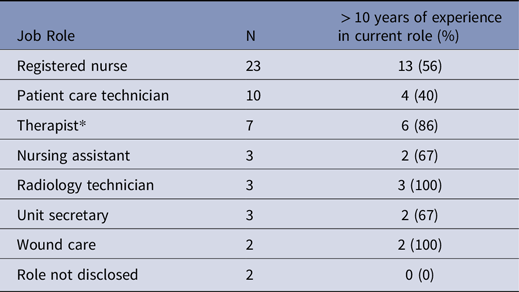
Fifty-three surveys were completed. Respondents were 92% female, 43% nurses, and 60% had >10 years of experience in their current role (Table 1). Understaffing (63%), lack of training (52%), lack of coworker accountability (48%), and lack of time for task completion (49% for self, 48% for coworkers) were identified as barriers to C. auris prevention.
Survey participant job roles and years of experience

* Respiratory therapist (n = 6), physical therapist (n = 1)
Participants reported high awareness of common healthcare-associated pathogens including Clostridioides difficile (98%), methicillin-resistant Staphylococcus aureus (MRSA; 88%), C. auris (86%), and vancomycin-resistant Enterococcus (VRE; 85%). Participants less frequently reported awareness of extended-spectrum β-lactam-resistant (ESBL; 68%) and carbapenem-resistant pathogens (carbapenem-resistant Enterobacterales [CRE; 79%], carbapenem-resistant Pseudomonas aeruginosa [CRPA; 56%], and carbapenem-resistant Acinetobacter baumannii [CRAB; 64%]). Participants most commonly selected C. auris (32%) or C. difficile (28%) when asked which organism they felt was the most challenging to control. Nurses and nursing assistants reported high rates of awareness for all healthcare-associated pathogens queried (90.2%), followed by rehabilitation therapists (89.6%). Overall awareness reported by participants in other job roles (ie, wound care, radiology technicians, unit secretaries, and unknown) was lower (41.6%), although the numbers of participants were small (n = 10).
When surveyed, 74% (37/50) felt that C. auris is a national problem, but only 56% (28/50) felt it was a problem in their own hospital. The perception that C. auris is not a problem, as indicated by rating neutral or disagree, was more common among patient care technicians, radiology technicians, and wound care staff (60% for national and 80% for hospital problem). Only 65% of participants agreed they could identify which patients in their hospital had C. auris, while 71% agreed they knew where to find C. auris hospital guidelines. Most participants agreed they knew which protective precautions to use when caring for patients with C. auris (81%), how to prevent C. auris from spreading between patients (85%), and that their actions help prevent the spread of C. auris in their hospital (85%). However, only 66% agreed that they felt comfortable educating patients and their families about C. auris.
Participants accurately identified most prevention strategies for C. auris including use of gowns and gloves (96%), isolation status signage (96%), hand washing with soap and water (94%), single-patient rooms (94%), and cleaning of the hospital environment and shared patient equipment (94%). Participants less frequently identified hand washing with alcohol-based hand rub (87%) and patient bathing with antiseptic soap (85%) as effective strategies. Patient cohorting (73%) was the least commonly identified strategy, with 39% of nurses rating this strategy as neutral or disagree. Participants rated themselves and coworkers highly for compliance with prevention measures (96-98% and 86-96%, respectively). Motivations for compliance with personal protective equipment (PPE) were similar across all roles, including preventing spread to themselves, coworkers, family members, and other patients (92% agree for each).
Education and training regarding C. auris prevention was reported to be most commonly obtained through their primary hospital of employment (62%) and coworkers (45%). Participants preferred to learn about infection prevention through in-person teaching led by experts at their hospital (83%) or experts from another institution (79%), although self-learning styles (ie, printed materials [71%], assigned resources on the Internet [63%], or interactive modules [60%]) were also popular.
Qualitative focus groups
Twenty-one individuals participated in five focus groups, with group sizes ranging from 3-5 people. Participants included 10 nurses, 5 patient care technicians, 3 secretaries, and 3 therapists (including a physical therapist, respiratory therapist and speech/language therapist).
Participants were asked how they identify patients with resistant germs in their hospital and how this influences the care that they provide. Participants relied heavily on isolation signs placed outside patients’ rooms to identify those colonized with resistant organisms. They were not focused on names of individual organisms (eg, ‘CRE’, ‘MRSA’); rather, they were most concerned with identifying appropriate PPE and cleaning products. In the words of one participant, “I don’t think about [the germ] other than ‘do I have to wear a gown and what am I using to clean things in the room’.” Participants did not feel that knowing the specific organism would affect the care that they provided, other than use of appropriate PPE, cleaning products, and hand hygiene. One participant shared, “As long as I’m doing the proper PPE, I don’t worry about what kind of infection that he has. Making sure the patient is clean, making sure the patient is comfortable – that’s all that matters.” Another participant noted, “We’re still going to give them all the same care, but you just gotta wear different things.”
Participants were asked how they identify patients with C. auris and to share their experiences providing care. Most participants obtained information about C. auris colonization by chart review. Nurses also reported receiving this information in reports at patient hand-off. All participants indicated that they had cared for patients with C. auris but did not feel that knowledge of C. auris colonization substantially affected their experience. One participant shared, “It’s just a regular day for me. I just make sure I protect myself and I still got to care for my patient the same way I care for the rest. No difference.”
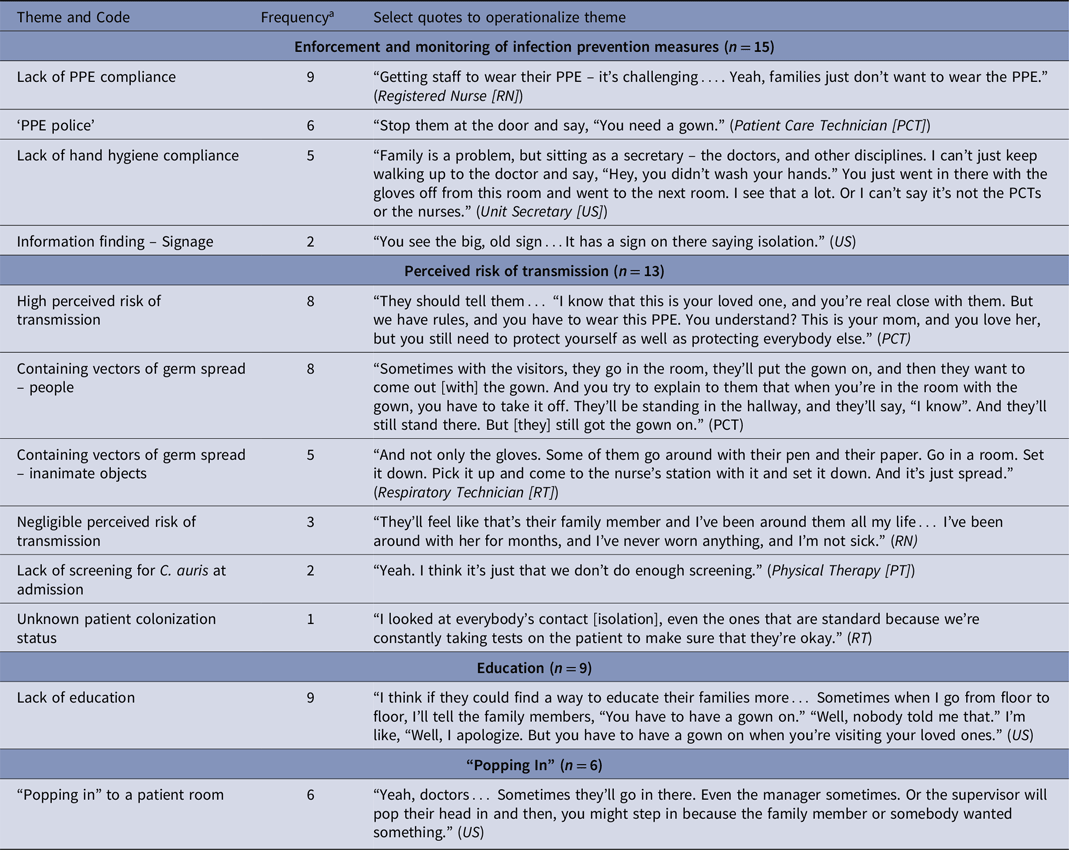
When asked about the greatest challenge to preventing C. auris in their hospital, the most convergent themes reported by responding participants (n = 19) were enforcement and monitoring of infection prevention measures and perceived risk of transmission. The ‘enforcement and monitoring’ theme was predominantly focused on noncompliance with PPE. Many participants identified themselves in the role of ‘PPE Police’, informally monitoring and enforcing compliance with prevention measures among peers. High perceived risk of transmission among healthcare providers was identified as a common contributor to C. auris spread. Negligible perceived risk of transmission, particularly among patient family and visitors, was also identified as a contributor to spread because it reduced compliance with prevention measures. Nearly half of participants identified lack of education as a challenge, suggesting that education should be required for healthcare providers as well as patients and visitors. Nearly one-third of participants also identified the behavior of “popping in” to a patient room (identified in earlier literature as ‘brief encounters’ Reference Dedrick, Sinkowitz-Cochran and Cunningham13 ) as a challenge, which occurs when a staff member enters a patient room for a brief task without using appropriate prevention measures. “Popping in” was described by one participant as, “People might think…I’m just going in there really quick…but it doesn’t matter if it’s really quick. You’re still going in there so you should wear the right equipment, even if it’s just to draw blood sugar.” (Table 2).
Qualitative codes by theme: What do you think is the greatest challenge to preventing C. auris at this hospital?

a All responses were provided voluntarily and due to the open discussion format, not every participant provided a response to every question. All summaries of qualitatively coded data are based upon those responses received throughout the discussion. Participants’ responses were categorized to each individual code only once; however, responses may be categorized to more than one code.
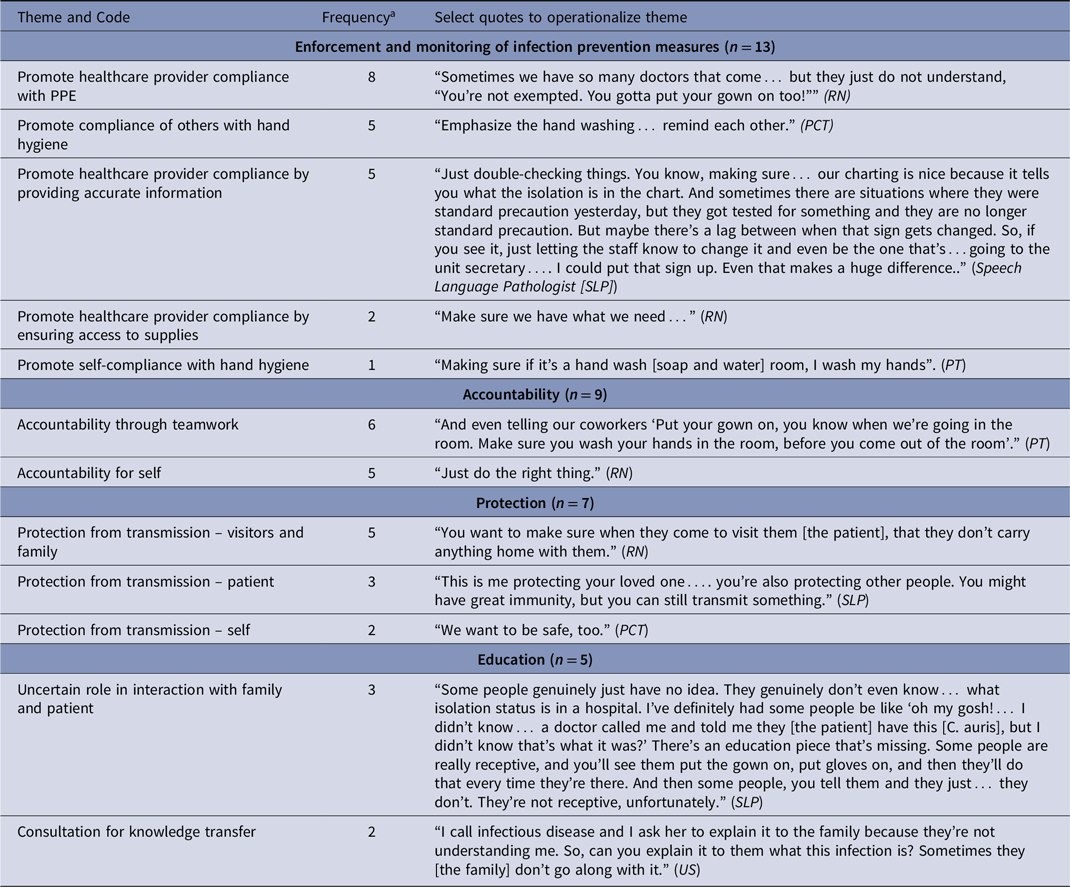
When asked what their role is in preventing C. auris at their hospital, nearly all responding participants (n = 14) identified enforcement and monitoring of infection prevention measures. Participants focused strongly on the compliance of their peers with PPE and hand hygiene. One participant provided the example, “Making sure that I speak up if I see somebody else not wearing their PPE.’” In contrast, monitoring for self-compliance was identified by only one participant. Participants also identified prominent roles in accountability and protection. Equal focus was placed on accountability for their own actions, as described by one participant, “Making sure that I set a good example, as far as compliance and PPE”, as well as those of the overall care team, “Keep your friends accountable, because the PPE police are not here 100% of the time.” The role of protection focused on protecting visitors from acquiring transmissible pathogens. Some participants expressed uncertainty regarding their role in educating patients and visitors. This uncertainty was highlighted in the context of negative or challenging interpersonal experiences when providing education or enforcement of prevention measures to visitors (Table 3).
Frequency of qualitative codes by theme: What do you think is your role in preventing C. auris at this hospital?

a All responses were provided voluntarily and due to the open discussion format, not every participant provided a response to every question. All summaries of qualitatively coded data are based upon those responses received throughout the discussion. Participants’ responses were categorized to each individual code only once; however, responses may be categorized to more than one code.
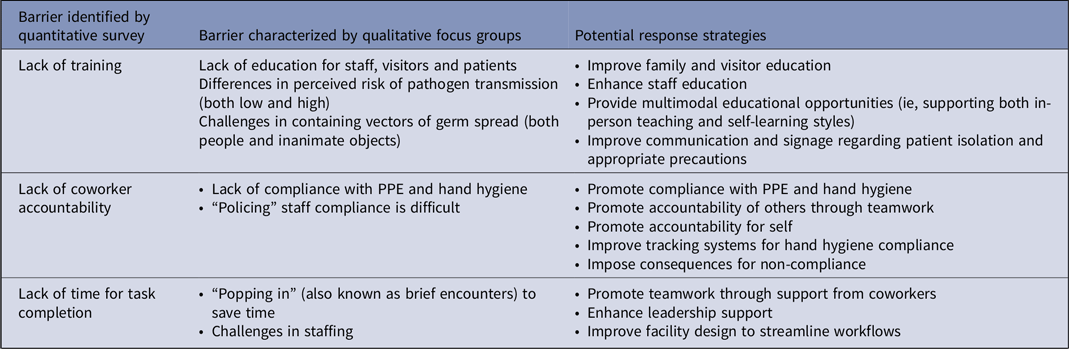
Participants were asked what changes they would make to better prevent infections from happening at their hospital. All responding participants (n = 20) identified the theme of enhanced education. This included education for healthcare providers as well as for patients and visitors. Building on the uncertain role in education, another participant suggested, “I think people would be more comfortable confronting visitors if they had more information. Maybe they don’t want to say anything because what if [the visitors] have some questions and then don’t know what to say?” Half of the participants suggested improvements in enforcement and monitoring of infection prevention measures. Enhanced staff support, improvement in visual communication (ie, use of easy-to-interpret signs), and improvements in healthcare design were also commonly identified. Remarkably, only two participants suggested that they would improve staffing (Table 4). Key barriers and potential solutions are summarized in the Box.
Qualitative codes by theme: Suppose that you were in charge – what changes would you make to better prevent infections from happening at this hospital?

a All responses were provided voluntarily and due to the open discussion format, not every participant provided a response to every question. All summaries of qualitatively coded data are based upon those responses received throughout the discussion. Participants’ responses were categorized to each individual code only once; however, responses may be categorized to more than one code.
Discussion
This study was conducted to better understand barriers to effective C. auris prevention among frontline healthcare workers in two LTACHs. Our study offers a novel contribution by utilizing a mixed-methods approach that presents distinct and unique perspectives of frontline healthcare workers, operationalized through their own words. There was strong concordance among responses acknowledging the importance of compliance with infection prevention measures. Barriers to C. auris prevention identified in the survey included understaffing, lack of training, lack of accountability, and lack of time for task completion. To further explore these barriers and identify potential solutions, we conducted qualitative focus groups. Convergent themes across focus groups highlighted the importance of enforcement and monitoring of prevention measures and the need for additional education. These insights were achieved through deep contextual understanding of barriers and potential solutions to prevention of C. auris.
Survey findings highlighted high levels of awareness of the most common healthcare-associated pathogens (ie, C. difficile, MRSA) but less familiarity with those with lower prevalence (eg, CRE). Qualitative evaluation revealed that participants found the names of pathogens to be less important than identifying the strategies needed for their containment. They focused strongly on operational considerations, such as whether providing care required the use of PPE. Participants relied heavily on signs placed outside of patients’ rooms for communication and offered multiple suggestions to improve information sharing. Our findings suggest that optimizing system level factors, such as standardized protocols Reference Barnes, White, Young, Ramsey, Cochran and Perkins14 and improved visual prompts, Reference Caris, Labuschagne, Dekker, Kramer, van Agtmael and Vandenbroucke-Grauls15 may enhance communication of containment strategies.
A resounding theme converging across nearly all questions was need for additional education for healthcare providers, patients, and visitors. Lack of education was consistently linked to perceived lack of compliance with prevention measures. For example, lack of compliance was attributed to low perception of risk, not knowing how to properly wear PPE, or inability to interpret posted signs. Participants inferred that education would improve compliance and reduce vectors of spread (ie, by people and inanimate objects). This idea is supported by prior work linking knowledge of the rationale for infection prevention with adherence to prevention measures. Reference Anderson, White, Cochran and Perkins16,Reference Nobile, Agodi and Barchitta17 Multiple potential educational solutions were identified, including in-person training, self-study, enhanced transparency of infection metrics, and transfer of knowledge (ie, from infection preventionist or leadership). We also found that healthcare providers felt uncertain in their role in educating patients and visitors about infection prevention. Reference Banach, Bearman, Morgan and Munoz-Price18 Thus, educational programs that empower healthcare providers to educate peers, patients and visitors may be beneficial. Reference Ronco, Odasmini, Chiappinotto and Palese19,Reference Pashnik, Creta and Alberti20 Additionally, future prevention efforts should be coordinated with public health partners and leverage available public health resources.
Although identified as a major barrier in the quantitative survey and prior work, Reference Snyder, Anderson and White21–Reference Seshadri, Concannon, Woods, McCullough and Dumyati23 staffing was a minor focus in focus groups. This may be explained by potentially different participants in the quantitative and qualitative cohorts or due to more in-depth insights garnered through group discussion. The representation of both direct and indirect patient care providers (eg, nurse, unit secretary) could also result in different perceptions. Lack of resources, commonly identified by frontline healthcare providers during the COVID-19 pandemic, Reference Snyder, White, Anderson and Cochran24–Reference McGarry, Grabowski and Barnett26 was not identified as a major barrier in either cohort.
This study was subject to several limitations. We utilized a convenience sample of healthcare providers. Each participant self-reported answers, which may have been subject to recall and social desirability biases. Participants were not included at random, with participants more likely to be knowledgeable or interested in the content area than those who did not volunteer to participate. We did not track whether participants of the quantitative survey participated in qualitative focus groups, which could explain the lack of convergence for some themes. Qualitative focus groups were only available during day shifts on selected dates. Notably, there was low recruitment from nonclinical groups.
Strengths of this study include recruitment of a cohort of frontline healthcare providers in a region of endemic C. auris spread. Our cohort also included healthcare providers with traditionally ‘nonclinical’ job titles (ie, unit secretary), but who may participate more intimately with patient care compared to short-stay acute care facilities. Unexpected unit secretary activities included education of visitors, responding to patient call lights, and having personal connections with long-term patients and their families. Most of the unit secretaries in our qualitative cohort reported prior job experience in direct patient care (eg, phlebotomist, patient care technician). The long-term care environment may result in unique engagement of both clinical and nonclinical healthcare providers in care compared to short-term acute care settings.
Future research should translate these findings into testable practical solutions to improve infection prevention practices in LTACHs. Implementation of individual, facility, and system-level interventions may include enhanced communication strategies, development of multimodal educational programs, and improved operationalization of such programs. Additionally, further evaluation of nonclinical perspectives (eg, hospital administration, environmental services) to identify additional gaps and potential solutions should be pursued.
In conclusion, we identified multiple barriers and potential solutions to C. auris containment in LTACHs. Potential targets for improvement include communication, education, and promotion of a culture of accountability.
Summary of Key Barriers and Potential Response Strategies

Supplementary material
To view supplementary material for this article, please visit https://doi.org/10.1017/ice.2025.10351
Acknowledgements
The authors thank Meghan Lyman and Maroya Walters for their critical review of the survey questions. We extended our deepest gratitude to participants of the study for making this work possible.
Financial support
This work was supported by the SHEA Research Scholar Award and by the cooperative agreement U54CK000607 from Centers for Disease Control and Prevention (CDC). Its contents are solely the responsibility of the authors and do not necessarily represent the official views of SHEA or CDC.
Competing interests
All authors report no conflicts of interest relevant to this article.