Introduction
It is well documented in the literature that the work situation of nurses in residential care is demanding and challenging (Edvardsson et al., Reference Edvardsson, Sandman, Nay and Karlsson2009a), but several studies also indicate that those nurses are generally satisfied with their work situation (Brodaty et al., Reference Brodaty, Draper and Low2003; Castle et al., Reference Castle, Degenholtz and Rosen2006). For example, nursing staff in Sweden and Australia (n = 927) stated that the feelings they most commonly experienced in their daily work with people with dementia were satisfaction and joy (Edberg et al., Reference Edberg, Anderson, Orrung Wallin and Bird2009). Research also shows that if the nurses in residential care are satisfied with their work situation, the quality of care improves (Castle et al., Reference Castle, Degenholtz and Rosen2006) and that when nurses perceive their work as unsatisfactory they exhibit a more distanced attitude toward their work (Demerouti et al., Reference Demerouti, Bakker, Nachreiner and Schaufeli2000). Edvardsson and co-workers (Reference Edvardsson, Sandman, Nay and Karlsson2008) found that a low prevalence of behavioral symptoms among residents in residential dementia care was associated with high levels of job satisfaction. A widely used definition of job satisfaction is given by Locke (Reference Locke and Dunnette1976) who stated that job satisfaction is a consequence of a positive or pleasurable emotional state resulting from the nurses’ appraisal of their job or work experience. Locke further states that job satisfaction occurs when the nurses are able to apply their own values in their work and, thus, bring their work into congruence with their needs. However, we have very little knowledge about this interrelationship, and such knowledge is needed in order to be able to design means for support and to assess intervention effects.
Job satisfaction as a concept is widely studied, but the evidence derived from various theoretical models remains ambiguous (Judge et al., Reference Judge, Anderson, Ones, Sinangil and Viswesvaran2001; Coomber and Barriball, Reference Coomber and Barriball2007). Theories from a general psychological perspective have previously been used such as Herzberg's (Reference Herzberg1966) theory in which he states that job satisfaction is improved by intrinsic variables (such as the work itself, achievements, and responsibilities) and job dissatisfaction is reduced by extrinsic variables (such as pay, company policies, and working conditions). Another general approach is the Job Characteristics Model (Hackman and Oldham, Reference Hackman and Oldham1976) which focuses mainly on intrinsically motivating characteristics within the care task, e.g. skills, autonomy, and feedback, which support high levels of job satisfaction. Hackman and Oldham (Reference Hackman and Oldham1976) further state that job satisfaction is more significantly associated with these characteristics among nurses who have a strong desire for professional development. These various theories indicate the importance of job satisfaction from a general perspective. There is, however, also a need for measures specifically designed for different work contexts, such as aged care, as the prerequisites and working conditions vary according to the context.
When the whole body of research in the field of job satisfaction related to residential care for older people is examined it seems ambiguous. Some studies investigate both job satisfaction and job strain (e.g. Moyle et al., Reference Moyle, Skinner, Rowe and Gork2003; Te Boekhorst et al., Reference Te Boekhorst, Willemse, Depla, Eefsting and Pot2008), but focus mainly on the strenuous aspects rather than what constitutes job satisfaction, thus, treating the two concepts as two sides of the same coin. Other studies indicate that job satisfaction and job strain among nurses working in dementia care are not correlated (c.f. Brodaty et al., Reference Brodaty, Draper and Low2003) and, thus, cannot be treated as extremes on a continuum or as one concept: a position supported by the Herzberg's (Reference Herzberg1966) theories on job satisfaction. Substantial research has been carried out in the field of job satisfaction on a general level and several associated variables have been found, for example leadership (e.g. Tellis-Nayak, Reference Tellis-Nayak2007; Sellgren et al., Reference Sellgren, Ekvall and Tomson2008) and organizational work climate (e.g. Sellgren et al., Reference Sellgren, Ekvall and Tomson2008). Variables found to be associated with satisfaction with nursing-care provision, i.e. on a context-specific level, are the caring climate (e.g. Morgan et al., Reference Morgan, Stewart, D'Arcy, Forbes and Lawson2005; Pekkarinen et al., Reference Pekkarinen, Sinervo, Elovainio, Noro, Finne-Soveri and Leskinen2006), personalized care provision, and environmental support (Edvardsson et al., Reference Edvardsson, Fetherstonhaugh, McAuliffe, Nay and Chenco2011). In addition, personal and work-related aspects, such as work experience, education (e.g. Zimmerman et al., Reference Zimmerman2005; Lu et al., Reference Lu, While and Barriball2007), and age (e.g. Brodaty et al., Reference Brodaty, Draper and Low2003; Lu et al., Reference Lu, While and Barriball2007), have been found to be associated with job satisfaction in dementia care. However, most studies focused mainly on one or a few variables when investigating job satisfaction, which complicates defining job satisfaction as a concept from a broader perspective. One of the few studies that tried to grasp job satisfaction in a wider perspective is that of Tourangeau and co-workers (Reference Tourangeau, Cranley, Spence Laschinger and Pachis2010) who found that general job satisfaction is associated with emotional exhaustion, personal accomplishment, global empowerment, psychological empowerment, work group cohesion, and perceived organizational support. This model explained 56% of the variance of general job satisfaction. Factors that did not contribute to the final model were depersonalization, burnout, work group communication, supportive conditions for work effectiveness, and supportive leadership practices. The results from Tourangeau and co-workers showing that leadership aspects were not related to job satisfaction contrast with the results of other studies (e.g. Tellis-Nayak, Reference Tellis-Nayak2007; Sellgren et al., Reference Sellgren, Ekvall and Tomson2008) which show that job satisfaction was closely related to leadership aspects. However, these studies measured the concepts in different ways which could be one reason for the diverging results. The sample in Tourangeau and co-workers (Reference Tourangeau, Cranley, Spence Laschinger and Pachis2010) study was also heterogeneous, including for example registered nurses (RNs), licensed practical nurses (LPNs), and managers. As these professionals face different challenges in their work, the models and interrelationships explaining job satisfaction might differ among them. There were fewer differences between RNs’ and LPNs’ perceptions than one might expect, which also raises the question of the impact of different organizational structures when comparing countries and work settings. Consequently, focusing on nurse assistants, as the ones who are the main providers of everyday nursing care and on both general and context-specific levels, could lead to a deeper understanding of the concept of job satisfaction. In this study, the aim was, thus, to investigate job satisfaction and explore associated variables among nurse assistants working in residential care for older people.
Methods
Context and participants
The present study had an explorative, descriptive, and cross-sectional design. A sample (n = 312) of nurse assistants ((LPNs) and Nurse's Aides (NAs)) working in general residential or specialized dementia care settings in three districts of a larger city in southern Sweden were invited to participate in the study. Both oral and written information about the study was given by coordinators working with the research project managing the data collection. The nurse assistants were given time on several occasions to answer the questionnaire during work time with access to the research coordinator, if clarification of the questions was needed. Because so many participants did not have Swedish as their native language (48% of the participants were born outside of Sweden but had lived there for a median of 17 years), they were given the chance to have an interpreter but did not take up the offer. The total questionnaire took approximately 1–2 hours to complete and was returned in a sealed envelope by the participant. Only the coordinators had access to the participant code key, in order to be able to send out reminders if questionnaires were missing and at the same time to ensure that the researchers could not link any answers to individual participants. Nurse assistants working with everyday domestic (cleaning and cooking) and caring tasks were eligible for participation in the study. In total 225 (68.9%) nurse assistants gave their informed consent to participation in the present study. There were no direct analysis of the non-respondents; however, the mean age and gender of the participants in the present study corresponded to group statistics available from the Swedish Association of Local Authorities and Regions (SALAR, 2009). No other data concerning non-participants were available.
In Sweden, LPNs have approximately 2–3 years of upper secondary education in nursing-care or an equivalent education within adult education. LPNs are supervised by registered nurses who are in charge of delegated medical tasks, such as distributing oral and subcutaneous medicine and treating pressure ulcers. NAs have limited or no formal education in nursing-care, but perform approximately the same care tasks as LPNs, apart from delegated medical tasks.
Those living in the residential care settings are older people (+65) with extensive care needs due to physical and/or cognitive impairment. The care settings range from smaller special accommodation units caring exclusively for people with dementia to larger, non-specific, caring for older people, but with a high proportion of residents with dementia. All care settings strive to provide a home-like environment, with shared as well as private spaces. All residents have their own apartments with their own private furniture within the care setting.
Measurements
Data were extracted from a larger questionnaire concerning work-related questions, other parts of which will be published elsewhere. For this study, data were selected concerning job satisfaction, including both general job satisfaction and satisfaction with nursing-care provision, demographic and work-related aspects, health complaints, sense of coherence, person-centered care provision, care climate, quality of care, general work climate, and leadership. All questionnaires were pretested for psychometric properties such as validity and reliability; for details please see specific references.
General job satisfaction was measured using the Job Satisfaction Questionnaire (Ekvall, Reference Ekvall2001), with 20 items scored on a four-point scale (0 = mostly negative to 3 = mostly positive). The summarized score is divided by the number of items with a possible range from 0 to 3. High scores indicate high levels of job satisfaction. The questionnaire consists of five factors (Ekvall, Reference Ekvall2001). In this study, internal consistency was measured using Cronbach's α and was α = 0.94 for total score and as follows for the five factors: autonomy α = 0.86, competence α = 0.78, emotion α = 0.82, initiative α = 0.78, and relation α = 0.72.
Satisfaction with nursing-care provision was measured using the Psychosocial Aspects of Job satisfaction Questionnaire (Engström et al., Reference Engström, Ljunggren, Lindqvist and Carlsson2006), with 49 questions scored on a five-point scale (ranging 0 = never to 4 = very often). The summarized score divided by the highest possible score multiplied by 100 gives a possible range of 0–100. High scores indicate high levels of job satisfaction. The questionnaire comprises eight factors (Engström et al., Reference Engström, Ljunggren, Lindqvist and Carlsson2006). In this study, the internal consistency, using Cronbach's α was α = 0.92 for the total score and as follows for the eight factors: personal development α = 0.81, workload α = 0.81, criticism α = 0.83, expectations and demands α = 0.70, cooperation α = 0.75, internal motivation α = 0.75, external motivation α = 0.58, and position in the group α = 0.51).
Demographic and work-related information collected included age (years), gender (male/female), marital status (married/partner or single), formal education (compulsory school only (9 years)/upper secondary school/university or college), position at the workplace (LPN/NA), work experience in residential care (years), working time (day/night), working hours (full-time/part-time), and workplace (dementia care setting/general care setting).
Health complaints were measured using the following single items from a questionnaire concerning staff health (Engström et al., Reference Engström, Ljunggren, Lindqvist and Carlsson2006): During the last 3 months have you experienced: (a) sleep problems, (b) feeling worried and restless, (c) physically exhausted after work, and (d) feeling sad and depressed. All questions were answered on a five-point scale (0 = never to 4 = very often). High scores indicate poorer health (Engström et al., Reference Engström, Ljunggren, Lindqvist and Carlsson2006).
Sense of coherence is a concept that embraces the internal resources a person can draw on when dealing with the demands in life and includes the core components comprehensibility, manageability, and meaningfulness. Sense of coherence was measured in this study using the Sense of Coherence questionnaire (Antonovsky, Reference Antonovsky1987). The instrument comprises 29 items and is rated on a seven-point scale (1 = rarely or seldom to 7 = very often); negative questions were reversed before summarizing the total score, which had a possible range of 29–203. High scores indicate a strong sense of coherence. In this study, the internal consistency, measured using Cronbach's α, was α = 0.88 for the total score.
Personalized care and organizational support were measured using the Person-centered Care Assessment Tool (Edvardsson et al., Reference Edvardsson, Fetherstonhaugh, Nay and Gibson2010), based on 13 questions rated on a five-point scale (ranging from 1 = completely disagree to 5 = completely agree). A two-factor solution as described by Sjögren and co-workers (Reference Sjögren, Lindkvist, Sandman, Zingmark and Edvardsson2012) was used in this study, measuring personalized care and organizational and environmental support. Negative questions were reversed before summarizing and transforming the scores into an average mean, with a possible range of 1–5. High scores indicate a high degree of person-centered care provision (Edvardsson et al., Reference Edvardsson, Fetherstonhaugh, Nay and Gibson2010). In this study, the internal consistency, measured using Cronbach's α, was α = 0.74 for the factor personalized care and α = 0.79 for the factor organizational and environmental support.
The caring climate was measured using the Person-centered Climate Questionnaire, staff version (Edvardsson et al., Reference Edvardsson, Sandman and Rasmussen2009b), with 14-item rated on a six-point scale (1 = no, I completely disagree to 6 = yes, I completely agree). The total score was summarized, divided by the number of items giving a possible range of 1–6 (Edvardsson et al., Reference Edvardsson, Sandman and Rasmussen2009b), with high scores indicating a high person-centered climate. In this study, the word “patient” was replaced by using “resident” in order to fit the residential care context. The internal consistency, measured using Cronbach's α, was α = 0.78, for the total score.
The quality of care was measured using the Quality of Care Aspect Questionnaire (Engström et al., Reference Engström, Ljunggren, Lindqvist and Carlsson2006), based on 24 questions rated on a 0–4-point scale (0 = never happens to 4 = happens very often; 0 = happens very often to 4 = never happens; 0 = very bad to 4 = very good). The summarized score divided by the highest possible score multiplied by 100 gives a possible range of 0–100. High scores indicate high levels of quality of care. The questionnaire comprises four factors: nursing and medical care, communication obstacles, documentation, and communication ability (Engström et al., Reference Engström, Ljunggren, Lindqvist and Carlsson2006). In this study, the internal consistency, measured using Cronbach's α, was α = 0.86 for the total score and on the factor level as follows: nursing and medical care α = 0.82, communication obstacles α = 0.76, documentation α = 0.89, and communication ability α = 0.79.
The general work climate was measured using the Creative Organizational Climate Questionnaire (Ekvall, Reference Ekvall2004), with 50 items rated on a four-point scale (0 = agree, not at all to 3 = agree, very much). High scores indicate a positive general work climate and the summarized score, divided by the number of items, gives a possible range of 0–3. The questionnaire comprises ten factors (Ekvall, Reference Ekvall2004). In this study, the internal consistency, measured using Cronbach's α, was α = 0.79 for the total score and on factor level as follows: challenge α = 0.79, freedom α = 0.62, idea/support α = 0.88, trust α = 0.67, dynamism α = 0.71, playfulness α = 0.81, debates α = 0.70, conflicts α = 0.80, risk taking α = 0.69, and idea time α = 0.81.
Leadership was measured using the Leadership Behavior Questionnaire (© Farax Group AB, Ekvall and Arvonen, Reference Ekvall and Arvonen1994), which comprises two sub-scales concerning the leaders’ managerial behavior and the prerequisites for a leader. The sub-scale used in this study referred to the leaders’ managerial behavior and comprised 24 questions rated on a six-point scale (1 = completely disagree to 6 = completely agree). The summarized score, divided by the number of items, gives a possible range of 1–6. High scores indicate positive leadership. The sub-scale consists of three factors concerning the leader's behavior: employee/relations, change/development, and production/task/structure (Ekvall and Arvonen, Reference Ekvall and Arvonen1994). In this study, the internal consistency, measured using Cronbach's α, was 0.96 for the total score and varied from 0.90 to 0.92 for the factors.
Statistical analysis
Descriptive statistics were calculated using means and standard deviations for continuous variables and frequencies and percentage for categorical variables. The questionnaires’ internal consistency was tested on total scores and factors, using Cronbach's α. The sample was divided into three with the first 25 percentile (1st quartile) of the nurse assistants defined as having low job satisfaction, and the 25–75 percentile (2nd–3rd quartiles) defined as having moderate job satisfaction, and the top 75 percentile (4th quartile) defined as having a high level of job satisfaction (Tables 1 and 3). Associations and differences were considered to be significant if p < 0.05. Imputations (using mean substitutions) were made for variables in the questionnaires if less than 10% of the answers to the questions per case and questionnaire were missing. Comparisons were made using Student's t-test and One-way ANOVA for interval and ratio data, the χ 2 test for nominal data, and the Kruskal–Wallis test for ordinal or skewed ratio data. If significant differences were found between low, moderate, and high levels of job satisfaction in the Kruskal–Wallis test, post-hoc tests with the Mann–Whitney U-test using Bonferroni adjustment were performed with an adjusted α of 0.017, in order to reduce type 1 errors.
Comparisons of demographic, work-related, and health complaint variables between low, moderate, and high levels of job satisfaction

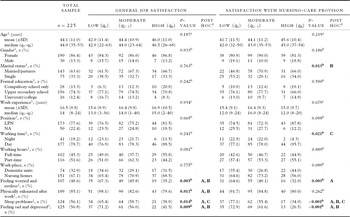
LPN = licensed practical nurse, NA = nurse's aide. Missing values for total sample: 13.1%–5.3%, 21.3%–2.2%, 38.4%. aOne-way ANOVA, b χ 2 test, cKruskal–Wallins test, dMann–Whitney U-test followed by Bonferroni adjustment (revised α = 0.017): Significant difference between A low and high, B low and moderate, C moderate and high job satisfaction. Significant differences are presented in bold.
In total, 15 multiple linear regression analyses (backward selection) were made to explore variables associated with general job satisfaction and satisfaction with nursing-care provision. The B coefficient indicates how the independent variable changes if the dependent variable changes by one unit, whereas the β coefficient shows the hierarchical interrelationship between the independent variables in the regression model. The final models presented include only significant variables associated with job satisfaction. Variables in the 15 models were total scores and factor scores (competence, emotion, autonomy, initiative, and relations) for general job satisfaction and total score and factor scores (personal development, workload, criticism, expectations and demands, cooperation, internal motivation, external motivation, and position in the group) for satisfaction with nursing-care provision.
In all 20 independent variables were entered into all the regression models: age, gender, marital status, sleep problems, feeling worried and restless, physically exhausted after work, sad and depressed, sense of coherence, formal education, working experience, position, working time, working hours, workplace, personalized care provision, organizational and environmental support, caring climate, quality of care, general work climate, and leadership. Single items concerning health complaints, measured on a four-point ordinal scale, were transformed into dichotomized variables (never and seldom = 0 and sometimes, quite often and very often = 1) before being entered into the regressions. The number of independent variables in the analysis was deemed satisfactory due to the sample size not exceeding 5–10 cases per variable entered in the model (Norman and Streiner, Reference Norman and Streiner2008). An adjusted goodness of fit (R 2 adj ) was used because of the relatively large number of variables entered into the models, thus, minimizing overestimation of the regression models. No problems with multicollinearity were found in the correlation matrix, meaning no correlations above 0.7, no values below 0.10 when testing the tolerance, and no values above 10 in the variance inflation factor test. No violations of normality of the residuals were found when visually assessing normal probability plots or using the Shapiro–Wilk test of normality. Predictive Analysis Software (PASW) 18.0 (IBM, SPSS, Inc., Somers, NY, USA) was used for all statistical analyses.
Ethical considerations
Ethical approval was not needed for the main study according to the advisory decision from the regional ethics board (ref. no. 2009/527), with reference to Swedish legislation (SFS, 2003: 460) and the limited risk of harm the present study could potentially pose. The ethical principles of the Helsinki Declaration 1964, as revised in 2008, were followed. Participants were supplied with both oral and written information about the study before they gave their informed consent. They were also informed that they could withdraw at any stage of the study without prejudice and confidentiality was ensured as no personal information, apart from demographics, was collected. The questionnaires were coded, and the researcher had no access to the code key. The workplace managers at the residential care units did not have access to any information about who did and did not answer the questionnaires.
Results
The total sample comprised 225 nurse assistants with a mean age of 44.1 (SD 11.0) years, the majority was women (86.4%) who were married or had partners (63.6%). Regarding formal education, the majority of the nurse assistants had a formal upper secondary education (74.3%). In the sample, 13.3% had only compulsory schooling, and 12.4% had studied at university level (Table 1).
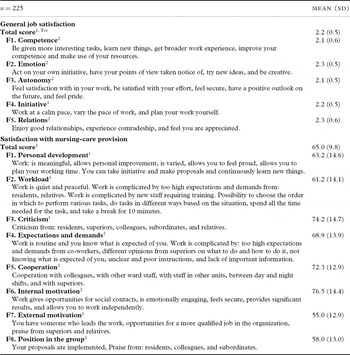
Concerning general job satisfaction, the mean score was 2.2 (possible range of 0–3) (Table 2) and concerning satisfaction with nursing-care provision the mean score was 65.0 (possible range of 0–100) (Table 2). Significant correlations between the dependent variables (general job satisfaction and satisfaction with nursing-care provision) in total and as a factor level varied between r ranging from 0.142 to 0.650. No significant differences in job satisfaction were found between dementia units and nursing homes. However, marital status and working time differed significantly when low, moderate, and high levels of job satisfaction with nursing-care provision were compared. This meant that married nurse assistants reported more satisfaction with nursing-care than those who were single and that those working days reported more satisfaction with nursing-care than those working nights. In addition, health complaints differed significantly when low, moderate, and high levels of job satisfaction were compared, apart from feeling physically exhausted after work, in that nurse assistants who reported health complaints also reported lower job satisfaction (Table 1).
Description of general job satisfaction and satisfaction with nursing-care provision on total and factor level

Missing:14.0%–6.7%, 21.8%–3.6%.
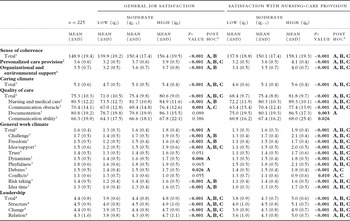
When describing variables in comparisons between low, moderate, and high levels of job satisfaction (Table 3), the results showed the same patterns for general job satisfaction and satisfaction with nursing-care provision, meaning that the variable scores increased in accordance with an increasing degree of job satisfaction (e.g. low, moderate, and high levels of job satisfaction). Nurse assistants who rated high on satisfaction with nursing-care provision had significantly higher scores for sense of coherence, person-centered care provision, caring climate, quality of care, general work climate, and leadership than nurse assistants who rated high for general job satisfaction (Table 3).
Descriptions and comparisons of independent variables between low, moderate, and high levels of job satisfaction

Missing values in total sample: 16.7%, 21.8%–3.6%, 34.0%–6.2%, 412.9%–15.6%. All statistics comparing groups were performed with Kruskal–Wallins test except a Post hoc tests that were performed with Mann–Whitney U-test followed by Bonferroni adjustment (revised α = 0.017): Significant difference between A low and high, B low and moderate, C moderate and high job satisfaction. Significant differences are presented in bold.
Variables associated with general job satisfaction
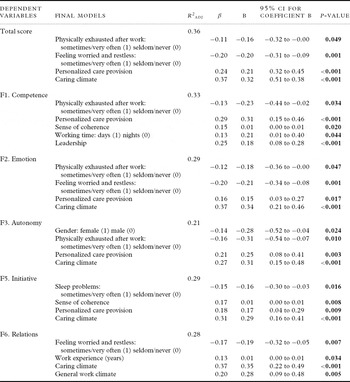
The variables entered into the regression model concerning general job satisfaction explained 36% of the variance on total score (Table 4). In a hierarchal order, the caring climate explained most of the variance in general job satisfaction, followed by personalized care provision. Low general job satisfaction was associated with feeling worried and restless and feeling physically exhausted after work. Some variables that were not associated with total general job satisfaction explained the variance on factor level. The variables associated with high Competence (F1) were leadership, sense of coherence, and working days. Being female was associated with low Autonomy (F3). Sense of coherence was associated with a high degree of Initiative (F4). Having sleep problems was associated with a low degree of Initiative (F4). Finally, the general work climate and work experience were associated with positive Relations (F5) (Table 4).
Variables associated with general job satisfaction on total and factor levels, respectively

Variables entered into the regression analysis: age, gender, married/partner, feeling sad and depressed, feeling worried and restless, sleep problems, physically exhausted after work, sense of coherence, formal education, position, working experience (in years), working time, working hours, work-place, personalized care provision, organizational and environmental support, caring climate, quality of care, general work climate, leadership. Significant differences are presented in bold.
Variables associated with satisfaction with nursing-care provision
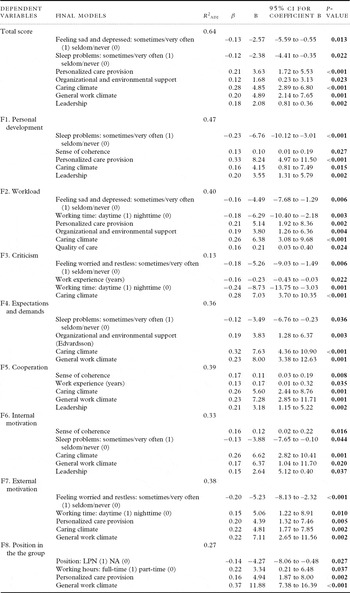
The variables entered into the regression model concerning satisfaction with nursing-care provision explained 64% of the variance on total score (Table 5). In hierarchal order, the caring climate was associated with high satisfaction with nursing-care provision and explained most of the variance followed by personalized care provision, general work climate, leadership, and organizational and environmental support. Feeling sad and depressed and having sleep problems were associated with low satisfaction with nursing-care provision.
Variables associated with satisfaction with nursing-care provision on total and factor levels, respectively

Variables entered into the regression analysis: age, gender, married/partner, feeling sad and depressed, feeling worried and restless, sleep problems, physically exhausted after work, sense of coherence, formal education, position, working experience (in years), working time, working hours, work-place, personalized care provision, organizational and environmental support, caring climate, quality of care, general work climate, leadership. Significant differences are presented in bold.
Some variables that were not associated with total general job satisfaction explained the variance on factor level. These variables were: sense of coherence associated with high personal development (F1) and working days associated with high workload (F2). In addition, low workload (F2) was associated with quality of care. Working days, work experience, and feeling worried and restless were associated with high scores for criticism (F3). Sense of coherence and work experience were associated with high scores for cooperation (F5). The general work climate and the sense of coherence were also associated with high scores for internal motivation (F6). The general work climate and working days were associated with scores for external motivation (F7). In addition, feeling worried and restless was associated with low external motivation (F7). Finally, the general work climate and working full-time were associated with high position in the group (F8) and being an LPN was associated with low position in the group (F8) (Table 5).
Discussion
This study aimed to investigate job satisfaction and explore associated variables among nurse assistants working in residential care. The main results show that the caring climate and personalized care-provision were associated with high job satisfaction both on a general and a context-specific level. The general work climate, leadership, organizational and environmental support provided additional explanations for the variance in high levels of satisfaction with nursing-care provision. The variables that were associated with low job satisfaction were extrovert in character, i.e. feeling physically exhausted after work and feeling worried and restless. The variables that were associated with high levels of satisfaction with nursing-care provision were introvert in character, i.e. feeling sad and depressed and having sleep problems. Even though the constructs of job satisfaction have to some extent a conceptual overlap (correlation r being 0.065 between total scores) they have different associated variables, thus, indicating that both general as well as context-specific levels seem to be important when investigating job satisfaction.
The main results, that a positive caring climate and high extent of personalized care provision were found to be connected to both general job satisfaction and satisfaction with nursing-care provision, are supported by Edvardsson and co-workers (Reference Edvardsson, Fetherstonhaugh, McAuliffe, Nay and Chenco2011). They showed that job satisfaction among nurses in residential care was associated with person-centered care and that person-centered care explained 40% of the variance in job satisfaction, thus, constituting an important aspect of their work. Person-centered care is also emphasized as being fundamental for care provision in international as well as national guidelines for dementia care (National Board for Health and Welfare, 2010). Person-centered care has also, in turn, been shown to be related to care quality in residential care (Castle et al., Reference Castle, Degenholtz and Rosen2006). Even if these studies do not take the interrelationships between other associated variables into account, as in this study, they confirm the importance of enabling nurse assistants to provide a nursing-care that is focused on the residents’ needs and their situation, not only for the benefits for the residents but also for their own satisfaction with their work.
The results also show that high levels of satisfaction with nursing-care provision are related to aspects of leadership, general work climate, and organizational and environmental support. Other studies have shown that these aspects are interrelated with the provision of person-centered care. For example, McCormack and co-workers (Reference McCormack2010) evaluated a person-centered practice framework and found that nurse management, among other factors, was important in facilitating person-centered care provision in residential care. Tellis-Nayak (Reference Tellis-Nayak2007) investigated nurse assistants and families of residents in 156 nursing facilities and found that managers played an important role in job satisfaction among nurse assistants. However, managers also played an important role in constructing a person-centered work-place which increased nurse assistants’ engagement (Tellis-Nayak, Reference Tellis-Nayak2007). There is also an interrelationship between the quality of the work environment and engaged nurse assistants, which was presumed to influence the quality of life for the residents (Tellis-Nayak, Reference Tellis-Nayak2007). Even though the study by Tellis-Nayak (Reference Tellis-Nayak2007) was focused on management, their results strengthen the interpretation of the findings from our study. A study by Tourangeau and co-workers (Reference Tourangeau, Cranley, Spence Laschinger and Pachis2010) investigating factors associated with job satisfaction supports the findings from this study in that the environmental support was connected to job satisfaction. No associations were found between job satisfaction and leadership, either on a cognitive, behavioral, or supportive level in the Tourangeau and co-workers’ (Reference Tourangeau, Cranley, Spence Laschinger and Pachis2010) study. However, as earlier mentioned, these differences could be due to a more heterogeneous study sample, but could also be explained by the differences in measurements. Tourangeau only included five items. In conclusion, for the sample in this study and for nurse assistants within the Swedish context one can assume that a supportive management, emphasizing the importance of leadership, plays a crucial role in nurse assistants’ job satisfaction.
Our results also show that low job satisfaction was closely connected with health complaints among the nurse assistants, i.e. feeling worried and restless, feeling physically exhausted after work, feeling sad or depressed, or having sleep problems. This is in line with Hasson and Arnetz (Reference Hasson and Arnetz2008), who reported that work-related exhaustion is a strong predictor of low job satisfaction. However, our study design, as well as that of the study by Hasson and Arnetz (Reference Hasson and Arnetz2008), was cross-sectional, which hampers the interpretation of causalities, meaning that conclusions concerning cause and effect cannot be drawn.
Demographic and work-related aspects did not seem to influence the experience of job satisfaction. This is in contrast to the findings from other studies (e.g. Brodaty et al., Reference Brodaty, Draper and Low2003) showing that, for example age was related to low job satisfaction. This might be due to the fact that they included different work groups (e.g. registered nurses) in their sample (as in other studies) in contrast to our relatively homogeneous sample, including only nurse assistants. Focusing only on those who work most intimately with the residents and excluding those who had a leading position or did not work with the provision of everyday nursing-care, meant that we could explore which aspects were connected with job satisfaction for this particular group who have a more direct effect on the wellbeing of residents.
Another surprising finding in this study was the absence of differences between residential dementia care settings and non-specific residential care settings concerning the perception of job satisfaction, as dementia care is often described as being more demanding. This could be due to the fact that many people with dementia live in non-specific dementia units, and that eventual differences are, therefore, concealed. This, however, is the reality in Swedish residential care today. The results might also add further support to the results of Brodaty and co-workers (Reference Brodaty, Draper and Low2003) who suggest that job satisfaction and job strain are two different concepts, i.e. even if job satisfaction does not differ between care settings, the experience of strain might do so. More research is needed to explore this relation further. Finally, when interpreting the overall results, it seems that the managers play a crucial role in nurse assistants’ job satisfaction, especially concerning nursing-care provision, and they also set the agenda for high quality care provision. If leaders do not take full responsibility for both the general and context-specific climate (i.e. care climate) in residential care settings, there is a risk that the nurse assistants will experience low job satisfaction, which in turn creates a vicious circle with health complaints, distancing from the residents, increased turnover of nurse assistants (e.g. Coomber and Barriball, Reference Coomber and Barriball2007) consequently negatively affecting both the quality of care and the residents’ wellbeing.
Limitation of the study
As a cross-sectional design was used in this study, further research is required to investigate the causality of job satisfaction and associated variables. The study population comprised strategically from nurse assistants working in residential care, within three districts in a city consisting of approximately 300,000 inhabitants, in Sweden. This might limit the possibility of wider generalization to, for instance, home-care and other care settings. The results cannot be generalized to other healthcare professionals. We decided that because of their consultative roles in Swedish aged care, registered nurses, occupational therapists, physiotherapists, and physicians should not be included in this study. Thus, in these groups of healthcare professionals there could be other interrelationships and other aspects of job satisfaction that are important. The sample was, however, representative as regards the age and gender of nurse assistants working in Swedish municipal care (SALAR, 2009). One threat to the reliability of the results is the drop-out rate. Approximately 31% declined to participate in the study, and we know little about this group although it came to the knowledge of the research team, through personal communication, that residential care units with a high external drop-out had organizational problems. This could have biased the result, with those perceiving the least job satisfaction potentially choosing not to participate in the study. The results of this study might, therefore, show a more positive view of, and satisfaction with, the work situation of nurses than is current in residential care in general. Another limitation of the study was the low α-levels for two of the factors (external motivation and position in the group) in the questionnaire measuring satisfaction with nursing-care provision, indicating a problem with the homogeneity of the factors. Low α-levels have also been presented in other studies (Engström et al., Reference Engström, Ljunggren, Lindqvist and Carlsson2006; Engström et al., Reference Engström, Skytt and Nilsson2011). These findings indicate that some items might be redundant and thus could be excluded. This raises the question of the feasibility of measurement on factor level, which suggests that the psychometric properties of the questionnaire need further evaluation. Thus, one has to be cautious drawing any strong conclusions from the regression models deriving from these factors. In addition, two of the factors concerning the general work climate, freedom and trust, had relatively low α-levels though not as low as in the questionnaire measuring satisfaction with nursing-care provision. However, the questionnaire measuring the general work climate has very good homogeneity and the models concerning associations with job satisfaction rest only on data on total scores for this measurement.
Conclusion
In conclusion, the caring climate stands out as by far the most important variable explaining job satisfaction, followed by the extent of personalized care provision. Particularly when using the context-specific measurement of satisfaction with nursing-care provision, it becomes evident that both general and context-specific variables are important and connected with job satisfaction. Thus, nurse assistants with a good work and caring climate, who have a positive perception of their leadership, receive organizational and environmental support and provide a person-centered care experience a higher degree of job satisfaction.
Conflict of interest
None.
Description of authors’ roles
A.-K. Edberg designed the main study; A. Orrung Wallin processed data, did the analyses, and wrote the paper under the supervision of U. Jakobsson and A.-K. Edberg.
Acknowledgments
We are grateful to all the nurse assistants who participated in the study, and to the coordinators involved in the data collection. We also want to thank Patricia Shrimpton for revising the language. We are grateful to the Swedish Brain Power Consortium, King Gustaf V and Queen Victoria's Foundation, the Swedish Institute for Health Sciences, Vårdalinstitutet, the Dementia Foundation and the Memory clinic, Skåne University Hospital, Lund for financial support.