Introduction
Oversight of the bureaucracy is an important responsibility of Congress. It allows for democratically elected representatives to supervise the actions of unelected agency personnel who oversee the vast policymaking responsibility of the federal bureaucracy. As part of policy evaluation, it is an essential piece of the policy process. As Anderson (Reference Anderson2010) notes, “one of the primary functions of Congress is the supervision and evaluation of the administration and execution of laws and policies” (p. 281). In light of its importance, considerable work explores the determinants of congressional oversight efforts. Much of this research underscores the political foundations of agency oversight, with factors such as party control of government playing a prominent role in oversight activity (see Aberbach Reference Aberbach1990, Reference Aberbach2002; Kriner and Schwartz Reference Kriner and Schwartz2008; Parker and Dull Reference Parker and Dull2009, Reference Parker and Dull2013; McGrath Reference McGrath2013; MacDonald and McGrath Reference MacDonald and McGrath2016).
Less attention has been given to how the politics of oversight shape the way in which citizens react to these efforts, particularly for members of Congress. Considering presidential approval, research indicates that congressional investigations into the executive branch are detrimental to the president’s approval, highlighting that politically costly, copartisan investigations have the greatest negative effect (Kriner and Schickler Reference Kriner and Schickler2014). If costly oversight activities hold the greatest sway for citizens, are members of Congress rewarded for taking politically costly oversight actions? We evaluate the effect of oversight activities on citizens’ evaluations of Congress members, taking into account the Congress member’s partisanship, the citizen’s partisanship and agency ideology. Members of Congress may be rewarded differently depending on whether citizens interpret members’ actions as politically costly or politics-as-usual. We use a survey experiment to evaluate this question, considering both a liberal and conservative agency in order to explore the effect of oversight efforts associated with each. Our results suggest that all members, copartisans and cross-partisans, are rewarded for oversight efforts. Politically costly actions against ally agencies, however, do not appear to be rewarded to a greater extent by copartisans. Thus, despite potentially being the type of costly action that sends a credible signal to citizens (see Baum and Groeling Reference Baum and Groeling2009; Kriner and Schickler Reference Kriner and Schickler2014), members do not see a greater increase in approval from copartisan citizens for this type of action against ally agencies.
Broadly, our research speaks to questions about the politics of policy oversight and good governance. Oversight activity has increased over time, though unevenly (Aberbach Reference Aberbach1990; MacDonald and McGrath Reference MacDonald and McGrath2016). The extent of oversight activity is often attributed, at least partially, to members’ incentives to conduct oversight. Among other concerns, electoral considerations are highlighted as a motivating factor for oversight activity. Aberbach (Reference Aberbach1990), for example, finds that voter concerns are important for members of Congress when selecting the targets of oversight. We add to this literature by exploring the other side of the electoral motivation equation – whether citizens reward members for oversight efforts and whether oversight activity is interpreted through a partisan lens. Thus, this research provides insight into the types of incentives members face when considering oversight efforts. This question is connected to understanding effective oversight and accountability in a democracy. Effective oversight is related to lower levels of corruption (Santiso Reference Santiso2006) and retrospective oversight capabilities even increase the probability of foreign policy victory (Colaresi Reference Colaresi2012). As such, given that electoral considerations contribute to the incentive to conduct oversight, it is important to understand how voters interpret oversight actions and what influences their reactions to these efforts.
Congressional oversight and citizen approval
Congressional oversight of the executive branch is an important feature of the United States (US) political system. Scholars have devoted considerable attention to the reasons why members of Congress participate in oversight activities (McCubbins and Schwartz Reference McCubbins and Schwartz1984; Aberbach Reference Aberbach1990, Reference Aberbach2002; Epstein and O’Halloran Reference Epstein and O’Halloran1995; Johnson Reference Johnson2005; Balla and Deering Reference Balla and Deering2013) and the implications of this oversight (Marvel and McGrath Reference Marvel and McGrath2016). Research in this area illustrates the way in which political considerations influence agency oversight activities. Congressional oversight activities are linked to divided government and new united government regimes (Kriner and Schwartz Reference Kriner and Schwartz2008; Parker and Dull Reference Parker and Dull2009; MacDonald and McGrath Reference MacDonald and McGrath2016). Under divided government, oversight activity is also increased when the ideological difference between the committee and the president is greater (McGrath Reference McGrath2013). Moreover, powerful congressional opponents can use oversight to impose costs on an agency in an attempt to reduce its regulatory output (Potter and Shipan 2017).
Scholarship on congressional oversight has also considered the way in which congressional investigations into the executive branch influence citizen approval of institutional actors. Kriner and Schickler (Reference Kriner and Schickler2014) find that citizens’ approval of the president is diminished by congressional investigations into the executive branch. Additionally, using a survey experiment, they show that an investigation by the president’s congressional copartisans has the greatest effect on citizens’ approval of the president.
While research has explored the role that congressional investigations play in presidential approval, little research considers how oversight activity might affect citizens’ approval of members of Congress. A wealth of research has informed our understanding of the factors that shape the approval of members of Congress and Congress as an institution. Among other factors, research shows a connection between the activities of members of Congress and citizens’ approval of them (see Schaffner et al. Reference Schaffner, Schiller and Sellers2003; Doherty Reference Doherty2015). For example, Sulkin et al. (Reference Sulkin, Testa and Usry2015) examine a range of activities associated with legislative work, finding that citizens reward copartisans for many activities. They also find that while citizens punish cross-party members for partisan-driven actions, like party loyalty and legislative success, they also reward cross-party members for other activities, such as showing up to vote and district attention. Approval of Congress or its members is also affected by the passage of legislation, conditional on citizens’ approval of the legislation (Jones Reference Jones2013), and by the way in which the actions of members correspond to citizens’ expectations (Grant and Rudolph Reference Grant and Rudolph2004).
As one of the primary mechanisms for holding unelected agency actors accountable and a facet of good governance, there are reasons to think that congressional oversight of the bureaucracy might be an activity that is rewarded by the public. However, given the evidence that oversight activities are not simply nonpartisan exercises in agency accountability and are, instead, sometimes used for political purposes, we suggest that citizens may judge members of Congress differently for their oversight activities depending on the partisanship of the member and the ideology of the agency.Footnote 1
Government agencies have different characteristics that might influence the way in which oversight activities affect citizens’ evaluations of Congress members. Specifically, we focus on the influence of the ideological leaning of government agencies. Recent work has estimated ideal points for different government agencies and agency heads (see Clinton and Lewis Reference Clinton and Lewis2008; Bertelli and Grose Reference Bertelli and Grose2011; Clinton et al. Reference Clinton, Bertelli, Grose, Lewis and Nixon2012; Chen and Johnson Reference Chen and Johnson2015; Richardson et al. Reference Richardson, Clinton and Lewis2018). Along the same lines, citizens appear to hold differing views of government agencies that are not wholly a reflection of the partisanship of the presidential administration. For example, in a 2015 survey, under the Obama administration, only 39% of Republicans had a favourable view of the Department of Health and Human Services (HHS), while 68% of Democrats held this view; in contrast, 64% of both Republicans and Democrats reported a favourable view of the Department of Defense (DOD) (Pew Research Center 2015).Footnote 2 Recent work suggests that agency ideological alignment conditions the positive effect of agency spending on citizens’ evaluations of agencies (Miller Reference Miller2016). Agency ideology is also related to agency outputs in expected ways. Potter and Shipan (2017) find that conservative agencies issue fewer rules.
Importantly, agency ideology has started to be incorporated into work on congressional oversight. MacDonald and McGrath (Reference MacDonald and McGrath2016) find that agency ideology is an important factor related to oversight efforts. They show that oversight in new united government regimes is more likely to be aimed at allied agencies, suggesting that Congress members target ideologically aligned agencies at the start of new oversight regimes because these agencies are the most likely to be receptive to the committee’s policy agenda. In a complementary line of research, Potter and Shipan (2017) argue that the potential for onerous oversight from an ideologically opposed Congress can work to shift the regulatory outputs of agencies, finding that ideological opposition in Congress is associated with reduced agency rulemaking. Taken together, this work suggests that agency ideology may be an important consideration in members’ oversight efforts. It may serve to incentivise members to target particular agencies for oversight in order to pursue a political agenda. Similarly, agency ideology may also work to inform how citizens reward members of Congress for oversight activities. Citizens may view oversight conducted by members who are not ideologically aligned with an agency as a politically motivated action, while oversight conducted by members aligned with an agency may be viewed as a costly action in the service of good governance.
In light of this, we develop hypotheses that consider the way in which members of Congress may be rewarded for their oversight activities differently depending on how their partisanship aligns with that of the citizen and agency. First, we expect citizens to reward their copartisans for leading oversight activity. As noted above, research suggests that citizens reward copartisan members or members with whom they agree for a variety of activities (see Jones Reference Jones2013; Sulkin et al. Reference Sulkin, Testa and Usry2015). If an agency is potentially misbehaving, citizens should reward copartisans for engaging in oversight activity.
We expect citizens to reward copartisan members of Congress irrespective of the political leaning of the agency. When members of Congress attack agencies with which they are politically aligned, it could be damaging to the agency, meaning that the agency may lose public support, resources and political capital, which may ultimately hinder the agency’s ability to achieve its goals – goals with which the ally member of Congress likely agrees. For example, Potter and Shipan (2017) explain how hostile oversight is a nonstatutory constraint on an agency that raises the costs of rulemaking to an agency, thus hindering its pursuit of policy goals. As such, levelling charges against an ally agency is likely something that a member of Congress would rather avoid all else equal. As noted above, recent scholarship indicates that citizens distinguish between inter- and intraparty criticism, showing that citizen approval of the president is depressed to a greater extent when the president’s congressional copartisans, as opposed to opposition leaders, launch an investigation (Kriner and Schickler Reference Kriner and Schickler2014). Similarly, Baum and Groeling (Reference Baum and Groeling2009) find that statements that are costly for the speaker’s party have a greater influence on public opinion than cheap talk statements. When political actors take actions against those perceived to be on the same political team, it could be costly, potentially hindering political goals, which may increase the significance of these actions for citizens. Thus, a copartisan attacking a politically aligned agency functions as a credible signal that the agency has acted improperly. As such, citizens might reward copartisan members for taking the politically costly action and putting the values of good governance over partisan politics.
Citizens might also reward copartisan members of Congress when conducting oversight of a politically opposed agency. However, unlike in the case of the politically aligned agency, citizens will not necessarily factor the potential political costs of oversight to the agency, nor will they need a credible signal that the agency has acted improperly. In this case, citizens may be more willing to accept that a politically opposed agency acted in an inappropriate manner, rewarding copartisans for their oversight accordingly.Footnote 3 While oversight of an agency with whom the members of Congress are politically opposed could be interpreted as a politically motivated attack, thereby attenuating approval, we do not think that this will harm respondents’ evaluation of copartisan members taking this type of action. Recent work suggests a preference for partisan wins over bipartisan legislation and that partisans, particularly strong partisans, favour partisan voting records over bipartisan ones (Harbridge and Malhotra Reference Harbridge and Malhotra2011; Harbridge et al. Reference Harbridge, Malhotra and Harrison2014). Similarly, Sulkin et al. (Reference Sulkin, Testa and Usry2015) find that party loyalty in voting is positively related to citizen evaluations of copartisans. As such, our first hypothesis is as follows.
H1: Citizens reward copartisan members of Congress for oversight efforts, regardless of agency political leanings.
We next consider how citizens reward cross-partisan members of Congress. As noted above, citizens give more weight to costly signals (Baum and Groeling Reference Baum and Groeling2009; Kriner and Schickler Reference Kriner and Schickler2014). Translating this logic to the effect of oversight activities on citizens’ assessments of cross-party members, we suggest that citizens may reward cross-partisan members when these members conduct oversight of an agency with political leanings that correspond to that of the members (and, thus, do not correspond to the political leanings of the respondent). These oversight actions are potentially costly to the members of Congress and the ally agency; thus, citizens may give credit to cross-party members of Congress for taking this type of costly action. Similar to the logic in Hypothesis 1, these citizens may not necessarily require a credible signal of agency wrongdoing, given that the agency in question is likely not politically aligned with the citizen, although a member criticizing an ally agency likely provides a credible signal. In this scenario, citizens reward cross-partisan members for placing good governance above partisan politics and taking a politically costly action.
We expect a different result when citizens evaluate cross-partisan members of Congress who conduct oversight of an agency that is not politically aligned with the members (and, thus, is politically aligned with the citizen). The logic for this expectation is based on the idea that citizens have little incentive to reward cross-partisan members of Congress for oversight of a politically unaligned agency (e.g. Republican members conducting oversight of a liberal agency). When members of Congress conduct oversight of agencies with which they are politically opposed, they are not undertaking a politically costly action. Instead, this action can be interpreted as simple partisan politics. Research indicates that party loyalty in voting reduces support from cross-party citizens (Sulkin et al. Reference Sulkin, Testa and Usry2015). Moreover, citizens could question whether the agency actually acted inappropriately, given that citizens may not view cross-partisan attacks on an agency with whom the citizen is politically aligned as particularly credible. These considerations lead to our second set of hypotheses.
H2a: Given a liberal agency, Republicans reward Democratic members of Congress for oversight efforts; Democrats do not reward Republican members of Congress for oversight efforts.
H2b: Given a conservative agency, Democrats reward Republican members of Congress for oversight efforts; Republicans do not reward Democratic members of Congress for oversight efforts.
Table 1 illustrates our predictions for the effect of oversight on approval of copartisan (cross-partisan) members of Congress, given the partisanship of the respondent and the ideological leanings of the agency. Hypothesis 1 involves estimating respondent approval levels for copartisan members across the liberal agency and conservative agency; we hypothesise that the effect of oversight on copartisan approval is positive regardless of agency ideological leanings, as indicated by the plus symbol. Hypotheses 2a and 2b involve estimating respondent approval for cross-partisans; the cells marked “no effect” indicate that we do not expect oversight to have an effect on member approval.
Predicted effect of oversight on approval of copartisan (cross-partisan) Congress members

Note: The symbol + indicates an increase in approval. MCs refers to members of Congress.
Hypotheses 2a and 2b are “sharp” hypotheses, in that they predict zero reward from citizens for cross-party members’ oversight of a politically unaligned agency. An alternative, weaker form of these hypotheses is that, for a particular agency, cross-party members will be rewarded more their for oversight if they are politically aligned with an agency compared to cross-party members who are politically unaligned with the agency. Given a conservative agency, for example, Democrats reward Republican members for oversight more than Republicans reward Democratic members for oversight. In this example, Democrats would reward Republican members more than the reverse because Republican members exercise good governance and undertake a politically costly action by conducting oversight of a conservative agency. Alternatively, when Democratic members conduct the oversight, they exercise good governance but undertake no politically costly action. Thus, the weaker form of the hypotheses allows citizens to reward cross-partisan members for good-governance oversight of federal agencies, but also reward cross-partisans differentially more when that action is politically costly. In our analysis below, we explore the sharper and weaker forms of these two hypotheses.
Finally, the president’s partisanship is constant in our analysis; our experiment was administered during a Republican administration. Because we do not manipulate the president’s partisanship in our experiment, we do not focus on this factor. However, it might affect how citizens view oversight generally and how citizens view agency ideological leanings; both of which might influence whether actions are interpreted as politically costly or partisan politics-as-usual. Citizens may view all agencies as closer to or farther from their ideological preferences depending on the president. However, we also think that there is a stable element to agency ideological leanings such that between-agency ideological comparisons will still hold and agencies will not switch ideological categories entirely (e.g. HHS will still be viewed as more liberal than DOD under a Republican president) (see Richardson et al. Reference Richardson, Clinton and Lewis2018). As such, while we do not expect the president’s partisanship to alter our expectations significantly, we may see less support for Hypotheses 2a or 2b depending on the partisanship of the president.
For example, under a Republican president, Republicans may view all agencies as closer to their preferences, and the reverse may be true for Democrats. Given that research indicates that citizens reward copartisans for partisan behaviour (Harbridge and Malhotra Reference Harbridge and Malhotra2011; Sulkin et al. Reference Sulkin, Testa and Usry2015), the implication for Hypothesis 1 is that Democrats may reward copartisans for oversight more than Republicans reward copartisans. Focussing on cross-partisan evaluations (Hypotheses 2a and 2b), Republicans may have lower support for cross-partisan oversight of both conservative and liberal agencies. Republican citizens may not reward Democratic members for oversight of agencies – liberal or conservative – if they see it as a purely partisan attack on an administration and agency that have moved to the right on the ideological spectrum. Thus, we might see more support for the conservative agency hypothesis (Hypothesis 2b) than the liberal agency hypothesis (Hypothesis 2a), given that the conservative agency’s ideological leanings are currently reinforced by the presidential administration and this hypothesis focuses on Democrats rewarding Republican members for oversight efforts.
Data
To test our hypotheses, we use an original survey instrument administered on Amazon’s Mechanical Turk (MTurk) platform to collect our data.Footnote 4 The survey was administered in September 2018. We offer users of MTurk a chance to take a short academic survey. We provided an anonymous survey link to direct interested users to our survey, developed and hosted on the Qualtrics platform. Users view an online consent form and decide whether or not to take the survey. We used MTurk settings to limit the sample to users located in the US, as determined by MTurk, and who have task approval rates over 90%, a setting used to improve the quality of the survey pool.
The survey included two components: a screener component and a main survey component. Immediately after consent, respondents proceeded through several screening questions. The purpose of the screener was to ensure our sample included an approximately equal number of Republican and Democratic respondents.Footnote 5 Using the two-stage party question, we asked respondents to select their party affiliation. We set a quota of 1,200 for both Republicans and Democrats.Footnote 6 After the quota was reached, respondents of that particular party were no longer invited to take the main survey component. Given the composition of MTurk respondents, the quota for Democrats was reached first. Overall, our sample includes 1,201 Democrats (51.7%) and 1,121 Republicans (48.3%). All respondents received $0.10 for participation in the screener component. Respondents who were invited to and participated in the main survey component received an additional $0.40 bonus.
Experiment
The main survey component includes the experimental manipulation. All respondents read a short vignette, illustrated as a recent news story, about an investigation of a federal agency over an abuse of government contracting.Footnote 7 The news story describes an investigation of an agency improperly awarding government contracts without competition and failing to conduct audits, which resulted in over $500 million in questionable contracting costs. We choose the issue of government contracting because it is a general activity undertaken by many agencies, which facilitates our comparison across agencies. In addition, we seek a salient issue that the public cares about that is likely to be the subject of an oversight hearing. Reducing corruption in government is a broad issue that a significant majority of the population considers important when voting for Congress; in August 2018, 74% report that corruption will be extremely or very important to their vote for Congress (Cable News Network (CNN) 2018).Footnote 8 To create a specific, concrete example of the broader issue of corruption in government, we choose the abuse of government contracting. There is evidence that the public cares about potential abuses in government contracting; for example, in 2006, 60% of the public placed investigations into government contracts in Iraq as a top priority for Congress (Newsweek 2006). Because we are interested in the incentives to conduct oversight when there is a good governance issue, we provide an example of agency wrongdoing that is fairly unambiguous.
Our experimental randomisation occurs across two factors: the entity conducting the oversight and the name of the agency under investigation. The US federal government includes hundreds of departments, agencies and bureaus. To simplify the experiment, we choose two federal departments to include in our survey: the HHS and the DOD. Our choice follows two principles. First, we selected one agency that is generally considered more conservative, the DOD, and one that is considered more liberal, the HHS. Our hypotheses involve conservative and liberal agencies. Thus, we want to consider agencies generally perceived as being on the ideological left or right. Second, we choose prominent agencies that respondents are more likely to recognise and associate with a specific ideology.
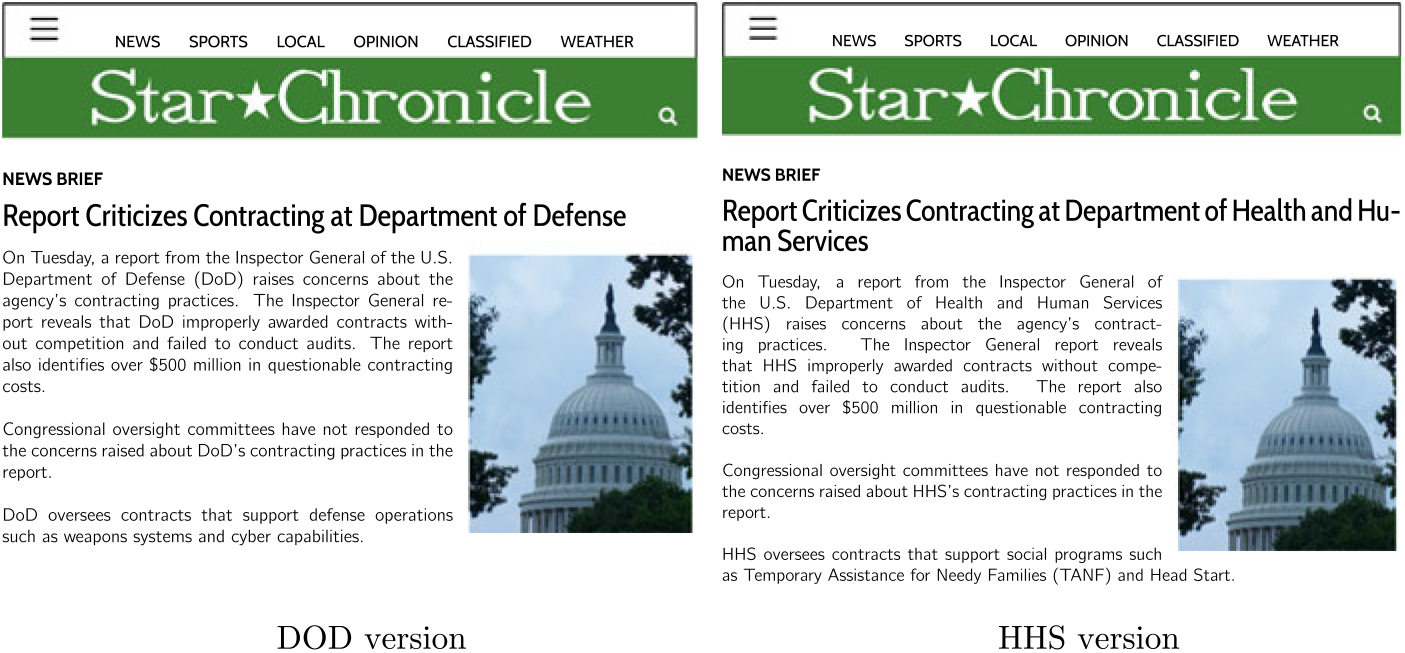
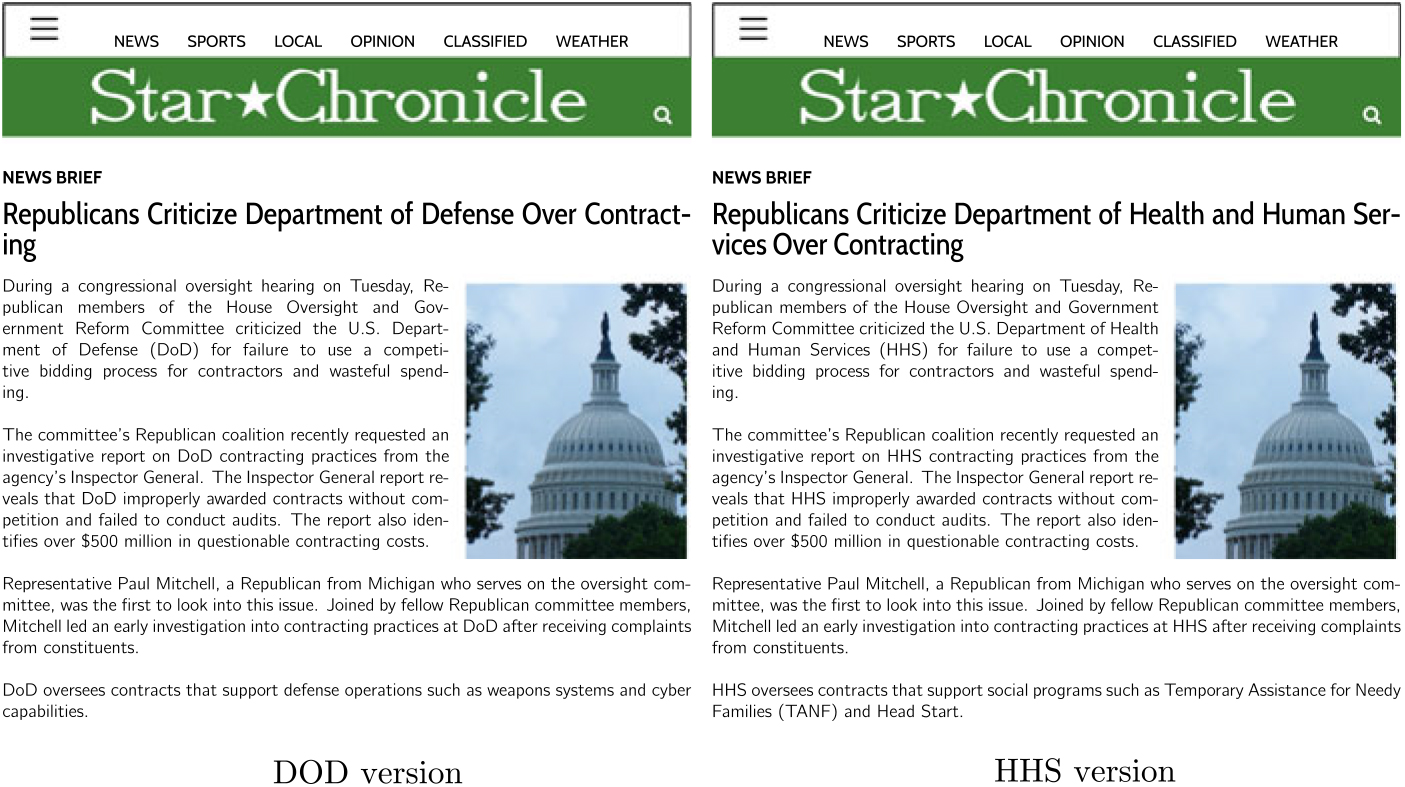
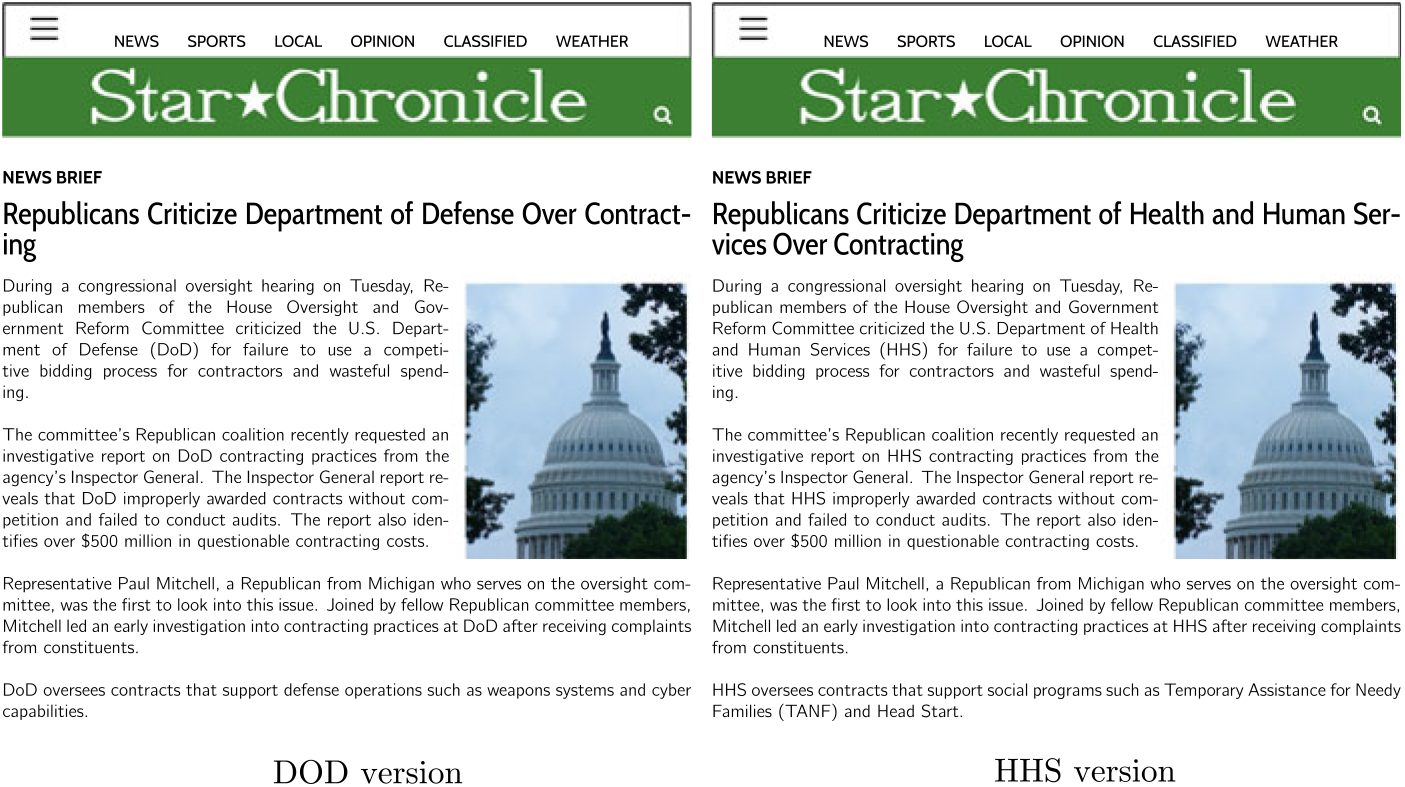
For the entity conducting oversight, we randomise the party identification of the congressional coalition and the representative leading the oversight efforts. In the Republican oversight condition, a Republican coalition of members on the House Oversight and Government Reform Committee begin and lead the investigation into the agency. This condition informs respondents that this coalition requested an Inspector General report, and a single representative, Republican Paul Mitchell of Michigan, was the first to look into the issue and led the early investigation. The Democratic oversight condition is the same in structure, only we change the party identification of the coalition and the individual representative named is Matt Cartwright of Pennsylvania. The baseline control condition shows no information about the party of the coalition and does not mention an individual representative. It only reports that the inspector general for the agency has published an oversight report, and that congressional oversight committees have not responded to concerns about the agency. For illustration, the baseline and Republican vignettes are shown in Figures 1 and 2, respectively.
Baseline vignettes.

Republican vignettes.
As our hypotheses state, we are interested in the effect of congressional oversight on approval, conditional on the party affiliation of the citizen. To increase the precision of our estimates, we randomise the treatments within blocks defined by respondent party identification (Republican and Democrat). The blocking procedure ensures that the number of “treated” units is approximately equal in each party identification block.
In total, we randomise Democratic and Republican respondents into eight separate oversight conditions (16 cells in total). Our experiment features four control groups. At the beginning of the survey, we assign respondents to an agency group (DOD or HHS) and an oversight entity group (Democratic or Republican members) or the respective control group. Each of the four treatment groups has its own control because the proper baseline depends on the party conducting the oversight. This design creates the eight separate conditions within each of the two party blocks, leading to 16 total cells. A table identifying all of the cells is presented in Appendix Table A.1.
In our experiment, we seek to reinforce subtly the perception of DOD as conservative and HHS as liberal. To do so, each vignette describes programs or policies that the agency implements. For HHS, we note that the agency “oversees contracts that support social programs such as Temporary Assistance for Needy Families (TANF) and Head Start.” For DOD, we note that the agency “oversees contracts that support defense operations such as weapons systems and cyber capabilities.” In the US, Democrats typically support greater investment in social welfare programs than Republicans; and Republicans typically support greater investment in antiterrorism and military defense than Democrats (Pew Research Center 2017).Footnote 9
After reading the vignette, all respondents evaluate the actions of the oversight committee and the individual representative. We ask, “Do you approve or disapprove of the way the Democratic (Republican) members of the oversight committee are handling their job?” and offer five ordinal choices: strongly approve, somewhat approve, neither approve nor disapprove, somewhat disapprove or strongly disapprove. We also ask, “Do you approve or disapprove of the way Representative Matt Cartwright (Paul Mitchell), a Democrat (Republican) who serves on the oversight committee, is handling his job?”Footnote 10 By asking about the committee coalition and an individual representative, we seek to understand the party’s and the individual member’s incentive to undertake oversight. Each respondent is only asked about one political party coalition and its individual member.Footnote 11
We chose not to present respondents with the name of their own senator. Not all respondents live in states with senators of each party, which prevents us from randomising the party of oversight. In addition, our survey was conducted before the 2018 midterm elections. Not all senators were running for reelection, which would potentially introduce an extra confounding variable into our analysis. As an alternative, we choose two representatives with different party affiliations who have similar demographic characteristics, are from similar states, ran for reelection in 2018 and serve on the House Oversight and Government Reform Committee.Footnote 12
Methods
Our hypotheses focus on the relationship between oversight and approval of copartisan and cross-party members of Congress. Because our outcome variable is a five-level ordinal approval rating, we estimate this relationship using ordinal logistic regression models. The model specification includes an indicator for the experimental condition (oversight or no oversight), as well as common demographic variables: age, education level, a dummy for female respondents, a dummy for African American respondents and a dummy for Hispanic respondents. The regressions include interactions between treatment condition and the party of the respondent or the agency, which allow us to test the hypotheses outlined above. We also subset the sample based either on agency or respondent party.
Descriptive statistics
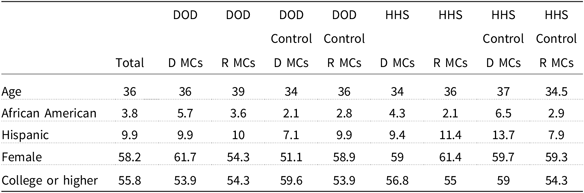
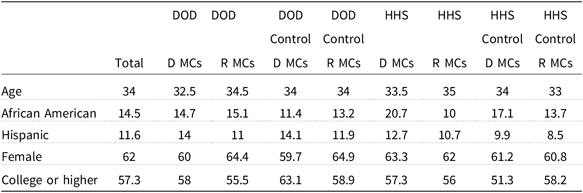
In our sample, we have 2,322 total respondents – 1,121 Republicans (48.3%) and 1,201 Democrats (51.7%) – who completed the full survey.Footnote 13 Since we randomise within blocks defined by partisan identification, we present descriptive statistics by party. Table 2 shows statistics for Republican respondents and Table 3 for Democratic respondents. For age, the median is presented; the percentage is presented for all other variables. For each table, columns 2–5 present statistics for respondents randomised into the DOD condition, while columns 6–9 show statistics for respondents randomised into the HHS condition. The total sample shares features common to convenience samples and the MTurk subject pool. Compared to the US adult population, our MTurk sample is a little younger and has a higher level of educational attainment. In online convenience samples, Democrats and independents typically outnumber Republicans. However, by design our sample features approximately equal numbers of Democrats and Republicans.
Descriptive statistics of Republicans by treatment condition
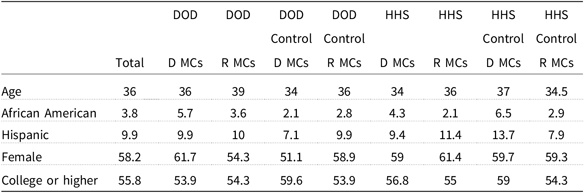
Note: D MCs (R MCs) refer to respondents randomised into a Democratic (Republican) member condition.
Descriptive statistics of Democrats by treatment condition
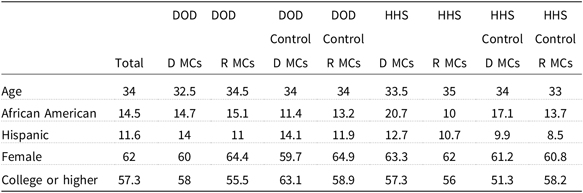
Note: D MCs (R MCs) refer to respondents randomised into a Democratic (Republican) member condition.
We evaluate the balance of these pretreatment covariates across the within-block randomised treatment groups. The results suggest that the randomisation successfully balanced these observable covariates across the treatment groups. We use analysis of variance (ANOVA) tests for the continuous variable (age) and chi-square tests for the categorical variables to test the null hypothesis that there is no association between treatment assignment and the pretreatment covariate. We cannot reject the null hypothesis for any of these tests.Footnote 14
Results
Evaluation of copartisan members of Congress
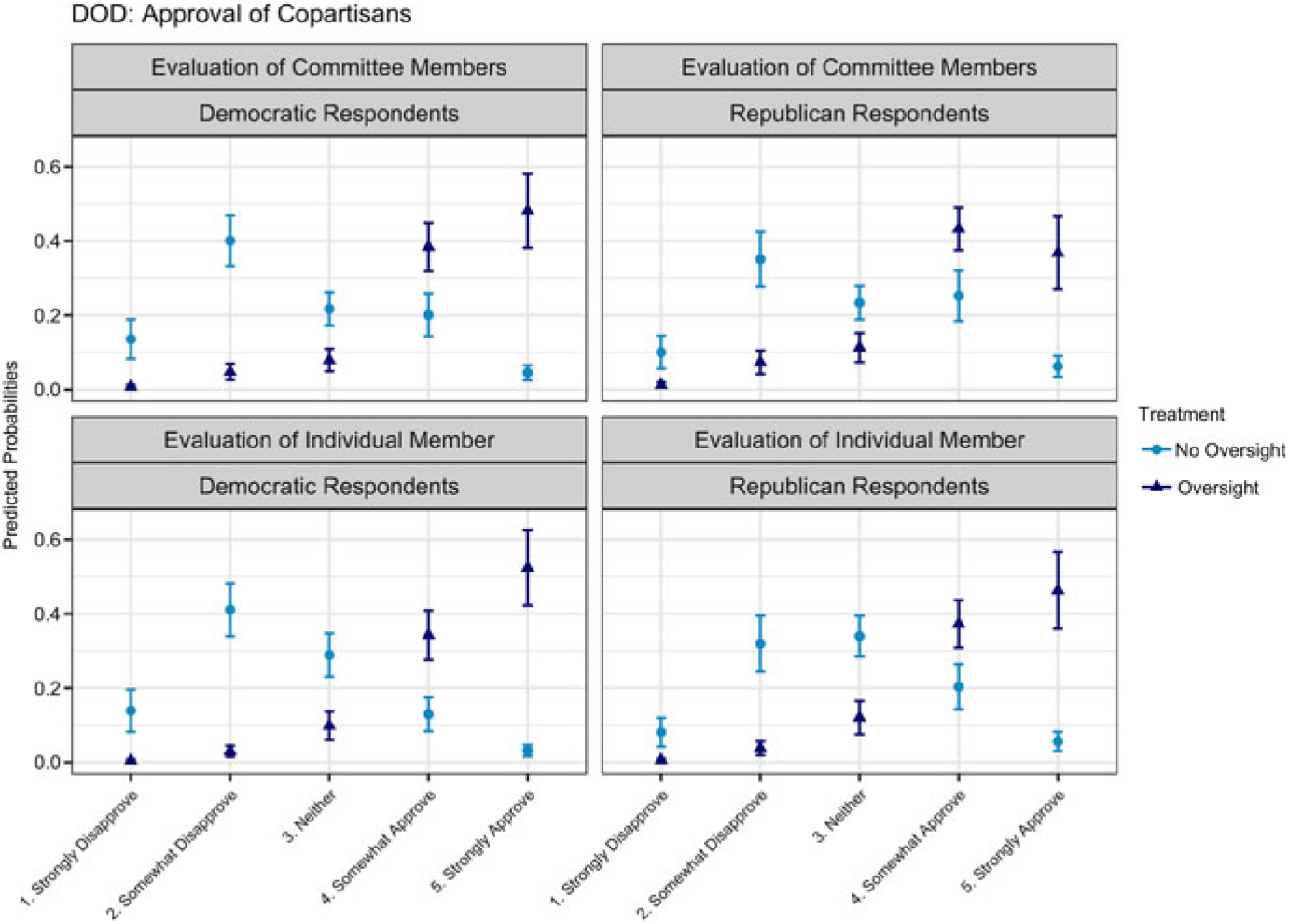
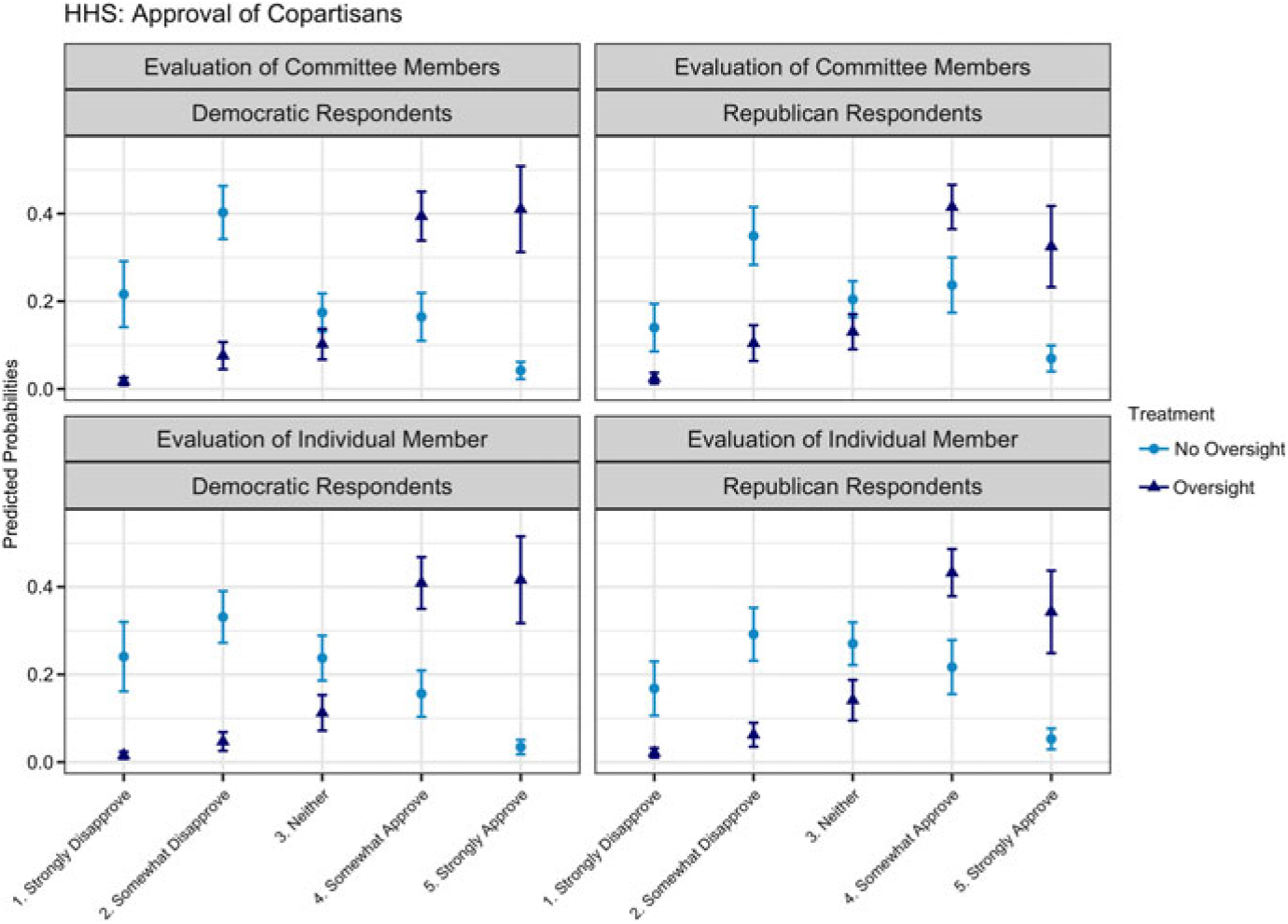
Estimated from the ordered logistic regression models, we present figures of the predicted probabilities for the oversight and no oversight conditions.Footnote 15 Figure 3 shows the evaluations of copartisans (e.g. Democratic citizens evaluating Democratic members) for oversight of the DOD.Footnote 16 Figure 4 shows the predicted probabilities for HHS oversight. These figures reveal strong support for Hypothesis 1. For DOD and HHS, respondents in both parties are more likely to approve of committee members and individual representatives from their own party when they conduct oversight compared to when they do not.Footnote 17
Predicted probability of approval for oversight and no oversight conditions (95% confidence intervals).
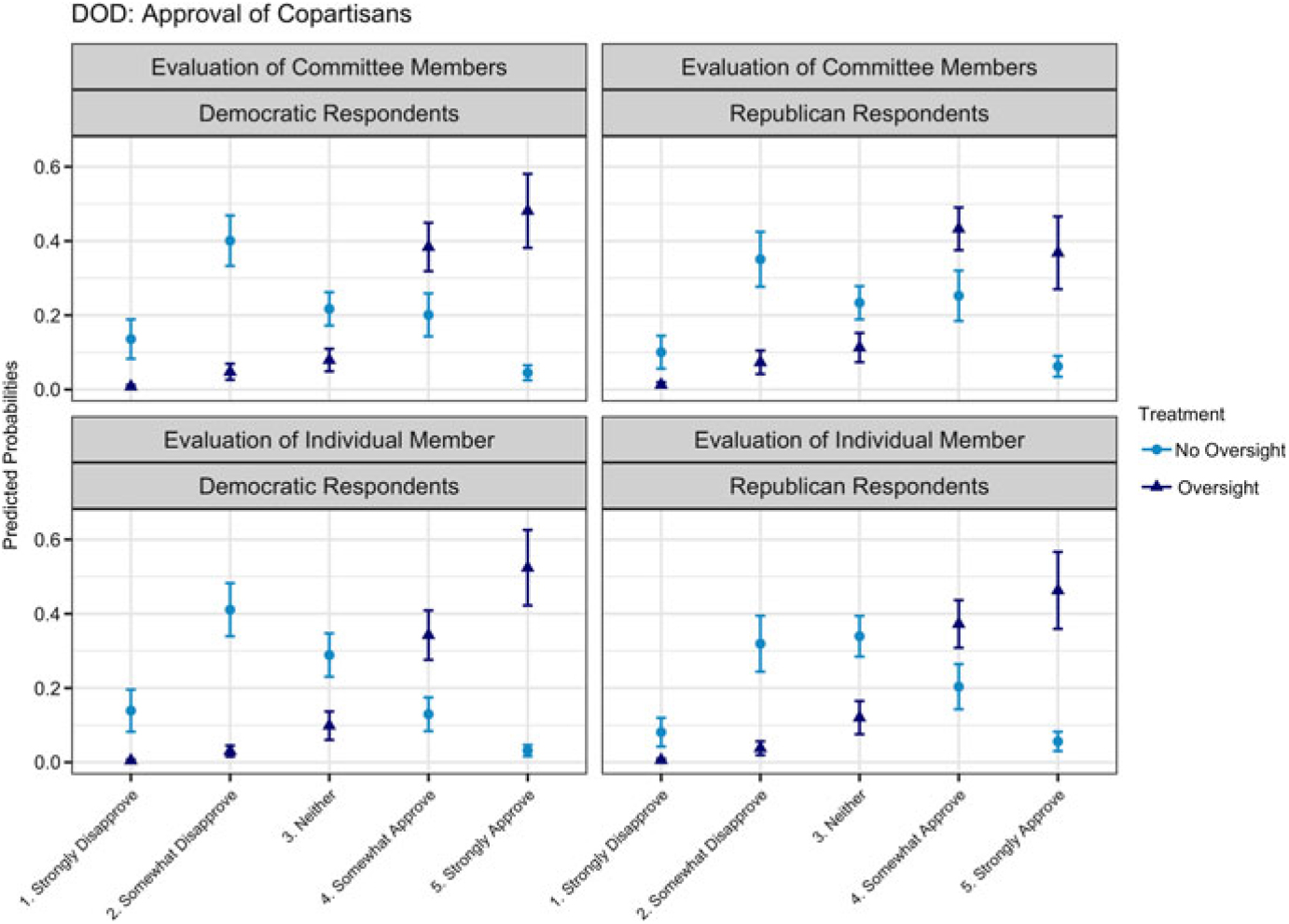
When looking at the DOD results (Figure 3), the probability that Republicans strongly approve of their copartisan committee members’ actions increases by 0.31 when they conduct oversight (0.062 – no oversight condition, 0.368 – oversight condition) and the probability that Democrats strongly approve increases by 0.44 (0.045–0.481).Footnote 18 The same pattern is revealed for individual members. The probability that Republicans strongly approve of the Republican member increases by 0.41 under the oversight condition (0.056–0.463), while the probability that Democrats strongly approve of the Democratic member increases by 0.49 (0.032–0.524).
The results are similar for HHS (Figure 4). When looking at approval of committee members, the increase in the probability of strong approval associated with oversight of HHS is 0.26 for Republicans (0.069–0.325) and 0.37 for Democrats (0.042–0.410). The probability of approving of individual members also increases with oversight, with the probability of strongly approving shifting by 0.29 for Republicans (0.053–0.343) and 0.38 for Democrats (0.034–0.416).
Predicted probability of approval for oversight and no oversight conditions (95% confidence intervals).

An interesting pattern revealed in these results is that the increase in approval (or decrease in disapproval) that Democrats award to their copartisans for oversight is somewhat greater than that of their Republican counterparts. For example, the increase in the probability that copartisan respondents strongly approve of copartisan committee members associated with oversight is 0.13 greater for Democrats than Republicans for the DOD and 0.11 greater for the HHS. For individual members, while the increase in approval is not statistically distinct, the decrease in the probability that respondents somewhat (strongly) disapprove of copartisan individual members associated with oversight is 0.10 (0.06) greater for Democrats than Republicans for the DOD and 0.05 (0.08) greater for the HHS. These results may be a function of survey timing. The survey was administered during a Republican administration. While all respondents rewarded copartisans for congressional oversight, the effect might be mitigated for Republicans who, in this case, are not only politically aligned with members of Congress but also the president at whose administration the oversight is aimed. Democrats, in contrast, are evaluating Democratic members’ actions aimed at a cross-party administration. This may reflect the idea that citizens reward members for both doing their jobs (e.g. attending votes and making speeches/writing editorials) (Sulkin et al. Reference Sulkin, Testa and Usry2015) and for party loyalty (Harbridge and Malhotra Reference Harbridge and Malhotra2011; Sulkin et al. Reference Sulkin, Testa and Usry2015); under a cross-party president, these signals are not competing when it comes to oversight. As such, this pattern may be reversed when a Democratic president is in office. If this result is connected to the president’s partisanship, then this may suggest that there is not an increased benefit from copartisan citizens associated with the costly action of directing oversight at a same-team administration. However, this interpretation is speculative; research that directly tests this question is needed.
Hypothesis 1 predicts that the effect of oversight on approval will be positive for both agencies. Taking advantage of our randomisation of agencies, we also show that the estimated effects across agencies do not reflect a pattern of higher levels of approval associated with oversight of one agency compared to the other. Subsetting by respondent party, we estimate the models with an interaction between the oversight treatment variable and an agency indicator (DOD = 1, HHS = 0) (see Appendix Table A.4). The interaction is not statistically significant in these models, suggesting that the effect of oversight on approval is not conditional on agency. When looking at the differences between the probability changes associated with oversight for each value of approval, almost all the differences between the changes are not statistically distinct from 0.Footnote 19 Taken together, these results indicate that across the two agencies, both Republicans and Democrats reward their copartisans for oversight. Additionally, as expected, there does not appear to be a substantially enhanced reward from copartisan citizens for politically costly oversight of an ally agency.Footnote 20
Evaluation of cross-partisan members of Congress
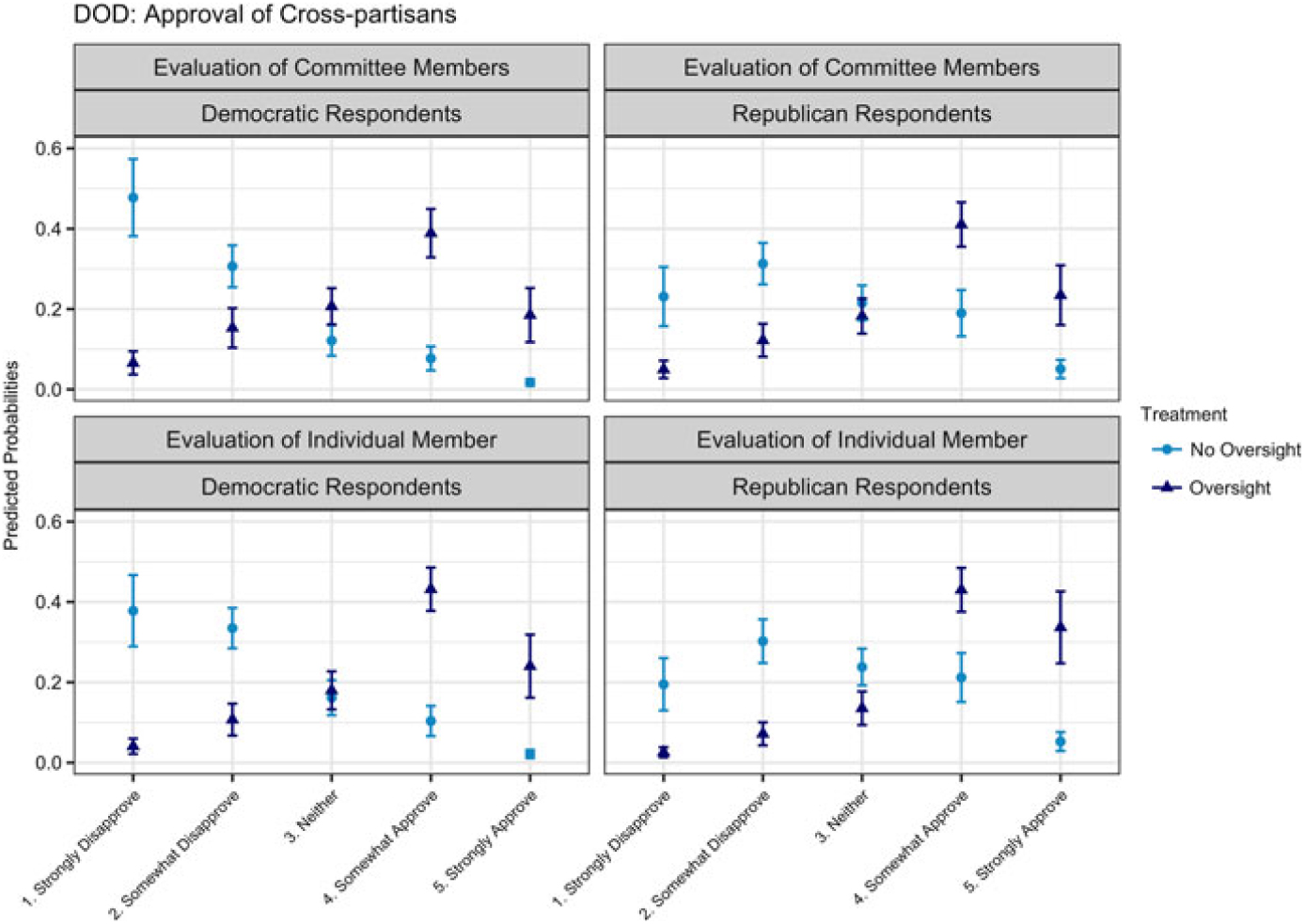
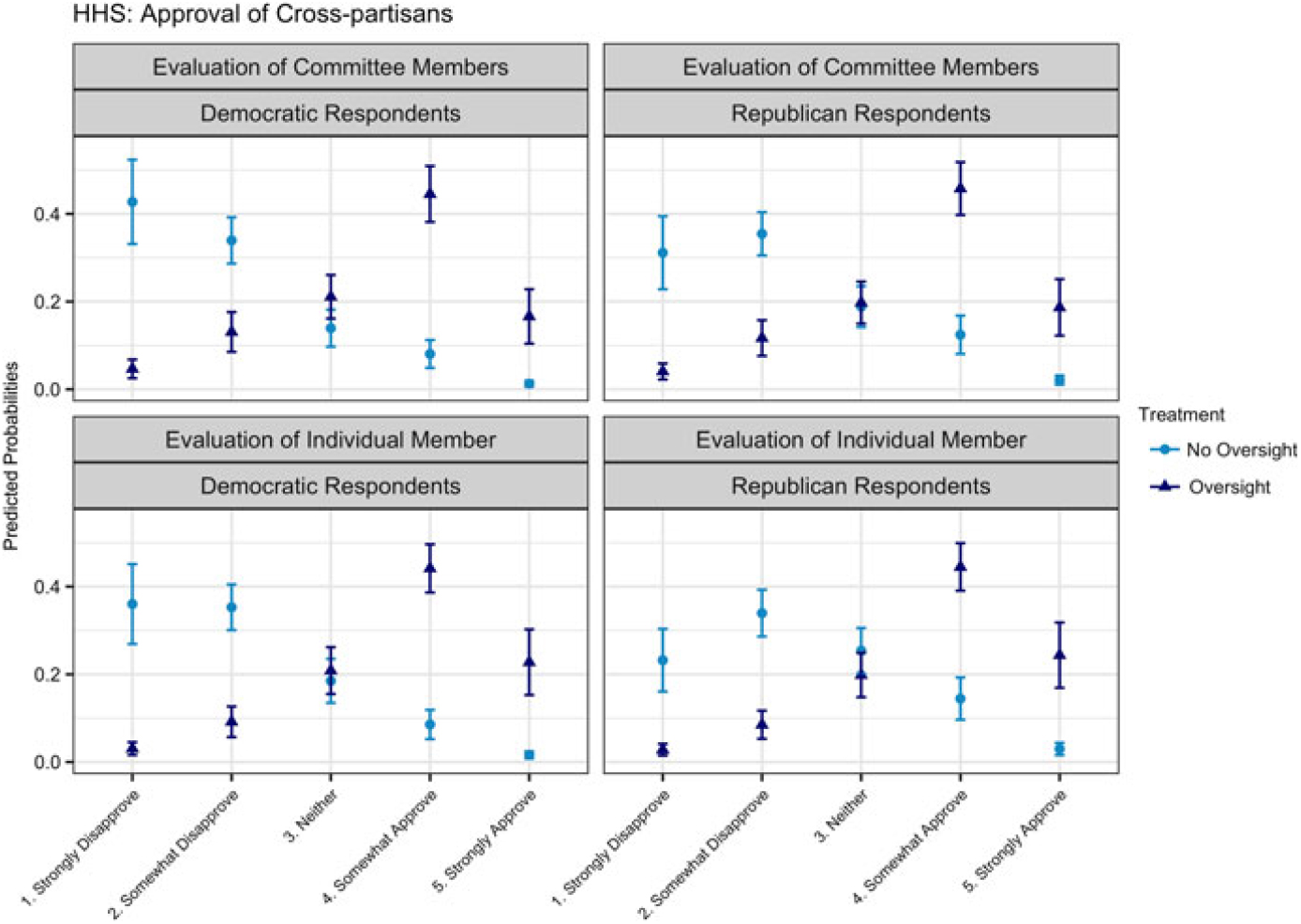
Turning to the results for cross-partisans, Figures 5 and 6 show the predicted probabilities associated with oversight in each approval category, with Figure 5 presenting the DOD results and Figure 6 presenting the HHS results.Footnote 21 For Hypotheses 2a and 2b, we expect differences based on agency ideological leanings. For DOD, we expect positive effects of oversight on approval for Democrats’ evaluations of Republicans but not vice versa; for HHS, we expect the opposite – positive effects of oversight on approval for Republicans’ evaluations of Democrats but not vice versa. When using the sharp interpretation of our expectations, we do not see evidence in support of our hypotheses, as the oversight condition is associated with an increase in approval across all partisan groups. Even with a softer interpretation of our expectations (i.e. that the positive effect should be enhanced for Democrats’ evaluations of cross-partisans for the DOD and Republicans’ evaluations of cross-partisans for HHS), we do not see support for our expectations, particularly when considering how the partisanship of the president may be influencing the results.Footnote 22
Predicted probability of approval for oversight and no oversight conditions (95% confidence intervals).

Predicted probability of approval for oversight and no oversight conditions (95% confidence intervals).

Focussing on the DOD (Figure 5), our results indicate that, consistent with the soft expectation, Democrats reward Republican members’ oversight of a conservative agency more than Republicans reward Democratic members’ oversight of the same agency. Oversight has a significant effect across all levels of approval, including a 0.17 increase in the probability that Democrats strongly approve of Republican members and a 0.41 decrease in strongly disapprove. For Republicans, oversight has a significant effect across all levels of approval except the neither category, including a 0.18 increase in the probability that Republicans strongly approve of Democratic members and a 0.18 decrease in strongly disapprove. Compared to Republicans, oversight leads to a significantly greater change for Democrats’ evaluations of cross-partisan committee members; Democrats have a 0.09 greater increase in the probability of somewhat approving of cross-partisans, a 0.12 greater increase in the probability of neither approving nor disapproving, and a 0.23 greater decrease in the probability of strongly disapproving. Similarly, considering approval of individual members, compared to Republicans, Democrats’ change in probability associated with oversight is 0.11 greater for somewhat approve, 0.12 greater for neither, and 0.17 lower for strongly disapprove. These results appear in line with the expectation that oversight of a conservative agency will have a greater positive effect on Democrats’ approval of cross-partisans compared to that of Republicans (Hypothesis 2b). However, these results are also consistent with the “Democrats reward oversight to a greater extent” theme that we uncovered in the evaluations of copartisans.
Moving on to oversight of HHS (Figure 6), the results are contrary to our expectation (Hypothesis 2a). While the softer version of our hypotheses predicts that Republicans reward cross-partisans for oversight of a liberal agency to a greater extent than Democrats, we see some results in the opposite direction. For evaluations of committee members, the change in Democrats’ probability of strongly disapproving decreases by 0.11 more than Republicans’ probability change and the increase in the probability of neither approving nor disapproving is 0.06 greater for Democrats. Similarly, for individual member evaluations, the increase in the probability of somewhat approving associated with oversight is 0.06 greater for Democrats than Republicans, the increase in the probability of neither approving nor disapproving is 0.08 greater, and the decrease in the probability of strongly disapproving is 0.13 greater. These results are contrary to what we expected; they may reflect the countervailing pressures faced by Republicans when evaluating oversight within a Republican administration. While oversight leads Republicans’ approval of cross-partisan members to increase, it does not increase to the same extent as Democrats’ approval of cross-partisans, even for a liberal agency. Thus, we do not see evidence of citizens evaluating oversight of liberal or conservative agencies differently in the manner predicted by our hypotheses.Footnote 23
Overall, these results suggest that when presented with a fairly clear example of agency wrongdoing, citizens reward both copartisans and cross-partisans for oversight efforts. Across all groups, oversight significantly enhances approval ratings. Additionally, the evidence suggests that politically costly oversight actions against ally agencies are not rewarded by copartisan citizens to a greater extent than partisan actions against an unaligned agency. Generally, agency ideology appears to play a relatively minor role (if any) in how citizens interpret the oversight activities of members. However, these results are specific to our experimental design; additional research is needed to understand the role of agency ideology more fully. Moreover, in these results, Democratic citizens appear to reward oversight to a greater extent across the board, which may reflect their lack of shared partisanship with the president. If connected to the president’s partisanship, this may speak to the reward, or lack thereof, associated with politically costly oversight actions against a same-team administration. However, it may also be the case that Democratic citizens simply reward oversight to a greater extent regardless of the president’s partisanship. Research that varies the president’s partisanship is needed to address these questions.
Conclusion and implications
Members of Congress may be motivated to conduct oversight of executive branch agencies for a variety of reasons, including political concerns. In this paper, we seek to understand how citizens react to congressional oversight efforts and whether members are rewarded differently for their oversight activities by citizens based on political factors. When thinking about the results, two points stand out. First, our results provide evidence that citizens reward all members of Congress for good governance actions. This presents a somewhat surprisingly nonpartisan interpretation of oversight efforts by citizens. This result is consistent with Sulkin et al.’s (Reference Sulkin, Testa and Usry2015) finding that citizens reward copartisan and cross-partisans for nonpartisan activities such as showing up to vote. One point to bear in mind, however, is that the case of agency malfeasance presented is a fairly unambiguous example. It would be interesting to see if this result holds when the case presented is more ambiguous, allowing for greater interpretation through a partisan lens.
Second, while previous research illustrates that citizens give more weight to costly signals when making decisions (Baum and Groeling Reference Baum and Groeling2009; Kriner and Schickler Reference Kriner and Schickler2014), we do not find much evidence that copartisan citizens reward this type of costly action, at least not to a greater extent than other oversight efforts. Neither Democrats nor Republicans gave consistently increased levels of approval to copartisan members for the costly action of targeting oversight at an ally agency. This result may reflect the increase in party polarisation. If this experiment were conducted prior to the intensely polarised climate of today (or is replicated in the future if polarisation subsides), then we might see a greater reward from copartisans for members taking on an ally agency. In contrast to the first point, this presents a much more partisan view of how citizens interpret oversight efforts against political allies.
Together, these two insights lead to a somewhat ambiguous conclusion. Citizens reward members of Congress, even cross-partisan members, for oversight of federal agencies, which is normatively positive if one values less partisanship and greater oversight in government. At the same time, if Congress members weigh both the copartisan voter response and the potential costs to the agency (or possibly other political allies) when deciding to conduct investigatory oversight, this second point suggests that less oversight might occur against allies. This is generally consistent with the pattern of lower levels of investigatory oversight under united government (see Kriner and Schwartz Reference Kriner and Schwartz2008; Parker and Dull Reference Parker and Dull2009). These results are, of course, limited to the specifics of our experimental design; the generalisability of these findings to other agencies, issues and oversight activities are areas of future research.
Data Availability Statement
Replication materials are available in the Journal of Public Policy Dataverse at https://doi.org/10.7910/DVN/RURFHL.
Supplementary material
To view supplementary material for this article, please visit https://dx.doi.org/10.1017/S0143814X19000151
Acknowledgements
We thank the editor and three anonymous referees for their helpful comments and suggestions. An earlier version of this article was presented at the 2017 annual meeting of the Midwest Political Science Association. We are grateful for comments from the panel’s participants. Some of the survey results reported here were obtained from searches of the iPOLL Databank and other resources provided by the Roper Center for Public Opinion Research.