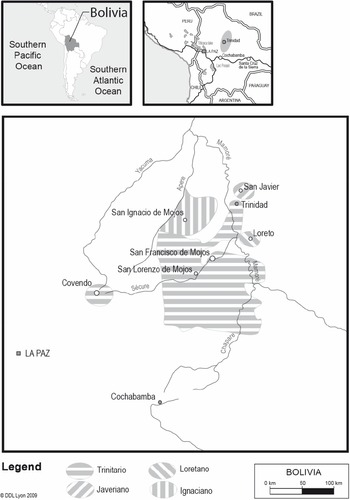
Mojeño Trinitario (Glottocode: trin1274) is a variety of Mojeño, an indigenous language of the Arawak family spoken in Lowland Bolivia. The Trinitario variety of Mojeño is spoken in the Isiboro-Secure Indigenous Territory, the Multiethnic Indigenous Territory, along the Mamoré river, in Trinidad and around the villages of San Lorenzo de Moxos and San Francisco de Moxos (Figure 1). It is spoken by around 3000 speakers () and is endangered by the gradual loss of inter-generational transmission (Crevels Reference Crevels, Mily, Simon Van, Sergio and Hein Van2002). Old Mojeño data (Marbán 1702) has been crucial in the identification of the Arawak family, when Reference GilijGilij compared it to the Maipure language (Reference GilijGilij 1780–1784).
Map of Mojeño dialects.

A basic introduction to Mojeño Trinitario is Rose (Reference Rose, Mily and Peter2015). Previous work on the said variety (Gill Reference Gill1957, Ibáñez Noza et al. 2007, IbáÑez Noza et al. 2009), on a sister variety Mojeño Ignaciano (Olza Zubiri, Nuni de Chapi & Tube Reference Olza, Jesús and Tube2002), and on the variety spoken in Jesuit missions in the 17th century (Marbán 1702) present very little information on phonetics. An official alphabet was proposed in 1995 (Fabricano NoÉ, Semo Guaji & Olivio Reference Fabricano2003).Footnote 1 The historical development of the actual Mojeño Trinitario phonological system has been discussed in de Carvalho & Rose (Reference de Carvalho and FranÇoise2018). That paper shows that most of the phonological innovations of Trinitario result from a rather pervasive process of rhythmic syncope, which affected this variety only. Consequently, it displays a much more complex phonological inventory and syllable structure than Ignaciano and Old Mojeño.
My knowledge of the language is based on fieldwork conducted since 2005 (11 months in total), resulting in a collection of 10 hours of recorded speech, plus various word lists. I have been working with 30 consultants, but most of the data linked to this paper have been recorded with Claudio Guaji Jare (from the area of San Lorenzo de Mojos, now living in Trinidad).Footnote 2 Most of the examples included in this paper have been recorded as a word list, with three repetitions of each item, so that the timing is comparable across examples. The data in the ‘Prosody’ section below have been recorded in a carrier sentence /ˈkope __ nhiʧˈwiːʔi/ˈnkeːʔi/ kope __ njichvii’i/nkee’i ‘Yesterday I said/told you _’. Praat (Boersma Reference Boersma2001) has been used for acoustic analyses. Vowel plots have been produced with the phonR package of the R software (McCloy Reference McCloy2016, R Core Team 2019). The IPA transcription is phonemic in this paper, unless specified as phonetic by square brackets. Transcription in the official alphabet is given in italics. In the spectrograms, the transcription is phonetic.
Consonants
Mojeño Trinitario shows an inventory of 28 consonants, with 16 simple consonants using six manners of articulation and six places of articulation, and 12 consonants with secondary articulations. Voicing is not contrastive. Some discussion follows on the phonetic realization of some of these consonants, mainly those showing some allophony or for which the phonetic realization is a strong argument for their phonological status. The other segments are realized as expected from their IPA transcription. In the list below, bold marks the phoneme that is being illustrated.


The glottal stop /ʔ/
Ladefoged & Maddieson (Reference Ladefoged and Ian1996: 75) give the following acoustic description of glottal stops:
In the great majority of languages we have heard, glottal stops are apt to fall short of complete closure, especially in intervocalic positions. In place of a true stop, a very compressed form of creaky voice or some less extreme form of stiff phonation may be superimposed on the vocalic stream.
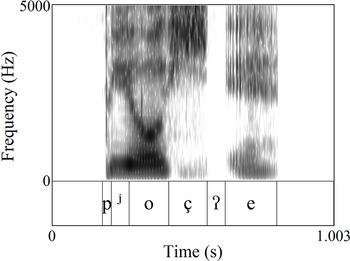
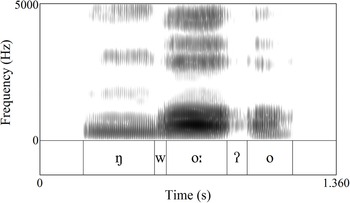
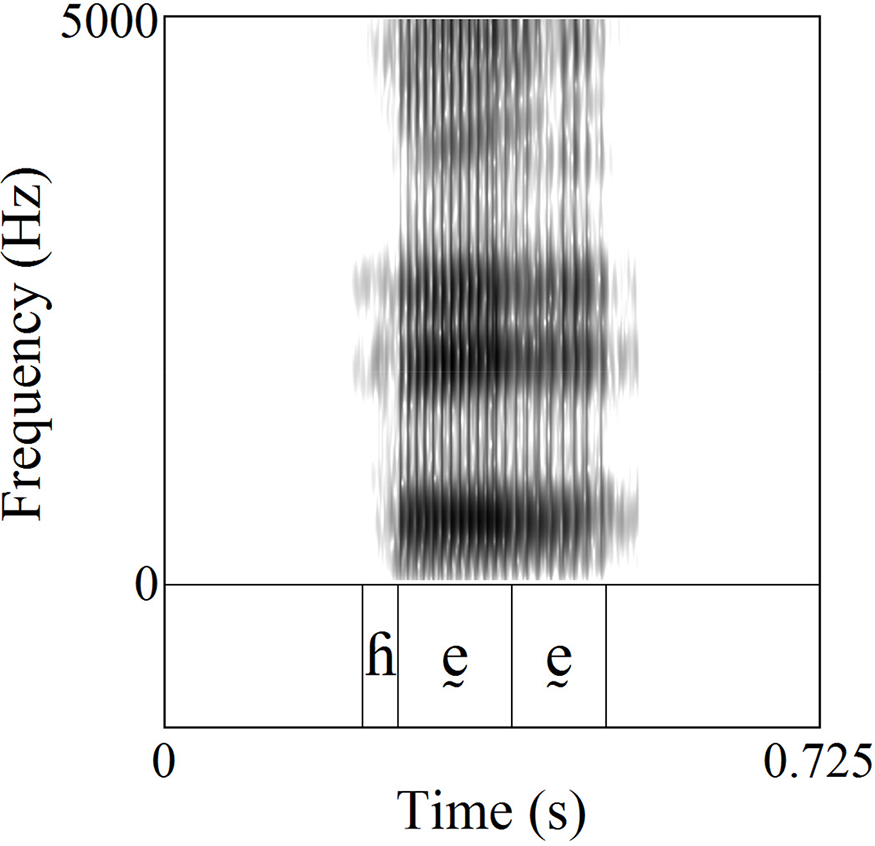
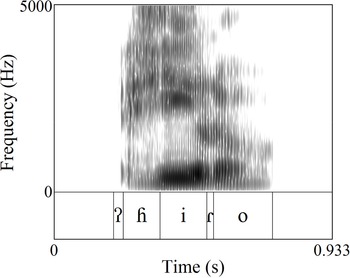
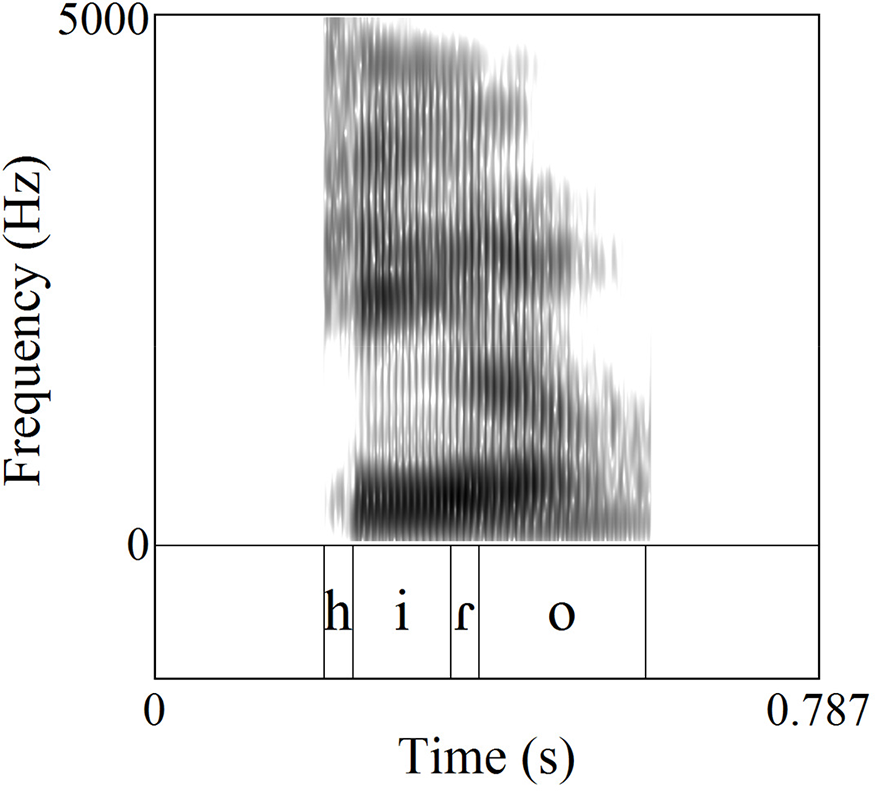
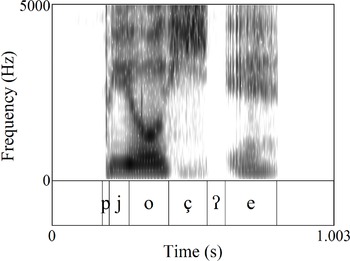
In Mojeño Trinitario, the glottal stop can be realized with different degrees of closure of the vocal folds. If there is a full closure of the vocal folds, it is simply expressed by a short pause characterized by the absence of voicing between two segments. This is observable in the spectrogram of /ˈpʲoÇʔe/ piog’e ‘your body’ (Figure 2. If the closure of the vocal folds is less complete, they vibrate and there is some voicing during the pause, as in /ˈnwoːʔo/ nwoo’o ‘I want’ (Figure 3). There may even be no pause and then the vocal folds continue to vibrate during the adjacent vowels, leading to creakiness, as in /ˈheʔe/ je’e valid (Figure 4).Footnote 4 Creakiness can also be observed at the onset of the vowel e after the glottal stop in Figure 2. In word-initial position before a consonant, the glottal stop is not always as visible in spectrograms as in that of /ˈʔhiɾo/ ⁰jiro ‘man’ (Figure 5). It is nevertheless generally audible with some practice, giving the impression that the word begins with ‘more strength’ according to some speakers, or with a geminate. A laryngograph could be used in a future fieldtrip to confirm the full closure of the vocal folds in this context. The presence of the glottal stop in word-initial position before a consonant is contrastive, as in /ˈʔhiɾo/ ⁰jiro ‘man’ to be contrasted with /ˈhiɾo/ jiro ‘fish sp.’ (Figure 6). It substitutes for a word-initial vowel that has (synchronically or diachronically) syncopated in words with an iambic parse, as in /ʔmotˈne-ko/ ⁰motneko ‘work (non-possessed)’, derived from the root /emotone/ ‘work (possessed)’, or /ˈʔɾesʲa/ ⁰resia ‘church’ a loan from Spanish iglesia. Finally, the variable presence or absence of the glottal stop in word-initial position before a vowel makes it non-phonemic in that position. In all other positions, the glottal stop is phonemic.
Spectrogram of /ˈpʲoÇʔe/ ‘your body’.

Spectrogram of /ˈnwoːʔo/ ‘I want’.

Spectrogram of /ˈheʔe/ valid.

Spectrogram of /ˈʔhiɾo/ ‘man’.

Spectrogram of /ˈhiɾo/ ‘fish sp.’.

The alveolar nasal /n/
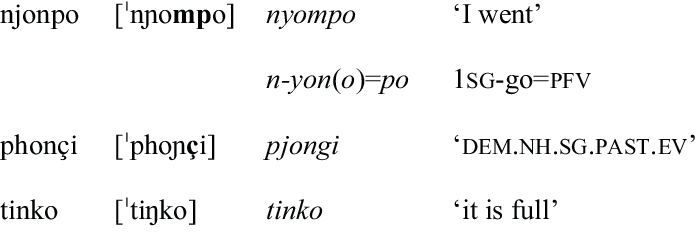
The alveolar nasal consonant assimilates its place of articulation to that of a following (oral or nasal) obstruent. In many cases, there are morphological alternations that provide evidence for the underlying place of articulation of this nasal (as in the first example),Footnote 5 but there are also morpheme-internal cases without such evidence (as in the other examples).
The palatal nasal /ɲ/
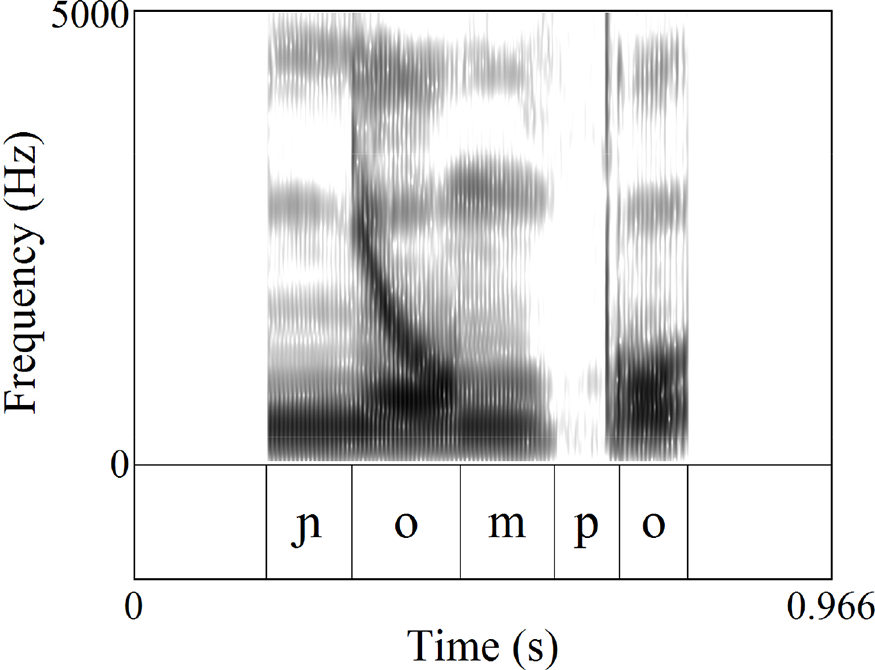
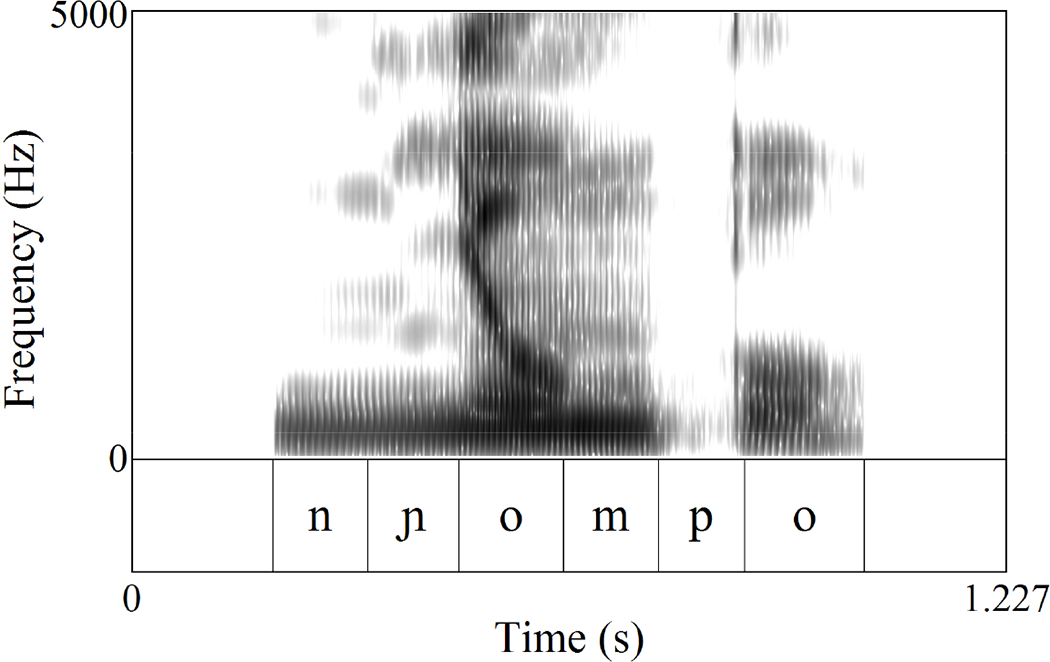
The palatal nasal is distinct from an alveolar nasal followed by a palatal approximant. For example, /ˈɲompo/ Ñompo ‘he carried’ and /ˈnjonpo/ nyompo ‘I went’ contrast. In the first word (shown in Figure 7), /ɲ/ in /ˈɲ-ompo/ is morphologically in a prefix slot where it alternates with other prefixes (as in /n-ompo/ ‘I carried’), showing that the root for ‘carry’ is /omo/, to which the perfective clitic =po is added in /ˈɲompo/. In the second word (shown in Figure 8), /n/ in /n-jonpo/ alternates with other prefixes, showing that the root for ‘go’ is /jono/ to which the perfective clitic is added in /njonpo/ with vowel syncope. In the second word, the root-initial glide is realized as a palatal nasal following the alveolar nasal prefix.
Spectrogram of /ˈɲompo/ ‘he carried’.

Acoustic analysis shows that the duration of the palatal nasal corresponding to a phonemic /ɲ/, as in Figure 7, is on average longer (0.122 s) than that of the palatal nasal corresponding to a phonemic /j/ (0.078 s), as in Figure 8.Footnote 6 It is also interesting to note that the prefixal alveolar nasal preceding the palatal in words like the one in Figure 8 is longer (0.172 s) than the prefixal palatal nasal (0.122 s) in words like that in Figure 7. The length of this initial /n/ could be due to the syncope of the vowel that was etymologically present (*/nu-jono=po/).
Spectrogram of /ˈnjompo/ ‘I went’.

The palatal fricative /Ç/
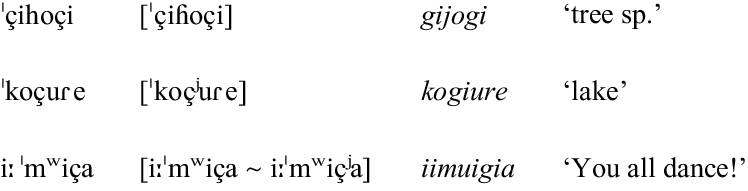
The phoneme /Ç/ is always realized as a palatal fricative [Ç] before /i/ and consonants, but as either [Ç] or [Çʲ] before vowels other than /i/, with inter-speaker and intra-speaker free variation.
The glottal fricative /h/
The glottal fricative /h/ is often realized voiced [ɦ] between vowels (and occasionally between a vowel and a consonant), as in /ʔnuːˈhinə͡ehi/ ⁰nuuhinaehi ‘immediately’ realized [ʔnuːɦineɦɪ]. Other variants involve a slight palatal, velar or pharyngeal friction.
The alveolar affricate /ʦ/
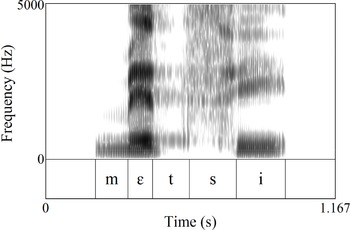
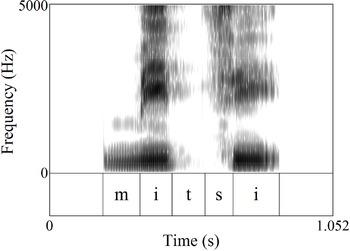
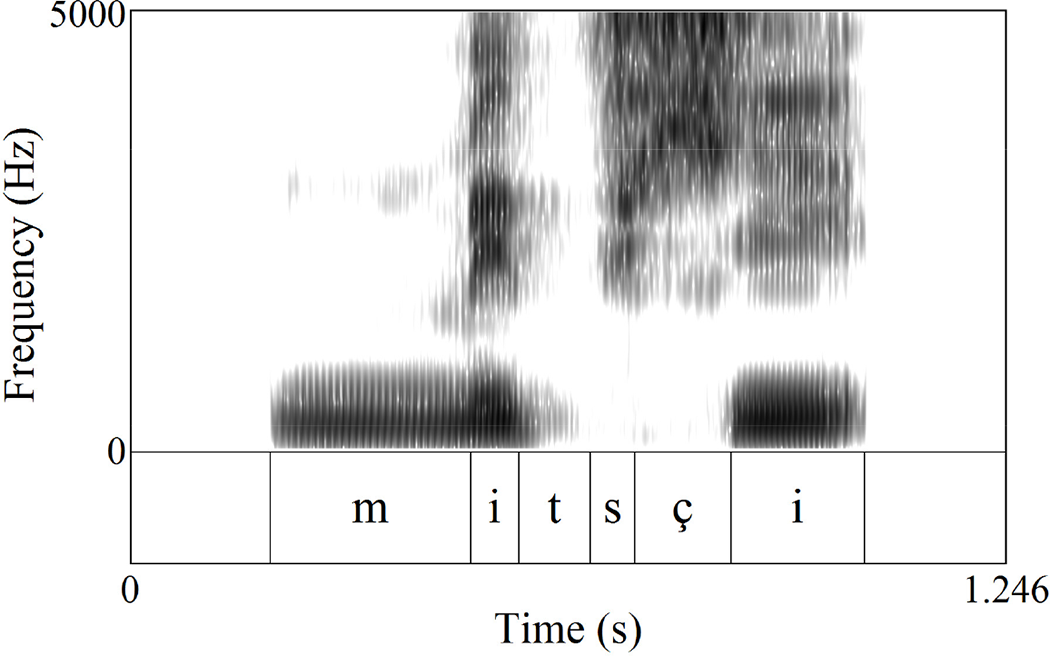
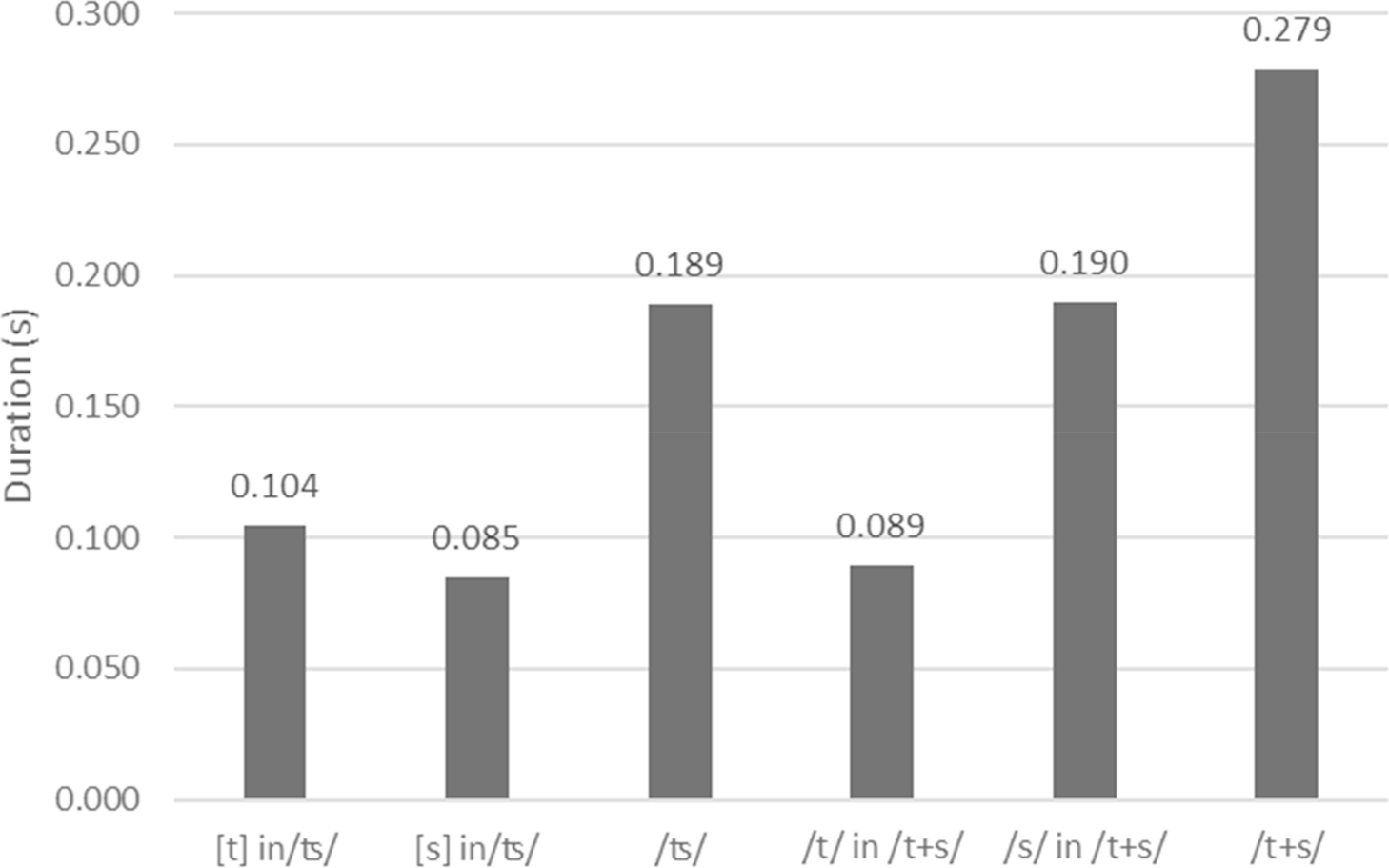
The affricate /ʦ/ contrasts with the sequence /t+s/, even though both start as an alveolar stop and end with an alveolar fricative. The observation of Figures 9 and 10, as well as the duration measures in Figure 12,Footnote 7 show that the sequence /t+s/ is much longer than the affricate /ʦ/, and that this additional length is due to the duration of the fricative part, as in fact the stop part is shorter in the bi-phonemic sequence.Footnote 8 As a result, the ratio of the duration of the fricative part with respect to the stop part is 81% in the phonemic affricate, while it is 212% in /t+s/ sequences. Note that the total length of the affricate in the coda position in Figure 11 is very comparable to the stop coda in Figure 9 (0.168 s vs. 0.148 s).Footnote 9
Spectrogram of /ˈmet.si/ ‘pot’.

Spectrogram of /ˈmi.tsi/ ‘cat’.

Spectrogram of /ˈmits.gi/ ‘backbone’.

Duration measures for [t] and [s] in affricate /ʦ/ and sequence /t+s/.

The rhotic /ɾ/
The phoneme /ɾ/ displays an array of slightly differing realizations in variation, with some lateral and retroflex articulations. It often triggers the presence of a schwa-like transitional vocoid [ᵊ] immediately preceding it when following a consonant, as in /tɾappesˈɾawo/ trappesrawo ‘shining’, that is realized [təɾapːesəˈɾawo].
The labio-velar approximant /w/
The phoneme /w/ is realized by two major allophones in complementary distribution: the bilabial fricative [β] is found (in free variation with the rarer labio-dental fricative [v]) before a front vowel, and the labio-velar approximant [w] before other vowels or consonants. Word-initially before a consonant, /w/ can also be realized with a short vocalic sound [wʊ], or as a single non-syllabic vocalic realization [u̯]. When preceding the consonant /j/, it merges with it in a labio-palatal glide [ɥ].
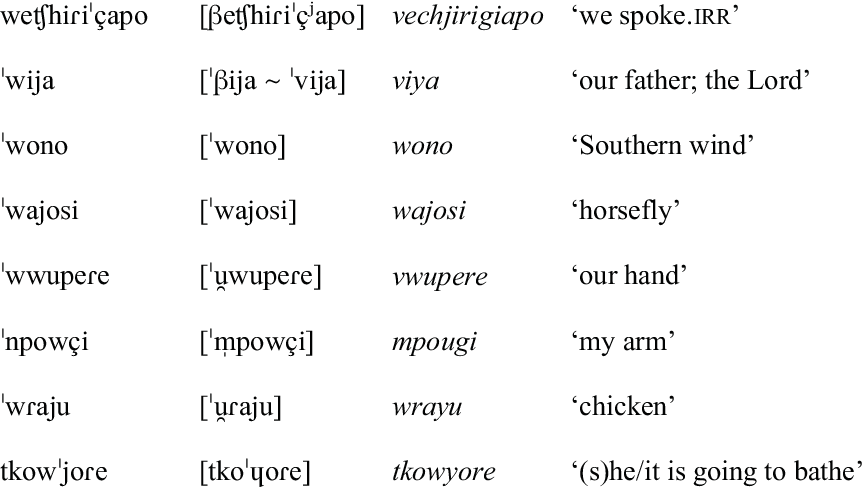
There are two types of exceptions to this complementary distribution. First, the allomorph /wi/ of the negative auxiliary /wo/ does not comply with the distribution stated above.Footnote 10 As a consequence, an opposition can be found between [w] and [β] in the following minimal pair /ˈwiʧʔo/ vich’o ‘we call him/her/it’ vs. /ˈwiʧʔo/ wich’o ‘not yet’ realized respectively [βiʧʔo ˜ viʧʔo] and [wiʧʔo]. Second, the labio-velar allophone of /w/ is also found before a front vowel, when this sequence results from the syncope of a non-front vowel from the sequence of /w/ + non-front vowel + front vowel. The labiovelarized /w/ is systematically realized as [w], even though it now precedes a front vowel, as in /natiˈwina/ natiwina ‘their being first’ (segmentable in /na-tiwo-ina/ 3pl-first-irr), realized [natiwina].
Spectrogram of /ˈpʲoÇʔe/ ‘your body’.

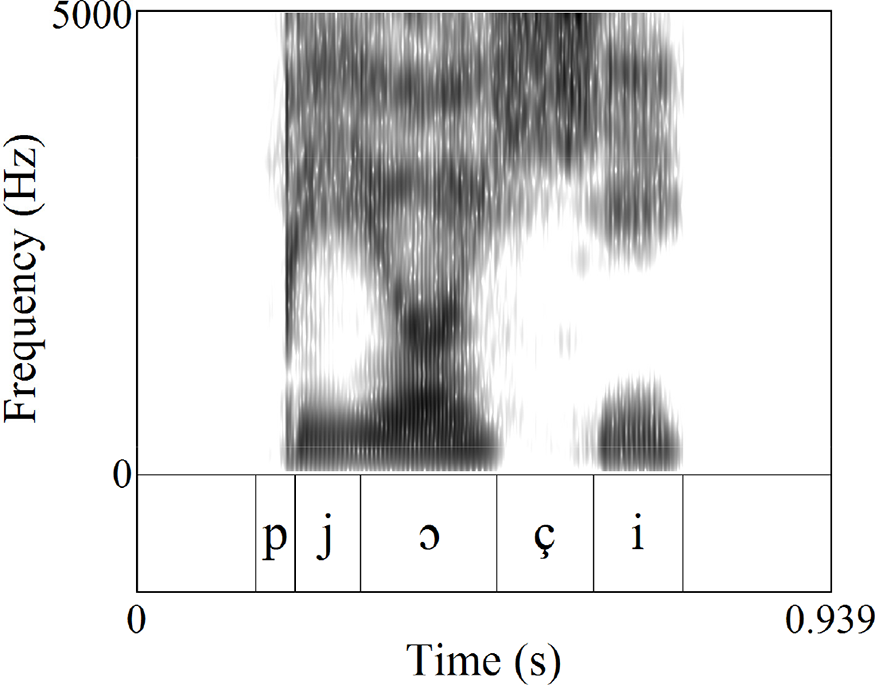
Spectrogram of /ˈpjoÇi/ ‘your penis’.

Consonants with secondary articulation
The secondary articulations most often result from palatalization or labio-velarization of the preceding consonant in the process of resolution of a hiatus. Because the presence of these secondary articulations is not always predictable in synchrony, the palatalized and labio-velarized consonants are nevertheless considered as phonemes here. Figure 13 (repeated from Figure 2) and Figure 14 illustrate the phonetic contrast between a consonant with a secondary palatal articulation (nine segments in the consonant inventory) and the same consonant followed by a (consonantal) palatal approximant. The words /ˈpʲoÇʔe/ piog’e ‘your body’ and /ˈpjoÇi/ pyogi ‘your penis’ are made up of the prefix /pi-/ ‘2sg’ (with its /i/ syncopated as will be explained in the ‘Prosody’ section) and the roots /-oÇʔe/ ‘body’ and /-joÇi/ ‘penis’, respectively. Both words show a steady palatal element after the initial stop, followed by a glide transition, even though both words are syllabified in two syllables only: /ˈpʲoÇ.ʔe/ and /ˈpjo.Çi/.Footnote 11 Measures show that on average, the palatal steady state of the secondary articulation (0.068 s) is somewhat shorter than that of the phonemic /j/ (0.078 s).Footnote 12 However, since the second word alternates in a paradigm with forms like /maˈjoÇi/ mayogi ‘his penis’, it is clear that phonologically the palatal segment is a consonant in a complex onset in /ˈpjoÇi/ pyogi ‘your penis’. It would be interesting to conduct perception tests on that contrast.
Vowels
The vowel inventory consists of 12 vowels, with six vowel qualities and a length contrast.Footnote 13 In the list below, bold marks the phoneme that is being illustrated.


Phonetic realizations
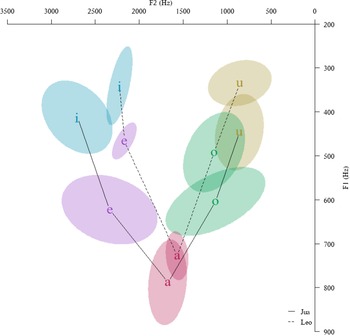
Figure 15 plots the five simple vowels of two speakers.Footnote 14 The distribution of the vowels is close to the cardinal vowels.
Mojeño Trinitario simple vowels of two speakers (Jua and Leo). Each colour represents a vowel, symbols represent the category barycenters and shaded areas represent 68% confident ellipses, i.e. ±1 standard deviation of the normal density contour estimated from the data.

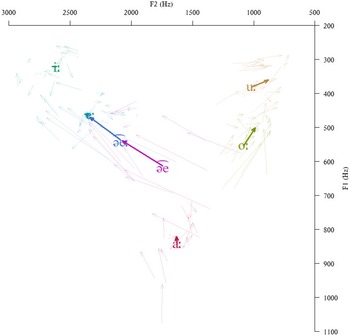
Mojeño Trinitario long vowels and the central vowel. Each colour represents a vowel category. Arrows represent the trajectory of the first two formants of the tokens, between a point taken at one third and another at two thirds of the vowel duration. Bold arrows represent the average realization for each vowel type.

Figure 16 plots the long vowels and the complex central vowel of two speakers.Footnote 15 Again, the distribution of the long vowels is canonical and corresponds to that of their short counterparts. Long back vowels show a trajectory tending towards a more posterior and closed articulation. The complex central vowel shows a trajectory starting as a central vowel and evolving towards a more anterior and closed articulation.
Additional information is that the short mid vowels /e/ and /o/ have two phonetic realizations, mid-high and mid-low, in free variation, but with a preference for the mid-high realization in open syllables. The realization [y] has also sometimes been attested for /u/.
The segment /ə͡e/ is generally realized as a complex sound with canonically a mid-central vocalic component followed by a mid-front vocalic component [æ] in careful speech, with both elements showing a lot of variation. In natural speech, it is regularly monophthongized, and is then usually pronounced either as a mid-central to low-high central vowel (between [ɘ] and [ɨ]), or as a front vowel [ɛ ˜ e]. It is comparable in length to short simple vowels. The diphthong also shows a (rare) long counterpart /ə͡eː/.
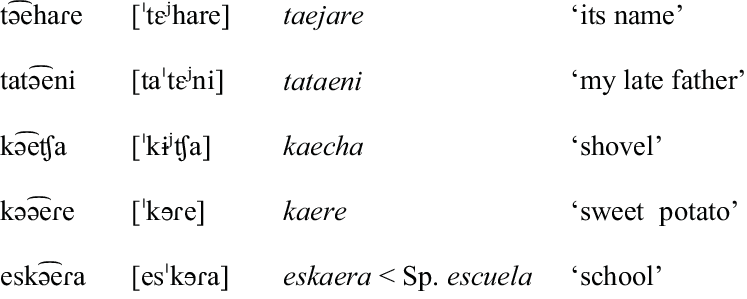
A slight phonetic nasalization of vowels has been noticed when adjacent to, and especially when immediately following, a nasal consonant, as well as in word final position in the word list and at the end of sentences in texts, as is the case with /anˈcoho/ antyojo ‘glasses’ (from Spanish anteojos) realized [aɲˈcohÕ]. Spontaneous nasalization of vowels and consonants as a boundary marker for syllables, words, or clauses is found scattered across Amazonia (Rodrigues Reference Rodrigues2003, Aikhenvald Reference Aikhenvald2012).
Length
Long vowels contrast with short vowels. Duration measurements show that /oː/ is more than twice as long as /o/ in the minimal pair exemplified below (0.363 s vs. 0.162 s).Footnote 16

Distribution
Generally, all vowels can appear in all positions in the word, with two exceptions. First, the segment /ə͡e/ is essentially found word-internally.Footnote 17 There is only one word-final occurrence (/nə͡e/ nae, the reduced form of the preposition /jeʔe/ ye’e with a 3rd person plural prefix /na-/, as in /nə͡e no/ nae no ‘with the’). Second, long vowels are generally not found word-finally, except in very few items like the reduced realization [taː] of /taha/ taja ‘inter.nh’, as in /taː pemˈtone/ taa pemtone ‘what is your work?’. All vowels can be found in any syllable type, except long vowels, which are not found in closed syllables.
Prosody
The Mojeño Trinitario phonological/prosodic word is defined as the domain of stress, rhythmic syncope and phonotactics.
SyllableFootnote 18
The syllable structure observed in Mojeño Trinitario speech is the following: (C(C))V(ː/C). It consists of an optional onset (that can be complex with maximally two consonants), and a rhyme with an obligatory vocalic nucleus. The rhyme can be either light or heavy (i.e. with a long vowel, or with a short vowel followed by a coda). Note that long vowels never combine with a coda.
Complex onsets and onsetless syllables are found word-initially only. Word-internal consonant sequences are therefore always heterosyllabic and show a great diversity (only affricate and tap-initial sequences are not found). Consonant sequences can consist of two identical consonants; this is attested with /p t k m n s/. There are no vowel sequences within a word. Heavy nuclei (long vowels or short vowel + coda) are usually not found word-finally. None of the syllable types are found exclusively at morpheme boundaries.
Stress and rhythmic syncope
Primary stress falls on the rightmost foot.Footnote 19 The default parse is an iambic rhythmic pattern that applies to the underlying form of words, which is made up of open syllables only. Words are parsed from left to right by binary iambs, and the last syllable is extrametrical. The language shows another (minor) metrical parse, found exclusively with disyllabic roots (and a handful of exceptional trisyllabic roots), and only when they are bare or carrying post-root morphology only (disyllabic roots with prefixes fall under the default iambic parse): this trochaic parse applies also from left to right, and the last syllable is not extrametrical. The stress patterns and rhythmic syncope are described in greater details in Rose (Reference Rose2019).
There is considerable inter- and intraspeaker variability in the correlates of stress. Preliminary results indicate that the most robust acoustic correlate of word-level stress is intensity, while duration and f0 are less reliable diagnostics for stress (Gordon & Rose Reference Rose2019). A major manifestation of the stress patterns is a pervasive process of rhythmic syncope, described in detail in Rose (Reference Rose2019). Vowels in foot-internal non-head position, as well as unfooted moras, are targets for syncope, in either iambic or trochaic words.Footnote 20 The word-final syllable, extrametrical in the iambic parse, is not eligible as a target for syncope. The following examples illustrate stress placement and vowel syncope in words with iambic and trochaic parses. Parentheses indicate the foot parse in the form, with syncopated vowels underlined (generally reconstructed from morphological alternations).
Iambic

Trochaic

Apocope
More rarely, the final vowel of words is deleted in rapid speech, either within a phonological phrase (and often in short, frequent words), or at the end of a phrase, as in the title of the text below where the final vowel of /ˈsaʧe/ sache ‘sun’ is not realized.
Transcription of the recorded text
The Mojeño Trinitario version of ‘The North Wind and the Sun’ is read by Claudio Guaji Jare. It is his own translation of the Spanish version of the tale. This section offers a phonetic transcription, a phonological one, and the transcription in the official alphabet (with some adaptations) aligned with a literal English translation.
Phonetic transcription

Phonological transcription

Orthographic, aligned with English translation
To tjooveko kjo’o ene to sache
‘The North Wind and the Sun’
To tjooveko kjo’o ene to sache techjirikwonri’iji te’ to najpukeji ⁰tumeponri’iji, te tetavikpopri’i etna mapuiiriru tyaykukwopri’i te pjo ⁰chope muepkochepo.
‘People tell that the North Wind and the Sun were discussing who was stronger, while a traveller was passing by, wrapped up in a large cape.’
Techokokompo te’ to najpukaeji natiwina naetpigieji to tvejamuiriokapo to muepkochepo, eto mrakineji to ⁰tumewoo’i.
‘They agreed that the one would would be the first to reach his taking off his cape would be might (in strength).’
To tjooveko kjo’o mrakaeji to… tochusraa’i tektikwopuiji to tajichri’i, etotsero to tochus… tochukpoo’i, taemiaykunecheji to muepkochepo ema mapuiiriru.
‘The North Wind got strong in his blowing, it blew on purpose, but as it was blowing, it made the traveler wrap himself even more in its cape.’
Takeptse to tjooveko kjo’o trassakpuiji to tochusraa’i taenajikpoo’i to taworiraa’i.
‘In the end, the North Wind calmed its blowing, it abandonned its decision.’
Takeptse to trappesrawo tamikuchra to sache, te’ to tajaaresrawo ⁰nuujinaeji to mave’ri’i to muepkochepo ema mapuiiriru, tjicho eto tjooveko kjo’o, taechopo to mrakaeji to tatumewoo’i to sache.
‘Then the shining, the lighting of the Sun. Immediately after this light started, the traveller took off his cape, for that reason the North Wind knew the strength of the power of the Sun.’
je’e, titowopo pjoka ⁰chosioropi, rusrupaya
‘All right, the old story is over, thank you.’
Acknowledgements
This paper would not have been possible without my long-standing relationship with Trinitario speakers. For this study, data collected with the help of Florencia Carire Tamo, Leonardo Jou Ichu, Juana Noye Moye, and Claudio Guaji Jare are crucial. Many colleagues have also contributed to this work. I would like to thank Charlie Farrington, Jennifer Krzonowski, MÉlanie Canault and Vincent Arnaud for their help with Praat, Paul Olerjaczuk and Jennifer Krzonowski for their help with vowel charts, Emmanuel Ferragne for his cp_formants Praat script (downloadable at https://moodlesupd.script.univ-paris-diderot.fr/mod/page/view.php?id=49768), Zoe Tribur for harvesting consonant sequences, Christophe Dos Santos, Denis Bertet and Didier Demolin for discussing the phonetic transcriptions, and AndrÉ Radtke and Egidio Marsico for help with noise reduction on audio files. The phonological analysis has greatly benefitted from discussions with Tulio Rojas Curieux, Denis Creissels, GÉrard Philipson, Shelece Easterday and Fernando de Carvalho. I am also thankful to several JIPA editors and reviewers for their very useful comments. All errors are mine.
Supplementary material
To view supplementary material for this article (including audio files to accompany the language examples), please visit https://doi.org/10.1017/S0025100320000365.