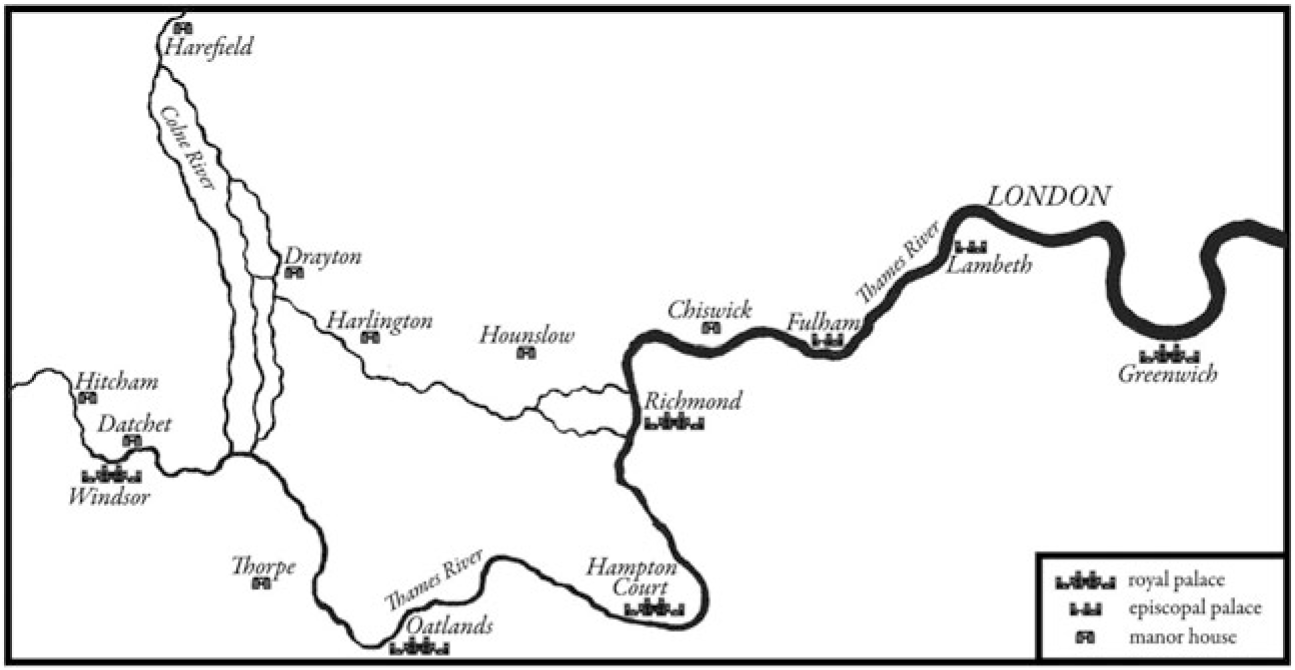



The summer of 1602, Queen Elizabeth's last, was a joyful one in spite of the weather. The monarch had been planning to go on another of her ‘progresses’, visiting grand houses around her realm, receiving copious rich gifts, and being royally entertained. In the end, her travels were somewhat curtailed, as John Chamberlain later reported, due to ‘the fowle weather, and a generall infection of the small pockes spred ower all the countrie’.Footnote 1 The progress began when she left her Palace at Greenwich on 28 July, and travelled through Lambeth to the small village of Chiswick, across the Thames near the site today of The National Archives at Kew, and home of Sir William Russell (see Map). Russell presented a recitation at Elizabeth's arrival and departure, written for the occasion by John Lyly.Footnote 2
Palaces and manor houses in Queen Elizabeth's summer progress of 1602

On 31 July, after passing through Hounslow and Harlington, the queen arrived at Harefield, north of Uxbridge, the home of Sir Thomas Egerton, the Lord Keeper, and his wife Alice (Spencer), the Dowager Countess of Derby. Alice's three daughters by her late husband, the 5th Earl of Derby, were in need of husbands, and the couple were intent on soliciting the help of the queen to facilitate that end. Things did not work out quite as they had hoped in that regard, but there was an elaborate entertainment laid on for Elizabeth during her three-day sojourn there, apparently devised by John Davies, and it survives somewhat piecemeal in no fewer than twelve manuscript copies – a remarkable record of preservation for such an event.Footnote 3
After Harefield, on 3 August, the court moved to Hitcham manor, near Burnham in Buckinghamshire, the home of Sir William Clarke. Clarke was considered by one courtier not to have been very accommodating of the retinue,Footnote 4 but it seems to have been convenient for the court to stay there while preparing to go to the royal palace at Oatlands, in Surrey, as a substitute destination of the soggy progress. As Thomas Edmonds wrote to the Earl of Shrewsbury on that same day: ‘Her Majestie hath had compassion, notwithstanding her earnest affection to goe her progresse, yett to forbeare the same in favor to her people, in regard of the unseasonableness of the weather; and, for that pourpose doth appointe to return by the end of this weeke, and to settle at Otelandes.’Footnote 5 Indeed, she had originally planned to go as far as Bristol, and to take the waters at Bath for her aching arm and hip.Footnote 6
After a meal at Datchet and a brief stay at Thorpe in Berkshire, the court arrived on 11 August at Oatlands, which became its home base for nearly two months. In spite of the near-constant rain, the queen rode out hunting about three times a week, people came and went, and there were occasional excursions. One extended excursion, from 9 to 11 September, was to Drayton to visit the queen's cousin, George Carey, Lord Hunsdon, who was Lord Chamberlain at the time. His wife was the former Elizabeth Spencer, sister of Alice, Dowager Countess of Derby, who had been the queen's hostess at Harefield. The Careys had themselves been at Bath, and the queen had intended to visit them there until the weather intervened. After that short visit, it was back to Oatlands.Footnote 7
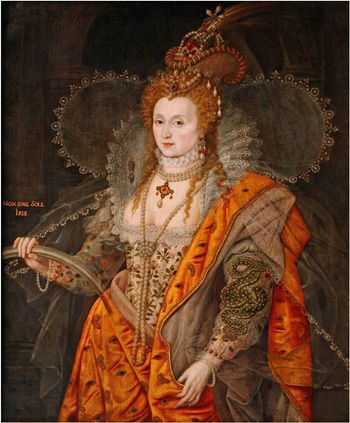
Finally, on 8 October, the court moved to Richmond Palace, and though it never travelled far from London, the progress of 1602 was officially over. In spite of the wretched weather and her nagging infirmities, the queen seems to have had a marvellous time. Her Principal Secretary, Sir Robert Cecil, wrote to George Carew on 9 August that ‘blessed be God, I saw not her Majesty so well these dozen yeares’.Footnote 8 George Savile wrote to the Earl of Shrewsbury on 14 August about the merriment at the Lord Keeper's house at Harefield, including ‘Barley Breaks, dancing of country dances by the Boys of the Chapel, and excellent vaulting of tumblers’.Footnote 9 On 19 September, the Earl of Worcester wrote to the Earl of Shrewsbury, saying ‘Wee are frolyke heare in Cowrt; mutche dawncing in the privi chamber of Contrey dawnces before the Queene maiestie, who is exceedingly pleased therewith. Irish tunes are at this tyme most pleasing …’.Footnote 10 On 23 September, the royal favourite Fulke Greville wrote to the Countess of Shrewsbury: ‘The best news I can yet write your ladiship is of the Queens health & dispo[si]tion of body, which I assure you is excellent good & I have not seen her every way better disposed thes many years.’Footnote 11 Lastly, on 27 September, the Bishop of London, Richard Bancroft, wrote from his Palace at Fulham to the Earl of Shrewsbury: ‘Her Majesty is merry; long may she continue so and in good health, which is our chief worldly comfort.’Footnote 12 A portrait of the resplendent Queen Elizabeth, apparently from the time of the 1602 progress, may be seen in Figure 1.Footnote 13
Queen Elizabeth I (1533–1603). ‘The Rainbow Portrait’, attr. Marcus Gheeraerts, c. 1602). Reproduced with permission of the Marquess of Salisbury, Hatfield House

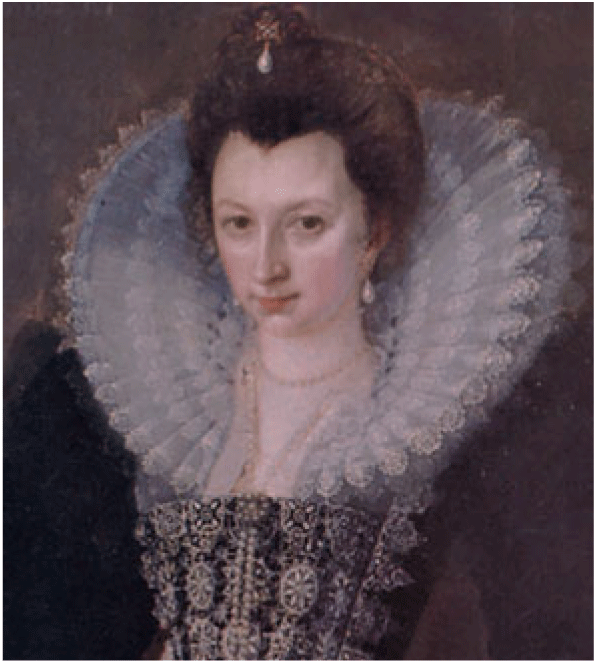
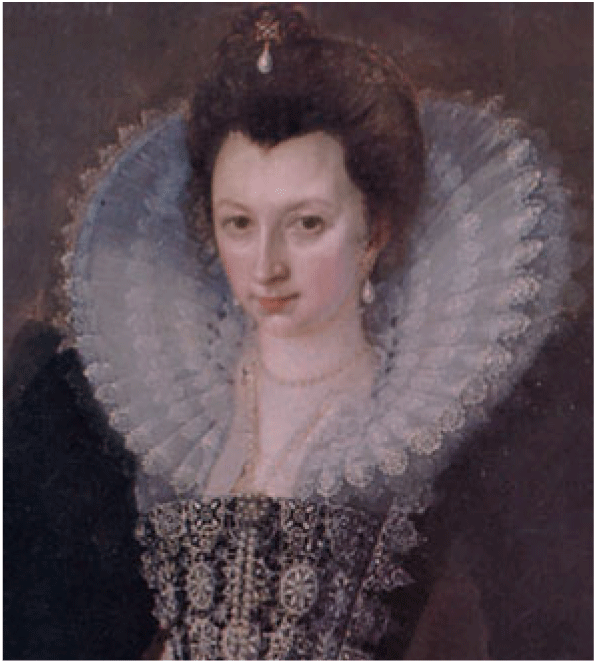
In the midst of this arcadia occurred a curious incident involving three people: the queen, Sir Robert Cecil (see Figure 2), and his niece, Elizabeth (see Figure 3). This young woman was the eldest daughter of Cecil's late sister Anne and the Earl of Oxford, and wife to William Stanley, the current Earl of Derby. She was also a Lady of the Queen's Bedchamber, which means that she attended the queen along with the other ladies and Maids of Honour, of whom there were several.Footnote 14 The incident in question was described in a letter from William Browne to the Earl of Shrewsbury, written on 18 September:
Sir Robert Cecil, Queen Elizabeth's Principal Secretary (1563–1612). Miniature portrait by Isaac Oliver (c. 1600), shown actual size. Reproduced by permission of The Burghley House Collection

Elizabeth (de Vere) Stanley, Countess of Derby (1575–1627). Anonymous painting c. 1600. Reproduced from the collection at Blair Castle, Perthshire
I send your Lo: herein enclosed som verses compounded by Mr. Secretary who gott Hales to frame a ditty vnto itt, the occasion was as I hear yt the young Lady of Darby wearing about her neck in her bosom a picture wch was in a dainty tablet, the Queen espying itt asked what fyne iewell that was the Lady Darby was curious to excuse the shewing of itt butt the Queen wold haue itt and opening itt and fynding itt to be Mr. Secretaryes, snatcht itt away and tyed itt vppon her shoe, and walked long wth it there, then she tooke itt thence and pinned itt on her elbow and wore itt somtymes there also, wch Mr. Secretary being told of, made these verses, and had Hales to sing them in his chamber, itt was told her maty. yt Mr. Secretary had rare musick and songs she wold needes hear them and so this ditty was soung, wch yu see first written, more verses [down the left margin:] there be lykewyse whereof som or all were lykewyse soung, I do imagin yt boldly send these things to your Lo: wch I wold not do to any els for I hear they are very secrett, some of ye verses argew that he repynes not thoghe her maty please to grace others, and contents himself wth th[e fa]vour he hath: I am now in hast butt will wryte again when I haue bene at court, in the meane tyme will pray for your Lo: and my most honorable Lady and remayne ever
Your Lo: in All humblenes sincerely
William Browne
18th September 1602Footnote 15
To summarise, Cecil's niece was wearing a miniature portrait in a closed locket around her neck.Footnote 16 The queen demanded to see it, which the young countess was initially reluctant to allow. Discovering the portrait to be of her Principal Secretary, the monarch seemed to show displeasure by walking around with the locket tied first to her shoe, then to her elbow. It is difficult to say if the queen was angry or teasing, but Cecil could not afford to take any chances, so he wrote some verses and made it known that they would be sung in his chamber by Robert Hales, one of the queen's favourite singers. The queen could not resist coming to hear the songs, which were intended to appease her. Browne notes that he enclosed the lyrics, which he considered ‘very secrett’, but they were not preserved with his letter.
Why the young Countess of Derby would be wearing a closed-locket portrait of her uncle is something of a mystery. He was a dozen years older but they were both raised in the household of William Cecil, Lord Burghley – her grandfather and his father – for several years after 1576, when Elizabeth was temporarily disavowed by her father, the Earl of Oxford. Even after her parents’ reconciliation in 1582, she seems to have remained in the Cecil household until 1589, when she became a Maid of Honour to the Queen. Robert Cecil may thus have been either an older-brother figure or a father figure to the countess.Footnote 17 Regardless, for a young married woman to be discovered wearing another man's portrait must have been an embarrassment for the married couple and the man portrayed.
As for the queen's insistence on opening the locket, she may have been alarmed because the young Countess of Derby had carried on a scandalous liaison with the Earl of Essex from 1595 to 1597, starting just a few months after her marriage.Footnote 18 As with Robert Cecil, the countess had known Essex from a young age as well, since he spent some years in the same household as a ward of Burghley. By the summer of 1602, Essex had been dead for eighteen months, but it is easy to understand why the queen might be suspicious when the young woman was reluctant to hand over the locket.
Browne's account of this incident has been known since the late eighteenth century,Footnote 19 but it took another two hundred years before the lyrics themselves were identified. They will be discussed below, but the event as described has fascinating cultural implications, as outlined by T. G. Bishop:
The route taken by Cecil in his attempt to regain the good graces of the queen reveals not only his knowledge of her personal tastes, but his shrewd sense that refiguring his relations to her through the musical mode at this tense moment, when spoken appeals might be futile or even provocative, allows both parties leeway to reposition themselves. Music saves appearances and offers new roles through a translated formal mediation. Cecil does not have to entreat, or even directly express an intention to entreat, nor does the queen have to undertake to listen to anything but a concert: what is ‘told’ her is not that ‘Cecil wishes to apologize’, but that he has ‘rare music and songs’. The disgraced lord does not speak for himself, but ‘is sung’ by another, and Elizabeth, if she wishes to hear the music, must agree to remain silent while he is represented.Footnote 20
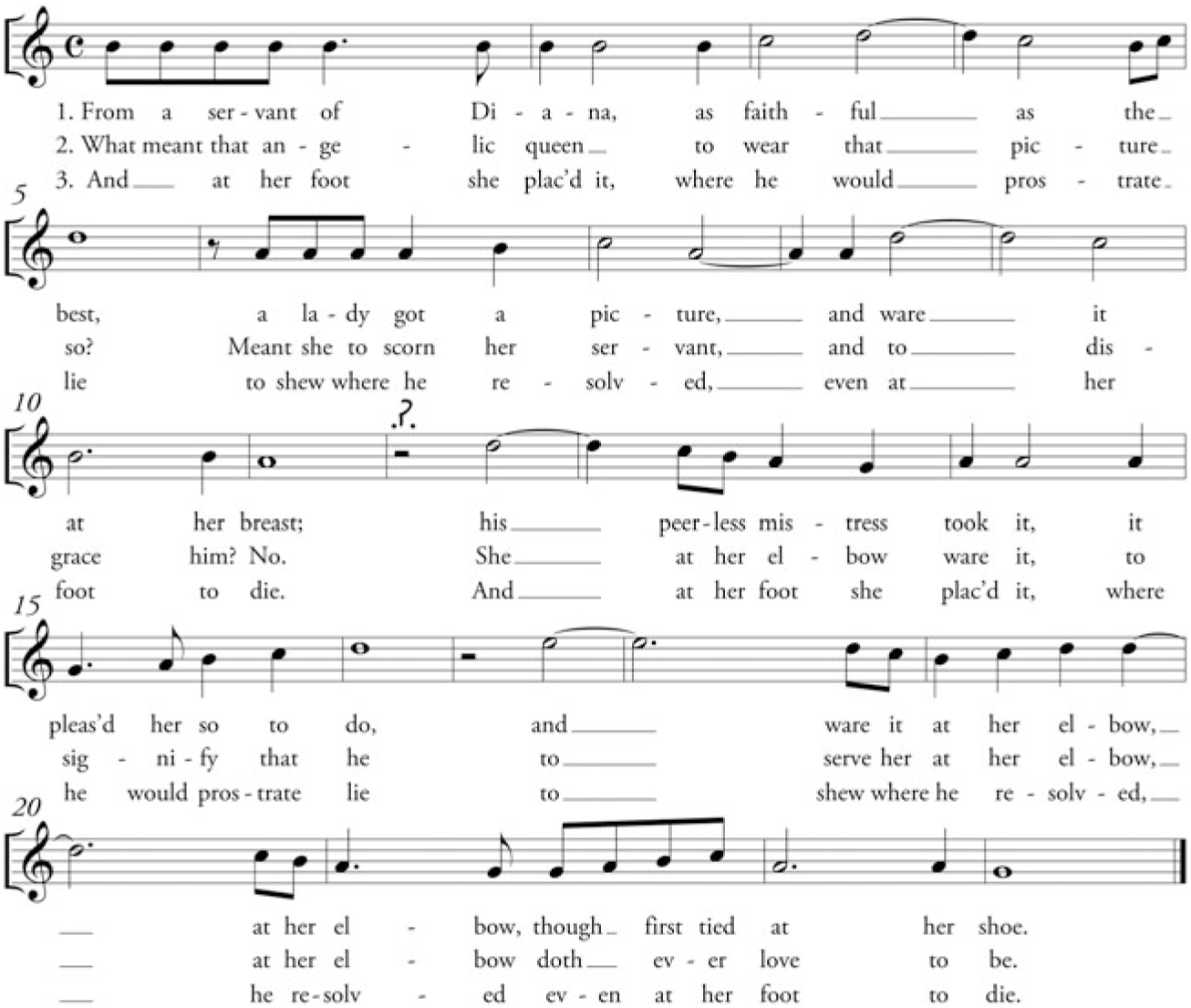
After two hundred years of commentators wishing they knew what song accomplished this reconciliation, Katherine Duncan-Jones identified Cecil's lyric, or at least one that fits Browne's description perfectly, in a manuscript at Oxford's Bodleian Library:Footnote 21
Cecil cleverly shows how the queen's actions of wearing the portrait on her shoe and at her elbow, rather than demeaning him (the obvious interpretation), could be construed to show her appreciation of Cecil's devotion to her.Footnote 23 In both manuscripts where this poem appears, it is paired with a second lyric, My love doth fly with wings of fear. It seems possible that this other lyric relates to the ‘more verses there be likewise whereof some or all were likewise sung’, though its specific connection to the incident is not clear. In the Bodleian manuscript, it is attributed to the Earl of Clanricard, recently returned from military success in Ireland and rapidly gaining favour with the queen.Footnote 24
A third source, the so-called Burley manuscript,Footnote 25 contains only this second lyric and preserves one further stanza at the end:
The central task of this study is to try to discover what sort of musical setting might have been provided for these two lyrics. One factor must have been the apparent urgency of the incident: ‘Mr. Secretary being told of [the Queen's actions], made these verses, and had Hales to sing them in his chamber.’ This suggests real haste, and while Cecil may simply have been anxious to reinterpret an obvious humiliation, Joshua Eckhardt has pointed out that Cecil's guilty conscience over his ongoing correspondence with King James could have spurred him to swift action, representing himself ‘as a prostrate servant when he could have been charged as a traitor’.Footnote 26 Indeed, Cecil had fired his long-time personal secretary, Simon Willis, just three days before the summer progress began, as he wrote to Sir Henry Wotton in 1608,
principally, because I was loath he should haue come to some Discovery of that correspondency which I had with the King our Souveraigne, which, without great Difficulty, I could not have avoyded, considering his dayly, and neare attendance, as my Secretary, to whose eyes a pacquett, or a paper, might haue beene so visible, as he mought haue raysed some such inferences thereof, as mought have bredd some jealousie in the Queenes mynd, yf she had knowne it, or heard any such suspicion to move from him. Wherein, althogh I hope you remayne secure, yf her Majesty had knowne all I did, how well there should have knowne the innocency and constancy of my present fayth; yet her age and orbity,Footnote 27 joyned to the jealousy of her sexe, might haue moved her to think ill of that which helpt to preserve her.Footnote 28
Thus, at this sensitive time, Cecil could not afford for the queen to harbour any lingering doubts about his loyalty. For him, it was an emergency, and he must have quickly made the verses and had them sung. Browne's initial description, in fact, recounted that Cecil wrote the lyric and ‘gott Hales to frame a ditty vnto itt’. That phrase is confusing, and requires some unpacking. The most likely reason for the confusion is that Browne was a little unclear about the terminology, using ‘ditty’ to refer to a piece of music generally, whereas it actually refers to a lyric.Footnote 29 That usage seems clearer later on when he says ‘so this ditty was soung, wch yu see first written, more verses there be lykewyse whereof som or all were lykewyse soung’, which seems to equate ‘ditty’ and ‘verses’. Thus, in spite of the modern conception of a ‘ditty’ as a ‘short simple song’ (to quote the Oxford English Dictionary), a ‘ditty’ for Elizabethans was a lyric which could be set to music, or a lyric written for specific music, not something to which a ditty might be framed. Such an interpretation is evident from widespread contemporary usage,Footnote 30 such as this couplet from Thomas Whythorne's Songes of 1571:
Similarly, this quotation from Thomas Kyd's(?) The Tragedye of Solymon and Perseda (1592) includes this couplet of dialogue (1.2):
These are supported by passages from Thomas Morley's 1597 treatise A Plaine and Easie Introduction to Practicall Musicke:Footnote 33
Rules to be obserued in dittying: It followeth to shew you how to dispose your musicke according to the nature of the words which you are therein to expresse, as whatsoeuer matter it be which you haue in hand, such a kind of musicke must you frame to it. (p. 177)
[Music] being aptlie framed for the dittie and well expressed by the singer (p. 179)
Poets who compose the ditties (p. 180)
The most principall and chiefest kind of musicke which is made without a dittie is the fantasie (pp. 180–1)
The Italians make their galliardes (which they tearme saltarelli) plaine, and frame ditties to them (p. 181)
Browne probably meant that Cecil ‘got Hales to frame music unto the ditty’, or something similar. Indeed, it is possible to frame music to an existing lyric, or to frame a lyric to existing music, but not frame a lyric to a lyric. The task of Robert Hales, then, would have been to set Cecil's lyric to music.
Hales is known to have composed a single lute-song, O eyes leave off your weeping, printed in Robert Dowland's A Musicall Banquet of 1610,Footnote 34 but that is the only evidence we have for him as a composer. His primary fame was as a singer, and he was a recognised favourite of the queen. When on 17 November 1590 (Accession Day), Sir Henry Lee retired as Elizabeth's ‘Champion’ at a court ceremony in the Tiltyard at Whitehall, John Dowland's His golden locks time hath to silver turned was ‘pronounced and sung by M. Hales, her Maiesties seruant, a Gentleman in that Arte excellent, and for his voice both commendable and admirable’.Footnote 35 Sir Henry Wotton reported that ‘my Lord of Essex chose to evaporate his thoughts in a Sonnet (beeing his common way) to be sung before the Queene, (as it was) by one Hales, in whose voyce shee tooke some pleasure’.Footnote 36 And for Twelfth Night in January 1601, Lord Chamberlain Hunsdon gave instructions ‘To appoint Musicke seuerally for the Queene, and some for the play in the Hall. And Hales to have one place expressly to shewe his owne voice.’Footnote 37
But this evidence does not suggest that Robert Hales was so fluent a composer as to make an instantaneous lute-song setting of From a servant of Diana, nor indeed, of the other songs that were apparently sung at the same time, including My love doth fly. So, how might Hales have framed music to Cecil's poem, especially given the time constraints? The most likely scenario is that he did not compose something new but, rather, used existing music that fit the words. Even if Browne was confused about the terminology in saying that Cecil ‘gott Hales to frame a ditty vnto itt’, and used ‘ditty’ in the sense of words and music together, he surely meant that Hales set the tune of the pre-existent song to Cecil's lyric. Indeed, one thing that ‘ditty’ does not mean at this period is a composed melody without words, so according to Browne's description, this would rule out Hales creating new music to set Cecil's lyric. Moreover, hasty musical borrowings made necessary by the shortness of time have a long history. Ludwig Senfl reworked Costanzo Festa's motet for the 1514 funeral of Anne of Brittany, tweaking it slightly to make it suitable for the funeral of the Emperor Maximilian in 1519.Footnote 38 Elton John took his own Candle in the Wind, a 1973 elegy for Marilyn Monroe, and wrote new lyrics for Princess Diana's funeral in 1997.Footnote 39 Closer to the time in question, some anonymous lyricist used Cease now, delight, Thomas Weelkes's elegy for Lord Borough (d. 1597), for Prince Henry (d. 1612), changing only a few words to make it fit the situation.Footnote 40 The scramble resulting from unexpected deaths invited that kind of repurposing, and I believe such a process is most likely here, not for a sudden death, but for an urgent crisis of state.
Thus, it is much more likely that Hales simply sang the lyric to existing music that, in his opinion, worked the best.Footnote 41 There are two basic possibilities for this. One is that he borrowed an existing lute-song for the purpose, and the other is that he set the lyric to a popular tune that fitted the stanza versification of eight lines of trimeter in an abcbdefe rhyme scheme. Both possibilities will be explored here.
Writing new lyrics for ballad tunes was an everyday occurrence in the broadside repertoire, but is it, indeed, likely that a popular tune would be used for such a purpose at court?Footnote 42 To answer this question, it is useful to review what is known about music for Elizabeth during her 1602 progress. The Entertainment at Chiswick, the first stop on the progress, consisted solely of two prose speeches by John Lyly, so there was no known musical involvement. At Hitcham, there are no descriptions of music, but it is interesting for the report of William Browne, who enjoyed an extended audience with the queen on 8 August, and wrote excitedly about it afterwards to Sir Robert Sidney on 12 August.Footnote 43 He was obviously interested in entertainment because, in a postscript, he mentions that he is enclosing copies of the entertainments at both Chiswick and Harefield.
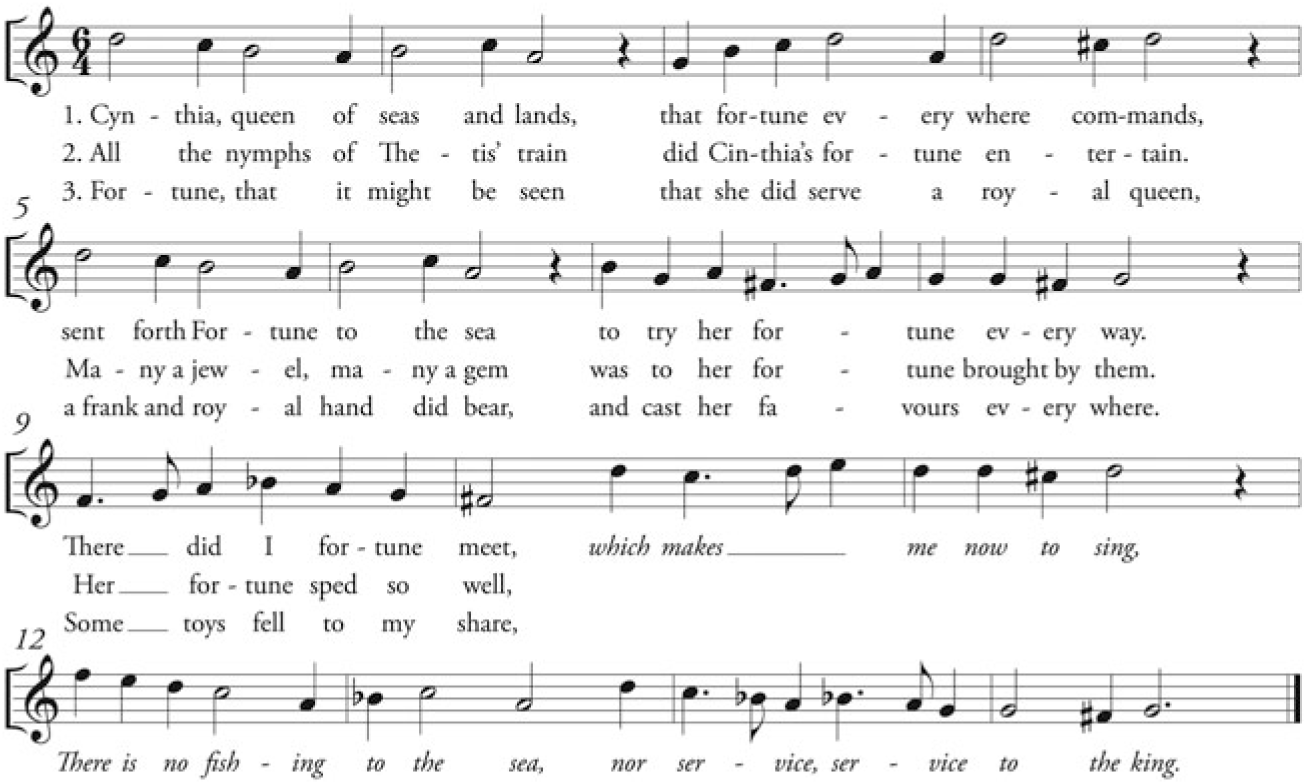
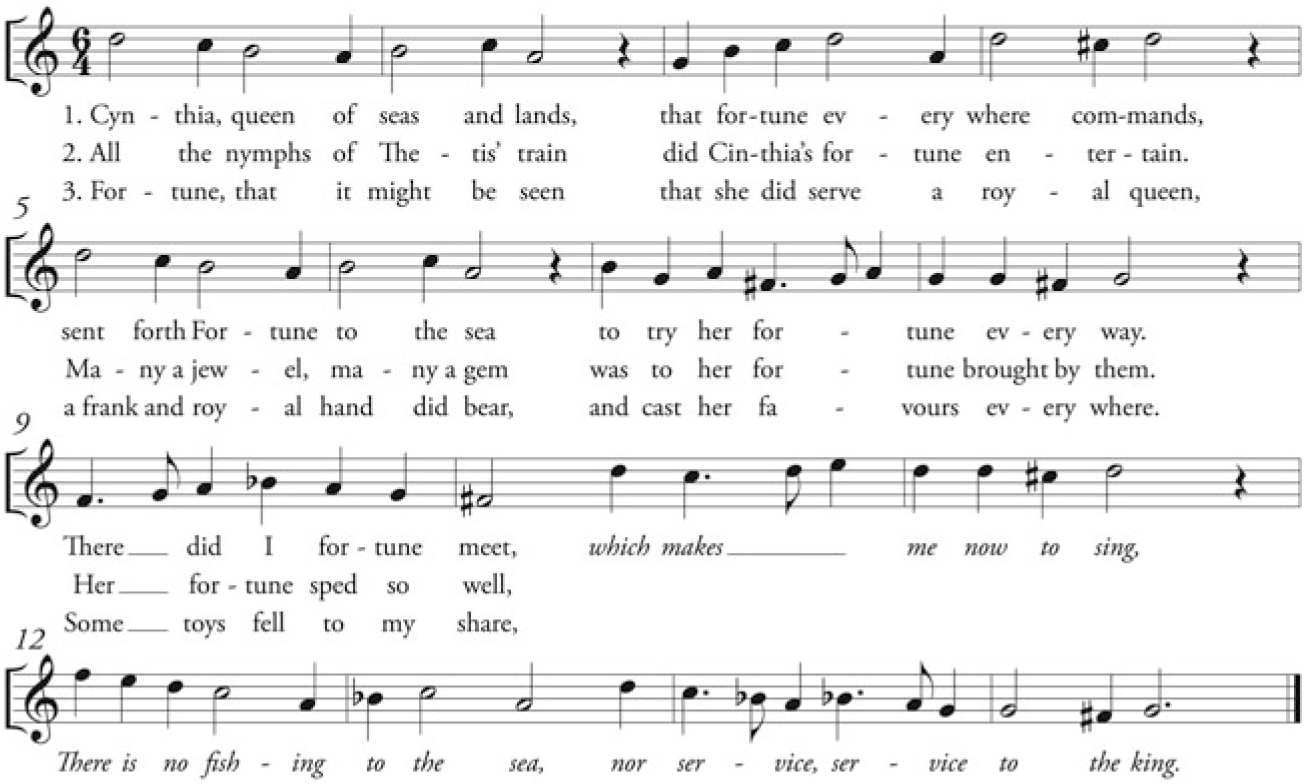
Apparently the last to be planned in advance, Harefield was an elaborate entertainment indeed, consisting of the ‘Dialogue of the Bailiff and the Dairymaid’, the ‘Dialogue of Place and Time’, the ‘Petition of St Swithin’, a ‘Lottery’, and ‘Place's Farewell’, all ostensibly written for the event by John Davies. The Lottery was an extended device where the ladies of the court drew lots, supposedly booty from a real Spanish ship recently pirated and brought to shore, with each new item accompanied by a couplet of poetry. The obvious music in all of this entertainment is a song, used to introduce the Lottery by the Mariner who brought the booty. Cynthia, queen of seas and land was sung by the Mariner (or, in one source, two Mariners),Footnote 44 and a setting of it survives, published in 1605 by Robert Jones in his Ultimum Vale.Footnote 45 We have no guarantee that this was the setting used at Harefield, both because the script circulated so widely after the event, and because Jones's published setting is for four voices, though a version of it may have been possible. Just to show that some other setting could have been used, Example 1 gives that lyric set to I smile to see how you devise, a tune from the Elizabethan keyboard manuscript known as the Mulliner Book.Footnote 46 It is one of the only tunes suitable for a stanza with the rare 44443343 versification, as found in this lyric.
Cynthia, queen of seas, set to I smile to see how you devise
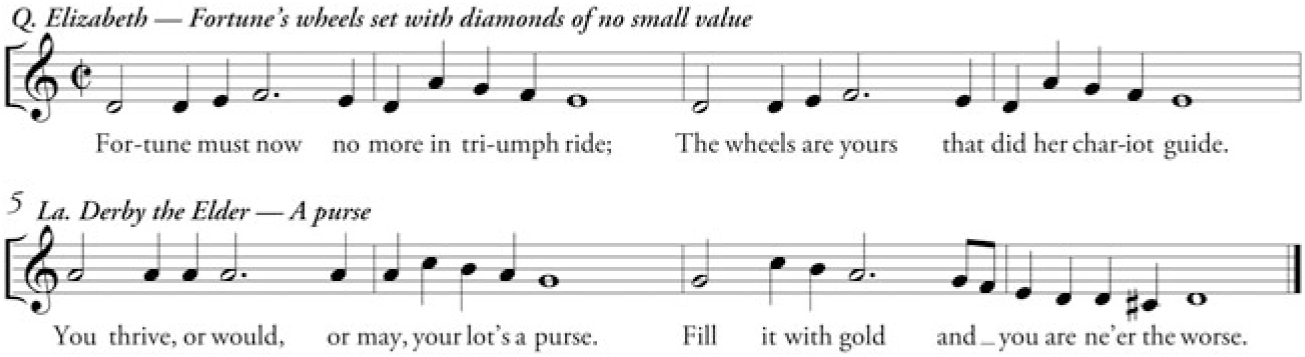
After singing this song, the Mariner gives a short speech introducing the Lottery. In the course of the song and the paragraph following, he uses the word ‘fortune’ fourteen times, including the vow ‘that as they came to my hands by fortune, soe I would not parte from them but by fortune’. The Lottery itself begins with the drawing by the queen of ‘Fortunes wheeles sett with diamonds’ and a couplet that begins ‘Fortune muste nowe no more in triumphe ride’. Indeed, all of the verses are pentameters of rhyming couplets. Any lottery ostensibly involves luck or chance, so the word ‘fortune’ might be expected to be prominent, but its constant use throughout this lyric, plus the distinctive versification, lead me to suggest that all of the couplets of the Lottery were sung to the tune Fortune my foe.Footnote 47 The use of the word ‘fortune’ and the versification would be enough to make a case for the tune, but there are echoes of the original Fortune my foe song as well, in lines like ‘Blinde Fortune dothe not see howe faire you bee’, which is reminiscent of ‘If wisdom's eyes blind Fortune had but seen’, or ‘Frowne in goode earnest’, which recalls the opening line of the famous song ‘Fortune my foe, why dost thou frown on me?’, or ‘fortune might favor thee’, which recalls ‘though Fortune favor thee’ from the song. The personification of Chance makes an appearance in both lyrics as well: ‘Chaunce knows not what to giue you for a lott’ from the Lottery, and ‘O cruel Chance, thou breeder of my pain’ from the original song. Thus, while we have no direct evidence that it was sung, it seems quite possible that parting with the lots ‘by fortune’, as the Mariner vowed, meant parting with them while singing the lyrics to the tune Fortune my foe. Example 2 gives the opening couplets for Queen Elizabeth and the Dowager Lady Derby, Harefield's hostess (following the order in the Conway manuscript and in the sole printed version).Footnote 48 The lots drawn are given after their names.
Sample couplets from the Lottery, set to the tune Fortune my foe

There are some things about the performance of the Lottery that are unclear in the description. Do the ladies named actually draw the lots from the box, or are they drawn for them? A period engraving by Gijsbert van Veen shows Death drawing lots from an urn for a line-up of people from all walks of life, and this seems to support the idea that the lots were drawn for the ladies in this case.Footnote 49 Secondly, do the ladies present the couplets themselves, each in turn, or are they presented for them by some actor or musician, with some master of ceremonies – the mariner himself, perhaps – naming the objects as they are drawn? That there is a specific couplet for each lot shows that the order was not random: there must have been some sort of choreography to ensure that the item drawn was paired with the right person, and the couplet was ready when the object was drawn. In addition, the fact that the queen is first in the action, with both a lot and a couplet, confirms that the ladies are not doing these things themselves, though everyone would certainly have known the tune. Indeed, in the c. 1587 poetic exchange between Queen Elizabeth and Sir Walter Raleigh, both Raleigh's original ‘Fortune hath taken thee away my love’, and Elizabeth's ‘Ah, silly pug, wert thou so sore afraid’, both fit handsomely to Fortune my foe, and they may have been written expressly to do so.Footnote 50 That may also explain why Robert Naunton, speaking of Raleigh after his death, said he had sung Fortune my foe when he found ‘his favour declining’.Footnote 51
There is one other roundabout confirmation of popular song being heard at court around this time. On 26 September 1602, the Duke of Stettin-Pomerania visited the court at Oatlands. His three-week trip to England was chronicled by his secretary, Frederic Gerschow, who afterwards wrote down everything they saw and experienced.Footnote 52 Ten days before visiting the court, they had been to the Tower of London, which led Gerschow afterwards to mention the late Earl of Essex and a ballad written about him:
On descending to the courtyard, the spot was shown to us where the brave hero the Earl of Essex was beheaded, and lay buried in the chapel close by. How beloved and admired this Earl was throughout the kingdom, may be judged from the circumstance that his song, in which he takes leave of the Queen and the whole country, and in which also he shows the reason of his unlucky fate, is sung and played on musical instruments all over the country, even in our presence at the royal court, though his memory is condemned as that of a man having committed high treason.Footnote 53
Gerschow mentions hearing the ballad All you that cry, O hone, O hone, written partially in the voice of the earl, during their one-day visit to the court. The broadside called for the tune The King's Goodnight,Footnote 54 which then became known as Essex Last Goodnight,Footnote 55 but it was a popular tune and it is remarkable that Gerschow and his Duke happened to hear such a song at court during their few hours at Oatlands on 26 September.
At any event, Elizabeth herself and no doubt all of her ladies could have sung their couplets to the first or second strain of Fortune my foe, though it seems virtually certain that, for the Harefield entertainment, they had someone to do it for them,Footnote 56 possibly even the Boys of the Chapel who were present.Footnote 57 The widespread knowledge of the tune, even at court, plus the various references to country dances, Irish tunes and Barley Break during the progress, help to make clear that a song set to a popular tune would not have been out of place at court during this season.
Before leaving Harefield, I would like to propose that another existing lute-song may have been inserted earlier in the festivities, perhaps during the Dialogue of Time and Place. These two allegorical characters discuss how time stops for the ‘goddess’ that they are entertaining, and Time's speech includes this passage: ‘I am her time, and time were verie vngratefull yf yt shoulde not euer stande still to serue preserue cherishe & delighte her, that is the glorie of her time, and makes the time happie whearein she liues.’Footnote 58 It seems to have gone unnoticed heretofore that the verbal imagery is strongly reminiscent of John Dowland's exquisite lute-song Time stands still, published in his Third and Last Booke of Songs or Aires of 1603, just a year after the Harefield entertainment.Footnote 59 Indeed, though the language of the lute-song is more elevated, it fits the situation so well that if it was not written for the Dialogue, it must certainly have been inspired by it. Here is Dowland's lyric:
Though not used as a proper noun, ‘place’ is mentioned in the song as well, at the end of the second line. The praise here is so extravagant that it could only be addressing the queen, and indeed, the line ‘shee remains the same’ recalls Elizabeth's motto, Semper eadem. Fortune is well represented, and will be again shortly in the ‘Lottery’, as we have seen. Dowland's His golden locks has already been mentioned as used in the court ceremony for Sir Henry Lee, and it has previously been proposed that Time stands still emanated from some court entertainment as well, but no specific occasion has emerged until now.Footnote 60 A performance of Time stands still could have occurred at the end of the Dialogue of Time and Place, or alternatively, it could have come near this passage within it: ‘Well, well, this is not time for vs to enterteine one another, when wee should bothe ioyne to enterteine her; arre you redie, Place? Time is redie.’Footnote 61
Lastly, with regard to the Harefield entertainment, there seem to be two passages that anticipate wording from the two songs of the Cecil incident. The first occurs as part of Place's speaking in her Dialogue with Time, when she says: ‘I should in somme measure resemble her sacred self, and been in the outward fronte exceedinge faire, and in the inward furniture exceedinge riche.’ This seems echoed in the Burley manuscript's added verse to My love doth fly, which includes the lines ‘Would god twere like her sacred breast/most fayre wthout, most rich wthin.’
The other connection is subtle but intriguing. Cecil's niece, Elizabeth, who was at the centre of the incident with the locket, draws a lot described as ‘A ring, with this Poesye, as faithfull as I finde’. It seems not to have been noticed heretofore that this is reminiscent of the opening of Cecil's lyric: ‘From a servant of Diana, as faithful as the best’. The language ‘as faithful as’ suggests an awareness on Cecil's part of the specific role his niece had played in the Lottery at Harefield,Footnote 62 and may imply that the incident took place not long after, but we do not know for sure.
Some information about dating may be teased out of the letters of William Browne, who is the sole source for the incident in his letter to the Earl of Shrewsbury on 18 September. But where was he writing from? And how new was the information about the incident and the songs? Browne was clearly interested in court entertainments since he went to the trouble of having the Chiswick and Harefield entertainments copied out to send to Sir Robert Sidney along with his newsy letter on 12 August, ten days after the Harefield event and four days after his own visit to court at Hitcham. If Browne had known about the incident then, he would probably have mentioned it, so it is unlikely to have been current gossip on 8 August, when he visited the court. We have another letter from William Browne to Sir Robert Sidney on 15 September, and this provides further insight into the timing. Writing from London, Browne reports that he expects to be at the court on Friday or Saturday of that week, which would be 17 or 18 September, and that he expected to stay four or five days.Footnote 63 We know from his 18 September letter that he was not yet at court (‘I am now in hast butt will wryte again when I haue bene at court’). It has been proposed that Browne was still in London on the 18th,Footnote 64 but that seems unlikely because he wrote to Shrewsbury on 17 September from Fulham, saying he had determined not to write until he had been to the court, but an opportunity to send a letter had presented itself.Footnote 65 So the next day, the 18th, since he was not yet at court (Oatlands is 15 miles from Fulham), he was very likely still at Fulham. On that day, he wrote again to Shrewsbury, sharing the story about the incident with Cecil and the queen, and enclosing the lyrics. The most obvious interpretation is that, no earlier than 17 or 18 September, word of this story leaked to Fulham, and Browne was able to share it. Fulham was the palace of the Bishop of London, Richard Bancroft, who (as noted above) wrote a letter on 27 September describing Elizabeth's high spirits, so he seems to have kept informed about the court at Oatlands. One further possibility is that the incident took place at Drayton, at the home of Lord Hunsdon, during the queen's visit there from 9 to 11 September. It could not have occurred much later than that for word of the incident to have leaked and the secret lyrics copied and shared from Fulham on 18 September. So, after the event at Harefield, the month from Browne's 12 August letter to the queen's 11 September return from Drayton seems the most likely window.
The question remains: how might Robert Hales have set the lyrics to music? Can we gain some sense of how these songs may have sounded? If, indeed, popular tunes were used to set the lyrics, it is unfortunate that Browne did not mention any titles so that the Earl of Shrewsbury could sing along to himself as he read, and we could know exactly how they sounded. Browne was reporting second-hand, however, so he did not actually hear the songs himself, and that may be why he did not include musical information in the letter, though he may have inserted ‘to the tune of …’ directions on his now-lost copy of the lyrics. Plausible settings of these lyrics to popular tunes can be conjectured from the available information, however, narrowing the possibilities to a small number of likely prospects. The versification of each of the two lyrics is unusual but not extremely so, and thus there is a handful of tunes that could set each poem. I present them here with a brief argument for each.
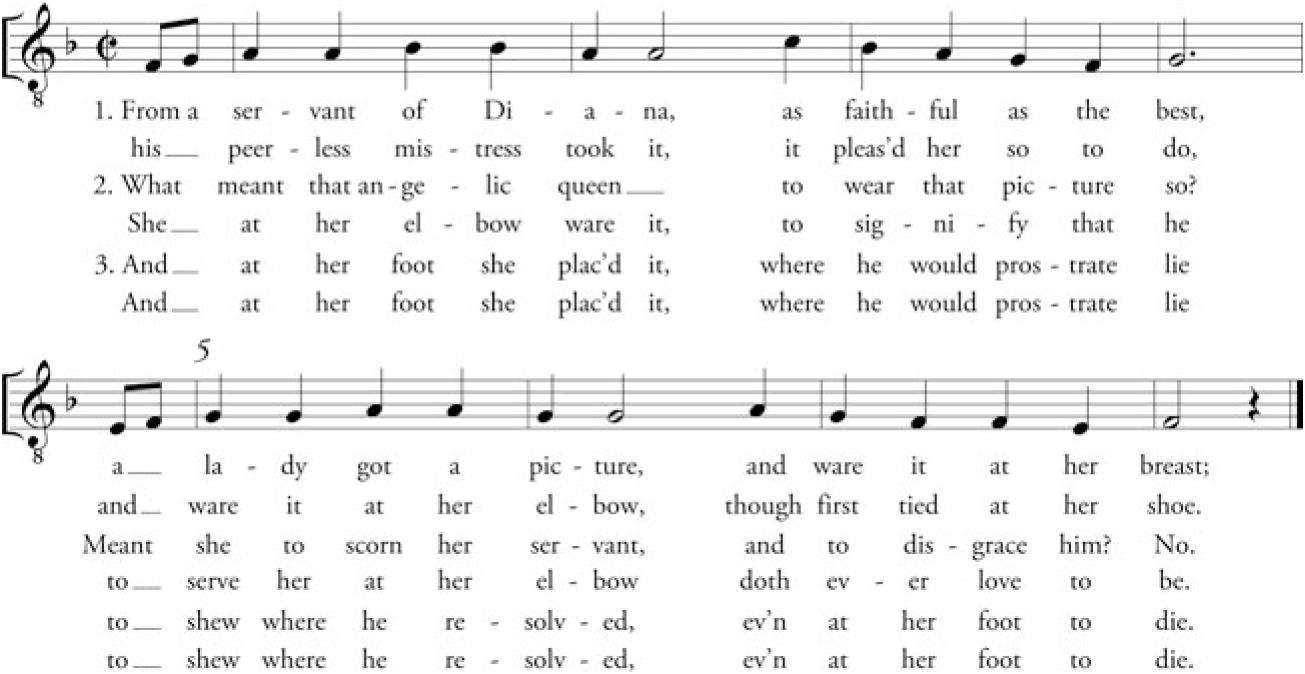
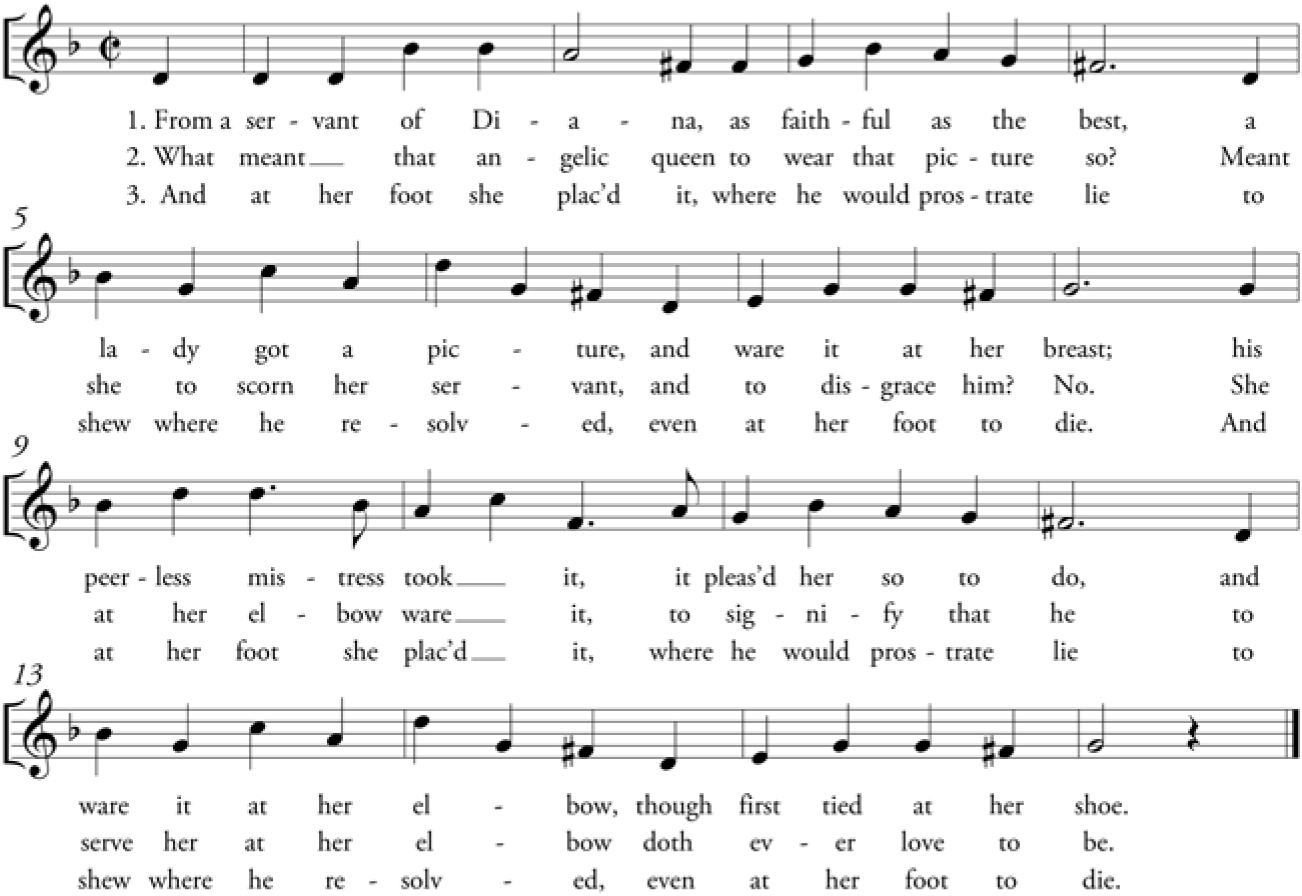
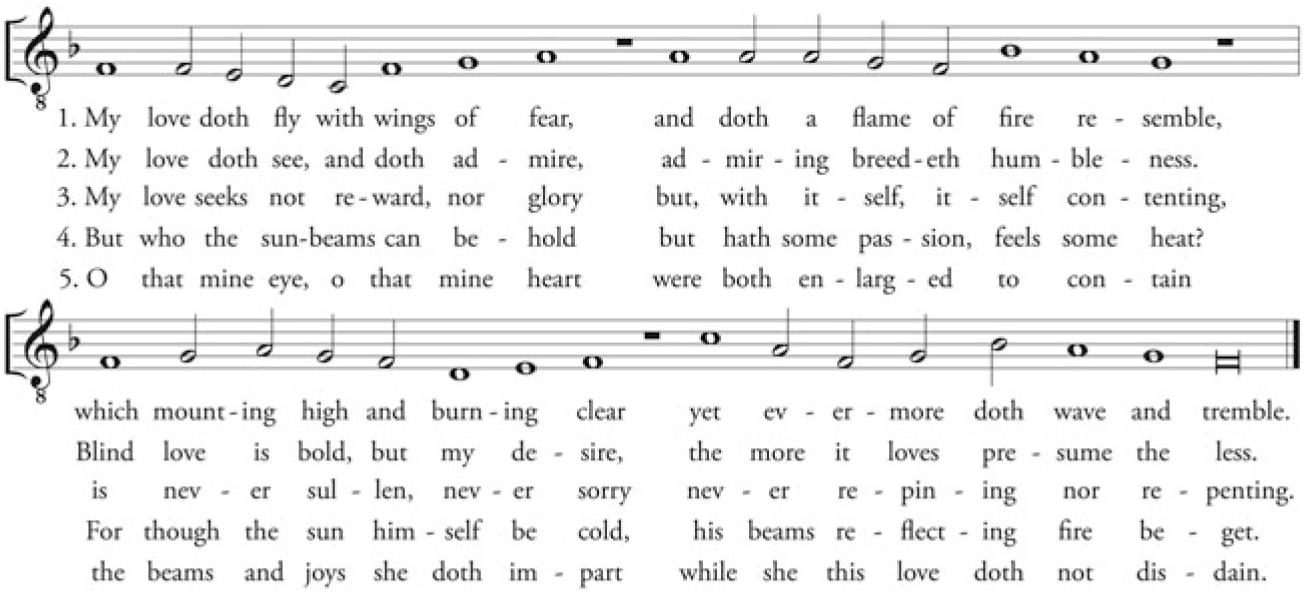
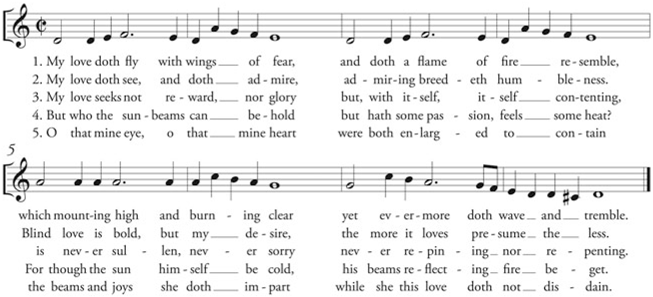
The first setting of From a servant of Diana is to the tune of Rogero, a melody based on a variant of the Ruggiero ground bass that was commonly used to improvise musical settings of Italian poetry from this period.Footnote 66 Yet another variant of Ruggiero survives as a setting for Philip Sidney's Have I caught my heavenly jewel, quoted by Falstaff in Merry Wives of Windsor (Act III, sc. 3).Footnote 67 The Rogero ground, intriguingly, set the ballad Diana and her darlings dear, so its use to improvise a setting of Cecil's Diana song seems entirely plausible, although the original poem is in ballad metre and Cecil's entirely in trimeters.Footnote 68 It also happens that Rogero sets only half a stanza of Cecil's poem, so there is a lot of repetition, including a complete reprise of the final quatrain, which makes little sense musically. Still, the Diana connection and the simple improvisatory character make it seem possible for an urgent situation (Example 3).
From a servant of Diana, set to the tune of Rogero
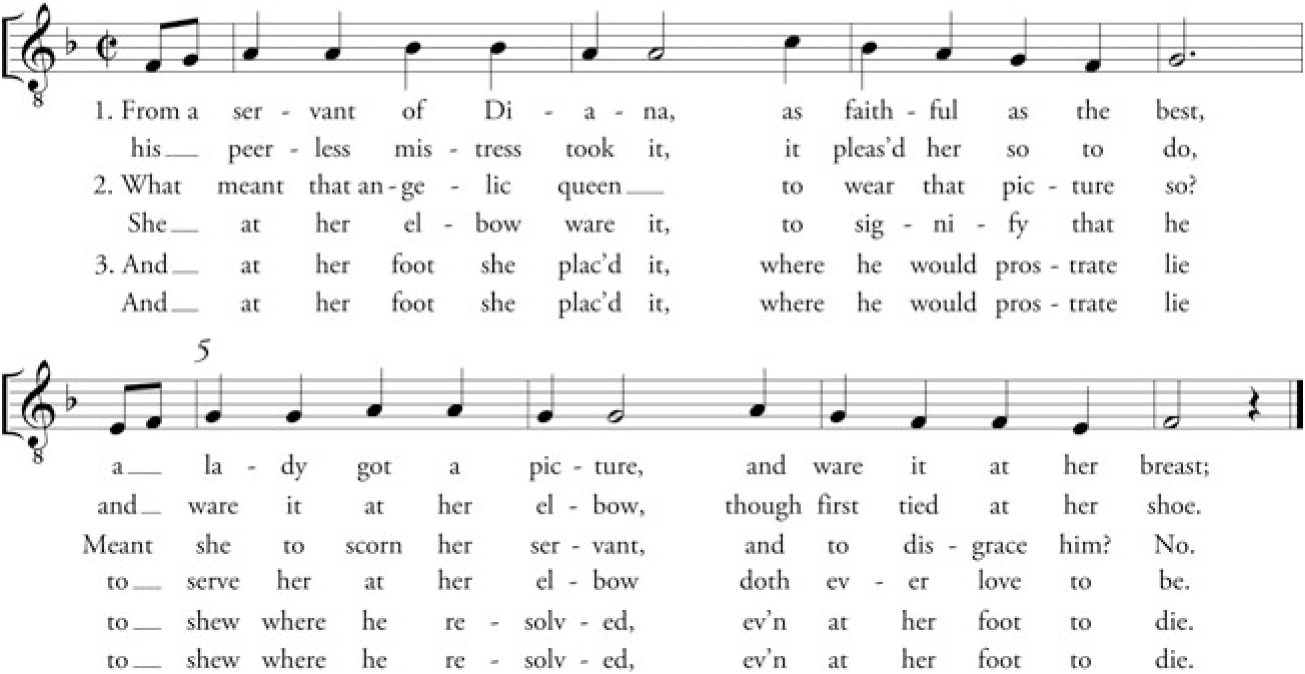
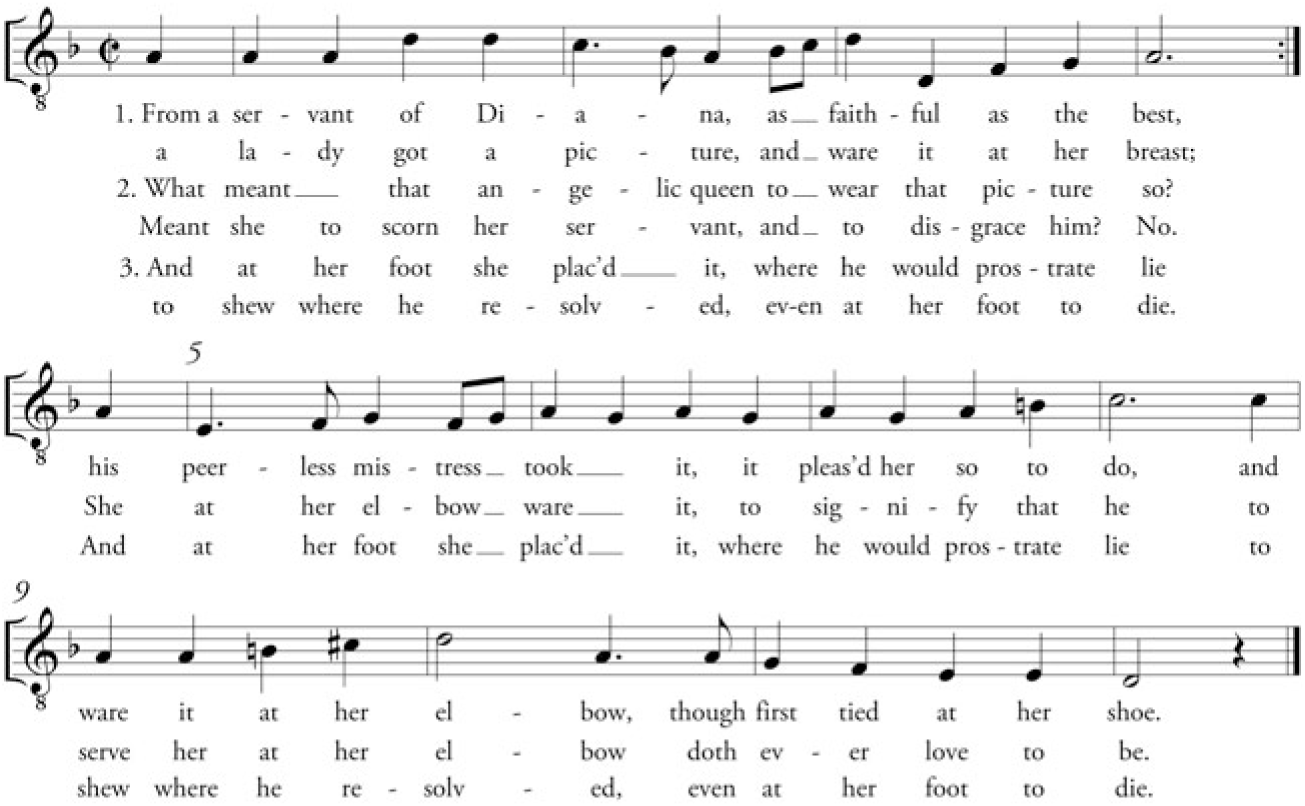
The most common way of ‘improvising’ a musical setting, however, was simply to use a borrowed melody that fit the versification of the lyric, and an obvious choice at that time would have been the tune of Rowland (Example 4). That tune was enormously popular starting in the late 1580s, when it was used to set a ballad about Lord Willoughby fighting in the Low Countries, and it was the most popular tune of the period for eight-line trimeter stanzas.
From a servant of Diana, set to the tune of Rowland
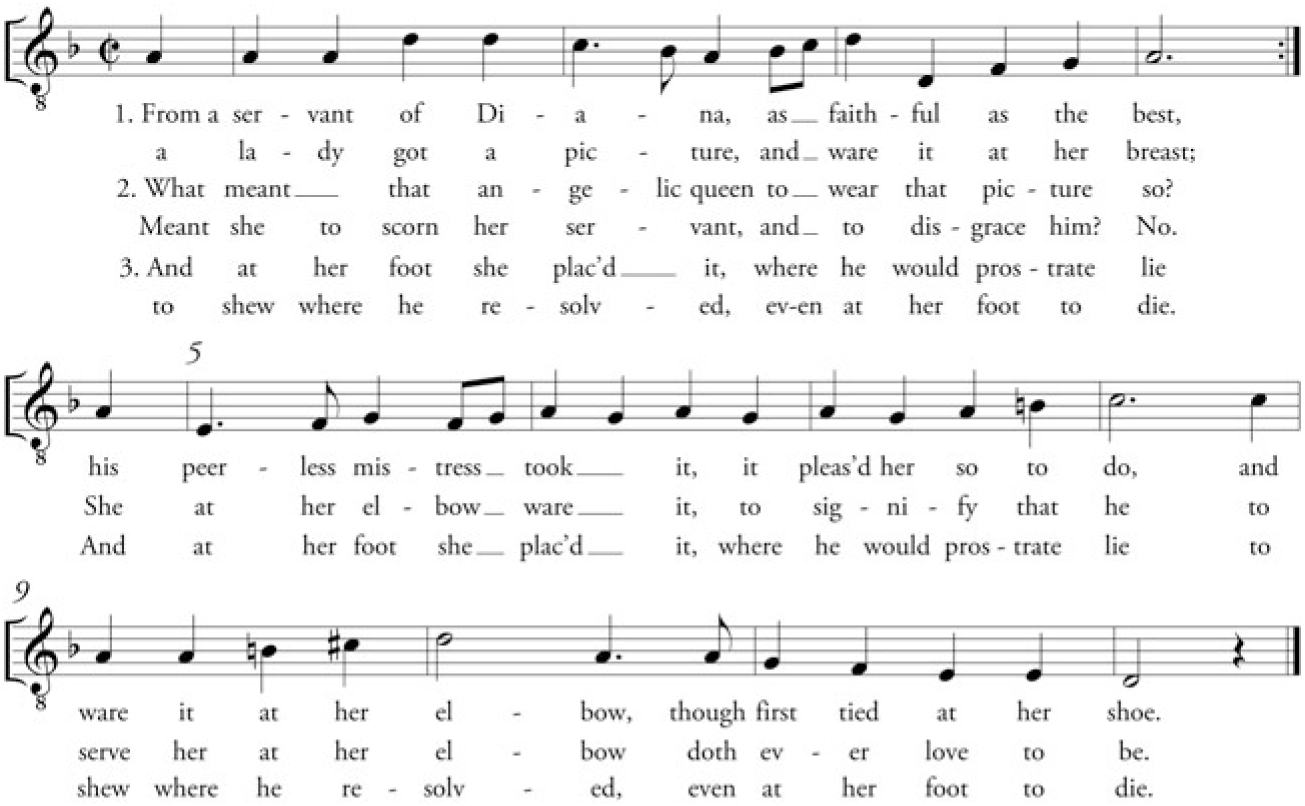
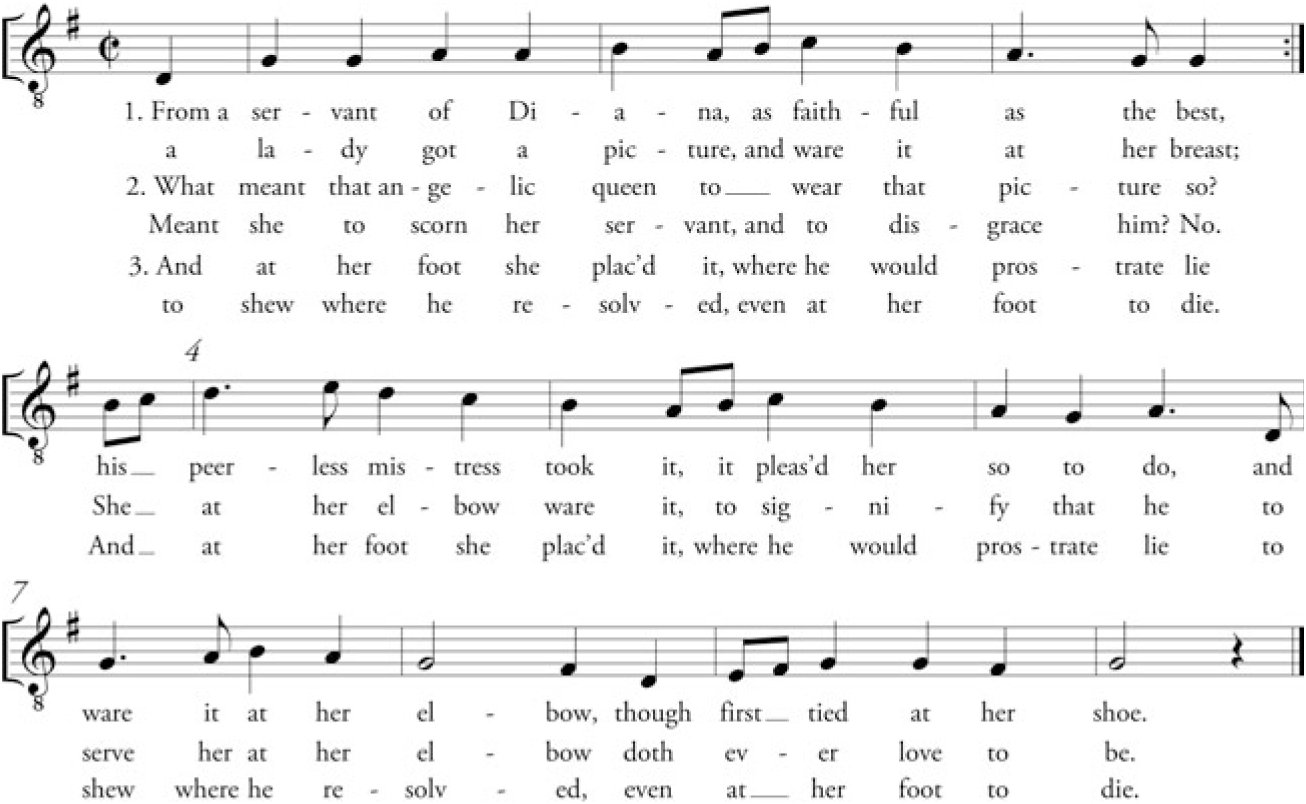
Next is a setting to the tune Walking in a Country Town (Example 5). The first published appearance of this tune was the year after the incident, in Thomas Robinson's Schoole of Musicke (1603),Footnote 69 so it was current and, like all these tunes, fits extremely well. A personal connection existed, moreover, since Robinson dedicated his New Citharen Lessons (1609) to Robert Cecil's son, Viscount Cranborne, noting that he had ‘alwaies tasted of the comfortable liberalitie, of your Honours Father’.Footnote 70
From a servant of Diana, set to the tune Walking in a Country Town
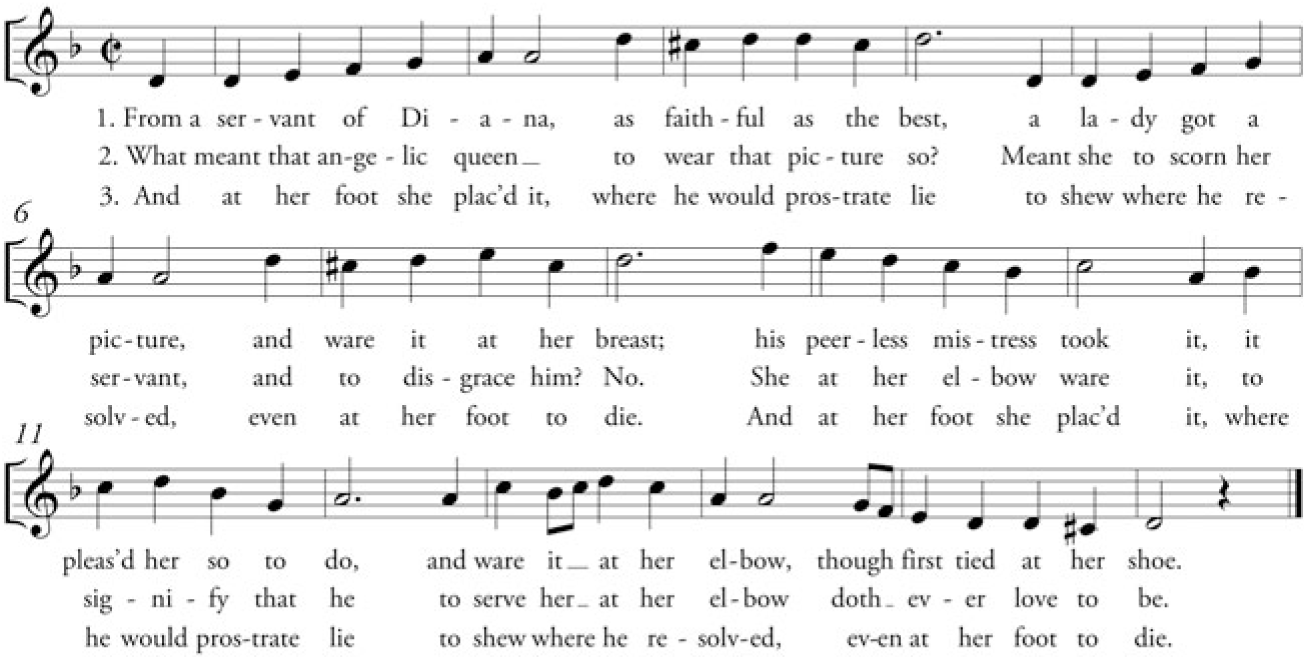
The next possibility is a setting to the tune O Man in Desperation (Example 6). A ballad with that title was registered on 15 August 1586 and it was called for as a tune later that year,Footnote 71 so it seems immediately to have had an independent musical life. It is a pity that the original ballad has not survived, but ‘man in desperation’ suits Cecil's situation in this incident remarkably well, and the symbolism may have made it an enticing choice.
From a servant of Diana, set to the tune O Man in Desperation
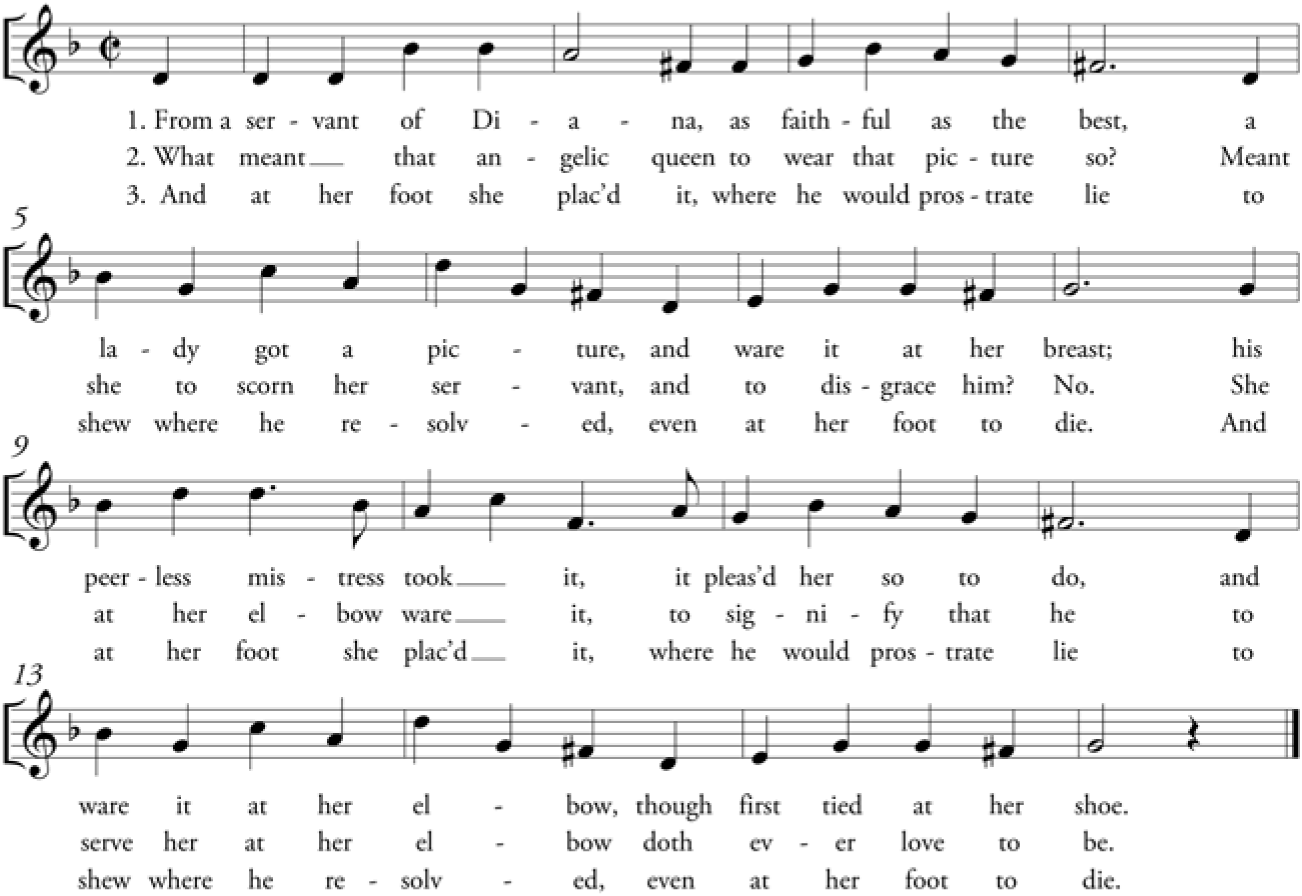
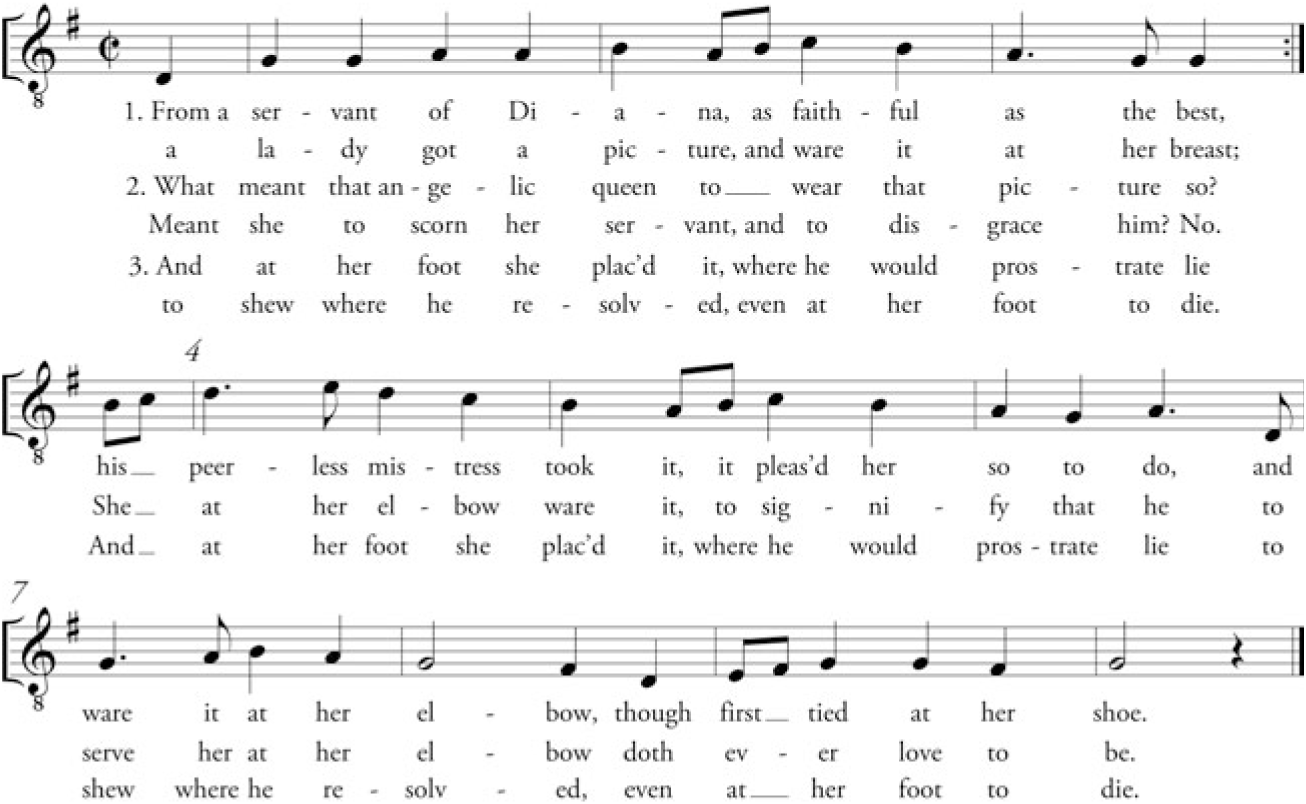
Finally, among ballad tune possibilities is a setting to Wilhelmus van Nassau (Nassaw, Nassouwe) (Example 7). This does not initially seem like an obvious choice since it was not called for as a tune for any English broadsides, so it may not have been widely known, but the melody does appear in several English lute manuscripts from the period.Footnote 72 Its most important credential in this context is that Sir Philip Sidney wrote his poem Who hath his fancy pleased to be sung to the tune (probably having heard it in the Low Countries),Footnote 73 and its eight-line trimeter versification matches Cecil's perfectly.Footnote 74
From a servant of Diana, set to the tune Wilhelmus van Nassau
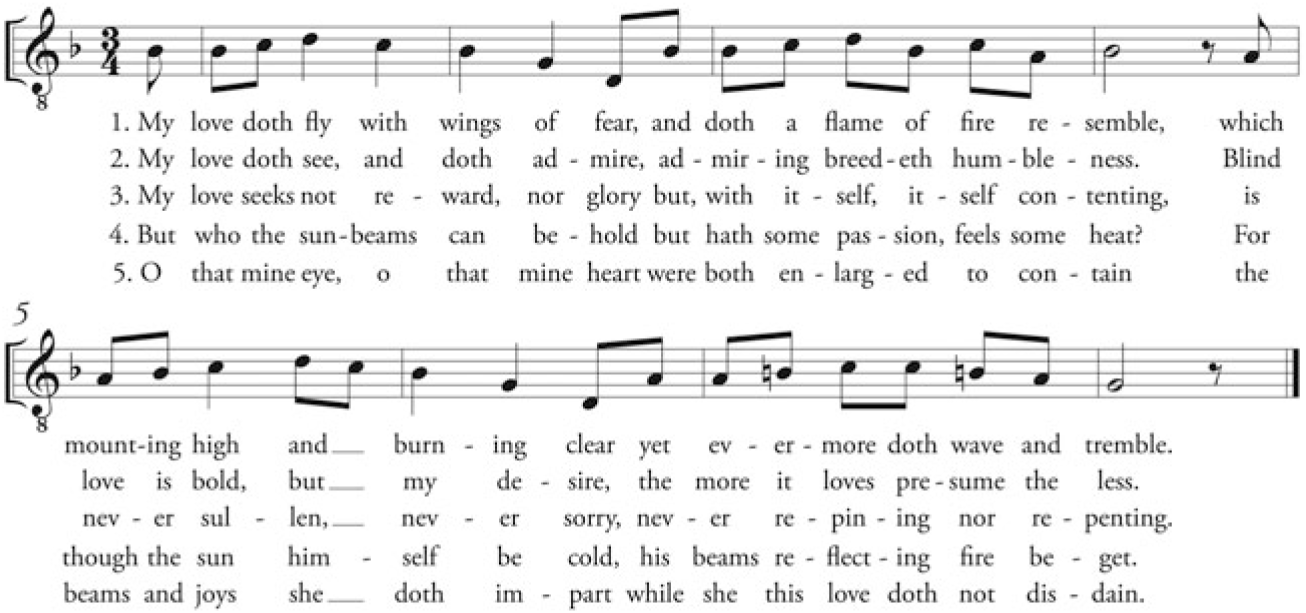
For My love doth fly, the second lyric which may have been sung by Robert Hales, there are four popular tune possibilities. First is the tune Walsingham. Katherine Duncan-Jones noted the affinity between the final stanza of Raleigh's Walsingham poem and the third stanza of this lyric:Footnote 75

No one, to my knowledge, has suggested that My love doth fly might therefore have been sung to the Walsingham tune. It can be made to fit, although Walsingham is in ballad metre and My love doth fly entirely in tetrameters, so a little crowding is necessary (see Example 8).Footnote 76 It is also intriguing that, immediately after Queen Elizabeth's death, Clanricard married Frances Walsingham, the widow of both Sir Philip Sidney and the Earl of Essex.Footnote 77
My love doth fly, set to the tune Walsingham

A melody that works better from a versification standpoint is the tune of I have house and land in Kent, from Melismata (1611) by Thomas Ravenscroft (Example 9).Footnote 78 Besides the felicitous match of words and music, Thomas Egerton's first wife was a Ravenscroft, and Thomas Ravenscroft's brother was in service with the Egerton family, certainly in 1603 and possibly earlier.Footnote 79
My love doth fly, set to Thomas Ravenscroft's I have house and land in Kent
Another connection to Thomas Ravenscroft may be through the author of the Entertainment at Harefield. It has been assumed that the writer of the entertainment was John Davies of the Middle Temple, later knighted for his work in the governance of Ireland. But the evidence for authorship comes only from a ‘I.D.’ attribution in the first printed version in 1608, and those attributions are shaky enough.Footnote 80 Moreover, there are letters from John Davies of the Middle Temple to Sir Robert Cecil in June and September of 1602, and neither suggests plans for nor follow-up to an entertainment that summer.Footnote 81 So, if the writer was, indeed, John Davies, it may have been the other poet of that name, later known as John Davies of Hereford. One reason for this includes a conspicuous fascination with Time and Place in the latter's published poems from the period.Footnote 82 John Davies of Hereford also dedicated several publications to Thomas Egerton and members of his family, so he seems to have been close to the household. But he was also close to Thomas Ravenscroft since he wrote a commendatory poem for Ravenscroft's treatise A Briefe Discourse (1614), where he referred to the musician as ‘my deare, vertuous, and right expert friend’.Footnote 83
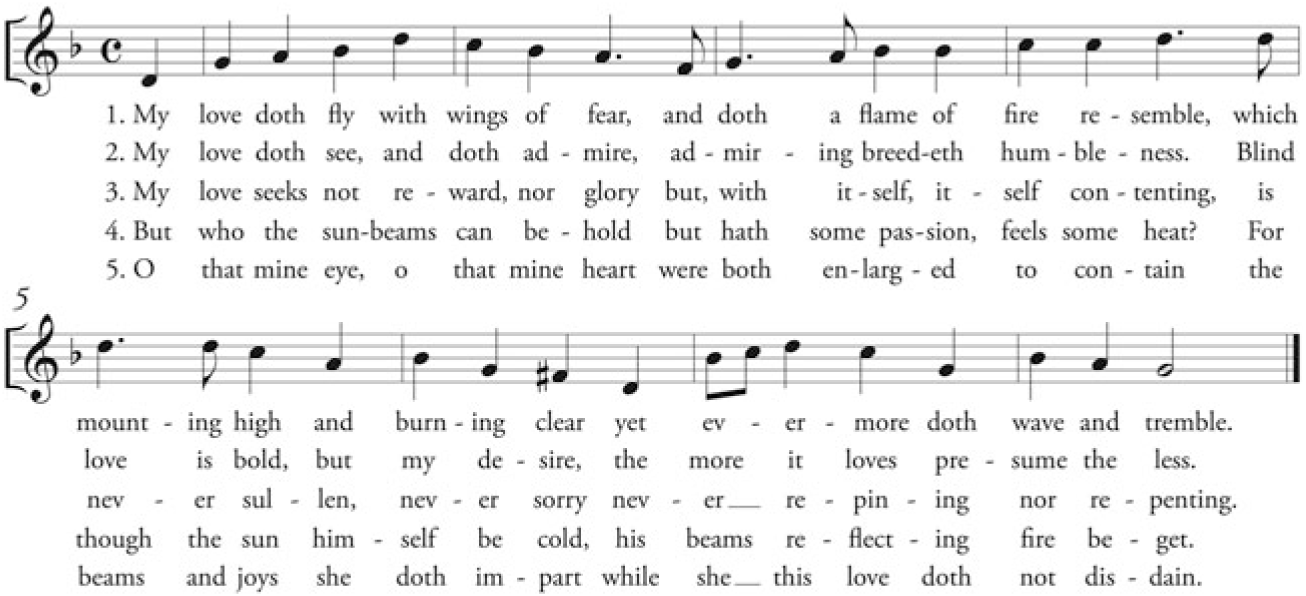
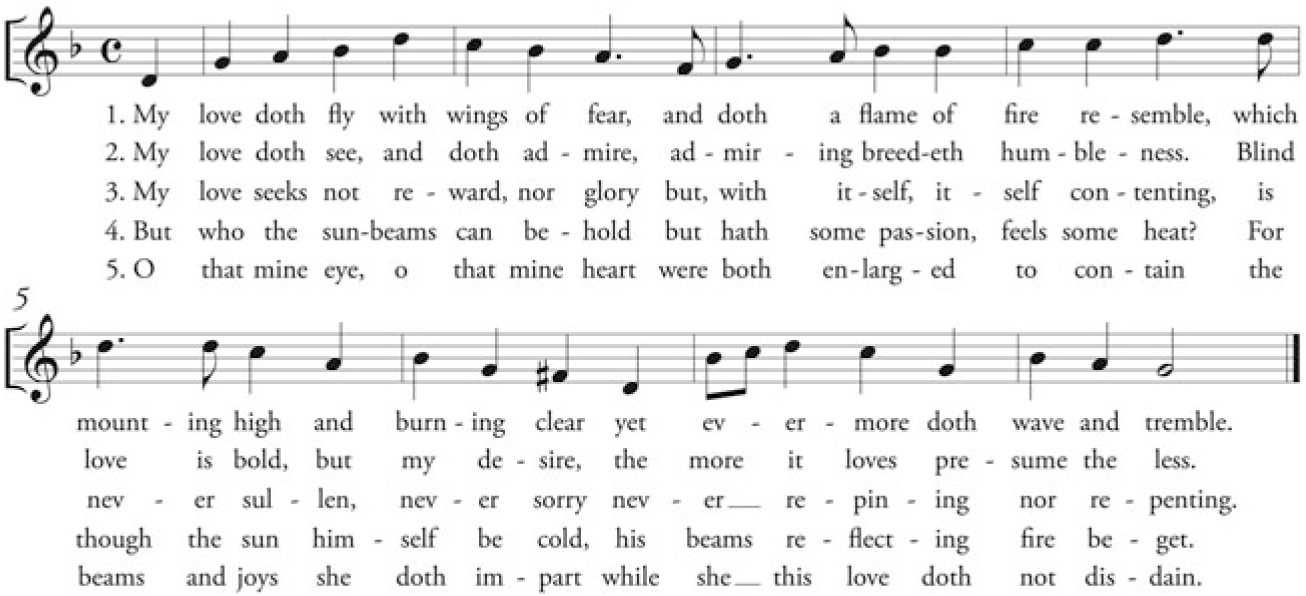
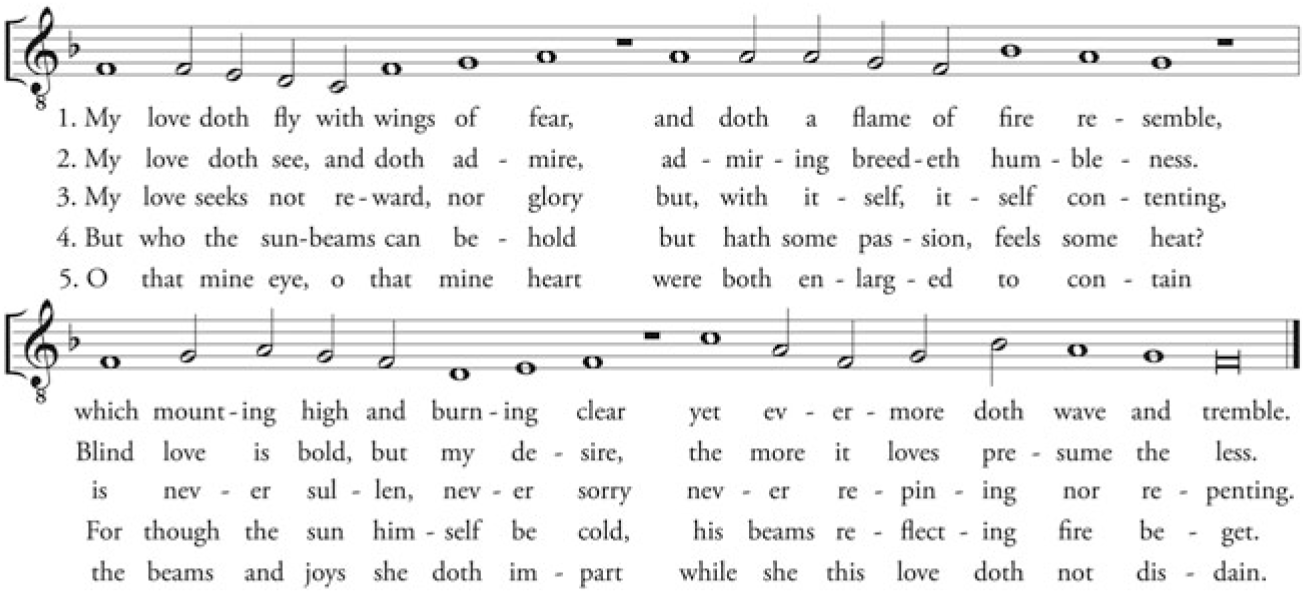
Next is a setting to the metrical psalm tune popularly known as Old Hundredth (Example 10). This was first printed in England as a melody for Psalm 100 in Foure Score and Seuen Psalmes of Dauid in 1561.Footnote 84 It then appeared in the 1565 edition of The Whole Booke of Psalmes, and became extremely popular from that time forth, even to the present day. Of the sixty-seven Sternhold & Hopkins metrical psalm tunes in the 1573 print (the most in any edition),Footnote 85 this is the only one that fits a four-line stanza of tetrameters. There is a verbal connection, furthermore, in the ‘wings of fear’/‘serve with fear’ figure in the first stanza of each. And even though Robert Cecil seems to have been aligned with the emerging high-church party, we know that psalm singing formed a part of daily worship in the Cecil household,Footnote 86 as well as that of John Egerton and his stepsister-wife Frances (Stanley), the children of Harefield's hosts.Footnote 87 After all, as Nicholas Temperley said of the English avidly singing metrical psalms: ‘They sang not because they were Puritans, but because they were singers.’Footnote 88 Amidst that practice, using an iconic psalm tune to set a compatible lyric seems like a reasonable option.Footnote 89
My love doth fly, set to the metrical psalm tune Old Hundredth
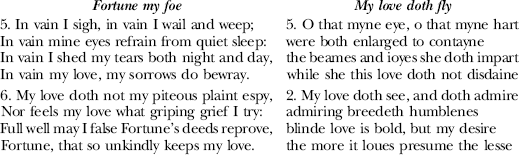
Lastly, among the popular tune settings, is Fortune my foe (Example 11). That tune normally sets pentameters, as noted above, but there are tetrameter lyrics that call for it, and the imagery of My love doth fly matches some in the original ballad:
My love doth fly, set to the tune Fortune my foe
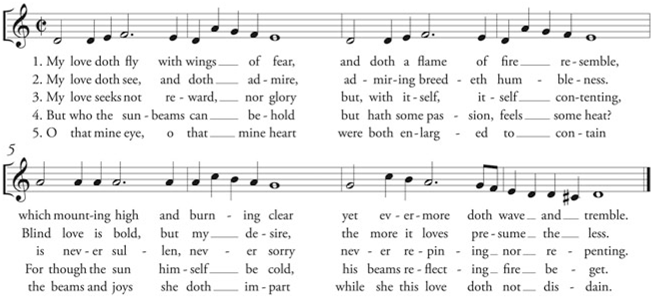
The ‘mine eyes’/‘myne eye’Footnote 90 and the shared beginning to the stanza, ‘my love doth’, makes the connection seem conceivable, especially since Fortune my foe appears to have been on people's minds that summer.
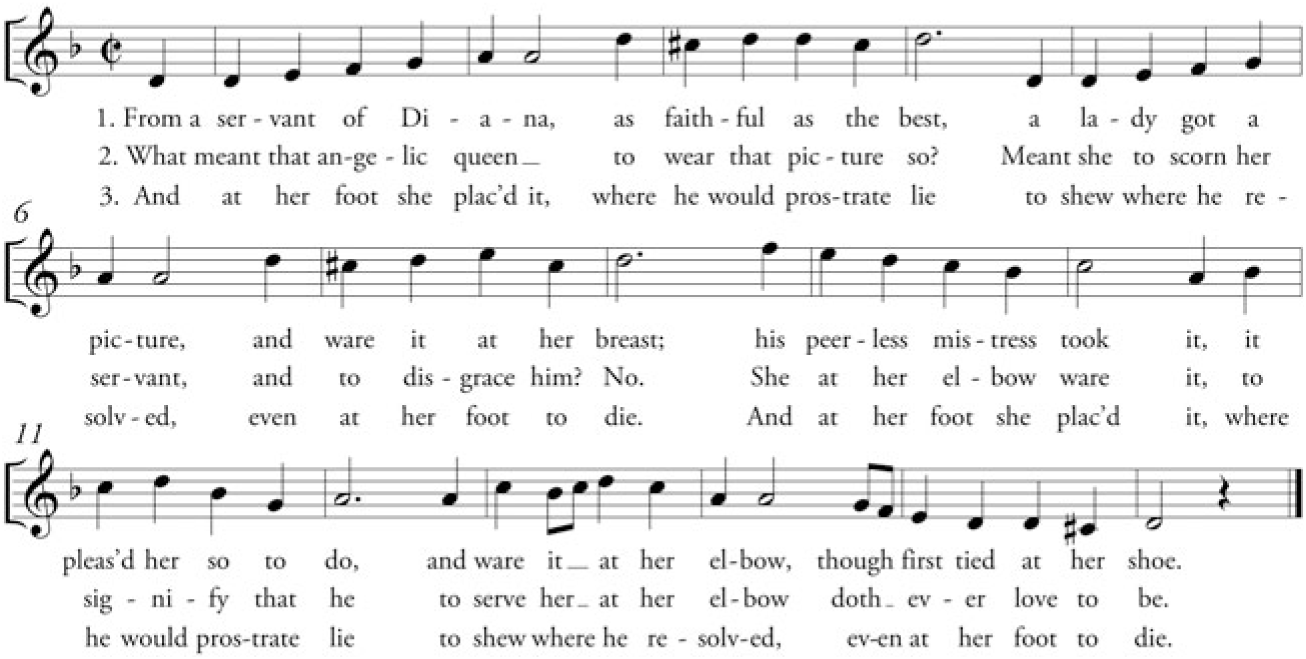
These are the popular tunes that seem most plausible as choices for Robert Hales in setting Cecil's lyrics to music. But, as noted earlier, it is also possible that Hales used an existing lute-song to provide music for the lyrics. Intriguingly, the only lute-song in the entire repertoire that approaches the versification of From a servant of Diana is John Dowland's Me, me, and none but me, from his Third and Last Booke of Songs or Aires of 1603 (Example 12),Footnote 91 the same publication that furnished Time stands still, discussed above. Hales sang Dowland's His golden locks at an earlier court event, so it might be expected that he was familiar with Dowland's more recent work. It is worth noting also that Dowland was once in the service of Lord Hunsdon, whose house the court had visited from 9 to 11 September, and would later dedicate his translation of a German music treatise to Cecil himself, noting that Cecil did ‘excellently vnderstand, and royally entertaine the Exercise of Musicke’.Footnote 92 And besides those personal connections and the versification match, both lyrics conclude with the words ‘to die’.
From a servant of Diana, set to John Dowland's Me, me, and none but me (1603)

There is also a plausible lute-song setting for My love doth fly. There are four lute-songs up to 1610 that use quatrains of tetrameters in an abab rhyme scheme, but the best match, both for the musical character and the date, is Robert Jones's Once did I love from his First Booke of Songes & Ayres of 1600 (Example 13), a collection dedicated to Sir Robert Sidney, younger brother of Sir Philip Sidney, and recipient of letters from William Browne during this 1602 progress.Footnote 93 The setting requires a repeat of the final phrase of the lyric in each stanza, but Jones's original song is set that way as well.Footnote 94
My love doth fly, set to Robert Jones's Once did I love (1600)

Traces of historically significant but ephemeral works like those discussed here are always difficult to uncover. Some vestiges may be found, however, in a close re-examination of the texts themselves, in letters (including eyewitness accounts and gossip), and in personal connections, all filtered through known performance practices of the period for whatever insights may be revealed. There is no way to know for certain how Robert Hales chose to ‘frame’ Cecil's ditty on that summer day in 1602, but if my surmise about the urgency of the occasion is correct, and Hales used pre-existing music – either popular tunes or borrowed lute-songs – the settings presented here would all have been excellent possibilities. Hales may even have had to choose among these very settings when deciding how best to present these secret songs for Queen Elizabeth and, crucially, bring Sir Robert Cecil back into her good graces. For centuries, we may have lamented the loss of lyrics connected with this curious incident, but now that they have been identified, we can recover a semblance of their musical charm, and bring them to life as Elizabeth may have heard them. She may have been merely teasing her trusted adviser, but the incident is mysterious and Cecil was clearly anxious. If they indeed helped to preserve the peaceful succession of the crown at a moment when things might have gone much awry, there are few songs in English history whose successful performance was more important to the security of the realm.