1. INTRODUCTION
The role of religious organizations in promoting human right agendas remains underexplored despite the growing scholarly interest in their participation in democratic struggles and conflict resolution (Appleby Reference Appleby2000; Little Reference Little2007; Toft et al. Reference Toft, Philpott and Shah2011). This article offers the first systematic and comparative study of human rights advocacy by Catholic and Muslims groups during violent internal conflicts characterized by gross human rights violations. What factors affect religious organizations' willingness and ability to condemn these violations? Why did some of these organizations promote human rights centric platforms while others did not?
The article adopts a comparative historical approach to answer these questions (Mahoney and Rueschemeyer Reference Mahoney and Rueschemeyer2003). It focuses on religious organizations in four countries that experienced high levels of political violence in their recent history. El Salvador and Peru are Catholic majority countries where powerful leftist insurgencies fought the ruling regimes throughout the 1980s and early 1990s. In El Salvador, the Frente Farabundo Martí para la Liberación Nacional (FMLN) waged a guerilla war to overthrow a highly repressive oligarchic regime backed by the United States government. The Church established two of the most effective human rights organizations, Tutela Legal and Socorro Juridico that extensively documented violations and provided legal counsel to the victims. In Peru, a Maoist guerilla organization, the Shining Path (Sendero Luminoso) was on the brink of victory but rapidly lost its power after the capture of its leader in 1992. While not as forcefully as its Salvadorian counterpart, the Peruvian Church also supported human rights causes in Peru. The Church established the Comisión Episcopal de Acción Social (CEAS) that investigated and publicized violations, pursued litigation on behalf of the victims, organized human rights awareness workshops around the country, and collaborated with other associations. In Turkey, a militant Kurdish organization, the Partiya Karkerên Kurdistan (PKK) initiated armed struggle to establish an independent Kurdistan in 1984. Despite a ceasefire agreement in early 2013, the conflict remains unresolved after three decades. While popular Islamic organizations largely avoided human rights activism, a small number of Islamic activists established Mazlum-Der in 1991 that became one of the most influential human rights organizations in the country. Indonesia faced two major secessionist movements in Aceh and East Timor in the last quarter of the 20th century. Neither Muhammadiyah (e. 1912) nor Nahdlatul Ulama (e. 1926, NU), the two major Indonesian Islamic organizations, established human rights associations. Many pious Muslims who were affiliated with these organizations and actively took part in human rights struggles received little institutional support. Hence, religious organizations in these four countries exhibited considerable variation in their willingness and ability to establish institutions collecting information about and monitoring human rights abuses, disseminate their findings to both domestic and international audiences, provide comfort and legal aid to the victims, and engage in nonviolent activism to stop these abuses. In sum, institutionalized religious human rights activism was highest in El Salvador, substantial in Peru, noticeable in Turkey, and non-existent in Indonesia.
What explains this cross-sectional variation? Building on previous scholarship exploring the increasing role of religious actors in politics (Philpott Reference Philpott2007; Toft et al. Reference Toft, Philpott and Shah2011, 9–10), this article identifies two causal factors: (1) transnational religious ideas and linkages, and (2) the nature of the state-religion relationship. The spread of pro-human rights ideas among religious leaders, intellectuals, and activists in the aftermath of Vatican II and Liberation theology were decisive in the transformation of Catholicism in both El Salvador and Peru. Prominent transnational religious networks in the Muslim world in the late 20th century had a very different character. As discussed in the next section, historical factors unique to Muslim societies' encounter with modernity contributed to the weakness of transitional Islamic movements with human rights agendas. Islamic human rights advocacy remained more limited in Turkey and Indonesia primarily because of the lack of transnational Islamic ideas and linkages similar to Catholicism during the same period.
The reason why there was more institutionalized religious human rights activism in El Salvador than in Peru, and in Turkey than in Indonesia, was mostly a result of the different trajectories of the state-religion relationship. In El Salvador, the increasingly violent and exclusivist nature of the ruling regime and the ideological affinities and networks between the Marxist insurgency and progressive Catholicism contributed to the Church's greater involvement in human rights activism. In contrast, the Peruvian regime remained less exclusionist and the Church was ideologically more conservative. Accordingly, these two entities had more room to cooperate. In Turkey, the antagonism between the secular state and Islamic organizations paved the way for human rights activism by a group of Islamic activists who widely documented and publicized abuses taking place in Kurdish areas of Turkey in addition to the violations of religious freedom. In Indonesia, Suharto (r. 1967–1998) pursued rapprochement with Islam from the late 1980s onward, precluding the formation of a unified Islamic opposition through strategies of cooptation at least until the last days of his rule. Consequently, Islamic human rights activism remained very weak during the last decade of the Suharto era.
This comparison of religious human rights activism in these four countries has three premises. First, a comparative perspective allows for more valid casual inferences than studies exclusively focusing on a single country or religious denomination. The cases analyzed here also exhibit temporal variation that allows for “within-case analysis” and avoids “mistaking a spurious correlation for a causal relationship” (Mahoney Reference Mahoney2007, 131–132). Second, religious organizations were not direct participants in violence in any of these four countries where state forces engaged in widespread abuses such as extrajudicial executions, forced disappearances, systematic torture, forced dislocations.Footnote 1 Victims of these abuses were often pious Catholics in El Salvador and Peru and Muslims in Indonesia and Turkey. All four countries had limited pluralism and openness where avenues for human rights activism were not completely blocked. Hence, religious organizations had the choice of siding with the state, staying silent, or pursuing a more active human rights agenda. Religious actors by virtue of their expertise, reputation, and credibility could play transformative roles in these violent internal conflicts and contribute to resolution (Sandal Reference Sandal2011). Last, religious actors (i.e., the Church, clerics, religious organizations, activists) in these countries were not unitary and monolithic entities. This religious diversity and multivocality led to different and often competing positions on political issues. Some religious actors prioritized human rights, other religious actors remained closely allied with the state despite widespread abuses by security forces in the same country such as Peru.
Section 2 of this article reviews the scholarly perspectives on Catholic and Muslim involvement in democratic struggles and develops the theoretical framework. The next four sections are historical analyses of religious human rights activism in El Salvador, Peru, Indonesia, and Turkey. These case studies mostly rely on secondary literature. Research trips to Indonesia, Peru, and Turkey provide additional insights and support more informed interpretations. The conclusion summarizes the main argument and suggests avenues for further research.
2. EXPLAINING CATHOLIC AND ISLAMIC HUMAN RIGHTS ACTIVISM
Conventional theories of secularization that posit a causal link between public withdrawal of religion and sustainable democratic governance are no longer very compelling (Casanova Reference Casanova1994; Taylor Reference Taylor2007). However, the question of when religious organizations become involved in human rights activism on the behalf of victims of political violence remains largely unanswered. Daniel Philpott's (Reference Philpott2007) theoretical framework suggests that two factors influence a religious organization's pursuit of human rights: (1) the pace and scope of dissemination of new and progressive ideas transmitted among its members through transnational religious networks, and (2) the nature of the state-religion relationship.
The Transnational Dissemination of Pro-Human Rights Ideas
The Second Vatican Council (Vatican II), between 1962 and 1965, was a sea of change that completely reconfigured the Roman Catholic Church's relationship with the modern world. The Catholic Church shifted its position from neutrality toward democratic regimes to active support, committed itself to the protection of human rights (most notably in John XXII's Pacem in Terries in 1963), and endorsed the principle of religious freedom (Paul VI's Dignitatis Humanae in 1965) (Philpott Reference Philpott2004). As Wilde (Reference Wilde2007) demonstrates, these progressive changes that emerged from the Council were unexpected. Bishops from Europe and North America who advocated better relations with Protestants established strategic organizational alliances with bishops from Latin America who favored social justice and bishops from Asia and Africa who were seeking to expand the reach of Catholicism. This progressive alliance managed to overcome resistance by conservative bishops and brought the ideological transformation of the Catholic Church. Vatican II was a central factor facilitating the rise of Liberation theology with its “preferential option for the poor” and critique of structural violence (Smith Reference Smith1991; Anderson Reference Anderson2007). Liberation theology gaining prominence with the second meeting of the Latin American Episcopal Council in Medellín in 1968 had transformative influence on the religious imagination and behavior of Catholic clergy and activists. It led to a reorientation of the Catholic Church and the legacy of Jesus Christ in a more popular direction in some countries. Catholic clergy and activists affiliated with Liberation theology espoused that the Church should work to improve the living conditions of the poor rather than just emphasizing salvation after death. At the same time, these developments generated intense internal strife leading to a conservative backlash (Hebblethwaite Reference Hebblethwaite and Keogh1990, 58–59; Levine Reference Levine and Keogh1990, 35–36). Consequently, regional and local factors as well as the strength of transnational networks in a country mediated the influences of Vatican II and Liberation theology (Mantilla Reference Mantilla2010). For instance, the Brazilian Church emerged as a strong supporter of democratization during the military regime (Mainwaring Reference Mainwaring1986; Levine and Mainwaring Reference Levine, Mainwaring and Eckstein2001, 216–221). In Chile, the Church sponsored human rights organizations that became formidable centers of opposition to the military dictatorship (Loveman Reference Loveman1998, 488–495). As discussed below, the Vatican II and Liberation theology had also transformative influence on the Salvadorian and Peruvian churches (more so in the former than in the latter). In contrast, the appeal of Vatican II and Liberation theology remained very weak in the Argentinean and Uruguayan Churches.
Transnational dissemination of pro-human right ideas were mostly absent in the Muslim world in the late 20th century. While Islam lacks a centralized and hierarchical authority similar to the Catholic Church, several Islamic organizations such as the Islamist Muslim Brotherhood and Al-Qaeda exerted significant transnational influence during this period. Neither of these organizations exhibited strong commitments to the idea and practice human rights (Kepel Reference Kepel2003). Additionally, the two states that represent alternative versions of Islamic rule had no concern for human rights. While Saudi Arabia promoted Wahhabism, a rigid and intolerant interpretation of Islam, hardliners in the Islamic Republic of Iran attempted to empower Shiite radicalism. Furthermore, the most influential Muslim intellectuals of the 20th century such as Egyptian Sayyid Qutb, Pakistani Abul A'la Maududi, and Iranian Ali Shariati called for a revitalization of Islam as the primary source of radical political action in the pursuit of social justice but did not have human rights as a guiding political principle.Footnote 2 Muslim reformist thinkers such as Mohammed Arkoun, Mohsen Kadivar, Abdullahi Ahmed An-Na'im, and Abdolkarim Soroush espoused human rights and offered synthesis of Islam and democracy, but their intellectual influence among the Muslim publics remained limited (Roy Reference Roy2004, 30–31).
Two dimensions of the complicated history characterizing Muslim societies' encounter with modernity seem to contribute to the underdeveloped nature of Islamic human rights activism. The first dimension concerns the notion of Islamic human rights as distinct from human rights originated in the West.Footnote 3 While many religious traditions embody ideas of justice and equality, the idea and practice of human rights emerged as a defensive mechanism against the growing power of the modern state and market economy in the Western societies (Donnelly Reference Donnelly2007). Many Islamic organizations and activists have associated human rights with Western civilization alien to Muslim beliefs and culture. The quest to preserve and foster Muslim autonomy and authenticity vis-à-vis Western cultural, economic and political expansionism was central to many Islamic actors in the 20th century. In particular, they perceived gender equality and freedom of religion as culturally specific rights that did not comply with Islamic norms (Mayer Reference Mayer1993; Kabasakal Arat Reference Kabasakal Arat2006). This dimension about autonomy of Islamic culture (i.e., exceptional views regarding gender equality and freedom of religion) is not directly relevant to the focus of this study that primarily deals with violations related to political violence such as extrajudicial executions, enforced disappearances, and torture. The second dimension concerns the widespread perception that Western actors hypocritically used human rights to justify their expansionism and promote their political interests (Hicks Reference Hicks2002; Mayer Reference Mayer2007). As Samuel Moyn's (Reference Moyn2010) astute analysis of the tension between self-determination and human rights in the post-WWII period demonstrates, many activists in the newly independent states perceived human rights as instruments in the service of imperial powers and threats to the sovereignty of their states. As discussed in more detail below, this perception was also widespread among Islamic actors in Turkey and Indonesia who often ascribed the causes of internal violence to foreign conspiracies.
The State-Religion Relationship
Recent scholarship suggests that the autonomy of religious organizations from political rulers and vice-versa is an essential factor contributing to pro-democratic religious activism (Stepan Reference Stepan2000; Driessen Reference Driessen2010; Sarkissian Reference Sarkissian2012). Philpott (Reference Philpott2007, 507) identifies an additional dimension of this organizational autonomy and distinguishes between consensual and conflictual forms. Autonomous religious organizations that exist in a conflictual relationship with the state are more likely to engage in human rights activism.
The Church had historically formed an alliance with the military and oligarchic classes in many Latin American countries (Fleet and Smith Reference Fleet and Smith1998, 22).This historical alliance came under duress in the face of rapid socioeconomic change and new geopolitical conditions in the post-WWII period. As Marxist movements promising radical political change to eradicate pervasive inequalities gained ground in the continent, the Church became more involved in and concerned with social issues in parts of Latin America. (Poulat Reference Poulat and Keogh1990, 17–19; Sigmund Reference Sigmund and Pattnayak1995, 49–54; Klaiber Reference Klaiber1998, 5).Footnote 4 In this historical context, the Salvadorian Church experienced strong tensions and hostility with the ruling regime that increasingly turned violent in the face of growing popular mobilization. The level of state-religion conflict remained more restrained in Peru. This difference in state-religion relationship is a major factor explaining greater religious human rights activism in El Salvador than in Peru in the 1980s.
As in Latin America, the degree of autonomy of Islamic organizations from the state was an important factor shaping their human rights activism. Many Muslim movements often benefited from state patronage and collaborated with right-wing authoritarian regimes against the leftists during the Cold War era. This was particularly the case in Indonesia in the last decade of the New Order of Suharto (r. 1965–1998). Islamic organizations became more interested in human rights agendas when the ruling regimes identified political Islam as a major threat, as in Turkey, and enacted policies to exclude Islam from public sphere. Secularism of the Turkish Republic heavily restricted public expressions of Islam in contrast to the Ottoman Empire that had promoted a hegemonic version of Islam it replaced. The conflict between republican secular elites and Islamic groups has been a defining aspect of the Republic since its foundation (Kuru Reference Kuru2007). This conflict was particularly acute throughout the 1990s. Islamic activists repressed by the state became gradually more interested in religious freedom as a way to limit authoritarian tendencies of Turkish secularism. Hence, Islamic human rights activism in Turkey had a stronger institutional basis than Islamic human rights in Indonesia in the 1990s.
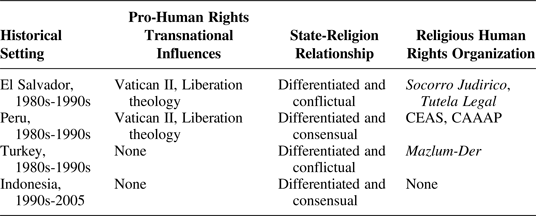
Table 1 shows the application of these two causal factors to the four historical cases. First, Catholic organizations in El Salvador and Peru had a more active human rights agenda than Islamic organizations in Indonesia and Turkey given the legacies of Vatican II and Liberation theologies. Additionally, religious organizations in general more actively espoused human rights when they had both stronger autonomy and experience higher levels of conflict with the ruling elites. The degree of conflict between the state and Church was higher in El Salvador than in Peru. Catholic human rights activism had a stronger institutional and less ambivalent nature in El Salvador than in Peru where significant segments of the Church remained passive in the face of atrocities. Similarly, greater ideological distance and tensions between the Turkish state and Islamic organizations explain greater religious human rights activism in Turkey than Indonesia where the state managed to co-opt many organizations.
Determinants of Religious Human Rights Activism in El Salvador, Peru, Indonesia and Turkey

THE SALVADORIAN CIVIL WAR AND THE CHURCH
The Salvadorian Church was historically allied with the coffee producing elite and the military that ruled over a large peasant population (Paige Reference Paige1997). The Church remained passive during La Matanza when tens of thousands of ordinary people killed by the military following a failed popular uprising in 1932. However, Vatican II and Liberation theology transformed the teachings and social base of the Salvadorian Church starting in the late 1960s. The Church gradually became a progressive force critical of widespread inequalities and poverty under the long archiepiscopacy of Luis Chávez (1939–1977). The Medellín meeting of 1968 generated significant debate within the Salvadorian Church and culminated in greater Church participation in the lives of ordinary people (Cardenal Reference Cardenal and Keogh1990, 231–237). Inspired by Vatican II and Liberation theology, United States Catholic missionaries, including members of the Maryknoll and Jesuit priests, founded Christian Base communities and engaged in grassroots activities among the poor by the early 1970s (Blanke Reference Blanke2004; Sanchez Reference Sanchez2014). Chávez expanded the Church's outreach by sending nuns and priests to rural parishes who offered spiritual and material resources to peasants during periods of political violence. In 1969, the Church affiliated groups founded the Christian Federation of Salvadoran Priests that educated and mobilized peasants for agrarian reform. These ideological and organizational changes triggered by transnational networks facilitated the emergence of the Church as a force of social opposition and defender of human rights in the 1980s. Christian Base communities provided resources to the FMLN war efforts and increased grassroots support for the guerillas in the 1980s (Krauss Reference Krauss1982; Wood Reference Wood2003; Sanchez Reference Sanchez2014).
Catholic activists became targets of state violence as a result of their involvement in social projects to address the plight of peasants and workers. The right-wing death squads engaged in an assassination campaign targeting outspoken and activist members of the Church in the late 1970s and early 1980s. The assassination of Rutilio Grande, a Jesuit priest working among poor peasants and organizing strikes in sugar plantations, at the hands of a right-wing death squad had a huge impact on Óscar Romero, the newly appointed Archbishop of San Salvador (Berryman Reference Berryman1984, 106–115). Romero gradually became the most prominent critic of the regime (Kumm Reference Kumm1978). He reached large domestic and international audiences through his Sunday homilies broadcasted over radio. He explicitly condemned the enforced disappearances and torture by the security forces. The Socorro Juridico (Legal Aid, e. 1975), a small office established by the Archdiocese, investigated human rights violations and offered legal counsel to the victims. The Church also provided shelter to people displaced from the war zones in its seminaries.
Romero's direct confrontation of the military and death squads sponsored by the elite signified the complete transformation of the state-religion relationship in less than two decades. Romero himself was assassinated in 1980, a day after he called on soldiers not to kill their own people (Levine Reference Levine and Keogh1990, 29). The Church's commitment to human rights continued under his successor Arturo Rivera y Dama who served as the Archbishop of San Salvador until 1994. He established Tutela Legal (the Archbishop's Human Rights and Legal Aid Office, e. 1982) that became the most effective fact-finding human rights association under the directorship of María Julia Hernández.Footnote 5 By the mid-1980s, the Church-led organizations of Socorro Juridico and Tutela Legal were two of the four active human right organizations in the country (Boler Reference Boler1985, 545–547). Tutela Legal investigated extrajudicial executions, disappearances, and torture, published detailed reports, worked closely with the United Nations, Red Cross, and international human rights organizations such as Human Rights Watch (Klaiber Reference Klaiber1998, 177).Footnote 6 It played a crucial role in documenting the El Mozote massacre of December 1981 when the army killed around 800 people. It also unearthed evidence showing the responsibility of the army in the murder of six Jesuits at the Central American University in 1989 (Economist 2007). The Church also supported the Committee of Mothers of the Disappeared, Murdered, and Politically Imprisoned of El Salvador, an influential human rights association. The Committee of Mothers produced daily radio programs on a Church-run radio station.
The state forces were responsible for an overwhelming majority of the violations during the civil war.Footnote 7 They also targeted human rights associations to prevent and discredit their work. In this political context, the Church, with its extensive international connections and moral reputation, offered a degree of protection to human rights activists. Many Catholic leaders and activists were tireless advocates of human rights despite the dangers they faced. The ideological and organizational transformation of the Church under the influence of Vatican II and Liberation theology from the late 1960s on, and the growing distance of the Church from an increasingly violent and repressive state, were major factors contributing to this activism.
THE PERUVIAN CIVIL WAR AND THE CHURCH
Similar to the El Salvadorian Church, the Peruvian Church was historically supportive of socioeconomic and political elites. As a response to rapid socioeconomic and cultural changes in the post-WWII era, the Church expanded its outreach to peasants and urban poor after the appointment of Juan Landázuri Ricketts as the Archbishop of Lima in 1955 (Romero Reference Romero and Mainwaring1989). Under his leadership, the Church experienced an ideological metamorphosis as Vatican II and the Medellín meeting of 1968 greatly shaped the cultural and intellectual atmosphere. Catholic intellectuals such as Father Gustavo Gutiérrez, the author of path-breaking Teología de Liberación (1971), offered a conceptual framework to bring different social classes together for social justice (Peña Reference Peña1994). As in El Salvador, the influx of foreign missionaries, who called for land reform and greater state intervention to reduce inequalities, reinforced Catholic progressive tendencies in Peru.
During this period, the Church established important organizations with popular reach. The CEAS, established in 1965, would become one of the leading human rights associations in the 1980s. The National Office of Social Information, established in 1968, evolved into a powerful clerical pressure group pursuing social justice and equality (Fleet and Smith Reference Fleet and Smith1998, 88). It characterized the prevailing social system as “institutionalized violence” against the poor and considered armed struggle a legitimate response against this system (Pásara Reference Pásara and Mainwaring1989, 282). It sponsored protests such as hunger strikes against the government policies, challenged economic policies contributing to inequality, and supported workers' collective struggles. The National Union of Catholic Studies, under the intellectual leadership of Gutiérrez, was another Church affiliated organization that disseminated Liberation theology among the Catholic intelligentsia. Nevertheless, conservative tendencies within the Church remained strong. The Sodalitium Vitae movement, founded in 1971, presented a conservative organizational and ideological alternative to liberation theology (Peña Reference Peña1992).Footnote 8
In contrast to El Salvador, the legal avenues of political participation for the leftist opposition in Peru remained opened, especially after the transition to a multiparty electoral regime in 1980. The main threat to Peruvian democracy in the 1980s came from the Shining Path, which emerged in the underdeveloped and isolated region of Ayacucho and waged a prolonged Maoist people's war to overthrow the regime (McClintock Reference McClintock and Eckstein2001). Different from the FMLN in El Salvador, the Shining Path was responsible for a majority of human rights violations while the security forces also committed widespread atrocities.Footnote 9 In the words of a prominent Peruvian human rights activist, the Shining Path had “profound disregard for human life … and contempt for the discourse of human rights … [It] openly repudiated human rights in both doctrine and practice” (Iglesias Reference Iglesias and Stern1998, 426, 431). In response to the growth of the Shining Path insurgency, the government placed large parts of the country under emergency rule where most of the human rights violations took place (Ellenbogen Reference Ellenbogen1991, 93–94).
Under these circumstances, the state-Church relation had a less conflictual character in Peru than in El Salvador in the 1980s for two reasons. The Peruvian Church remained ideologically more conservative than its Salvadorian counterpart. Furthermore, the Peruvian regime was less exclusive and insulated than the Salvadorian oligarchy during this period. While Church affiliated organizations actively pursued human rights activism, the Church as a whole failed to develop a consistent discourse characterized by human rights and social justice. The bishops were often reluctant to criticize the violent military campaigns victimizing large number of citizens (Pásara Reference Pásara and Mainwaring1989, 321–322; Fleet and Smith Reference Fleet and Smith1998, 231). They were primarily preoccupied with issues such as divorce, abortion, and birth control and attempted to protect the Church's official privileged position (cf. Hagopian Reference Hagopian2008).
Nonetheless, Peru still had effective Catholic human rights organizations during the conflict. The CEAS reported extensively on human rights violations, protested them, helped refugees from the emergency zones, and provided legal assistance to individuals accused of terrorism (Klaiber Reference Klaiber1998, 163). It also established alliances with other domestic and international human rights organizations. The leftist, liberal, and progressive Catholic human rights associations formed the National Coordinating Committee of Human Rights (La Coordinadora) that organized a march against violence in Lima in November 1985 (Muňoz Reference Muňoz and Stern1998, 449–452). La Coordinadora had 44 members, 20 of them affiliated with the Church (Klaiber Reference Klaiber1998, 164). The local Churches in the Southern Andes and the Amazon also promoted human rights in contrast to the ecclesiastical authorities in Ayacucho that opposed the CEAS. The bishops in Puno, Ayaviri and Juli regions had established human rights commissions and organized peace marches and symposiums on human rights (Klaiber Reference Klaiber1998, 159). The Church related Amazonic Center of Anthropology and Practical Application (CAAAP, e. 1974) became a human rights resource for indigenous people victimized by the insurgents and drug traffickers (Espinosa Reference Espinosa2011).
In sum, Vatican II and Liberation theology also profoundly transformed the Peruvian Church even if conservative tendencies within it remained powerful. Furthermore, Peruvian state elites had a less conflictual relationship with the Church than their Salvadorian counterparts. Consequently, while certain segments of the Church and Catholic laity involved in human rights activism, other members of the Church hierarchy remained aloof during the conflict and did not directly condemn abuses by the Peruvian security forces.
THE KURDISH CONFLICT IN TURKEY AND ISLAMIC ORGANIZATIONS
The Turkish Republic perceived public expressions of Islamic and Kurdish identities as a threat to its nation-building project. The first openly Islamist party (MNP, later MSP, National Salvation Party) explicitly challenging Turkish secularism emerged in 1970. Its ideology is known as Milli Görüş (MG). The second half of the 1970s saw the rise of a more universalistic and radical generation of Islamists influenced by Abul A'la Maududi and Sayyid Qutb and later the Iranian revolution (Yenigün Reference Yenigün1998). During this period, major Islamic actors had utopian and moralist political visions that left little room for pluralism and tolerance for ideas deemed to lack “Islamic authenticity.” They were highly skeptical of human rights discourse they associated with Western powers hostile to Islamic beliefs and norms.
The 1980 coup was a watershed in contemporary Turkish politics. The military espoused Turkish-Islamic ideology as an antidote against both socialism and Kurdish nationalism. In this atmosphere, the Islamic organizations expanded their activities and increased their visibility even as the restrictions of public expressions of Islam continued. The Welfare Party (RP), established by the MG movement in 1983, won the 1995 parliamentary elections. The RP adopted a discourse of social justice while being committed to market economics and challenged the Turkish state's exclusivist and militaristic policies on the Kurdish question (Çakır Reference Çakır1994; Çalmuk Reference Çalmuk2001). During this period, Islamic associations, corporations, media outlets, and educational institutions proliferated (Göle Reference Göle and Norton1996). Fetullah Gülen cultivated a vibrant network involving pious Muslims who gradually evolved into the most successful and influential movement in contemporary Turkey. The growth of Islamic activism triggered the reaction of the secularist military and high judiciary that brought down the RP-led coalition government and outlawed the RP in 1998. After a period of turmoil, a younger generation of Islamic politicians under the leadership of the former mayor of Istanbul, Recep Tayyip Erdoğan, founded the Justice and Development Party (AKP) in 2001 that became the most successful electoral party of modern Turkey (Tezcür Reference Tezcür2010).
With the onset of the Kurdish insurgency in 1984, many parts of eastern Turkey became war zones by the early 1990s. The security forces engaged in widespread human rights violations, especially during the 1990s, that alienated large segments of the Kurdish society. The PKK also used violence to obtain compliance from the Kurds and staged attacks against civil servants. The Turkish human rights community emerged under these historical conditions characterized by widespread state abuses and increasing violence between the state and the Kurdish insurgents. The late 1980s and early 1990s saw the formation of influential human rights organizations such as the Human Rights Association, (İHD, e. 1986), the Turkey Human Rights Foundation (TİHV, e. 1990), and the Human Rights and Solidarity with the Oppressed Association (Mazlum-Der 1991).Footnote 10 Founders of these organizations were either victims or witnesses of state violence who adopted human rights as a defensive mechanism against a repressive state (cf. Donnelly Reference Donnelly2007, 287–288). These organizations reported on abuses, led campaigns to end these abuses, and provided legal and psychological assistance to the victims (Çalı Reference Çalı and Kabasakal Arat2007). Leftist and Kurdish nationalist activists established the İHD and the TİHV. Islamic activists founded the Mazlum-Der that addressed violations experienced by pious Muslims, the Kurds, and asylum seekers.
The Mazlum-Der's founders criticized the Western conceptions of rights as limited, hypocritical, and serving imperialism. They argued that the Quran provides a more comprehensive and universal set of rights (Mazlum-Der 1991, 6–12). The Mazlum-Der extensively documented human rights abuses committed by the security forces in their fight against the PKK and proposed non-militaristic resolutions (Mazlum-Der 1993). For this reason, other Islamic actors accused it for having a secessionist agenda (Kadıoğlu 2005, 37). It did not receive institutional support from the MG despite their common struggle against Turkish secularism (e.g., ban on headscarf and restrictions on Islamic education). Kurdish Islamic Mazlum-Der activists from this period later became AKP parliamentarians and played important roles in its “Kurdish openings” in 2005 and 2009.Footnote 11 However, even after the AKP came to power, Mazlum-Der struggled to remain distinct from pro-AKP Islamic associations exclusively focusing on issues concerning pious Muslims.Footnote 12 It espoused an inclusive multicultural agenda of universal rights, continued to cooperate with leftist and Kurdish associations, and developed common positions critical of state abuses (Öztekin Reference Öztekin2009; Kaliber and Tocci Reference Kaliber and Tocci2010, 207–208).Footnote 13
While transnational Islamic influences such as the writings of Ali Shariati contributed to their distinct activism, inclusive human rights activism in Turkey as represented by Mazlum-Der was primary a response to the exclusionary and repressive secularist state policies. Mazlum-Der did not receive support from other Islamic organizations in Turkey and did not benefit from transnational linkages with Islamic forces similar to Vatican II or Liberation theology. Many Islamic organizations perceived human rights from a narrow perspective and exclusively focused on the victimization of pious Muslims by the secular state. Moreover, they had a strong tendency to perceive the Kurdish conflict as a Zionist-Christian plot aiming to divide Turkey and undermine Islamic unity (Çalmuk Reference Çalmuk2001, 99–100). This conspiratorial perception restricted their willingness to adopt more human rights oriented positions. Besides, the influential Gülen movement sought accommodation with state elites and was too protective of their own organizational interests. Hence, it did not energetically and consistently criticize the army's poor human rights record until the onset of the second term of the AKP in 2007.Footnote 14 Religious human rights activism in Turkey during the violent 1990s did exist but remained more limited than religious human rights activism during the El Salvador and Peruvian civil wars.
THE SECESSIONIST CONFLICTS IN INDONESIA AND ISLAMIC ORGANIZATIONS
The most popular Indonesian Islamic associations, the NU and the Muhammadiyah, were established in the early 20th century to organize and defend Muslim interests under Dutch colonial rule and against Chinese influence. Indonesia's colonial experience contributed to the anti-Western ideological outlook of Indonesian Islamic organizations that also adopted fierce anti-communist positions during the Cold War. General Suharto took over power in 1965 and orchestrated mass killings not only of communists but also of many peasants with less than orthodox Islamic beliefs (Robinson Reference Robinson1995). The NU was part of the anti-communist civilian and military coalition that carried out the mass killings of 1965–1966 (Hefner Reference Hefner2000, 51–63). The Muhammadiyah also encouraged its supporters to exterminate the “communist threat” (ibid, 108).Footnote 15 In consolidating his power, Suharto gradually marginalized these autonomous Islamic associations and identified “political Islam” as a major threat to his rule. The army, which became the most powerful institution in the country, engaged in widespread human abuses in Aceh, East Timor (invaded by Indonesia in 1975 after the withdrawal of Portugal), and Papua. It also massacred pious Muslim activists and villagers in two separate occasions, in 1984 and 1989. With the advent of the 1990, however, Suharto became a champion of conservative Islam. He aimed to diversify his powerbase vis-à-vis the army, and integrate and neutralize the aspirations of the rising Muslim middle classes (Ramage Reference Ramage1995, 63). The Indonesian Muslim Intellectual's Association (ICMI), established in 1990, became a major instrument for the recruitment of the Muslim intelligentsia into the state bureaucracy, the cabinet, and the People's Consultative Assembly and to counter the influence of Christians and non-conservative Muslims in the army (Liddle Reference Liddle1996; Porter Reference Porter2002, 88–89; Bertrand Reference Bertrand2004, 83–89; Aspinall Reference Aspinall2005, 40–42, 56-57).
Islamic organizations faced an inevitable dilemma in this context. They did not approve many of Suharto's policies but their open dissent would not only jeopardize their access to significant resources distributed by the regime but also result in their repression. Their dependence on regime patronage made it difficult for many Islamic leaders and organizations to distance themselves completely from the ruling elite until the last days of Suharto's rule (Aspinall Reference Aspinall2005). Nonetheless, not all Islamic organizations were willing to be coopted. Abdurrahman Wahid, who became the general chairperson of the NU in 1984, opposed the notion of an Islamic state, attacked the cozy relationship between the ICMI and the regime, and tried to protect the autonomy of the NU's grassroots (Ramage Reference Ramage1995, 54–55; Hefner Reference Hefner2000, 170–171; Porter Reference Porter2002, 110–111). While he also initially aimed to build a coalition of democratic forces opposing Suharto, he publicly reconciled with Suharto just before his fall (Aspinall Reference Aspinall2005, 197–199). In contrast, Amien Rais, who was President of Muhammadiyah between 1995 and 1998, and Nurcholish Madjid, a leading Muslim intellectual, were both initially involved in the ICMI but later became critics of the regime (Hefner Reference Hefner2000, 116–119).
Meanwhile, journalists, students, and human rights activists documented and condemned human rights abuses by the state forces in Aceh, East Timor, and Papua (Aditjondro Reference Aditjondro1997; Aspinal Reference Aspinall2005, 43; Robinson Reference Robinson2010, 80–85). The Indonesian Legal Aid Institute evolved into the most active influential human rights association and represented East Timorese and Acehnese activists in courts (ibid, 100–115). The army's massacre of nonviolent demonstrations in Dili, the capital of East Timor, in 1991, gave impetus to the emerging alliance between the East Timorese and Indonesian activists (Jetschke Reference Jetschke, Risse, Ropp and Sikkink1999, 144–147, 155–156). Despite these developments, neither the NU nor the Muhammadiyah consistently and institutionally pursued human rights activism regarding Aceh, East Timor, or Papua.Footnote 16 Overall, Islamic organizations perceived the struggle in East Timor as a “Christian separatist movement” that did not deserve their support. They were prone to a conspiratorial mindset that accused Western powers of creating trouble in Indonesia (Aditjondro Reference Aditjondro1997; Van Bruinessen Reference Van Bruinessen, Hanneman and Nordholt2004; Fealy Reference Fealy, Akbarzadeh and MacQueen2008). For instance, Rais reasoned that Western countries were interested in East Timor only because of its Catholic character (Aspinall Reference Aspinall2005, 278, fn. 10). Din Syamsuddin, who became the President of the Muhammadiyah in 2005, characterized the liberal conception of human rights as insensitive to cultural differences, and complained about Western double standards.Footnote 17 For similar reasons, the Islamic organizations' interest in the human rights situation in Aceh, a Muslim majority region where the Indonesian army was battling a secessionist insurgency, also remained very limited throughout the 1990s. With the fall of Suharto in 1998, civil society organizations flourished and there was a notable increase in media presence in Aceh. The Islamic organizations, however, failed to engage in human rights activism with the revival of the Gerakan Aceh Merdeka insurgency and violence (Aspinall Reference Aspinall2009, 125–129).
Overall, both the NU and the Muhammadiyah played constructive roles in the transition to a political system based on free and fair elections in 1999 and during the sectarian riots characterizing the transition (Hefner Reference Hefner and Hefner2004). They did not institutionally involve in human rights activism regarding Aceh, East Timor, and Papua during the 1990s.Footnote 18 They took positions on human rights cases exclusively about the victimization of pious Muslims or attacks against Islamic beliefs. (e.g., Sulistiyanto Reference Sulistiyanto2007). There were two primary factors for this narrow vision. First, the Suharto regime's pursuit of Islamization neutralized or at least tamed Islamic opposition in its last decade. Second, the Islamic organizations remained skeptical about human rights discourse. They identify it as a thinly veiled excuse of Western imperialism to dismantle Indonesia. There were no transnational Islamic influences similar to Vatican II that would eliminate this skepticism about human rights.
CONCLUSION
This article offers the first comparative study of religious human rights activism (as different from democracy promotion and conflict mediation) and suggests that transmission of new ideas through international networks and prevailing domestic political conditions shape the nature of this activism. In these four countries, state violence and armed conflicts characterized by widespread abuses were the catalysts giving rise to vibrant human rights communities. In its explanatory framework, the article highlights the influence of the dissemination of new ideas over behavior in institutional settings. Religious traditions are open to competing readings and the ways through which believers interpret these traditions strongly influence religiously inspired behavior. In this regard, perspectives that theorize behavioral change as a response to changes in institutional factors overlook the role of ideas. The dissemination of human rights oriented ideas and the emergence of a new generation of religious intellectuals and activists were decisive in transforming the political commitments and strategies of religious organizations. In El Salvador and Peru, Vatican II and Liberation theology significantly contributed to the emergence of religious actors committed to human rights activism (cf. Risse et al. Reference Risse, Ropp and Sikkink1999). Islamic human rights advocacy in Turkey and Indonesia remained more limited primarily because of the lack of transnational Islamic movements with human rights agendas.
The nature of the state-religion relationship is also a major factor explaining why Salvadorian Church pursued a more determined human rights agenda than its Peruvian counterpart, and why an influential Islamic human rights association emerged in Turkey, but not in Indonesia. In El Salvador, the ruling elite's refusal to share power and its violent response to popular demands significantly contributed to the Church's emergence as a primary advocate of human rights. The transformation of Óscar Romero in the face of state violence was telling in this regard. In Peru, the Church had a more ambivalent stance as it did not experience a complete rupture in its relations with a state that was more pluralistic and inclusive. In Turkey, the regime's secularist policies alienated Islamic activists and increased their willingness to brave its abuses and enter into coalitions with non-Islamic activists throughout the 1990s. In Indonesia, Islamic activists were more reluctant to challenge and antagonize the ruling elite because of the Suharto regime's cooptation strategy.
The nature of the interaction between ideas and state-religious relationship require further research. For instance, the influence of Vatican II and Liberation theology was stronger in El Salvador than in Peru. Moreover, the Salvadorian Church also had a more conflictual relationship with the state than the Peruvian Church. Consequently, Catholic human rights activism in El Salvador was over-determined. It is not entirely clear if the Salvadorian Church would have had the same commitment to human rights in the absence of the ideological transformations it had experienced. Studies of Catholic human rights activism during the Guatemalan and Nicaraguan civil wars will introduce more variation and be particularly informative to flesh out precisely the causal impacts of new ideas and state-religion relations. Similarly, the scope and extent of Islamic human rights activism as a local response to state abuses in the absence of supportive transnational ideas requires further research. In this regard, studies of the Muslim reformers' involvement in human rights activism in the Islamic Republic of Iran would be particularly informative and further clarify the relative impact of transnational ideas and political context on Islamic human rights activism.