The story of the woman taken in adultery (John 7:53–8:11) has a long, complex history. Well-known in the Latin West, the story was neglected but not forgotten in the East. Incorporated within Late Antique and Early Medieval Gospel manuscripts, depicted in Christian art, East and West, and included within the developing liturgies of Rome and Constantinople, the passage has fascinated interpreters for centuries despite irregularities in its transmission.Footnote 1 Throughout this long history, one narrative detail has been of particular interest: the content and significance of Jesus— writing. Discussed in sermons, elaborated in manuscripts, and depicted in magnificent illuminations, Jesus— writing has inspired interpreters at least since the fourth century, when Ambrose of Milan first mentioned it. Offering his opinion on the propriety of capital punishment, the bishop turned to the pericope in order to argue that Christians do well to advocate on behalf of the condemned since, by doing so, they imitate the mercy of Christ. Nevertheless, he averred, the imposition of capital punishment remains an option for Christian rulers and judges. After all, God also judges and condemns, as Christ showed when, responding to the men questioning him and accusing the adulteress, he wrote twice on the ground. Demonstrating that “the Jews were condemned by both testaments,” Christ bent over and wrote “with the finger with which he had written the law,” or so the bishop claimed.Footnote 2 Ambrose offered a further conjecture in a subsequent letter: Jesus wrote “earth, earth, write that these men have been disowned,” a saying he attributes to Jeremiah (compare Jer 22:29),Footnote 3. As Jeremiah also explains, “Those who have been disowned by their Father are written on the ground,” but the names of Christians are written in heaven.Footnote 4
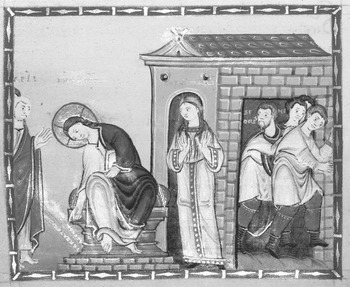
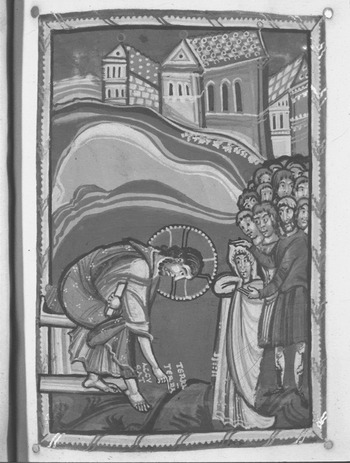
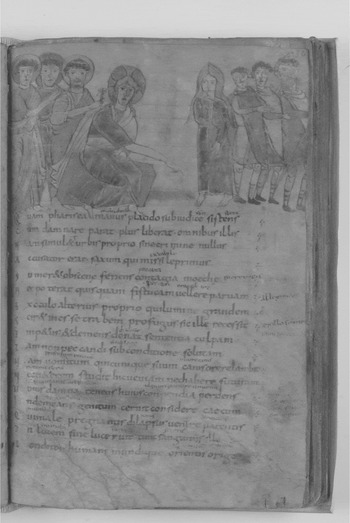
With this supposition, Ambrose began a widespread fascination with what Jesus wrote. Explanations regarding Jesus— writing entered textual and interpretive traditions as diverse as the tenth-century Latin picture book Codex Egberti and the ninth-century Constantinopolitan Codex Nanianus of the Gospels (U 030), the first Byzantine manuscript to supply the detail “[he wrote] the sins of each one of them” (ενοϛ εκαστου αυτων ταϛ αμαρτιαϛ).Footnote 5 Codex Egberti offers an alternative, depicting Jesus bending down and inscribing “earth accuses earth” (terra terram accusat) in the ground,Footnote 6 (fig. 1) a feature that also appears in the illuminated eleventh-century Gospel Book of Hitda of Maschede,Footnote 7 (fig. 2) and a ninth-century glossa, Codex Sangalensis 292.Footnote 8 Perhaps the compiler of the glossa and the illuminators of Egberti and the Gospel Book of Hitda were inspired by Ambrose's earlier view, or, perhaps they were paraphrasing a statement made by Augustine.Footnote 9 In either case, they, like Codex Nanianus, took care to specify the content of Jesus— writing. As such, they added to a host of interpretive elaborations entered into textual witnesses, discussed in commentaries, invoked in sermons, and represented in images designed to accompany the Gospels, each offering a distinctive “paratext” specifying what Jesus wrote and why he wrote it.Footnote 10 By tracing these and other suggestions regarding this writing, this essay explores what can be learned about the transmission and reception of the pericope adulterae on the basis of claims about what Jesus wrote.
Codex Egberti, Trier, ninth cent. Stadtbibliothek/Stadarchiv Trier, MS 24, fol. 46v

Recent Proposals
Contemporary scholars have also wanted to determine what Jesus wrote, or if he wrote at all. In 1964, J. Duncan Derrett put forward the highly speculative proposition that Jesus inscribed selections from Exodus 23. Accepting the historicity of the episode, Derrett envisioned Jesus seated on a low stool and therefore limited in what he could have written. To inscribe more than sixteen characters of Hebrew text would have been physically awkward, if not impossible, Derrett suggests, and so Jesus probably traced out, “You shall not spread a false report” (Exodus 23:1b). This verse contains the right number of Hebrew letters, Derrett observes, and was widely discussed in rabbinic literature. Also, the saying fits both the controversy and Jesus— legal perspective, at least as Derrett reconstructs it.Footnote 11 Others remain unconvinced by this fanciful hypothesis, arguing instead that it is equally possible that Jesus wrote nothing at all. As Paul Foster observes, the term καταγράϕω only rarely refers to writing an alphabetical script, more often denoting drawing or etching, especially outside a Septuagint context. Thus, Jesus could just as well have been tracing lines or doodling while mulling over his response,Footnote 12 a conclusion also suggested by Raymond Brown.Footnote 13 Brown notes, “One cannot help but feel that if the matter were of major importance, the content of the writing would have been reported.”Footnote 14
Hitda Codex (Gospels), Christ and the Woman Taken in Adultery. Cologne, ca. 1000. MS 1640 171r, Universitäts- und Landesbibliothek Darmstadt.

It is not only what Jesus wrote but also the manner in which he was described as writing that has prompted speculation from interpreters. By specifying that Jesus wrote with his finger, Harald Schöndorf points out, the author of the passage may be recalling Exodus 31:18, a verse that describes God inscribing covenant provisions with the divine finger. Linking divine law as given through Moses, on stone and with the divine finger, with divine writing inscribed on the ground and revealed by Christ, this detail implies that Jesus is equal or even superior to Moses, who simply receives rather than writes divine law.Footnote 15 A possible link with Exodus is also suggested by James Sanders, who wonders if Jesus did not write the Decalogue, inscribing the first five commandments before stating, “Whoever is without sin, throw the first stone at her,” and then writing the remaining five after bending down once more.Footnote 16 The writing on the wall in Daniel (5:5, 24–28) also serves as a possible inter-text; here divinely-sent fingers write letters announcing judgment against Belshazzar, a foolish and idolatrous king, who died that very night. Similarly, Jesus announces the judgment of the scribes and Pharisees throughout the Gospels, warning that they too will receive their punishment.Footnote 17 A further connection with Daniel is also possible: Read in Rome on the third Saturday of Lent at the titular church of the Gai (Santa Susanna), the pericope adulterae was associated with the episode of Susanna and the elders at least from the fifth century on, an association that the author himself may have intended if, as Robert E. Osborne suggests, Jesus wrote words from Daniel 13.Footnote 18
Recently, scholarly interest has turned away from the content of Jesus— writing to the fact that he is represented as writing at all. As George Aichele observes, the logocentrism of John's Gospel offers a particularly fitting context for a story involving Jesus, writing, and a set of missing words: In a manner similar to the Gospel itself, Jesus— words fail to signify, at least in an obvious way.Footnote 19 Considering the significance of writing in a recent study, Chris Keith argues that this portrayal of Jesus— writing may have served as a defensive maneuver designed to resist outsider critique. The writing on the ground demonstrates that Jesus was “grapho-literate”—that is, he had attained the highest level of literacy available in his day—a point so crucial that this pericope was added to the Gospel of John after initial publication, perhaps as a response to those who denigrated Jesus— lack of formal education. Jesus knew how to read and write, the pericope adulterae proclaims, an answer to the question raised in John 7:15: “How does this man know his letters, when he has not been taught?” (πῶϛ οὗτοϛ γράμματα οἶδεν μὴ μεμαθηκώϛ;).Footnote 20 As Keith explains, what Jesus wrote was not the issue, but that he wrote and how he wrote.
This essay takes a different tack, however, asking not what Jesus wrote or why he was represented writing but what claims about Jesus— writing can reveal about the assumptions brought to bear on this passage and its text. Texts do not stand apart from those who produce, read, and interpret them. Rather, they are written, preserved and authorized within particular historical settings by human actors, who bring diverse assumptions to bear on the texts they interpret and transmit.Footnote 21 Viewed from this perspective, the unusual transmission history of the pericope adulterae bears witness not to the corruption of a pristine gospel text but to the promiscuity of text and meaning.Footnote 22 Assertions about what Jesus wrote do not solve the question of this writing; instead they offer competitively plausible explanations that fit within the interpretive rules they seek to apply.Footnote 23 Other explanations for Jesus— act are also possible, and, indeed, many more have been offered. The knotty transmission history of the pericope highlights the phenomenon further, with copyists and scholars from the fourth century onward taking care to signal the story's instability, sometimes including it and sometimes leaving it out, according to the dominant text-critical assumptions of their day.Footnote 24 Scribes, translators and scholars as diverse as Jerome,Footnote 25 an anonymous sixth-century Greek chronicler,Footnote 26 the twelfth-century patriarch of Constantinople Euthymius Zigabenus,Footnote 27 and several anonymous scholiastsFootnote 28 noted the problems posed by this passage's presence or absence from the Gospels, a dilemma that made its way into the text in the form of text-critical marks, blank spaces in manuscripts, and diverse locations within the Gospels, despite its predominant placement in John 8.Footnote 29 Yet none of these diverse indicators of textual instability managed to push the story to the margins of Christian interpretation, and none have prevented readers from offering suggestions regarding what Jesus wrote, when they knew a version of the story that represented him as writing.
Notably, the earliest probable references to the pericope adulterae make no mention of writing. Papias of Hieropolis's story involving a woman “falsely accused of many sins” (ἐπὶ πολλαῖϛ ἁμαρτίαιϛ διαβληθείσηϛ) does not discuss the writing;Footnote 30 neither does a possible allusion in the Proto-Gospel of James 16.2, which focuses on a false charge of sexual sin.Footnote 31 The earliest certain reference, a citation in the Didascalia Apostolorum, includes the last line of the familiar Johannine text––“Go, neither do I condemn you”––but without any mention of Jesus— writing on the ground.Footnote 32 Origen's consideration of an adulteress facing the possibility of stoning invokes the Johannine title for Christ, “Logos,” and notes that the adulteress was found in the actFootnote 33 but includes no discussion of writing.Footnote 34 Didymus the Blind's Commentary on Ecclesiastes 223.7–13 is equally silent, emphasizing instead the universality of sin as a warning for those who make the mistake of judging too quickly.Footnote 35 Unlike these earlier authors, however, Didymus may have known the story from John, though his comment, “in certain gospels (ἔν τισιν εὐαγγελίοιϛ) one finds [the following story],” leaves the question open.Footnote 36 The pseudo-Augustinian Questiones Veteris et Novi Testamenti reads the story as a condemnation of the Jews, an interpretation that received further endorsement by Ambrose and later Latin fathers, but this work does not link their condemnation to Jesus— writing.Footnote 37 Pacian of Barcelona listed the adulteress as an example of Christ's exceptional mercy, placing the emphasis on Jesus— dealings with the woman rather than on his opponents and therefore failing to mention Jesus— written judgment against them.Footnote 38 Hilary of Poitiers alluded to the passage in his commentary on Psalm 118, citing the saying “whoever is without sin,” but without mention of Jesus— writing.Footnote 39 A possible allusion in a fifth- or sixth-century Pachomian catechesis also stresses the comment, “whoever is without sin,” raising Christ's mercy as a rationale for the decision to correct rather than expel wayward monks; once again, writing is overlooked.Footnote 40 When the writing is mentioned, however, an explanation for this narrative detail often accompanies the discussion.
Writing Latin in the Ground
Though absent from a majority of early Greek copies of the Gospels, the pericope adulterae does appear within the fifth-century Greek-Latin diglot Codex Bezae and, when it does, Jesus clearly writes. He “was writing with his finger in the ground” (τω δακτυλω κατεγραϕεν ειϛ την γην/digito suo scribebat in terram), the Bezan text reports, and, when the “priests” continued to press him, he wrote a second time, once again with his finger (τω δακτυλω κατεγραϕεν ειϛ την γην / digito suo scribebat in terram). Ambrose of Milan knew these same details in the 380s: Jesus/God “wrote on the ground with the finger with which He had written the law” (scribebat autem in terra digito, quo legem scripserat),Footnote 41 a narrative feature that Jerome also mentioned a few decades later.Footnote 42 Beyond noting the importance of Jesus— finger and the fact that he wrote, the Bezan text offers no further suggestion regarding the content and significance of Jesus— writing. Ambrose and Jerome, however, supply a series of interpretive expansions that link Jesus— action to God's judgment. According to Ambrose, Jesus wrote, “earth, earth, write that these men have been disowned” (terra terra scribe hos uiros abdicatos),Footnote 43 a passage that references Jeremiah 22:29–30.Footnote 44 Ambrose further suggests that “Jesus inclined his head to write in the ground” (Iesus inclinato capite scribebat in terra), turning his head away in response to insults thrown at him by the Jews.Footnote 45 “When the Jews demand payment,” Ambrose continues, “their names are written in the ground.” By contrast, “the names of Christians are written in heaven.”Footnote 46 Jerome's comments are similar but more succinct: Jesus wrote, “they that depart from you shall be written on the earth” (reliquentes autem te, super terram scribantur), a paraphrase of Jeremiah 17:13.Footnote 47
Peter Chrysologos, a fifth-century bishop of Ravenna, seems not to have been aware of these interpretive traditions, despite his geographical proximity to Ambrose. He also addresses Jesus— writing, making much of the posture the savior adopted while he wrote, but, according to Peter, the writing was directed at the woman rather than at the scribes and Pharisees. Offering an allegorical interpretation of the passage in the context of a sermon on Romans 7, the bishop imagines the adulteress as the sinful Synagogue, unrepentant in her fornication. Appalled by her sin, Jesus turns away, bows down to the earth, and averts his gaze from both her and her crimes. Peter explains, “[Jesus] preferred, brethren, to write forgiveness in the sand rather than to utter a condemnation about the flesh” (et maluit, fratres, in puluere scribere ueniam, ne daret in carne sententiam).Footnote 48 To this bishop, then, Jesus— writing represents not judgment but forbearance, a delay offered to the woman/Synagogue so that she might repent of her wicked ways, a point he links to Paul's injunction regarding the freedom from the law attained by a widow upon her husband's death (Romans 7:3). The faithful are no longer bound by the law, Peter argues, but urged instead to join in a pure union with Christ.Footnote 49
As the combined witness of Codex Bezae and these Latin writers demonstrates, by the late fourth century Jesus— writing had become an established feature of Johannine versions of the pericope, particularly as it was preserved in Latin and probably in Greek as well.Footnote 50 The Latin fathers Ambrose and Pacian displayed a particular interest in Jesus— posture, an interest that may also be reflected in some Old Latin witnesses. Codices Colbertinus (c), Palatinus (e), and Codex Corbeiensis (ff 2) also add that Jesus “bowed his head,”Footnote 51 perhaps harmonizing the verse with a phrase from John 19:30, which reads “inclinato capite.”Footnote 52 Here Jesus bows his head on the cross as he gives up his spirit; thus, by linking Jesus— posture on the cross with his posture when confronting the woman, Ambrose, Pacian and these Old Latin witnesses may seek to recall Jesus— attitude of mercy toward all sinners.Footnote 53 The Old Latin witness Codex Aureus (aur), the text of Codex Fuldensis, and the majority of the Vulgate tradition, however, read “inclinans se deorsum,” a translation that better reflects the Greek κατακύψαϛ.Footnote 54 Codex Gatianus (Bt/gat), which presents a mixed Vulgate/Old Latin text, has the unique conflated reading “inclinate capite deorsom.”Footnote 55 It should also be noted that Codex Palatinus translates ἀνέκυψεν/ἀνακύψαϛ (v. 7, 10) as “adlebauit/adleuasset capud,” which implies that the reference to the head in Latin may reflect translation technique rather than harmonization.
In the early fifth century, Augustine took the lead from Ambrose and Jerome by offering a number of diverse suggestions regarding Jesus— writing. In his commentary on Psalms, for example, he claimed that Jesus stooped, just as “God had stooped to man, who had been told: ‘Earth thou art, and to earth thou shalt go— ” (Ille autem inclinauerat se ad terram, id est, Deus ad hominem, cui dictum est: Terra es et in terram ibis).Footnote 56 In Answer to an Enemy of the Law and the Prophets, he suggested that the Lord's writing shows that “those who abandon him are written in the earth,” an interpretation he supported on the basis of Jeremiah 17:13, “ ‘Let all those who abandon you be confused; as they withdraw, let them be written upon the earth— ” (Quis enim cogitat, quomodo ad memoriam dei scribantur in caelis sequentes dominum, derelinquentes autem dominum scribantur in terra, de quibus propheta Ieremias dicit: Uniuersi qui derelinquunt te confundantur; recendentes super terram scribantur).Footnote 57 Augustine also mentions Jesus— posture, noting that the Lord “inclined his head” in several of his writings.Footnote 58 Adding his own unique viewpoint on the matter, he observed, “the law was written by the finger of God; but because [the Jews] were hard men, it was written on stone.” By contrast, Jesus wrote in the earth, to show that the Christians would bear fruit.Footnote 59 In a sermon preached on a verse from Psalm 2—“Be instructed, all you who judge the earth” (Erudimini omnes qui iudicatis terram)—he invoked Jesus— writing to remind kings that, when they judge people of the earth, “earth itself is judging the earth” (quia terra iudicat terram); in other words, mortals who judge mortals ought to remember that they are of the earth as well and, as such, will be judged by God.Footnote 60 Implicit throughout Augustine's exegesis of the passage is the view that, acting as God, Jesus inscribed judgment into the earth with his finger, a perspective Augustine shared with his teacher Ambrose and his contemporary Jerome.
Incorporated in the Roman liturgy from the earliest period, perhaps the fifth century but certainly before the institution of Lenten Thursdays in the eighth century, the pericope adulterae was read on the third Saturday of Lent, and therefore featured in the most important cycle of the liturgical year.Footnote 61 The liturgical prominence of the passage likely contributed to its popularity among preachers and commentators. The story was a particular favorite of Augustine's, who may have been influenced by its placement in the Latin lectionary when composing sermons that quote it at length.Footnote 62 Pope Leo the Great (d. 461) recalled the adulteress as an example of Christ's care for feeble souls in the context of a Palm Sunday sermon, a fitting choice since the pericope would have been read in Rome a few weeks earlier.Footnote 63 The fifth-century Latin poet Sedulius composed a Christian hexameter poem for the Easter season that labeled the woman as a “repulsive adulteress,” set free by the gentle one, again an appropriate choice for a story read during the Lenten season.Footnote 64 The story was also cited outside of liturgical contexts. In a letter written in the 490s, Pope Gelasius (d. 496) reminded church leaders that all are sinners, citing the pericope.Footnote 65 The sixth-century senator, orator and statesman Cassiodorus (d. ca. 580) invoked the passage in a series of essays on the Psalms, arguing that the Jews, who dared to test Jesus on a point of law, would be judged.Footnote 66
Latin writers therefore attest to a continuing tradition of interpretation and preservation of what had become a familiar story,Footnote 67 an impression that is confirmed by the Latin manuscript tradition. Out of eighteen extant Old Latin manuscripts that could possibly contain the story (that is, they preserve complete or nearly complete copies of John), fourteen do, nine of which more or less attest to the Vulgate form of the text.Footnote 68 Vulgate gospels invariably include the passage.Footnote 69 Latin manuscripts that include capitula regularly list the pericope, usually at canon 86, though other numbering systems also appear.Footnote 70 Codex Fuldensis, which incorporates a capitulum taken from an exemplar that diverges from the copied text, nevertheless lists chapter 70 as “de muliere a iudaeis in adulterio deprehensam.” In other words, though the text of the pericope remained somewhat fluid, and its placement in textual apparatuses like the capitula shifted, the story was well-known, highly regarded and proclaimed in Latin liturgical contexts from the fourth century onwards. Moreover, the Old Latin text of the pericope adulterae (not that of the aberrant d) is closely related to the Greek text of f 1, which is nearest to the “initial text” as reconstructed by the editors of the Nestle-Aland, 27th edition. Significantly, this means that the Old Latin witnesses, normally not considered among primary witnesses to the initial text, are in effect the earliest witnesses to this particular passage.Footnote 71 Moreover, though absent from Eastern witnesses to Tatian's Gospel harmony, the Diatessaron, the passage is found in all Western Diatessaron witnesses, albeit in different locations.Footnote 72 The passage was therefore probably added to the Latin textual tradition very early, though all the extant Latin Diatessaron witnesses reproduce the Vulgate textform. The transmission of this story in the East, however, is much less clear.
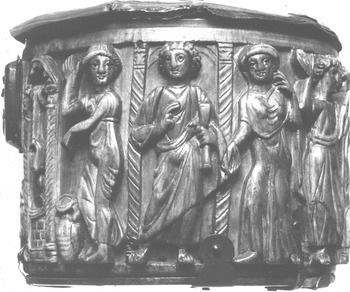
Ivory pyxis, Russia, fifth-sixth cent. The State Hermitage Museum, St. Petersburg. Inv. no. W-5.

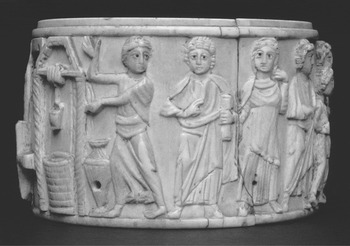
Ivory pyxis, Paris, fifth-sixth cent. Musée national du Moyen àge–Thermes de Cluny, numéro d—inventaire: cl. 444 (D.S. 1033). Photo: Réunion des Musés Nationaux/Art Resource, N.Y.

Tracing Eastern Witnesses
The pericope adulterae gained a secure place in Latin versions of John more quickly than in other traditions, yet we can detect traces of its presence, and of an interest in Jesus— writing, elsewhere as well. Two surviving pyxides depict the adulteress with Jesus, who, placed in a prophetic role, is shown holding a scroll, teaching in the temple and encountering the woman, who gestures with shame or surpriseFootnote 73 (figs. 3–4). The sixth-century mosaics of Sant—Apollinare Nuovo in Ravenna may also depict the scene,Footnote 74 perhaps suggesting that the story was known not only in Ravenna but in Constantinople as well since Sant—Apollinare Nuovo was commissioned by the Ostrogothic king Theodoric following his appointment by the Emperor Anastasius (491–518 C.E.). Raised in the Constantinopolitan court as a hostage in the imperial palace, Theodoric was also a close associate of Cassiodorus, the Roman statesman, client of Constantinople and Theodoric's Latin secretary,Footnote 75 and, as we have already noted, Cassiodorus certainly did know the pericope.Footnote 76 The ciborium columns of San Marco in Venice may provide further evidence of knowledge of the story in sixth-century Constantinople. Brought to Venice in the thirteenth century, these columns are much older, offering an extraordinary example of Byzantine figurative sculpture. Among the many scenes of Jesus— life rendered, there is an illustration of his encounter with a woman that may depict the pericope.Footnote 77 Given the Lukan theme of most of these illustrations, a recent analysis of the columns identifies this woman as either one of the women listed in Luke 8:2–3 (Mary Magdalene, Joanna, wife of Chuza, and Susanna) or as either Mary or Martha of Bethany.Footnote 78 By contrast, the Medieval Latin epigrapher who inserted the running inscriptions identifies the woman as the adulteress.Footnote 79
There is no direct manuscript evidence for the pericope between its first appearance in Bezae and its re-appearance in the eighth-century Codex E of the Gospels (07). Still, the story could be found in some copies, as the surviving canon tables of a seventh-century tetra-evangelion belonging to Epiphanius of Thebes suggest. The canons and Eusebius's letter to Carpianus are all that remains of this codex, but in John the section numbers were advanced by one numeral somewhere between numbers 70 and 91, likely because of the presence of the pericope, which has been given its own section.Footnote 80 We cannot know what text of John was here preserved, but presumably the pericope appeared in some form similar to what is found in later Greek manuscripts. A fragment of the story may survive on a Coptic ostrakon dated to the seventh or eighth centuries. If so, this ostrakon offers additional evidence of the presence of the story in Egypt at this same time.Footnote 81 Marginal notes in much later (twelfth- and thirteenth-century) Coptic manuscripts confirm the impression of the story's marginality but abiding presence. Colophons were included explaining that the story was added on the basis of Greek copies, on the basis of the Syriac, or on the basis of an Arabic translation.Footnote 82
An anonymous sixth-century chronicle, written in Greek but preserved in Syriac, adopts an attitude similar to these twelfth-century Coptic copyists. When the chronicler was made aware of the passage as it appeared in a personal tetra-evangelion owned by Bishop Moro of Amida, he took care to copy it out.Footnote 83 Noting that this passage, “not found in other manuscripts,” could be found in the eighty-ninth canon of the bishop's copy of John, he wrote out the story but in a particularly unusual form. According to the chronicler, or perhaps according to Bishop Moro's Gospels, Jesus writes after the woman's accusers leave the scene:
And when they had gone, Jesus looked upon the ground and, writing in the dust there, said to the woman, “They who brought thee here and wished to bear witness against thee, having understood what I said to them, which thou also hast heard, have left thee and departed. Do thou also, therefore, go thy way, and commit not this sin again” (Chronicle of Zachariah of Mitylene 8).Footnote 84
Thus, neither the action of writing nor the writing itself was directed at the woman's accusers, who had already departed.
The faint traces of this pericope—and of Jesus— writing—confirm its relative marginality in non-Latin contexts. Excluded from the principal feasts of the developing Greek lectionary system, the story was neglected by the Constantinopolitan liturgy, which read John 7:37–52 and 8:12 on the feast of Pentecost. Perhaps the pericope was not present in the copies of John from which the moveable lections from Easter to Pentecost were drawn.Footnote 85 Alternatively, perhaps John 8:12 was appended as a fitting ending to 7:37–52 with full knowledge that an intervening episode had been overlooked. Without it, the reading would conclude, “A prophet will not arise from Galilee” (ἐκ τῆϛ Γαλιλαίαϛ προϕήτηϛ οὐκ ἐγείρεται), hardly a satisfactory ending on a feast day designed to celebrate the coming of the Holy Spirit upon the disciples, who then prayed and prophesied in Christ's name.Footnote 86 The pericope adulterae therefore found its way into the Byzantine liturgy rather late, perhaps at some point in the sixth century,Footnote 87 when it was chosen as the appropriate lection for the feast days of Pelagia of Antioch, Mary of Egypt, Theodora, or Euphemia, depending on the cycle of saints honored by the particular Menologion.Footnote 88 Often, the lection included only 8:3–11, beginning with the phrase, “The scribes and the Pharisees brought a woman caught in adultery,” a lectionary decision that impacted the story's incorporation in some Johannine Gospel witnesses. As Robinson points out, the abridged Menologion version appears in ten of the twenty-eight continuous-text manuscripts that treat the pericope as a preface or appendix to the Gospel.Footnote 89
The story was also overlooked in the developing liturgy of Jerusalem, a decision which would go on to impact the Syriac and Armenian lectionaries. According to the medieval Armenian manuscripts that preserve the Jerusalem liturgical cycle, John 16:5–15 was the Pentecost lection, read during the stational feast at the Mount of Olives, as the fourth-century Itinerarium Egeriae also suggests.Footnote 90 Not surprisingly, then, the pericope was irregularly included in the Syriac Palestinian lectionary, appearing in only one of three medieval manuscripts compared by Agnes Smith Lewis and Margaret Dunlop Gibson in 1899.Footnote 91 Nevertheless, the passage seems to have been appended to the end of the exemplars from which these manuscripts were produced, for all three include a colophon after John 8:2: “The Gospel of John has been finished by the Greeks in Ephesus [as follows],” or “The Gospel of John has been finished with the assistance of Christ [as follows].”Footnote 92 Thus, read only rarely, on the feast day of a saint rather than as part of a major stational feast at either Constantinople or Jerusalem, the pericope faded into relative oblivion, whether or not texts of John preserving the story were available to readers and scribes.
Beginning in the eighth century, the fortunes of the pericope adulterae began to shift in Greek, at least in terms of manuscript witnesses. Omitted from the two third-century papyri that could have contained it ( 66 and 75),Footnote 93 and excluded from all but one (D 05) of the six fourth- through eighth-century majuscule witnesses to John,Footnote 94 the story reappears in three eighth-century majuscules, but in one of them, Codex Basiliensis (E 07), it is obelized, either as an indication of its disputed status, along the lines of Alexandrian text-critical marks, or as a visual aid to the reader, who would know to skip from 7:52 to 8:12 when reading the Pentecost lection.Footnote 95 Limiting the discussion to eighth- through tenth-century majuscule witnesses, we detect the following results:

This sample of surviving manuscripts may or may not be representative of the larger textual tradition. Nevertheless, the results are striking: of twenty-one extant majuscule manuscripts from this period, sixteen show some knowledge of the pericope and place it in its traditional place in John, while five omit it outright. Of the sixteen showing some knowledge of the pericope, two leave a blank space where it could be added later, five mark it with obeli, and nine include it within an unmarked, continuous text of John. The story may have been excluded from Alexandrian witnesses and ignored by Byzantine exegetes and homilists,Footnote 96 but it remained part of the Greek textual tradition and was therefore ready to be applied to the feast days of various female saints both before and after the tenth-century liturgical reforms of Symeon Metaphrastes.Footnote 97
Embedded within these Byzantine manuscripts are two interpretive traditions regarding what Jesus wrote: According to the witnesses E (07), G (011), H (013) and K (017), Jesus wrote “taking no notice [of them]” (κατεγραϕεν ειϛ την γην μη προσποιουμενοϛ) when writing the first time;Footnote 98 the text of Codex Nanianus (U 030) informs the reader that Jesus wrote “the sins of each of them” (εγραϕεν ειϛ την γην ενοϛ εκαστου αυτων ταϛ αμαρτιαϛ) when writing a second time. The first expansion—Jesus took no notice of them—finds no parallel in the exegesis encountered thus far but, like additions to the Latin that emphasize Jesus— posture, explains Jesus— affect while writing: He pretended not to notice (προσποιέω) their illegitimate question, answering them only when they continued to press him. The second––Jesus wrote the sins of each of them––is quite similar to what has already been encountered in late antique Latin exegesis: those who are condemned, Ambrose, Jerome and Augustine agreed, are written in the earth. This coincidence, together with the more prominent role of the pericope adulterae in Latin exegesis, may suggest that this particular expansion first entered John under the influence of Latin texts and exegesis.Footnote 99 Regular interchange between Greek and Latin churches throughout late antiquity and the early medieval period increases this possibility. Compilations of orthodox patristic exegesis and commentary were available from the late fifth century onward, including works of Latin fathers, translated into Greek for the benefit of Greek participants in ecumenical councils.Footnote 100 Southern Italy was especially influenced by Byzantine practices and texts,Footnote 101 and Greek Bibles and books were always available in Rome.Footnote 102 With consistent interactions between Greek- and Latin-speaking Christians throughout this period, despite the upheaval of Arab and Lombard invasions,Footnote 103 a relationship between Latin Bibles and patristic exegesis and these Byzantine copies of John cannot be ruled out. Nevertheless, these particular expansions are not found in the Latin textual tradition. Moreover, traditions linking condemnation with divine writing, particularly writing in the earth, are much older than what is found among the Latin fathers. The view that Jesus wrote “the sins of each one of them” may therefore have entered the text of John independently of any Latin influence. Indeed, it is also possible that Jerome first associated the pericope with Jeremiah and divine judgment on the basis of Greek exegetical traditions, which were simply carried forward in Greek textual witnesses.Footnote 104
As Derek Krueger has noted, ancient and medieval Christian authors regularly figured the history of salvation “as a series of scribal acts.”Footnote 105 This tradition began early, and appears in writings as diverse as the Apocalypse of John, the letter to the Colossians and the Gospel of Truth.Footnote 106 Already in the second century, Clement of Alexandria recalled Jeremiah 22 to argue that God writes the faithless into the earth and the faithful into heaven:
For the one in a state of ignorance, who is sinful, is also earth and ashes, but the one who rests in a state of knowledge, having become assimilated to God as far as possible, is able to become spiritual already, and for this reason elect. That the scripture calls the senseless and disobedient “earth,” will be made clear. Jeremiah the prophet, in reference to Joachim and his brothers, says, “Earth, earth, hear the word of the Lord: write this man, a person banished” (Stromateis 4.26.168.2–6).Footnote 107
Clement clarifies Jeremiah's statement with a saying attributed to Abraham, conflated with a Johannine saying of Jesus. Referring to Jesus— judgment, Clement explains, Abraham said, “‘O Lord, the one who judges the earth,—” since “the faithless one, according to a saying of the savior, is condemned already” (κύριε, ὁ κρίνων τὴν γῆν, ἐπεὶ, ὁ απιστήσαϛ, κατὰ τὴν σωτήριον ϕωνὴν ἤδη κέκριται).Footnote 108 The condemned are to be judged with the earth and as earth, Clement asserts, a claim that Ambrose will associate with the pericope adulterae some two centuries later. Origen made a similar point in the context of a homily on Jeremiah 17, a passage that would also be associated with the pericope in Latin exegesis:
“Let them be dishonored,” [Jeremiah says], “when they have separated, let them be written on the earth” (Jer 17:13). For also “with the measure that you measure you will be measured” (Matt 7:2). Each person is responsible for himself for what is written. If you seek what is on earth, you do not seek what is in heaven. (Hom. Jer. 17.4)Footnote 109
Those who are separated from God, Origen suggests, are written on the earth since they have been measured and judged.
The view that Jesus “wrote the sins of each one [of them]” therefore fits within a wider, shared interpretive tradition, a tradition that also made its way into the specific context of Codex Nanianus (U 030), a ninth-century text from Constantinople.Footnote 110 In the sixth century, Constantinopolitan poet and deacon Romanos the Melodist popularized the image of Christ literally inscribing salvation with his incarnation, death and resurrection. Repeatedly invoking Jesus— writing in a series of liturgical hymns tied to the festivals of the church year, he does not mention the perciope adulterae, but he does describe Jesus as writing, and in contexts when writing is not obviously present.Footnote 111 For example, imagining the repentant thief of Luke's passion narrative, Romanos suggests that Jesus wrote a notice (πρόγραμμα) for the thief in his blood, which was then presented to the angels as a divine letter of recommendation: “The cherubim, receiving it, recognized the letters, shining out with the grace of the purple of blood, and they delighted in how beautifully it had been dictated.”Footnote 112
In this retelling, Christ's blood becomes the ink and the wood of the cross the parchment upon which a written decree is inscribed. A similar perspective is adopted in another holy week hymn:
[H]aving taken in [my hand] a reed, I am starting to write a pardon for all Adam's descendants. My flesh, which you see, becomes for me like parchment and my blood like ink, where I dip my pen and write.Footnote 113
Romanos's songs remained popular in Constantinople for centuries; a feast day (October 1) was dedicated to him and at least four different Lives were composed in his honor.Footnote 114 Thus, it may have seemed especially appropriate for a scribe to add that Jesus wrote “the sins of each one” when drawing with his finger on the ground, the oldest witness to the expansion being the ninth-century Codex Nanianus (U 030).Footnote 115 But if Jesus literally wrote the sins of each, the context apparently demanded an additional change; hence, some later manuscripts with this expansion further replace the “hearing” (ἀκούσαντεϛ) in verse 9 of what Jesus had just said, with “reading” (ἀναγινώσκοντεϛ) of what Jesus has written: that is, the sins.Footnote 116
“Earth Accuses Earth”: The Pericope in Early Medieval Latin
Early medieval Latin manuscripts do not supply information regarding Jesus— writing in their texts of the pericope, but they do include information nonetheless, and not only in separate commentaries, homilies, and books. Northumbrian and Carolingian editors were quite familiar with the passage and went to considerable lengths to make sure it was included in their Gospels. Thus, the sixth-century insular Old Latin manuscript Usserianus Primus (r 1) includes the passage, but from a Vulgate translation, suggesting that the scribe added the passage from a separate exemplar.Footnote 117 By contrast, the eighth-century northern Italian Old Latin Codex Rehdigeranus (l) omitted the pericope, at least initially, but then, in the ninth century, the passage was added, sewn into the margin by a later scribe.Footnote 118 A ninth-century edition of Sedulius's Carmen paschale, likely copied from a manuscript owned by Cuthwine, an early eighth-century bishop of the East Angles known to Bede,Footnote 119 incorporates an image of the pericope at the appropriate place in the poem, but highlights aspects of the story that are not present in Sedulius's text: Christ is depicted seated upon a stool and reaching down toward the earth (fig. 5). The adulteress gestures in shame while her accusers surreptitiously depart and the disciples look on.Footnote 120 By contrast, Sedulius makes no mention of Jesus— writing, envisions the woman pressed on all sides by a crowd, and emphasizes the stones that would be used to crush her.Footnote 121 As such, these images were likely drawn not from an earlier illuminated Sedulius but from a now-lost illuminated Gospel book.Footnote 122
Sedulius Carmen paschale, Antwerp, ninth cent. Museum Plantin-Moretus/Prentenkabinet, Antwerp–UNESCO World Heritage. Inv. no. M 17.4, fol. 30r. Photo: Peter Maes

In Jarrow in the early eighth century, Bede (ca. 673–735) preached a Lenten homily that demonstrated interest in Jesus— writing as well. According to Bede, Jesus represented his humility by bowing down, and, by writing in the ground, he showed that our deeds are written on our hearts.Footnote 123 Bede is remarkable not only for his well-crafted sermons on this pericope and other passages, his knowledge of Greek,Footnote 124 and his well-known Ecclesiastical History, but also for his active involvement in the preservation and copying of Northumbrian Bibles. It is Bede who tells us that Ceolfrith, prior of Wearmouth, brought back from Italy a large pandect Bible that had once belonged to Cassiodorus. Apparently, this pandect went on to serve as the model for Codex Amiatinus, a massive illuminated pandect presented as a gift to Pope Gregory II (715–731). When edited, various changes were made, including the replacement of an older Latin translation with Jerome's noua translatio, that is, with the Vulgate text.Footnote 125
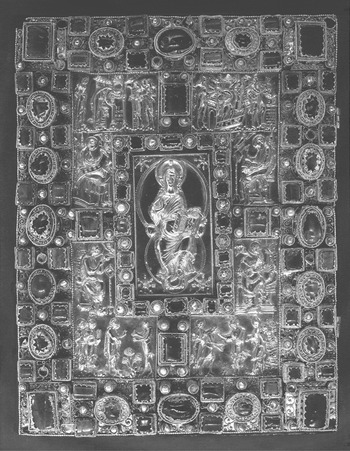
Cover of Codex Aureus of St. Emmeram (Golden Gopels of Charles the Bald), 870. München SB: Clm 1400.

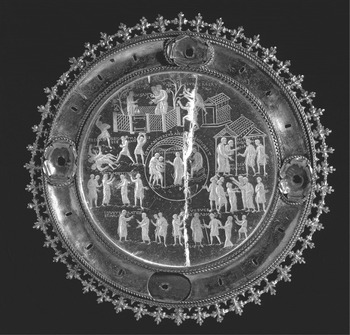
Lothair Crystal, London, ca. 855–886. British Museum, Department of Medieval and Later Antiqities. Inv. no. M&LA 55,12-1,5.

Northumbrian Bible production went on to influence the Carolingian reform, with Alcuin of York serving as a key figure in Charlemagne's educational program, further guaranteeing the presence of the passage both in Gospel books and in early medieval exegesis.Footnote 126 Carolingian preachers paid regular attention to the story.Footnote 127 The pericope was also chosen as a subject for the golden cover of Codex Aureus of Emmerman, a version of the Gospels copied in 870 for Charles the BaldFootnote 128 (fig. 6). This jewel encrusted golden cover includes scenes from Jesus— life, all drawn from the Gospel of John, and evangelist portraits around an enthroned Christ. The pericope adulterae is depicted on the upper left, across from an image of the cleansing of the temple. In this scene, Jesus is writing “si quis sine pecato” (if anyone is without sin), a paraphrase of the Vulgate, “qui sine peccato est vestrum primus in illam lapidem mittat” (whoever of you is without sin, let him be the first to throw the stone at her). Interestingly, a comparable set of biblical paraphrases may be found on the contemporary Lothair Crystal, a finely wrought depiction of the story of Susanna engraved on a lens-shaped rock crystal, probably for King Lothair II of the Franks, who reigned in Lothairingia from 855 until 869 (fig. 7).Footnote 129 Phrases from the Vulgate translation of Daniel 13 are inscribed adjacent to the appropriate scenes, sometimes literally and sometimes in paraphrase, in ways that further add to the story.Footnote 130 The images also extend the narrative, depicting, for example, the stoning of the elders, a detail that is not specified in the Vulgate text.Footnote 131
An analysis of this crystal by Valerie Flint suggests further, possibly explicit, connections between the cover of Codex Aureus and the Lothair Crystal. As Flint points out, the story of Daniel and the story of the adulteress were read in tandem on the third Saturday of Lent, a connection that Carolingian-sponsored liturgical reforms formalized. The very early Roman lectionary, the Comes of Würzburg (ca. 700), links the two passages, as do two other eighth- and ninth-century lectionary manuscripts.Footnote 132 Thus, when the Lothair Crystal labels Susanna as Sancta Susanna, it may well suggest not the Susanna who was a victim of the elders in Daniel 13 but Saint Susanna, the legendary martyred niece of Diocletian and patron saint of the Roman stational church of the Gai, renamed by Pope Gregory the Great in the late sixth century.Footnote 133 The two Susannas were conflated, possibly with the adulteress of John 8 as well. Flint concludes:
[T]he veiled and standing woman [of the Lothair Crystal] may also represent Susanna's liturgical companion, the unnamed adulterous woman of the gospel. The two standing figures … would then be the Scribes of the gospel—and the seated figure representative of Christ himself, sitting canopied in judgment in the Temple.Footnote 134
Whether or not the Lothair Crystal conflates the Susannas and the adulteress, the crystal and the golden cover of Charles the Bald's Gospels do present a series of intriguing coincidences: both were likely designed for the personal collections of Carolingian kings, both paraphrase passages from their chosen stories, and both were produced in the mid-ninth century, within a span of five years. The Lothair Crystal seems to have served as some sort of gift or talisman, perhaps given to Queen Theutberga upon her reconciliation with her husband King Lothair II.Footnote 135 The luxury Codex Aureus of Saint Emmerman adorned Charles the Bald's personal library, along with a Sacramentary, a prayer book, Psalter, and Antiphony, each richly decorated.Footnote 136 In addition to the episodes from John chosen to adorn its covers, the manuscript also includes a dedicatory, Byzantine-style image of Charles the Bald, signaling the importance of lavish, illuminated books in the context of ninth-century Carolingian–Byzantine exchange.Footnote 137 In other words, both the golden Gospels cover and the crystal fit within the activities and concerns of Carolingian court circles, and both address themes of divinely-ordained justice.
The particular popularity of the pericope adulterae in Carolingian contexts is further evinced by early Glossa designed to accompany and clarify biblical texts, commentaries and commentary collections, and also by the Miscellanies produced by court scholars like Sedulius Scottus.Footnote 138 This Sedulius, not to be confused with the sixth century Sedulius who composed the Carmen paschale, was an Irish poet and scholar likely invited to the royal court at Liège by Charles the Bald, serving as a tutor to the future King Lothair II.Footnote 139 He included a saying from John 8 in his collection of biblical, patristic, and classical excerpts, many of which also appear in his later work, De rectoribus christianis (written ca. 855–859). He listed, “Whoever is without sin, let him throw the first stone at her,” among a series of selections from “the doctors” of the church, including excerpts from the writings of Jerome, Gregory the Great, Isaiah and Isidore.Footnote 140 As we have seen, the goldsmith who manufactured the golden cover of Codex Aureus of Emmerman, also for Charles the Bald, paraphrased this same verse a few decades later.
A surviving ninth-century glossa, Codex Sangallensis 292, comments upon the pericope adulterae: after the scriptural tagline “digito scribebat in terra,” this glossa indicates that Jesus wrote “terra terram accusat,” that is, “earth accuses earth.”Footnote 141 No further context or information regarding the phrase is offered. As we noted earlier, Ambrose did link sayings of the prophet Jeremiah with the pericope, suggesting that Jesus wrote, “earth, earth, write that these men have been disowned” (terra, terra, scribe hos uiros abdicatos; Ep. 50.4).Footnote 142 The phrase “terra terram accusat” may therefore be a convenient paraphrase of Ambrose's point of view. A sermon preached by Augustine on Psalm 2 offers another, even more plausible source for the glossa. In this sermon, the bishop reminded North African rulers that, when judging, they are merely “earth itself judging the earth” (terra iudicat terram), “a human judging a human, a mortal judging a mortal, a sinner judging a sinner” (porro autem si reges iudicant terram … homo hominem, mortalis mortalem, peccator peccatorem; Sermo 13.4).Footnote 143 He then invoked the pericope adulterae, observing that, when the Lord Jesus wrote with his finger, he judged the earth, even as he displayed pity for the woman (Sermo 13.5).Footnote 144 Augustine's emphasis on pity, missing from Ambrose's Epistles, is also present in the St. Gall glossa, which depicts the woman “standing in the middle, that is, between death and life, judgment and pity.”Footnote 145 Moreover, Augustine's message––kings will also be judged––fits well with advice given to Carolingian rulers by ecclesiastical authorities of all sorts.Footnote 146
Whatever its source, the phrase “terra terram accusat” went on to enjoy a long history, reappearing in the pages of Codex Egberti (Trier, Stadtbibliothek, MS 24), a tenth-century pericope book commissioned by Archbishop Egbert of Trier (977–993) during the reign of Otto II, son of the Saxon king Otto I and husband of the Byzantine princess Theophanu.Footnote 147 In this manuscript, Christ quite literally inscribes terra terram accusat into the ground while the woman, her accusers, and two disciples look on.Footnote 148 The eleventh-century Gospels of the Abbess Hitda of Meschede (ca. 1000–1020) reproduces this same image: once again, Jesus inscribes “terra terram accusat.”Footnote 149 Thus, by the Ottonian period, a Christ-centered royal theology fully incorporated the phrase featuring Psalters and Evangeliaries, elaborate ruler portraits, and the enthroned Christ.Footnote 150 The declaration, then, that “earth accuses earth,” can perhaps be read as a reminder that, as Augustine proclaimed, human rulers and human judges are just that––human––and, like the adulteress, they too will be subject to divine judgment.
Jesus— Writing Illuminated: The Pericope Adulterae in Medieval Greek
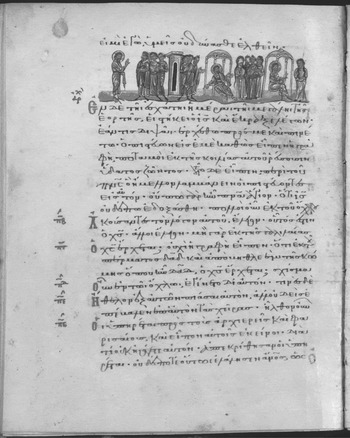
Although it was marginal among Greek-speaking Christians, the pericope adulterae was preserved by a majority of Byzantine majuscule witnesses nonetheless, most often without critical marks, and included in various Menologia, perhaps from the sixth or seventh centuries. The relegation of the pericope to Menologia did not fully impede its telling, however, as art historical and later manuscript evidence both suggest. Chosen for illustration on two ivory pyxides, as we have seen, and carved, perhaps, on a sixth-century Byzantine ciborium, the iconographic record points to a continuing tradition of illustration and remembrance in Greek and Latin both, an impression further confirmed by the series of miniatures that accompany the passage in an eleventh-century Byzantine Gospels (Florence: Laurenziana cod. Plut. VI, 23; fig. 8).Footnote 151 This extraordinary manuscript depicts nearly every Gospel scene in magnificent detail, including the pericope, and does so in a manner similar to what must have been common in much earlier illuminated Gospels. Like the sixth-century Vienna Genesis, the Rossano Gospels and the Sinope Gospels, this tetra-evangelion presents a coherent visual narrative in sequential, “cinematographic” scenes.Footnote 152
Illuminated Gospels, ca. 1000. Firenze, Biblioteca Medicea Laurenziana, Plut. 6.23, c. 184v. Su concessione del Ministerio per i Beni e le Atività Culturali. E— vietata ogni ulteriore riproduzione con qualsiasi mezzo.

Unfortunately, no surviving pre-iconoclastic manuscript has preserved the relevant section of John, and so none can verify the pericope's inclusion within a more ancient iconographic schema.Footnote 153 It is likely, however, that the Florence Gospels faithfully reproduced by-then conventional iconographic formulae, harkening back to earlier models.Footnote 154 As such, this manuscript may point to the incorporation of the pericope adulterae not only within pre-iconoclastic Gospel texts but also within pre-iconoclastic Byzantine illuminations.Footnote 155 Similarities between the imagery in the Florence Gospels and other Christian art confirm the impression: as in the ninth-century illuminated Sedulius, Jesus is portrayed sitting, pointing to the ground; as in Codex Egberti, the woman stands by, first with her accusers and then with Jesus;Footnote 156 and, as in the Lothair Crystal, Jesus is portrayed seated under a canopy. Tracing late antique Greek exemplars, now lost, through to Carolingian and Ottonian books and images, and onto an eleventh-century Byzantine tetra-evangelion may not be possible. Nevertheless, long-standing interactions between text and image—complicated by the intense material and cultural intercourse between Byzantine-Frankish and then Ottonian-Byzantine courts—place the pericope adulterae within an on-going setting of interface and exchange.Footnote 157 Notably, both the Eastern and Western imagery highlight Jesus— writing.Footnote 158 By the twelfth-century, Constantinopolitan scholar Eustathius of Thessaloniki simply assumed that his audience knew the story well. Calling the passage a “gospel pearl” and invoking it as a proof of God's compassion, Eustathius implored his brothers to follow Christ's example by showing mercy to one another instead of casting stones.Footnote 159
The Story Continues
The continuing development of the pericope adulterae emphasizes this story's long-standing place in the Christian imagination. As meaning and text shifted over time, traditions associating divine judgment with writing on the ground came to influence both Greek and Latin texts and paratexts. In the Greek case, the observation that Jesus/God inscribes sins into the ground was literally written into some manuscripts of John. In Latin, exegetical and liturgical decisions made by Ambrose, Jerome, Augustine, Cassiodorus, Pacian, Sedulius, and others were carried forward into Carolingian and Ottonian royal theology, influencing the books, liturgy, art, and scholarship produced at this time. Yet here claims about what Jesus wrote—first introduced by Ambrose or Augustine—were applied not to Jews or the woman's accusers but to kings, an appropriate choice given the court setting of the artists, illuminators, and scholars who fashioned these books and images. Once proposed, these interpretive innovations were repeated, gaining so strong a foothold that the thirteenth century Dominican scholar Jacobus de Voragine (ca. 1230–1298) could simply assume that Ambrose and Augustine had associated Jesus— writing with the words “terra terram accusat.” Footnote 160 Revisiting the pericope adulterae in a Lenten sermon, Jacobus listed a series of suggestions regarding what Jesus wrote: according to Ambrose and Augustine, Jesus wrote “terra terram accusat”; according to the Glossa Ordinaria, he wrote out the sins of the woman's accusers “eorum peccata”;Footnote 161 finally, Jacobus reports, according to John Chrysostom, Jesus wrote “earth, swallow these men who have been disowned” (terra absorbe hos uiros abdicatos; Sabbato Sermo 1:45–48).Footnote 162 Demonstrating his great learning as well as his fidelity to the traditions of the church, Jacobus collected the interpretations of two Latin fathers, information gathered in the Glossa Ordinaria, and teachings attributed to the great orthodox preacher John Chrysostom into one, coherent narrative, all to argue that Jesus wrote words of judgment in the earth.
In the end, it is not possible to determine what Jesus wrote or even if he wrote, nor is it likely that the original intentions of the author of this passage, evangelist or interpolator, will ever be available to contemporary readers. Nevertheless, the idea that Jesus wrote with his finger in the ground has remained a source of fascination and creative engagement for centuries, capturing the imagination of artists, theologians, and biblical scholars from antiquity to today.Footnote 163 The popularity of the pericope adulterae may wax and wane, and its place within the canonical gospels may never be totally secure, but the passage endures. Bearing with itself and as itself the history of its multiple engagements, the story's meaning and text are circumscribed, at least to some degree.Footnote 164 Nevertheless, interpretation, liturgy, text, and image remain open and contested. The story of this story will therefore continue to be written, as will speculation regarding what Jesus wrote, how he wrote and why he wrote at all.
 01), fourth cent.; Codex Vaticanus (B 03), fourth cent.; 032, fourth cent.; 029, fifth cent.; and 022, sixth cent.