INTRODUCTION
Most of the marine exotic species recorded in the Mediterranean are considered to have arrived through the Suez Canal. However, according to Zenetos et al. (Reference Zenetos, Gofas, Russo and Templado2003) not all the exotic marine molluscs should be considered as lessepsian inmigrants. Thus, shipping and aquaculture are currently accepted as some of the main human activities that facilitate the introduction of exotic marine organisms (Zibrowius, Reference Zibrowius1992; Gofas & Zenetos, Reference Gofas and Zenetos2003; Zenetos et al., Reference Zenetos, Çinar, Pancucci-Papadopoulou, Harmelin, Furnari, Andaloro, Bellou, Streftaris and Zibrowius2005a, Reference Zenetos, Koutsoubas and Vardala-Theodoroub, Reference Zenetos, Vassilopoulo, Salomisi and Poursanidis2008b; Streftaris & Zenetos, Reference Streftaris and Zenetos2006). These activities not only increase the flux of organisms from the Red Sea and the Indian Ocean through the Suez Canal, but from many other regions of the world.
Zenetos et al. (Reference Zenetos, Vassilopoulo, Salomisi and Poursanidis2008b) list 216 alien Mollusca from the Mediterranean Sea, of which 33 are opisthobranchs (Zenetos et al., Reference Zenetos, Çinar, Pancucci-Papadopoulou, Harmelin, Furnari, Andaloro, Bellou, Streftaris and Zibrowius2005a, Reference Zenetos, Meriç, Verlaque, Galli, Boudouresque, Giangrande, Çinar and Bilecenoğlu2008a). Most of the exotic Mediterranean opisthobranchs are considered to have arrived via the Suez Canal, except some which are considered introduced probably by shipping or aquaculture activities through the Strait of Gibraltar or, at least, not necessarily via the Suez Canal, for example, Haminoea japonica (=cadillegenita), Polycerella emertoni, Polycera hedgpethi, Cuthona perca or Aeolidiella indica. Some of them are considered as alien species without well-established populations, since only one or two published records from the Mediterranean are known based on one or few specimens.
In this paper, new records of two alien opisthobranchs, Polycera hedgpethi Marcus, Reference Marcus1964 and Godiva quadricolor (Barnard, Reference Barnard1927), from the Atlantic Moroccan coasts and southern Spain are provided.
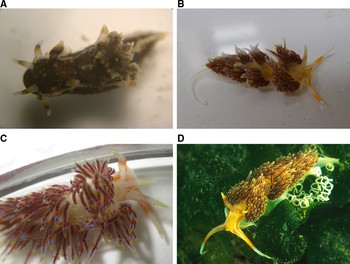
Polycera hedgpethi, specimen of 20 mm from Aghroud (Morocco, Atlantic) (A); Godiva quadricolor, specimen of 30 mm from Anza (Morocco, Atlantic) (B); specimen of 13 mm from the Bay of Algeciras (Strait of Gibraltar) (C); specimen of 35 mm from the Gulf of Naples (Italy, Mediterranean) (D).

MATERIAL EXAMINED
Aghroud, Morocco (Atlantic) (30°36′N 9°47′W): 19 October 2009, 9 specimens from 5 to 20 mm in length collected intertidally under stones by N. Tamsouri. The lower faces of these stones were covered by bryozoans, some small hydrozoans and some tunicates; the upper faces were covered by algae.
DESCRIPTION
The external morphology and colour pattern of our material (Figure 1A) match with those described/reported by: Marcus (Reference Marcus1964); Gosliner (Reference Gosliner1982, Reference Gosliner1987); McDonald (Reference McDonald1983); Cattaneo-Vietti et al. (Reference Cattaneo-Vietti, Chemello and Giannuzzi-Savelli1990, as Polycera [Palio] dubia, p. 109, plate 7, figure 2); Cervera et al. (Reference Cervera, García-Gómez, Toscano and García1991 [1988]); Wells & Bryce (Reference Wells and Bryce1993); Vallés et al. (Reference Vallés, Valdés and Ortea2000); Miller (Reference Miller2001), Caballer & Ortea (Reference Caballer and Ortea2002); Zenetos et al. (Reference Zenetos, Gofas, Russo and Templado2003); Rie (Reference Rie2004); Behrens & Hermosillo (Reference Behrens and Hermosillo2005); Trainito (Reference Trainito2005b); Cobb & Willan (Reference Cobb and Willan2006); Hermosillo et al. (Reference Hermosillo, Behrens and Ríos Jara2006); Koh (Reference Koh2006); Valdés et al. (Reference Valdés, Hamann, Behrens and DuPont2006); Wilson (Reference Wilson2006); Caballer (Reference Caballer2007); Debelius & Kuiter (Reference Debelius and Kuiter2007); and Coleman (Reference Coleman2008).
REMARKS
This species was originally described from the Californian coasts by Marcus (Reference Marcus1964), being a common species from California to Baja California and Panama (McDonald, Reference McDonald1983; Behrens & Hermosillo, Reference Behrens and Hermosillo2005; Hermosillo et al., Reference Hermosillo, Behrens and Ríos Jara2006). It is agreed that Polycera hedgpethi has been introduced probably by shipping in scattered regions of the world since it feeds on Bugula spp., which are among the more typical members of the fouling community attached on ship hulls (Willan & Coleman, Reference Willan and Coleman1984; Cervera et al., Reference Cervera, García-Gómez, Toscano and García1991 [1988]; Wells & Bryce, Reference Wells and Bryce1993; Zenetos et al., Reference Zenetos, Gofas, Russo and Templado2003; Cobb & Willan, Reference Cobb and Willan2006; Wilson, Reference Wilson2006; Caballer, Reference Caballer2007; Debelius & Kuiter, Reference Debelius and Kuiter2007). Bugula spp. grow on other submerged elements linked with shipping or port activities, like buoys and ropes, as well as being very abundant in environments highly eutrophized. Gosliner (personal communication) currently agrees with this view, although he early stated that Polycera hedgpethi could not be an introduced species in South Africa (Gosliner, Reference Gosliner1987). The Australian National Marine Pests Information System (NIMPIS) suggests that this native species from California is cryptogenic in the Caribbean, and introduced to South Africa, South-West Africa, the Mediterranean, Australia and New Zealand (NIMPIS, Reference Hewitt, Martin, Sliwa, McEnnulty, Murphy, Jones and Cooper2002). Wilson (Reference Wilson2006) gives an account of the current distribution of this species around Australia and discusses the spreading of this species through the different harbours of this country/continent.
Most of the records of this species are from Indo-Pacific localities, although this species has also been recorded from Atlantic and Mediterranean localities. Thus, Cervera et al. (Reference Cervera, García-Gómez, Toscano and García1991 [1988]) published the first Mediterranean record of this species on the basis of 7 specimens from an Italian coastal lagoon (Fusaro Lake, Gulf of Naples region). Moreover, Cattaneo-Vietti et al. (Reference Cattaneo-Vietti, Chemello and Giannuzzi-Savelli1990) attribute to Polycera (Palio) dubia (p. 109, plate 7, figure 2) one specimen of P. hedgpethi from Fusaro Lake. This misidentification was corrected by Bedulli et al. (Reference Bedulli, Catttaneo-Vietti, Chemello, Ghisotti, Giovine, Minelli, Ruffo and La Posta1995). Two more recent records of this species from the Mediterranean region are supplied by Poddubetskaia (Reference Poddubetskaia2003; French coasts) and Trainito (Reference Trainito2005b; Adriatic Sea). However, we cannot confirm the specific identity of the specimen of the photograph included in Trainito (Reference Trainito2005a; p. 43, figure 67). Thus, to date, P. hedgpethi is considered lacking a well-established population in the Mediterranean (Zenetos et al., Reference Zenetos, Çinar, Pancucci-Papadopoulou, Harmelin, Furnari, Andaloro, Bellou, Streftaris and Zibrowius2005a). Concerning the Atlantic Ocean, three records have been published during the 21st Century: Angola (Vallés et al., Reference Vallés, Valdés and Ortea2000; 3 specimens), northern Spain (Caballer & Ortea, Reference Caballer and Ortea2002; 5 specimens) and Costa Rica Atlantic coasts (Valdés et al., Reference Valdés, Hamann, Behrens and DuPont2006; no data about number of specimens). Our record is the highest, in number of collected specimens, among all non-Indo-Pacific records, suggesting that a possible settlement of a well established population of P. hedgpethi could be expected in the near future, if not yet, in north-eastern Atlantic/Mediterranean localities with relevant shipping activities or close to some of them.
MATERIAL EXAMINED
Bay of Algeciras (Strait of Gibraltar) (36°10′N 5°25′W): 27 October 2006, 1 specimen 13 mm long collected at 5 m depth on hydroids on the columns of the wharf of a power station by M.M. González-Duarte. Anza, Morocco (Atlantic) (30°26′N 9°38′W): 15 December 2008, 3 specimens from 30 to 40 mm in length; 6 October 2009, 5 specimens from 24 to 50 mm in length. Aghroud, Morocco (Atlantic) (30°36′N 9°47′W): 19 October 2009, 10 specimens from 15 to 25 mm in length. All the specimens collected from the Moroccan localities were collected intertidally under stones by N. Tamsouri. The lower sides of these stones were covered by bryozoans and some tunicates; the upper sides were covered by algae.
DESCRIPTION
The external appearance of our specimens (Figure 1B, C) matches with those described/reported by: Barnard (Reference Barnard1927); Macnae (Reference Macnae1954); Gosliner (Reference Gosliner1987); Willan (Reference Willan1987, Reference Willan2004); Wells & Bryce (Reference Wells and Bryce1993); Kieu (Reference Kieu2000), Trainito (2005a, as Facelina coronata); Cobb & Willan (Reference Cobb and Willan2006); Debelius & Kuiter (Reference Debelius and Kuiter2007); Zsilavecz (Reference Zsilavecz2007); and Coleman (Reference Coleman2008).
REMARKS
Godiva quadricolor was originally described from temperate coasts of South Africa (False Bay) by Barnard (Reference Barnard1927). Later, it has been recorded from other southern African and, even, southern Mozambique localities (Macnae, Reference Macnae1954; Gosliner, Reference Gosliner1987; Fraser, Reference Fraser2001). Godiva quadricolor has also been recorded from localities, out of its supposed natural geographical range, from many Indo-Pacific regions (southern Japan, the Mariana Islands, Singapore, the Philippines, Papua New Guinea, New Caledonia, northern and western Australia, Marshall Islands and Fiji), but never occurs naturally (Willan, Reference Willan2004). A detailed report about the human-assisted spread of this species is provided by Willan (Reference Willan2004). Nevertheless, this author also advises about the possibility that the locality from which a species was originally described is not necessarily the centre of its natural distribution (Willan, Reference Willan1976).
Edmunds (Reference Edmunds1977) provided the first and single published record of this species from the Atlantic, from one specimen collected on a boat hull in Ghana. Much more recently, Cervera (Reference Cervera2002) point out that a photograph of Godiva quadricolor included in Cattaneo-Vietti et al. (Reference Cattaneo-Vietti, Chemello and Giannuzzi-Savelli1990, plate 3, figure 4) of one specimen from an Italian coastal lagoon, the Fusaro Lake (Gulf of Naples, Mediterranean) is misidentified as Facelina coronata. This mistake is maintained by Trainito (Reference Trainito2005a, p. 84, figure 165) for another specimen from the same area. In fact, G. quadricolor is not included by Zenetos el al. (2003) and subsequent updates of the Atlas of the Exotic Molluscs from the Mediterranean, or in the ‘Checklist of the species of the Italian fauna’ (Bedulli et al., Reference Bedulli, Catttaneo-Vietti, Chemello, Ghisotti, Giovine, Minelli, Ruffo and La Posta1995) and subsequent updates (see Stoch, Reference Stoch2003). However, Willan (Reference Willan2004) notes and agrees with Cervera's remark. Moreover, the existence of a well-established and growing population of this species in different coastal lagoons of the Gulf of Naples region during the last 10–12 years has been confirmed by Villani (unpublished data) (Figure 1D). For this reason, the recently collected specimens from the Bay of Algeciras (Strait of Gibraltar) (Figure 1C), and the region of Agadir (Figure 1B) (present paper) support the view that the geographical range of G. quadricolor is widening through the establishment of populations in some areas of the Mediterranean or Atlantic regions close to the Strait of Gibraltar. Additionally, one specimen of this species has been recently found in a tank of an aquaculture company from Salobreña (Granada, southern Spain, Mediterranean) (Sánchez-Tocino, unpublished data). All the areas where the Mediterranean or Atlantic specimens have been recorded share a very high level of shipping or human activities and the Mediterranean coastal lagoons from which they have been recorded have a high level of euthophization due to a high human influence.
ACKNOWLEDGEMENTS
Thanks are due to Badiâa Iazza for her help during samplings, as well as to Manuel María González Duarte who provided the specimen and the photograph of Godiva quadricolor from the Bay of Algeciras and to Luis Sánchez Tocino for the data of this species from the coast of Granada. This paper has benefited from the Spanish projects CGL2006-05182/BOS (Spanish Ministry of Science and Innovation), PAIDI2005 RNM-369 (Department of Innovation, Science and Enterprise of the Andalousian Regional Government) and PCI 2007 A/8688/07 (Spanish Agency of International Cooperation and Development, AECID).