Probiotics are “preparations or products containing viable, defined microorganisms in sufficient numbers, which alter the microflora in a compartment of the host and by that exert health effects in this host” (Schrezenmeir & de Vrese, Reference Schrezenmeir and de Vrese2001) or, according to the FAO/WHO definition “live microorganisms, which when administered in adequate amounts confer a health benefit on the host” (FAO/WHO, 2001). Even if not specifically addressed in these definitions, the term probiotic nevertheless implies that positive health effects of probiotic bacteria are not only strain- and target-specific, but also may depend on the matrix. In one investigation, only very small effects of added fruit preparations on viability of probiotic bacteria has been shown in stirred yogurts during storage (35 days, 4°C; Kailasapathy et al. Reference Kailasapathy, Harmstorf and Phillips2008). There are, however, no studies investigating the question, to what extent proven probiotic health effects of probiotic foods, and here in particular yogurt-like fermented milk products, are sustained in fruit preparations and similar additives.
We therefore investigated if the probiotic effect is matrix-dependent, by examining whether a combination of two lactobacilli and bifidobacteria strains, which have a proven antidiarrheal efficacy in plain yogurt, can also reduce antibiotic-associated diarrhea (AAD) and further gastrointestinal complaints when administered in a fruit yogurt matrix. The strains used were Lactobacillus acidophilus LA-1 (LA-1®) and Bifidobacterium lactis BB-12 (Bb-12®, the taxonomic classification of this strain is under debate). These strains are also used in commercially available probiotic milk products on the market (Möller & de Vrese, Reference Möller and de Vrese2004).
The necessity of such an investigation arises from the fact that probiotic foods must not be advertised without appropriate scientific proof, preferably by a randomised, controlled, double-blind clinical study, administering the microorganism strains in that matrix which will be used subsequently for sale (Buttriss & Benelam, Reference Buttriss and Benelam2010).
A direct comparison of probiotic fruit- with probiotic plain yoghurt is not possible without breaching the principle of (double) blindness of the study. Therefore we had to limit ourselves to examining the hypothesis that the respective probiotic health effect is also possible within a fruit yoghurt matrix. Our concurrent assumption that the strength of the effect is comparable with that of LA5+BB12 in a plain yoghurt matrix, could only be substantiated in comparison with literature data in a semiquantitative way, without statistical confirmation.
Our study was done in Helicobacter pylori infected, but otherwise healthy, men. Hel. pylori is a pathogenic bacterium which colonizes the mucus layer of the human gastric mucosa. Its pathogenetic impact on gastritis, ulcera, the MALT lymphoma, and carcinoma of the stomach is well documented (Kandulski et al. Reference Kandulski, Selgrad and Malfertheiner2008). Eradication of Hel. pylori by antibiotic treatment is therefore justified for preventive reasons (Smoot & Hamilton, Reference Smoot and Hamilton1995; Malfertheiner et al. Reference Malfertheiner, Megraud, O'Morain, Hungin, Jones, Axon, Graham and Tytgat2002) and was used as a human model to investigate potential preventive or therapeutic effects of probiotic bacteria on AAD (Armuzzi et al. Reference Armuzzi, Cremonini, Bartolozzi, Canducci, Candelli, Ojetti, Cammarota, Anti, De Lorenzos, Pola, Gasbarrini and Gasbarrini2001; Szajewska et al. Reference Szajewska, Ruszczynski and Radzikowski2006; Safdat et al. 2008).
The underlying mechanisms may be related to the fact, that AAD is often caused by Clostridium difficile (Katz, Reference Katz2006). Whereas this microorganism is a quite common inhabitant of the healthy gut, disruption of the indigenous microflora by antibiotics can lead to an abnormal increase in C. difficile numbers accompanied by symptoms related to toxin production. Suggested mechanisms by which probiotic bacteria may reduce the incidence of AAD are restoration of the normal gastrointestinal microbiota, inhibition of gastrointestinal pathogens and stimulation of the immune system of the host (Winkler et al. Reference Winkler, Ghadimi, Schrezenmeir and Kraehenbuhl2007; de Vrese & Offick, Reference de Vrese, Offick, Watson and Preedy2010). Some recent in vitro and in vivo studies demonstrated, that besides probiotic bacteria, components of cow's milk itself may inhibit pathogenic bacteria of the gastrointestinal tract and their adhesion to the gastrointestinal mucosa (Clare et al. Reference Clare, Catignani and Swaisgood2003; de Vrese & Offick, Reference de Vrese, Offick, Watson and Preedy2010).
Materials and Methods
Subjects
After screening 1090 men and women by applying the 13C-urea breath test, 237 subjects (22%) were identified as Hel. pylori-positive. A subgroup of 88 Hel. pylori-positive volunteers, 43 men (47·6±1·7 years) and 45 women (43·6±1·5 years), who had given written informed consent, were enrolled in the study after a physical examination and after testing laboratory safety parameters.
Inclusion criteria were:
Detectable Helicobacter-activity (delta-over-baseline (D.O.B.)>5 in the 13C-urea breath test), age 18–65 years, written consent of the volunteers.
Exclusion criteria were:
Safety parameters outside the normal range, known congenital or acquired immune defects, chronic diseases and acute diseases requiring treatment, pregnancy or breast-feeding, interfering dietary habits, lactose intolerance, allergy against the medication for the eradication therapy, medication affecting the intestine or its microbiota, alcohol and/or drug abuse.
Diets and intervention groups
Because administation of fermented milk products with and without added fruit preparations in one and the same trial, would have eliminated double-blind condition, therefore only acidified milk products with fruits were administered in the three study groups. The experimental milk products were (n=subjects per group):
1. a fruit-yoghurt-like low-fat milk product fermented by the probiotic ABT-21 culture® and admixed with an apple/pear fruit preparation, corresponding to 13% fruit, 0·4% fibre and 10% sugar (the ABT-21 culture® consists of the strains Lb. acidophilus, LA-5®, Bifido. animalis, ssp. lactis, BB-12® and Streptococcus thermophilus, ⩾106 cfu/g each, provided by Christian Hansen, Nienburg, Germany) (n=30),
2. the same product, however, subsequently pasteurized (n=29),
3. chemically acidified and curded milk, in order to exclude any effect from living or dead probiotic or yogurt bacteria on the immune system (control; n=29). For this purpose, L(+)-lactic acid was added to low-fat milk to reduce the pH to 4·5. The product was then mixed with the same fruit preparation as the others.
All test and control products were manufactured, prepacked and numbered randomly by the Dairy Education and Research Centre Oranienburg, Germany in order to fulfill the criteria of double-blind coding. The products were delivered biweekly to the Federal Dairy Research Centre, Kiel and stored at 4–6°C until distribution to the study participants. Bacterial counts in the verum products were measured in randomly collected samples and were found to drop from 8×10⁶ to 5×10⁵ per ml within 14 days.
Study protocol
The study followed a randomized, controlled, double-blind design with 3 parallel intervention groups. The protocol was approved by the ethical committee of the medical faculty of the Christian-Albrecht-University, Kiel, Germany.
After random assignment to one of the 3 dietary groups the volunteers consumed 2×125 g/day of the respective experimental milk product during the 5 weeks intervention period. Volunteers were asked to maintain their usual eating habits during the study. However, consumption of pre- or probiotic products as well as fresh or heat-treated fermented food with the exception of the experimental milk products was not allowed.
During week five (day 29 to 35) Helicobacter infection was treated by daily administration of two antibiotics (500 mg Clarithromycin, Clacid™, Abbot, Wiesbaden, Germany and 1 g Amoxicillin, Amoxypen™, Ratiopharm, Ulm, Germany) plus the proton pump inhibitor Omeprazol (20 mg Antra 20™, Astra, Wedel, Germany). The test products and Omeprazol were to be ingested during lunch time, the antibiotics in the morning and evening.
Blood samples for hemograms were collected at the beginning and end of the study.
13C-urea breath test
At inclusion in the study, immediately before and after the eradication therapy and at the end of the trial Hel. pylori activity was assessed with the aid of 13C-urea breath tests in overnight fasted subjects (Perri et al. Reference Perri, Clemente, Pastore, Quitadamo, Festa, Bisceglia, Li Bergoli, Lauriola, Leandro, Ghoos, Rutgeerts and Andriulli1998). For this purpose a first breath sample was taken immediately before the ingestion of 150 ml orange juice containing 75 mg 13C-urea. A second sample was obtained 30 min after ingestion of this tracer test drink. 13CO2 was measured by infrared spectroscopy using a Fanci® spectrometer (Fischer Analysen, Leipzig, Germany). Treatment effect was calculated by subtracting baseline values from the 30-min values. An excess Δ 13CO2 of >5% was defined as a positive signal, i.e. to indicate a Helicobacter infection.
Questionnaires
The participants were asked weekly to fill out questionnaires about their gastrointestinal symptoms during the past week at the following time points: day 1, indicating symptoms present before intervention, day 28, representing the dietary intervention, day 35, representing the period of eradication, and on day 56, representing the recovery period after eradication therapy. The questionnaire used was based on a score (Cook et al. Reference Cook, Irvine, Campbell, Shannon, Reddy and Collins1990), which was used and evaluated in several of our studies (de Vrese et al. Reference de Vrese, Rautenberg, Laue, Koopmans, Herremans and Schrezenmeir2005) and found to be a sensitive measure for assessing gastrointestinal discomfort. It contained questions about the frequency, intensity and duration of abdominal pain, about stool frequency and consistency, and the occurrence or absence of one or more other symptoms associated with the Irritable bowel syndrome (flatulence, belching, passing of gas, nausea, heartburn, passage of mucus with stool, feeling of incomplete emptying, excessive straining to move bowels and sensation of incomplete evacuation).
Each item was quantified on a scale of 0 to 6. In the case of stool frequency and stool consistency, where deviations on both sides of the “normal situation” could be expected, 0 means “once a day, well-shaped stools”, whereas 6 indicates maximal deviation from normality either in the direction of constipation or diarrhoea. Beside these items a “pain score” and a “total symptom score” were calculated by addition of the three pain scores without or plus the “other symptom” score.
The WHO defines diarrhoea as three or more watery stools on two or more consecutive days. In the present study, however, shorter episodes (one day) were considered and counted, too, because the results of a recentlty finished study with other products and microorganisms, but with the same Triple Therapy model had shown us that this therapy is well tolerated and that the frequency of “true” diarrheas is low. The duration of diarrhea episodes was taken from the questionnaires. Thereby all episodes were considered, where at least one day lay within the eradication week.
Orofecal transit times
To measure orofecal transit times the volunteers ingested 20 radioopaque transit markers/d each (Radiopaque Marker, P & A Mauch, Münchenstein, Schweiz) in the morning of six consecutive days. The shape of the markers varied from day to day. From the number of each of the different markers in the X-ray picture of the first stool collected on day 7, the orofecal transit time was calculated according to:

where sn=Number of markers from day n found in the stool; tn=time between defecation and ingestion of the respective markers; (Cummings & Wiggins, Reference Cummings and Wiggins1976).
Analysis of the stool microbiota
Stool samples (3–5 g) were collected in small tubes (Sarstedt, Nümbrecht, Germany) and stored at 4–8°C until flora was analysed — at the latest within one day.
The following culture media were used: RCM agar plus 0·02 g polymyxin B/l, pH 5·9 (Bifidobacteria); Columbia agar plus 5% sheep blood and CLED agar (Escherichia coli and aerobic bacteria); Phenyl-ethyl-alcohol blood agar, Wilkins-Chalgren agar and Wilkins-Chalgren agar plus Tween80 and N-S (or G-N)-anaerobic-selective supplement (Clostridia, Bacteroides, other anaerobic bacteria). All media were from Oxoid, Wesel, Germany.
Appropriate dilutions of the stool homogenates were added to the respective selective media and incubated at 37°C for 72 h (Bifidobacteria), 48°C for 96 h (anaerobes) or 24°C for 48 h (aerobes); if nessessary using protective systems (Anaerocult A, Merck, Darmstadt, Germany, Anaerojars, Oxoid, Wesel, Germany and the Gaspak (H2/CO2) system (BD, Germany).
Bifidobacteria were identified according to colony morphology. Bacteria which did not grow under aerobic conditions and less than 5% CO2 were considered as anaerobes and differentiated according to their gram-characteristic on Wilkins-Chalgren agar after pre-differentiation using kanamycin, colistin and vancomycin. Aerobes were identified biochemically (indole, cytochrome oxidase, lysine decarboxylase and ornithine decarboxylase) and according to colony morphology and gram-characteristic.
Statistics
The (required) minimum number of 28 participants per group was calculated according to the following data, which were based on two previously carried out pilot studies (de Vrese & Schrezenmeir Reference de Vrese and Schrezenmeir2002): diarrhea frequency without or with probiotics is 25% (corresponds here to 100%) and 6% respectively; alpha=0·05, beta=0·10. The thus calculated group size (n=14) was doubled to account for multiple testing. Due to the skewed, not normal distribution of the parameters investigated, the effects of the various milk products on gastrointestinal complaints were analyzed by Kruskal-Wallis tests, followed by multiple comparisons by unpaired Mann-Whitney-tests by ranks, whereas starting and endpoints of each intervention period were compared by Wilcoxons paired test by ranks (P<0·05). The frequency of antibiotic-induced diarrhoea was analysed by one-sided chi-square analysis. Where the available literature indicates that probiotic bacteria and particularly the strains LA-5 and BB-12, have a positive effect on gastrointestinal symptoms, if there is any effect at all, single-sided statistical tests were chosen. Statistical analysis was performed using the software package “Statgraphics Plus for Windows” (version 4.5, Manugistics, 20852 Rockville, USA).
Results
Of the 237 Hel. pylori-positive subjects, 149 were not admitted to the study because of one or several exclusion criteria, or they declined for personal reasons, mostly because of their time schedule. None of the 88 subjects who were finally included in the study dropped out.
Therapeutic outcome
Antibiotic treatment completely eradicated Hel. pylori in all subjects irrespective of the treatment group as shown by 13C-urea breath tests, and only six subjects out of 88 (7%) showed a recurrence of Hel. pylori three weeks after eradication therapy.
Antibiotic-induced diarrhoea
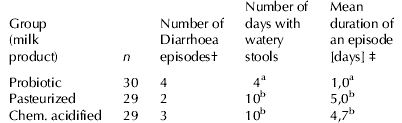
The number of days with watery stools and the mean duration but not the frequency of episodes including shorter ones (one day), were significantly (P<0·05, Kruskal-Wallis tests) lower in subjects receiving the probiotic product compared with the groups receiving the subsequently pasteurized or the chemically acidified milk product (Table 1). The frequency of diarrhoea did not differ significantly between the groups.
The effect of acidified milk products with or without living LA-5 and BB-12 on the frequency and duration of antibiotic-induced diarrhoea during eradication of Hel. pylori by antibiotic treatment
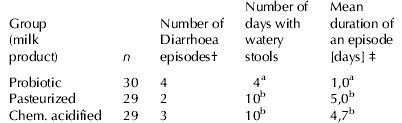
† Three or more watery stools per day, at least day one lay within the eradication week
‡ Number of days with watery stools/number of diarrhoea episodes
a,b Different superscripts denote significant differences between groups (P<0·05, Kruskal-Wallis tests, followed by multiple comparisons by unpaired Mann-Whitney-tests by ranks)
Orofaecal transit times
Orofaecal transit times did not differ between treatment groups. They were, however, significantly decreased by antibiotic treatment from 51·2±4·4 to 42·4±3·9 h (mean of all groups, P <0·05).
Gastrointestinal symptoms
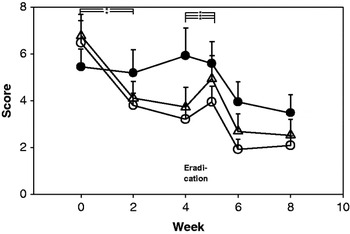
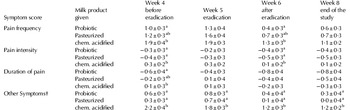
Before Hel. pylori eradication, both fermented products, but not the chemically acidified milk, reduced the gastrointestinal total symptom score (Fig. 1), the intensity and duration of pain and the so-called other symptoms score (Table 2). During antibiotic treatment weaker complaints (duration and intensity of pain, other symptoms; Table 2) and lower total symptom score values (Fig. 1) were observed in the groups to which milk fermented with LA-5 and BB-12 or the subsequently pasteurized product were given, although there was no relevant increase of the total symptom score in the control group because of higher score values before eradication (Fig. 1). These improvements were generally more pronounced in subjects receiving the probiotic milk product compared with those receiving the subsequently pasteurized product, the differences, however, were not significant.
Bacterial counting
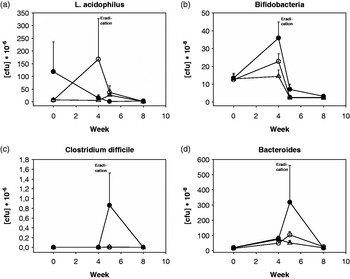
Administration of LA-5®and BB-12® was associated with an increase in faecal Lb. acidophilus and bifidobacteria counts during the first 4 weeks before eradication and with a suppressed increase in bacteroides and C. difficile counts observed during antibiotic treatment. Bifidobacteria counts also increased in the group receiving the chemically acidified milk (Figure 2a–d).
Hel. pylori activity
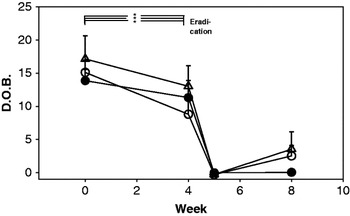
In all 3 groups the acidified milk product significantly reduced the Hel. pylori activity (which was determined by the urea-breath test) without significant differences between groups (Fig. 3).
Discussion
The observed Hel. pylori prevalence of 22% in the population segment examined corresponds well with the 25% reported for German adults (Bode et al. Reference Bode, Rothenbacher and Brenner2001). No subject dropped out of therapy due to side effects, and Hel. pylori was successfully eradicated in 93% of the subjects. Due to the high efficacy of the triple therapy, which therefore is regarded as the golden standard, a probiotic effect on the efficacy of therapy had not been expected and, indeed, was not observed (Malfertheiner et al. Reference Malfertheiner, Megraud, O'Morain, Hungin, Jones, Axon, Graham and Tytgat2002; Kim et al. Reference Kim, Kim, Lee, Park, Hwang, Kim, Jeong, Lee, Kim, Jung and Song2008). This is in accordance with studies of Felley et al. (Reference Felley, Corthesy-Theulaz, Rivero, Sipponen, Kaufmann, Bauerfeind, Wiesel, Brassart, Pfeiffer, Blum and Michetti2001), who demonstrated that fermented milk containing Lb. acidophilus LA1, although it improved Hel. pylori gastritis in men, had no effect on the efficacy of clarithromycin on Hel. pylori eradication.
Time course of the gastrointestinal total symptoms scores. Throughout a dietary intervention period of 56 days participants ingested one of the following milk products: ○ the LA-5 and BB-12 containing fermented milk, ▵ the fermented and then pasteurized product, ● chemically acidified milk. Asterisks indicate significant changes during intervention within the respective group (P<0·05; paired t-tests).

Fecal bacteria concentrations on day 0, 28, 35 and 56 of the study. Over a dietary intervention period of 56 days participants ingested one of the following milk products: ○ LA-5 and BB-12 containing fermented milk, ▵ the fermented and then pasteurized product, ● chemically acidified milk.

The effects of eradication therapy and milk products with or without living bacteria on H. pylori activity assessed by 13C-urea breath tests. ○ the LA-5 and BB-12 containing fermented milk, ▵ the fermented and then pasteurized product, ● chemically acidified milk. Asterisks indicate significant changes during intervention within the respective group (P<0·05).

Alterations in the gastrointestinal complaints scores during intervention (day 0 to day 56)

† “Other symptoms” means flatulence, belching, passing of gas, nausea, heartburn, passage of mucus with stool, feeling of incomplete emptying, excessive straining to move bowels, sensation of incomplete evacuation
a,b The superscripted letters denote significant differences between the diet groups within one symptom for the same period (P<0·05, Kruskal-Wallis tests, followed by multiple comparisons by unpaired Mann-Whitney-tests by ranks)
The main result of the present study is the favourable effects of the ingestion of living probiotic bacteria in a fruit yogurt matrix on antibiotic induced diarrhoea.
However, in the present investigation the triple therapy was tolerated very well and therefore the number of subjects suffering from diarrhoea turned out to be too low for a statistical evaluation of preventive effects and thus no significant reduction in the incidence of diarrhea by LA-5 and BB-12 was observed. The number of days with watery stools, however, was 60% lower (P<0·05) and accordingly the median duration of a diarrhoea episode was 75% shorter, compared with the chemically acidified unfermented milk product, in subjects receiving living LA-5 and BB-12 but not in those receiving the subsequently pasteurized product.
These findings agree with previously published results of randomized controlled trials with subject numbers between 10 and 388, where administration of probiotics reduced incidence, severity and duration of antibiotics-associated diarrhoea by 50 to 75% (McFarland, Reference McFarland2006; Szajewska et al. Reference Szajewska, Ruszczynski and Radzikowski2006).
These effects seem primarily induced by the beneficial modulation or rather stabilization of the balance of the intestinal flora, by suppressing an excessive increase of C. difficile and a stimulation of body defence mechanisms through live probiotic bacteria, as they were not observed if the fermented-and-then-pasteurised milk product was given. An immediate influence on gut motility can not be a relevant cause, as the orofaecal transit times were not different between groups, and reasons other than an accelerated transit time have to be considered: such as the changed mucosal secretions induced by some gut bacteria.
Frequency, duration and severity of abdominal pain, flatulence, passing of gas, nausea and passage of mucus with stool, which were observed during or already before antibiotic treatment, were significantly reduced in the LA-5 plus BB-12 group as well as—although less pronounced—in the group which had received the pasteurized product. Therefore these effects could not result exclusively from the direct influence of viable probiotic bacteria on the (disturbed) intestinal flora or gastrointestinal functions, respectively. They may also result from specific antimicrobial substances and fermentation products in the fermented milk (Midolo et al. Reference Midolo, Lambert, Hull, Luo and Grayson1995; Aiba et al. Reference Aiba, Suzuki, Kabir, Takagi and Koga1998; Kim et al. Reference Kim, Hur, Yu, Cheigh, Kim, Hwang and Pyun2003; Sgouras et al. Reference Sgouras, Maragkoudakis, Petraki, Martinez-Gonzalez, Eriotou, Michopoulos, Kalantzopoulos, Tsakalidou and Mentis2004), as well as from components of dead bacteria. Particularly bacterial DNA (Ghadimi et al. Reference Ghadimi, Fölster-Holst, de Vrese, Winkler, Heller and Schrezenmeir2008) and components of the bacterial cell membrane show well-proven immunomodulatory properties and a strenghtening of the mucosal barrier function (Kabir et al. Reference Kabir, Aiba, Takagi, Kamiya, Miwa and Koga1997; Gotteland et al. Reference Gotteland, Cruchet and Verbeke2001; von Der et al. Reference von Der, Bulliard and Schiffrin2001; Winkler et al. Reference Winkler, Ghadimi, Schrezenmeir and Kraehenbuhl2007).
Moreover, plain unfermented milk itself may inhibit growth of intestinal pathogens or their adhesion to the gastric mucosa, because it is a rich source of immunomodulatory and/or directly antimicrobially active low molecular compounds (phospholipids, short- and medium-chain fatty acids and peptides (Sun et al. Reference Sun, O'Connor and Roberton2003, Clare et al. Reference Clare, Catignani and Swaisgood2003)). It also contains antiadhesive glycoproteins, immunoglobulins, lactoferrin or a cysteine-rich whey protein fraction for glutathione restitution (Hirmo et al. Reference Hirmo, Kelm, Iwersen, Hotta, Goso, Ishihara, Suguri, Morita, Wadstrom and Schauer1998; Dial et al. 1998; Early et al. Reference Early, Hardy, Forde and Kane2001; Bounous & Molson, Reference Bounous and Molson2003; Shin et al. Reference Shin, Yamauchi, Teraguchi, Hayasawa and Imoto2002).
Antimicrobial milk compounds and particularly lactic acid may also be the reason for the decrease in Hel. pylori activity in the stomach which was observed not only after administration of viable or heat-killed probiotics but also after the chemically acidified milk product. However, as all three test products were milk-based, it was not possible to determine the effect of these milk components, although they did possibly somewhat blur the differences between intervention groups. Despite this weakness, the result is noteworthy as in other studies, where a probiotic (dairy) product reduced Hel. pylori activity, these effects were attributed to the added probiotic bacteria, but not to the dairy product itself (Sachdeva & Nagpal, Reference Sachdeva and Nagpal2009; Kato-Moti et al. Reference Kato-Mori, Orihashi, Kanai, Sato, Sera and Hagiwara2010; Bekar et al. Reference Bekar, Yilmaz and Gulten2011; Lin et al. Reference Lin, Wu, Fang, Guo, Huang, Lee and Yang2011).
Administration of viable BB-12 and LA-5 increased faecal excretion of bifidobacteria and Lb. acidophilus during the first four weeks of the study and suppressed antibiotics treatment-associated increase in C. difficile counts in week five. This was not observed in the group consuming the pasteurized product. These effects as well as the positive effects on diarrhoea and other gastrointestinal complaints have been observed, although the concentration of LA-5 and BB-12 in the product fell below 10−6 cfu/g. This value corresponds to a daily intake lower than the frequently recommended minimum dose of 108 cfu/day and demonstrates that ingestion of relative small amounts of effective probiotic bacteria may also exert beneficial health effects, and a general minimum intake for probiotic bacteria cannot be given.
All in all the present study shows that fermented milk products with added fruits are suitable matrices for probiotic bacteria, which can shorten the duration of antibiotics-associated diarrhoea and can alleviate accompanying gastrointestinal symptoms as well as gastrointestinal complaints which occasionally occur independently of an antibiotics-therapy. A direct comparison with corresponding plain fermented milk in the sense of an equivalence or a superiority study is not possible, because no plain yogurt group had been introduced in the study for reasons mentioned above, and the number of subjects per group was well under the requirements for an equivalence study. However, comparable studies, in which the strains LA1 and BB12 were supplied in a plain yogurt matrix or as dried bacteria preparations, showed an improvement of gastrointestinal symptoms to the same extent (Nord et al. Reference Nord, Lidbeck, Orrhange and Sjostedt1997; Wang et al. Reference Wang, Li, Liu, Perng, Su, Wu, Jan, Lai, Wang and Wang2004; Wenus et al. Reference Wenus, Goll, Loken, Biong, Halvorsen and Florholmen2008).
Despite this weakness, our study was the first one which tested a probiotic in that matrix which will be used later on for sale/advertisement. The necessity of such a proof becomes evident not only in numerous discussions and catalogues of requirements which accompanied the introduction of the so-called “Health Claim regulations” in Europe (Buttriss & Benelam, Reference Buttriss and Benelam2010) but also the installation of a new working group on “plasticity of a given probiotic strain in different food forms” (IDF, 2010).
The study was supported by Chr. Hansen GmbH, Nienburg, Germany, J. Bauer GmbH & Co. KG, Wasserburg/Inn, Germany, Privat-Molkerei Borgmann GmbH & Co. KG, Coesfeld, Germany, NÖM AG, Molkerei, Baden bei Wien, Austria, Molkerei H. Strothmann GmbH, Gütersloh, Germany. We thank the staff of the Department of Physiology and Biochemistry of Nutrition for their excellent technical assistance.